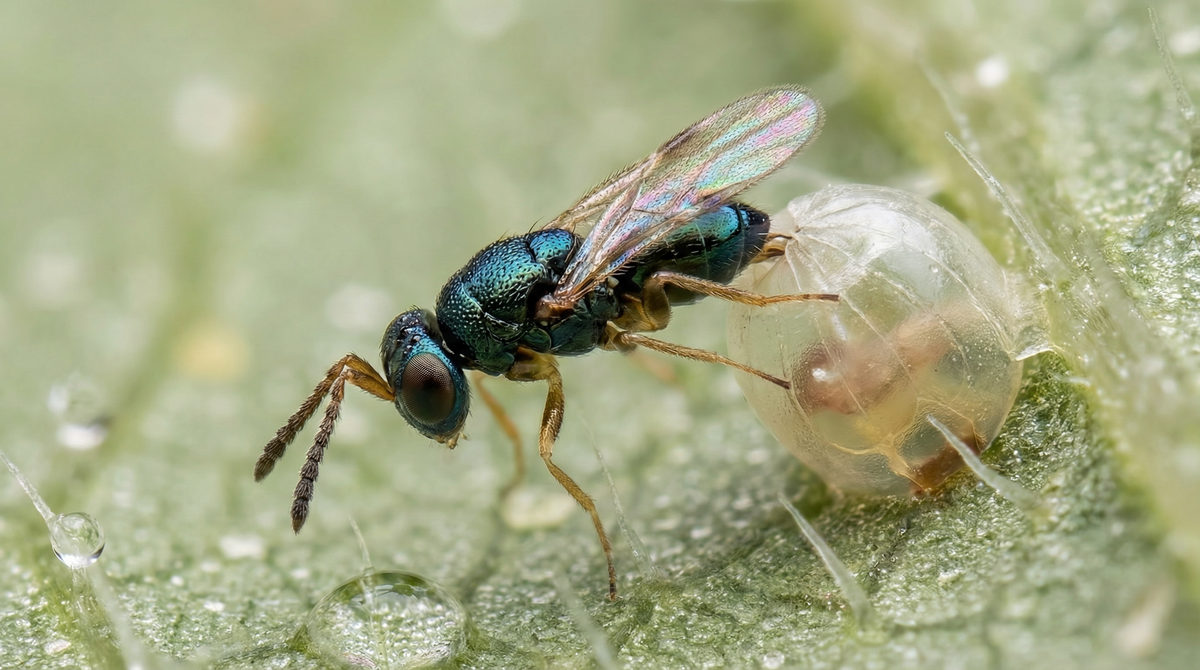
Trichogramma wasps (Trichogramma spp.) are among the smallest insects on Earth and among the most valuable to a gardener — microscopic parasitic wasps that destroy pest caterpillars before they ever hatch. Rather than attacking the caterpillar, a female Trichogramma lays her own egg inside the egg of a moth or butterfly, and her larva devours the pest embryo from within. Because they stop pests at the egg stage, and because so many destructive garden pests are moth and butterfly larvae, Trichogramma are one of the most widely used biological control agents in the world. With a beneficial rating of 5 out of 5, they are a powerful, invisible ally.
Identification and Description
Trichogramma wasps are almost impossibly tiny — often just 0.2 to 0.5 millimeter long, smaller than the period at the end of this sentence — which makes them essentially invisible to the naked eye and impossible to identify individually in the garden without magnification. Under a microscope they are stout, short-bodied wasps with characteristic fringed wings and often reddish eyes. Gardeners never really "see" Trichogramma at work; instead, the sign of their activity is host eggs that have turned black. A moth or butterfly egg is normally pale; once a Trichogramma larva has consumed the contents, the egg darkens to black as the wasp pupates inside — a small but telling clue that these beneficials are present and working.
Life Cycle
The Trichogramma life cycle is extraordinarily fast and entirely tied to its host's eggs. The female locates the egg of a host insect — typically a moth or butterfly — and lays one or more of her own eggs inside it. The wasp larva hatches and consumes the host egg from within, killing the developing pest before it can become a leaf-eating caterpillar. The larva then pupates inside the blackened host egg, and after just 7 to 14 days the adult wasp chews its way out to seek more host eggs. This rapid cycle allows up to 30 generations in a single season, letting populations track and suppress pest outbreaks with remarkable speed. Trichogramma overwinter as mature larvae or pupae within the eggs of their hosts, emerging to resume their work when hosts become available in spring (activity peaks roughly May through September).
Habitat and Range
Trichogramma wasps occur worldwide, including throughout North America and across the entire United States — Northeast, Southeast, Midwest, Southwest, West, and Pacific Northwest. They are found in gardens, meadows, forests, agricultural fields, and even aquatic habitats (some species parasitize the eggs of aquatic insects). Wherever host moth and butterfly eggs and nectar sources are present, Trichogramma can establish, making a diverse, flower-rich garden ideal habitat.
Role in the Garden
Trichogramma wasps are supremely beneficial, earning the top rating of 5, because they intercept pests at the egg stage — before any feeding damage occurs. They parasitize the eggs of a wide range of destructive caterpillar pests, including corn earworm, European corn borer, cabbage loopers and other cabbage worms, armyworms, cutworms, tomato hornworms, codling moth, and many more. By killing the eggs, they prevent the caterpillars from ever hatching to chew leaves, bore into fruit, or tunnel through stems. They are completely harmless to people, plants, pets, and other beneficial insects, and they are so effective that they are mass-reared and sold commercially for release in gardens, orchards, and farms — one of the most successful examples of applied biological control anywhere.
Attracting and Supporting Trichogramma Wasps
Because Trichogramma are wholly beneficial, the goal is to attract, retain, and augment them. As with other tiny parasitic wasps, adults need nectar from small, shallow flowers they can access — plants in the carrot family (Apiaceae) such as dill, fennel, and carrots (left to flower), along with yarrow and valerian, are especially good, and a diverse, continuously blooming garden keeps adults fed and present. Crucially, avoid broad-spectrum insecticides, which kill these delicate wasps instantly and eliminate the natural control they provide. For active pest outbreaks — or to establish them early in the season — commercially available Trichogramma can be purchased (typically as parasitized eggs on cards) and released near affected crops, timed to coincide with pest egg-laying for best results. Combining releases with nectar plantings and a pesticide-free garden gives the wasps the best chance to establish a lasting, self-sustaining presence.
An Invisible Guardian
Trichogramma wasps do their work unseen, destroying pest eggs before a single leaf is chewed. Plant dill, fennel, yarrow, and other small-flowered nectar sources, keep the garden free of broad-spectrum sprays, and release commercial wasps to knock down caterpillar outbreaks — and these microscopic guardians will quietly patrol your garden, stopping many of its most damaging pests at the very start of their lives.