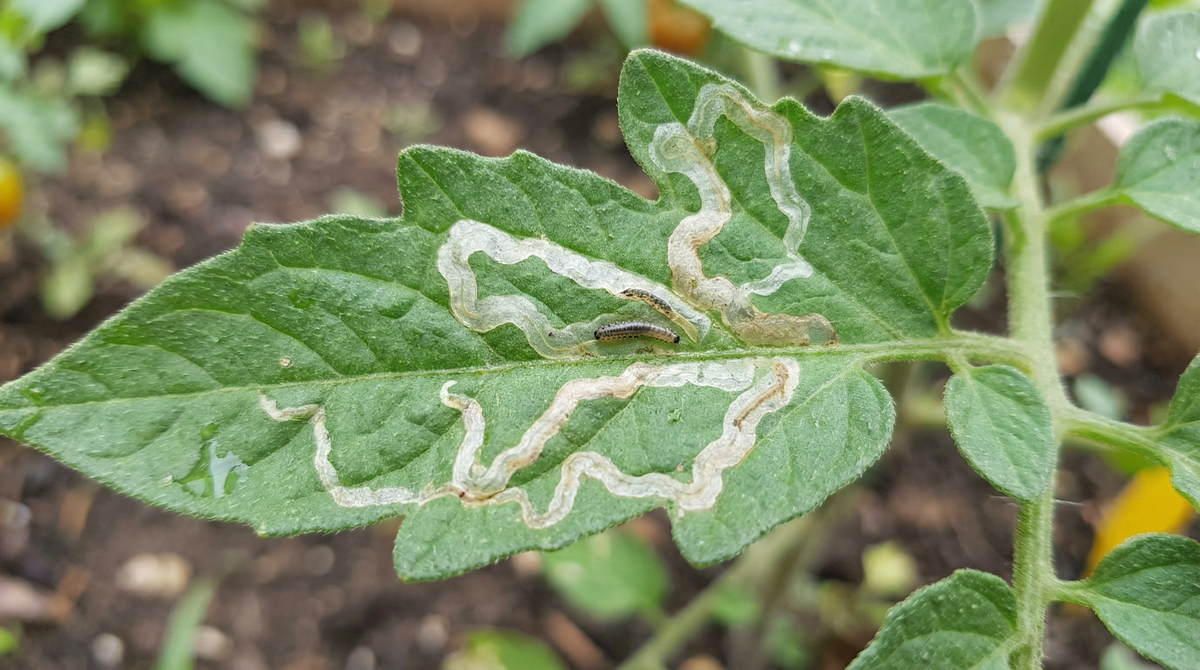
The vegetable leafminer (Liriomyza sativae) is a small fly whose larvae tunnel through the interior of leaves, leaving the winding, pale trails that give leafminers their name. A member of the family Agromyzidae, it is a significant pest of vegetable crops in warm regions, attacking a broad range of garden plants and reproducing so quickly in heat that populations can build with startling speed. Because the larvae feed safely between the leaf surfaces, this pest is difficult to reach with sprays, making prevention and biological control especially important. With a beneficial rating of −4, the vegetable leafminer is a pest worth watching closely wherever it is active.
Identification and Description
The adult vegetable leafminer is a tiny fly, roughly 1.5 to 2 millimeters long, mostly black with distinctive bright yellow markings on the head, sides, and a yellow spot on the back. The damage is far more noticeable than the fly: the larvae create narrow, winding, serpentine mines that meander across the leaf, starting thin and widening as the maggot grows, and appearing as pale or whitish squiggly lines against the green leaf. Holding a mined leaf to the light often reveals the small larva within its tunnel. The larva itself is a minute, legless maggot, colorless at first, then greenish and finally yellowish as it matures. Adult females also produce small feeding and egg-laying punctures that show as pale stipple marks on the leaf.
Life Cycle
The vegetable leafminer develops with remarkable speed in warm weather — the entire cycle from egg to adult takes only about 15 days at 30°C (86°F), stretching to about 25 days at cooler 15°C (59°F). Females insert their white, elliptical eggs into the leaf tissue, and these hatch in about 3 days. The larvae mine the leaf through three active instars over 7 to 9 days in warm conditions. The mature larva then cuts a slit in the leaf, emerges, and drops to the soil to pupate in a reddish-brown puparium, which lasts about 7 to 9 days. Adults emerge in the early morning and live about a month. In warm climates the vegetable leafminer breeds continuously, producing many overlapping generations per year, and it cannot survive cold winters except in the protected environment of a greenhouse — a key limitation on its range.
Habitat and Range
Native to the New World (Western Hemisphere), the vegetable leafminer is most damaging in the warm Southeast, Southwest, and West, and persists year-round in greenhouses elsewhere. It occurs in gardens and agricultural fields, attacking a very broad host range across several plant families — Cucurbitaceae, Leguminosae, and Solanaceae especially — including bean, pea, eggplant, pepper, potato, tomato, squash, cucumber, watermelon, beet, lettuce, and onion, along with weeds such as nightshade and Spanish needles that sustain populations between crops.
Role in the Garden
The vegetable leafminer is a significant pest rated −4. The larval mines destroy photosynthetic tissue, and heavy mining can reduce a plant's vigor and yield, cause premature leaf drop, and — on leafy crops like lettuce grown for their foliage — render the leaves unmarketable. The egg-laying and feeding punctures of adults add further stippling damage and can serve as entry points for disease. Seedlings and young plants are especially vulnerable, and because the pest breeds continuously in warm weather and is shielded inside the leaf, infestations can escalate rapidly if not caught early. A particular concern is that broad-spectrum insecticides often make leafminer problems worse by killing the natural enemies that normally keep them in check.
Managing the Vegetable Leafminer
Because the larvae feed protected within the leaf, control emphasizes prevention and biological control over spraying. Biological control is the cornerstone: numerous tiny parasitic wasps attack leafminers — including Diglyphus isaea, Chrysonotomyia punctiventris, Halticoptera circulus, Ganaspidium hunteri, and Opius dimidiatus — and protecting these natural enemies (by avoiding broad-spectrum sprays) often provides excellent, self-sustaining control. Row covers placed over crops physically exclude the egg-laying adult flies, an effective preventive measure for susceptible plantings. Removing and destroying infested leaves at the first sign of mines eliminates larvae before they mature and reduces the next generation. Yellow sticky traps monitor and trap adult flies and signal when populations are rising. Among sprays, Spinosad and neem oil have some translaminar (leaf-penetrating) action that can reach larvae within the mine and are the better organic options; time them to adult activity and use sparingly to spare the parasitic wasps.
Companion Planting
Planting French marigolds may help deter leafminers, and — most valuably — growing a diversity of small-flowered nectar plants attracts and sustains the parasitic wasps that are the vegetable leafminer's most important natural enemies. Supporting those beneficials is the single best long-term companion-planting strategy against this pest.
Letting Natural Enemies Lead
The vegetable leafminer breeds fast and hides inside the leaf, so the smartest approach is to lean on its natural enemies. Cover susceptible crops, pick off and destroy mined leaves, monitor with sticky traps, use Spinosad or neem judiciously, and above all protect the parasitic wasps by keeping broad-spectrum sprays out of the garden — and those tiny allies will usually keep this tunneling fly from getting the upper hand.