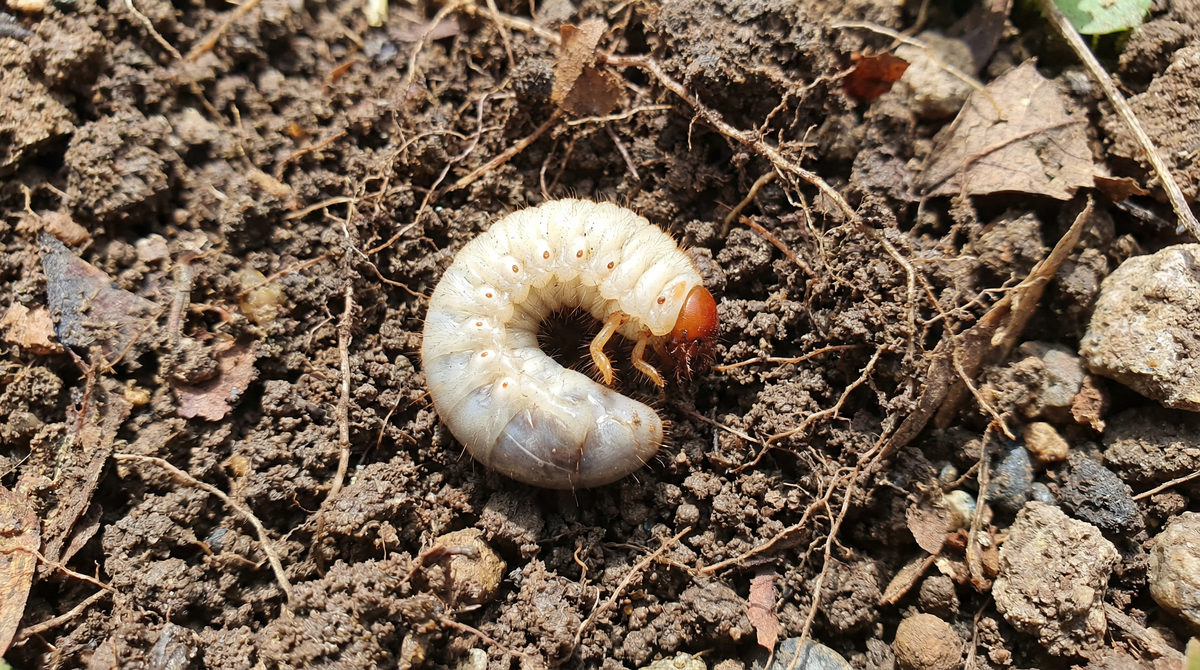
White grubs are the fat, C-shaped larvae of scarab beetles — including the May and June beetles (Phyllophaga spp.), Japanese beetles, and their relatives — that live in the soil and feed on plant roots. Hidden beneath the surface, they chew through the roots of lawns, vegetables, and ornamentals, causing plants and turf to wilt, yellow, and die from below. Because the damage is underground and the grubs are rarely seen until the soil is turned, white grubs are often diagnosed only after harm is done. With a beneficial rating of −5, they are a serious pest, and their soil-bound life cycle makes prevention and biological control the most effective response.
Identification and Description
White grubs are unmistakable once unearthed: soft, plump, C-shaped larvae, white to grayish with a distinct reddish-brown head capsule and three pairs of small legs near the front, curling into a characteristic "C" when disturbed. Depending on species they grow up to about 40 millimeters long. The adults are scarab beetles — the familiar brown, nocturnal May/June beetles that clatter against windows and lights in early summer, and the metallic green-and-copper Japanese beetle, among others. Above-ground signs of a grub infestation include patches of grass or plants that wilt, yellow, and die despite adequate water, and turf that lifts up easily like a loose carpet because the roots have been severed. Increased digging by birds, skunks, and raccoons hunting the grubs is another telltale clue.
Life Cycle
Most white grubs follow a one-year life cycle (some larger Phyllophaga take two or three). Adult beetles emerge from the soil from late spring to midsummer (roughly May to July) to mate and feed. Females then burrow a few inches down to lay 60 to 75 eggs, which hatch into small grubs in about two to three weeks. The grubs feed voraciously on roots through summer and early fall, molting twice as they grow; the third larval stage is the most damaging and lasts about nine months. As temperatures drop, the mature grubs burrow deeper into the soil to overwinter, then move back up to feed briefly in spring before pupating and emerging as the next generation of adults. This means the heaviest root damage occurs in late summer and again in spring, and the grubs are most vulnerable to treatment while they are young and feeding near the surface.
Habitat and Range
White grubs are native to North America and found across the entire United States — Northeast, Southeast, Midwest, Southwest, West, and Pacific Northwest. They live in gardens, lawns, turfgrass, agricultural fields, and meadows — anywhere with soil and roots to feed on. Grass and turf roots are prime targets, but they also attack the roots of ornamental plants, potatoes, strawberries, raspberries, and lettuce, while the adult beetles feed above ground on the foliage of many deciduous trees and shrubs. Well-watered lawns and beds are especially attractive to egg-laying females.
Role in the Garden
White grubs are a serious pest rated −5. By feeding on roots below the soil, they cut off a plant's ability to take up water and nutrients, causing wilting, yellowing, stunting, and death — and they are notorious for destroying lawns, leaving dead patches of turf that peel away from the loosened soil. In the vegetable garden and berry patch they damage roots and tubers directly. Compounding the problem, the adult beetles (particularly Japanese beetles) then feed on foliage and flowers above ground, so the same insect damages the garden at two life stages. Because the grubs are shielded in the soil, they are difficult to reach and best managed before populations build.
Managing White Grubs
Control emphasizes biological agents and cultural methods that reach grubs in the soil. Beneficial nematodes — microscopic roundworms such as Heterorhabditis bacteriophora and Steinernema feltiae — are a highly effective, safe biological control: watered into moist soil, they seek out grubs, penetrate them, and release bacteria that kill the host, working best when the grubs are young and near the surface. Milky spore (Paenibacillus popilliae) is a bacterium specific to Japanese beetle grubs that, once established (in soil above about 65°F), can provide long-term control as infected grubs die and spread the spores. Bacillus thuringiensis var. galleriae (Bt) applied to the soil kills grubs that ingest it. For immediate, hands-on control, tilling garden beds brings grubs to the surface where they can be handpicked or left for birds to eat. Avoiding excessive lawn watering during the beetles' egg-laying period makes the soil less inviting, and encouraging natural predators — birds, and beneficial soil life — helps keep numbers down.
Companion Planting
Aromatic plants can help deter the egg-laying adult beetles and reduce future grub populations. Lavender, with its strong scent, confuses and repels beetles when planted along borders or in pots near susceptible plants; French marigolds release thiophene from their roots, a compound toxic to many soil pests including grubs; and peppermint and garlic can also deter beetles — though mint should be grown in containers to keep it from spreading. These plantings support, rather than replace, nematodes and other soil treatments.
Tackling the Root of the Problem
White grubs work unseen at the roots, so the winning strategy is to treat the soil and target them young. Apply beneficial nematodes and milky spore to reach grubs where they live, till beds to expose them to birds, ease off summer lawn watering during egg-laying, and edge susceptible plantings with lavender and French marigolds to deter the adult beetles — and you can protect your lawn, vegetables, and ornamentals from this hidden root-feeding pest.