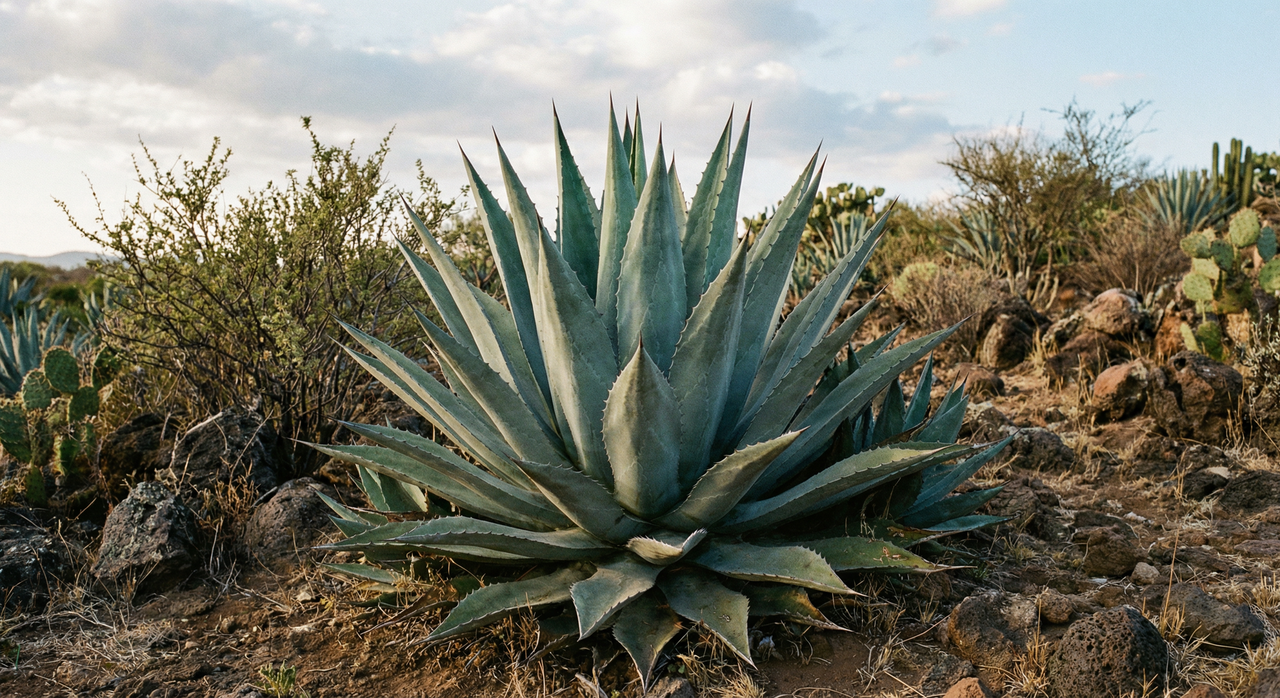
Agave tequilana spends somewhere between eight and twelve years doing almost nothing you'd notice, quietly storing sugars in a dense, water-filled heart while its blue-gray leaves get sharper and its root system quietly colonizes the surrounding soil. Then it does something that still catches me off guard even after years of working with this genus: it decides, all at once, that it's done. It throws up a flowering stalk that can hit thirty feet in a matter of weeks, pours every calorie it's ever saved into one spectacular reproductive act, and dies. That's it. One flower. One death. No second chances. I've had clients call me in a panic thinking something had gone wrong, and I always have to deliver the same news: no, the plant is fine; it's just finishing.
What gets me is that the entire tequila industry, a multi-billion dollar global trade, is built around catching these plants before that moment happens. The jimadors who harvest agave read the plant the way a good baker reads dough, watching for the subtle signs that the piña is at peak sugar and the flower stalk hasn't yet bolted. Miss the window and you've lost years of accumulation to a process you can't reverse. There's something almost philosophical about that, a crop that gives you exactly one opportunity and then it's over, rooted in a plant most people know only as the thing on a tequila bottle. There's considerably more to it than that.
Origin and History of Agave (Blue Agave)
Botanical Background and Native Habitat
The agave plant scientific name most people associate with spirits is Agave tequilana, formally described in 1902, though the plant itself has shaped human life in Mexico for millennia before anyone thought to name it scientifically. Blue Agave is native to the west-central Mexican states of Jalisco, Colima, Nayarit, Michoacán, and Aguascalientes, where it grows at elevations of 1,000 to 2,500 meters in volcanic semi-arid highlands receiving just 500 to 900 mm of rain per year.[1][2] That context matters enormously for understanding where agave grows best and why it thrives on what most plants would consider punishing conditions.
The secret is CAM photosynthesis. Agave keeps its stomata closed during the day to lock in moisture, opens them at night to fix carbon dioxide, and stores the results in a thick, waxy-cuticled rosette that reflects intense highland sun rather than absorbing it.[3][4] It's a set of adaptations shared across the wider genus, from the giant Agave americana and pulque-producing Agave salmiana down to the compact Agave potatorum, the narrow-leaved Agave angustifolia, and the cold-hardy Agave parryi, which pushes into the southwestern United States.[5][6]
Visual Characteristics and Growth Cycle
Blue Agave forms a basal rosette 1.5 to 2 meters tall and wide, its lanceolate leaves running 1 to 2 meters long and flushed a distinctive glaucous blue-gray with dark marginal spines and a stout terminal spine at the tip.[7][8] I'll note from my landscape work in Central Florida that the blue really does deepen on well-sited specimens. Over-watered plants tend to read as murky green rather than that clean silvery blue, which is a quick visual cue I use to gauge whether a plant is getting what it needs or just sitting in too much moisture through a humid summer.
The growth cycle is what makes agave genuinely dramatic to live with. Blue Agave is monocarpic: it grows vegetatively for 7 to 15 years, flowers exactly once, produces offsets, and dies.[7][9] When it finally bolts, the inflorescence rockets up 4.5 to 8 meters and opens clusters of yellowish tubular flowers at night.[10] I've never waited out the full decade on a tequila agave, but I've watched century plants at botanical gardens do this, and the speed of that stalk once it starts is genuinely startling. Other species scale the drama even further: Agave americana throws stalks up to 12 meters, while Agave potatorum keeps its whole rosette under 90 centimeters.[11][12] One genus, wildly different scales.
Traditional and Cultural Significance
Long before tequila existed, agave was the center of material and spiritual life across Mesoamerica. Pre-Columbian peoples roasted the piña for food, harvested sap for pulque, spun leaf fibers into rope and textile, and used the spines as needles and ritual instruments.[13][14] Pulque held sacred status in Aztec ceremony, bound to the goddess Mayahuel, and was not simply a drink but a medium between the human and divine.[15]
Colonial distillation changed the trajectory. The first documented tequila distillery opened in Jalisco in 1795, and the cultural and economic weight behind that single plant variety only grew from there.[16] The Denominación de Origen Tequila, established in 1974 and recognized by UNESCO as intangible cultural heritage in 2019, now strictly limits production to specific Mexican regions using exclusively the Blue Weber cultivar.[17] Understanding those regulations actually helped me when I first started sourcing agave plants for landscape work: it clarified which plants were genuine tequilana and which were hybridized ornamentals sold under loose common names.
Fun Facts and Ecological Role
That common name "century plant" for Agave americana? It's simply wrong. Most flower in 10 to 30 years, not 100.[18] The name stuck because the wait feels long, not because the math is right. What's genuinely impressive is the water storage: Blue Agave can hold 10 to 20 liters in its thick leaves and central piña, and in its native highlands it can persist through years between significant rain events.[19]
The ecological story has a harder edge. Blue Agave's nocturnal flowers are primarily pollinated by the endangered Mexican long-nosed bat (Leptonycteris nivalis).[20][21] I've become more mindful about night-blooming plants generally after learning that relationship: I leave spent stalks standing when possible because the pollinators using them often have nowhere else to go. Commercial tequila production, worth roughly $15 billion annually to Mexico's economy,[22] has reduced wild agave populations substantially, putting pressure on those same bat populations. Overharvesting also threatens wild stands of Agave potatorum and the pulque sources of Agave salmiana.[23][24] The genus is resilient by nature, but resilient is not the same as inexhaustible, and that distinction is worth keeping in mind whether you're growing one plant in a home garden or thinking about agave in any larger context.
Agave Varieties and Where to Buy Them
Blue Agave (Agave tequilana var. azul) for Tequila and Ornamental Use
If you've ever wondered why only one agave ends up in your tequila bottle, the answer is strictly legal. Agave tequilana Weber var. azul, the Blue Weber agave, is the sole variety permitted under Mexico's denomination of origin rules for 100% agave tequila production.[25][10] No other variety qualifies, regardless of how similar it might look. That exclusivity comes down to sugar content: var. azul regularly hits 22-28° Brix in the piña,[26][27] and commercial fields average an 8-year harvest cycle, with mature piñas weighing 20-50 kg and yields running 25-35 tons per hectare.[26]
As a landscape plant, it forms a solitary basal rosette reaching 5-6 feet tall and wide, with blue-green leaves coated in a waxy, powdery bloom.[12][28] I've grown several in my Central Florida beds, and that waxy bloom is one of my favorite sensory cues. Under full sun with good air circulation, the leaves take on a genuinely striking blue-gray cast; move the plant into shade or crank up the humidity without airflow, and that color dulls noticeably. It's a simple tell for whether the plant is actually thriving. Hardy in USDA zones 8-11 and tolerating brief dips to about 10°F when protected,[12][29] var. azul was introduced to the U.S. Southwest in the early 20th century as a drought-tolerant ornamental specimen, and it remains popular there for exactly that reason.[30] Just know that growing it outside Mexico means you're cultivating it purely for the architecture; the tequila label stays firmly on the other side of the border.[31]
Other Notable Agave Species and Cultivars
Once you step outside the tequila conversation, the genus opens up considerably. Agave salmiana, the giant pulque agave, forms enormous rosettes and was traditionally harvested for fermented pulque sap; it's monocarpic like all agaves, flowering after 10-20 years before dying.[32][33] Agave angustifolia, known in mezcal circles as Espadin, has a narrower leaf profile and pulls double duty in distillation and ornamental planting; its taxonomy overlaps with tequilana in some older literature, but horticulturally they're treated as distinct plants with their own character.[34][35]
For tighter spaces, Agave potatorum is a standout. It shows considerable natural variation in leaf width and spine expression, with recognized forms ranging from broad-leafed var. potatorum to the narrow, compact f. verschaffeltii; cultivars like 'Variegata' and 'Picta' have made it a favorite among succulent collectors.[36][37] When I'm designing a guild with limited room, I reach for compact forms like these before even considering the full Blue Weber, which genuinely needs space to show off that 5-6 foot architectural scale.
Agave parryi is the one I recommend most often to gardeners in colder climates. Its compact rosettes top out at 1.5-3 feet across with blue-green to gray fleshy leaves,[38] and cultivars like 'Compacta', 'Frosty', and 'Huachuca Warrior' have been specifically selected for xeriscape performance.[39] It's also cold-hardy well into zone 5, which makes it accessible to growers who'd never survive a winter with true blue agave.[12]
Sourcing and Purchasing Agave Plants
Blue Weber offsets from specialist nurseries typically run $15-45 for starter pups, with 3-5 year established plants climbing to $100-300; seeds are more accessible at $3-12 per packet, though prices spike in coastal and Northeast markets where transport costs add up.[40] Most of the rest of the genus is cheaper and easier to find. Agave americana is practically everywhere and can cost as little as $5 for a pup; parryi, salmiana, angustifolia, and potatorum range from $10-500 depending on size and source, with good specialist access in most regions.[41][42] The genus's inherently long maturation cycle, anywhere from 6-20 years depending on species, limits supply of large specimens across the board.
Importing live Blue Agave from Mexico requires USDA APHIS permits and phytosanitary certificates; denomination of origin law means the tequila designation is strictly Mexican regardless of where you grow the plant.[43][44] Agave parryi carries an additional layer of complexity as a CITES Appendix II species, regulated for international trade.[45] For most home growers, sourcing domestically through nurseries like Mountain Crest Gardens, Plant Delights, or High Country Gardens sidesteps those headaches entirely.[30]
My honest advice: skip the big-box garden center for agaves. Early in my succulent work, I bought a few bargain specimens from chain stores and paid for it later with core rot from weevil damage I hadn't caught at purchase.[30] Specialist nurseries screen for pests and acclimate their stock properly. When I'm selecting any agave in person, my non-negotiables are firm upright leaves without soft spots or tip browning, a solid root system, and no signs of damage at the base of the rosette. A healthy plant will tell you immediately; a compromised one hides it just long enough for you to get attached before the problem surfaces.
Propagating and Planting Agave tequilana
If you're growing Blue Agave and hoping to multiply it, the choice of propagation method isn't really a choice at all, at least not in any practical sense. Commercial tequila producers have known this for generations: seed-grown Agave tequilana is genetically variable because the species is a highly heterozygous, obligate outcrosser, which means the progeny aren't reliably true-to-type.[46][47] When your entire industry depends on piñas with uniform sugar content and predictable maturation timing, that variability is commercially ruinous. So vegetative offsets dominate, across plantations in Jalisco and in gardens everywhere.
Vegetative Propagation: Offsets, Tissue Culture, and Grafting
In my years of planting agaves across Central Florida gardens, I've separated hundreds of pups, and the single lesson that took me longer than it should have to learn is this: don't rush it. Early on I was pulling offsets the moment they appeared, planting them before they were ready, and losing a discouraging number of them. Now I wait until a pup reaches roughly 20-30 cm tall, with firm white roots already visible at its base and a rosette diameter at least one-third that of the mother plant.[48][49] That's the cue I trust more than any calendar date.
The technique itself is straightforward once you have the timing right. Use a sterilized, sharp knife to cut the pup free from the mother plant, then set it somewhere dry and shaded for one to two days to let the cut surface callus over.[50] That callusing step is what separates successful propagators from frustrated ones; a raw wound planted directly into soil is an open invitation to rot. Once callused, plant into a well-draining cactus or succulent mix, water it once to settle the roots, and then largely leave it alone. University extension protocols and peer-reviewed studies confirm that vegetative offset propagation achieves 80-95% success when performed in spring or summer, with rooting typically occurring in four to eight weeks.[51][52]
For commercial or collector-scale work, tissue culture pushes those numbers even further, achieving multiplication rates of four to six shoots per explant with success rates up to 95%.[53] Grafting onto rootstocks like Agave americana or Agave salmiana is another option, with spring being the preferred window and cleft or whip-and-tongue methods achieving 60-90% success.[54] Neither method is necessary for the home gardener who has a patient mother plant producing pups, but it's good to know the toolkit exists.
One more thing worth understanding about the monocarpic life cycle: once your mother plant sends up its flowering spike after six to ten years, the pup production slows and eventually stops. The decision to harvest offsets is also, in a quiet way, a decision about when to let the parent plant complete its single reproductive act. I try to take my pups in the middle years, not too early, not so late that the mother has begun redirecting all her energy skyward.
Seed Propagation, Viability, Storage, and Germination
Seed is the interesting alternative rather than the reliable one. What makes it genuinely fascinating is polyembryony: each Agave tequilana seed can contain two to ten embryos, with the nucellar ones being genetically identical to the mother plant.[55][56] Polyembryony rates can exceed 50-80% in some populations,[57] which is a partial genetic consolation. I'll admit that when I first read about this I found it remarkable enough to start labeling every seed tray carefully anyway, because even with high nucellar rates I still see enough variation in leaf color and spine density among seedlings to want records. The research and the seed tray both tell the same story: seed is useful for breeding and conservation work, not for producing a reliable landscape specimen quickly.
The practical seed story starts with storage. Agave tequilana seeds are orthodox, meaning they tolerate desiccation and store exceptionally well: over 80% viability after eight years at -18°C and 6% moisture content, in hermetic containers at 10-20% relative humidity.[58][59] For germination, surface-sow fresh seed in sterile sandy medium at 70-85°F with light; rates climb to 50-70% under these conditions, though without treatment they can drop as low as 10-30%.[60] Scarification or gibberellic acid treatment improves results. If you want to test stored seed before sowing, tetrazolium chloride staining (viable tissue turns red) and X-ray radiography are the standard methods; collect seed when capsules dehisce naturally for the best starting viability.[61][62]
Soil, Site Selection, and pH Requirements
I have lost more agaves to heavy soil and overwatering than to any pest, any freeze, or any act of neglect. Drainage is the non-negotiable across the entire genus, and everything else in site selection flows from it. Blue Agave in its native volcanic highlands of Jalisco grows in rocky, limestone-influenced tierras negras at 1,200-2,000 meters with annual rainfall of 250-800 mm.[63][64] The root system is shallow and fibrous, typically only 15-60 cm deep and spreading 1-2 m laterally, which makes the plant acutely sensitive to compaction and poor aeration.[65] There's no room for error in a waterlogged clay bed; Phytophthora and Fusarium move fast in those conditions.[66]
Before I plant any agave on a job site now, I test the existing soil and amend heavily. For Florida's clay-heavy ground I work in 50-70% inorganic material: coarse sand, pumice, or perlite, to mimic that rocky native substrate and keep roots breathing.[60] Organic matter should stay below 2%; the target is lean, gritty, and fast-draining.[67] For pH, the sweet spot is 6.5-7.5, with tolerance from 6.0 to 8.0.[30] Go below 6.0 and you risk phosphorus, calcium, and magnesium lockout; push above 8.0 and iron, manganese, and zinc become unavailable, producing the interveinal chlorosis and tip necrosis I've seen on over-limed agaves in alkaline Central Florida soils.[30] A simple soil-test kit before planting saves a lot of post-hoc troubleshooting.
Spacing, Planting Technique, and Establishment Timeline
Commercial Agave tequilana plantations in Jalisco run at roughly 2 m between plants and 2 m between rows, putting around 2,400 plants per hectare in average soils.[10][68] That figure is a useful starting point for the garden, though I default to the wider end of the ornamental range, 2-2.5 m, whenever I'm planting in humid subtropical conditions. Airflow around the rosette base is a disease-prevention tool as much as it's a size accommodation, and I've watched closely-planted agaves in Central Florida summers develop fungal problems that proper spacing would have prevented. For smaller species like Agave potatorum or Agave parryi, 0.6-0.9 m is adequate; Agave angustifolia wants 0.9-1.5 m; the large Agave americana and salmiana types need 1.8-3 m to fully express themselves.[69][12]
For planting timing, spring after the last frost is ideal, or the onset of a rainy season, once soil temperatures have cleared 60°F.[70] Set the crown at or slightly above the soil surface; burying it is one of the fastest ways to introduce rot at the plant's most vulnerable point. Water in deeply once after planting, then allow the soil to dry completely before watering again.[49] Offsets and seedlings both take one to two years to establish before putting on rapid growth, so patience is the real skill here. Once drainage is solved and the plant is sized appropriately for its space, agave becomes almost self-sufficient, which is exactly the relationship I want with every plant in a well-designed food forest or xeriscape guild.
Blue Agave Care Guide
Every time I see a struggling agave in someone's garden, the culprit is almost always kindness. Too much water, too much fertilizer, too much fussing. Blue Agave evolved in the semi-arid highlands of Jalisco at elevations between 1,200 and 2,000 meters, where the soil is rocky, the rainfall is seasonal, and the sun is relentless. Its CAM photosynthesis keeps stomata closed during the day to conserve moisture, then opens them at night to fix carbon quietly. That physiology is the whole story. Once you stop fighting it and start working with it, caring for agave becomes less about intervention and more about restraint.
Sunlight Requirements for Blue Agave
Blue Agave needs a minimum of 6 to 8 hours of direct sun daily to develop properly, and I mean direct, not dappled.[7][71] Plants that get full sun develop tight, compact rosettes with that gorgeous blue-gray color. Shade them out and you get the opposite: pale, stretched, sad-looking leaves that lose their shape and fail to accumulate the sugars that make this species commercially and ornamentally valuable. I've watched shaded specimens slowly etiolate over a single season, and the difference is striking.
That said, sudden full exposure can burn leaves, leaving brown or black dry patches, especially on plants moved from low light or on variegated forms with less protective pigmentation.[12][72] The fix is simple: acclimate gradually over two to three weeks, especially with younger plants. Mature, established specimens handle intense sun with no issues at all.
Watering Needs and Drought Tolerance
Established Blue Agave can go 6 to 12 months without supplemental water during dormancy.[29][73] That's not a typo. The plant's thick, water-storing leaves are essentially living reservoirs, and its CAM physiology keeps moisture loss minimal through the hottest months. Its native rainfall is only 20 to 30 inches annually, arriving in a distinct wet season from June through October, which is the pattern I try to mimic even in my own garden.
Watering needs to match the plant's life stage. Seedlings want light moisture every 7 to 10 days once the top couple of centimeters of soil have dried out. Vegetative plants in years one through seven can go two to four weeks between deep waterings during spring and fall, with near-complete dryness in between. Pre-flowering plants are deliberately stressed with even less frequent water to trigger bolting, while fresh pups off the mother are treated like seedlings again.[74][75] In winter, I drop to monthly watering at most. The rule across all stages: soil must dry completely before the next drink.
Overwatering is the number one killer I see, full stop. Yellowing from the leaf tips, mushy tissue at the base, wilting despite wet soil, and a foul smell all point to root or basal rot from pathogens like Phytophthora or Erwinia.[76][77] Underwatering, by contrast, shows up as wrinkled leaves and browning tips, which are far easier to recover from. The soil itself matters as much as frequency: Blue Agave prefers slightly alkaline conditions with a pH of 7.0 to 8.0 and tolerates moderate salinity, but drainage is absolutely non-negotiable.[78][79] In my early attempts growing Blue Agave in humid subtropical conditions, inadequate drainage caused basal rot faster than anything else I tried. Rocky or sandy soil that sheds water fast is the foundation everything else depends on.
Feeding Blue Agave: Low-Nitrogen Fertilization
Go light. A balanced 10-10-10 diluted to half strength, or a low-nitrogen formulation like 5-10-10, applied once or twice during the active growing season is genuinely sufficient.[80][81][82] Mature plants in decent soil often need nothing at all. I've watched a single high-nitrogen feeding produce lush, rapidly grown leaves that looked impressive for about two weeks before they went soft, lost structural integrity, and collapsed after the first heavy rain. High nitrogen also reduces sugar content in the piña and increases susceptibility to rot, which the commercial tequila research confirms clearly. A soil test every year or two keeps you from guessing, and the answer is almost always "do less."
Heat Tolerance and Summer Management
Blue Agave's optimal daytime growth range is 59 to 95°F, and it tolerates sustained heat up to 104°F reasonably well in AHS Heat Zones 10 through 12.[83][84] Brief spikes to 113°F are survivable if nighttime temperatures drop back to the 50s. Seedlings are the most vulnerable; anything above 95°F consistently can set them back fast.
Heat stress shows up as scorching, tip browning, inward leaf curling, and in severe cases, reddening or necrosis.[85][86] Physiologically, prolonged heat impairs photosynthesis and can cut productivity by up to 30%, and flowering plants are particularly at risk for pollen damage and flower abortion. In my own garden during brutal summers, I've seen pup production slow noticeably on plants under prolonged heat stress, which aligns with what the research shows about reduced overall productivity.
Practical mitigations include 30 to 50 percent shade cloth for juveniles (up to 70 percent for seedlings), a 2 to 4 inch layer of coarse inorganic mulch around the base, and deep infrequent drip irrigation in early morning every two to four weeks.[87][88][89] Good airflow matters too; spacing plants at least 1.5 to 2 meters apart on a slight slope helps air move through. Remove shade cloth once the heat breaks to avoid encouraging etiolation.
Frost Tolerance and Winter Protection
Blue Agave is rated for USDA zones 8 through 11, tolerating brief dips to around 20°F with mature plants handling short exposures down to 10 to 14°F.[90][91][92] Maturity genuinely transforms cold tolerance; a 7-year-old plant in well-drained soil is a fundamentally different animal than a two-year-old juvenile. Damage always shows first at the leaf tips and edges, and if cold reaches the apical meristem, the growing point at the center of the rosette, the plant is finished. That's the one part you cannot sacrifice.
For growers in colder climates who want reliable results, Parry's Agave is worth considering instead: mature specimens can handle -10 to -20°F, a dramatic difference from Blue Agave's limits.[93] Agave americana offers a middle ground, with RHS H4 hardiness and some zone 7b success stories, while angustifolia and sisalana are less hardy and should be protected below 20 to 25°F.[94][95]
For marginal zones, keep soil as dry as possible through winter (wet frozen soil below 10°F is particularly damaging), mulch 4 to 12 inches around the base, and use frost cloth during hard freezes below 20°F.[96][97][98] Container plants should come indoors before temperatures drop below 40°F. After a cold snap, I prune damaged leaves promptly to prevent secondary rot from setting in, but I'm careful, sometimes excessively so, around the growing tip. That apical meristem is the whole future of the plant.
Pruning, Maintenance, and Seasonal Rhythm
Blue Agave is monocarpic, meaning it flowers once and dies. After 7 to 15 years, usually between May and July, the plant sends up a spectacular inflorescence 6 to 8 meters tall, then declines once flowering is complete.[12] It sounds dramatic, and it is. Knowing this lifecycle shapes every maintenance decision you make, because the mother plant's death is the signal to tend to whatever pups it left behind before flowering ended that option.
Annual maintenance between those years is minimal. Remove only dead, brown, or diseased lower leaves during active growth in spring or summer, cutting cleanly close to the base with sharp sterilized tools.[99][100][101] Never remove healthy green leaves, and never prune during dormancy. After the bloom stalk dries, cut it down. The sap is genuinely irritating, a lesson I learned firsthand the first time I pruned without gloves and long sleeves. Goggles are not overkill. Once you have sap in your eye, you understand immediately why the warnings exist.
Vegetative growth follows a seasonal rhythm tied to the Mexican rainy season pattern: active from June through October, dormant from November through May.[12] Matching your watering, fertilization, and any disturbance to that rhythm, doing more in the active season and near-nothing in the dry season, is the simplest framework for keeping this plant happy. Neglect during dormancy isn't a failure. It's correct practice.
Harvesting Agave Tequilana
Most home gardeners will never harvest a piña. I say that not to discourage anyone, but to set honest expectations: growing Blue Agave in a Central Florida garden or a desert xeriscape is a long-term landscape commitment, and for the vast majority of us, the reward is the plant itself. But understanding how commercial harvest works deepens the respect you'll have for every bottle of tequila you open, and it changes how you observe your own plants over the years.
When to Harvest Blue Agave: Maturity Timelines and Indicators
Blue Agave typically matures for harvest 5 to 8 years after planting, though in less-than-ideal conditions that window can stretch to 12 years.[102][103] The timing matters enormously: harvest has to happen before the plant bolts. Once the quiote shoots up and the agave pours its stored energy into flowering, the piña's sugars are spent. The plant is monocarpic, so that flowering event is also the beginning of its end.[104]
Experienced jimadores don't just count years. They look for a piña in the 20 to 50 kg range, leaf color shifts, and Brix readings between 20 and 30 degrees.[105][106] Harvest too early and sugar yield drops; wait too long and the piña's fibers toughen and become harder to process.[106] In Jalisco, peak harvest runs October through May, with the driest months of November to March being preferred.[107] The Tequila Regulatory Council oversees these standards across the production chain.[105]
The genus as a whole is even more patient. Agave americana may take 10 to 30 years to reach its harvest window, Agave salmiana and Agave potatorum around 8 to 12 years, and Agave parryi anywhere from 10 to 25 years.[18][108][109] I always tell clients who plant these in my Florida designs: label them clearly, because a young Blue Agave can look deceptively like half a dozen other succulents in its first few years, and you don't want to make a 10-year mistake.
How to Harvest the Piña: Traditional Jimador Techniques
The actual harvest is manual, skilled work. Jimadores use a coa, a long-handled tool with a heavy circular blade, to strip the spiny leaves one by one until only the dense, pineapple-shaped heart remains.[102][110] Having worked around agaves for years in landscape design, I have genuine respect for anyone doing this at scale. Those marginal teeth will find you if you're not paying attention. Gloves and eye protection aren't optional around any agave, whether you're doing maintenance trimming or anything more involved.
Once harvested, piñas can be held briefly in ventilated areas for up to 24 hours before processing, or stored at 5 to 10°C with 60 to 70% relative humidity for 4 to 6 weeks without triggering premature fermentation.[111][112] It's worth contrasting this with how other agave relatives are harvested: Agave americana and Agave angustifolia can have leaves cut for fiber without killing the plant, while Agave salmiana is tapped for sap over months, yielding 1 to 5 liters of aguamiel per day through repeated scraping of the hollowed heart.[113] Tequilana's harvest is a singular event. The plant gives everything at once.
Yield, Flavor, and Post-Harvest Considerations
A mature piña is a remarkable thing: 20 to 50 kilograms of dense, fibrous, juice-laden heart.[29] Raw, it smells grassy and green, almost like cucumber and fresh melon. Cooking transforms it entirely into something caramelized, earthy, and complex.[114] Plants left to mature 8 to 12 years hit 20 to 30° Brix and develop phenolic compounds that translate into the citrus, herbal, and mineral notes tequila enthusiasts spend a lot of time debating.[115] I think of it the same way I think about soil and microclimate shaping the flavor of Florida-grown citrus: terroir is real, and it starts in the ground years before harvest.[116]
The leaves are not edible, and raw sap contains saponins that require proper preparation before any consumption.[12] For home growers, the practical harvest is almost always the pups, not the piña. If you're growing agave ornamentally, the most sustainable approach is to collect offsets for propagation or gifting, leave the mother plant to complete its cycle, and choose nursery-grown plants over wild-collected ones to avoid adding pressure to native populations.[117] Commercial agave cultivation in the U.S. remains experimental in states like California, Texas, and Arizona, with yields well below Jalisco standards, and wild harvesting in some regions requires permits.[118] Grow it, watch it, propagate it responsibly. The dramatic bloom is a once-in-a-decade spectacle, and that's a gift in itself.
Agave Preparation and Uses
What looks like a dramatic landscape specimen is, in the right hands, a multi-use food plant with centuries of preparation knowledge behind it. Blue Agave's most famous role is obvious: the piña at the center of every bottle of tequila, governed by strict Mexican standards (NOM-006-SCFI) that regulate every step from harvest through distillation.[10][119] But the edible story extends well beyond commercial spirits. Across the genus, usable parts include the piña, the sap (aguamiel), flower buds, young stalks, and occasionally bulbils.[10][120] Species like Agave americana, A. salmiana, A. parryi, A. potatorum, and A. angustifolia all follow similar patterns when handled correctly.[18][121]
Culinary Uses and Flavor Profiles of Agave
The non-negotiable first step with any agave piña is cooking. Raw tissue contains saponins that cause digestive distress, and the only reliable way through that is heat and time: traditional pit-roasting runs 24-48 hours, though boiling or steaming also works.[122][123] Having worked through similar preparation logic with yucca and other spiny-leaved edibles in my Central Florida test gardens, I'd say this is one of those situations where shortcuts have real consequences -- digestive upset is the mildest outcome. Parry's agave piñas were traditionally baked in earthen pits by Tohono O'odham communities;[124] A. americana and A. angustifolia hearts, once cooked, taste somewhere between hearts of palm and sweet potato.[14] A. salmiana leans toward caramel-molasses when roasted for mezcal.[125] The Maillard reactions happening during that long roast produce furans, aldehydes, and phenols that drive those complex, smoky-sweet flavors.[126]
Sap tapped before the plant bolts -- aguamiel -- is sweet and earthy, with caramel-honey-vegetal notes, and high in fructose (70-90% of its sugars) and prebiotic fructans.[127][128] Fresh, it's a pleasant drink; fermented 24-48 hours, it becomes pulque: mildly alcoholic (4-6% ABV), tangy, yeasty, effervescent, with tropical fruit undertones.[129][130] I've noticed that sap from ornamental relatives in my garden tastes noticeably sweeter after a long hot summer, which aligns with research showing that heat and water stress push fructan accumulation in the piña. Agave syrup or nectar, processed from that same sap, runs about 310 calories per 100g and is roughly 1.5 times sweeter than sugar, with those familiar caramel-vanilla notes -- but because it's 70-90% fructose, moderation matters.[131][132] As an agave sweetener, it works beautifully in marinades and dressings; just don't mistake it for a health food in large quantities. The agave vs honey comparison that comes up constantly online is honestly a wash -- both are high-sugar condiments, both have legitimate uses in small amounts.
Young flower stalks cook up like asparagus or artichoke hearts;[133] Nahua, Aztec, Mixtec, and Zapotec communities roasted piñas for stews and sweets long before distillation entered the picture.[134] Modern applications follow those same principles: roasted buds in salads, syrup in fusion dishes, tequila alongside carne asada or ceviche.[135] The piña itself is dense with prebiotic fructans (20-50% dry weight in mature A. tequilana), along with modest minerals and antioxidants from phenolics and flavonoids.[136][137] Commercial tequila production is its own regulated world -- what belongs in a NOM-compliant distillery stays there -- but the broader culinary tradition is genuinely accessible at home, with proper preparation.
Traditional Medicinal Preparations from Agave
Across Mexican indigenous communities, agave sap and leaf preparations have treated wounds, digestive disorders, and inflammation for generations, with uses documented in Nahua and related traditions spanning multiple species.[138][139] Preparations are low-tech: fresh sap applied directly to skin as an antiseptic or diuretic drink, leaf poultices for inflammation, infusions and decoctions for digestive complaints.[140] It's a little like working with aloe -- the fresh material has immediate, practical applications that don't require laboratory equipment. Dosages aren't standardized in the traditional literature, which means this is an area where professional guidance genuinely matters before you experiment beyond topical wound care.
Non-Food Uses of Agave
Leaf fibers, called ixtle, have supplied ropes, baskets, textiles, cordage, and traditional tools across the genus for centuries, with A. americana, A. potatorum, A. angustifolia, and A. salmiana all documented in that role -- some even offered ritually to deities in pre-Columbian practice.[133][141] In permaculture terms, the post-harvest biomass picture is compelling: agave can produce up to 40 tons per hectare, making it a realistic candidate for mulch, biofuel feedstock, or drought-season fodder.[142] For clients designing xeriscapes in water-stressed climates, I've started framing spent agave material as a resource rather than a disposal problem -- the fibrous leaves break down slowly enough to function as long-lasting mulch around the very plants they once sheltered.
Agave Health Benefits and Medicinal Uses
Agave's health story doesn't start in a supplement aisle. It starts in the Mexican highlands, where Indigenous communities have relied on the genus for centuries as medicine. I find that context matters a lot when I'm talking to clients about this plant, because it grounds the science in something older and harder to dismiss than a single peer-reviewed study.
Traditional and Modern Medicinal Applications of Blue Agave
Across Mexican ethnomedicine, Agave species including Blue Agave have been used to address an impressively wide range of conditions: wound healing, digestive disorders, respiratory ailments, diabetes management, pain relief, rheumatism, skin conditions, and inflammation, prepared as poultices, teas, sap applications, and decoctions.[143][144][145] Modern research has started explaining the mechanisms behind those traditional applications, though the picture isn't fully formed yet.
Phenolic compounds and flavonoids in Blue Agave demonstrate strong antioxidant activity, scavenging free radicals and activating the Nrf2 pathway, with total phenolic content reaching up to 150 mg GAE/g and IC50 values comparable to ascorbic acid in standard assays.[143][146] Anti-inflammatory effects are equally documented, with extracts suppressing TNF-α, IL-6, NF-κB, and COX-2, producing up to 60% reduction in paw edema in rat models at 200-400 mg/kg.[147][148] Antimicrobial activity against Staphylococcus aureus, Escherichia coli, and Candida albicans has also been confirmed in vitro, with saponins disrupting bacterial cell membranes at MIC values of 50-200 μg/mL.[149][150] The antidiabetic angle is also promising: preclinical work shows inhibition of α-glucosidase and α-amylase, enhanced insulin sensitivity, and AMPK activation,[151][152] though these results come almost entirely from cell cultures and animal studies. Most pharmacological evidence remains in vitro or animal-based, with limited human clinical trials completed so far.[153][154] In my own practice, I take the traditional and preclinical evidence seriously while always pointing people toward a healthcare provider before using agave medicinally.
Key Phytochemicals: Saponins, Flavonoids, Phenolics, and Agavins
Blue Agave contains four dominant compound classes: steroidal saponins (including hecogenin, gitogenin, smilagenin, and sarsasapogenin), flavonoids like quercetin and kaempferol, phenolic acids including ferulic and p-coumaric, and agavins, which are branched fructans with a degree of polymerization ranging from 3 to 60.[155][156] Saponins tend to get the most attention from gardeners because they're what make the sap sting your skin, but it's actually the flavonoids and phenolics concentrated in the stems and flowers that deliver most of the antioxidant activity.[157][158]
Saponins concentrate in the leaves and roots at 0.5-2% dry weight in Blue Agave, with some species like A. potatorum reaching 5-10%; those levels explain both the antimicrobial and anti-inflammatory actions and the irritant profile.[159] One thing worth understanding is that phytochemical composition shifts dramatically depending on plant age (peaking around 8-10 years), which part you're looking at, soil type, altitude, and environmental stress; drought in particular drives up saponin and phenolic production.[160][13] I've noticed that plants grown hard in full sun with minimal water tend to be noticeably more pungent and reactive than those in pampered garden beds, which makes sense once you know drought is essentially forcing the plant to ramp up its chemical defenses.
Nutritional Profile and Prebiotic Potential
Raw Blue Agave runs about 68 kcal per 100g, with roughly 16g of carbohydrates and notable minerals including potassium at 256-500 mg, plus calcium, magnesium, phosphorus, and iron.[161][162] The real nutritional story, though, is the fructans. Agavins and inulin-like polysaccharides can make up 70-80% of the dry weight of the piña, delivering prebiotic fiber that supports beneficial gut bacteria at only 1-2 kcal/g and with low glycemic impact.[162][163] Fermented preparations like pulque can also gain B-vitamins through microbial activity during the fermentation process.[164][165]
Clients frequently ask me whether agave syrup qualifies as a healthy sweetener, and my honest answer is: it's complicated. The fructan content is genuinely promising for gut health, but commercial agave nectar loses most of its mineral content during processing, and its high fructose load means overconsumption still raises metabolic concerns despite a low glycemic index label.[166] Moderation isn't a hedge; it's the actual recommendation.
Safety Considerations and Handling Precautions
For pet owners, Blue Agave is mildly toxic to dogs and cats, causing oral irritation, drooling, vomiting, and gastrointestinal distress; livestock may show salivation, diarrhea, weakness, or photosensitivity after significant ingestion.[167][168] I've seen dogs chew on a fallen leaf and develop mild mouth irritation that resolved quickly, but I still keep my landscape plants well out of reach of curious animals.
For humans, the risks come from two directions: chemical irritation from saponins (0.5-2% dry weight in the leaves) and calcium oxalate raphides, which cause mechanical irritation, contact dermatitis, and gastrointestinal upset if raw sap or plant material contacts skin or is ingested, plus the obvious puncture hazard from the spines.[169][170][171] I usually describe it to gardeners as similar to aloe sap irritation but angrier; most reactions are irritant contact dermatitis rather than a true IgE-mediated allergy, which is reassuring, though it doesn't make the rash any less uncomfortable. Thick gloves, long sleeves, and eye protection aren't optional when I'm working around agave in the landscape; if sap does hit skin, rinse immediately.[172]
The good news is that traditional processing makes all the difference. Roasting or fermentation reduces or eliminates the toxic saponins and oxalates, which is why commercially processed products like roasted piñas and pulque are generally safe to consume.[173][174] Agave extracts show low acute toxicity in animal studies (LD50 above 2000 mg/kg) with no significant hepatotoxicity in subchronic research,[175] though excessive agave syrup use due to its high fructose content can cause bloating, diarrhea, or metabolic concerns over time.[176] Extra caution is warranted during pregnancy, for anyone on antidiabetic medications, and for those sensitive to FODMAPs, given the fructan concentration.[177] Respect the plant, process it properly, and it can be a genuinely useful ally.
Agave Pests and Diseases: Prevention, Management, and IPM Strategies
Part of what makes agave so compelling as a landscape plant is how much punishment it can shrug off on its own. The physical armor alone is formidable: tough succulent leaves, a thick waxy cuticle, terminal spines, trichomes, and extrafloral nectaries that literally recruit predatory ants as security guards.[178][179] Layer in the chemical defenses -- saponins and phenolics that deter insect feeding and disrupt digestion -- and you have a plant that deer, rabbits, and most casual opportunists leave alone.[180][181] Wild populations lean on genetic diversity and endophytic microbes to push that resistance even further.[182] In my experience, a well-sited agave in appropriate conditions genuinely takes care of itself most of the time. The problems come when we stress the plant, or when a specific enemy shows up that the plant's defenses simply weren't built to stop.
Agave Snout Weevil and Other Major Pests
The agave snout weevil (Scyphophorus acupunctatus) is the threat that changes every calculation. This beetle bores directly into the plant's core, causes internal rot, and creates entry points for secondary bacterial pathogens like Erwinia that accelerate the collapse.[183][184] In untreated commercial fields of Blue Agave, losses of 30 to 50 percent have been documented.[91][185] Every species in the genus is considered highly susceptible, and infestations are notoriously hard to catch early because the damage happens inside the crown while the plant still looks fine from the outside.[183][184] I've had clients call me to look at an agave that "suddenly collapsed overnight," and it's almost always the weevil. What clued me in the first few times was gently probing the base of the offset with a gloved finger during spring checks -- a mushy crown and a faint fermented smell are the tells, even before exit holes appear.
Beyond the weevil, mealybugs, spider mites, and scale insects are the pests home gardeners encounter most often, causing sap feeding, stippling, and the honeydew buildup that leads to sooty mold.[185][183] These tend to flare up when plants are stressed -- either by drought or, counterintuitively, by the humidity of a greenhouse or humid subtropical summer.[186] Aphids, thrips, and slugs show up occasionally but rarely cause serious harm to otherwise healthy specimens.[187] The pattern I keep seeing is that a vigorous, well-drained agave in full sun shrugs off minor pest pressure; it's the stressed or containerized plant that becomes a pest magnet. No cultivar selection will fix that equation -- genetic resistance to the snout weevil remains limited across all commercial lines, so cultural practice is doing most of the work.[188]
Key Diseases of Blue Agave and Related Species
The four disease groups that matter most for agave are Fusarium wilt, Phytophthora root rot, bacterial soft rots, and fungal leaf spots -- and they're almost always linked to the same root cause: too much water, too little drainage.[189][184] Fusarium oxysporum causes vascular discoloration, wilting, and plant death; Blue Agave is particularly vulnerable, with yield losses up to 30 percent in over-irrigated fields and no cure once infection takes hold.[190][191] Phytophthora cinnamomi follows the same wet-soil pattern, rotting roots and spreading via contaminated tools or irrigation water.[192][193] Bacterial soft rots from Erwinia and Pseudomonas species typically follow mechanical injury or weevil damage -- which is exactly why the snout weevil is so devastating beyond the boring itself.[194]
Fungal leaf spots from Phyllosticta, Cercospora, and Alternaria show up in humid conditions, leaving necrotic lesions that reduce photosynthetic capacity.[195] I've noticed that Agave parryi relatives tend to stay remarkably clean in dry microclimates where Blue Agave in a humid spot develops spots within a single rainy season -- which reinforces something I tell clients constantly: site selection matters more than species selection for disease prevention.[30] Agave americana, for all its toughness, follows the same script as the rest of the genus: get the drainage right and most fungal issues disappear on their own.[196] Soil pH extremes below 6.0 or above 8.0 correlate with higher Fusarium incidence, and environmental stresses from suboptimal conditions can increase overall disease susceptibility by up to 40 percent.[197] If you suspect Fusarium in a larger planting, send a sample to your local extension lab rather than guessing at treatment -- the speed at which it moves through monoculture plantings is genuinely alarming, and that 30 percent yield loss figure from Mexican commercial fields reflects what happens when it goes undiagnosed.
Integrated Pest Management for Agave
Integrated Pest Management is the only reliable framework here, and it works in a specific sequence: cultural controls first, biological controls second, chemical intervention as a genuine last resort.[198][199] For pests, that means regular spring scouting with attention to the crown and base of offsets, removal and destruction of infested plants before weevils emerge, planting certified pest-free stock, and spacing plants well enough that stressed individuals don't immediately spread problems to neighbors.[183] For diseases, it's the same logic: drip irrigation rather than overhead watering, well-drained soil, sterile tools between plants, and prompt removal of infected material.[200]
On the biological side, entomopathogenic nematodes like Steinernema carpocapsae have shown 70 to 90 percent efficacy against weevil larvae when applied correctly, and Trichoderma species and Bacillus subtilis can suppress soil-borne pathogens while supporting root health.[201] In my designs I prioritize these options before reaching for anything chemical; rotating imidacloprid only when nematode applications aren't sufficient has kept specimen agaves healthy for years without compromising the local pollinators that these plants depend on for seed production.[198] When fungicides are necessary, azoxystrobin targets Fusarium, metalaxyl addresses Phytophthora, and copper-based compounds handle fungal leaf spots -- always applied preventively and rotated to avoid resistance.[202] Since no widely available cultivars offer strong resistance to snout weevil or Fusarium, prevention through good site selection, vigilant monitoring, and sound cultural practices remains what actually keeps these plants thriving long-term.[203]
Agave in Permaculture Design: Climate Fit, Ecosystem Roles, and Guild Placement
Few plants reward the permaculture designer quite like agave does in a hot, dry landscape. The genus brings an almost unfair combination of low inputs and high outputs: extreme drought tolerance, structural presence, deep erosion-controlling roots, and a once-in-a-lifetime flowering event that temporarily turns your garden into a bat and hummingbird feeding station. Blue Agave in particular has a long history of multi-use cultivation in its native Mexican highlands, and that practical tradition translates well into regenerative design thinking. The key is matching the plant's actual climate needs honestly, then building your guild around what it actually does rather than what you wish it would do.
Climate and Hardiness Zones for Blue Agave
Blue Agave is comfortable in USDA zones 9-11, where conditions most closely mirror its native semi-arid Mexican highlands at 1,000-2,000 meters elevation.[29][31] Mature plants can handle a brief dip to around 20°F (-7°C), but damage becomes likely below 25°F (-4°C), and young plants are considerably more vulnerable once temperatures drop below 30°F (-1°C).[204] It also has a sweet spot for heat, thriving between 70-90°F and tolerating occasional spikes to 100°F without complaint, as long as rainfall stays moderate.[205]
Rainfall matters less than drainage. Blue Agave survives on as little as 10-12 inches of annual precipitation thanks to its CAM physiology, which reduces water loss by up to 90% compared with C3 plants, but excessive rainfall above 1,000 mm tips the balance toward root rot fast.[10][84] Humidity compounds this: the plant prefers dry air below 50-60% relative humidity with good circulation, and humid subtropical climates require exceptional drainage to compensate.[206] I learned this the hard way. After losing my first Blue Agaves to root rot in Central Florida's humidity, raised berms became non-negotiable in my designs, even when placing an agave in what looks like a perfectly sunny, fast-draining spot.
For marginal zone 8 growers, a south-facing microclimate with heavy mulch can push survivability into brief dips of the low 20s F, though I still treat Blue Agave as a zone 9+ plant for reliability rather than getting hopeful about a single mild winter.[12] If cold hardiness matters more to your design than the tequilana species specifically, the genus has excellent alternatives: Agave americana tolerates down to about 5°F in a sheltered spot,[207] and Parry's agave (A. parryi) is the cold-hardiness leader of the genus, surviving brief exposure to 0°F or below in zones 7-10.[208][209] Those two species extend agave's usefulness well into temperate climates where Blue Agave simply won't reliably overwinter.
Ecological Functions and Biodiversity Support
The ecological value of a mature agave in flower is genuinely hard to overstate. Blue Agave is monocarpic, spending 5-15 years building energy before sending up a quiote that can reach 5-9 meters tall and blooming with pale yellow tubular flowers.[210] I've watched hummingbirds and bees work the flowering stalks of other agaves in my landscape, and the activity is impressive, but bats are doing the heavy lifting. Blue Agave's nocturnal flowers, musky scent, and copious nectar are specifically adapted for the Mexican long-nosed bat and lesser long-nosed bat, its primary pollinators; the tall stalk itself is essentially a bat landing pad.[211][212] Planting agaves in diverse clusters rather than a single specimen visibly increases the range of pollinators attracted and keeps that benefit running across different flowering years.
Below ground, agave earns its keep through an extensive fibrous root system reaching up to 3 meters deep, stabilizing slopes, improving water infiltration, and forming symbiotic relationships with arbuscular mycorrhizal fungi that unlock nutrients in poor, compacted soils.[213] Parry's agave extends this further, functioning as a nurse plant in arid ecosystems where it creates the shade and moisture retention that allows understory plants to establish.[214] When leaves are chop-and-dropped as mulch, agave functions as a dynamic accumulator, returning minerals to the soil surface over time.[215] Century Plant specifically concentrates potassium, calcium, and silica, which makes its leaf material genuinely useful biomass rather than just garden debris.[216]
One caveat worth carrying into any design conversation: large-scale monoculture of agave, as practiced in commercial tequila production, erodes the biodiversity benefits significantly.[217] The permaculture answer is diversified planting with companion species and preserved native vegetation corridors. The ecosystem function is real; monoculture just systematically dismantles it.
Forest Layer, Guild Design, and Companion Planting
In a food forest or layered polyculture, Blue Agave sits in the shrub layer, occupying roughly 1-3 meters of vertical space with a rosette up to 1.2-1.8 meters tall and 2.5 meters wide at maturity.[12][218] It prefers full sun but tolerates partial shade during establishment from taller canopy species, which makes it useful as a mid-succession plant in dryland food forests. I've used agaves as living fence elements on property edges, where their spines discourage foot traffic and the rosette structure creates wind protection for more sensitive plantings inside the zone.
Guild design around agave rewards species selection carefully. Good companions include lavender, salvias, yuccas, Opuntia cacti, and Eriogonum, all of which share the drought tolerance that lets them thrive on the same watering regime without competing aggressively for moisture.[219] In alley-cropping systems, agave intercropped with maize, beans, or legumes at 2-3 meter spacing benefits from the nitrogen-fixing companions while providing structural windbreak and erosion control along the alleys.[220]
What I underestimated early on was how much root competition and allelopathic chemistry can suppress shallow-rooted neighbors.[221] Agave's allelopathy suppresses weeds effectively, which reads as a benefit until you realize it can work against sensitive companions planted too close. Spacing agaves at least 6-8 feet from shallow-rooted guild members avoids most of the competition issues and turns the combination into a productive windbreak-and-groundcover pairing rather than a suppression problem.
For colder or smaller-scale designs, genus breadth solves size and hardiness constraints well. Century Plant's massive rosette and 25-foot flower spike make it a dramatic edge barrier or focal point, while Parry's compact 1-3 foot form works as a nurse plant in tight spots or colder climates.[12][222] The design principle scales across species: put agave where you need structure, erosion control, and pollinator support with minimal water inputs, then build your companion planting outward from those anchors.
The Plant That Taught Me to Wait
I planted my first Blue Agave knowing I'd probably never harvest it. That felt strange at first, putting something in the ground for a future that might not include me. But there's something quietly clarifying about a plant that operates on its own timeline, completely indifferent to impatience. It changed how I think about a garden: not everything needs to be productive on my schedule to be worth the space.
Sources 222
- Royal Botanic Gardens, Kew - Agave tequilana ↩
- Blue Agave Habitat in Mexico - Britannica ↩
- Photoinhibition and high-light adaptation in CAM plants ↩
- Cuticular waxes of Agave americana: Structure and function in drought tolerance ↩
- USDA PLANTS Database ↩
- Agave parryi - Flora of North America ↩
- Agave tequilana - Missouri Botanical Garden ↩
- Agave tequilana - Royal Horticultural Society ↩
- Maturation and flowering phenology of Agave tequilana in Jalisco, Mexico ↩
- Agave tequilana - Wikipedia ↩
- Agave americana - Missouri Botanical Garden ↩
- Agave potatorum - Missouri Botanical Garden ↩
- Phytochemicals and Biological Activities of Agave Species: A Review ↩
- Ethnobotany of Agave in Mexico ↩
- Mayahuel: The Aztec Goddess of Maguey ↩
- History of Tequila Production ↩
- Tequila: The Cultural and Historical Significance ↩
- Agave americana - Wikipedia ↩
- Physiological Adaptations of Agave to Arid Environments ↩
- Pollination Ecology of Agave tequilana ↩
- Mexican Long-Nosed Bat and Tequila Agave ↩
- Tequila Industry Economic Impact Report ↩
- IUCN Red List Assessment: Agave potatorum ↩
- Sustainability of Wild Pulque Production from Agave salmiana ↩
- Tequila Regulatory Council - Agave Specifications ↩
- Yield and Maturation of Blue Agave Cultivars ↩
- Sugar Content in Agave Varieties for Tequila Production ↩
- Agave tequilana - Kew Science ↩
- Agave tequilana - USDA PLANTS Database ↩
- Agave in Arizona Landscapes - University of Arizona Extension ↩
- Agave tequilana Weber | Tequila Agave | Plant Profile - Missouri Botanical Garden ↩
- Agave salmiana - Plants of the World Online | Kew Science ↩
- Ethnobotany of Agaves in Mexico ↩
- Plants of the World Online: Agave angustifolia ↩
- Missouri Botanical Garden Plant Finder: Agave angustifolia ↩
- Agave potatorum ↩
- Horticultural Varieties of Agave potatorum ↩
- Flora of North America - Agave parryi ↩
- Cultivated Agaves ↩
- Agave tequilana - Missouri Botanical Garden ↩
- Agave salmiana ↩
- Agave potatorum Plant Profile ↩
- Tequila and Protected Designations of Origin ↩
- Importation of Plants and Plant Products ↩
- CITES Appendices ↩
- Genetic Diversity and Population Structure in Agave tequilana ↩
- Propagation of Agave tequilana Weber var. azul by Seed and Vegetative Means ↩
- Growing Agaves: Propagation and Care ↩
- Century Plant Propagation Guide ↩
- Vegetative Propagation of Agave tequilana ↩
- Propagation of Agave Species ↩
- How to grow agaves ↩
- Micropropagation of Agave tequilana ↩
- Grafting Techniques for Agave Species ↩
- Embryology of Agave tequilana Weber ↩
- Nucellar Polyembryony in Blue Agave (Agave tequilana Weber) ↩
- Polyembryony in Agave Species: Implications for Propagation ↩
- Seed Storage of Agave tequilana Weber ↩
- Millennium Seed Bank: Agave Conservation ↩
- Germination of Agave Seeds: Protocols and Rates ↩
- Tetrazolium Testing for Agave Seed Viability ↩
- X-Ray Analysis of Seed Viability ↩
- Agave tequilana - Kew Science ↩
- Blue Agave Habitat and Ecology - Tequila Regulatory Council ↩
- Root System of Blue Agave ↩
- Missouri Botanical Garden - Agave tequilana ↩
- RHS - Agave tequilana ↩
- Tequila Agave Production Practices - FAO Document ↩
- Agave Cultivation Guide - University of Arizona Extension ↩
- Agave tequilana Cultivation Guide - University of California Agriculture ↩
- Blue Agave Cultivation Guide - University of California Agriculture ↩
- Sun Requirements for Agaves - University of Arizona Extension ↩
- Drought Tolerance of Agave Species - University of Arizona Extension ↩
- Agave tequilana - Missouri Botanical Garden ↩
- Agave tequilana - Royal Horticultural Society ↩
- Blue Agave (Agave tequilana) Growing Guide ↩
- Missouri Botanical Garden - Signs of Underwatering in Succulents ↩
- Plants of the World Online (Kew Gardens) ↩
- Salt Tolerance in Agave tequilana (Journal of Plant Physiology) ↩
- Fertilization of Agave tequilana Weber for Tequila Production ↩
- Soil Fertility Guidelines for Agave in Jalisco ↩
- Cactus & Succulent Care: Fertilizing ↩
- Agave tequilana Weber ↩
- Cultivation of Blue Agave for Tequila Production ↩
- Heat Stress Responses in Agave tequilana Weber: Implications for Tequila Production ↩
- Heat Stress Effects on Succulent Plants: Case of Agave ↩
- Shade and Mulch Effects on Agave Seedlings Under High Temperatures ↩
- Succulent Gardening in Desert Conditions ↩
- Irrigation Strategies for Blue Agave in Tequila Production ↩
- Cold Tolerance of Blue Agave (Agave tequilana Weber) ↩
- Frost Damage in Agave tequilana: Implications for Tequila Production ↩
- Agave tequilana - Missouri Botanical Garden ↩
- Agave parryi ↩
- RHS Plant Finder - Agave americana ↩
- Missouri Botanical Garden - Agave salmiana ↩
- Cold Protection for Agaves - University of Florida IFAS ↩
- University of Arizona Extension - Agave Care ↩
- RHS - Protecting Agaves in Winter ↩
- Missouri Botanical Garden Plant Finder - Agave tequilana ↩
- Royal Horticultural Society - Growing Agave Species ↩
- Agave americana IPM Guidelines ↩
- Agave tequilana Cultivation and Harvesting ↩
- The Life Cycle of the Blue Agave Plant ↩
- Reproductive Biology of Agave tequilana ↩
- Reglamento de la Industria Tequilera ↩
- Agave tequilana Weber Maturity and Harvest Criteria ↩
- The Agave Plant ↩
- Agave salmiana ↩
- Agave parryi ↩
- ucanr.edu ↩
- Tequila Production Process ↩
- Agave Processing in Tequila Making ↩
- Traditional Pulque Production from Agave salmiana ↩
- Journal of Agricultural and Food Chemistry (2005) Volatiles in Agave tequilana Piña ↩
- Influence of Agave Maturity on Tequila Flavor Compounds ↩
- Terroir Effects on Agave Flavor in Mezcal Production ↩
- Tequila Regulatory Council Sustainability Guidelines ↩
- Sustainable Harvesting of Agave Species ↩
- NOM-006-SCFI-2012: Tequila Specifications ↩
- Traditional Uses of Agave in Mexico ↩
- Foraging Texas: Agave americana ↩
- Ethnobotany of Agave Species in Mexico - Journal of Ethnopharmacology ↩
- Traditional Mexican Agave Foods ↩
- Fire Effects Information System (FEIS) - Agave parryi ↩
- Ethnobotany of Agave potatorum in Oaxaca, Mexico ↩
- Volatile Compounds in Roasted Agave Piñas for Mezcal Production ↩
- Chemical and Sensory Analysis of Agave tequilana Sap ↩
- Nutritional Composition of Agave Sap and Derivatives ↩
- Pulque: The Ancient Mexican Drink Made From Agave Sap ↩
- Pulque Production from Agave salmiana ↩
- USDA FoodData Central - Agave Nectar ↩
- Agave Nectar: Good or Bad? - Healthline ↩
- Traditional Uses of Mexican Agave Species ↩
- Traditional Uses of Agave in Mexico - Ethnobotany Journal ↩
- Culinary Uses of Agave in American Southwest Cuisine ↩
- Fructan Composition in Agave ↩
- Bioactive Compounds in Agave ↩
- Medicinal Uses of Agaves in Mexican Indigenous Communities ↩
- Traditional Uses of Agave salmiana in Mexico ↩
- Traditional Uses of Agave Species ↩
- Fiber Uses of Agave Species in Indigenous Communities ↩
- Agave in Permaculture: Sustainable Practices ↩
- Ethnobotany of Agave tequilana in Mexico ↩
- Traditional Medicinal Uses of Agave Species in Mexico ↩
- Ethnobotany and Ethnopharmacology of Agave Species ↩
- Antioxidant Activity of Phenolic Compounds in Agave tequilana ↩
- Pharmacological Activities of Agave tequilana: A Review ↩
- Pharmacological Activities of Agave Species: A Review ↩
- Antimicrobial Saponins from Agave tequilana ↩
- Antimicrobial Activity of Agave tequilana Extracts ↩
- Pharmacological Properties of Agave Species: A Review ↩
- Antidiabetic Potential of Agave salmiana in Experimental Models ↩
- Pharmacological Properties of Agave tequilana: A Review ↩
- Traditional uses and pharmacology of Agave species ↩
- Bioactive Compounds and Biological Activities of Agave Plants ↩
- Phytochemical Constituents and Pharmacological Activities of Genus Agave: A Review ↩
- Flavonoids and Phenolics in Agave Species ↩
- Phenolic Compounds in Agave tequilana: Antioxidant Potential ↩
- Saponins from Agave spp.: Chemistry and Bioactivity ↩
- Secondary Metabolites from Agave Species: A Review ↩
- USDA FoodData Central - Agave, raw ↩
- Nutritional Composition of Agave tequilana Weber ↩
- Nutritional and chemical characterization of Agave salmiana ↩
- Nutritional and chemical composition of Agave salmiana ↩
- Nutritional Evaluation of Agave Syrup and Microparticles of Roasted Agave Heart ↩
- Nutritional Composition of Agave Species ↩
- Agave Toxicity in Pets - ASPCA ↩
- Toxicity of Agave Species to Livestock - Journal of Animal Science ↩
- Saponins in Agave: Chemistry and Toxicology ↩
- Calcium Oxalate Crystals in Agave Leaves ↩
- Agave Plant Dermatitis ↩
- Plant Dermatitis - DermNet NZ ↩
- Traditional Uses of Agave Species in Mexican Medicine ↩
- Toxicity and Traditional Uses of Agave Plants ↩
- Toxicity Assessment of Agave tequilana Extracts ↩
- Toxicity and Side Effects of Agave Products ↩
- Fructans in Agave and Their Health Effects ↩
- Missouri Botanical Garden Plant Finder - Agave tequilana ↩
- Plant defenses against herbivory: Chemical and physical strategies in Agave ↩
- Secondary Metabolites of the Genus Agave and Their Potential Applications ↩
- Defense Mechanisms in Agave Species: Physical and Chemical Adaptations ↩
- Endophytic Microbes in Agave and Their Role in Pest Resistance ↩
- Agave Snout Weevil Management ↩
- Diseases and Pests of Agave ↩
- CABI Crop Protection Compendium: Agave tequilana Pests ↩
- Pests of Agave and Yucca ↩
- University of Florida IFAS Extension: Agave Pest Management ↩
- Breeding for Resistance in Agave angustifolia ↩
- Fusarium Wilt Resistance in Blue Agave Varieties ↩
- Fusarium oxysporum f. sp. agaves in Blue Agave ↩
- Fusarium Species as Pathogens on Plants and Their Role in Agave tequilana Weber Diseases ↩
- Phytophthora Root Rot of Agave tequilana ↩
- Phytophthora Root Rot of Agave tequilana in Mexico ↩
- Bacterial Diseases of Agave tequilana ↩
- Diseases of Agave tequilana: A Review ↩
- Century Plant Diseases - University of California IPM ↩
- Diseases of Agave tequilana Weber Caused by Microorganisms ↩
- Snout Weevils (Agave and Other Succulents) - UC IPM ↩
- FAO Guidelines on Agave Pest Management ↩
- Fusarium Wilt of Agave: Symptoms and Management ↩
- Biological Control of Scyphophorus acupunctatus on Blue Agave ↩
- Phytophthora Root Rot in Agaves ↩
- Phytosanitary Guidelines for Agave from Mexican Tequila Producers ↩
- Royal Horticultural Society - Agave tequilana ↩
- CactiGuide.com - Blue Agave Care ↩
- Missouri Botanical Garden - Agave tequilana ↩
- Royal Horticultural Society - Agave americana ↩
- Agave parryi ↩
- Cold Hardy Agaves: Agave parryi ↩
- Agave tequilana - Missouri Botanical Garden ↩
- Pollination Biology of Agave tequilana ↩
- The Role of Agaves in Bat Pollination ↩
- Agave in Permaculture Systems ↩
- Nurse Plants and Plant-Plant Interactions in Arid Ecosystems ↩
- Journal of Arid Environments - Agroecological roles of agaves (2019) ↩
- Dynamic Accumulators in Permaculture ↩
- Biodiversity and Soil Health in Agave Plantations ↩
- Missouri Botanical Garden Plant Finder ↩
- Permaculture Companion Planting for Agaves - Permaculture Research Institute ↩
- Intercropping Blue Agave with Maize and Legumes ↩
- Allelopathy and Competition in Agave Plantations ↩
- Agave parryi ↩