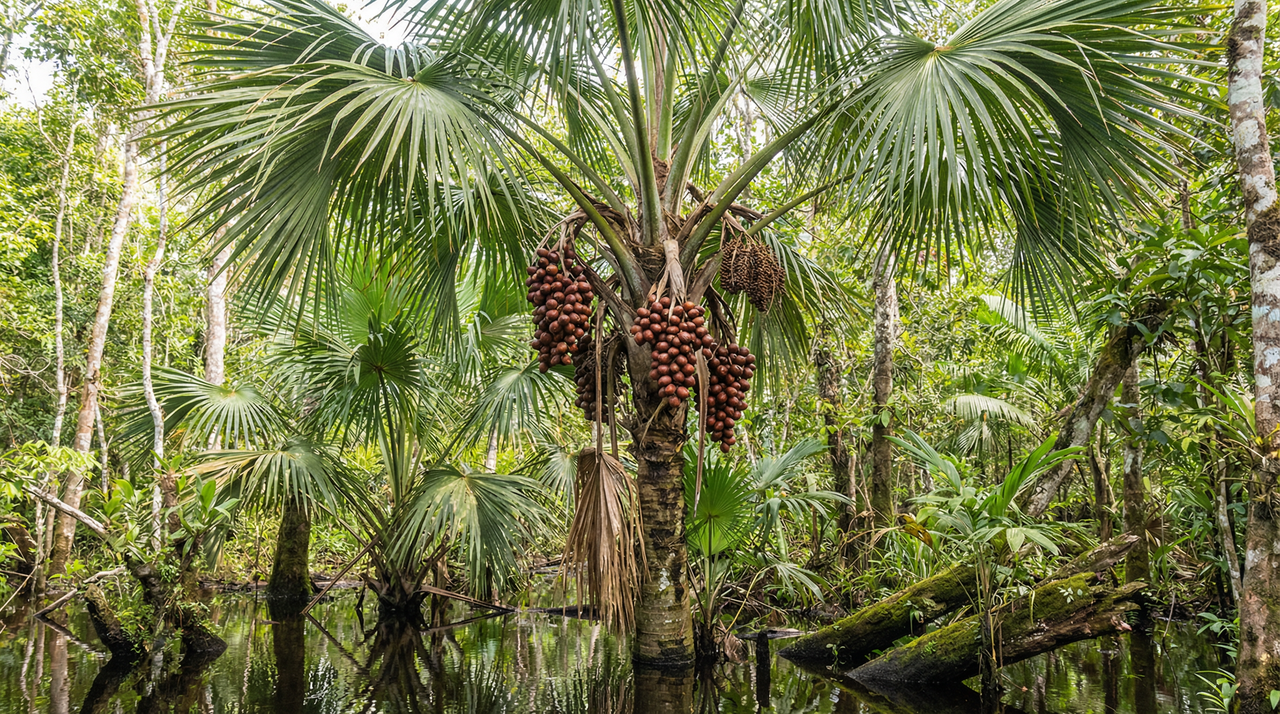
There's a fruit so rich in beta-carotene that researchers measuring it had to double-check their instruments. Aguaje, the fruit of Mauritia flexuosa, carries anywhere from 12 to 44 times the beta-carotene of a carrot,[1] and yet most of the world has never heard of it. I hadn't, until I started digging into Amazonian agroforestry systems and kept running into this palm, over and over, described by indigenous peoples as the "tree of life." That phrase gets thrown around a lot in ethnobotany. With aguaje, it turns out to be almost literal.
What stops most gardeners cold is the timeline. We're talking 10 to 15 years from seed to first fruit, a palm that grows to 35 meters, and a species that genuinely wants its roots sitting in water for months at a stretch. It's the opposite of a quick win. But here's what I keep coming back to: the palms that ask the most of a landscape tend to give the most back, and aguaje is one of the most ecologically generous plants I've encountered in two decades of designing food forests. If you're in a warm, wet climate and you're thinking in decades rather than seasons, this palm deserves your full attention.
Origin and History of Aguaje (Mauritia flexuosa)
Botanical Background and Native Habitat
Aguaje, known to science as Mauritia flexuosa, is native to the vast wetland systems of tropical northern South America, ranging across the Amazon and Orinoco basins through Brazil, Peru, Venezuela, Colombia, Bolivia, Ecuador, Guyana, and Suriname.[2][3] It thrives in igapó blackwater forests, várzea floodplains, and seasonally inundated savannas, typically below 500 meters elevation.[4] I've grown several tropical palms in Central Florida and none of them have demanded this level of hydrological commitment. The palm doesn't just tolerate flooding; it has built its entire life strategy around it.
The palm is polycarpic, meaning it flowers and fruits repeatedly over a lifespan that routinely exceeds 50 to 100 years, growing from a single apical meristem in a clustering habit with multiple stems rising from a shared rhizome.[2][5] What really gets me as a designer is its phenological calendar: flowering peaks from September to November as the wet season begins, fruiting runs December through May, and seeds disperse during the dry season between June and August, precisely when falling waters can carry them to new ground.[2][6] That synchronization with the flood pulse is a masterclass in ecological timing that any permaculture designer would do well to study. Unfortunately, deforestation, habitat fragmentation, and overharvesting are disrupting these cycles and threatening regeneration across the palm's range.[7]
Visual Characteristics of the Buriti Palm
Standing anywhere from 15 to 35 meters tall with a trunk 30 to 75 centimeters across, aguaje is a skyline species in every sense.[2][8] Its pinnate leaves stretch 3 to 4 meters with petioles alone reaching 1 to 2 meters, and each leaf carries up to 100 pairs of leaflets that gleam bright green on top and flash silvery-white beneath from a waxy coating.[9] When a breeze catches those crowns, the silver undersides flicker like light on water. It's dramatic in a way that no photograph quite captures.
The flowers hang on pendulous inflorescences up to 2 meters long; male flowers are small and creamy-yellow while female flowers run reddish-brown, and the resulting fruit is a 3.8 to 5 centimeter reddish-brown drupe housing a single hard seed.[2][10] Below ground, the story is equally impressive. Aguaje develops adventitious fibrous roots fanning out in a horizontal mat up to 10 to 15 meters wide, gripping soft flooded soils and holding banks together.[11] It also adjusts leaf size, thickness, and overall stature depending on flood depth and nutrient availability, a phenotypic plasticity that reminds me of Florida's saw palmetto in principle, though on a dramatically larger scale. Where saw palmetto tweaks a frond here or there, aguaje reconfigures its whole architecture to read its site.
Traditional and Cultural Uses Across the Amazon
Indigenous Amazonian peoples have relied on this palm for millennia, and the first European to put that relationship on record was Gonzalo Fernández de Oviedo, whose 16th-century accounts from the Orinoco region documented the palm's centrality to local life.[12] Alexander von Humboldt followed with detailed observations in 1805, and Linnaeus formally assigned the species its name in 1782.[13] Those European encounters documented a relationship that oral traditions had carried for generations before any outsider arrived.
The fruit is processed in several ways:
- eaten fresh
- pressed into juice
- stirred into ice cream
- fermented into wine and liqueurs
- processed into cooking oil
For the Yanomami, Warao, Shipibo-Conibo, Yanesha, and others, aguaje embodies life, fertility, resilience, and protection; it appears in rituals, festivals, myths, and ceremonies, and is understood as a guardian of water sources.[18][19] I'm not an indigenous practitioner, and I want to be careful not to flatten what is a living, complex cultural relationship into a bullet point. What I can say is that reading the ethnobotanical literature and talking with colleagues who work in Amazonian agroforestry has genuinely shifted how I think about keystone species. This palm isn't just useful. It is, in many communities, a center of meaning. That matters when we talk about who benefits from its commercialization.
On that note, the sustainability picture deserves honesty. Overharvesting for commercial buriti oil, combined with deforestation and habitat degradation, is reducing regeneration across the range.[20] Having collaborated on projects that source ethically traded tropical products, I've learned that supporting community-led management isn't optional; it's the only way to avoid repeating colonial patterns of extraction. Selective harvest without felling trees, ladder-based collection, fair-trade frameworks, and genuine benefit-sharing with indigenous rights holders are the baseline, not the ideal.[21][22]
Fun Facts and Ecological Significance
Aguaje survives prolonged flooding by developing aerenchymatous tissue and adventitious aerial roots that keep gas exchange going in waterlogged, hypoxic soils.[4][23] Its thick fibrous trunk even resists low-intensity fires, allowing resprouting in savanna habitats where dry-season burns are routine. The palm supports an extraordinary web of wildlife: toucans, macaws, fruit bats, monkeys, and peccaries all depend on its fruit, and the canopy and trunk provide nesting and roosting habitat that ripples through the food web.[24]
Pollination comes primarily from dynastid beetles working at night, while seeds travel by two very different routes: frugivorous vertebrates carry them overland, and the seeds' natural buoyancy lets floodwaters do the rest.[25] A single mature tree can produce 50 to 200 kilograms of fruit annually, and that fruit is extraordinary: orange-yellow when ripe, stacked with beta-carotene, vitamins A and C, and a mesocarp oil rich in oleic acid, carotenoids, and tocopherols that finds its way into food, cosmetics, and traditional medicine alike.[5][26]
The IUCN currently lists Mauritia flexuosa as Least Concern globally, but that designation masks real localized pressure from habitat loss, illegal logging, and commercial oil demand.[27] Climate projections add another layer of concern: increased drought and temperature variability are expected to contract suitable habitat by 2050.[28] Anyone thinking about cultivating aguaje outside its native range, including in USDA zones 10 to 11 where I work, needs to track local humidity and temperature trends closely. The climate window for this palm is real and it is narrowing in parts of its native territory. Honoring what this palm is, ecologically and culturally, means entering that conversation with eyes open.
Aguaje Varieties and Where to Buy
Fruit Characteristics and Regional Variation
There's only one aguaje. Mauritia flexuosa is a monotypic species with no recognized subspecies and no named cultivars, so you won't be sorting through a seed catalog comparing 'Iquitos Gold' against 'Orinoco Sweet.'[29] What you get instead is wild ecotypic variation, and honestly, it's fascinating once you understand it. The mauritia palm reads its environment and responds. Specimens growing in nutrient-rich floodplain soils produce noticeably larger fruit with higher oil content and more sweetness than those on leaner ground.[30] I've seen similar patterns when growing other slow tropical edibles: the same genetic material produces remarkably different fruit on a mucky low spot versus slightly better-drained adjacent ground. With aguaje, that difference is baked into its evolutionary history rather than any breeder's notebook.
The fruit itself is the whole reason to care about any of this. Those oblong drupes, 5 to 7 cm long with a scaly reddish-brown exterior, hold pulp that tastes like apricot and pineapple decided to collaborate, sweet-tart, fragrant, and rich with carotenoids and vitamin C.[2][10][31] In floodplain populations, oil content can reach 25%, which is why the pulp feels buttery rather than just juicy. I've tasted aguaje in juices and frozen preparations, and the richness is more pronounced when the fruit comes from well-watered, fertile ground. That's not a cultivar difference; it's a site selection lesson.
Because no formal breeding programs exist, reforestation and cultivation both depend entirely on wild-collected seed, which means fruit quality is genuinely variable until you know your source region.[32] The species is rated Least Concern by the IUCN,[33] but localized overharvesting and wetland loss are real pressures in parts of its Amazonian and Orinoco range.[34][35] I treat any mauritia palm I plant as part of the wider wetland conservation story, which means sourcing from suppliers who collect sustainably rather than strip-harvesting from wild stands.
Sourcing Aguaje Seeds and Plants
Don't expect to find aguaje at your local nursery. Its need for constant tropical warmth and perpetual soil moisture means most standard U.S. operations simply can't keep it alive in inventory, let alone grow it to saleable size.[36] Specialty exotic palm suppliers, botanical garden plant sales, and online seed importers, primarily based in Florida and California, are your realistic options. The USDA lists Mauritia flexuosa as an introduced non-native species, currently present only in the warmest Florida microclimates,[37] so you're firmly in specialty-grower territory here.
Seed is by far the easiest entry point. Packets typically run $10 to $25; seedlings cost $25 to $60; and larger containerized plants, if you can even find them, range from $100 to $500 depending on size and supplier. Fresh seed germinates in two to three months at 80 to 90°F with success rates up to 70 to 90% when scarified and kept consistently moist.[38] My strong advice from working with other recalcitrant tropical seeds: insist on freshness. Old aguaje seed can take twice as long to sprout and rots readily in Florida's humid summers if it hasn't been properly scarified. Any vendor who can't tell you when the seed was collected is worth skipping.
The regulatory picture is refreshingly clean. Aguaje sits on no CITES appendix and faces no species-specific import restrictions into the United States,[39][40] so I've sourced seed directly from reputable South American growers without special permits. That said, all live plants and seeds still require a phytosanitary certificate from the country of origin and must clear standard USDA APHIS screening.[41][42] I always request that paperwork regardless, partly for compliance and partly because it's your first filter for disease-free material. It's a small step that protects your whole collection.
Aguaje Propagation and Planting Guide
Before anything else, you need to accept the timeline. Aguaje takes 10-15 years from germination to first fruit under optimal conditions, and that stretches to 20 years in the wild or in suboptimal setups.[2][43][44] I always start 10-15 seedlings at once when I'm working with slow-maturing palms like this, partly to hedge against germination losses and partly because aguaje is dioecious. You won't know which seedlings are male and which are female until they're old enough to flower, so planting multiples isn't optional if you want fruit. Plan for the long game from day one, use nurse crops between your young palms to make productive use of the space, and let the decades work in your favor.
Seed Propagation and Germination Timeline
Seed is the only realistic propagation method for aguaje. It's a monocot palm, which means grafting isn't feasible, and vegetative options like cuttings or layering have unproven or consistently low success in this species.[45][46] I've never seen successful offshoot propagation for Mauritia flexuosa in any cultivation context I've encountered, and the published record backs that up.[47]
The seeds are recalcitrant, which is the key fact that shapes everything else. They cannot be dried for storage. Viability drops sharply within 1-2 months of harvest and is effectively lost if moisture content falls below 20-30%.[48][49] I learned this the hard way with another recalcitrant palm species years ago: I let the seeds sit wrapped in newspaper for a few weeks and ended up with a germination rate near zero. With aguaje, you sow fresh or you don't bother.
The seeds themselves are polyembryonic, ovoid-ellipsoid, 1.5-3.5 cm long, with a fleshy sarcotesta wrapped around a hard lignified endocarp.[50] Preparation is straightforward once you know the steps: remove that fleshy outer layer completely, soak the cleaned seed in warm water (30-50°C) for 24-48 hours, and optionally do light scarification on the endocarp before sowing 1-2 cm deep in a sandy-loam or peat-sand mix kept consistently moist.[51] Bottom heat at around 28°C and 80-90% humidity during those first months mirrors what the seed would experience during the Amazon's rainy season onset, and that's the condition worth replicating. An alternating day/night temperature regime around 30°C and 20°C produces the highest germination rates.[52] Under those optimal conditions, germination rates can reach 91% with fresh seed.[52] Realistically, in a home nursery setting, 50-70% is a more honest expectation. Germination itself takes anywhere from 1-6 months, with 2-4 months being most common.[53]
Young seedlings look deceptively grass-like in their first year, similar to other Arecaceae at that stage, which can cause real problems if you've got helpers weeding your nursery beds. Mark them clearly. They need shade protection for the first 6-12 months, and you transplant to larger containers once they've reached 30-50 cm, typically after 6-12 months in the nursery.[54] On sourcing: in my work with Amazonian species, I always use reputable nurseries rather than wild-collected seed. Seed collection from wild populations is regulated for conservation in parts of Brazil and Venezuela,[39] and those regulations exist for good reason.
Soil, Site Selection, and Planting Technique
Everything about this palm's soil requirements comes back to one thing: it evolved in Amazonian floodplains, swamps, and seasonally inundated savannas where annual rainfall exceeds 2,000 mm and the soil is permanently wet.[55][2] Aguaje doesn't tolerate well-drained or dry upland conditions -- this isn't a palm you slip into an ordinary garden bed and hope for the best.[56] Every attempt I've heard of in standard garden soil ends the same way.
It thrives in sandy-loam, clay-loam, silty, or peat soils high in organic matter, with a pH of 4.5-6.5.[10][55] The roots have aerenchyma tissue that moves oxygen down into anaerobic flooded zones, allowing the palm to tolerate seasonal inundation up to 0.5-1.5 m.[57] The important nuance here is that "waterlogged" and "stagnant" aren't the same thing. Compacted, poorly aerated soils increase Phytophthora root rot risk,[58] so the goal is a saturated, organically rich, slightly flowing wetland profile, not a sealed bog. For container work during the nursery phase, I maintain consistent saturation using a saucer-and-wick setup, checking regularly to ensure water is moving rather than just pooling.
Spacing, Transplanting, and Establishment
Mature aguaje palms reach 15-35 m tall with a canopy spread averaging around 15 m,[59] so generous spacing isn't a suggestion. Field recommendations call for 5-8 m between palms (roughly 100-300 per hectare depending on soil fertility and use intent),[60] and because the species is dioecious, a planting ratio of one male for every ten females is the standard recommendation for ensuring adequate pollination.[61] Since you won't know sex until flowering, that 10-15 seedling start I mentioned earlier takes on even more practical importance.
Transplant nursery seedlings (30-50 cm tall, 6-12 months old) during the rainy season when soil saturation is naturally maintained and establishment stress is lowest.[62] In agroforestry systems, companion planting with nitrogen-fixers between young palms is worth doing; it improves soil biology during those long juvenile years and gives the system productivity while the aguaje matures.[63] Slow growth of 0.5-1 m per year initially[64] means your spacing decisions today are decisions you're living with for decades. Get them right from the start.
Aguaje (Mauritia flexuosa) Care Guide
Caring for aguaje is really an exercise in thinking like a floodplain. Every decision you make about water, light, and feeding should circle back to one question: does this mimic what happens in the Amazon varzea? When the answer is yes, the palm rewards you. When it isn't, you'll know quickly.
Sunlight Requirements for Aguaje Palms
Mature aguaje is a canopy emergent that wants full sun, ideally 6-8 hours of direct light daily.[2][10] In the wild it towers over open floodplains, and without that intensity of light, fruiting suffers noticeably. That said, seedlings are a different story. Young plants have genuine shade tolerance and actually benefit from dappled light during their first year or two of establishment.[65][66] I've made the mistake of planting young aguaje seedlings into unfiltered afternoon sun too early; the fronds scorched within weeks. Now I treat them like any tender tropical I'm propagating: dappled shade for the first 18 months, then a gradual transition to full exposure as the root system firms up.
The species shows impressive plasticity across light gradients, from forest understory to open savanna, as long as moisture stays consistent.[65] That flexibility is useful in varied garden microclimates, but don't let it fool you into underestimating the light requirement for a productive adult tree. Chlorotic older fronds, leggy growth, and stunted development all signal insufficient light; scorching, bleaching, and wilting point to the opposite problem.[67][68] Since these symptoms overlap with heat and water stress, always check all three factors together before adjusting anything.
Watering Needs and Flood Tolerance
This is where aguaje separates itself from every other palm most gardeners will ever grow. In its native habitat, it tolerates seasonal flooding up to 1-2 meters deep for several months at a stretch, a feat made possible by aerenchyma tissue in the roots that ferries oxygen through waterlogged soil, along with adventitious roots that extend into the water column.[2][69] I think of it like bald cypress: the same principle of specialized root anatomy that lets a tree stand in standing water without rotting. Except aguaje is doing it at a scale most cypresses would envy.
In cultivation, aim to keep soil at 60-80% field capacity consistently. Young plants need watering every 2-3 days; established specimens can usually manage with weekly deep watering during dry periods, since their roots reach 2-3 meters down to access groundwater.[10][70][71] The annual rainfall sweet spot is 1,500-3,000 mm, with 1,200 mm as a workable minimum.[10] If you're irrigating, rainwater is preferable to tap water; the palm is sensitive to salt accumulation, though it can tolerate low salinity up to around 4-6 dS/m.[70][72] A thick layer of organic mulch helps enormously with moisture retention between waterings, and I use it on every wetland-adjacent planting I manage. Even with flood-adapted palms, letting the soil dry out completely during establishment sets the plant back significantly.
Fertilizing Aguaje: A Moderate Feeder in Wetland Soils
Aguaje evolved in nutrient-poor acidic floodplains, which means it's not a heavy feeder by default, but it does respond well to supplemental fertility in cultivation.[73] I always soil-test before fertilizing any wetland-adjacent planting. I've watched well-intentioned over-fertilization cause leaf burn and downstream runoff issues in Florida gardens, and with aguaje growing near water features or retention areas, that risk is real.
A balanced slow-release palm fertilizer works well, something in the range of 8-2-12 or 10-10-10, applied 2-4 times during the growing season.[74][75] Potassium is the nutrient that matters most for root development and fruit set, so don't scrimp on it. Young plants need modest amounts annually; mature specimens can take 1-2 kg per year, though let your soil test guide you rather than any fixed rate.[74] Integrating compost or aged manure into the organic amendment cycle reduces reliance on synthetic inputs and suits the palm's preference for high-organic-matter soils. When the soil is actively flooded, pull back on fertilizer applications entirely to avoid waste and eutrophication risk.[76][77] If you see yellowing on older fronds, suspect nitrogen; necrotic frond tips suggest potassium deficiency; interveinal chlorosis on newer growth points to iron. Micronutrient deficiencies respond well to foliar sprays applied during active growth.[76]
Frost Tolerance and Cold Protection
Aguaje is strictly tropical and cold is its hard limit. Chilling injury begins below 15°C (59°F), with symptoms including leaf browning, wilting, and bud dieback; any frost at or below 0°C is lethal.[78][79] USDA zones 10-11 are its home territory, with zone 9b possible only for mature, well-established plants in sheltered microclimates.[80][81] Young plants have almost no buffer; they need total protection the moment temperatures drop toward 15°C.
I've overwintered tender palms in containers by moving them into a heated greenhouse before the first cold front, which is my preferred strategy for anything this sensitive. If you're growing aguaje in ground in a marginal zone, heavy mulching over the root zone combined with frost cloth over the crown buys a few degrees of protection, but it's a gamble I'd only take with an established specimen. The single apical meristem is the palm's most vulnerable point; lose it to cold and there's no recovery.
Heat Tolerance and Stress Management
Aguaje's upper comfort range runs from 25-35°C (77-95°F), with tolerance stretching to around 40°C for brief periods.[82][83] Prolonged heat above 35-38°C causes scorching, wilting, and reduced growth; seedlings are especially sensitive, with germination and survival both dropping under sustained heat.[84][85] Flowering and fruit set suffer above 35°C due to impaired pollen viability, so heat extremes cost you production even when the plant survives.[84] Combined heat and drought stress is worse than either alone, which is why irrigation is always your first line of defense.
For young plants and nursery stock, 50-70% shade cloth during peak summer heat is standard practice in my tropical guild installations, the same approach I use for heat-sensitive bananas and gingers until they're established. Five to ten centimeters of organic mulch at the base keeps root zone temperatures down considerably. Windbreaks on the prevailing hot-wind side reduce desiccation stress, especially in drier landscapes where you're already pushing the humidity envelope.
Pruning, Maintenance, and Seasonal Rhythm
With aguaje, the golden rule is restraint. Remove only dead, diseased, or damaged fronds, cutting cleanly at the base with sterilized tools during the dry season when infection risk is lowest.[86][87] Never strip healthy green fronds, and never remove more than 10-20% of the canopy at any one time. Every green frond is photosynthesizing and feeding that developing fruit crop; over-pruning is a common mistake I see on ornamental palm-lined properties and it applies doubly here. The single growing point at the crown is irreplaceable. Damage it and the tree is finished.
Because aguaje is dioecious, productive plantings require both sexes. A 1:10 male-to-female ratio is the standard recommendation for orchards, with males distributed to maximize pollen reach.[2][63] Given that the palm can live 50-100 years or more with consistent moisture, warmth, and minimal disturbance, the time you spend getting that sex ratio right early pays dividends across generations.[2][63]
Seasonal Growth Patterns
In the Amazon, aguaje's calendar is written by water. Vegetative growth peaks during the high-water flood season, roughly December through May in central Amazonia, when floodwaters deliver a pulse of nutrients from upstream. Flowering aligns with the wet-to-dry transition, and fruit ripens during lower-water periods, timed for dispersal by the river itself.[88] It's a beautifully coordinated system, and understanding it makes you a much better cultivator even when you're growing the palm far from any Amazon tributary.
Outside its native range, the practical translation is this: ramp up watering and apply fertilizer during your warm wet season to mimic the flood pulse, then reduce inputs during cooler or drier months and stay alert for any cold vulnerability during temperature transitions.[2] I've applied this flood-pulse logic to other seasonally inundated species I've worked with in South Florida, and it genuinely shifts how you think about the maintenance calendar. You're not just watering on a schedule; you're replicating a seasonal rhythm that the plant's physiology is wired to follow.
Aguaje Harvesting: Timing, Techniques, and Yields
Patience is the first skill aguaje demands. From the moment flowers appear, you're looking at another 4-6 months before the fruit reaches maturity.[89][90] And that's assuming you already have a mature, fruiting tree, which only happens 10-15 years after planting from seed. I always tell clients who get excited about aguaje: label your female trees clearly and update your records every season. After a decade of similar-looking fronds towering overhead, you'd be surprised how easy it is to lose track of which palm is which until the first fruit cluster finally appears.
Ripeness Indicators and Seasonal Harvest Windows for Aguaje
Ripe aguaje announces itself clearly if you know what to look for. The skin shifts from green to a vivid orange-red, the fruit yields to gentle pressure, and individual fruits detach from the bunch with little resistance.[91][92] That color change also correlates with peak carotenoid accumulation, so color really is your best nutritional proxy, not just a cosmetic signal.
Fruiting occurs year-round, but the heaviest production in the Amazon runs roughly December through July, with the commercial peak in Peru concentrated from March to May.[10][93][89] This timing follows the floodplain's rhythm: flowering typically kicks off during drier periods, and fruit ripens as waters recede, which is something any wetland designer working with this palm should track closely rather than relying on a fixed calendar date.
Harvesting Methods and Post-Harvest Handling of Aguaje Fruit
Getting the fruit down is genuinely hard work. These palms reach 15-30 meters, so the practical options are climbing with ropes and harnesses, using hooked poles up to 20 meters long to cut bunches from the ground, or collecting fruits that have naturally fallen.[91][94][95] Early morning is the right time, both to beat the heat and to buy yourself maximum handling time before deterioration sets in. In my design work, I've started recommending that clients plan communal harvests as a practical workaround, since the labor involved is real and the window for processing is brutally short.
That window is 24-48 hours. Aguaje pulp begins fermenting fast at ambient tropical temperatures, and I've seen the difference a single delayed day makes. Once you've collected the fruit, wash it, sort it, and get it into the pulping process immediately.[96][97] If you're drying the pulp, keep temperatures between 40-60°C to preserve the carotenoids and drive moisture down to 10-15%; going above 60°C degrades the nutrients you're working so hard to preserve. For short-term storage before processing, cool conditions of 5-10°C with 85-90% relative humidity in ventilated containers can extend usable quality to about 10-20 days, but don't go below 4°C or you risk chilling injury.[98]
The palm also offers harvests beyond fruit. Tapping inflorescences during the flowering period can yield up to 3 liters of sap per tree per day for palm wine production,[99] and mature outer fronds are cut sustainably for thatching, weaving, and fiber.[100] The non-negotiable rule in both cases: protect the single growing point. I've seen stressed palms fail to bounce back after careless frond removal or aggressive tapping, and a dead aguaje after fifteen years of patient cultivation is a genuinely painful loss. Indigenous harvest practices take only outer, mature leaves for exactly this reason, and that's guidance worth following precisely.
Expected Yields and Flavor Profile of Aguaje
The payoff, when it finally comes, is real. Ripe aguaje pulp is sweet with a tangy edge, somewhere between apricot, mango, and carrot, with a buttery, oily, creamy texture and earthy-citrus aromatics from volatile esters and terpenes.[101][102] To me, it eats like a very ripe avocado crossed with mango, and that richness makes sense once you know the pulp carries 20-30% oil by weight.[103][104] Don't harvest early. Unripe fruit is tart, astringent, and genuinely unpleasant,[105] and the dramatic flavor improvement at full ripeness is why the orange-red color cue matters so much.
A healthy mature tree yields 100-300 kg of fresh fruit per year, with output varying by age, health, and how closely site conditions match its wetland origins.[91][92] The pulp is what most people are after; the seeds see far less culinary use. If you're cultivating aguaje outside the Amazon in anything less than ideal wetland conditions, temper your yield expectations accordingly. The fruit is worth the effort, but only if the site is right from the start.
Aguaje Preparation and Uses
Every edible part of the aguaje palm (Mauritia flexuosa) has been ingeniously transformed by Amazonian peoples into food, medicine, and material over thousands of years.[2][106] The fruit pulp is the star of that relationship, and for good reason.
Culinary Uses and Traditional Preparations of Aguaje Fruit
That orange mesocarp is extraordinary. The vivid orange pulp provides exceptional concentrations of provitamin A alongside meaningful amounts of vitamin C and vitamin E, with a fatty acid profile dominated by oleic acid.[107][108] Think of it like pumpkin or mango dialed up considerably, both in pigment and in richness. The high oil content gives fresh pulp an almost buttery, almost silky mouthfeel that I find genuinely unexpected the first time you taste it. The flavor itself is a tropical tangle of mango, apricot, and citrus with faint nutty undertones, though unripe fruit will hit you with bitterness that cooking or fermentation takes care of.[109]
Traditional communities soften the pulp by boiling, then press it to extract oil or blend it fresh into juices, smoothies, jams, and ice creams.[110][111] Fermented preparations run the gamut from vinho de buriti to chicha, with both the pulp and the sweet sap tapped from the trunk pressed into service as a base.[112] The oily seed kernel is also edible once properly processed to remove bitter compounds, ground into flour or cold-pressed for additional oil.[113] Palm heart is technically edible but harvesting it kills the tree, so it represents exactly the kind of practice that modern regenerative growers and responsible foragers set aside in favor of fruit and sap.[2][114] When I'm working with any multipurpose palm in a food forest design, that's always the first rule: harvest what regenerates.
Medicinal and Topical Preparations
The same fruit oil that enriches the kitchen has a long parallel life in the medicine bundle. Traditional Amazonian communities apply mauritia flexuosa fruit oil directly to wounds, burns, ulcers, and dermatitis, relying on its moisturizing and antioxidant properties for healing and sun protection.[111][14] I've used ethically sourced buriti oil in homemade salves for dry or damaged skin and I'll say plainly: its emollient quality is genuinely superior to most plant oils I reach for in that context. For preserving those antioxidant properties, I store it in dark glass away from heat, which keeps it stable considerably longer than you'd expect from a fruit-derived oil. Choosing a sustainably harvested source matters here, both for the integrity of the oil and for the communities whose knowledge made it available.
Non-Food and Practical Uses
Beyond the edible, aguaje's leaf fibers are harvested for thatch, baskets, hats, bags, and cordage, durable enough to roof a structure and fine enough to weave into intricate crafts.[115] The trunk provides construction posts, tools, and fuel.[116] The fruit oil extends further still into cosmetics and hair care, where its vitamin A richness and antioxidant profile make it a prized ingredient.[117][118] What strikes me about this palm, having worked with other multipurpose tropical species, is the coherence of it: the same plant that feeds a community also shelters it, heals it, and clothes it, with sustainable leaf and fruit harvest leaving the tree intact to do it all again next season. That's not a list of uses. That's a relationship.
Aguaje (Mauritia flexuosa) Health Benefits
The pharmacological profile of the aguaje palm extends far beyond basic nutrition. The fruit, oil, bark, and leaves of Mauritia flexuosa have been used for generations to treat everything from wounds and fevers to respiratory ailments and digestive upset, and modern pharmacological research is starting to explain the chemistry behind those traditions.
Traditional Medicinal Uses and Pharmacological Research
Across the Amazon, aguaje has served as an anti-inflammatory, diuretic, antispasmodic, and wound-healing agent in indigenous medicine systems, with bark decoctions used specifically for diarrhea and infections.[119][120][121] That breadth makes sense once you look at the bioactive profile: the plant contains carotenoids, tocopherols, polyphenols, flavonoids, fatty acids including oleic and palmitic acids, and sterols throughout its various tissues.[122][123]
The strongest mechanistic evidence supports antioxidant and anti-inflammatory activity. Preclinical models show robust free-radical scavenging from high phenolic and carotenoid content,[124][125] while anti-inflammatory effects appear to work through suppression of pro-inflammatory cytokines and COX-2 enzymes.[126][127] Extracts have also demonstrated antimicrobial activity against Staphylococcus aureus, Escherichia coli, and Candida albicans,[128][129] and analgesic effects have been observed in animal models alongside a diuretic action that increases urine output without disrupting electrolyte balance.[130]
Research has also turned up antispasmodic activity possibly mediated through calcium channel blockade, wound-healing effects via enhanced collagen synthesis, and antidiabetic potential including alpha-glucosidase inhibition and improved insulin sensitivity.[119][131] Neuroprotective and hepatoprotective effects linked to its antioxidant capacity round out a remarkably diverse preclinical profile.[132] Almost all of this work is in vitro or in animal models. The notable exception is buriti oil, where limited human clinical trials show real benefits for skin hydration and UV protection.[133] I've worked with buriti oil in both landscape and formulation contexts, and the skin-hydrating quality is genuinely distinct from more common carrier oils like coconut; it absorbs differently, feels richer, and that lines up with the clinical data even if the evidence base is still modest. The traditional uses align well with what the pharmacology suggests, but until more human trials catch up, it's worth holding the research findings with appropriate humility.
Nutritional Profile of Aguaje Fruit
The beta-carotene story is what stops people mid-sentence when I describe this fruit. The orange pulp contains 30 to 50 mg of beta-carotene per 100g fresh weight, translating to over 50,000 IU of vitamin A activity making it one of the richest provitamin A sources in the neotropics.[134][135][136] A typical serving of raw pulp runs 50 to 100 grams, which is roughly the orange, fleshy mesocarp that makes up 40 to 50 percent of the fruit's weight.[2][135]
Beyond the carotenoids, that same 100g of pulp delivers around 118 kcal, 1.3 to 4g of protein, 5 to 10g of fiber, meaningful fat ranging from 2.5 to 30 percent with oleic acid as the dominant fatty acid, and solid doses of vitamin E (5 to 15 mg) and vitamin C (15 to 35 mg).[137][138] The mineral profile adds potassium (256 mg), calcium (58 mg), magnesium (32 mg), phosphorus (42 mg), and iron (1.2 mg) per 100g, alongside 100 to 300 mg GAE of total phenolic compounds that drive its antioxidant capacity.[139][140]
Buriti oil concentrates the fat-soluble fraction, with oleic acid comprising 61 to 80 percent of its fatty acid profile.[141] During processing, cooking or drying cuts vitamin C by 20 to 50 percent, but the fat-soluble carotenoids remain relatively stable, especially in oil form.[142] Bioavailability of beta-carotene from buriti is enhanced by the fruit's own fat content, with absorption rates reaching 30 to 40 percent.[143] Traditional Amazonian preparations often incorporate the pulp into fatty dishes or blended drinks, and I've noticed that when you add pulp to a coconut milk-based preparation, the color deepens visibly, which I take as a practical signal of improved fat-soluble compound uptake. It's the same principle as eating your greens with olive oil, just more dramatic.
Key Phytochemical Compounds
Aguaje's secondary metabolite profile reads like a study in tropical adaptation. The major compound classes include flavonoids (notably quercetin, kaempferol, and their glycosides), condensed and hydrolyzable tannins, triterpenes and steroidal saponins concentrated in the mesocarp, and phenolic acids like gallic acid, catechin, and epicatechin.[144][145] The triterpenes and saponins are particularly associated with the anti-inflammatory and hypolipidemic effects noted in the medicinal research. Carotenoids, chiefly beta-carotene and lycopene, give the pulp its vivid orange color while alpha-tocopherol provides additional antioxidant cover in the oil fraction.[146][147] The seed oil has a distinct fatty acid profile from the pulp, dominated by medium-chain lauric and myristic acids, while sesquiterpenes in the leaf and fruit essential oils contribute to the palm's characteristic aroma.[148]
The ecological logic behind this chemistry is genuinely interesting from a permaculture perspective. Leaf flavonoids reduce herbivore damage by up to 40 percent through bitterness and oxidative stress induction.[149] The bright carotenoid-rich pulp attracts frugivorous birds and bats, driving seed dispersal.[150] Phenolics help the palm manage antimicrobial defense and tolerate the oxidative stress of periodic flooding and intense UV exposure in open canopy gaps.[151] The plant produces these compounds for its own reasons, and we benefit as a side effect. Growing conditions matter here too: higher soil fertility and consistent moisture tend to produce richer carotenoid concentrations, seasonal peaks in antioxidant compounds occur during the rainy season, and Amazonian populations show higher flavonoid levels than Cerrado populations of the same species.[152][153] I've seen analogous patterns with other tropical species I've grown: a plant thriving in well-matched conditions simply produces more vibrant, nutritionally dense fruit.
Safety and Precautions
Aguaje's safety record across centuries of Amazonian consumption is reassuring. Ripe fruit is nutritious and generally non-toxic, the plant is considered generally recognized as safe for food and cosmetic applications, and no widespread allergies have been documented.[2][154][155] The main genuine hazard is the seed: aguaje seeds contain cyanogenic glycosides capable of releasing hydrogen cyanide if consumed raw or unprocessed.[156][153] Traditional preparation through soaking, boiling, or roasting effectively neutralizes this risk, and indigenous communities have been doing exactly that for generations without incident. In my work with tropical plants, I've found that respecting these traditional processing methods prevents problems entirely; the knowledge exists, you just have to use it. The sap and leaves can cause skin irritation from natural waxes and irritant compounds, and occupational exposure carries some risk of respiratory symptoms and contact dermatitis.[157]
Buriti oil can be used topically or internally, with typical adult doses around 1 to 2 teaspoons (5 to 10 ml) daily.[121] Excessive intake of the carotenoid-dense fruit or oil can cause benign carotenemia, the harmless yellowing of skin from accumulated beta-carotene, which resolves when intake is reduced.[158] Pregnant and breastfeeding women should exercise caution given the very high vitamin A precursor content and the limited data in those populations; the same applies to anyone already taking retinoid medications.[159] No significant drug interactions are currently documented, but consulting a healthcare provider makes sense for those on medications affecting liver function or fat-soluble vitamin metabolism.[160] One identification note that I take seriously as someone who propagates tropical palms: juvenile aguaje can superficially resemble other palms, and confusion with toxic cycads like Cycas revoluta (sago palm) is a real risk since sago palm contains cycasin, a potent liver toxin.[161][162] I label my seedlings meticulously for exactly this reason. Positive identification before any consumption is non-negotiable.
Aguaje Pests and Diseases
Growing aguaje outside the Amazon demands some humility about what the plant expects from its environment. In its native varzea, the biodiversity surrounding it, the seasonal flood pulse, and its own physical architecture create a surprisingly resilient system. Pull it into cultivation, disrupt any of those conditions, and you open the door to problems that the plant would shrug off in the wild.
Common Pests of Mauritia flexuosa
The threat I take most seriously on any large specimen palm is the red palm weevil (Rhynchophorus palmarum in the Neotropics), which bores into stressed trunks and can kill a mature tree if the infestation isn't caught early.[92][163] I've learned to look for weeping sap holes and granular frass around the base and lower trunk during routine inspections; by the time symptoms are obvious, the damage is already deep. A broader insect cast includes leaf beetles, defoliating caterpillars, leaf miners, thrips, and scale insects, most of which become significant only when humidity is high and plants are crowded.[164][165] Root-knot nematodes (Meloidogyne spp.) are worth flagging specifically for nursery growers, since juveniles are considerably more vulnerable to root damage than established trees.[166]
Key Diseases and Pathogens
The diseases that keep me vigilant are soil-borne. Ganoderma butt rot and Phytophthora root and bud rot can be fatal, and both thrive when drainage fails.[167][168][169] I learned this the hard way with seedlings in my nursery that looked perfectly healthy right up until a Phytophthora flare-up after a week of overwatering. Even for a wetland palm, stagnant water around the root collar in a container is a different beast than natural floodplain hydrology. Colletotrichum fruit rot can also appear in persistently humid conditions.[170] Foliar issues, including Bipolaris, Cercospora, and Pestalotiopsis leaf spots, show up as yellowing and necrosis and tend to be opportunists that spike in crowded, poorly ventilated plantings rather than landscape-scale killers.[171][172]
Natural Defenses and Integrated Management
Part of what makes aguaje interesting from a design standpoint is that it comes with genuine defenses. The petiole spines deter herbivory in ways that remind me of saw palmetto back in Florida, and the phenolic compounds and flavonoids concentrated in the leaves appear to offer additional chemical protection.[173][167] The palm also shows moderate natural resistance in its native wetland habitats, where biodiversity and waterlogged soils suppress many soil-borne pathogens; it's the disturbed or greenhouse setting that strips away those advantages.[167][174] There are no disease-resistant cultivars available, and breeding has focused on yield and oil content rather than pathogen tolerance.[175] In my regenerative design work, I'd rather spend energy on ecological site matching and guild diversity than wait for a variety that may never come.
The IPM framework recommended in Brazilian agroforestry research sequences priorities exactly the way I'd approach any wet tropical palm: cultural controls first (sanitation, removing diseased fronds, adequate spacing for airflow, and drainage management at pH 5.5-7.0), then biological options like parasitoid wasps, entomopathogenic fungi, and pheromone traps for weevils, with copper-based fungicides or targeted insecticides only as a genuine last resort.[176][177][178] Preventing wet, stagnant conditions around the root zone and maintaining generous spacing between palms does the heavy lifting. I only reach for copper fungicide after those cultural steps are maxed out, and in my experience, a well-sited aguaje in a diverse planting rarely forces that decision.
Aguaje in Permaculture Design
Before you picture aguaje in your food forest, you need to picture its feet: permanently underwater, standing in dark, acidic, organic-rich floodplain soils for up to nine months of the year. That image tells you almost everything about whether this palm belongs in your design. Mauritia flexuosa is not a plant you adapt to your site; it's a plant you build a site around.
Climate Requirements and Suitable Zones for Aguaje
Aguaje evolved in true tropical rainforest and monsoon climates, the Köppen-Geiger Af and Am categories, where temperatures hover between 24 and 28°C, humidity rarely drops below 80%, and annual rainfall clears 2000 mm comfortably.[2][15] It is strictly an obligate wetland species; dry or well-drained soils are simply not an option for it. In practical cultivation terms, that means USDA zones 10b and 11, full stop, for anything resembling reliable performance.[179] Zone 10a is marginal territory. Specimens grow at Fairchild Tropical Botanic Garden in Miami, and I've seen them there; they're stunning. But I've also watched young tropical palms in central Florida take a hit from a single cold night that nobody expected, and this species has even less cold buffer than most.[180] If you're in a frost-prone 10a pocket, deep mulching around the root zone and careful microclimate selection near thermal mass or water bodies can tip the odds, but I wouldn't plant one without a backup plan for cold protection on young specimens.[181][182] The wetter, hotter, and more consistently humid your site, the more the aguaje tree will reward you.
Ecosystem Functions and Guild Roles of Aguaje
The ecological case for this palm is genuinely humbling. In its native range, aguaje is a keystone species whose dense morichale stands support more than 200 wildlife species, including macaws, tapirs, bats, and Amazonian fish, while supplying lipid-rich fruits (over 30% fat by weight) that sustain frugivores and drive seed dispersal across the floodplain.[183][59] I always remind people that planting a single aguaje is a quiet act of habitat infrastructure. You're not just growing a palm; you're potentially creating a feeding station and shelter structure for dozens of species in a wet tropical system.
Below ground, its specialized roots, equipped with pneumatophores and aerenchyma tissue for oxygen uptake in waterlogged conditions, stabilize flooded soils while its annual leaf and fruit litter cycles carbon, nitrogen, and phosphorus back into the system.[184] In swamp conditions it actively drives peat accumulation and long-term carbon sequestration, which matters enormously if you're designing for climate resilience on a wet edge.[185] I treat the leaf litter as free, on-site mulch; in my experience with wet-footed palms, that constant organic input is part of what makes the surrounding soil progressively richer and more moisture-retentive over time.
Pollination is where permaculture growers need to pay close attention. The aguaje plant is dioecious, meaning you have separate male and female trees, and its enormous pendulous inflorescences (up to 3 meters long) depend primarily on scarab beetles, particularly Cyclocephala species, along with bees, flies, and weevils.[186][187] In a simplified garden system without those specialist pollinators, fruit set can fall dramatically. Habitat fragmentation alone can reduce pollination success by up to 50%.[188] I've worked with enough dioecious species, persimmons, kiwi, some palms, to know that the lesson is always the same: mark your sexes early and plan for intervention. A recommended ratio of one male to ten females, combined with occasional hand pollination during the flowering window (roughly warm, humid conditions around 25 to 35°C), gives you far more reliable harvests in a managed planting than leaving it entirely to chance.[189]
Forest Layer Placement and Wetland Guild Design with Aguaje
At 20 to 35 meters tall with a canopy spread of 10 to 12 meters and fronds pushing 4 meters long, aguaje occupies the emergent canopy layer without compromise.[184] Young plants tolerate partial shade during establishment, which actually gives you a useful design window to start them beneath a temporary nurse canopy, but mature trees will eventually tower above everything else on the site. Plan accordingly; this is a multi-decade commitment to a particular zone of your landscape.
Its capacity to tolerate seasonal inundation at water depths of 2 to 4 meters for six to nine months at a stretch makes it an exceptional choice for flood-prone edges that most food forest species would simply drown in.[190] In my work on wet sites, I think of it as a living structural anchor: its root system holds the bank, the tall silhouette creates wind shelter, and the shaded, calmer water pockets that form around the trunk base open up a whole understory niche for aquatic and semi-aquatic companions. Heliconia, taro, canna, and various Amazonian aquatics slot naturally into the wetter zones beneath it, mimicking the layered structure of a morichale without requiring you to import the entire ecosystem.[191][192] The design goal is water retention, biodiversity stacking, and multi-use yields layered upward from the waterlogged substrate to that spectacular emergent crown.
The Palm That Made Me Rethink What "Long-Term" Really Means
I planted my first aguaje seedling knowing full well I'd likely never eat its fruit. That kind of commitment used to feel impractical to me; now it feels like the whole point. There's something clarifying about a plant that asks you to think in decades, not seasons, and to design not just for yourself but for whoever tends this land after you're gone.
Sources 192
- Carotenoid composition and vitamin A value of the aguaje fruit (Mauritia flexuosa L. f.) from the Peruvian Amazon ↩
- Mauritia flexuosa - Wikipedia ↩
- Kew Science - Plants of the World Online: Mauritia flexuosa ↩
- Mauritia flexuosa Profile - Missouri Botanical Garden ↩
- The Buriti Palm (Mauritia flexuosa): Morphology and Uses ↩
- Phenology and reproductive biology of Mauritia flexuosa (Arecaceae) in central Brazilian Amazon ↩
- Threats to Buriti Palm Populations in South America ↩
- Mauritia flexuosa | Plants of the World Online | Kew Science ↩
- Mauritia flexuosa - Missouri Botanical Garden ↩
- Buriti Palm (Mauritia flexuosa) - Useful Tropical Plants ↩
- Phenotypic plasticity of the palm Mauritia flexuosa in Amazonian floodplains ↩
- The Moriche Palm in the Early History of the Americas ↩
- Mauritia flexuosa ↩
- Nutritional and Medicinal Properties of Moriche Palm ↩
- Buriti (Mauritia flexuosa): A Versatile Amazonian Palm ↩
- Ethnobotany of the Buriti Palm (Mauritia flexuosa) in the Brazilian Amazon ↩
- Traditional Uses of Moriche Palm Fibers in Venezuelan Indigenous Crafts ↩
- Ethnobotany of Mauritia flexuosa in the Peruvian Amazon ↩
- Traditional uses of aguaje (Mauritia flexuosa) by indigenous communities ↩
- Overexploitation of Buriti Palm (Mauritia flexuosa) in the Amazon: Sustainability Challenges ↩
- Ethnobotany and Sustainable Harvesting of Mauritia flexuosa in the Brazilian Amazon ↩
- Indigenous Knowledge and Benefit Sharing in Buriti Oil Production ↩
- Ecological Adaptations of Mauritia flexuosa in Flooded Savannas ↩
- Ecological Roles of Palms in Amazon Floodplains ↩
- Seed Dispersal of Buriti Palm (Mauritia flexuosa) by Vertebrates and Hydrochory ↩
- Chemical Composition of Buriti Oil (Mauritia flexuosa) from Different Regions ↩
- Mauritia flexuosa ↩
- Climate Change Vulnerability of Amazonian Palms: Case of Buriti (Mauritia flexuosa) ↩
- Mauritia flexuosa - Kew Science Plants of the World Online ↩
- Morphological Variation in Mauritia flexuosa Across Amazonia ↩
- Mauritia flexuosa - FAO ↩
- FAO: Non-wood Forest Products - Buriti Palm ↩
- IUCN Red List: Mauritia flexuosa ↩
- Mauritia flexuosa - Missouri Botanical Garden ↩
- The Buriti Palm (Mauritia flexuosa) in the Orinoco Delta ↩
- Growing Mauritia flexuosa ↩
- Moriche Palm (Mauritia flexuosa) ↩
- Palm Seed Germination Guide ↩
- CITES Appendices ↩
- CITES Species Database ↩
- Importing Plants and Plant Products ↩
- Plants and Plant Products Import Manual ↩
- Buriti Palm (Mauritia flexuosa): Propagation and Cultivation ↩
- Growth and Development of Mauritia flexuosa ↩
- Propagation and Cultivation of Mauritia flexuosa ↩
- Palms: Cultivation and Propagation Techniques ↩
- Propagation of Palms ↩
- The dynamics of recalcitrant seed banks of Mauritia flexuosa (Arecaceae) ↩
- Recalcitrant Seeds: A Status Report ↩
- Seed Morphology and Embryology of Mauritia flexuosa ↩
- Seed structure and germination in buriti (Mauritia flexuosa), the Swamp palm ↩
- Temperature, Light, and Desiccation Tolerance in Seed Germination of Mauritia flexuosa L.F. ↩
- Propagation of Palms ↩
- Cultivation of Buriti Palm (Mauritia flexuosa) ↩
- Ecology of Mauritia flexuosa in Amazon Floodplains ↩
- Ecology of Mauritia flexuosa in the Brazilian Amazon ↩
- Ecophysiology of Mauritia flexuosa in Amazonian Wetlands ↩
- Phytophthora Diseases of Palms ↩
- Mauritia flexuosa - Moriche Palm ↩
- Cultivation and Management of Mauritia flexuosa in Amazonia ↩
- Management of Mauritia flexuosa in Amazonian Agroforestry ↩
- Cultivation and Management of Buriti Palm (Mauritia flexuosa) ↩
- Agroforestry Systems with Native Palms in the Brazilian Amazon ↩
- Ecology and Uses of Mauritia flexuosa in the Amazon ↩
- Kew Science - Mauritia flexuosa Fact Sheet ↩
- Justus-Liebig University Giessen - Buriti Palm Ecology ↩
- Light Requirements for Tropical Palms - Royal Horticultural Society ↩
- Mauritia flexuosa Care Guide ↩
- Adaptations of the Buriti Palm (Mauritia flexuosa) to Flooded Environments ↩
- Mauritia flexuosa Care Guide - University of Florida IFAS Extension ↩
- Buriti Palm Cultivation Guide - FAO ↩
- Growing Moriche Palm (Mauritia flexuosa) - Gardenia.net ↩
- FAO - Multipurpose Palms in the Neotropics ↩
- Nutrient Management for Tropical Palms - University of Florida IFAS Extension ↩
- Cultivation of Mauritia flexuosa in the Amazon Region ↩
- Nutrient Deficiencies of Landscape Palms ↩
- Nutrient Management for Native Palms in Amazonia ↩
- Cold Tolerance of Tropical Palms - University of Florida IFAS Extension ↩
- RHS Plant Finder - Mauritia flexuosa ↩
- USDA Plant Hardiness Zone Map - Moriche Palm ↩
- Cold Tolerance of Tropical Palms ↩
- Ecological Distribution of Mauritia flexuosa in the Amazon ↩
- Physiological Responses of Mauritia flexuosa to Environmental Stresses ↩
- Ecophysiological responses of the Amazonian palm Mauritia flexuosa to flooding and temperature variations ↩
- Cultivation and Management of Mauritia flexuosa in the Brazilian Amazon ↩
- Pruning Palms in the Landscape ↩
- Cultivation of Buriti Palm (Mauritia flexuosa) ↩
- Seasonal growth patterns of Mauritia flexuosa in seasonally flooded forests ↩
- Phenology of Mauritia flexuosa in the Peruvian Amazon ↩
- Fruit Development in Neotropical Palms ↩
- Buriti Palm (Mauritia flexuosa): Harvesting and Uses ↩
- Fruit Yield and Harvest Techniques for Mauritia flexuosa ↩
- Aguaje (Mauritia flexuosa): A Sustainable Resource in the Peruvian Amazon ↩
- Harvesting and Processing of Buriti (Mauritia flexuosa) Fruits in the Amazon ↩
- Traditional Harvesting Techniques for Mauritia flexuosa in Indigenous Communities ↩
- Postharvest Handling of Buriti (Mauritia flexuosa) Fruit: A Review ↩
- Post-Harvest Management of Aguaje Fruit ↩
- Storage Conditions for Amazonian Fruits: Buriti (Mauritia flexuosa) ↩
- Phenology and Fruit Characteristics of Mauritia flexuosa ↩
- Buriti Palm (Mauritia flexuosa): Cultivation and Uses ↩
- Chemical Composition and Sensory Evaluation of Buriti Fruit (Mauritia flexuosa) ↩
- Aguaje (Mauritia flexuosa) Fruit: Nutritional Value and Sensory Characteristics ↩
- Nutritional Composition of Mauritia flexuosa Fruits ↩
- Buriti Fruit: Nutritional Composition and Sensory Properties ↩
- Chemical Composition and Antioxidant Activity of Buriti (Mauritia flexuosa L.f.) Fruit ↩
- Ethnobotany of Mauritia flexuosa in Brazilian Amazonia ↩
- Nutritional Composition and Phytochemicals of Mauritia flexuosa Fruits ↩
- Nutritional Composition and Bioactive Compounds of Buriti (Mauritia flexuosa L.f.) Fruit ↩
- Missouri Botanical Garden Plant Finder: Mauritia flexuosa ↩
- Buriti Fruit: Nutritional Value and Processing ↩
- Traditional Uses of Buriti Palm in Amazonian Communities ↩
- Buriti Palm (Mauritia flexuosa): Traditional Uses in the Amazon ↩
- Mauritia flexuosa - Useful Tropical Plants ↩
- IUCN Red List: Mauritia flexuosa ↩
- Ethnobotany of Buriti Palm (Mauritia flexuosa) ↩
- Ethnobotanical Uses of Buriti (Mauritia flexuosa) in the Amazon ↩
- Ethnobotany of Mauritia flexuosa in the Brazilian Amazon ↩
- Mauritia flexuosa in Traditional Medicine and Uses ↩
- Pharmacological potential of Mauritia flexuosa: A review ↩
- Ethnobotany of Buriti Palm in the Amazon ↩
- Mauritia flexuosa - Traditional Uses and Phytochemistry ↩
- Phytochemical Composition and Biological Activities of Buriti (Mauritia flexuosa) Fruit ↩
- Nutritional and bioactive profile of moriche palm fruit oil ↩
- Antioxidant and Anti-Inflammatory Activities of Mauritia flexuosa Fruit ↩
- Pharmacological potential of Mauritia flexuosa: Antioxidant and anti-inflammatory activities ↩
- Antioxidant and anti-inflammatory activities of Mauritia flexuosa fruit ↩
- Anti-inflammatory Properties of Mauritia flexuosa Oil ↩
- Antimicrobial and wound healing properties of moriche palm extracts ↩
- Antimicrobial Properties of Buriti Oil from Mauritia flexuosa ↩
- Analgesic and diuretic effects of Mauritia flexuosa in traditional medicine ↩
- Antidiabetic Potential of Mauritia flexuosa Leaf Extracts ↩
- Pharmacological Properties of Mauritia flexuosa: A Review ↩
- Clinical Trial on Buriti Oil for Skin Health ↩
- Carotenoids in Buriti (Mauritia flexuosa) Pulp ↩
- Nutritional Composition of Buriti Fruit (Mauritia flexuosa) ↩
- Vitamin A Content in Amazonian Fruits including Buriti ↩
- Tabela Brasileira de Composição de Alimentos (TBCA) - Buriti ↩
- Carotenoids and Tocopherols in Buriti Fruit (Mauritia flexuosa L.) ↩
- Chemical Composition of Mauritia flexuosa Fruit from the Brazilian Amazon ↩
- Antioxidant Activity and Phenolic Content of Buriti Fruit ↩
- Nutritional Composition and Bioactive Compounds of Mauritia flexuosa Fruits ↩
- Effect of Drying and Cooking on the Carotenoid Content of Buriti Fruit ↩
- Bioavailability of Beta-Carotene from Buriti Oil ↩
- Phytochemical analysis of Mauritia flexuosa fruits and leaves ↩
- Evaluation of phenolic compounds in Mauritia flexuosa ↩
- Carotenoid content in Moriche palm fruits ↩
- Characterization of Buriti (Mauritia flexuosa) Pulp Oil and the Effect of Its Supplementation in an In Vivo Experimental Model ↩
- Fatty acid composition of Mauritia flexuosa seed oil ↩
- Flavonoids and Herbivory Defense in Amazonian Palms ↩
- Carotenoids in Seed Dispersal of Mauritia flexuosa ↩
- Adaptation to Floodplains: Secondary Metabolites in Neotropical Palms ↩
- Phenolic Compounds and Antioxidant Activity of Mauritia flexuosa Fruits from Different Regions ↩
- Seasonal Variation in the Chemical Composition of Buriti (Mauritia flexuosa) Fruit ↩
- Safety Assessment of Buriti Oil in Cosmetics ↩
- Traditional Uses and Safety of Amazonian Palm Fruits ↩
- Toxicity of Buriti Palm (Mauritia flexuosa) Seeds ↩
- Toxicity of Palm Fruits - Journal of Ethnopharmacology ↩
- Carotenoid Content and Toxicity of Palm Oils ↩
- Mauritia flexuosa (Buriti) Fruit: Nutritional and Bioactive Compounds ↩
- Pharmacological Activities and Phytochemicals of Buriti (Mauritia flexuosa) Fruit: A Review ↩
- Cycas revoluta Toxicity - ASPCA ↩
- Ethnobotany of Mauritia flexuosa in the Peruvian Amazon ↩
- Pests and Diseases of Tropical Palms ↩
- Insect Pests of Palm Trees in the Neotropics ↩
- Pests and Diseases of Palm Trees in the Neotropics ↩
- Nematode Problems in Palms ↩
- Diseases of Mauritia flexuosa in Brazilian Floodplains ↩
- Phytophthora Root Rot in Palms ↩
- Ganoderma Diseases in Oil Palm and Other Palms ↩
- Pests and Diseases of Buriti Palm ↩
- Diseases of Palms in the Neotropics ↩
- Fungal Pathogens of Mauritia flexuosa ↩
- Neotropical Conservation - Phenolic Content of Mauritia flexuosa Leaves ↩
- Mauritia flexuosa: Ecology and Uses in the Amazon ↩
- Genetic Diversity and Breeding Potential of Buriti Palm ↩
- Integrated Pest Management for Palms in Neotropics ↩
- Integrated Pest Management for Palm Trees - FAO Guidelines ↩
- Pests and Diseases of Buriti Palm - Embrapa Brazil ↩
- Cultivation of Moriche Palm - University of Florida IFAS Extension ↩
- Fairchild Tropical Botanic Garden - Palm Collections ↩
- Cold Hardiness of Tropical Palms ↩
- Mauritia flexuosa - Moriche Palm (Palm and Cycad Societies of Australia) ↩
- Journal of Tropical Ecology (2018) Article ↩
- Ecological Role of Mauritia flexuosa in Amazonian Wetlands - Journal of Ecology ↩
- Ecological adaptations of Mauritia flexuosa in Amazonian floodplains ↩
- Insect Pollinators of Neotropical Palms ↩
- Reproductive Biology and Pollination in Moriche Palm (Mauritia flexuosa) ↩
- Impacts of Habitat Fragmentation on Palm Pollination in the Amazon ↩
- Pollination Ecology of Mauritia flexuosa in the Brazilian Amazon ↩
- Flood Tolerance in Amazonian Palms ↩
- Buriti Palm in Permaculture Systems ↩
- Ecology of Mauritia flexuosa in Amazonian Wetlands ↩