Here's something that took me an embarrassingly long time to work out: allspice isn't a blend. I'd been in the spice trade long enough to know better, but the name had done its work on me anyway, and I suspect it does the same to most people. It's a single berry, dried whole from a single Caribbean tree, and yet it genuinely tastes like cloves, cinnamon, and nutmeg all at once. That's not marketing; it's eugenol, the same aromatic compound that dominates clove oil, showing up in concentrations of 70 to 90 percent in the berry's essential oil.[1] One molecule, doing the work of an entire spice rack.
What I find even more striking is that Columbus encountered this tree in 1494, mistook the berries for pepper, and European traders spent the next century trying to figure out what category it belonged to. They eventually just called it "allspice" and gave up on the taxonomy of flavor. Meanwhile, the Taíno people had been using the berries, leaves, and bark for medicine and food preservation for generations before anyone from the outside world arrived to be confused by it. The tree didn't need a name that made sense to European merchants. It was already doing exactly what it does, quietly and completely, in the forest understory of the Greater Antilles.
Allspice Origin, History, and Botanical Background
Before allspice ever reached a spice jar, it was a forest tree. Pimenta dioica grows natively across southern Mexico, Central America, and the Greater Antilles, from Jamaica and Cuba to Hispaniola and Puerto Rico, occupying the understory and mid-canopy of evergreen and semi-evergreen tropical forests from sea level up to about 900 meters elevation.[2][3][4] Given the right warmth and humidity, it's remarkably long-lived, capable of producing for 50 to 100 years or more, reaching reproductive maturity around three to five years from seed and hitting its stride at seven to ten.[2][5][4] That's the kind of patience a permaculture grower understands intuitively.
The tree thrives in both tropical rainforest and wet-dry savanna climates, and it shows a striking phenotypic plasticity: shrubby and compact in poor soils, tall and commanding in favorable conditions, with a taproot in youth that transitions to a fibrous system as it matures.[3][2] I've noticed this directly when raising allspice seedlings in containers: they look almost reluctant at first, almost shrubby and stubborn, and then once you give them consistent heat and humidity they take off in a way that reminds me of young citrus finally finding its footing. Its close relatives, Pimenta racemosa and Pimenta jamaicensis, share the same Caribbean range and evergreen habit, growing in similar moist forests up to 800 meters, but those species are grown primarily for their leaves, distilled into bay rum rather than harvested for spice berries.[6][7]
Native Range, Habitat, and Visual Characteristics of Pimenta dioica
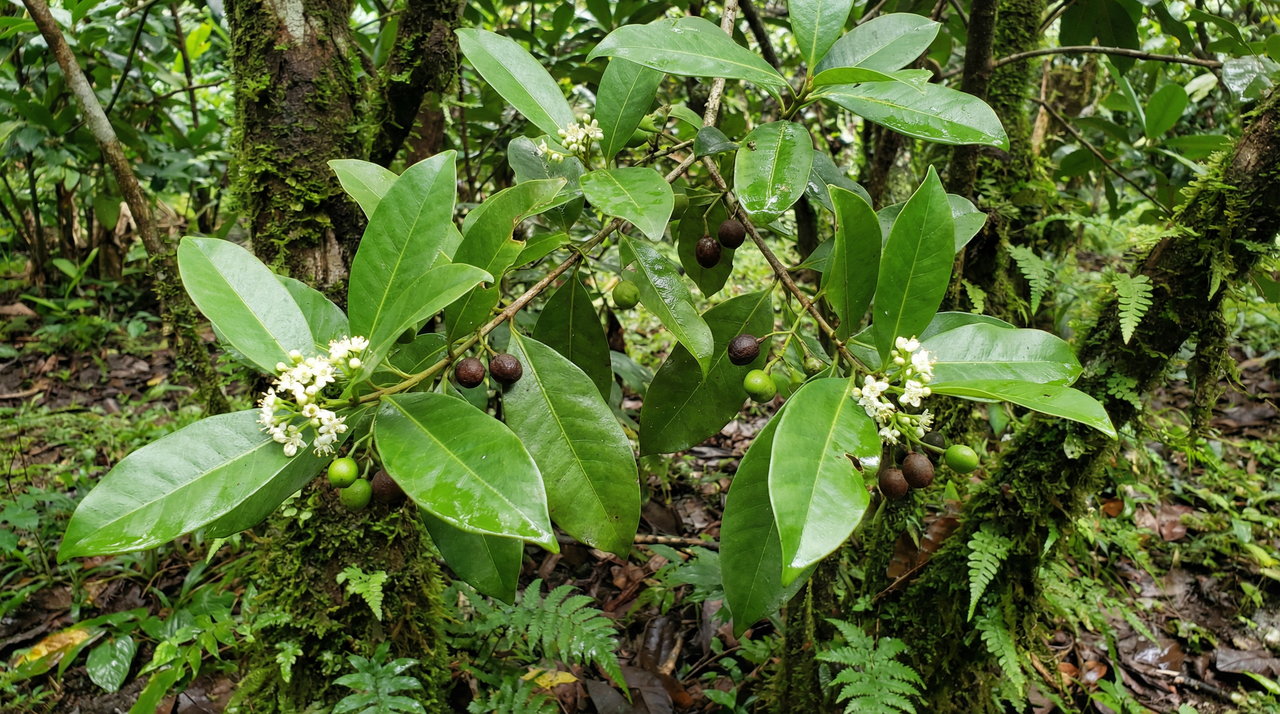
Pimenta dioica in the wild reaches 10 to 20 meters, though cultivated trees are typically kept to 6 to 12 meters for practical harvesting.[2][8] The bark is smooth and grayish-brown, becoming lightly fissured with age. The leaves are opposite, glossy, leathery, and oblong-ovate, roughly 5 to 15 cm long, and studded with tiny pellucid glandular dots that release oil when held to light or crushed.[8][3] The first time I crushed an allspice leaf in the garden, I immediately understood why traders eventually named this plant allspice: the cinnamon-clove-nutmeg rush is unmistakable and a little bit magical coming from a single leaf. The related bay-rum species carry similar aromatic foliage, but when you crush a P. racemosa leaf beside a P. dioica leaf, the bay-rum scent is distinctly sharper and more medicinal, a sensory distinction that only makes sense once you've had both in hand.
Small white star-shaped flowers appear in axillary clusters mainly in spring and summer, followed by 6 to 12 mm spherical drupes, green at first, ripening to reddish-brown, each containing a single seed.[8][2] Those berries, harvested green and unripe, are what became one of the world's most recognized spices.
Traditional and Cultural Significance in the Caribbean
Long before any European ship arrived, the Taíno, Arawak, and Maya had deep working knowledge of this tree. They used the berries and leaves for digestive complaints, colds, and rheumatism, as a meat preservative and antiseptic, in poultices and medicinal teas, and in spiritual rituals involving purification, protection, and cleansing. Leaves and berries appeared in incense, ceremonial baths, and even embalming.[9][10] That knowledge was comprehensive, earned over generations of close observation of a plant that was fully integrated into the life of the forest and the people within it.
That relationship hasn't ended. Allspice remains embedded in Jamaican Maroon and Rastafarian practices, Haitian Vodou rituals, and Garifuna traditions, present in jerk seasoning, soups, preserves, and ital cooking, and understood as a symbol of Jamaican resilience and identity.[11][10] Meanwhile, the genus breadth shows in P. racemosa leaves distilled for bay rum, used historically for hair tonics, joint liniments, and obeah and vodou practices, a parallel ethnobotanical thread that demonstrates just how thoroughly these trees were known and used across their range.[12]
The Taíno knowledge of allspice's preservative and medicinal properties was folded into colonial trade routes that still shape today's supply chains, without acknowledgment or reciprocity.[10]
From Indigenous Use to Global Spice: The Colonial History of Allspice
The spice's flavor identity comes down largely to chemistry. The dried unripe berry's essential oil is dominated by eugenol, reaching up to 80 to 90 percent of total oil composition, supported by eugenyl acetate, β-caryophyllene, methyleugenol, and 1,8-cineole, the combination producing that layered peppery-woody-aromatic profile that reads simultaneously as cinnamon, nutmeg, and clove.[13][14] English traders named it allspice in the 1620s for exactly that reason.[13]
The European encounter began earlier, though. On Columbus's second voyage in 1494, he mistook the berries for pepper and called them "pimiento," a misidentification that lodged in the botanical record for generations.[13][15] Cultivation expanded under Spanish colonization in the 16th century, and Jamaica ultimately came to dominate world production so completely that the island historically supplied over 80 percent of the global supply.[13] That concentration shaped the British colonial spice trade for centuries and still influences how Jamaican allspice is regarded as the benchmark for quality.
Underneath all of that history is an ecology worth respecting. Pimenta dioica functions as a pioneer species in disturbed neotropical habitats, providing shade and structure for understory regeneration, with seeds dispersed by tanagers, agoutis, and other fruit-eaters, and flowers pollinated by bees.[16][17] A mature tree can produce 10 to 25 kg of dried berries annually, with exceptional individuals yielding up to 40 kg.[18] The IUCN currently lists the species as Least Concern due to its wide distribution and cultivation, though wild populations face real pressure from habitat loss and overharvesting, particularly in Jamaica and Grenada.[19] I've seen how readily allspice regenerates in disturbed tropical edges, and that resilience makes it a genuinely promising candidate for reforestation planting, provided the seed is sourced responsibly and the harvesting pressure on wild trees is taken seriously.
Allspice Varieties, Cultivars, and Where to Buy
Limited Named Cultivars and Related Pimenta Species
If you're expecting a seed catalog page full of named cultivars, allspice is going to surprise you. Pimenta dioica has essentially no formally recognized horticultural varieties; what exists in cultivation is a collection of seedling-grown trees and selected clones, mostly tracing back to Jamaican and Central American stock.[20][21] The broader genus follows the same pattern. Pimenta jamaicensis carries two botanical varieties, var. jamaicensis and var. curvipes, but those are taxonomic distinctions for herbarium drawers, not names you'll encounter at a nursery.[21]
The seedlings I've grown from different suppliers show real, visible differences in leaf width and aromatic punch when you crush a leaf, and that genetic variability is simply what you're working with. It's not a drawback so much as a feature of an underdomesticated tropical tree. Pimenta racemosa, the West Indian bay tree, turns up alongside P. jamaicensis in the US trade and the two are frequently confused with each other. Both are valued primarily for their aromatic foliage rather than their berries, and they are more accessible as container specimens than true allspice tends to be.[22][23] Label your pots carefully from day one; the first-year seedlings of these species look nearly identical.
Sourcing Allspice Plants, Seeds, and Dried Berries in the US
You won't find a pimenta dioica plant at your local garden center. This is strictly a specialty-nursery purchase, with the best selection going to growers in USDA zones 10-11, basically South Florida, coastal Southern California, and Hawaii.[24][25] For anyone searching "allspice tree for sale" or "allspice plants for sale," the realistic destinations are Logee's Plants for Better Living, Florida Hill Nursery, Strictly Medicinal Seeds, Sheffield's Seed Company, and Plant Delights Nursery, with Etsy and eBay filling in the gaps, though live-plant shipping carries state-specific restrictions you'll want to confirm before ordering.[23][26] I've ordered from both Logee's and Strictly Medicinal over the years, and I've learned to ask specifically for the freshest seed lot available, because viability drops fast.
Budget-wise, seed packets typically run $3 to $8 for 10 to 50 seeds, with bulk lots of 100 or more landing in the $15 to $50 range; young plants generally cost $10 to $30 each.[27][28] P. racemosa seeds run a little higher, $5 to $15 per packet, with young plants at $20 to $50 and larger trees reaching $50 to $150. Dried berries for the kitchen face only standard FDA food-safety rules, but if you're importing live plants or seeds from outside the country, you'll need a USDA APHIS permit and a phytosanitary certificate; I've been through that process twice, and the phytosanitary certificate is non-negotiable.[29][30]
For dried berries, quality is easy to read once you know what to look for. Whole, glossy fruits that release a strong clove-forward scent when crushed are the good ones; dull, shriveled, or brownish berries have already lost most of their volatile oils.[31] I keep whole berries from a trusted spice supplier next to the ones I've grown and dried myself, and the contrast is striking every time. Once your seeds or plant arrives, act quickly: allspice seeds are recalcitrant and must be sown immediately, while container-grown stock should go into a pot large enough to move indoors or to a protected patio when temperatures threaten to dip toward 35°F.[31][32] Pimenta dioica has naturalized in parts of Florida and Puerto Rico without triggering any invasive-species flags from the Florida Invasive Species Council, so you won't be fighting regulatory headaches on that front once it's in the ground.[33]
Allspice Propagation and Planting
Growing an allspice tree from scratch means making one fundamental choice early: are you starting from seed, or going vegetative? The answer shapes your timeline, your budget, and what you'll ultimately end up with. I've grown both Pimenta dioica and its close cousin West Indian bay (Pimenta racemosa) from fresh seed in subtropical conditions, and the experience taught me fast that the genus has its own rules.
Propagation Methods: Seeds, Cuttings, Grafting, and Air Layering
Seed is the commercial baseline for this species, and for good reason: it's accessible, relatively affordable, and produces trees with broad genetic diversity.[34][35] The catch is that allspice plant seeds are recalcitrant, meaning they cannot be dried and stored like tomato or pepper seeds. They're sensitive to desiccation from the moment they leave the fruit, and viability drops steeply after just one to four weeks.[36][37] Even under optimal moist, cool storage at 10-20°C and 80-90% relative humidity, you're looking at a viable window of one to six months at best.[38] The practical implication: if you're sourcing allspice tree seeds, they need to go into moist media almost immediately after cleaning the pulp. I've lost entire batches by waiting two weeks. Fresh seeds sown promptly can germinate at rates of 50-90%; a 24-hour warm water soak beforehand helps soften the seed coat and nudges those numbers upward.[39][40]
The seedling-grown trade-off worth knowing upfront: allspice seedlings are not true-to-type. They show genetic variation, so two trees from the same batch may differ in leaf oil intensity, growth rate, or berry yield.[34][41] For diversity and resilience in a food forest planting, that's a feature. For replicating a known high-performer, you need vegetative methods.
Semi-hardwood cuttings taken in late summer (4-6 inches, with IBA hormone at 3000-8000 ppm, bottom heat at 75-85°F, and high humidity) root in four to eight weeks with 40-80% success.[42][43] Many U.S. nurseries prefer this route for consistency. Grafting onto compatible Myrtaceae rootstocks (cleft, whip-and-tongue, or budding) gets you clonal trees with 50-80% success rates, and air layering is a solid home-gardener option at 60-80% success.[44][45] Whichever vegetative route you choose, use sterile media and keep humidity high; in my propagation setups I always sterilize everything first because once Phytophthora takes hold in a young cutting or seedling flat, recovery is nearly impossible.[46]
Germination Timeline and Seed Viability for Allspice
At soil temperatures of 75-85°F with consistently moist, well-drained media and indirect light, allspice seeds germinate in two to six weeks.[34][47] I keep seedlings in pots for six to twelve months before transplanting; they're slow to establish and benefit from that container phase. One thing I wish someone had told me: first-year allspice seedlings look remarkably like other small myrtles, so label your rows clearly or you'll spend the second season guessing.
Seed-grown trees take five to seven years to reach full production, with the first small berry crop appearing around year three to five.[18] Grafted trees consistently fruit by years three to five.[44] I've watched grafted stock in a local botanical collection produce reliably by year four while my own seed-grown plants didn't offer a meaningful first harvest until year six. If you're gardening on a timeline, that two-year gap matters.
Soil, Site Selection, and Sun Requirements
Drainage is non-negotiable. Allspice demands well-drained, fertile loamy or sandy-loam soil at pH 5.5-7.0, with roots that need to breathe through at least a meter of uncompacted ground.[34][48] Waterlogging triggers Phytophthora root rot fast, showing up as yellowing leaves and stunted growth before the roots are visibly gone.[49] On Florida limestone soils, I amend liberally with elemental sulfur and organic matter to pull pH into the optimal range; within a season the foliage color and oil richness in the leaves tells me whether it's working.[50][51] For containers, a mix of roughly 40% potting soil, 30% perlite or coarse sand, 20% peat or coir, and 10% compost at pH 5.5-6.5 works well.
Full sun to partial shade suits this tree; six to eight hours of direct sun daily is the target, though its tropical understory origins mean it can handle 30-70% canopy cover without collapsing.[42][52] That shade tolerance is genuinely useful when you're tucking a young pimenta dioica tree into a developing food forest guild beneath taller canopy.
Spacing, Planting Technique, and Initial Establishment
Mature allspice trees reach 20-40 feet tall with canopy spreads of 15-30 feet, so give them room to think about the future.[44] Commercial orchards space trees 20-25 feet apart at densities of 100-150 trees per hectare; high-density plantings compress that to 15-20 feet with regular pruning to manage canopy.[53][54] For home gardens, 10-15 feet is workable if you're committed to pruning. Proper spacing pays off in airflow (which reduces fungal pressure), light penetration, and harvest access once the tree is producing.[55]
Plant in spring or early summer once soil temperatures exceed 70°F.[56] In those first three years before the canopy fills in, the space between trees is an opportunity: Caribbean agroforestry systems routinely intercrop young allspice with banana or coffee, which provides light shade for the young tree, generates income or food in the meantime, and mimics the layered structure the genus evolved in. It's a pattern I find practical and worth borrowing.
Allspice Care Guide: Watering, Feeding, Climate, and Maintenance
Caring for allspice well is really about understanding one central truth: this is a tree from humid Caribbean rainforests, and it will tell you clearly when something is off. Leaf color, wilting patterns, flower timing -- they're all reading you back. Once you learn to read the signals, allspice tree care becomes less guesswork and more conversation.
Watering Needs for Allspice Trees
Allspice wants consistently moist soil, but not wet feet. The practical rule I follow is to let the top 1-2 inches dry out between waterings, then water deeply.[57][44] Young trees and container specimens need water every 5-7 days during active growth, dropping to every 10-14 days in cooler months. Mature trees in the ground can tolerate a dry spell of 2-4 weeks once established, but they perform best with about 1-2 inches of water per week adjusted for season and drainage.[58][59]
Yellowing leaves and soft wilting usually mean overwatering; crisp leaf edges and drooping point to drought stress, and at that point pest pressure tends to follow quickly.[57][60] Those are the two signals I watch first. A thick mulch layer (I aim for 4-6 inches of wood chips or compost) goes a long way toward preventing both extremes -- it conserves moisture, moderates soil temperature, and reduces how often you need to water.[34] Soil pH should fall between 5.5 and 7.5 in well-drained loamy soil; the tree has moderate salinity tolerance but won't thrive in salty or compacted ground.[61]
Sunlight Requirements and Light Management
Full sun is the goal -- at least 6-8 hours daily for strong growth and good essential oil production.[35][48] Mature trees handle partial shade reasonably well, but reduced light shows up quickly as etiolated growth, leaf drop, and noticeably lower berry yields.[62] The tree will adapt by pushing larger, thinner leaves to capture more light -- which is ecologically clever but not what you want from a production tree.[63]
Young plants are a different story. I learned the hard way that moving seedlings straight into full subtropical sun causes scorched, papery leaves within days. Now I use 30-70% shade cloth for the first 4-6 weeks after transplanting, then gradually remove it.[64][65] That acclimation window makes a real difference. In hot subtropical climates, afternoon shade during peak summer heat also helps -- think of it as the natural forest edge condition these trees evolved in.[66]
Feeding and Nutrient Management
Allspice has moderate nutrient needs. It wants balanced macronutrients -- nitrogen for leaf growth, phosphorus for root development, potassium for disease resistance and fruiting -- along with key micronutrients like iron, manganese, zinc, and boron.[67][68] I've found that a citrus-formula 8-3-9 or standard 10-10-10 blend applied 2-4 times a year during spring through fall works well, starting with about 1-2 lbs per young tree.[69][70]
The thing that changed my approach most was noticing aroma. After I switched from a high-nitrogen formula to a balanced one, the leaves and berries from my trees were noticeably more fragrant. Excess nitrogen pushes lush vegetative growth at the direct expense of essential oil concentration -- which matters when you're growing this tree for its spice.[71] Over-fertilizing generally also risks salt buildup, root burn, and leaf scorch, so I rely on a soil test rather than guessing at application rates.[72] Deficiency symptoms to watch for: uniform yellowing of older leaves signals nitrogen deficiency, purplish stunted growth points to phosphorus, marginal leaf scorch suggests potassium, and interveinal chlorosis means iron or magnesium is short.[73] Optimal pH for nutrient availability sits between 5.5 and 6.5.[69]
Frost Tolerance and Cold Protection
Allspice is reliably hardy only in USDA zones 10a-11b, with zone 9b marginal at best.[74][75] The RHS rates it H1c, meaning greenhouse protection is required anywhere outside the warmest coastal climates in the UK.[76] Brief dips to 28-30°F may be survivable for mature trees, but damage begins below 30°F and anything below 28°F risks severe or lethal injury.[77][78] Young plants are far more vulnerable than established ones, so if you're pushing the cold limits, mature specimens are your best bet for recovery.
I tell people: if you can successfully overwinter container lemons or avocados using frost cloth and mulch, you can protect allspice the same way. The toolkit is identical -- 4-6 inches of organic mulch over the root zone, frost blankets that can raise air temperature 4-8°F around the canopy, and a south-facing sheltered microclimate away from frost pockets.[79] Container growing is the simplest hedge for zone 9b growers. The closely related Pimenta racemosa and P. jamaicensis share nearly identical frost thresholds, so experience with either species transfers directly.[80][81]
Heat Tolerance and High-Temperature Management
Allspice grows best between 70-90°F and is rated AHS Heat Zone 10, meaning it can handle brief spikes to 100-105°F.[82][83] Once temperatures push above 95-104°F consistently, though, the tree starts to struggle -- photosynthesis slows, stomata close, flowers drop, and fruit set declines.[84] I've seen this in my own garden during multi-week heat stretches: smaller berry clusters, slower ripening, and leaves that go dull rather than glossy.
The mitigation practices I rely on every summer are straightforward but they do make a difference. Deep watering early in the morning (before heat peaks) at about 1-2 inches per week, combined with that 3-6 inch mulch layer to hold soil temperature steady, reduces stress noticeably.[85][86] Windbreaks planted 10-20 feet away reduce desiccating wind exposure, and shade cloth (30-70%) gives young trees a real advantage during peak summer.[87] There are no widely recognized heat-tolerant cultivars of allspice, so your best option is selecting from locally adapted nursery stock and building the right microclimate around your tree.[59]
Pruning, Maintenance, and Seasonal Rhythm
Allspice is a genuinely slow-growing tree. Expect slow, steady baseline growth as the tree establishes its canopy over decades.[44][88] That long arc is part of why I think of pruning as a decades-long conversation with the tree rather than an annual chore. The best time to prune is after harvest, during the dry season -- remove dead, crossing, or damaged branches, but resist the urge for heavy cuts, which reduce essential oil production.[89] Light tip pruning in spring and summer encourages bushy structure on younger trees. Space trees 15-20 feet apart and site them away from strong prevailing winds, which can shred the large aromatic leaves.[90] A well-cared-for allspice tree can remain productive for 30 to 100 or more years in optimal conditions -- that's the time horizon worth keeping in mind when you're making pruning decisions early on.[88]
Seasonal Care for Allspice
In the native Caribbean range, allspice flowers primarily from April through June, with berries developing and reaching harvest readiness from July through October.[3] In consistently warm tropical conditions the phenology can become semi-continuous, but in USDA zones 10-11 with any seasonal temperature variation, this spring-summer-fall rhythm is fairly reliable. I use the appearance of the first white flower clusters in late spring as my signal that the tree is content with its siting and nutrition -- it's one of those observations that ties all the care variables together into a single quiet confirmation.
Watering and feeding follow this same seasonal arc. During spring and summer, keep the top 1-2 inches moist and water every few days in heat; in fall, allow the top 2-3 inches to dry before watering every 6-7 days; in winter, water sparingly every 1-2 weeks only if the soil is dry, and never during frost events.[91][92] Fertilize during active spring and summer growth only; hold off entirely in winter dormancy.[3] Monitoring for nutrient deficiency symptoms tends to intensify during heat stress and recovery periods, so those are the seasons to look most closely at your leaves. P. racemosa and P. jamaicensis follow the same basic seasonal pattern and hardiness profile, which makes experience with any member of the genus genuinely transferable.[93]
Harvesting Allspice Berries
The whole harvest story with allspice comes down to timing: catch the berry at exactly the right physiological moment, and you get that deep, complex warmth the spice is famous for. Miss it, and you get something thinner, less pungent, less worth the wait. A tree started from seed won't offer you much to harvest for five to seven years, and even vegetatively propagated stock needs three to five before it produces seriously. But once a mature tree hits its stride, it can yield reliably for decades, so learning its harvest rhythm is genuinely worth the investment.
When to Harvest Allspice
The berries need roughly six to eight months from flowering to reach the harvesting window, and in Jamaica that lines up with August through October; Central American trees tend to peak a bit later, September into November.[94][95][96] Trees at higher elevations, up to around 500 meters, can push maturation back another one to two weeks.[97][96]
After growing allspice through several fruiting seasons, I've learned to watch the color shift rather than the calendar. The berries turn from deep green to a plum-red blush well before full ripeness, and that is your window. Letting them go even a few days past that point noticeably drops the eugenol content that gives allspice its depth. You want the berry firm to the touch, not soft, and fully colored but definitely not ripe enough to fall. The related West Indian bay (Pimenta racemosa) follows the same six-to-eight-month berry development pattern, though for that species growers are typically chasing the aromatic leaves during the dry season rather than the fruit itself.[98]
How to Harvest and Process Allspice
Hand-picking is the standard method, and it's really the only one that makes sense at any scale a home grower would manage. You're selecting berries in the four-to-eight millimeter range, firm and intact, cleaning away stems and debris once you're off the tree, then spreading them to sun-dry for four to seven days until they reach that characteristic mahogany-brown and drop to around ten to twelve percent moisture content.[94][99][47] There's an optional curing step after drying where you pile the dried berries together for a day or two to let the aroma develop further.[94] I've done this and found it genuinely improves the depth of the finished product; it's a small extra step that's hard to argue against.
Yield, Flavor, and Storage
A well-managed mature tree typically produces ten to twenty kilograms of dried allspice berries per year; wild trees run closer to five to ten.[94][88] Eugenol makes up sixty to ninety percent of the essential oil in the dried berry, and Jamaican-grown material consistently hits the high end of that range, seventy-five to ninety percent, supported by β-caryophyllene for woody-spice character and limonene for a citrus lift.[100][101] In practice, Jamaican-climate-grown whole allspice berries consistently smell more clove-forward after drying than Central American fruit, and that difference is real enough to notice when you open the drying tray. The signature clove-cinnamon-nutmeg bouquet with its clean, non-bitter finish is created as much in the drying yard as on the tree itself, which is why harvesting green and unripe, then drying carefully, is the whole game.[102] The leaves are worth using in Caribbean cooking, jerk seasoning especially, but they're secondary; the dried berry is the primary product.[3]
For storage, I keep dried allspice pimento berries in small glass jars at cool room temperature and find they hold their full aroma for at least three years. The FAO and USDA guideline of ten to fifteen degrees Celsius at fifty to sixty percent relative humidity has proven reliable in my own pantry.[94][103][104] Done right, a single good harvest can flavor your kitchen for three to four years. That's the real reward for getting the timing right.
Allspice Preparation and Uses
Culinary Uses and Flavor Profile
The berries are the star. Harvested green and unripe, then sun-dried to a deep mahogany brown, they're what most of the world means when it says "allspice."[24][13] That name isn't just marketing. This signature warm, blended complexity is driven by eugenol alongside supporting compounds like caryophyllene, cineole, and linalool.[105][106] When I'm mixing jerk seasoning at home, I use noticeably less of my own home-dried berries than I would store-bought powder, because the whole dried berry I ground myself carries so much more heat and aromatics than the pre-ground stuff sitting in a jar on a warehouse shelf.
The leaves deserve equal attention, though they're far less celebrated outside the Caribbean. Fresh Pimenta dioica leaves work beautifully as a bay leaf substitute in stews and braises, and related species like P. racemosa and P. jamaicensis follow the same pattern, lending their aromatic warmth to rice, meats, and jerk marinades before being pulled out before serving.[24][11][107] Anyone who gardens in the subtropics knows that a fresh leaf torn from the tree and dropped into a slow-cooked stew smells nothing like the dusty dried bay leaves from the grocery store. The aroma is fuller, more resinous, genuinely complex.
Regionally, allspice seasoning anchors Jamaican jerk alongside Scotch bonnet peppers, thyme, garlic, and cinnamon, appears in Latin American mole sauces, and forms the backbone of Middle Eastern baharat blends.[108][105] Early Spanish traders carried the spice across the Atlantic, where European bakers folded it into spice blends beside cinnamon, nutmeg, and ginger where it still belongs today.[13] One fair caution: stick to berries and leaves. The bark has no established edibility, and proper identification matters because some look-alikes in the landscape, certain Sassafras or Daphne species among them, are genuinely toxic.[24] I learned to key out my seedlings carefully early on, and I've never regretted taking that extra time.
Medicinal Preparations
Traditional Caribbean preparations draw on both berries and leaves, and the methods are straightforward: infusions, decoctions, poultices, and liniments made from material that can be used fresh or dried depending on what's available.[109][110] A simple leaf tea, about one to two teaspoons of dried leaves steeped ten to fifteen minutes, taken once to three times daily, is the most common domestic preparation across the Pimenta genus.[111] I make it fairly regularly, and I treat it the way I'd treat any herb tea: pleasant in normal quantities, not something to push to excess.
The essential oil is where care really matters. Given the berry's profound eugenol concentration, a dilution of 1 percent or less in a carrier oil is the sensible ceiling for topical use.[71][106] I've found that staying at or below 1% keeps the pleasant warming sensation from crossing into actual redness or irritation. Internal use of concentrated essential oil isn't something to attempt without professional guidance; that's not overcaution, it's just chemistry.[112]
Non-Food and Traditional Applications
The same aromatic leaves that season a pot of rice have a long second life in Caribbean fragrance tradition. Leaves of Pimenta racemosa and P. jamaicensis are distilled into bay rum oil, historically blended with rum for use as a cologne, aftershave, hair tonic, and scalp rinse.[113][11][114] There's something I find quietly wonderful about a plant whose leaves can finish a stew in the afternoon and condition your hair in the evening. That breadth of use, built into the same eugenol chemistry threading through the whole genus, is exactly why this tree earns its place in a serious food forest.
Allspice Health Benefits and Medicinal Uses
Most people think of allspice as something that belongs in pumpkin pie and jerk marinade, full stop. But once you start looking at the phytochemistry behind that warm, complex aroma, the traditional reputation of Pimenta dioica as a medicinal plant starts making a lot of sense. The bioactivity is real. The research, however, comes with some important caveats, and I'd rather give you the honest picture than oversell a spice rack staple.
Key Phytochemicals in Allspice: Eugenol and Supporting Compounds
The health story of allspice is, at its core, a eugenol story. The fruit essential oil is dominated by eugenol at 70-90%, with the leaf oil running somewhat lower at 60-80%, followed by methyl eugenol, β-caryophyllene, and a cast of minor terpenoids and phenolics.[115][116] Related species like Pimenta racemosa and P. jamaicensis follow a similar pattern, with eugenol typically comprising 50-85% of their oils, though that number shifts with plant part, geography, soil, and seasonal conditions.[117][118]
I've grown allspice in Central Florida, and I've noticed that the berries smell noticeably richer and warmer during the hottest, driest stretches of summer. That tracks with what the research shows: stress conditions and heat tend to push essential oil production. It's a direct, sensory connection to the chemistry.
Eugenol doesn't work alone, though. Pimenta dioica also contains significant phenolic compounds including gallic acid, protocatechuic acid, catechin, quercetin, and quercitrin, with total phenolic content running 100-200 mg GAE per gram and ORAC values exceeding 100,000 μmol TE per 100g.[119][71] Free radical scavenging activity (DPPH IC50 of 10-50 μg/mL) puts it in genuinely strong antioxidant territory, not just "technically has antioxidants" territory.[120] As a member of the Myrtaceae family, allspice shares this terpenoid and phenolic-rich secondary metabolite profile with related genera, where eugenol itself appears to serve an ecological role in plant defense against herbivory and pathogens.[121][122]
Nutritional Profile of Allspice
The per-100g numbers for ground allspice look impressive:
- 263 calories
- Over 21g of fiber
- 1044mg of potassium
- 661mg of calcium
- 255mg of magnesium
- 7.06mg of iron
- Meaningful amounts of vitamins C, E, and A
Where allspice earns its keep nutritionally is manganese. A teaspoon of ground allspice delivers more manganese than almost any other spice I regularly work with in the kitchen, and that's before you factor in the antioxidant flavonoids that come along for the ride. A dash in a curry or a few whole berries in a braise won't transform your mineral intake, but relative to the quantity used, it's punching well above its weight.
Medicinal Research and Traditional Uses of Allspice
Traditional Caribbean use of Pimenta dioica covers a lot of ground: dyspepsia, flatulence, diarrhea, toothache, muscle pain, arthritis. Antimicrobial applications appear consistently across ethnobotanical records, and lab work backs up the pattern, with activity documented against E. coli, S. aureus, and Candida albicans, again largely attributed to eugenol content.[124][125][126]
Related species flesh out the picture further. Across P. racemosa, P. jamaicensis, and P. pseudocaryophyllus, preclinical studies show anti-inflammatory mechanisms including NF-κB and COX-2 inhibition, with paw edema reductions of 60-70% in rodent models, and analgesic activity comparable to aspirin via TRPV1, TRPA1, and COX/LOX pathways.[127][128] The shared Caribbean ethnobotanical tradition of using these plants for rheumatism, respiratory infections, and wound healing aligns closely with what the lab data is showing.[129]
I've followed the Pimenta literature for years, and while the animal and in vitro data is genuinely promising, there are no large-scale randomized controlled trials or systematic reviews on human clinical use for any species in this genus.[130][131] I don't recommend allspice as a standalone treatment for anything until we have better human evidence. The traditional use is real and worth respecting; the clinical confirmation isn't there yet.
Safety Considerations for Allspice
Culinary use of allspice is FDA GRAS, and at the teaspoon-in-your-jerk-rub scale, that's exactly where this spice belongs for most people.[132][133] The risk profile changes substantially when you move toward concentrated essential oil, which is roughly 50-100 times more potent than the dried spice. At that concentration, the eugenol (up to 80%) and methyl eugenol, which IARC classifies as a possible human carcinogen, become genuine concerns.[134]
Large doses of the essential oil can trigger gastrointestinal irritation, nausea, vomiting, CNS depression, and at high enough exposures, hepatotoxicity in animal models.[133] Allergic contact dermatitis and occupational asthma are rare but documented, usually from repeated direct skin exposure to eugenol.[135]
The drug interaction piece is the part I bring up most often with clients. If you're on blood thinners, eugenol's anticoagulant potential isn't theoretical; it's documented across multiple essential oil safety references, and allspice in medicinal quantities could amplify anticoagulant effects.[136][137] CYP450 interactions, effects on blood sugar regulation, and possible uterine stimulant activity at high doses mean that pregnancy, breastfeeding, children under six, and pre-surgery windows all warrant extra caution.[138][137] Talk to your doctor before using more than culinary amounts if any of those apply to you.
For topical applications, especially if you're working with related P. racemosa bay rum oil for muscle pain or as a liniment, dilute to 1-2% in a carrier oil and always patch test first.[138][139] Internal use of any Pimenta essential oil should stay firmly in the "professional guidance only" category.
Allspice Pests and Diseases
Natural Defenses and Disease Susceptibility
There's something satisfying about crushing an allspice leaf and getting that sharp, clove-forward hit of eugenol right in the face. I've noticed that plants grown in full sun release a noticeably stronger scent, and those same plants consistently show fewer aphid colonies than partially shaded specimens in my landscape. That's not coincidence. The eugenol and phenolic compounds concentrated in every part of this tree serve as genuine built-in repellents, providing real baseline protection that most gardeners don't fully appreciate.[140][141]
That said, allspice carries moderate overall disease resistance, and once humidity climbs above 80% and temperatures settle into that 25-30°C sweet spot, fungal pathogens find their opening.[142][37] The most serious disease by far is Phytophthora root rot, caused by Phytophthora cinnamomi, which moves fast in waterlogged or poorly drained soil and can take a young tree down before you've fully registered something is wrong.[143][144] I lost a young allspice to exactly this in a low spot with marginal drainage, and I've never planted a Pimenta in flat ground since. Raised beds or sloped sites only, full stop.
Anthracnose, caused by Colletotrichum gloeosporioides, is the second major threat, attacking leaves, stems, and developing berries with sunken lesions that lead to defoliation and real yield loss if ignored.[145][146] Fungal leaf spots from Cercospora, Pestalotiopsis, and Alternaria species round out the common disease picture, causing spotting, yellowing, and premature leaf drop under similar humid conditions.[147][148] Bacterial and viral diseases, thankfully, are rarely reported and not considered significant concerns for home or commercial growers.[147] The related Pimenta racemosa adds one more Myrtaceae-family worry worth knowing: myrtle rust (Austropuccinia psidii), which has been spreading through Florida and the Caribbean and could affect the broader genus.[149]
No disease-resistant cultivars of Pimenta dioica exist commercially; breeding programs in Jamaica and Mexico are ongoing but have focused on yield and essential oil quality rather than pathogen resistance.[150] Every allspice I've grown still relies entirely on cultural practices, and that's where the real control lives in a home garden or permaculture planting.
Common Insect Pests of Allspice
The eugenol chemistry deters a lot, but not everything. Scale insects, mealybugs, aphids, thrips, leaf-eating caterpillars, bark borers, and fruit flies all show up in the pest literature for Pimenta dioica, and most growers in humid tropical regions will eventually meet at least a few of them.[74][56] Scale and mealybug infestations are the ones I watch most closely, because sap-feeding leads to honeydew, which leads to sooty mold, which can coat enough leaf surface to meaningfully reduce photosynthesis. Related P. racemosa can lose 30-50% of its foliage from untreated scale or aphid pressure, which gives you a sense of how quickly things can spiral without intervention.[37] Bark borers are the other concern I take seriously; structural damage from borers is slow to show and hard to reverse once it's established in a young tree.
Young trees and plants growing outside their native range are consistently more vulnerable, and pest pressure in Jamaica and the Caribbean is notably higher than what most Florida or California growers encounter.[150] Caribbean fruit fly (Anastrepha suspensa) is a documented threat to related Pimenta species in the region, causing premature berry drop and yield loss.[151] Poor airflow and waterlogging predictably amplify all of these pressures, which is why the spacing and drainage decisions discussed in earlier sections aren't just aesthetic choices.
Integrated Pest and Disease Management for Allspice
Cultural prevention is genuinely the most powerful tool available, and there's no breeding shortcut coming anytime soon.[152] Proper spacing for airflow, excellent drainage, drip irrigation rather than overhead watering, clean pruning cuts, and prompt removal of diseased material handle the bulk of problems before they become crises.[37][153] For young trees especially, I make a habit of checking the undersides of leaves every couple of weeks; catching scale or aphids early means a horticultural oil or neem spray handles it cleanly before sooty mold enters the picture.
When biological support is possible, it's worth building in. Trichoderma soil treatments offer real protection against Phytophthora and other soilborne pathogens, and Bacillus subtilis foliar sprays can reduce fungal pressure without chemical load.[69][152] I've been running Trichoderma inoculations at planting in my subtropical trials, and they track well against what extension researchers report locally. When chemical intervention becomes necessary, copper-based fungicides address leaf spots and anthracnose, metalaxyl targets Phytophthora, and broader fungal issues respond to azoxystrobin or mancozeb.[153] The sequence matters: reach for biological and cultural tools first, and treat chemicals as a targeted last resort rather than a routine.
Allspice (Pimenta dioica) in Permaculture Design
Before you fall in love with the idea of allspice in your food forest, you need to have an honest conversation with your climate. I say this as someone who has grown it in Central Florida and learned, sometimes the hard way, that even zone 10 is not a free pass. The design decisions for this tree flow almost entirely from its frost sensitivity and its hunger for tropical humidity, so getting that foundation right is the whole game.
Climate Requirements and Hardiness Zones
Pimenta dioica is solidly at home in USDA zones 10b through 12, with the sweet spot in zones 10b to 11.[24][74][3] Young trees show frost damage below 30°F and can die outright below 20°F, so winter protection is not optional when plants are young.[24] My first two seedlings went into the ground in Brevard County with nothing but confidence, and I spent the following January throwing frost cloth over them at midnight. A south-facing wall or the thermal mass of a larger established canopy tree makes a real difference. Don't skip that step.
The tree wants 60 to 100 inches of annual rainfall, 60 to 80 percent relative humidity, and average temperatures between 68 and 86°F.[2][154][5] Once established, though, those thick leathery leaves and deep roots give it a surprising ability to bridge dry spells.[2] In the United States, reliable outdoor production is realistic in southern Florida, Hawaii, and sheltered coastal pockets of southern California or Texas with freeze protection; anywhere in zones 7 through 9, you're looking at greenhouse or large-container culture with supplemental heat and humidity.[74][58][155] If you're on the climate edge and want a related species with marginally more resilience, Pimenta racemosa can shrug off brief dips to 28 to 30°F, and P. jamaicensis sometimes succeeds in protected 9b sites, but neither delivers the same commercial berry that makes allspice allspice.[156][64][48]
Ecological Functions and Forest Layer Role
Once you've confirmed the climate fit, the ecological richness this tree contributes is genuinely exciting. As a mid-canopy evergreen native to tropical moist forests across Central America and the Caribbean, allspice does real structural work: its deep root system anchors soil on slopes, and its leaf litter cycles nitrogen, phosphorus, and potassium back into the soil as it breaks down.[157][158] I've noticed that allspice leaf litter breaks down noticeably faster than what I see under most other tropical evergreens in my beds, which makes sense given the essential oil content affecting microbial activity. That turnover means nutrients return to the surface layer relatively quickly, which your understory plants will appreciate.
Allspice isn't a nitrogen fixer, but it functions as a dynamic accumulator, mining deeper soil layers and returning nutrients through prunings that work well as mulch or green manure.[159][160] Pair it with a nitrogen-fixer in the upper canopy, and you've got a complementary nutrient partnership. The aromatic compounds in the foliage and berries add another layer of function: they provide natural pest-repellent and antimicrobial effects that benefit the whole guild, and the branching structure supports epiphytes like orchids and bromeliads, which increases overall canopy biodiversity.[161][157] Related species like P. racemosa and P. jamaicensis share many of these functions and also provide bird-dispersed fruits and erosion control, though P. racemosa tends toward more of an understory pioneer role in disturbed sites rather than the true mid-canopy position allspice holds.[162][163]
The flowers deserve special attention from a design perspective. Small, white, fragrant, and nectar-rich, they draw carpenter bees, bumblebees, and honeybees, and fruit set is significantly higher with insect visitation than with wind or self-pollination alone.[164][165] In my garden, carpenter bees are the most frequent and effective visitors by a wide margin, and I've watched them work the flowers for years. Pollination peaks at 24 to 28°C and 70 to 80% humidity, and habitat fragmentation or pollinator decline can cut yields by 20 to 50%.[166][167] Planting nectar corridors, avoiding any pesticide use during bloom, and providing nesting habitat for native bees aren't just good permaculture practice here; they're directly tied to your berry harvest.
Pollination Ecology and Guild Companions
Allspice starts its life as a shade-tolerant seedling, needing 40 to 60% shade for good establishment, then matures into a tree that wants full sun to light shade at mid-to-upper canopy height, reaching 20 to 30 feet under cultivation or up to 50 feet in forest settings.[168][157][169] That shade progression is your design cue: plant it with some initial canopy protection above, then let it grow into the light as the system matures. It forms mycorrhizal associations that improve phosphorus uptake and relies on birds and mammals for seed dispersal, which means it integrates naturally into a food forest that's already attracting wildlife.[170][171]
As a guild centerpiece, allspice works beautifully above shade-tolerant companions like vanilla, coffee, cacao, and medicinal herbs, with nitrogen-fixers planted nearby to compensate for what it doesn't provide itself.[172][173] I've had good results pairing it with vanilla orchids on the same trellis system; the tree's dappled shade and the humidity it helps maintain in its microclimate suit the vine without creating the deep shadow that would shut down flowering. One practical note: in the first growing season, allspice seedlings look deceptively similar to other Myrtaceae, so mark your rows carefully if you're starting multiple species from seed in the same nursery bed. P. jamaicensis occupies a similar mid-layer niche with comparable shade tolerance, while P. racemosa is better suited to understory or pioneer roles; P. pseudocaryophyllus is a different story altogether, functioning as an understory shrub in Brazilian montane forests well above sea level.[174][175] Knowing where each species sits in the canopy helps you use the whole genus intentionally rather than treating them as interchangeable.
The Tree That Made Me Rethink What "Slow" Means
I planted my first allspice seedling on a warm January morning and genuinely wondered if I'd ever live to harvest it. Now I crush a berry between my fingers before almost every Caribbean dish I cook, and the smell still stops me cold every single time. Some plants earn their place through sheer productivity; this one earns it through patience and then pays you back in something that feels almost unreasonable.
Sources 175
- Characterization of essential oil from Pimenta dioica ↩
- Pimenta dioica - Wikipedia ↩
- Allspice (Pimenta dioica) - Kew Royal Botanic Gardens ↩
- Pimenta dioica L. - USDA Forest Service ↩
- Allspice Production Guide ↩
- Pimenta racemosa ↩
- Bay Rum Tree (Pimenta racemosa) ↩
- Pimenta dioica (L.) Merr. - Allspice ↩
- Ethnobotany of Pimenta dioica in the Caribbean ↩
- Indigenous Knowledge of Caribbean Spices ↩
- Ethnobotany of the Caribbean: Bay Rum Tree ↩
- History of Bay Rum Tree - Economic Botany ↩
- Allspice: History and Uses ↩
- Chemical Composition of the Essential Oils of Pimenta dioica ↩
- Christopher Columbus and the New World Spices ↩
- Ecological Role of Pimenta dioica in Neotropical Forests ↩
- Wildlife Interactions and Seed Dispersal in Allspice ↩
- Allspice Production Guide ↩
- Pimenta dioica ↩
- Allspice (Pimenta dioica): Botany, Cultivation and Post Harvest Technology ↩
- Plants of the World Online ↩
- Pimenta racemosa: The Bay Rum Tree ↩
- Bay Rum Tree (Pimenta racemosa) Seeds ↩
- Pimenta dioica ↩
- Allspice Management in Florida ↩
- Pimenta racemosa - Bay Rum Tree ↩
- Allspice Seeds - Pimenta dioica ↩
- Allspice Plant - Pimenta dioica ↩
- Importation of Plants and Plant Products ↩
- PPQ Form 526 Application for Permit to Import Plants or Plant Products ↩
- Herb Horticulture: Pimenta dioica - University of Florida Extension ↩
- Allspice in Florida Landscapes ↩
- Florida's Most Invasive Plants ↩
- Allspice Production in Florida ↩
- Pimenta dioica (Allspice) ↩
- Seed Viability and Storage Physiology of Pimenta dioica ↩
- Allspice Propagation and Seed Viability - University of Florida IFAS Extension ↩
- Tropical Tree Seed Manual ↩
- Germination of Allspice (Pimenta dioica) Seeds ↩
- Seed Biology and Propagation of Pimenta Species ↩
- Allspice - Pimenta dioica ↩
- Propagation of Allspice (Pimenta dioica) ↩
- Bay Rum Tree Care and Propagation ↩
- Allspice Production and Utilization ↩
- Tropical Fruit Tree Grafting Techniques ↩
- Florida Milkweed Paths and Allspice Horticultural Guide ↩
- Allspice (Pimenta dioica) in the Landscape ↩
- Allspice (Pimenta dioica) - Missouri Botanical Garden Plant Finder ↩
- Pimenta racemosa (West Indian Bay Tree) ↩
- Allspice Tree Care Guide - Gardening Know How ↩
- Container Growing Tropical Trees - University of Florida IFAS Extension ↩
- Pimenta dioica - Kew Science Plants of the World Online ↩
- Allspice Production and Research in Jamaica ↩
- Tropical Fruit Trees: Planting and Spacing Guidelines ↩
- Allspice Production and Marketing in the Caribbean ↩
- University of Florida IFAS Extension ↩
- Allspice Plant Care - Gardening Know How ↩
- Allspice Growing Guide - Royal Horticultural Society ↩
- USDA Plants Database - Pimenta dioica ↩
- Root Rot in Tropical Plants ↩
- Pimenta racemosa - West Indian Bay ↩
- Sunscald and Leaf Scorch in Tropical Plants ↩
- Pimenta racemosa (West Indian Bay Tree) ↩
- Pimenta racemosa (Bay Rum Tree) ↩
- Light Requirements for Tropical Trees ↩
- Light Requirements for Tropical Trees - University Extension Guide ↩
- Nutrient Management for Tropical Fruit Trees ↩
- Nutrient Management in Tropical Trees ↩
- Fertilization of Tropical Fruit Trees ↩
- Hawaii Tropical Fruit Trees Fertilizer Recommendations ↩
- Essential Oils from Bay Leaves (Pimenta racemosa) ↩
- Overfertilization Symptoms in Tropical Trees ↩
- Nutrient Deficiencies in Plants ↩
- Allspice Cultivation Guide - University of Florida IFAS Extension ↩
- USDA Plants Database - Pimenta dioica ↩
- Pimenta dioica - RHS Gardening ↩
- Pimenta dioica - Kew Science ↩
- North Carolina Extension Gardener Plant Toolbox - Allspice ↩
- Frost Protection for Tropical Plants - Royal Horticultural Society ↩
- Pimenta jamaicensis - Missouri Botanical Garden ↩
- Bay Rum Tree - University of Florida IFAS Extension ↩
- Heat Stress Effects on Tropical Spices: A Review ↩
- Tropical Fruit Production in Florida: Allspice ↩
- Pimenta dioica L. (Myrtaceae): Cultivation and Stress Responses ↩
- Allspice Production Guide ↩
- Heat Stress Management in Tropical Trees ↩
- Shade Management for Tropical Crops ↩
- California Rare Fruit Growers ↩
- Pruning Tropical Trees: Allspice ↩
- Pimenta racemosa: Bay Rum Tree Cultivation and Care ↩
- Missouri Botanical Garden: Pimenta dioica ↩
- Royal Horticultural Society (RHS): Pimenta dioica ↩
- Pimenta jamaicensis - Florida Native Plant Society Factsheet ↩
- Allspice: Production, Processing and Marketing ↩
- Allspice Production and Marketing in Jamaica ↩
- Spice Crops of Central America: Allspice Phenology ↩
- Pimenta dioica: Cultivation and Harvesting Practices ↩
- Pimenta racemosa (West Indian Bay Tree) ↩
- Harvesting and Post-Harvest Handling of Allspice ↩
- Chemical Composition of the Leaf and Berry Oils of Pimenta dioica from Jamaica ↩
- Effect of Maturity Stage on the Essential Oil Composition of Pimenta dioica Berries ↩
- Allspice Flavor Profile and Chemical Composition ↩
- Drying and Storage of Allspice Berries ↩
- Allspice Storage and Use - USDA Agricultural Handbook ↩
- Allspice - Wikipedia ↩
- Allspice (Pimenta dioica): A Review of Its Chemical Composition and Bioactivity ↩
- West Indian Bay Leaf - Pimenta jamaicensis ↩
- Traditional Uses of Allspice in Jamaican Cuisine and Medicine ↩
- Medicinal Uses of West Indian Bay Tree ↩
- Pimenta jamaicensis - Useful Tropical Plants ↩
- Pimenta racemosa - Useful Tropical Plants Database ↩
- Essential Oils: Pimenta racemosa - AromaWeb ↩
- Traditional Uses of Medicinal Plants in the Caribbean ↩
- Plants of the World Online ↩
- Chemical Composition of the Essential Oils of Pimenta dioica ↩
- Phytochemical and Pharmacological Review of Pimenta dioica ↩
- Chemical Composition and Antioxidant Activity of Essential Oil from Leaves of Pimenta racemosa ↩
- Chemical Composition and Variability of the Essential Oils from Wild Populations of Pimenta dioica (L.) Merr. from the Caribbean ↩
- Phytochemicals and Health Benefits of Allspice (Pimenta dioica) ↩
- Antioxidant properties of essential oils from Pimenta species ↩
- Secondary Metabolites in Myrtaceae: A Review Including Pimenta Species ↩
- Secondary Metabolites of Pimenta dioica and Their Role in Plant Defense ↩
- Spices, allspice, ground - USDA FoodData Central ↩
- Pimenta dioica (Allspice): A Comprehensive Review of Its Traditional Uses, Phytochemistry, and Pharmacology ↩
- Antimicrobial activity of allspice (Pimenta dioica) essential oil ↩
- Antimicrobial and Antioxidant Activities of Pimenta dioica Leaves ↩
- Anti-inflammatory and analgesic activities of Pimenta racemosa essential oil ↩
- NF-κB suppression by Pimenta pseudocaryophyllus leaf extract ↩
- Traditional uses of Pimenta racemosa in Caribbean folk medicine ↩
- Pimenta racemosa (Mill.) J.W. Moore ↩
- Pharmacology of the genus Pimenta: a review of medicinal species. ↩
- FDA Substances Added to Food Inventory ↩
- Allspice - Drugs and Lactation Database (LactMed) ↩
- Eugenol and Methyleugenol Safety Assessment ↩
- Allergic Contact Dermatitis from Spices ↩
- Allspice - WebMD ↩
- Eugenol: A Review of Its Pharmacological and Toxicological Effects ↩
- Essential Oil Safety: A Guide for Health Care Professionals ↩
- Tisserand Institute: Bay Rum Oil Profile ↩
- Insecticidal and repellent activity of Pimenta dioica (L.) Merr. essential oil against stored-product insects ↩
- Essential Oils as Insect Deterrents in Pimenta Species ↩
- University of the West Indies (UWI) Plant Protection Handbook ↩
- Phytophthora Root Rot of Allspice ↩
- Phytophthora Root Rot of Trees and Shrubs ↩
- Anthracnose of Allspice (Pimenta dioica) ↩
- Anthracnose of Allspice: Etiology and Control ↩
- Diseases of Allspice (Pimenta dioica) ↩
- Fungal Pathogens of Allspice in Jamaica ↩
- Myrtle Rust in Florida ↩
- Diseases of Allspice (Pimenta dioica) in Jamaica ↩
- Caribbean Fruit Fly Management ↩
- Integrated Pest Management for Spices - ResearchGate ↩
- Allspice Production Guide - FAO ↩
- Missouri Botanical Garden Plant Finder: Pimenta dioica ↩
- Tropical Fruit Trees in Hawaii ↩
- Pimenta racemosa (West Indian Bay Tree) ↩
- Allspice Ecology in Tropical Forests - USDA ↩
- Biodiversity and Nutrient Cycling in Caribbean Forests ↩
- Ecological Roles of Allspice in Tropical Agroecosystems ↩
- Permaculture Plants: Allspice (Pimenta dioica) ↩
- Medicinal Properties of Allspice ↩
- Plant Profile: Pimenta racemosa (West Indian Bay Tree) ↩
- Seed Dispersal by Birds in Caribbean Ecosystems ↩
- Floral Biology of Pimenta dioica - Journal of Tropical Ecology ↩
- Pollination Ecology of Myrtaceae in the Neotropics ↩
- Effects of Habitat Fragmentation on Allspice Pollination ↩
- Pollination Ecology of Pimenta dioica in Jamaica ↩
- Shade Tolerance of Tropical Trees: Pimenta dioica ↩
- Allspice Tree - University of Florida IFAS Extension ↩
- Mycorrhizal Associations in Tropical Trees ↩
- Seed Dispersal of Allspice in Neotropical Forests ↩
- Permaculture Guilds with Allspice (Pimenta dioica) ↩
- Allspice Cultivation in Agroforestry Systems ↩
- Flora of the West Indies: Pimenta jamaicensis ↩
- Pimenta pseudocaryophyllus - Wikipedia ↩