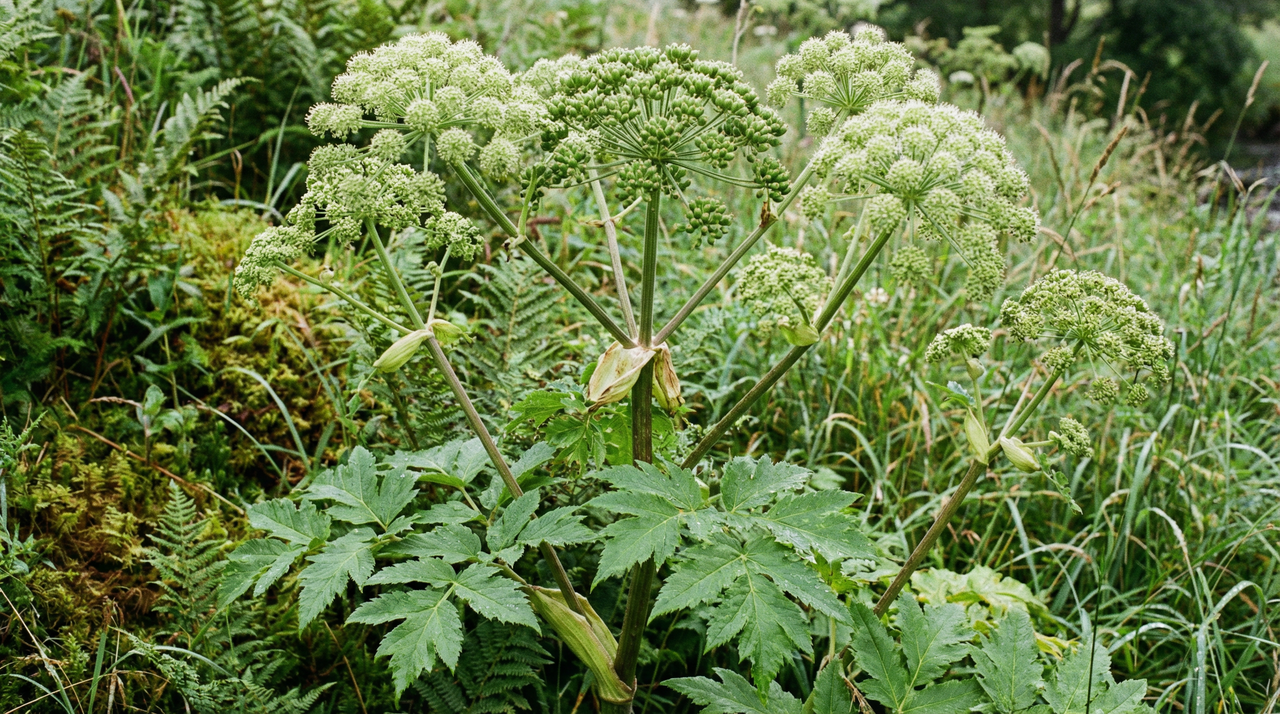
Medieval Europeans believed Angelica bloomed on the feast day of the Archangel Michael and that carrying its roots would protect you from plague.[1] I find that detail remarkable not because it's quaint, but because it tells you something true about this plant: people took it seriously. Seriously enough to name it after an angel. Seriously enough to stuff it in their pockets during one of history's worst pandemics. And then, somehow, it ended up candied on top of a birthday cake, which is almost certainly where most people today have encountered it without knowing it. That pink-green crystallized garnish you've been picking off your cake for decades? That's Angelica. The plague herb.
What strikes me most after growing it in several different gardens is how consistently it refuses to be modest. It gets six feet tall in its second year, throws up these enormous cream-white umbels that practically hum with hoverflies all summer, and smells like something between juniper and celery with something wilder underneath it. Nobody who walks past a mature Angelica ignores it. The plant has presence. But the gap between that dramatic garden reality and most people's awareness of it is enormous, and I think that gap is worth closing, because what's going on inside this plant, biochemically and ecologically, is every bit as striking as what's happening above ground.
Origin and History of Angelica (Angelica archangelica)
Botanical Background and Native Range
Angelica archangelica is fundamentally a plant of the cold and the wet. Its native range sweeps from Scandinavia and the British Isles across northern and central Europe and into Siberia and western Asia, anchored to riverbanks, wet meadows, woodland edges, and ditches where moisture is reliable and summers stay cool.[2][3][4] It has since naturalized in parts of northeastern North America, following exactly the kinds of habitats it preferred in Europe. Where does angelica root grow? Wherever the ground stays damp and the air has some chill to it.
The biennial lifecycle is central to understanding this plant. In year one, angelica builds a large basal rosette of bold compound leaves and a substantial taproot, storing energy quietly and giving very little indication of what comes next. Year two is when everything changes: a thick flowering stem rises to 2.5 meters or more, topped with broad greenish-white umbels, and then the plant sets seed and dies.[5][6] I always warn new gardeners to mark their first-year rosettes carefully, because they look deceptively like oversized parsley or celery seedlings until those second-year stalks shoot up and suddenly you have an eight-foot giant in what used to be a tidy herb bed.
The genus extends well beyond northern Europe. Angelica dahurica grows across temperate East Asia through China, Korea, Japan, and Russia; Angelica gigas occupies mountainous zones of Korea and parts of China up to 2,000 meters; and Angelica glauca inhabits the high-altitude western Himalayas from 2,500 to 4,500 meters in India, Pakistan, Nepal, and Tibet.[7][8][9] Each occupies a distinctly different climate niche, but all share that same preference for cool conditions and defined wet seasons.
Visual Characteristics of Angelica
In its flowering year, angelica is genuinely hard to miss. The stems are stout, hollow, and ridged, often green with distinctive purple blotching at the nodes, reaching anywhere from one meter to a full 2.5 meters tall (occasionally more).[3][6][5] The leaves are alternate and compound, sometimes reaching a meter in length, with ovate-lanceolate serrated leaflets. The umbels at the top of the plant spread 15 to 20 centimeters across in a wide, domed spray of tiny greenish-white flowers, followed by winged schizocarp fruits 6 to 10 millimeters long. That deep, pale-brown taproot can grow to nearly a meter.
Crush a leaf or snap a stem and you get an immediate, distinctive aromatic hit: anise meeting celery meeting citrus, unmistakably its own thing.[10][11] That scent is actually my first check in the field when I need to confirm identification quickly. The Apiaceae family contains some genuinely dangerous plants, and poison hemlock (Conium maculatum) shares enough superficial similarities to be a real concern for foragers.[12] The aromatic scent and the purple-blotched hollow stems together are the combination I rely on. Hemlock smells unpleasant and mousy; angelica smells like something you'd want to eat. Still, I'd encourage anyone new to the plant to learn it from a knowledgeable mentor before ever harvesting from the wild.
The genus shows interesting variation when you look across species. Angelica gigas produces striking deep-purple spherical umbels instead of the pale greenish-white of the European species, while Ashitaba (Angelica keiskei) is famous for regenerating new leaves within roughly 24 hours of cutting and exudes a distinctive yellowish sap.[13][14] That kind of rapid regrowth is remarkable even among fast-growing herbs. A variegated form of archangelica with creamy-white leaf margins also exists, though it's more of a collector's novelty than a garden workhorse.
Traditional and Cultural Uses Across Continents
The documented history of angelica as a medicinal plant in Europe goes back at least to the first century AD, when it appeared in Dioscorides' De Materia Medica, and it remained prominent through the medieval period in the writings of Hildegard von Bingen and John Gerard.[15][4] Monastic gardens were its real engine of propagation in Europe. Monks cultivated it for medicine and food, and from those gardens it traveled along trade routes and eventually into North America as European settlers carried their herbal traditions with them. I find it meaningful to grow it in a guild alongside other moisture-loving herbs, knowing I'm participating in a cultivation tradition that stretches back through centuries of monastery gardens.
In East Asia, Angelica dahurica (known in Traditional Chinese Medicine as Bai Zhi) appears in the Shennong Bencao Jing, compiled around 200 to 250 CE, and received detailed attention again in Li Shizhen's 16th-century Bencao Gangmu.[16][17] It has been used across TCM, Japanese Kampo, Korean Hanbang, and Mongolian medicine for relieving headaches, nasal congestion, and skin conditions. High in the Himalayas, Angelica glauca carries its own deep traditions within Ayurvedic, Unani, and Himalayan folk medicine, used for digestive, respiratory, and women's health applications, and holds ceremonial significance in Hindu and Buddhist purification rituals.[18]
Across all of these traditions, certain themes appear again and again: digestive support, respiratory relief, anti-inflammatory applications.[19] For the European species specifically, the culinary dimension has always been present alongside the medicinal. Young stems have been candied since the Middle Ages; roots and seeds flavor liqueurs like Chartreuse and aquavit; the plant's aroma makes it a natural fit for teas and spirits.[5]
That long history of intensive use has consequences. Angelica glauca is now listed as Vulnerable on the IUCN Red List, with commercial harvesting pressure outpacing what wild populations can sustain.[20][21] Wild European and Siberian populations of archangelica face similar pressure from demand. My own approach is to grow cultivated angelica rather than forage for it, and I'd encourage anyone drawn to this plant to do the same. The traditional knowledge behind its uses belongs to Sami, Himalayan, and East Asian communities who developed it over generations, and honoring that means being thoughtful about how we source and use the plant.
Folklore and Fun Facts About Angelica
The name archangelica is not accidental. Legends of its divine origins on May 8th cemented its reputation as a sacred amulet against illness and misfortune.[15] People carried it as an amulet, burned it as incense, and incorporated it into charms meant to ward off witchcraft. In Scandinavia and Iceland, protective garlands woven with angelica appeared at Midsummer and solstice celebrations, and the Sami people used it both medicinally and as a flavoring. These plague-protection beliefs were exactly that: beliefs. But they speak to how powerfully this plant captured the imagination of the communities that lived alongside it.
The transit from sacred protective herb to everyday kitchen ingredient happened relatively smoothly. Monastic gardens grew it as a vegetable from the Middle Ages onward, and candied angelica stems became a traditional confection across Europe that persists today.[15][18] In East Asia, parallel ritual uses evolved independently: Angelica dahurica and Angelica glauca both feature in incense, amulets, and purification ceremonies, suggesting something about the genus's aroma and presence that made it cross-culturally significant. A plant named after an archangel, cultivated in monasteries, carried as a charm, and still growing along European riverbanks and in gardeners' borders today: that kind of staying power tells you something.
Angelica Varieties and Sourcing
Notable Cultivars and Related Species of Angelica
The species most temperate gardeners will encounter is Angelica archangelica, a biennial that goes from modest first-year rosette to a genuinely impressive 1.5-2.5 m flowering column in year two, hardy from USDA zones 4-9 and capable of surviving temperatures down to -30 °C as long as summers stay reasonably cool.[22][23] The straight species has two subspecies: subsp. archangelica, which dominates inland habitats, and the coastal subsp. litoralis.[11] Among named cultivars, 'Variegata' brings cream-margined foliage that earns its place purely on looks, while 'Compacta' stays around 1.2 m and fits more easily into a smaller medicinal bed. If you want the full architectural drama, 'Maxima' and 'Gigantea' push toward 2-2.5 m.[23][13] I've grown both 'Maxima' and Ashitaba side by side, and the height difference alone changes everything about guild placement. The European archangelica plant needs serious vertical clearance, while Ashitaba tucks into a mid-layer bed without shading out neighbors.
Ashitaba (Angelica keiskei) is the Asian species with the most developed cultivar roster. A perennial reaching 0.9-1.5 m with large compound leaves and hollow stems that sometimes flush red-purple, it has been bred specifically for yield and habit in Japan: 'Gogyo' and 'Yonbagana' for productivity, 'Hime Ashitaba' for a dwarf form, 'Kuro Ashitaba' for dark ornamental stems, 'Hachijo' as the wild-type standard, and 'Midori' for a clean green-stemmed option.[24][25] Dahurian angelica (Angelica dahurica, the Chinese angelica known in TCM as Bai Zhi) is a 1-2 m East Asian perennial with two subspecies differing in furanocoumarin content, but no named horticultural selections to speak of.[26][27] Himalayan angelica (Angelica glauca) is similar in that regard, a 1-2 m high-altitude perennial valued for its aromatic roots and attractive umbels, but with no cultivar names attached.[28] That lack of named cultivars in both species is pretty typical of herbs where breeders have followed the chemistry rather than ornamental traits, and it's worth keeping in mind when you're shopping.
Sustainable Sourcing and Purchasing Angelica
Before sourcing any new species, I check the regulatory landscape, and angelica is reassuringly uncomplicated. A. archangelica carries no CITES listing, no federal invasive designation, and no state-level noxious-weed flags in California, Washington, or Pennsylvania.[29][30][31] If you're importing seed or plants from abroad, USDA APHIS phytosanitary requirements and potentially an import permit under 7 CFR 319 apply, so factor that in before ordering from overseas suppliers.[32] That said, wild populations of A. archangelica are under pressure from habitat loss in parts of its native range, so buying cultivated stock is the responsible call regardless of where you are.[33]
For seed, viability is the real practical concern. I learned early on that angelica archangelica seeds stored more than two or three years lose germination rates fast; after a few disappointing flats from old packets, I now buy only from suppliers I trust to rotate fresh stock. Seeds need 4-6 weeks of cold stratification and can still hit 50-70% germination in 14-30 days at 15-20 °C when treated correctly.[34] For A. dahurica specifically, seed packets run $5-15, live plants $15-35, and dried root $20-50 per pound, mostly through specialty herbal retailers rather than mainstream garden centers.[35] Strictly Medicinal Seeds and Mountain Rose Herbs are my go-to starting points for the genus; availability shifts by season, so if something is out of stock, contact the nursery directly rather than waiting for the website to update.[36][37] When I'm purchasing dried root for tincture work, I always look for organic certification, both for quality assurance and to keep purchasing aligned with sustainable production practices.
Angelica Propagation and Planting
Everything about growing angelica starts with accepting that this plant is a biennial built for cold northern winters, and it will not pretend otherwise. In its first year it produces a basal rosette and begins developing that thick taproot; in its second year it bolts, flowers, sets seed, and dies.[38][39] Without sufficient winter chill it may stay stubbornly vegetative or linger as a short-lived perennial that never quite performs.[40] Understanding that cycle is the foundation for every decision that follows.
Propagation Methods for Angelica archangelica
Seed is the right way to propagate angelica, full stop. The seeds are small, yellowish-brown schizocarps with translucent winged margins, and they carry an underdeveloped embryo that needs a cold, moist period to break dormancy before the seed can germinate.[41][42] Four to six weeks at roughly 35-40°F in a moist medium does the job, mimicking the European winter the plant expects.[43][38] I've done this with zip-top bags of moist vermiculite at the back of my refrigerator and consistently get 60-70% germination on fresh seed, which tracks with what the research describes.[44]
Fresh seed is non-negotiable. Viability drops fast with angelica, and a packet that sat on a shelf through a warm summer may give you nothing regardless of how perfectly you stratify it.[38] If you need to store seed, keep it sealed with a desiccant at low temperature and humidity; under those conditions it can remain viable for several years.[45] When you sow, surface-sow or press the seeds no deeper than a quarter inch. They need light to germinate.[38]
Root division and root cuttings taken in early spring are possible but genuinely stressful for the plant, with lower success rates than seed.[46][47] I don't bother with vegetative propagation for home use because a well-sited plant self-sows reliably once established. Commercial operations use tissue culture with good survival rates,[48] but that's not something most gardeners need to think about.
Soil, Site Selection, and Planting Technique
Angelica is native to riverbanks, damp meadows, and woodland edges, and the soil profile it evolved in tells you exactly what to prepare: deep, moist, humus-rich loam with good drainage and an organic matter content around 3-6%.[46][49] The taproot can go 30-60 cm deep, and any compaction or waterlogging causes it to fork or rot.[50] I always test soil before planting because I've seen iron deficiency turn otherwise healthy angelica pale in alkaline beds I've inherited; the optimal pH range is 6.0-7.5, and outside that window you'll see either aluminum toxicity stunting roots on the acid end or chlorosis reducing vigor on the alkaline end.[38][51]
Heavy clay needs generous compost or well-rotted manure worked in before planting. If you're growing in containers, use pots at least 12-18 inches deep with a mix of roughly half loam and compost and a quarter or more perlite or sand to keep drainage honest.[52][53] In my experience, double-digging or raised beds have solved more angelica problems than anything else, because the deep taproot simply cannot express itself properly in compacted ground. For light, partial shade with 4-6 hours of direct sun is the sweet spot.[54] Full sun works in cool, reliably moist northern climates, but anywhere warmer, afternoon shade is your friend or you'll see the leaves scorch and the plant stress-bolt early.[38]
Spacing, Timing, and Establishment
Transplant after the last frost (late April to early May in most temperate gardens) or sow direct in early fall and let the winter do your stratification work for you.[43] If you're transplanting seedlings, move them when they have 2-4 true leaves at most; the taproot becomes resentful of disturbance quickly, so handle it as little as possible and avoid breaking the root tip.[55] Direct sowing into a prepared permanent bed avoids the problem entirely.
Space plants 18-24 inches apart, with 24-36 inches between rows.[13] A mature plant can hit 5-6 feet tall, occasionally more, with a 2-3 foot spread, and it needs room to breathe. Airflow is not just comfort for the plant; it's your primary defense against the fungal issues that plague overcrowded angelica.[56] Angelica needs that elbow room the way basil does. Crowd either one and you invite the same fungal problems I've repeatedly seen fix themselves once spacing was corrected. Second-year stems can get top-heavy in exposed positions, so plan for staking if your site is windy.[57]
Germination Timeline and Lifecycle Expectations
Once stratification is complete, germination at 60-70°F typically takes two to four weeks.[43][38] The seedlings look a bit like carrot tops at first, and I'll confess I've made the mistake of thinning the wrong plants in a mixed Apiaceae bed before I started labeling rows religiously. From that first true-leaf stage to a harvest-ready plant is roughly 18-24 months, which is the trade-off with a biennial: patience upfront, then the satisfaction of a plant that, if you let a few umbels go to seed in the right spot, will quietly perpetuate itself for years without much intervention from you.
Angelica Plant Care and Growing Guide
Every care decision for angelica traces back to the same origin story: this is a plant from cool, damp northern meadows and stream banks, and it thrives when you recreate that habitat rather than fight it. Once I stopped treating it like a typical Mediterranean herb and started thinking of it alongside hosta and ligularia in my moisture-retentive borders, the whole plant clicked into place.
Watering Needs
Angelica wants consistently moist, well-drained, fertile loamy soil with a pH of 6.0-7.5, and it does not forgive prolonged dryness or sitting water.[58][59] In practice that means about an inch of water per week during the growing season, with seedlings needing light watering every two to three days to keep the top inch of soil moist, and established plants needing more in hot dry spells and less over winter.[38] A two-to-four inch layer of organic mulch is the single most practical tool here: it holds moisture, cools the root zone, suppresses weeds, and buffers the temperature swings that stress the plant.[38][58] If you have heavy clay, amend it before planting; drainage is just as important as moisture here. Wilting and crispy leaf margins tell you the plant is thirsty; yellowing from the base upward with mushy stems means you've gone too far the other way.[38][60] Once you learn to read those signals, they're easy to correct early.
Sunlight Requirements
Angelica archangelica prefers partial shade to full sun, ideally four to six hours of light per day, and really appreciates afternoon shade in any climate that gets genuinely warm summers.[38][61] I think of it the same way I think about parsley and lovage: bright, indirect light suits it far better than a full south-facing exposure. Strong sun combined with dry soil is a fast track to stress and premature bolting, which is the thing you most want to avoid in the second growing year.
Soil and Feeding Requirements
Angelica is a moderate feeder that responds well to fertile soil enriched with compost or well-rotted manure before planting, with the biennial lifecycle dictating how you handle fertility across the two years.[38][61] Year one is about soil preparation: generous organic matter and good structure so the rosette can establish and the taproot can develop without obstruction. In year two, if you fertilize at all, reach for a low-nitrogen balanced formula like 10-10-10 or 5-10-10 slow-release, applied sparingly in early spring at roughly one to two pounds per hundred square feet.[38][62] Early in my growing experience I over-fertilized in year two and ended up with seven-foot floppy stems that needed staking every windstorm. Excess nitrogen drives leggy growth, weakens stems, reduces seed production, and lowers essential oil quality.[63] Phosphorus and potassium are your friends for root development and structural integrity. I now run a soil test in the first spring because the difference in second-year vigor between a balanced soil and a guessed application is genuinely visible in stem sturdiness and seed set.
Frost Tolerance and Winter Protection
Angelica archangelica is cold hardy to USDA zones 3-7, tolerating winter lows well below -30°F in its native northern range.[64][65] As a biennial, it dies back to ground level in winter and regrows from the roots, which means the crown is the thing to protect. Young leaves and emerging spring buds are most vulnerable, showing up as water-soaked, brown-going-black collapse after a late freeze.[38][66] A three-to-four inch layer of organic mulch applied after the first hard frost has reliably carried my plants through unexpected cold snaps with no crown damage. In zone 5 and colder, go deeper.[38][67] Site the plant in a sheltered microclimate away from frost pockets, and ensure drainage is impeccable before winter; a saturated crown in a freeze is more damaging than the cold itself.
Heat Tolerance and Summer Care
This is where angelica genuinely struggles. It performs best with daytime temperatures of 59-68°F, and sustained heat above 77-86°F causes wilting, leaf scorch, stunted growth, and, critically, premature bolting that cuts short the second-year display.[68][69] I watch for the sudden vertical surge in the second spring when warm spells arrive early, and I respond immediately with extra shade cloth or a deeper mulch layer to cool the root zone.[38][70] After planting one specimen in a western-exposure hot spot and watching it bolt two months early, I now give it the eastern side of a taller guild member for afternoon relief without exception. Consistent deep watering to maintain soil moisture and mulch that reduces evaporation are your main levers here.[58]
Pruning, Maintenance, and Seasonal Rhythm
Year one is simple: the plant forms a basal rosette and asks very little of you beyond water, mulch, and removal of damaged or dead leaves to keep airflow open.[71][72] Year two is where maintenance picks up: the plant sends up a flowering stem that can reach five to six feet, and in exposed or windy gardens those tall stems need staking with bamboo canes tied loosely to prevent stem snap.[73] After flowering, your decision about deadheading shapes the plant's future in the garden. Leave seed heads and self-seeding takes care of succession planting; remove them and you manage spread, which matters in wetter, wilder edges where angelica can establish a little too enthusiastically.[38] I'll admit I've accidentally weeded out second-year seedlings more than once because young Apiaceae are remarkably similar before the true leaves develop, so I mark seedling rows carefully now. Cut dead stems to ground in late fall, lay down fresh mulch, and the garden is set for whatever overwinters in the crown below.[55] Once you have the moisture-and-coolth combination dialed in, angelica is genuinely a low-intervention plant. The architecture earns its keep; your job is mostly getting out of the way.
When and How to Harvest Angelica
Everything about harvesting angelica flows from one fact: it's a biennial, and the plant's two-year clock dictates what you can take and when. The first year rewards you with lush leaves and tender stems, ready and immediately useful. The second year is where patience pays off, delivering roots with real medicinal depth and seeds with that warm, spicy aroma. Get the lifecycle wrong and you'll either harvest too early, missing peak potency, or too late, finding the plant has already spent itself.
When to Harvest Angelica by Plant Part
First-year leaves are ready from mid-spring into early summer, when plants are somewhere between 12 and 18 inches tall, still tender and vibrantly aromatic.[38][74][51] Stems destined for candying are best cut pre-flowering in year one or two, when they're pale green, firm, and exuding that characteristic celery-musk scent.[38][74] Seeds come in late summer, July through August, when the umbels shift from green to yellowish-brown and the seeds themselves smell warmly spiced.[51][74] Roots follow in September or October of the second year, after die-back but ideally around the first frost, when the plant has drawn its energy downward.[51][38] I've learned to trust my nose as much as the calendar for root timing; there's a distinct sharpening of that musk-celery fragrance right when conditions are ideal, and I've missed good windows by ignoring it in favor of a date on a spreadsheet. Gardeners in northern zones 4 through 7 should expect harvest windows to shift 2 to 4 weeks later than mid-Atlantic or southern references suggest.[75][71]
For Angelica dahurica, root harvest is a later, longer affair: second or third year, September through November after the leaves wither, with roots ideally reaching 1 to 3 cm in diameter, pale yellow-white on the outside and spongy white within.[76][77] The timing logic is similar but the emphasis is entirely on the root, which is where the medicinal value concentrates in that species.
Harvest Techniques and Post-Harvest Handling
When harvesting leaves, take only the outer ones and never strip more than a third of the plant at once.[38][74] I over-harvested a first-year plant once, convinced I was being thrifty by taking what I needed in one go. The plant sulked for weeks and never reached the second-year vigor I'd hoped for. Cut outer leaves at the base, let the crown recover, and you'll have a far more productive plant come autumn of year two. Roots are best dug carefully to avoid breaking them, washed promptly, and sliced before drying.[38][74][51] Seeds should be cut as whole umbels and dried slowly in a paper bag or on a rack in a shaded spot.
Drying temperature matters far more than most guides admit. Roots dry best at 35 to 45°C, stems at 30 to 40°C, and seeds at 25 to 35°C, all in good airflow and away from direct sun, until completely brittle, which usually takes one to two weeks for roots.[78][79][80] Push above 45°C and the essential oils noticeably diminish; I've run the comparison on my own drying racks and the cooler batch simply smells better and tastes more alive. Stored in airtight containers in a cool, dark space, properly dried angelica root holds its potency for one to two years.[78][79] If you're wildcrafting rather than growing your own, take no more than 10 to 20 percent of any stand you find, and only from healthy, moist, shaded populations.[81] I apply the same ethic I use with other umbellifers: if you'd be uncomfortable returning to find the stand gone, you've taken too much.
Angelica Preparation and Uses
Few herbs give you this much to work with. Every part of Angelica archangelica has a role in the kitchen:
- fresh young leaves in salads and broths
- peeled stems eaten raw or cooked
- roots dried for liqueurs and syrups
- seeds used to flavor spirits like gin, vermouth, and absinthe
Culinary Applications and Flavor Profiles
The stems are the showpiece. Fresh from the garden, a young peeled stem has a crisp, celery-like snap and a sweet, mildly licorice-tinged flavor.[11][82] I've candied them several times, pairing the results with rhubarb in tarts, and what strikes me every time is the transformation: that crisp snap gives way to a pleasantly gelatinous chew, and the bitterness mellows into something almost floral. Scandinavian cooks have known this for centuries, using angelica in dishes like Norwegian rhubarb and angelica pie and Swedish angelica cake, with tart fruits doing the work of balancing the herb's intensity.[83] If you're new to cooking with it, rhubarb is the natural first pairing.
Leaves offer a softer, herbaceous flavor closer to celery or parsley, while the roots go somewhere entirely different: intensely bitter, earthy, and musky, harvested in the second year and best used dried to flavor liqueurs like Chartreuse and vermouth or steeped into teas and syrups.[11][84] The seeds bring a warm, musky quality with hints of pepper and juniper, which explains their long history in spirit-making.[82] Roots and seeds contribute the essential oils that drive these flavor profiles; those oils vary meaningfully by plant part, with roots rich in β-phellandrene and sabinene, leaves carrying more myrcene, and seeds leaning toward α-pinene and limonene.[85][86] As a practical bonus, fresh leaves carry a useful dose of vitamin C and the roots are a legitimate source of potassium and dietary fiber, so there's real nutrition here alongside the flavor.[87]
If you grow Ashitaba (Angelica keiskei), the culinary experience shifts considerably. The leaves and stems are milder, with a fresh green quality reminiscent of celery or parsley, and they work beautifully stir-fried, pickled, or dried into tea.[14] I've been adding dried Ashitaba powder to smoothies for its chalcones and antioxidants; the bitterness is much more manageable than the A. archangelica root, and it's one of the rare plant sources of vitamin B12, something even spinach can't claim.[88] Angelica dahurica roots, by contrast, are best approached as a medicinal ingredient: thin-sliced, soaked, and blanched before use to reduce bitterness and mitigate potential toxins, then added cautiously to soups or broths in the TCM tradition.[26]
Safety Considerations and Toxic Look-Alikes
This is the part I don't gloss over. Angelica archangelica contains phototoxic furanocoumarins concentrated in the roots and stems; handle them without protection and then spend time in sunlight, and you're risking genuine blistering from phytophotodermatitis.[49] Strict adherence to the contact precautions detailed previously is non-negotiable. I've seen what happens when someone skips those precautions, and it's not worth it. If you're pregnant, nursing, on anticoagulants, or managing liver or kidney disease, keep angelica root preparations firmly in the medicinal category and get professional guidance before using them therapeutically; the coumarin effects are well-documented.[89] Small culinary amounts are a different matter, but concentrated preparations are not casual territory.
Identification is non-negotiable before you use any part of this plant. Angelica archangelica shares its habitat and family with Poison Hemlock, Water Hemlock, and Giant Hogweed, all genuinely dangerous plants.[90][91][92] What I've learned to look for: smooth green ridged hollow stems with a pleasant aromatic smell, and rounded leaf divisions. Poison hemlock has telltale purple-blotched stems and a distinctly unpleasant odor when crushed. Ashitaba has an additional aid: break a stem and it exudes a distinctive yellow sap.[93] If you have any doubt, don't use the plant. Get a professional identification first.
Medicinal Preparation and Non-Food Uses
For anyone processing angelica root for dried preparations or teas, storage conditions matter more than people realize. Dried material stored in airtight containers below 15°C with humidity under 60% will hold its quality for up to two years.[78][80] I label every container with the harvest date and part; angelica root and angelica seed are not interchangeable in a recipe, and it's easy to lose track when both are just sitting in brown paper bags.
Beyond the kitchen, the essential oils extracted from roots and seeds, constituting roughly 0.5-2% of the dry material, have established uses in perfumery, confectionery, and pharmaceuticals.[94] For home growers, the more practical non-food preparation is simply having dried root on hand for teas and tinctures, a tradition that spans European herbalism, Japanese medicine (via Ashitaba), and Chinese practice with A. dahurica. In all of those traditions, the consistent thread is careful preparation: blanching, soaking, or drying to tame bitterness and reduce risk. Angelica rewards the grower who approaches it with that same care.
Angelica Health Benefits and Medicinal Uses
Every traditional use attributed to angelica, from settling a nervous stomach to warding off plague, traces back to a remarkably complex internal chemistry. Understanding what's actually in this plant makes sense of why it has been trusted for centuries in European monasteries and Chinese pharmacopeias alike, and why modern researchers keep returning to it.
Key Phytochemicals in Angelica
Angelica archangelica contains an unusually broad array of bioactive compound classes: coumarins and furocoumarins (including angelicin, osthol, imperatorin, and isoimperatorin), flavonoids like quercetin and kaempferol derivatives, phenolic acids (chlorogenic, ferulic, caffeic), terpenoid-rich essential oils dominated by β-phellandrene, polysaccharides, polyacetylenes including falcarinol and panaxydol, tannins, saponins, and sterols like β-sitosterol.[95][96] Where those compounds concentrate depends heavily on which part of the plant you're working with: roots are richest in coumarins and polyacetylenes, leaves lean toward flavonoids and phenolic acids, and seeds carry the highest essential oil content, typically 0.5-1.5% by weight.[9]
Timing matters too. Furocoumarins peak in the aerial parts during late summer and early autumn when the plant is flowering, while coumarin content in the roots is highest in autumn-harvested material.[97] I've noticed this directly in my own beds: roots I pull in October have a noticeably more pungent, resinous quality than ones I've harvested in spring, and the research explains exactly why. Geography adds another layer of variation, with coastal populations showing higher furocoumarin levels than inland ones, likely from UV and salinity stress.[98] Cultivation choices compound that further: full sun exposure enhances furocoumarin production, while organically managed, well-drained soils favor root development and secondary metabolite accumulation generally.[99] The same compound classes appear across related species like Angelica dahurica, where imperatorin can reach 1-2% in dried root, reinforcing that coumarin-rich chemistry is a genus-wide pattern rather than a quirk of the European species.[100]
Medicinal Actions and Research Findings
The anti-inflammatory activity is probably where modern pharmacology most clearly validates traditional use. Extracts of A. archangelica suppress pro-inflammatory mediators including TNF-α, IL-1β, IL-6, and COX-2 through NF-κB pathway inhibition, and Angelica dahurica shares essentially the same mechanism.[101][102] The plant also shows meaningful antioxidant activity through free radical scavenging, metal chelation, and enhancement of endogenous enzymes like SOD, CAT, and GPx.[101]
The digestive territory is where preclinical evidence feels strongest and most grounded in real-world use. Angelica archangelica exhibits antispasmodic and smooth muscle relaxant effects in the gastrointestinal tract, acting by blocking calcium influx through L-type Ca²⁺ channels, and it has demonstrated gastroprotective activity against ethanol- and NSAID-induced ulcers in rat models.[101][103] These findings align directly with its centuries-old use as a digestive bitter and carminative across European and Asian traditions, which are recognized in WHO monographs alongside uses for respiratory conditions, inflammation, and as a diuretic and tonic.[104] Angelica dahurica (Bai Zhi) extends the pattern into TCM territory, where it's used for headaches, sinus congestion, toothaches, and as a pain-relieving agent, with additional anti-allergic actions via suppression of histamine release and mast cell degranulation.[105]
Sedative, anxiolytic, and analgesic effects have been observed in preclinical studies, likely mediated through GABAergic modulation, with neuroprotective potential through acetylcholinesterase inhibition also noted.[106] Preliminary anticancer findings, including apoptosis induction via falcarinol and flavonoids, and cardiovascular benefits through ACE inhibition, round out an impressive pharmacological profile.[107][108] The honest caveat, and I always mention this with clients who want to treat angelica as a pharmaceutical, is that the vast majority of this evidence comes from in vitro and animal studies. Small clinical trials on IBS, dyspepsia, rhinitis, and skin conditions show promise, but most lack placebo controls and none are large enough to be definitive.[108][109] Approach it as a supportive herb with real biochemical backing, not as a replacement for medical care.
Nutritional Profile of Angelica
Think of angelica less like a nutritional powerhouse and more like a flavorful, nutrient-decent herb you'd reach for the way you'd reach for fennel or celery, in small amounts that add up meaningfully over time. Fresh stems are mostly water (around 71g per 100g), with modest protein, minimal fat, and about 27 kcal per 100g.[110] Dry the roots and the picture shifts considerably: roughly 285 kcal per 100g, with significant fiber and protein in concentrated form.[110] Vitamin C content in fresh parts can range from 20 to 100 mg per 100g depending on the plant part and growing conditions, though cooking or drying destroys 40-70% of it.[111] Mineral content is where it becomes genuinely interesting: roots can contain 800-1500 mg potassium, 100-300 mg calcium, and up to 15 mg iron per 100g.[112] USDA FoodData Central has no dedicated angelica entry, so these values derive from related herbal analyses rather than standardized food testing.[113]
The culinary tradition makes the most sense when you look at the whole edible plant together: young stems eaten raw or candied, leaves for teas and salads, roots for liqueurs like Chartreuse, seeds used as a fennel-like spice.[65] Angelica dahurica sits at the other end of the spectrum, used almost entirely as a medicinal root (Bai Zhi) rather than a food, with a similar mineral-dense profile but its nutritional value is secondary to its coumarin and polysaccharide content.[114]
Safety Considerations and Contraindications
Culinary use of angelica at normal cooking quantities is considered safe; the FDA recognizes angelica root extract as generally recognized as safe (GRAS) for food use.[115][116] Acute toxicity is low, with an LD50 above 5 g/kg in rats, and excess intake at culinary doses typically causes nothing worse than mild GI upset.[117] But GRAS status applies to the culinary context, not to concentrated extracts, essential oils, or medicinal doses, and the gap between those categories is where real risks live.
Phototoxicity is the most common and most underestimated hazard. The furocoumarins in angelica, including psoralens, imperatorin, and angelicin, cause phytophotodermatitis when skin that has contacted plant sap is then exposed to sunlight. Symptoms appear 24-48 hours later: erythema, blisters, edema, and lasting hyperpigmentation.[118][119] I always harvest and process angelica in the evening or on overcast days, wearing gloves and long sleeves, and I ask clients to avoid sun exposure for at least 24 hours after handling the plant. Roots and seeds carry the highest furocoumarin concentrations, so those warrant extra care.
The coumarin content also creates a real anticoagulant interaction risk. Angelica species can inhibit platelet aggregation, affect CYP enzyme activity, and potentiate blood-thinning medications like warfarin. If you are on anticoagulants, this interaction is genuine and worth discussing with your healthcare provider before using anything beyond the occasional culinary stem.[120][121] Angelica is contraindicated in pregnancy because of its potential uterine-stimulant and emmenagogue effects, and it's not recommended during lactation either.[122][123]
The essential oil is in a separate risk category entirely. Ingesting it can cause severe GI distress, dizziness, or convulsions; topical use requires dilution and mandatory sun avoidance for 12-24 hours afterward.[124][125] I keep angelica out of reach of pets and livestock and treat any concentrated form with genuine respect; the falcarinol and furocoumarin research is clear enough that I don't experiment.[126][127] For medicinal use, the European Medicines Agency supports dried root or seed tea at 1-2 grams per cup, up to 6 grams daily, or tincture at 1-2 mL three times daily, always under professional guidance.[125]
After years of working with Apiaceae plants I've learned to label my angelica beds clearly from the seedling stage, because young plants can look enough like carrot or parsley to cause mix-ups at harvest. That same identification discipline matters enormously for foragers: poison hemlock (Conium maculatum), water hemlock (Cicuta species), and giant hogweed all share angelica's umbel flower form and general silhouette. Misidentification is genuinely dangerous, and anyone sensitive to Apiaceae family plants may also experience contact dermatitis from angelica regardless of species.[128][129] Positive identification before any harvest is non-negotiable.
Angelica Pests and Diseases
Natural Resistance and Common Pests
Angelica's pungent, almost medicinal smell isn't just for show. Those volatile essential oils, coumarins, polyacetylenes, and glandular trichomes give the plant moderate natural pest resistance that holds up surprisingly well against casual browsers.[130][131] In my experience, deer tend to pass it by when plenty of other things are available, which is better than what I get from most Apiaceae. Parsley disappears overnight here; angelica usually doesn't. But "moderate resistance" is doing a lot of work in that sentence, because the plant shares all the classic Apiaceae vulnerabilities once conditions favor the specialists.
Aphids are the most consistent problem, particularly Myzus persicae and various Aphis species that colonize tender growth and new stems.[132][38] Carrot fly (Psila rosae) is the other serious one, tunneling into roots in a way that's hard to detect until you dig up a hollowed-out taproot at harvest. Leaf miners, flea beetles, cutworms on seedlings, and spider mites in dry or greenhouse situations round out the usual suspects.[133] In damp springs, which coincide exactly with the conditions angelica loves, slugs can shred young foliage before plants have a chance to establish.[73] I always put copper tape or grit barriers around seedlings the moment they go in. What makes pest pressure especially worth managing is that aphids, cutworms, and slugs don't just cause direct damage; their wounds become entry points for fungal and bacterial pathogens, compounding the problem through the season.[134]
Fungal and Bacterial Diseases
If angelica sits somewhere between cilantro and dill on the Apiaceae disease-resistance spectrum, think of it as the one that holds together reasonably well until humidity tips above 80% or drainage fails, at which point things can go sideways fast.[135][136] Powdery mildew (Erysiphe heraclei) is the most common fungal visitor, coating leaves and stems with the familiar white fuzz that spreads fast when nights are cool and air is still.[137] Leaf spot diseases from Septoria angelicae, Alternaria, and Cercospora cause necrotic patches that can defoliate plants if left unchecked. Downy mildew and rust (Puccinia angelicae) show up less frequently but are worth recognizing early.[138]
The diseases I worry about most are root rots. Phytophthora, Pythium, and Fusarium complexes will collapse a plant in waterlogged soil with very little warning, and the deep taproot structure means by the time symptoms show above ground the roots are often already gone.[139] I learned this the hard way in my first few seasons growing angelica in heavy clay; I lost two plants that looked fine on a Tuesday and were wilted past saving by Friday. Bacterial soft rot and leaf spot from Xanthomonas can also appear in warm, wet spells, though viruses and wilts are generally low-risk.[140] In commercial A. dahurica cultivation, disease incidence hits 20-30% without proper management, which gives you a realistic picture of what neglect looks like at scale.[141]
Prevention and Integrated Management
There are no disease-resistant angelica cultivars available. I've trialed the common selections across several designs and none stand out on that front, so everything depends on cultural practice.[58] The non-negotiables: well-drained soil (raised beds with added grit if your native soil is heavy), spacing of at least 12-18 inches for airflow, crop rotation every 3-4 years, and no overhead irrigation.[142][143] I always site plants where they get morning sun; in my experience that single decision reduces powdery mildew pressure more than anything else I've tried, because foliage dries quickly after dew and cool nights never get a chance to hold moisture on the leaves.
For aphids, I introduce ladybugs early in the season and plant angelica near alliums or other strongly aromatic companions as a guild design habit rather than an afterthought. For root rots, raised beds are non-negotiable once you've lost a plant to them. Powdery mildew responds to potassium bicarbonate or sulfur applied at first sign; copper fungicide handles leaf spot; neem oil or insecticidal soap covers most soft-bodied insects without much collateral damage.[144][145] Remove infected material promptly; it doesn't get better sitting there, it just becomes a reservoir. The real skill with angelica is site selection and vigilance, not reaching for a spray bottle.
Angelica in Permaculture Design
When I first started incorporating angelica into food forest designs, I kept placing it wrong. Too sunny, too dry, too exposed. Once I stopped fighting its native habitat preferences and started reading the plant more carefully, everything clicked. Angelica archangelica isn't trying to be adaptable; it's telling you exactly where it wants to live, and the garden rewards are considerable when you listen.
Climate and Hardiness Zones for Angelica
Angelica archangelica is genuinely cold-hardy, tolerating winter lows around -30°F (-34°C) across USDA zones 4-9.[146][147] The RHS rates it H5, meaning it holds through -15°C and lower without complaint.[147] That's reassuring for cold-climate growers, but the more limiting variable in most gardens isn't winter cold -- it's summer heat. Optimal growth happens in cool temperate to subarctic conditions, somewhere in the 59-77°F range, with good humidity and annual rainfall between 30 and 60 inches.[148][38] Above 85°F, the plant begins to struggle, and in hot humid lowlands it often fails entirely.[149] In warmer edges of its range, I've had success tucking it into afternoon shade with extra mulch to buffer the heat, but that's design triage rather than ideal placement.
Its native damp habitats tell the design story clearly: riverbanks, wet meadows, woodland edges, and streamside corridors from sea level up to around 2,000 meters.[150] Pacific Northwest and Northeastern US gardeners are the obvious beneficiaries here; in those regions, angelica's low invasive potential means you can let it self-seed without worry.[151] A 2-4 inch winter mulch applied after the ground freezes adds useful insurance in colder zones, and microclimate, drainage, and plant provenance all influence hardiness in ways that can shift performance noticeably from one garden to the next.[152] The Asian relatives extend this picture across the genus: Angelica dahurica handles zones 5-9 with tolerance to -20°F, Angelica gigas performs well in the upper Midwest, northeastern US, and Pacific Northwest (zones 4-8) but struggles in hot humid lowlands, and Himalayan Angelica glauca suits zones 5-9 in alpine meadows from 2,500 to 4,200 meters.[153][154][155] The thread connecting them all is cool moisture; design for that and the genus generally cooperates.
Ecosystem Functions and Guild Roles
The most visible ecological service angelica provides is pollinator support, and if you've ever stood next to a plant in full flower, you understand why. The compound umbels -- flat-topped landing platforms of small greenish-white flowers -- are structurally perfect for a wide range of insects, and nectar secretion peaks in the morning when hoverfly activity is highest.[65][156] The plant is self-incompatible and insect-pollinated, so it actively needs those visitors for seed set, which creates a mutually beneficial relationship that benefits everything else flowering nearby.[65] Syrphid flies (hoverflies) are the primary efficient pollinators, joined by bees, other flies, and occasional butterflies; peak activity aligns with 59-68°F temperatures and long summer days.[157][158] In midsummer, my angelica plants draw what I can only describe as a sustained, audible hum -- not the quick fly-by you get with simpler flowers, but extended foraging visits that spill over to neighboring vegetables and fruit trees.
Below ground, the work is equally substantial. A deep taproot reaching 1-2 meters stabilizes banks, aerates compacted soil layers, and forms arbuscular mycorrhizal associations that improve phosphorus uptake for the plant and potentially its neighbors.[159] As a dynamic accumulator, it draws potassium, phosphorus, calcium, magnesium, silica, and iron from deeper soil layers.[160] I've grown it alongside comfrey and nettles in soil-building guilds and noticed greener, more vigorous foliage on neighboring plants the following season -- attributing all of that to angelica alone would be too tidy, but the timing pattern is consistent enough that I keep the combination. One clarification worth making explicit: angelica is not a nitrogen-fixer. It doesn't carry legume traits, so those soil chemistry benefits come from accumulation and organic matter cycling rather than atmospheric nitrogen capture.[161] Above ground, it also provides wildlife habitat for certain Lepidoptera larvae, birds, and small mammals, and its Apiaceae aromatics have a documented repellent effect on carrot fly.[159][160] Dahurian angelica shares many of these functions -- syrphid fly and bee attraction, potassium and phosphorus accumulation, riparian soil stabilization -- with the additional note that coumarin root exudates may have allelopathic effects on close neighbors, something worth keeping in mind when planning tight guilds.[162]
Forest Layer Placement and Companion Planting
Structurally, Angelica archangelica belongs in the herbaceous layer or at the edge of a cool, moist woodland guild, where its first-year basal rosette expands into a full-height plant reaching 3-6 feet (occasionally taller) in its second year before flowering and setting seed.[65][163] That dramatic height makes it useful as a vertical anchor in damp shaded borders, and I've used it repeatedly to add presence and pollinator draw to what would otherwise be a low, flat understory planting. Partial shade, rich moist well-drained soil at pH 6.0-7.0, and spacing of 2-3 feet gives it room to develop without crowding out companions.[164] Its insectary role here is real and observable -- the aromatic compounds that attract hoverflies and parasitic wasps also appear to repel aphids and carrot fly from the surrounding zone.[165]
For guild companions, think cool-season and moisture-tolerant: ferns, hostas, comfrey, nettles, and other Apiaceae family members like dill and carrots all share compatible habitat preferences and contribute to a layered, biodiverse planting without competing aggressively.[166][167] The biodiversity value here doesn't hinge on nitrogen fixation; it comes from stacking ecosystem services across the guild so that pollinator populations, soil mineral cycling, and pest pressure all shift in positive directions simultaneously. One practical reality I've come to appreciate is that angelica's self-seeding behavior, in the right damp microclimate, fills gaps in a guild naturally. Seedlings appear in just the spots the plant seems to prefer, which over a few seasons teaches you more about its preferences than any planting guide. The furocoumarins in this genus cause phototoxic skin reactions -- that's true of Dahurian angelica as well, and worth building into any guild maintenance routine from day one.[168]
Why Angelica Commands Respect in the Garden
I killed my first planting of angelica with old seed and impatience, then spent the next season wondering why everyone talked about this plant with such reverence. When I finally got the stratification right and watched that rosette bulk up through a cool, wet spring, I understood. There's something quietly humbling about a plant that simply won't be rushed, and that insists on damp feet and cold winters and a second year before it shows you what it actually is.
Sources 168
- Angelica | Britannica ↩
- Plants of the World Online - Angelica archangelica ↩
- Flora of North America: Angelica archangelica ↩
- USDA Plants Database - Angelica archangelica ↩
- Missouri Botanical Garden - Angelica archangelica ↩
- RHS Plant Finder - Angelica archangelica ↩
- Flora of China - Angelica dahurica ↩
- Plants of the World Online - Angelica glauca ↩
- Ethnobotanical and Ecological Studies of Angelica glauca in the Himalayas ↩
- Missouri Botanical Garden Plant Finder ↩
- Wikipedia - Angelica archangelica ↩
- Missouri Botanical Garden: Angelica archangelica ↩
- Missouri Botanical Garden - Angelica gigas ↩
- Wikipedia - Angelica keiskei ↩
- Angelica in Medieval Herbalism ↩
- Shennong Bencao Jing ↩
- Angelica dahurica in Traditional Chinese Medicine ↩
- Ethnobotanical Survey of Medicinal Plants in the Indian Himalayas ↩
- Ethnobotany of Angelica archangelica ↩
- IUCN Red List - Angelica glauca ↩
- Frontiers in Pharmacology - Angelica dahurica Review ↩
- Missouri Botanical Garden - Plant Finder ↩
- Angelica archangelica ↩
- Medicinal Properties and Cultivars of Angelica keiskei ↩
- Commercial Production of Ashitaba in Japan ↩
- Angelica dahurica - Wikipedia ↩
- Flora of China - Angelica dahurica ↩
- Flora of China: Angelica glauca ↩
- CITES Appendices ↩
- PLANTS Database Profile for Angelica archangelica ↩
- California Invasive Plant Council Inventory ↩
- Importation of Seeds and Seed-Related Plant Material ↩
- Angelica archangelica ↩
- Angelica archangelica ↩
- Organic Angelica Dahurica Seeds ↩
- Angelica Dahurica (Bai Zhi) - Medicinal Herb Profile ↩
- Growing Angelica Dahurica: A Guide for Herbalists ↩
- Angelica archangelica - Cultivation and Harvest ↩
- Angelica archangelica ↩
- Angelica archangelica ↩
- Seed Structure and Anatomy in the Apiaceae ↩
- Angelica archangelica ↩
- Angelica archangelica - Missouri Botanical Garden ↩
- Growing Angelica ↩
- Seed Storage Behaviour: A Compendium ↩
- Angelica archangelica ↩
- Propagation of Angelica ↩
- Micropropagation of Medicinal Plants: Angelica archangelica ↩
- Growing Angelica ↩
- Angelica archangelica ↩
- Soil Requirements for Medicinal Angelica - USDA Plant Guide ↩
- Angelica archangelica Growing Guide ↩
- How to Grow Angelica in Containers ↩
- Angelica archangelica Profile ↩
- Angelica dahurica Cultivation Guide ↩
- Angelica archangelica ↩
- Cultivation of Angelica dahurica ↩
- Missouri Botanical Garden Plant Finder ↩
- Royal Horticultural Society - Angelica archangelica ↩
- Extension - Common Issues with Angelica ↩
- Missouri Botanical Garden - Angelica archangelica ↩
- Growing Medicinal Herbs: Angelica Species ↩
- Nutrient Management in Apiaceae Crops ↩
- USDA PLANTS Database ↩
- Kew Gardens: Plants of the World Online ↩
- Missouri Botanical Garden - Angelica archangelica ↩
- Frost Protection Techniques for Herbaceous Perennials ↩
- Missouri Botanical Garden Plant Finder ↩
- Response of Angelica archangelica to Abiotic Stresses ↩
- Physiological Mechanisms of Thermotolerance in Dahurian Angelica ↩
- USDA PLANTS Database ↩
- Royal Horticultural Society - Angelica archangelica ↩
- Royal Horticultural Society - Angelica archangelica ↩
- Angelica archangelica ↩
- Angelica archangelica (Garden Angelica) ↩
- Cultivation Techniques of Angelica dahurica ↩
- Phenological Stages and Harvest Timing for Umbelliferae Medicinal Plants ↩
- Post-Harvest Handling of Medicinal Plants ↩
- Angelica Cultivation and Processing Guide ↩
- Herb Drying and Storage Techniques ↩
- Angelica archangelica ↩
- Flavor and Aroma Profile of Angelica Root Essential Oil ↩
- Garden Angelica in Nordic Cuisine ↩
- Angelica archangelica - An Overview of Its Traditional Uses ↩
- The Essential Oil of Angelica archangelica L. ↩
- Chemical Composition and Antioxidant Activity of Essential Oils from Different Parts of Angelica archangelica L. ↩
- Nutritional and Phytochemical Composition of Angelica archangelica L. ↩
- Nutritional and Functional Properties of Ashitaba (Angelica keiskei) ↩
- Angelica root EPAR - European Medicines Agency ↩
- Poison Hemlock vs. Wild Parsnip: Identification and Look-Alikes ↩
- Water Hemlock (Cicuta spp.) ↩
- Giant Hogweed: Identification and Control ↩
- Apiaceae Family - North American Look-Alikes ↩
- Essential Oil Composition of Angelica archangelica Roots ↩
- Phytochemical and Pharmacological Review of Angelica archangelica L. ↩
- Angelica archangelica: An Ethnopharmacological Review ↩
- Seasonal Variation in Furocoumarin Content of Angelica archangelica ↩
- Geographic Variation in Secondary Metabolites of Garden Angelica ↩
- Cultivation Practices for Optimizing Apiin in Angelica Roots ↩
- Phytochemical and Pharmacological Aspects of Angelica dahurica: A Review ↩
- Pharmacological Review of Angelica archangelica L.: Botanical Characteristics to Molecular Mechanisms ↩
- Anti-inflammatory effects of Angelica dahurica through NF-κB inhibition ↩
- Mechanisms of Spasmolytic Action of Angelica archangelica Essential Oil ↩
- WHO Monographs on Selected Medicinal Plants ↩
- Angelica Dahurica in Traditional Chinese Medicine: A Review ↩
- Pharmacological Activities of Angelica archangelica: A Review ↩
- Pharmacological Activities of Falcarinol and Related Polyacetylenes from Angelica Species ↩
- Pharmacological Activities of Angelica archangelica ↩
- Clinical Studies on Angelica dahurica for Inflammatory Conditions ↩
- FoodData Central - Angelica, leaf ↩
- Nutritional Composition and Bioactive Compounds in Apiaceae Family Plants ↩
- Nutritional and Chemical Composition of Angelica archangelica L. ↩
- USDA FoodData Central Search ↩
- Pharmacological and Phytochemical Profile of Angelica dahurica ↩
- FDA Food Substances Database: Angelica Root Extract ↩
- Generally Recognized as Safe (GRAS) | FDA ↩
- Angelica archangelica: A Review of its Traditional Uses, Phytochemistry, and Pharmacological Activities ↩
- Angelica archangelica L. (Apiaceae): Chemistry, Pharmacology, and Uses ↩
- Furanocoumarins in the genus Angelica: A comprehensive review ↩
- Drug-Herb Interactions: Coumarins in Angelica ↩
- Interactions of Coumarin-Containing Herbs ↩
- Angelica archangelica Safety Review ↩
- Angelica archangelica - Drugs and Lactation Database (LactMed) ↩
- Safety Review of Angelica archangelica Essential Oil ↩
- Assessment report on Angelica archangelica L., radix and folium ↩
- Toxicology of Angelica Species ↩
- Garden Angelica (Angelica archangelica) Toxicity ↩
- Allergic contact dermatitis from Apiaceae family plants - Contact Dermatitis Journal, 2021 ↩
- Apiaceae Family Look-alikes - Royal Horticultural Society ↩
- Chemical Defense in Angelica archangelica: Coumarins and Polyacetylenes ↩
- Insect Resistance Mechanisms in Apiaceae: Essential Oils and Trichomes ↩
- Insect Pests of Apiaceae Crops ↩
- Integrated Pest Management for Angelica ↩
- Diseases and Pests of Angelica dahurica in Cultivation ↩
- Diseases of Angelica ↩
- Powdery Mildew on Apiaceae ↩
- Royal Horticultural Society (RHS) - Gardens, Disease: Downy mildew (apiaceae) ↩
- Diseases of Apiaceae Crops ↩
- Phytophthora Root Rot in Ornamentals ↩
- University of California Integrated Pest Management (UC IPM) - Vegetable Diseases of the Southwestern US ↩
- Fungal Diseases of Herbaceous Plants ↩
- Integrated Pest Management for Herbs ↩
- Cultivation and Disease Management of Angelica dahurica ↩
- Powdery Mildew on Ornamentals ↩
- Diseases and Pests of Angelica Species ↩
- Missouri Botanical Garden - Angelica archangelica ↩
- Royal Horticultural Society - Angelica archangelica ↩
- North Carolina Extension Gardener Plant Toolbox - Garden Angelica (Angelica archangelica) ↩
- Missouri Botanical Garden - Angelica archangelica ↩
- Plants of the World Online - Angelica archangelica ↩
- University of Washington Botanic Gardens - Growing Angelica ↩
- Royal Horticultural Society - Growing Angelica archangelica ↩
- Missouri Botanical Garden - Angelica dahurica ↩
- Missouri Botanical Garden Plant Finder: Angelica gigas ↩
- Royal Horticultural Society - Angelica glauca ↩
- Pollination Ecology of Angelica archangelica in Northern Europe ↩
- The Role of Syrphid Flies in Apiaceae Pollination ↩
- Insect Visitors and Pollinators of Apiaceae Species ↩
- Ecological Role of Angelica in Woodland Ecosystems ↩
- Dynamic Accumulators in Permaculture ↩
- Nutrient Dynamics in Food Forests ↩
- Allelopathic Potential of Angelica dahurica Root Exudates ↩
- Royal Horticultural Society - Angelica archangelica ↩
- Angelica archangelica in Permaculture Systems ↩
- Permaculture Plants: Angelica archangelica ↩
- University of California Master Gardener Program - Angelica: Culinary and Medicinal Uses ↩
- Permaculture Plants: Angelica ↩
- Ecological Role of Apiaceae in Forest Understories ↩