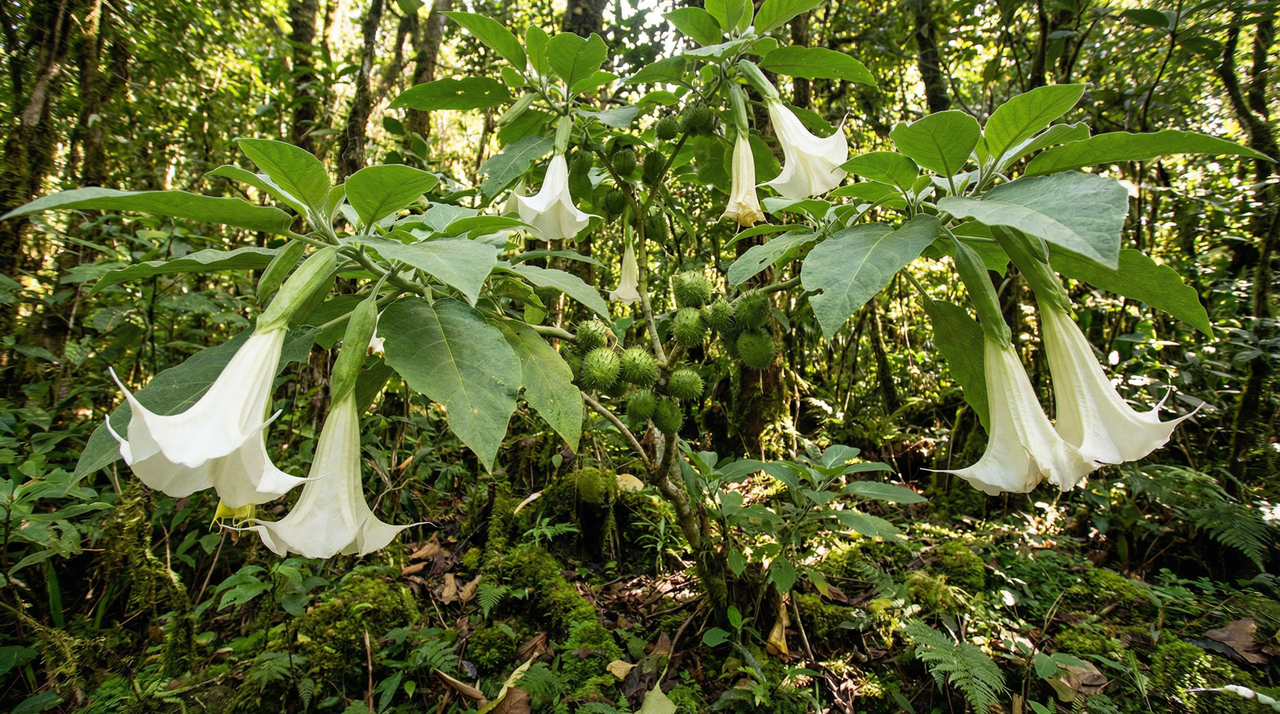
Every plant I grow, I can eat from, brew with, or hand to a neighbor without a second thought. Angel's Trumpet breaks that rule completely, and I grow it anyway. There's something clarifying about a plant that demands you take it seriously from the very first encounter: the flowers hang down in these enormous, pendulous trumpets, sometimes eight inches long, and after dark the fragrance shifts from faint sweetness to something almost overwhelming, jasmine and citrus and something harder to name. The whole performance feels designed to pull you closer. That's not entirely metaphor. Brugmansia evolved its scent as a nighttime signal for hawkmoths, but the tropane alkaloids concentrated in every part of the plant, flowers, leaves, seeds, roots, are some of the most potent anticholinergics found in any garden ornamental.
What stops most people from growing it isn't the toxicity, actually. It's the misconception that Angel's Trumpet is a difficult, fussy exotic. In the right climate it's almost aggressively easy, fast-growing, and floriferous to a degree that feels almost theatrical. The harder truth is one most nursery tags won't tell you: every Brugmansia species is extinct in the wild.[1] The plants gracing gardens from California to Cornwall exist only because humans kept propagating them. That fact changes how I think about every cutting I root, every season I coax one through a marginal winter. There's more history wound into these flowers than their catalog photos suggest.
Angel's Trumpet Origin, History, and Botanical Background
Here's something that stops most gardeners cold when they first hear it: every angel's trumpet growing in a garden, a container, or a nursery pot anywhere on earth is, in a very real sense, an orphan. All seven Brugmansia species are listed as Extinct in the Wild on the IUCN Red List, with no self-sustaining wild populations remaining anywhere.[2][3][4] The leading theory is that the large South American mammals that once dispersed Brugmansia seeds are gone, victims of the Pleistocene megafauna extinctions, and without them the plants simply couldn't regenerate in the wild.[5] I've seen similar stories play out with other Solanaceae in disturbed landscapes, where the loss of one ecological relationship quietly unravels the whole thread. What makes Brugmansia's story particularly poignant is that the plant didn't go extinct. Humans loved it too much for that. Every cutting rooted on a windowsill is, whether its grower knows it or not, an act of ex-situ conservation.
Botanical Background and Andean Origins
Angel's trumpet is native to the Andean regions of South America, with Brugmansia suaveolens (the scientific name you'll see on most nursery tags) naturally occurring across Colombia, Ecuador, Peru, Bolivia, and Venezuela in montane cloud forests up to around 2,000 meters elevation. Other species in the genus range as high as 3,200 meters.[6][7] Those cloud forests are humid, mist-wrapped, and filtered by a canopy that delivers dappled light rather than scorching sun. That origin explains a lot about how these plants behave in cultivation: they want moisture, they want shelter, and they resent harsh midday exposure.
The genus name itself has a layered history. Carl Linnaeus first formally described Brugmansia arborea back in 1753, classifying it under Datura, and the Datura-angel's trumpet confusion has persisted in common language ever since.[8] Alexander von Humboldt and Aimé Bonpland described B. suaveolens as Datura suaveolens in 1809, and the genus wasn't formally separated until Berchtold and Presl did so in 1823.[9] The devil's trumpet versus angel's trumpet distinction, while partially botanical (Datura flowers point upward, Brugmansia flowers hang down), gets muddled in casual use. They share the Solanaceae family and the same dangerous tropane alkaloid chemistry, but they are genuinely separate genera. As a tender evergreen shrub or small tree, B. suaveolens typically lives 5-15 years in cultivation, occasionally reaching 20 years under ideal conditions.[10]
Visual Characteristics of Angel's Trumpet
In cultivation, angel's trumpet typically grows 6-15 feet tall with a spreading, vase-shaped canopy, though in a genuinely warm, protected spot it can push past 20 feet.[11][12] The leaves are large, simple, and elliptic to ovate, running 6-12 inches long, with young foliage that's softly hairy and matures to something closer to smooth and slightly leathery.[13] One thing I tell people learning to distinguish young B. suaveolens seedlings from related nightshades: look for the slightly glaucous leaf sheen and opposite or whorled arrangement on the stems. It's a subtle cue, but once you've seen it, it clicks.
The angel's trumpet flower is where the whole genus justifies its cult following. Pendulous, trumpet-shaped blooms hang 6-12 inches long, typically white in B. suaveolens, releasing an intense fragrance that builds from dusk onward.[14][15] I've grown several cultivars in containers, and I'll tell you plainly: the first warm evening you step outside and that scent hits you, you understand immediately why people grow this plant despite everything they know about it. The genus also offers dramatic variation. B. sanguinea reaches 10-33 feet and carries vibrant red to orange tubular flowers 8-12 inches long;[16] B. arborea tops out at 10-20 feet with white to cream blooms and a broad, rounded crown.[17] Whatever the species, always wear gloves when handling any part of the plant.
Traditional and Cultural Uses in Indigenous Andean Cultures
Long before Humboldt gave the genus a Latin name, the Shuar, Quechua, Shipibo-Conibo, and other Andean and Amazonian peoples had developed sophisticated, carefully controlled relationships with Brugmansia. Shamans and curanderos prepared teas, ointments, and other preparations from B. suaveolens, B. sanguinea, and B. arborea for divination, spiritual communication, initiation rites, and healing, always administered under the supervision of trained practitioners who understood the lethal margin involved.[18][19] Having read the primary ethnobotanical literature and grown the plant myself, I cannot emphasize enough: these powerful tropane alkaloids belong only in the hands of trained traditional practitioners. The traditional medicinal applications were broad, spanning pain, inflammation, asthma, and rheumatism, among others, always in highly diluted preparations, and none of them carry modern clinical validation.[20]
Spanish and Portuguese traders brought the plant to Europe beginning in the 16th century, initially as an ornamental and medicinal curiosity. B. arborea reached European gardens around 1773, and B. sanguinea was documented at Kew Gardens by 1823.[21] From there the ornamental trade carried it globally. That spread has brought real concerns: the commercialization of sacred indigenous protocols, recreational misuse leading to hospitalizations, and the steady erosion of traditional knowledge about appropriate use.[22] The angel's trumpet symbolism in its cultures of origin runs deep and specific; outside that context, it's a beautiful ornamental that demands respect, not experimentation.
Fun Facts About Angel's Trumpet
The night-building fragrance isn't accidental. B. suaveolens is pollinated primarily by nocturnal hawkmoths, and its long, tubular flowers and intensifying evening scent are precisely calibrated for that partnership.[7] Meanwhile, the red-flowered B. sanguinea attracts hummingbirds instead, a striking example of how different pollinators have shaped different evolutionary paths within a single genus. Where does angel's trumpet grow today? Practically everywhere warm, which creates its own ecological tension. In Hawaii and other Pacific islands, naturalized Brugmansia can outcompete native flora, making it an invasive concern even as it's a prized ornamental elsewhere.[23] Its worldwide popularity in USDA zones 9-11 stems from exactly the combination that makes it complicated: dramatic beauty, intoxicating fragrance, and a chemistry that demands you keep your wits about you every time you pick up the pruning shears.[24] The plants thriving in gardens from California to Queensland are, at root, living cultural heirlooms, propagated from cuttings because the wild ecology that once sustained them no longer exists.
Angel's Trumpet Varieties and Where to Buy
Notable Varieties of Brugmansia suaveolens and Related Species
Brugmansia suaveolens is the angel's trumpet most gardeners encounter first: a semi-woody shrub or small tree originally from the Andean cloud forests of South America, now cultivated across warm climates worldwide and capable of naturalizing in humid U.S. regions.[25][26] Plants typically run 6-12 feet tall and wide, though in ideal conditions they can push to 20 feet.[11] Those pendulous trumpets hang 6-15 inches long, opening white to pale cream in the straight species and ranging into pink, apricot, orange, and bicolor in cultivated forms.[11][27] The fragrance is jasmine-sweet, intensifying after sunset to draw in moth pollinators.[28]
Every Brugmansia cultivar and species carries a potent tropane alkaloid profile throughout every part of the plant.[29] Breeders have given us double petals, variegated leaves, deeper colors, and arguably stronger nocturnal fragrance, but nobody has bred out the toxicity. Growing several cultivars side by side over the years, I've noticed that 'Charles Grimaldi' and similar orange-red forms do seem to throw a particularly heady scent on warm summer nights, but that sensory payoff doesn't change what you're dealing with chemically. Every flower, leaf, and seed is dangerous.
Among B. suaveolens selections, 'Snow White' gives you clean single white blooms, 'Double White' layers the petals for a more theatrical effect, and 'Variegata' adds cream-edged foliage to the show.[30] The related B. sanguinea, the red angel's trumpet, shifts the palette entirely with compact 4-6 inch funnel-shaped flowers in vivid red, represented in named selections like 'Ecuador Red' and 'Super Red.'[31][30] B. arborea leans back toward white-to-cream with longer trumpets and a history of cultivation stretching to pre-Columbian times; 'Knightii' is a vigorous white selection worth seeking out.[32][33]
Sourcing Angel's Trumpet Plants Safely
B. suaveolens is hardy in USDA zones 9-11 and widely available from specialty tropical nurseries, with peak supply running spring through summer.[34][35] Budget around $10-30 for rooted cuttings or small plants, $25-60 for larger specimens, and upward of $100 for mature statement plants.[36] B. sanguinea is considerably harder to find because its endangered wild status and CITES trade restrictions mean most suppliers offer it only as seeds or cuttings through specialist channels.[37][38] In my zone 9 trials it's also behaved as slightly more cold-sensitive than the white suaveolens forms, so factor that into your decision if you're pushing hardiness limits.
Before you order anything, check your local regulations. I always do this before buying because in Florida, B. suaveolens cannot legally be sold, propagated, or planted, and B. sanguinea is prohibited in California.[39][40] That's not a gray area. When a plant does arrive, I flip the leaves and check the undersides immediately for spider mites, because they spread fast to neighboring tropicals and are far easier to address on a single new plant than across an established collection. Look for healthy foliage, no signs of root rot, and ask for phytosanitary documentation on any imported material.[39] Every part of every variety remains highly toxic to children, pets, and adults, so placement and labeling matter from day one.[41][42] I label my container plants clearly and I only pass cuttings to other gardeners after a direct conversation about what they're taking home. Logee's Plants and Plant Delights Nursery are reliable U.S. sources worth starting with.[43][44]
Angel's Trumpet Propagation and Planting (Brugmansia suaveolens)
There's a fundamental choice to make before you propagate angel's trumpet, and it comes down to this: do you want flowers this season, or are you comfortable waiting a few years for something potentially surprising? That single question should guide every decision that follows, because the two main methods -- cuttings and seed -- represent almost opposite gardening experiences.
Understanding Recalcitrant Seeds and Viability
Before anything else, you need to understand how Brugmansia suaveolens handles seed storage, because it's genuinely different from most plants in your garden. These seeds are recalcitrant, meaning they cannot tolerate drying out or cold temperatures without rapidly losing the ability to germinate.[45][46][47] I learned this the hard way. I stored a small batch in the refrigerator thinking I was preserving them, pulled them out six weeks later, and got almost zero germination. Sow fresh, sow immediately.
When you harvest ripe pods, you'll find flat, kidney-shaped seeds, dark brown to nearly black, roughly 2-4 mm long with a slightly waxy surface.[48][49] Sow them about half a centimeter deep in warm, moist media kept at 70-80°F (21-27°C). Expect germination in two to four weeks.[45][50] Soaking seeds in warm water for 24 hours before sowing can push germination rates up to 70-90% with fresh seed.[51]
Cuttings: The Fastest Route to True-to-Type Plants
Semi-ripe cuttings taken in spring or early summer are the method I default to almost exclusively, and for good reason. If you bought a named double-flowered cultivar or a specific color form, cuttings are the only way to guarantee you get the same plant back.[52][53] I've struck hundreds of cuttings over the years, and I now label every single tray after once losing track of a prized double-pink among a flat of indistinguishable seedlings that looked exactly like tomato starts in their first weeks.
Take cuttings 4-8 inches long from healthy, non-flowering stems with two to three nodes, dip them in rooting hormone at 0.3-0.5% IBA concentration, and set them in a sterile perlite-peat mix.[52][53][54] Keep humidity high (60-90%), temperatures in that same 70-80°F range, and provide bright indirect light. Rooting typically happens in three to six weeks,[53][55] which is roughly comparable to striking rosemary or lavender -- familiar timelines if you've propagated either of those. Once roots are established, pot up into well-draining mix and treat the cutting like a very hungry tomato seedling: it wants warmth, consistent moisture, and room to run.
Seed Propagation: Patience and Genetic Variation
Growing brugmansia from seed is a different kind of project. You're trading speed for the possibility of something new -- a different fragrance intensity, subtle color shifts, or a novel growth form that no named cultivar has captured yet. Seed-grown plants typically take one to two years to first bloom, and some species in the genus stretch that to three years.[45][56] If you have that patience, and you enjoy the process of watching seedlings develop, it's genuinely rewarding. If you want flowers this season, take a cutting.
Advanced Techniques: Grafting, Layering, and Tissue Culture
For gardeners who want to push further, grafting onto compatible rootstocks (other Brugmansia species, or even tomato) using cleft or whip-and-tongue techniques achieves success rates of 50-90%, with graft unions forming in four to six weeks.[57][58] It's worth pursuing for rare hybrids or when disease resistance matters more than simplicity. Air layering is slower but reliable at 60-90% success in four to twelve weeks on established plants in early summer.[59][60] Tissue culture achieves over 90% success but requires sterile lab conditions, putting it firmly outside the home garden toolkit.[60]
Regardless of method, I never propagate or prune without gloves and long sleeves. The tropane alkaloids in every part of this plant are no joke, and I've seen pets and small children get into trouble when the warning was treated lightly.[55][11] Sterilize your tools, use sterile media, and keep good airflow around any cuttings to prevent Botrytis and root rot from moving in during those vulnerable first weeks.[55]
Soil, Site Selection, and Planting Technique
In its native Andean habitat, B. suaveolens grew along riverbanks in moist, loamy, volcanic or alluvial soils loaded with organic matter.[61][62] That tells you everything about what it wants: rich, moisture-retentive soil that still drains freely. Target a pH of 6.0-7.0, though it tolerates a broader range from 5.5 to 7.5.[61][12] Sandy loam or loamy textures are ideal; clay is workable if you amend it heavily for drainage.[11][63] In my experience, blending 20-30% perlite or coarse sand into a quality potting mix has prevented more root-rot problems than any other single amendment.
The root system is fibrous, shallow, and spreading, extending 30-60 cm deep and up to 1-2 m horizontally.[45][64] That architecture makes the plant extremely sensitive to compaction and waterlogging; either one restricts airflow to the roots and invites rot fast.[65] For in-ground planting, prepare a hole at least 45-60 cm deep with loose, well-aerated soil. For containers, go a minimum of 18-24 inches deep and make sure drainage holes are adequate.[61][12] Set the root ball at soil level, never deeper, to avoid stem rot at the crown.[45]
Site this plant where it gets six to eight hours of direct sun daily, with some protection from strong afternoon wind that can shred those large leaves.[66][45] In hotter climates, dappled afternoon shade prevents leaf scorch without sacrificing bloom production.[12]
Spacing and Transplanting for Healthy Growth
New growers almost always plant too close. A mature angel's trumpet can reach 10-15 feet tall with a spread of 6-10 feet,[67][45] and I know from walking between specimens in a client's landscape that 6-foot centers feel impossibly tight once the plants hit full size. I space mine 8 feet on center in the ground so there's room to move through for pruning and inspection without brushing against the foliage. Missouri Botanical Garden recommends 6-8 feet as a minimum.[67] In tropical landscapes where growth is unrestricted, 10-12 feet between plants is genuinely more appropriate.[68] Good airflow from day one reduces the fungal pressure that catches up with crowded specimens later.
For outdoor planting in zones 9-11, wait until after the last spring frost and until soil has warmed to at least 60°F.[61][12] In cooler zones, the plant needs to stay in a container that can move indoors before the first frost arrives.
Timeline from Propagation to First Bloom
Here's where the cutting versus seed decision becomes very concrete. Plants grown from semi-ripe cuttings typically bloom in 6-12 months under good conditions.[45][56] Seed-grown plants take one to two years on average, and in cooler conditions or with less-than-ideal light, you might wait three years before seeing those pendulous flowers.[45] Grafted plants land somewhere in the middle, typically flowering 6-18 months after a successful union.[45] In zone 9B with warm nights and generous sun, gardeners who take cuttings in spring generally land at the faster end of those windows. Once those first enormous blooms open 6-12 months after striking a cutting, the plant becomes nearly impossible to resist propagating further.
Angel's Trumpet Care Guide: Growing Brugmansia suaveolens
Every decision you make with angel's trumpet traces back to the same root fact: this is a cloud-forest plant from the Andean slopes of South America, and it has never forgotten it. Getting brugmansia care right means understanding that the plant evolved in a world of consistent moisture, moderate temperatures, and rich volcanic soil, and it will communicate, loudly, when any of those conditions slip. I've grown the same Brugmansia suaveolens clone for seven years now, and what's kept it going isn't any single trick; it's learning to read the plant's signals before they become emergencies.
Sunlight Requirements for Angel's Trumpet
Angel's trumpet performs best with 6-8 hours of direct sun per day, and longer photoperiods of 12-14 hours genuinely move the needle on flower production.[11][45] Think of it the way you'd think about hibiscus or plumeria in a Florida garden: strong morning sun is essential, but harsh afternoon exposure in peak summer invites trouble. Too little light and stems go spindly and pale almost immediately, with noticeably reduced flower set.[45][69] I watch for etiolation on my indoor-started seedlings every spring and move them under stronger light before they stretch past recovery. On the other end, too much intense afternoon sun scorches leaf margins to a crisp brown and can bleach flower color.[45] If you're moving a plant from lower to higher light, do it gradually over a week or two; this species does not acclimate well to abrupt changes.
Watering Needs and Drought Tolerance
Brugmansia suaveolens comes from a habitat that receives up to 3,000 mm of rain annually, and it has essentially zero drought tolerance.[13][70] I learned this the hard way: one missed deep watering during a 95°F week and an entire flush of buds dropped overnight. The research backs that experience; stress shows within 3-7 days of dry soil in heat.[71] Water thoroughly when the top inch or two of soil dries out, saturating the root zone each time.[11][45] Container plants dry dramatically faster and often need checking every couple of days in warm weather. Overwatering is equally damaging: yellowing leaves starting at the base, wilting despite wet soil, and soft stems usually mean root rot is already underway.[56][45] The plant prefers a slightly acidic to neutral soil pH of 6.0-7.0 and dislikes hard or high-salt water; rainwater or dechlorinated tap water is worth the small effort.[45][72] In winter dormancy, pull back dramatically, watering only every four to six weeks to keep the soil barely moist.[45]
Feeding and Fertilizer for Angel's Trumpet
This is a genuinely heavy feeder, and skimping on fertilizer is one of the fastest ways to end up with a lot of leaves and very few flowers. During the growing season, apply a balanced water-soluble fertilizer (10-10-10 or similar) every two to four weeks at half strength.[73][45] Once you see buds forming, switch to a high-phosphorus formula like 10-30-20; in my experience this genuinely delivers the oversized, prolific flush that makes brugmansia so dramatic.[74] Stop feeding as fall approaches and cease entirely through winter dormancy, flushing your container soil monthly with plain water to prevent salt accumulation.[75][45] Nutrient deficiencies are easy to read once you know the language: uniform yellowing of older leaves points to nitrogen hunger, interveinal chlorosis on young leaves signals iron deficiency, marginal scorch on older leaves suggests potassium is running low, and older leaves showing interveinal yellowing again, but different in pattern, usually means magnesium.[76][74] I now catch the pale new growth of iron chlorosis within a few days and hit it with chelated iron before the plant loses momentum. Compost tea, fish emulsion, and well-rotted manure are all solid organic options for gardeners who prefer that route.[75]
Frost Tolerance and Overwintering
Brugmansia suaveolens is hardy only in USDA zones 9-11; outside that range, it's a tender perennial that needs your help to survive winter.[77][14] Temperatures below 32°F damage the plant and anything at or below 28-32°F is often lethal to stems and foliage, though insulated roots may survive if the soil is dry and well-drained.[78] The first signs of cold injury are water-soaked patches, rapid browning or blackening of leaves, and eventual stem collapse.[79][80] If you're growing in a container, which I'd strongly recommend anywhere outside zone 9b or warmer, move the plant indoors before the first frost. I prune mine back to around 12-18 inches before bringing it in each fall; it's much easier to store, and the hard cut actually stimulates vigorous basal growth the following spring.[81] Keep it in a cool, bright, frost-free spot between 45-55°F through winter, water only to prevent complete desiccation, and resume normal care after your last frost date.[79] For in-ground plants in marginal zones, 5-12 inches of organic mulch over the root zone combined with a frost cloth can sometimes see the roots through a mild freeze.[45]
Heat Tolerance and Summer Stress Management
Angel's trumpet thrives in daytime temperatures of 70-85°F with nights staying above 60°F, and it can handle brief spikes to around 100°F if humidity is adequate.[11][75] Above 90-95°F without intervention, stress shows up as flower and bud drop, wilting, and leaf scorch. The practical fix is afternoon shade, consistent deep watering, and 2-3 inches of mulch over the root zone; in my hot, humid summers I've found the difference between mulched and unmulched plants is dramatic in both leaf health and flower retention.[82] On west-facing exposures I often add 30-40% shade cloth through July and August. B. sanguinea, from higher cloud-forest elevations, is even more heat-sensitive and starts showing stress above 85°F, while the cultivar 'Charles Grimaldi' has a reputation for handling heat better than many others in the genus.[56][83]
Pruning, Maintenance, and Seasonal Rhythm
Prune established plants in late winter or early spring before new growth pushes, cutting back by a third to a half and removing any crowded or crossing branches.[45][84] For overwintered container plants, this late-winter cut and the pre-storage cut I mentioned earlier essentially merge into the same seasonal rhythm. Pinching shoot tips on young plants early on is something I wish someone had told me from the start; it transformed my own specimens from single-stem, leggy sticks into multi-branched, floriferous shrubs.[85] Light deadheading through the growing season keeps new flushes coming, and flowering typically peaks from late spring through early autumn.[86][87] Brugmansia suaveolens is polycarpic and can live 5-20 years, but it's also reliably perpetuated through cuttings indefinitely, which means the plant you invest care in now can be with you for decades.[75] One last thing I'll say firmly: always wear gloves and long sleeves when pruning. Every part of this plant contains tropane alkaloids, and I've seen pets and small children become seriously ill from exposure to even a single leaf.[81] That's not a footnote; it's a core part of responsible brugmansia care.
Harvesting Angel's Trumpet Flowers and Seeds
Growing angel's trumpet from seed is genuinely a long game. In my zone 9B garden I've grown Brugmansia both ways, from cuttings and from seed, and the timelines couldn't be more different. Cutting-grown plants often surprise with their first blooms in the first full season under consistent warm days and nights. Seed-grown plants are a different story: expect to wait the full second or third year before those pendulous trumpets finally appear.[88][89] Once they do, brugmansia seed pods take another four to eight weeks post-flowering to fully mature,[90][45] so patience isn't optional with this plant.
Timing, Ripeness Cues, and Seasonal Windows
In USDA zones 9 through 11, peak flowering runs roughly June through October, with brugmansia seed pods maturing through late summer into November.[91] The ripeness cues are pretty unmistakable once you've watched a few seasons of this. A pod that's ready transitions from leathery green through yellowish-brown to a uniform dry brown, developing a papery, brittle texture as it goes. When it finally splits along its length and reveals the dark angular seeds inside, that's your window.[92][93] I've learned to check pods daily as they approach that point, because waiting too long means seeds on the ground before you get to them.
One thing I want to be direct about here: any harvest of brugmansia seed pods is strictly for ornamental seed saving. Alkaloid concentrations are significant throughout the plant, and mature pods are no exception. There is no safe culinary or medicinal application for any part of this plant, full stop.
Fragrance Profile and Safety Considerations
The real reward for all that waiting isn't the seeds at all. It's stepping into the garden at dusk and being stopped in your tracks by the fragrance. The flowers of Brugmansia suaveolens produce a heavy, pervasive scent with jasmine and honeysuckle notes and a faint citrus lift underneath, strongest in the evening hours when the plant is signaling to its nocturnal moth pollinators.[14][70] The compounds driving that scent include benzyl acetate and linalool.[94] Think night-blooming jasmine, but louder.
I've made it a non-negotiable rule that the scent is where my relationship with these flowers ends. Nothing from this plant enters my kitchen or medicine cabinet, ever. The tropane alkaloids that saturate every part of the plant, flowers, leaves, seeds, pods, roots, create a profound gap between "smells incredible" and "safe to use." Always wear gloves when handling, keep the plant well away from children and pets, and treat any accidental ingestion as a medical emergency. The beauty is real. So is the danger.
Angel's Trumpet Preparation and Uses
Why Angel's Trumpet Is Not Edible
There are no safe culinary or nutritional uses for angel's trumpet. Every part of Brugmansia suaveolens and its relatives contains tropane alkaloids (scopolamine, hyoscyamine, and atropine) at concentrations high enough to cause serious harm.[95][96] The intense bitterness and immediate oral numbness aren't subtle; they're the plant's warning system. I've watched a colleague's child brush a leaf against their lips and spit it out immediately from the taste alone, and that instinctive reaction probably spared them a very bad night. Anticholinergic poisoning can escalate rapidly, with symptoms appearing within 30 minutes to 2 hours and persisting 24 to 48 hours or longer.[97] Even 1 to 2 leaves or seeds can be dangerous, and no amount of cooking or drying reliably removes the toxins.[98]
If you suspect exposure, call Poison Control immediately rather than waiting for symptoms to develop. In my work I've seen how quickly tropane effects can escalate, and fast action is critical. There's no specific antidote; treatment is supportive, sometimes involving activated charcoal or physostigmine in severe cases.[99][100] Also worth knowing: angel's trumpet is frequently confused with Datura (Devil's Trumpet). The key visual difference is flower orientation — Brugmansia flowers hang downward from woody shrubs, while Datura flowers point upward on herbaceous stems. Both genera share the same dangerous alkaloid profile, so correct identification matters for any emergency responder.[12]
Traditional Medicinal and Shamanic Preparations
Indigenous Andean and Amazonian peoples, including Quechua, Jivaro, and Shipibo-Conibo communities, developed sophisticated ritual and medicinal uses for Brugmansia species over centuries, including leaf infusions for respiratory conditions, root poultices for wounds, and flower decoctions for sedation.[101][18] These were not casual folk remedies. They were highly ritualized practices performed under strict shamanic supervision, embedded in cultural knowledge systems built over generations.[102] The alkaloid content across individual plants varies enormously with growing conditions, season, and plant part, meaning there is no standardized dose and no established safety threshold. Attempting to replicate these preparations at home isn't just inadvisable — it's genuinely life-threatening.[103] I'll direct you to the origin and health sections of this profile for deeper cultural and pharmacological context; the short version here is simply: don't.
Ornamental and Non-Food Uses
What angel's trumpet genuinely excels at is being spectacular to look at and smell. I've specified B. suaveolens with its classic white to pale yellow pendulous trumpets in estate garden designs more times than I can count, always for the same reason: nothing else fills an evening garden with that kind of jasmine-forward fragrance while simultaneously drawing in hawkmoths and hummingbirds. The red-tubered B. sanguinea pulls more hummingbird traffic in my experience, while B. aurea's yellow blooms can reach ten inches long and perfume an entire courtyard.[104][105] The pollinator value is real, extending to bats and moths in warm climates, and the biomass from hard pruning can be used cautiously as mulch or green manure in areas well away from food beds, children, and pets.[11]
My standard practice when installing these plants is to place them where their fragrance drifts toward seating areas at dusk but where the plants themselves sit behind low fencing or dense border plantings that discourage casual contact. Always wear gloves when pruning or handling, keep them far from play areas, and label them clearly if you're gardening with anyone unfamiliar with toxic ornamentals.[106] The beauty is genuine. So is the responsibility that comes with it.
Angel's Trumpet Health Benefits and Medicinal Uses
This is one of those sections where "health benefits" is almost a misleading heading. Angel's Trumpet doesn't have a wellness story. What it has is a fascinating, potent, and genuinely dangerous phytochemical profile that has attracted human curiosity for centuries and continues to attract it for all the wrong reasons. Understanding that chemistry is worthwhile. Acting on it is not.
Phytochemical Profile of Brugmansia suaveolens: Tropane Alkaloids and Secondary Metabolites
Every conversation about this plant's effects, traditional uses, and toxicity traces back to two compounds: scopolamine and hyoscyamine. These tropane alkaloids dominate the chemistry of Brugmansia suaveolens, with scopolamine typically ranging from 0.02-0.5% dry weight in leaves (and up to 1.2% in seeds) and hyoscyamine running 0.01-0.49% dry weight depending on plant part.[107][22][108] Seeds and leaves carry the heaviest load, roots moderate amounts, and stems and bark the least. That gradient matters, but it doesn't make any part safe.
What also matters is variability. Concentrations shift with temperature, humidity, light exposure, water stress, soil pH, altitude, plant age, and season, with levels typically rising during flowering or dry periods.[109][110][111] I grow Angel's Trumpet in humid subtropical conditions, and I've noticed that the nights when the fragrance is most intense seem to correspond with warm, moisture-heavy periods. Whether that's a reliable correlate of peak alkaloid production, I can't say for certain, but it's taught me to treat every part of the plant with equal caution at every time of year. There's no "safer" season with this one.
Beyond the dominant tropanes, B. suaveolens also contains flavonoids like rutin and quercetin, phenolics including chlorogenic acid, coumarins, saponins, and tannins reaching 5-10% in bark and leaves.[103][112] These contribute to measurable in-vitro antioxidant and antimicrobial activity, and they're genuinely interesting from a phytochemical standpoint. They do not, however, reduce or offset the toxicity of the alkaloids. Minor compounds like apoatropine and cuscohygrine are also present in trace amounts.[113][114] The tropane alkaloids evolved as herbivore defenses and likely influence pollinator selectivity. The plant is, in essence, chemically armed by design.
Traditional and Research-Based Medicinal Insights
Scopolamine and hyoscyamine function as competitive antagonists at muscarinic acetylcholine receptors, producing the anticholinergic syndrome that makes Brugmansia both culturally significant and acutely dangerous.[115][116][117] The hallucinations these compounds produce are not the classic psychedelic experience people sometimes imagine; they're delirium, disorientation, and altered perception driven by receptor antagonism, frequently described by survivors as deeply unpleasant and indistinguishable from psychosis.
Indigenous Andean communities, including Shuar and Quechua peoples, have used Brugmansia in shamanic ritual and ethnomedicine for centuries: for visions, divination, analgesia, and anti-inflammatory purposes.[118][119][120] These are strictly historical and cultural contexts, with preparations administered in tightly controlled ritual settings by specialists who understood the plant's behavior. They are not a template for anything modern or home-based. I do not use this plant medicinally in any form, and I tell clients the same. The research on its anticholinergic potency is too clear for any home experimentation.
Preclinical work, animal models and in-vitro studies primarily, does document analgesic, sedative, and anti-inflammatory effects. One cited example shows 40-60% reduction in carrageenan-induced paw edema alongside COX and cytokine inhibition; antimicrobial activity against S. aureus, E. coli, and Candida has also been measured at MIC 0.5-2 mg/mL.[121][122] No controlled human trials exist, and modern toxicological review confirms the therapeutic window is so narrow that any perceived benefit is overtaken by risk before a meaningful dose can be identified.[123][124] The mechanism is interesting science. It is not a treatment pathway.
Nutritional Profile and Food Safety Considerations
Angel's Trumpet has no nutritional value. There is no established food data for Brugmansia suaveolens in any food composition database because no part of the plant is edible. The flavonoids and phenolics noted in the phytochemical profile don't change that classification; they exist alongside the same tropane alkaloids that run through every tissue from root to seed pod. As a landscape professional I position this plant exclusively as an ornamental specimen, and I make its non-edible status explicit with every client who asks. It's not a subtle distinction. One mistake with this plant, especially involving children or pets, can mean a 911 call.
Safety, Toxicity, and Responsible Handling of Angel's Trumpet
All parts of Brugmansia suaveolens, and of related species including B. sanguinea and B. arborea, are highly toxic. Symptoms of anticholinergic poisoning include dry mouth, pupil dilation, blurred vision, rapid heart rate, hyperthermia, hallucinations, delirium, and in severe cases, respiratory failure, coma, or death.[125][126][99] Effects can begin within 30 minutes and persist for days. Even small amounts, a leaf or two, can hospitalize a child or pet. Cooking, drying, or burning the plant does not neutralize the alkaloids.
There is no antidote. Treatment is supportive: activated charcoal for recent ingestion, benzodiazepines for severe agitation, and physostigmine only under strict medical supervision in hospital settings.[127][128] Long-term effects from severe poisoning can include cognitive deficits and organ damage. If ingestion is suspected, call Poison Control immediately.
The contraindication list is long and serious: pregnancy (risk of miscarriage, uterine contractions, and fetal malformation), breastfeeding, glaucoma, cardiac arrhythmias, myasthenia gravis, prostate hypertrophy, respiratory conditions, and neurological or psychiatric disorders.[129][130] Interactions with other anticholinergics, sedatives, alcohol, MAOIs, antihistamines, tricyclics, and opioids can compound toxicity dramatically. No safe internal dose exists because alkaloid concentrations vary so widely between individual plants, plant parts, growing conditions, and seasons.
Contact risks are real too. Sap can cause dermatitis in sensitive individuals, and people with Solanaceae allergies may react to pollen.[131][132][99] I learned this the hard way early on, pruning without gloves and ending up with an irritated forearm for days. Now I wear gloves and long sleeves without exception, wash hands thoroughly after any contact, and never compost the trimmings. I also remove developing seed pods promptly, especially when dogs or young children are around, because ripe pods are among the highest-alkaloid structures on the plant.
One final identification note: Datura species are frequent lookalikes, distinguished primarily by their erect flowers versus Brugmansia's pendant trumpets and by their herbaceous rather than woody habit.[133][134] Both genera are toxic. After once finding Datura volunteers mixed in with ornamental seedlings in a mixed border, I started labeling every Solanaceae in my designs clearly. It's a small habit that prevents a big problem. Grow Angel's Trumpet for the breathtaking flowers and the extraordinary evening fragrance. Grow it knowing exactly what it is.
Angel's Trumpet Pests and Diseases
For a plant loaded with highly toxic tropane alkaloids, angel's trumpet has a reasonable built-in defense system. Those tropane alkaloids deter feeding and egg-laying, and the plant backs them up with glandular trichomes that trap small insects, extrafloral nectaries that recruit predatory ants, and latex laced with additional toxic compounds.[135][136][137] In my residential designs, I've watched deer strip gardenias and knock over banana plants while completely ignoring the Brugmansia two feet away.[138] The toxicity is real, and it works.
Pest Resistance and Common Insect Problems
The chemical armor has limits. Sap-sucking insects largely ignore the alkaloid question and go straight for vascular tissue anyway, and that's where Brugmansia runs into its most consistent problems. Aphids, spider mites, whiteflies, scale, mealybugs, thrips, and leaf miners are the usual cast, producing curled or yellowing foliage, stippling, honeydew, sooty mold, fine webbing, and silvery scarring depending on who's doing the damage.[139][45] In Central Florida, spider mites are my dry-season nemesis, showing up every spring with that characteristic fine webbing and stippling that looks almost identical to what I see on my hibiscus when conditions get arid. Catching it early makes a real difference.
The bigger concern is what these pests open the door to. Aphids, whiteflies, and mites can vector viruses or create wounds that invite fungal and bacterial secondary infections.[140] In humid climates or tropical settings, Lepidoptera larvae and leaf miners add pressure; greenhouse-grown plants face elevated spider mite and whitefly populations year-round.[141] No cultivar provides meaningful genetic resistance to any of these.[142] Management is entirely cultural and biological. I always site Brugmansia near flowering companions that draw lacewings and lady beetles, and the payoff in aphid suppression is noticeable within a season. Yellow sticky traps for early detection, proper spacing for airflow, and neem oil or insecticidal soap as a last resort covers most situations without disrupting the beneficials doing real work.[143][144]
Disease Resistance and Common Pathogens
Brugmansia sits squarely in the Solanaceae family, and that means fungal disease is always the first real threat to manage.[145] Leaf spot (Alternaria or Cercospora), powdery mildew, Botrytis blight, Fusarium wilt, Verticillium wilt, and Phytophthora root rot are the main offenders. Symptoms range from circular brown spots with yellow halos and white powdery surface growth to sudden wilting with mushy, foul-smelling roots.[145][146] Root rot from Phytophthora is the one that taught me the hardest lesson early on; I lost two young plants before I understood that "well-draining" isn't optional with this genus. Now I grow mine in containers or raised beds with generous perlite or bark amendments, and I haven't lost one to rot since.
Bacterial wilt (Ralstonia solanacearum), soft rot, and bacterial leaf spot are less frequent but far harder to resolve once established, and bacterial wilt has no cure.[145][147] Viral issues like Tobacco mosaic virus and Tomato spotted wilt virus, spread by insects or contaminated tools, also have no treatment once a plant is infected.[145] The environmental triggers that accelerate all of this are consistent: temperatures below 50°F, humidity above 85% with poor airflow, waterlogged soil, and erratic watering cycles.[148][149] Some species show relative advantages, with B. sanguinea carrying cool-weather resilience from its high-Andean origins and B. aurea showing moderate powdery mildew tolerance, but no cultivar is specifically bred for disease resistance.[45][150] Even 'Charles Grimaldi,' which I've found shrugs off mild mildew pressure better than the straight species in humid summers, gets the same preventive airflow and sanitation treatment as everything else in the planting. Good drainage, soil pH kept between 6.0 and 7.5, overhead watering avoided, and infected material removed promptly: that's the disease management program, and it works far better than any spray.[146][45]
Angel's Trumpet in Permaculture Design
Angel's Trumpet is one of those plants that stops people dead in their tracks at a garden tour, then raises a complicated set of design questions the moment you start thinking about where it actually belongs in a system. It earns its place, but it earns it on very specific terms. The Andean cloud-forest origins of Brugmansia suaveolens tell you most of what you need to know: this is a plant shaped by warm humidity, dappled understory light, and the rhythm of montane rainfall,[6][151] and it will let you know, clearly and dramatically, whenever your garden fails to deliver those conditions.
Climate and Hardiness Zones
The hardiness baseline is USDA zones 9 through 11, with frost sensitivity that begins right around 32°F and causes real damage at anything below 28°F.[152][153][12][35] In zone 9 landscapes I've worked on, the difference between a coastal planting and an inland one is significant. Coastal sites let Angel's Trumpet persist as a true perennial with minimal fuss; inland, where freezes hit harder and linger longer, plants frequently die back to the ground.[89][154] What I've found is that protecting the root zone with a generous layer of mulch is far more reliable than trying to shield the whole canopy with frost cloth. Mulched roots have bounced back from light freezes that killed unprotected neighbors outright.
For growers in zones below 9, container cultivation with indoor overwintering is the practical answer, and it works better than most people expect once you commit to it.[89][155] On the heat end, the sweet spot is 60 to 85°F; above 90°F, afternoon shade becomes important to prevent leaf scorch, and sustained temperatures above 100°F with inadequate irrigation will push the plant into visible stress.[129][156][12] The Andean cloud-forest ancestry is why it craves those cooler nights even in a warm climate; that nighttime temperature drop is part of what triggers heavy bud set. A quick note on genus diversity: B. sanguinea, native to higher elevations in the Andes (up to 3,500 m), tolerates somewhat more cold but remains firmly in zones 9 to 11 and does poorly in saline coastal conditions,[157][158] so the hardiness window across the genus is narrower than gardeners sometimes assume.
Ecosystem Functions and Pollinators
Here is where Angel's Trumpet earns its keep in a designed system. Those long pendulous flowers, with corolla tubes stretching 15 to 30 cm, are precisely matched to the proboscis of hawkmoths (family Sphingidae), and the plant produces 1 to 5 ml of nectar per flower at 20 to 30% sucrose concentration to make the transaction worth the moth's effort.[159][160][161] I've designed several evening garden borders around this plant specifically for that reason, and there's genuinely nothing else I've grown that pulls in hawk moths the way a blooming Angel's Trumpet does on a warm, humid night after rain. The fragrance intensifies noticeably in those conditions, something you only really understand after standing next to one in a subtropical garden at dusk, watching the moths arrive.
Compared to moonflower, which is my usual go-to for covering a trellis in a nighttime pollinator garden, Angel's Trumpet occupies a different ecological niche entirely: it's a woody perennial presence rather than a seasonal vine, and the nectar volume it offers is in another league. Hummingbirds serve as secondary pollinators for B. suaveolens, while the red-flowered B. sanguinea is primarily hummingbird-pollinated and B. arborea draws both hummingbirds and bats,[162][163] illustrating how much variation in pollination guild exists within a single genus based on flower color and timing alone.
Two honest caveats belong here. First, the tropane alkaloids that make this plant toxic to mammals also make it largely unpalatable to herbivores, which does reduce grazing pressure around it, but the same compounds and possible allelopathic root exudates may inhibit nearby seedling germination.[99][164] That's a design consideration, not a dealbreaker, but it shapes companion selection. Salvia, bee balm, and lantana make good companions for pollinator layering without competing for space at the root zone.[165] Second, Angel's Trumpet is listed as invasive in Florida, Hawaii, and parts of Australia,[166][167] and I'd encourage anyone in a subtropical or tropical climate to check their local invasive species list before planting, even in what feels like a contained border situation.
Forest Layer and Guild Placement
In forest garden terms, Angel's Trumpet sits in the shrub to understory tree layer, typically reaching 3 to 5 meters, which is where it occupied disturbed forest edges, riverbanks, and secondary growth in its native Andean range.[84][168] It forms arbuscular mycorrhizal associations that support phosphorus uptake and contribute to nutrient cycling in poor tropical soils,[163][5] and it provides some slope stabilization on subtropical banks, though it's not a primary erosion-control tool. Those are useful background functions, but they are not the reasons you'd choose this plant for a guild.
The real design answer is simpler: Angel's Trumpet belongs at the ornamental edge of a food forest, full stop. Every part of the plant, from roots to flowers to seeds, contains scopolamine and hyoscyamine at concentrations that make accidental ingestion genuinely dangerous for children, pets, and livestock.[99][169][41] I've placed it in pollinator evening borders where it's the undisputed star, but I always keep it at least 20 feet from any edible beds or play areas. Its value in a designed system is real: striking ornamental presence in the shrub layer, exceptional nighttime pollinator support, and aesthetic contribution to moon gardens and evening entertainment spaces.[170][171] It is not a nitrogen fixer, not a meaningful biomass producer, and not a candidate for food-zone guilds. Know that going in, site it accordingly, and it will reward you with one of the most dramatic flowering presences a temperate-zone evening garden can hold.
The Night I Stood Too Long Under the Flowers
I'll admit it: I once spent a full summer evening reading under a mature 'Charles Grimaldi' in full bloom, thinking the mild headache afterward was dehydration. It wasn't. That was the night Brugmansia stopped being just a beautiful plant to me and became something I genuinely respect, the way you respect deep water. It hasn't left my garden, but it's never let me forget who's in charge.
Sources 171
- IUCN Red List – Brugmansia species assessments ↩
- IUCN Red List: Brugmansia ↩
- IUCN Red List: Brugmansia suaveolens ↩
- IUCN Red List: Brugmansia sanguinea ↩
- Overharvesting of Brugmansia Species in the Andes ↩
- Brugmansia suaveolens ↩
- Brugmansia in the Andes - Kew Royal Botanic Gardens ↩
- Species Plantarum by Carl Linnaeus ↩
- Flora Peruviana et Chilensis ↩
- Plant Finder - Brugmansia suaveolens - Missouri Botanical Garden ↩
- Brugmansia suaveolens ↩
- Angel's Trumpet (Brugmansia spp.) ↩
- Brugmansia suaveolens ↩
- Brugmansia suaveolens ↩
- Angel's Trumpet (Brugmansia) ↩
- Brugmansia sanguinea ↩
- Tree Datura (Brugmansia arborea) ↩
- Ethnobotany of Brugmansia in South America ↩
- The Shamanic Use of Brugmansia in the Andes ↩
- Brugmansia Species in Traditional Andean Medicine ↩
- History of Tropical Plants in European Gardens ↩
- Ethnobotany of Brugmansia Species in Peru ↩
- Invasive Plants in Hawaii: Brugmansia sanguinea ↩
- Brugmansia suaveolens ↩
- Brugmansia suaveolens - Kew Science ↩
- Brugmansia suaveolens - USDA PLANTS Database ↩
- Royal Horticultural Society - Brugmansia suaveolens ↩
- Brugmansia suaveolens - North Carolina Extension Gardener Plant Toolbox ↩
- Missouri Botanical Garden: Plant Finder - Brugmansia suaveolens ↩
- American Brugmansia & Datura Society - Cultivars ↩
- Brugmansia sanguinea ↩
- Brugmansia arborea ↩
- Cultivars of Brugmansia arborea ↩
- Royal Horticultural Society - Brugmansia suaveolens ↩
- USDA Plant Hardiness Zone Map ↩
- Angel Trumpet Plants ↩
- Brugmansia Sanguinea - Red Angel's Trumpet Plant ↩
- CITES Appendices ↩
- Federal Noxious Weeds ↩
- California Code of Regulations - Prohibited Plants ↩
- Toxic Plants: Angel's Trumpet ↩
- Poisonous Plants of California ↩
- Where to Buy Brugmansia Plants in the US ↩
- Brugmansia Species and Hybrids ↩
- Brugmansia Cultivation Guide ↩
- Seed Storage Behaviour of Brugmansia suaveolens ↩
- Recalcitrant Seeds: Biology and Storage ↩
- Seed Morphology in the Solanaceae: Heavy Use of Embryo Micromorphology in Phylogenetic and Taxonomic Studies - Leiss & Graf (2009) ↩
- Plants of the World Online - Brugmansia suaveolens ↩
- Seed Biology of Brugmansia sanguinea (Solanaceae) ↩
- Growing Brugmansia from Seed ↩
- Brugmansia Propagation ↩
- Propagating Angel's Trumpet from Cuttings ↩
- How to Grow Brugmansia ↩
- UC Master Gardener Program: Angel's Trumpet Cultivation ↩
- Propagation of Brugmansia suaveolens ↩
- Grafting Brugmansia: Techniques and Rootstocks ↩
- Propagating Brugmansia: Grafting Methods ↩
- Brugmansia Propagation Guide ↩
- In Vitro Propagation of Brugmansia ↩
- Brugmansia suaveolens ↩
- Royal Horticultural Society - Brugmansia cultivation ↩
- Angel's Trumpet (Brugmansia spp.) ↩
- Growing Angel's Trumpet - University of Florida IFAS Extension ↩
- Soil Compaction Effects on Tropical Ornamentals ↩
- Brugmansia suaveolens ↩
- Plant Care Guide: Brugmansia ↩
- Cultivation of Ornamental Brugmansia ↩
- Light Requirements for Angel's Trumpet Plants ↩
- Brugmansia: Angel's Trumpets and Thorn Apple ↩
- Brugmansia suaveolens, Angel's Trumpet - UF/IFAS Assessment ↩
- Water Quality for Ornamental Plants ↩
- Plant Care: Brugmansia suaveolens ↩
- Fertilizing Angel's Trumpet Plants ↩
- Fertilizing Angel's Trumpet ↩
- Nutrient Deficiencies in Ornamental Plants ↩
- Brugmansia suaveolens - Angel's Trumpet ↩
- Angel's Trumpet (Brugmansia spp.) ↩
- Angel's Trumpet: Cold Damage and Recovery ↩
- Signs of Cold Injury in Tropical Plants like Brugmansia ↩
- RHS Gardening - Brugmansia ↩
- AHS Heat Zones ↩
- Brugmansia sanguinea - Missouri Botanical Garden ↩
- Brugmansia Care and Pruning ↩
- Angel's Trumpet (Brugmansia spp.) ↩
- Brugmansia suaveolens ↩
- Brugmansia suaveolens ↩
- Brugmansia suaveolens ↩
- Angel's Trumpet: Growing Brugmansia ↩
- Brugmansia Cultivation Guide ↩
- Brugmansia at Missouri Botanical Garden ↩
- Royal Horticultural Society ↩
- Harvesting Seeds from Angel's Trumpet (Brugmansia) ↩
- Volatile Compounds in Brugmansia suaveolens ↩
- Toxicity of Brugmansia - Poison Control ↩
- Poisoning Due to Angel's Trumpet (Brugmansia spp.) ↩
- Angel's Trumpet (Brugmansia spp.): A Dangerous Plant for Poisoning ↩
- Toxicity of Brugmansia and Datura Species ↩
- Angel's Trumpet Toxicity - Poison Control ↩
- Tropane Alkaloids in Brugmansia - NCBI ↩
- Ethnobotany of Brugmansia in South America ↩
- Ethnobotany of Brugmansia Species in South America ↩
- Brugmansia: Usage in Traditional Medicine and Toxicity ↩
- Angel's Trumpet: Cultivation and Care ↩
- Brugmansia sanguinea ↩
- Royal Horticultural Society - Brugmansia Care and Toxicity ↩
- Tropane Alkaloids in Brugmansia and Datura Species: Pharmacology and Toxicology ↩
- Tropane Alkaloids: Chemistry, Pharmacology, and Toxicology ↩
- Environmental Influences on Tropane Alkaloid Production in Brugmansia suaveolens ↩
- Seasonal Dynamics of Alkaloids in Brugmansia suaveolens ↩
- Soil and Climate Effects on Alkaloid Content in Solanaceae Plants ↩
- In Vitro and In Vivo Antioxidant Properties of Brugmansia suaveolens Extracts ↩
- Chemical Defense Mechanisms in Brugmansia suaveolens ↩
- Chemical Ecology of Alkaloids in Solanaceae: Defense and Pollination ↩
- Pharmacological Reviews: Scopolamine and Anticholinergics ↩
- Tropane Alkaloids: Chemistry, Pharmacology, and Toxicology ↩
- Scopolamine: Molecular Mechanisms of Action and Clinical Utility ↩
- Hallucinogenic Plants of the Andes: Brugmansia in Shamanic Practices ↩
- Ethnobotany of Brugmansia Species in South America ↩
- Traditional Medicinal Uses of Brugmansia in South America ↩
- Anti-Inflammatory Effects of Brugmansia suaveolens in Carrageenan-Induced Rat Paw Edema ↩
- In Vitro Antimicrobial and Anti-inflammatory Properties of Brugmansia spp. ↩
- Toxic and Medicinal Properties of Brugmansia Species ↩
- PMC Article on Tropane Alkaloids Pharmacology ↩
- Brugmansia Poisoning: A Retrospective Review of 90 Cases ↩
- Clinical Toxicology of Plant Toxins - Frontiers in Neurology ↩
- ATSDR Toxicological Profile for Atropine and Related Alkaloids ↩
- Poisoning by Angel's Trumpet: Case Report - CDC ↩
- Brugmansia Toxicity - Missouri Botanical Garden ↩
- Anticholinergic Toxicity ↩
- Contact Dermatitis from Ornamental Plants - American Family Physician ↩
- Brugmansia Cultivation - University of Florida IFAS ↩
- Brugmansia - Wikipedia ↩
- Tropane Alkaloids in Solanaceae ↩
- Chemical Defense in Brugmansia suaveolens: Role of Tropane Alkaloids Against Herbivores ↩
- Trichomes and Extrafloral Nectaries in Solanaceae: Insect Defense Mechanisms ↩
- Latex and Morphological Defenses in Angel's Trumpet (Brugmansia spp.) ↩
- Plant Finder - Brugmansia suaveolens ↩
- Insect Pests of Angel's Trumpet ↩
- Growing Angel's Trumpet (Brugmansia) ↩
- Brugmansia (Angel's Trumpet). Insect and Mite Pests ↩
- Brugmansia Production Guide ↩
- Integrated Pest Management for Floriculture and Nursery Crops ↩
- Managing Pests on Ornamental Plants: Brugmansia ↩
- Diseases of Brugmansia ↩
- Diseases of Brugmansia: Identification and Management ↩
- Bacterial Wilt in Plants ↩
- Brugmansia: Angel's Trumpet Care and Cultivation ↩
- Disease Management in Ornamental Solanaceae ↩
- Diseases of Angel's Trumpet (Brugmansia spp.) ↩
- Brugmansia suaveolens - Kew Science ↩
- Brugmansia suaveolens (Angel's Trumpet) ↩
- Brugmansia suaveolens ↩
- Growing Brugmansia in the Garden ↩
- Brugmansia and Datura Guidelines ↩
- Brugmansia suaveolens ↩
- Plants of the World Online: Brugmansia sanguinea ↩
- Missouri Botanical Garden - Plant Finder: Brugmansia sanguinea ↩
- Pollination Ecology of Brugmansia in Andean Habitats ↩
- Pollination Ecology of Brugmansia (Solanaceae) in the Central Andes ↩
- Brugmansia: The Complete Guide ↩
- Pollination Ecology of Brugmansia in the Andes ↩
- Pollination Biology of Brugmansia sanguinea ↩
- American Journal of Botany - Toxicity and Allelopathy in Solanaceae ↩
- Permaculture Companion Plants for Brugmansia ↩
- Invasive Potential of Brugmansia spp. - CABI Compendium ↩
- USDA PLANTS Database ↩
- Ecology of Brugmansia Species in the Andes ↩
- Angel's Trumpet (Brugmansia spp.) ↩
- Permaculture Research Institute ↩
- Permaculture Applications of Toxic Plants ↩