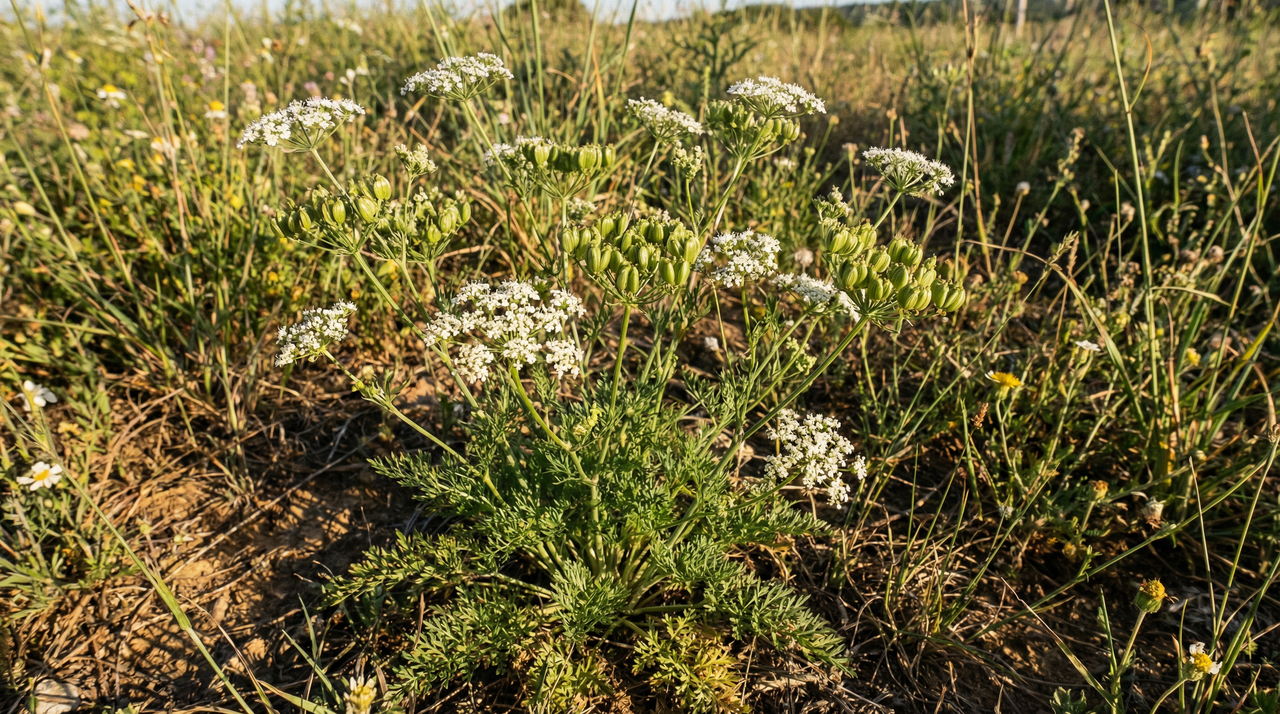
Nobody warned me that anise takes almost five months to give you anything. I'd grown coriander, dill, fennel; I thought I understood Apiaceae timing. But anise sits there in your garden for 120 to 150 days, quietly building those ferny little fronds, and the whole time it looks like it might just bolt and disappear before it ever rewards you. The first season I grew it seriously, I nearly pulled the whole planting in August because I convinced myself it had stalled. Two weeks later the umbels went gray-brown, the seeds rattled when I brushed them with my hand, and I understood why people have been cultivating this plant since ancient Egypt. That smell, cut grass and licorice and something almost medicinal underneath, came off the dried seed heads and filled the whole corner of the garden.
What I find genuinely strange is how little that 5,000-year cultivation history seems to have changed the plant.[1] Most herbs we grow today look nothing like their wild ancestors; breeders have been busy. Anise, though, remains stubbornly itself: no real named cultivars, no dramatic breeding programs, just regional landraces that differ in modest ways most gardeners will never notice. The plant that flavored Roman wedding cakes and showed up in Egyptian medical papyri is, more or less, the same one you'll direct-sow this spring. That continuity either means humans got it exactly right from the beginning, or we've been too distracted by how good it smells to bother improving it.
Anise Origin, History, and Botanical Background
Native Range and Botanical Description
Pimpinella anisum is the plant behind that unmistakable sweet-licorice scent most people associate with black jelly beans or Italian digestivi. A true annual in the Apiaceae family, it's native to the Eastern Mediterranean and Southwest Asia, with wild origins spanning Egypt, Iran, Iraq, Lebanon, Syria, and Turkey.[2][3] Over centuries of cultivation and trade, it naturalized across temperate Europe, Asia, and parts of North America, but gardeners in the U.S. should know it's an introduced species here, not a native.[4] It completes its full life cycle in a single season, typically 120 to 180 days from sowing to senescence, and will grow across USDA zones 4 through 9.[5][6] One thing I always remind newer growers: anise is insect-pollinated and shares its open-umbel flower structure with several toxic relatives, including poison hemlock (Conium maculatum) and water hemlock (Cicuta spp.).[7] Learning to tell them apart before you start harvesting is non-negotiable.
Visual Characteristics of Pimpinella anisum
In the garden, anise reaches somewhere between 30 and 90 centimeters tall with a branching, erect habit and a deep taproot that doesn't appreciate being disturbed once established.[8][9] The basal leaves are long-petioled and two- to three-pinnate; further up the stem they get progressively smaller and more finely divided into that characteristic feathery texture.[10] I grow anise every year from seed and I always mark my rows immediately after sowing, because those first true leaves look almost identical to carrot and parsley seedlings. Mistaking them for a weed and pulling them is a very easy thing to do.
By midsummer, the plants produce compound umbels two to six centimeters across, each holding clusters of tiny white to pinkish flowers barely three millimeters in diameter.[8] Those give way to grayish-brown, ribbed schizocarps, three to five millimeters long, that split into two single-seeded mericarps at maturity.[11][12] The anethole stored in the plant's glandular trichomes is what gives those seeds their licorice aroma, and it's potent enough that you'll smell it just brushing past the foliage on a warm afternoon.
Traditional, Cultural, and Historical Uses
Anise has one of the longer documented histories of any culinary herb. Seeds have been recovered from ancient Egyptian tombs, and the Ebers Papyrus, written around 1550 BCE, records its use for digestive complaints, coughs, flavoring, and even embalming.[13][14] Theophrastus described it around 300 BCE, and Pliny the Elder wrote about its carminative and expectorant properties in 77 CE.[15][16] What strikes me about that timeline is how consistent the uses are across cultures and millennia; the same properties that ancient Egyptian physicians valued are still what herbalists reach for today.
Moving along trade routes that eventually included the Silk Road, anise spread into Europe, India, and Asia well before the Middle Ages.[14] It accumulated symbolic meaning along the way: purification rites in Egypt, fertility and love rituals in Greece and Rome, a presence at Jewish Passover tables, and roles in South Asian bridal traditions.[17][18] European folklore assigned it to amulets against the evil eye, sleep remedies, and love charms, a range of applications that reflects how thoroughly this plant embedded itself in daily life.[19] Today, wild anise populations in Turkey and Egypt face pressure from overharvesting, raising genuine concerns about biodiversity loss and equitable benefit-sharing under frameworks like the Nagoya Protocol.[20] I choose to grow my own rather than buy imported seed when possible, both to reduce that pressure on wild Mediterranean populations and because I like knowing exactly how my herbs were produced.
Fun Facts and Ecological Notes
The anethole that defines anise's meaning in the kitchen and apothecary, making up 70 to 90 percent of its essential oil, also functions as a chemical defense against insect herbivores in the wild.[21] Its rapid annual life cycle is itself an adaptation, allowing the plant to flower, set seed, and senesce before Mediterranean summer heat and drought peak.[22] Essential oil content varies considerably by growing conditions, ranging from two to five percent, with warmer, drier summers pushing concentrations higher.[23]
On the ecological side, those midsummer umbels are genuinely excellent for beneficial insects. In my garden, the white-to-pinkish flower clusters reliably draw clouds of hoverflies and small native bees, week after week through the bloom period. Research on Apiaceae pollination ecology supports what any observant gardener will notice: these plants support a broad range of pollinators with nectar and pollen during a season when many other sources are winding down.[24][25] Commercial production now relies almost entirely on cultivated landraces rather than wild stands, with oil yield per hectare reaching 20 to 60 kilograms under optimal conditions, but the plant's deeper value in a home garden is less about output and more about the web of relationships it sustains.[26]
Anise Varieties and Sourcing
Morphological and Chemical Differences in Anise Landraces
Here's something I wish someone had told me before I spent time hunting for anise cultivars the way I'd shop for basil: there aren't any. Unlike tomatoes or even dill, Pimpinella anisum has no widely recognized, formally named commercial cultivars. Commercial production worldwide still relies on landraces and locally adapted populations rather than packaged, branded varieties.[27][28] For seed catalogues, that means the decision isn't "this variety versus that one." The decision is freshness, provenance, and aromatic intensity.
Variation does exist across global populations, just not in ways that get marketing names attached to them. Landraces and accessions differ in plant height (anywhere from 30 to 90 cm), seed size (3 to 5 mm), and most significantly, essential oil composition.[29][30] Anethole, the compound responsible for that characteristic sweet-licorice scent, drives the essential oil composition, though total oil content fluctuates significantly depending on the population and the growing season.[29][30] In my experience, the high-anethole lots are obvious the moment you bruise a seed between your fingers; the licorice scent is assertive rather than faint, and those same seeds tend to produce noticeably more flavorful harvests in the kitchen.
What actually matters when selecting a seed lot is how well it's adapted to your local temperatures and whether its 120 to 130 day maturity window fits your season.[31] The sweet anise plant is comfortable between 18 and 25°C (64 to 77°F) and cannot take hard frost or sustained heat at flowering.[9][32] Breeders are actively comparing landraces against improved lines for seed yield and oil quality, particularly from Egyptian and Turkish programs, but detailed comparative data is still thin enough that most home growers do the honest thing: trial two or three different seed sources side by side and save seed from whichever performs best. Low-tech, but it works.
Where to Buy Quality Anise Seeds
The sweet anise herb is widely available through major online retailers, specialty spice merchants, and health food stores. That broad availability is a blessing and a mild curse, because not all seed lots are created equal and the packaging rarely tells you what you actually need to know.
I always crack a few seeds before committing to a bag. If the licorice scent hits you immediately, that's a lot with decent anethole content and reasonably good viability. If you get a musty or almost odorless seed, keep shopping. The best seeds are light brown to gray-brown in color, with a bright, clean aroma. Dull color and weak fragrance both suggest age or poor storage, and those are exactly the lots that will give you patchy germination and underwhelming plants. The seeds you buy to cook with are the same seeds you'll put in the ground, so quality cuts both directions. I've had far better germination from small-batch lots picked up at farmers market spice stalls than from sealed jars sitting in a box-store spice aisle, and I suspect it comes down almost entirely to freshness and turnover rate.
If you're sourcing imported seed, it should meet FDA regulatory standards, which is a quiet but meaningful quality floor. Beyond that, your nose is the best tool you've got.
Anise Propagation and Planting Guide
Understanding Anise "Seeds" and Their Characteristics
What we casually toss into a seed packet and call "anise seeds" are technically mericarps, the two halves of a schizocarp fruit that splits at maturity. Each small, grayish-brown, slightly hairy piece measures just 3-5 mm and holds a single seed with oily endosperm and a tiny embryo.[33][34] That oily endosperm is where the anethole lives, which is why they smell unmistakably of licorice the moment you open the packet. Knowing you're sowing a fruit half rather than a true seed matters mostly when saving your own stock: what looks like one "seed" is already pre-split, so don't expect two seedlings from it.
The good news on storage is excellent. Anise exhibits orthodox seed behavior, staying viable for 3-10 years when kept at 5-8% moisture, around 4-10°C, and low relative humidity in a sealed container.[33][35][36] I keep mine in a small airtight jar with silica packets in the refrigerator and still see strong germination four or five years in. That longevity makes it easy to buy a good batch, save some for successive seasons, and not stress if one year's sowing underperforms.
Soil and Site Requirements for Successful Germination
Anise is native to the calcareous, well-drained soils of the Eastern Mediterranean, where dry summers and wet winters kept its roots aerated and its crown dry.[37][34] Replicate that drainage in your garden and you've solved more than half the potential problems before they start. It wants a loamy or sandy loam soil at pH 6.0-7.5, ideally sitting between 6.5 and 7.0, with moderate organic matter and good aeration.[38][39][40] Heavy clay is genuinely incompatible here; Fusarium root rot and damping-off move fast in waterlogged or compacted ground, and there's no recovering a seedling once either pathogen takes hold.
I learned the pH lesson the hard way after seeing yellow leaves appear in a slightly acidic bed. Iron chlorosis shows up below pH 6.0, and manganese or iron issues can appear above 7.5, so a soil test before planting isn't optional as far as I'm concerned.[37][41] A light lime application fixed the problem within a season. If you're working with sandy soil, work in compost to improve moisture retention without sacrificing drainage; the target is structure, not richness.[37] For container growing, a mix of 50% potting soil, 30% compost, and 20% perlite or coarse sand in a pot at least 20-30 cm deep gives the taproot the room and drainage it needs.[42]
Site selection and soil are inseparable from sunlight here. Anise needs six to eight hours of direct sun daily; shade produces leggy, pale growth and noticeably less aromatic seed.[43][44] The plants I grow in the brightest corner of my kitchen garden consistently produce the most fragrant seeds at harvest, which matters if you're growing for culinary or medicinal use rather than just the foliage.
Propagation Methods: Why Direct Seeding Wins
Anise is propagated by seed, full stop.[5][45] Stem cuttings succeed less than 20% of the time, division makes no sense for a taprooted annual, and while tissue culture is technically possible it's not commercially or practically justified.[46][47] Skip the mental gymnastics on vegetative methods. Seeds are what work.
Among seed-sowing approaches, direct sowing outdoors is strongly preferred over indoor starts because the taproot is sensitive to disturbance.[5][38] I tried transplanting indoor starts once and watched them sulk for weeks while direct-sown neighbors outpaced them entirely. If your season genuinely demands a head start, you can begin indoors 4-6 weeks before the last frost, but use deep individual cells and harden off carefully.[48] Surface sow the mericarps and press them gently into contact with the soil; they require light for germination and must not be buried.[39][38] At 20-25°C, expect germination in 10-14 days at 70-90% success rates under good conditions.[5][45] The early seedlings look remarkably similar to other Apiaceae, so I label every row clearly to avoid confusing them during thinning.
Damping-off from Pythium and Rhizoctonia is the main germination-phase threat, especially in heavy soils or humid conditions. Use a sterile seed-starting mix, keep airflow strong, and don't overwater those first few weeks.[38] After losing early batches to damping-off in wet conditions, I now prioritize drainage above everything else at sowing time.
Planting Technique, Spacing, and Timeline
Thin or transplant to 6-12 inches (15-30 cm) between plants, with rows 18-24 inches (45-60 cm) apart.[38][39][5] At maturity anise reaches 18-24 inches tall with a 12-18 inch spread, so these numbers aren't generous padding; they're the minimum airflow the plant needs to stay healthy and avoid the fungal pressure that comes with crowding.[49] On very fertile soil I'll push plants slightly closer together since the canopy fills in faster, but if seed yield is the goal over foliage, erring wider pays off at harvest.
Plan your sowing date around the full picture: anise takes 120-150 days from sowing to seed maturity, with flowering beginning around 90-120 days after germination.[45][39] Across USDA zones 4-9, that means a spring sow targeting late summer or early fall harvest.[4] Get the seeds in the ground at the right time, into well-drained soil in full sun, and the rest of the growing season tends to follow logically from there.
Anise Care Guide: Growing Pimpinella anisum Successfully
Every decision you make with anise comes back to one central truth: this is a cool-season Mediterranean annual working against a clock. It needs warmth to germinate, moderate temperatures to build its vegetative frame, and a long frost-free window to set seed. Get those seasonal bookends right and the daily care requirements are genuinely modest. Get them wrong and you end up with beautiful ferny foliage and not a single ripe umbel to show for it.
Sunlight Requirements
Anise needs full sun, at least 6 to 8 hours of direct light daily, to drive the essential oil production that makes the seeds worth growing in the first place.[50][7] That's the baseline and I don't think you can negotiate around it. Where it gets nuanced is in climates that push past 85°F regularly. Once temperatures climb into that range, some afternoon shade helps prevent wilting and leaf scorch and, critically, keeps seed quality from dropping. In my hotter summer gardens I've sited anise where a taller companion provides relief from the worst of the afternoon sun. The same logic applies whether you're gardening in the Deep South or anywhere with punishing late-summer heat.
Watering Needs
The target is roughly 1 inch of water per week through the growing season, applied when the top inch or two of soil has dried out, in well-drained soil.[51][7] Anise has low drought tolerance; a dry spell longer than one to two weeks leads to wilting, reduced flowering, and stunted seed development.[52][11] But the opposite is equally damaging: waterlogged roots rot quickly, and you'll see yellowing leaves and stunted growth before the plant collapses.[39] Consistent moisture without saturation is the standard you're aiming for.
Young seedlings need gentle watering every two to three days until they're established, and a layer of mulch helps hold that moisture between sessions.[53][39] Once the taproot is running, the plant becomes somewhat more forgiving, but it still dislikes swinging between waterlogged and bone dry. Drip irrigation at the base is worth setting up early, both for water efficiency and to keep foliage dry, which matters more once you reach the disease section.
Soil and Feeding Requirements
Anise is a moderate feeder that does best in well-drained, fertile soil with a pH between 6.0 and 7.5.[54][55] A soil test before you plant is genuinely useful here, not just boilerplate advice. Working in 1 to 2 inches of compost or well-rotted manure before sowing, along with a balanced 10-10-10 fertilizer at 1 to 2 pounds per 100 square feet, sets the plant up without pushing it into excess.[54][56]
The critical mistake I see repeatedly is overfeeding with nitrogen. My first year growing anise I had gorgeous, lush, dark-green foliage and almost nothing to harvest. Excess nitrogen delays flowering and depresses the essential oils in the seed, which means you get less yield and diminished aroma.[54][57] Side-dress with nitrogen only if growth has stalled, and stop feeding entirely once flowering begins. If your soil test shows phosphorus and potassium are adequate, adding more won't increase seed yield, but it will increase aphid pressure. I've watched that play out in my own beds more than once.
Frost Tolerance and Protection
While mature plants can survive a brief dip near 20 to 23°F with protection, seedlings are a different story entirely.[7][58] Young plants collapse at the first touch of frost, much like basil does, and the damage shows immediately: wilting, blackened foliage, necrotic tissue.[59][60] The practical rule is to protect below 32°F without exception. Floating row covers, 2 to 3 inches of organic mulch, and keeping plants out of low-lying frost pockets are your main tools.[54][61] Your last frost date isn't just a planting guide with anise; it's the boundary that defines whether your whole season succeeds.
Heat Tolerance and Summer Management
Anise grows best between 60 and 75°F.[62][54] Above 85°F the plant is stressed; above 90°F it's in real trouble. Heat stress causes leaf scorch, wilting, premature bolting, blossom drop, and seed yield losses of 20 to 50%.[63][64] In practice this is what makes anise tricky in humid subtropical gardens. I watch for afternoon wilting as my first warning sign, and I've found that 2 inches of leaf mulch over the root zone keeps soil temperatures noticeably cooler than bare ground. When the forecast turns brutal, shade cloth at 30 to 50% density helps, as does shifting irrigation to early morning so plants aren't stressed going into peak heat.[65][66]
Pruning, Maintenance, and Seasonal Rhythm
There's one maintenance step that makes a measurable difference in seed production: pinching the central growing tip when the plant reaches 6 to 8 inches tall, usually four to six weeks after sowing.[67] I used to skip it, assuming the plant would branch on its own. What I got was one tall stem with a single umbel and a disappointing harvest. Now I mark 6 inches on my garden stakes and pinch as soon as growth hits that point, every single season. Beyond that, maintenance is genuinely minimal:
- Remove yellowing lower leaves to encourage airflow
- Stake plants in exposed or windy sites to prevent lodging
- Keep overhead watering to a minimum.
The seasonal rhythm is straightforward once you internalize the 120 to 150 day arc: vegetative growth through spring after the last frost, flowering in early summer, seed set in late summer, and senescence as autumn arrives.[8][49] Every care decision you make from germination onward is in service of arriving at late summer with healthy umbels full of ripe seeds. Understanding that arc is what separates growers who harvest well from those who wonder what went wrong.
Harvesting Anise Seeds and Leaves at Peak Flavor
Anise will teach you patience and then punish you for being too patient. The entire harvest window comes down to catching the plant at one precise moment, and I learned that the hard way in my first season growing it, watching a significant portion of my seed crop scatter across the bed because I waited just a couple of days too long.
When to Harvest Anise: Timing, Visual Cues, and Avoiding Seed Shatter
Count on 120 to 150 days from sowing before your seeds are ready, which puts most temperate-zone gardeners into late summer or early autumn.[67][68] The visual cue you're watching for is the umbels shifting from green to gray-brown or yellowish-brown. But the test I rely on most now is sound: cup an umbel gently in your palm and give it a light shake. If you hear seeds rattling inside, you're right at the window.[69][5] I grow fennel and dill in the same beds and harvest them with similar intuition, but anise shatters far more readily than either of those, so that rattle test has become non-negotiable for me. The seeds are fully formed at that point but haven't dried to the point where they'll drop the instant you brush the stem.[69][70] Cut too early and you lose essential oil concentration; wait even a day past peak and you lose yield to the ground.
How to Harvest, Dry, Thresh, and Store Anise for Maximum Quality and Shelf Life
When the umbels are ready, cut the stems cleanly just below them with scissors or sharp shears, then hang them upside down in a warm, dry spot with good airflow, or spread them on fine-mesh screens.[69] Either way, you're aiming for one to two weeks of air-drying until seeds reach around 10 to 12 percent moisture content, which prevents mold without sacrificing aroma.[69][71] I've found slow air-drying really does produce a more fragrant seed than forcing it through a dehydrator, though a low-temperature oven or dehydrator set to 95 to 105°F works if you're in a hurry.[69] Once fully dry, thresh by rubbing the umbels between your palms over a clean bowl, then store the seeds in airtight containers somewhere cool, dark, and below 60 percent humidity.[69][7] Stored well, seeds hold quality for two to three years.[7] Any batch that smells musty or shows discoloration gets discarded immediately; there's no rehabilitating it.
Fresh leaves are a much shorter story. Snip them young and tender as needed, wrap in a damp paper towel, tuck into a perforated bag, and refrigerate at 32 to 40°F.[71] Even with that care, they decline noticeably after three to five days, so I harvest only what I'll use that same day.
Expected Yield, Seed and Leaf Characteristics, and Flavor Notes
What you get from a well-tended plant is plenty for home culinary and medicinal use: small, hard, crescent-shaped seeds with a faintly ridged surface and that unmistakable sweet licorice character driven by their high trans-anethole content.[72] The leaves, in contrast, are delicate and feathery while fresh but become brittle and lose much of their character once dried, which is why the seeds are always the prize.[72] Yield varies with your site and season, but the better you manage drainage and heat stress through the growing season, the more aromatic your seeds will be at harvest.
Anise Preparation and Uses
Culinary Uses of Anise: Seeds, Leaves, and Flavor Magic
Anise seeds are where most of the action is, but don't overlook the leaves and flowers. The tender feathery leaves and the small white umbel flowers are both edible and genuinely useful in the kitchen, contributing a greener, more herbaceous version of that licorice note.[73][74] Roots and stems aren't worth your time; they're fibrous and offer nothing culinarily that the seeds and leaves can't do better.
The seeds themselves are technically split fruits called schizocarps, two mericarps that separate at harvest, though everyone just calls them seeds.[4] That concentrated sweet licorice flavor comes from trans-anethole, which makes up 75-90% of the seed's essential oil.[75] When I grind freshly harvested seeds in my mortar, the aroma is immediate and intense in a way store-bought pre-ground anise simply cannot replicate. Toasting before grinding develops a slightly nutty, caramelized depth on top of that licorice sweetness.[76] Just keep processing temperatures below 40°C if you're drying them; higher heat degrades the volatile oils and can reduce anethole content by 15-30%.[77] Seeds from hotter, drier growing seasons tend to be noticeably more aromatic, which matches the research showing Mediterranean-grown anise typically reaches 80-92% anethole concentration.[78]
The applications run from baking to the bar cart. Anise goes into Italian biscotti and holiday cookies, breads, confections, liqueurs like ouzo and sambuca, and savory dishes including soups, stews, and spice blends.[79] It pairs beautifully with fish, poultry, carrots, tomatoes, dill, and fennel. A quick note on a common kitchen mix-up: anise seed and star anise share a similar flavor profile because both contain anethole, but they're entirely different plants. Star anise is a woody pod from an unrelated Asian tree; anise seed is a tiny oval fruit from this Mediterranean annual.[80] Substituting one for the other works in a pinch, but the quantities need adjusting since star anise is considerably more potent by volume.
Medicinal Preparations and Dosages
The same essential oil that makes anise taste like licorice candy also drives its therapeutic actions, which means your tea and your medicine are often the same thing. For digestive support, I follow the German Commission E and EMA guidelines directly: 1-3 g of dried seed per cup as an infusion, up to three times daily, or a tincture at 1-2 mL (1:5 ratio) three times daily.[81][82] These guidelines are grounded in long-term traditional use with solid safety data behind them, so they're a sensible place to anchor your practice. For a deeper look at the research on specific conditions and safety considerations for sensitive populations, the health benefits section covers all of that.
Non-Food and Companion Uses
Anise earns its place in the garden beyond the harvest basket. The anethole-rich foliage acts as a natural deterrent against aphids and other soft-bodied insects, making harvested sprigs a handy resource for garden pest management.[83] I've watched it noticeably reduce aphid pressure on nearby plants in seasons when other unprotected areas in the same garden were getting hammered. It won't replace good IPM practices, but as one layer in a diverse polyculture, it genuinely pulls its weight without any effort on your part once it's in the ground.
Anise Health Benefits and Medicinal Uses
What I find endlessly satisfying about anise from a grower's perspective is how directly its chemistry connects to its effects. This isn't a plant where the traditional uses and the pharmacology sit in separate categories. They point at the same molecule.
Key Phytochemicals in Anise: Trans-Anethole and Supporting Compounds
Trans-anethole is the dominant compound in anise essential oil, typically comprising 75-95% of the oil, with minor components including estragole (3-15%), anisaldehyde, fenchone, linalool, and terpenoids like limonene and α-pinene.[84][85][86] That single compound is responsible for the instantly recognizable scent and, as we'll see, most of the pharmacological activity. I've noticed in my own garden that seeds harvested after a hot, dry summer smell noticeably sharper than those from cooler years, which tracks with the research: Mediterranean varieties and warmer growing conditions tend to produce higher anethole concentrations.[87][88] The seeds themselves run 2-5% essential oil with 80-90% anethole; the leaves contain far less, around 0.5-1% oil with proportionally more linalool and limonene.[89]
Beyond anethole, anise seeds carry a meaningful load of phenolic compounds (10-50 mg/g dry weight), including chlorogenic, caffeic, ferulic, and p-coumaric acids, plus flavonoids such as quercetin, kaempferol, rutin, and luteolin.[90][91] These aren't passengers. Anethole has demonstrated antimicrobial activity (MIC 0.5-2 mg/mL), anti-inflammatory effects, and gastroprotective properties, while the phenolics and flavonoids contribute antioxidant capacity and likely reinforce the plant's defenses against pathogens and herbivores in the field.[85][92]
Nutritional Profile of Anise Seeds
Anise seeds are the primary edible and medicinal part of the plant, with typical adult use running 1-5 grams per day in culinary contexts.[93] Per 100 grams of dried seeds, the USDA data shows 337 kcal, 17.6 g protein, 15.9 g fat, 50.1 g carbohydrates, and 12.6 g fiber, alongside striking mineral levels: calcium at 647 mg, iron at nearly 37 mg, magnesium at 170 mg, potassium at 1,440 mg, and meaningful amounts of B vitamins and vitamin C.[93] I keep coming back to that iron number when people ask me whether a kitchen spice garden can contribute real nutrition. A small daily pinch of anise seed in tea or baking is not going to transform your iron intake, but at those concentrations it pulls more weight than most people expect from something they treat as flavoring. The minerals and macronutrients are relatively stable through processing, but the volatile oils are more fragile: boiling or baking causes a 20-50% loss of volatile compounds, while shade-drying or low-temperature drying preserves the phytochemical profile much better.[94][95] Stored cool and dark, seeds hold their quality for one to two years with minimal macronutrient loss.[96]
Medicinal Research and Traditional Uses
Across Middle Eastern, Ayurvedic, Traditional Chinese, and European systems, anise has been used for centuries as a carminative and digestive aid for bloating, gas, indigestion, and colic; as an expectorant for cough and bronchitis; and for menstrual cramps, insomnia, and as a galactagogue to support milk production.[97][98] The modern pharmacological picture is broadly consistent with that tradition, with the strongest human clinical evidence sitting in digestive and gynecological applications: clinical trials show reduced abdominal pain and bloating in IBS and dyspepsia. Furthermore, anise extract has matched mefenamic acid and ibuprofen for primary dysmenorrhea pain relief in trials involving 180 women.[99][100] That dysmenorrhea comparison caught my attention when I read the trials. Reaching for a seed tea over an NSAID isn't a decision anyone should make lightly, but knowing the research exists and is reasonably well-designed changes how I think about the traditional uses.
The mechanisms behind these effects are well-described in preclinical research: anti-inflammatory activity via NF-κB inhibition and reduced TNF-α, IL-6, and COX-2/5-LOX; antioxidant activity up to 80% DPPH scavenging with enhanced SOD and catalase; antispasmodic action via calcium channel blockade; broad-spectrum antimicrobial activity against E. coli, S. aureus, and Candida via membrane disruption; and estrogenic activity through trans-anethole binding to ERα and ERβ receptors, which provides a plausible mechanism for the hormonal applications even though human evidence there remains limited.[101][102][103] Preclinical data also supports analgesic effects (roughly 50% pain reduction in animal models), diuretic activity, sedative effects, and limited galactagogue evidence, but these areas are waiting on more rigorous human trials.[104] Anethole is rapidly absorbed (peak plasma around 30 minutes) and metabolized via CYP enzymes, which becomes relevant both for understanding its speed of action and for potential drug interactions.[105]
Safety Considerations for Anise
At culinary amounts, anise has an excellent safety record. The FDA recognizes it as generally safe (GRAS), and the seeds at 1-5 grams per day are well-tolerated by most adults.[106] For medicinal use, the typical recommendation is 1-3 grams of crushed seeds as a tea up to three times daily, and trans-anethole has low acute toxicity in animal studies (LD50 around 2090-3000 mg/kg in rats).[107] The cautions that deserve real attention are about concentrated essential oil, not culinary seeds: high doses of anise oil can cause nausea, vomiting, seizures, or pulmonary edema, and the minor component estragole raises theoretical carcinogenic concerns at concentrated levels, though the risk at culinary amounts appears minimal.[108][109]
I take the pregnancy and anticoagulant cautions seriously rather than waving them off with a generic disclaimer. The estrogenic activity via ER binding is specific and documented, which means hormone-sensitive conditions, pregnancy, and concurrent use of estrogenic drugs all warrant a conversation with a doctor before moving into medicinal doses.[110] The same CYP-enzyme metabolism that makes anethole fast-acting also creates genuine interaction potential with anticoagulants and other CYP-processed drugs.[111] Anyone with celery, mugwort, or broader spice allergies should also know that anise cross-reactivity is documented, up to and including anaphylaxis in sensitized individuals.[112] One final note on identification: if you're foraging or growing from an unlabeled packet, crush a leaf before assuming you have anise. The sweet licorice scent is unmistakable in a way that hemlock's musty, unpleasant smell never is. The Apiaceae family contains some dangerous lookalikes, and your nose is your first line of defense.[113]
Anise Pests and Diseases
Anise sits in an interesting position: as a member of the Apiaceae family, it inherits the full roster of pests that target carrots, dill, and their relatives, yet its own chemistry gives it a modest layer of built-in protection. The anethole and anisaldehyde concentrated in its tissues act as insect repellents, toxicants, and feeding deterrents that genuinely disrupt pest behavior and reproduction.[114][115] That resistance is real in the lab; in the garden it's more like a buffer than a shield. When conditions favor the pests, the plant still loses.
Common Pests of Anise
The pest list is predictably Apiaceous: aphids, thrips, leaf miners, carrot fly, spider mites, leaf beetles, cutworms, and leafhoppers can all find their way to anise at some point during the season.[116][117] Aphids are the one I watch most closely. They feed on sap, transmit viruses, and leave behind honeydew that invites sooty mold, and their populations peak in spring when humidity sits in that 70-80 percent range.[118] In my garden, aphid pressure on anise spikes noticeably after a stretch of warm, humid days, especially if I've watered overhead and left the foliage wet. That observation tracks directly with the research on humidity and virus transmission.
Carrot fly is a harder problem because the larvae attack roots underground, and anise's essential oils offer little protection against it.[116] Leaf miners tunnel through the leaf tissue, spider mites cause stippling and webbing in dry conditions, and leafhoppers can transmit phytoplasma diseases while creating stippled foliage of their own, with dry and windy weather making both worse.[117] I've noticed fewer leafhopper issues on anise I've grown interplanted with other strong-scented herbs compared to isolated plants, which suggests the field-scale repellency of anethole works better in a polyculture context than in a monoblock.
Diseases Affecting Anise
The disease pressure on anise is predominantly fungal. Leaf spot (Septoria or Alternaria), downy mildew, powdery mildew, Fusarium wilt, rust, root rots, and damping-off in seedlings can all appear, with conditions ranging from high humidity for the foliar pathogens to waterlogged soil for root issues.[119][120] Fusarium wilt is arguably the most destructive: it enters through the roots, causes yellowing of the lower leaves, and can kill the plant outright.[119] Rust produces orange pustules that cut into photosynthesis and yield, and it tends to flare in persistently humid stretches.[121]
Beyond fungi, bacterial leaf spot caused by Pseudomonas cichorii produces water-soaked lesions that turn necrotic in warm, wet weather, and Cucumber mosaic virus causes mosaic patterning and stunting, spread by the same aphids discussed above.[122][123] In major Indian growing regions, disease can account for 20-50% yield losses under favorable conditions, which gives a sense of what's at stake when the humidity settles in.[124] Damping-off in seedlings is the one that breaks my heart most reliably; those tiny ferny seedlings can collapse overnight in cool, wet soil before you've even confirmed what you're growing.
Prevention and Integrated Management
Since no widely available cultivar offers strong built-in pest or disease resistance, cultural practices carry almost all the weight here.[37] Rotating anise out of any bed that has grown Apiaceae crops for at least three to four years breaks soil-borne pathogen cycles, particularly for Fusarium.[125] Switching from overhead to drip irrigation was the single most effective change I made after losing a bed of anise to downy mildew two seasons ago. Keeping water off the foliage removes the humidity spike that those fungal pathogens need to take hold. Proper spacing for airflow and starting with disease-free seed round out the cultural toolkit.[126]
On the biological side, companion planting with basil, dill, or yarrow can draw in ladybugs, lacewings, parasitic wasps, and predatory mites that keep aphid, thrips, and spider mite populations in check.[127] Chemical intervention should be the last resort. Neem oil and insecticidal soaps handle soft-bodied insects reasonably well, while copper-based fungicides or sulfur can address foliar diseases when the label permits use on herbs.[128] Always check current labels and your local extension service guidance, since registrations shift and regional conditions vary considerably.[129]
Anise in Permaculture Design
Anise isn't the first plant most permaculture designers reach for, but I keep coming back to it season after season because it delivers ecological returns that feel disproportionate to the small footprint it takes up. At 45-60 cm tall with feathery, finely divided foliage and those delicate white umbels, it's a low-profile annual that quietly does a lot of work at the sunny edges of a guild or kitchen-garden bed.[4][7] Getting the placement right starts with understanding what the plant actually needs climatically, because anise has real preferences and ignoring them leads to disappointment.
Climate Requirements and Hardiness Zones
Anise is happiest in that sweet Mediterranean-summer zone where days are warm and dry: vegetative growth and seed production peak between 18-24°C (64-75°F), with an overall comfortable range up to 25°C.[130][37] It's listed as hardy across USDA zones 4-9, though it performs most reliably in zones 5-9 where summers are consistently warm.[59][131] Think of it the way you think about basil: that first hard freeze ends the season, full stop. It's an annual, and frost sensitivity is part of the deal.
Rainfall of around 500-750 mm annually suits it well, with consistent moisture during germination and early growth, good humidity balance, and critically, sharp drainage throughout the season.[59] Once established it handles dry spells reasonably well, which is why it thrives in California and Texas production settings where Mediterranean-style dry summers are the norm.[132][133] Gardeners in cooler Midwest climates can still grow it successfully by choosing a raised bed or a south-facing microclimate that captures extra warmth and sheds water efficiently.[134] I sow mine only after the soil has genuinely warmed; seedlings that go in during a cold, wet spring tend to bolt and skip productive seed set entirely.
Ecosystem Functions and Pollination Services
The small white-to-yellowish umbels that open June through August are where anise earns its ecological keep.[4][135] The flowers are self-compatible, so the plant can technically pollinate itself, but insect activity is where the real yield comes from. Honeybees, wild bees, and especially hoverflies (Syrphidae) are the primary visitors, drawn in by the protandrous flower structure and that characteristic anethole scent.[136][137] In pollinator-scarce conditions, seed set can drop by up to 50%.[138][139] I've seen this play out directly in my own garden: seasons when hoverflies are abundant produce noticeably heavier, fuller seed heads; quiet pollinator years produce thin ones.
That dependency is actually a feature from a permaculture perspective because it gives you a direct feedback signal about ecosystem health on your site. To keep that signal positive, avoid broad-spectrum sprays and build in structural diversity around your anise planting. The roots contribute something too, improving soil structure and supporting nutrient cycling over the season, even if anise isn't a nitrogen fixer or heavy biomass producer.[140][141]
Forest Layer Placement and Guild Companions
In a food-forest context, anise belongs in the herbaceous layer at the sun-facing edge, the kind of open, well-drained spot it would naturally occupy in a disturbed Mediterranean habitat.[142][143] It wants full sun and a fertile loamy or slightly calcareous soil sitting between pH 6.0-7.5. Its modest height means it won't compete with shrubs or canopy, and the feathery foliage creates a lovely textural contrast against broader-leaved neighbors like basil or lemon balm.
I regularly tuck anise among carrots and coriander. The three Apiaceae family members seem to support one another's pollinators, and the anethole-rich essential oils do real work keeping aphids off the carrots without any sprays required.[144][143] Legumes are another good neighbor; they supply nitrogen anise doesn't fix itself, and the anise returns the favor by drawing in beneficial insects. One honest caveat though: anise produces mild allelopathic root exudates that can suppress certain brassicas, so I've stopped planting it near broccoli or kale after some disappointing trials.[145] The research and my own trial-and-error land in the same place on that one. Those same exudates do provide some weed suppression in the immediate root zone, which is a small but welcome low-maintenance bonus in a busy kitchen-garden bed.
The Plant That Taught Me to Listen for the Rattle
I've lost more than one anise harvest to impatience, cutting too early, then watching a later batch shatter onto the soil because I waited just a day too long. There's something humbling about a plant that demands you pay that kind of attention. I keep growing it anyway, partly for the bees that descend on those flat white umbels every August, and partly because crushing a ripe seed between my fingers and breathing in that smell still feels like a small, uncomplicated pleasure worth building a garden around.
Sources 145
- Pimpinella anisum in morphology, phytochemistry and uses ↩
- Pimpinella anisum - Plants of the World Online ↩
- Pimpinella anisum L. - Missouri Botanical Garden ↩
- Pimpinella anisum - USDA PLANTS Database ↩
- Anise Growing Guide - The Old Farmer's Almanac ↩
- Anise (Pimpinella anisum) - RHS Gardening ↩
- Pimpinella anisum - Missouri Botanical Garden Plant Finder ↩
- Flora of North America: Pimpinella anisum ↩
- Anise (Pimpinella anisum) - North Carolina Extension Gardener Plant Toolbox ↩
- Pimpinella anisum L. - Missouri Botanical Garden ↩
- Royal Horticultural Society Plant Fact Sheet ↩
- Pimpinella anisum L. - Plants of the World Online ↩
- Archaeobotany of Anise in Ancient Egypt ↩
- Anise - Ancient Uses and Cultivation ↩
- Theophrastus' Enquiry into Plants ↩
- Pliny the Elder's Natural History: Book 20 on Anise ↩
- The Jewish Observance of Anise, Fenugreek, and Cumin ↩
- Anise - Pimpinella anisum ↩
- Historical Uses of Anise in Ancient Civilizations ↩
- Sustainability and Overharvesting of Medicinal Plants: The Case of Anise ↩
- Anethole: Biosynthesis, Physiological Role, and Ecological Significance in Pimpinella anisum L. ↩
- Anise (Pimpinella anisum L.) Production and Uses ↩
- Essential Oils of Anise: Composition and Variation ↩
- Pollination Ecology of Apiaceae in the Mediterranean Basin ↩
- Role of Umbellifers in Mediterranean Agroecosystems ↩
- Essential Oil Yield of Anise Cultivars ↩
- Mansfeld's Encyclopedia of Agricultural and Horticultural Crops ↩
- Handbook of Herbs and Spices ↩
- Genetic Diversity and Essential Oil Composition in Pimpinella anisum L. ↩
- Morphological and Chemical Characterization of Anise Varieties ↩
- Anise (Pimpinella anisum L.) Cultivation Guide ↩
- Missouri Botanical Garden - Pimpinella anisum ↩
- Anise (Pimpinella anisum L.): A review of its traditional uses, botany, phytochemistry, and pharmacological properties ↩
- Kew Science - Pimpinella anisum L. ↩
- Seed Storage of Horticultural Crops ↩
- Anise Seed Production and Storage ↩
- Anise (Pimpinella anisum) - University of Minnesota Extension ↩
- Growing Anise ↩
- Anise - Royal Horticultural Society ↩
- Pimpinella anisum Cultivation Requirements - University of Florida IFAS Extension ↩
- Growing Anise Plants - Gardening Know How ↩
- How to Grow Anise ↩
- Anise ↩
- Growing Anise ↩
- Anise (Pimpinella anisum) ↩
- Anise (Pimpinella anisum) ↩
- Propagation of Anise (Pimpinella anisum) ↩
- Anise Production and Marketing ↩
- USDA Plant Guide for Anise (Pimpinella anisum) ↩
- Growing Anise in the Home Garden ↩
- Royal Horticultural Society - Anise Growing Guide ↩
- Missouri Botanical Garden Plant Finder ↩
- Cultivation of Anise ↩
- Anise Production Guidelines - University Extension Services ↩
- Anise Cultivation Guide - FAO ↩
- Royal Horticultural Society - Growing Anise (Pimpinella anisum) ↩
- Fertilizer Management for Pimpinella anisum ↩
- Pimpinella anisum - Anise ↩
- Anise (Pimpinella anisum) Plant Profile ↩
- Frost Tolerance of Herbs ↩
- Frost Damage in Herb Gardens - University of Minnesota Extension ↩
- Pimpinella anisum (Anise) Plant Profile ↩
- Physiological Responses of Anise to Abiotic Stresses ↩
- Heat Stress Responses in Medicinal Plants: Pimpinella anisum ↩
- Growing Herbs in Hot Climates ↩
- Anise Production Guidelines ↩
- Anise Production Guide ↩
- Anise (Pimpinella anisum L.) Production and Utilization ↩
- Anise (Pimpinella anisum) Production Guidelines ↩
- Harvesting and Post-Harvest Handling of Anise Seeds ↩
- Storing Fresh Herbs ↩
- Missouri Botanical Garden Plant Finder - Pimpinella anisum ↩
- Missouri Botanical Garden Plant Finder - Anise ↩
- Cornell University Cooperative Extension - Herb Fact Sheet: Anise ↩
- Chemical Composition and Antioxidant Activity of Anise (Pimpinella anisum L.) Essential Oil ↩
- Royal Horticultural Society: Anise ↩
- Effect of Drying and Region on Anise Oil Yield ↩
- Cultivar Variations in Anethole Content of Anise ↩
- Anise (Pimpinella anisum L.) Fruits: Traditional Uses and Nutritional Value ↩
- Royal Horticultural Society (RHS): Pimpinella anisum ↩
- German Commission E Monograph - Anise Seed ↩
- EMA Assessment Report: Pimpinella anisum L., fructus ↩
- Companion Planting with Anise for Soil Health and Pest Management ↩
- Chemical Composition and Biological Activities of Anise (Pimpinella anisum L.) Essential Oil ↩
- Phytochemical and pharmacological review of Pimpinella anisum ↩
- Chemical Composition of the Essential Oils of Pimpinella anisum L. ↩
- Seasonal Variation in the Essential Oil and Trans-Anethole Content of the Fruits of Pimpinella anisum L. ↩
- Geographical Variation in Chemical Composition of Anise Essential Oil ↩
- Chemical Composition of the Essential Oils of Pimpinella anisum L. from Different Parts ↩
- Phytochemical Composition and Pharmacological Activities of Pimpinella anisum L. ↩
- Flavonoids and phenolic acids in anise ↩
- Pharmacological activities of anethole: A comprehensive review ↩
- USDA FoodData Central - Spices, anise seed ↩
- Effect of Drying Methods on Essential Oil Content in Anise Seeds ↩
- Impact of Cooking on Phytochemicals in Spices Including Anise ↩
- Storage Stability of Nutrients and Essential Oils in Anise Seeds ↩
- Anise (Pimpinella anisum L.) from Traditional Usage to Its Use in Modern Medicine ↩
- Anise - Pimpinella anisum L. Traditional Uses and Health Benefits ↩
- The effect of anise (Pimpinella anisum L.) on IBS symptoms: A randomized, double-blind, placebo-controlled clinical trial ↩
- Effect of Pimpinella anisum L. Extract on Menstrual Pain ↩
- Antioxidant and Anti-inflammatory Effects of Anise ↩
- Antimicrobial activity of anise essential oil (Pimpinella anisum L.) ↩
- Anethole, a Potential Marker of Estrogenicity in Pimpinella anisum L. ↩
- Anti-inflammatory activity of Pimpinella anisum essential oil ↩
- Pharmacokinetics of Anethole in Humans ↩
- FDA Substances Added to Food (formerly EAFUS) - Anise ↩
- Safety evaluation of certain food additives: Anethole ↩
- Anise Oil Toxicity - PubMed ↩
- Estragole: Innocuous or Concern? The Pharmacokinetic Behavior of Estragole and Its Implication for Risk Assessment ↩
- Estrogenic Effects of Anise ↩
- Anise - NCCIH ↩
- Anaphylaxis to Aniseed in a Patient with Spice Allergy ↩
- Poison Hemlock Look-alikes and Identification ↩
- Natural Resistance in Pimpinella anisum to Insect Pests - Journal of Economic Entomology ↩
- Anethole as a Natural Insect Repellent ↩
- Insect Pests of Anise - University of California Agriculture and Natural Resources ↩
- Insect Pests of Anise - University of California Agriculture ↩
- Aphids and Mites on Apiaceae Crops - Journal of Economic Entomology ↩
- Diseases of Anise (Pimpinella anisum) ↩
- Fungal Diseases of Umbelliferous Crops ↩
- Anise (Pimpinella anisum L.) Production and Diseases ↩
- Bacterial Leaf Spot of Anise Caused by Pseudomonas cichorii ↩
- Viral Diseases of Apiaceae Family Including Anise ↩
- Anise Cultivation and Disease Management in India ↩
- Crop Rotation for Disease Management in Herbs ↩
- Anise Production Guide - Extension Bulletin ↩
- Integrated Pest Management for Apiaceae Crops ↩
- Pest Management for Apiaceae Crops - Penn State Extension ↩
- Anise Production Guide: Disease Management ↩
- Pimpinella anisum L. (Anise): A Comprehensive Review on Its Traditional Uses, Phytochemistry, Pharmacology and Toxicology ↩
- USDA Plant Hardiness Zone Map ↩
- Growing Anise in California - UC Agriculture and Natural Resources ↩
- Anise Production in Texas - Texas A&M AgriLife Extension ↩
- Microclimate Management for Cool-Season Herbs - USDA NRCS ↩
- Flora of China: Pimpinella anisum ↩
- Insect Pollinators of Anise (Pimpinella anisum) ↩
- Bee Visitation in Umbelliferous Crops ↩
- Pollination Biology of Anise (Pimpinella anisum L.) ↩
- Pollination Ecology of Apiaceae ↩
- Ecological Role of Anise (Pimpinella anisum) in Mediterranean Agroecosystems ↩
- Habitat Management for Pollination Services ↩
- Pimpinella anisum ↩
- Ecological Role of Anise in Agroecosystems ↩
- Insect Repellent Activity of Anise Essential Oil ↩
- Allelopathic Effects of Apiaceae Family ↩