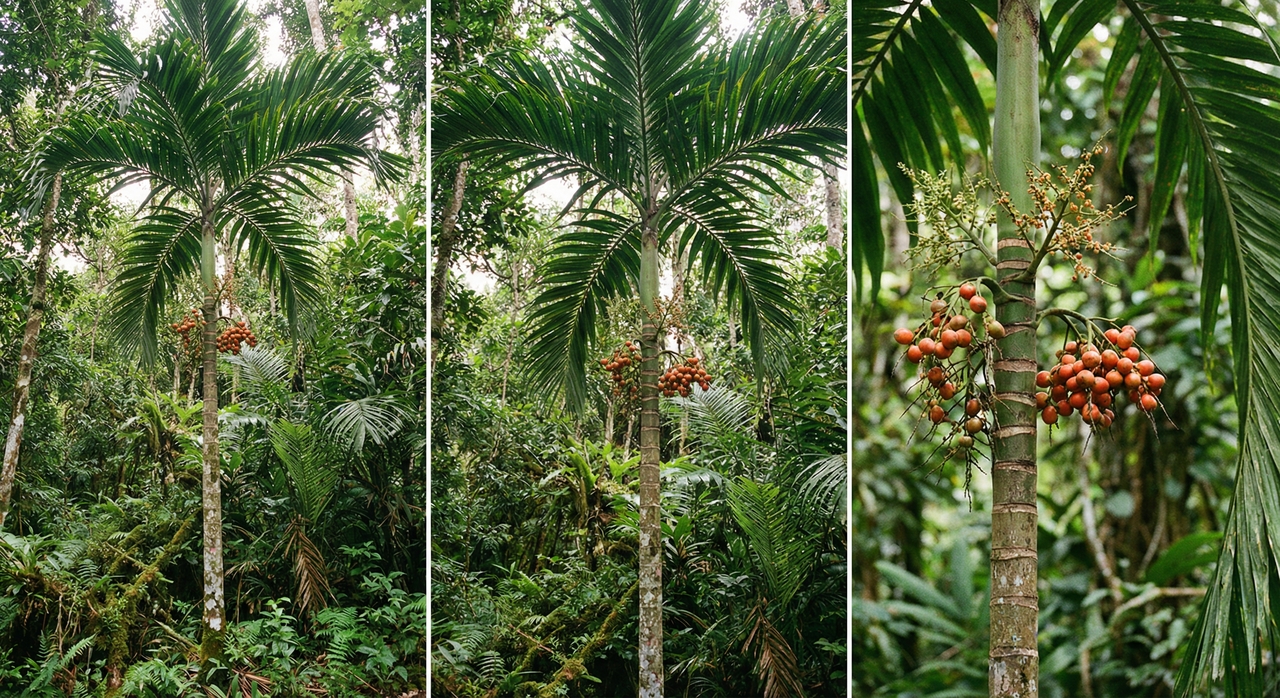
The Areca palm is best known as a cheerful houseplant, quietly hiding its identity as the source of betel nut—one of the world's most widely consumed psychoactive seeds. That's the thing about this plant: it's sold in every garden center as a cheerful, air-purifying houseplant, and it's also the source of betel nut, the fourth most widely used psychoactive substance on Earth.[1] The same slender, feathery palm softening the corner of someone's office is, in its tropical homeland, a deeply ritualized crop with a 5,000-year relationship with human culture. I find that gap between how we see a plant and what it actually is to be one of the most telling things in horticulture.
What makes Areca catechu genuinely worth understanding isn't the controversy, though there's plenty of it. It's the way this palm sits at a crossroads: revered across South and Southeast Asia as a symbol of hospitality and sacred offering, woven into wedding ceremonies and Buddhist rites, yet now classified by the IARC as a Group 1 carcinogen.[2] That's not a contradiction you can smooth over, and I won't try. What I will do is give you the full picture, because this plant deserves one.
Areca Palm Origin, History, and Cultural Significance
Most people who ask me about the areca palm are thinking of a feathery houseplant or a poolside accent, so it's always a little fun to explain what they're actually dealing with. Areca catechu, the botanical name of the areca palm, is a bona fide tropical tree native to the humid forest understories of Southeast Asia, from India and Bangladesh through Malaysia, Indonesia, the Philippines, and Sri Lanka, where it grows in dappled light on humus-rich, well-drained, mildly acidic soils.[3][4][5] That understory origin matters enormously once you're siting it in a designed landscape, and I'll keep coming back to it throughout this profile.
Botanical Background and Visual Characteristics
The scientific name of the areca palm is Areca catechu L., and knowing that distinction is useful because the genus Areca contains several species that get lumped together in nursery signage. The plant itself is a long-lived perennial that flowers and fruits repeatedly across its lifespan rather than dying after a single reproductive event, which botanists call a polycarpic habit.[3][6] Under optimal tropical conditions it reaches reproductive maturity in four to six years, eventually climbs anywhere from 10 to 30 meters tall on a slender, ringed trunk just 10 to 15 centimeters in diameter, and can persist for 30 to 80 years.[3][7] I always warn clients that the graceful silhouette looks deceptively delicate; in reality, you're looking at a tree that will eventually need six to eight meters of vertical clearance and solid protection from cold winds.
From base to crown, the physical architecture of the tree is visually distinctive. A fibrous adventitious root system anchors a solitary, unbranched trunk marked by prominent leaf scars, which gives older specimens that characteristic ringed appearance. Above that sits a terminal crown of 8 to 16 spirally arranged pinnate leaves, each 1.5 to 2.5 meters long, carrying 40 to 100 linear-lanceolate, bright-green leaflets.[8][9] Those leaflets have a leathery, feathery quality that makes the palm instantly recognizable, even among other pinnate-leaved species in a mixed tropical planting. Creamy-white to yellowish flowers emerge from branched panicles in the leaf axils, and the resulting fruits ripen to a striking orange-red, each one housing a single hard seed — the betel nut.[3][10] Height, leaflet count, and fruit size all vary with soil, light, and cultivar, so treat any single figure as a midpoint rather than a ceiling.
Areca catechu's solitary, unbranched form contrasts with its clustering relatives. Areca triandra, a smaller understory species from Northeast India through Vietnam, and Areca macrocalyx, a cespitose palm reaching 8 to 15 meters with long pendulous inflorescences, both offer multi-stemmed habits that fill a mid-layer guild more readily and provide better wind resistance in landscape settings.[6][11] The classic single-trunk silhouette is what most people picture when they think of a betel-nut palm, but those clustering relatives are worth knowing for anyone designing a layered tropical system.
Traditional and Cultural Uses
The areca palm's relationship with human civilization stretches back at least 5,000 years. Archaeological remains from Spirit Cave in Thailand, dating to the Neolithic period roughly 10,000 to 5,500 years ago, include evidence of areca use, and domestication in the Malesia region is thought to have occurred around 3,000 years ago.[12][13] Written records follow a similar arc: the Sushruta Samhita (circa 600 BCE), the Charaka Samhita (circa 300 BCE), and the Sangam Tamil literature of 300 BCE to 300 CE all reference the plant, and Li Shizhen's 16th-century Bencao Gangmu catalogued it in the Chinese materia medica.[14][15]
The cultural heart of the areca palm's story is the betel quid: areca nut chewed together with Piper betle leaf and slaked lime. For more than 3,000 years across South and Southeast Asia and the Pacific Islands, this combination served simultaneously as a mild stimulant, a mouth freshener, a digestive aid, and a universal symbol of hospitality and social bonding.[16][17][18] Hindu and Buddhist ceremonies, weddings, rites of passage, and religious offerings across South Asia and the Pacific all incorporated it; refusing betel was, in many traditions, a social slight. Economically, the palm became a major cash crop, centered today in Karnataka and Kerala, India, and Portuguese traders carried it to East Africa in the 16th century, with European colonial networks later spreading cultivation into the Caribbean and Oceania.[19][20]
I love the richness of that heritage, genuinely. But the contemporary turn is real: public-health campaigns have made the carcinogenic risks of habitual chewing impossible to ignore, and consumption is declining in many regions as awareness grows.[21][22] The health details belong in a later section of this profile, but the cultural tension is part of this plant's biography and it's honest to name it here.
Archaeological Roots and Fun Facts
The numbers behind this palm are genuinely striking. A single productive specimen yields 200 to 300 nuts per year,[23] and global production tops one million tons annually, driven primarily by India, Bangladesh, and Indonesia.[24] The largest recorded specimens reach 25 to 30 meters with trunk diameters up to 50 centimeters, and a notable historic planting survives at the Singapore Botanic Gardens.[8][25] Seeing a mature specimen towering over a tropical garden helps you understand, viscerally, why this particular palm became both a cash crop and a cultural cornerstone across so much of Asia. It reaches that stature slowly, taking 10 to 20 years under optimal conditions to build significant height,[8] but the 5,000-year arc from Spirit Cave to modern plantation agriculture suggests humanity decided early on that the wait was worth it.
Areca Palm Varieties and Sourcing
Notable Varieties of Areca catechu and Related Species
The classic betel-nut palm, Areca catechu, is a solitary, slender-trunked tree that can reach 50 to 100 feet tall with ringed gray bark and a crown of pinnate leaves stretching up to six feet long.[26][27] Most cultivated selections were developed in India for productivity rather than looks. Over 100 local selections exist there, with named varieties like 'Mangala' and 'Sreekoya' selected for high nut yield, 'Mohitnagar' for disease resistance, and 'Bhagya' for nuts with stronger medicinal properties. These cultivars can grow up to 80 cm per year and yield 50 to 100 percent more nuts than wild-type material.[28][29] In my experience growing palms in Central Florida, I've seen that fast-selected cultivars can also be more susceptible under pressure, and the research backs that up: high-yield lines are more vulnerable to red palm weevil and Phytophthora bud rot than disease-resistant selections like 'Mohitnagar', which is why commercial growers in wet climates tend to favor it.[26]
Then there's Areca triandra, and this is where the labeling chaos begins. Areca triandra is a legitimate, distinct species with clustering slender stems reaching 15 to 30 feet, orange-red globose fruits, and young stems that are often triangular in cross-section rather than perfectly round.[6][30][31] It's grown strictly as an ornamental in USDA zones 10b-11 and produces no betel nuts worth harvesting. I've seen "Areca" tags applied to at least three different genera over the years at nurseries; learning to check young stem shape is a quick way to avoid buying the wrong plant entirely. Areca catechu itself is also suited to zones 10b-11 with moderate salt and drought tolerance once established.[26][9] Ornamental selections of the anchor species are limited in the U.S. trade, so if a nursery is offering something exotic-sounding, verify before you buy.
Sourcing Areca Palms in the United States
Finding Areca catechu in the United States takes a bit of hunting. Specialty tropical nurseries and online vendors like Logee's Greenhouses, Tropica Nursery, Palmco, and Rare Palm Seeds are your most reliable sources; big-box stores simply don't carry it.[32][33] Seeds are usually the easiest path: a packet runs $5 to $20, while small 2- to 4-foot container plants typically cost $50 to $150, and larger specimens can push $300. Before you get excited about ordering seeds online, know that live plants and seeds require USDA APHIS import permits, and Florida and California both carry additional state-level restrictions. The FDA also maintains Import Alert 45-02 specifically covering betel nuts due to contamination and toxic-compound concerns.[34][35] I always check current APHIS and state rules before placing an order because the list shifts more often than people expect.
When you do find a source, inspect carefully. I once introduced scale to an entire guild by skipping that step, and I've refused plants with even minor leaf spotting ever since. Look for clean foliage, healthy roots with no decay or deformity, and a well-draining, slightly acidic growing mix.[36] If the label looks questionable, cross-reference against Tropics or Kew before you commit. Mislabeled palms are genuinely common, and the correction once something is in the ground is never cheap.
Areca Palm Propagation and Planting Guide
Growing an areca palm from scratch starts with understanding a seed that behaves nothing like what most gardeners are used to. These seeds won't sit in a jar on a shelf for next season. They are biologically engineered to get into the ground fast, and the window they give you is short.
Seed Morphology and Anatomy
The seeds of Areca catechu are ovoid to ellipsoid, roughly 2-3 cm long and 1.5-2 cm wide, with three longitudinal furrows that give them a distinctly trigonous silhouette.[37][38] They're reddish-brown to dark brown, wrapped in a fibrous pericarp, and each one contains a single zygotic embryo, which is what monoembryonic means in practice: no backup, no twins, one shot per seed.[37] Inside that hard coat sits a thick stony endosperm loaded with starch, tannins, and arecoline, with a small curved embryo tucked at the micropylar end.[37][39] In the wild, the orange-red aril attracts hornbills, civets, and primates for dispersal, while the alkaloid-rich flesh discourages casual snackers.[40][41] Understanding that biology explains everything about how you need to handle them in the nursery.
Proven Propagation Methods: Seeds, Suckers, and Beyond
These seeds are recalcitrant, meaning they maintain a high internal moisture content of 40-50% and die if they dry below roughly 20%.[42][43] You cannot store them like a bean or a tomato seed. After losing several early batches to viability decline, I now harvest and scarify the same day, no exceptions. That mindset shift alone takes your germination rate from frustrating to genuinely exciting, because fresh seeds sown properly achieve 70-90% success, while seeds older than 60-90 days give you almost nothing.[44][45]
Scarify by soaking seeds in warm water at 29-35°C for 48-72 hours, optionally nicking the coat or using a 1:1 water-to-coconut-milk soak, then sow 2.5-5 cm deep in a well-draining sterile mix of equal parts sand, peat, and perlite.[46] Keep conditions at 25-32°C with 70-90% humidity and bright indirect light.[46][47] Seedlings initially look remarkably like tufts of grass before true palm leaves emerge. I label rows carefully in the nursery because of this, especially since seed-grown plants vary due to cross-pollination.
If you want true-to-type plants and faster results, suckers from mature specimens are the better route. Separate them in spring, pot them up in moist but well-drained media, and keep them in bright indirect light at 24-32°C while roots establish.[48][49] Clients who want fruit in their edible landscapes always ask which method I'd recommend, and my answer is always: find a good offshoot and don't look back. Cuttings and air layering using IBA give variable results in the 20-70% success range over 4-8 weeks to several months.[50][51] Grafting is essentially off the table since Areca catechu is a monocot with no vascular cambium, putting success below 20%.[50] Tissue culture exceeds 90% success in laboratory settings, but the cost and equipment required put it firmly outside home and most commercial contexts.[52]
Germination Timeline and Storage Realities of Recalcitrant Seeds
Under good conditions, germination takes 1-3 months, though stubborn seeds can push toward 6 months.[46][53] Transplant seedlings once they reach 15-20 cm tall with 2-4 true leaves showing.[54][46] The long game from there is real: seed-grown palms typically take 4-7 years to first harvest and 8-10 years to full bearing.[53][55] A well-chosen sucker division shortens that to 3-5 years.[49][56] Growing from seed teaches patience in a way few other crops can, but watching a sucker division fruit two full years earlier makes a meaningful difference in any edible landscape design.
Soil Preferences, Site Selection, and Light Requirements
The non-negotiable trio is drainage, pH, and organic matter. This palm wants fertile loamy or sandy-loam soil with 2-5% organic matter and a pH of 5.5-7.0, with the sweet spot sitting between 6.0 and 6.5.[57][58] I test every new bed before planting. I once watched manganese deficiency yellow an entire row of young palms planted in soil that tested at pH 7.8; the difference between healthy green and stressed yellow was visible within weeks. At the low end, dropping below 5.5 locks out nutrients and causes chlorosis just as fast.[59] Heavy clay and waterlogged conditions are equally problematic, since the shallow fibrous root system needs at least 60 cm of well-drained soil depth to function properly.[57][60]
In its native South and Southeast Asian range, this palm grows in lateritic and alluvial soils that are naturally humus-rich.[61][62] In cultivation, that translates to generous compost amendments and a thick mulch layer to replicate that humus layer, hold moisture, and protect the shallow roots. In heavier subtropical soils, I often raise planting areas slightly or add coarse grit to push drainage in the right direction before the palm goes in the ground.
Light requirements reflect its understory origins. Young plants want bright indirect light or 30-50% shade, tolerating 4-6 hours of morning sun while staying protected from intense afternoon exposure.[63][64] In my subtropical projects, I run 40% shade cloth for the first two years because I've seen afternoon sun scorch young leaves even when the temperature itself isn't extreme. Once established in a humid tropical climate, mature specimens handle full sun to partial shade reasonably well.
Spacing, Transplanting, and Initial Establishment
Commercial plantations in South Asia use a square or triangular pattern at 2.7 m x 2.7 m, supporting roughly 1,350-1,500 plants per hectare.[65][66] In high-rainfall or disease-prone regions, widening to 3 m x 3 m improves airflow and meaningfully reduces fungal pressure, while tighter spacing at 2.1-2.4 m suits high-density systems that may need thinning later.[67] For ornamental or garden plantings, the solitary trunk of Areca catechu needs more breathing room than a clumping species would: allow 1.5-2 m between plants, accounting for a mature spread of 3-4.5 m and heights reaching 9-15 m or beyond under ideal conditions.[68][69] Container culture works in cooler climates using pots at least 50-60 cm in diameter with a mix of potting soil, perlite, and coco coir or peat.[70]
Transplant seedlings once they reach 15-20 cm with 2-4 true leaves into holes two to three times wider than the root ball, under 50-70% nursery shade, keeping moisture consistent without letting roots sit wet.[71][72] Acclimate gradually before full outdoor exposure. In my experience, staking young palms for the first two to three years in any site with regular wind pays for itself by preventing the stem lean that can set growth back significantly and never fully corrects itself.[68] Give them room, give them structure early, and this palm will reward you for decades.
Areca Palm Care Guide
Everything about caring for Areca catechu makes more sense once you picture where it actually lives: the humid understory of a Southeast Asian rainforest, where rainfall exceeds 2000 mm per year, humidity rarely dips below 80%, and temperatures stay in a predictable, warm band year-round.[26] Replicate those conditions and this palm thrives. Stray too far from them and it will tell you quickly.
Watering and Humidity Needs for Areca catechu
The rule I keep coming back to is "consistently moist, never soggy." That means watering when the top inch or two of soil feels dry, which in practice translates to every five to seven days during the growing season and every ten to fourteen days in fall and winter.[26][73][74] Seedlings want lighter, more frequent watering; mature plants do better with deeper, less frequent soaks that encourage roots to settle. Crispy leaf tips usually mean you've waited too long. Foul-smelling soil means you've overwatered, and with this palm's shallow, fibrous root system sitting only 12 to 18 inches deep in a container, root rot can set in fast.[26][73] I learned that the hard way in year two of growing mine in a container with inadequate drainage; I now use a loamy mix amended with perlite and coarse sand, and I've never looked back.
Humidity is the other half of the water equation. This palm wants 50 to 70% relative humidity at a minimum, ideally higher.[26][9] In Central Florida's humid summers I rarely need to intervene, but the moment I run indoor heating or air conditioning in winter, spider mite outbreaks follow. A pebble tray with water under the pot and occasional misting sorted that problem out almost immediately. If you're growing this plant indoors in a dry climate, a small humidifier nearby is genuinely worth considering.
Sunlight Requirements and Light Management
Areca catechu is an understory palm by nature, and young plants especially need that shade-filtered light. Seedlings and plants under three years old do best with 30 to 50% shade; too much direct sun scorches the leaves before they've had a chance to toughen up.[57][75] I start seedlings under shade cloth or on an east-facing porch and move them into brighter positions gradually as they put on size. Mature specimens can handle full sun but appreciate afternoon protection when temperatures push past 90°F.
The symptoms on both ends are pretty readable. Too little light and you'll see etiolated, weak growth with pale leaves and poor fruiting.[76][75] Too much and the fronds bleach, tips burn, and the plant just looks unhappy. Once you dial in the right position, this palm is relatively forgiving about everything else.
Feeding, Nutrient Deficiencies, and Soil Preferences
This is a hungry palm. Young plants need 50 to 100 g of nitrogen, 25 to 50 g of phosphorus, and 100 to 200 g of potassium annually, along with generous organic matter; mature palms scale up considerably, needing up to 250 g N, 125 g P, and 400 g K, split across two to three applications per year.[77][78] I time those applications outside the heaviest rains to prevent leaching, and I always soil test first. A balanced palm fertilizer with magnesium, iron, zinc, and manganese included covers the micronutrient gaps that slow-release NPK formulas often miss.
Knowing your deficiencies by sight saves a lot of guesswork. Nitrogen shows as uniform yellowing on older leaves from the tips inward. Potassium produces orange-brown necrosis along older leaf margins. Magnesium gives you yellow-orange chlorosis between the veins on older fronds. Iron and zinc deficiencies, by contrast, show up on the new growth: interveinal chlorosis on young leaves for iron, small distorted leaves with interveinal yellowing for zinc.[79][58] Once you've seen each of those a few times, you stop confusing nitrogen deficiency with normal leaf senescence.
Over-fertilizing is also a real risk. Salt buildup causes tip burn, chlorosis, and root damage; the fix is to flush thoroughly with water and scale back future applications.[80][81] Combining compost or well-aged manure with inorganic fertilizers keeps the soil biology healthy and improves long-term nutrient uptake. Aim for a soil pH of 5.5 to 7.5 and test regularly.
Frost Tolerance and Cold Protection
There's no softening this: Areca catechu is strictly a USDA zones 10a through 11 palm.[26][82][83] Sustained temperatures below 50°F cause stress; any actual frost causes damage or death, especially to the apical bud, which is the one part of a palm you absolutely cannot lose.[84][85] I grow Sabal palms alongside mine and it's a useful comparison: Sabals shrug off hard freezes; Areca catechu does not. It's a different category of cold sensitivity entirely.
For gardeners in marginal climates, containers are the practical answer. You can move the plant indoors before temperatures drop, apply heavy mulch over the root zone, and wrap the trunk during brief cold snaps.[84][86] Keeping the soil consistently moist going into a cold event helps too. Watch for yellowing or browning fronds after any exposure to cold; that's your early warning that damage has occurred.
Heat Tolerance and High-Temperature Management
Optimal growth happens between 68 and 86°F, with the palm handling spikes to around 95 to 104°F in high humidity without major problems.[87][88] Above 35°C, though, photosynthesis starts suffering, pollen viability drops, and flowering can fail at rates that translate to serious yield losses.[89][90] I notice reduced flowering during extended summer heat waves, and it's not subtle.
The management toolkit is straightforward: shade cloth for young plants, 5 to 10 cm of organic mulch (coconut husk works beautifully) to buffer soil temperature, increased irrigation frequency during heat peaks, and maintaining atmospheric humidity above 60%.[57][91] In practice, mulching makes the single biggest measurable difference in how the palm handles July and August. Some cultivars also show better heat stability than others, so if you're in AHS heat zones 11 or 12, it's worth asking about variety when you source your plant.
Pruning, Maintenance, and Seasonal Rhythm
Pruning an areca palm correctly means restraint. Remove only fronds that are dead, diseased, or clearly necrotic; that's it.[74][92] Annual removal of yellow or browning leaves improves air circulation and keeps the plant looking tidy. Young palms benefit from staking while the trunk is still establishing, especially in windy spots. Repot containers every two to three years when roots fill the pot or start appearing at the drainage holes, using a fresh, well-draining mix.
The seasonal rhythm of Areca catechu is pleasantly low-maintenance in tropical climates: it grows nearly continuously without a true dormancy period, with flowering and fruiting cycling somewhat loosely around wet seasons.[3][93] Boost potassium and maintain steady moisture during fruiting phases. In temperate-zone winters, reduce watering, stop fertilizing, and bring containers indoors before temperatures drop below 50°F, keeping them somewhere bright and warm with 50 to 70% humidity.[8] Once you've built the care habits around water, light, and feeding, this palm honestly asks for very little beyond consistency. Compared to the more demanding fruit trees I manage, a well-sited Areca catechu is a straightforward long-term companion.
Harvesting Areca Palm (Areca catechu)
Patience is the prerequisite for any serious attempt at harvesting betel nuts. From the moment flowers are pollinated, fruits need roughly 6-8 months to reach maturity, and the palms themselves won't produce anything at all for 4-7 years after germination.[94][95] One thing I always tell clients thinking about edible-use planting is to start with larger nursery specimens rather than seed; shaving even two years off that juvenile phase matters when you're planning a long-term food-forest feature. Once the palm is established and fruiting, continuous inflorescence production does allow multiple harvests per year in true tropical climates, which helps offset the low per-tree yields.
When to Harvest Areca Nuts: Timing, Maturity Indicators, and Regional Seasons
The key signal to watch for is color transition: fruits moving from green toward greenish-yellow or pale yellow, with the husk beginning to soften and loosen, tell you you're approaching the window.[96][97] Inside, the nut itself should feel hard and woody. Soluble solids at this stage measure around 20-25° Brix, which serves as a reliable chemical confirmation for anyone running small-scale production trials.[98] This "green harvest" stage is where experienced tropical growers aim to pick; I've spoken with farmers in southern India who are emphatic that waiting until the fruits turn fully orange or red produces nuts that are noticeably more bitter and astringent, and that the alkaloid profile shifts in ways that make over-ripe nuts far less desirable for any use.
Regionally, India's main harvest runs May through September with a peak from June to August following the monsoon, while growers across Southeast Asia can harvest nearly year-round with peaks between April and October.[94][99] Climate is doing a lot of work here; outside humid tropical zones, even getting to a harvestable bunch is a significant horticultural achievement.
How to Harvest and Process Areca Nuts: Technique, Post-Harvest Steps, and Yields
Commercial harvesting is manual and physically demanding. Workers either climb the tall, slender trunk or use long bamboo poles to cut bunches selectively, leaving others to continue developing.[10][100] In my experience watching clients attempt something similar with ornamental specimens, improper climbing technique leaves visible ring scars on those elegant trunks and can create entry points for pathogens. Sustainable practice means picking selectively and leaving some fruits to ripen fully for seed propagation rather than stripping every bunch at once.
Post-harvest processing is inseparable from harvest quality. Nuts need cleaning, then sun-drying for 10 to 30 days to bring moisture content down from around 50% to below 10%, followed by cracking the outer fibrous husk and removing the hard inner seed coat.[101] Cutting corners on drying shows up immediately in the final product's flavor and shelf life. This is genuinely labor-intensive work, and anyone imagining a casual backyard harvest should understand that the processing alone requires real commitment.
Flavor Profile and Yield of Fresh Areca Nuts
Realistic yields run 50-100 nuts per mature tree annually, translating to roughly 1-3 kg of dried nuts.[19][102] Compared to the productive backyard fruits I grow and recommend, those numbers are modest. The edible portion is the single seed inside a fibrous 5-6 cm orange-yellow drupe; mature dried nuts have a firm, hard, woody texture with low moisture.[103][9]
The flavor is dominated by bitterness and astringency from alkaloids, particularly arecoline, and tannins, with a lingering pungent, numbing aftertaste that can persist for hours.[104][105] Green immature nuts sit at the intense end of that spectrum; ripe orange-red fruits soften slightly; proper drying and curing reduce astringency further and develop subtle earthy, nutty notes.[106][107] I tell clients directly: this is a traditional stimulant requiring careful processing and cultural context, not a backyard snack. Given the documented toxicity profile, I treat this palm strictly as an ornamental first. If the traditional preparation interests you, the preparation and uses section covers what that means in practice.
Areca Palm Preparation, Uses, and Important Safety Notes
I've grown areca palms as houseplants and feature them regularly in tropical landscape designs, and I always take a moment to tell clients the same thing: the palm itself is harmless, but those seeds inside the fruit are a different story entirely. The only part of Areca catechu that humans consume is the seed, the areca nut, nestled inside a fibrous drupe whose outer flesh is not eaten.[3][108] The leaves, stems, and flowers have no culinary role whatsoever. That distinction matters enormously, because it's the seed where all the risk lives.
Culinary and Traditional Consumption of Betel Nut
This is not a food plant in any conventional sense. The areca nut is never cooked into dishes; it's consumed as a stimulant through a preparation called a betel quid, where the processed nut is wrapped or chewed alongside betel leaf (Piper betle), slaked lime, and often tobacco or spices.[109][17] The flavor is bitter and aggressively astringent, driven primarily by arecoline, the alkaloid responsible for both the stimulant effect and the toxicity.[110] Think of chewing something as fibrous and mouth-puckering as an unripe plantain, but with a chemical kick on top. That's roughly the sensory territory.
Before chewing, the raw nut goes through post-harvest processing: the husk is removed, the nut is sometimes boiled or fermented, and it's sun-dried for three to five days until moisture drops below 10%.[111] Roasting, boiling, and fermentation can reduce arecoline content by 20 to 70 percent depending on method, bringing residual levels down from roughly 0.5–1% to around 0.1–0.3%.[112][113] I follow the same evidence-based position that led the WHO and IARC to classify betel nut as a Group 1 carcinogen: no processing method fully removes the carcinogenic potential.[110] The health benefits section of this article covers the full pharmacological and safety picture, and I'd strongly encourage reading it before forming any conclusions about traditional use.
Traditional Medicinal Preparations
Ayurvedic and ethnobotanical traditions historically used powdered areca nut at roughly 1 to 3 grams per day in divided doses, while related preparations using the wild relative Areca triandra reference 5 to 10 grams of dried material daily.[114][115] These figures are offered here strictly as ethnobotanical context, not as guidance. None of these dosages are standardized by modern pharmacology, and the weight of current evidence argues strongly against any internal use. The traditional knowledge deserves acknowledgment; recommending it is a different matter.
Non-Food and Practical Uses
Here's where I find myself genuinely enthusiastic again. The fronds, leaves, stems, and fibrous biomass of Areca catechu have a rich history of practical, non-toxic use across rural South and Southeast Asia.[116] Leaves woven into mats, baskets, and hats; fronds layered as thatch on roof structures; stems and husks repurposed as rope, fuel, mulch, and construction material. I've used similar palm fronds in tropical landscape installations for thatching garden structures and woven accents, and there's something genuinely satisfying about closing the loop on a plant's biomass this way. That zero-waste, whole-system thinking is exactly the kind of resourcefulness permaculture rewards. The areca palm may carry an outsized safety warning around its seeds, but its structural materials have been quietly useful for centuries, and that part of the story deserves a little recognition.
Areca Palm Health Benefits and Medicinal Uses
The health story of Areca catechu is genuinely one of the more complicated ones I've encountered in years of working with useful plants. There's real chemistry here, centuries of traditional use, and some intriguing laboratory findings. There's also a Group 1 carcinogen classification from the IARC. Both things are true, and I think readers deserve the full picture rather than a sanitized version of either.
Phytochemical Profile and Active Compounds
The areca nut is chemically dense. Its secondary metabolite profile includes alkaloids, flavonoids, phenolic acids, tannins, saponins, and triterpenoids, with compounds distributed unevenly across plant parts: arecoline and related alkaloids concentrate in the fruit kernel, while flavonoids and phenolics run higher in the leaves of related species like Areca triandra.[117][118] The dominant alkaloid is arecoline, which makes up 70 to 90 percent of total alkaloid content and occurs in the nut at anywhere from 0.05 to 2 percent dry weight, a range driven by variety, maturity, processing method, soil nutrients, and growing season.[119][120] I've observed this kind of metabolite variability firsthand growing palms in humid subtropical conditions; nuts from trees grown in rich, well-amended soils tend to show more vigor overall, and the secondary metabolite literature supports the idea that nutrient availability is a real driver of alkaloid concentration.
Among the supporting alkaloids, guvacine has drawn some attention as a potential GABA reuptake inhibitor with preclinical antidepressant-like activity, and the entire alkaloid suite appears to serve an ecological chemical defense function against herbivores and pathogens.[121][122] The flavonoid fraction (quercetin, kaempferol, catechin, epicatechin) and phenolic acids (gallic, chlorogenic, caffeic) provide the antioxidant substrate that shows up in cell studies, while tannins at 3 to 8 percent of dry weight contribute the aggressive astringency anyone who has tasted a raw areca nut will immediately recognize.[123]
Traditional Uses and Modern Medicinal Research
Ayurveda, Traditional Chinese Medicine, and other Asian medical systems have used betel nut for millennia as a stimulant, digestive aid, astringent, anthelmintic, and tool for qi regulation and deworming.[124][125] That heritage deserves respect. Modern pharmacology has at least partially explained the mechanisms: arecoline acts as a non-selective muscarinic acetylcholine receptor agonist with partial nicotinic activity, stimulates dopamine release in the mesolimbic pathway (which is where its addiction potential comes from), and can antagonize anticholinergic medications while inhibiting CYP2A6 enzymes and altering how the body processes nicotine, caffeine, and certain antidepressants.[126][127]
Preclinical models have shown antioxidant activity from the phenolic and catechin fractions, anti-inflammatory effects through downregulation of TNF-α and IL-6, antimicrobial activity against Streptococcus mutans and Candida albicans, and some memory-improving effects in scopolamine-induced amnesia models.[128][129] While rodent studies showing cytokine modulation are genuinely interesting, the human epidemiological evidence of oral submucous fibrosis is so overwhelming that I can't in good conscience frame any of this as therapeutic potential. All of it remains in vitro or early animal work, with no robust human clinical trials validating therapeutic use for either Areca catechu or the related Areca triandra.[112]
Nutrition Facts
Per 100 grams of dried areca nut, you're looking at 281 to 418 calories, 15 to 45 grams of carbohydrates, 15 to 20 grams of protein, high fiber, modest B vitamins (riboflavin 0.273 mg, niacin 1.5 mg, B6 0.25 mg), and reasonable mineral content including potassium (378 to 756 mg), iron (3.36 mg), and phosphorus (114 mg).[130][131] In practice, a typical betel quid contains about 1 gram of areca nut, with habitual users consuming 5 to 20 grams daily.[132] The nutritional value is modest at any serving size, and processing (boiling, roasting) often increases alkaloid bioavailability while degrading some vitamins, meaning the risk profile worsens even as perceived palatability improves.
Safety Considerations and Toxicity
The IARC classifies areca nut as a Group 1 carcinogen, meaning carcinogenic to humans, with clear links to oral and esophageal cancers, oral submucous fibrosis (a precancerous condition causing progressive mouth stiffening), leukoplakia, and an approximately eightfold increased risk of oral cancer when chewed as betel quid.[133][134] Chronic use also drives cardiovascular disease, hypertension, metabolic syndrome, and addiction through the same dopaminergic pathway that makes it feel rewarding in the short term. Having reviewed the IARC monographs and multiple systematic reviews, I advise every pregnant client or parent I work with to treat betel nut the same way we treat tobacco: complete avoidance. Adverse pregnancy outcomes including preterm birth and low birth weight are documented, and children are particularly susceptible to neurotoxicity.[135][136]
In acute cases, ingestion produces classic cholinergic toxicity: nausea, vomiting, excessive salivation, sweating, dizziness, and tachycardia.[136] For pets, the nuts are toxic to both dogs and cats, causing GI upset, hyperactivity, tremors, and potentially seizures or death, with the highest alkaloid concentration sitting right there in the seeds.[137] In my Florida-based consultations I always mention that dropped nuts from ornamental specimens pose a real risk to curious animals. I also take time to help clients distinguish true Areca from the far more acutely dangerous sago palm (Cycas revoluta): look for the characteristic smooth green ringed stem of Areca versus the rough, scaled trunk of Cycas. The sago palm causes severe liver failure in pets, and the two get confused often enough that the distinction has prevented real harm for clients of mine.[138]
Drug interactions are a serious concern: arecoline can antagonize anticholinergics, interact with CNS depressants and antipsychotics, and alter CYP enzyme metabolism of multiple medications.[139] The FDA classifies betel nut as an unsafe food additive, issues import alerts restricting its entry into the US, and cultivation outdoors is realistically limited to USDA zones 10 to 11.[140] The preclinical findings on antioxidants and antimicrobials are genuinely interesting science. They do not change the risk calculus.
Areca Palm Pests and Diseases
I'll be honest: Areca catechu is not a tough plant when it comes to disease and pest pressure. It has low-to-moderate resistance across the board, and the same warm, humid conditions it absolutely needs to thrive are the ones that invite its most serious pathogens. That's not a reason to avoid growing it, but it is a reason to think about prevention before you ever put one in the ground. The grower's job here is less about spraying and more about siting, drainage, and paying attention.
Major Diseases of Areca catechu
Bud rot caused by Phytophthora palmivora and related species is the disease I'd lose the most sleep over. It can reach 30-50% incidence under wet conditions, starting at the crown with wilting and working down into full rot.[141][142][143] I lost a young palm to it during an especially wet summer before I understood how much drainage matters. Now I prioritize elevated planting and amended soil from day one. If you see areca palm leaves drooping from the crown down and the spear leaf pulls out easily, that's your warning sign, and it's almost always too late by then.
Leaf spots from Pestalotiopsis, Colletotrichum, Bipolaris, and Cercospora species show up as necrotic lesions that chip away at photosynthetic capacity over time.[141][144] No widely available cultivar offers meaningful resistance to them.[141][144] Areca palm leaves turning brown or developing black spots on stems often traces back to these fungal culprits, especially during periods of heavy rain or poor air circulation. In mature plantations, Ganoderma boninense and G. lucidum are a grimmer story: they cause white rot and trunk decay that can bring down entire trees, with no complete resistance identified.[145][141] Fusarium oxysporum adds to the vascular disease picture, causing progressive yellowing and top-down wilt with characteristic discoloration inside the trunk tissue.[146][147]
Less common but worth knowing: stem bleeding from Thielaviopsis paradoxa, bacterial leaf blight from Xanthomonas campestris, and root-knot nematodes that form galls and impair nutrient uptake are all documented, though they're secondary concerns compared to the fungal diseases.[148][149][141] Varieties like Mangala and Sumangala show moderate tolerance to bud rot, but no cultivar solves the Ganoderma or widespread leaf spot problem.[150][151] What you can control is the environment: high humidity above 80%, temperatures above 35°C, poor drainage, and alkaline soils all sharply increase risk, while well-drained soil at pH 5.5-7.0 and careful water management significantly reduce incidence.[152][143][153]
Key Pests and Their Impact
The red palm weevil (Rhynchophorus ferrugineus) is the pest I take most seriously, because by the time you notice the damage, the palm is usually beyond saving. It bores into the trunk and crown, and in Asia it's considered one of the most destructive insects this species faces.[154][155] I set pheromone traps early in the season as standard practice now, and I've caught adults long before any visible trunk injury appeared. That early warning has saved mature specimens from the kind of severe internal damage you can't reverse.
For ornamental growers in Florida and Hawaii, mealybugs (Planococcus citri and related species) and scale insects (Aspidiotus destructor) are probably the more common day-to-day headache. They feed on sap, excrete honeydew, and encourage sooty mold that shows up as that distinctive blackening on leaves and stems.[156][157][46][158] Areca palm leaves turning white or pale and developing a dusty texture often signals a heavy mite infestation, which tends to flare in dry spells. The areca nut borer causes direct fruit damage and yield loss on productive trees.[156]
The palm does have some built-in defenses worth appreciating. Its alkaloids (including arecoline), phenolics, and terpenoids have demonstrated insecticidal and repellent activity in laboratory studies against a range of insects.[159][160][161] Field results are inconsistent, but I've noticed fewer incidental insect attacks on my Areca specimens when they're interplanted with aromatic companions, which reminds me a little of how neem functions in a guild. Regional cultivars like some Malabar selections show moderate mite tolerance, and thicker-trunked varieties can deter weevil boring somewhat, though no universally resistant cultivar exists.[162][163]
Integrated Pest and Disease Management
My approach here follows what ICAR-CPCRI and the University of Florida IPM guidelines recommend: prevention first, targeted intervention when necessary, and broad-spectrum sprays avoided as a default.[144][153][151] Routine spraying disrupts the beneficial insects that naturally keep mealybug and scale populations in check, and it's a habit that creates more problems than it solves over time.
A strong cultural foundation constitutes the most important management layer: ensure good drainage from the start, proper spacing to allow airflow, prompt removal of infected material, and balanced nutrition. A palm that goes into the ground with the right soil structure and consistent feeding is genuinely harder to kill with disease than one that gets sprayed reactively. I've seen a real difference between specimens that receive proactive Trichoderma soil treatments and those that only get attention once symptoms appear. Biological agents like Trichoderma species and Bacillus subtilis have good support for disease suppression; Bacillus thuringiensis and entomopathogenic nematodes add options on the pest side.[144][153][151][164] When chemistry becomes necessary, copper fungicides, phosphonates, metalaxyl, and Bordeaux mixture are the tools with the most research behind them, used as part of a broader program rather than a first response.[144][153] Weekly monitoring, pheromone traps for weevils, and sanitation that removes fallen debris close the loop on a program that's genuinely achievable for attentive growers.[165][166][167][158]
Areca Palm in Permaculture Design
Before you fall in love with the areca palm's graceful, ringed trunk and start sketching it into your food forest plan, there's one question worth answering first: do you actually live somewhere it can survive outdoors? I've seen this palm impulse-purchased at tropical nurseries by well-meaning gardeners in zone 9 who end up nursing a frost-bitten wreck by February. Getting the climate piece right upfront saves a lot of heartbreak.
Climate Requirements and Suitable Zones
Areca catechu is a strictly tropical palm, hardy only in USDA zones 10b through 11, with a minimum temperature tolerance somewhere around 30°F (-1°C) before you start seeing real damage.[26][168] But that 30°F figure is misleading if you take it as a safe floor. In practice, temperatures dipping below 50°F (10°C) already stress the plant, and it much prefers to stay in that 70-85°F sweet spot year-round.[169] On the upper end, it handles heat well past 100°F when humidity is adequate, which makes sense given its native habitat.
That native habitat is humid tropical rainforest or monsoon forest, meaning annual rainfall between 2,000 and 4,500 mm and relative humidity sitting at 50-80% or higher.[170][171] It grows from sea level up to about 1,200 meters in elevation.[3] In the United States, that realistically narrows outdoor cultivation to frost-free parts of Florida, Hawaii, and sheltered pockets of coastal California.[172][173] Everywhere else, you're looking at greenhouse culture or serious winter protection.
I've grown areca palms in Central Florida-adjacent landscapes, and even there I keep frost blankets on hand for young specimens during the occasional cold snap. Mature plants handle brief dips better, but juveniles are genuinely vulnerable. If your site gets hard freezes, design around a different palm.
Ecosystem Functions and Services
Where the climate fits, areca palm earns its place in a designed system through several overlapping functions. As a monoecious species, it carries both male and female flowers on the same inflorescence, and its flowering is primarily insect-driven, with flies, beetles, and bees doing most of the work, assisted by wind.[174][175] The flowers even generate heat and scent to attract pollinators, a trait I find remarkable and one I notice in a few other Arecaceae I manage.[176] Companion planting with flowering herbs or hedgerows can boost insect visits by 20-50% in palm groves, which translates directly to better fruit set.[177] That's not a trivial gain, and it's exactly the kind of stacking you're designing for anyway.
The scarlet fruits feed squirrels, birds, monkeys, and rodents, making this palm a genuine wildlife food source and seed disperser in its native range.[178] I've watched birds and squirrels work through the fruit clusters on mature specimens, and it reinforces what the ecological research already says: this palm supports vertical habitat structure and biodiversity, not just nut production.[179] Decomposing fronds, spent fruits, and fallen leaves all feed nutrient cycling in the soil beneath.[179] On slopes and coastal edges, its root system contributes meaningfully to erosion control, and the overall biomass supports carbon sequestration while providing nesting cover for birds and invertebrates.[180]
That said, I want to be honest about what this palm doesn't do. It fixes no nitrogen, and there's no meaningful documentation of it as a dynamic mineral accumulator or pest repellent. In monoculture it can suppress local biodiversity and demands substantial water inputs. Because I know it doesn't bring nitrogen to the table, I always pair it with leguminous companions in any design, treating that limitation as a hard constraint rather than a minor footnote.
Forest Layer Placement and Guild Design
Areca catechu is a slender, single-stemmed palm that reaches 10-20 meters at maturity, forming a straight trunk topped with a crown of arching pinnate fronds.[3][181] In forest succession terms it behaves as a pioneer or early successional species in disturbed tropical forest, which actually makes it a useful tool for establishing vertical structure relatively quickly in a young food forest system.[10]
One thing that shapes placement decisions is how dramatically its light needs shift with age. Young plants want shade, ideally 40-60% filtered light, while established specimens handle full sun to partial shade without complaint.[26] In agroforestry contexts it slots into the middle to upper canopy layer, spaced roughly 3-4 meters apart to limit root competition once the grove matures.[182]
The early years before canopy closure are prime intercropping time. Companion plants that integrate well beneath young areca palms include:\n- Bananas\n- Cocoa\n- Ginger\n- Turmeric\n- Taro\n- Black pepper\n- Legumes like Stylosanthes[65][182] In my own design work, interplanting ginger and turmeric under palms has visibly reduced soil erosion on slight slopes while adding a second harvest stream to what would otherwise be bare ground. The legumes handle what the palm can't: building soil nitrogen while the canopy fills in. That combination of functions, structure from the palm, ground cover and nitrogen from the guild, is exactly the kind of stacking that makes this species worth the climate constraints it comes with.
The Palm I Grow for Its Presence, Not Its Nuts
I keep an Areca catechu in a large glazed pot on my back patio, and honestly, most visitors just think it's decorative. They're not wrong. But every time I walk past it, I think about Spirit Cave, about five thousand years of human ritual wrapped around a single genus, about how much cultural weight one slender palm can carry. I grow it as a reminder that plants have histories longer and stranger than any garden.
Sources 182
- WHO: Betel-nut use ↩
- IARC Monographs: List of Classifications ↩
- Areca catechu - Wikipedia ↩
- Areca catechu L. | Species | India Biodiversity Portal ↩
- Royal Botanical Gardens, Kew - Plants of the World Online ↩
- Plants of the World Online (Kew Science) ↩
- Betel Nut Palm Cultivation - TNAU Agritech Portal ↩
- Missouri Botanical Garden Plant Finder ↩
- Royal Botanical Gardens, Kew - Plants of the World Online ↩
- Areca catechu - Kew Science ↩
- Areca macrocalyx - Plants of the World Online (Kew Science) ↩
- Archaeological Evidence of Betel Chewing in Southeast Asia ↩
- Betel Nut Chewing in Iron Age Vietnam - Detection of Areca catechu Alkaloids ↩
- Areca Nut in Vedic and Ayurvedic Texts ↩
- Bencao Gangmu: Materia Medica ↩
- Cultural Significance of Betel Chewing ↩
- Betel Nut Chewing - Cultural and Health Perspectives ↩
- Chewing Betel (Areca Nut) in Pacific Cultures ↩
- Economic Importance of Areca Nut in India ↩
- Portuguese Trade and the Spread of Areca Nut to Africa ↩
- Areca Nut: The Cultural and Health Perspectives ↩
- Betel Nut Chewing in Southeast Asia: Cultural and Health Perspectives ↩
- Betel nut (Areca catechu) ↩
- Global Production of Betel Nut ↩
- Palms of Singapore Botanic Gardens ↩
- Areca catechu - Plant Finder ↩
- Areca catechu - Betel Palm ↩
- Betel Nut Palm Varieties - ICAR ↩
- Horticulture Research - Cultivated Varieties of Areca catechu ↩
- Areca triandra vs. Areca catechu - Flora Malesiana ↩
- Areca triandra - Useful Tropical Plants ↩
- Areca Catechu - Betel Nut Palm ↩
- Tropical Palms for Southern Landscapes ↩
- Import Alert 45-02 - Detentions of Areca Nuts ↩
- Plants and Plant Parts; Importation Regulations ↩
- Missouri Botanical Garden Tropicos ↩
- Areca catechu L. (Arecaceae): A Review ↩
- Flora of China - Areca catechu ↩
- Flora of Tropical East Africa - Areca catechu ↩
- Areca catechu - Kew Science ↩
- Seed Dispersal Ecology of Southeast Asian Palms ↩
- Seed Storage of Horticultural Crops ↩
- Recalcitrant Seeds: Biology, Ecology and Conservation ↩
- Propagation of Betel Nut Palm (Areca catechu) ↩
- Areca Nut Cultivation Guide ↩
- Propagation of Betel Nut Palm (Areca catechu) ↩
- Seed Germination of Tropical Palms ↩
- Areca catechu (Betel Palm) ↩
- Propagation of Betel Nut Palm (Areca catechu L.) ↩
- Vegetative Propagation of Palm Trees Including Betel Nut ↩
- Rooting of Areca catechu Cuttings Using Plant Growth Regulators ↩
- Micropropagation of Areca catechu L. through Tissue Culture ↩
- Areca Nut: Production and Processing ↩
- Propagation of Areca catechu - FAO Guidelines ↩
- Areca catechu L. ↩
- Areca Nut Cultivation Guide ↩
- Betel Nut Palm (Areca catechu) ↩
- Areca Nut Cultivation Practices ↩
- Nutrient Management in Palms ↩
- Soil Requirements for Areca Nut Palm - FAO ↩
- Betel Nut Cultivation Practices ↩
- Ecological Requirements of Areca catechu ↩
- Royal Horticultural Society - Areca catechu Growing Guide ↩
- Betel Nut Palm Cultivation ↩
- Areca Nut Cultivation - TNAU Agritech Portal ↩
- Package of Practices for Areca Nut - Kerala Agricultural University ↩
- ICAR - Areca Nut Spacing and Disease Management ↩
- Areca Palm Planting Guide ↩
- Betel Palm (Areca catechu) Plant Profile ↩
- RHS Gardening: Growing Areca Palms in Containers ↩
- Nursery Techniques for Palms - University of Florida IFAS ↩
- Betel Nut Cultivation Practices - ICAR ↩
- Royal Horticultural Society - Areca catechu ↩
- Areca catechu Care Guide - University of Florida IFAS Extension ↩
- Royal Horticultural Society - Areca catechu Growing Guide ↩
- Missouri Botanical Garden Plant Finder - Areca catechu ↩
- Nutrient Management in Areca Nut Cultivation ↩
- Areca Nut Cultivation Practices ↩
- Nutrient Deficiencies in Palms ↩
- Symptoms of Over-Fertilization in Palms ↩
- Fertilizer Recommendations for Areca Nut ↩
- Betel Nut Palm (Areca catechu) - University of Florida IFAS Extension ↩
- Areca catechu - USDA PLANTS Database ↩
- Cold Damage in Palms: Identification and Treatment ↩
- California Rare Fruit Growers - Betel Palm ↩
- University of Florida IFAS Extension: Palm Health and Care ↩
- Areca catechu - Betel Nut Palm ↩
- Betel Nut Palm (Areca catechu) ↩
- Physiological Responses of Areca catechu to Heat Stress: Effects on Photosynthesis and Antioxidant Defense ↩
- Heat Tolerance in Betel Nut (Areca catechu L.) Varieties: Biochemical and Molecular Insights ↩
- Response of Areca catechu Seedlings to High Temperature Stress ↩
- Royal Horticultural Society - Palm Maintenance ↩
- The Betel Nut Palm (Areca catechu L.) - FAO ↩
- Areca Nut Cultivation ↩
- Tropical Fruits: Areca Catechu ↩
- Maturity Indices for Areca Nut (Areca catechu L.) ↩
- Fruit Maturity and Quality Parameters in Areca catechu ↩
- College of Tropical Agriculture and Human Resources (CTAHR), University of Hawaii at Manoa - Areca Palm Production ↩
- Betel Nut Production in Southeast Asia ↩
- Harvesting and Post-Harvest Management of Betel Nut ↩
- Processing of Areca Nut ↩
- Areca Nut Cultivation Practices ↩
- USDA PLANTS Database: Areca catechu ↩
- Peiris et al. (2021). Phytochemistry and Pharmacological Profile of Areca Palm (Areca catechu L.) ↩
- Journal of Ethnopharmacology Review: Areca Nut Properties ↩
- Chemical Composition and Biological Activities of Areca catechu L. ↩
- Post-Harvest Processing of Betel Nut and Its Impact on Quality ↩
- Betel Nut (Areca catechu) - Drugs and Lactation Database (LactMed®) ↩
- Royal Botanic Gardens, Kew - Areca catechu Fact Sheet ↩
- Areca catechu: A Review - NCBI ↩
- Harvesting and Post-Harvest Management of Betel Nut ↩
- Effect of Roasting on Alkaloid Content in Areca Catechu ↩
- Detoxification of Betel Nut by Boiling and Fermentation ↩
- Areca Nut - StatPearls - NCBI Bookshelf ↩
- Ayurvedic Uses of Betel Nut ↩
- Kew Gardens Palms: Areca catechu ↩
- Areca catechu: Review on its chemical components, pharmacological activities and toxicological profiles ↩
- Dietary Betel Nut (Areca Catechu L.) Consumption: Phytochemistry, Non-Carcinogenic Effects, and Potential Carcinogenicity ↩
- Phytochemical and Pharmacological Profile of Areca catechu L. (Areca Nut): A Review ↩
- Phytochemical Constituents of Areca catechu L. ↩
- Guvacine and Its Potential in Neuropsychopharmacology ↩
- Ecological Role of Secondary Metabolites in Areca catechu ↩
- Phytochemical and pharmacological properties of Areca catechu: A review ↩
- Areca catechu - Traditional Uses and Health Implications ↩
- Traditional Uses of Areca Nut in Chinese Medicine ↩
- Pharmacological Review of Areca catechu ↩
- Arecoline and Cytochrome P450 Interactions ↩
- Antioxidant and Anti-inflammatory Activities of Areca catechu ↩
- Antimicrobial Properties of Betel Nut Extract ↩
- USDA FoodData Central - Nuts, areca, dried ↩
- Chemical Composition of Areca Nut and Its Adverse Effects on Human Health ↩
- WHO - Betel Quid and Areca Nut Chewing ↩
- IARC Monograph 85: Betel-quid and Areca-nut Chewing ↩
- Areca Nut and Oral Submucous Fibrosis: A Comprehensive Review ↩
- Systematic review of areca (betel nut) use and adverse pregnancy outcomes ↩
- Areca Nut Toxicity - StatPearls - NCBI Bookshelf ↩
- Betel Nut (Areca catechu) Is Poisonous to Dogs and Cats - ASPCA ↩
- Sago Palm Toxicity - ASPCA ↩
- Areca Nut - LiverTox - NCBI Bookshelf ↩
- FDA Import Alert 45-11: Detentions Without Physical Examination of Betel Quid and Betel Nut ↩
- Diseases of Betel Nut Palm (Areca catechu) in India ↩
- Phytophthora Bud Rot of Palms ↩
- Betel Nut Palm Cultivation - Diseases and Management ↩
- Management of Diseases in Areca Nut ↩
- Ganoderma Diseases in Palms ↩
- Fusarium Wilt of Palms ↩
- Diseases of Betel Vine and Betel Nut ↩
- Diseases of Areca Nut ↩
- Bacterial Leaf Spot on Areca Nut ↩
- Arecanut Varieties - TNAU Agritech Portal ↩
- Management of Diseases in Arecanut - ICAR-CPCRI ↩
- Environmental Factors Affecting Areca Nut Diseases ↩
- Diseases of Palms and Their Management ↩
- Pest Management in Betel Nut (Areca catechu L.) ↩
- Pests and Diseases of Betel Nut Palm ↩
- University of Florida IFAS Extension: Areca Palm ↩
- Mealybugs on Ornamental Palms in the US ↩
- Insect Pests of Palms in Hawaii ↩
- Bioactivity of Areca catechu Extracts Against Insects ↩
- Chemical Composition and Bioactivity of Betel Nut Essential Oil ↩
- Terpenoids from Areca catechu Leaves: Potential for Pest Management ↩
- Indigenous Cultivars of Areca catechu in Southeast Asia ↩
- Varietal Improvement in Areca Nut ↩
- Integrated Management of Palms Diseases ↩
- Management of Pests in Areca Nut ↩
- Pest Management for Palms in Florida ↩
- Red Palm Weevil Management ↩
- USDA PLANTS Database - Areca catechu ↩
- Betel Nut Palm - University of Florida IFAS Extension ↩
- Betel nut palm (Areca catechu) | CABI Compendium ↩
- Areca catechu - Useful Tropical Plants Database ↩
- Cultivation of Areca catechu in Florida ↩
- Royal Horticultural Society - Areca catechu ↩
- Pollination and Seed Dispersal in Areca catechu ↩
- Pollination Biology of Areca catechu L. (Arecaceae) ↩
- Floral Thermogenesis and Pollination in Palms ↩
- Enhancing Pollination via Companion Planting in Tropical Crops ↩
- Ecological Role of Palms in Tropical Forests - FAO Report ↩
- Nutrient Cycling in Tropical Rainforests - Smithsonian Tropical Research Institute ↩
- Ecological Roles of Palms in Tropical Forests ↩
- Areca catechu in Agroforestry Systems - FAO ↩
- Agroforestry Systems Involving Areca nut - ICAR ↩