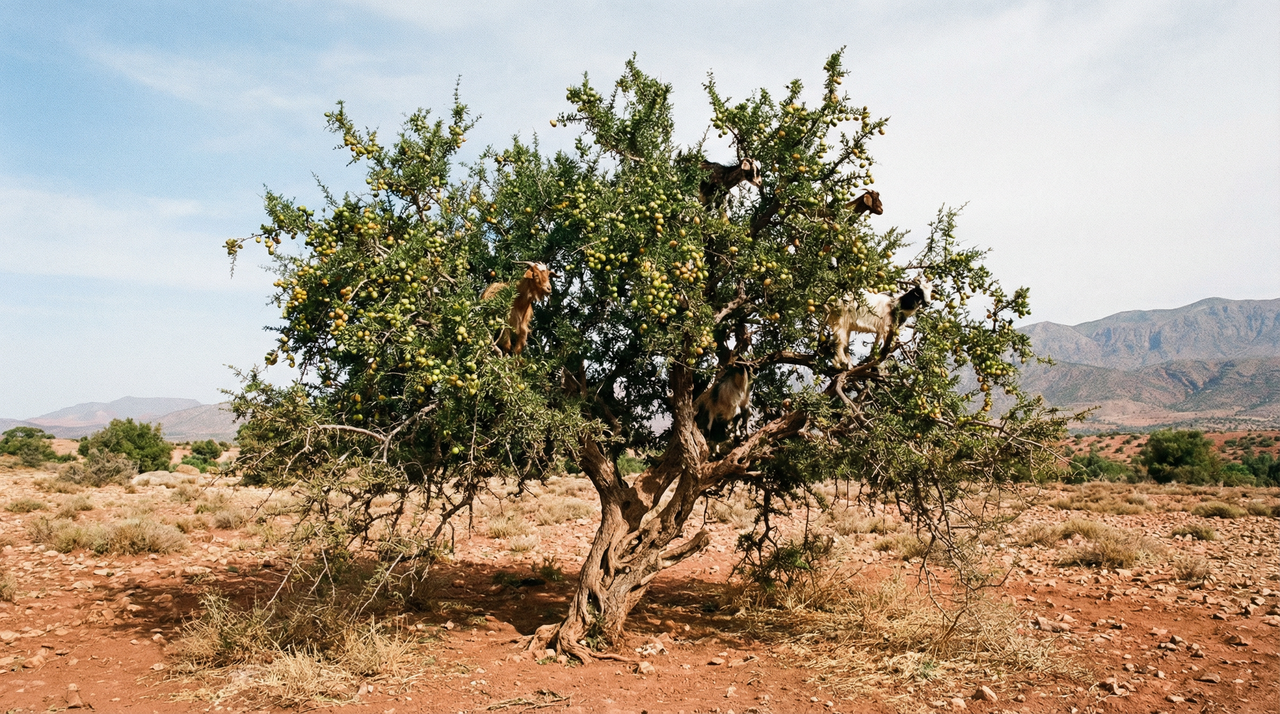
Here's the thing nobody mentions when they're rhapsodizing about argan oil: the traditional harvest depends, in part, on goats climbing trees. Not metaphorically. Actual goats, up in the branches, eating the fruit, and passing the hard inner nuts through their digestive systems so the tough outer pulp softens enough to crack. I've spent a lot of years in food forests, and I've watched animals do some genuinely strange things in the name of seed dispersal, but the first time I saw photographs of Moroccan goats perched eight or ten feet up in a thorny, gnarled argan canopy, I stopped and just sat with that image for a while. The whole ecosystem of the argan tree, from its deep desert roots to the women's cooperatives that cold-press the kernels by hand, runs on relationships that took millennia to develop.
Argania spinosa grows nowhere on earth except a roughly 800,000-hectare arc of semi-arid southwest Morocco, and it has been there since the Miocene.[1] That's not a gardening factoid; it's a warning and an invitation at once. This is a tree so tightly woven into its place, its people, and its ecology that growing it anywhere else asks real questions about patience, humility, and what we actually want from a plant. If your answer involves a fast harvest or a casual experiment, argan will disappoint you. If you're willing to think in decades, it might be the most interesting tree you ever put in the ground.
Origin and History of the Argan Tree (Argania spinosa)
Botanical Background and Native Range
The argan tree is, in the most literal sense, a relic. Fossil evidence from North Africa places its ancestors in the late Miocene or Pliocene, making this tree a survivor from a vastly different continent.[2] Today, Argania spinosa grows almost nowhere except southwestern Morocco, concentrated in the Souss-Massa region, the Sous Valley, and the Anti-Atlas mountains, with a small foothold in northwestern Algeria.[3][4][5] The arganeraie woodland that it anchors, spanning somewhere between 800,000 and 2.5 million hectares depending on how you measure it, was recognized as a UNESCO Biosphere Reserve in 1998.[6][3] That designation signals something important: this isn't just a useful tree, it's an irreplaceable ecosystem.
What allows the argan tree to hold its ground in one of North Africa's harshest landscapes is a set of deeply refined adaptations. Its taproot can drive 15 to 30 meters or more into the earth to reach groundwater,[7][8] its leathery, sclerophyllous leaves cut water loss, and mycorrhizal partnerships boost its ability to pull phosphorus from nutrient-poor soils.[4][9] It tolerates sandy, rocky, and calcareous soils across a pH range of 6.5 to 8.0, handles salinity without complaint, and can resprout from lignotubers after fire.[2][10] I've spent years working with drought-adapted plants that use similar deep-root, thick-leaf strategies, and the argan tree's suite of survival tools is genuinely exceptional even in that company.
Its life history only deepens the picture. Typical specimens live 150 to 200 years, with some ancient individuals estimated at 400 years old.[11][4][12] Seed-grown trees don't reach meaningful fruit production until they're 20 to 30 years old,[13][14] and natural seedling survival rates often fall below 10% thanks to herbivory, drought, and competition.[13][14] Growing long-lived perennials has taught me that this kind of slow start demands patience and a long-term mindset that most modern gardeners have to consciously cultivate. The argan tree is already listed as Vulnerable on the IUCN Red List, threatened by overgrazing, habitat loss, agricultural expansion, and climate change,[5][15] which means its slow regeneration isn't just a horticultural quirk. It's a conservation crisis.
Physical Characteristics and Visual Identification
At first glance the argan tree looks almost defiant. It's a slow-growing evergreen that typically reaches 8 to 10 meters tall with a canopy spread to match, though older specimens push toward 12 to 15 meters.[4][16] The crown is spreading, irregular, and multi-stemmed, a growth habit that screams arid-adapted survivor. If you've spent time around mesquite or hawthorn, you'll recognize the visual logic immediately. The bark is rough and gray, the branches carry stout spines up to 10 centimeters long,[4][17] and from a guild-design standpoint I'd treat those thorns exactly the way I treat hawthorn: keep browsing livestock and tender understory companions at a respectful distance. The small leaves, only 2 to 3 centimeters long, are elliptic, leathery, and a silvery gray-green that reflects sun and conserves moisture.[4][17]
Flowers are small and pale yellow-green, and the fruit that follows is an oval drupe, 2 to 5 centimeters long, ripening to a yellow-brown with bitter, inedible pulp wrapped tightly around one to three hard, oily kernels.[4][3] Below ground, that extraordinary taproot system extends 15 to 30 meters or more.[7][8] Every visible feature of this tree, from the waxy leaf surface to the spines to the deep root architecture, is a direct answer to the question of how you survive centuries in a semi-arid landscape.
Traditional, Cultural, and Economic Uses
The Amazigh (Berber) people of Morocco's Souss region have been harvesting and using this tree for thousands of years, with archaeological evidence reaching back into prehistory and the earliest written record appearing in the 13th-century botanical work of Ibn al-Baytar.[18][19] For them the tree isn't a crop or a resource. It's the tree of life, a cultural symbol of resilience and divine provision in an unforgiving landscape,[20] and the act of harvesting and processing its oil has always been communal, carried down through generations with songs and shared labor.
Traditionally, that processing has been women's work. Women of the Chleuh tribes in the Souss Valley have long cracked, roasted, and cold-pressed argan kernels by hand through cooperative structures whose knowledge is now inscribed on UNESCO's Representative List of the Intangible Cultural Heritage of Humanity.[21][22][23] The scale of this industry is significant: Morocco produces 4,000 to 7,000 tons of argan oil annually from roughly 8 to 10 million trees, generating over $100 million in global exports.[24] The oil feeds families, funds educations, and sustains entire communities. Beyond oil, the tree provides fodder from its leaves and fruit pulp, fuelwood, and stabilizes soils that would otherwise surrender to desertification.[4]
The modern argan boom has a shadow side, though, and I think it's worth naming it plainly. Commercialization has raised serious ethical questions around fair wages for local harvesters, equitable benefit-sharing with indigenous communities, and overharvesting that has reduced original argan forests to just 10 to 20% of their historic extent.[25][26] When I buy argan oil, I look for community-cooperative sources and fair-trade certification. The UNESCO recognition of traditional processing is a form of protection for the women who carry this knowledge, and how we shop either reinforces or undermines that.
Fun Facts and Ecological Significance
While the famous tree-climbing goats are an unforgettable image, their ecological role presents a fascinating relationship.[27] Goats will scale the sprawling branches to browse leaves and fruit, and the seeds largely survive digestion, which means the goats function as a dispersal vector.[14] From a permaculture lens it's a complicated relationship: useful seed dispersal on one hand, significant browsing pressure and reduced regeneration on the other. Real ecological relationships rarely fit neatly into the "beneficial/harmful" categories we like to use.
A single mature tree produces 20 to 50 kilograms of fruit per year, and from that you can extract roughly 1 to 3 liters of oil, with kernel oil content running between 45 and 55%.[28][29] That's a modest yield from a single tree, which is exactly why scaling this into an industry required entire landscapes of forest and generations of labor.
The climate picture is sobering. Models project that suitable habitat for the argan tree could contract by 23 to 50% by 2050 as aridity increases, temperatures rise, and phenological shifts disrupt pollination and fruit set.[30][31] I've watched similar projections play out for Florida native species, where shifting rainfall and heat stress are quietly reshaping which plants thrive and which are failing to regenerate. The mechanism differs but the trajectory feels painfully familiar. The hope lies in active conservation: reforestation programs using mycorrhizal inoculation to boost seedling survival, sustainable cooperative management, and growing recognition of the argan tree as a keystone species whose removal would accelerate desertification across an enormous stretch of North Africa.[32][9] The tree has outlasted ice ages and regime changes. Whether it outlasts us depends on decisions being made right now.
Argan Tree Varieties and Sourcing
Natural Genetic Diversity and Notable Ecotypes of Argania spinosa
If you come to this section expecting a tidy lineup of named cultivars, the argan tree is going to surprise you. Argania spinosa is the only species in its genus, with no formally recognized subspecies and no standardized horticultural cultivars.[33][34] The closest thing to official types are two morphological varieties: var. spinosa, which carries larger kernels, and var. apiculata, distinguished by apiculate leaves and different fruit and seed characteristics.[35] Beyond those two, what actually matters to growers is ecotypic diversity rooted in Morocco's climate gradients. Wild populations show meaningful variation in drought tolerance, fruit traits, and kernel oil content, with selected material ranging from 45 to 55 percent oil by weight.[33][36]
That diversity is exactly what Moroccan breeders and conservation programs are working with. Rather than developing named cultivars, they're selecting superior genotypes from wild populations for faster maturity, higher oil yield, and improved drought and pest tolerance.[37][34] The difference is tangible. Wild trees typically need 20 to 30 years to reach maturity and produce 2 to 3 kilograms of kernels annually, while selected material can mature in 10 to 15 years and yield 5 to 8 kilograms per tree.[38][39] This conservation-oriented domestication, organized through more than 30 cooperatives in Morocco,[40] isn't just about productivity. Supporting it means supporting the genetic bank that will underpin the argan plant's resilience for generations, especially as successful trials in California, Israel, and South Africa demonstrate its potential outside its native range.[41]
Where to Buy Argan Trees: Seeds, Plants, and Import Considerations
Outside Morocco, the argan tree is not a plant you'll stumble across at a garden center. It moves through specialty channels only, typically as seeds or small plants from niche nurseries rather than anything resembling mainstream wholesale distribution.[42] For US growers in USDA zones 9 to 11 (the realistic climate window, with zones 9b to 10b being optimal), vendors like Baker Creek Rare Seeds, Sheffield's Seed Company, Rare Exotic Seeds, and Logee's Greenhouses occasionally carry seeds or young plants.[43][44][45] Stock sells out fast and doesn't always restock on a predictable schedule, so when you see it, don't wait. Seed packets run $5 to $20, small plants range from $30 to $100, and larger specimens can push past $200.
Germination is genuinely humbling. I've worked through several batches of imported argan seed, and even with scarification the results are inconsistent. Fresh, properly stored seed from a reputable supplier makes a real difference. On the import side, the regulatory picture is actually pretty clean. The argan tree isn't listed under CITES,[46] so no endangered-species permit is required. What you do need is a phytosanitary certificate from the country of origin; that's the one document I always confirm before placing any order.[47][48] Small personal quantities under 50 pounds generally don't require additional permits if they aren't destined for commercial propagation. When you do source seed or plants, look for vendors who are working with or buying from Moroccan cooperatives. The ethics matter here, and for a species this ecologically significant, where your money goes is part of the permaculture calculation.
Argan Tree Propagation and Planting (Argania spinosa)
Growing an argan tree from scratch is a commitment measured in years, sometimes decades. Understanding what you're working with before you start saves a lot of heartbreak.
Understanding Argan Seeds: Anatomy, Dormancy, and Viability
Each argan fruit is a small drupe, averaging about 1.8 cm long and weighing roughly 0.40 g, with a fleshy outer mesocarp surrounding a rock-hard lignified endocarp that houses a single embryo.[49][50] That endocarp is the whole problem. It's physically impermeable, which enforces near-zero germination in untreated seeds.[51] Even goats, which disperse argan seeds in the wild through digestion and partial endocarp weathering, only manage a 10–20% germination rate in natural conditions.[14]
The seed storage question adds another layer of uncertainty. Some research classifies argan seeds as orthodox, meaning they tolerate drying to 3–7% moisture and cold storage at -18°C with viability lasting 5–10+ years. Other studies describe intermediate or recalcitrant behavior, where seeds stored too dry lose viability sharply within 12–18 months.[52][53] The research is still unsettled, so I treat them like an intermediate species, storing at moderate moisture and testing viability every year, because I've lost batches I left too dry. Tetrazolium staining (24–48 hours) or X-ray radiography can confirm viability faster than a germination trial, though scarification is usually required before any test gives meaningful results.[54][55]
Propagation Methods: From Scarified Seeds to Grafting and Tissue Culture
Argania spinosa is dioecious, with separate male and female trees and primarily wind-assisted pollination.[56] Grow from seed, and roughly half your seedlings will be male and never produce a single fruit.[57] That's not theoretical; I label every propagation flat because I've learned to wait until trees flower at year four or five before roguing out the non-producers. For consistent oil production, vegetative propagation is the only reliable route.
Grafting is the commercial gold standard, with 60–80% success under good conditions using cleft, veneer, or budding techniques onto seedling rootstocks of the same species.[58] For most home growers, this is the answer; a grafted female from a reputable nursery skips years of uncertainty. Cuttings of 10–15 cm semi-hardwood material treated with IBA at 3,000–8,000 ppm do root, but the success rates are low enough that they function as a backup rather than a primary method.[59] Layering lands somewhere in the middle at around 30–50% success.[56] Tissue culture can hit 70–90% germination in laboratory conditions but struggles with phenolic browning and acclimatization, which keeps it squarely in the research arena for now.[60]
If you do go the seed route, you need to break that endocarp. Hot-water soaking at 80–90°C for 24 hours, mechanical nicking, or concentrated sulfuric acid for 30–60 minutes are the documented options, followed by cold stratification at 4–5°C for one to two months before moving to a germination temperature of 20–25°C.[51][61] After several seasons of trial and error I now combine hot-water soaking with mechanical nicking on every batch, because relying on a single method has been inconsistently rewarding in my experience. On the sulfuric acid option: wear full PPE and work outdoors. I've seen concentrated acid damage skin through gloves when not handled carefully, and this is not a step to improvise.
Soil, Site Selection, and Sun Requirements
The argan tree's deep taproot, which can descend 10–30 meters in mature trees, and its small, waxy, leathery leaves are evolutionary answers to life in an arid landscape.[4] Both adaptations tell you exactly what the tree needs from your site: full sun (a minimum of 6–8 hours daily) and drainage that never fails.[61] Heavy clay or any situation where water pools after rain is essentially a death sentence for young plants before that taproot gets established.
Sandy, loamy, gravelly, or calcareous soils with low organic matter are ideal; this is a tree that evolved in poor soils and doesn't need richness.[28] Target a pH of 6.5–7.5, though the tree tolerates a broader range of 6.0–8.5 with some caveats: iron chlorosis shows up above pH 8.0 and root damage can occur below 6.0.[62] I test pH before planting because iron chlorosis is easy to misread as a nutrient deficiency in alkaline soils, and chasing the wrong fix wastes a season. Aim for a minimum soil depth of 2–3 meters so the taproot has somewhere to go early on.[63]
Spacing, Planting Technique, and Establishment Care
Mature argan trees reach 8–10 meters tall with a canopy spread of 6–10 meters, occasionally topping 15 meters in ideal conditions.[28] Commercial plantations typically space trees 6–8 meters within rows and 7–10 meters between rows, landing at 150–250 trees per hectare. Traditional Moroccan silvopastoral systems use much wider spacing of 20–200 trees per hectare to allow understory crops and livestock integration, which is the model most relevant to permaculture design.[64] For erosion-control plantings along contours, 5–7 meters works well.
Buy container-grown stock if at all possible. The taproot is sensitive and transplanting bareroot material risks enough damage to set the tree back significantly. Plant in spring after frost risk has passed, or in fall in frost-free climates, keeping the root ball intact and disturbing the roots as little as you can manage.[61] The optimal window in USDA zones 9–11 is late winter to early spring, roughly February through April. Water establishment is the one moment this drought-tolerant tree actually needs consistent moisture: plan on 25–50 mm per week for the first one to two years.[65] On exposed sites, temporary staking or a simple windbreak during establishment prevents the kind of rocking stress that damages young taproots before they anchor properly.
Germination Timeline and Success Rates
With proper scarification and stratification, argan seeds germinate in one to eight weeks at 20–25°C, though the more common experience is somewhere in that one-to-three month range.[61] Lab success rates after pretreatment run 20–80%, occasionally higher, compared to the 10–20% typical in wild conditions.[56] Tissue culture's 70–90% success figures are real but require controlled laboratory infrastructure that no backyard grower has access to.[60]
Whatever propagation method you choose, factor in the timeline to fruiting: grafted trees typically begin producing in 4–7 years; seed-grown trees need 7–15 years to reach harvest maturity.[56] Think of it the way you'd think of a pistachio or a slow-fruiting olive: a long-term investment in the landscape, not a quick payoff. Grafted stock from a verified female plant is almost always the better starting point for anyone who actually wants oil.
Argan Tree Care Guide
If there's one thing that shapes how you approach argan tree care, it's understanding where this tree comes from. The arganeraie woodlands of southwestern Morocco receive somewhere between 100 and 400 mm of rain annually, and the trees have learned to source moisture from fog, dew, and whatever the soil holds after a brief wet season. That context reframes every decision you'll make in cultivation. Less really is more with this species.
Watering Needs and Drought Tolerance
Once established, argan trees are genuinely extraordinary in their drought tolerance, surviving 4 to 6 months without significant rainfall and performing adequately on as little as 250 mm of water annually.[66][65] That resilience is built on a taproot that can reach 9 to 30 meters deep, pulling moisture from well below the surface where other trees give up.[67] During extended dry periods, supplemental irrigation every two to six weeks is enough for a mature specimen. Young trees are a different story. For the first one to three years, water every seven to ten days in dry conditions, roughly 10 to 20 liters per session, until that taproot is deep enough to fend for itself.[67]
The soil matters as much as the schedule. Argan prefers well-draining sandy or loamy soil with a pH anywhere from 5.5 to 8.5, and it handles moderate salinity reasonably well.[68] In my humid subtropical climate, drainage is the one thing I won't compromise on. Overwatering in poorly drained soil is the fastest way to kill one of these trees; symptoms include yellowing, wilting foliage, and eventually blackened, mushy roots.[69] I'd rather underwater and deep-soak infrequently than keep the root zone consistently moist.
Sunlight Requirements
Argan trees evolved in open semi-arid woodlands, and they need full sun for at least six hours daily to grow well and produce oil-rich nuts.[70] Shade makes them leggy and pale, with reduced photosynthesis and stunted development.[56] I've noticed that full sun produces the tight, compact form with those small, leathery leaves, similar to what I see on other drought-adapted trees like olive or carob. Partial shade loosens the whole architecture in a way that never quite recovers. The flip side is that excessive heat combined with insufficient water causes leaf scorching, bleaching, and necrosis,[56] which is where irrigation and mulching do their most important work.
Feeding and Nutrient Management
Argan is adapted to nutrient-poor, rocky calcareous soils, and that deep root system means mature trees in natural settings rarely need fertilizing.[71] My established trees get almost nothing beyond occasional compost, and they're fine. When I was younger and more enthusiastic with the nitrogen, I pushed lush, fast growth that looked impressive until the following winter, when that same soft tissue took far more frost damage than the trees that had been left alone. Now I test the soil first and use organic compost or well-aged manure at around 5 to 10 kg per tree annually if anything at all.[72] If a chemical fertilizer is warranted, a balanced slow-release NPK applied sparingly in spring is the safer route, with iron or zinc foliar sprays at 0.5% chelate concentration to address the interveinal yellowing that sometimes appears in high-pH calcareous soils.[73][74] Nitrogen deficiency shows as uniform yellowing of older leaves, phosphorus deficiency as purplish foliage and poor fruiting, and potassium deficiency as marginal scorch.[74] Any of those is preferable to the weakened, frost-sensitive growth that over-fertilization produces.
Frost Tolerance and Cold Protection
Argan growing conditions outside USDA zones 9 to 11 are genuinely risky.[75] I treat young argan much like tender citrus: potted specimens come under cover when forecasts drop below 30°F, and I mulch the root zone heavily before any cold snap. Mature trees can tolerate brief dips to around -5 to -7°C (23 to 19°F), but young trees can defoliate or die at just -2 to -4°C.[76] Spring frosts during flowering are particularly damaging and can cause up to 50% yield loss from flower and fruit drop alone.[76] For protection, frost cloth, sheltered microclimate planting, and well-drained soil (which improves cold hardiness considerably) are the practical tools.[77]
Heat Tolerance and Stress Management
On the opposite end, argan tree climate tolerance extends to genuinely punishing heat. This is a tree suited to AHS Heat Zones 9 to 11, sustaining daytime temperatures of 40 to 45°C and short spikes to 50°C.[28] Optimal growth happens between 18 and 30°C; above 45°C you start seeing wilting, leaf scorch, and reduced fruit quality.[56] Seedlings are most vulnerable, stressed above 40°C, and flowering is sensitive above 35°C because pollen viability drops significantly.[56] The tree recovers through deep roots, stomatal regulation, and heat-shock proteins, and it benefits enormously from cooler nights.[78] Practically speaking, 2 to 4 inches of organic mulch moderating root-zone temperature is the single most useful intervention I've found, paired with supplemental irrigation during heat spikes.[79] I've also had better results with seed or seedling stock sourced from hot, dry Moroccan provenance; those specimens handle my summer conditions with noticeably more composure than material from unknown origins.
Pruning, Mulching, and Maintenance
Apply 2 to 4 inches of organic mulch around the base each spring to retain moisture, suppress weeds, and buffer soil temperature.[65] I use pine-bark mulch and have found it reduces the summer stress dormancy I used to see regularly; trees stay actively growing longer into the dry season when their roots stay cool and moist. Pruning should stay minimal. For the first three to five years, formative pruning in late winter establishes a strong structure, whether a single central leader or an open-vase form, by removing competing branches.[80] After that, I prune lightly after the autumn fruit harvest, removing dead, diseased, or crossing branches to improve airflow and light penetration. Done consistently, that light canopy thinning can improve kernel yield by 20 to 30%.[81] Heavy pruning on slow-growing species is a mistake that sets productivity back by years.
Seasonal Rhythm and Lifecycle
Argan is evergreen with no true dormancy, though it may slow significantly during extreme dry summers. Flowering runs from March through June, followed by five to seven months of fruit development that finishes between July and November.[82] Outside its native range, general care remains fairly consistent year-round, with light, water, and temperature being the primary variables rather than a dramatic seasonal shift. When I see growth slow noticeably in July and August, I treat it as a stress-dormancy signal and respond with one deep watering rather than fertilizer. The tree usually resumes active growth once temperatures moderate. That rhythm, slow and steady across decades, is worth respecting.
Harvesting Argan Tree Fruits and Kernels
The argan tree is not a plant for the impatient grower, and nowhere is that clearer than in thinking about harvest. If you're starting from seed, expect it to be at least a decade before you begin to see meaningful yields on a seedling tree, while utilizing a grafted specimen accelerates this timeline quite significantly, which is one reason I always recommend grafted stock to anyone who asks. After growing both, the difference feels profound when you're the one doing the waiting. Full maturity arrives around 20 to 30 years, and peak productivity doesn't come until after 40.[83][84][85][86] Label your trees clearly and date your records. You'll thank yourself in a decade.
When to Harvest: Long-Term Maturity and Seasonal Timing
The annual rhythm runs like this: flowering from March through May, then a 4 to 6 month stretch before the fruits ripen, putting the main harvest window between July and September with August being the busiest month.[87][88] The tricky part is that the fruits don't all ripen at once. You'll need multiple passes over several weeks, which is just part of working with this tree. I think of it like figs in that respect: asynchronous ripening that rewards attentive checking rather than a single harvest day.
Ripeness cues are distinctive once you know them. Green skin shifts to yellow or reddish-brown, the surface wrinkles and softens, the outer pericarp may begin to split open, and then the fruit simply drops.[89][28] That natural drop is your signal. Timing harvest to fully ripe fruit also matters chemically: kernels at full maturity carry 50 to 60% oil content, so waiting for true ripeness isn't just about flavor, it's about getting the most from what those years produced.[28][51]
Traditional and Modern Harvesting Techniques
The right approach is ground collection, waiting for fruits to fall naturally and gathering them from underneath the tree.[90][91] I learned that lesson the direct way: attempting to pull fruits from the branches introduced me to just how viciously thorny this tree is and how easily you can damage growth that took years to develop. Ground-fall collection protects both you and the tree's long-term productivity.
Once you've collected the fruit, spread it in the sun for several days to reduce moisture and prevent fungal problems before cracking.[92] Then comes the notoriously labor-intensive step: breaking open the stone-hard shells to reach the kernels of the argan tree inside. Traditionally this essential hand-processing requires a level of skill, precision, and physical patience that machines are only just beginning to replicate at scale.[92]
Yields, Pulp Flavor, and the Rewards of Processing
Expect modest yields, at least for most of a tree's life. Peak output from a well-established, properly managed tree after 40 years sits around 50 to 100 kg of nuts.[86] In my experience, that upper end is genuinely optimistic, reached only by older trees in conditions close to ideal. Set your expectations accordingly for any permaculture planting.
The ripe pulp itself is worth tasting: mildly sweet with a pleasant acidic edge, something like almond crossed with passion fruit.[93] The raw kernels, though, are another story entirely. They're distinctly bitter and not something you'd eat directly. All the kernel value runs through processing. Roast them, press them, and the transformation is genuinely remarkable: a rich, nutty oil with hazelnut and almond character, toasty and complex from the Maillard reactions, with subtle fruity and woody undertones.[94] It's the kind of flavor that makes the whole multi-decade wait feel worth it.
Argan Tree Preparation and Uses
Culinary Uses and Flavor Profile of Argan Oil
The kernel is where everything worth eating lives in an argan tree, and getting from raw kernel to finished oil is not a casual kitchen project. Raw kernels contain saponins and cyanogenic glycosides that make them genuinely unsafe to eat without proper processing.[95][96] I've always been cautious with raw tree seeds in my own experiments, and argan is one species where that caution is fully warranted. Proper roasting followed by cold-pressing is what transforms the kernel into something both safe and extraordinary.
The two oil types deserve a clear distinction. Culinary oil comes from roasted kernels; the Maillard reactions during roasting produce compounds like 2,5-dimethylpyrazine that give the oil its signature character.[97][98] Cosmetic oil is cold-pressed from unroasted kernels, milder and sometimes slightly bitter, and is the version used for skin and hair rather than the table.[99] Having worked with pistachio oil, walnut oil, and other high-oleic pressed oils in regenerative landscape design projects, I'd describe culinary argan oil's mouthfeel as silky in a way that reminds me of a milder pistachio oil, with a hazelnut-roasted depth and just a whisper of nutty bitterness at the finish.[100][101] Traditional uses include drizzling over salads and breads, and blending into amlou, the Moroccan paste of argan oil, almonds, and honey that I'd put against any nut butter I've tasted.[102]
The oil's nutritional backbone, oleic acid at 43-49% and linoleic acid at 29-36%, plus exceptionally high gamma-tocopherol levels (620-900 mg/kg total tocopherols, surpassing olive oil), explains both its stability and its antioxidant performance.[98][103] I actually notice that it holds up better on my pantry shelf than most pressed oils I keep around. People with tree nut allergies should approach argan carefully given its relatedness to cashew and mango, and pregnant or breastfeeding individuals should consult a healthcare provider before regular culinary use.[95]
Medicinal Preparations and Traditional Remedies
Beyond the kitchen, traditional Berber practice uses almost every part of the tree medicinally. Leaf infusions, typically 1-2 grams of dried leaves steeped in 250 mL of hot water for 10-15 minutes and taken two to three times daily, address digestive complaints and inflammation.[104] I grow a range of medicinal herbs and shrubs, and the leaf infusion preparation here is straightforward enough to compare to a standard chamomile or olive leaf tea. Bark is traditionally boiled for 20-30 minutes to extract tannins.[104] The oil itself, taken orally at roughly 15-30 mL daily or applied topically at 5-10 mL, is used for skin conditions, rheumatism, and digestive support, with cold-pressing preserving the bioactive compounds most effectively.[4] The phenolic compounds, ferulic acid, syringic acid, and catechin, provide the antioxidant backbone that grounds many of these traditional applications in identifiable chemistry.[105]
Non-Food Uses, Processing, and Cultural Significance
Traditional argan processing is genuinely labor-intensive: hand-cracking the stone-hard nuts, roasting the kernels, grinding them into paste, then pressing out the oil.[106] Women-led cooperatives in Morocco's UNESCO Arganeraie Biosphere Reserve have centered this work for generations, and the slow stone-grinding step that contributes so much to the oil's depth of flavor also directly sustains those community livelihoods.[107][108] When I think about why properly sourced argania spinosa kernel oil commands the price it does, the answer is inseparable from that human and ecological context.
Beyond oil, the tree has over 40 documented traditional uses.[109] Leaves and fruit pulp feed goats; the dense hardwood fuels cooking fires; the canopy stabilizes soil against desertification.[110][111] The oil also carries natural insect-repellent properties, adding another practical dimension.[112] Properly dried kernels stored at 4-10°C remain viable for 12-18 months, which matters for anyone managing a small-scale harvest seriously.[56] Every use circles back to the same truth: this tree sustains people, animals, and landscapes simultaneously, and how we source and prepare its products either honors that relationship or erodes it.
Argan Tree Health Benefits and Medicinal Uses
What makes argan oil worth the extraordinary effort it takes to produce comes down to chemistry. This is an oil with an unusually dense nutrient profile, and once you understand what's actually in it, the centuries of Berber reverence start to make a lot of sense.
Phytochemical Profile of Argania spinosa
The kernel oil is built around a fat profile that skews heavily unsaturated: roughly 43-49% oleic acid and 29-36% linoleic acid, which puts it in the same structural neighborhood as olive oil but with a higher proportion of the omega-6 linoleic fraction.[94][113] What sets it apart from most edible oils, though, is the vitamin E fraction. Gamma-tocopherol dominates at 620-900 mg/kg total tocopherols, which is notably different from the alpha-tocopherol-dominant profile in olive oil, and research suggests gamma-tocopherol may have superior anti-inflammatory activity.[114] Add in 300-600 mg/kg of squalene plus polyphenols including ferulic acid, catechins, and vanillic acid, and you have a genuinely complex oil.[94]
The bioactive story extends beyond the oil. Leaves, fruit pulp, and seed hulls carry flavonoids (catechin, quercetin derivatives, luteolin) and phenolic acids, while bark contains tannins and roots contain alkaloids and saponins.[115][116] These compounds vary meaningfully with season, geography, and tree age: phenolic concentrations peak in spring and summer leaves, and trees from arid southern Morocco consistently show higher flavonoid levels than those from wetter northern sites.[117][118] I've noticed this in practice: batches I've sourced from cooperatives in the arid south consistently feel richer and more herbaceous than oils from the northern edge of the range. That's not just preference; it reflects a real difference in phytochemical density that origin and harvest timing directly influence.
Medicinal Research and Traditional Uses
Berber communities have been using this oil medicinally for as long as records exist. Topical applications for eczema, acne, burns, and wound healing; internal use for digestive complaints, rheumatism, hypertension, and diabetes; leaf tea for diarrhea and parasitic infections -- these aren't marginal folk practices but a deep, systematic pharmacopoeia built through generations of observation.[119][120] Building on that history, modern laboratory work has started mapping the mechanisms behind those traditional outcomes.
Antioxidant activity is the foundation. The tocopherols and polyphenols drive potent free-radical scavenging, metal chelation, and Nrf2/ARE pathway activation, which is the cell's own stress-response system.[121][122] From there, preclinical evidence branches into anti-inflammatory activity (COX-2, TNF-α, and NF-κB inhibition), antimicrobial activity against Staphylococcus aureus and Candida albicans, and promising metabolic effects including antidiabetic and hypolipidemic actions in animal models.[121][123][124] Preliminary anticancer research shows apoptosis induction in cell lines, but that evidence is very early stage.[125]
The strongest clinical ground is skin and cardiovascular health. Randomized controlled trials found that 60 days of topical argan oil improved skin hydration, elasticity, and visible aging signs, with particularly clear results in postmenopausal women.[126] Oral consumption has produced favorable shifts in lipid profiles in human subjects.[127][128] I use it both ways: unroasted on skin and as a finishing oil in salad dressings, and the extra-virgin version I prefer absorbs noticeably faster and smells far more alive than roasted oil. Most of the pharmacological evidence still comes from in-vitro and animal studies, and longer-term human trials are needed before the metabolic claims reach the same confidence level as the skin data.[121] Compared to, say, olive oil's decades of large-scale human research, argan is still building its clinical story.
Nutritional Composition
Cold-pressed kernel oil is the primary edible product, with kernels yielding 43-49% oil by weight at roughly 884 kcal/100g.[94][129] The fat profile (roughly 45-50% oleic, 30-35% linoleic) gives it a good balance of heart-supportive monounsaturated and essential omega-6 fats. Its vitamin E content is exceptional: 600-700 mg/100g, predominantly in the gamma-tocopherol form.[130] The oil also contains meaningful levels of potassium, magnesium, phosphorus, calcium, iron, and zinc alongside up to 600 mg/kg squalene and the unique sterols schottenol and spinasterol, which appear primarily in this species.[131][114]
One practical note on processing: roasting the kernels before pressing reduces phenolic content by 20-50% compared to unroasted pressing, so unroasted cosmetic-grade oil retains more antioxidant activity even though roasted culinary oil has the flavor advantage.[117] The fruit pulp is fibrous and bitter; it's mainly fed to livestock rather than eaten by people.[28] Properly stored kernels hold aflatoxin levels below EU safety limits, so food safety isn't a concern when you're sourcing from reputable producers.[132]
Safety and Potential Side Effects
Properly processed argan oil has an excellent safety profile. It's GRAS-approved by the FDA, cleared for food and cosmetic use by EFSA, SCCS, and CIR, and acute toxicity studies show an LD50 above 5 g/kg in animal models, which puts it firmly in the low-risk category.[133][134] The key phrase is "properly processed." Fruit pulp and raw press cake contain tannins and oleanane-type triterpenoid saponins that can cause gastrointestinal irritation in quantity, but standard cold-pressing methods -- following Moroccan NM 08.0.023 or FAO guidelines -- eliminate those concerns for the finished oil.[135][136]
No cyanogenic glycosides or cardiotoxic compounds have been identified in the plant, and there are no significant pollen allergens on record.[137] Allergic contact dermatitis is occasionally reported, but it's genuinely rare.[138] When I'm recommending any new plant-based oil to clients with reactive skin, I always suggest a simple patch test on the inner forearm before committing to full use; that's good practice here too. The oil appears safe during pregnancy in moderate amounts, and traditional oral intake runs 1-3 tablespoons daily.[139] The one theoretical caution worth mentioning: high vitamin E intake from any source may interact with anticoagulant medications, so anyone on blood thinners should check with their provider before making this a daily supplement.[139]
Argan Tree Pests and Diseases
Natural Defenses and Overall Resistance
The argan tree's first line of defense is built right into its body. Those sharp spines aren't just for keeping goats at bay; the branches and glandular trichomes on the leaves physically trap and toxify small arthropods before they even get started.[140][9] Beneath that, the chemistry is doing heavy lifting: flavonoids, tannins, terpenoids, and essential oils rich in alpha-pinene act as insecticides, repellents, and antifeedants.[141][142] I think of it the way I think about rosemary or lavender in my Mediterranean guilds; those pungent protective compounds are the plant's own pest management system. The difference with argan is that wild trees carry these defenses much more strongly than cultivated ones do, which is a useful reminder that domestication always comes with tradeoffs.[143]
Major Diseases and Root Rot Challenges
Here's the hard truth for anyone planting an argan tree outside its native range: this is a desert survivor that will die in wet feet faster than almost any stressor you can throw at it. Phytophthora cinnamomi root rot is the single biggest disease threat, and it thrives in poorly drained or waterlogged soils.[144] I learned this firsthand after planting a young tree in a site I thought was "well-draining enough." It wasn't. The early wilting fooled me into thinking drought stress at first, but the root system told a different story when I dug it up. Proper siting, which I cover in the care guide, is genuinely your first line of defense here.
Beyond Phytophthora, the disease list is longer than most people expect: Alternaria and Cercospora leaf spots, powdery mildew, Botryosphaeria canker causing branch dieback, anthracnose, and both Rosellinia and Armillaria root rots.[140][145] Stress amplifies all of it. Drought, salinity, overexploitation, and climate variability each erode resistance, and incidence shifts considerably by region, provenance, and how the tree is managed.[146]
Insect Pests and Their Damage
The insect pest list for Argania spinosa is surprisingly varied once you're in plantation or stressed-tree territory. Seed weevils and Mediterranean fruit fly attack the fruit directly, reducing yield and causing rot.[143] Cerambycid borers and the leopard moth tunnel into trunks and branches, weakening structure from the inside.[147] Scale insects and aphids cause sap loss and defoliation. Monoculture conditions and drought stress consistently amplify all of this pressure compared to wild trees growing in diverse stands.[148] For growers in California, Florida, or other non-native U.S. settings, the picture is considerably calmer; spider mites can appear under dry stress, and humidity may encourage some foliar fungal issues, but no major pest epidemics have been reported in experimental American plantings.[149] In my Central Florida observations, a well-sited, properly watered tree stays remarkably trouble-free.
Integrated Management and Breeding for Resilience
In my designs, I lead with biology and culture, not chemistry. For argan, that means Trichoderma harzianum applied at planting and annually to suppress soil-borne pathogens, companion planting with nitrogen-fixers to keep trees vigorous, and careful pruning for airflow to reduce foliar disease pressure.[150][151] Predatory insects and parasitic wasps handle most soft-bodied pest populations when the surrounding guild supports them. Copper-based compounds or phosphonates stay on the shelf unless things get genuinely severe.[152]
On the genetics side, Moroccan breeding programs at INRA have made real progress, developing selections like 'Arganier de Taroudant' with improved resistance to Phytophthora, leaf spot, weevils, and fruit fly drawn from diverse natural provenances.[153][154] Where you can source from conservation-minded nurseries carrying Moroccan-selected material, I'd always prioritize that over anonymous seedlings. Good genetics are preventive medicine, and with a tree this slow-growing, you want that advantage built in from day one.
Argan Tree in Permaculture Design
Every dryland permaculture designer eventually starts hunting for that one keystone tree: something that builds soil, holds slopes, shelters understory plants, and produces food with almost no inputs once it's established. The argan tree is that plant for North Africa's arid edge, and for anyone gardening in a similar climate, it deserves serious attention.
Climate Suitability and Growing Zones
Argania spinosa is native to the semi-arid zones of southwestern Morocco and northwestern Algeria, where annual rainfall sits between 100 and 600 mm and the Mediterranean rhythm of hot, dry summers and mild, wet winters defines the growing calendar.[4][155] That 250-400 mm sweet spot is worth fixing in your mind because it tells you everything about how the tree expects to be treated. This is not a tree that rewards irrigation anxiety. It's designed for scarcity.
USDA zones 9-11 are the realistic window for outdoor cultivation, with zones 10-11 as the most reliable,[156][68] and mature trees can technically handle brief dips to -7°C.[4] Young plants, though, are genuinely frost-tender, so anyone trialing argan at the cooler edge of zone 9 needs to take that seriously. I've seen similar situations with other arid-adapted trees where growers underestimate the establishment window and lose plants in the first or second winter. Patience and frost cloth in early years aren't optional luxuries here. The tree wants well-drained, calcareous soil with a pH of 6 to 7.5 and will not tolerate waterlogging under any circumstances.[156][157] Outside Morocco, experimental plantings in coastal California, Israel, southern Australia, and South Africa have shown limited promise,[158] but "limited" is the operative word. This is a Koppen BSh and BWh specialist,[159] and no amount of enthusiasm overrides a climate mismatch.
Forest Layer, Growth Form, and Guild Integration
In canopy terms, the argan tree occupies the upper layer of open dryland woodlands, typically reaching 6-10 meters tall with a spreading crown 8-10 meters wide, and occasionally topping 15 meters in favorable sites.[160][4] Its multi-stemmed, somewhat shrubby form creates a broad, dappled shade zone rather than a solid canopy, which is exactly what you want when you're trying to grow understory plants in a climate that punishes full sun. I think of it the way I think about mesquite in my Sonoran Desert design work: a tree that earns its space by creating a liveable microclimate for everything growing beneath it.
That microclimate effect goes deeper than shade. Argan roots can descend up to 30 meters,[161] drawing moisture from far below and cycling it back into the upper soil profile as leaf litter and root exudates. The tree's mycorrhizal associations actively facilitate nutrient uptake for understory species, moderating soil temperature and bumping local humidity in the process.[162] In practice, I mulch heavily around young argan trees to accelerate this soil-building cycle while the root network is still establishing, borrowing from what Moroccan agro-pastoral systems demonstrate naturally.
For guild design, space trees 6-10 meters apart and pair them with drought-tolerant herbs, native groundcovers, and nitrogen-fixing shrubs.[28] That last point matters: argan doesn't fix nitrogen itself (more on that below), so building nitrogen-fixing companions into the guild from the start compensates for that gap. Once mature, trees in traditional Moroccan agroforestry systems yield 20-50 kg of nuts annually,[28][4] but "mature" means 20-50 years. Anyone who has designed long-rotation agroforestry knows this kind of thinking, but it's worth stating plainly: this is a multigenerational investment.
Ecosystem Functions and Pollination Dynamics
The argan tree's ecosystem services are genuinely impressive for a single species. Those 30-meter taproots anchor slopes and riverbanks, making it one of the most effective erosion-control trees available for arid sites.[56] More than 100 associated plant species, plus birds, mammals, insects, and livestock, depend on established argan woodlands,[163] which is the kind of biodiversity-hosting capacity that earns something the "keystone species" label. Sequestration estimates run to 10-20 tons of CO2 per hectare annually,[164] a figure that means something to me when clients ask how to make their dryland properties more climate-resilient.
Argan sits in the Sapotaceae family, not the legumes, and it does not fix nitrogen.[165] It compensates through leaf litter and mycorrhizal soil-building rather than atmospheric fixation, which is why I always plan for nitrogen-fixing companions in the guild from day one. The tree does have an unusual accumulation capacity for zinc and cadmium,[166] which opens some intriguing possibilities for phytoremediation on degraded sites, though that's still emerging territory.
Pollination is where argan surprises most designers. The tree is self-incompatible and requires cross-pollination,[167] relying on both wind and insects, with insects carrying more of the load than older literature suggested. Honeybees account for over 70% of pollinator visits, supported by solitary bees including Andrena, Halictus, Anthophora, and Osmia species.[168] Flowers are small, pale yellow-green, and bloom from February through June when temperatures hold between 20 and 30°C with moderate humidity.[169] The same strategy I use around other fruit trees applies here: preserve native flowering plants around and within the guild, skip any broad-spectrum pesticides during bloom, and consider supplemental hives if wild bee populations are thin on your site. Habitat loss and pollinator decline are real limiting factors for argan's productivity,[170] and addressing that at the design stage rather than after the fact is the difference between a productive grove and a frustrating one.
The Tree That Taught Me to Think in Centuries
I keep a small bottle of culinary argan oil in my kitchen, and every time I open it, that roasted, nutty warmth stops me for a second. Someone cracked those nuts by hand. The tree that produced them was probably older than I am. Working with argan has quietly shifted how I measure time in a garden; not in seasons, not even in decades, but in the kind of patience that gets passed down through generations of women with stones and a purpose.
Sources 170
- IUCN Red List: Argania spinosa ↩
- Fossil evidence for Argan origin ↩
- Argania spinosa - Wikipedia ↩
- Argania spinosa - Kew Royal Botanic Gardens ↩
- Argania spinosa: The IUCN Red List of Threatened Species ↩
- Arganeraie Biosphere Reserve ↩
- Argan Tree (Argania spinosa) - Root System and Adaptations ↩
- Water uptake by deep-rooted trees within a semi-arid riparian gallery forest of Morocco: the case of Argania spinosa ↩
- Role of Mycorrhizae in Argan Tree Survival ↩
- Missouri Botanical Garden Plant Finder ↩
- Missouri Botanical Garden Plant Finder ↩
- The Argan Tree: A Model Tree for Arid Conditions ↩
- Argan Tree Cultivation and Maturity ↩
- Population Dynamics of Argania spinosa in Morocco ↩
- The Argan Tree: A Unique Ecosystem Engineer ↩
- Argania spinosa - Missouri Botanical Garden ↩
- Argania spinosa - Missouri Botanical Garden ↩
- Historical and Cultural Aspects of Argan Tree in Morocco ↩
- The History and Traditional Uses of Argan Oil ↩
- The Argan Tree: A Symbol of Life and Sustainability in Moroccan Berber Culture ↩
- Traditional knowledge of the Argan tree ↩
- Traditional skills in argan oil production - UNESCO Intangible Cultural Heritage ↩
- Cultural and Economic Importance of Argan Oil Production among Berber Women ↩
- FAO Report on Argan Tree Sustainability and Economic Impact ↩
- Ethical Issues in the Commercialization of Argan Oil: Fair Trade and Indigenous Rights ↩
- Sustainability Challenges in Argan Oil Production: Overharvesting and Market Pressures ↩
- Why do goats climb trees ↩
- Argan Tree Cultivation and Yield ↩
- Review of the Argan Tree and Argan Oil: Distribution and Ecological Adaptations, Uses, Economic Significance, and Propagation ↩
- Climate change impacts on the argan tree ↩
- Argania spinosa (L.) Skeels: An Endemic Tree from Morocco with Outstanding Sustainable and Socioeconomic Potential ↩
- Argan Tree Conservation and Sustainable Management ↩
- Genetic diversity and structure of the argan tree (Argania spinosa (L.) Skeels) in relation to climate gradients ↩
- The argan tree (Argania spinosa L. Skeels): An endemic Moroccan species of multiple uses ↩
- Varieties and Regional Adaptation of Argania spinosa in Morocco ↩
- Genetic Diversity of Argania spinosa (L.) Skeels in the Western Anti-Atlas of Morocco ↩
- Breeding history of Argania spinosa ↩
- Argan Tree Cultivation and Management in Morocco ↩
- Growth and Yield Performance of Argania spinosa Varieties ↩
- Commercial cultivation of argan in Morocco ↩
- Introduction of Argania spinosa to California ↩
- Argania spinosa ↩
- Argan Tree - Argania spinosa ↩
- Argania spinosa Seeds ↩
- Argan Tree - Argania spinosa ↩
- CITES Species List ↩
- Importing Plants and Plant Products into the United States ↩
- Phytosanitary Certificates for Imports ↩
- Plants of the World Online ↩
- Seed Anatomy and Morphology of Argan Tree (Argania spinosa) ↩
- Seed Dormancy and Germination in Argania spinosa ↩
- Seed Storage of Argan Tree (Argania spinosa) ↩
- FAO Report on Argan Tree Conservation and Seed Banking ↩
- Seed Viability Testing Handbook ↩
- Tetrazolium Testing for Seed Viability ↩
- Reproductive Biology of Argania spinosa ↩
- Genetic Variation in Argania spinosa ↩
- Propagation of Argan Tree (Argania spinosa) by Grafting ↩
- Propagation of Argania spinosa by Cuttings and Tissue Culture ↩
- Micropropagation of the Argan Tree (Argania spinosa) ↩
- Argania spinosa - Plant Finder - Missouri Botanical Garden ↩
- Argania spinosa ↩
- Soil and Site Requirements for Argan Tree (Argania spinosa) Cultivation ↩
- Argan Tree Cultivation Guidelines ↩
- Argan Tree Cultivation and Management ↩
- Missouri Botanical Garden Plant Finder ↩
- Argan Tree Cultivation Guide - FAO ↩
- USDA Plants Database: Argania spinosa ↩
- Root Rot in Argan Trees ↩
- Argan Tree Cultivation Guide - FAO ↩
- Argania spinosa: Ecology and Cultivation ↩
- Argan Tree Cultivation Guide ↩
- Nutrient Requirements of Argania spinosa in Arid Regions ↩
- Nutrient Management in Argan Orchards ↩
- Argania spinosa - Missouri Botanical Garden ↩
- Frost Tolerance of Argania spinosa in Moroccan Argan Forests ↩
- Frost Protection for Subtropical Plants ↩
- Temperature Stress Responses in Argania spinosa ↩
- Heat Stress Mitigation in Argania spinosa ↩
- Argan Tree Management in Morocco ↩
- FAO Guidelines on Argan Tree Management ↩
- Phenology of Argania spinosa in Morocco ↩
- Argania spinosa (Argan Tree) ↩
- Cultivation of the Argan Tree ↩
- Argan Tree (Argania spinosa): Cultivation and Uses ↩
- Argan Tree Cultivation and Management ↩
- Phenology and reproductive biology of Argania spinosa ↩
- The Argan Tree: Biology and Uses ↩
- Phenology of Argania spinosa in Southwest Morocco ↩
- Argania spinosa (Semens) Lateral Branching and Fruit Production under Traditional Cultivation ↩
- Argan Tree Cultivation and Harvesting Practices ↩
- Argan Oil Production: Harvesting and Processing ↩
- Argan - Wikipedia ↩
- Sensory and Chemical Characteristics of Edible Argan Oil ↩
- Phytotherapy Research (2004) - Safety of Edible Argan Oil ↩
- USDA PLANTS Database ↩
- Journal of Agricultural and Food Chemistry Review ↩
- Volatile Compounds of Argan Oil from Unroasted and Roasted Kernels ↩
- Sensory and Chemical Characteristics of Virgin Argan Oils ↩
- Sensory and Chemical Characteristics of Moroccan Virgin Argan Oil ↩
- Flavor and Sensory Evaluation of Argan Oil from Argania spinosa ↩
- Kew Science - Argania spinosa Fact Sheet ↩
- Fatty Acid and Tocopherol Composition of Argania spinosa Oil ↩
- Journal of Ethnopharmacology: Phytochemical analysis of Moroccan Argan tree abuse ↩
- Antioxidant Phenolic Compounds in Argan Oil ↩
- Traditional Argan Oil Extraction Techniques ↩
- Argan Oil Production and Sustainability in Morocco ↩
- UNESCO Arganeraie Biosphere Reserve ↩
- Ethnobotanical Survey of Argania spinosa in Morocco ↩
- The Argan Tree: Economic and Environmental Importance ↩
- Argan: A multipurpose tree ↩
- Argan Oil: Production and Processing ↩
- Argan Oil: Occurrence, Composition and Verified Health Effects ↩
- Chemical Composition and Nutritional and Pharmacological Properties of the Fruit and Kernel of Argania spinosa ↩
- Phytochemicals and Bioactivities of Argan Tree ↩
- Journal of Agricultural and Food Chemistry Article on Argania spinosa Metabolites ↩
- Seasonal Variation of Phenolic Compounds in Argania spinosa Leaves ↩
- Geographic Variation in Flavonoids of Argania spinosa ↩
- Traditional Uses and Pharmacological Activities of Argania spinosa: A Review ↩
- Ethnobotanical Survey of Medicinal Plants Used by Berber Communities in Morocco ↩
- Pharmacological Activities of Argania spinosa: A Review ↩
- Antioxidant and Anti-inflammatory Properties of Argan Oil ↩
- Anti-inflammatory Mechanisms of Argan Tree Components ↩
- Antidiabetic Effects of Argan Oil in Streptozotocin-Induced Diabetic Rats ↩
- Antimicrobial Activity of Argania spinosa Extracts ↩
- Effects of argan oil on postmenopausal skin ↩
- Clinical Trial on Argan Oil and Metabolic Syndrome ↩
- Effects of argan oil on the lipid profile of healthy men and women: A randomized controlled trial ↩
- USDA FoodData Central - Argan Oil ↩
- Vitamin E in Argan Oil ↩
- Nutritional Composition of Argan Kernels ↩
- Aflatoxins in Argan Kernels: Risk Assessment ↩
- Scientific Committee on Consumer Safety (SCCS) - Opinion on Argan Oil ↩
- Pharmacological Activities and Safety Evaluation of Argan Oil ↩
- Insights on Phytochemistry and Pharmacological Properties of Argania spinosa ↩
- Moroccan Standard NM 08.0.023 - Argan Oil Specifications ↩
- Safety Evaluation of Argania spinosa Kernel Oil during Pregnancy ↩
- Allergic Contact Dermatitis from Argan Oil ↩
- Drug Interactions and Contraindications of Plant-Derived Oils Including Argan ↩
- Pathogens and Diseases of the Argan Tree (Argania spinosa (L.) Skeels) in Morocco ↩
- Secondary Metabolites from Argania spinosa: Extraction and Bioactivity Against Insect Pests ↩
- Insecticidal Properties of Argan Tree Leaf Extracts: Phenolic Compounds and Essential Oils ↩
- Insect Pests of the Argan Tree (Argania spinosa) in Morocco ↩
- Phytophthora cinnamomi in the Argan Tree: A Review ↩
- Botryosphaeria Canker on Argan Trees ↩
- Genetic Diversity and Disease Resistance in Argania spinosa ↩
- Entomological Review of Argania spinosa Threats ↩
- Field and Greenhouse Studies on Argan Tree Pathogen and Pest Interactions ↩
- UF/IFAS: Pest Management for Tropical Trees in Florida ↩
- Integrated Pest Management for Argania spinosa ↩
- Biological Control Agents for Root Rot in Argan Trees ↩
- Integrated Pest Management for Argan Plantations ↩
- Genetic Improvement of Argania spinosa for Disease Resistance ↩
- Breeding and Selection of Argan Tree (Argania spinosa L. Skeels) for Sustainable Production ↩
- FAO: Argan Tree in Morocco ↩
- Argania spinosa - Missouri Botanical Garden ↩
- Argan tree cultivation - FAO ↩
- Argan Tree Cultivation in California - University of California Agriculture ↩
- Argan Tree Distribution and Climate - FAO ↩
- Missouri Botanical Garden - Argania spinosa ↩
- Ecological Structure of Argan Forests in Morocco ↩
- Mycorrhizal associations in Argania spinosa ↩
- Ecosystem Services Provided by Argania spinosa in Morocco ↩
- Argan Tree: Ecological and Economic Importance ↩
- Nitrogen Fixation in Argan Tree (Argania spinosa) ↩
- Heavy Metal Accumulation in Argania spinosa ↩
- Pollination Ecology of the Argan Tree (Argania spinosa L. Skeels) in Southwest Morocco ↩
- Insect Pollinators of Argania spinosa L. (Sapotaceae) in Southwestern Morocco ↩
- Pollination biology of Argania spinosa ↩
- Habitat Management for Pollinators in Argan Tree Ecosystems ↩