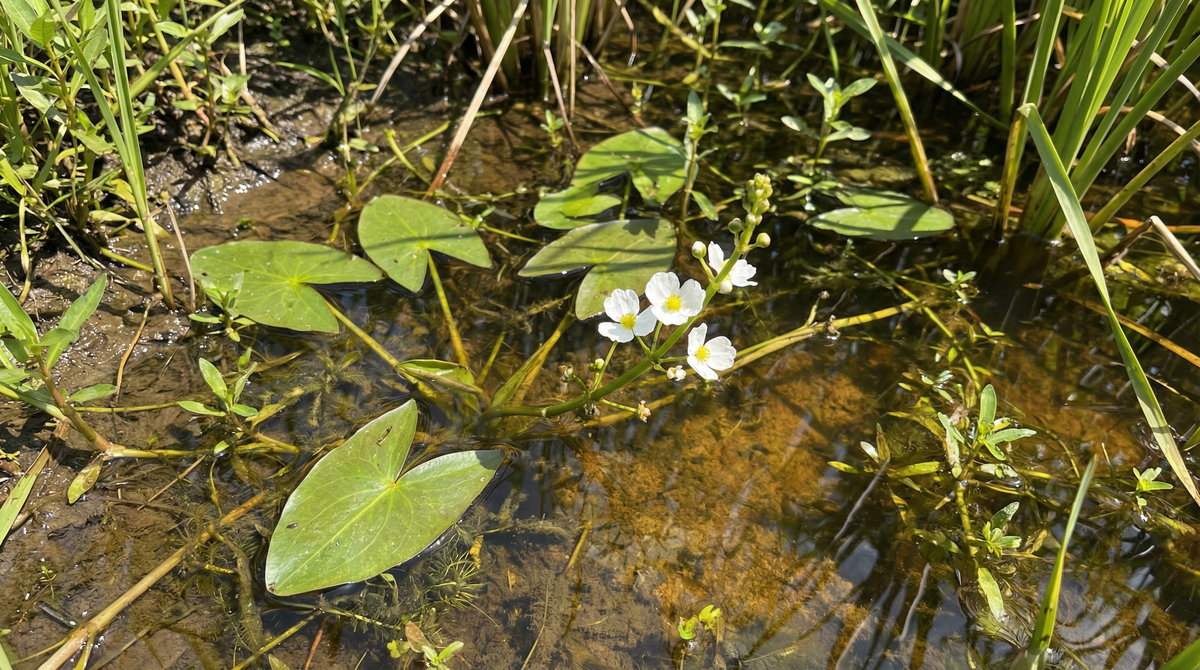
Few expect a weed to taste like a water chestnut. The first time I pulled arrowhead tubers from the muck at the edge of a Carolina pond, I was honestly just trying to thin an overgrown colony that was crowding out the pickerelweed. I rinsed one off with my water bottle, took it home to boil, and stood there eating the cooked slices, genuinely surprised. Clean, crisp, mildly sweet. Not a hint of the swampy funk you'd expect from something you dug out of pond sediment. That's the detail about arrowhead that never makes it into the polite botanical descriptions.
What I find fascinating about this plant, especially Sagittaria macrocarpa and its close relatives, is how thoroughly it's been forgotten in Western food culture despite feeding entire civilizations. Indigenous communities across North America harvested arrowhead tubers as a staple starch for thousands of years,[1] and Asian arrowhead species are still cultivated and eaten across East and Southeast Asia today. We somehow lost the thread. The plant is still here, still colonizing pond edges, still producing those tubers every fall, still waiting. That persistence is exactly why it deserves a serious second look from anyone designing a water garden or wetland edge.
Arrowhead Origin, History, and Cultural Significance
Botanical Background of Sagittaria macrocarpa
The name gives everything away. Sagittaria comes from the Latin sagitta, meaning arrow, and one look at the leaves tells you exactly why. That bold, arrowhead-shaped foliage is the genus signature, rising from the water's edge on long petioles with two distinctive basal lobes that point backward like a notched hunting tip. Sagittaria macrocarpa belongs to the family Alismataceae, a group of aquatic and semi-aquatic monocots that colonize the shallow margins of ponds, marshes, and slow-moving streams across temperate and tropical regions. Like its relatives, it produces small white flowers arranged in whorled racemes and, more importantly for anyone thinking about food or foraging, it produces fleshy underground tubers packed with starchy carbohydrates. I've established related arrowhead species at several Central Florida pond-edge sites, and watching those first arrow-shaped leaves push up through the water surface never gets old. There's something deeply satisfying about a plant that looks exactly like what it's called.
Traditional and Cultural Uses of Arrowhead Species
Detailed ethnobotanical records for Sagittaria macrocarpa specifically are genuinely sparse. When I'm selecting native aquatics for clients, I cross-reference university extension resources, historic ethnobotany texts, and regional flora databases, and macrocarpa keeps showing up as ecologically documented but undercharacterized compared to its more famous cousins. That's not a reason to dismiss it; it's a reason to understand it in genus context.
The arrowhead genus as a whole carries a substantial human history. Sagittaria latifolia, sometimes called katniss or wapato, was a critical food source for Indigenous peoples across North America. Harvesters waded into shallow water and dislodged the tubers with their feet, letting them float to the surface for collection. In East Asia, Sagittaria sagittifolia and Sagittaria trifolia have been cultivated in flooded paddies for centuries, prized for tubers that cook up something like a small potato crossed with a water chestnut; firm, mildly sweet, and easy to prepare. I've cooked with arrowhead tubers from the broader genus before, and that comparison to a small potato is genuinely apt, though the texture stays a bit firmer even after boiling.
Sagittaria macrocarpa occupies the same ecological niche as these well-documented relatives,
- stabilizing pond margins
- feeding waterfowl
- offering a potential tuber crop that fits naturally into a designed wetland guild
Arrowhead Varieties and Sourcing
Sagittaria macrocarpa sits in a genus with almost no cultivar development to speak of, which is pretty typical for native wetland perennials that have spent most of their existence outside of commercial horticulture. You won't find named varieties with catchy marketing labels. What you will find, if you dig into the genus a little, is a group of closely related species that growers and permaculturists actually work with in practice, each one bringing something slightly different to a pond or bog guild.
Common Edible Arrowhead Species
I've grown several Sagittaria species in my Central Florida ponds and bogs, and the one that consistently performs best in my zone 9B climate is S. latifolia, the common arrowhead native to North America. It's vigorous, it produces large tubers, and it spreads readily enough to colonize a pond margin without much help from me. The cooked tubers have a clean, starchy, potato-like quality that I genuinely enjoy. S. macrocarpa, by comparison, requires more careful siting; it tends to get shaded out if you don't give it a spot with reliable full sun and a bit of elbow room.
S. sagittifolia, the European arrowhead, produces smaller white tubers with a slightly more bitter aftertaste than its North American relatives, at least in my experience cooking with it. Still worthwhile, but worth knowing before you build a recipe around it. Then there's S. trifolia, the Chinese arrowhead sometimes labeled sagittaria platyphylla in older catalogs, which is the species most commonly consumed across East and Southeast Asia. Its tubers are crisp, mild, and particularly well suited to stir-fries. S. lancifolia rounds out the genus for those of us in subtropical regions, offering more of an ornamental and habitat value than a culinary one.
Where to Source Arrowhead Plants and Tubers
I learned the hard way to source from specialists. I once picked up a bag of unlabeled "arrowhead tubers" from a general nursery and ended up with something that didn't match any edible Sagittaria I could identify. Since then I've stuck to reputable native-plant nurseries and wetland restoration suppliers, and for Florida growers, Florida Native Plant Society chapter sales are genuinely one of the best places to find accurately labeled S. latifolia stock. S. macrocarpa specifically tends to show up through specialty native-plant suppliers rather than mainstream garden centers, usually as bare-root plants or unpackaged tubers rather than anything with a cultivar name on it.
For S. trifolia, Asian grocery stores are a surprisingly practical option. The tubers sold as "Chinese arrowhead" or "ci gu" are often viable for planting, and online seed catalogs occasionally carry them too. In my experience, starting from small tubers or bare-root divisions establishes far faster in a new pond than attempting to grow from seed, so I'd always prioritize vegetative material when you can get it.
Arrowhead Propagation and Planting (Sagittaria macrocarpa)
Arrowhead is one of those plants that almost teaches you how to propagate it. Once you've got a colony going at the edge of a pond or swale, division becomes second nature, and you'll find yourself passing tubers to neighbors the way some gardeners share tomato seedlings. Getting that first planting right, though, is where most people need a little guidance.
Propagation Methods for Arrowhead
Division is by far the most reliable way to establish Sagittaria macrocarpa, and I'd recommend it over seed for almost any home grower. In late winter to early spring, before the plant breaks dormancy, you can dig into the muddy margins and pull apart the fleshy tubers without much fuss. They look remarkably like small, knobby potatoes, pale and starchy. I always rinse mine gently before replanting to knock off any anaerobic muck that might encourage rot once they're settled into their new spot.
Seeds are technically possible, but they're fussier than division in every way. Sagittaria seeds generally need cold stratification and consistent shallow standing water to germinate reliably, and the window for success is narrow. I've tried both methods across different garden projects and the division route wins every time on speed and predictability. Save the seed experiments for when you're curious, not when you're trying to establish a working wetland plant by summer.
Soil, Site Selection, and Planting Techniques
Arrowhead wants its feet wet, full stop. I've planted it successfully in the transitional zones of rain gardens that stay flooded for two or three weeks after a heavy storm, which in zone 9B happens more than you'd think. Shallow water, anywhere from consistently saturated soil out to about 6 to 12 inches of standing water, is the sweet spot. The substrate doesn't need to be fancy; a loamy, organically rich mud is ideal, the kind you'd find at a natural pond margin. I treat Sagittaria much like I do pickerelweed: same shallow-water planting depth, same care to keep the crown right at the soil surface without burying it too deep or letting it float free.
Full sun drives the best tuber production. Partial shade is tolerated, but the plants tend to stay lean and put less energy into the corms you're growing them for. Slightly acidic to neutral pH, typical of most Central Florida wetland soils, suits them well, though they're more adaptable than you'd expect.
Spacing, Timing, and Germination Expectations
I space divisions about 12 to 18 inches apart, which gives each plant room to form a natural clump before they start pressing against neighbors. Plant the tubers horizontally just beneath the soil surface with the growing tip angled upward. That detail matters more than it sounds; tubers planted upside down or on end will still find their way eventually, but you'll lose a few weeks of growth while they sort themselves out.
First-season growth can feel underwhelming. Most of the plant's energy goes underground into root and tuber development rather than the showy arrow-shaped leaves above the waterline. I remind myself every time that patience here pays off. By the second season, those modest starts have typically become vigorous colonies, the kind that are sturdy enough to stabilize a newly dug swale edge or anchor a rain garden planting. That's when arrowhead stops being a plant you tend and starts being a plant you share.
Arrowhead Care Guide: Water, Light, and Maintenance
Caring for arrowhead comes down to one guiding principle: keep it wet. Sagittaria macrocarpa evolved in shallow wetland margins, and almost every care decision you'll make traces back to mimicking those conditions. Get the moisture right and the plant is remarkably forgiving. Let it dry out in summer heat, and it will tell you immediately through yellowing, wilting foliage that something has gone wrong.
Water and Soil Requirements for Arrowhead
In my pond plantings, arrowhead does best when the crown sits roughly two to six inches below the water surface. That shallow-water zone is the sweet spot. I made the mistake early on of setting plants in deeper water thinking more was better, and the foliage never emerged properly. Moving them to the shallower margins of the pond made an immediate difference. For bog-style setups or rain garden edges, consistently saturated soil works well too, as long as it doesn't dry out between rain events during the warmer months.
Soil texture matters less than you'd expect for an aquatic plant. Rich, loamy pond substrate works well, but I've grown arrowhead in fairly heavy clay at the pond edge with no complaints. What it cannot tolerate is drying out during the growing season, so if you're growing it in a container submerged in a water feature, check water levels regularly through summer.
Sunlight and Temperature Needs
Arrowhead wants full sun. It will tolerate partial shade, but tuber production and overall vigor both drop noticeably without good light exposure. In my zone 9B gardens, it handles summer heat without much drama as long as water depth stays consistent. The tubers are what give the plant its cold resilience. I've had arrowhead overwinter reliably in water that doesn't freeze solid, but if you're gardening in colder regions, I'd treat the tubers like I treat my tender cannas: lift them in late autumn, store them in barely moist medium, and replant in spring.
Feeding, Pruning, and Seasonal Care
Much like my water cannas, arrowhead benefits from an occasional liquid feed in mid-summer when it's pushing hard growth. An aquatic-specific fertilizer tablet pressed into the substrate around the root zone works cleanly without clouding the water. I don't feed heavily or often, maybe once or twice a season, because overfeeding aquatic plants can cause more algae problems than they're worth.
For pruning, I keep it simple. Spent flower stalks come off as they fade, and in late autumn I cut back the foliage before it collapses into the water. Decomposing plant material adds unnecessary nutrients to a closed pond system, and managing it proactively keeps the water cleaner through winter. Beyond that, arrowhead doesn't need much fussing. If the plant looks pale or sluggish mid-season, check water depth and light first before reaching for anything else.
Harvesting and Storing Arrowhead Tubers
There's no published harvest protocol specific to Sagittaria macrocarpa, so what follows is drawn from my own time in pond margins and client wetland gardens. That's not a disclaimer so much as an invitation: this plant rewards patient observation, and the techniques that work for the genus translate well once you learn how this particular species moves through its seasonal cycle.
When and How to Harvest Sagittaria macrocarpa
The clearest signal that arrowhead tubers are ready is the foliage itself. When those bold, arrow-shaped leaves yellow and begin to collapse back toward the water, the plant has finished moving energy downward into the tubers. I've learned the hard way that harvesting too early results in tiny, bland corms that aren't worth the muddy knees; waiting for true senescence is non-negotiable. In temperate climates, that usually means after the first hard frost. Here in zone 9B where hard frosts are rare, I watch for daylight shortening and wait until growth slows dramatically, usually late November into December.
Compared to the more common Sagittaria latifolia, macrocarpa tubers tend to run noticeably larger and sweeter, which makes the wait worthwhile. They're clustered closer to the crown than I expected the first time I harvested them, and the texture in hand is firmer and smoother than the surrounding mud would suggest. I flood the area slightly before digging to soften the substrate, then work with fingers or a broad-tined fork, loosening sediment rather than scooping aggressively. The plant regrows readily from any rhizomes left behind, so I never take more than a third of any colony. The rest keeps doing its job filtering water and anchoring the bank.
Yield, Flavor, and Storage Tips
A mature, well-established clump in rich muddy substrate can yield two to five pounds of sagittaria latifolia tubers per square foot, and macrocarpa, with its larger corm size, can hit the higher end of that range in good conditions. The flavor is nutty and mildly sweet, and it improves noticeably after a cold rest period, much the way parsnips sweeten after frost. Store them in a cool, damp environment and they'll keep for several weeks; blanch and freeze them if you're sitting on a larger harvest. For a perennial carbohydrate source that requires almost no inputs once established, the muddy hands are a pretty fair trade.
Arrowhead Preparation and Culinary Uses
The tubers of the Sagittaria genus are remarkably approachable in the kitchen. There's no soaking, no special equipment, no complicated prep. You pull them, rinse off the mud, and you're about five minutes from something genuinely good to eat. That accessibility is a big part of why I keep coming back to arrowhead in my edible water garden designs.
Culinary Uses of Arrowhead
The tubers of the Sagittaria genus taste mild and slightly sweet, somewhere between a water chestnut and a small Yukon Gold potato. What I love is the texture: when you boil or steam them, there's a clean firmness you don't get from most root vegetables. Store-bought water chestnuts in a can are soft and a little tired; a freshly cooked arrowhead tuber has this satisfying dense pop when you bite through it. I noticed it the first time I threw some into a stir-fry and my dinner guests immediately asked what they were.
For everyday cooking, I keep it simple. Boiling until just tender takes about ten minutes and works well for anything you'd do with fingerling potatoes. Roasting at high heat caramelizes the natural sugars beautifully. Sliced thin and stir-fried with ginger, garlic, and whatever else is coming out of the garden, they hold their shape where softer vegetables would turn to mush. Young spring shoots from related edible arrowhead species like S. latifolia can be cooked as potherbs, but I want to be clear: any time you're harvesting wild plants from a wetland edge, positive identification is non-negotiable. The family has look-alikes, and eating the wrong thing is never worth the shortcut. I make that point firmly whenever I take clients out for a foraging walkthrough near pond margins.
Other Uses for Arrowhead
The most compelling non-food applications for Sagittaria macrocarpa are ecological rather than medicinal or craft-based. Documented traditional uses of the plant itself are thin, and I'd rather point you toward what I've actually observed than speculate about unverified properties. In my water gardens, the dense root systems stabilize soft pond margins, and the foliage provides cover for frogs, small fish, and beneficial insects. That habitat function is real and repeatable. For the deeper dive into how arrowhead fits into a wetland guild, the permaculture design section of this profile covers the ecological picture more thoroughly. What I'd say here is simply this: harvest thoughtfully, leave a healthy portion of the colony intact each season, and the plant will keep producing for years. A sustainable harvest is what makes arrowhead a permanent fixture in the edible pond rather than a plant you exhaust in one enthusiastic afternoon.
Arrowhead Health Benefits and Medicinal Uses
The health benefits picture for Sagittaria macrocarpa specifically is thin. Not because the plant is without value, but because it's simply not a species that's attracted much clinical or phytochemical attention. That's a pattern I've seen across a lot of native wetland plants that do quiet, important ecological work without ever landing on a researcher's radar. What we can do is look honestly at what traditional use of related species suggests, acknowledge where the evidence stops, and treat anything beyond that as informed speculation rather than established fact.
Traditional Uses and Limited Modern Research
Across the Sagittaria genus, particularly among better-documented relatives like S. sagittifolia in East Asia and S. latifolia in North America, folk traditions describe poultices from the leaves for minor skin irritations and simple preparations of the corms for digestive support. In my work with native plant restoration, I've observed that S. macrocarpa seems to sit in a quieter corner of that traditional knowledge space. It's used, or has been used, but the documentation just isn't there the way it is for its relatives. Any medicinal claims being made about this species right now are extrapolations from genus-level knowledge, and I'd be doing you a disservice by presenting them as anything more solid than that.
Nutritional Profile of Arrowhead Tubers
Where arrowhead does have something practical to offer nutritionally is in its starchy corms. These are a genuinely useful carbohydrate source: low in fat, reasonably mild on the stomach, and once properly cooked, they have a satisfyingly firm texture. I've noticed that steaming or boiling them until fully soft makes a real difference in digestibility, not just palatability. They're not a nutritional powerhouse in the superfood sense, but as part of a diverse, garden-grown diet, they're a clean, easily digestible energy source that tends to sit gently even for people with sensitive digestion.
Safety Considerations for Foraging and Use
Aquatic environments are full of look-alikes, and the stakes are higher than in a typical kitchen garden. Correct identification of Sagittaria macrocarpa before eating anything is non-negotiable. I cross-reference at least two reliable field guides whenever I'm working with aquatic species I'm not harvesting from a plant I put in the ground myself. Raw corms from plants in this family can cause digestive upset due to calcium oxalate, a compound that cooking largely neutralizes. I've learned through working with similar aquatics that a good rolling boil isn't optional. Keep the first serving small until you know how your body responds, and if you're considering any kind of medicinal application, please consult a qualified practitioner. The research vacuum around this species means there's genuinely no clinical basis to lean on, and caution is the only reasonable stance.
Arrowhead Pests and Diseases
In all the arrowhead plantings I've designed and maintained, I've never lost sleep over pest or disease pressure. Sagittaria macrocarpa simply doesn't accumulate the kind of documented pest and pathogen baggage that follows most food crops around. That's not a research gap I'm papering over; it reflects the reality of a robust native wetland perennial growing in conditions it evolved for. The biggest nuisance I've encountered in arrowhead guilds is duckweed muscling in for surface space, and that's a competition issue, not a disease.
What I've noticed across multiple water garden installations is that arrowhead rarely shows leaf spotting even when neighboring plants are struggling. I've grown it alongside water lilies that were fighting off fungal blotches and aphid colonies, and the arrowhead nearby sat pristine. That kind of contrast tells you something meaningful about ecological fit. Plants under stress invite opportunistic problems; plants in their element tend to shrug them off.
That said, I do keep an eye on water quality, because a stagnant, oxygen-depleted pond is where even resilient aquatics can develop soft, discolored root tissue. If arrowhead leaves are yellowing or drooping, my first question is always about root conditions rather than pathogens. Check that the water isn't stagnant, that the planting isn't severely overcrowded, and that the container or margin isn't trapping anaerobic muck around the rhizomes. Brown leaf tips often just mean someone let the water level drop during a heat stretch, leaving emergent roots briefly exposed.
The permaculture design principle matters here too. When I build an aquatic guild with arrowhead, frogs and dragonflies usually keep any potential soft-bodied insect pests in check. That's the advantage of choosing plants that genuinely belong in the system. A balanced pond with diverse species and a functioning predator community is a far better defense than any spray schedule.
Arrowhead in Permaculture Design
There's a particular kind of satisfaction that comes from placing a plant exactly where it wants to be. With Sagittaria macrocarpa, that place is the margin between open water and dry land, which happens to be one of the most ecologically productive zones in any landscape. I first got serious about aquatic arrowhead plant design after watching an unplanted pond edge erode through two rainy seasons. Once I put arrowhead in, the root mats knit the bank together within a single growing season. That was the lesson that made me a convert.
Ecosystem Functions and Wetland Services
As an emergent aquatic, arrowhead occupies the shallow-water zone where most upland plants can't survive and most submerged aquatics can't reach. Its root system binds saturated soils and reduces the slumping and erosion that plagues unplanted pond edges and swale margins. The broad, arrow-shaped leaves shade the water surface directly beneath them, which suppresses algae by limiting light penetration. And in a well-designed wetland system, the tubers themselves serve as a nutrient sink, pulling excess phosphorus and nitrogen out of the water column and storing them underground as starch. When you harvest those tubers in late fall, you're literally removing those nutrients from the system, which is a genuinely useful bioremediation loop.
The plant also provides structure for wildlife. I've watched red-winged blackbirds nest near established arrowhead colonies, and the flowers draw native bees reliably through summer. For a plant that asks almost nothing in the way of maintenance, that's a remarkable return on investment.
Forest Layer, Guilds, and Companion Planting
In food forest terms, arrowhead belongs to the aquatic and bog layer, the zone that most permaculture designers either skip entirely or treat as an afterthought. I think that's a mistake. Pairing this arrowhead wetland plant with thoughtful companions turns a pond edge into a layered, functional system rather than just a place to dump excess runoff.
My go-to guild in humid subtropical conditions starts with:
- cattails for vertical structure and emergent biomass
- water lilies to cover open surface area and further shade out algae
- pickerelweed as a pollinator bridge
I call arrowhead my "water potatoes" in design conversations, which gets people interested fast. Just be ready to manage it: I now keep mine in a contained bog garden because I've watched it outcompete smaller marginals in an open pond when given free rein.
Climate Adaptation and Growing Zones
Sagittaria macrocarpa is a warm-climate native, but the genus broadly tolerates a wide range of conditions, with various arrowhead species documented growing from USDA zones 5 through 11. In zone 9B, where I work, it spreads vigorously once established and doesn't need any coddling. In colder zones, the tubers overwinter underground even when the foliage dies back completely, which is actually when I harvest mine anyway. I learned early that waiting until the leaves die back in late fall makes tuber harvest dramatically easier; early attempts at summer digging felt like searching for buried treasure with no map.
The non-negotiables are saturated or submerged soil and full sun. Give this arrowhead pond plant those two things and it largely takes care of itself. Shade slows it down; standing water that's too deep pushes it toward purely vegetative growth with fewer tubers. Keep it in water that's ankle-deep or shallower, aim for a spot that gets at least six hours of direct sun, and you have what is genuinely one of the lowest-maintenance perennials in a designed water system.
The Plant That Made Me Take Pond Edges Seriously
I spent years treating the margins of my water features as afterthoughts, places where the real garden just kind of trailed off and got muddy. The first time I harvested arrowhead tubers in late autumn, pulling them loose from the cold silt with my bare hands, something shifted. That quiet, productive fringe stopped looking like an edge and started looking like the point.