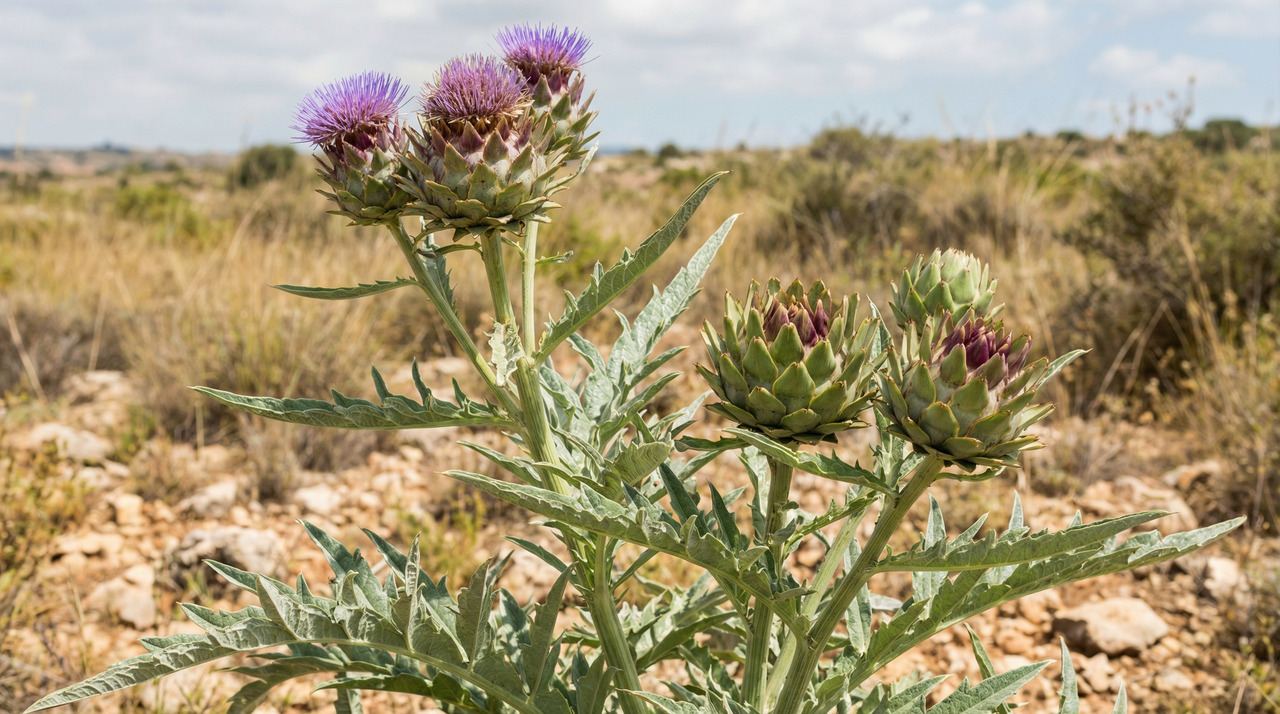
Nobody warned me that artichokes bleed. The first time I divided a mature clump with a spade, the cut ends wept a faintly green, slightly bitter juice that stained my gloves and smelled unmistakably like the inside of a raw globe you'd buy at a farmers' market. That smell stopped me cold. I'd grown this plant for two seasons, harvested dozens of buds, steamed them with garlic and lemon, and somehow never made the connection: what I was eating was a flower. A thistle flower, technically, cut before it could open. Every artichoke you've ever dragged through drawn butter was an act of intervention, a bud caught mid-bloom on its way to becoming something purple and wild and completely inedible.
Most people treat artichokes like an annual vegetable, something you start from seed in spring and rip out in autumn. That's not wrong exactly, but it misses what this plant actually is: a deep-rooted Mediterranean perennial that, given the right site, will feed you for a decade or more without being replanted.[1] The cultivated globe artichoke descended from a spiny wild thistle, the cardoon, that still grows on rocky hillsides from the Canary Islands to the eastern Mediterranean. Centuries of selection softened the bracts, enlarged the bud, and dialed back some of the bitterness, but the bones of that wild plant are still absolutely present in how this thing grows, defends itself, and behaves in your garden. Understanding that changes how you site it, how you care for it, and honestly, how you taste it.
Artichoke Origin, History, and Botanical Background
The artichoke (Cynara scolymus) is a perennial herbaceous plant in the Asteraceae family, native to the Mediterranean basin across southern Europe and North Africa.[2][3] Its closest wild relative is the cardoon (Cynara cardunculus), a spiny, thistle-like species of rocky slopes, coastal dunes, and disturbed sunny ground that domestication slowly transformed into the large-headed globe we grow today.[4][5] That process likely began around 3000 BCE in places like Cyprus and Sardinia,[6] and you can still read the wild ancestry in every mature plant: the drought tolerance, the spiny armor, the deep taproot reaching one to two meters into the soil.[7][8] I've divided mature artichoke crowns in year four or five and been genuinely surprised by how much root I pull up; that taproot is a serious structure, and it's exactly why divided plants rebound so confidently even in a dry season.
As a polycarpic perennial, an artichoke plant typically lives five to ten years, with bud production peaking somewhere around years three through five.[9][10] Wild cardoon in favorable Mediterranean scrublands can push past a decade, which hints at what selective breeding sacrificed in longevity to gain in palatability and productivity.[4][11] I grow both, and while cardoon has its own appeal as an edible stalk crop with dramatic architectural presence, the artichoke is the one that genuinely rewards patience in the food garden with those globe-shaped buds and the pollinators that follow.
Ancient Mediterranean Roots and Greek Mythology
The plant's very scientific name carries mythology with it. Cynara was, depending on which source you favor, a young woman whom Zeus either transformed into an artichoke out of spite or, in other versions, Aphrodite's jealousy was the cause, a figure symbolizing beauty hidden behind thorns and resilience in the face of divine whim.[12][13] That resonance carried forward into Renaissance iconography, where the artichoke appeared as an emblem of abundance and fertility. When I see a mature rosette in a client's garden, all those ancient associations make a strange kind of sense; the plant really does feel like something that arrived from another era.
Theophrastus described its Mediterranean cultivation as early as the fourth century BCE, and Pliny the Elder later catalogued varieties while praising artichoke as both a Roman table delicacy and a treatment for liver complaints.[14][15][16] Dioscorides added notes on leaf infusions for digestive and urinary complaints, and the tradition carried forward through Moorish Spain into broader European herbal medicine, where the plant became associated with jaundice, gout, and general detoxification.[17][18] The culinary focus was always on the buds; the medicinal uses I reference are historically documented, though the evidence behind folk ritual uses is thin and I'll always direct people toward the well-studied edible before anything unverified.
Spanish settlers brought artichoke to California in the nineteenth century, and Monterey County now produces over 90% of American artichokes,[6][19] a fact that makes perfect sense when you consider how closely coastal California mirrors the Mediterranean climate the plant evolved in. The Castroville Artichoke Festival has celebrated that local dominance since 1959,[6] and Italy's own Sagra del Carciofo still draws crowds with parades celebrating a vegetable that somehow symbolizes both prosperity and the unfolding of the heart.[20][21] U.S. production reached roughly 28,500 tons from 8,500 acres in 2023.[22] For what it's worth, the largest recorded artichoke in history measured nearly ten feet in circumference and was grown in California in 1982,[23] which feels like the plant making a point.
Visual Characteristics and Growth Habit
What you're actually growing is a bold, architectural plant that earns its place in any perennial border before it produces a single bud. Mature artichokes reach three to six feet tall with a three to four foot spread, building from a basal rosette of large, pinnately lobed leaves that can run thirty to one hundred centimeters long.[24][25] The tops are dark green and the undersides are grayish-white and woolly, and on a breezy day that two-toned shimmer reads as unmistakably Mediterranean. Those waxy, silver-backed leaves aren't just beautiful; they're functional adaptations that reduce water loss, a direct inheritance from cardoon ancestors that lived in dry scrub.[7]
The stout, ridged stems carry the flower heads we eat: globe-shaped to ovoid buds, three to five inches across, built from fleshy spine-tipped bracts surrounding a core of purple tubular florets that emerge if you leave the bud to open.[8][26] When seeds do form, they're small brown cypselae topped with a white pappus of bristles for wind dispersal, the same basic apparatus you'd find on a dandelion.[27] Cardoon shares the general outline but tends toward spiner, less-divided leaves with more morphological variation under stress, which makes the cultivated artichoke's consistency feel like a real achievement of ancient selection work.[28] The deep taproot anchors all of it, enabling the vigorous spring regrowth that makes this plant so rewarding across multiple growing seasons once it's properly established.[29]
Artichoke Varieties and Sourcing
Notable Artichoke Cultivars: Green Globe, Imperial Star, Violet de Provence, and Glory
Sorting through artichoke cultivars is easier once you understand what breeders and botanists actually use to tell them apart. Cynara scolymus cultivars are classified by bud color, thorniness, leaf shape, and overall bud morphology; horticulturally, they fall into groups like Catalan, Romanesco, and Spineless, while Kew Gardens uses a four-group system: Blanca de España, Verde de España, Piovan, and Tudela.[30][31] Knowing this framework helps when you're staring at a seed catalog wondering why two "green artichokes" behave so differently in the garden. I've grown both spiny and spineless types side by side and learned the hard way to label my rows carefully because the seedlings look almost identical at six weeks old.
The green globe artichoke plant is the commercial standard, and for good reason. Large, round, spineless buds with mild nutty flavor and lower bitterness than most cultivars; under optimal coastal California conditions it yields 8-12 heads per plant.[32][10] It's what most families expect an artichoke to taste like, which makes it the safe crowd-pleaser for gardeners cooking for people who aren't yet adventurous. The downside is that traditional Green Globe grows best as a perennial from crown division, meaning you're usually waiting until year two for a meaningful harvest.
The imperial star artichoke plant changed what's possible for gardeners in shorter seasons. It's an F1 hybrid bred for uniformity and early maturity, producing green buds in 50-70 days from transplant with first-year harvest reliably achievable from seed, and yields of 7-11 heads per plant.[32][10] It's also rated for USDA zones 6-9, extending usefulness into marginal cooler regions where standard cultivars struggle to overwinter.[33] I've started both Green Globe and Imperial Star from seed in the same season and the hybrid's consistency is genuinely striking; Imperial Star seedlings flower on a predictable schedule while my Green Globe seedlings varied by weeks, which makes succession planning much easier with the hybrid.
If you want something with more personality in the kitchen, the purple artichoke plant (Violet de Provence, sold as Violetto) delivers a noticeably different experience. Smaller heads with purple-tinged bracts that are occasionally lightly thorny, tender, and loaded with polyphenols, with an earthy-bitter flavor profile that's bolder than most green types and yields of 6-10 heads per plant.[32][34] The flavor difference isn't subtle. Steaming a homegrown Violetto bud produces a noticeably more herbaceous, complex aroma than a supermarket Green Globe, and that's partly because Violetto carries higher levels of 1,8-cineole alongside its elevated polyphenol content.[35] The Glory cultivar rounds out the main lineup with deep green buds, meaty texture, and a bushy, productive growth habit that suits gardeners who want a substantial harvest from a smaller footprint.[32]
Worth keeping in perspective is the wild ancestor behind all of these. Wild cardoon (Cynara cardunculus subsp. cardunculus) reaches 1-2 meters tall with numerous small, spiny flower heads and very low commercial bud yield, but with exceptional drought tolerance.[36][37] Every cultivated artichoke we grow was selected away from those intensely bitter, fibrous qualities toward palatability and productivity.[38] When you taste the difference between a wild cardoon and a steamed Green Globe heart, you really appreciate several thousand years of careful selection.
Where to Buy Artichoke Seeds and Plants
For seeds, the most reliable US sources are Johnny's Selected Seeds, Territorial Seed Company, High Mowing Organic Seeds, and Baker Creek Heirloom Seeds; for live plants, Fast Growing Trees and TN Nursery carry artichoke starts online.[39][40][41][42][43] Green globe artichoke seeds and imperial star artichoke seeds from those companies generally run $3-6 per packet; starter plants typically fall in the $8.95-$12 range, and bare-root crowns or larger potted plants can run $10-30 depending on size and source.[44] Live plants are genuinely hard to find at local garden centers outside Mediterranean-type climates, so if you're in zone 7 or colder, plan on ordering online or starting from seed.
One thing I want to flag before you order anything: Cynara cardunculus, which includes both cardoon types and globe artichoke cultivars, is listed as a noxious weed in California, Alabama, Florida, and Oregon and is regulated by USDA APHIS.[45][46][47] When I first wanted to try growing cardoon in my zone 9B Florida garden, I checked the state noxious-weed list and then called my county extension office just to make sure I understood what was actually permitted. That extra step took twenty minutes and saved me from a potential headache. If you're in any of those states, verify the current rules for your specific county before placing an order, especially for cardoon types grown primarily for stalks rather than buds, since those forms are generally considered higher-risk spreaders.[48]
How to Propagate and Plant Artichokes
Artichoke sits in an interesting middle ground as a plant that technically produces viable seed yet rewards you most when you skip it entirely. I've grown artichokes both ways, and the seed route taught me more about patience and genetic unpredictability than it did about producing consistent kitchen-quality buds. Understanding both paths makes you a better grower, so let's start with the seed itself before making the case for why I reach for a spade instead.
Artichoke Seed Characteristics and Storage
The seed of Cynara scolymus is an achene, small and elliptical, typically 5-8 mm long with a smooth grayish-brown coat and a feathery white pappus that hints at its thistle lineage.[49][29] These are orthodox seeds, meaning they store well: kept cool, dry, and sealed, home-saved artichoke seed can hold 70-90% germination viability for up to five years, and professionally stored seed can last a decade or more.[10][50] If you're unsure about older seed, a quick germination test or tetrazolium staining will tell you what you're working with before you waste a whole flat.[10][51] Fresh seed benefits from cold stratification at around 4-5°C for four to six weeks before sowing, and germination is best at soil temperatures of 70-75°F; treated seeds can hit 50-90% germination under good conditions.[52][10]
Vegetative Propagation Methods for Reliable Results
Here's my honest experience with seed-grown artichokes: one season I started a flat of seedlings, got beautiful germination, and by midsummer had a spectacular collection of plants with wildly inconsistent bracts, different head sizes, and varying degrees of spininess. Some were genuinely interesting. None matched the tight, meaty buds I wanted for cooking. That's not a fluke; artichoke is an obligate outcrosser that requires insect pollination between genetically distinct individuals, which means seed-grown plants are a genetic lottery.[53][10] Seed work is genuinely useful in breeding programs, but for the kitchen garden, named cultivars propagated vegetatively are the only way to guarantee what you're growing.
Division of crowns, offsets, or suckers is the standard method for a reason: done in late winter or early spring on a healthy plant, it succeeds 80-95% of the time.[10][54] I use a sharp knife, take offsets with a good root mass attached, and get them back in the ground the same day. My success rate is close to 100% when I divide in early spring. Fall division can work, but in marginal zones without heavy mulch protection I've seen significantly more losses, so I stick to spring unless I have a very good reason not to. If you're dealing with soil-borne disease pressure or want to expand a planting with better vigor, grafting artichoke scions onto cardoon (Cynara cardunculus) rootstock is worth exploring; cleft or whip-and-tongue grafts in early spring achieve 80-90% success under controlled conditions.[55] Stem cuttings are another option, rooting at 50-70% in four to six weeks with IBA treatment and high humidity, though I find division far simpler for home-scale work.[56]
Soil, Site, and Sun Requirements
Everything about the artichoke's preferences traces back to its calcareous Mediterranean homeland: rocky, well-drained limestone soils, bright sun, and no standing water. Replicating that at home isn't hard once you understand the logic. The target pH is 6.5-7.5, with a workable range of 6.0-8.0; go below 6.0 and you risk aluminum toxicity and stunted growth, climb above 8.0 and iron chlorosis appears quickly.[10][9] I learned to test every new bed before planting after an untested acidic spot caused interveinal yellowing in a young artichoke planting that took weeks to diagnose and correct. Fifteen minutes with a soil test saves months of frustration.
Soil preparation should go 12-18 inches deep, incorporating 2-4 inches of compost or aged manure.[10] If you're working heavy clay, add gypsum or coarse material to open up drainage; raised beds with a well-draining mix of compost, coir, and perlite (minimum 24 inches deep and wide) work well for problem sites.[9] Full sun is non-negotiable: fewer than six hours of direct light and you get etiolated, chlorotic plants with poor bud formation.[57][58] A spot with some wind protection helps too, especially in exposed coastal or inland gardens where gusts can rock the deep-rooted crowns before they're settled in.
Spacing, Timing, and Establishment Tips
New transplants look deceptively small. By year two, a mature artichoke can reach 3-6 feet tall with a 3-4 foot spread, and if you've planted too close, the crowns start competing for resources and air circulation drops just enough for mildew to take hold.[10][9] I planted a row at 2 feet once. By the second summer the heads were noticeably smaller and I was constantly getting jabbed by neighboring spines during harvest. Lesson learned. For perennial plantings, 3-4 feet between plants and 4-6 feet between rows gives you good airflow, manageable access, and room for the clumps that will need dividing every 3-5 years.[10][59] Annual culture in colder zones can squeeze a bit tighter, but perennial beds need the generosity. Your local extension service will give you the most reliable spacing guidance for your specific climate and cultivar.
Germination and Time to First Harvest
Patience is the defining virtue of growing artichokes from seed. Seed-started plants typically take 2-3 years before they produce a marketable harvest, and most won't give you real heads in year one.[60][10] Division and transplants shorten that considerably: expect 85-180 days from transplant to first harvest, with early cultivars like 'Imperial Star' landing at the shorter end of that range.[61][10] Grafted or division-propagated plants can yield in their first or second season under optimal conditions.[60] Once established, though, these are genuinely long-lived perennials capable of multiple harvests per year across many seasons. The early investment in doing the propagation right and choosing the method that suits your timeline pays dividends every spring for years to come.
How to Care for Artichokes: Sunlight, Water, Feeding, and Seasonal Management
Artichoke care makes much more sense once you understand the plant's evolutionary starting point: a sun-drenched Mediterranean hillside with well-drained soil, long mild seasons, and no tolerance for soggy roots or dark corners. Match those conditions and the plant rewards you generously. Stray too far from them and you'll spend the season troubleshooting instead of harvesting.
Sunlight Requirements for Healthy Artichoke Growth
Artichokes need full sun, at least 6 to 8 hours of direct light daily, to produce the large, dense buds worth growing them for.[9][62] In my experience, even shaving two hours off that minimum produces noticeably leggy stems and buds that never quite bulk up the way they should. The plant needs that intensity to fuel photosynthesis across those enormous leaves and push energy into bud development. Dappled shade might work for a lot of edibles, but not this one.
Watering Needs and Drought Tolerance
Plan on 1 to 2 inches per week during the growing season, applied deeply and infrequently to encourage the taproot that can reach 24 to 36 inches down.[10][63] The goal is soil that stays consistently moist several inches down without staying wet. A 2 to 3 inch layer of organic mulch does a lot of that work for you by reducing evaporation and suppressing the weeds that compete for moisture.[64]
Artichokes can technically survive 4 to 6 weeks of dry conditions, but the symptoms of underwatering show up well before that point: wilting in afternoon heat, leaf margins going brown and crispy, and noticeably stunted new growth.[65][66] Overwatering has an equally recognizable signature: yellowing lower leaves and plants that wilt even though the soil feels damp. When in doubt, I push a finger 4 to 6 inches into the soil before reaching for the hose. Consistent moisture matters most during bud formation, so don't let things dry out right when the plant is working hardest.[10]
Feeding and Soil Fertility for Heavy-Feeding Artichokes
These are moderate to heavy feeders. A balanced 10-10-10 at planting gets things off to a solid start, followed by nitrogen-rich side-dressings every 4 to 6 weeks through active growth; back off the nitrogen once buds form and shift focus to phosphorus and potassium to support that final push.[10][9][67] That late-season nitrogen reduction also helps avoid soft, frost-vulnerable new growth heading into fall, which is something I pay close attention to as the season winds down.
Before planting, incorporate 2 to 4 inches of compost and aim for a soil pH of 6.5 to 7.5.[10][68] Soil testing every two years has let me cut my fertilizer use by roughly a third while keeping yields steady, because I'm correcting actual deficiencies rather than guessing. The symptom map is worth memorizing: uniform yellowing on older leaves signals nitrogen shortfall, marginal browning and necrosis points to potassium, and interveinal chlorosis on young leaves is iron.[69][70] I watch my older leaves weekly once plants hit full size; catching that pale yellowing early, before it works its way up into the younger growth, keeps bud size where it should be.
Frost Tolerance and Winter Protection
Artichokes are perennial in USDA zones 7 through 11, and established plants can handle brief dips to around 20°F (-7°C), but prolonged freezes below 25°F (-4°C) are genuinely damaging, especially in wet soils where cold penetrates deeper.[9][10][71] Frost damage shows up as wilting and blackening of leaves and buds, and any developing buds are essentially lost once that happens.[9][58]
After losing my first planting to an unexpected dip below 25°F, I now apply 4 to 6 inches of straw mulch over the crown every fall without fail. I haven't lost a crown since. In zones below 7, digging and storing roots indoors is the reliable option; a southern-facing, well-drained spot also buys a degree or two of buffer. Worth noting: the wet-cold combination accelerates Botrytis risk,[72] so good drainage isn't just about root health, it's about disease prevention through winter too.
Heat Tolerance and Managing High Temperatures
The sweet spot for artichoke growth is 50 to 75°F (10 to 24°C), with ideal daytime highs around 70°F (21°C). Once temperatures push consistently above 82 to 86°F (28 to 30°C), the plant is under real stress: photosynthesis drops, buds abort, and yield losses can reach 50% during flowering.[73][74] In hot humid summers I've learned to watch for slight leaf cupping and a noticeable slowdown in new growth; that combination, before you see any scorching, is the early warning sign that heat stress is building and spider-mite pressure typically follows close behind.
Varieties like 'Imperial Star' handle heat better than most,[75] and the practical toolkit for hotter gardens includes 30 to 50% shade cloth during peak afternoon heat, consistent drip irrigation, 2 to 4 inches of mulch to buffer soil temperature, and siting plants where fog or elevation provides natural cooling.[76][10] For gardeners in zones 9 and warmer, starting with a heat-tolerant variety isn't optional; it's the difference between a productive bed and a frustrating one.
Pruning, Maintenance, and Seasonal Rhythm
The annual maintenance calendar follows the plant's natural cycle pretty closely. In spring, remove dead material, cut back suckers to the strongest shoots, and divide clumps if they haven't been split in 3 to 4 years; waiting until productivity visibly drops means you've already lost a season.[58][9] After the main spring harvest, I cut the central stem back to about 10 inches, which reliably pushes a second flush of side-shoot buds in fall. Smaller than the primary crop, yes, but still worth having.[10] In windy spots, tall summer stems benefit from staking before they start leaning.
The deeper rhythm worth understanding is this: artichoke is a polycarpic perennial, but each individual rosette is monocarpic, meaning it flowers once and then dies back while the clump as a whole continues.[77][78] Bud set also requires vernalization, roughly 10 to 21 days of temperatures between 35 and 50°F, so a mild winter that never delivers that cold period can mean a season of impressive leaves and zero buds. Respecting this seasonal rhythm, spring emergence, summer feeding and growth, fall harvest, winter dormancy, is what turns a single plant into a multi-year producer rather than a one-season experiment.[77]
Harvesting Artichokes
After a season of watching those silvery rosettes send up tall stalks, the moment you finally cut your first bud is genuinely satisfying. And after years of doing it, I can tell you the cue that matters most isn't a calendar date or a measurement. It's weight. A ready artichoke feels almost surprisingly heavy for its size, and those bracts hug together with no gaps, deep green shading to violet with no sign of opening. That heft in your palm, combined with tight, closed bracts and a bud around 3 to 4 inches across, is your signal.
When to Harvest Artichokes: Timing and Maturity Cues
Once a bud is visible, you're typically 7 to 14 days from harvest.[10] The window is short, and I've been caught off guard more than once by a bud that was perfect on Tuesday and flowering by Friday. In a California-style climate, the harvest season runs from March through December with spring and fall peaks, and an established plant will give you multiple picks across that stretch.[79] One thing worth knowing upfront: if you're growing from divisions, you may see buds in year one, but for plants that need vernalization to trigger flowering, a meaningful harvest usually starts in year two.[10] Be patient. The perennial rhythm is worth it.
How to Harvest and Handle Artichokes
I always cut in the cool of the morning with a sharp knife, taking about 2 to 4 centimeters of stem with each bud.[80] During peak season, checking every 2 to 3 days isn't excessive.[80] Post-harvest, I never wash them unless absolutely necessary and get them cold as fast as possible. Deterioration shows up quickly as browning at the base, softening, and that hollow, pithy feeling when you press the receptacle.[81] Ideally you want them down to 0 to 2 degrees Celsius within a few hours of cutting, and kept humid.[82] Skip that step and your refrigerator shelf life shrinks noticeably.
Artichoke Flavor, Texture, and Yield at Harvest
What you're harvesting is an immature flower bud, the fleshy bract bases and the receptacle beneath them, cut before those violet florets ever open.[83] Raw, it's earthy, vegetal, and slightly bitter, a flavor profile driven by cynarin and chlorogenic acid that also produces that curious sweetness-enhancement effect in everything you eat afterward.[84][85] Cooking transforms it completely. Steaming or roasting breaks down lignin and pectin so the bracts go tender and pliable while the heart turns creamy and nutty, the bitterness pulling back into something mellow and rich.[86] I've noticed that artichokes from my warmer garden beds tend to be sweeter and less fibrous than anything from a cooler coastal climate, which tracks with research showing that California-grown plants tend toward milder profiles while cooler conditions push up phenolic bitterness.[87] Cardoon, by comparison, is fibrous enough that blanching is standard practice just to make it edible.[88] The globe artichoke is far more forgiving at the table.
Artichoke Preparation, Culinary Uses, and Medicinal Applications
Edible Parts, Preparation Techniques, and Flavor Transformation
The edible parts of an artichoke are the immature flower bud's lower bracts, the heart at the base, and the inner portions of the bracts themselves.[89][90] Its close relative cardoon works differently: you grow it for the blanched stalks and young leaves, not the bud, so peeling away those stringy outer fibers and blanching to temper the bitterness is the whole process there.[91] I learned the hard way that they're not interchangeable in the kitchen, even if they look almost identical in the garden bed.
Before you cook an artichoke, trim the thorns from the bract tips, snap off any small outer leaves, and cut the top inch off the bud. Then, the step people skip at their peril: dig out the hairy choke with a spoon. Leave it in and you're dealing with a choking hazard and a mouthful of fibers that will ruin the experience.[92][93] The first time I skipped that step, I understood immediately why every recipe mentions it twice. Boil for 10 to 30 minutes or steam for 15 to 25 minutes until the base of a bract pulls away cleanly.[94]
A word on foraging, or even working around wild-looking plants in the landscape: giant hogweed (Heracleum spp.) can cause severe, blistering burns from its phototoxic sap, and wild parsnip will give you a nasty dermatitis you won't forget.[95][96] I always double-check for artichoke's distinctive silvery-gray, deeply lobed foliage and the specific spine pattern on the bracts before I touch anything. Milk thistle and Canada thistle are easy to confuse at a glance, but cardoon and globe artichoke have smoother bract edges and that unmistakable woolly underside.[97][98]
Once cooked, the flavor transformation is the real reward. Raw artichoke is earthy, vegetal, and bitter from cynarin and chlorogenic acid; heat mellows all of that and draws out a nutty, faintly sweet quality in the heart with a buttery texture that still surprises me after years of growing them.[99] Steaming preserves the delicate, slightly sweet vegetal notes better, while grilling or frying pushes toward caramelized crispiness and a more pronounced nuttiness from Maillard reactions.[100] For artichoke hearts how to cook: simple steaming is my default recommendation for first-timers. You get the clearest read on the actual flavor, and it preserves more of the nutrition than boiling.[101]
Canned or marinated artichoke hearts go milder and sweeter, picking up umami or tang from their brine, though canning can cut phenolic content by up to 50%.[102][103] For long-term preservation, pickling hearts at home is satisfying and effective. The nutrition profile still holds up reasonably well: a 100g serving of cooked artichoke delivers about 53 calories, 5.4g of fiber, 11.7mg of vitamin C, and 68µg of folate, plus a solid hit of potassium, magnesium, and iron from the raw hearts, and around 20 to 50mg of cynarin per serving.[104][105] People with ragweed or other Asteraceae allergies should take note; the high fiber content can also cause bloating if you're not used to it, and anyone on liver medications or managing gallbladder issues should check with a practitioner before making artichoke a regular fixture.[106]
Medicinal Preparations and Traditional Uses
The leaves, not the bud, are the primary vehicle for artichoke's medicinal applications. Traditional preparations run from simple leaf tea (1 to 2g of dried leaves steeped in hot water, one to three cups daily) to full decoctions (simmer 1 to 3g in 150ml of water for 10 to 15 minutes), and tinctures made by macerating dried leaves in roughly 60% ethanol for two to three weeks, typically dosed at 1 to 2ml three times daily.[107] Standardized dry extracts (targeting 5 to 20% cynarin or 40 to 50% chlorogenic acid) are commonly dosed at 300 to 1,200mg per day split into two or three doses.[107]
I've made artichoke leaf tea from plants in my own garden and I'd suggest starting with a small test batch from quality dried leaves before committing to regular use. The taste is distinctly bitter and herbal. This tradition stretches back to Theophrastus around 300 BCE and Pliny the Elder, who documented the plant's role in liver and digestive support across the ancient Mediterranean.[108][109] The continuity from those early leaf preparations to today's standardized extracts is genuinely remarkable for a garden plant. As noted in the health benefits section, pregnancy warrants caution with any concentrated preparation, and the same gallbladder and medication considerations apply here as in culinary use.
Non-Food Applications and Cultural Significance
Beyond the kitchen and the medicine cabinet, both artichoke and its progenitor cardoon have a longer history of utility than most people realize. Cardoon in particular has been harvested for centuries as drought-tolerant fodder for sheep and goats across arid parts of Spain and Morocco, and it remains a practical livestock feed in those regions today.[110] The stems and leaves of both species yield natural fibers usable in textiles, cordage, and even lightweight construction materials, while the flowers produce purple and blue-green dyes and the leaves yield yellow.[111] From a permaculture standpoint, that kind of multi-output functionality in a single perennial is exactly what you're looking for when designing a productive landscape.
The cultural weight of artichoke in the Mediterranean is harder to quantify but equally real. In Italy it symbolizes fertility and features prominently in seasonal festivals; in Greek and Roman traditions it was medicine, food, and mythology simultaneously.[112][113] I've seen this play out in the landscape too: an artichoke planted at the center of a Mediterranean-style garden bed carries a kind of presence that goes beyond yield. The sculptural silver leaves, the ornamental purple thistle blooms when you let a bud open, and the sheer scale of a mature clump all communicate something older and more rooted than most vegetables. That combination of practical abundance and visual authority is, frankly, why I keep making room for it in every design that can support it.
Artichoke Health Benefits and Medicinal Uses
What I find fascinating about artichoke as a medicinal plant is that the same compounds responsible for its distinctive bitter flavor are precisely the ones doing the most physiological work. This isn't a case where you have to swallow something unpleasant to get a benefit; the bitterness is the benefit, and understanding why helps make sense of the whole plant.
Key Phytochemicals in Artichoke: Cynarin, Chlorogenic Acid, Luteolin, and Cynaropicrin
Cynarin is the signature compound here. Concentrated in the leaves at 20-50 mg per 100g fresh weight, it belongs to the phenolic acid family alongside chlorogenic acid (10-30 mg/g dry weight) and caffeic and ferulic acids.[114][115][116] Flavonoids like luteolin, apigenin, and cynaroside round out the phenolic fraction, and their glycoside forms improve bioavailability considerably. Collectively, phenolics make up 5-10% of leaf extracts by dry weight. That's a dense concentration, which is why traditional preparations have always emphasized the leaves over the edible bud.
The sesquiterpene lactones, particularly cynaropicrin and grosheimin, add a separate layer of chemistry. They concentrate in leaves and bracts, drive most of what your palate registers as bitter, and are the primary source of artichoke's choleretic activity -- the bile-stimulating action that underpins its long liver and digestive reputation.[117][118] Coumarins, saponins, and tannins round out the phytochemical profile, contributing additional antioxidant, antimicrobial, and lipid-lowering effects.[117]
After growing artichoke for years in hot, sunny conditions, I've noticed that leaves harvested at peak summer heat yield noticeably more bitter teas than those taken in cooler months. The research supports this observation: growing conditions, soil quality, and season all shift phenolic concentrations significantly, with organic Mediterranean cultivation producing the highest levels.[119][120] More bitterness in your leaf tea generally means more bioactive compounds at work.
Evidence-Based Medicinal Benefits of Artichoke Leaf Extract
The mechanisms are well-characterized at this point. Chlorogenic acid and cynarin scavenge free radicals directly, while cynaropicrin suppresses NF-κB and reduces inflammatory cytokines TNF-α and IL-6. The choleretic action works by upregulating CYP7A1 and BSEP to increase bile production and flow.[121][122] The liver and digestive tract get the most direct benefit, and that tracks exactly with how Mediterranean herbalists have used this plant for centuries -- leaf teas for jaundice, hepatitis, indigestion, and poor appetite, uses now backed by EMA and German Commission E approval of standardized extracts (1.5-6 g daily) for dyspepsia and appetite loss.[107][123]
The strongest clinical evidence clusters around three areas. Randomized trials and meta-analyses show improved liver enzymes in NAFLD patients.[124][125] Cochrane review-level evidence supports reductions in total cholesterol, LDL, and triglycerides via HMG-CoA reductase inhibition and increased bile acid excretion.[126] Multiple clinical trials confirm meaningful relief of dyspepsia and IBS-like symptoms.[127][128] I use a leaf tea from my own plants occasionally for sluggish digestion after heavy meals, which isn't a clinical claim -- but it puts the research in a frame I can feel. The mild diuretic effect is real too, comparable to dandelion (a natural companion in permaculture guilds), though it's a supporting benefit rather than a primary one. Preliminary antidiabetic and anticancer findings are promising but remain early-stage, and I'd be cautious about overstating them.[129]
Artichoke Nutritional Profile and Serving Considerations
The edible part -- the immature flower head's fleshy base and tender inner bracts -- is what most of us think of as the artichoke heart.[104] A typical serving, around 100g cooked, delivers 53 kcal, 2.8g protein, 5.7g fiber, solid potassium (345 mg), meaningful folate (89 µg), iron (2.3 mg), and manganese (1.2 mg).[130] Canned hearts are lower calorie but drop to about 2.8g fiber versus nearly 6g in fresh cooked,[131] so fresh or frozen wins for the nutritional benefits of artichoke hearts if you can get them.
How you cook makes a real difference to phenolic retention. Steaming or microwaving holds onto 85-95% of vitamin C and phenolics; boiling drops that to 60-70%.[132] I steam mine rather than boil for exactly this reason, and it's a simple habit that costs nothing. Cultivar matters too -- varieties like 'Violet de Provence' tend toward higher polyphenol levels (up to 500 mg/100g) compared to standard commercial types,[133] which is something to keep in mind when choosing what to grow or buy.
Artichoke Side Effects, Safety Profile, and Contraindications
The good news first: artichoke is GRAS for culinary use, the ASPCA lists both Cynara scolymus and C. cardunculus as non-toxic to pets, no cyanogenic glycosides are present, and oxalate levels in cooked hearts are low at 5-8 mg per 100g.[134][135] Overconsumption of raw parts can cause nausea, diarrhea, or heartburn, but that's true of most high-fiber vegetables eaten in excess.[136]
The Asteraceae allergy connection is worth knowing: cynaropicrin and related sesquiterpene lactones can cause contact dermatitis in sensitive individuals, and roughly 10% of ragweed hay-fever sufferers show cross-reactivity.[137][138] Eating the hearts is typically fine; handling raw leaves or bracts without gloves is where problems arise.
Where I speak most directly to clients is on the contraindications for therapeutic leaf extract. If you have gallstones or bile duct obstruction, skip concentrated leaf preparations entirely -- the choleretic effect is real and the research is consistent.[139] The extract may also potentiate anticoagulants like warfarin and has additive blood-glucose-lowering effects that interact with diabetes medications, so anyone on those medications needs to flag this with their prescriber.[140] Pregnancy and breastfeeding data are limited, and caution is warranted there. Standardized extracts at 300-1800 mg/day are generally well-tolerated for everyone else.[141] And for reducing bitterness and the digestive upset it can cause, thorough cooking for 20-40 minutes or blanching in acidified water largely neutralizes the sesquiterpene lactones responsible.[142]
Artichoke Pests and Diseases: Prevention and Management
Artichoke is a genuinely tough plant in many ways, but "tough" doesn't mean trouble-free. The same spiny bracts and bitter chemistry that evolved to deter herbivores provide only partial protection against the full range of insects and pathogens that can move into your bed. In my experience, the growers who get into serious trouble aren't ignoring one big problem; they're overlooking a handful of small ones until those small ones compound into something much harder to fix.
Common Pests and Natural Defenses
The artichoke plume moth is the pest I take most seriously. Its larvae bore directly into buds and stems, producing deformed, unmarketable heads, and in untreated plots of closely related cardoon, armyworm species alone have caused up to 30 percent yield loss.[143][144][145] That number focuses the mind. Beyond the plume moth, a longer cast of insects can cause real damage: aphids (both the potato aphid and cotton aphid) cause leaf curling and transmit viruses; western flower thrips scar developing buds; leafminers tunnel through foliage; weevils chew roots and stems; leafhoppers vector aster yellows; earwigs and slugs feed on buds and leaves at night.[146][147][10]
The plant does fight back, though. Artichoke produces a suite of sesquiterpene lactones including cynaropicrin and grosheimin, plus phenolic compounds like chlorogenic acid, saponins, and volatile organics that actively deter feeding and function as toxins to some herbivores.[148][149][150] If you've ever chewed a raw leaf and noticed that sharp, almost aggressive bitterness, that's cynaropicrin telling you to stop. It's like a much more intense version of dandelion bite. Dense trichome coverage and spiny bracts add physical deterrence on top of that.[151] But these defenses are partial, not complete. Young plants especially are vulnerable to aphids and thrips before their chemistry and structure have fully developed, and dense plantings significantly increase plume moth risk.[152][145]
Variety selection matters here. Cultivars like 'Imperial Star', 'Violet de Provence', 'Green Globe Improved', and 'Sangria' show moderate to better tolerance to aphids, thrips, and spider mites, and perennial types generally outperform annual ones in overall pest resilience.[144][133] I've recommended 'Imperial Star' repeatedly in my designs specifically because it keeps showing up well in UC trials for both pest and disease tolerance, and that has borne out in practice.
Major Diseases and Environmental Triggers
The disease spectrum on artichoke is genuinely wide, and the honest assessment is that broad resistance doesn't exist in commercial lines. Downy mildew, Fusarium wilt, Verticillium wilt, Sclerotinia white mold, powdery mildew, Botrytis gray mold, Phytophthora root rot, leaf spots from Alternaria and Cercospora, and a collection of viruses including artichoke latent virus, curly top, and tomato spotted wilt can all cause serious losses.[153][154][155] That list is long, but most of these pathogens are opportunists that need the right environmental conditions to establish. Downy mildew surges in cool, humid weather between 10 and 20°C with leaf wetness above 80 percent humidity. Fusarium and Verticillium wilts worsen above 20°C, particularly in soils with pH above 7.0 or poor drainage. Botrytis and powdery mildew both thrive in cool, humid conditions. Phytophthora and bottom rot are almost always drainage failures.[156][10][157][158] I've seen Botrytis bud damage spike reliably after warm humid spells in spring, and now I proactively increase spacing in any microclimate with limited airflow rather than waiting to react.
Here, variety choice is again a practical tool. 'Imperial Star' and 'Green Globe Improved' show partial resistance to Fusarium, with some trials reporting 30 to 50 percent lower infection rates compared to susceptible lines, along with reduced susceptibility to downy mildew and Verticillium. 'Madrigal' and 'Harmony' perform well in certain climates, and some breeding lines carry resistance to curly top virus.[153][10][157] Bacterial soft rot and Ascochyta blight are worth knowing about but are generally minor concerns in field production, mainly affecting stored material rather than healthy growing plants.[159]
Integrated Pest and Disease Management Strategies
UC IPM research is clear that cultivar selection, consistent scouting, stress prevention, and layered cultural-biological-chemical tactics outperform any single-input approach.[144][160] The cultural foundation matters most: rotate artichokes with non-host cereals on a three- to five-year cycle to deplete soil-borne pathogens; maintain proper spacing of three to four feet for airflow; keep pH between 6.0 and 7.0; remove infected debris promptly; and avoid overhead irrigation.[144][10][157] In problem sites, soil solarization can significantly reduce wilt pressure before planting.
For insects, pheromone traps for plume moth, physical removal of early aphid colonies, and biological controls including parasitic wasps, lady beetles, lacewings, and Aphidoletes can collectively cut pest pressure by 50 to 70 percent without a single spray.[161][162][163] For diseases, Trichoderma and Bacillus subtilis are useful biological soil amendments; protectant options like copper, sulfur, potassium bicarbonate, or neem can be applied preventively during high-risk periods.[144][164] I limit copper sprays to genuinely high-risk windows and always follow label rates closely, because repeated applications accumulate in soil and knock back the microbial communities you're trying to protect. There is no chemical cure for Fusarium wilt once it's established, which is why prevention is the only real strategy.[10] With attentive management, an artichoke planting can be a reliable, long-lived perennial system; without it, you're essentially just creating conditions for the most opportunistic pest or pathogen to move in.
Artichoke in Permaculture Design
Every time I design a Mediterranean-style perennial border, artichoke earns its place on the plan before almost anything else. It's not just the edible buds, though those are wonderful. It's what the plant is doing for the whole system while it's growing them. To understand why artichoke performs so well in regenerative designs, it helps to start where the plant started: the Mediterranean Basin, shaped by mild wet winters and hot dry summers under what climatologists classify as Csa and Csb Koppen-Geiger regimes.[2][3] That climate history is written into every aspect of how artichoke behaves in a designed system.
Climate and Hardiness Zones
Artichoke is reliably perennial in USDA zones 7 through 11, with zones 8 to 10 being the sweet spot where plants return vigorously year after year.[165][9] Established crowns can handle short dips to around 20°F (-7°C), and some varieties push into zone 6b with heavy mulching over the root zone, surviving brief exposures down to 14°F (-10°C).[165][58] It performs best with daytime temperatures between 70 and 85°F (21-29°C) and cool nights in the 50-55°F range.[165] Growth slows noticeably above 85°F and, while plants can survive up to 100°F with irrigation support, hot inland summers require more careful siting than the foggy coastal California conditions where commercial production clusters around Monterey Bay.[22][166]
For rainfall, artichoke wants 25 to 40 inches annually for optimal growth, though it can get by on 15 to 20 inches when irrigation fills the gap.[167] Gardeners in the Midwest have had success treating it as an annual in zones 5 and above, starting early indoors and mulching hard at season's end.[168] It works, but you lose the perennial momentum that makes the plant so valuable in long-term systems.
Cardoon (Cynara cardunculus), artichoke's wilder relative, is worth knowing here because it shares much of the same climate profile while offering slightly broader cold tolerance, surviving down to 0°F (-18°C) once established with protection.[169] Its pubescent leaves and extensive root system also push drought resistance further than most artichoke cultivars.[170] That said, I'd urge real caution before introducing cardoon into California or Australian landscapes; its invasive potential in those regions is well-documented, and that's a conversation I'll return to below.
Ecosystem Functions and Services
Let an artichoke bud go past harvest and you'll see exactly why pollinators lose their minds over this plant. Those large purple thistle-like heads, three to five inches across, are nectar and pollen machines.[171][172] In my designs, I intentionally leave a few buds on each plant to flower; the honeybee activity peaks in that 70-80°F window on warm afternoons and you can actually hear the buzz from several feet away. Research confirms honeybees account for over 80% of pollination events, with bumblebees and wild bees contributing the rest.[173][174] For a food forest guild trying to support a pollinator corridor, that's significant.
Below ground, artichoke earns its keep in ways that often go unappreciated. The deep taproot, reaching up to six feet, stabilizes soil on slopes and functions as a dynamic accumulator of iron, potassium, calcium, and trace minerals.[175] I think of it as the comfrey of the Mediterranean palette: both mine the subsoil for minerals and bring them up into biomass you can chop and drop, but artichoke adds edible flower buds and dramatic late-season flowers that comfrey can't offer. At scale, artichoke produces 20 to 30 tons of dry biomass per hectare,[175] and even in a home garden, the spent leaf mulch visibly improves soil texture over a few seasons. Sesquiterpene lactones in the plant tissue also appear to deter certain aphids and nematodes, and the leaf spines provide some physical defense against browsing.[176]
Back to cardoon for a moment, because it shares these pollinator and soil benefits while carrying that serious invasive caveat. In California specifically, cardoon forms dense monocultures that crowd out native plants and increase fire risk.[46][177] My approach in designed systems is to stick with named globe artichoke cultivars and harvest every bud before it can set seed. That keeps the plant well-behaved and still delivers all the ecosystem services without the ecological risk.
Forest Layer and Guild Design
Artichoke sits in the herbaceous layer of a food forest, though it pushes the upper boundary of that layer at three to six and a half feet tall with a three to five foot spread.[178] It needs full sun and won't tolerate competition from overhead canopy; I position mine at the sunny edge of any tree guild rather than underneath. The silvery, deeply lobed foliage contrasts beautifully against darker greens, and that architectural presence does real design work while the plant is also producing edible buds and improving the soil beneath it.
Artichoke doesn't fix nitrogen, so its guild needs that function supplied by companions. I pair it consistently with legumes like fava beans or perennial clovers to fill that gap, along with garlic, thyme, and tarragon, which contribute pest deterrence and attract beneficials.[179] It forms arbuscular mycorrhizal associations that support phosphorus uptake,[179] so avoiding synthetic phosphorus applications that suppress those fungal networks is worth keeping in mind.
Spacing is something I learned the hard way: four feet within a row and six feet between rows is not excessive.[180][181] When I've tried to squeeze plants closer to fit more into a bed, the sprawling leaves shade out lower companions and airflow drops, which invites disease. Give each plant real room and you get dramatic architecture, strong yields, and a guild that actually functions. A well-sited artichoke can live and produce for five to ten years, becoming a structural anchor in its planting, but extended monoculture without nitrogen replenishment from companions or organic amendments will gradually deplete potassium and nitrogen in the surrounding soil. Design the guild around that reality from the start and artichoke rewards you with both a beautiful garden and a productive, ecologically sound system.
The Plant That Taught Me to Slow Down at Harvest Time
I still catch myself standing in the garden longer than I need to when the buds are ready, just holding one before I cut it. There's something about the weight of a well-grown artichoke, cool and tight in the hand on an early morning, that feels like the whole season condensed into a single object. It's not a quick crop. It doesn't apologize for taking up space. And somehow, after all these years, that's exactly why I keep making room for it.
Sources 181
- UC ANR: Artichoke Production in California ↩
- Missouri Botanical Garden Plant Finder ↩
- Plants of the World Online - Kew Science ↩
- USDA Plants Database: Cynara cardunculus ↩
- Plants of the World Online: Cynara cardunculus ↩
- History of Artichoke Production in California ↩
- Physiological and morphological traits contributing to drought tolerance in Cynara cardunculus ↩
- Cynara scolymus - Missouri Botanical Garden ↩
- Growing Artichokes - University of Minnesota Extension ↩
- Artichoke Production Guide - UC Davis ↩
- Acta Horticulturae ↩
- Cynara in Greek Mythology ↩
- Artichoke in Greek and Roman Mythology ↩
- The Artichoke: Botany, Horticulture, and History ↩
- Pliny the Elder's Natural History: Book XIX ↩
- Enquiry into Plants by Theophrastus ↩
- Historical Uses of Artichoke in Ancient Medicine ↩
- Traditional Uses and Folklore of Wild Cynara cardunculus ↩
- The Artichoke: History and Cultivation ↩
- Cultural Significance of Artichokes in Italy ↩
- Sagra del Carciofo: Italian Artichoke Festivals ↩
- Vegetables 2022 Summary ↩
- Guinness World Records: Largest Artichoke ↩
- Cynara scolymus - Missouri Botanical Garden ↩
- Globe artichoke (Cynara scolymus) - RHS ↩
- Cynara scolymus - RHS ↩
- Flora of North America: Cynara scolymus ↩
- Cynara cardunculus - RHS ↩
- Cynara scolymus L. - USDA ↩
- Artichoke Cultivar Classification - HortScience Journal ↩
- Royal Botanic Gardens, Kew - Artichoke Cultivars ↩
- Artichoke Varieties - University of California Agriculture and Natural Resources ↩
- Globe Artichoke Varieties ↩
- Violet de Provence Artichoke Description - Seed Savers Exchange ↩
- Volatile Composition and Sensory Characteristics of Artichoke Cultivars ↩
- Plants of the World Online ↩
- Cynara cardunculus (cardoon) | USDA PLANTS Profile ↩
- Wild Relatives of Artichoke: Cardoon Flavor Profiles ↩
- Johnny's Selected Seeds ↩
- Territorial Seed Company ↩
- High Mowing Organic Seeds ↩
- Baker Creek Heirloom Seeds ↩
- Globe Artichoke Plants for Sale Online - TN Nursery ↩
- Artichoke Production in California ↩
- Cynara cardunculus (Cardoon) ↩
- Wild Artichoke - Cynara cardunculus ↩
- Importation of Plants and Plant Products ↩
- State Noxious Weeds List ↩
- Plants of the World Online - Cynara scolymus ↩
- Seed Storage Behaviour of Cynara scolymus ↩
- Seed Viability Testing Handbook ↩
- Germination and Dormancy in Cynara scolymus ↩
- Artichoke Genetics and Breeding ↩
- Propagation of Globe Artichoke ↩
- Grafting Artichokes onto Cardoon Rootstocks for Disease Management ↩
- Vegetative Propagation of Artichoke ↩
- Artichoke Growing Guide - Missouri Botanical Garden ↩
- Growing Artichokes ↩
- Royal Horticultural Society - Globe Artichoke ↩
- Growing Artichokes From Seed ↩
- Globe Artichoke Growing Guide ↩
- Artichoke Production in California ↩
- Artichoke Irrigation Guidelines ↩
- Artichoke Plant Care: Watering and Irrigation Tips ↩
- Cynara cardunculus - Plant Finder ↩
- Water Stress in Globe Artichoke: Symptoms and Management ↩
- Fertilizer Recommendations for Artichokes ↩
- Globe Artichoke: Nutrient Management ↩
- Nutrient Management for Artichokes ↩
- Diagnosing Nutrient Deficiencies in Artichokes ↩
- Artichoke Winter Care ↩
- Royal Horticultural Society (RHS) Plant Care Guide for Cynara scolymus ↩
- Effects of Heat Stress on Artichoke (Cynara scolymus L.) Growth and Physiology ↩
- Temperature Stress Impacts on Vegetable Crops: Focus on Artichoke ↩
- Heat Tolerance in Globe Artichoke: Varietal Responses to Temperature Stress ↩
- Mulching Strategies for Perennial Vegetables Under Heat Stress ↩
- Missouri Botanical Garden - Cynara scolymus ↩
- Royal Horticultural Society - Globe Artichoke ↩
- Artichoke Production ↩
- Harvesting Artichokes ↩
- Cynara cardunculus var. scolymus Fact Sheet ↩
- Postharvest Handling of Globe Artichokes ↩
- Cynara scolymus ↩
- Flavor Chemistry of Artichoke (Cynara scolymus L.) ↩
- Cynarin and the Sweet Taste of Artichokes ↩
- Sensory Characterization of Artichoke (Cynara scolymus L.) ↩
- Regional Variations in Cynara scolymus: Flavor and Nutritional Profiles ↩
- Cynara cardunculus var. scolymus - Plant Finder ↩
- Missouri Botanical Garden - Plant Finder ↩
- Cynara cardunculus - Wikipedia ↩
- Cardoon (Cynara cardunculus) - Plants for a Future ↩
- University of California Agriculture - Artichoke Harvesting and Use ↩
- Globe Artichoke Cooking and Preparation - USDA ↩
- University of Florida - Fruit & Nut Facts ↩
- UC Integrated Pest Management: Giant Hogweed ↩
- USDA Plants Database: Pastinaca sativa ↩
- Milk Thistle Identification and Look-Alikes ↩
- Missouri Botanical Garden Plant Finder for Cynara cardunculus ↩
- Flavor Chemistry of Artichoke (Cynara scolymus L.) ↩
- Impact of Cooking Methods on Artichoke Sensory Quality ↩
- NC State Extension - Growing and Using Artichokes ↩
- Flavor Profile of Globe Artichoke: Fresh vs. Processed ↩
- Processing Effects on Phenolic Compounds in Artichokes ↩
- USDA FoodData Central - Artichokes, cooked, boiled, drained, without salt ↩
- Artichoke (Cynara scolymus L.): Chemical Composition and Antioxidant Properties—A Review ↩
- Cynara cardunculus L. (Asteraceae): A Review on Its Phytochemistry and Potential Health Benefits ↩
- Assessment report on Cynara scolymus L., folium ↩
- Theophrastus on Plants ↩
- Pliny the Elder: Natural History ↩
- The Cardoon (Cynara cardunculus L.): A Neglected Source of Food and Medicine ↩
- Biomass Production and Uses of Cardoon ↩
- Ethnobotany of Artichoke in Mediterranean ↩
- Culinary History of Italy: Vegetables from Antiquity ↩
- Phytochemicals in Artichoke (Cynara scolymus L.): Varieties, Processing, and Biological Properties ↩
- Phytochemical Profile and Health-Promoting Effects of Cynara scolymus L. ↩
- Phenolic Compounds in Artichoke (Cynara scolymus L.): Biochemistry, Physiology and Medicinal Properties ↩
- Phytochemicals and Biological Activities of Artichoke (Cynara scolymus L.) ↩
- Terpenoids from Cynara scolymus L.: Structure and Biological Activity ↩
- Phenolic compounds in artichoke (Cynara scolymus L.) and cardoon (Cynara cardunculus L.): A review ↩
- Seasonal Variation of Phenolic Compounds in Cynara cardunculus ↩
- Pharmacological Studies of Artichoke Leaf Extract and Their Health Benefits ↩
- Review of Artichoke's Choleretic and Diuretic Properties ↩
- Artichoke Leaf - Cynara scolymus ↩
- Hepatoprotective Effects of Cynara scolymus in NAFLD ↩
- Efficacy of artichoke leaf extract in non-alcoholic fatty liver disease: A meta-analysis ↩
- Artichoke leaf extract for treating hypercholesterolaemia ↩
- Clinical Trial on Artichoke Extract for Dyspepsia ↩
- Artichoke leaf extract reduces symptoms of irritable bowel syndrome in a randomized placebo-controlled trial ↩
- Antidiabetic potential of artichoke in clinical settings ↩
- USDA FoodData Central - Artichoke, cooked, boiled, drained, without salt ↩
- USDA FoodData Central - Artichoke hearts, canned, drained solids ↩
- Effect of Cooking Methods on the Stability of Phenolic Compounds and Antioxidant Activity in Artichoke ↩
- Variability of Bioactive Compounds in Artichoke Cultivars ↩
- Cynara scolymus L. (Asteraceae): A Review of Its Phytochemistry and Pharmacology ↩
- Toxic and Non-Toxic Plants: Artichoke ↩
- Artichoke: Uses, Side Effects, Interactions ↩
- Allergic Contact Dermatitis Caused by Cynara scolymus ↩
- Cross-Reactivity between Artichoke and Ragweed Allergens ↩
- Artichoke Leaf Extract Monograph ↩
- Cynara scolymus (Artichoke): A Review of Safety and Interactions ↩
- Safety Assessment of Artichoke Leaf Extract ↩
- Cardoon (Cynara cardunculus L.): Chemistry, Bioactivity, and Production Technology ↩
- Artichoke Plume Moth ↩
- Artichoke Pest Management Guidelines ↩
- Susceptibility of Cynara cardunculus to Spodoptera spp. in Field Trials ↩
- Insect Pests of Artichoke ↩
- Artichoke Insect Pests ↩
- Chemical Composition and Bioactivity of Different Extracts from Cynara scolymus ↩
- Sesquiterpene Lactones from Cynara scolymus: Insect Antifeedant Activity ↩
- Sesquiterpene Lactones of the Genus Cynara and Their Insecticidal Activities ↩
- Trichome Density and Secondary Metabolites in Cynara cardunculus: Implications for Herbivore Resistance ↩
- Thrips and Aphid Infestations on Globe Artichoke ↩
- Disease Resistance in Artichoke (Cynara scolymus L.): A Review ↩
- Diseases of Artichoke ↩
- Viral Diseases of Globe Artichoke ↩
- Downy Mildew of Artichoke ↩
- Verticillium Wilt of Artichoke ↩
- Botrytis Gray Mold on Artichoke ↩
- UC IPM, Cynara cardunculus ↩
- Artichoke Diseases and their Management ↩
- Artichoke IPM Guide ↩
- Integrated Pest Management for Artichokes ↩
- Biological Control of Pests in Artichoke Production ↩
- Organic Management of Artichoke Diseases ↩
- Artichoke Plant Care and Growing Guide ↩
- Artichoke Production in California ↩
- Artichoke Production - UC ANR ↩
- Wisconsin Horticulture: Growing Artichokes ↩
- Cynara cardunculus - RHS ↩
- Physiological Response of Cardoon (Cynara cardunculus) to Drought Stress ↩
- Cynara scolymus (Globe Artichoke) ↩
- Plants for Pollinators ↩
- Pollination Biology of the Globe Artichoke (Cynara scolymus L.) ↩
- Role of Apis mellifera in Artichoke Pollination Efficiency ↩
- Biomass Potential of Cynara scolymus ↩
- The Genus Cynara: A Review ↩
- Invasive Plant Atlas - Cynara cardunculus ↩
- Missouri Botanical Garden - Cynara scolymus ↩
- Mycorrhizal Associations in Asteraceae ↩
- Permaculture Research Institute - Food Forest Layers ↩
- Mediterranean Perennial Crops in Agroforestry ↩