Most people who grow ashwagandha for the first time dig up the roots, take a good long sniff, and immediately wonder if something went wrong. Nothing went wrong. That smell, somewhere between a horse stall and damp earth with a faint metallic edge, is exactly what you're after. The Sanskrit name says it plainly: "ashwa" means horse, "gandha" means smell. Ancient Ayurvedic physicians weren't being poetic. They were describing the root you're holding, and they believed that smell carried something of the horse's vitality into whoever consumed it.[1] That's a 3,000-year-old logic, and honestly, after growing this plant in subtropical Florida heat with drainage I had to fight for, I find it harder to dismiss than I expected.
Here's the contradiction that keeps me coming back to it: ashwagandha is one of the most celebrated calming herbs in the world, and it is also one of the toughest, most stubborn, borderline-aggressive plants I've grown in a medicinal garden. It shrugs off drought that would kill half my other herbs. It seeds itself into gravel. It sulks dramatically in wet soil and then resurrects. A plant this ornery producing something that genuinely helps the nervous system feels like a joke the botanical world is playing on us, and I'm here for it.
Origin and History of Ashwagandha (Withania somnifera)
Botanical Background and Native Range
Ashwagandha's home is the dry fringe, the kind of landscape most gardeners write off. Its botanical name, Withania somnifera, places it in a small genus of resilient Solanaceae, and in the wild it stakes its territory in the arid scrublands and disturbed roadsides of Rajasthan, Gujarat, Pakistan, Sri Lanka, the Middle East, and North Africa, where annual rainfall can dip below 500 mm and soils are coarse and gravelly.[2][3][4] Its close relative, Paneer Dodi (Withania coagulans), shares similar territory, extending from India and Pakistan into Afghanistan and parts of the Middle East, often climbing to 1500 m on rocky desert slopes.[5] Both species evolved to persist where other plants give up.
In its native warm climates, Ashwagandha is a perennial shrub living 3 to 15 years depending on conditions, but under cultivation for medicinal root production the productive window is typically 2 to 4 years, and in cooler regions it is grown as an annual because frost cuts it down before it gets the chance to settle in.[6][7] Plants reach flowering maturity just 4 to 6 months after germination, which is part of why it has found a niche even in short-season gardens. Ancient trade routes and colonial-era plant exchanges carried it far beyond South Asia; it has naturalized in subtropical regions and is now monitored as potentially invasive in parts of Florida.[8] Globally, the IUCN classifies it as least concern, though wild populations in some native areas face vulnerability from overharvesting and habitat loss.[9]
Visual Characteristics and Identification
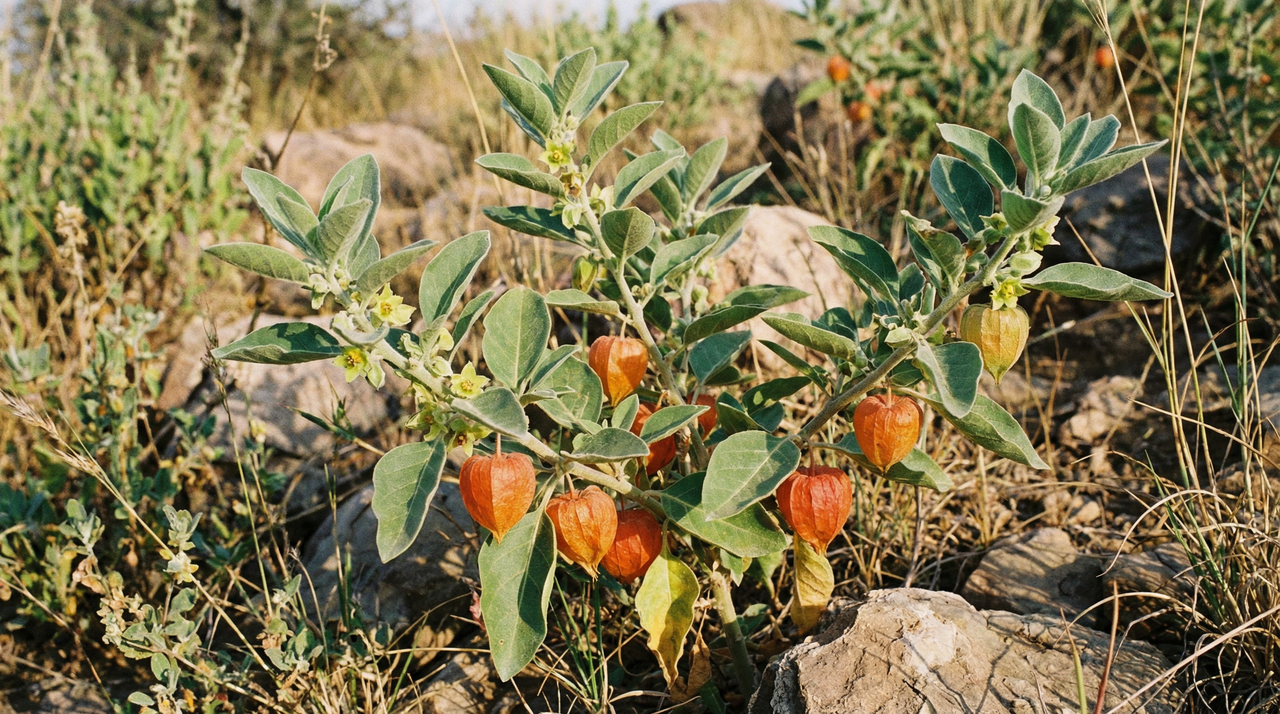
In the garden, Ashwagandha has a look that is unmistakably its own once you've grown it a season or two. It's an erect, branching shrub reaching 0.5 to 2 m tall, covered in soft pubescent stems, with alternate ovate leaves up to 15 cm long that feel slightly fuzzy underneath.[10][11] The flowers are small, greenish-yellow, and easy to miss, but the fruit is another story: bright orange-red berries, 5 to 10 mm across, each tucked inside a papery inflated calyx like a tiny lantern. Those berries are one of my favorite identification markers because the swollen calyx makes the plant look almost decorative even as it's doing serious medicinal work underground.[1] And that taproot, reaching 20 to 30 cm down, is dense, pale-skinned, and carries the earthy, distinct scent that characterizes the species.
What I've noticed across my own trial beds is how dramatically conditions shape the plant's stature. In drier, lower-fertility plots, plants stay compact, 30 to 60 cm with smaller leaves; give them irrigation and rich soil and they push toward 1.5 to 2 m with leaves nearly the size of your hand.[12][13] Paneer Dodi, by contrast, looks noticeably different up close: woollier, thornier, with dense grayish-green stellate hairs covering stems and both leaf surfaces, and a non-tuberous root that won't yield the same prize at harvest.[14][15] In an arid-adapted design it offers real textural contrast, but it is a different plant with its own phenological rhythm, flowering April through August rather than Ashwagandha's October-to-January window.[16]
Traditional and Cultural Uses
The history of the Ashwagandha plant in human medicine stretches back more than 2,000 years. It is documented in both the Charaka Samhita and the Sushruta Samhita, two foundational Ayurvedic texts, where it is classified as a Rasayana herb: a rejuvenative that builds vitality, eases stress, supports longevity, and strengthens reproductive and immune function.[17][18] The Ayurvedic Pharmacopoeia of India still specifies roots standardized to at least 0.3% withanolides.[19] I want to be clear that my role here is to connect that historical context to regenerative gardening practice, not to prescribe use, but knowing this lineage matters when you're deciding to grow a plant with such deep roots in another culture's healing tradition.
Its reach extends beyond classical Ayurveda. The Bhil and Gond tribes of Rajasthan have long used it for snakebite, asthma, fever, and joint pain, and parallel uses appear across Unani, Siddha, and African indigenous medicine systems.[20][21] Paneer Dodi carries its own thread in these traditions, used in Ayurveda and Unani for diabetes, arthritis, asthma, and as a cardiotonic and rejuvenative, making the Withania genus as a whole a significant chapter in South Asian ethnobotany.[22] Having worked on ethnobotanical projects, I prioritize sourcing from cultivated stock rather than wild-harvested material. Modern commercialization has accelerated overharvesting and habitat loss in native populations, and the communities who developed this knowledge over centuries deserve equitable credit and benefit-sharing, not just supply chains extracting their heritage.[23]
Fun Facts and Ecological Insights
Pull an Ashwagandha plant from dry soil and the taproot tells the whole story of how it survives where it does. Beyond simply reaching deep for groundwater, the plant accumulates osmoprotectants like proline and glycine betaine, ramps up antioxidant enzymes under stress, and uses ABA-mediated osmotic regulation to manage water loss through its stomata.[24] Those pubescent leaves and thick cuticles I mentioned earlier aren't just texture; they're functional drought armor. Seeing all of this in person, pulling roots from trial beds in drier versus irrigated plots, genuinely reinforced for me why this plant outcompetes most other medicinals on marginal ground.
Genetic variability across regional landraces is significant, influencing fruit size, leaf shape, root thickness, and ultimately withanolide content, though no formal subspecies have been described.[25][26] In native habitats, seed dispersal happens primarily through birds (munias and sparrows are drawn to those red berries), with possible contributions from ants or wind, and the plant functions ecologically as a pioneer species that helps stabilize degraded soils.[27] Its phenology tracks the Indian monsoon closely: vegetative growth through the wet season, flowering October through January, fruiting and berry-reddening into late winter.[13][7] Outside cultivation in non-native regions, it rarely persists as a self-sustaining population, which makes it a manageable candidate for subtropical gardens even where invasive potential warrants a watchful eye.
Ashwagandha Varieties and Where to Buy
Notable Cultivars and Ecotypes of Ashwagandha
Most of the ashwagandha seed you'll find today traces back to breeding programs run by three Indian institutions: CIMAP, IIHR, and TNAU. Their flagship releases, including Jawahar Asgandh-20 (JA-20), Jawahar Asgandh-134 (JA-134), Arka Ashwagandha, Poshita, AU-6, Usha, RRA-2, and Try-002, were developed specifically for improved root yield, withanolide content, and regional adaptability.[28][29][30] JA-20 is among the most referenced for both root yield and withanolide A concentration, and modern cultivars as a group tend to outperform traditional landraces by 20 to 30 percent.[28][31] Arka Ashwagandha was selected for disease resistance and uniform growth; Poshita is promoted for organic farming in arid regions and is one of the cultivars now being trialed in US conditions alongside Jawahar lines.[29][28][32] TNAU's AU-6 focuses on withanolide A improvement, while Usha was bred specifically for drought tolerance and higher biomass.[30]
At the species level, there are two naturally occurring botanical varieties: Withania somnifera var. somnifera, which has a more spreading habit, and var. rare, which grows more erect.[33] I prefer the upright types in tighter guild plantings because they leave horizontal space for companion plants while still putting energy into root development.
For US growers in warmer, drier climates, the most meaningful distinction is actually between desert and coastal ecotypes. Desert-origin material from regions like Rajasthan produces deeper root systems, reduced transpiration rates, and survival rates up to 85 percent under water stress compared to 60 to 70 percent for coastal types.[34][35][36] The chemistry follows: withanolide content in desert ecotype roots runs 1.5 to 2.5 percent, versus 0.8 to 1.5 percent in coastal types.[34][35] In my trials, roots grown from desert-origin seed have a noticeably stronger, more resinous aroma at harvest, which tracks with what the research says about withanolide density. If you're growing for medicine, seek desert-type or Rajasthani-origin seed when you can find it labeled as such.
Sourcing Ashwagandha Seeds, Plants, and Root
Ashwagandha is completely unrestricted in the US. Withania somnifera is a tender perennial hardy in USDA zones 8 through 11. It appears on no CITES appendix, carries no federal import restrictions, and is not classified as invasive nationally.[37][38][39] I've checked the USDA records myself before scaling up my plantings, and there's nothing stopping you from growing and sharing it freely within your climate range.
For seeds and live plants, Strictly Medicinal Seeds is my first stop; they carry both seeds and plants and often specify cultivar lines. Mountain Rose Herbs stocks organic seed, and Seed Savers Exchange, Victory Seed Company, and Orange Fiber Farms are all worth bookmarking. Plant Delights Nursery occasionally carries plants as well. The USDA GRIN database also maintains germplasm accessions if you want to go that route.[40] One lesson I learned early: buying generic "ashwagandha" seed without cultivar information is a gamble. I did it twice and ended up with lower-yielding, unimpressive plants both times. Now I specifically look for Jawahar or Poshita lines and skip vendors who can't tell me what they're actually selling.
Availability is seasonal and sometimes scarce; commercial cultivation of ashwagandha in the US is limited, so popular varieties do sell out.[41] Order seeds in late winter if you can. Prices are reasonable across all forms: 100 seeds typically run $8 to $12, live plants $15 to $25 each, dried root $6 to $10 per ounce, root powder $4 to $8 per ounce retail or $8 to $20 per pound wholesale, and extract $20 to $50 per pound. Growing your own from high-withanolide cultivar seed is, season over season, the better investment if you're using the root medicinally with any regularity.
Ashwagandha Propagation and Planting (Withania somnifera)
Ashwagandha rewards growers who take the time to understand its biology before they ever open a seed packet. Every step from germination to harvest makes more sense once you've held one of these seeds and really looked at it.
Seed Morphology, Embryology, and Storage of Ashwagandha
The seeds are small, only 2-3 mm long, kidney-shaped, and covered in a thin yellowish-brown to reddish-brown coat.[42][43] Inside each one sits a curved solanad-type embryo embedded in endosperm, and that embryo's underdevelopment is exactly why fresh seeds sometimes germinate erratically without pretreatment.[44] Physiological dormancy can be broken with a 24-hour warm-water soak, light scarification, or a GA3 soak at 100-500 ppm; cold stratification at 4-10°C for 2-4 weeks also works if you're starting early indoors.[45][46] I usually go with the warm-water soak because it's fast, low-risk, and I've gotten consistent results across multiple seasons.
One thing I love about ashwagandha seeds is how forgiving they are to store. They're orthodox, meaning they tolerate desiccation well. Kept in a sealed glass jar with a silica gel packet in a cool room, they hold 70-90% viability for 5-7 years and can stay viable up to a decade.[47][48] Leave them at room temperature for two years, though, and viability can drop to around 40%.[49] I test stored seed every couple of years with a simple paper-towel germination test rather than anything fancy, and that's always been enough to catch a batch that needs replacing before I waste a whole flat.
Seed is the standard propagation method for home growers and commercial operations alike.[50] Semi-hardwood cuttings treated with 1000-2000 ppm IBA will root in 4-6 weeks under mist, and tissue culture is used commercially, but those routes are really for preserving specific high-withanolide clones rather than routine production.[51][52] Unless you're replicating a specific genotype, just start from seed.
Germination Requirements and Timeline for Ashwagandha Seeds
Pretreated seeds germinate in 7-14 days at soil temperatures between 77-86°F (25-30°C), with acceptable germination stretching to 20 days in cooler conditions.[53][7] Sow seeds about 1/4 inch deep in a neutral-pH, well-aerated mix, keep moisture consistent but not wet, and expect 60-90% germination rates when you've done the pretreatment.[54] Those first two weeks are the moment of truth that validates everything you did with seed selection and pretreatment.
For shorter-season gardens, start seeds indoors 6-8 weeks before your last frost date, then transplant once soil hits 60°F and nights stay above 50°F.[55][32] From sowing to harvestable root is 150-180 days, so plan backwards from your first hard freeze.[56] A word of warning from my own indoor starts: the seedlings in their first two weeks look remarkably like young carrot tops. I've learned to label every flat immediately because once you have a dozen trays of various herb seedlings going, you will not remember which tray is which. Trust me on that one.
Soil, Site Selection, and Planting Technique for Ashwagandha
The non-negotiables here are drainage and sun. Ashwagandha wants well-drained sandy loam at pH 7.5-8.0 (it'll tolerate 6.0-8.5), low organic matter around 1-2%, and full sun for at least 6-8 hours daily.[52][57] Shade leads to etiolated, chlorotic plants with reduced flowering and lower withanolide levels.[58] I've seen this firsthand: plants grown in my subtropical garden under full sun produce noticeably more aromatic roots than the ones that got afternoon shade from a nearby fence. The difference in potency is real.
Waterlogging is the primary killer.[59] After losing several early plants to root rot in my heavier garden beds, I now build a custom mix for containers and raised beds: roughly 50% sandy loam, 25% coarse perlite or grit, and 25% mature compost.[60] For in-ground planting, incorporate well-rotted compost at 10-15 tons per hectare equivalent and correct pH with lime on acid soils or gypsum where soil is overly alkaline.[52] If your leaves start yellowing from the margins inward after transplant, suspect compaction or poor drainage before anything else.
Spacing, Transplanting, and Establishment Tips
Mature ashwagandha plants reach 60-150 cm tall with a 60-90 cm spread, so they need room.[61] Standard field spacing is 60 cm between rows and 30-45 cm between plants; on poorer soils, open that up to 90 cm to reduce root competition and improve airflow.[62][63] I've tried tighter spacing on fertile raised beds and it worked until a humid summer arrived, at which point the reduced airflow invited fungal issues I wouldn't have had otherwise. The spacing guidance exists for good reason.
For container growing, choose pots at least 30-40 cm deep with a minimum 15-20 L volume to give the taproot space to develop properly, and keep pots 60-120 cm apart.[64][65] Transplant seedlings after hardening off over 7-10 days, once they've developed several true leaves. Remember that this plant's story happens mostly underground: the above-ground growth can look almost suspiciously slow in the early weeks, but the taproot is doing exactly what it should. You'll understand the whole arc at harvest.
Ashwagandha Care Guide: Growing Withania somnifera Successfully
Every care decision you make with ashwagandha traces back to a single fact: this plant evolved in the semi-arid scrublands of India and North Africa, where soils are lean, summers are brutal, and rain arrives in pulses rather than steady streams. Work with that physiology and you'll get thick, potent roots. Fight it with too much water, too much nitrogen, or the wrong season, and the plant tells you immediately through its leaves.
Sunlight Requirements and Light Management
Ashwagandha wants full sun and well-drained, sandy or loamy soil as its baseline.[66][67] Six or more hours of direct light daily is the standard, and established plants handle intense sun remarkably well because of their pubescent leaves and tight stomatal control. Young transplants are a different story. Once temperatures climb past 100°F, I've seen the tips brown and curl within a day or two, especially on plants that went in the ground less than six weeks prior.[68] At that point I throw up a 40% shade cloth over the bed for the peak afternoon hours and the symptoms stop almost immediately.
The cues to watch are leaf margin browning and midday wilting that doesn't recover by evening. Either of those signals means the plant is losing the photosynthesis battle, not winning it.[68][69] Think of sunlight and temperature as one system to manage together rather than two separate boxes to check.
Watering Needs and Drought Tolerance
Once the roots are established, ashwagandha behaves a lot like rosemary or lavender: deep-rooted, comfortable with dry spells, and genuinely stressed by sitting in wet soil.[70][71] In the seedling stage (the first four weeks), I water every two to three days to keep the soil damp but never waterlogged. Through the vegetative phase I back off to roughly once a week, watering deeply when the top inch goes dry. Once flowering begins, I reduce to every ten to fourteen days deliberately, because that water stress is what pushes the plant's energy downward into root development rather than upward into foliage and fruit.
If the lower leaves start yellowing and the soil has stayed wet for more than four days, root rot risk is already real. I pull back on irrigation the moment I see that combination. No fixed calendar schedule has saved me as many plants as just checking the top inch of soil before I reach for the hose.
Heat Tolerance and Mitigation Strategies
Ashwagandha is rated for AHS Heat Zones 8-11 and thrives in USDA zones 8-11, handling temperatures from 50°F up to around 104°F in short bursts when the soil moisture is adequate.[72][73] Prolonged exposure above 95°F starts producing visible symptoms: leaf scorch, wilting, blossom drop, and in severe cases a kind of general standstill where the plant just stops growing.[74]
The most effective mitigation toolkit combines 40% shade cloth, 5-8 cm of organic mulch (which improves water use efficiency by 20-30%), early morning irrigation, and spacing plants 60-90 cm apart for airflow.[75][76] I've pushed plants through short 105°F spikes with nothing more than a deep evening water and a straw mulch layer. Cultivar choice matters too: heat-tolerant selections like 'Poshita' and 'Jawahar Asgand-20' show noticeably better resilience in those conditions compared to unimproved seed stock.[77]
Frost Tolerance and Overwintering
Ashwagandha is frost-sensitive, with lethal damage at 32°F and visible stress setting in below 50°F.[78][53] The RHS rates it H1c, meaning it needs frost-free conditions to survive outdoors year-round.[79] In zones 9-11 it can be treated as a perennial; in zone 8 and cooler, most growers (myself included) run it as an annual or bring containers indoors. Every November I move my potted plants into a bright room that stays around 50°F, and every March they go back outside looking surprisingly eager. Protecting in-ground plants in marginal zones means 6-8 inches of mulch over the root zone plus row covers during hard freezes, which buys roughly 4-8°F of buffer.[80][61]
Soil Fertility and Feeding
Ashwagandha is a moderate feeder that prefers slightly alkaline soil in the pH 7.5-8.5 range.[81] Phosphorus and potassium drive root development and withanolide production; nitrogen supports early vegetative growth but becomes a liability if applied heavily, promoting lush canopy at the expense of the medicinal root you're actually growing.[82] I learned this the hard way with a single generous nitrogen application that left me with impressive foliage and disappointingly small, low-potency roots. Now I use modest organic amendments at planting, then follow up with a phosphorus and potassium top-dressing when plants enter flowering. Split applications timed to vegetative and flowering peaks outperform a single basal dose.[52] High fertility also increases disease pressure, so restraint here pays double dividends.[83]
Pruning, Maintenance, and Seasonal Rhythm
Plant ashwagandha in spring after the last frost, typically March through May depending on your zone.[53] Germination takes 7-21 days, and the plant moves through seedling establishment, vegetative growth, flowering, and fruiting over roughly 120-180 days total.[84] Like tomatoes or peppers (close Solanaceae relatives), it rewards a bit of early intervention: pinch the growing tip when plants reach 6-8 inches to encourage lateral branching, and consider light topping again around 30-40 days after transplanting.[85] That simple step can increase root yield by 20-30%.[86]
How tall does ashwagandha grow? Expect 2-3 feet under normal garden conditions, with taller plants occasionally needing staking at flowering to prevent lodging.[84] Weed aggressively in the first 60 days, every 15-20 days by hand or hoe, then let the canopy do most of the work.[86] A 2-3 inch straw mulch layer handles moisture retention, weed suppression, and soil temperature in one move. In humid climates like Florida, prioritize airflow and drainage above everything else; the plant's arid origins mean it doesn't forgive poor ventilation for long.[87] By late autumn, as berries redden and leaves yellow, the plant is signaling the close of its season and the readiness of its roots below.
Harvesting Ashwagandha: Timing, Technique, and Yield
Patience is the defining skill here. Ashwagandha roots need 150-180 days from sowing before they're worth pulling, which means a March or April planting in most of the US won't see harvest until October or November.[88][32] In India, growers sow during the June-July monsoon and dig in November or December, following essentially the same biological clock into a cooler, drier season. The calendar is almost secondary once you understand why the timing works: the plant is shutting down above ground so it can concentrate everything it has into the root below.
When to Harvest Ashwagandha Roots, Leaves, and Berries
The plant tells you when it's ready if you know what to watch. Yellowing and drying leaves are the most reliable backyard signal, and I've learned to treat them as the green light rather than a warning sign.[89] Berries turning fully red or orange is a useful second cue; flowering typically starts 60-70 days after sowing, and root harvest follows 90-120 days after that.[90] I've found that waiting until those first berries are deeply colored before digging consistently produces thicker, more aromatic roots than harvesting at the first hint of leaf yellowing.[7][91] The roots themselves shift from white to a light brownish color as they mature, and at that point they've usually reached 15-30 cm in length and 2-5 cm across.[89][92] Berry color can vary slightly between cultivars, so cross-reference what you know about the variety you planted rather than relying on any single cue alone.
How to Harvest and Handle Ashwagandha for Best Quality
The staggered harvest is one of the things I genuinely appreciate about growing this plant. Leaves can be cut starting around 3 months after planting, with repeat harvests every 30-45 days until you're ready to dig the roots.[88] In my zone 9B garden I've routinely taken two or three leaf harvests before lifting the roots in fall, which means the plant is contributing to teas and tincture material for months before the main event. Berries come off when fully ripe and papery-husked; collect them gently and set them aside for seed saving or drying.
For the roots themselves, a digging fork is your friend. Ashwagandha roots go deep and snap if you yank rather than loosen. Once they're out, shake off the soil, trim the lateral roots, and shade-dry at 25-30°C for several days until moisture drops to around 6-8%.[93] I always dry out of direct sun because high heat degrades the withanolides; this isn't theoretical caution, it's what consistently gives me dried material that holds its characteristic scent for months afterward.
Expected Yields and What Mature Roots Look Like
Commercial fields under optimal conditions produce roughly 500-1000 kg of dried root per hectare.[89][94] A single healthy backyard plant in good soil typically yields something closer to 100-300 grams of dried root, which is a realistic season's supply for personal use. A root harvested at the right stage snaps with a crispness similar to fresh ginseng, and you'll recognize the earthy, slightly bitter aroma immediately. Harvest too early and the roots are thin, pale, and mild. Get the timing right and you'll understand why those visual cues matter so much: they're directly connected to the potency of what ends up in your apothecary jar.
Ashwagandha Preparation and Uses
Culinary and Edible Uses of Ashwagandha
The ashwagandha root is where nearly all the action happens. It's the primary edible and medicinal part in Ayurveda, used as an adaptogenic tonic in powder, tea, or supplement form, while the other plant parts are very much supporting cast.[1][95] Young leaves can be cooked like spinach, ripe berries have a sweet-tangy quality in small amounts, and seeds aren't really eaten.[96] The root functions primarily as a potent therapeutic addition rather than a caloric staple.[1] The key bioactives, withanolides, run at 0.25–5% dry weight in roots and are heat-stable, which matters when you're warming the powder in ghee or simmering it in milk.[1][97]
The flavor is a lot to reckon with at first. Roots are bitter, astringent, and distinctly earthy; Ayurveda classifies the overall profile as bitter (tikta), sweet (madhura), and astringent (kashaya).[98][1] Early on, I tried blending the powder straight into cold smoothies. It was overwhelming. I've since learned that warming it gently in ghee first rounds out the flavor considerably and makes daily use much easier to stick with. Cooked leaves turn tender and slightly mucilaginous, and ripe berries taste sweet with a mild astringent edge, though large quantities can cause gastrointestinal upset, so I treat them more as a forager's nibble than a bowl-filling ingredient.[99]
The related Paneer Dodi (Withania coagulans) opens up some genuinely fun culinary territory: its dried fruits work as a thickener in curries and gravies, seeds yield 20–30% oil or can be roasted into flour, and stem resin acts as a traditional milk-coagulating rennet for cheese-making.[100][101] Processing to reduce bitterness matters for both species. And unripe berries of either plant should be avoided entirely since they're toxic.[98] I'd also encourage anyone growing ashwagandha to get confident with identification before harvesting anything. The first season I grew it, I checked every berry cluster against Datura and Physalis traits until I could recognize the pubescent leaves, yellow-orange berries, and non-inflated calyx without hesitation. In a family full of look-alikes, that habit is worth building early.
Medicinal Preparations and Dosages
The evidence-based dosing range most clinical studies work within is 3–6 g of root powder daily, divided into one or two doses, typically taken with milk or water, or 300–600 mg of a standardized extract (5% withanolides) split across two doses.[102][103] Most studies run 8–12 weeks at these levels. Traditional Ayurvedic rasayana preparations do exactly what those numbers imply: root powder stirred into warm milk with honey or ghee, or simmered gently as kshira, a milk decoction designed to buffer the bitterness and enhance absorption.[104][105] Because withanolides are heat-stable, the warm milk approach doesn't degrade what you're after. I always store my root powder in opaque, airtight jars because that horse-like aroma will absolutely migrate into neighboring pantry items given half a chance. Shade-dried root keeps well for 2–3 years when stored cool and dry.
Paneer Dodi preparations follow a different rhythm, centered on fruit rather than root: 1–3 g fruit or seed powder twice daily, or 5–10 g in decoction, with clinical diabetes research using 500 mg fruit extract daily.[106][107] It's a useful contrast that shows how differently two close relatives can be used, but for anyone growing standard ashwagandha, the milk-and-root preparation is where I'd start.
Non-Food Uses and Safety Considerations
Ashwagandha is generally safe for most adults at studied doses, but the safety profile deserves honest attention. Common side effects include gastrointestinal upset and drowsiness, and the herb can interact with sedatives, immunosuppressants, and thyroid medications.[108][109] I do not use or recommend ashwagandha in any form during pregnancy. The animal-study evidence on uterine effects is clear enough to take seriously, and the same contraindication applies to Paneer Dodi.[110] Anyone with hyperthyroidism should also hold off and speak with a practitioner first.
From a permaculture standpoint, sustainable harvest matters as much as safe use. Guidelines recommend collecting no more than 20–30% of a root population and replanting seeds to maintain stands over time.[111][112] Compared to faster annual herbs in my garden, ashwagandha's 10–12 month root cycle demands more patience, and that timeline is a good reason to resist pulling every plant at once. Most home growers are focused on personal tonic use rather than commercial resin or oil extraction, so the math is manageable: harvest thoughtfully, save seed, and the planting stays productive year after year.
Ashwagandha Health Benefits and Medicinal Uses
Few plants carry 3,000 years of uninterrupted use as a Rasayana rejuvenator the way ashwagandha does. In Ayurvedic medicine, Rasayana herbs are those that build fundamental resilience in body and mind, and Withania somnifera earned that classification by demonstrating exactly that kind of broad-spectrum support for stress, vitality, and reproductive health.[113][114] The same traditions that documented it in Unani and Siddha medicine also used it to enhance strength, endurance, fertility, and sperm quality in men, which tells you something about how holistically it was understood.[115][116]
Traditional and Modern Medicinal Applications
The strongest modern evidence sits squarely in the stress and anxiety space. Randomized, double-blind, placebo-controlled trials have shown ashwagandha meaningfully lowers cortisol levels and improves stress resilience, which is about as close as herbal medicine gets to a clean clinical win.[117][118] I've grown both ashwagandha and holy basil for years, and while tulsi is a beautiful daily nerve tonic, ashwagandha hits differently. In my experience observing both plants and their effects, ashwagandha's impact on deep sleep and stress recovery is more pronounced, which makes sense when you look at how the withanolides interact with cortisol pathways. Preclinical work also documents real anti-inflammatory effects, with animal models showing reduced TNF-alpha through inhibition of key inflammatory signaling,[119] and human studies point to cognitive improvements and memory support with potential relevance for Alzheimer's disease research.[120]
A Cochrane review found only low-quality evidence for anxiety treatment and called for more rigorous trials, and the NIH's NCCIH echoes that the results are promising but not yet definitive.[121][102] Anticancer and reproductive research is similarly exciting and similarly early. I always recommend standardized extracts from verified sources for anyone seeking the specific benefits studied in trials, because the withanolide content driving these effects varies enormously by growing conditions and processing method.
Key Phytochemicals: Withanolides and Beyond
Ashwagandha contains a wide cast of secondary metabolites including alkaloids, flavonoids, saponins, and phenolic acids.[122][123] But the withanolides are the story. These steroidal lactones, over 40 identified so far, are the signature compounds that explain nearly every benefit above, and they concentrate primarily in the root at 0.1-0.5% of dry weight.[124][122] Withaferin A, the most studied, targets NF-κB and COX-2 pathways and shows cytotoxicity against cancer cells at micromolar concentrations.[125] Withanolide D modulates cytokine production, and withanoside IV supports neuronal regeneration and protects against oxidative stress.[126]
These compounds aren't static. Environmental stress drives production. Altitude, season, and soil type all shift withanolide concentrations, with sandy loam soils, winter harvesting, and Indian accessions producing the highest levels.[127][128] Roots I harvest after a dry, sunny stretch are noticeably more bitter and pungent, which lines up perfectly with the research showing that plant stress upregulates these defensive compounds.[129] The plant makes withanolides as ecological armor, and understanding that helps you grow better medicine.
Nutritional Profile of Ashwagandha Roots, Leaves, and Berries
No USDA nutritional database entry exists for ashwagandha, so everything below comes from peer-reviewed literature rather than a standard food label.[102] Dried root powder runs roughly 303 kcal per 100g, with about 14g protein, 68g carbohydrates, and 15g fiber.[130] The mineral density is genuinely impressive: roots contain 500-1000mg calcium, 20-50mg iron, and 1000-1500mg potassium per 100g.[131][132] Leaves are higher in protein (20-25g/100g) and vitamin C (up to 50mg/100g vs 10-20mg in roots), though nobody's eating ashwagandha leaves as a salad green.[133]
Standard daily use ranges from 1-6g of root powder to 300-600mg of standardized extract.[102] Heat processing can degrade withanolide content by 20-50%, which is why I prefer gently dried root powder over preparations that involve prolonged cooking.[134] The nutrition here is useful context for daily users, but this isn't a plant you're growing for its calories. You're growing it for its chemistry.
Safety, Side Effects, and Responsible Use
Withaferin A, the most therapeutically active compound, is also the most cytotoxic. It generates reactive oxygen species and disrupts mitochondrial function, which is precisely what makes it interesting against cancer cells and precisely why dosing and sourcing matter.[135] Leaves concentrate withaferin A at higher levels than roots, which is why I skip homemade leaf teas entirely and stick to standardized root extracts with verified withanolide percentages on the label.[135] The berries are the most toxic plant part and should not be eaten casually; ashwagandha is Solanaceae, and the family's tendency toward alkaloid-rich fruit is real here even if it's milder than Datura relatives.[136]
At recommended doses of 300-600mg standardized extract daily, most adults tolerate ashwagandha well, with gastrointestinal upset and drowsiness being the most commonly reported side effects.[102][137] I've seen the case reports on liver enzyme elevation at doses as low as 450mg of extract, which is squarely within commercial capsule territory, and it's why I stay at the lower end of the researched range and only use third-party tested products.[138] These events are rare, but they're real. Plants grown under drought stress also produce higher alkaloid and withanolide concentrations, meaning wild-collected material carries more variability in toxin load than cultivated, standardized extracts.[139]
The contraindications are clear and non-negotiable. Avoid ashwagandha entirely during pregnancy due to documented potential for uterine contractions and abortifacient effects.[102][137] Anyone with thyroid conditions should get bloodwork first, since ashwagandha can increase thyroid hormone production and interact with thyroid medications.[140] It also interacts with sedatives, immunosuppressants, antidiabetic drugs, and blood pressure medications, and long-term safety data beyond 12 weeks is limited.[102][135] Talk to a provider before starting, especially if you're managing any of the above. In the US it's sold as an unregulated dietary supplement, which means quality control is the buyer's responsibility.[141] Know what you're buying.
Ashwagandha Pests and Diseases
There's something I've noticed every time I brush past young ashwagandha in the morning: that faintly bitter, musky scent that clings to your fingers. It's easy to dismiss as just the smell of the plant, but that aroma is actually a signal that the plant's chemical armor is working. The withanolides and alkaloids concentrated throughout the foliage, roots, and stems aren't just what makes ashwagandha medicinally interesting -- they're part of an active defense system backed by glandular trichomes that visibly trap small insects on contact, much like I see on other sticky-leaved Solanaceae relatives.[142][143][144]
Natural Defenses and Pest Resistance
That chemical defense translates to real-world pest pressure reduction. Chewing insects like Helicoverpa armigera are deterred by withanolides strongly enough that this counts as high resistance in the literature,[145][142] and aphids show moderate resistance thanks to latex and secondary compounds -- though that resistance drops under drought stress or when the plant is pushed with high nitrogen fertility.[146][145] Where things get complicated is with sucking pests. Leafhoppers (Empoasca spp.) and whiteflies largely sidestep the withanolide defense. Leafhoppers in particular cause real damage: in Indian field conditions during peak monsoon months of July and August, leafhopper populations can inflict 30-40% yield loss through hopper burn.[147][148] Whiteflies compound this in dense plantings or greenhouse conditions, where they transmit viral diseases and leave behind sooty mold from their honeydew.[147] Cultivar choice matters here: Jawahar Asgandh-20 shows moderate leafhopper resistance, but most commercial varieties were selected for withanolide content and yield rather than pest tolerance.[147]
For IPM, I always start with Trichoderma applied at planting -- it fights damping-off while giving seedlings a root vigor boost I can see within a few weeks compared to untreated starts. Beyond that, neem-based biopesticides, crop rotation, and good sanitation handle most pest pressure without disrupting the soil life I've worked hard to build.[149][150] Chemical applications stay as a genuine last resort. The plant's own root extracts carry insecticidal activity from their secondary metabolites,[151] so the goal is supporting what's already there rather than overriding it.
Disease Resistance and Management
Disease susceptibility in ashwagandha is very much a genotype-and-environment story. Fusarium wilt is the most consequential threat, and resistance ranges from immune to low depending on the accession -- meaning variety selection is the single highest-leverage decision you'll make.[152] Foliar diseases like Alternaria leaf spot (necrotic spots progressing to defoliation) and powdery mildew run moderate under dry conditions but worsen fast with humidity.[153][154] Root rots from Phytophthora, Fusarium, and Rhizoctonia follow the same pattern: variable resistance, but heavily promoted by poor drainage.[155] Bacterial threats including Xanthomonas axonopodis pv. withaniae, Ralstonia solanacearum wilt, and little leaf disease (Verticillium dahliae) tend to peak during monsoon seasons.[156] Seedling damping-off rounds out the picture as an early-stage vulnerability most growers encounter at least once.[157]
I approach variety selection here the same way I do with tomatoes: I'm choosing blight resistance before I'm choosing flavor. NRAS-1 and NRAS-2 carry wilt and damping-off resistance, Jawahar Asgandh-20 holds up against little leaf, and Gujarat Asgandh-1 offers little leaf tolerance alongside reasonable field performance.[158][159] The withanolides and somniferine that give the plant some inherent antimicrobial activity work better when the plant is already growing in well-drained, low-humidity conditions that don't stress the defense system.[160][161] For integrated management, I rely on Trichoderma and Bacillus subtilis as biological anchors, combined with proper spacing for airflow, soil solarization where feasible, and sulfur-based fungicides when foliar disease pressure escalates beyond what the biologicals can handle.[162][163] Drainage and airflow, honestly, solve more problems than any spray program.
Ashwagandha in Permaculture Design
If there's one plant I keep reaching for when someone asks me about building a low-water medicinal guild on challenging ground, it's ashwagandha. It reads the site the way a good pioneer should: give it heat, drainage, and minimal interference, and it gets to work.
Climate Preferences and USDA Hardiness Zones
Ashwagandha (Withania somnifera) is a reliable perennial in USDA zones 8-11, with the sweet spot sitting squarely in zones 9-10.[61][2] It handles light frost but starts taking real damage below 28°F (-2°C), and prolonged cold below 59°F (15°C) slows it down considerably.[70][164] Its cousin Paneer Dodi (Withania coagulans) is actually more frost-sensitive, pushing you toward zones 9-11 for reliable outdoor performance.[41][165] For marginal zone 8 situations, I've found that overwintering container-grown plants in a cool, bright spot around 50-60°F with almost no water is the simplest approach that actually works.
Both species evolved in arid and semi-arid climates, and that origin shapes everything about how you site them. Optimal temperatures run from 68-95°F (20-35°C), with impressive heat tolerance up to around 104°F for short stretches, but prolonged heat above that threshold brings leaf scorch.[166][167] Humidity is the variable that trips up most North American growers: this plant wants 30-60% relative humidity and performs beautifully in Arizona, California, and New Mexico where the air stays dry.[59][168] Annual rainfall in the 20-30 inch range is ideal, and it tolerates down to about 10 inches in semi-arid conditions, but push past 40 inches per year and root rot becomes a real conversation.[55][57] I grew it in Central Florida for two seasons before I got serious about raised beds and airflow. Once I did, the fungal issues that had plagued me essentially disappeared. Humid subtropical gardeners can absolutely grow this plant, but drainage isn't optional.
Ecosystem Functions and Guild Roles
In its native dry deciduous forests, rocky slopes, and wastelands across India, the Middle East, and North Africa, ashwagandha functions as a genuine pioneer.[169] Its taproot drives 1-2 meters into the ground, stabilizing sandy and degraded soils, improving water retention, and building organic matter where little else will put in the effort.[170][171] That's not a metaphor. These roots are doing erosion control work in habitats up to 2000 meters elevation where the soil profile would otherwise blow away.
Above ground, the small greenish-yellow flowers attract honeybees, wild bees, and butterflies, and the papery-husked berries feed birds and small mammals, with bulbuls and mynas handling a fair bit of the seed dispersal.[171][1] The flowers are protogynous, meaning the female parts mature first to favor cross-pollination, and pollination efficiency genuinely improves with insect activity at temperatures between 25-35°C.[172][156] Once I started planting basil and marigolds nearby, my berry set improved noticeably. It's the same logic you'd apply to tomatoes or peppers, which makes sense given the family relationship.
The withanolides that make this plant medicinally interesting also give it natural pest-repellent properties and mild allelopathic effects through root exudates that can suppress some weed growth.[173] It accumulates iron and calcium and adds organic matter as it decomposes, but it's not a heavy-metal phytoremediation plant, so don't site it expecting miracles on contaminated ground.[1] Ashwagandha doesn't fix nitrogen, so I always pair it with legumes (cowpeas and beans are my usual choices) in medicinal guilds to maintain soil fertility over multiple seasons.[174] The combination consistently outperforms either plant alone in terms of soil health. And while W. coagulans shows allelopathy toward some Solanaceae, I'm cautious about following any ashwagandha with tomatoes or potatoes in the same bed until I've had a season or two to read the local soil dynamics.[175]
Forest Layer Placement and Companion Planting
Ashwagandha sits in the shrub layer, growing as a woody-based subshrub from 0.5 to 2 meters tall with a spreading crown and that characteristic deep taproot.[61][176] It wants full sun and open conditions, which means its home is at the edge of a woodland system or in an open agroforestry guild, never under a closed canopy. Dense shade will give you a leggy, unproductive plant with minimal root development.
What makes it genuinely interesting from a guild-design perspective is its relationship with arbuscular mycorrhizal fungi, particularly Glomus species, which enhance phosphorus and water uptake in exactly the kind of nutrient-poor arid soils where you'd want to establish this plant.[177] Avoid sterilizing your planting soil or dosing with synthetic phosphorus fertilizers, both of which disrupt those fungal partnerships. Its resource partitioning and drought tolerance allow it to coexist with other dryland species without outcompeting them for limited water, and the mild allelopathic effect helps manage weed pressure in the surrounding soil.[178]
In practice, I position ashwagandha in medicinal guilds on marginal or degraded land, intercropped with legumes, millets, or culinary herbs. Near tomatoes and beans it can repel certain nematodes and insects while contributing to soil structure over time.[179][176] The pioneer role it plays in its native range translates cleanly to a restoration context: put it on the difficult edges, the south-facing slopes, the lean soils other plants don't want, and it will steadily do its work.
The Root That Humbled Me Into Patience
I've killed more ashwagandha plants than I care to admit, mostly by treating them too well. Too much water, too rich a soil, too much hovering. What finally worked was stepping back and trusting a plant that evolved through centuries of drought and neglect. There's a lesson in there that has nothing to do with horticulture, and every time I dig a root and catch that strange, horsey smell, I think about it.
Sources 179
- An Overview on Ashwagandha: A Rasayana (Rejuvenator) of Ayurveda ↩
- USDA PLANTS Database - Withania somnifera ↩
- Kew Science - Plants of the World Online: Withania somnifera ↩
- Ashwagandha (Withania somnifera) - Distribution and Ecology ↩
- Kew Science - Plants of the World Online: Withania coagulans ↩
- Missouri Botanical Garden - Withania somnifera ↩
- Withania somnifera: The Indian Ginseng Ashwagandha ↩
- Invasive Species in Florida: Withania somnifera ↩
- Withania somnifera - IUCN Red List ↩
- Missouri Botanical Garden - Withania somnifera ↩
- Kew Science - Withania somnifera ↩
- Morphological Variability in Withania somnifera under Different Environmental Conditions ↩
- Phenology and Morphological Traits of Ashwagandha Cultivars ↩
- Withania coagulans - Kew Science ↩
- Flora of Pakistan - Withania coagulans ↩
- Withania coagulans - Useful Tropical Plants Database ↩
- Ashwagandha in Ayurveda: Historical Perspectives ↩
- Ashwagandha in Ayurveda: Historical Perspectives ↩
- Ayurvedic Pharmacopoeia of India, Volume I ↩
- Ethnobotanical Survey of Withania somnifera in Tribal Areas of Rajasthan ↩
- Ethnopharmacology of Withania coagulans in India ↩
- Medicinal properties of Withania coagulans (Stocks) Dunal: A review ↩
- Assessing the Sustainability of Ashwagandha Harvesting: Ethnobotanical Perspectives ↩
- Drought Stress Responses in Withania somnifera ↩
- Molecular characterization of Withania somnifera from different geographical regions suggests significant genetic variability ↩
- Genetic Diversity in Withania somnifera (L.) Dun. Landraces of India as Revealed by RAPD Analysis ↩
- Seed Dispersal Mechanisms in Solanaceae: Withania somnifera ↩
- Ashwagandha Cultivation: Varieties and Practices ↩
- Horticultural Varieties of Withania somnifera ↩
- Development of High Withanolide Yielding Varieties of Ashwagandha ↩
- Breeding for Yield and Quality in Withania somnifera ↩
- Withania somnifera (Ashwagandha) Production Guide ↩
- Withania somnifera: A Review on Varieties and Cultivation ↩
- Ecotypic Variation in Withania somnifera: Implications for Drought Tolerance and Withanolide Production ↩
- Withanolide Content and Growth Performance of Withania somnifera Varieties Under Water Stress ↩
- Medicinal Potency of Indian Ashwagandha Ecotypes: A Review ↩
- Ashwagandha Cultivation in the United States ↩
- CITES Appendices ↩
- USDA PLANTS Database ↩
- GRIN Taxonomy for Withania somnifera ↩
- Missouri Botanical Garden - Withania coagulans ↩
- Withania somnifera (L.) Dunal ↩
- Embryology of Angiosperms ↩
- Seed Germination and Dormancy in Withania somnifera ↩
- Seed Storage Behaviour of Withania somnifera ↩
- Kew Seed Information Database: Withania somnifera ↩
- Viability of Ashwagandha Seeds Under Different Storage Conditions ↩
- Millennium Seed Bank: Withania somnifera Protocol ↩
- Seed Storage of Withania somnifera: Viability and Germination Studies ↩
- Propagation and cultivation of Ashwagandha (Withania somnifera) - ResearchGate ↩
- Vegetative Propagation of Withania somnifera Using Stem Cuttings ↩
- Ashwagandha Cultivation Practices ↩
- Growing Ashwagandha: Planting Guide ↩
- Phenology and Life Cycle of Withania somnifera ↩
- Ashwagandha Cultivation Practices ↩
- Missouri Botanical Garden - Withania somnifera ↩
- Withania somnifera (Ashwagandha) Propagation Guide ↩
- Growth and Withanolide Content of Withania somnifera as Affected by Sunlight and Soil Moisture ↩
- Ashwagandha Production Guide ↩
- Cultivation of Ashwagandha (Withania somnifera): A Review ↩
- Withania somnifera ↩
- Withania somnifera: Agronomic Practices ↩
- Commercial Cultivation of Ashwagandha ↩
- Withania somnifera ↩
- Chandrika (Withania somnifera) Cultivation Practices ↩
- Withania somnifera ↩
- Ashwagandha Growing Guide ↩
- Growing Ashwagandha (Withania somnifera) in California ↩
- Royal Horticultural Society - Withania coagulans ↩
- Cultivation of Ashwagandha (Withania somnifera) ↩
- Withania somnifera (Ashwagandha) ↩
- AHS Heat Zone Encyclopedia ↩
- Withania somnifera - Ashwagandha ↩
- Heat Stress Responses in Withania somnifera: Morphological and Physiological Changes ↩
- Effect of Shade Net on Growth and Yield of Ashwagandha under Heat Stress ↩
- Mulching and Irrigation Management for Withania somnifera in Arid Regions ↩
- Heat Tolerance in Ashwagandha Cultivars: Screening and Selection ↩
- Withania somnifera ↩
- Withania somnifera (L.) Dunal ↩
- Growing Ashwagandha in the Home Garden ↩
- Cultivation of Ashwagandha (Withania somnifera) ↩
- Role of Macronutrients in Secondary Metabolite Production in Withania somnifera ↩
- Ashwagandha Cultivation Guide ↩
- Ashwagandha Cultivation Practices ↩
- Growing Ashwagandha: A Guide for Home Gardeners ↩
- Pruning and Training of Medicinal Plants ↩
- Growing Ashwagandha: Tips for Success ↩
- Ashwagandha Production Guide ↩
- Ashwagandha Cultivation Guidelines ↩
- Phenology and Growth Cycle of Withania somnifera ↩
- Ashwagandha Cultivation Guide ↩
- Medicinal Plant Cultivation Manual ↩
- Indian Institute of Horticultural Research – Post-Harvest Handling of Withania coagulans ↩
- Commercial Cultivation of Ashwagandha ↩
- Plants for a Future - Withania somnifera ↩
- Food Plant Network - Withania somnifera ↩
- Withanolides: Chemistry and Biological Activities ↩
- Ashwagandha (Withania somnifera)—A Review on Ethnopharmacology, Phytochemistry and Pharmacological Uses ↩
- Volatile Constituents of Roots, Stems, and Leaves of Withania somnifera ↩
- Withania coagulans: A Lesser Known Indian Medicinal Plant from Solanaceae ↩
- Extraction and Utilization of Oil from Withania coagulans Seeds ↩
- Ashwagandha: A Review of Its Clinical Use and Safety ↩
- AHPA Botanical Safety Handbook ↩
- Ethnobotany of Ashwagandha in Ayurveda and Regional Practices by Pal & Agrawal ↩
- Ayurvedic Pharmacopoeia of India - Withania somnifera ↩
- Pharmacological Potential of Withania coagulans ↩
- Clinical Study on Withania coagulans for Diabetes ↩
- Safety and Toxicity of Withania somnifera (Ashwagandha): An Evidence-Based Review ↩
- Withania somnifera (Ashwagandha): A Review on Ethnopharmacology, Toxicity, and Pharmacokinetics ↩
- Herbal Medicine: Biomolecular and Clinical Aspects - Withania coagulans ↩
- IUCN Red List - Withania somnifera ↩
- Sustainable Harvesting Guidelines for Medicinal Plants - FAO ↩
- Withania somnifera | Plants of the World Online ↩
- Ashwagandha: An ancient Indian herb with roles in Ayurveda to treat manifest human diseases ↩
- Withania somnifera - Plant Finder ↩
- Traditional Uses and Pharmacological Profile of Withania somnifera (Ashwagandha) ↩
- A Randomized, Double-Blind, Placebo-Controlled, Crossover Study Examining the Hormonal and Vitality Effects of Ashwagandha ↩
- Effects of Withania somnifera on Stress and Anxiety ↩
- Pharmacological Effects of Withania somnifera: An Overview ↩
- Withania somnifera as a Potential Candidate to Ameliorate Cognitive Dysfunction in Alzheimer's Disease ↩
- Withania somnifera for anxiety: A systematic review and meta-analysis ↩
- Phytochemical and Pharmacological Importance of Withania somnifera (Ashwagandha): An Overview ↩
- Secondary Metabolites from Withania somnifera and Their Biological Activities ↩
- Withania somnifera: A Review on Ethnopharmacology, Phytochemistry and Pharmacology ↩
- Withaferin A: A Magic Bullet for Cancer? ↩
- Neuroprotective Role of Withanoside IV ↩
- Influence of Altitude and Soil Type on Withanolide Content in Withania somnifera ↩
- Seasonal Variation in Secondary Metabolites of Ashwagandha ↩
- Withanolides: Biologically Active Compounds from Withania somnifera ↩
- Nutritional Composition of Withania somnifera (Ashwagandha) Root ↩
- Mineral composition of ashwagandha (Withania somnifera) leaves and roots ↩
- Nutritional and Phytochemical Composition of Withania somnifera ↩
- Proximate Analysis of Ashwagandha Leaf Powder ↩
- Effect of processing on withanolide content in Ashwagandha ↩
- Withania somnifera (Ashwagandha): A Review on Ethnopharmacology, Phytochemistry, Metabolism, and Toxicology ↩
- Toxicological evaluation of Withania somnifera ↩
- Ashwagandha - Memorial Sloan Kettering Cancer Center ↩
- Case Report: Acute Liver Injury Due to Ashwagandha ↩
- Influence of abiotic stress on withanolides in Withania somnifera ↩
- Withania somnifera (Ashwagandha) in Neuroendocrine Immune Complex ↩
- Dietary Supplement Labeling Guide for Industry ↩
- Withanolides: Biologically Active Compounds from Withania somnifera ↩
- Role of Trichomes in Plant Defense Against Herbivores ↩
- Endophytic Fungi in Withania somnifera and Their Role in Stress Tolerance ↩
- Insect pest management in medicinal plants ↩
- USDA PLANTS Database Profile: Withania somnifera ↩
- Pest Management in Ashwagandha (Withania somnifera) ↩
- Field Evaluation of Insect Pests on Withania somnifera ↩
- Integrated Pest Management in Ashwagandha Cultivation ↩
- Integrated Pest Management Strategies for Ashwagandha Cultivation ↩
- Diseases and Pests of Withania somnifera ↩
- Screening of Withania somnifera Accessions for Resistance to Fusarium Wilt ↩
- Management of Diseases in Ashwagandha Cultivation ↩
- Susceptibility of Withania somnifera to Powdery Mildew and Alternaria ↩
- Phytophthora Root Rot in Medicinal Plants: Resistance Studies ↩
- Diseases of Withania somnifera and Their Management ↩
- Diseases of Ashwagandha and Their Management ↩
- Development and Performance of Ashwagandha Varieties in India ↩
- ICAR-NRC on MAP: Ashwagandha Varieties ↩
- Withania somnifera (Ashwagandha) ↩
- Pathogen Resistance in Withania somnifera ↩
- Integrated Pest and Disease Management for Ashwagandha ↩
- Ashwagandha Production Guide ↩
- Withania somnifera: Botanical and Pharmacological Profile ↩
- Journal of Ethnopharmacology - Cultivation of Withania coagulans (2022) ↩
- Ashwagandha (Withania somnifera) Production and Utilization ↩
- Heat Stress Tolerance in Withania somnifera ↩
- Growing Ashwagandha in California ↩
- Withania somnifera - Wikipedia ↩
- Ecological Role of Ashwagandha in Indian Arid Zones ↩
- Soil Stabilization and Biodiversity Contributions of Ashwagandha ↩
- Pollination Ecology of Withania somnifera (L.) Dunal ↩
- Pest Management Properties of Withania somnifera ↩
- Companion Planting Guide ↩
- Krishi Mitra – Companion crops for Withania ↩
- Ashwagandha (Withania somnifera) - Ecology and Cultivation ↩
- Mycorrhizal Associations in Arid Land Plants: Withania somnifera Case Study ↩
- Allelopathic Potential of Withania somnifera ↩
- Ashwagandha (Withania somnifera) in Permaculture ↩