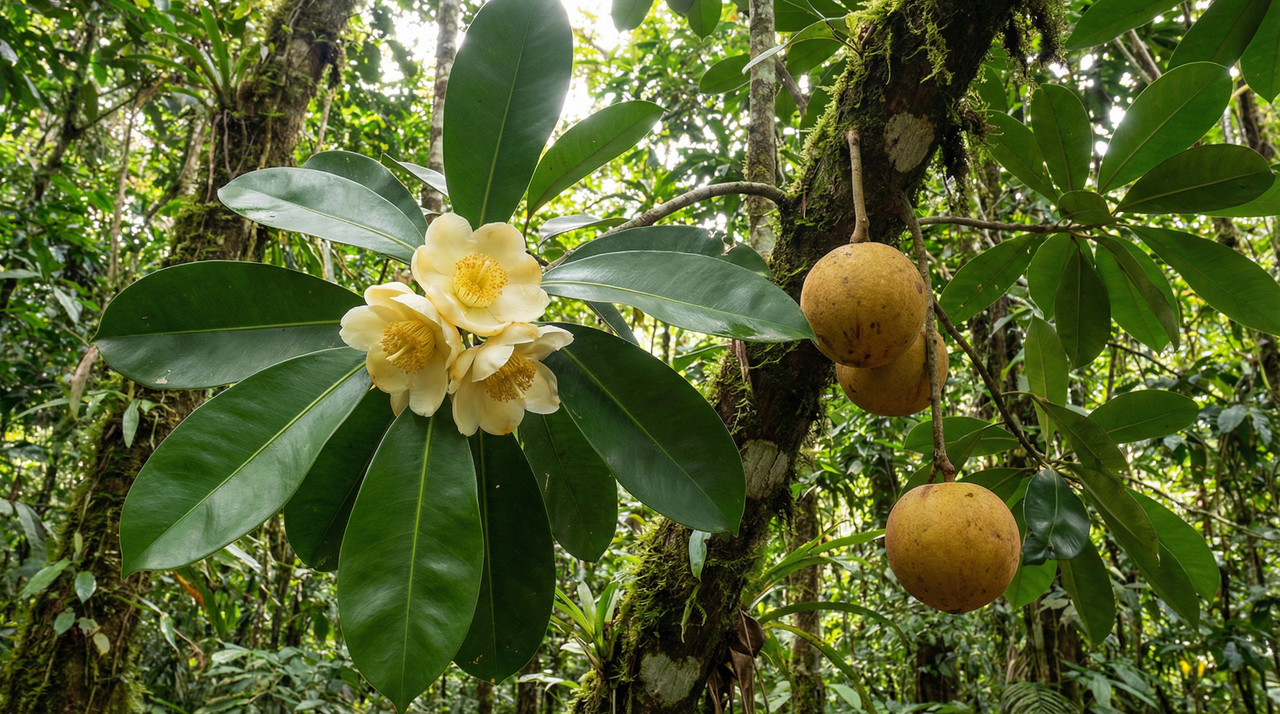
The fruit drops before you can pick it. That's not a flaw in bacuri's design; it's the deal. You don't harvest this tree so much as you wait beneath it, because the only fruit worth eating is the one that decided, on its own schedule, that it was ready. I've spent time with a lot of fruit trees that punish impatience, but bacuri is something else entirely. It's an Amazonian canopy tree that can take a decade or more to fruit, produces on its own terms, and then hands you something so aromatic and strange and rich that you genuinely wonder why you've spent your whole gardening life on mangoes and papayas.
What gets me is the contradiction at the center of it. The pulp is intensely sour straight from the rind, almost aggressive, yet it underpins some of the most beloved sweets and ice creams in northern Brazil.[1] The seeds look like a liability until you learn they press into a butter used in kitchens and skincare alike. Even the tree's slow growth, which would disqualify most species from serious consideration in a food forest, turns out to be exactly the kind of long-game investment that makes a mature forest garden worth walking into. If you're curious whether bacuri belongs in your system, or your kitchen, read on.
Bacuri Origin, History, and Cultural Significance
There's a particular type of tree that permaculture designers learn to recognize and respect early on: the slow-growing, long-lived canopy species that rewards decades of patience with abundance so reliable it becomes the backbone of a food system. Bacuri, known botanically as Platonia insignis, is exactly that tree. Native to the humid tropics of northern Brazil, Paraguay, and surrounding Amazonian regions, it's a fruit that most of the world hasn't encountered yet, but that indigenous communities across South America have depended on for generations.
Botanical Background and Native Range
Platonia insignis belongs to the Clusiaceae family, which means it shares lineage with mangosteen. If you've grown or studied mangosteen, you already have a useful mental model: think large seeds, a resinous latex in the plant tissues, slow establishment, and an upper-canopy presence in complex rainforest systems. Bacuri tends toward the tall end, capable of reaching true canopy heights in its native range, which spans the Amazon basin from northeastern Brazil into parts of Bolivia and Paraguay. It thrives in deep, well-drained soils under high rainfall conditions, and while it's been found growing wild in seasonally flooded landscapes, it genuinely prefers the kind of consistent moisture that a humid tropical forest provides. In permaculture terms, it reads clearly as a canopy layer species, the sort of long-lived anchor around which you'd build an entire guild.
Traditional and Cultural Uses
Long before bacuri entered Brazilian commercial markets, it was a staple of indigenous Amazonian diets, eaten fresh from the forest floor after the fruit naturally drops. The pulp finds its way into juices, ice creams, and sweets across Pará and Maranhão states, where bacuri season is treated as a genuine cultural event. Local markets in Belém are famous for it. That cultural embeddedness matters to me as a designer, because a fruit with that kind of deep human relationship carries something you can't manufacture: generations of knowledge about when it ripens, how to handle it, and what it pairs with. When we talk about sourcing seeds or propagating this species for designed systems, honoring that indigenous heritage and prioritizing ethical, locally adapted material is the only approach that makes sense.
Fun Facts About Bacuri
One thing I find genuinely delightful about this species is how its seeds behave. They're enormous relative to the fruit, viviparous in tendency, and absolutely cannot be dried or stored the way most gardeners expect. The seeds want to germinate immediately, sometimes before the fruit has even fully opened. For a plant that takes years to reach first fruit, it starts its life in a remarkable hurry. That tension between urgency at germination and profound patience at every stage after is, in a way, a pretty good summary of what it means to grow bacuri at all.
Bacuri Varieties and Sourcing
If you've spent time browsing tropical fruit catalogs hoping to find a neatly named bacuri cultivar list, you've probably come up empty. That's not a gap in the catalog — it's just where this fruit is in its domestication arc. Most bacuri encountered today comes from wild or semi-wild trees growing in native Amazonian stands, selected informally by local growers who know which tree in the forest produces the biggest fruit or the thinnest rind. There are no registered cultivars the way there are for, say, acerola or mangosteen, which have decades of formal breeding programs behind them. What exists instead is a pool of extraordinary genetic diversity, and that's actually something a permaculture designer should find exciting rather than discouraging.
Notable Cultivars and Selections of Platonia insignis
Brazilian research institutions, particularly EMBRAPA, have been identifying and cataloging superior wild genotypes of Platonia insignis for years, focusing on traits like pulp-to-seed ratio, flavor intensity, and ripening time. These aren't named varieties in the commercial sense, but they represent real, vegetatively propagated material with documented performance differences. I've evaluated fruit from several different Amazonian sources over the years, and the variation is striking — some batches are thick-fleshed and almost lush, while others have a higher seed burden and sharper acidity that really demands processing rather than fresh eating. That kind of variation tells me the raw material for genuine cultivar development is absolutely there; it just hasn't been formalized yet.
Related Species and Sourcing Guidance
For most growers outside Brazil, seeds are the most realistic starting point, with grafted material from selected trees occasionally available through specialty tropical nurseries or Brazilian research station networks. The catch is that bacuri seeds are recalcitrant, meaning they cannot be dried or stored — viability drops sharply within weeks of leaving the fruit. My general rule with any Clusiaceae species in this category is to prioritize fresh, moist-packed seed from a supplier who clearly understands what they're shipping. A desiccated seed arriving in a padded envelope after two weeks in transit is not worth planting. Start with the best seed you can source, grow out multiple individuals, and pay close attention to which trees in your planting express superior fruit quality. Those become your candidates for grafting and propagation, putting you directly in the role of participatory breeder — which, honestly, is one of the more meaningful things a permaculture grower can do with an underdomesticated species like this one.
How to Propagate and Plant Bacuri
If there's one thing bacuri demands from the moment you decide to grow it, it's immediacy. Everything about establishing this tree starts with understanding just how uncompromising its seeds are.
Propagation Methods for Bacuri
The seeds of Platonia insignis are recalcitrant, meaning they lose viability rapidly once separated from the fruit and cannot be dried, stored, or shipped the way most temperate tree seeds can.[2] I've started bacuri from fresh seed several times now, and the lesson I learned the hard way is that 48 hours after removing the pulp, germination rates drop noticeably. Get them into moist substrate the same day you process the fruit, full stop. When conditions are right, fresh seeds will sprout within 20 to 40 days, though germination can be frustratingly erratic even then.[3] Sow them in moist, shaded conditions, and don't plant just one or two if you can help it. Sow generously and accept the odds.
Seed is by far the most common propagation route, but it's not the only one that's been attempted. Semi-hardwood cuttings from juvenile material under mist have shown limited success, though rooting percentages remain quite low and the research base is thin.[4] Given the sparse peer-reviewed protocols available, I use my design background to bridge the gap: sourcing fruit from vigorous, high-producing mother trees is the single best investment you can make, and experimenting with a 12-hour soak before sowing costs you nothing but time.
Soil, Site Selection, and Planting Technique
Young bacuri plants want deep, sandy-loam soil with generous organic matter, good drainage, and a slightly acidic pH somewhere between 5.0 and 6.5.[5] Waterlogging will kill them, so if your site has any tendency toward compaction or pooling, address that before you plant rather than after. In heavy soils I often build a low mound or incorporate a hugelkultur-style base layer to give the developing taproot somewhere to go that isn't saturated clay.
Seedlings also need shade protection for the first one to two years.[5] Think of them the way you'd think of young avocado or citrus transplants: they're simply not ready for intense overhead sun until they've had time to build root depth and leaf mass. A shade cloth at 30 to 40 percent, or strategic placement under a nurse tree, gets them through that vulnerable window without scorching.
Spacing, Germination Timeline, and Early Care
Once you're ready to move seedlings into their permanent position, plan for 8 to 12 meters between trees to accommodate the eventual canopy spread of 8 to 10 meters and leave room for an understory guild to develop beneath them.[6] Dig generously, at least 50 centimeters deep and wide, and fill the hole with compost and mycorrhizal inoculants to mirror the rich, biologically active soils of its Amazonian home.[7] I think of this as building a biological battery: good compost, a handful of biochar for moisture and microbial habitat, and native soil biology to help the roots communicate with the system from day one.
Now for the part that tests every grower's patience. Bacuri can take 8 to 12 years or longer to produce its first fruit from seed.[3] I planted unnamed seedling stock once and waited the better part of a decade only to get fruit of mediocre quality. That experience is why I now push hard for grafted or carefully selected material whenever it's available. If you're planting from seed, plant it as a legacy tree, something for your community or the next generation of growers, and fill the years around it with shorter-lived companions that reward you while the bacuri quietly becomes the canopy.
Bacuri Care Guide: Growing Platonia insignis Successfully
Bacuri asks one thing above everything else: consistency. This is a tree shaped by the Amazon, where rainfall arrives in reliable, generous quantities year after year, and every care decision you make should start from that fact. Once you internalize that, a lot of the guesswork disappears.
Watering Needs for Bacuri: Balancing Moisture and Drainage
In its native range, bacuri receives the equivalent of 1500-2500 mm of annual rainfall.[8][9] Outside that range, you're replicating that through supplemental irrigation, which sounds straightforward until you realize the tree is equally unhappy sitting in waterlogged soil.[8][9] That tension is the whole game with this species.
In my experience with moisture-loving tropicals, the mistake I see most often is growers reaching for the hose too enthusiastically in heavy clay or poorly structured soils. Root rot sets in quietly, and by the time you notice something's wrong, the damage is done. Drainage comes first, always. Bacuri wants humus-rich soil that holds moisture without ever becoming saturated, the kind of spongy, well-structured growing medium that mimics a living forest floor.
During the growing season, aim for roughly 1-2 inches of water per week to keep the soil evenly moist.[8][9] Young plants need more frequent attention than that guideline implies; I've learned to water seedlings in their first year with shorter, more regular intervals rather than deep, infrequent soaks. They don't yet have the root architecture to seek moisture on their own. Mature trees develop considerably more tolerance for short dry periods,[8] but "tolerant" shouldn't be mistaken for "thriving." During fruiting especially, don't let supplemental irrigation slip. Stress at that stage costs you quality and yield. Bacuri is genuinely sensitive to both extremes: prolonged drought and chronic overwatering will both push it toward decline.[8]
The most practical tool I reach for to manage all of this is mulch. A 3-4 inch layer of organic material does more than conserve moisture; it mimics the decomposing leaf litter of the forest floor that bacuri evolved under, slowly feeding the soil while buffering against moisture swings. Keeping soil moisture around 60-80% field capacity is the target, but in a humid subtropical climate, that often means reading the tree and the soil rather than following a rigid watering schedule. Observe, adjust, and resist the urge to treat irrigation like a fixed routine.
Bacuri Harvesting: Timing, Technique, and Post-Harvest Handling
The most important thing to understand about harvesting bacuri is that you don't pick it. Like many large-seeded tropical fruits, Platonia insignis does not continue ripening once it separates from the tree, so pulling fruit before it's ready guarantees disappointment. The technique is simpler and more meditative than most growers expect: you wait, you watch the ground, and you collect what the tree decides to release. In Brazil's native range, that window generally runs January through May, though growers in Zone 10-11 microclimates outside the Amazon should expect some shift depending on tree age, local rainfall patterns, and how the previous season unfolded.
Ripe bacuri announces itself through several cues at once. The rind transitions from green to a warm golden yellow, the fruit takes on a heavy, almost resinous tropical scent, and it yields slightly to gentle pressure rather than feeling like a dense rubber ball. I think of it similarly to watching a mango or avocado in Central Florida: once you understand what the fruit is communicating through color, smell, and give, you stop guessing and start trusting it. What helps bacuri in particular is that its thick, tough rind absorbs the impact of the fall remarkably well, protecting the fragrant white pulp inside during what could otherwise be a bruising drop from a canopy tree.
Once you've collected fruit from the ground, the clock starts immediately. The pulp oxidizes quickly after you open that rind, so prompt processing isn't optional, it's part of the harvest workflow. Plan to process or refrigerate same-day. Yield expectations also deserve an honest note: bacuri trees, especially younger ones or those grown outside their native range, tend to produce in smaller quantities than most temperate fruit trees. It rewards patience rather than volume, and building that expectation in before your first harvest season will save a lot of frustration.
Bacuri Preparation, Culinary Uses, and Non-Food Applications
The first time you crack open a ripe bacuri, the scent alone stops you in your tracks. It's resinous, intensely floral, and a little wild in a way that reminds me of a very aromatic passionfruit crossed with something closer to mango. The pulp itself is that same contradiction: creamy and rich, but with a citrusy tartness that can catch you off guard if you eat it straight without expecting it. That tang is actually the key to understanding how Amazonian cooks have worked with this fruit for generations. You're not really fighting the acidity; you're building around it.
Traditional Culinary Preparations of Bacuri
The most common preparations lean on sugar to bring the pulp into balance. Fresh juice sweetened and served cold is a staple across Pará and Maranhão states in Brazil, and from there the fruit moves naturally into ice creams, sorbets, and mousses where that resinous brightness actually shines rather than overwhelms. Jams and preserves concentrate the flavor beautifully, and bacuri liqueur has earned a devoted following in the regions where the fruit is abundant. I think of it the way I think about using tamarind or passionfruit in my own kitchen: the intensity is the point, and you calibrate sweetness to let the character come through rather than bury it.
The seeds are where things get particularly interesting from a permaculture design perspective. Rather than discarding them, traditional communities press or render them into a rich, pale butter with a mild, slightly nutty flavor. Platonia insignis seed butter has a thick, waxy texture that honestly reminds me of unrefined shea; it melts slowly and leaves a coating richness that works in cooked preparations and as a finishing fat. That kind of whole-fruit thinking, pulp for food and seeds for oil, is exactly the zero-waste logic I try to build into every food forest guild I design.
Medicinal and Non-Food Uses of Bacuri
Bacuri butter, or bacuri oil depending on how it's processed, has a long history in Amazonian skincare traditions. Communities have used it topically for skin conditions, wound care, and as a general moisturizer, and anyone who works with similarly fat-rich seed oils like tucuma or cupuacu will recognize the profile immediately. In natural products formulation, bacuri butter is valued for its emollient qualities and relative stability. The rind, which is thick and tough enough that it feels almost architectural when you're holding the fruit, also appears in some traditional remedies, though that territory overlaps with the health benefits Stephanie already explored earlier in this profile. What I keep coming back to, working with plants like this, is how thoroughly indigenous knowledge anticipated what sustainable design principles would eventually name: use everything, waste nothing, and let the forest economy be the model.
Bacuri Health Benefits and Medicinal Uses
I want to be upfront about something before we get into this: the research on bacuri's health properties is genuinely thin. What exists is promising, and the traditional knowledge behind this fruit runs deep across Amazonian communities, but most of what we can say with confidence rests on phytochemical analysis and preliminary lab or animal studies rather than large-scale human trials. I'd rather tell you that clearly than dress up early-stage science as settled medicine.
Nutritional Profile and Phytochemicals
The pulp is rich in vitamin C at levels that put it comfortably alongside other high-performing tropical fruits I've worked with, like acerola and camu-camu, both of which I've incorporated into Florida-adjacent food forest designs as antioxidant powerhouses. Bacuri belongs in that same conversation. Beyond vitamin C, the fruit contains carotenoids, polyphenols, and a particularly interesting suite of bioactive compounds: xanthones, benzophenones, and flavonoids that show up throughout the Clusiaceae family. When I first tasted bacuri pulp, I was struck by how intensely aromatic and tart-sweet it was, the kind of flavor that makes you understand why people have been eating it for generations. It's easy to blend into smoothies or juices and incorporate as a regular antioxidant source without much effort.
Traditional and Research-Backed Benefits
Across the Amazon basin, bacuri has a long history of use for treating diarrhea, fevers, and skin conditions. These are traditional applications, not clinical endpoints, and I think it's worth holding that distinction carefully. What the preliminary research does suggest is that the xanthones and benzophenones identified in the fruit, seeds, and rind are biologically active compounds with demonstrated anti-inflammatory, antimicrobial, and gastroprotective effects in laboratory and animal models. The wound-healing reputation the plant carries in indigenous medicine may have a real phytochemical basis; it just hasn't been confirmed in the kind of rigorous human studies that would let us say so definitively. In my landscape designs, I prioritize plants with both ecological function and nutritional upside, and bacuri delivers on both counts even if we still need more human research to nail down its specific therapeutic applications.
Safety and Considerations
As a whole fruit eaten in reasonable quantities, bacuri is generally considered safe in the same way any traditional food fruit would be. Where I'd urge caution is with concentrated extracts or supplements, which carry a different risk profile than simply eating the pulp. I always tell clients who are excited about a newly discovered tropical fruit to start slowly and pay attention to how their body responds. If you're pregnant, nursing, or managing a health condition with medications, that conversation should involve your healthcare provider before it involves an exotic fruit extract. This isn't bacuri-specific caution; it's just good practice with any unfamiliar species you're adding medicinally rather than recreationally to your diet.
Bacuri Pests and Diseases
I'll be honest with you: dedicated research on pests and diseases specific to Platonia insignis is remarkably thin. I haven't come across any studies cataloging confirmed major threats, and that tracks with its reputation as a robust rainforest canopy tree that evolved in a genuinely competitive ecosystem. Absence of data isn't the same as absence of problems, though, so I think it's worth thinking through what a grower in humid subtropical or tropical conditions should realistically watch for.
My experience with other Clusiaceae relatives and tropical fruit trees in warm, wet climates points to a few usual suspects worth monitoring. Scale insects and mealybugs have a habit of colonizing stressed trees, and fruit flies can become a nuisance once trees start producing. Fungal pressure is probably the bigger concern in practice: overly wet soil combined with poor airflow creates conditions where root rot and leaf-spot pathogens thrive. I've seen otherwise vigorous tropical trees decline quickly when planted in spots that hold water after heavy rain, and I'd expect bacuri to be no different given its sensitivity to waterlogging noted during establishment.
Good site selection honestly does most of the heavy lifting here. A well-drained, sunny position with adequate spacing for air circulation around the canopy removes the conditions where most problems take hold. In my regenerative garden work, I've found that building soil health and fostering biodiversity does more to keep potential disease pressure low than any spray schedule ever could. Underplanting with aromatic herbs or including nitrogen-fixing shrubs in the guild improves overall system vigor in ways that seem to make the whole planting more resilient, including the anchor tree.
Because documented bacuri-specific vulnerabilities are so sparse, I'd love to hear from growers who have trees in the ground. If you've encountered anything consistent, share it in the comments. This is genuinely one of those species where collective field observation is going to outpace published research for a good while yet.
Bacuri in Permaculture Design
Before you start dreaming about where to tuck a bacuri into your food forest, there's one non-negotiable to get out of the way: this tree is a true tropical specialist. Platonia insignis is suited to USDA zones 10 through 12, full stop.[2] I've worked with a lot of marginal tropical placements over the years, and bacuri is not the tree to experiment with at the edge of your frost tolerance. Think of it like cacao or rambutan rather than mango or avocado. Mango can sometimes surprise you in a warm zone 9B microclimate with the right south-facing wall and enough mulch. Bacuri is less forgiving. If hard frosts are a realistic possibility at your site, even once a decade, this one isn't your best bet.
Climate Suitability and Growing Zones for Bacuri
For those of us in places like South Florida or Hawaii where zone 10 conditions are genuinely reliable, bacuri belongs in the upper canopy layer of a humid food forest. It's a large, slow-growing tree in its native Amazon basin, and it will eventually dominate its vertical space, so placement decisions matter enormously. I think of it similarly to how I'd site a large breadfruit or a mature sapodilla: give it room, and plan your understory around the shade it will eventually cast. Dense canopy from a mature specimen will shift what's possible below it, favoring deep-shade-tolerant plants like ginger, turmeric, and various aroids over anything that needs bright sun to fruit.
The platonia flower, which appears before fruit set, is worth factoring into your design timeline as a signal of tree maturity and health, but the ecological picture here is still developing in the research literature. Honest permaculture design means sitting with that uncertainty rather than retrofitting functions onto a species just because they'd be convenient. What I can say with confidence is that bacuri belongs in a high-humidity system with consistent rainfall or supplemental irrigation and excellent drainage. The care guide covers that water balance in detail. From a design standpoint, your job is simply to give it the wettest, warmest, most sheltered position available, away from frost pockets and drying winds.
If you're in a zone 9B location and feeling optimistic, I'd treat any attempt as genuinely experimental. A protected courtyard site with overhead thermal mass, heavy mulching, and a windbreak can push conditions toward survivable, but survivable isn't the same as thriving. Bacuri rewards growers who can offer it the real deal: consistent heat, high humidity, and no cold surprises.
The Tree That Taught Me to Think in Decades
I still remember cracking open my first bacuri in a market in Belém, expecting something familiar, and getting something I didn't have words for yet. That resinous, almost perfumed sweetness stuck with me longer than most fruits do. Bacuri asks you to slow down at every stage: slow seed, slow growth, slow harvest window. For a designer used to thinking in systems, it's the species that quietly reminded me that the best food forests aren't built in a season.
Sources 9
- Bacuri (Platonia insignis Mart.) fruit pulp: Characterization and antioxidant capacity ↩
- Platonia insignis - Wikipedia ↩
- Platonia insignis Mart.: A Amazonian Fruit with Potential Agronomic and Pharmaceutical Application ↩
- Vegetative Propagation Studies on Platonia insignis ↩
- Bacuri (Platonia insignis) - Useful Tropical Plants ↩
- Bacuri (Platonia insignis) Agroforestry Potential ↩
- Bacuri Cultivation Guide ↩
- Platonia insignis - Bacuri ↩
- Bacuri (Platonia insignis Mart.) ↩