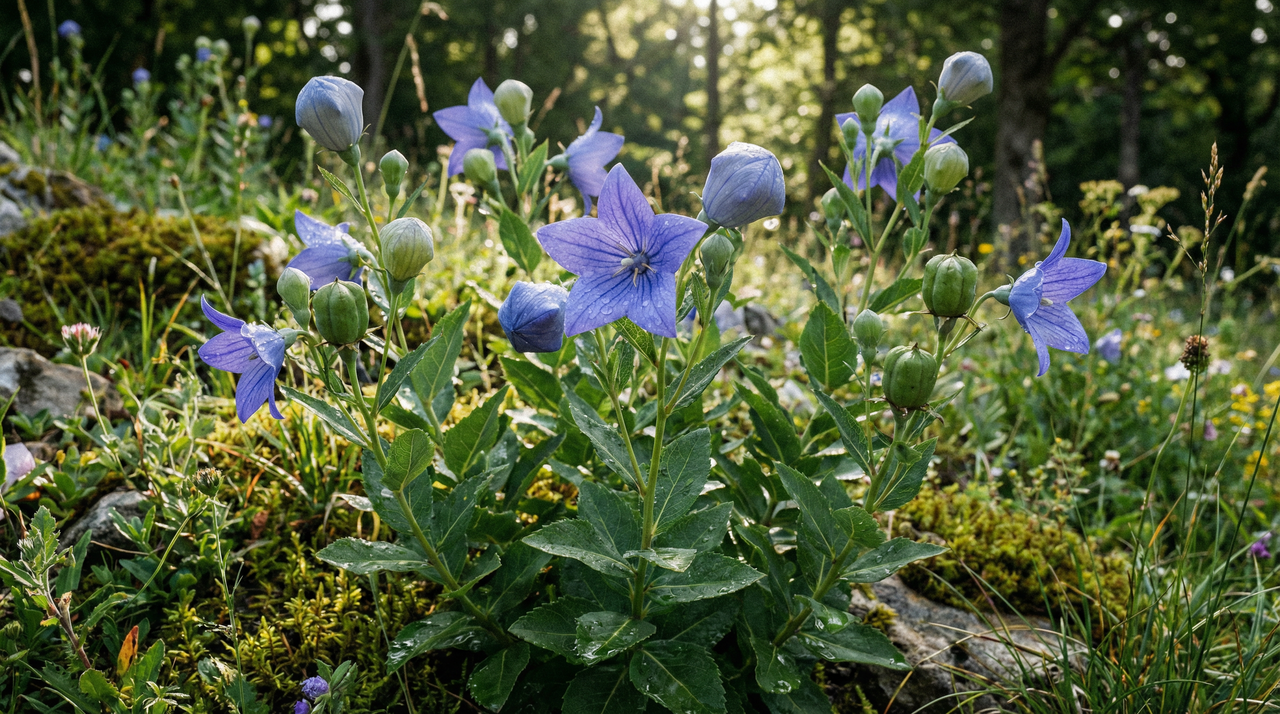
There's a moment, right before balloon flower opens, where the bud just sits there looking almost smug about itself. Five sepals fused into a perfect inflated sphere, taut as a tiny green lantern, and then slowly, over the course of a morning, it splits into a wide open bell with petals so cleanly sculpted they look almost artificial. I've watched that same drama play out in a Pennsylvania food forest, a coastal North Carolina herb bed, and a container on my own back porch, and it still stops me. But here's what I didn't understand for an embarrassingly long time: what I was admiring as an ornamental curiosity, Korean grandmothers were pickling. The root that I was treating as ornamental ballast has been a kitchen staple, a cough remedy, and a symbol of autumn longing across East Asia for over two thousand years.
Most Western gardeners know Platycodon grandiflorus strictly as a pretty border perennial, file it somewhere between salvia and coneflower, and move on. That's a real shame, because this plant carries a depth of use that most ornamentals simply can't match. It's the kind of plant that rewards you for paying closer attention.
Balloon Flower Origin, History, and Botany
Botanical Background and Native Habitat
Platycodon grandiflorus holds a distinction that's easy to overlook but actually quite remarkable: it's the only species in its entire genus, a true botanical singleton within the Campanulaceae family.[1][2] Native to temperate East Asia, spanning China, Korea, Japan, and the Russian Far East, this clump-forming herbaceous perennial grows wild in meadows, grasslands, forest edges, and open woodlands anywhere from sea level up to about 2,000 meters elevation.[3][4] Those native habitats experience brutal continental winters, sometimes plunging to -30°C or colder, which explains a lot about why this plant shrugs off conditions that flatten less-tested perennials.[5][6] It dies back completely each winter to a deep, fleshy, spindle-shaped taproot and resprouts from the base each spring, a polycarpic perennial typically living three to seven years in cultivation.[7][8] I've grown balloon flower from seed several times, and one thing I'll say upfront: patience is non-negotiable. It generally takes two full years from seed before you see your first flower.[9] The wait is worth it, but knowing that going in saves a lot of frustrated second-guessing in year one.
Visual Characteristics and Signature Balloon Buds
The plant forms upright clumps typically between 30 and 90 cm tall and 30 to 60 cm wide, with mostly smooth, erect stems carrying lanceolate to ovate leaves arranged alternately or in whorls.[4][10] Respectable enough as foliage goes, but nothing that would make you stop walking. The buds are a completely different story. Before the flowers open, the sepals seal tightly around a swelling interior and the whole thing puffs up into a perfect round balloon, roughly 1 to 2 cm across, before unfurling into wide, five-petaled bell flowers spanning up to 7.5 cm in shades of violet-blue, lavender, white, or pink.[11][12] Once you've seen it, the common name makes immediate, obvious sense. Below ground, that deep carrot-like taproot is what grants the plant its drought resilience once established, and it's also what makes mature plants genuinely difficult to move.[13][14] I now mark its location with a labeled stake the moment I plant it, because I learned the hard way that attempting to relocate an established plant is a losing proposition. Site it thoughtfully from the start.
Traditional and Cultural Uses Across East Asia
Documented medicinal use stretches back more than two thousand years, to the Shennong Bencao Jing (compiled around the 1st to 2nd century AD), where the root is listed under the name Jie Geng as a superior herb for lung and throat ailments.[15][16] Li Shizhen elaborated on it in the Bencao Gangmu in 1596, and Korea's Donguibogam (1613) describes the same root, called doraji, for expectorant, anti-inflammatory, and detoxifying purposes.[17][18] I'm not a practitioner of traditional Chinese or Korean medicine, but I find it genuinely compelling that independent medical traditions across several cultures arrived at nearly identical respiratory applications over centuries. Deliberate cultivation for these uses had already begun in Tang Dynasty China, shifting from wild harvest toward intentional growing long before Western herbalism paid it any attention.[18][19]
The plant's cultural reach goes well beyond the apothecary. In Korea, doraji root has been eaten since the Joseon Dynasty, prepared as a crisp, slightly bitter banchan alongside blanching and stir-frying to soften its bite.[20] The folk song Doraji Taryeong treats the act of gathering its root as a metaphor for longing and resilience.[21] In Japan it's called kikyo, one of the seven flowers of autumn, and carries symbolism of honesty, obedience, and enduring love.[22] Western horticulture discovered balloon flower in the 19th century and adopted it almost purely as an ornamental, which is a fraction of the story.[19] That global ornamental popularity arrived alongside growing pressure on wild populations; overharvesting for the medicinal trade has raised real sustainability concerns across parts of its native range.[23] Because of that, I only ever purchase nursery-grown plants or propagate my own from seed rather than sourcing anything wild-collected.
Fascinating Facts About Balloon Flower
Those dramatic inflating buds aren't just charming; they're the result of a precise physiological sequence. Rapid cell expansion, increased vacuolar volume, and hormonal signaling through auxins and gibberellins drive the inflation, making the bud more visible to pollinators while protecting the developing reproductive structures inside.[24][25] It reminds me a bit of the way certain poppy buds swell and split just before the petals burst out, that same sense of something barely contained. Watching it happen in the garden never gets old, even after all the seasons I've grown this plant. Below ground, that same deep taproot that drives me to plan its placement carefully also earns its keep ecologically, stabilizing soil in native grasslands and helping the plant persist as an early successional species in disturbed sites.[26][27] In the garden it's generally a low-fuss perennial that benefits from division every few years to stay vigorous, though it will protest root rot quickly in poorly drained soil and can occasionally naturalize beyond where you planted it.[28][29] Good drainage isn't optional with this one; it's the single biggest factor in whether your plant thrives for years or quietly disappears.
Balloon Flower Varieties and How to Source Them
One thing I appreciate about Platycodon grandiflorus is how consistent it is across cultivars. Nearly all of them, from 'Royal Velvet' to 'Mark Twain', share the same zones 3-8 hardiness.[30][31] So if you're in a temperate garden, you don't have to worry about a named selection suddenly being less cold-tough than the straight species. That reliability is the foundation; what the breeding work has actually focused on is habit, flower form, color, and disease resistance.[32][33]
Notable Balloon Flower Cultivars
The cultivars I reach for most often as a landscape designer are the ones that solve real problems. The Astra series (Astra Blue, Astra Deep Blue, Astra Pink) stays compact and tidy, which means no staking, no flopping, and reliable performance in containers or tight border edges.[34][30] I've specified balloon flower Astra Blue for clients with small urban gardens more times than I can count. Balloon flower Mariesii is another compact standout worth knowing, with violet-blue flowers on a naturally low, well-branched plant.
If humid summers are your reality, cultivar selection genuinely matters. I've watched standard Platycodon struggle with powdery mildew in muggy conditions, but selections like Sentimental Blue and Amazing Grace hold up noticeably better under the same care.[34][35] Balloon flower Sentimental Blue also offers that double-flowered look that reads as fuller and more lush in a mixed perennial planting. For white options, Alba, Shiro-kuma, and Amazing Grace all deliver clean white blooms; Amazing Grace specifically earns its keep with that disease resistance. Blue Sphere gives you dwarf habit with double blue flowers if you want maximum impact in minimum space.[36]
Sourcing Balloon Flower Plants and Seeds
Balloon flower is genuinely easy to find across the US, which isn't always true for plants I like this much. Big-box retailers like Home Depot and Lowe's carry starter plants in spring, and online specialists including Bluestone Perennials, Plant Delights Nursery, and High Country Gardens stock named cultivars with better variety selection. I personally prefer ordering plugs from specialty growers when I need a specific cultivar like 'Astra Deep Blue' or 'Twinkle Blue'; the plants establish faster than you'd expect and the selection is far better than most local nurseries.
Seeds from Johnny's Selected Seeds, Burpee, or Everwilde Farms typically run $3-6 per packet, a low-stakes way to trial balloon flower in quantity. Starter plants in 4-inch pots land around $5-12, one-gallon containers run $10-15, and larger 2-gallon specimens can reach $15-25 depending on the retailer and season. Spring is peak availability, so order early if you're after something specific like Astra Pink balloon flower or platycodon Pop Star Blue. Balloon flower isn't listed as invasive anywhere in the US,[37] so there are no planting restrictions to navigate. Just make sure wherever you're sourcing from, the plants look clean and healthy rather than root-bound; this genus resents transplant stress, and that's a topic worth knowing before you get them in the ground.
Balloon Flower Propagation and Planting Guide
Balloon flower is one of those plants that looks like it should be fussy about reproduction and isn't, mostly. Seeds are reliable, the plants divide reasonably well, and the main thing standing between you and a thriving colony is understanding one structural quirk: that taproot. Get that right from the start and everything else falls into place.
Seed Morphology, Storage, and Germination Requirements
The seeds themselves are small, maybe 2-3 mm long, ellipsoid to kidney-shaped, dark brown with a finely netted coat.[38][39] They're easy to handle once you know what you're looking at. What catches new growers off guard is the light requirement: these seeds need light to germinate, so surface sowing isn't a preference, it's the protocol. Press them lightly into a well-draining seed-starting mix and leave them uncovered.
Before sowing, 4-6 weeks of cold moist stratification at around 34-41°F breaks physiological dormancy and dramatically improves uniformity.[40][41] I keep leftover seed in a labeled jar in the refrigerator with a silica packet tucked inside; it's a habit from winter sowing prep that's saved me more than once when germination rates on unstratified seed turned out patchy. Many gardeners in warmer zones skip stratification and get acceptable results, but if you want the 60-80% success rates the literature cites, cold treatment is worth the patience.[31]
Start seeds indoors 10-12 weeks before your last frost date, keeping the mix at 65-75°F.[40] Germination typically happens in 10-21 days under good conditions. The good news on storage: platycodon produces orthodox seeds that tolerate drying to low moisture content and remain viable for 5-15 years stored in an airtight container in the fridge, or much longer at freezer temperatures.[42][43] A bag of seeds from a trade swap five years ago isn't necessarily compost material. If you're growing for medicinal root rather than ornament, plan your timeline now: roots reach harvestable maturity after 2-3 years from sowing.[44]
Propagation Methods: Seeds, Division, Cuttings, and More
For most home gardeners, the decision is simple: seeds if you want numbers or variety, division if you want clonal copies of a named cultivar. Balloon flower is primarily an outcrosser, with 70-90% of seed set depending on cross-pollination, so seed-grown plants will vary in height, flower size, and bloom time.[45][46] That variability is charming if you're filling a border; it's a problem if you bought 'Sentimental Blue' specifically for its double flowers and compact habit.
Division is the answer for cultivar fidelity, but it demands respect. Do it in early spring when shoots are just emerging, or in fall after dormancy sets in; never during active growth or flowering.[41] I learned the hard way that you need to dig far wider than the clump looks. The taproot descends well below the visible crown, and if you sever it carelessly, survival rates can drop below 50%.[31] Use a garden fork rather than a spade, go at least 10-12 inches out from the crown, and work slowly. Each division needs both roots and a shoot. After replanting, keep divisions consistently moist while they re-establish.
Semi-ripe stem cuttings taken from non-flowering shoots in summer, treated with rooting hormone and misted, can achieve 50-70% success.[45] Tissue culture on Murashige and Skoog medium gets 80-95% success in commercial settings. Grafting onto compatible Campanulaceae rootstock is occasionally attempted, but neither method is worth the bother for a home grower.[47][48] Seeds and careful division will get you everywhere you need to go. Whatever method you use, prioritize a well-draining starting mix with added perlite; damping-off in seedlings and root rot in divisions are both fundamentally drainage failures, not disease problems you need to spray your way out of.[41]
Soil, Site Selection, and Light Needs
If there's one thing I've seen sink more balloon flower plantings than anything else, it's poorly drained soil. This plant's native habitat on well-drained grassy slopes and forest edges in East Asia tells you everything you need to know about its preferences.[49] A fertile, loamy or sandy-loam soil with moderate moisture is the sweet spot; heavy clay without amendment is a slow death sentence via root rot.[41][50] In heavy soils, raised beds work well; 2-4 inches of compost tilled in or a generous perlite-to-soil ratio in containers will do the same job.
Soil pH in the 6.0-7.0 range produces the strongest growth and flowering, though the plant tolerates 5.5-7.5 without drama.[51] Push above 7.5 and you may start seeing interveinal chlorosis from iron and manganese deficiency; drop below 5.5 and expect stunted plants or worse.[52] I always recommend a basic soil test before planting perennials in a new bed. In one project, adjusting pH with sulfur made the difference between plants that sulked and ones that bloomed spectacularly, and it cost almost nothing to diagnose.
For light, full sun with 6 or more hours of direct sun daily produces the best flowering and the most compact, upright stems.[41] Partial shade (4-6 hours) is tolerable, particularly in hotter climates where afternoon shade paired with consistent moisture reduces heat stress; push into deeper shade and you'll get leggy, pale, underperforming plants.[50] Pick your site with both drainage and light in mind before you put a single seed in the ground.
Planting Spacing, Technique, and Establishment
Mature balloon flower plants reach 18-24 inches tall with a similar spread, hitting full size over 2-3 years.[41] Space standard-sized cultivars 12-18 inches apart in borders; I think of it the same way I space Campanula lactiflora, which has a similar clumping habit. Good air circulation between plants significantly reduces powdery mildew risk, and you'll be glad you left the room.[31] Compact Astra series and similar dwarf cultivars can squeeze down to 10-12 inches.[53]
When transplanting hardened-off seedlings or divisions, wait until after your last frost date and plant at the same depth as they were growing previously.[54] The taproot needs room to travel: aim for a minimum of 12 inches of loose, uncompacted soil depth, and 18-24 inches is better if you can manage it.[41] Water consistently for the first few weeks to ease transplant stress. One practical note: label your divisions when you plant them. The spring shoots emerge late and look remarkably like several other perennials waking up at the same time, and I've more than once nearly weeded out a clump I'd divided and replanted the previous autumn.
Balloon Flower Care Guide
For a plant that puts on such a theatrical show every summer, balloon flower asks surprisingly little in return. Once it's settled in, it's one of the most reliably low-fuss perennials I reach for in temperate border designs. The key is understanding the contrast at the heart of its personality: those thick, fleshy taproots are genuinely tough, surviving brutal winters and brief droughts without complaint, yet the plant above ground is sensitive to the two things that kill more perennials than anything else -- waterlogged roots and too much fertilizer. Get those two things right, and you're most of the way there.
Water Needs and Drought Tolerance
The basic rhythm is straightforward: about 1 inch of water per week during the growing season, applied deeply rather than frequently, letting the top inch of soil dry out between sessions.[55][56] Young plants need consistent moisture while they're building that taproot system, but once established, they can handle brief dry spells without much drama.[41][57] During winter dormancy, you can largely ignore them; the taproot survives dry winters with minimal intervention.[58]
I always tell clients to check soil moisture by feel rather than by schedule. Wilting new growth followed by browning leaf margins is the plant telling you it's thirsty; yellowing leaves, soft mushy stems, and a general collapse usually mean too much water, and root rot from Phytophthora can set in fast in those conditions.[59][60] If you're in a rainy climate or a heavy-clay situation, that drainage question matters more than how often you water.
Sunlight Requirements and Heat Management
Balloon flower blooms best with at least 6 hours of direct sun daily, and in most temperate zones full sun is ideal.[7][61] In warmer microclimates, though, I routinely spec it with afternoon shade. Prolonged heat above roughly 95°F stresses the plant significantly, and intense afternoon sun can cause leaf scorch, browning at the tips and margins, and what researchers call photoinhibition, where chlorophyll actually takes damage.[62][63][8] A taller perennial neighbor that casts dappled shade from midafternoon onward can make a meaningful difference. In designs for warmer sites within its zone 3-8 range, I've found pairing it with something like a tall ornamental grass or a mid-canopy astilbe handles that naturally without any extra fussing.
Feeding and Soil Fertility
Balloon flower prefers fertile, well-drained loamy soil with a pH between 6.0 and 7.0, though it tolerates a slightly wider range.[64][65] For feeding, I recommend a balanced slow-release fertilizer like a 10-10-10 in early spring as new growth emerges, with light follow-up applications every four to six weeks through midsummer.[66][67] The thing I've noticed running soil tests for landscape clients over the years is that this plant almost always needs far less nitrogen than people assume. Excess nitrogen produces tall, leggy stems with fewer flowers, exactly the outcome nobody wants.[68] Compost or well-rotted manure worked in at planting is often enough for average garden soil, and going organic means you're much less likely to overdo it. Stop fertilizing entirely by late summer; feeding into fall encourages tender growth that's vulnerable to frost and disrupts the dormancy the plant needs.[69]
Frost Tolerance and Winter Protection
Hardy across USDA zones 3-8, this is genuinely one of the toughest herbaceous perennials for cold climates. The roots can survive temperatures down to -40°F, which even the most cold-zone-obsessed gardeners find reassuring.[70][64] The vulnerability comes in spring. New emerging shoots are susceptible to late frosts below about 28°F, much like the tender new growth on hostas or emerging peony eyes -- things that zone 4 and 5 gardeners already know to watch.[71] A simple row cover thrown over the crown on a cold night is all it takes. In zones 3-5, applying 2 to 4 inches of organic mulch after the ground freezes in fall gives the roots an added buffer, and you peel it back gradually in spring as things warm up.[72][73] Any frost damage that does occur shows up as blackened, mushy tissue; prune it off in spring and the plant almost always bounces back from the roots.[74]
Pruning, Maintenance, and Seasonal Rhythm
Balloon flower is a herbaceous perennial through and through: basal rosette in spring, blooms from roughly June through August, then complete die-back to the taproot over winter.[12][75] That annual cycle is actually what makes the maintenance so manageable once you understand it. Early spring, when shoots reach about 6 to 8 inches, pinch the tips to encourage bushy compact growth; I learned this lesson the blunt way on one of my first landscape jobs, where un-pinched plants sprawled open by midsummer and looked entirely different from the tidy specimens in the design rendering.[76] Through the bloom season, deadhead spent flowers to extend the show and limit self-seeding. In late fall after frost, or in early spring before new growth emerges, cut all stems back to ground level.[7][31] Divide clumps every three to four years in spring to keep them vigorous; clients whose plantings I've maintained for over a decade have held their form beautifully on that schedule. Add 2 to 3 inches of organic mulch in spring once the soil warms, and you've essentially described the entire annual calendar for a plant that, once settled, genuinely takes care of itself.[61]
Balloon Flower Harvesting: Timing, Technique, and Yield
When and How to Harvest Balloon Flower Roots and Flowers
Most gardeners who grow balloon flower never think twice about the root. They're here for the flowers, and honestly, that's completely valid. The cut flower harvest is the more immediate reward: in mid to late summer, watch for buds that have swollen to that signature taut, 1-2 inch balloon stage, shifting from bright green to a pale green or light yellow.[8][77] I've started watching mine daily once midsummer heat kicks in because that color shift happens fast, sometimes over just a few days. Cut at that inflated-but-not-yet-open stage and you'll get the best vase life. If you want seeds instead, simply leave the blooms on the plant until the pods dry and start to split open naturally in late summer or early fall.
The root harvest is a different kind of patience altogether. Medicinal-quality roots need at least two to three years of growth, and the ideal window is autumn, after aerial parts die back completely, when the plant's energy has retreated underground and saponin concentration is at its peak.[44][78] Early spring, just before new shoots emerge, works as a secondary window if you miss the fall.[79] In my landscape designs, I'll sometimes let a clump establish for three or four years, then sacrifice one plant when I'm dividing anyway, turning routine maintenance into an opportunity to actually understand what the root looks and smells like firsthand.
Harvesting and Preparing Balloon Flower Roots for Use
For cut flowers, morning is your window. After dew has dried, cut stems at a 45-degree angle and get them straight into water.[8][80] Simple and satisfying.
Digging roots requires more care. A garden fork is your best tool here: work around the plant generously to avoid snapping that substantial taproot, then lift the whole clump with a slow, steady pull rather than yanking it straight up.[79][81] After growing these for years in landscape borders, I've learned that rough digging wastes the plant's stored saponins just as surely as harvesting too early. Once you have the root out, shake off excess soil, wash it thoroughly, then slice it into thin sections and dry it for storage.[78] A mature, harvestable root runs 1.5 to 3 cm in diameter, with chestnut-brown corky outer skin and yellowish to reddish-brown inner tissue.[7] Dried balloon flower root has a long shelf life when sliced thin and stored in a cool, dry spot away from light.
Balloon Flower Root Yield, Texture, and Flavor Profile
Raw, the root is crisp and slightly fibrous, with a mild slipperiness from saponins and a clean bitterness that reminds me of burdock or salsify before cooking.[78] Cook it and that transforms completely into something tender and chewy, with a flavor closer to water chestnut or radish, mildly sweet underneath the bitter edge. Young roots from the two-to-three-year mark are generally preferred for both texture and potency; what you're looking for is firm and flexible, never woody or shriveled.[77][78] That flexibility tells you the plant has stored real energy down there. The wait is long by annual-gardener standards, but what you get from a well-grown, properly timed harvest of dried platycodon root is genuinely different from anything you'd pull at the one-year mark. Patience here has a measurable payoff.
Balloon Flower Preparation and Uses
Culinary Uses of Balloon Flower Root (Doraji)
The root is where balloon flower earns its place in the kitchen. Known as doraji in Korea and Jie Geng in Chinese tradition, it appears in bibimbap, namul side dishes, japchae, pancakes, kimchi, and soups.[1][82] Raw, it's startlingly crisp, like a water chestnut with an assertive bitter edge.[83] That bitterness comes from saponins, and the first time I blanched home-grown roots, the water went genuinely foamy, almost soapy. It surprised me the same way my first burdock prep did. The fix is straightforward: peel, slice thin, blanch in salted boiling water for five to ten minutes, then rinse well.[83][84] Over several seasons I've refined my rinsing to two cold-water changes after blanching, and the result is genuinely tender, mildly sweet, with a subtle nutty undertone that pairs beautifully with sesame oil, garlic, soy sauce, gochujang, or a splash of vinegar.[85]
The root also carries antioxidants, vitamin C, vitamin E, and minerals including potassium, calcium, and iron[86], which reinforces why Korean cooks have treated doraji as more than a garnish for centuries. The Missouri Botanical Garden, USDA PLANTS Database, and Royal Horticultural Society all recognize the root as the primary edible part.[7][64][87] Young leaves and flowers can go into salads or serve as garnishes in small amounts, and the flowers make a pretty, mildly flavored edible decoration or herbal tea addition.[1] Seeds are not used culinarily. For foragers new to the plant, those distinctive inflated balloon buds before the flower opens are your reliable identification marker; they don't appear on lookalikes like Campanula, which opens directly into bells without ever inflating.[83]
Traditional Medicinal Preparations
The same root that goes into banchan becomes Jie Geng in the apothecary, used in Traditional Chinese Medicine to clear lung heat, ease coughs and sore throats, and act as an expectorant.[1][88] For a basic decoction, the American Herbal Pharmacopoeia guidelines suggest three to nine grams of dried root simmered in water for twenty to thirty minutes.[89] Tincture preparations run two to four milliliters at a 1:5 ratio, two to three times daily, and the root is classically paired with licorice root (Gan Cao) in traditional formulas.[90][91] If you're drying roots from your own garden, slice them and dry at 40 to 60°C in a well-ventilated space until moisture drops to around 10 to 12%, then store in airtight containers in a cool, dark spot; dried roots keep well for one to two years.[92][93] For medicinal-quality root, plants need at least two to three years in the ground before autumn harvest, with roots sliced and processed quickly at low temperature to preserve the platycodins.[94] I defer to a qualified practitioner on dosing specifics; my role is growing a healthy root, not prescribing one.
Safety Considerations
Balloon flower is generally considered safe at moderate culinary and traditional doses, but I've learned to take the saponin content seriously.[95] Excess saponins can cause mild gastrointestinal irritation, which is precisely why the blanching and rinsing steps matter for culinary use, and why medicinal dosing stays within three to ten grams of dried root daily.[95] As covered in the main health guidelines, medicinal use is firmly contraindicated during pregnancy.[95][96] Anyone on anticoagulants should also consult their healthcare provider before using it medicinally, given the root's mild antiplatelet activity.[97] Used thoughtfully within those boundaries, doraji is a genuinely rewarding plant to grow, cook with, and respect.
Balloon Flower Health Benefits
Most people plant Platycodon grandiflorus for those irresistible puffed buds and star-shaped summer blooms. What surprises many gardeners is that this cheerful ornamental has been treated as serious medicine for nearly two millennia. The root, known as Jie Geng in Traditional Chinese Medicine and Doraji in Korean herbalism, has been historically documented within these traditional systems, which prescribed it for coughs, sore throats, bronchitis, and phlegm accumulation by venting lung qi and promoting expectoration.[95][98][99] That's not a minor footnote. That's 1,800 years of practitioners reaching for the same root when a patient couldn't stop coughing.
Medicinal Research and Traditional Uses of Balloon Flower
The root is where the action is, chemically speaking. It contains triterpenoid saponins at 2 to 11 percent of root content, with platycodin D typically comprising 0.5 to 4 percent, alongside polysaccharides and flavonoids.[100][101] Modern research has started connecting those compounds to specific mechanisms: platycodin D inhibits NF-κB, MAPK, and NLRP3 inflammasome pathways, reduces pro-inflammatory cytokines like TNF-α and IL-6, and demonstrates antioxidant activity via Nrf2 activation and free radical scavenging.[102] The expectorant effect, which TCM practitioners described centuries ago as loosening phlegm and opening the lung, appears to work by relaxing bronchial smooth muscle and stimulating airway secretions. Preclinical models have also turned up antimicrobial, anticancer, immunomodulatory, anti-diabetic, hepatoprotective, and neuroprotective activities.[103][104] Impressive, but worth tempering: most of that evidence comes from in vitro and animal studies, not human trials.
Human clinical data does exist, though it's limited to small Asian RCTs. Those trials suggest that doses of 200 to 500 mg of polysaccharides per day, or up to 60 mg of extract daily, produce measurable symptom relief for cough and upper respiratory infections compared to placebo.[105][106] Larger RCTs are still needed. While I rely on that preclinical and small-trial evidence to feel confident recommending balloon flower as a respiratory ally, my respect for its 1,800-year history in TCM and Korean medicine reminds me that sometimes the oldest uses are the most reliable guides for home growers.
Key Phytochemicals in Balloon Flower
The full phytochemical picture goes well beyond platycodin D. Triterpene saponins as a class can reach 10 to 15 percent of dry weight in autumn-harvested roots, while the leaves concentrate flavonoids like apigenin, luteolin, and quercetin glycosides at 0.5 to 3 percent, and the flowers carry notable phenolic acids, including chlorogenic and caffeic acids, at around 5 to 10 mg per gram.[107][101] Polysaccharides make up another 5 to 30 percent of dry root weight depending on the source. No significant alkaloids have been identified.
Cultivation conditions strongly influence these phytochemical levels. Saponin content peaks in roots harvested in autumn (10 to 15 percent) versus spring (5 to 8 percent), climbs at higher altitudes, responds positively to nitrogen-rich soils with a boost of 20 to 30 percent, and holds highest in the 15 to 25°C temperature window at pH 6.0 to 7.0.[103][108] Drought stress also elevates levels. These compounds serve the plant as chemical defenses against insects, fungi, and herbivores, which is why the bitterness is so pronounced in fresh, underprepared root.[109] From a permaculture lens, that defensive chemistry is working double duty: protecting the plant in the ground while offering medicinal value at harvest.
Nutritional Profile of Balloon Flower
Balloon flower root reminds me of burdock in its earthy, chewy character after cooking, and the nutritional profile has a similar modest-but-useful quality. Per 100g of raw root, Korean food composition data shows roughly 38 to 58 calories, 88 to 90 percent water, 5 to 9g of carbohydrates, and around 1 to 2g of fiber.[110][111] Minerals include around 300mg potassium, 150mg calcium, and 2.5mg iron per 100g, along with modest magnesium, phosphorus, and zinc. Vitamin C runs 5 to 15mg in the root and up to 30mg in the leaves. There's no USDA entry to cross-reference, so these numbers come from Korean agricultural databases and should be taken as approximate.
The real nutritional story, though, is in the bioactives. The same saponins, polysaccharides, and flavonoids driving the respiratory benefits are present in a culinary serving of 30 to 50g, which means a bowl of doraji namul is doing quiet nutritional work alongside the pleasure of eating it.[112] Polysaccharide levels peak in autumn-harvested roots, aligning traditional harvest timing with both culinary and medicinal use. The root is a staple in Korean cuisine precisely because it's genuinely nourishing, serving as a versatile culinary ingredient after proper processing.[1][113]
Safety and Precautions for Balloon Flower
Balloon flower root has a reassuring toxicity profile at normal use levels. Animal studies put the LD50 for crude extract above 10g per kilogram body weight, and standard TCM practice calls for 3 to 9g of dried root daily as a decoction, or up to 10 to 15g for acute cases.[114][91] The plant is generally considered non-toxic to humans and pets at these levels, which is a comfort for those of us who grow it in gardens where curious animals wander through.
The caveats matter, though. Raw or improperly prepared root can cause nausea, vomiting, and digestive irritation because of those same saponins that make it medicinally useful. I've found that a thorough 2 to 3 hour soak in salted water followed by blanching reliably removes most of the bitterness and reduces saponin content by 20 to 50 percent, which aligns with both the safety data and the Korean culinary tradition.[115][116] Skip that step and you'll understand quickly why the preparation matters. Medicinal use is contraindicated in pregnancy due to risk of uterine contractions, and should be avoided during breastfeeding, with stomach ulcers, or with bleeding disorders. It may also potentiate diuretics, hypoglycemics, and anticoagulants, so anyone on those medications should consult a healthcare provider before using it therapeutically.[117]
The identification warning I give every client who grows this plant is the same one my horticultural training drilled into me: do not confuse balloon flower with foxglove (Digitalis purpurea). Balloon flower buds are rounded, inflated balloons that open into upward-facing, five-pointed star flowers. Foxglove produces tall spikes of downward-hanging tubular bells. They look nothing alike once you know what you're looking for, but in a crowded mixed border with young plants, the foliage can fool a casual eye. Foxglove contains cardiac glycosides that are genuinely dangerous. I always label my plants clearly and I'd encourage anyone harvesting roots for culinary or medicinal use to source from a reputable supplier until they're confident in their identification.[64][118]
Balloon Flower Pests and Diseases
Natural Defenses and Overall Resistance
Balloon flower has a genuinely low-maintenance reputation when it comes to pests and diseases, and that reputation holds up in the garden.[119][120] Part of the reason is chemistry: the same saponins (particularly platycodin D) that give the root its medicinal bite also function as insect deterrents, and the leaves have a fine pubescence that creates a physical barrier small pests find unwelcoming.[121] I've noticed those hairy leaves seem to deter aphids that happily colonize the smoother foliage of nearby Campanula or Lobelia, which says something about what a little leaf texture can do. Viral and bacterial problems are rarely reported in any major horticultural database, and no significant outbreak history has surfaced in RHS, Missouri Botanical Garden, or USDA records.[55][122][119][64] That said, "resistant" never means "immune," and a few predictable problems are worth knowing.
Common Insect Pests and Management
The pest list is manageable.
- Aphids cluster on new growth and cause leaf distortion and discoloration.
- Thrips leave silvery streaks and deform flowers.
- Spider mites show up as stippling and fine webbing on leaf undersides.
My approach follows integrated pest management principles: I start with hand-picking, proper spacing, and a strong spray of water before I reach for anything else, because those mechanical steps preserve the beneficial insects I rely on across the whole garden. Insecticidal soap or neem oil can address aphids and thrips when needed, and iron phosphate bait handles slugs without harming other wildlife.[31][123] If you're selecting plants for a humid climate prone to insect pressure, cultivars like 'Aphrodite' and 'Sentimental Blue' tend toward lower aphid susceptibility, and the RHS Award of Garden Merit selections, including 'Amabilis,' 'Crimson Queen,' 'Roseus,' 'Sakura,' and 'Bicolor,' have demonstrated reliable pest and disease performance across trials.[124][125] I routinely recommend those AGM selections to clients gardening in wetter, more humid regions.
Fungal Diseases, Environmental Triggers, and Prevention
Fungal disease is where balloon flower can catch you off guard, and root rot is the one I take most seriously. Phytophthora and Fusarium both thrive in waterlogged or poorly drained soil and can kill plants outright.[122][31] I lost a young clump to root rot early in my landscape work by planting into a clay-heavy bed that held water after every rain. Since then I always amend planting holes with coarse grit or perlite, and I haven't had a repeat. Powdery mildew, leaf spot (Septoria, Alternaria, or Cercospora), anthracnose, Botrytis blight, and downy mildew round out the fungal concerns, though they're far less lethal than rot when caught early.[122]
Every one of these problems has the same environmental fingerprint: humidity above 70 percent, temperatures between 60 and 75 degrees F, poor air circulation, and soggy soil.[126] Double-flowered cultivars are worth watching more closely because their dense blooms restrict airflow around the plant.[127] Prevention is straightforward: plant in well-drained soil, space plants 12 to 18 inches apart, water at the base, clean up debris in fall, and divide clumps every three to four years to keep them open and vigorous.[55][128] Sulfur-based fungicides can address powdery mildew if cultural fixes haven't been enough, but in my experience the disease rarely escalates when drainage and spacing are handled correctly from the start.[31]
Balloon Flower in Permaculture Design
Balloon flower earns its place in a thoughtful permaculture system not through flashy soil-building credentials but through consistency: it shows up, blooms reliably for months, feeds pollinators, minds its own space, and asks for almost nothing in return. That said, I want to be honest about where it performs effortlessly and where it needs a little design help from you.
Climate Adaptation and Hardiness Zones
Hardy from USDA zone 3 through 8, balloon flower can weather winter lows down to -40°F without complaint.[129][64] The Royal Horticultural Society rates it H5, meaning it's reliably hardy across most of the UK and continental Europe as well.[130] Its East Asian origins tell the real story: this plant evolved in temperate continental climates with cold dry winters, warm summers, and 20 to 40 inches of annual precipitation spread across distinct seasons.[131][132] It's a Midwest perennial at heart, and it shows.
Where things get complicated is in zone 9 and hotter humid regions. I learned this the hard way when I lost two clumps to root rot in my first Florida summer before I understood that drainage isn't just a preference for this plant, it's non-negotiable.[129][8] Now I always put it in a raised bed or amend heavily with grit and perlite when humidity is a factor. Raw temperature numbers also don't tell the whole story; a zone 8 garden in the Pacific Northwest performs very differently from a zone 8 garden in Georgia, and the balloon flower responds accordingly. If you're in the hotter, muggier end of its range, afternoon shade and extra spacing between plants help prevent the fungal issues that come with stagnant air.
Ecosystem Functions and Guild Roles
The headline permaculture value here is pollinator support, and it's backed up by real numbers. Bee-exclusion studies show over a 70% reduction in seed set when insect visitors are blocked, confirming that this plant is genuinely dependent on native pollinators and, in turn, genuinely feeding them.[133][134] I've spent entire mornings watching bumblebees wrestle those tightly inflated balloon buds open, and it never gets old. The flowers bloom from June through September,[41][135] bridging a gap that many spring bloomers leave behind, which makes them especially useful in a mixed pollinator guild.
Below ground, the deep taproot is doing quiet but meaningful work. It aerates compacted soil in a way that reminds me of what daikon or comfrey do, though on a more modest scale, and it forms arbuscular mycorrhizal associations that improve phosphorus uptake and drought tolerance once the plant is established.[64][31] Above ground, the mild saponin content offers a bit of natural pest repellency. I rarely see aphids on my balloon flowers, though I don't count on that as a standalone pest solution; it's a pleasant bonus in a diverse planting rather than a reason to skip other guild members.[136][137] Deer tend to leave it alone, and its seeds disperse by wind or ballistic ejection from drying capsules without smothering neighboring plants,[4] which is more than I can say for several other perennials I've tried in the same borders.
Forest Layer Placement and Companion Plants
Balloon flower sits firmly in the herb layer, reaching 12 to 36 inches tall with a spread of 12 to 18 inches depending on the cultivar.[138][139] In a food forest, it works well tucked into the woodland edge or understory margins where it catches several hours of direct sun without baking. Space plants 12 to 18 inches apart in borders or pollinator guilds,[140] with a little extra room in humid climates for airflow.
For balloon flower companion plants, I keep coming back to the same reliable combinations: hostas and ferns provide the afternoon shade that helps it through hot spells, while salvia, bee balm, and coneflowers extend the pollinator buffet across the season.[141][142] Astilbe is another natural pairing; its feathery texture contrasts beautifully with the bold balloon buds, and it appreciates similar moisture conditions without competing aggressively. One guild I return to often is balloon flower with salvia and ferns at a woodland edge, where the ferns handle erosion on the slope, the salvia draws early-season bees, and the balloon flower carries the pollinator load through late summer.
It's worth being clear-eyed about what balloon flower won't do. It's not a dynamic accumulator in the way comfrey or yarrow are; it won't mine potassium or pump nitrogen into the system.[143] What it does offer is months of pollinator support, deer resistance, decent soil aeration, and a clump-forming habit that stays exactly where you put it. In my temperate-style borders, that combination often makes it the smarter low-effort choice over something more aggressive that would need constant management to keep in check.
The Plant That Made Me Stop and Actually Watch a Flower Open
I've knelt beside a lot of plants over the years, but balloon flower is the one that turned me into a person who sets a timer. There's something quietly absurd about a bud that inflates like a tiny lantern before it splits open, and I've never gotten tired of watching it happen. My kids think I'm ridiculous. They're probably right.
Sources 143
- Platycodon grandiflorus - Wikipedia ↩
- Kew Science: Plants of the World Online - Platycodon grandiflorus ↩
- Flora of China: Platycodon grandiflorus ↩
- Platycodon grandiflorus - Missouri Botanical Garden ↩
- Missouri Botanical Garden Plant Finder ↩
- Platycodon grandiflorus - Royal Horticultural Society ↩
- Platycodon grandiflorus - Missouri Botanical Garden ↩
- Platycodon grandiflorus Overview - North Carolina Extension Gardener ↩
- Royal Horticultural Society - Platycodon grandiflorus ↩
- Platycodon grandiflorus - RHS ↩
- Platycodon grandiflorus - Plants of the World Online (Kew Science) ↩
- Platycodon grandiflorus (Balloon Flower) ↩
- Platycodon grandiflorus - Flora of North America ↩
- Plants of the World Online: Platycodon grandiflorus ↩
- Shennong Bencao Jing ↩
- History of Platycodon in East Asian Medicine ↩
- Dongui Bogam ↩
- The Ethnopharmacology of Platycodon grandiflorus: A Review ↩
- Platycodon grandiflorus (Balloon Flower): Ethnopharmacology and Conservation ↩
- Korean Functional Foods: Composition and Health Benefits ↩
- Doraji Taryeong: The Balloon Flower Song in Korean Folklore ↩
- Kikyo: Symbolism in Japanese Flower Culture ↩
- Sustainability Challenges in Traditional Chinese Medicine: The Case of Jie Geng ↩
- Morphology and Development of the Flower Bud in Platycodon grandiflorus ↩
- Hormonal Regulation of Flower Bud Inflation in Balloon Flower ↩
- Royal Horticultural Society: Platycodon grandiflorus ↩
- Plants of the World Online: Platycodon grandiflorus ↩
- Platycodon grandiflorus ↩
- How to Grow Balloon Flower ↩
- Platycodon grandiflorus - Missouri Botanical Garden ↩
- Balloon Flower Cultivars - University of Minnesota Extension ↩
- Missouri Botanical Garden - Platycodon grandiflorus ↩
- Royal Horticultural Society - Platycodon grandiflorus Cultivars ↩
- Platycodon grandiflorus Cultivars ↩
- Common Pests and Diseases of Balloon Flower ↩
- Royal Horticultural Society - Platycodon grandiflorus ↩
- Invasive Plant Atlas of the United States ↩
- Seed Morphology of Campanulaceae ↩
- Embryo Development in Platycodon grandiflorus ↩
- Seed Biology of Platycodon grandiflorus: Dormancy and Germination Traits ↩
- Platycodon grandiflorus ↩
- Seed Storage of Horticultural Crops ↩
- Orthodox Seed Storage Guidelines - Kew Millennium Seed Bank ↩
- Platycodon grandiflorus Cultivation and Harvesting Guide ↩
- Propagation of Balloon Flower (Platycodon grandiflorus) ↩
- Reproductive Biology of Platycodon grandiflorus ↩
- Micropropagation of Platycodon grandiflorus: Protocol and Success Rates ↩
- Propagation Techniques for Campanulaceae ↩
- Flora of China - Platycodon grandiflorus ↩
- Platycodon grandiflorus - Balloon Flower ↩
- Platycodon grandiflorus ↩
- University of Illinois Extension - Gardening Guide ↩
- Royal Horticultural Society Plant Advice ↩
- Missouri Botanical Garden - Platycodon grandiflorus ↩
- Platycodon grandiflorus - Missouri Botanical Garden ↩
- Platycodon grandiflorus - Royal Horticultural Society ↩
- Kew Gardens - Platycodon grandiflorus Cultivation ↩
- Missouri Botanical Garden Plant Finder ↩
- Missouri Botanical Garden Plant Finder ↩
- Root Rot in Perennials ↩
- Balloon flower - Royal Horticultural Society ↩
- Light Stress in Ornamental Plants ↩
- Photoinhibition and Plant Stress ↩
- USDA PLANTS Database - Platycodon grandiflorus ↩
- Royal Horticultural Society - Platycodon grandiflorus ↩
- Platycodon grandiflorus (Balloon Flower) - Missouri Botanical Garden ↩
- University of Illinois Extension - Perennial Flowers Fertilization ↩
- Balloon Flower Care: How To Grow And Care For Balloon Flower Plants ↩
- Growing Balloon Flowers: Tips for Platycodon Care - The Spruce ↩
- Platycodon grandiflorus - RHS Gardening ↩
- Frost Damage on Perennials - University of Minnesota Extension ↩
- Platycodon grandiflorus - RHS Gardening ↩
- Missouri Botanical Garden Plant Finder ↩
- Perennial Winter Protection Guide ↩
- Platycodon grandiflorus - Kew Royal Botanic Gardens ↩
- Missouri Botanical Garden - Platycodon grandiflorus ↩
- Platycodon grandiflorus ↩
- Korean Pharmacopoeia: Platycodonis Radix ↩
- Cultivation and Harvesting of Platycodon grandiflorus ↩
- Postharvest Handling of Cut Flowers Including Balloon Flower ↩
- Growing Balloon Flower (Platycodon grandiflorus) ↩
- Balloon Flower Root (Doraji) - Korean Bapsang ↩
- Platycodon - Wikipedia ↩
- Saponins in Platycodon grandiflorus: Extraction and Removal Methods - PubMed ↩
- Aroma Characteristics of Traditional Chinese Medicinal Herbs ↩
- Platycodon grandiflorus: A comprehensive review of its botany, bioactive compounds, and pharmacological properties ↩
- Royal Horticultural Society - Platycodon grandiflorus ↩
- Medicinal Uses of Platycodon grandiflorus - NCBI ↩
- Balloon Flower Root (Jie Geng) - American Herbal Pharmacopoeia ↩
- Traditional Chinese Medicine Dosage Guidelines - Sacred Lotus ↩
- Jie Geng (Platycodon Root) in Traditional Chinese Medicine - American Dragon ↩
- Post-Harvest Processing of Medicinal Plants ↩
- Chinese Pharmacopoeia 2020 Edition - Platycodonis Radix ↩
- Cultivation of Jie Geng (Platycodon Root) for Medicinal Use ↩
- Platycodon grandiflorus - An ethnopharmacological review ↩
- Toxicity and Safety of Herbal Medicines ↩
- Drug Interactions with Herbal Medicines ↩
- Doraji (Platycodon grandiflorus) in Korean Medicine ↩
- Platycodon grandiflorus in Traditional Chinese Medicine ↩
- Phytochemical and Pharmacological Review of Platycodon grandiflorus ↩
- Chemical Composition of Platycodon grandiflorus: A Review ↩
- Platycodin D, a bioactive component from the root of Platycodon grandiflorum, inhibits NF-κB activation and inflammatory response ↩
- Pharmacological Activities of Platycodin D: A Review ↩
- Phytochemical and Pharmacological Review of Platycodon grandiflorus ↩
- Clinical Efficacy of Jie Geng in Cough and Respiratory Infections ↩
- Randomized Trial of Jie Geng for Acute Upper Respiratory Tract Infection ↩
- Phytochemical Constituents and Pharmacological Activities of the Genus Platycodon: A Review ↩
- Optimization of Cultivation Conditions for Platycodon grandiflorus Saponins ↩
- Secondary Metabolites of Platycodon grandiflorus: A Review ↩
- Nutritional Information on Doraji (Platycodon Root) ↩
- Korean Food Composition Database - Rural Development Administration ↩
- Chemical Composition and Health Benefits of Platycodon grandiflorus ↩
- Doraji (Balloon Flower Root) - Maangchi ↩
- Safety and Toxicity of Jie Geng (Platycodon grandiflorus) ↩
- Balloon Flower: Edible Uses and Benefits - Eat The Weeds ↩
- Chemical Composition and Biological Activities of Platycodon grandiflorus ↩
- Interactions and Contraindications of Platycodon ↩
- Safety of Balloon Flower - Royal Horticultural Society ↩
- Royal Horticultural Society - Platycodon grandiflorus ↩
- Royal Horticultural Society - Platycodon grandiflorus ↩
- Missouri Botanical Garden Plant Finder: Platycodon grandiflorus ↩
- Diseases of Bellflower - ScienceDirect ↩
- Balloon Flower (Platycodon grandiflorus) Care and Pests ↩
- RHS Plant Trial: Platycodon grandiflorus ↩
- Royal Horticultural Society Platycodon grandiflorus Cultivars ↩
- Powdery Mildew on Ornamental Plants ↩
- Platycodon grandiflorus Care and Diseases ↩
- Royal Horticultural Society - Balloon Flower Care ↩
- Missouri Botanical Garden Plant Finder - Platycodon grandiflorus ↩
- RHS Plant Finder - Platycodon ↩
- Plants of the World Online - Platycodon grandiflorus ↩
- Missouri Botanical Garden Plant Finder: Platycodon grandiflorus ↩
- Pollination Biology of Platycodon grandiflorus in Native Habitats ↩
- Xerces Society - Pollinators and Native Plants: Balloon Flower ↩
- Platycodon grandiflorus - RHS Gardening ↩
- Xerces Society - Pollinators and Native Plants: Balloon Flower ↩
- Balloon Flower Plant Profile ↩
- Kew Plants of the World Online - Platycodon grandiflorus ↩
- Missouri Botanical Garden - Platycodon grandiflorus ↩
- Missouri Botanical Garden - Platycodon grandiflorus ↩
- Balloon Flower Cultivation - UC ANR ↩
- Companion Planting for Pollinators ↩
- Permaculture Plants: Platycodon grandiflorus ↩