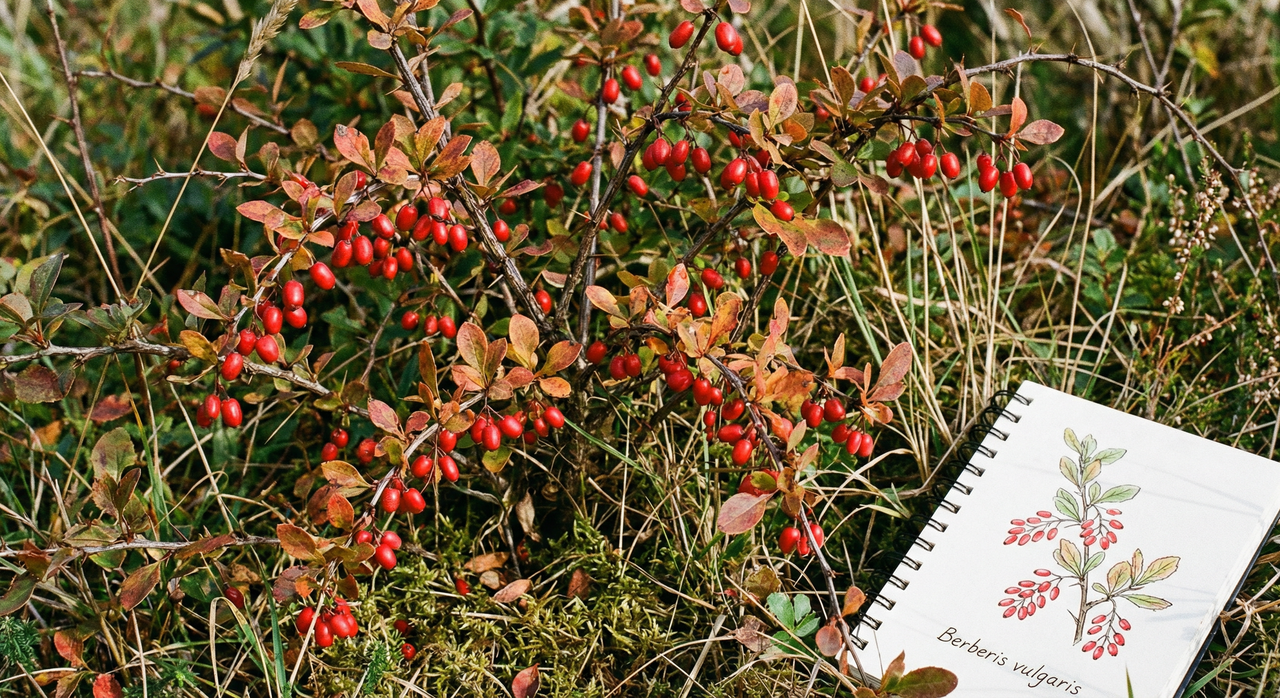
Barberry got banned from American farms not because it was toxic, not because it spread aggressively (though it does), but because it was killing wheat. Specifically, it was harboring wheat stem rust, Puccinia graminis, a fungal pathogen that wiped out entire harvests across the Great Plains in the early 20th century.[1] The U.S. government launched a coordinated eradication campaign that ran for decades and removed an estimated 500 million barberry plants. Five hundred million. I grew up in the Midwest and never heard a word about it.
That story sits underneath everything worth knowing about this plant. Barberry isn't complicated to grow; it's genuinely tough, productive, and beautiful in the right hands. But it carries a regulatory and ecological history that most ornamental plant tags quietly ignore, and I think growers deserve the full picture before they dig a hole. The thorns, the tart red berries, the alkaloid-loaded roots with a surprising amount of clinical research behind them, the birds that eat those berries and scatter seeds into wild places: it all connects. And once you see the whole thing, you'll understand why I have a complicated fondness for this shrub that I haven't quite managed to shake.
Origin and History of Barberry (Berberis vulgaris)
Botanical Background and Native Range
European barberry, scientific name Berberis vulgaris, is a deciduous woody shrub native to a sweeping arc of temperate terrain, from Scandinavia and central Europe south to the Mediterranean, across northwest Africa, and east through western Asia to the Caucasus.[2][3][4] It's a long-lived plant, capable of persisting 20 to 50 years in the wild, reaching sexual maturity in as few as three to five years from seed, and then flowering and fruiting repeatedly for the rest of its life.[3][5] That combination of early fruiting and lifelong productivity is part of what made it so appealing as a garden and hedging plant across centuries.
The trouble is that European barberry is an alternate host for wheat stem rust (Puccinia graminis), and that single ecological fact has shaped its entire North American story.[3][6] The plant is now listed as invasive or prohibited in 19 U.S. states, and before you consider growing it anywhere in the Northeast or Midwest, checking your state's current quarantine list isn't optional.[7] I do this as a matter of routine before every client project in those regions. It takes five minutes and it's the difference between responsible horticulture and an expensive removal job.
Visual Characteristics and Identification
In the landscape, Berberis vulgaris is hard to confuse once you know what to look for. The stems are upright to arching, distinctly zigzagged, and armed with sharp three-pronged thorns, one to three centimeters long, that start reddish-brown and weather to gray over time.[8][3] Those zigzag stems and three-pronged thorns are the first thing I look for when I'm trying to distinguish B. vulgaris from Japanese barberry (Berberis thunbergii), which has straighter canes and simpler single spines. It's a distinction that only clicks after you've pruned both species with the same pair of gloves on the same afternoon.
The leaves cluster in rosettes on short shoots, elliptical to obovate, with spiny-toothed margins, dark green above and paler below, turning red to orange in autumn.[8][9] Spring brings pendant clusters of small bright yellow flowers, ten to twenty per raceme, followed by oblong red berries, seven to fifteen millimeters long, that ripen in late summer and hang on through winter.[10][11] Birds eat those berries readily. Mammals largely avoid them because the berberine makes the fruit unpalatable, which also helps explain the plant's spread across disturbed landscapes.[11] My reliable in-field genus confirmation is a fresh pruning cut: the inner bark is unmistakably bright yellow.[12] I use that marker every time before I confirm a plant's identity in a client hedge.
Traditional and Cultural Uses Across Continents
The documented history of barberry as a medicinal plant goes back to the first century AD, appearing in both Dioscorides' De Materia Medica and Pliny the Elder's Naturalis Historia, where it was prescribed for jaundice, urinary complaints, fevers, and digestive disorders.[13][14] Medieval Europe added culinary and folkloric dimensions: the sour berries substituted for citric acid in cooking and winemaking, the roots and bark yielded a yellow dye, and the thorny shrub was planted near homes to repel evil spirits and witches, its association with the Christian crown of thorns adding another layer of symbolic weight.[15][16]
Further east, the berries became a kitchen staple in Persian cuisine, where they're known as zereshk and appear in rice dishes and Nowruz celebrations as symbols of vitality.[17] Turkish folk medicine employed the plant for wounds, gastrointestinal complaints, and general tonics.[18] Running parallel is a separate but equally deep tradition built around Berberis aristata, known in Ayurveda as Daruharidra, which has been documented in the Charaka Samhita and Sushruta Samhita since roughly 600 BCE.[19] Growing at elevations of one thousand to three thousand meters in the western Himalayas, this species has its own ritual importance in Hindu festivals and its own conservation crisis, because wild populations are being overharvested for berberine-rich roots and bark.[20][21] As a horticulturist I strongly prefer cultivated, verified sources for any berberine-containing plant, and that preference only gets stronger when I read the sustainability data. North American Indigenous medicinal uses attributed to barberry almost always refer to native species like B. aquifolium, not the introduced European plant.[22]
From European Gardens to North American Invasive: A Cautionary Tale
European barberry arrived in North America in the 1600s, brought over for ornamental planting and hedgerows, and it escaped cultivation with impressive efficiency. Dense thickets, allelopathic soil chemistry, and first-year seedling survival rates above 70 percent allowed it to outcompete native understory plants across the northeastern and midwestern states.[23][5] The wheat stem rust connection accelerated the regulatory response: eradication campaigns begun in the early twentieth century reduced rust incidence significantly across North American grain belts, though the fungus can still complete its cycle on other hosts, and USDA APHIS continues to restrict sale and movement of susceptible Berberis species today.[24][25]
The name itself traces to the Arabic barbaris for the fruit, while vulgaris simply means common.[9] Older texts sometimes list Berberis vinifera, the wine-bearing barberry, as a synonym, a nod to those medieval winemakers who added the sour berries to acidify their casks; it's not a valid species, just a historical footnote now absorbed into B. vulgaris.[15] In its native European range the plant is still a cherished part of hedgerows and traditional gardens, tolerating drought, poor soils, and alkaline conditions while feeding birds with berries that deter most mammals, which is precisely the ecological resilience that made it such a problem once it landed somewhere with no co-evolved checks on its spread.[5][26] When clients in regulated states ask me about barberry, I always steer them toward sterile cultivars or non-host alternatives, and I verify the current state list before anything goes in the ground.
Barberry Varieties and Cultivars
Notable Varieties and Cultivars of European Barberry
Before you fall in love with a cultivar, you need to know where you live. Berberis vulgaris is banned or heavily restricted in a long list of US states, including Massachusetts, Minnesota, New York, North Dakota, South Dakota, Washington, Kansas, Wisconsin, and Michigan, because it hosts wheat stem rust and has naturalized invasively in over 30 states.[3][27] Early in my career I spec'd 'Atropurpurea' for a client hedge and only discovered after the fact that the county had a local prohibition. I now run every barberry selection through the state's noxious-weed list before it ever touches a planting plan.
Where it is legal to grow, the wild-type European barberry is a 6 to 10 foot thorny deciduous shrub with clean spring foliage, fiery autumn color, and clusters of tart red berries that hang into winter.[28] Named cultivars are relatively limited compared to other ornamental shrubs. 'Atropurpurea' gives you deep purple-red foliage and reaches into USDA zone 4a. 'Aurea' offers golden-yellow leaves that glow in partial shade. 'Compacta' stays tight and dense for smaller spaces. 'Coccinea' earns its place with vivid winter stems and berries, while var. gerda stands out as a compact selection with better rust resistance than the species.[29][30] Foliage color and compact habit are the main selling points; rust resistance matters most for anyone in agricultural grain regions.
If you've walked through a mainstream garden center and marveled at compact, jewel-toned barberries, you were almost certainly looking at Japanese barberry (Berberis thunbergii), not the European species. Berberis thunbergii has a far wider cultivar palette: 'Crimson Pygmy' tops out around two feet, 'Orange Rocket' grows in a tight column with blazing fall color, and 'Rose Glow' offers variegated pink and red foliage at four to five feet.[31] I've managed both in client landscapes, and the Japanese cultivars have a more refined, less aggressively suckering character than a well-established European hedge. California barberry (Mahonia pinnata) and Indian barberry (Berberis aristata) round out the genus for native-adapted and medicinal use respectively, though both have few named ornamental forms.[32][33]
Sourcing Barberry Plants Responsibly
Before you click "add to cart," check your state's current noxious-weed list. These regulations change, and USDA APHIS governs interstate movement of susceptible cultivars, often requiring permits or phytosanitary certificates.[34][35] Where it's legal, states like Illinois, Pennsylvania, and Ohio have the best commercial availability through nurseries such as One Green World, Sheffield's Seed Company, and Horizon Herbs. Expect to pay $15 to $40 for bare-root stock, $20 to $35 for one-gallon containers, and $3 to $10 for seed packets.[36][37] Bare-root is the most economical option, but it demands careful spring planting before the roots dry out. I've lost a few bare-root shipments to delayed planting, so I treat them like a time-sensitive ingredient.
Indian barberry is a specialty find, typically sourced through ethnobotanical vendors like Strictly Medicinal Seeds, with live plants ranging from $15 to $100 and seeds from $5 to $50.[38] For readers primarily interested in berberine rather than the shrub itself, standardized supplements are widely available online for $10 to $30 per bottle.[39] If you're in a region where planting common barberry is prohibited or ecologically risky, I genuinely steer people toward Mahonia species instead. They deliver similar wildlife value and medicinal chemistry without the rust-vector liability.[40]
Barberry Propagation and Planting (Berberis vulgaris)
Before anything else: check your state regulations. Berberis vulgaris is banned or restricted in New York, Illinois, Michigan, Washington, North Dakota, South Dakota, and several other states because it acts as an alternate host for wheat stem rust (Puccinia graminis) and has become invasive across much of the northeastern and midwestern U.S.[41][42][43] Every Berberis species can host rust diseases, so propagation material must come from visibly healthy, disease-free stock, and any rust-infected material should be destroyed rather than composted.[44][42] I say this not to scare anyone off, but because the consequences of hosting wheat rust are serious enough that I check my state's current regulations every time before propagating any barberry, even for a client who's been growing the species for years without issue.
Propagation Methods for Barberry
Barberry gives you plenty of options. For home gardeners, the simplest starting points are division and layering. Digging and separating rooted suckers from an established plant in spring is about as low-tech as propagation gets, and since the plant suckers readily, you'll often find divisions already waiting for you at the base.[45][46] Simple or air layering of low branches in spring achieves 70 to 90 percent success under moist, humid conditions, with roots forming in four to eight weeks; you sever the layer after a full year.[47][48] Layering is my preferred method when I need a quick, reliable clone without any fuss over humidity chambers or hormone powders.
Cuttings are the next step up. Softwood taken in late spring or early summer, treated with IBA rooting hormone at 3,000 to 5,000 ppm and kept at 18 to 24°C with 70 to 80 percent humidity in a perlite-vermiculite mix, roots at 60 to 80 percent.[49][50][51] Semi-hardwood in late summer runs 50 to 80 percent under similar conditions; dormant hardwood cuttings drop to 40 to 60 percent and aren't worth the bother unless that's your only window. Grafting onto B. thunbergii or B. vulgaris rootstock using whip-and-tongue or cleft methods in late winter hits 70 to 90 percent success and is mainly useful when you want a cultivar to fruit faster than seedlings allow.[52][53]
Seed is the most complicated route and, honestly, the least predictable. European barberry seeds are physiologically dormant and often polyembryonic, with two to six embryos packed into a single dark seed.[54][5] They need 90 to 120 days of cold moist stratification at 2 to 5°C before germination at 15 to 20°C, with success rates of 20 to 70 percent depending on seed lot.[55][56] Seeds store well under orthodox conditions: dried to 3 to 10 percent moisture and refrigerated, viability holds for two to five years, and even longer at freezer temperatures.[57][58] The catch is that seedlings are highly variable; I grew a batch once and found dramatic differences in thorn density, fruit size, and overall form among siblings from the same berry. They also take four to six years to fruit. Unless you're breeding or experimenting, vegetative propagation gives you far more predictable results. Indian barberry (B. aristata) needs a shorter cold treatment of just 30 to 60 days or a GA3 soak as an alternative, while Japanese barberry requires scarification before stratification.[59][60]
Soil, Site Selection, and Planting Requirements
Barberry's native habitat tells you a lot: rocky slopes, hedgerows, and woodland edges across Europe and western Asia, from sea level up to 1,600 meters, typically on well-drained, calcareous ground.[61] That origin explains why poor, dry, or even gravelly soils don't faze an established plant. Good drainage is the one non-negotiable: waterlogging causes chlorosis, stunting, and root death.[62][28] Before I planted barberry on a heavy clay site for a client, I dug a test hole and watched the water drain out. It didn't, so we spent an afternoon incorporating grit and compost. The result was a healthy, thriving hedge; skip that step and you get a yellow, struggling shrub.
Target a soil pH of 6.0 to 7.5 for best results; the plant tolerates a broader range of 5.5 to 8.0 but develops iron deficiency chlorosis in alkaline soils above 7.5 and risks aluminum toxicity below 5.0.[5] Full sun gives you the densest growth and heaviest berry set, though partial shade is workable. Amend heavy clay before planting, then set the root ball with its top sitting level with or just slightly above the soil surface; minimum soil depth should be 18 to 24 inches to accommodate the fibrous root system, which typically spreads 12 to 24 inches rather than driving a deep taproot.[63][64] Finish with two to three inches of organic mulch to hold moisture and moderate soil temperature.
Spacing, Timing, and Planting Technique
European barberry reaches six to ten feet tall and wide with a growth rate of 12 to 24 inches per year, suckering outward as it matures.[65][9] I space planting barberry the way I space rugosa rose: two to three feet apart for an impenetrable hedge, four to six feet for border specimens. In my experience, the tighter hedge spacing fills in within three years, though it does demand regular monitoring for suckers that escape the intended footprint. In fertile soil, push specimen spacing to eight to ten feet so plants don't crowd each other before you've had a chance to intervene.
Early spring after the last frost or early fall four to six weeks before the first frost are both good windows in USDA zones 4 to 8.[29][66] Fall planting is my preference: the roots get a full cool season to settle before summer heat arrives. Water deeply right after planting, then maintain consistent moisture without waterlogging through the first year. Once established, barberry is genuinely drought-tolerant, but that first growing season is when consistency counts.
Barberry Care Guide: Growing Berberis vulgaris Successfully
Barberry is one of those plants that makes you look like a genius after the first two years -- but those first two years require actual attention. I've watched gardeners plant these thorny beauties, ignore them through the hottest stretch of summer, and wonder why their hedge looks half-dead by September. The short version: establish it properly, and it'll outlast you. Rush that phase, and you'll fight it all season.
Watering Needs for Establishment and Drought Tolerance
New transplants need about an inch of water per week, or a deep soak every seven to ten days, for the first one to two growing seasons.[64][67] That seems obvious until you learn it the hard way, which I did early in my career when I underwatered a barberry hedge on a slope and overwatered the replacement planting out of guilt. Root rot from the second attempt was worse than the drought stress from the first. Deep, infrequent watering beats shallow daily misting every time. Water when the top two to four inches of soil are dry. If you're seeing wilted foliage and scorched leaf tips, check soil depth before you reach for the hose again.[68]
Overwatering signals are distinct: yellowing lower leaves, soft stems, and the mushy black roots that confirm Phytophthora is already visiting.[69][68] Once established in zones 4-8, though, barberry essentially shrugs off drought for weeks at a time.[3][64] Consistent moisture still improves fruit production, so if you're growing for the berries, don't abandon irrigation entirely in dry summers. Soil pH between 6.0 and 7.5 is the sweet spot, with tolerance stretching to 5.5-8.0; it also handles moderate salinity up to around 4-6 dS/m without complaint.[30][70]
Soil, pH, and Fertilization Requirements
Before I do anything with a new barberry planting, I test the soil. After years of doing this I almost never fertilize established plants at all -- and the lush, weak growth I once produced with a high-nitrogen 20-20-20 application taught me that lesson permanently. Leggy shoots, sparse flowers, fewer berries. Barberry is a light feeder by nature, and fertile, well-drained loam is genuinely all it asks for in most situations.[71][72]
If a soil test shows a genuine deficiency, a balanced slow-release 10-10-10 at one to two pounds per 100 square feet in early spring is appropriate; anything heavier pushes vegetative growth at the expense of flowering.[73] For food-forest and medicinal plantings, I reach for compost or well-rotted manure instead; they improve soil structure without the risk of tipping the plant into excess.[74][29] Soil testing every two to three years keeps you honest.[74]
When something does look wrong, the symptoms tell you where to look: nitrogen deficiency shows up as yellowing on older leaves with stunted growth; phosphorus deficiency produces purplish discoloration and weak roots; potassium deficiency causes marginal browning and soft stems.[75] The one I see most often in alkaline soils above pH 7.5 is iron deficiency -- interveinal chlorosis on the youngest leaves, where the tissue goes pale yellow between green veins.[71][72] It's the same pattern I'd see on my citrus in higher-pH soil, and the fix is the same: a chelated iron drench gets those new leaves greening up within a couple of weeks.
Sunlight and Heat Tolerance
European barberry is rated for USDA zones 4-8 and AHS heat zones 4-7, meaning it can handle stretches of hot weather with reasonable grace.[30] Above 95°F with inadequate soil moisture, though, you'll see leaf scorch, wilting, and bleaching -- the plant's own heat-stress response involves proline accumulation and antioxidant enzyme activity, which you can think of as its internal sunscreen, but there are limits.[76] Flowering also suffers during extreme heat; pollen viability drops above roughly 32-38°C, which delays or reduces fruit set.[77]
Two to four inches of organic mulch, deep infrequent irrigation, and good airflow handle most summer stress without drama.[78] For clients gardening in the hotter end of zone 8, I often recommend Japanese barberry cultivars over B. vulgaris; they tend to perform better through sustained high temperatures and give more cultivar options suited to that heat.[79]
Frost Tolerance and Winter Protection
This is where European barberry genuinely impresses. Mature plants are hardy to approximately -30°F, surviving deep cold that would finish off a long list of other ornamentals.[3][80] The caveat is young growth in late spring and early fall; soft new shoots and emerging buds can take damage below 28°F, showing as blackened tips, necrotic spots, and shoot dieback.[81] Plants almost always recover, but it's worth noting that new transplants are more vulnerable than established shrubs.
My winters rarely test these cold limits, but I still apply three inches of pine bark around new transplants every fall after the ground starts to firm up. The one season I skipped it, I saw root heaving on a planting that had looked perfectly settled. Mulch after the ground freezes, keep it away from the stem, and use burlap or row cover for extreme cold snaps if the plant is in its first year.[82] If you're choosing between barberry species for a colder site, Indian barberry (zones 5-9) and Delavay's barberry (zones 6-9) are meaningfully less cold-hardy than the European species and won't handle prolonged deep freezes as well.[45]
Pruning, Maintenance, and Seasonal Rhythm
Before any pruning conversation, the rust-host issue: before I specify Berberis vulgaris for any client, I check the local ag extension list. In many states it's simply not allowed near wheat fields, and I respect that agricultural history. Sucker removal is equally non-negotiable for containment; let those suckers go and you'll be managing a thicket rather than a shrub.[83]
On pruning timing: the flowers that open April through June produce the red-to-coral berries that ripen by July-October and often persist through winter.[84][3] Prune immediately after flowering -- late spring to early summer -- and you preserve next year's buds without sacrificing fruit.[83][45] I've maintained barberry hedges for clients for years, and that two-session schedule -- light shaping after flowers fade, then thinning of crowded interior branches in late winter for airflow -- keeps them tight and productive without sacrificing the fruit display. Heavy pruning in fall is the mistake to avoid; it stimulates tender new growth that goes into cold weather unprepared.[83]
A two-to-three inch mulch layer applied in spring handles moisture retention and weed suppression through the growing season; keep it pulled back from the stems.[85][86] Very young transplants in exposed, windy sites may benefit from temporary staking, but once the root system is established, you're mostly watching the calendar. Yellow spring flowers give way to fruit, fruit ripens as leaves color in fall, then the plant drops its leaves and goes dormant -- a clean deciduous cycle that actually reduces frost vulnerability compared to evergreen alternatives. The persistent berries after leaf drop are what I design around; that's the winter interest clients ask for, and barberry delivers it without fuss once you've put in the early work.
Harvesting Barberry: Timing, Technique, and Post-Harvest Handling
Patience is the real prerequisite for harvesting barberry. You'll see small fruit clusters forming in the second or third year, but anything resembling a meaningful crop from European barberry usually doesn't arrive until years four or five, when established bushes can yield anywhere from two to five kilograms per plant, and more in a particularly good season.[29][87] Once that wait is over, the payoff is genuinely satisfying.
When to Harvest Barberry Berries
European barberry runs a 90 to 120 day window from spring flowering to ripe fruit, landing most temperate gardeners in the August through October harvest range.[29][78] The reliable cues are color, texture, and that characteristic brightness: berries should be fully red, plump, slightly yielding to gentle pressure but not mushy, and hitting a Brix of roughly 12 to 18% if you have a refractometer handy.[88] In my humid Central Florida conditions, I've learned to trust full color development above everything else and to harvest a few days earlier than I think I need to. Waiting for textbook perfection in high humidity usually means losing berries to sudden softening or birds who are watching just as closely as I am.
Indian barberry (Berberis aristata) moves faster, with fruit maturing in just 45 to 60 days and ripening as early as May or June at higher Himalayan elevations, shifting to July through September at lower altitudes.[89][90] The ripeness cues are similar: look for 80 to 90% red to purplish-red coloration and slight berry softening as sugar content rises.[91]
Harvest Methods and Yields
Wear thick gloves. That's less advice and more a hard lesson I learned the first time I tried to strip barberry clusters barehanded. The clusters remind me of tiny grapes hanging on thorny stems, and that mental image actually shaped how I harvest now: I reach in with pruning shears and clip whole clusters rather than picking individual berries. It's faster, gentler on the fruit, and keeps your hands a reasonable distance from the thorns.[92] Go out in the early morning before temperatures climb, and skip harvest days that are rainy or muggy to lower your risk of Botrytis and fruit softening.[92][93] Once you're back inside, rinse clusters in cool water, pull out any damaged fruit, and get them down to 0 to 4°C as quickly as you can.[92][94]
Flavor Profile and Post-Harvest Storage
Raw barberry is not subtle. The high organic acid content combined with berberine delivers a sharp, sour-bitter punch that most people find too intense to eat straight off the bush.[29][88] Cooking or sweetening softens both edges considerably, which is exactly why barberry has been a staple of Persian rice dishes and European preserves for centuries. Indian barberry shares that sour-bitter core but adds earthy, citrus-forward aromatics that work beautifully in Himalayan chutneys and curries.[95]
For storage, fresh cleaned berries refrigerate well for two to three weeks with good humidity control.[92] For longer shelf life, dried barberry is the real workhorse: dry at 40 to 60°C until moisture drops to 15 to 18%, then seal in airtight containers kept cool, dark, and below 60% relative humidity, where they'll keep for one to two years.[94][96] I've tried both oven-drying and shade-drying in my Florida climate, and shade-drying consistently gives me better color in the finished dried barberry. The low-and-slow approach protects those anthocyanins in a way that even a careful low-temperature oven sometimes can't match.
Barberry Preparation, Uses, and Safety
Culinary Uses of Barberry Berries
Those clusters of fully ripe, bright red berries are where Berberis vulgaris earns its place in the kitchen. Persian cuisine has known this for centuries: zereshk polo, the classic rice pilaf scattered with dried barberries, is beloved precisely because the berries cut through buttery richness with a tartness that sits somewhere between a cranberry and an unripe red currant.[97][98] British and German traditions use them in jams, jellies, chutneys, and vinegars for much the same reason. The acidity is assertive enough to balance fatty meats like lamb, venison, or pork in a way few fruits can.[99][100] That sourness comes primarily from malic, citric, and ascorbic acid, with a thread of bitterness from berberine underneath it.[101] The berries are also genuinely nutrient-dense, delivering high vitamin C and dietary fiber alongside potassium, calcium, and iron.[102][103]
Nobody eats them raw with any enthusiasm; the intensity is too much straight off the branch.[104] What transforms them is heat. A quick simmer of five to ten minutes, discarding the first water, mellows both the sharpness and the berberine load significantly, and dried berries develop a concentrated, almost earthy depth that raw ones never have.[105][106] I've noticed that berries from the sunnier, drier spots in my garden taste slightly sweeter and less aggressively bitter once cooked, which makes sense given how stress and sun exposure influence alkaloid and acid accumulation. A quick cooking step is the single most important thing a home cook can do.
One thing I always stress: only the fully ripe, red fruit of Berberis vulgaris belongs in the kitchen.[3] Unripe berries concentrate far higher levels of berberine and related alkaloids that can cause nausea, vomiting, and diarrhea.[107][108] Roots, bark, and stems are a different matter entirely and not food. I also label my barberry rows carefully because young shrubs can look similar to other species at first glance, and confident identification matters before you harvest anything.[109] For anyone pregnant or on anticoagulants like warfarin, I keep this simple: skip it entirely. The evidence on berberine's uterine-stimulating effects and its inhibition of CYP3A4 and CYP2D6 enzymes is clear enough that I keep barberry strictly culinary in my household and consult a qualified herbalist for anything concentrated.[110] Culinary amounts of properly prepared ripe berries are generally well tolerated by healthy adults; the risks scale up fast with unripe fruit, non-fruit plant parts, or concentrated extracts.
Medicinal Preparations and Dosages
The bridge between barberry's kitchen role and its medicinal one is berberine concentration. Ripe berries contain relatively modest amounts; roots and bark are where the alkaloid is richest, and preparation method determines how much of it you're actually delivering. Standard adult dosages in clinical use run 500 mg of berberine two to three times daily, totaling 900 to 1,500 mg;[111][112] the European Medicines Agency also references dry extract equivalent to 10 to 20 mg berberine daily for traditional registered use. Common preparations include a 1:5 tincture in 60% alcohol dosed at 1 to 2 ml up to three times daily, decoctions from root or bark for extracting the tougher constituents, and poultices for external anti-inflammatory application.[113] Ayurvedic tradition around Berberis aristata uses 1 to 3 g of root bark powder or 20 to 30 ml decoction twice daily, with modern standardized extracts sitting at 500 to 1,000 mg per day.[114] I grow the plant and prepare the berries at home, but for anything beyond that I defer to these guidelines and a qualified practitioner.
Traditional Non-Food Uses
The same roots loaded with berberine that make this plant medicinally potent have historically served a completely different purpose: dyeing. Bark from Berberis vulgaris and related species produces a vivid, warm yellow on wool, leather, and textiles, and this use spans medieval Europe through the Himalayas.[115] I've experimented with small-scale berry dyes for food-safe coloring and landed on a soft gold-amber with an alum mordant; the root bark would give something far more saturated. Beyond dye, Berberis aristata bark fiber has been twisted into ropes and coarse cloth, the dense wood worked into tool handles and small implements, and spent material converted to charcoal or fuel.[87][116] And then there's the hedge. That same ferociously spiny growth that makes barberry a challenging neighbor in a food forest also makes it one of the most effective living barriers in the traditional landscape toolkit, historically used for erosion control and stock exclusion in one persistent, low-maintenance planting. A single shrub: dye, medicine, food, fiber, hedge, and wildlife habitat. That's a permaculture guild participant in one package.
Barberry Health Benefits and Medicinal Uses
When people ask me why barberry deserves a place in a permaculture garden beyond its ornamental value, the answer almost always starts underground. The roots and bark of this plant carry a phytochemical punch that has driven its use in traditional medicine across three continents, and understanding that chemistry helps you work with the plant more deliberately, whether you're growing it for food, for medicine, or simply to understand what you've got in the ground.
Key Phytochemicals: Berberine, Flavonoids, and Phenolics
Berberine is the compound that defines barberry medicinally, and it's not evenly distributed across the plant. In Berberis vulgaris root bark, berberine typically makes up 4–6% of dry weight, with total alkaloids reaching 5–8%.[117][118][119] Stems run noticeably lower, leaves lower still, and the ripe berries you're most likely to eat contain only trace amounts, around 0.1–0.5 mg/g.[117] Indian barberry (B. aristata) is even more concentrated, with stem bark reaching 10–15% berberine by dry weight, which is part of why it's been the preferred medicinal species in Ayurvedic practice for centuries.[118]
Berberine isn't just a pharmaceutical curiosity. It's a plant defense compound, evolved to deter herbivores and suppress pathogens.[120] That ecological function is precisely what makes it pharmacologically interesting. I've found that in my own garden, plants grown in full sun with good drainage produce noticeably more bitter root tissue than those struggling in heavier, shadier spots, and the research backs this up: altitude, alkaline soil, sun exposure, and plant maturity can push alkaloid levels 20–30% higher than stressed or shaded specimens.[121][122] Timing matters too: berberine peaks in autumn, so I harvest root bark then and the resulting tinctures are visibly darker and considerably more bitter than anything I've made from spring material.
The berries and leaves tell a different phytochemical story. They're rich in phenolics (20–50 mg/g dry weight), quercetin, rutin, kaempferol glycosides, and anthocyanins, which contribute meaningful antioxidant activity even without high berberine.[123][124] So the plant has two distinct phytochemical profiles depending on which part you're working with, and conflating them leads to confused expectations about what you're actually getting.
Evidence-Based Medicinal Benefits of Barberry
Traditional medicine systems from Europe to Ayurveda to traditional Chinese medicine converge on root bark as the primary medicinal part, used for digestive complaints, infections, liver ailments, skin disorders, and fever.[11][125] The berries have their own traditional role treating diarrhea and dysentery, which makes sense given berberine's well-documented antimicrobial properties.[126]
Where the clinical evidence gets genuinely strong is metabolic health. Multiple meta-analyses confirm that berberine, typically at 500–1500 mg per day in divided doses, produces clinically meaningful improvements in blood glucose, insulin sensitivity, and lipid profiles in people with type 2 diabetes and hyperlipidemia, with some trials showing effects comparable to pharmaceutical interventions.[127][128][129] The mechanism is AMPK activation, which you can think of as turning up the body's metabolic signaling, improving how cells take up and process glucose.[130]
Beyond metabolism, berberine shows anti-inflammatory action through NF-κB inhibition and reduced TNF-α and IL-6 signaling, along with antioxidant effects via Nrf2 activation, hepatoprotective properties, antimicrobial activity, and some preclinical evidence for apoptosis induction in cancer cell lines.[117][131] Most of those secondary actions remain preclinical, and the trials study isolated berberine, not whole-plant barberry preparations. I always flag that distinction with clients: the research on berberine is solid; the leap to unprocessed root bark tinctures involves considerably more variability.
Nutritional Profile of Barberry Berries
The ripe berries are where barberry earns its place in the kitchen. They're intensely tart, reminiscent of cranberries or underripe rose hips, and that sourness comes with real nutritional substance. Per 100 grams raw, they deliver 23–69 mg of vitamin C, 284–665 mg of potassium, useful amounts of calcium and iron, and a solid dose of antioxidant anthocyanins and phenolics.[132][133] Macros are modest, around 30–36 kcal with 7–27 g carbohydrates and up to 25 g fiber depending on ripeness and variety, plus small amounts of protein and fat.[134][135]
Drying concentrates most of those nutrients but degrades vitamin C, and cooking leaches water-soluble vitamins into the cooking liquid.[133] If you want the vitamin C, eat them fresh or minimally processed. B. aristata berries show a similar nutritional profile with impressively high dried mineral content, up to 18 mg iron and 1400 mg potassium per 100 g in dried form.[136] The key practical point is that the fruit's berberine content is genuinely low, so culinary use doesn't carry the same cautions as medicinal use of roots or bark.
Safety, Dosage, and Contraindications
Start with what's safest: fully ripe berries are the lowest-risk part of this plant, and misidentification with Mahonia (Oregon grape) is common enough that I label my barberry shrubs explicitly and learned early on to distinguish them by leaf shape and thorn pattern before harvesting anything.[137] Non-fruit parts are a different matter. High berberine intake from roots, bark, or stems can cause nausea, vomiting, diarrhea, drowsiness, and hypotension, and in serious cases, jaundice or organ stress.[111][138] Livestock and pets are susceptible too, so placement in a family garden matters.
On drug interactions: berberine inhibits CYP3A4, CYP2C9, CYP2D6, and P-glycoprotein, which creates real interaction risks with warfarin, antidiabetic medications, antihypertensives, cyclosporine, and certain antidepressants.[139] If you're on blood thinners or diabetes medication, or if you're pregnant, I do not recommend medicinal use of barberry beyond culinary amounts of the ripe berries. The research on berberine's uterine-stimulant effects and its risk to neonates (kernicterus) is clear, and I take it seriously in my consultations.[140]
For adults using supervised berberine supplementation, 500–1500 mg per day in divided doses for up to 4–6 weeks is the typical studied range, with mild gastrointestinal side effects occurring in roughly 10–20% of users.[141] Traditional Ayurvedic processing of B. aristata uses specific preparation methods to reduce alkaloid toxicity before therapeutic application, which is a reminder that traditional systems weren't naive about potency.[142] I don't harvest non-berry parts for medicinal use without knowing my plants' age and growing conditions well, and I always recommend clients work with a qualified practitioner rather than self-dosing from garden-foraged material.
Barberry Pests and Diseases
Barberry's chemistry is genuinely impressive as a first line of defense. Berberine and related alkaloids act as feeding deterrents against aphids, leafminers, and beetles, and those physical spines do real work too.[143][144] I think of it like neem or other bitter-leaved plants where the chemistry does most of the heavy lifting. Healthy, well-sited barberry plants rarely need intervention beyond occasional monitoring.
Common Pests of Barberry
The usual suspects are aphids (particularly Rhopalosiphum spp. and Aphis fabae), spider mites, scale insects, leafminers, leaf beetles, and gall midges.[145][146] Severity tends to land in the moderate range (3–7 out of 10) and correlates strongly with plant stress; a barberry struggling in compacted soil or getting too much shade is far more vulnerable than a thriving one.[147] In humid conditions I watch new growth for aphid colonies in spring, but I rely on the resident ladybugs and lacewings rather than reaching for a spray bottle. Broad-spectrum insecticides knock out those natural enemies and make the problem worse in the long run.[148]
Major Diseases and Rust Concerns
The disease issue that genuinely changes how you site and select barberry is wheat stem rust (Puccinia graminis f. sp. tritici). European barberry serves as the alternate host where the pathogen sexually reproduces and generates more virulent strains; this drives the strict local planting bans and eradication protocols previously discussed.[5][149][150] Extension severity ratings put wheat rust risk at 8–10 out of 10 in susceptible agricultural zones, compared to 5–7 for more manageable foliar issues like anthracnose or downy mildew.[147] If you garden near wheat fields, this is exactly why your extension agent may ask you to remove the plant.
Beyond rust, powdery mildew (Erysiphe berberidis) shows up as white coatings on leaves and stems when humidity climbs above 80% and temperatures sit in that 15–25°C sweet spot.[151][152] Leaf spot fungi (Alternaria, Cercospora, and relatives) can cause dark necrotic lesions and defoliation when leaves stay wet and warm for extended periods.[151][153] Crown and root rot from Phytophthora cactorum is the one that really worries me; it moves fast in waterlogged or alkaline soils, and a wilted berberis that won't recover after rain is often telling you the roots are already compromised.[154][155] All of these flare under the same conditions: high humidity, poor air circulation, and overhead watering.[156]
Cultivar selection is the first decision that shapes all of this. In my designs near agricultural areas I steer clients toward rust-resistant Japanese barberry selections or named cultivars of B. vulgaris like 'Atropurpurea', 'Crimson Pygmy', and 'William Penn' that show improved resistance.[157][78] Species like Indian barberry (B. aristata) tend to have higher alkaloid concentrations and generally show lower overall disease incidence than European barberry under comparable conditions, a useful reminder that the genus isn't monolithic.[158][159]
Integrated Management and Prevention
Most barberry problems I've seen trace back to siting rather than bad luck. Proper spacing, pruning to open the canopy, watering at the base rather than overhead, pulling debris from around the root zone, and keeping soil drainage honest will prevent the majority of fungal issues before they start.[154][152] When those cultural basics are in place, beneficial insects handle most pest pressure on their own.[148] If chemistry does become necessary, sulfur works for mildew and triazole fungicides like myclobutanil address rust, but these are backup tools, not a routine.[160][161] For anything region-specific, especially if you're in wheat country where regulatory removal of susceptible barberry may be required, your local Cooperative Extension service will always give more accurate advice than any general guide.[162][163]
Barberry Permaculture Design and Ecosystem Roles
Barberry is one of those shrubs that a permaculture designer can get genuinely excited about and genuinely worried about, sometimes in the same breath. What it offers ecologically is real and documented. What it can do to a landscape where it doesn't belong is also real and documented. A good site assessment means holding both of those truths at once, so let's work through them in that order.
Climate Adaptation and Hardiness Zones for Barberry
European barberry is cold-hardy in USDA zones 4 through 8, with cold tolerance down to roughly -30°F to -35°F, and some subspecies pushing into zone 3 territory near -40°F.[3][8][104] It performs best in average annual temperatures between 40°F and 70°F, with summer highs tolerable up to around 90-100°F before stress sets in.[104][30] One climate requirement that often gets overlooked is its need for 1,000 to 1,500 hours of winter chilling below 7°C.[164] In my experience, plants that consistently hit that chilling threshold produce noticeably heavier berry set the following autumn. If you're in a marginal zone and wondering why your barberry looks healthy but fruits sparsely, chilling hours are usually where I'd start looking.
Once established, it's moderately drought-tolerant, performing best with 20 to 40 inches of annual rainfall but surviving on as little as 12 to 15 inches.[28][3] It prefers well-drained, moderately fertile soil at pH 6.0 to 7.5, and it does well from full sun into partial shade. Naturally, it gravitates toward edge habitats: fencerows, open woodlands, forest margins, the kind of structurally complex transitional zones that permaculture designers intentionally try to create.[5][56] That affinity for edges is worth keeping in mind when you think about where to place it in a guild.
Across the broader Berberis genus, the hardiness picture shifts depending on species. Japanese barberry (B. thunbergii) tolerates temperature swings from -25°F to 100°F across zones 4 through 8.[165] Indian barberry (B. aristata) is better suited to zones 5 through 9, with cold hardiness to around -20°F and a preference for cooler, more humid montane conditions.[45][166] That species-level variation matters when you're choosing which barberry actually fits your microclimate and your regulatory context, because in North America, the regulatory context is unavoidable.
European barberry is invasive in parts of the Northeast and Midwest, and it serves as an alternate host for wheat stem rust (Puccinia graminis), triggering planting restrictions or active eradication programs in many agricultural areas.[167][168][30] Check your local regulations before you plant, full stop. This isn't a minor caveat to tuck into a footnote.
Ecosystem Functions of Barberry in Permaculture
Set aside the invasiveness question for a moment and the ecological resume is genuinely impressive. The bright yellow racemes open in spring, typically April through May, and they arrive early enough to feed bees, hoverflies, and butterflies when very little else is blooming.[8][169] I think of it the way I think about mahonia or forsythia: it's not flashy compared to a full summer bloom, but to a queen bumblebee in April, that early pollen matters enormously. Flowers are hermaphroditic, primarily insect-pollinated, and under good pollinator conditions the plant achieves fruit-set rates of 70 to 90%.[28]
Come autumn, those bright red berries feed more than 30 bird species, including thrushes, waxwings, and robins, along with small mammals.[170][5] The dense, spiny structure doubles as shelter and nesting habitat for birds, small mammals, insects, and reptiles. I've watched a barberry hedge go bare of berries by mid-winter while the thorns continue excluding deer from whatever is planted behind it. That's the dual function of a really well-placed shrub layer plant working for you on two fronts simultaneously.
As a dynamic accumulator, barberry cycles phosphorus, potassium, calcium, and trace minerals, and its root system stabilizes slopes and controls erosion while leaf litter contributes to soil organic matter.[171][5] The berberine and other alkaloids also appear to confer some pest-repellent properties against insects, aphids, and certain herbivores. Indian barberry mirrors most of these functions in its native Himalayan range, including pollinator support, wildlife food and shelter, erosion control on steep slopes, and dynamic accumulation of potassium and phosphorus, without the same North American invasiveness flags.[172][173]
Now, the flip side. Birds that eat those berries disperse seeds widely, and barberry also spreads vegetatively through root suckers.[5][174] The same allelopathic compounds, berberine and phenolics, that deter herbivores also inhibit germination and alter soil microbial communities in ways that suppress neighboring vegetation.[175] A thorny thicket that feeds birds and resists deer is a useful thing in your design. A thorny thicket that is steadily expanding and suppressing the native understory you're trying to encourage is a problem. The vigor doesn't separate from the risk.
Forest Layer and Guild Integration for Barberry
Structurally, barberry belongs in the shrub layer. It's a deciduous, upright-to-arching, multi-stemmed shrub typically reaching 1 to 3 meters (occasionally 4 meters), and it thrives at forest edges and under partial canopy cover from oaks, pines, or similar overstory trees.[3][8][176] It forms arbuscular mycorrhizal associations that support nutrient uptake and can act as a nurse plant, helping other species establish on disturbed edges or unstable slopes.[177][172]
In its native European and Asian ranges, that combination of food, cover, pollinator resources, and mycorrhizal support genuinely enhances local biodiversity. In North America, the dense thickets, allelopathic soil chemistry, and role as an alternate host for wheat stem rust and white pine blister rust have the opposite effect, reducing native plant diversity and triggering regulatory restrictions.[175][178][179] Because European barberry can host wheat stem rust, I don't plant it near vegetable gardens or orchards in regions where the disease is a concern. The research on that interaction is decades old and conclusive; it's not a theoretical risk worth gambling on.
Where it is legally permissible and ecologically appropriate, the most defensible placement I've found is as a managed boundary element: a thorny backing hedge along the outer edge of a shrub guild, paired with nitrogen-fixing Elaeagnus or Siberian pea shrub on one side and productive berry bushes like currants or gooseberries toward the interior. That arrangement lets barberry do its actual jobs, early pollinator forage, wildlife shelter, and deer exclusion, without giving it the open-ended space to sucker into the rest of the system. Aggressive monitoring and regular sucker removal are not optional. They're part of the maintenance contract if you're going to grow this plant responsibly in North America. For growers in regions where B. vulgaris is restricted, Indian barberry (B. aristata) offers a comparable shrub-layer profile with less invasiveness baggage, particularly in montane or cooler humid climates where its native conditions are more closely replicated.[180][181] The genus has real gifts to offer; the job of the designer is to deploy them where those gifts don't become liabilities.
The Plant That Made Me Read the Fine Print
I planted my first barberry before I fully understood what I was working with, and that humbling experience made me a more careful designer. There's something about a plant this ancient, this chemically complex, and this ecologically fraught that demands you sit with the whole picture before you reach for a shovel. I still grow it, but I earned that decision slowly, and I think that's exactly how it should be.
Sources 181
- USDA ARS: Wheat Rust Timeline ↩
- Berberis vulgaris - Missouri Botanical Garden ↩
- Berberis vulgaris -USDA PLANTS Database ↩
- Berberis vulgaris - Plants of the World Online (Kew Science) ↩
- Berberis vulgaris - USDA Forest Service ↩
- Barberry and Wheat Stem Rust ↩
- Invasive Plant Atlas - Berberis vulgaris ↩
- Berberis vulgaris - Missouri Botanical Garden ↩
- Berberis vulgaris - RHS Gardening ↩
- Berberis vulgaris - Missouri Botanical Garden ↩
- Berberis vulgaris - Kew Royal Botanic Gardens ↩
- Flora of North America: Berberis ↩
- De Materia Medica by Dioscorides ↩
- Naturalis Historia ↩
- The Role of Barberries in Medieval Winemaking ↩
- Medieval Herbals and Symbolism ↩
- Persian Cultural Symbols ↩
- Ethnobotanical Survey of Medicinal Plants in Turkey ↩
- Berberis aristata in Ayurveda - Charaka Samhita References ↩
- Ethnobotany of Berberis Species in the Indian Himalaya ↩
- Sustainability Challenges in Berberis Harvesting ↩
- Native American Ethnobotany: Berberis Species ↩
- Invasive Plant Atlas: Berberis vulgaris ↩
- Barberry and Wheat Stem Rust - USDA ARS ↩
- Regulation of Barberry Plants in the United States ↩
- Ecology of Berberis vulgaris in European Forests ↩
- Barberry Rust Regulations - USDA APHIS ↩
- Berberis vulgaris - Missouri Botanical Garden ↩
- Berberis vulgaris cultivars - Royal Horticultural Society ↩
- Barberry Varieties - Missouri Botanical Garden ↩
- Missouri Botanical Garden Plant Finder - Berberis thunbergii ↩
- Mahonia pinnata - Wikipedia ↩
- Berberis aristata ↩
- Barberry Regulation ↩
- State Noxious Weed Lists ↩
- Berberis vulgaris - Buy Online ↩
- Barberry Seeds - Berberis vulgaris ↩
- Berberis aristata Seeds ↩
- Berberine Supplement Pricing on Amazon ↩
- Plant Conservation Alliance: Berberis vulgaris ↩
- USDA Plants Profile: Berberis vulgaris ↩
- Wheat Stem Rust and Alternate Hosts ↩
- Invasive Plant Atlas: Barberry ↩
- Cedar-Apple Rust Management Guide ↩
- Berberis vulgaris (European Barberry) ↩
- Growing Barberry from Seed and Cuttings ↩
- Cuttings and Layering Techniques for Woody Plants ↩
- Propagation of Berberis Species ↩
- Woody Plant Propagation Techniques ↩
- Propagation of Barberry Shrubs ↩
- Rooting Cuttings of Woody Plants ↩
- Propagation of Woody Ornamentals: Berberis ↩
- Grafting Techniques for Deciduous Shrubs ↩
- Embryogeny in Berberis vulgaris L. ↩
- Seed Dormancy and Germination in Berberis vulgaris ↩
- Flora of North America: Berberis vulgaris ↩
- Seed Storage Behaviour Database ↩
- Kew Seed Information Database - Berberis vulgaris ↩
- Seed Germination of Berberis aristata DC: Breaking Seed Dormancy ↩
- Japanese Barberry - Berberis thunbergii ↩
- Flora Europaea (via GRIN/Kew Gardens) ↩
- Berberis vulgaris - Royal Horticultural Society ↩
- Planting and Care of Barberry Shrubs ↩
- Berberis vulgaris Growing Guide ↩
- Missouri Botanical Garden Plant Finder - Berberis vulgaris ↩
- Barberry (Berberis spp.) Plant Guide ↩
- Missouri Botanical Garden - Berberis vulgaris ↩
- Barberry Care: Watering and Common Issues ↩
- Berberis vulgaris - RHS Gardening ↩
- Royal Horticultural Society - Berberis vulgaris ↩
- Berberis vulgaris ↩
- Barberry (Berberis spp.) ↩
- Missouri Botanical Garden - Berberis thunbergii ↩
- Fertilizing Shrubs ↩
- Nutrient Deficiencies in Woody Plants ↩
- Physiological Responses of Barberry (Berberis vulgaris) to High Temperature and Drought ↩
- Effects of Heat Stress on Seed Germination and Seedling Growth of Berberis vulgaris ↩
- Barberry (Berberis spp.) ↩
- Heat Tolerant Barberry Cultivars for Southern Landscapes ↩
- Royal Horticultural Society - Berberis vulgaris ↩
- Frost Damage on Ornamental Shrubs - University of Minnesota Extension ↩
- Frost Protection for Woody Plants - University of Minnesota Extension ↩
- Berberis vulgaris ↩
- Missouri Botanical Garden - Berberis vulgaris ↩
- Berberis vulgaris ↩
- Missouri Botanical Garden - Berberis vulgaris ↩
- Cultivation and Harvest of Berberis Species ↩
- Fruit Ripening in Berberis vulgaris ↩
- Phenology of Berberis aristata in the Western Himalayas ↩
- Phenology and Maturity Indicators of Daruharidra (Berberis aristata) ↩
- Berberis aristata - An Overview ↩
- Barberry Production Guide ↩
- Harvesting and Postharvest Handling of Berries ↩
- Post-Harvest Management of Fruits: Barberry ↩
- Berberis aristata in Traditional Medicine ↩
- Drying and Storage of Berries ↩
- Serious Eats - Zereshk Polo Ba Morgh ↩
- The Spruce Eats - Zereshk Polo ↩
- Traditional Uses of Barberry in European Cuisine - BBC Good Food ↩
- Ethnobotany of Berberis vulgaris in Europe ↩
- Chemical Composition of Berberis Fruits - Journal of Food Science ↩
- Nutritional Composition of Berberis vulgaris Fruits - Review from NCBI ↩
- Nutritional and Phytochemical Composition of Berberis vulgaris Fruits ↩
- Barberry (Berberis vulgaris) - Toxicity and Edibility ↩
- Effect of Processing on Berberine Content in Barberry Fruits ↩
- Chemical Composition of Berberis Fruits ↩
- Berberine and Berberis Species: Toxicity Overview ↩
- Fatokun and Onyeyili (2021) - Berberine Toxicity: A Review ↩
- Berberis vulgaris - Missouri Botanical Garden ↩
- Berberine: A Review of its Pharmacological Activity and Safety ↩
- Berberine - Drugs and Lactation Database (LactMed) ↩
- European Medicines Agency (EMA) Assessment Report on Berberis vulgaris ↩
- European Medicines Agency (EMA) Assessment Report on Berberis vulgaris ↩
- Berberis aristata: A Review of its Traditional Uses, Phytochemistry, Pharmacology, and Clinical Studies ↩
- Historical Dyes from Plants in Europe ↩
- Traditional Uses of Berberis Species: An Overview ↩
- Phytochemical and Pharmacological Profile of Berberis vulgaris ↩
- Berberine: Botanical Occurrence, Traditional Uses, Extraction Methods, and Relevance in Cardiovascular, Metabolic, Hepatic, and Renal Disorders ↩
- Quantitative Determination of Alkaloids in Berberis vulgaris Root Bark ↩
- Frontiers in Plant Science: Berberine biosynthesis in Berberidaceae ↩
- Seasonal Dynamics of Secondary Metabolites in Japanese Barberry ↩
- Influence of Soil Composition on Alkaloids in Barberry Plants ↩
- Phenolics and Flavonoids in Berberis vulgaris Leaves and Fruits ↩
- Phytochemical Analysis of Berberis vulgaris L. Fruits and Leaves ↩
- Ethnobotany of Barberry in Europe and Asia ↩
- Traditional Uses of Berberis vulgaris in Gastrointestinal Disorders ↩
- Efficacy and Safety of Berberine in the Treatment of Type 2 Diabetes: A Meta-Analysis ↩
- Berberine versus placebo for the treatment of type 2 diabetes: A systematic review and meta-analysis ↩
- Berberine for the treatment of hyperlipidemia: A systematic review ↩
- Anti-inflammatory and Anti-cancer Effects of Berberine via NF-κB and AMPK ↩
- Pharmacological Review of Berberine ↩
- USDA FoodData Central - Barberries, raw ↩
- Drying of Barberry (Berberis vulgaris) fruits: Effect on nutritional and antioxidant properties ↩
- USDA FoodData Central - Barberries, raw ↩
- Nutritional Composition of Berberis vulgaris Fruits ↩
- Nutritional Composition of Berberis aristata Fruits ↩
- Barberry - WebMD ↩
- Berberine - LiverTox - NCBI Bookshelf ↩
- Berberine: A Review of its Pharmacological Activity and Drug Interactions ↩
- Berberine - MotherToBaby Fact Sheet ↩
- Natural Medicines Database - Barberry ↩
- Ayurvedic Pharmacopoeia of India ↩
- Berberine and Other Alkaloids of Genus Berberis ↩
- Chemical Defense in Barberry (Berberis vulgaris) Against Insect Herbivores ↩
- Pests and Diseases of Barberry ↩
- Insect Pests of Ornamental Barberry ↩
- Common Barberry (Berberis vulgaris) ↩
- Integrated Pest Management for Ornamental Plants ↩
- Barberry Eradication Program ↩
- Barberry and Wheat Stem Rust ↩
- Diseases of Barberry (Berberis spp.) ↩
- Barberry Diseases and Pests - University of California IPM ↩
- Japanese Barberry: Diseases and Insect Pests ↩
- Barberry Diseases and Management ↩
- Growing Barberries: Berberis spp. ↩
- Environmental Influences on Disease in Berberis Species ↩
- Rust Resistant Barberry Varieties ↩
- Fungal Pathogens of Berberis aristata in India ↩
- Antifungal Properties of Berberis aristata Against Plant Pathogens ↩
- University of Missouri Extension - Barberry and Stem Rust ↩
- Powdery Mildew on Ornamentals ↩
- Barberry and Wheat Stem Rust ↩
- Diseases of Barberry (Berberis spp.) ↩
- Royal Horticultural Society - Berberis vulgaris ↩
- Missouri Botanical Garden - Berberis thunbergii ↩
- USDA Plant Hardiness Zone Map ↩
- USDA Plants Database - Berberis vulgaris ↩
- Invasive Plant Atlas - Berberis vulgaris ↩
- Royal Horticultural Society - Berberis vulgaris ↩
- Royal Botanic Gardens, Kew - European Barberry ↩
- NSW DPI: Erosion Control Species Guide ↩
- Ecological Role of Berberis aristata in Himalayan Forests ↩
- Pollination Biology of Berberis aristata DC. in the Western Himalaya ↩
- Wildlife Interactions and Seed Dispersal by Birds in Barberry ↩
- Ecological Impacts of European Barberry (Berberis vulgaris L.) in Northeastern United States ↩
- Royal Horticultural Society - Berberis vulgaris ↩
- Mycorrhizal Associations in Berberis Species ↩
- USDA APHIS - Barberry as wheat stem rust host ↩
- Invasive Plant Atlas - Berberis vulgaris ↩
- Flora of China - Berberis aristata ↩
- Soil Nutrient Dynamics under Berberis aristata ↩