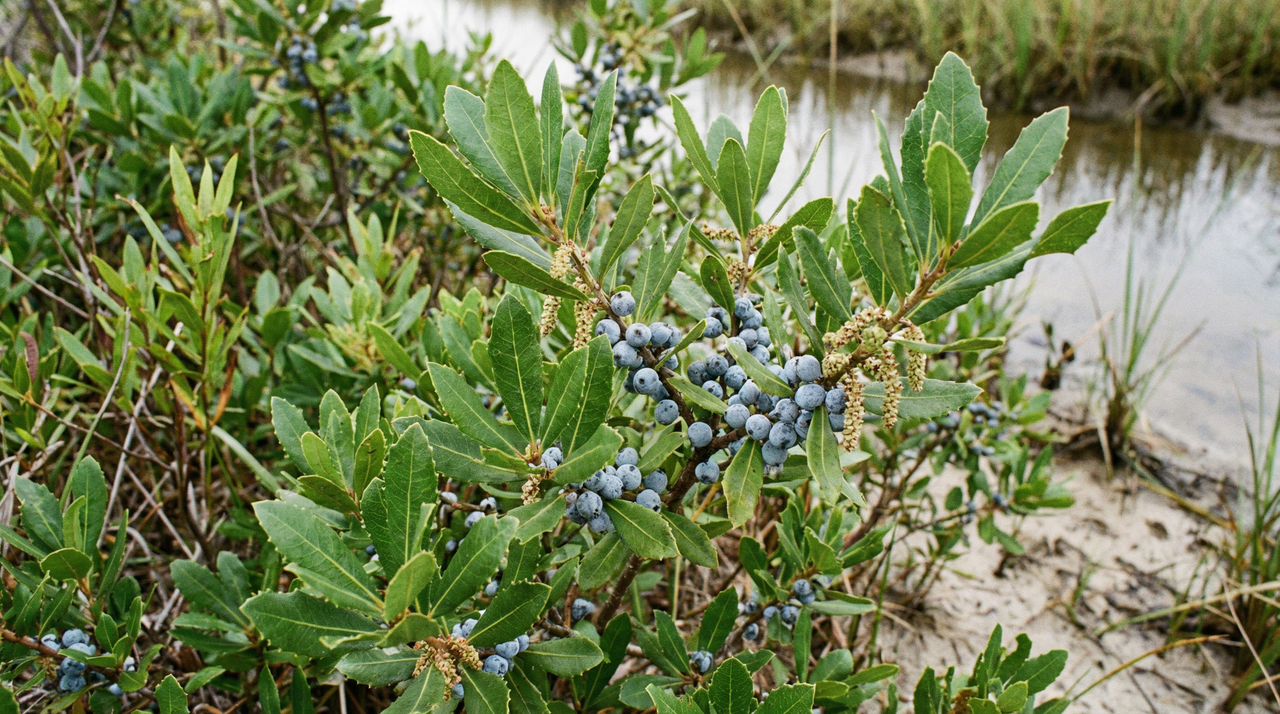
Most people who grow bayberry are actually thinking of a different plant. Ask around at a native plant sale and you'll hear "bayberry" applied to Myrica cerifera, Morella pensylvanica, and occasionally something that turns out to be entirely unrelated to the genus. The one I want to talk about, Myrica heterophylla, the evergreen or hairy bayberry, gets quietly passed over even when it's sitting right there on the table. That's a mistake I've watched people make for years, and I understand it; this is not a showy plant. It doesn't announce itself. But I've put it to work in some of the most difficult wet, acidic, nutrient-starved sites I've ever designed for, and it keeps showing up, keeps fixing nitrogen, keeps feeding the birds while everything else sulks.
What finally made me pay serious attention was realizing how much this plant asks for nothing. Not metaphorically. I mean it genuinely thrives where better-loved natives struggle or outright fail, and it does it without any drama. There's something worth understanding in that.
Origin and History of Bayberry (Myrica heterophylla)
Botanical Background and Native Range
If you've spent any time sourcing plants for wetland-adjacent landscapes in the eastern United States, you've almost certainly encountered something sold simply as "bayberry" without a second thought about which species you were actually getting. I've been there. Myrica heterophylla, sometimes called the evergreen bayberry or swamp bayberry, is a North American native in the Myricaceae family, threading its way from eastern Canada down through the coastal plain to Florida and west to Texas, where it settles happily into bogs, pocosins, and the kind of seasonally saturated edges that most nursery shrubs quietly give up on. What strikes me about working with this plant in humid subtropical conditions is how its root architecture does real ecological work, binding saturated soils and tolerating periodic inundation in a way that a generic landscape shrub simply can't replicate.
Traditional and Cultural Significance
The Myrica genus has a long, useful history on this continent. Indigenous peoples and early European settlers both discovered that the waxy coating on the berries could be harvested and rendered into candles, a fragrant, slow-burning alternative to tallow that became something of a colonial-era staple in households where bayberry grew near the door. I've actually scraped that waxy bloom off berries from a closely related Morella cerifera to show clients what all the fuss was about; once you see it, the whole candle-making tradition clicks into place in a very tangible way. Beyond wax, bayberry bark and leaves have a documented history of use in herbal medicine for their astringent and stimulant properties, appearing in early American herbalism as a tonic for digestive complaints and circulatory sluggishness. The line between therapeutic and irritating is narrower here than with gentler plants.
Fun Facts About Bayberry
The common name "bayberry" does not belong to just one plant. Myrica pensylvanica (northern bayberry), Morella cerifera (southern wax myrtle), and Myrica heterophylla have all worn it at various points, sometimes on the same nursery bench. I've had more than one client call me confused after ordering "bayberry" and receiving something with a completely different growth habit and moisture tolerance than what their site needed. Getting the right species matters, especially when you're placing a shrub in a rain garden or a seasonally wet low spot where the specific adaptations of M. heterophylla are exactly what the design calls for. The shared name reflects a genuine botanical kinship, all of these plants share that characteristic waxy berry and the nitrogen-fixing root associations that make the genus so useful in regenerative landscapes. However, they are not interchangeable, and learning to tell them apart at the nursery is worth your time.
Bayberry Varieties and Sourcing
Myrica heterophylla isn't the kind of plant that comes with a catalog page full of named cultivars and trademarked selections. You're not going to find a 'Compact Gold' or 'Variegated Sunrise' version at the garden center. Honestly, that's part of what I appreciate about it. The diversity that matters here lives at the species level, within the broader bayberry group, and understanding those distinctions is what actually helps you make good design decisions.
The three landscape species utilized most often are Myrica heterophylla, Myrica cerifera, and Myrica pensylvanica. Each fills a different niche. M. heterophylla sits between the other two in habit: evergreen to semi-evergreen depending on winter severity, with broader and more rounded leaves that give it a softer texture in mixed plantings than the narrower, glossier foliage of M. cerifera. I reach for heterophylla when I want something that reads as understory shrub rather than screen, and when the site is wetter and more acidic than cerifera prefers. Cerifera, meanwhile, grows faster and taller and works beautifully as a hedgerow anchor. Northern bayberry, M. pensylvanica, is a great plant if you're in New England or the Mid-Atlantic and working with well-drained, drier sites. But I've seen it planted in Zone 8 gardens and struggle, putting out sparse growth and never really settling in. If you're in the Southeast, heterophylla or cerifera will serve you far better.
On sourcing: skip the big box store. Seriously. For any of the Myrica species, but especially heterophylla, the material that establishes best is what I'd call genetically local. I've had noticeably better success with nursery stock sourced within a few hundred miles of the planting site than with generic regional material of unknown provenance. Many conservation nurseries and restoration-focused growers carry Myrica heterophylla because of its genuine wildlife value, and those relationships are worth cultivating. If you can't find a local source, starting from stratified seed is a slower but reliable route, and one I recommend to anyone with patience and a refrigerator willing to share space with damp peat moss over winter. The natural genetic variation within wild populations often provides more resilience than any commercially selected form could, which is exactly what you want in a guild plant meant to anchor an ecosystem for decades.
Bayberry Propagation and Planting Guide
Soil and Site Requirements for Myrica heterophylla
Get the soil wrong with this plant and you'll spend years fighting a problem that a soil test and some pine bark could have prevented. Myrica heterophylla wants moist, well-drained, acidic conditions with a pH sitting comfortably between 4.5 and 6.5; sandy, loamy, and peaty substrates all work well, and the plant genuinely prefers low-salinity ground that stays consistently damp without tipping into waterlogged.[1][2][3][4] That 4.5 to 6.5 window is narrower than most gardeners expect, so I always pull a soil pH reading before I put a Bayberry in the ground. Neutral soils that sit around 7.0 are a quiet disaster waiting to happen; the shrub will limp along, develop chlorosis, and never give you the nitrogen-fixing root system that makes it worth growing in the first place.
I treat Bayberry's site requirements much like those of highbush blueberry: if your native soil reads neutral or close to it, amend heavily with pine bark and elemental sulfur before planting rather than hoping the plant will adjust. The amendment window before establishment is far easier than trying to correct pH around an established shrub. A partially shaded to full-sun position on slightly sloped or naturally draining ground is ideal, somewhere the soil holds moisture but rain moves through within a day or two.
On the propagation side, I'll be honest that species-specific data on seed germination rates and stratification timelines for Myrica heterophylla is thin in the literature. In practice, I source transplants from native nurseries that grow local-genotype material whenever possible. That approach sidesteps the cold-stratification window that bayberry seed typically needs to break dormancy, and it means the genetics are already adapted to regional conditions. For those who want to try growing bayberry from seed, the general protocol for Myrica involves cold-moist stratification for several weeks before spring sowing, which mirrors what works for other native wetland shrubs in this family. Softwood cuttings taken in early summer are another route I've seen succeed, though rooting can be slow.
Whichever route you take, planting into the right site matters more than any other single decision. A Bayberry placed where pH, drainage, and moisture align with its preferences will require very little intervention once established, and it will start delivering real ecological returns: nitrogen accumulation in the soil, erosion stabilization on slopes, and cover for wildlife that relies on it across the coastal Southeast.
Bayberry Care Guide: Water, Soil, and Seasonal Needs
Water Needs for Myrica heterophylla
The first two years are where most people lose a bayberry shrub, and almost always the cause is one of two things: neglect during establishment, or kindness that crosses into overwatering. Getting the rhythm right from the start matters more than anything else you'll do for this plant.
Newly planted bayberry needs deep watering about once a week through the growing season.[5][6][7] That deep soak matters because you're encouraging the root system to push down, not stay shallow. Once those roots are established, the plant becomes genuinely resilient, only needing supplemental water every two to three weeks during prolonged dry spells.[1][2] That shift from weekly care to occasional checking is one of my favorite moments with any native shrub installation.
Part of what makes this possible is the extensive, deep root system Myrica heterophylla develops over time.[1][7] Those roots access groundwater far below the surface and are what allow this bayberry bush to shrug off periodic flooding without missing a beat.[1][8] I've planted these in rain gardens and bioswales specifically because the root architecture makes them excellent soil stabilizers in wet zones. The whole plant is built for dynamic hydrology.
There is an important distinction between periodic inundation and constant saturation. Consistently waterlogged soil will cause root rot, and once that sets in, the plant rarely recovers.[9][10] Let the top inch or two dry out between waterings.[9] The cue I watch for when caring for a Myrica in its first season is subtle: the leaves go slightly dull and the tips droop just a little before any browning starts. Crispy edges and leaf drop come later, once drought stress is already doing real damage.[11][9] Learn that early droop and you'll never lose a plant to underwatering again.
For irrigation water, soft tap water or collected rainwater is preferable; hard water with high mineral content can gradually alter soil chemistry in ways that work against this plant's preferences.[1][3] A three-inch layer of mulch around the base reduces how often you'll need to water at all.[9][12] I've had good results with pine straw specifically because it mimics the acidic leaf litter of the plant's native understory and slowly improves soil structure as it breaks down.
One thing I'd flag if you're near the coast: northern bayberry has low salinity tolerance and really does need freshwater conditions.[1] I've watched it struggle in sites where Southern Wax Myrtle (Myrica caroliniensis) thrives without complaint, since that southern relative handles salt spray and coastal soils with considerably more ease.[3][13] If your site has any coastal influence, test for salinity before you commit to the northern species.
Harvesting Bayberry (Myrica heterophylla)
Published harvesting data specific to Myrica heterophylla is thin on the ground. What we have instead is a solid body of general Myrica knowledge, the broader horticultural tradition around bayberries, and the kind of hands-on observation you accumulate after a few seasons with a plant. That's enough to work with.
When to Harvest Bayberry Berries and Leaves
The berries are your primary signal. Through late summer, they're still green and tight. By fall, that distinctive waxy coating starts to develop, and when you roll a ripe berry between your fingers, you'll know it: there's a spicy, resinous scent released that's more pungent than what I get from wax myrtle and distinctly its own. In warmer zones where this species naturally grows, the harvest window can stretch well into November, which is one of its quiet advantages over the northern bayberry.
Leaves are available year-round, but I find them most aromatic before the plant flowers or after fruiting winds down. A few snipped stems for tea or tincture work is all you need, and the shrub barely notices.
Sustainable Harvesting Techniques for Home Gardens
My first few seasons with Myrica, I was too enthusiastic. I stripped a young plant harder than I should have, and it set back the shrub's vigor noticeably the following year. Now I leave at least two-thirds of the fruit on the plant, partly for the birds, partly because the shrub earns its keep in the garden first and my wax projects second.
Hand-stripping is the gentlest approach: run your fingers along a fruiting stem and let the berries fall into a container below. A mature, well-sited shrub on free-draining, acidic soil might yield a few cups per season, which is enough for a small candle-making batch if you process the same day. Florida's humidity degrades the wax coating fast once the berries are off the plant, so I don't let them sit. For leaves, clip small stems rather than stripping individual leaves, and never take more than a quarter of any branch's growth at once.
Bayberry Preparation and Uses
Myrica heterophylla isn't the kind of plant you grow because it fills your pantry or medicine cabinet. Compared to better-documented relatives like M. cerifera, this species shows up in very little culinary or medicinal literature, and I think that's actually fine. When I include it in client designs, I'm thinking years out, planning for a shrub that fixes nitrogen, holds a wet edge, feeds wildlife, and yes, eventually yields a modest harvest of those distinctively waxy berries. The uses follow naturally from that ecological logic rather than driving the planting decision.
Traditional and Non-Food Uses of Bayberry Wax
The candle-making tradition is the reason this plant got its common name, and it genuinely delivers. The process is straightforward: simmer the ripe berries in water, skim the fragrant wax that rises as it cools, and repeat until you have enough to pour into molds or dip wicks. The bayberry candle tradition in North America goes back to early colonial households, and the bayberry candles good luck custom of burning them at Christmas or New Year's has kept the practice alive in craft circles ever since. Rendering bayberry wax fills the workshop with a clean, spicy scent that's hard to describe accurately until you've experienced it firsthand. It's nothing like paraffin and considerably more interesting than plain beeswax.
Northern bayberry (M. pensylvanica) is the species most often cited in candle-making guides, and because it's closely related and shares the same wax chemistry, everything those sources describe translates well to M. heterophylla. You'll just work with a smaller shrub and a somewhat smaller harvest per plant, which is worth factoring in if you're serious about a meaningful wax yield. I usually recommend clustering several plants in a guild planting rather than expecting a single specimen to supply a full candle-making session.
Beyond wax, some foragers experiment with bayberry leaves as a mild aromatic in cooking or dried for a tea, drawing on the genus's broader traditional uses. I approach that territory cautiously. The Myrica genus contains compounds that deserve respect. Any intended application of the leaves or bark for medicinal support demands rigorous caution. The ecological yields of this plant are reliable and well-understood; the kitchen or apothecary applications are not, and that's a meaningful distinction worth holding onto.
Bayberry Health Benefits and Traditional Uses
I'll be honest with you upfront: if you're looking for a stack of peer-reviewed clinical trials on Myrica heterophylla, you won't find them. This is one of those native shrubs that mainstream botanical medicine has largely overlooked, which means the honest conversation here is about traditional use, genus-level phytochemistry, and what a cautious, curious practitioner can reasonably infer. That's not a reason to dismiss it, but it is a reason to be careful about what we claim.
Bayberry root bark possesses a well-documented history in early American herbalism as a primary astringent and digestive tonic. Indigenous peoples and later colonial herbalists prepared preparations from the bark to address diarrhea, mucous membrane irritation, and sluggish digestion. That astringent reputation makes chemical sense: like other members of the Myrica genus, this shrub almost certainly contains significant tannin concentrations, along with the triterpenes and flavonoids that show up in better-studied relatives like wax myrtle (Myrica cerifera). Those compounds underpin the tightening, drying action that made bayberry bark a go-to in the old materia medicas. Whether the specific concentrations in M. heterophylla mirror those in M. cerifera closely enough to draw direct parallels is genuinely unknown; the two aren't identical, and I'd be doing you a disservice to treat them as if they were.
In my years working with native plant gardens and designing with wetland-adapted shrubs, I've occasionally had clients report using small amounts of bayberry bark tincture for occasional digestive support, always under the guidance of a qualified herbalist rather than on a whim from a foraging guide. Those anecdotal observations are consistent with the plant's traditional reputation, but they're not clinical evidence, and I hold them loosely.
On safety, the tannin content is the practical concern I raise most often. Strong preparations are bitter, and they can be genuinely irritating to sensitive stomachs. If you're working with this plant medicinally, I recommend starting with very low doses and paying close attention to how your body responds. Correct botanical identification also matters more than people realize: several shrubs share overlapping common names and similar habits in coastal and wetland environments, and misidentification is a real risk when foraging. Consult a regional botanist or experienced herbalist before you do anything beyond appreciating the plant from a design perspective. That's advice I've given to many native plant enthusiasts, and I stand behind it.
Bayberry Pests and Diseases
This is a brief section to write because bayberry requires almost no pest intervention. In all the years I've been planting Myrica heterophylla in coastal and wetland-edge designs, I've never once reached for a spray bottle on its behalf. No fungicide, no insecticidal soap, no panicked Google searches at midnight. It just grows, season after season, without asking much from anyone.
Part of that resilience comes down to what bayberry is ecologically: a nitrogen-fixing pioneer species that evolved in poor, challenging soils where most plants don't want to be. Plants adapted to hardship tend to develop robust constitutions, and bayberry is no exception. Its native range spans some genuinely tough coastal environments where salt, wind, and saturated soils create constant stress. Something that shrugs off those conditions isn't going to be brought low by aphids.
I've had clients ask me to compare it to other nitrogen-fixers in the same guild, and it's a fair question. False indigo (Baptisia australis) will occasionally get leaf miners. Autumn olive draws its share of browsing pressure. Bayberry, planted right next to both, typically comes through the season unmarked. That contrast becomes a real design advantage when you're building a guild meant to run with minimal intervention over years, not months.
The one monitoring habit I do maintain, mostly out of professional diligence rather than any real expectation of problems, is a quick visual check during pruning. I scan for anything unusual while I'm already handling the plant. That's it. No spray schedule, no scouting protocol. If you've chosen bayberry partly because you want a low-maintenance native that pulls its ecological weight without demanding constant attention, you've chosen well.
Bayberry in Permaculture Design
Bayberry frequently anchors the most difficult ecological restoration designs across the Southeast. It fulfills crucial guild functions reliably without requiring intensive management.
Climate Adaptability and Hardiness Zones
Knowing which species you're working with matters here more than with most plants. Myrica heterophylla, the Swamp Bayberry, is hardy in USDA zones 6 through 9 and native to the southeastern coastal plain.[14] The closely related Morella caroliniensis extends that range further, covering zones 6a through 10b.[15][16] In my zone 9b Central Florida work, I've found the caroliniensis performs beautifully through the punishing combination of hot, humid summers and mild winters that would stress many shrubs into submission. The heterophylla, on the other hand, really shines along the Gulf and Atlantic coastal plains where soils stay wet and salt spray is a real consideration. Getting that species distinction right at the design stage saves a lot of frustration later.
Ecosystem Functions and Guild Roles
What I love about bayberry in a permaculture design is how many jobs it holds at once without ever feeling like it's straining. It's an actinorhizal nitrogen-fixer, forming root associations with Frankia bacteria that quietly build soil fertility over time, which makes it genuinely useful as a pioneer in degraded or nutrient-poor landscapes. I pair it regularly with other native shrubs and understory trees that benefit from that fertility boost, things like native blueberries, Virginia willow, and buttonbush in wetter guilds, letting bayberry play the role of soil conditioner while the others contribute fruit or flower production.
Its canopy contribution falls solidly in the shrub layer, which is often the most underdeveloped layer in food forest designs. A well-placed bayberry thicket creates structure, windbreak value, and edge habitat that attracts a remarkable number of birds. I've stood next to established stands in late fall and counted five or six species moving through in under an hour, drawn by the waxy berries that persist on the branches well into winter when other food sources are gone. That wildlife magnetism has real design value in pollination networks and pest management, since insect-eating birds don't discriminate.
For hedgerow applications, bayberry's tolerance for wet feet, moderate shade, and wind exposure gives it a flexibility that few native shrubs match in coastal and piedmont zones. I've used it along pond margins, as screening along property edges with poor drainage, and as a transitional plant between mown lawn and naturalized woodland areas. The key design lesson I've learned is to give it room to spread and colonize slowly. It wants to form thickets, and resisting that by planting it in a tidy single-specimen situation usually just produces a frustrated, underperforming plant. Let it be what it is, and it will deliver soil health, wildlife habitat, and functional yield with almost no maintenance ask on your end.
A Reliable Pioneer for Difficult Margins
There's a row of bayberry along the wet margin of my food forest where I've tried at least a dozen other plants and lost them all. The bayberry just quietly took over, fixed nitrogen into soil that needed it badly, and fed the birds through January. I didn't plan for it to become the backbone of that whole section, but here we are. Some plants earn their place without asking for much attention, and that, honestly, is the kind I want more of.
Sources 16
- Bayberry ↩
- Myrica heterophylla ↩
- Morella caroliniensis ↩
- Morella caroliniensis (Mill.) Small ↩
- Wax Myrtle (Myrica cerifera) Plant Profile ↩
- Myrica caroliniensis (Southern Waxmyrtle) ↩
- Southern Wax Myrtle - Morella cerifera ↩
- Wetland Plants: Morella heterophylla ↩
- Myrica heterophylla (Northern Bayberry) ↩
- Wax Myrtle (Myrica caroliniensis) Care Guide ↩
- Drought Stress in Woody Plants ↩
- Wax Myrtle ↩
- MYCA3: Morella caroliniensis ↩
- Morella heterophylla – Southern Bayberry Wax Myrtle Shrub ↩
- Morella caroliniensis | plant lust ↩
- Morella caroliniensis – Florida Native Plant Society ↩