Most people plant Bee Balm for the hummingbirds and end up surprised by the tea. That sequence matters, because the plant's most underappreciated quality has nothing to do with its spectacular scarlet blooms and everything to do with what happens when you bruise a leaf between your fingers. That smell, sharp and warm and somehow both citrusy and oregano-like at once, is thymol, the same compound that puts the antiseptic bite in your mouthwash. I've had visitors in my garden rub a leaf, go quiet for a second, and say "what is that?" It smells like something you already know but can't quite place, which is exactly how Bee Balm tends to work on people.
Here's the part most gardeners miss: this is a native North American plant with a documented history as both a food and a medicine, one that Indigenous peoples across the eastern woodlands were brewing long before European settlers decided to rename it "Oswego tea" and claim it as their revolutionary-era coffee substitute. It's been quietly earning its place in gardens, guild plantings, and herb collections for centuries. Grow it once and you'll find yourself making a case for it in every design you touch.
Bee Balm Origin, History, and Botanical Background
When I first started designing pollinator gardens, I kept reaching for bee balm almost instinctively. There was something about it that felt fundamentally North American, rooted in a way that imported ornamentals never quite manage. That instinct turns out to be botanically accurate. The genus Monarda is entirely native to North America, and the species most gardeners know by name, Monarda didyma, is the anchor of the whole story.
Native Habitat and Distribution of Bee Balm and Its Relatives
Scarlet bee balm (Monarda didyma) is native to Eastern North America, ranging from Nova Scotia and Ontario south to Georgia and west through Missouri and Oklahoma, growing naturally along moist stream banks, woodland edges, and forest clearings from sea level up to roughly 1,500 meters in elevation.[1][2][3] Picture it growing in humus-rich, consistently moist soil with dappled light filtering through a forest canopy. That's its natural home. The rest of the genus radiates outward from that wet eastern template into drier, more challenging territory. Lemon beebalm (Monarda citriodora) colonizes the central prairie states from Kansas and Nebraska south into Texas and northern Mexico, where it supports generalist pollinator communities in open grasslands.[4][5] Eastern beebalm (Monarda bradburiana) spans the central and eastern US from Texas and Oklahoma up through Indiana, Ohio, Kentucky, and Tennessee.[6][7] Rough beebalm (Monarda rugosa) overlaps much of this eastern range but also extends into montane western populations in California, Oregon, and Nevada at elevations above 1,500 meters.[8][9] Together, these relatives paint a portrait of a genus that evolved for nearly every North American climate, from muggy Appalachian hollows to windswept Kansas prairies.
Visual Characteristics of Monarda Species
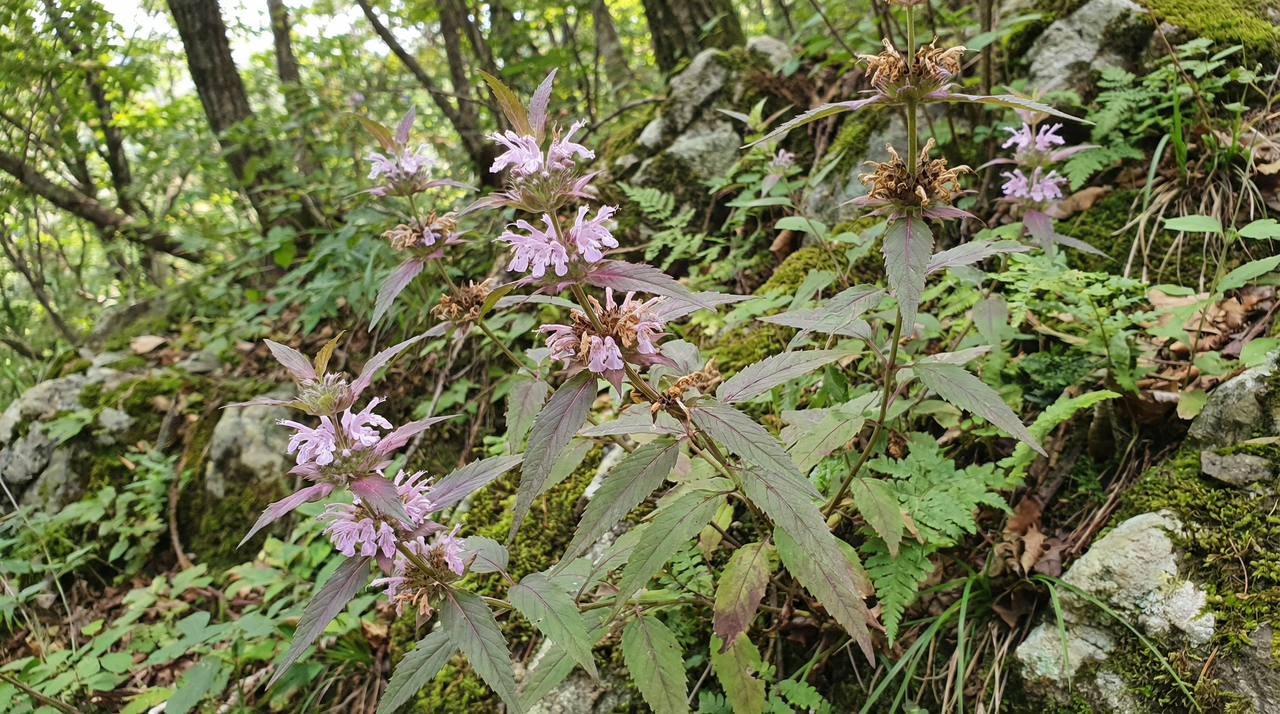
Once you know what to look for, Monarda species are hard to mistake for anything outside the mint family. The square stems are the first tell, erect and four-sided with a slightly rough, hairy texture from fine glandular and non-glandular pubescence.[9][10] The leaves are opposite, ovate to lanceolate with toothed margins, typically 5 to 10 cm long, and they crush into an unmistakable herbal fragrance.[11] Flowers arrive in dense, shaggy, terminal clusters of tubular blooms, lavender to scarlet depending on species, usually 2 to 3 cm long, followed by dry fruits that split into four small nutlets.[12][13]
Height and color separate the species once you get close. M. didyma typically reaches 2 to 4 feet with its signature scarlet flowers, while M. rugosa tends to stay more compact at 1 to 3 feet with lavender-pink blooms.[14][15] I've grown both in the same pollinator bed and labeled them carefully from day one, because in the first season their young leaves look strikingly similar. The tip I give workshop attendees: run your thumb along the leaf surface. If it feels like fine sandpaper, you've likely got rugosa, named specifically for that wrinkled, rough texture.[16] Lemon beebalm breaks the perennial pattern entirely, growing as an annual with smoother, brighter green leaves and prominent purple-tinged bracts beneath the flowers. Wild bergamot (M. fistulosa) grows to a similar height as didyma but carries a mintier, oregano-forward scent. Eastern beebalm stands out by blooming weeks earlier than its relatives, often April through June, sometimes before its leaves have fully expanded.[17][18][7]
Traditional and Cultural Uses by Native Americans and Early Settlers
The ethnobotanical record for Monarda is deep and consistent across cultures. Cherokee, Iroquois, Ojibwe, Menominee, and Comanche communities all brewed leaves and flowers into teas for colds, fevers, sore throats, digestive complaints, and headaches; the plants also served as poultices for wounds and as general tonics with antiseptic properties.[19][20][21] I've brewed Monarda leaf tea myself during Florida winters when a scratchy throat appears, and the flavor is genuinely pleasant: minty up front with a subtle oregano warmth that lingers. Eastern beebalm carried additional ceremonial roles, used in smudging, ritual baths, and as a natural dye that produced pink to red hues on textiles and basketry.[22][23]
European settlers took notice quickly. By 1762, Monarda had entered the colonial botanical record through John Clayton's Flora Virginica, and settlers had already adopted the plants as digestive remedies and beverage substitutes.[24][25] Nineteenth-century herbalists relied on it for respiratory ailments and antiseptic applications, building directly on the knowledge that Indigenous communities had held for generations.
Fun Facts and Fascinating Details About Bee Balm
If you've ever grown what you thought was wild bergamot and later wondered whether you actually had rough beebalm, you're in very good company. Monarda rugosa and M. fistulosa share overlapping common names and similar flowers; the rugose, sandpaper-like leaf texture is the most reliable field distinction.[26] Misidentification within this genus is genuinely common, and it matters for both culinary and medicinal uses.
Lemon beebalm holds a chemistry surprise worth knowing. Its essential oil is dominated by citral at 60 to 90% of total composition, a concentration that actually exceeds what you'd find in lemon peel oil from Citrus limon.[27][28] I've distilled small batches and was genuinely caught off guard: the aroma was brighter and sharper than my own lemon verbena, which I'd always considered the gold standard for lemon-scented herbs in the garden.
Eastern beebalm, meanwhile, earns its place in the permaculture design toolkit partly through timing. Blooming in April through June, often before the leaves are fully out, it delivers early-season nectar at exactly the moment when most other perennials are still waking up.[29] It also hosts larvae of the hermit sphinx moth and draws goldfinches to its mature seeds, packing a lot of ecological function into a relatively compact footprint.[30] For a genus that started wild in the understory, it has turned out to be remarkably useful company in the garden.
Bee Balm Varieties and Where to Buy
Popular Monarda didyma Cultivars
If you've grown straight-species scarlet bee balm and spent every August watching it disappear under a white fuzz of powdery mildew, modern Monarda didyma cultivars will feel like a revelation. Breeding programs at institutions like the University of Connecticut and Heritage Perennials have spent decades selecting for exactly what humid-summer gardeners need: disease resistance, long bloom windows, and that same hummingbird-and-bumblebee magnetism the wild type delivers.[31][32] 'Jacob Cline' is my most reliable performer in humid conditions, topping out at three to four feet with clear scarlet flowers and genuinely impressive mildew tolerance.[15] 'Cambridge Scarlet' is the vigorous old classic; 'Marshall's Delight' swaps red for pinkish-lavender and brings some of the best disease resistance in the genus; 'Raspberry Wine' hits a rich berry-red with solid mildew tolerance.[15][33] For smaller spaces, 'Petite Delight' and 'Pink Lace' stay compact without sacrificing pollinator appeal.
Hybrids between Monarda didyma and Monarda fistulosa (wild bergamot) bring another layer of resilience into the mix. I've noticed these crosses handle dry spells noticeably better than pure didyma, and they tend to bloom for four to six weeks rather than petering out after three.[34] If your site tilts toward summer drought, a didyma-fistulosa hybrid is worth seeking out over either pure species.
Varieties Across the Monarda Genus
Beyond the didyma cultivar crowd, the broader Monarda genus offers useful alternatives. Lemon beebalm (Monarda citriodora) has a handful of ornamental selections worth knowing: 'Claire Grace' is compact with soft lavender-pink flowers and better disease resistance than the straight species, while 'Lambrook Silver' offers silvery foliage and improved heat tolerance for warmer sites.[35][36] Eastern beebalm (Monarda bradburiana) stays tighter and blooms earlier in spring, with selections like 'Miss Ruby' and 'Violet Queen' bred for compact growth and mildew resistance.[37] Rough beebalm (Monarda rugosa) is essentially still wild-form; the occasional 'Pink Form' or 'White Form' selection exists, but named cultivar development is minimal.[38] For permaculture guilds where the goal is habitat function over showiness, straight species seed of any of these does the ecological work just fine.
Sourcing Bee Balm Plants and Seeds
Monarda didyma and its cultivars are genuinely easy to find in spring, whether you want potted plants ($10 to $25 each) or seed packets in the $3 to $6 range.[39] For named cultivars, I'd steer you toward specialty suppliers over big-box generics: Prairie Moon Nursery, Plant Delights, High Country Gardens, Bluestone Perennials, and Missouri Wildflowers Nursery all carry well-adapted stock and can tell you what they're actually selling.[40] The Eastern and lemon beebalm cultivars are harder to track down and largely absent from mainstream retailers; native plant specialists are your best bet there.[35][40] Shop in spring for the widest selection; availability drops sharply by fall. None of the Monarda species carry any noxious weed designation or domestic shipping restrictions, so you can confidently order across state lines for your pollinator plantings.[41][42]
Bee Balm Propagation and Planting
Bee balm gives you real options at propagation time, and which one you choose shapes everything from your timeline to how much genetic variation you're willing to live with. I've gone down most of these paths over the years, and the short version is this: seed for pollinator meadows and wildflower strips, division or cuttings for anything where the cultivar color actually matters.
Bee Balm Seed Characteristics, Storage, and Dormancy
The seeds themselves are tiny things, barely 1-2 mm long, dark brown to nearly black, with a slightly oily surface that hints at their minimal endosperm reserves.[10][43] Like most Lamiaceae, they're orthodox storers, meaning you can dry them down to around 5-10% moisture and refrigerate them without harm.[44][45] I keep mine in labeled glass jars with a silica packet tucked inside, stored at the back of the refrigerator, and they stay viable for three to four years without much fuss.[46][47] If you're working with older stock, a quick germination test before committing to a whole sowing is worth the effort; I test mine every couple of years.[48]
The catch with perennial Monarda didyma is physiological dormancy. Most seed lots need 30-60 days of cold moist stratification at around 4-5°C before they'll cooperate, and even then, germination rates land somewhere between 50-80%.[49][50] My winter routine is simple: mix seeds with moist vermiculite in a labeled zip bag and slide it into the crisper drawer. I've found that six weeks works noticeably better for my seed lots than four, so I give them the longer run whenever I can. Lemon Beebalm is a different story entirely -- it has low dormancy and germinates readily without any cold treatment, needing only light exposure and warmth to get going.[51] Eastern Beebalm sits at the other extreme, sometimes requiring both cold stratification and scarification to break combined physiological and physical dormancy.[52]
Seed also comes with a variability caveat: Monarda crosses freely, and seedlings often don't come true to type. Flower color, height, and vigor can all wander from the parent.[53][54] I grow named cultivars like 'Jacob Cline' from division for the garden's centerpiece spots, and start species seed for the wildflower strip where that variation is actually an asset. Both have their place; it's just about being clear on your goal.
Germination Timeline and Methods
Lemon Beebalm germinates in 7-21 days at 65-75°F without any stratification, and will flower 60-90 days after sowing.[37] Rough Beebalm takes 4-6 weeks of cold treatment followed by 10-21 days to sprout, and may bloom its first year if you start it early indoors, though year two is more reliable.[15] Eastern Beebalm generally needs 2-3 years from seed before you see a proper flower show.[55]
First-year Monarda didyma seedlings are often small and tentative, sending up a flower or two at best. The real display comes in year two. I tell anyone starting bee balm from seed to be patient with them, because that slow-building first season is easy to mistake for failure. If you want usable plants faster, softwood cuttings root in 2-4 weeks in moist medium, with harvest-ready growth possible 4-6 weeks after rooting; divisions get you there in 8-12 weeks.[56][57] For anyone who wants a productive plant this season rather than next, cutting or division is the obvious choice.
Soil, Site Selection, and Light Requirements
Monarda didyma wants full sun (at least six hours of direct light) to partial shade, with the best flowering in full sun but some afternoon shade appreciated where summers run hot.[1][58] Soil should be moist, well-drained, and humus-rich, ideally a loamy or sandy loam at pH 6.0-7.0.[14][1] Good drainage is the non-negotiable part, particularly through wet winters. Root rot kills more bee balm than drought ever will.
The genus covers a wider range of soil preferences than people expect. Rough Beebalm actually prefers moist to wet, poorly drained soils and wetland conditions; Lemon Beebalm tolerates considerably drier, well-drained ground once established; Eastern Beebalm thrives in lean, rocky or sandy soils with partial shade.[9][59][6] I keep both Lemon Beebalm and Monarda didyma in the same garden, but I water them on very different schedules and have them planted in different microzones entirely. Knowing which species you're working with before you site it saves a lot of guesswork. All Monarda have shallow, rhizomatous roots that handle compaction poorly, so if your soil is heavy or prone to compaction, work in organic matter and mulch well; a raised bed is worth considering where drainage is genuinely problematic.[60][61]
Spacing, Planting Technique, and Initial Care
Space bee balm 18-24 inches apart with rows 24-36 inches apart, and treat that spacing as a mildew prevention strategy as much as a planting guideline.[37][62] These plants spread by rhizome, easily reaching 2-3 feet wide over a few seasons, and crowded plants in still air are where the mildew problems start. After losing several cultivars to powdery mildew in my first humid summers, I now give every new planting a full 24 inches and deliberately choose sites with morning sun and some afternoon airflow. The difference is dramatic.
For vigorous cultivars like 'Jacob Cline' or gardens in humid southern zones, push that spacing to 24-30 inches. Compact or supporting species like Lemon Beebalm can be planted closer, around 12-18 inches, especially in mass plantings.[63][64] Direct-sown seed goes in at about 1/8 inch deep after the last frost in spring, or in fall in the Southeast.[65] Young seedlings look surprisingly similar to other mints until the square stems emerge, so mark your rows clearly or you'll spend a confused half hour wondering what volunteered in your bed. Established clumps should be divided every 2-4 years in spring or fall; it controls the spread, rejuvenates the center of the clump, and produces new plants to share.[62] That spring division ritual has become one of my favorite ways to multiply plants for friends while keeping the original colony tight, healthy, and producing the air circulation it needs to stay clean.
Bee Balm Care Guide and Seasonal Maintenance
Caring for bee balm comes down to three things: enough light to bloom well, consistent moisture without waterlogging, and air circulation that keeps powdery mildew from taking over. Get those right and this plant is genuinely low-maintenance. Miss any one of them and you'll spend the summer chasing problems.
Sunlight Requirements for Healthy Growth and Flowering
Monarda didyma wants full sun to light partial shade, and I've found that the more sun it gets, the more it blooms.[1][66] Push it into dense shade and you get tall, floppy stems and almost no flowers. In my zone 9B garden, though, full Florida sun from noon onward is genuinely brutal, so I treat afternoon shade the same way I treat basil in midsummer: a little shelter, a thick mulch layer, and consistent moisture prevents the wilting and leaf scorch that shows up fast once temperatures climb.[67][66] If you're in a cooler climate, aim for six or more hours of direct light and you'll be rewarded.
Water Needs and Drought Tolerance
Bee balm is not drought-tolerant. Full stop. Monarda didyma wants about one inch of water per week, and the top inch of soil should be allowed to dry slightly between waterings, but no more than that.[68][1] Push it into two to three weeks of dry soil and you'll see leaf scorch, root dieback, and reduced flowering that doesn't always fully recover.[69] But overwatering is just as damaging: soggy roots go black and mushy, leaves yellow and wilt even though the soil feels wet, and you've created exactly the conditions powdery mildew needs to take hold.[70]
Two to three inches of shredded bark mulch pulled back a few inches from the crown has been my most reliable tool for keeping that moisture balance consistent without constant hand-watering.[68] In summer, especially above 85°F, bump irrigation up to one to two inches per week.[71] Come fall, ease off significantly, and through winter dormancy, stop supplemental watering almost entirely. If you garden in a drier climate, consider Wild Bergamot (Monarda fistulosa) or Lemon Beebalm (Monarda citriodora) instead; both tolerate lean, drier conditions much better once established.[72]
Feeding and Fertility Needs
Bee balm is a moderate feeder that thrives in average to fertile soil with a pH of 6.0 to 7.0, and honestly doesn't need much help if you've built decent organic matter into the bed.[73][74] I learned this the hard way: I over-fertilized a new planting once with a high-nitrogen granular, and by midsummer I had the lushest, most mildew-ridden monarda I'd ever seen. Leggy stems, almost no airflow through the clump, and white powder on everything. Now I default to a shovelful of compost worked in at planting and a half-strength balanced slow-release fertilizer (10-10-10 or 5-10-10) in early spring only if a soil test suggests the bed needs it.[74][75] Excess nitrogen is genuinely counterproductive here: it drives leafy, weak growth that's more vulnerable to mildew and produces fewer flowers.[35] Lemon Beebalm is even less demanding, happy in lean soil and tolerant of a wider pH range up to 8.0, so it needs even less intervention.[37]
Frost Tolerance and Winter Protection
One of the things I genuinely love about Monarda didyma is its cold hardiness. Established plants are rated for zones 3 through 9 and can survive temperatures down to -40°F, a reflection of their native North American origins in temperate woodlands and meadows.[9][76] The real vulnerability is tender new growth in late spring or early fall frosts, which can cause blackening, distorted leaves, and dieback at shoot tips.[77]
For winter protection, apply two to four inches of organic mulch after the soil freezes in late fall, kept clear of the crown.[64] Mature plants rarely need anything more. Young first-year plants in very cold climates can benefit from a light fleece below -20°F. Come early spring, I always check for frost heaving and gently firm any crowns that have been pushed out of the soil back into place. Wild Bergamot and Eastern Beebalm handle cold similarly, aided by rhizomatous roots,[66] while Lemon Beebalm is only reliably hardy to zone 5 and may need to be treated as a self-seeding annual in colder gardens.[35]
Pruning, Maintenance, and Seasonal Rhythm
The seasonal rhythm of caring for bee balm plants is what keeps them vigorous, compact, and blooming reliably for pollinators. In late winter or early spring before new growth emerges, cut all stems hard to about six inches above the ground.[78] This is also the time to divide clumps that have been in place for two to four years: dig, split, replant the outer sections with the most vigorous roots, and discard the tired center.[79] Division rejuvenates the plant, controls its rhizomatous spread, and opens up the center of the clump to airflow, which matters a great deal for mildew prevention.
Once plants reach about twelve inches in early summer, pinch them back by a third to encourage bushier, sturdier stems with more flowering sites.[80] I label my rows carefully at this stage because bee balm seedlings look so much like other mint-family plants, and it's easy to pinch the wrong thing. Throughout the bloom season, deadheading bee balm plants keeps flowers coming and prevents aggressive self-seeding. Deadhead spent flowers regularly for continuous bloom, or cut leggy stems back by a third to a half in midsummer to improve both structure and air circulation through the clump.[81]
On mildew: in my humid climate, consistent morning watering at soil level and spacing plants eighteen to twenty-four inches apart has done more than any fungicide ever could.[79] When infection does appear, cut well below visible lesions and sanitize your pruners with a 10% bleach solution between cuts.[82] A fresh layer of mulch in spring or fall caps off the seasonal rhythm nicely, retaining moisture and insulating roots while reinforcing all the cultural habits that keep these plants healthy year after year.[83]
Harvesting Bee Balm (Monarda didyma)
The window that matters most with bee balm is the one just before the flowers open. That's when the leaves are at peak oil content, slightly wrinkled with that rugose texture I've come to use as my field marker: if a stem's upper leaves look almost puckered, it's ready to cut. For most gardeners in temperate zones, that window falls in June or early July.[84][85] In my zone 9B garden it shifts about two weeks later, so calibrate by plant behavior rather than the calendar.
Timing and Visual Cues for Leaves, Flowers, and Seeds
For perennial species like Monarda didyma, I give first-year plants a pass and take my first real harvest in year two once the clump has established.[86] Once blooms open fully and show that vibrant scarlet color, you've shifted from leaf harvest into flower harvest territory, which peaks from late July into early August.[87] Cut them at full color for maximum aromatic quality. Then, if you're saving seed, wait longer: monarda seed heads need to go fully dry and brown, typically August through September, about 20 to 30 days after bloom. You'll know they're ready when the seeds rattle inside the pods.[88][89]
Harvest Technique and Sustainable Yield
Get out there between 8 and 10 in the morning, after the dew lifts but before the heat climbs. That's when volatile oil concentration is highest, and what you cut will smell and taste noticeably stronger than an afternoon harvest.[90][91] Never take more than a third of the plant at once; the clump needs enough foliage to keep pushing new growth through the season.[84]
For drying, hang small bundles upside down in a dark, ventilated space kept between 85 and 110°F. They'll be crisp and ready in one to two weeks.[92][93] Skip the oven. Heat above 120°F drives off the very oils you harvested for. I label my bundles the moment I hang them because dried Monarda leaves look deceptively similar across species. Seeds store well in paper envelopes in a cool, dark spot and stay viable for two to three years, as long as they're completely dry going in.[94][93]
Flavor Profile, Aroma, and Post-Harvest Handling
The moment you crush a fresh bee balm leaf it smells like you dropped an Earl Grey tea bag in the garden: that same bergamot-mint-citrus combination, herbaceous and slightly floral, then something deeper underneath.[25][95] The aftertaste is thyme-forward and medicinal, and it lingers noticeably longer than any culinary mint I've grown.[25] That quality derives directly from thymol, which spikes dynamically depending on the plant and where it's growing.[96] Plants grown in sandy, well-drained soil tend to push higher thymol levels; clay or loamy soils can shift the profile toward other phenolics, which is why your neighbor's bee balm might taste noticeably different from yours.[97] Lemon Beebalm (Monarda citriodora) is a different experience entirely: bright, citral-forward, wonderful in teas and as a garnish, but a separate flavor story from the scarlet species.[98]
I keep my harvests moderate, and I mean that practically rather than generically. The thymol that gives bee balm its pleasant medicinal kick can irritate the stomach and mucous membranes in quantity.[99] Use it as a flavoring herb, not a bulk green, and anyone with mint-family sensitivities should take extra care before diving in.
Bee Balm (Monarda didyma) Culinary and Medicinal Preparations
Culinary Uses and Flavor Profiles of Bee Balm
Bee balm is genuinely one of the more surprising kitchen herbs I grow. The leaves and flowers go into teas, salads, soups, herb blends, jellies, vinegars, and pesto; they're strong companions for lamb, poultry, tomatoes, and wild game.[100][101] My first strong cup of Oswego tea genuinely caught me off guard. That flavor sits somewhere between mint, thyme, and bergamot orange, with a spicy aftertaste the thymol in the essential oils is responsible for.[102][103] Now I always start with 1 teaspoon of dried leaves per cup, steep for 5 to 10 minutes, and adjust from there rather than wrecking the subtlety.[104][105] Young leaves give the cleanest flavor; intensity ramps up in hot, dry summers when thymol content climbs noticeably.[102]
The broader Monarda genus adds interesting range. Lemon beebalm (M. citriodora) brings a bright citrusy note from citronellal,[15] while wild bergamot (M. fistulosa) skews toward the Earl Grey-adjacent bergamot-orange character I reach for in blended teas.[103] I treat all of them more like a potent oregano than an everyday mint; a little goes a long way, and moderation matters especially with species like Eastern beebalm (M. bradburiana), where potential thujone content calls for restraint in both cooking and tea.[101] Raw leaves chopped into salads work, but large quantities can cause mild digestive upset, so steeping or cooking is the more reliable route.[104]
Identification is non-negotiable here. All Monarda species share the square stems and opposite leaves that run throughout the mint family, which means confusion with Pycnanthemum, Collinsonia canadensis, and other look-alikes is genuinely easy.[100][106] I label every row in my herb beds because early in my gardening I mixed up seedlings more than once. The most serious misidentification risk is confusing lemon beebalm with American pennyroyal (Hedeoma pulegioides), which contains hepatotoxic pulegone.[107] If you're not certain, grow it yourself from a reliably labeled source.
Medicinal Preparations from Bee Balm
The standard medicinal preparation is simple: 1 to 2 teaspoons of dried aerial parts steeped in a cup of hot water, taken once or twice daily for respiratory or digestive support.[108][109] For topical use, a stronger infusion or a poultice from the aerial parts applied to wounds, insect bites, or skin irritations follows the same traditional pattern that Native American communities applied across multiple Monarda species for generations.[110][111]
For any topical or internal use, I prefer plants from my own garden over wild-harvested material. Cultivated bee balm avoids the contamination risks and ambiguous identities that come with foraging mint-family plants from roadsides or disturbed ground.[13] If you do harvest from established plants, cut aerial parts after blooming without disturbing the roots so the clump keeps producing. Some of the traditional uses cited for Monarda rugosa and related species are inferred from broader genus-level ethnobotany rather than species-specific studies, so I hold those applications lightly and stay within the well-documented M. didyma and M. fistulosa territory whenever I can.
A few safety points deserve plain language rather than fine print. Avoid bee balm tea during pregnancy. Anyone with Lamiaceae allergies should patch-test topical preparations first. And because this is a thymol-rich herb with genuine biochemical activity, moderate use is the right default: a cup of monarda tea a few times a week is very different from treating it as a daily high-dose supplement.
Bee Balm Health Benefits and Medicinal Uses
Before the chemistry, there's the story. Bee balm has been a working medicine plant for a very long time. Cherokee and Iroquois peoples brewed Monarda didyma for respiratory ailments, fevers, and digestive complaints, and the tradition spread widely enough that colonial settlers adopted the practice for their own daily use.[112][113] Across the genus, the ethnobotanical record is remarkably consistent: tribes from the Ojibwe to the Navajo used various Monarda species for the same cluster of conditions, typically as teas and infusions for colds, respiratory congestion, digestive upset, skin conditions, and wound healing.[114][115] That kind of convergent use across independent cultures is one of the things I find most compelling when I'm evaluating a plant's potential in a home garden context.
Traditional and Modern Medicinal Applications of Bee Balm
Modern research gives those traditional uses some biochemical grounding, though with important caveats. The essential oil's dominant compounds, thymol and carvacrol, show strong in vitro antimicrobial activity against Staphylococcus aureus, E. coli, and Candida albicans, with minimum inhibitory concentrations in the range of 0.06 to 0.5 mg/mL.[116][117] Animal model studies on anti-inflammatory activity are similarly impressive, with rosmarinic acid inhibiting COX-2 and NF-κB pathways and reducing paw edema by 40 to 60 percent in some models, figures that put it in the same conversation as pharmaceutical references like indomethacin.[118][119] Preclinical work has also flagged mild analgesic potential, acetylcholinesterase inhibition that could be relevant to neurodegenerative research, alpha-glucosidase inhibition suggesting antidiabetic activity, and anxiolytic effects in Lemon Beebalm (Monarda citriodora) models.[120][121]
I treat these findings the way I treat a lot of preclinical herb research: seriously enough to pay attention, but not seriously enough to make therapeutic claims. Large-scale randomized human trials simply don't exist for bee balm, and what clinical data there is covers small-scale oral health studies only.[122][123] What I'm comfortable saying is that this plant earns its place in a pollinator guild and a kitchen garden partly because of a centuries-deep track record as a supportive herb for everyday wellness, in the same family and the same spirit as the thyme and oregano I grow alongside it.
Key Phytochemicals in Bee Balm: Thymol, Carvacrol, Rosmarinic Acid, and Flavonoids
The chemistry behind bee balm's reputation is rooted in its essential oil, which in Monarda didyma runs 30 to 50 percent thymol and 5 to 20 percent carvacrol, with p-cymene and gamma-terpinene rounding out the profile.[116][124] These are the same monoterpenes that make thyme and oregano medicinally active, which is part of why I find bee balm so intuitive to work with. Thymol content varies by species, plant part (leaves are consistently richer in oil than flowers), growing conditions, and season, peaking during the summer flowering window.[125][126] In my experience growing Monarda in full sun pollinator guilds, the leaves harvested right at peak bloom are noticeably more pungent than anything picked earlier or later in the season, which tracks with what the research describes about secondary metabolite production.
Alongside the volatile oil fraction, the plant's aerial parts carry an impressive load of phenolics and flavonoids: rosmarinic acid at concentrations of 1 to 5 mg/g in fresh plant material (and much higher in concentrated extracts), plus quercetin, luteolin, apigenin glycosides, rutin, and caffeic acid.[127][128] Flowers tend to run higher in phenolics than leaves, which is useful to know if you're harvesting with medicinal intent. The volatile compounds, including menthofuran and pulegone alongside thymol, also serve real ecological functions: pollinator attraction, herbivore deterrence, and pathogen resistance.[129] Optimal production of these compounds happens in well-drained, neutral-pH loamy soils in full sun with minimal irrigation; sustainable growing practices tend to enhance diversity across the secondary metabolite profile.[130] Lemon Beebalm (Monarda citriodora) follows a completely different chemotype, with citral dominating the oil at 40 to 70 percent, which explains its distinct fragrance and slightly different herbal character.[131]
Nutritional Profile and Antioxidant Benefits
Bee balm doesn't appear in the USDA FoodData Central database as a distinct entry, so specific macronutrient data relies on estimates from related Lamiaceae herbs.[132] That's an honest limitation worth naming upfront. What is documented is a reasonable vitamin C contribution from fresh leaves (estimated at 20 to 100 mg per 100g, though heat from brewing reduces that by 40 to 70 percent), along with meaningful mineral levels including potassium, calcium, magnesium, and iron in the dry herb.[133][134] The more compelling nutritional story, though, is the phenolic load: total phenolic content measured up to 120 mg GAE per gram in some preparations, with DPPH free radical scavenging activity reaching 80 to 90 percent in high-phenolic extracts.[128][135]
I prefer working with whole dried leaves over commercial oils or extracts precisely because of the processing question. Drying at low temperatures (under 40°C) preserves most of the phenolics while sacrificing some vitamin C and 20 to 50 percent of the volatile oils, which for home tea use is an acceptable tradeoff.[135] I treat bee balm the way I treat lemon balm or the more pungent kitchen herbs: as a genuinely antioxidant-rich accent to a summer herbal tea blend, not a primary vegetable. The numbers are real, but so is the context that these are estimates built from related species and small studies.
Safety Considerations and Contraindications for Bee Balm
The good news for gardeners with curious pets: the ASPCA lists Monarda species as non-toxic to dogs, cats, and horses, and no documented cases of serious human poisoning from culinary or tea use exist across the genus.[136][137] For most adults, moderate culinary use and one to three cups of tea daily (using 1 to 2 teaspoons of dried herb per cup, steeped 5 to 10 minutes) falls well within sensible limits, with a practical ceiling of about 3 to 4 grams of dried herb per day.[122]
The concentrated essential oil is a different story, and I treat it the way I treat oregano oil: with genuine respect. Thymol has an oral LD50 of around 980 mg/kg in rats, and at high doses thymol and carvacrol can cause gastrointestinal irritation, contact dermatitis, or liver concerns.[138][139] Topical applications need dilution to 1 to 2 percent and a patch test first, and the oil should stay well away from mucous membranes.[140] Anyone with sensitivities to the mint family (basil, oregano, thyme) should introduce bee balm cautiously, since cross-reactivity in Lamiaceae is documented.
Pregnancy and breastfeeding are clear reasons to skip anything beyond small culinary amounts. Thymol has potential emmenagogue and uterine-stimulant effects, and the safety data during pregnancy is simply insufficient to justify therapeutic doses.[141][142] If you're on anticoagulants like warfarin, thymol's potential to potentiate bleeding is worth a conversation with your healthcare provider before you start drinking bee balm tea regularly.[143] The plant is also not recommended for children in therapeutic amounts. My personal rule of thumb: start with a single cup, see how you feel, and if something seems off, back off. Most people who grow and use this plant in a kitchen garden context never run into any of these issues, but knowing where the limits are is just good practice with any potent herb.
Bee Balm Pests and Diseases
Honest talk about bee balm's disease challenges is mostly a conversation about one disease. Powdery mildew follows Monarda didyma the way aphids follow roses, and if you're growing it in a humid climate without paying attention to airflow, it will find you. Fortunately, cultural prevention handles the bulk of it, and insect pressure on this plant is generally low.
Powdery Mildew: The Primary Challenge for Monarda didyma
The first sign I see in my own garden is a faint white dusting on the lower leaves after several muggy days without a breeze. By the time it's obvious, it's already been there a week. That early detection window matters, because powdery mildew on bee balm spreads fast in humid, stagnant conditions, coating leaves with those characteristic white powdery patches that eventually yellow and collapse the foliage.[144][145] So now I do a quick check every week through midsummer.
Prevention is the real treatment. I've learned the hard way that overcrowding a bee balm patch almost guarantees mildew by the third year, so I now divide every two to three years without fail and space plants at least 18 to 24 inches apart to keep air moving through the clump.[146] Drip irrigation or base watering in the morning, rather than overhead watering in the evening, removes a lot of the risk.[70][82] Mulching around the base reduces soil splash, which matters more than most people realize. When humidity is running high for days at a stretch, neem oil applied weekly as a preventative is my go-to organic spray; it's effective at the precautionary stage without disrupting the bees and hummingbirds I've worked hard to attract.
If you want to sidestep the mildew battle somewhat, species selection helps. Monarda bradburiana, Eastern bee balm, is meaningfully more resistant to powdery mildew than M. didyma, likely because it's adapted to drier, well-drained woodland glades rather than moist streamside habitats.[147][148] It behaves more like a tough prairie plant, while straight M. didyma in a humid garden can act a lot like garden phlox: beautiful, beloved, and annoyingly vulnerable. I grow M. bradburiana in the drier spots of my food forest and M. didyma closer to the rain garden where it stays moist but has room to breathe.
Other Fungal and Bacterial Diseases
Beyond powdery mildew, Monarda faces a shorter list of secondary diseases worth knowing. Rust (Puccinia spp.) shows up as orange pustules on leaves during wet weather, and Lemon Beebalm (M. citriodora) is particularly prone to it.[149] Septoria and Cercospora leaf spot diseases cause brown spotting and reduced vigor when conditions are consistently wet.[150] Phytophthora root rot can hit plants sitting in poorly drained soil, and bacterial leaf spot (Xanthomonas spp.) remains a concern even for species with better fungal resistance, like Monarda rugosa.[151][152] The pattern across all of these is consistent: good drainage, appropriate spacing, and healthy soil do most of the protective work.[153] Plants that are well-sited rarely need any intervention at all.
Pest Repellent Qualities
Insect pressure on bee balm is genuinely low compared to the disease concerns, and there's a nice flip side to that story: the plant actually deters certain pests from neighboring crops. Monarda didyma is known to repel tomato hornworms, which is one reason I always tuck it into the edges of my vegetable beds near the tomatoes. It's one of those quiet guild relationships that doesn't announce itself but pays dividends at season's end. Healthy, well-spaced plants in appropriate conditions rarely need any chemical intervention, and that's the most reassuring thing I can say about growing bee balm alongside food crops.
Bee Balm in Permaculture Design
If you're looking for a plant that earns its space in a guild through sheer ecological generosity, bee balm is one of the first I reach for. It feeds pollinators, deters pests, stabilizes soil, and contributes to soil health all at once, and it does it while being genuinely beautiful. Before you can layer it into a design, though, you need to know whether your climate will let it thrive.
Climate and Growing Zones for Bee Balm
Monarda didyma is hardy across a wide range, from USDA zones 4 through 9, capable of surviving winter lows down to -30°F (-34°C).[14][154] That said, it's really at its best in zones 4 through 8, where consistent moisture and good air circulation keep the plant growing vigorously through summer. After several seasons of growing it in humid conditions, I've learned that siting matters almost as much as zone: morning sun with afternoon airflow is my go-to placement, because that combination dries the foliage before the cool, still evenings when mildew pressure spikes.
The moisture requirement is real and non-negotiable for this species. Bee balm wants 30 to 50 inches of annual rainfall and at least an inch of water per week during the growing season.[1][155][156] Let it go dry and you get yellowing leaves, reduced bloom, and an invitation for pests to move in. Its temperature sweet spot runs from 65 to 85°F, and once heat climbs past 90°F in combination with high humidity, mildew susceptibility increases if moisture is inconsistent.[157] In colder zones, a layer of winter mulch helps protect crowns from hard freezes and excessive wet; in warmer zones, leaning into cultivar selection and spacing for airflow goes a long way.
If your site is too dry or too cold for Monarda didyma, the genus has you covered. Rough Beebalm (Monarda rugosa) handles zones 3 through 8 and tolerates -40°F, with better drought tolerance once established.[9] Lemon Beebalm (Monarda citriodora) runs zones 5 through 10 and thrives in warmer, drier conditions where didyma would struggle.[4] Eastern Beebalm (Monarda bradburiana) covers zones 5 through 9, with more shade tolerance than the scarlet species.[6][15] None of these are replacements for didyma so much as they're design alternatives when the primary species won't fit the site.
Bee Balm Forest Layer and Guild Roles
In permaculture design, bee balm occupies the herbaceous layer. It's a square-stemmed, deciduous perennial in the Lamiaceae family that dies back hard in winter and resurfaces reliably each spring.[158][159] Its natural habitat is open woodland edges, meadows, and prairies where it receives full sun to partial shade rather than dense canopy shade.[160][161] That tells you where to put it in a food forest: along the sunny edges where the canopy opens up, not tucked beneath a heavy overstory.
Like mint (a close Lamiaceae relative), bee balm spreads by rhizomes, forming dense clumps 2 to 4 feet tall that will naturalize if given space to do so.[1][66] I always give it room to roam and plan to divide every three to four years to keep it from crowding out neighbors. That division habit is actually a feature in a permaculture context: you get new starts to propagate into other guild areas for free.
Its guild contributions go beyond structure. The essential oils in bee balm's foliage show mild allelopathic properties, suppressing germination of some competing plants nearby.[162][15] I space plants generously within guilds for this reason, a lesson I learned after early overcrowding stunted some companions. The decaying foliage each winter also adds organic matter and supports mycorrhizal networks in the soil, building fertility indirectly over time. I've grown it alongside tomatoes, squash, and brassicas with good results. It functions as a dynamic accumulator of potassium and phosphorus, while its aromatic presence deters tomato hornworms and pulls in a whole supporting cast of beneficial insects.[163][164]
The supporting Monarda species add design flexibility at the guild level too. Lemon Beebalm works well as a reseeding annual filler in open prairie-style plantings.[165] Rough Beebalm's compact 1 to 2 foot habit and moderate shade tolerance make it a candidate for tighter understory spots.[13] Eastern Beebalm's dense rhizomatous mats are ideal for slope stabilization on drier, calcareous soils where you need ground-cover coverage and erosion control in one plant.[6]
Ecosystem Functions and Biodiversity Support
The ecological headline for bee balm is pollinator attraction. From June through August, the tubular scarlet flowers pull in bumblebees, honeybees, native solitary bees, butterflies, moths, and hummingbirds in numbers that are genuinely striking to watch.[1][166] Once my bee balm patch hit its stride in the third season, the bloom period turned into a reliable event: bumblebees working every flower head while hummingbirds hovered in rotation. I plan at least one clump within sight of the kitchen garden now because the activity alone signals that the surrounding plantings are getting serviced.
Rough Beebalm adds a technical dimension worth knowing: it's self-incompatible, requiring cross-pollination to set seed, and its flowers produce 2 to 4 microliters of nectar at 25 to 35 percent sugar concentration.[167][168] Bees are its primary visitors, with fewer hummingbird visits than the eastern species. That distinction matters when you're designing for a specific pollinator group. Where pollinator populations have declined from habitat loss or pesticides, seed set can drop by up to 50 percent, and hand-pollinating with a small brush is a practical workaround in areas where bee pressure is low.[169][170]
The aromatic foliage delivers a second layer of ecological service. Anecdotally and in traditional companion planting practice, bee balm's volatile oils deter deer, rabbits, aphids, cabbage moths, and mosquitoes when interplanted with susceptible crops.[171][172] I've tested it near brassicas and noticed fewer cabbage moth visits in those beds compared to beds farther from the patch; I won't call that controlled evidence, but I keep doing it. Lemon Beebalm's high citronellol content adds a particularly strong lemon-scented repellent quality that complements the broader pest deterrence of the planting.
Beyond pest management, the rhizomatous colony structure stabilizes soil on slopes and creates small habitat niches for insects and other ground-level fauna.[173] Bee balm doesn't fix nitrogen, but it builds soil chemistry indirectly through organic matter accumulation, mycorrhizal support, and the dynamic mineral accumulation that Wild Bergamot in particular is noted for.[104][174] The flowers also attract ladybugs, parasitic wasps, and other predatory insects that stay to work the surrounding garden. Finally, if you're layering phenology into your pollinator planting, Eastern Beebalm's April through June bloom window extends the nectar sequence earlier in the season before Monarda didyma takes over in summer, supporting spring-emerging bees that would otherwise find nothing in that slot.[59]
The Plant That Made Me Stop Rushing Past the Garden
I still remember the first time a ruby-throated hummingbird found my 'Jacob Cline' before I did that morning; I'd walked right past it carrying my coffee, and there it was, completely unbothered by me, working every bloom. Bee Balm has a way of reminding you that the garden isn't just yours. I grow it for the pollinators, sure, but I also grow it because it keeps teaching me to slow down and pay attention.
Sources 174
- USDA PLANTS Database - Monarda didyma ↩
- Royal Botanic Gardens, Kew - Monarda didyma factsheet ↩
- Flora of North America - Monarda didyma ↩
- Monarda citriodora ↩
- Lemon Beebalm (Monarda citriodora) ↩
- Monarda bradburiana ↩
- Monarda bradburiana ↩
- Monarda rugosa A. Gray (Lamiaceae) in the Central Sierra Nevada ↩
- USDA PLANTS Database: Monarda rugosa ↩
- Flora of North America - Monarda rugosa ↩
- Missouri Botanical Garden Plant Finder ↩
- Monarda rugosa - Lady Bird Johnson Wildflower Center ↩
- USDA Plants Database - Monarda rugosa ↩
- Missouri Botanical Garden Plant Finder - Monarda didyma ↩
- Monarda rugosa - Plant Finder ↩
- Monarda rugosa - Missouri Botanical Garden ↩
- Flora of North America - Monarda fistulosa ↩
- Lemon Beebalm (Monarda citriodora) ↩
- Native American Ethnobotany Database ↩
- Medicinal Plants of Native America: Manual No. 4 ↩
- Native American Ethnobotany ↩
- Native American Ethnobotany Database ↩
- Ethnobotany of the Monarda Genus ↩
- Flora Virginica ↩
- Ethnobotany of Monarda fistulosa ↩
- Plant Finder - Monarda rugosa ↩
- Chemical Composition of the Essential Oils of Two Monarda Species ↩
- Citral Content in Lemon Beebalm (Monarda citriodora) Essential Oil ↩
- Monarda bradburiana ↩
- Bradbury's Beardtongue (Monarda bradburiana) ↩
- University of Connecticut Plant Database - Bee Balm Cultivars ↩
- Perennial Resource - Monarda Breeding History ↩
- Pest Management for Bee Balm - Cornell Cooperative Extension ↩
- Fine Gardening - Bee Balm Hybrids ↩
- Monarda citriodora - Lemon Beebalm ↩
- Beebalm Cultivars and Selections ↩
- Monarda bradburiana (Eastern Beebalm) ↩
- Plants of the World Online - Monarda rugosa ↩
- Monarda didyma (Scarlet Beebalm) ↩
- Bradbury's Beebalm (Monarda bradburiana) ↩
- Federal Noxious Weed List ↩
- Monarda didyma ↩
- Seed Morphology of Lamiaceae ↩
- Seed Storage Behaviour: A Compendium ↩
- Kew Millennium Seed Bank - Seed Storage Guidelines for Lamiaceae ↩
- Seed Storage of Horticultural Crops ↩
- Seed Longevity of Native North American Plants ↩
- ISTA International Rules for Seed Testing ↩
- Seed Germination of Beebalm (Monarda didyma L.) ↩
- Monarda didyma Seed Propagation Guide ↩
- Monarda citriodora (Lemon Beebalm) ↩
- University of Minnesota Extension - Growing Native Bees and Garden Plants ↩
- Monarda (Beebalm) Propagation ↩
- Breeding and Genetics of Monarda Species ↩
- Propagation of Monarda bradburiana ↩
- Propagation of Monarda Species ↩
- Herb Propagation Techniques ↩
- Royal Horticultural Society - Monarda didyma ↩
- Monarda citriodora - Lemon Beebalm ↩
- Missouri Botanical Garden Plant Finder - Monarda rugosa ↩
- Journal of the American Society for Horticultural Science - Impact of Soil Compaction on Prairie Natives (2015) ↩
- Royal Horticultural Society - Bee Balm ↩
- Penn State Extension ↩
- Bee Balm (Monarda spp.) ↩
- Planting Time for Monarda in Southeastern US - Extension Service ↩
- Missouri Botanical Garden - Monarda didyma ↩
- Monarda didyma - Royal Horticultural Society ↩
- Missouri Botanical Garden - Monarda didyma ↩
- Missouri Botanical Garden Plant Finder - Monarda didyma ↩
- Bee Balm (Monarda didyma) - RHS Gardening ↩
- University of Maryland Extension - Growing Bee Balm ↩
- Monarda fistulosa - Missouri Botanical Garden ↩
- USDA PLANTS Database ↩
- Growing Monarda (Bee Balm) ↩
- Royal Horticultural Society Plant Care Guide for Monarda ↩
- USDA Plant Hardiness Zone Map ↩
- Frost Injury to Woody and Herbaceous Plants ↩
- Royal Horticultural Society Monarda didyma cultivation guide ↩
- Growing Native Perennial Flowers: Bee Balm (Monarda) ↩
- How to Prune Bee Balm ↩
- Missouri Botanical Garden Plant Finder ↩
- Powdery Mildew on Ornamentals - University of Minnesota Extension ↩
- Bee Balm (Monarda) Plant Profile ↩
- Monarda rugosa (Wrinkled Leaf Beebalm) ↩
- Bee Balm (Monarda spp.) Harvesting Guide ↩
- Harvesting Perennial Herbs ↩
- Harvesting Herbs: Bee Balm (Monarda) ↩
- Seed Saving Guide: Monarda rugosa ↩
- Harvesting and Uses of Monarda Species ↩
- Harvesting Herbs: Timing and Techniques ↩
- Harvesting Bee Balm (Monarda spp.) ↩
- Drying Herbs at Home ↩
- Post-Harvest Handling of Medicinal and Aromatic Plants ↩
- Seed Saving for Native Plants ↩
- Flavor Profile of Monarda Species ↩
- Chemical Composition of Essential Oils from Monarda rugosa ↩
- Influence of Soil Type on Volatile Compounds in Monarda Species ↩
- University of Arizona Cooperative Extension: Lemon Beebalm ↩
- Bee Balm: Health Benefits and Safety - Healthline ↩
- Monarda rugosa (Wrinkled Beebalm) ↩
- Edible and Medicinal Plants of the Midwest ↩
- Essential Oil Composition of Monarda Species ↩
- Monarda fistulosa - Wikipedia ↩
- USDA Plants Database - Monarda fistulosa ↩
- Peterson Field Guide to Medicinal Plants and Herbs ↩
- Bee Balm (Monarda spp.) Identification Guide ↩
- Poisonous Plants of North America ↩
- Missouri Botanical Garden Plant Finder - Monarda ↩
- Native American Ethnobotany Database ↩
- Flora of the Chicago Region - Monarda Sections ↩
- University of Michigan Herbarium - Monarda rugosa ↩
- Ethnobotany of Monarda didyma in Native American Traditions ↩
- Historical Uses of Oswego Tea (Monarda didyma) ↩
- Monarda rugosa - Native American Ethnobotany Database ↩
- Native American Ethnobotany ↩
- Chemical Composition and Biological Activities of Monarda didyma Essential Oil ↩
- Antimicrobial Activity of Bee Balm (Monarda didyma) Extracts ↩
- Anti-inflammatory Effects of Monarda didyma in Mouse Models ↩
- Anti-inflammatory and Antioxidant Properties of Monarda Species ↩
- Pharmacological Evaluation of Bee Balm Essential Oils ↩
- Anxiolytic and antidepressant-like effects of the essential oil from Monarda citriodora Benth. in mice ↩
- Monarda didyma L. (Lamiaceae): A Review of Chemistry and Pharmacology ↩
- Clinical Evaluation of Monarda didyma in Oral Health ↩
- Essential Oils of Monarda Species: Composition and Bioactivity ↩
- Chemical Composition and Antimicrobial Activity of Essential Oils of Monarda rugosa ↩
- Chemical Composition of Essential Oils from Monarda rugosa Leaves and Flowers ↩
- Phytochemical Analysis of Monarda Species: Flavonoids and Phenolics ↩
- Phenolic Compounds and Antioxidant Activity of Monarda didyma L. ↩
- Volatile Compounds in Monarda Species ↩
- Influence of Soil Conditions on Secondary Metabolites in Lamiaceae Species ↩
- Chemical Composition of the Essential Oils of Monarda citriodora Cerv. ex Lag. ↩
- USDA FoodData Central - Proximate Analysis of Common Herbs ↩
- Nutritional Profile and Mineral Content of Monarda Species ↩
- Vitamin C Content in Herbal Teas Including Bee Balm ↩
- Effect of Drying Methods on Phenolic Compounds in Monarda didyma ↩
- Bee Balm ↩
- Monarda fistulosa - Drugs and Lactation Database (LactMed) ↩
- Toxicity of Thymol and Carvacrol to Mammals ↩
- Allergic contact dermatitis from Monarda didyma (bee balm) ↩
- Essential Oil Safety: A Guide for Health Care Professionals ↩
- Herbs and Pregnancy: Contraindications ↩
- Botanical Safety Handbook ↩
- Thymol: Uses, Interactions, Mechanism of Action ↩
- Texas A&M AgriLife Extension - Growing Bee Balm ↩
- Powdery Mildew on Ornamentals - University of Illinois Extension ↩
- Powdery Mildew on Monarda ↩
- Monarda bradburiana - Missouri Botanical Garden Plant Finder ↩
- Eastern Beebalm - Monarda bradburiana - North Carolina Extension Gardener Plant Toolbox ↩
- Evaluation of Monarda citriodora for Disease Resistance ↩
- Diseases of Beebalm (Monarda spp.) ↩
- Monarda rugosa - RHS Plant Finder ↩
- Monarda species resistance to downy mildew, NC State University Extension ↩
- Fungal Diseases of Ornamentals in Texas ↩
- USDA PLANTS Database - Monarda didyma ↩
- Lady Bird Johnson Wildflower Center - Bee Balm Precipitation ↩
- Bee Balm Care Guide - Missouri Botanical Garden ↩
- Missouri Botanical Garden Plant Finder ↩
- Missouri Botanical Garden Plant Finder ↩
- USDA PLANTS Database ↩
- USDA PLANTS Database ↩
- Missouri Botanical Garden ↩
- Allelopathic Potential of Monarda didyma Essential Oils ↩
- Companion Planting with Monarda didyma in Food Forests ↩
- Beneficial Insects and Habitat Provision by Native Perennials ↩
- Monarda citriodora (Lemon Beebalm) Plant Profile ↩
- Xerces Society: Pollinator Plants - Wild Bergamot ↩
- Floral Biology of Monarda (Lamiaceae): Nectar Production and Pollinator Interactions ↩
- Pollination Biology of Monarda Species in Western North America ↩
- Impacts of Pollinator Declines on Native Plants: Case Study of Monarda rugosa ↩
- Hand Pollination Techniques for Native Perennials ↩
- Essential Oil Composition of Monarda Species ↩
- Beebalms for Pollinators and Pest Control ↩
- USDA PLANTS Database: Monarda rugosa ↩
- Native Plant Trust: Ecological Role of Bee Balm ↩