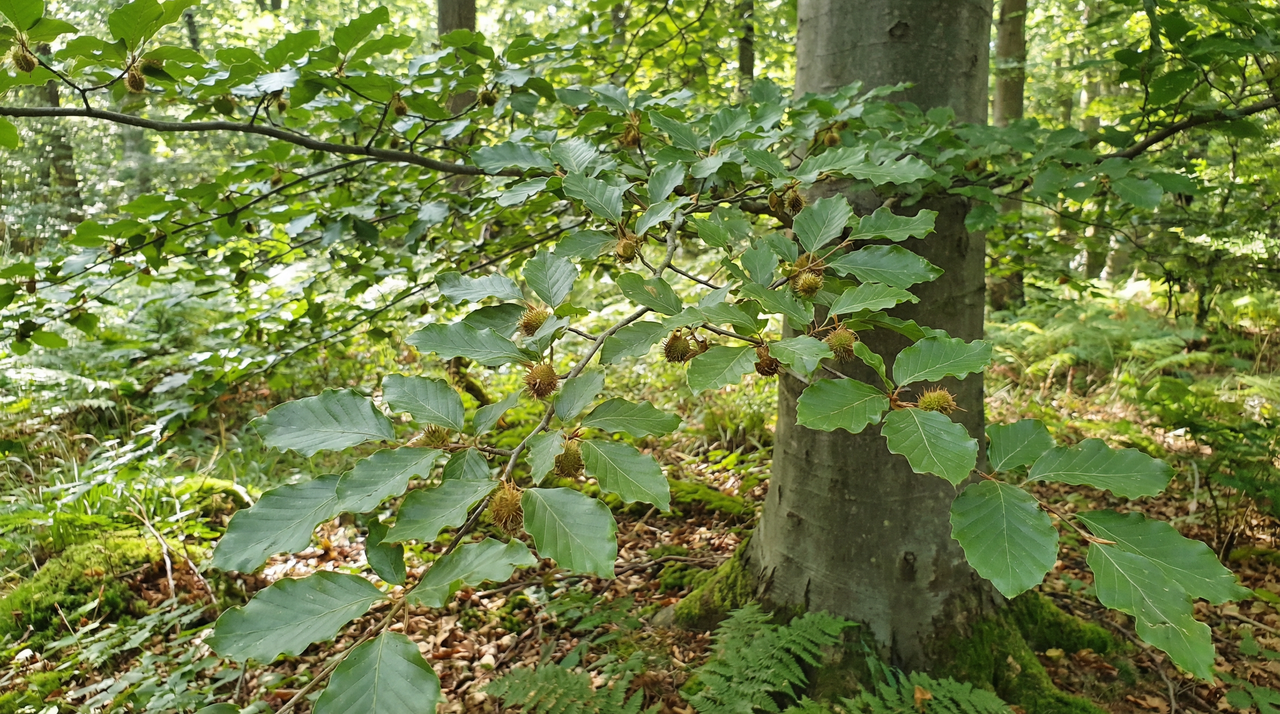
The word "book" comes from beech. That's not a folk etymology or a romantic stretch; the Old English bōc and the Proto-Germanic bōks both trace back to the same root as bōkjō, meaning beech tree, because early Germanic peoples scraped thin tablets from beech bark and carved runes into them.[1] So when you stand under a beech and drag your fingers along that impossibly smooth, silver-gray bark, you're touching something that was, in a very real sense, the first paper. I find that genuinely difficult to hold in my head while also remembering that this same tree won't produce its first meaningful nut crop for thirty to fifty years from seed, won't hit canopy dominance until it's nearly a century old, and will outlive every person who plants it today by several generations.
That tension between slow time and deep usefulness is the whole story of beech. It's not a plant you put in a food forest for a quick yield. It's a plant you put in the ground as a commitment, almost a letter to the future. I've watched gardeners dismiss it for exactly that reason, and I've watched other gardeners fall completely under its spell once they understood what they were actually looking at: one of the longest-lived, ecologically richest, and most quietly complex trees in the temperate world.
Beech Origin, History, and Cultural Significance
Botanical Background and Ecology of Beech Trees
When I'm designing a food forest or long-rotation timber planting, I think in decades. Beech trees force me to think in centuries. European beech (Fagus sylvatica) typically lives 150-300 years under optimal cool-temperate conditions, with exceptional specimens documented at 400-600 years and some believed to push past that.[2][3] American beech (Fagus grandifolia) and Oriental beech (Fagus orientalis) share similar ranges, while Japanese beech (Fagus japonica) tends to top out at 150-250 years.[4][5][6] That extraordinary longevity isn't luck. It's the product of a whole suite of biological strategies operating together.
All Fagus species are polycarpic, meaning they reproduce repeatedly throughout their lives rather than dying after a single seed set.[7][8] European beech reaches sexual maturity around 20 years but doesn't settle into reliable, consistent seed production until 30-50 years, with full reproductive maturity closer to 40-50 years.[9] Canopy dominance takes even longer, arriving somewhere around 80-100 years. American beech matures in a similar window of 20-60 years; Oriental beech is slower still at 40-100.[9] The patience baked into this genus is almost philosophical. Growth rates are slow to moderate, typically 12-24 inches per year in youth, before the tree settles into its broad final form over those first eight or nine decades.[10][11]
Several factors enable lifespans this long. Beech thrives in cool temperate climates receiving 600-1500 mm of annual rainfall, with average temperatures around 8-15°C, in well-drained, fertile, slightly acidic to neutral loamy soils with a pH of 6.0-7.5.[12][13] Rot-resistant heartwood and high shade tolerance allow saplings to persist in the understory for decades while waiting for a gap.[12] Critically, all Fagus species form ectomycorrhizal associations that boost drought resistance and nutrient acquisition, which is why I always flag soil fungal health as a priority when establishing beech in any landscape design.[14][15]
The threats to these long lifespans are real and, for American beech especially, severe. Beech bark disease, driven by the scale insect Cryptococcus fagisuga working in concert with opportunistic fungi, has caused up to 50% mortality in European stands and as high as 95% in some northeastern American beech populations since it arrived in the 1890s.[16][17] Phytophthora root rot compounds the problem, and climate change is tightening the screws on drought-sensitive species like European and Japanese beech.[18] In my work with woodland restoration, I've seen how quickly beech bark disease spreads once scale is established; that 95% mortality figure is exactly why early monitoring belongs in any beech-inclusive design from day one.
Geographically, Fagus sylvatica is native to temperate Europe from southern Scandinavia to the Mediterranean, thriving between roughly 40-64°N latitude.[19][20] It was introduced to North America around 1754, Australia in the 19th century, and beyond, primarily for ornament.[21] American beech is native to eastern North America; Oriental beech hails from the Caucasus and southwestern Asia; Japanese beech is endemic to Japan.[5][6] Different origins, but all beeches reward the same thing: patience.
Visual Characteristics of Beech Trees
The beech tree's silhouette is one of those things you only have to learn once. European beech typically reaches 50-80 feet at maturity, with a 40-70 foot spread and a broad, rounded canopy; exceptional specimens in European forests have been recorded beyond 160 feet.[22][23] American beech runs similarly at 50-70 feet, with champion specimens reported past 100 feet; Oriental beech can tower to 98-131 feet; Japanese beech is the more modest member of the group at 33-66 feet.[7][24][25]
What stops people in their tracks, every time, is the bark. I've run my hand along mature beech trunks in public parks that have to be 80 or 100 years old, and the surface is still smooth in a way that feels almost architectural, silvery-gray and polished, what some writers describe as "elephant-hide," with only the faintest horizontal lenticels breaking the surface and deep fissures not appearing until very great age.[26][27] American and Japanese beech share the same quality when young; Oriental beech grows more fissured with age.[7][28]
The leaves are alternate, simple, elliptical-ovate, 2-4 inches long with wavy or remotely serrate margins, emerging bright green in spring and turning yellow-orange-copper in autumn.[29][21] American beech leaves have sharper, doubly serrate margins with more prominent parallel veins; Japanese beech carries a glossy green that turns coppery-bronze come autumn.[30][25] Many beech species are marcescent, holding onto their dried, rustling leaves through winter, which gives even a leafless winter landscape a distinct, amber-toned warmth. Flowers are inconspicuous and wind-pollinated, appearing in April-May as pendulous male catkins and small upright female clusters, followed by the distinctive spiny cupule that splits at maturity to release two or three small triangular nuts.[31][30]
One structural detail that matters enormously for site planning: beech root systems are typically shallow and wide-spreading, with most feeder roots in the top 12-30 cm of soil and lateral roots potentially extending 50-100 feet from the trunk.[32][33] That makes trees vulnerable to compaction, drought, and windthrow, three things I always flag before signing off on a beech placement. Popular cultivars extend the palette considerably. 'Atropurpurea' (Copper or Purple Beech) carries deep purple-red foliage that shifts to copper-bronze in autumn, while 'Pendula' creates a sweeping, umbrella-like canopy; both share the species' 150-300 year lifespan potential.[34][35]
Traditional and Cultural Uses of Beech
Human relationships with the beech tree go back as far as we've been writing things down. Theophrastus described it around 371-287 BCE; Pliny the Elder referenced it in 77 CE; Linnaeus formally named Fagus sylvatica in 1753.[36][37] Prehistoric evidence of beechnut use in Europe stretches back to roughly 6000 BCE, and in Japan the Jōmon period (14,000-300 BCE) shows similar foraging traditions.[38]
As food, beechnuts sustained people across cultures during lean years and ordinary seasons alike. In Scandinavia and Germany, they were famine food; Algonquian, Iroquois, Ojibwe, and Cherokee peoples ground them into flour for porridge and bread; communities in Turkey, the Caucasus, and Japan used them comparably, and all traditions share the knowledge that the nuts require leaching or roasting to remove bitter tannins before eating.[39][40][41] Pressed beechnut oil was a valuable byproduct across European traditions.
Medicinal use followed the same geography. European folk healers prepared bark as an astringent decoction for wounds, diarrhea, fevers, and skin conditions; leaf teas addressed respiratory and digestive complaints.[42][43] Native American tribes used the bark of Fagus grandifolia in similar preparations, while Turkish and Caucasian traditions employed Fagus orientalis bark and leaves for wounds, inflammation, and respiratory ailments.[40][44] Documentation of Japanese beech in formal medicinal traditions is thinner, though use in and around significant landscapes is well recorded.
For timber, beech has been prized since Roman times: furniture, tool handles, flooring, charcoal for iron smelting, and shipbuilding all drew on its strength and fine grain.[45] Young flexible branches were woven into baskets, hurdles, and fencing, a tradition that continued through the medieval period and beyond.[46] Oriental and Japanese beech share parallel craft histories in their own regions, from carpentry to domestic utensils.[41]
The symbolic dimension of beech is the one I find myself reaching for when clients ask why I'd choose a tree that won't be "done" in their lifetime. In European folklore, beech represents wisdom and protection, a symbolic association that traces back to its widespread use as an early writing medium.[47] Celtic Druids held beech sacred in Ogham script and fertility rites; it appears in Beowulf, in Grimm tales, and in Irish fairy lore.[48] American beech symbolized longevity to certain Native tribes, Oriental beech represents endurance in Caucasian and Turkish tradition, and Japanese beech appears near shrines as an emblem of serenity.[49][50] That the word "book" carries beech inside it feels fitting; this is a tree people have been learning from for a very long time.
Conservation realities add urgency to that history. European beech holds IUCN Least Concern status but faces deer browsing, disease, and a shifting climate. American beech is under severe pressure from beech bark disease and the emerging beech leaf disease. Oriental beech has suffered significant deforestation from overharvesting in Turkey and Iran. Japanese beech faces logging, habitat fragmentation, and climate stress despite its Least Concern listing.[51][52][53][54] Sustainable management that emphasizes natural regeneration is increasingly central to keeping these forests intact.
Fun Facts About Beech Trees
If you've ever watched a squirrel or a jay work a beech tree in a good mast year, you already understand the ecology viscerally. All Fagus species produce beechnuts rich in fats and protein that are essential high-energy food for squirrels, deer, bears, turkeys, jays, and many other species.[11][55] Mast production is irregular, cycling every 2-5 years, which creates genuine boom-and-bust dynamics in forest food webs. Bears may derive more than 80% of their diet from beechnuts in a strong mast year, and the frantic caching behavior of small mammals and birds during that same window drives seed dispersal across the landscape.[56][55] Having watched it happen, I can say the data barely captures the intensity of a good mast year in a beech-dominant forest.
That smooth, silvery-gray bark is more than beautiful. American beech bark in particular actively deters lichen, moss, and heat absorption, and its naturally tight surface resists certain pest colonization.[57][58] It was historically used as a writing surface across cultures, the original "nature's paper," and applied as a medicinal poultice in some traditions.[59] European beech wood carried those practical virtues into the Middle Ages and beyond, becoming the foundation of bentwood furniture techniques in the 19th century, as well as tool handles, charcoal production, and construction across the continent.[60] Beech tar, distilled from the bark in Germanic folk medicine, was applied topically for rheumatism and skin disorders.[61]
The Copper Beech cultivar ('Atropurpurea') carries its own cultural weight, moving through Victorian ceremonial use into modern pagan and garden traditions.[32] I've learned to tell clients upfront that the full purple intensity of a young Copper Beech takes years to develop, and that the spring flush on a maturing tree is something worth siting deliberately so it can be appreciated for generations. In protected settings like botanical gardens, beech lifespans routinely exceed 300 years across both straight species and named structural cultivars.[13][62] That's not a footnote; it's the entire point of the genus. Plant a beech tree and you're making a decision that will outlast you, possibly by several lifetimes.
Beech Tree Varieties and Where to Buy Them
Notable Beech Cultivars and Species
European beech consistently produces exceptional ornamental cultivars that solve real design problems. The roster is genuinely impressive: 'Purpurea' (copper beech) opens each spring in rich purple-red before shifting through green toward a copper-bronze autumn finish, 'Pendula' sweeps the ground with curtain-like branches, 'Dawyck' stands in a narrow column where space is tight, and selections like 'Tricolor' and 'Roseomarginata' offer creamy-pink variegation that catches light in a woodland edge planting.[63][32][29] All of these share the species' slow-to-medium growth rate of 12 to 24 inches per year and hardiness across USDA zones 4 through 7, so patience and long planning horizons come with the territory.[64][65] One thing I learned the hard way installing 'Pendula' in several designed landscapes: stake those young trees firmly for the first two to three years, because without support the leader wanders and you end up with a permanently lopsided form that no amount of later pruning will fix.
For designers wanting a beech with exceptional autumn warmth, Japanese beech delivers reliable yellow-orange-copper color and a refined pyramidal silhouette, and it holds the RHS Award of Garden Merit.[66][25] It performs in zones 5 through 8, making it a useful option where European beech hits its southern limit. At the colder end of the range, American beech (Fagus grandifolia) extends hardiness down to zone 3 and carries the added value of being native, which matters enormously in restoration work.[67][30] I've found it establishes noticeably faster than European cultivars on appropriate native sites, which is a real advantage when you're designing systems meant to function within a decade rather than a century. Oriental beech is the outlier in the genus, capable of reaching over 80 feet with a wide spread and hardy in zones 4 through 8, but with far fewer named garden forms to choose from.[68]
Sourcing Beech Trees and Seeds
Finding beech trees requires going beyond the typical garden center. European beech is the most accessible, available through Nature Hills Nursery, FastGrowingTrees.com, TreeWorks Nursery, and Sheffield's Seed Company.[69][70][71] For American beech, Prairie Moon Nursery and Roundstone Native Seed are reliable sources, while ForestFarm stocks Oriental beech and Plant Delights or Logee's can supply Japanese beech.[72][73][74][75][76] Trees are sold as seeds, bare-root saplings, container-grown stock, or balled-and-burlapped specimens, and specialty ornamental cultivars command premium pricing — expect to pay $20 to $150 for saplings, and $200 or more for larger or rarer forms.[69][71] Given that a healthy beech tree will likely outlive whoever plants it, that upfront cost looks pretty reasonable over any honest time horizon.
If you're sourcing non-native species, USDA APHIS permits and phytosanitary certificates are required to prevent introduction of pests, and the regulatory picture shifts often enough that you should verify current requirements before ordering.[77][78] American beech faces fewer federal restrictions but interstate movement may still require checking origin and disease status given the spread of beech bark disease.[79][80] When I'm evaluating nursery stock before purchase, I always look for the cottony white masses of woolly beech scale on the bark; it's a quick check that takes thirty seconds and can save you from inadvertently introducing problems to your site.
Beech Propagation and Planting
Beech doesn't follow the rules that apply to most trees in the nursery trade, and if you come to it expecting the straightforward process you'd use with an oak or a maple, you'll lose seeds and patience in roughly equal measure. The genus rewards growers who understand its biology first and reach for the trowel second.
Seed Storage, Viability, and Dormancy Requirements
Beechnuts sit in an awkward middle ground between orthodox and recalcitrant seeds, what botanists call intermediate storage behavior. European beech seeds tolerate some drying, down to around 20-30% moisture content, but lose viability sharply if they drop below 10-15%.[81][82] They also cannot be frozen; storage requires 4-10°C in sealed containers maintaining 30-40% moisture.[81] Under those conditions European beech can stay viable for 2-5 years, occasionally longer with careful monitoring, while American beech drops off sharply after 6-18 months and Japanese beech becomes unreliable within 6 months to 2 years.[83][7] All species form only transient soil seed banks lasting less than two years, so they're not waiting in the ground for you either.[83]
I've stratified beech nuts for restoration clients a number of times, and the single most consistent lesson is this: collect fresh and never let them dry out. The triangular nuts, 1.2-1.5 cm long and enclosed in their spiny four-valved husks, need to come off the ground as soon as the husks brown and split open in September to November,[84] be cleaned with minimal handling, and go straight into moist storage or begin stratification within days. Batches that sat on a potting bench for even a week started showing fungal issues before stratification was half done.
Before investing time in stratification, testing viability is worth the effort. A 1% tetrazolium solution will stain living embryos red, and lots above 80% viability are considered good material worth working with.[85] European beech demands 90-120 days of cold moist stratification at 3-5°C before germination will occur; some sources also recommend a preliminary warm phase of 12-16 weeks at 20-25°C for seed that hasn't already experienced autumn warmth naturally.[86][87] American, Oriental, and Japanese beech species need a similar 60-120 days cold.[86] There are no shortcuts here. The cold period is non-negotiable.
Germination and Seedling Care
Once stratification ends and seeds are moved to warm conditions (15-25°C), germination begins in roughly two to four weeks under moist, well-drained acidic media with some shade protection from intense sun.[86] Laboratory germination rates of 50-90% are possible with high-viability seed, but expect 30-70% in practice, and less if squirrels or mice find the trays.[86][88] Beech germinates hypogeal, meaning the cotyledons stay underground while the shoot emerges, so the first thing you see aboveground is a simple arching stem rather than a pair of seed leaves.
The young true leaves, when they do appear, look surprisingly similar to juvenile hornbeam foliage. I learned this the embarrassing way after losing a row of seedlings to overzealous weeding one spring; I now use colored labels in every tray so I'm never guessing. Inoculating sowing media with ectomycorrhizal fungi (Boletus, Lactarius, or Russula species are all natural beech partners) gives seedlings a genuine early boost on nutrient-poor or acidic substrates.[89] Keep seedlings lightly shaded and consistently moist through their first season; they're more vulnerable to drought than young beech trees get credit for.
Vegetative Propagation: Cuttings, Layering, and Grafting
Every beech tree grown from seed is genetically unique. Because the species is wind-pollinated and strongly outcrossing, named cultivars like 'Purpurea' or 'Pendula' cannot be reliably reproduced from seed.[90] If you want a purple-leaved beech or a weeping form, vegetative propagation is the only path to a true-to-type plant.
Cuttings are the obvious first thought, but beech is stubborn about rooting. Juvenile softwood taken in late spring to early summer, treated with IBA at 3,000-8,000 ppm under intermittent mist, achieves only 10-30% success, and mature wood does significantly worse.[91] It's a technique worth trying for patient small-scale growers with mist-bench setups, but it's not reliable enough for production purposes.
Grafting is the real workhorse. Whip-and-tongue, cleft, or side-veneer grafts onto dormant European beech seedling rootstock in late winter to early spring consistently achieve 50-95% success.[92] After several seasons of practicing whip-and-tongue on beech rootstock in my own nursery, I reliably hit 70-80% take, and I credit most of that improvement to sharp blade discipline and careful cambium alignment. Grafting also compresses the wait considerably for nut production compared to seed-grown trees. For any named cultivar or tricolor beech form, grafting isn't just convenient; it's the correct method.
Soil and Site Selection for Beech
Getting the soil and site right before planting a beech tree matters more than almost any other decision you'll make. European beech performs best in deep, fertile, well-drained loamy soil with 3-5% organic matter and a pH between 5.5 and 7.5.[93] Push above pH 7.5 and the tree becomes calcifuge, developing iron chlorosis as it struggles to access micronutrients. Drop below pH 4.5 and aluminum toxicity becomes a real risk.[93] I always recommend a soil test before planting because I've watched mature beech develop chronic yellowing years after installation in unamended high-pH suburban clay; the symptoms appear so gradually that by the time most gardeners notice, the tree has been struggling for seasons.
Drainage is the other non-negotiable. Beech roots are shallow and fibrous, concentrated in the top 30-50 cm of the soil profile,[94] which means waterlogging and compaction directly compromise the root zone the tree depends on most. Both conditions promote Phytophthora root rot, and once that gets established, it's very difficult to turn around.[30] In my experience, more beech trees fail in urban and suburban landscapes from poor drainage and compacted subsoil than from any other single cause. Treating the site before planting, whether that means breaking up hardpan, raising the planting area, or simply choosing a better location, is far easier than managing a slowly declining tree afterward. A 2-3 inch layer of organic mulch extending to the dripline, kept clear of the trunk, does double duty by conserving moisture and protecting those shallow roots from compaction and temperature swings.
Planting Technique, Spacing, and Establishment
Before you put a beech in the ground, reckon honestly with its mature size. European beech reaches 50-80 feet tall with a canopy spread of 40-70 feet,[95] and while the 12-24 inches of annual growth after establishment feels modest, the tree doesn't stop. For specimen planting, 40-60 feet between trees is the minimum to avoid canopy competition; I personally space my landscape specimens at least 50 feet apart because I've watched crowded plantings develop competing leaders and lopsided canopies that require corrective work for years. Hedges are a different story entirely: plant at 18-24 inches for a formal beech hedge, and 8-15 feet for forestry or windbreak rows with the expectation of later thinning.[96]
Timing the planting of a beech tree matters, too. Early spring or autumn while the tree is dormant minimizes transplant shock significantly.[97] Beech develops a taproot alongside fleshy lateral roots that resent disturbance, so move seedlings at 1-2 years old with intact root balls and minimal root pruning.[98] Weeping and copper cultivars may benefit from temporary staking in their first season. Once planted, consistent watering through the first two growing seasons is the single most important thing you can do; the shallow root system simply cannot chase moisture the way a tap-rooted oak can. I learned to mulch out to the full dripline rather than just around the trunk after losing a couple of young trees to summer drought, and the difference in establishment speed was immediately noticeable. Get those basics right and you're setting up a tree that may well outlive everyone who plants it.
Beech Tree Care Guide: Sunlight, Water, Soil, and Seasonal Maintenance
Get the site right, and a beech tree will mostly take care of itself for the next few centuries. Get it wrong, and no amount of fertilizer, irrigation, or attentive pruning will fully compensate. Every recommendation below flows from that single principle.
Sunlight Requirements for Beech Trees
European beech wants at least six hours of direct sun for dense foliage and the best color on cultivars, though its juvenile shade tolerance is genuinely remarkable.[99][100] Seedlings can persist under a closed canopy for decades, making them unusual among large forest trees.[99][101] In practice, though, I've noticed that copper and purple-leaved cultivars scorch faster in unrelenting afternoon sun than the straight species does. Japanese beech benefits from afternoon shade in hotter zones,[102] and Oriental beech is the most shade-tolerant of the three common species.[103] All species prefer shelter from strong winds, which can desiccate the shallow roots even when soil moisture seems adequate. For more on how afternoon heat compounds these light stresses, the heat tolerance section below covers mitigation in detail.
Watering Needs and Drought Tolerance
European beech evolved in cool, moist temperate forests and its roots know it. It prefers consistently moist, well-drained soil with a pH of roughly 6.0 to 7.5 and is sensitive to saline irrigation water.[104][21] American beech prefers a slightly more acidic range of 5.0 to 6.5,[105] and Japanese beech sits between the two at 5.5 to 7.0.[106]
Newly planted trees need about an inch of water per week during the first growing season; young nursery stock typically needs watering every two to three days until roots establish.[107][108] Once established, deep watering of one to two inches every one to two weeks only during extended dry spells is usually all they need.[99] I check soil moisture twelve inches down with a screwdriver before I decide whether to run the irrigation; if it slides in easily and comes out dark, I wait. European beech can only tolerate two to four weeks of dry conditions before showing stress,[109][110] while American, Oriental, and Japanese beeches are moderately more tolerant once mature. Overwatering is just as dangerous as drought: Phytophthora root rot moves fast in waterlogged soil, and wilting despite wet conditions is its classic early signal.[111] A two-to-four-inch layer of organic mulch kept clear of the trunk handles more watering problems than any irrigation schedule I've tried.[112]
Soil, Feeding, and Nutrient Management
After watching iron chlorosis develop on a client's beech planted in high-pH urban soil, I now insist on a soil test before specifying any Fagus. Alkaline conditions above pH 7.5 lock out iron, and the result is interveinal yellowing on young leaves that's easy to misread as a pest problem.[113][114] Sandy or high-pH soils can also produce manganese, zinc, and boron deficiencies, while nitrogen shortage shows as uniform pale yellowing and potassium shortage causes marginal leaf scorch.[115][116] A two-to-three-inch compost mulch applied annually often corrects mild deficiencies without sprays, and it's the single intervention I recommend first.
I over-fertilized a young copper beech early in my career. The soft, lush growth that followed looked great in late summer and then got hammered by the first hard frost. That tree took two seasons to recover. Beech has a real sensitivity to over-fertilization: it disrupts the mycorrhizal associations the tree depends on, accelerates disease susceptibility, and produces exactly the kind of frost-tender growth you don't want.[117][118] Established trees in appropriate soil need nothing beyond annual compost mulch. Young trees in the first one to three years may benefit from a light application if a soil test confirms a specific deficiency, but synthetic fertilizers should be a last resort, not a routine.[119]
Frost Tolerance and Winter Protection
European beech is reliably hardy in USDA zones 4 through 7, American beech in zones 3 through 9, and Oriental beech in zones 5 through 8.[99][105][25] Mature trees handle cold well. Young trees and newly emerging spring foliage are a different story: a late frost can blacken buds, distort new leaves, and kill back soft stem tips overnight.[120][121] I've lost the tips of young beech seedlings to a surprise May freeze more than once, and I now keep lightweight frost fleece on hand until I'm confident the last frost has passed.
For young trees in zones 3 through 5, the protection toolkit is straightforward: two to four inches of organic mulch around the base kept away from the trunk, a trunk wrap or hardware-cloth cylinder against sunscald and rodents, and a deep watering before freeze-up to reduce desiccation stress.[118][122] Avoid planting in frost pockets or anywhere drainage is questionable. One of the things I genuinely love about young beeches in winter is their marcescence, those papery tan leaves that cling to the branches through the coldest months, providing real bud protection and reducing browsing pressure from deer.[123] It's a feature, not a sign of stress, and it's one of the first things I point out to clients who mistake it for disease.
Heat Tolerance and Summer Stress Management
European beech is rated AHS Heat Zones 4 through 1, and it genuinely prefers summers that stay below 77°F.[124] Prolonged temperatures above 86 to 95°F trigger leaf scorch, wilting, and reduced photosynthesis, and seedlings are especially vulnerable.[110][125] Oriental beech handles heat a bit better, and American beech has the narrowest tolerance window, struggling above zone 7 without shade and supplemental moisture.[126]
I start monitoring leaf margins for early scorch in July. The fix I've found most effective isn't watering more aggressively at the trunk; it's moving the drip line out toward the dripline of the canopy, which encourages deeper rooting and noticeably improves resilience the following summer. Drought and heat almost always compound each other on beech, so the mulch layer, the deep infrequent irrigation, and north- or east-facing site orientation all work together.[127]
Pruning, Maintenance, and Seasonal Rhythm
Beech trees have a poor wound-closure response, which means every unnecessary cut is a liability.[128][129] Prune during dormancy in late winter to early spring before bud break, removing only dead, diseased, or crossing branches.[130] I limit my pruning work to structural corrections in the first five years and then largely leave the tree alone. Heavy pruning also creates large exposed surfaces prone to sunscald, so less really is more here. Stake young trees in windy sites for the first year or two, then remove the stake so the trunk develops natural taper and strength.
Seasonal Care Calendar for Beech
European beech follows a clean temperate cycle: leaves emerge with flowers in April and May, nuts mature from September through October, senescence arrives in October and November, and dormancy runs through to March.[131][132] Mast years arrive every two to seven years across the genus, those irregular bumper crops of nuts that feed birds, mammals, and forest ecology in general.[133] In practice, this calendar tells a gardener when to act: mulch in early spring before leaf emergence, water deeply through summer dry spells, hold off on any pruning until late winter dormancy, and let the marcescent leaves do their work through the cold months rather than raking them away.
European beech can live over 300 years and American beech beyond 400 under good conditions, reaching structural maturity around 80 to 100 years.[131] A beech tree planted today with proper site selection, restrained soil management, and patient hands can shade great-grandchildren. That's a long return on careful early decisions, and it's why I think beech care is really about trust: trust the tree's preferences, stay out of its way, and let the slow growth compound into something extraordinary.
Beech Harvesting Guide: Timing, Techniques, Yield, and Flavor
Planting a beech tree from seed for foraging requires setting a very long timeline. European beech grown from seed typically takes 30 to 50 years before it begins reliable nut production, averaging around 40 years, though optimal conditions can push that down to 20 and poor ones stretch it past 80.[134][135][136] Grafted trees are a different story entirely, coming into production in roughly 5 to 15 years.[137] In my own projects, grafted specimens have started dropping their first usable nuts around years 8 to 10, which feels like a miracle compared to what the seed-grown trees require. That choice, seed versus graft, is the real first decision for anyone who wants to forage rather than simply admire.
When Beech Trees Start Producing Nuts and Annual Harvest Windows
Once a tree reaches bearing age, the annual rhythm is satisfyingly predictable. Beech flowers in April or May as monoecious catkins, and the nuts reach physiological maturity roughly 150 to 210 days later, putting harvest squarely in September and October for European beech, and stretching into November for American beech populations at northern latitudes.[131][138][137][11]
What you won't get every year is abundance. European beech masts irregularly, every 2 to 10 years, and Oriental beech follows a similar pattern every 2 to 5 years.[139][140] I've taken to planning guild underplantings around anticipated bumper years, turning what looks like irregularity into a predictable permaculture pulse. When the mast comes, you want to be ready.
Harvesting itself is wonderfully passive. You're looking for husks that have turned brown and split open naturally, revealing plump, glossy, triangular nuts inside.[137][141] Gather from the ground after the natural drop rather than stripping from branches.[21] Soil quality, canopy light, and moisture availability all shift that window, sometimes by weeks, so your site conditions are worth tracking year to year.[142]
Beechnut Flavor, Texture, and Yield: From Bitter Raw to Roasted Perfection
The primary harvest is the triangular beechnut, tucked inside those spiny husks. Young spring leaves offer a secondary forage option, edible sparingly or steeped as a simple tea.[99][11][143] But the nut is the real reason you're here, and raw beechnuts are genuinely unpleasant across every Fagus species, bitter and astringent from high tannin content.[26][11] Roasting or leaching changes them completely, bringing out a sweet, nutty flavor with hazelnut and chestnut notes and a creamy, buttery texture that most people find genuinely surprising.[144]
I always roast a small test batch the moment the first nuts drop to gauge that year's tannin level. The shift in aroma is unmistakable: that astringent, faintly green smell gives way to something warm and nutty, like hazelnuts browning in a dry pan. When I catch that scent, I know the batch is done. Nuts harvested after the first frost tend to be noticeably milder raw, with tannins already beginning to break down, and they store better too.[145][11] On years following a late frost, I wait an extra week or two past husk-split before gathering.
Flavor varies more than most people expect. Green-leaved beech varieties tend toward sweeter nuts, while copper beech selections often run slightly more tannic in my experience.[144] Soil, climate, tree age, and even provenance all play a role; Turkish-origin Oriental beech nuts, for instance, tend to be larger and milder than Caucasian populations. Aroma follows a similar pattern across the genus, reminiscent of fresh hazelnuts or chestnuts once properly prepared, with Japanese beech adding distinctive woody and earthy depth.[26][146]
Beech Preparation and Uses
Culinary Preparation of Beechnuts and Other Parts
Raw beechnuts are not a snack you eat straight from the husks. Due to their tannin and theobromine content, they must be leached or roasted to prevent severe gastrointestinal distress.[147][148] Processing is the whole game here. I leach mine over three to seven days with daily water changes, and you can actually watch the water turn reddish-brown as the tannins leach out. By day four or five, that sharp mouth-puckering astringency is mostly gone. Slow roasting at around 150-200°C finishes the job and brings out something genuinely sweet and nutty.[149][150] Traditional Japanese methods for Fagus japonica follow the same logic, soaking for several days then roasting or boiling, confirming that this is a genus-wide truth, not a quirk of one species.[151]
Once processed, the payoff is real. Properly leached and roasted beechnuts eat like a cross between hazelnut and chestnut flour; I've baked with both, and beechnut flour lands somewhere between the two, a bit earthier than chestnut but with that same rich, slightly sweet depth. You can press the nuts for oil too. European beech oil is light and fruity with a high oleic acid content, and Oriental beech nuts run 40-60% oil, making them worth the extraction effort.[152][144] Roasted and ground, they also make a serviceable coffee substitute.[153] The nutritional return on all that processing is solid: around 576 kcal per 100g, 50g of mostly unsaturated fat, meaningful fiber, 7-18g protein, and good levels of magnesium, potassium, vitamin E, and B vitamins.[154][155] In terms of flavor pairings, beechnuts hold their own alongside brie, wild mushrooms, game, pork, and risottos; they sit naturally on a charcuterie board or folded into a stuffing.
The tree gives more than nuts. Young spring leaves of European beech are one of the gentler wild greens out there, tender enough to eat raw in salads with a mild, slightly nutty flavor.[156] The window is short; once they toughen up, so does the bitterness. Dried young leaves also make a mild tea with gentle diuretic properties, though I'd keep consumption modest given potential oxalate content.[20] In early spring, European beech sap can be tapped for a mildly sweet drink, or boiled down, much like a subtler version of what maple tappers do.
Beechnuts have fed people through hard times across several continents, ground into flour during medieval famines in Europe, pressed for oil in Anatolia and the Caucasus, eaten by Ainu communities in Japan, and processed from inner bark into porridge in North America when nothing else was available.[157][158] That's a long record of humans figuring out how to work with this tree. If you're foraging your own, two practical notes: I've always told foragers that if you're harvesting near roads or old industrial sites, skip the nuts entirely. Beech is an enthusiastic phytoremediator, and heavy metals accumulate in the kernel.[159] And because beech trees are mast producers, I've learned to watch a particular tree for several seasons before counting on a reliable harvest; mast years arrive every few to ten years, and plenty of seasons yield almost nothing. Tree-nut allergy sufferers should steer clear due to possible cross-reactivity,[160] and if you're uncertain about identification, the closest look-alike you'll encounter is acorns from oak, which happen to require the exact same leaching process anyway.[161]
Traditional Medicinal Preparations
Across European, Oriental, and American beech species, the folk medicine tradition centers on tannin-rich astringency: leaf infusions for diarrhea and as a mild diuretic, bark decoctions applied to wounds and skin conditions, poultices of fresh leaves or boiled bark for burns and rheumatic pain.[153][39] Historically, practitioners worked with roughly 1-2g of dried leaves per cup steeped as a tea, or a small bark decoction of about a teaspoon of chopped bark per cup, taken once or twice daily.[162][163] I find this ethnobotanical record genuinely interesting, but I treat it as historical lore rather than a prescription. There are no standardized doses, no clinical trials, and no FDA-approved preparations from beech. For the phytochemical and evidence picture, the health benefits section covers the research in detail.
Non-Food Uses of Beech
Beech timber is strong, fine-grained, and takes steam bending beautifully, which is part of why it's historically prized for furniture, flooring, tool handles, and cabinetry.[164] As a designer who's specified beech for long-term woodland plantings, I appreciate that it also burns clean: high BTU value, low smoke, minimal creosote buildup, which makes mature coppiced material genuinely useful in systems where firewood is part of the yield plan.[165] Bark and leaves yield tan, yellow, and brown dyes, a quiet craft use that rewards experimentation. Beyond the material, beech trees carry enormous cultural weight across Europe, Anatolia, the Caucasus, and Japan, appearing in ritual, folklore, boundary-marking, and sacred planting near Shinto shrines and Buddhist temples.[166][167] As the origin section touches on, the very word "book" traces back to beech bark used as writing material. That history is baked into the tree itself, and it's part of what makes planting one feel like a commitment to something larger than a single harvest.
Beech Health Benefits and Medicinal Uses
Beech is not a medicinal superstar the way some plants in a food forest guild are. Its health story is really one of fascinating phytochemistry, a long thread of cautious traditional use, and some genuinely interesting preclinical science that has yet to be tested on a single human in a clinical trial. That context matters, and I think it helps anyone deciding whether to plant a beech tree for its yields versus its ecological role.
Phytochemicals: Flavonoids, Tannins, and Phenolic Acids in Beech
The beech tree builds an impressive chemical arsenal across all its tissues. Leaves and bark of Fagus sylvatica contain flavonoids including quercetin, kaempferol, and rutin; condensed and hydrolyzable tannins such as castalagin and vescalagin; phenolic acids including gallic, protocatechuic, and ellagic acid; and coumarins, with phenolics and tannins together comprising up to 10-15% of dry weight in leaves and bark.[168][169] The bark runs especially high in ellagitannins, seeds hold catechins and condensed tannins, and these patterns hold broadly across American, Oriental, and Japanese beech as well.[170][171][172] The wood and bark also contain triterpenes including betulinic acid and lupeol, along with trace volatile monoterpenes tied to defense signaling.[169]
One thing I've noticed over years of working with beech in acidic-soil landscapes is that trees on leaner, more acidic ground seem to produce noticeably more astringent bark than those in richer, buffered soils. That observation lines up with the research: tannin and phenolic concentrations peak in autumn leaves and rise further under drought stress, as the tree ramps up its chemical defenses.[173][174] The same compounds that protect the tree from herbivores, pathogens, and competing plants through allelopathy[175][176] are exactly what herbalists were reaching for when they stripped beech bark for wound washes and astringent teas. Nature rarely separates ecological function from medicinal potential.
Medicinal Research on Beech: Antioxidant, Anti-inflammatory, and Antimicrobial Activity
The preclinical research is genuinely interesting, even if it stops well short of clinical proof. Leaf, bark, and wood extracts from multiple Fagus species all demonstrate meaningful free-radical scavenging capacity in standard DPPH, ABTS, and FRAP assays, with the antioxidant activity attributed primarily to the phenolic fraction.[177][178] In vitro and animal studies also document anti-inflammatory effects through NF-κB pathway modulation, suppression of pro-inflammatory cytokines, reduced nitric oxide production, and in some cases COX-2 inhibition.[179][180] Bark extracts show particular antimicrobial activity against Staphylococcus aureus and some effect against E. coli and certain fungi, driven largely by polyphenolic disruption of microbial cell membranes.[181][182]
Traditional European use built on this foundation for centuries: leaf infusions as diuretics and expectorants, bark preparations as astringents for diarrhea and skin conditions, and beech tar applied topically for eczema, burns, and psoriasis.[183][184] Native American tribes used Fagus grandifolia similarly for respiratory ailments, wounds, and digestive complaints,[185] and Oriental and Japanese beeches carry comparable folk applications in their regions. There are also preliminary signals worth watching: alpha-glucosidase inhibition, wound-healing activity, and apoptosis induction in cancer cell lines.[186][187] But "preliminary signal" is doing a lot of work in that sentence. No Fagus species has an FDA-approved medicinal application, no human clinical trials exist, and extract composition varies considerably by environment and preparation method.[188][178] I value the beech tree enormously in the permaculture landscapes I design, but I'm not suggesting anyone self-medicate with bark tea.
Nutritional Profile of Beechnuts
Here's where the beech tree actually delivers something tangible for foragers. Beechnuts are nutritionally dense: roughly 45-55% carbohydrates, 15-25% protein, and 20-30% lipids (primarily the unsaturated oleic and linoleic acids), plus strong mineral content with potassium running 700-800 mg per 100g and magnesium at 200-300 mg per 100g, alongside phosphorus, calcium, iron, and zinc.[189][154] They also bring B vitamins, vitamin E, and their own load of bioactive phenolics including gallic acid, ellagic acid, quercetin, and kaempferol.[190][191] Compared to hazelnuts or acorns, beechnuts hold their own in terms of fat quality and mineral density, which is why they were a genuine subsistence food across European and North American indigenous communities.
The catch is tannins. Raw beechnuts contain 2-10% tannins, enough to cause bitterness, reduced digestibility, and real gastrointestinal irritation if you eat enough of them.[192][193] I learned this the embarrassing way on an early foraging walk when I skipped the leaching step because I was impatient. Stomachache confirmed. Leaching, boiling, roasting, or fermenting reduces tannin content by 40-70% and dramatically improves both palatability and nutrient bioavailability.[192][193] Processed properly, a roughly 28g serving delivers around 160-187 kcal, and historical use stretched them into flour for breads, porridges, and even a coffee substitute.[191][184] If you have a birch pollen allergy, approach with extra caution since cross-reactivity is documented.
Safety Considerations and Potential Side Effects
The overall toxicity picture for beech is low to moderate. There are no lethal compounds lurking here, and casual exposure is not a serious concern for most adults. But tannins, which run at 5-20% dry weight across leaves, bark, and nuts, are the real variable to manage, and eating raw beechnuts in quantity is a reliable way to end up with nausea, vomiting, or diarrhea.[21][194] Livestock are more vulnerable than humans: horses and ruminants can suffer reduced feed intake or organ stress from excess beechnut or leaf consumption, and roasting or soaking reduces that risk here too.[195][196]
Pollen is a separate issue entirely. Beech pollen triggers hay fever, itchy eyes, and congestion in 5-15% of pollen-allergic individuals in Europe, with cross-reactivity to birch, oak, and other Fagales species.[197] I routinely flag this for clients who already react to birch before we place a large beech specimen near a sitting area or bedroom window. Woodworkers face a different risk: occupational exposure to beech dust is documented to cause asthma and contact dermatitis.[198] For foragers, identification matters too; beechnuts have been confused with horse chestnut during casual harvest, which is a much more serious toxicity situation.[196]
For internal medicinal use, I never recommend beech bark or leaf preparations without professional guidance. Tannin levels are simply too variable depending on species, season, soil, and preparation method, no standardized doses exist, and there is no clinical validation for any therapeutic application.[183] Pregnant or breastfeeding women, children, the elderly, and anyone with liver or kidney concerns should avoid medicinal preparations entirely.[183] If you're harvesting bark or nuts from wild or managed stands, source responsibly; beech trees are keystone species and stripping bark from living trees causes real damage to ecosystems that took centuries to build.[199][200]
Beech Pests and Diseases
Healthy beech trees have a surprising number of natural defenses: smooth gray bark that discourages colonization, waxy leaf cuticles, and a robust chemistry built on tannins, flavonoids, and phenolics that deter many insects before they get a foothold.[201][202] The catch is that those defenses erode quickly under stress. In my experience, almost every serious beech disease problem I've encountered in the landscape traces back to a compromised tree first, whether from poor drainage, compaction, or a site that was never really right to begin with.
Major Diseases of Beech Trees
The two headline threats for any North American planting are beech bark disease and the more recently identified beech leaf disease. Beech bark disease is a lethal complex: the beech scale insect (Cryptococcus fagisuga) creates entry wounds in the bark, then opportunistic Neonectria fungi move in, producing cankers, dieback, and eventually high mortality.[203][204] European beech is highly susceptible. Beech leaf disease, caused by the foliar nematode Litylenchus crenatae mccannii, is the newer and frankly more alarming problem: it produces dark banding between leaf veins, progressive canopy thinning, and kills trees within 6 to 10 years.[205][206] No reliable cure exists for it yet, which changes the calculus for anyone considering American beech in particular.
Below those two headline concerns sit root rots, and this is where site selection becomes everything. Both Phytophthora (particularly P. plurivora and P. ramorum) and Armillaria thrive in waterlogged or compacted soils, causing root decay, wilting, and steady decline.[207][208] After watching several client beeches collapse to Phytophthora in sites with poor subsoil drainage, I now insist on mounded or raised planting for any beech in a marginal drainage situation. Soil pH outside the 5.0 to 7.5 window compounds the risk further.[209] Foliar issues like anthracnose, powdery mildew, and leaf spots do appear, but on a genuinely healthy tree they're cosmetic; the fungi responsible largely stay opportunistic rather than lethal.[210][211]
One design choice worth knowing: Oriental beech (Fagus orientalis) and the Japanese species F. crenata and F. japonica show considerably greater resistance to beech bark disease than European or American beech, likely due to thicker bark and evolved chemistry from sharing range with their pathogens.[212][213] I've started recommending F. orientalis to clients who love the beech form but face humid conditions or heavy scale pressure, partly for that reason. No widely available European beech cultivar offers equivalent resistance yet, though breeding programs working with naturally resistant American beech selections give real reason for optimism.[214][215]
Common Pests Affecting Beech
The beech scale insect is the pest that matters most, not because its feeding damage alone is fatal but because it's the vector that opens the door to beech bark disease.[216] The white woolly masses it leaves on bark are surprisingly easy to overlook until you know what you're looking at; I've trained myself to check the lower trunk every spring, especially when laying out underplantings where I'll be crouching near the base anyway. Secondary pests like the woolly beech aphid (Phyllaphis fagi), various leaf miners, and occasional gypsy moth outbreaks cause honeydew, sooty mold, and defoliation, but on a well-sited, unstressed tree the impact rarely escalates.[216][217] Diverse, well-managed plantings with good air circulation consistently show lower overall pest pressure across the genus.[218]
Prevention, Management, and Resistance
Cultural prevention is the foundation of everything here. Select well-drained sites with pH in the 5.0 to 7.5 range, avoid wounding the root zone, prune only during dry weather with sterilized tools, and keep organic mulch over the root plate to maintain moisture and microbial health.[219][220] For established beech bark disease, heavily infested trees may need removal; where scale is caught early, a single dormant application of horticultural oil timed to the crawler stage has given me far better results than repeated summer sprays, with less collateral damage to beneficial insects. Chemical controls offer limited long-term efficacy anyway.[221] Beech leaf disease is a harder conversation: no reliable treatment exists yet, so prevention and sourcing clean nursery stock are the only real tools.[222]
Integrated pest management, combining those cultural practices with biological controls like lady beetles for aphid and scale populations and judicious sanitation, consistently outperforms chemical-heavy approaches.[223][224] In fifteen years of designing with beech I've watched healthy specimens in well-chosen sites resist pest pressure that killed stressed neighbors in a single season. Ongoing work at institutions like the Holden Arboretum and Cornell on resistant American beech selections offers real hope for the future; until those selections become commercially available, matching the right species to the right site, with a diverse guild around it, remains the most dependable form of resistance any of us have.
Beech in Permaculture Design
Beech is not a tree you slot into a design as an afterthought. It's a commitment, a generational one, and I think that's exactly why it tends to get underused in permaculture planning while simultaneously being one of the most ecologically powerful canopy trees available in temperate climates. I've specified European beech in several woodland restoration and silvopastoral projects over the years, and every time the decision came down to the same honest calculation: the long-term soil stabilization, wildlife value, and sheer structural presence outweigh the genuine limitations it imposes on the understory beneath it. You just need to go in with clear eyes about those trade-offs.
Climate Suitability and Hardiness Zones for Beech
European beech (Fagus sylvatica) is hardy across USDA zones 4-7, with the sweet spot sitting in zones 5-7 where it handles minimum temperatures down to around -30°F without complaint.[225][99][226] Zone 8 is where things get dicey. Heat stress becomes real, and in my experience with other temperate canopy trees pushed into warmer microclimates, the difference between survival and slow decline often comes down to afternoon shade from a neighboring structure or taller evergreen, combined with excellent drainage.[21] I've watched a zone 7 site behave like zone 8 simply because it sat in a low-lying bowl with clay soil that stayed wet in winter and baked in summer. Site selection matters as much as the zone number on paper.
Moisture requirements are substantial. European beech wants at least 24 inches of annual rainfall, and really performs best with 31-47 inches alongside moderate to high humidity through the growing season.[227][21][26] For North American designers considering alternatives, American beech (Fagus grandifolia) pushes colder, tolerating zone 3 and temperatures to -40°F, with a slightly wider precipitation range of 35-50 inches annually, and a clearer ceiling around 95°F.[161][30] Oriental beech (Fagus orientalis) fills the opposite end, extending to zone 8 with higher chilling-hour requirements and a preference for ample precipitation.[5][228] In all cases, microclimate, drainage, and humidity do more work than the hardiness zone label alone.[21]
Ecosystem Functions and Services of Beech
The ecological contributions of a mature beech tree are genuinely impressive. Beechnuts are a cornerstone mast crop for temperate wildlife, feeding squirrels, deer, wild boar, birds, and insects; mast events ripple through forest food webs, synchronizing population dynamics and driving seed dispersal in ways that sustain entire animal communities.[229][30] As a shade-tolerant, long-lived climax species, beech stabilizes slopes through its fibrous shallow root system, reduces erosion, improves water infiltration, and sequesters carbon across a lifespan that can stretch 300-500 years or more.[30][230]
Underground, beech forms ectomycorrhizal partnerships that dramatically improve phosphorus and water uptake, build drought resilience, and seem to enhance the health of neighboring trees across a shared soil network.[231][232] Once established, beech seems to connect into the broader soil web in ways that lift the whole system. The slow-decomposing leaf litter builds humus over time, though it also acidifies the soil beneath the canopy, which starts to explain the constraint side of this tree's character.
That constraint is allelopathy. Root exudates and tannin-rich litter from beech actively suppress competing plants, which is part of why beech stands develop such sparse understories.[110][30] In permaculture terms, this is a significant design variable, not a dealbreaker, but something to plan around deliberately rather than discover after planting.
Reproduction adds another layer of unpredictability to design planning. Beech is wind-pollinated and self-incompatible, meaning it needs cross-pollination from nearby trees, with flowering peaking in spring at moderate temperatures.[233][234] Mast years arrive irregularly every few years, and late frosts, habitat fragmentation, and shifting climate patterns can disrupt both pollination and seed set.[233][235] My practical approach is to treat beech mast as a wildlife bonus rather than a reliable annual yield, and to build guilds that don't depend on it. When it happens, it's spectacular for the ecosystem. When it doesn't, nothing in the design fails.
Within permaculture and agroforestry systems, European beech earns its place through timber quality, firewood value, leaf biomass for mulch, erosion control, and the shaded microclimate it creates below its canopy.[236][228] Oriental beech offers comparable functions with the added benefit of greater disease resistance in suitable climates.
Forest Layer Placement and Guild Design
Beech belongs in the canopy layer, unambiguously. Growing 50-100 feet tall with a dense spreading crown, it casts heavy shade that drops understory light below 5% of full sun as it matures.[99][237] Combine that with shallow roots competing intensely for moisture and nutrients in the top 30 centimeters of soil, acidic leaf litter dropping the pH to 3.5-4.5, and allelopathic chemistry from both roots and decomposing leaves, and you have a tree that systematically reinforces its own dominance.[238][239] Early in my career I tried underplanting beech with shade-tolerant perennials I thought would handle low light. Most of them sulked and slowly disappeared. The lesson was clear: beech demands true woodland specialists.
The companions that actually work beneath a beech are ferns, mosses, wild ginger, specialist fungi, and lichens; essentially the woodland floor community that evolved alongside Fagus.[240] Japanese beech (Fagus japonica) shows particularly strong juvenile shade tolerance and can accumulate minerals like potassium in its tissues, making it an interesting dynamic accumulator in appropriate designs. But the honest assessment for most food-focused permaculture projects is that productive guild planting beneath a beech canopy is genuinely difficult.
Beech prefers well-drained, fertile loamy soils with a pH range of 5.5-7.5, and its longevity of 300-500 years or more makes it a legacy tree in the truest sense.[27] I recommend it most enthusiastically in large-scale timber systems, silvopastoral designs, or woodland restoration where wildlife habitat and soil building are the primary outputs, and where space allows the tree to express its full ecological footprint without frustrating a companion planting scheme. In those contexts, beechnuts and young spring leaves offering edible yields to both humans and animals are a genuine added benefit, even accounting for processing needs.[241] Plant it where you can afford to be patient, give it good drainage, and design around its constraints rather than against them.
The Tree That Taught Me to Think in Centuries
I planted a young European beech on a client's property twelve years ago, and it's still barely taller than I am. Every spring I check on it, and every spring I have to remind myself that this isn't failure; it's just beech time. There's something quietly humbling about working with a plant whose real life begins long after yours ends, and I think that's exactly why I keep planting them.
Sources 241
- Online Etymology Dictionary: book ↩
- Fagus sylvatica - European Beech ↩
- Longevity of European Beech (Fagus sylvatica L.) in a Managed Temperate Forest ↩
- American Beech - Fagus grandifolia ↩
- Fagus orientalis - Oriental Beech ↩
- Fagus japonica ↩
- American Beech (Fagus grandifolia) ↩
- Fagus sylvatica - Royal Botanic Gardens, Kew ↩
- Silvics of North America: Fagus species ↩
- Beech Trees: Growth Rate and Lifespan ↩
- American Beech (Fagus grandifolia) ↩
- Fagus sylvatica ↩
- Fagus sylvatica (European beech) ↩
- Mycorrhizal Associations in Fagus grandifolia ↩
- Adaptations of Fagus sylvatica and Fagus orientalis to Environmental Stress ↩
- Beech Bark Disease and Its Impact on American Beech ↩
- Beech Bark Disease in the Northeastern United States ↩
- Phytophthora Diseases of Trees ↩
- European Beech (Fagus sylvatica) - Distribution and Ecology ↩
- Fagus sylvatica ↩
- European Beech (Fagus sylvatica) ↩
- European Beech (Fagus sylvatica) ↩
- European Beech (Fagus sylvatica) - Height Records ↩
- Fagus orientalis ↩
- Fagus japonica - Japanese Beech ↩
- European Beech (Fagus sylvatica) ↩
- Fagus sylvatica ↩
- Fagus orientalis ↩
- Fagus sylvatica L. ↩
- Fagus grandifolia ↩
- European Beech (Fagus sylvatica) ↩
- Fagus sylvatica ↩
- Beech, European ↩
- Fagus sylvatica 'Purpurea' ↩
- Fagus sylvatica 'Pendula' ↩
- Theophrastus: Enquiry into Plants ↩
- Species Plantarum ↩
- The Prehistoric Uses of Beech Nuts in Europe ↩
- Ethnobotany of the European Beech (Fagus sylvatica L.) ↩
- Native American Ethnobotany: A Database of Foods, Drugs, Dyes and Fibers of Native American Peoples, Derived from Plants ↩
- Ethnobotany of Fagus orientalis in Anatolia ↩
- Traditional Medicinal Uses of Beech Bark in Germany ↩
- Ethnobotany of Fagus sylvatica in Central Europe ↩
- Ethnobotany of Beech Trees in Turkey ↩
- Beech in Roman Forestry and Metallurgy ↩
- Historical Timber Uses in Medieval Italy ↩
- Folklore of Trees: The Beech in European Mythology ↩
- Sacred Trees of Europe: Symbolism and Myth ↩
- Traditional Uses of Oriental Beech in Anatolia ↩
- Cultural Significance of Trees in Japan ↩
- IUCN Red List: Fagus sylvatica ↩
- Beech Bark Disease ↩
- Sustainability Challenges for Fagus orientalis Forests in Iran ↩
- IUCN Red List: Fagus japonica ↩
- Beechnuts: A Key Food for Forest Wildlife ↩
- Mast Production in American Beech ↩
- Fagus grandifolia ↩
- American beech ↩
- Fagus orientalis ↩
- The European Beech: History and Uses in Furniture Making ↩
- Folk Medicine of the Beech Tree in Europe ↩
- Longevity of Trees in Cultivation ↩
- Fagus sylvatica Cultivars - RHS ↩
- Fagus sylvatica 'Pendula' (European Weeping Beech) ↩
- Royal Horticultural Society (RHS) Horticulture Guide to Beeches ↩
- Fagus japonica ↩
- Missouri Botanical Garden - Fagus grandifolia ↩
- Fagus orientalis ↩
- European Beech - Fagus sylvatica ↩
- European Beech Tree ↩
- Fagus sylvatica - European Beech Seeds ↩
- Fagus grandifolia - American Beech ↩
- American Beech Seeds ↩
- ForestFarm Online Catalog ↩
- Fagus japonica ↩
- Japanese Beech (Fagus japonica) Availability ↩
- Importation of Plants for Planting ↩
- 7 CFR Part 319 - Foreign Quarantine Notices ↩
- Beech Bark Disease ↩
- Fagus grandifolia ↩
- Seed Information Database - Fagus sylvatica ↩
- The Storage Behaviour of Seeds of Fagaceae Species ↩
- Seed Storage of Temperate Tree Species ↩
- Seed Ecology of European Beech (Fagus sylvatica L.) ↩
- Seed Viability Testing for European Beech (Fagus sylvatica L.) ↩
- Dormancy and Germination of Beech Seeds ↩
- Germination Requirements and Dormancy Breaking in Fagus Species ↩
- Woody Plant Seed Manual ↩
- Mycorrhizal Associations in Japanese Beech Forests ↩
- Clonal Propagation of Beech Cultivars: Challenges with Seedlings ↩
- Vegetative Propagation of Fagus sylvatica ↩
- Grafting and Budding Nursery Crop Plants ↩
- Fagus sylvatica ↩
- Effects of Soil Compaction on Root Growth and Morphology of European Beech Seedlings ↩
- European Beech (Fagus sylvatica) ↩
- Beech (Fagus sylvatica) hedging ↩
- Nursery Manual for Native Plants ↩
- Fagus sylvatica ↩
- Fagus sylvatica - Missouri Botanical Garden ↩
- Beech, Fagus sylvatica - Royal Horticultural Society ↩
- Beech, Fagus sylvatica - Royal Horticultural Society ↩
- Fagus japonica (Japanese Beech) - Missouri Botanical Garden ↩
- Fagus orientalis - USDA PLANTS Database ↩
- Fagus sylvatica - Missouri Botanical Garden ↩
- Fagus grandifolia - USDA PLANTS Database ↩
- Fagus japonica - Royal Horticultural Society ↩
- European Beech (Fagus sylvatica) Care Guide - Royal Horticultural Society ↩
- American Beech Care - University of Minnesota Extension ↩
- Fagus sylvatica - Missouri Botanical Garden ↩
- Drought Tolerance in European Beech Species ↩
- Phytophthora Root Rot in Beech Trees - Penn State Extension ↩
- Watering Trees and Shrubs - Missouri Botanical Garden ↩
- Iron Chlorosis in Trees: Diagnosis and Management - USDA Forest Service ↩
- Iron Chlorosis in Trees and Shrubs - University of Minnesota Extension ↩
- Nutrient Disorders in Trees: European Beech - ISA ↩
- Nutrient Requirements of European Beech (Fagus sylvatica) - Forest Research ↩
- Plant Care: Beech - Fagus sylvatica - Missouri Botanical Garden ↩
- European Beech - University of Minnesota Extension ↩
- Beech (Fagus sylvatica) - Royal Horticultural Society ↩
- Frost Damage to Trees and Shrubs - Royal Horticultural Society ↩
- Cold Injury to Woody Plants - University of Minnesota Extension ↩
- Winter Protection for Trees - Missouri Botanical Garden ↩
- Why Some Trees Hold onto Their Leaves in Winter - Smithsonian Magazine ↩
- AHS Plant Heat Zones - American Horticultural Society ↩
- Vulnerability of Fagus sylvatica to Combined Abiotic Stresses ↩
- Fagus sylvatica - Missouri Botanical Garden ↩
- Beech Tree Care in Warm Climates - Royal Horticultural Society ↩
- European Beech (Fagus sylvatica) - Planting and Care - Royal Horticultural Society ↩
- Beech Tree Cultivation Guide - Forest Research ↩
- Pruning Ornamental Trees - Missouri Botanical Garden ↩
- Beech Tree Facts - Woodland Trust ↩
- Fagus sylvatica - Missouri Botanical Garden ↩
- Dendrochronology of Fagus sylvatica ↩
- European Beech (Fagus sylvatica) ↩
- Beech Tree Cultivation and Propagation ↩
- Silvics of North America: Hardwoods ↩
- Propagation of European Beech (Fagus sylvatica) ↩
- Fagus sylvatica Profile ↩
- Mast Seeding in European Beech: Ecology and Management ↩
- Reproductive Biology of Fagus Species ↩
- Fagus sylvatica Seed Collection Guidelines ↩
- Cultivation Guide for Oriental Beech (Fagus orientalis) ↩
- Edible and Medicinal Plants of the Caucasus ↩
- Oriental Beech (Fagus orientalis) Fruits: Composition and Uses ↩
- European Beech (Fagus sylvatica) ↩
- Fagus Species Overview ↩
- Missouri Botanical Garden Plant Finder - Fagus sylvatica ↩
- Tannins in Tree Nuts - Journal of Agricultural and Food Chemistry ↩
- Fagus sylvatica ↩
- Processing Beechnuts for Food: Tannin Reduction Methods ↩
- Japanese Beech (Fagus japonica) Uses in Traditional Cuisine ↩
- Beech Nut Oil: Composition and Flavor ↩
- European Beech (Fagus sylvatica) - Edible Uses ↩
- USDA FoodData Central - Beechnuts, raw ↩
- Nutritional Composition and Fatty Acid Profile of European Beech (Fagus sylvatica L.) Nuts ↩
- Edible Beech Leaves and Tea Preparation ↩
- Traditional Uses of Fagus sylvatica in Europe ↩
- National Park Service - Detroit River International Wildlife Refuge Species Profile: American Beech ↩
- Environmental Science and Pollution Research - Beech (Fagus spp.) as a Phytoremediator ↩
- Allergies to Tree Nuts - American College of Allergy, Asthma & Immunology ↩
- USDA PLANTS Database - Fagus grandifolia ↩
- Plants for a Future: Fagus grandifolia ↩
- Phytochemical and Pharmacological Profile of Fagus orientalis Lipsky ↩
- European Beech - Fagus sylvatica ↩
- Wood Handbook: American Beech ↩
- Cultural Significance of Beech Trees in Azerbaijan Folklore ↩
- Ethnobotany of the Caucasus: Fagus orientalis ↩
- Phytochemical Profile of Fagus sylvatica L. (Beech) Leaves: Identification of Potential Antioxidants ↩
- Secondary Metabolites from European Beech (Fagus sylvatica L.): A Review ↩
- Phenolic Compounds in Leaves of Fagus sylvatica ↩
- Extraction and Identification of Tannins from Beech Bark ↩
- Phytochemical Composition of Fagus sylvatica Seeds ↩
- Seasonal Variation of Phenolic Compounds in Leaves of Fagus sylvatica ↩
- Drought-Induced Changes in Secondary Metabolites of European Beech ↩
- Allelopathic Potential of European Beech Litter Phenolics ↩
- Secondary Metabolites of European Beech (Fagus sylvatica L.) and Their Role in Defense ↩
- Phytochemical Composition and Antioxidant Activity of Fagus sylvatica L. Extracts ↩
- Phytochemical Composition and Antioxidant Activity of Fagus sylvatica L. Leaves ↩
- Antioxidant and Anti-inflammatory Activities of Fagus sylvatica L. Bark Extract: Modulation of NF-κB Pathway ↩
- Anti-inflammatory effects of Fagus orientalis extracts in vitro and in vivo ↩
- Antimicrobial Activity of Bark Extracts from Fagus sylvatica Against Pathogenic Microorganisms ↩
- Antioxidant, antimicrobial and antityrosinase activities of ethanol extract of Fagus orientalis L. bark ↩
- Traditional Uses of Beech in European Folk Medicine ↩
- European Beech (Fagus sylvatica) - Traditional Uses ↩
- Traditional Medicinal Uses of Fagus grandifolia in North America ↩
- α-Glucosidase Inhibitory Potential of Polyphenols from Fagus sylvatica Nuts ↩
- Phytochemical Composition and Wound Healing Potential of European Beech Extracts ↩
- Medicinal Uses of Fagaceae Family ↩
- Nutritional Composition of Beech Nuts ↩
- Nutritional Composition of Beechnuts (Fagus grandifolia) ↩
- Nutritional Composition of Beechnuts ↩
- Nutritional composition of Fagus sylvatica L. seed ↩
- Anti-Nutritional Factors in Tree Nuts: Tannins and Phytic Acid in Beech ↩
- Toxicity of Beech Nuts ↩
- Toxicity of Beech Nuts to Livestock ↩
- Foraging Safely: Identifying Edible Nuts ↩
- Tree Pollen Allergies: European Beech (Fagus sylvatica) ↩
- Occupational Allergy to Wood Dust from Fagus sylvatica ↩
- Sustainable Harvesting Medicinal Plants: Case of European Beech ↩
- Review: Bioactive Compounds in European Beech (Fagus sylvatica) and Their Pharmacological Potential ↩
- Chemical defence and its geographic patterns in European beech (Fagus sylvatica) ↩
- Chemical and Structural Defenses in Beech Trees (Fagus spp.) Against Insect Herbivores ↩
- Beech Bark Disease - Forest Service ↩
- Beech Bark Disease - USDA Forest Service ↩
- Beech Leaf Disease - Cornell Cooperative Extension ↩
- Newman, S.P. et al. (2019) PLoS Pathogens - 'Beech leaf disease...' ↩
- Phytophthora Diseases of Beech ↩
- Armillaria Root Rot in European Forests ↩
- European Beech (Fagus sylvatica) - Soil and Site Requirements ↩
- Diseases of Beech - Royal Horticultural Society ↩
- Powdery Mildew on Beech Trees ↩
- Beech Bark Disease in Eastern North America ↩
- Disease Resistance in Asian Beech Species ↩
- European Beech Cultivars: Disease Susceptibility ↩
- Breeding for Resistance to Beech Bark Disease in American Beech ↩
- Insect Pests of Trees and Shrubs ↩
- Beech Aphid (Phyllaphis fagi) ↩
- Beech Bark Disease in the Northeastern United States ↩
- Phytophthora Root Rot in Woody Plants ↩
- Beech: common problems ↩
- Managing Beech Bark Disease - USDA Forest Service ↩
- Beech Leaf Disease - Cornell University Extension ↩
- Integrated Pest Management for Ornamental Trees: Focus on Beech Species ↩
- Beech Bark Disease and Management ↩
- USDA PLANTS Database - Fagus sylvatica ↩
- Fagus sylvatica - Royal Horticultural Society ↩
- Fagus sylvatica - Royal Horticultural Society ↩
- Fagus orientalis - USDA Forest Service ↩
- Beech Mast and Wildlife Interactions in Temperate Forests ↩
- Role of Fagus orientalis in Soil Conservation ↩
- Mycorrhizal Associations of Fagus grandifolia ↩
- Nutrient Cycling in Beech-Dominated Forests ↩
- Pollination Ecology of European Beech (Fagus sylvatica L.) ↩
- Masting in Fagus sylvatica: Mechanisms and Ecological Implications ↩
- Climate Change Impacts on Forest Tree Reproduction ↩
- Fagus sylvatica in Permaculture ↩
- Beech Forests in Europe - European Environment Agency ↩
- Root Competition in European Beech Stands ↩
- The Ecology of Beech Forests ↩
- Ecology of Fagus japonica in Japanese Forests ↩
- Fagus sylvatica - Kew Science ↩