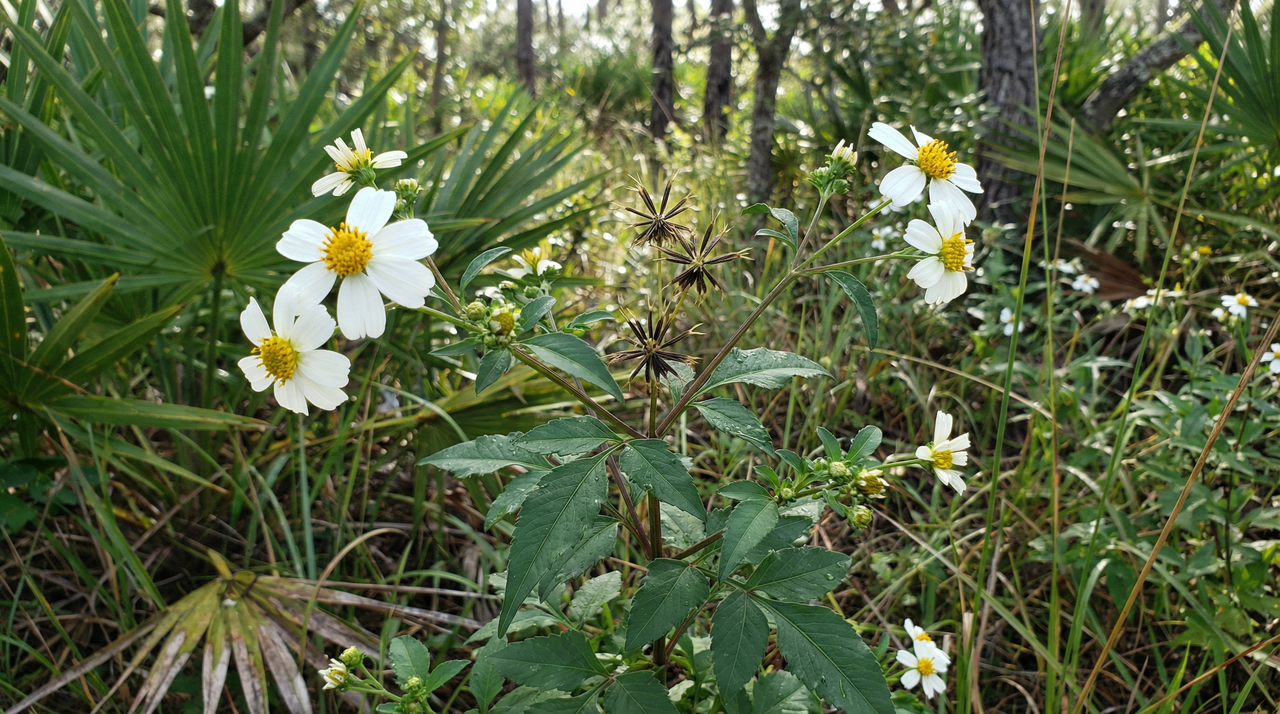
There's a moment every Florida gardener knows: you look down at your socks after a walk through an overgrown bed and find dozens of tiny two-pronged seeds embedded in the fabric, each one a small, stubborn hitchhiker with zero interest in leaving. That's beggarticks introducing itself. Most people's first instinct is irritation, and I get it. Mine was too, the first season I found it colonizing a freshly mulched bed I'd spent an entire morning preparing. But here's what stopped me from pulling every last plant: the bees. I'd never seen so many native bees working a single square foot of garden, all of them focused on those small white flowers like they were the only blooms left on earth.
Bidens alba is one of those plants that forces you to reconsider what "weed" actually means. It shows up uninvited, spreads aggressively, and clings to everything with legs or fabric. It's also one of the most ecologically generous plants growing in the southeastern United States, a prolific nectar source, a soil pioneer, a traditional medicinal herb, and yes, a perfectly edible green that most people walk right past. Once you know what you're actually looking at, those socks start to feel less like an annoyance and more like a delivery service.
The Origins and History of Beggarticks (Bidens alba)
If you've spent any time gardening in Florida or the Gulf Coast, you've met beggarticks. You probably didn't know its name. You just knew it as that cheerful little white daisy-like flower that appeared in the lawn after a heavy rain, or the plant whose seeds embedded themselves into your socks with an almost personal commitment. That's Bidens alba, and its story starts not in some far-flung exotic locale but right at the edges of driveways, along roadsides, and in every patch of bare ground that gets a bit of sun and moisture.
Botanical Background and Native Range of Bidens alba
Bidens alba belongs to the Asteraceae family, that enormous clan that includes sunflowers, coneflowers, and chamomile. As a native of subtropical and tropical America, it's deeply at home in Florida's climate, and I see it colonizing disturbed soils in my zone 9B projects with a speed that honestly impresses me every time. The white petals surrounding a golden-yellow center are compact and unpretentious, nothing like the showy cultivated Bidens ferulifolia I've grown intentionally in containers, but there's a tidiness to them that I've come to appreciate. What follows those flowers is the real identifier: those narrow, two-pronged black seeds that hook into anything with fibers. Clothing, pet fur, burlap sacking. Everything.
Unlike many plants in the permaculture literature that carry romantic origin stories from ancient civilizations, devil's beggarticks is more of a blue-collar native. It didn't travel the Silk Road. It grew up right here, quietly making itself at home wherever humans disturbed the soil and left it bare.
Traditional and Cultural Significance of Beggarticks
Documented traditional uses for Bidens alba specifically are thinner than I'd like them to be. There's some ethnobotanical record of related Bidens species being used as teas and in folk medicine across the Americas and parts of Africa, but I'm not going to overstate what the evidence actually shows. What I can tell you from my own experience in regenerative gardens is that this plant has a quiet modern reputation as a pollinator supporter, and that reputation is well earned. The traditional medicinal record for this specific plant is honest but relatively limited.
Fun Facts and Ecological Role of the Bidens Plant
The seed dispersal mechanism is essentially natural velcro, and once you've pulled a hundred seeds off your dog's ears after a trail walk through a weedy margin, you understand immediately how this bidens plant has managed to distribute itself so effectively across disturbed landscapes. I used to pull it from my clients' beds automatically, lumping it in with the genuine problem weeds. That changed when I started paying attention to what was visiting those small flowers in late summer and fall, when most of the showier garden plants had already wound down. Bees, butterflies, and beneficial wasps were working those blooms constantly.
That moment of reappraisal is where most gardeners' relationship with beggarticks turns. Once you understand that it's not an invasive exotic but a resilient native filling an ecological niche, one that's particularly gifted at showing up exactly where the soil needs cover and the pollinators need food, it stops looking like a problem. It starts looking like a plant that knows what it's doing.
Beggarticks Varieties and How to Source Them
If you're expecting a tidy cultivar list here, beggarticks is going to disappoint you in the best possible way. This is a plant that hasn't been through the commercial breeding machine, and honestly, I think that's a point in its favor. What you're working with are naturally occurring forms, not selections bred for tidy habit or showier blooms.
Common Forms and Closely Related Species
Botanists do recognize two varieties within the species: Bidens alba var. alba and B. alba var. radiata, the latter distinguished by more prominent white ray florets around the flower head.[1] In the field, the difference is subtle enough that most gardeners will never need to make the call. No widely cultivated ornamental cultivars exist for Bidens alba; its value sits in ecological function rather than aesthetic selection, which is exactly how I frame it to clients.[2]
The species you're most likely to confuse it with is Bidens pilosa, a closely related plant with similar growth habits and medicinal properties but slightly different seed morphology and phytochemical profiles.[3][4] I've grown both side by side, and for pollinator attraction and general garden utility, the distinction is largely academic. Foragers and permaculture designers often use the two interchangeably, and in most practical contexts that's fine.
Finding and Sourcing Beggarticks Plants or Seed
Commercial seed for beggarticks is rare. The most reliable approach is collecting mature seeds from local wild populations in late summer through fall, when those two-pronged seeds are actively hitching rides on anything that passes by.[5] I've gathered more seed from my own pants legs than I ever have from a catalog. Walk through a patch at the right time of year and the work is basically done for you. It's similar to collecting milkweed for a monarch garden: ethical local sourcing usually beats anything arriving in a mail envelope, both for ease and for how well the plant establishes once you get it home.
In my experience designing Florida-style guilds, locally adapted seed integrates faster and shows noticeably better vigor than imported stock, particularly for gardeners in USDA zones 8 through 11 where regional ecotypes are already dialed in to local soil and rainfall patterns.[6] If you'd prefer to buy rather than forage, look for Bidens alba or Bidens pilosa plants through native plant nurseries specializing in Southeast U.S. species, or through ethnobotanical seed suppliers who propagate ethically rather than pulling from wild populations.[7][8] That distinction matters, especially as foraging interest grows faster than responsible supply.
Beggarticks Propagation and Planting (Bidens alba)
If you've spent any time gardening in a humid subtropical climate, you've almost certainly already propagated beggarticks without trying. That's the honest starting point for this section. The plant self-seeds with such enthusiasm that intentional propagation is really more about directing what it's already doing than coaxing something reluctant into growth.
Seed Collection and Propagation Methods
The seeds, technically called achenes, are narrow, barbed structures perfectly adapted to hitch rides on passing humans or wildlife. Collecting them is simple: wait until the flower heads are fully dried and the seeds pull away cleanly with a gentle tug, usually late summer through fall. They look and feel a lot like cosmos achenes if you've handled those, just shorter and more aggressive in their sticking power. I store mine in a paper envelope in a cool, dry spot and they've stayed viable for at least a year without any fuss.
Direct sowing is the method I reach for with bidens seeds almost every time. Press them lightly into prepared soil, keep things moist, and in warm weather you'll see sprouts in as few as seven days. No stratification, no soaking, no scarification required. Starting bidens pilosa seeds or bidens ferulifolia seeds indoors in trays works well too, especially if you want more control over where plants end up, and temperatures around 70 to 80°F keep germination consistent. Early on in my designs, I learned to label my beggarticks starts clearly because their quick turnaround can cause mix-ups in a busy propagation area. Now I use them intentionally at guild edges where I want the nectar support, and the tray method helps me keep that placement deliberate.
Soil, Site Selection, and Spacing Recommendations
Beggarticks isn't picky about soil, which is part of why it colonizes so readily. Sandy, loamy, slightly acidic to neutral pH (roughly 6.0 to 7.5) all suit it fine. Full sun produces the most abundant flowering and the best pollinator traffic, but it tolerates partial shade without sulking. What I watch more carefully in the heavy summer rains we get in Central Florida is drainage. Low spots that stay soggy after a downpour push this plant toward overly rank, floppy growth and can make it harder to keep in check. Site it where water moves through rather than pools, and it stays productive rather than problematic.
Think of its native habitat as moist open woodland edges and disturbed margins, and you'll have a good mental model for placement in a guild. I tuck it along the sunny border of a food forest understory where it bridges the canopy edge and open garden, catching pollinators before they move deeper into the system.
Planting Techniques and Germination Timeline
Give plants 12 to 24 inches apart. That might sound generous, but beggarticks gets bushy fast, spreading 1 to 3 feet wide under good conditions, and crowding it just means more competition stress and less airflow. Think of how much room a large basil volunteer takes when you let it go unpinched, then double it. When transplanting volunteers or seedlings from trays, plant at the same depth as the root ball, firm the soil without compacting it, water well, and lay a light mulch around the base without mounding it against the crown. Establishment is quick; this isn't a plant that needs babying.
Germination in warm weather runs 7 to 21 days, faster in peak summer heat, slower as temperatures cool toward fall. The seedlings come up looking a bit like tiny marigold relatives at first, with small opposite leaves that are easy to mistake for a handful of other Asteraceae volunteers. Within a week or two the characteristic serrated, compound foliage starts to develop and identification becomes much easier. Learning that seedling look is genuinely useful, because how to grow bidens well is partly about knowing when to let it run and when to thin it before it crowds out something you planted on purpose.
Beggarticks Care Guide (Bidens alba)
If you're used to coddling garden plants, Bidens alba will feel like a relief. It's genuinely one of the lowest-maintenance plants I work with in Central Florida landscapes, and most of that comes down to how perfectly it's adapted to our humid subtropical conditions. That said, "low maintenance" doesn't mean "ignore it completely," and a little seasonal awareness goes a long way toward keeping it productive rather than problematic.
Water, Sunlight, and Soil Needs for Bidens alba
Beggarticks is moderately drought tolerant once established, but it performs noticeably better with consistent moisture during extended dry spells.[9][10] Here in zone 9B, I rarely need to supplement at all from June through September because Florida's summer rainfall pattern handles it.[11] That alignment with our wet season is exactly why it slots so naturally into low-input permaculture guilds.
For site selection, full sun is where it really shines as a pollinator plant. Six or more hours of direct sunlight produces the most prolific flowering,[12][13] and I've noticed that full-sun plants draw a noticeably wider diversity of bees and butterflies compared to the ones tucked into part shade. Partial shade still yields flowers, but the nectar production seems thinner. On soil, it's genuinely unfussy: sandy, loamy, disturbed, roadside-adjacent soil all work fine as long as drainage is adequate.[12]
Feeding, Pruning, and Seasonal Care
Don't fertilize this plant. Like most native wildflowers, beggarticks needs little to no supplemental fertilizer, and pushing nitrogen produces lush leafy growth at the expense of flowers.[14] I've stopped fertilizing my entire native wildflower guild because extra nutrients tend to shift the balance toward grasses anyway, which crowds out the flowering plants I actually want. Lean soil is your friend here.
Pruning is where I'd encourage you not to be hands-off. Regular deadheading or light trimming after the main bloom flush prevents beggarticks from self-seeding into every crack and pathway on your property.[13] I learned this the hard way one season when I let a patch go fully to seed near a gravel path and spent the following spring pulling seedlings from between the stones for weeks. In rich soils it spreads faster than in leaner spots, so keep a closer eye on well-amended beds. The goal is leaving enough seed heads for wildlife while preventing total colonization.
Seasonally, it germinates in spring, flowers heavily from late spring through fall, and can reseed prolifically before winter arrives.[15] I use that late-fall window to decide how much reseeding I want to allow before doing a harder cutback.
Frost and Heat Tolerance of Beggarticks
On the heat side, this plant is as tough as lantana or porterweed through our brutal July and August conditions,[10] thriving across USDA zones 8 through 11 without complaint. Frost is a different story. Temperatures below 28°F will damage or kill it, so in zone 9B it behaves somewhere between an annual and a short-lived perennial depending on winter severity.[11][16] On the rare nights we dip into the mid-20s, I lay pine straw mulch over the crowns, and in my experience that simple step helps the root zone survive and resprout quickly once temperatures recover. Whether the devil's beggarticks flower returns as a true perennial or comes back from seed often depends on your microclimate, and in a protected south-facing bed, it frequently surprises me by overwintering without any help at all.
Harvesting Beggarticks (Bidens alba)
Beggarticks isn't really a crop you plan around. In my Central Florida gardens, I've never once planted it intentionally, but every summer I find myself harvesting from it anyway, working around it during regular maintenance the way you'd pause to pick herbs growing between your flagstones. That opportunistic relationship is exactly the right frame for harvesting this plant. It shows up; you learn to recognize the right moment.
That moment is when the stems are still tender and the white daisy-like flowers are freshly open, ideally just after a summer rain when everything looks lush and the plant is putting energy into its aerial growth rather than seed production. I've noticed the leaves smell more aromatic right after a good soaking, which I take as a sign the volatile compounds are active. I do avoid harvesting during or right after heavy afternoon thunderstorms though, since excess surface moisture leads to mold when you're trying to dry the material later. Dry mornings are almost always the better call.
My technique is simple: snip or pinch the top six to eight inches of stem, flowers and all, using clean scissors or just your fingers. Early in my foraging practice I made the mistake of grabbing older, woody stems near the base. They brewed up bitter and unpleasantly fibrous. Now I go straight for the tender tips, and the difference in quality is significant. As a bonus, harvesting this way encourages the plant to branch out and produce more growth, which aligns nicely with permaculture's ongoing-yield thinking.
Because beggarticks regenerates so readily in disturbed soil, it's tempting to take as much as you want. I limit myself to no more than 20 to 30 percent of any stand, a rule I apply across all my native and naturalized species here in Florida. And one practical note on identification: harvest before the sticky two-pronged seeds fully set. Those barbed hitchhikers are a reliable sign you've waited too long, and collecting at that stage means spreading the plant everywhere your clothes or tools travel. When the flowers are fresh and the seeds haven't developed, handling is cleaner and identification is easier. Always confirm you have Bidens alba before eating or using any part, especially in areas with similar-looking Asteraceae growing nearby.
Beggarticks Preparation and Uses
Once you've got a basket of freshly harvested tips, the real fun begins. Beggarticks sits in that useful middle ground between raw salad green and cooked potherb, which means it adapts to however much time you actually have in the kitchen. I've pulled it from demonstration gardens in both full sun and partial shade, and I'll say this: shade-grown leaves tend to stay tenderer longer into the season, while the sun-grown plants get a little tougher and more assertive in flavor once the heat really sets in.
Culinary Uses of Beggarticks Leaves and Shoots
Young leaves and tender shoot tips are what you're after. Before flowering is when the flavor is brightest, and in my experience, beggarticks picked early in the morning has a lighter, less astringent taste that reminds me of young dandelion without the strong bitterness, making it genuinely approachable for people new to eating weeds. The flavor sits somewhere between chrysanthemum greens and a mild citrusy herb, which makes it an easy swap for either in a stir-fry or a simple soup. A good rinse, a rough chop, and a hot pan is really all it takes. I've used the tender tips raw in mixed greens where they add an herby note, and wilted into miso broth where that delicate flavor holds up beautifully without disappearing.
Traditional Medicinal Preparations
Folk use of Bidens alba as a healing herb runs deep across the Americas and into parts of Africa, mostly as a simple tea for respiratory complaints, digestive support, and general inflammation. A bidens alba tea recipe doesn't need to be complicated: steep a small handful of fresh leaves or a teaspoon of dried material in hot water for about ten to fifteen minutes, strain, and drink while warm. A bidens alba tincture recipe follows the same logic in concentrated form, packing fresh or dried herb into a jar and covering with a menstruum like 80-proof vodka, then waiting four to six weeks before straining. None of this is medical advice, and Bidens species vary enough chemically that consulting a qualified herbalist before relying on any preparation therapeutically is genuinely worth doing.
Non-Food Applications
Beyond the kitchen and the medicine cabinet, beggarticks has a few quieter uses that fit neatly into a closed-loop garden system. The fibrous stems can go into a compost pile or be used as a light surface mulch around young transplants. I've watched students in workshops initially resist this plant and then, once they start seeing how little of it actually goes to waste, come around to treating the whole harvest cycle as an integrated process. What you don't eat, you return. The stems break down quickly, the roots loosen compacted soil as they decompose, and the whole plant feeds the system that grew it.
Beggarticks Health Benefits and Medicinal Uses
Beggarticks doesn't have the clinical research backing of, say, echinacea or elderberry. What it has is a long, widespread history of use across cultures that independently arrived at similar applications, which is worth paying attention to even if modern pharmacology hasn't fully caught up. Consider this section a starting point for curiosity, not a prescription.
Traditional Uses of Bidens alba in Herbal Medicine
Across the Caribbean, Central America, and parts of Africa, various Bidens species have been used in folk medicine for generations. Bidens alba specifically appears in Caribbean and Latin American herbal traditions as a remedy for colds, flu-like symptoms, and sore throats, typically prepared as a simple leaf tea. Topical applications for minor wounds, skin irritations, and inflammatory conditions also show up repeatedly in ethnobotanical records from different regions. The fact that geographically separated cultures landed on overlapping uses suggests the plant is doing something real, even if we don't yet have controlled trials to explain exactly what.
Bidens pilosa medicinal uses have been documented more extensively than those of B. alba specifically, and the two are closely related enough that herbalists often treat the literature on one as loosely applicable to the other. Digestive complaints, including bloating and stomach upset, appear alongside the respiratory applications in traditional contexts. None of this constitutes proven pharmacology, but it frames a pattern of traditional use that's worth understanding if you're growing this plant intentionally.
Phytochemical Profile and Potential Benefits
Here's where things get genuinely interesting from a grower's perspective. Bidens alba contains flavonoids, polyacetylenes, and phenolic compounds, a phytochemical mix associated in related plants with antimicrobial and anti-inflammatory activity. I've noticed that beggarticks in my Central Florida garden beds is remarkably unbothered by the fungal pressures that hit other plants in our humid summers. That hardiness likely isn't coincidence. Plants that thrive in disturbed, pathogen-heavy soils often produce robust chemical defenses, and those same compounds tend to be what interests herbalists.
Lab studies on Bidens pilosa have shown some promising results around anti-inflammatory and antimicrobial properties, but I've found very little peer-reviewed work focusing specifically on B. alba in human health contexts. The potential benefits suggested by its phytochemical profile remain potential, not proven. I grow it primarily as a pollinator plant and let that be enough until more specific research emerges. That's not dismissing the traditional knowledge; it's just being honest about where the science currently stands.
Safety Considerations and Research Gaps
For most adults, a simple tea from young beggarticks leaves is generally considered low-risk, and topical use has a similarly mild safety profile. That said, I'd strongly recommend against internal use during pregnancy or while taking medications without talking to a qualified herbalist or physician first. The research gaps here aren't small. Without adequate safety studies, the margin of caution should be wide.
One thing I always remind people in my workshops: beggarticks is an Asteraceae family member, which means anyone with sensitivities to plants like chamomile, ragweed, or chrysanthemum should approach it carefully. When I'm harvesting from my own garden for tea, I make absolutely sure of my identification before anything goes in a cup. The Aster family has enough look-alikes that confident ID isn't optional. If you're drawn to its traditional uses, treat it as a minor supportive herb in an otherwise varied toolkit, and bring a professional into the conversation before leaning on it medicinally.
Pests and Diseases of Beggarticks
In all my years designing with native and naturalized plants across Florida, Bidens alba has never been a significant pest or disease problem in any of my projects. That's not me glossing over a thin data set. It's a genuine reflection of how this plant behaves in the field. Beggarticks grows with the kind of vigor that simply outpaces most insect pressure. Where a more delicate Aster family member like a cultivated echinacea might struggle with aphid colonies or leafhopper damage, beggarticks just keeps pushing.
That said, I do watch it like I watch any prolific spreader. If you notice yellowing leaves, my first instinct is to look at nutrient competition or waterlogged roots rather than reach for a disease diagnosis. Overly wet or compacted conditions could invite fungal leaf spot or powdery mildew, as they can with most herbaceous plants, but I've never seen a severe outbreak on this species. Aphids and spider mites are worth a casual check if the plant looks stressed, especially in container settings or unusually dry spells, though beneficial insects seem to show up and regulate things before they escalate. The same flowers drawing honeybees and native bees to your guild are also drawing predatory wasps and hoverflies that handle soft-bodied pest populations pretty efficiently.
The honest permaculture takeaway here is that a plant this unbothered by pests earns its place as a reliable filler in mixed guilds. Instead of monitoring it defensively, I monitor it observationally: watching for what's visiting, what's thriving around it, and whether it's crowding out something more intentional. Good air circulation and selective thinning are all the "disease management" it typically needs. Let the ecosystem do the rest.
Beggarticks in Permaculture Design
Most gardeners meet beggarticks as an adversary: an opportunistic weed crowding out intentional plantings, or a dense flush of stems appearing overnight in a freshly turned bed. I get it. My first few seasons in Central Florida, I spent more time pulling it than thinking about what it was actually doing in my soil. Then I started watching more carefully, and what I saw made me put the hoe down. This plant is working for you whether you invite it or not. The question is whether you design around that or keep fighting it.
Ecosystem Functions and Guild Roles
Beggarticks is a genuine overachiever at the bottom of the ecosystem services list. Its fibrous root system stabilizes bare or disturbed soil fast, preventing erosion during the heavy summer downpours that Central Florida gardeners know all too well. Above ground, it produces biomass at a pace that rivals most intentional cover crops, making it one of my go-to chop-and-drop candidates in new food forest clearings where I want to build organic matter quickly before slower perennials establish. I've sown it deliberately in bare patches between young fruit trees specifically for this reason.
The flowers are where it really shines for ecosystem design. Those small white daisy-like blooms attract a remarkable density of beneficial insects: syrphid flies, sweat bees, small native bees, and predatory wasps all work the flowers in my gardens. I've stood next to a patch in late summer and counted five or six different insects on a single square foot of bloom. That's not decoration; that's pest suppression and pollination services that extend to everything nearby.
Placement in Forest Layers and Guilds
In a food forest context, beggarticks belongs to the herbaceous ground layer, particularly at edges and in the gaps between more intentional plantings. I treat it the way I treat other fast-growing composites in young guilds: valuable during the establishment phase, worth managing once the canopy fills in. Placed along pathways or in rain garden swales, it does double duty as a living mulch and a pollinator corridor that funnels beneficial insects toward fruit trees or vegetable beds further into the system.
The management piece matters enormously here. I learned this the hard way when a healthy patch I let go to seed one October scattered itself thoroughly into an adjacent vegetable bed. Timing the chop-and-drop before seed set is the whole game. Cut it back when flower heads are fully open but before those distinctive seeds form, and you've captured the biomass benefit without the volunteers. Let it go longer and you're replanting it whether you meant to or not.
Climate Adaptability and Suitable Zones
Bidens alba is essentially purpose-built for humid subtropical conditions. It handles zone 9 summers with the kind of indifference that makes most vegetable gardeners jealous: full sun, partial shade, sandy soil, clay soil, periodic flooding, weeks without rain. It doesn't much care. In my zone 9B gardens, it grows almost year-round, slowing only slightly in the brief cool season before surging again with the first warm rains of late winter.
That same resilience is exactly why it demands honest management in high-rainfall climates. After a good summer storm, a small population can become a dominant stand in a matter of weeks. In drier zones or gardens with less disturbance pressure, it's easier to keep in check. In Florida-style humidity, you need to stay ahead of it. My approach is to welcome it in designated areas, let it do its work, and cut it back on a schedule that keeps it a contributor rather than a competitor. Treat it like any other dynamic accumulator: give it a job, observe it closely, and harvest its benefits before it decides to run the whole operation.
The Plant I Spent Years Pulling Before I Finally Listened
I won't pretend I welcomed beggarticks gracefully. I pulled it, cursed the seeds on my socks, and pulled it again. What changed me wasn't a research paper; it was watching a gulf fritillary work a single beggarticks flower for a long, unhurried minute while everything else in that bed sat ignored. Sometimes a plant's argument for itself is that simple.
Sources 16
- Flora of North America ↩
- Lady Bird Johnson Wildflower Center ↩
- USDA Plants Database ↩
- PFAF Plant Database ↩
- University of Florida IFAS Extension ↩
- Florida Native Plant Society ↩
- Native Plant Network Propagation Protocol Database ↩
- Strictly Medicinal Seeds ↩
- USDA Plants Database ↩
- Florida Native Plant Society ↩
- University of Florida IFAS Extension ↩
- Missouri Botanical Garden ↩
- Lady Bird Johnson Wildflower Center ↩
- USDA NRCS Plant Guide ↩
- University of Florida Herbarium ↩
- PFAF Plant Database ↩