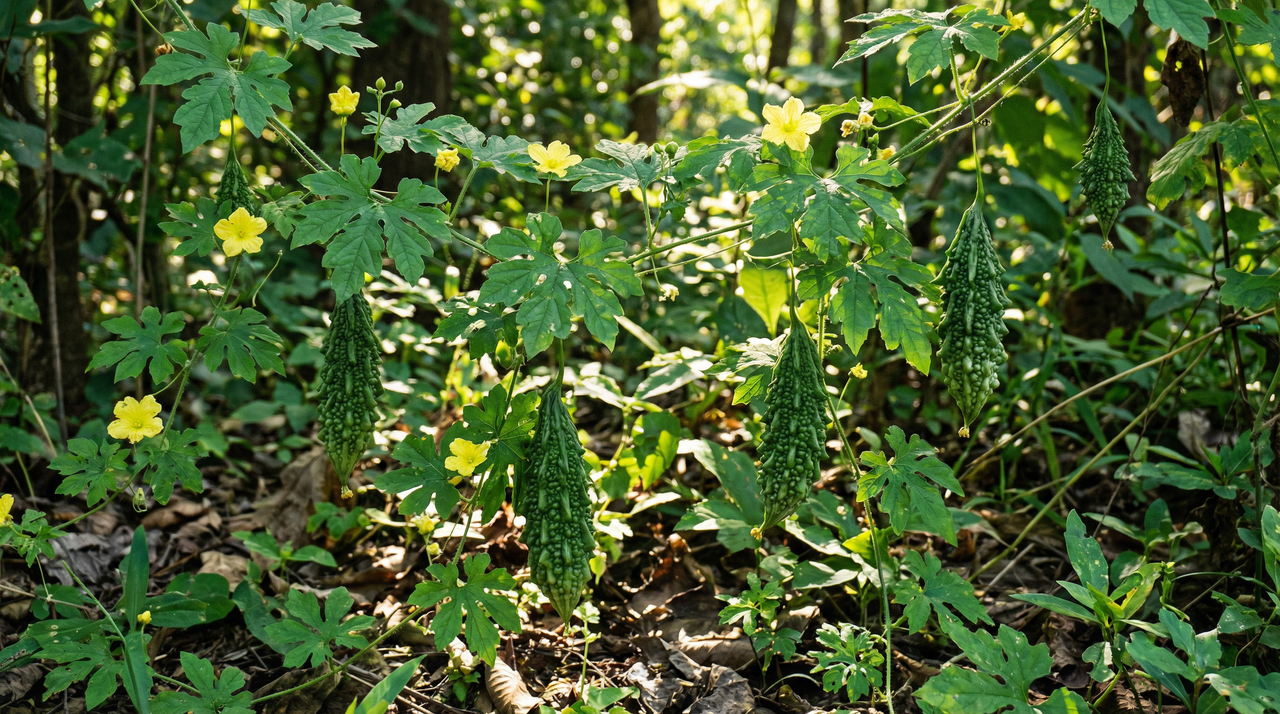
Most people taste bitter melon once and spend the next ten minutes trying to forget it. I get it. The first time I bit into a slice raw, straight off the vine in my zone 9B garden, my face did something involuntary and my dog walked away from me. But here's the thing that stopped me from pulling the plant: bitter melon doesn't taste like something went wrong. It tastes like something went right, on purpose, over thousands of years of human selection toward a flavor most Western palates have simply never been trained to read. Cultures across South Asia, East Asia, Africa, and the Caribbean didn't preserve this plant because they were short on options. They kept it because the bitterness is the point.
That bitterness comes from a group of compounds called cucurbitacins and momordicosides, and they're the reason bitter melon has sat at the intersection of kitchen and medicine cabinet across multiple continents for millennia.[1] The same chemistry that makes you wince is what researchers keep circling back to when studying blood sugar regulation, oxidative stress, and a handful of other serious health questions. It's a plant that refuses to separate food from medicine, and once I understood that, I stopped growing it as a novelty and started treating it as one of the hardest-working vines in my food forest.
Bitter Melon Origin, History, and Characteristics
Few vegetables carry as much ecological ambition as bitter melon. The plant seems almost impatient, reaching for trellises, fruiting within a single season, and turning up in cuisines and medicine cabinets from Mumbai to Montego Bay. Understanding where it came from and how it got everywhere else makes it a far more interesting garden subject than its warty exterior first suggests.
Botanical Background and Natural Habitat
Bitter melon (Momordica charantia) is native to tropical and subtropical Asia, with its primary center of domestication in India and a secondary foothold in southern China; it has also been established across parts of Africa and the Caribbean for long enough that the line between native and ancient naturalized range has largely blurred.[2][3][4] In its home range it behaves as a true perennial, but gardeners in temperate climates treat it as an annual because even a light frost will end it.[5][6] Those of us in zone 9B occasionally get it to push back from its roots after a mild winter, but I wouldn't count on it. More reliably, the plant races from seed to ripe fruit within a single season, completing its monocarpic life cycle with almost indecent speed before going all-in on seed production.[7]
Ecologically, this is a pioneer. In its native range it colonizes roadsides, forest edges, disturbed slopes, and overgrown agricultural margins wherever canopy cover is thin and competition hasn't yet closed in.[8] That opportunistic streak is exactly what makes it such a vigorous garden subject, and why giving it a proper trellis from day one isn't optional.
Visual Characteristics and Growth Habit
I always tell first-time growers to stand back. Bitter melon climbs via branched axillary tendrils and can reach three to five meters with support, and in peak summer heat it can extend one to two meters in a single week.[8][9] That's faster than pole beans and closer to hyacinth bean in sheer ambition. Young stems are slender, ridged, and slightly fuzzy, becoming woodier with age; the root system starts as a taproot and fans out into a fibrous network that's efficient at nutrient scavenging even without mycorrhizal partnerships.[10]
The leaves are alternate, palmately lobed into five to seven divisions at maturity (younger leaves look simpler and rounder), running six to fifteen centimeters long with downy undersides and serrated edges.[11][12] The fruit is where things get truly distinctive: an oblong, warty or tuberculate berry, typically ten to twenty-five centimeters long, that starts firm and bright green before ripening to orange-yellow or red.[13][14] Inside, the seeds sit wrapped in vivid crimson arils that startle almost every first-time grower. I remember my first season thinking something had gone badly wrong when a ripe fruit split open on the vine and revealed that unmistakable red. Nothing has gone wrong. That's just how it works, and those arils are what attract birds and mammals to disperse the seeds.[15]
There's also real morphological plasticity here. Asian market cultivars tend toward longer, smoother fruits, while African landraces are typically shorter and more heavily tuberculate, and bitterness intensity itself responds to heat stress and water deficit.[16][17] I've grown three or four cultivars side by side and watched the same Indian variety turn noticeably more bitter and more warty during a dry heat spell than it did with consistent irrigation earlier in the season. The plant is reading its environment and adjusting, which is both fascinating and practically relevant for anyone trying to dial in the flavor.
Traditional, Cultural, and Medicinal Uses
Bitter melon's relationship with humans is ancient. Archaeological evidence places its cultivation in India before 2000 BCE, and it appears in the Ayurvedic classics, the Charaka Samhita and Sushruta Samhita, as a remedy for metabolic and inflammatory conditions centuries before it reached China's materia medica tradition, the Shennong Bencao Jing (circa 200 CE) and later the Bencao Gangmu of 1596.[18][19] From those two epicenters it spread along ancient Indian Ocean trade routes to Africa and the Middle East, then to the Americas through European colonization and the transatlantic slave trade, accumulating distinct regional identities at every stop.[20]
Across Ayurveda, Traditional Chinese Medicine, Yoruba herbalism, Haitian Vodou, and Jamaican folk medicine, the plant's uses overlap around a consistent core: clearing heat, supporting blood sugar regulation, treating fevers and malaria, calming digestive complaints, and addressing skin conditions.[21][22][23] The antidiabetic reputation, rooted in compounds like charantin and polypeptide-p, is old enough to predate biochemistry by millennia. The plant also carries symbolic meaning far beyond medicine: in Chinese and South Asian cultures it represents longevity, resilience, and the idea that enduring something bitter leads to something better, and it appears in Diwali and Dragon Boat festival traditions as a talisman against illness and misfortune.[24]
That cultural depth comes with a modern responsibility. Overharvesting of wild populations, erosion of landrace genetic diversity, and patent filings around bioactive compounds like charantin have raised serious biopiracy concerns among indigenous knowledge communities. The FAO has responded by promoting cultivated production and agroforestry integration as a way to reduce pressure on wild stocks.[5] As someone who recommends this plant regularly, I'm deliberate about pointing growers toward seed suppliers who source from and credit traditional landrace communities rather than commercial lines disconnected from that history.
Fun Facts About Bitter Melon
The same bitterness that challenges beginner cooks is, culinarily speaking, the whole point. Across Indian, Chinese, Filipino, and Thai kitchens, bitter melon is stir-fried, stuffed, simmered into soups, and coaxed into curries precisely because that sharp, lingering intensity does something transformative when balanced against egg, pork, or fermented flavors.[25] The bitterness is also a defense strategy: the plant deploys cucurbitacins alongside fine leaf trichomes and a rapid growth rate to outpace and deter most herbivores, while those same chemicals are now the subject of serious pharmacological research.[15]
In genuinely hot conditions (germination is best at 21–29 °C and growth peaks at 25–35 °C), the vine can fruit within two to three months of sowing, and giant Asian cultivars have produced fruits exceeding 35 cm and a kilogram in weight.[8][26] For North American gardeners nervous about growing something from this lineage, the USDA lists it as introduced but not highly weedy in the United States, with naturalized populations concentrated in tropical and subtropical zones rather than spreading aggressively into temperate habitats.[6][27] Grow it, feed it well, and let it surprise you with how much personality one vine can hold.
Bitter Melon Varieties and Where to Buy Them
Botanical Varieties and Regional Types of Momordica charantia
At the botanical level, Momordica charantia splits into two primary varieties: var. charantia, the wild African and Asian types with larger, less wrinkled fruits, and var. abbreviata, the cultivated Indian types with smaller, more distinctly warted and wrinkled fruits.[17][28] That split becomes immediately practical once you move into horticultural groupings: Chinese types are crisp, milder, and triangular in cross-section; Indian and Pakistani types are slender, intensely bitter, and medicinal in their bite; Southeast Asian types fall somewhere in the middle, varying considerably in both length and bitterness.[17][28] I've grown Chinese Long and Indian Round types side by side, and the difference is stark. Chinese Long reaches 15-30 cm with pronounced warts and stays crisp in the refrigerator for days. Indian Round is short, 8-15 cm, and delivers the kind of concentrated bitterness that reminds me of a very strong medicinal tea. My Florida neighbors who were brand new to the vegetable consistently preferred the Chinese types.
Beyond those two, the regional picture gets even richer. African selections like Turbo (large, curved, developed in Uganda) and African Green (stocky, 12-20 cm) reflect var. charantia's wild roots, while American Green sits in a compact oval form at 10-15 cm, and Yellow Crookneck matures to a bright yellow that catches people completely off guard.[29][30] Named cultivars give these regional types even more definition. Pusa Do Mausami from India is known for high yields, Arka Harit is favored for culinary use, CO.1 offers solid disease resistance, and White Pearl from China delivers notably mild bitterness.[31][32] Modern breeding has pushed things further with hybrids like Hemo and White Hybrid, developed for improved yield and fruit quality. Gynoecious lines that increase female flower production have boosted yields by 20-30 percent in trial data, and several U.S. patents have been issued for these disease-resistant hybrids.[33][34] In my humid subtropical summers, I've found that disease-resistant cultivars like CO.1 and the gynoecious hybrids genuinely deliver that yield bump, so they're my first recommendation for anyone who's struggled with vine decline.
Sourcing Bitter Melon Seeds, Plants, and Fresh Produce in the US
Fresh bitter melon is available in U.S. Asian grocery stores, Caribbean and African ethnic markets, and increasingly in larger mainstream supermarkets in urban areas, typically running $2-5 per pound with prices climbing during off-season months.[35][36] Demand is growing as Asian, Caribbean, and African immigrant communities expand, and mainstream market availability is following.[37] For growers, there are no federal restrictions on cultivation or consumption to worry about.[38]
Seeds are easy to find from reputable vendors including Baker Creek Heirloom Seeds, Johnny's Selected Seeds, and Rupp Seeds, with packets typically running $3-6 for 10-25 seeds; live plants, when available, cost around $10-18.[39][40][41] I learned the hard way that not all online vendors ship viable seed; a few batches I ordered years ago had painfully poor germination rates. Sticking with those three houses has solved the problem entirely for me. With so many named cultivars now available, you can actually choose your bitterness level going in: White Pearl if you're cooking for skeptics, an Indian bitter gourd type like Pusa Do Mausami if you want the full karela experience, and a disease-resistant hybrid if your summer garden tends toward high humidity and fungal pressure.
How to Propagate and Plant Bitter Melon
Bitter melon is almost always started from seed, and for good reason. The plant develops a taproot quickly, which makes transplanting tricky if you wait too long, and vegetative propagation methods, while possible, are far more labor-intensive than they're worth for most home gardeners. The seed-to-first-fruit window is also remarkably short, typically 50-100 days, so there's real payoff for getting the germination phase right from the start.
Seed Characteristics and Storage
Bitter melon seeds are easy to identify once you know what you're looking for: oblong to elliptical, about 10-15 mm long, brown to dark brown, with a hard woody coat and a prominent ridge called the raphe running along one edge.[42][43] Fresh seeds are often still embedded in a spongy white aril, and I use that pulp as a freshness cue when evaluating saved seed. If it's still there and slightly sticky, you're probably working with good stock. That hard seed coat isn't accidental; it's an evolutionary adaptation shared by many tropical cucurbits that protects against stress and aids dispersal, but it does mean germination can be sluggish without a little help.[44]
One thing to keep in mind with saved seed: bitter melon is cross-pollinated by insects, which creates high genetic variability.[45][46] I've grown several hybrid and open-pollinated cultivars side by side in my Central Florida garden and learned to label rows carefully, because seedlings look nearly identical in their first weeks. The fruits they eventually produce, though, can vary surprisingly in shape, bitterness, and yield. For true-to-type results, use certified seed or hand-pollinate your best plants.
Stored properly, bitter melon seed holds up well. Expect 3-5 years of viability at room temperature, 5-15 years in an airtight container with silica gel kept at 4-10°C, and decades if you freeze it.[47][48][49] I keep a small silica-gel jar in my refrigerator for saved seed and have germinated 3-year-old seed at over 80% that way, while seed I neglected for five years without desiccant dropped below 50%. Fresh seed under optimal conditions germinates at 70-90%.[50][8] If you're uncertain about older seed, a simple germination assay at 30°C for 7-14 days will tell you what you're working with before you commit garden space.
For gardeners dealing with persistent Fusarium or root-knot nematode pressure, it's worth knowing that semi-hardwood cuttings treated with IBA and grafting onto pumpkin or bottle gourd rootstocks both achieve high success rates in commercial Asian systems.[51][52] These are genuinely useful tools, but they're more common in intensive production settings than home gardens. Seed remains the most practical starting point for most of us.
Germination and Timeline
Bitter melon has minimal dormancy, which is a pleasure after dealing with seeds that demand elaborate cold stratification. Given soil temperatures between 25-30°C, seeds typically sprout in 7-14 days, with first flowering around 40-60 days after germination and the first harvest arriving somewhere in the 50-100 day range, most often 60-75 days.[53][45][54] In my zone 9B garden, I start seeds indoors in March and I'm usually harvesting by early June. That calendar makes it easy to fit a second planting into a long growing season.
In Florida and similar warm climates, hybrid cultivars typically mature around 75 days; seeds germinate in 7-10 days and seedlings are ready to move outdoors after 3-4 weeks.[55][56] For gardeners in cooler climates, starting seeds indoors and waiting until after the last frost to transplant is the standard approach. The plant absolutely stalls in cool soil, so there's no benefit to rushing it outside before conditions are genuinely warm. I always pre-soak my seed for 24 hours before sowing; it softens that hard coat and tends to tighten up germination time noticeably.
Soil, Site, and Planting Requirements
Soil pH is something I never skip testing before planting bitter melon. The optimal range is 6.0-7.0, with tolerance extending to 5.5-7.5, but yields can drop 30-50% outside that window due to aluminum toxicity on the acidic end and iron deficiency on the alkaline end.[57][45][58] I've seen chlorosis and stunted vines in the slightly alkaline patches of my garden, and once you understand the nutrient lock-up mechanism, you stop guessing and just test. Amend with lime to raise pH or sulfur to lower it before planting; don't try to correct it mid-season.
The plant wants well-drained loamy or sandy-loam soil with around 2-5% organic matter and full sun, at least 6-8 hours daily.[57][45][58] Partial shade will reduce yield, noticeably. The roots reach 2-3 feet deep,[57][59] so raised beds or mounded rows help in heavy clay soils where drainage is questionable. This vine evolved in tropical conditions with optimal temperatures between 70-95°F; anything consistently below 50°F and it stops growing entirely.[57][59] That warmth requirement, combined with the drainage demand, is really the whole site-selection decision in two criteria.
Spacing, Trellising, and Planting Technique
Bitter melon is a serious climber, reaching 3-6 meters, and it needs a trellis, fence, or arbor at least 1.5-2 meters tall to perform well.[60][61][62] Plant seeds about 1 inch deep and space them 30-45 cm apart in the row, with 1.5-2.5 meters between rows for airflow.[60][61][62] I learned this the hard way: one season I crowded plants at 20 cm and got more powdery mildew than fruit. The wider spacing feels extravagant until you see how fast these vines fill horizontal space once they reach the top of the trellis.
When transplanting starts, set the root ball just below the soil surface and disturb the roots as little as possible. Train the main stem upward, and once it crests the trellis, guide laterals horizontally to spread fruit production evenly. Good support and adequate spacing aren't just aesthetics; they're the practical foundation for a productive plant that doesn't become a disease-prone tangle by midsummer.
Bitter Melon Care Guide
Sunlight Requirements
Bitter melon needs full sun, and I mean a genuine 6 to 8 hours of direct light every day.[8] I've grown mine in spots that get shaded out by noon, and the difference in fruit set and flavor is stark. Under 5 hours and you're mostly growing vine. The closely related balsam apple (Momordica balsamina) shares this preference, though it can tolerate a sliver of afternoon shade in truly brutal heat without the same yield penalty.[63] For bitter melon itself, more sun is almost always better. Site selection should be settled before you do anything else.
Watering Needs
Count on 1 to 2 inches of water per week once the vine is actively growing, with no gaps during flowering and fruiting.[64][65] Young seedlings want light, frequent watering every two or three days; mature vines do better with deeper, less frequent irrigation that encourages roots to go down. Drip is my strong preference here because keeping water off the foliage cuts mildew pressure significantly, something I'll return to when discussing pests.
What catches new growers off guard is how fast drought stress shows up. Skip irrigation for ten days or so and you'll see wilting, growth slowdown, and fruit drop in quick succession.[66] Overwatering is just as damaging: yellowing leaves, soggy roots, and a vine that never really gets going.[8] This plant originates from tropical regions that see 40 to 100 inches of annual rainfall with high humidity[67][68], so it wants consistent moisture in well-drained soil, not a wet sponge.
Soil and Feeding Requirements
Bitter melon is a heavy feeder, and the feeding strategy has to match the vine's growth stages or you'll leave yield on the table. Timing fertilizer to the plant's actual uptake patterns can increase production by 20 to 30 percent.[69][70] The soil itself should be fertile, well-drained loam with a pH of 6.0 to 7.5 and 2 to 5 percent organic matter; working in compost or well-rotted manure before planting sets the stage for everything that follows.[71][72] Always soil-test before setting rates.
The NPK shift across the season is predictable once you understand the vine's priorities. For the first four to six weeks, nitrogen drives vegetative growth and should be the dominant focus; a 5-10-10 or 10-10-10 blend at planting works as a basal dose, with the remainder split across three or four applications.[45][73] Too much nitrogen after week six and you delay flowering. Phosphorus becomes critical at the flowering and fruit-set stage around weeks six to eight, and potassium demand peaks during fruit development to support size, quality, and stress resistance.[70][74]
Macronutrient deficiencies are readable if you know what to look for: older leaves yellowing signals nitrogen shortage, purplish leaves point to phosphorus, and scorched margins on older leaves with weak stems suggest low potassium.[75][76] Micronutrients can be trickier. In my Central Florida garden, which runs a bit alkaline, interveinal yellowing on young leaves almost always means iron, not nitrogen, and a single foliar chelate spray in early summer has consistently restored vigor without any guessing at rates.[74][8] Keeping pH between 6.0 and 7.0 prevents most of those problems before they start. Fish emulsion, vermicompost, and compost tea are all solid organic options that also improve soil structure over time.[77]
Temperature, Frost, and Heat Tolerance
Bitter melon is a tropical plant with tropical expectations. Optimal growth happens between 70 and 95°F; below 60°F the vine stalls, and chilling injury appears below 59°F.[78][14][79] A hard frost is lethal, full stop. The related Momordica balsamina is equally frost-sensitive in zones 9 to 11, and M. foetida shows a comparable pattern, killed by temperatures below 50°F[80][81]; the genus as a whole does not forgive cold snaps.
When a surprise cold front is forecast, I reach for a medium-weight floating row cover (the 1.5 oz fabric that gives about 4 to 6 degrees of protection) and lay it over the trellis the evening before. That small act has saved productive vines more than once in zone 9B.[8][82] Young growth and developing fruit are most vulnerable, so if I can't cover everything, those get priority.
On the opposite end, bitter melon handles heat remarkably well. It carries an AHS Heat Zone 12 rating, tolerating more than 210 days above 86°F, with optimal daytime temperatures around 77 to 86°F.[80][14][83] Above 95°F, though, flower abortion and fruit drop become real problems, especially during peak bloom.[84] I've trialed 'Pusa Do Mausami' alongside standard catalog varieties through our brutal July heat, and it consistently outperforms them when temperatures push past 95°F for stretches longer than a week.[85][86] A layer of organic mulch (about 3 to 4 inches), consistent drip irrigation, and 30 to 40 percent shade cloth during the worst of the afternoon heat round out the management toolkit.
Pruning, Training, and Seasonal Maintenance
After several seasons of growing bitter melon in my Central Florida garden, I've learned one lesson more than any other: install the trellis before you plant, not after. Driving stakes around an established vine disturbs the root system and, honestly, the vines grow so fast in warm weather that you'll fall behind the plant if you wait. Aim for at least 5 to 6 feet of vertical support; I've had vines push past that and start looking for the roof.[87][88]
Once the main vine reaches 3 to 4 feet, begin a weekly routine: tie the leader upward with soft cloth ties, and remove excessive side shoots along with any old or crowded leaves. Good airflow through the canopy is genuinely protective against the fungal problems that thrive in humid conditions. Laterals below the first flower cluster can be pruned off after four to six weeks of growth, but hold off on heavy cutting once flowering is fully underway because you'll sacrifice the fruiting side branches that are doing most of the work.[89][90] Vines I trained consistently from the start produced noticeably cleaner, less disease-prone foliage than ones I let run for even two weeks without attention.
Seasonal Growth Rhythm
Whether bitter melon behaves as a perennial or an annual in your garden comes down entirely to frost dates. In frost-free zones it can cycle for 6 to 12 months, occasionally longer with protection during occasional cold snaps.[80][8] In zone 9B, where I garden, it's an annual: direct-sown once the soil warms to 70 to 85°F in late April or May, productive through the summer, and pulled at the first frost threat.[8][6]
Flowering begins 40 to 75 days after planting, and once it starts, fruiting continues for 2 to 3 months if the vine stays healthy.[80] That rapid seed-to-first-fruit timeline is one of my favorite things about bitter melon cultivation, but it also taught me to succession-sow every three weeks through early summer rather than planting everything at once. One big planting gives you one big flush; staggered sowing gives you steady harvests of armloads of fruit through July and August rather than a brief glut followed by an empty trellis. The biggest threats that shorten vine life within that window are aphids (which also vector viruses), fruit flies, and the fungal diseases that follow periods of wet weather[91], all of which the next section covers in detail.
Bitter Melon Harvesting Guide: Timing, Technique, and Flavor
When to Harvest Bitter Melon for Best Flavor and Texture
Once bitter melon starts flowering, I check my vines every single morning. That sounds obsessive, but the 10-15 day window between bloom and optimal harvest moves fast when temperatures are pushing 90°F, and missing it by even a couple of days means you're choosing between an overripe, softening fruit and a seed pod.[92][28] The fruit you want is 4-6 inches long, firm to the touch, with bright glossy green skin pulled taut over visible warty ridges and seeds that are still small and nestled in thin white pith.[93][94] If the skin is starting to look pale, yellowish, or the bumps seem smoother and more spread out, you're late.
From seed to first harvest runs 60-90 days depending on your site, and in southern states the productive window typically runs June through October with the heaviest flush hitting June through September.[8][55] Varietal timing matters here. Thai types tend to come in around 70-80 days, Chinese types at 75-85, and Indian types a little slower at 80-90 days.[55][93] I've found that switching to a Thai-type shaved nearly a week off my wait compared with the Indian varieties I started with, which matters when your growing season has a hard frost deadline. When fruits do slip past their window and turn orange-red, splitting open to reveal the bright red arils, don't compost them: they're perfect for seed saving, just useless for the kitchen.[94]
Bitter Melon Yield, Flavor Profile, and Post-Harvest Storage
Here's the flavor science that actually explains the urgency of early harvest. The intense, lingering bitterness comes from cucurbitacins, particularly momordicin and charantin, which bind strongly to human bitter taste receptors in a way that keeps the sensation going long after you've swallowed.[95][96] Momordicoside concentrations are highest in young, small, fully green fruits and drop as the fruit enlarges and ripens toward orange.[97] So harvesting early isn't just about texture; it's the moment of peak medicinal intensity and maximum culinary challenge. Beyond bitterness, the raw fruit is crisp, juicy, and green-earthy with faint cucumber notes, though it can feel slightly slimy near the seed cavity.[98] Cultivar variation is real: some lines carry a mild peppery undercurrent or a touch of sweetness that makes them noticeably more approachable than others.[97]
For harvest technique, use clean sharp shears rather than pulling, which can tear the vine and introduce infection. Store fruits unwashed at 50-55°F with relative humidity around 85-90% and plan to use them within 3-7 days.[99][100] I learned the hard way not to rinse them before refrigerating -- even a little surface moisture accelerates softening and decay. For dried bitter melon or dried bitter gourd preparations, slice the fruit thin before drying; fresh storage of whole fruits simply doesn't extend their shelf life far enough to skip that step. And if you want to know how to store bitter gourd through the off-season, your best option is the freezer after blanching, which also conveniently reduces the bitterness before cooking.
Bitter Melon Preparation and Uses
Culinary Uses: Managing Bitterness and Global Traditions
The primary parts you'll cook with are the immature fruits and their seeds, though young leaves and flowers are regularly eaten as vegetables across Asian and African cuisines too.[101][102] All of that bitterness comes from cucurbitacin compounds, which are actually mildly toxic in concentrated amounts, so preparation technique isn't just about palatability.[103] The good news is that cooking reduces bitterness by 50 to 80 percent through compound degradation, and you can stack multiple steps to get there.[104]
After years of growing and cooking bitter melon in my Central Florida food forest, the method I keep coming back to is straightforward: slice the fruit, scoop out the white pith and seeds (seed removal alone drops bitterness significantly), then soak in a 1-2% salt solution for 20 to 30 minutes.[105] That soak leaches out bitter compounds and reduces cucurbitacins by 20 to 30 percent on its own.[106] Follow it with a 2-3 minute blanch in boiling salted water, discard that water, and you've knocked bitterness down another 40 to 60 percent.[105] The fruit that goes into your pan at that point is genuinely different: the texture softens to tender-fibrous, and the aroma shifts toward roasted, nutty tones through Maillard reactions rather than staying harsh and vegetal.[107]
Every cuisine that loves this vegetable has evolved its own bitterness-balancing strategy. Chinese cooking pairs it with fermented black beans and pork, whose umami depth absorbs and reframes that edge.[8] Indian karela curries layer cumin and turmeric around it, or stuff and pan-fry the whole fruit so the filling carries the dish.[8] In Filipino ampalaya dishes, shrimp paste, fish sauce, and egg do the same work; Thai versions use chili and lime.[108] In my own kitchen I've found coconut milk is the fastest route to a crowd-pleasing result. Caribbean cooks boil it with saltfish, and West African stews fold it into tomatoes and onions where the surrounding fat and acid do the taming.[108][109] The pattern is consistent: fat, fermentation, acid, or pungent spice alongside the prep steps above.
If you also grow balsam apple (Momordica foetida), its ripe fruit offers sweet, edible pulp around the seeds, and young leaves can be fermented or soaked before cooking, resulting in a soft, mucilaginous texture that reminds me of cooked chayote or okra.[110] It's a useful parallel preparation within the genus.
Medicinal Preparations and Traditional Dosages
Beyond the kitchen, the same plant yields more concentrated forms with calibrated traditional dosages: tincture at 2-4 ml two to three times daily, decoction at 50-100 ml once or twice daily, dried powder at 1-6 grams per day in divided doses, or a simple tea of one to two cups daily.[111][112] A daily stir-fry is pleasantly safe seasoning. Concentrated teas and tinctures are a different category entirely, and the blood-glucose-lowering effects documented in the research can be potent enough to interact with diabetes medications. I never use bitter melon medicinally during pregnancy or when trying to conceive, and I tell every gardener who asks the same thing: the evidence on uterine stimulation is clear enough that culinary amounts are fine, but therapeutic preparations are not. Consult a qualified practitioner before moving from the pan to the tincture bottle.
Bitter Melon Health Benefits and Medicinal Uses
Key Phytochemicals in Bitter Melon
What makes bitter melon medicinally interesting is also what makes it taste the way it does. The fruit is loaded with secondary metabolites, including triterpenoids, flavonoids, phenolic acids, steroidal saponins, tannins, and glycosides.[113][114][115] The cucurbitacins responsible for that famously sharp, lingering bitterness are chemical defenses against herbivory, and the momordicosides are cucurbitane-type triterpenoid glycosides concentrated specifically in the fruit.[114] Charantin, a steroidal saponin mixture, is probably the most studied antidiabetic compound in the plant; it lowers blood glucose and supports beta-cell function.[116]
These compounds don't act in isolation. The bioactivity researchers keep documenting appears to come from synergistic interactions between triterpenoids and flavonoids rather than any single molecule.[113][24] Plant part matters too: leaves run high in flavonoids and phenolics, seeds concentrate cucurbitane triterpenoids and charantin, and the fruit itself features cucurbitacins, momordicins, and polypeptides. Growing conditions shift these ratios substantially. Higher triterpenoid and phenolic concentrations tend to show up during dry seasons or in acidic soils, which means the same cultivar can vary meaningfully in potency from one season to the next.[113] I've noticed this in my own harvests: fruits picked during a long dry stretch taste noticeably sharper than those coming off a well-watered vine in peak summer humidity. The related balsam apple (Momordica foetida) shares this cucurbitacin profile and adds its own alkaloids and coumarins, which is why African traditional practitioners use it for similar complaints, but the research base for M. charantia is far more extensive.
Medicinal Research and Traditional Uses
Across Asia, Africa, and the Caribbean, bitter melon has been the go-to plant for managing blood sugar for a very long time. The World Health Organization formally recognizes its traditional use for diabetes,[117][118] and the science has gradually caught up with that centuries-old consensus. The hypoglycemic action works through several pathways simultaneously: charantin, polypeptide-p, and vicine mimic insulin action and improve glucose uptake, while other mechanisms include enhanced insulin secretion, improved insulin sensitivity, AMPK activation, reduced glucose absorption, and DPP-4 inhibition.[119][120]
The clinical data on blood sugar is real but needs honest framing. Meta-analyses of type 2 diabetes patients show statistically significant reductions in fasting glucose (a weighted mean difference of roughly -6.86 mg/dL) and HbA1c compared to placebo.[121][122][123] I add cooked bitter melon to stir-fries a few times a week and find it supports more stable energy, but I'd never rely on it alone for blood sugar management. The clinical data matches what I observe in real life: a supportive effect, not a replacement for standard care or prescribed medication.
Beyond blood sugar, preclinical research documents a wide range of activity. Antioxidant effects operate through Nrf2 pathway activation; anti-inflammatory action runs through NF-κB and MAPK inhibition; researchers have also documented immunomodulatory effects, antimicrobial activity, and anticancer properties including apoptosis via caspase activation.[124][125][126][127] Lipid-lowering via HMG-CoA reductase inhibition, ACE-inhibiting cardioprotective effects, hepatoprotective activity, analgesic properties, wound healing acceleration, and aldose reductase inhibition (relevant to preventing diabetic complications) round out the picture.[128][129] For most of those applications, the evidence is from cell cultures or animal models, not human trials, so treat them as promising leads rather than established facts.
Ethnobotanically, different plant parts carry distinct reputations: leaves for diabetes, hypertension, and skin conditions; fruits and seeds for blood sugar regulation and digestive issues; roots for fever and abdominal pain. The plant has a long record in GI medicine too, used traditionally for indigestion, constipation, ulcers, diarrhea, and intestinal parasites.[130][131] Momordica foetida, the balsam apple common in African ethnobotany, shows comparable antidiabetic, antioxidant, anti-inflammatory, and antimicrobial activity in preclinical studies, and traditional healers use it for malaria, wounds, and respiratory conditions.[132][133] The genus has genuine breadth, but M. foetida relies more heavily on ethnobotanical surveys and animal data with very few human trials, which is why I focus on M. charantia in my own designs.
Nutritional Profile
As a vegetable, bitter melon punches above its weight. At roughly 17 calories per 100-gram serving, it delivers about 2.8 grams of dietary fiber, 69-84 mg of vitamin C, 296-355 mg of potassium, 20 mg of calcium, and 1.3 mg of iron.[134][135] The immature fruit is the part most commonly eaten, and it also carries those bioactive compounds -- charantin, polypeptide-p, and momordicin -- that overlap with its medicinal profile.[136] Momordica foetida leaves offer a comparable picture with slightly higher leaf protein (20-30% dry weight), beta-carotene, and minerals, suggesting the genus broadly rewards attention as a nutritional resource.[137] In practice, the bitterness naturally limits portion size, so I think of it as a nutrient-dense regular addition to a meal rather than a dietary workhorse.
Safety Considerations
Bitter melon occupies an interesting middle ground: safe as a cooked vegetable in culinary quantities, genuinely risky when used carelessly in larger medicinal amounts. The cucurbitacins and momordicosides, concentrated most heavily in seeds, roots, leaves, and unripe fruit, can cause gastrointestinal upset, hemolytic effects, diarrhea, vomiting, hypoglycemia, and in severe excess, coma.[138][139] Chronic overuse raises questions about liver and kidney stress, though the hepatotoxicity evidence remains contested; oral LD50 for extracts typically falls above 2000-5000 mg/kg, confirming low acute toxicity at the doses most people actually eat.[140]
Three contraindications deserve clear, direct treatment. First: pregnancy. Bitter melon has documented abortifacient and teratogenic activity, and the risk of spontaneous abortion is well-established enough that I'd never recommend it to anyone who is pregnant or breastfeeding, since it may also induce hypoglycemia in nursing infants.[141] Second: if you take metformin, insulin, or any other antidiabetic medication, talk with your doctor before using medicinal amounts of bitter melon -- the additive hypoglycemic effect is well documented and the interaction is clinically meaningful.[142] Third: people with known allergies to cucumbers, melons, or other cucurbits should be cautious, since cross-reactivity can trigger contact dermatitis, oral allergy syndrome, or in rare cases anaphylaxis.[143] Balsam apple (Momordica foetida and balsamina) carries the same cucurbitacin risks and the same pregnancy contraindication, so the cautions extend across the genus.[144]
Practically speaking: always cook the fruit thoroughly, whether stir-frying or boiling, because heat reduces cucurbitacin content and the stomach upset that comes with undercooked batches is a lesson you only need to learn once. Avoid the raw seeds entirely; they're the most concentrated source of these compounds and carry particular risk for people with G6PD deficiency. Clinical studies typically use 50-100 mL of juice or 0.5-12 grams of dried extract daily.[145][146] Fruit from plants under drought or other environmental stress tends to run more bitter and more potent, so gardeners harvesting during a dry stretch should cook thoroughly and start with smaller servings.
Bitter Melon Pests and Diseases
Bitter melon is not invincible, but it does come to the garden with some built-in defenses. The cucurbitacins and momordicin that make the fruit so intensely bitter also deter feeding insects to a real degree, and the glandular trichomes covering leaves and stems actually trap small arthropods in a sticky secretion.[147][148] I've grown bitter melon beside cucumbers and zucchini for years, and the cucumber beetles that shred my other cucurbits barely touch it past the seedling stage. That said, "moderate resistance" is not the same as "no problems," and knowing what to watch for makes a real difference.
Common Pests of Bitter Melon
The pest list includes aphids (Aphis gossypii), whiteflies, cucumber beetles, melon fruit flies, spider mites, and root-knot nematodes.[149][150] Aphids are my primary concern, not because they cause direct damage in small numbers, but because they vector Cucumber mosaic virus and other pathogens. Once night temperatures hold above 70°F and I start seeing high humidity, I flip leaves and check for the early sticky clusters. A hard water spray or dilute neem at that stage usually stops the population before it explodes into something that can spread virus through the whole planting.
Heat and nitrogen both amplify the problem. Temperatures above 86°F combined with flush growth from over-fertilization create ideal conditions for aphid and whitefly outbreaks.[151] I keep nitrogen moderate and balanced; a lush, sappy vine draws insects the way a porch light draws moths. Commercially available cultivars with genuine pest resistance are limited, though landraces like 'Nagajyoshi' and 'Pusa Hybrid-1' show better resilience under regional conditions, and wild Momordica relatives offer promising material for breeders.[152]
Diseases Affecting Bitter Melon
Bitter melon carries moderate overall disease resistance but tips toward susceptible for downy mildew, Fusarium wilt, root rot, and viral infections including Papaya ringspot virus and Cucumber mosaic virus.[153][154] Powdery mildew favors temperatures of 68-77°F with humidity above 85%; root rot follows wet soil combined with warmth in the 75-86°F range, and soils below pH 5.5 raise overall disease pressure across the board.[45][155] In my subtropical garden, a mildewed patch almost always traces back to poor morning sun, crowded vines, or roots that stayed wet after a rainy stretch. Once you have airflow and drainage sorted (see the care guide), disease pressure drops dramatically.
Some cultivars from Indian breeding programs offer meaningful improvement. 'Preethi' and 'USAG-17-1-1' carry CMV resistance; 'Co-1' and 'Arka Sumeet' perform better against Fusarium wilt; 'Pusa Do Mausami' and 'Arka Harit' show lower powdery mildew rates.[156][157] I reach for 'Pusa' or 'Arka' series seeds whenever I can source them because they've consistently shown less mildew in my trials than the generic market varieties. None are immune, but the difference in a humid summer is noticeable.
Integrated Management and Prevention Strategies
Cultural practices carry most of the load. Rotating with non-cucurbits for two to four years, maintaining adequate in-row spacing for airflow, keeping soil pH between 6.0 and 7.0, and removing infected plant material immediately are the foundation before any spray ever enters the picture.[8][158] My everyday toolkit is neem oil for aphids and early mildew, Trichoderma biocontrol worked into transplant holes for Fusarium and root rot, and reflective mulch during peak aphid season to disrupt the flight behavior of virus-vectoring insects.[159] I also deliberately cultivate habitat for ladybugs and lacewings nearby; they handle a surprising share of the aphid pressure and I'm not interested in spraying anything that kills them. When I must treat, I use neem or spinosad at dusk and follow the label closely because this is a food crop and residue matters.
Targeted fungicides like sulfur or chlorothalonil are an option for severe mildew, but in a well-managed planting with good cultivar choice and consistent monitoring, bitter gourd generally demands fewer interventions than watermelon or cucumber under the same conditions.[160][28] In a guild with good airflow, diverse companions, and balanced soil fertility, I rarely need more than two or three interventions in a season. That track record is exactly why bitter melon earns its place on my food-forest edges despite the pest list.
Bitter Melon in Permaculture Design
Bitter melon doesn't walk into a food forest design and announce itself as a superstar. What it does instead is quietly fill vertical space, feed pollinators, drop biomass, and deter pests while producing edible fruit across a long hot season. That's the kind of plant I want in a polyculture: not flashy, just genuinely useful across multiple functions at once.
Climate Adaptability and Hardiness Zones
The first thing any designer needs to accept about bitter melon is how climate-specific it is. It performs as a true perennial only in USDA zones 9-11 and zone 13; everywhere else it's an annual that you coax through a single season with warmth and timing.[161][162][45] The sweet spot is a fairly narrow 25-30 °C (77-86 °F) during the day, with nights staying above 15-18 °C. Push it outside that window and you're looking at 20-30 % yield reductions;[45][163] I think of it a bit like cucumber in that regard: the plant looks fine until heat stress accumulates, and then production just quietly collapses. Frost is an absolute hard limit. Leaf damage starts near 2 °C and prolonged exposure below 10 °C kills the plant outright.[162][164] Growers in cooler climates can make it work with row cover, season extension tunnels, and careful timing, but honest design means framing it as an annual with extra effort rather than a reliable perennial.
Water needs are substantial: 1000-1500 mm of annual precipitation with 60-80 % relative humidity is the comfort zone.[165][8] In Florida, Texas, coastal California, and Hawaii it fits naturally into the existing climate; in drier regions, consistent irrigation becomes non-negotiable.[14][28] If you're designing for a drier subtropical site and want something from the same genus, Momordica balsamina manages on 400-1200 mm precipitation and handles somewhat arid conditions more gracefully.[166][167] It's worth knowing those options exist, but for warm humid regions with reliable summer rain, M. charantia is the go-to.
Ecosystem Functions and Guild Roles
The pollination biology here matters enormously for design. Bitter melon is monoecious with protandrous dichogamy: male flowers open first, and all those small bright-yellow blooms appear early in the morning, opening around 5-7 AM, lasting only a single day, and producing nectar specifically to draw bees.[168][3] The plant depends almost entirely on cross-pollination by bees, including honey bees, carpenter bees, bumble bees, stingless bees, and native solitary bees; exclude insects and fruit set drops sharply.[168][169][170] That means designing a pollinator-friendly guild isn't optional; it's the difference between a productive vine and an ornamental one. Pesticide use, especially neonicotinoids, is a serious threat to that pollinator community.[171] In seasons when bees are scarce, hand pollination with a soft brush in the early morning can increase fruit set by 20-50 %.[8] I do a quick pass through the trellis on low-pollinator mornings; it takes ten minutes and genuinely rescues the harvest.
Beyond pollination, the vine contributes real ecological services. Its foliage and spent vines are good chop-and-drop material, feeding soil biology without extra inputs.[28] The root exudates contain phenolic compounds with mild allelopathic properties that appear to suppress some weed germination,[172] though I'd call that supporting evidence rather than a proven design feature. Similarly, the cucurbitacins and momordicin in the plant's tissues deter aphids, whiteflies, and beetles to some degree.[173] I've seen fewer aphids in beds where I've interplanted with marigolds alongside the bitter melon, though separating the vine's chemistry from the marigolds' deterrence is impossible to do without formal trials. Bitter melon is not a nitrogen fixer or heavy mineral accumulator, so don't place it in the guild expecting those functions.[28] Its fruits are also eaten by birds and mammals that disperse seeds,[174] which brings up the flip side: in warm subtropical climates this vine has real invasive potential outside its native range.[174] I monitor volunteers aggressively in my zone 9B garden and never let fruits ripen on the ground near fence lines.
Forest Layer Placement and Companion Strategies
In a food forest layout, bitter melon belongs in the vertical or middle layer, trained on trellises, arbors, or sturdy fences where it climbs by tendrils to 6-12 feet.[175][6] I've grown mine on cattle-panel arches and on living arbors of established shrubs, and in both cases keeping it vertical made a measurable difference: better airflow, cleaner fruit, and noticeably more bee activity than when I let it sprawl across the ground. The vine has moderate shade tolerance and can set fruit in up to 50 % shade,[176][28] but productive harvests really depend on that 6-8 hours of direct sun; the shade tolerance is a buffer, not an invitation to tuck it under a dense canopy. Vertical training also keeps it from shading low-story companions, which matters when you're stacking functions in a small space.
For a bitter melon companion plant strategy, leguminous beans are the practical first choice: they fix the nitrogen the vine wants but can't produce itself.[177][178] Marigolds and basil round out the pest management side of the guild.[177][179] Potatoes are worth avoiding as neighbors, primarily due to shared disease pressure and competitive dynamics.[177] The practical summary: give it a sturdy vertical structure, feed the soil with legumes, protect pollinators religiously, and keep a close eye on self-seeding in warm climates. That's a vine earning its place in the system.
The Plant That Taught Me to Stop Apologizing for Difficult Things
I used to warn visitors before handing them a slice, watching their faces brace for something unpleasant. Then I noticed the people who grew up eating it never flinched; they just reached for more. That reframing stuck with me. Some plants don't need softening. Bitter melon asked me to meet it where it was, and every season I've grown it, I've been glad I did.
Sources 179
- Bitter Melon as a Therapy for Diabetes, Inflammation, and Cancer: a Medicinal Overview ↩
- Bitter Gourd: Botany, Horticulture, and Breeding ↩
- Momordica charantia ↩
- Momordica charantia: An Overview of Its Phytochemistry, Pharmacology, and Ethnopharmacology ↩
- Bitter Gourd (Momordica charantia) Production Guidelines ↩
- Momordica charantia ↩
- Momordica charantia ↩
- Bitter Gourd (Momordica charantia): Cultivation and Varieties ↩
- Momordica charantia ↩
- Bitter Gourd (Momordica charantia): Botany, Horticulture, Breeding ↩
- Momordica charantia L. ↩
- Momordica charantia ↩
- Momordica charantia - Useful Tropical Plants ↩
- Bitter Melon (Momordica charantia) ↩
- Missouri Botanical Garden - Plant Finder: Momordica charantia ↩
- Bitter Melon, Bitter Gourd (Momordica charantia) Culture & Management ↩
- Momordica charantia: A Review of Its Varieties and Cultivation ↩
- Momordica charantia in Traditional Medicine ↩
- Shennong Bencao Jing: Early Chinese Materia Medica ↩
- Origin and Domestication of Cultivated Plants in West-Central Africa ↩
- Momordica charantia (Bitter melon): a review of its pharmacological effects on metabolic syndrome ↩
- Bitter Melon in Traditional Chinese Medicine ↩
- Ethnobotanical Survey of Momordica charantia in Africa ↩
- Bitter Gourd in Traditional Indian Medicine and Culture ↩
- Bitter Gourd: Cultural and Culinary Uses in Asia ↩
- Momordica charantia L. - Bitter Melon ↩
- Invasive Plant Atlas of the United States ↩
- Bitter Melon Production Guide ↩
- Bitter Gourd Production Guide ↩
- Momordica charantia Varieties and Cultivation ↩
- Bitter Gourd Cultivation Guide ↩
- Varietal Characteristics of Bitter Melon ↩
- Bitter Gourd (Momordica charantia) Production in Florida ↩
- US Patent 6,800,748 - Hybrid Bitter Melon Plants ↩
- Bitter Melon Production and Marketing ↩
- Bitter Melon: Market Trends in Ethnic Markets ↩
- Ethnic Vegetables in the US Market ↩
- USDA PLANTS Database ↩
- Where to Buy Bitter Melon Seeds ↩
- Bitter Melon (Momordica charantia) Production Guide ↩
- Growing Bitter Gourd: Seed and Plant Procurement ↩
- Bitter Gourd (Momordica charantia) Seed Description ↩
- Flora of China: Momordica charantia ↩
- Seed Morphology of Cucurbitaceae ↩
- Bitter Gourd Production Guide ↩
- Genetic Diversity and Population Structure in Bitter Gourd (Momordica charantia L.) ↩
- Seed Information Database (SID) - Royal Botanic Gardens, Kew ↩
- Seed Storage of Horticultural Crops ↩
- Effect of Storage Conditions on Seed Viability of Bitter Gourd (Momordica charantia L.) ↩
- International Seed Testing Association (ISTA) Rules ↩
- An overview of methods for in vitro propagation and genetic transformation of Momordica charantia L. (bitter melon) ↩
- Grafting of Cucurbitaceous Vegetables: A Review ↩
- Vegetable Matters: Bitter Melon (Momordica Charantia L.) ↩
- Care Guide for Bitter Melon ↩
- Bitter Gourd (Momordica charantia) Production in Florida ↩
- Momordica charantia L. ↩
- Bitter Melon Production in Florida ↩
- Soil Requirements for Vegetable Crops: Bitter Melon ↩
- Momordica charantia: Bitter Gourd Cultivation ↩
- Growing Bitter Melon: A Guide to Spacing and Trellising ↩
- Bitter Melon Production Guide ↩
- Bitter Melon Production ↩
- USDA PLANTS Database - Momordica balsamina ↩
- Bitter Melon (Momordica charantia) Production in Florida ↩
- Irrigation Management for Vegetable Crops ↩
- Crop Profile: Bitter Melon (Momordica charantia L.) ↩
- Momordica charantia L. ↩
- Momordica charantia ↩
- Bitter Gourd (Momordica charantia) Production Guide ↩
- Cucurbit Production in Florida ↩
- Bitter Gourd Production Guide ↩
- Soil Fertility for Vegetable Crops ↩
- University of Florida IFAS Extension: Bitter Melon (Momordica charantia L.) ↩
- Nutrient Management for Bitter Gourd ↩
- Nutrient Deficiencies and Toxicities in Plants ↩
- Nutrient Deficiencies in Cucurbits ↩
- Organic Fertilization for Momordica charantia ↩
- Growing Bitter Melon ↩
- USDA Plant Hardiness Zone Map and Crop Tolerance ↩
- Momordica balsamina Plant Profile ↩
- Momordica foetida - Missouri Botanical Garden Plant Finder ↩
- Frost Protection Methods for Warm-Season Crops ↩
- AHS Heat Zone Map ↩
- Heat Stress Effects on Bitter Gourd (Momordica charantia L.) Physiology and Yield ↩
- Heat Stress Management in Vegetable Crops ↩
- Bitter Gourd Production Guide ↩
- Bitter Melon Production in Florida ↩
- Trellising and Training Cucurbits ↩
- Momordica balsamina - Plant Profile ↩
- Pruning and Training Climbing Vines in Cucurbitaceae ↩
- Nematode Management in Bitter Gourd ↩
- Bitter Melon (Momordica charantia) Production in Florida ↩
- Bitter Gourd (Momordica charantia) ↩
- Bitter Melon (Momordica charantia) ↩
- Chemical Composition and Bioactivity of Bitter Melon (Momordica charantia) ↩
- Chemistry and Bioactivity of Bitter Melon (Momordica charantia) ↩
- Chemical Composition and Bioactivity of Bitter Melon ↩
- Flavor Profile of Bitter Melon Fruit - Journal of Food Science ↩
- Momordica charantia Plant Profile ↩
- Bitter Melon Production and Management ↩
- Momordica charantia Plant Profile ↩
- Traditional Uses of Momordica charantia ↩
- Chemical Composition and Bitterness of Bitter Gourd (Momordica charantia L.) ↩
- Effects of Cooking on the Bitterness and Nutritional Properties of Bitter Melon ↩
- Processing and Cooking Effects on Bitter Melon (Momordica charantia) Characteristics ↩
- Bitter Melon (Momordica charantia) - Food and Nutrition Guide for Health Workers ↩
- Sensory Evaluation of Cooked and Pickled Momordica charantia ↩
- Momordica charantia in Traditional Diets of Asia and the Caribbean ↩
- African Indigenous Vegetables: Bitter Gourd Preparations ↩
- Useful Tropical Plants Database - Momordica foetida ↩
- Bitter Melon (Momordica charantia): A Review of Its Pharmacological Effects and Clinical Use ↩
- Ayurvedic Uses of Karela (Momordica charantia) ↩
- Phytochemistry and Biological Activities of Momordica charantia L.: An Overview ↩
- Cucurbitane-Type Triterpenoids from Bitter Melon (Momordica charantia): Structures, Bioactivities, and Biological Roles ↩
- Momordica charantia L.: Comprehensive Review on Its Phytochemistry, Pharmacological Properties, and Toxicology ↩
- Antidiabetic Effects of Charantin from Momordica charantia ↩
- Momordica charantia in the treatment of diabetes mellitus: A systematic review and meta-analysis ↩
- WHO Monographs on Selected Medicinal Plants ↩
- Phytochemistry, pharmacology and clinical trials of Momordica charantia: A review ↩
- Molecular Mechanisms of Momordica charantia in Diabetes and Cancer ↩
- Effect of Momordica charantia on glycaemic control in type 2 diabetes: A meta-analysis ↩
- Momordica charantia for Type 2 Diabetes Mellitus ↩
- Systematic review and meta-analysis of Momordica charantia in diabetes management ↩
- Antioxidant and Nrf2 Activation by Bitter Gourd ↩
- Anti-inflammatory Effects of M. charantia on NF-κB and MAPK ↩
- Immunomodulatory Mechanisms of Bitter Melon ↩
- Anticancer potential of Momordica charantia: A review ↩
- HMG-CoA Reductase Inhibition by M. charantia ↩
- Pharmacological properties of Momordica charantia: A review ↩
- Momordica charantia: A Review of Its Traditional Uses and Pharmacological Properties ↩
- Ethnopharmacological Review of Momordica charantia L. for Gastrointestinal Disorders ↩
- A review of the pharmacological properties of Momordica foetida ↩
- Comparative Pharmacology of Momordica Species ↩
- USDA FoodData Central - Bitter Melon, raw ↩
- USDA National Nutrient Database for Standard Reference ↩
- Bioactive Compounds in Momordica charantia ↩
- Nutritional Composition of African Indigenous Vegetables - FAO Report ↩
- Toxicity of Momordica charantia: A Review ↩
- Toxic Properties of Momordica Species (NCBI) ↩
- Bitter Melon (Momordica charantia): A Review of Its Pharmacological Effects and Clinical Use ↩
- Bitter Melon: Dietary Supplement Fact Sheet - ODS/NIH ↩
- Bitter Melon (Momordica charantia) and Diabetes: FDA Public Health Advisory ↩
- A case of contact dermatitis due to bitter melon and a review of plant-induced allergic contact dermatitis ↩
- Phytochemical and Pharmacological Review of Momordica balsamina ↩
- University of Michigan Health - Bitter melon ↩
- Phytochemical and pharmacological profile of Momordica charantia: an update ↩
- Natural Resistance in Momordica charantia to Insect Pests ↩
- Trichomes of the Momordica: Structure and Function in Plant Defense ↩
- Insect Pests of Bitter Gourd ↩
- Susceptibility of Momordica charantia to Major Pests ↩
- Pest Management in Bitter Gourd: Environmental Influences and Resistance Strategies ↩
- Evaluation of Momordica charantia Germplasm for Resistance to Major Pests ↩
- Momordica charantia: An Overview of Its Diseases and Resistance ↩
- Viral Diseases of Cucurbits Including Bitter Melon ↩
- Cucurbit Diseases: Powdery Mildew ↩
- Bitter Gourd Varieties for Disease Resistance ↩
- Development of CMV Resistant Bitter Gourd Hybrids ↩
- Fusarium Wilt of Melons and Other Cucurbits ↩
- Organic Production Practices for Bitter Melon ↩
- Powdery Mildew on Cucurbits ↩
- USDA PLANTS Database Entry for Momordica charantia ↩
- Momordica charantia - Plant Finder - Missouri Botanical Garden ↩
- Momordica charantia: Temperature Requirements and Stress Responses ↩
- Bitter Melon Growing Guide ↩
- Momordica charantia: Agronomic Practices ↩
- Plants of the World Online ↩
- Momordica balsamina - Useful Tropical Plants ↩
- Pollination Biology of Momordica charantia ↩
- Pollination Efficiency of Honey Bees on Bitter Gourd (Momordica charantia L.) ↩
- Role of Native Bees in Pollination of Cucurbits: Case Study on Momordica charantia ↩
- Pesticide Impacts on Native Pollinators of Bitter Melon ↩
- Allelopathic Potential of Momordica charantia ↩
- Pest Management with Bitter Melon ↩
- Momordica charantia (Bitter Gourd) - Ecological Notes ↩
- Plant Guide: Momordica charantia ↩
- Bitter Gourd (Momordica charantia) Shade Tolerance ↩
- Companion Planting for Vegetables ↩
- Companion Planting for Tropical Vegetables ↩
- Companion Planting for Vines ↩