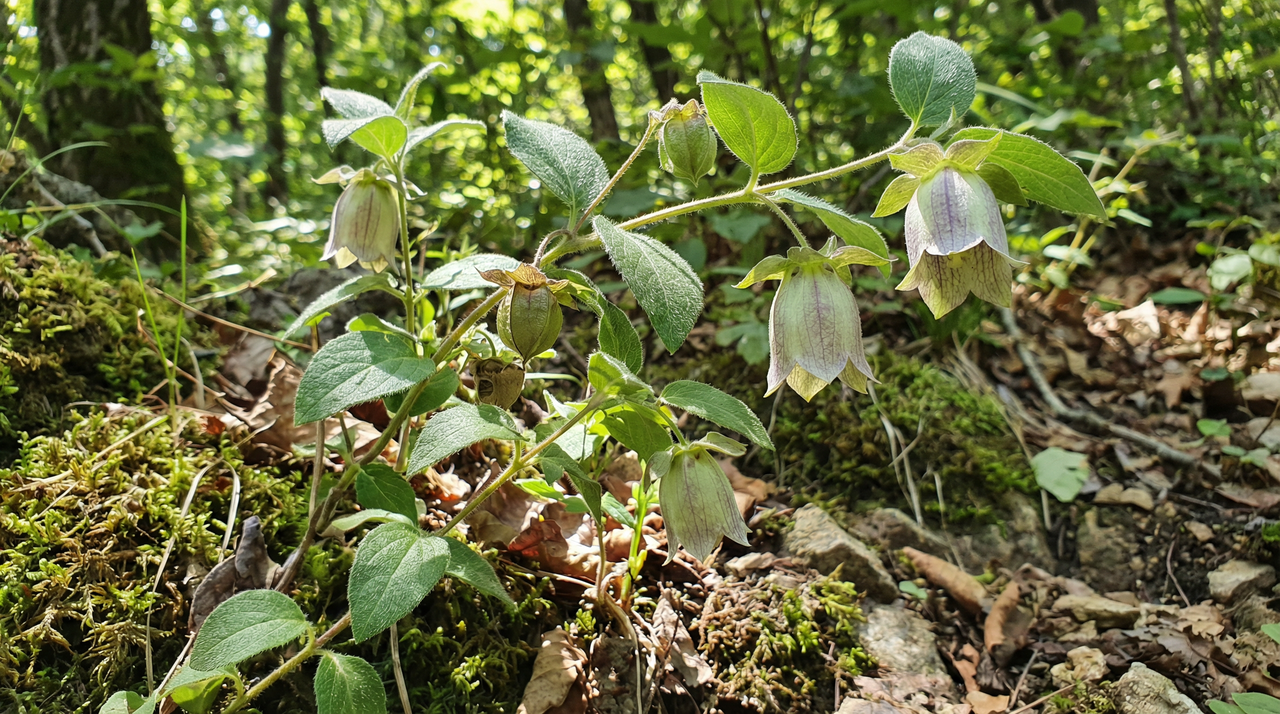
The first time I caught the scent of a freshly pulled Codonopsis pilosula root, I didn't think "medicinal herb." I thought: someone nearby is cooking chicken soup. That warm, almost brothy sweetness is nothing like what you'd expect from a plant that's spent two or three years quietly threading itself up a trellis in the back of a woodland bed. It's disarming, honestly. Here's a plant that looks like a shy, slightly hairy cousin to the bellflowers you'd tuck into a cottage border, and it smells like dinner.[1] That contradiction is exactly why I keep growing it.
Most Western gardeners who stumble across it in a seed catalog know it vaguely as "poor man's ginseng," which is technically accurate and also completely misses the point. It's not a cheap substitute for something better. In Traditional Chinese Medicine, Dangshen has been valued in its own right for over two millennia, prized precisely because its gentler adaptogenic action suits people who'd find true ginseng too stimulating.[2] That distinction matters, and it shapes everything from how you grow it to how you eventually use it.
Origin and History of Bonnet Bellflower (Codonopsis pilosula)
Botanical Background and Native Habitat
Most gardeners encounter bonnet bellflower as a curiosity at a specialty nursery, but this plant has a wild home that tells you a lot about what it wants from your garden. Codonopsis pilosula is a perennial member of the Campanulaceae family native to the mountain forests, grassy slopes, and alpine meadows of central and eastern China, Mongolia, Korea, Japan, and the Russian Far East, growing at elevations between 1,000 and 4,000 meters in well-drained, often rocky soils.[3][4] Those high-elevation origins explain why the plant craves cool nights and consistent moisture, something I've had to work around in my warm zone-9B trials using shade cloth and deep mulch. The broader genus offers useful range: C. tangshen and C. lanceolata occupy overlapping but distinct niches from near sea level up to 4,000 meters across East Asia, while the Himalayan C. ovata retreats to alpine zones above 2,000 meters.[5][6][7] That range within the genus is exactly why codonopsis as a group has proven so adaptable in cultivation. Wild populations of C. pilosula face real pressure from overharvesting, with regional depletion documented even where the species holds a Least Concern status overall,[8][9] which is why I only ever source nursery-grown plants and avoid wild-harvested material entirely. In the garden, the plant is polycarpic, living three to seven years in the wild, and medicinal roots are typically harvested at the two-to-four-year mark when bioactive content peaks.[10][11]
Visual Characteristics of Dangshen
The bonnet bellflower is a twining, climbing herb reaching anywhere from 30 to 200 centimeters depending on support and conditions, with stems covered in soft backward-pointing hairs.[12] Those retrorse hairs are actually one of my most reliable field markers when I'm weeding seedling trays, because young codonopsis stems have a distinctly rough, almost sticky feel in one direction that separates them immediately from the smoother campanula seedlings sharing the same bench. The leaves shift from opposite lower on the stem to alternate above, running ovate to lanceolate and about 1.5 to 4 centimeters long with hairy veins beneath. The flowers are the real delight: nodding, pale blue to violet bells with darker veining, two to four centimeters across, held singly on long stalks through summer.[13][14] Unlike the upright cups you see on common Campanula, the pendant habit here protects pollen during the humid, rainy summers I get, which I suspect helps explain why seed set in my garden is reasonably reliable without hand-pollination. Below ground, the medicinal part is a thick fusiform taproot, pale yellow inside, which is exactly what earned it the nickname poor man's ginseng.[15] Codonopsis lanceolata, the Korean deodeok, produces noticeably thicker rhizomatous roots reaching 30 to 50 centimeters deep,[16] something I've observed firsthand growing both species side by side.
Traditional and Cultural Uses in East Asian Medicine
Dangshen has been in continuous use in Traditional Chinese Medicine for more than two millennia, formally documented in the Tang-dynasty Yaoxing Bencao and given prominent treatment by Li Shizhen in the 1596 Bencao Gangmu.[17] Its role was always as a gentler alternative to Panax ginseng, valued for tonifying spleen and lung qi, nourishing blood, and addressing fatigue, poor appetite, chronic cough, and shortness of breath without the overheating effects that stronger ginseng can provoke.[18] Han, Hui, Tujia, Tibetan, and Mongolian peoples all developed traditions around it, and today it holds official status in the Chinese Pharmacopoeia alongside C. tangshen.[19][20] The Korean tradition took a parallel but distinct path: C. lanceolata was documented in the 1613 Dongui Bogam with emphasis on respiratory tonification and phlegm clearance, and its roots became a feature of Joseon court cuisine, showing up in traditional soups and broths in ways that make this as much a food plant as a medicinal one.[21] I find that culinary integration genuinely compelling; it's the same logic I apply when I add roots like this to long-simmered broths at home. Adoption spread further into Japanese Kampo and among the Ainu people of Japan, giving the codonopsis genus one of the broadest ethnobotanical footprints of any East Asian medicinal climber.[15][22]
Fun Facts and Conservation Notes
The "poor man's ginseng" nickname stuck for good reason. Dangshen delivers similar adaptogenic, qi-tonifying effects at a fraction of the cost of true ginseng, and without the risk of overstimulation that keeps some practitioners from recommending Panax for everyday use.[23] I reach for Dangshen in mild tonic teas precisely because that gentler action feels more appropriate for daily household use than the stronger Panax species. From a grower's standpoint, the plant is cold-hardy to USDA zones 5 through 8 (tolerating down to around -15°F), was introduced to European horticulture in the 19th century, and has since found a quiet but devoted following in North American temperate gardens.[24] Cultivation is now widespread in Chinese provinces including Shanxi, Gansu, and Shandong, which has helped reduce pressure on wild stands, though overharvesting continues to threaten some regional populations.[25][26] For me, that conservation picture is exactly why this plant has earned a permanent spot in my shaded woodland guild designs. Its modest lavender bells, vigorous but non-aggressive twining, and deep medicinal roots make it a genuinely responsible choice for the regenerative garden, something both traditionally grounded and forward-looking in one delicate, hairy-stemmed package.
Bonnet Bellflower Varieties and Sourcing
Botanical Varieties and Notable Cultivars of Codonopsis pilosula
If you've ever searched "dangshen" or "poor man's ginseng" online and ended up confused about what, exactly, you're buying, you're not alone. The taxonomy here has enough nuance to trip up even experienced gardeners. Royal Botanic Gardens Kew recognizes two infraspecific taxa under Codonopsis pilosula: var. pilosula, with densely hairy stems and leaves, and var. modicosa, which is noticeably less hairy.[27] In the garden, that hairiness difference is a surprisingly useful identification cue once you've grown both. Then there's var. tangshen, which some sources treat as a distinct variety and others fold into the species proper; what matters practically is that this form produces thicker roots with 20 to 30% higher biomass yield, which is exactly why commercial medicinal cultivators prefer it.[28][27] After trialing standard var. pilosula alongside thicker-rooted selections, I now source var. tangshen-type material whenever it's available because in a medicinal guild, root biomass per plant is what you're actually growing toward.
Korean breeding programs for Codonopsis lanceolata have pushed selection further, with named cultivars like 'Deodeok No. 1', 'Sancheong 1', and 'Sancheong 3' showing 20 to 30% yield improvements over wild types alongside better disease resistance and higher saponin content.[29][30] Regional Korean selections go further still: Paju-gae is favored for thick taproots, while Yangju-gae was selected for cold tolerance.[29][31] Chinese cultivation of C. pilosula in mountainous regions like Gansu and Qinghai takes a similar approach, selecting for root yield, growth rate, and higher polysaccharide content.[29]
For garden design purposes, the hardiness and habit differences between species matter as much as the chemotype. Codonopsis pilosula is reliably hardy through USDA zones 4 to 8 with some protection, while C. lanceolata and C. tangshen are rated for zones 5 to 9.[24][32] The two species also grow completely differently. C. pilosula is the compact, scrambling herbaceous plant most growers think of as dangshen. C. lanceolata is a true twining vine reaching 1 to 2 meters, with pale blue to white bells that are genuinely dramatic against a support structure.[24][33] I've found that C. lanceolata needs a vertical trellis or a shrub to climb through, whereas C. pilosula wants something lower and more horizontal to lean on. If you mix them up at planting and give the wrong support, you'll know by midsummer.
Where to Buy Bonnet Bellflower Seeds and Plants
Neither Codonopsis pilosula nor its close relatives are native to the US, and live plants remain a specialty purchase.[34] You won't find them at most garden centers. Reliable sources for seed and young plants include Strictly Medicinal Seeds, Plant Delights Nursery, and Horizon Herbs.[35][36] Seed packets in the US typically run $5 to $15 for 50 to 100 seeds, and young plants range from $10 to $30 depending on size and certification.[37][38] I've ordered from Strictly Medicinal Seeds across several seasons and found their germination rates consistent, which matters with a plant that already has some dormancy quirks to work through. Prices shift seasonally, so check current listings before budgeting.
Codonopsis lanceolata is even harder to find in the US market, available mainly through specialty suppliers of Asian medicinal perennials rather than any broad horticultural channel.[39] If you're tempted to order live plants from overseas, know that USDA APHIS phytosanitary rules apply: seeds for personal use may be allowed without a permit if declared and free of soil and pests, but live plants generally require permits and phytosanitary certificates.[40][41] I always double-check the latest APHIS guidelines before ordering anything live from overseas because regulations do change. Neither species is listed as a federal noxious weed or under CITES, so there are no restrictions on that front.[42][43] If you just want to cook with or explore the root medicinally, dried dangshen is easy to find at Asian grocery stores, health food shops, and suppliers like Mountain Rose Herbs, with far lighter regulatory friction than live plant import.[44][45]
How to Propagate and Plant Bonnet Bellflower (Codonopsis pilosula)
Every propagation decision with bonnet bellflower ultimately comes back to one thing: the root. Whether you're starting from seed or division, the goal is to create conditions where a deep, unobstructed taproot can spend two to three years quietly doing its work underground. Get the first choices right and the plant rewards you. Skip a step, and you'll find out why experienced growers talk about this one with a certain reverence.
Seed Morphology, Viability, and Germination Requirements
Codonopsis pilosula seeds are tiny, running just 1-2 mm long with an oval to elliptical shape and a brown to dark brown color.[46][47] Think fine black pepper, maybe slightly flatter. The testa is thin and membranous with a faintly reticulate surface that you'll only appreciate under a hand lens.[48] I mention all this because the first time I opened a packet of codonopsis seeds, I genuinely wasn't sure I hadn't just paid for dust. Keep them in a labeled container; they vanish into potting mix in seconds.
The seeds carry physiological dormancy caused by an underdeveloped embryo at maturity, so they need a cold, moist stratification period of four to six weeks at around 4°C before they're ready to germinate.[49][50] I use damp vermiculite in a sealed bag in the fridge, same as I do for other Campanulaceae like Platycodon. After stratification, sow onto the surface of your mix and press lightly; these seeds need light to germinate and should be covered no more than 1-2 mm if at all.[24] Keep the tray at 15-22°C and expect emergence in two to four weeks, with stratified seeds hitting roughly 60-80% germination.[50][51] Fresh seed does better, sometimes reaching 70-90%, so sourcing recently harvested codonopsis seeds matters.[50] If you're storing seed longer-term, the orthodox behavior here is genuinely reassuring: dried to 3-7% moisture and kept at -18 to -20°C in an airtight container with desiccant, viability can hold above 80% for five years or more.[52][53]
The cotyledons, when they finally appear, look startlingly like tiny carrot seedlings, thin and slightly ferny. I started using colored plant markers after losing a whole row to weeding by mistake. Give yourself the grace of a clearly labeled bed.
Vegetative Propagation Methods
Root division is the method most commercial growers and serious medicinal cultivators reach for, with success rates around 85% and the significant advantage of producing true-to-type plants.[54] That consistency matters because bonnet bellflower has an outcrossing breeding system, meaning seed-raised plants show considerable genetic variation in root size, chemistry, and vigor.[55][56] For anyone growing this plant for medicinal use and wanting predictable polysaccharide or saponin content, division wins on reliability. That said, I grow a mix deliberately: a few divisions from my best-performing roots alongside a dozen or so seed-raised plants, which lets me evaluate and select over time. Turning genetic variability into an on-farm breeding project feels more interesting than treating it as a flaw.
Semi-ripe stem cuttings taken in summer root at 70-80% with hormone treatment, and root cuttings of 2-4 inches with IBA at 1000-3000 ppm root in four to six weeks at 18-21°C.[57] Tissue culture using MS medium with cytokinins and auxins achieves 70-90% success for large-scale micropropagation, though that's territory most home growers won't enter.[58] For a backyard medicinal garden, division or fresh seed covers essentially every situation.
Soil, Site Selection, and Planting Technique
Drainage is the non-negotiable. After fourteen years of growing medicinal roots, my clearest lesson is that Codonopsis would rather be slightly dry at the crown than wet, and I learned that the hard way when I lost an entire first-year bed before switching to raised mounds. The plant is highly sensitive to waterlogging and root rot,[59] so if your garden soil is heavy clay, amend generously with sand or perlite, or build raised beds outright.
Beyond drainage, shoot for a loose, granular loam or sandy loam with at least 30-50 cm of workable depth so the taproot can descend without hitting compaction.[50] Organic matter in the 3-8% range, worked in as well-aged compost, gives roots the loose friable structure they want without the nitrogen loading that pushes vegetative growth at the expense of root quality.[60] I run this planting regime almost identically to how I set up beds for Platycodon and American ginseng: same pH target of 6.0-7.0, same low-nitrogen compost approach, same deep-dig preparation.[59][61] Outside that 6.0-7.5 window, expect chlorosis and reduced root quality. Do a soil test before planting and adjust with lime or sulfur if needed. The plant's native habitat on shaded mountain slopes at 1000-3500 m elevation tells you what it wants: cool, dappled light, consistent moisture without saturation, and soil that drains between rains.[62]
Spacing, Support, and Transplant Timing
Space plants 12-18 inches apart within rows and leave 24-36 inches between rows.[63] That generosity isn't just about root room; it's about airflow. Crowded vines in a humid summer are an invitation to fungal trouble, something I've watched unfold more than once in dense plantings. Get support structures in place before or at planting time: a simple 1-2 m trellis, bamboo poles, or wire frame all work.[63] Start training the vines when plants reach about 6-12 inches tall; by that point they're actively looking for something to twine around and will find your neighboring herbs if you haven't given them a better option.
Transplant seedlings started indoors after 8-12 weeks of growth, once they've been properly hardened off.[24] From that point, expect a largely vegetative first year, flowering beginning in year two, and roots worth harvesting in year two to three.[64] Division bypasses most of that wait, which is why I recommend it to anyone who wants medicinal yields sooner. The patience required by growing codonopsis pilosula from seed is real, but for those of us who enjoy watching a plant grow into itself slowly, it's part of the appeal.
Bonnet Bellflower Care Guide
Growing bonnet bellflower well is mostly about recreating the conditions of a cool East Asian mountain slope in your backyard. That sounds ambitious, but it really comes down to a few consistent habits: keep the roots evenly moist, give the vines some shade, feed sparingly, and let the plant follow its natural seasonal rhythm without interruption. I've grown similar understory perennials for years, and what separates the thriving plants from the disappointing ones is almost always one of those basics done slightly wrong.
Water Needs
Bonnet bellflower wants consistently moist soil, not wet feet. Aim for about 1 to 2 inches per week during the growing season, letting the top inch dry slightly between waterings before you reach for the hose.[65][50] That rhythm lands somewhere around every five to seven days in summer for most gardens. Once established, the plant tolerates a mild dry spell, but it's genuinely susceptible to root rot if soil stays waterlogged for long.[66] Yellowing leaves, wilting despite wet soil, and soft discolored stems all signal too much water;[67] curling brown leaf edges and crispy tips usually mean too little.[68] A 2 to 3 inch layer of straw or bark mulch goes a long way toward smoothing out both problems by moderating soil moisture and temperature.[50]
Sunlight Requirements
This is an understory plant by nature, and it behaves like one. Four to six hours of direct light with afternoon protection is the sweet spot, ideally in the 50 to 70 percent shade range.[69] Push it into intense afternoon sun and you'll see leaf scorch, bleached patches, and burned edges fairly quickly.[70] Too little light pulls it the other direction into weak, etiolated stems and pale foliage that becomes pest-prone.[71] I think of its light needs the way I think about ferns: bright enough to stay vigorous, shaded enough to stay happy. Flowering is best under partial shade conditions, and plants that get too many hours of direct sun tend to drop flower buds before they open.[72]
Feeding and Fertility Needs
After a few seasons with this plant, I've come to treat nitrogen as the enemy. A single high-nitrogen feeding in spring can turn healthy, medicinal vines into lush but medicinally weak plants almost overnight. I now rely on a soil test first, then apply a slow-release balanced fertilizer, something in the 10-10-10 range, every four to six weeks through spring and summer, tapering off in fall.[73][50] Phosphorus is the nutrient that actually matters here, supporting the root development where the medicinal value lives.[73] An annual topdressing of compost or well-rotted manure handles most of what the plant needs without risking overload.[74] Get the balance right and root yield can improve by 20 to 30 percent compared to unfertilized plants while still delivering quality medicinal root.[75] Over-fertilize and you'll see leaf chlorosis, marginal scorch, and roots that are stunted or blackened.[76]
Frost Tolerance and Winter Protection
Dangshen is reliably hardy in USDA zones 5 through 9, tolerating temperatures down to around -28°C in zone 5a.[77][78] Codonopsis lanceolata is similar, with established plants capable of dying back to the roots in a hard winter and resprouting reliably in spring.[79] In my zone 5 and 6 beds, a 3-inch layer of shredded bark applied after the first hard frost has carried plants through winter without any fleece or lifting.[80] The one non-negotiable is drainage; cold wet soil in winter kills roots faster than cold air ever will.[77] Young seedlings in their first winter deserve a little extra attention and sometimes a layer of horticultural fleece during severe dips.
Heat Tolerance
This plant comes from elevations between 2,000 and 4,000 meters in central and western China, and it carries that alpine preference into every garden it enters.[81] Heat stress sets in above roughly 28 to 30°C (82 to 86°F), and sustained temperatures beyond that bring wilting, leaf scorch, yellowing, and flower drop.[82][83] Optimal growth happens in that 15 to 24°C daytime range with cool nights. In the warmer parts of my growing zone, I've had real success using a 40 to 50 percent shade cloth through July and August paired with a thick straw mulch to keep the root zone cool; flowering stayed abundant and the vines didn't sulk the way they do when they bake.[84] If your summers run hot, treat this plant the way you'd treat a moisture-loving woodland perennial that simply does not belong in a south-facing border.
Pruning, Maintenance, and Support
Bonnet bellflower is a climber, growing 1 to 2 meters on twining stems that need something to grab onto: a trellis, wire frame, or a few stakes works well.[85] Pruning is light work. In early spring, remove any dead or damaged stems and thin crowded sections to improve airflow. Pinching stem tips when seedlings reach about 20 to 30 cm encourages a bushier habit rather than one long scrambling vine.[85] In late fall, cut the whole thing back to ground level and refresh the mulch layer.[85] I never prune heavily during the growing season because the root is where the real value lives, and I'd rather not stress it. Training the vines gently as they grow keeps the bed tidy without ever putting the root system under unnecessary strain.
Seasonal Rhythm and Growth Cycle
Expect shoots to emerge in April or May, flowering to run from June through August, and seeds to set in late summer before dormancy takes hold for winter.[5] During active growth, water when the top inch or two of soil feels dry, roughly every five to seven days.[24] As the plant enters dormancy in fall, dial watering back to once every ten to fourteen days or less. The growth-stage arc is worth understanding clearly: year one is about seedling establishment, years two and three bring vigorous climbing and canopy fill, and root maturity begins in year three.[50] That timeline demands patience, but the reward is real. Young seedlings look deceptively like carrot tops in their first season, and I always mark them carefully so they don't get pulled by mistake. Dormancy in winter is also the cue to apply that protective mulch layer and reduce any supplemental watering to near zero until spring emergence.
Harvesting Bonnet Bellflower (Codonopsis pilosula)
When to Harvest Dangshen Roots: 2–3 Year Timeline and Autumn Cues
The single biggest planning decision with bonnet bellflower is accepting that you won't be harvesting anything for a while. Roots reach their peak quality after two to three full growing seasons, in late autumn when the foliage yellows and starts to die back.[86][87] I've learned not to go by calendar dates alone; I watch for that first real yellowing in the canopy above and then check below. A harvest-ready root runs roughly 1–2 cm across and 10–20 cm long, firm and plump, with a white starchy interior that shows no hollowing.[88][89] That white, solid cross-section is your quality signal; anything hollow or soft means something went wrong earlier in the season.
The autumn window matters beyond mere size. Sugar accumulation peaks in fall, which is exactly what you want for both sweetness and optimal compound levels.[90][91] The plant flowers in July and August of its second year, but that's a milestone, not a harvest cue; root maturation continues well past flowering.[89][92] Don't make the mistake of waiting past year three, either. I've found that lifting at year three gives the best balance of size and tenderness; leave them longer and the roots turn woody fast, losing the very qualities that make them worth growing. The closely related C. lanceolata (deodeok) follows the same general autumn timeline, with root maturity arriving roughly 90–120 days after flowering.[93]
How to Harvest and What to Expect: Technique, Yield, and Flavor Profile
Early morning is the best time to dig, when soil holds some overnight moisture. I use a garden fork, not a trowel, worked in a wide circle around the crown before I lever anything upward. Early on I tried pulling a root directly and snapped the taproot clean off, which taught me quickly that patience doesn't end when you finally decide to harvest. Work the fork down and around, loosen the soil on all sides, then ease the whole root free.[87] If you're managing this as a perennial medicinal in a guild, keep the crown intact; it can regrow for a subsequent cycle. Expect around 100–200 grams per mature plant under typical garden conditions.[87] Growers scaling up with C. lanceolata under good conditions can reach 1–2 kg per square meter, which gives you a sense of the genus's productive ceiling when cultivation is dialed in.[94]
Fresh roots are sweet with earthy, slightly bitter undertones and a fibrous, chewy texture.[91][10] That bitterness comes from alkaloids, while the sweetness reflects polysaccharide content; autumn harvest tips the balance toward sweetness because of higher sugar accumulation at that stage.[91] Drying deepens the profile considerably, adding warm, nutty, almost caramel-like notes with more pronounced earthy undertones, somewhere between a mild ginseng and astragalus in the finished aroma. I've thrown dried dangshen slices into tonic broths alongside chicken and jujube and found the sweetness genuinely surprising for a medicinal root. C. lanceolata goes in a slightly different direction, with a crisp, juicy texture when fresh and a flavor that becomes richer and more umami-forward when cooked or pickled.[95][96] Regional conditions shape the result too: northern Chinese C. pilosula roots tend sweeter and more robust, while flavor profiles shift with latitude and soil in Korean-grown material as well.[91] What you grow and where you grow it will influence what ends up in your pot, which is one more reason to pay attention at every stage from planting through harvest.
Bonnet Bellflower Preparation and Uses
Culinary Uses and Flavor of Codonopsis Roots
The root is everything here. After growing Codonopsis for several seasons, I've found that roots harvested in the fall of their second or third year have this lovely mild sweetness that dried roots from suppliers often can't quite match. The flavor is earthy and faintly sweet, reminiscent of ginseng but without the intensity that some people find off-putting.[97][98] Raw roots are fine to eat after cleaning, but drying transforms them into a pantry staple: wash, trim, slice the thicker pieces for even drying, then cure at low heat or in the sun until moisture drops below 12%.[99][97] Properly dried slices store beautifully in sealed containers for two to three years, and I pull mine out all winter long for tonic soups.
Once you drop those dried slices into a long simmer, something satisfying happens: the fibrous texture softens into something almost gelatinous, gently thickening the broth while the earthy sweetness blooms. A classic preparation is to simmer 10-15g of sliced root with chicken, goji berries, and red dates for an hour or two.[100][101] Traditional combinations also lean on Chinese yam, lotus seeds, astragalus, and angelica root, and they work because the flavors are complementary rather than competitive.[102][103] Plan for at least 30-60 minutes of simmering to fully release both the flavor compounds and beneficial constituents.[100]
The closely related C. lanceolata, known in Korean cuisine as deodeok, takes this genus in a more vegetable-forward direction. Those roots show up in soups, stir-fries, pickles, grilled preparations, and fermented side dishes like deodeok muchim.[104][96] I've found that the roots' crisp texture holds up remarkably well to quick stir-frying or pickling, and blanching first mellows any bitterness before fermentation develops the umami and sour complexity that makes deodeok so compelling. Leaves and young stems of C. pilosula can technically be eaten as a potherb in some rural Chinese traditions, and young C. lanceolata leaves appear occasionally in Korean cooking too,[10][105] but the flowers, fruit, and seeds aren't considered edible in either tradition.[10]
Traditional Medicinal Preparations and Dosage
In Traditional Chinese Medicine, C. pilosula root has been used for over a millennium as a Qi tonic, supporting the spleen, stomach, and lungs, and commonly prescribed for fatigue, poor appetite, and post-illness recovery.[106][107] I've come to appreciate it as the kinder daily tonic compared to true ginseng; it supports energy without the jitteriness that some people experience with Panax, a distinction I noticed when experimenting with both in my own herbal tea blends. A simple codonopsis root tea starts with 9-15g of sliced dried root simmered in water for 20-30 minutes; clinical use generally falls in the 10-20g daily range, with the full dosage window running 9-30g depending on the formula and practitioner guidance.[108][109] If you're working with powdered root, 3-10g divided across two or three doses is the standard reference range.
For storage, keep dried roots in sealed containers at cool temperatures with low humidity, away from light; they'll hold their quality for two to three years under those conditions.[110] Fresh roots can go into the refrigerator short-term if you're not ready to dry them immediately. One thing I want to say plainly as someone who grows this plant: because young Codonopsis vines can be confused with toxic look-alikes in the wild, I strongly recommend growing it from reputable seed or buying cultivated dried root from trusted suppliers rather than foraging. The cultivated species itself is not endangered,[111] so there's no conservation argument for wild harvesting, and the identification risk simply isn't worth it when good cultivated sources exist.
Bonnet Bellflower Health Benefits and Medicinal Uses
What draws me to bonnet bellflower as a medicinal plant isn't any single dramatic compound but the sheer density of chemistry packed into those fleshy roots. This is a plant that has been earning its reputation in East Asian herbal traditions for over two millennia, and modern phytochemistry is gradually explaining why.
Key Phytochemicals in Bonnet Bellflower Roots
The dominant bioactives in Codonopsis pilosula roots are polysaccharides, and they're abundant enough to matter: typically 8 to 20 percent of dry root weight, existing as heteropolysaccharides built from glucose, arabinose, and galactose.[112][113] These are the compounds most closely tied to the immune-modulating and anti-fatigue effects that show up in clinical research. Alongside them sit triterpenoid saponins (codonopilosides, codonosides, oleanolic acid derivatives) at 1 to 5 percent of root weight,[114] which contribute adaptogenic and anti-inflammatory properties, though at high concentrations they can be hemolytic, which is worth keeping in mind around dosage.
Flavonoids including luteolin, quercetin, kaempferol, and apigenin reach 15 to 30 mg per gram in roots, with phenolic acids like chlorogenic and ferulic acid adding to the antioxidant load.[115][116] Total phenolics run roughly 15 to 50 mg GAE per gram of dried root, vitamin C reaches 50 to 100 mg per 100g, and the full chemistry rounds out with coumarins, sterols, polyacetylenes, trace alkaloids, and 17 amino acids including essential leucine, lysine, and arginine.[117][118]
One thing I've noticed growing similar adaptogenic roots is that plants under moderate stress, slightly leaner soils or higher elevations, consistently produce more pungent, aromatic material. The research bears this out: harvest at late autumn maximizes saponins and polysaccharides by 15 to 30 percent, while altitude between 1,500 and 3,500 meters and organic cultivation practices measurably increase secondary metabolites compared to plants grown in over-fertilized, poorly drained conditions.[119][120] These aren't just lab curiosities; the same defensive chemistry that helps the plant survive mountain stress translates into the tonic effects gardeners and herbalists have relied on for centuries.
Medicinal Research and Traditional Applications
In Traditional Chinese Medicine, C. pilosula (Dangshen) is a superior qi tonic, used to strengthen the spleen and lungs, address fatigue, improve digestion (poor appetite, bloating, loose stools), and support respiratory function in conditions like chronic bronchitis.[121] I think of it as the gentler cousin to ginseng: effective for everyday vitality without the overstimulation some people experience with stronger adaptogens.
Modern research is most robust in two areas. First, immunomodulation: polysaccharides act through TLR4/NF-κB and Nrf2 signaling pathways to enhance NK cell activity, macrophage function, and cytokine production, with meta-analyses supporting improved immune markers in human studies.[122][123] Second, fatigue reduction: clinical trials and meta-analyses show that Dangshen extracts reduce cancer-related and chronic fatigue, modulate HPA axis stress hormones, lower lactic acid buildup, and improve exercise endurance.[124][125] Gardeners I've worked with who use Dangshen tea regularly describe a steady, sustained energy through long outdoor days without any crash afterward, which lines up neatly with those endurance and lactic acid findings.
Anti-inflammatory effects add another layer: polysaccharides suppress TNF-α, IL-1β, COX-2, and nitric oxide via NF-κB inhibition,[126] and the wider genus expands this picture further. Codonopsis lanceolata (deodeok) shows comparable anti-inflammatory activity in lab models[127] along with nervine, hepatoprotective, diuretic, and potential anticancer actions via caspase and Bcl-2 pathways in lung cancer cells.[128] Other reported genus-wide actions include α-glucosidase inhibition (anti-diabetic potential) and cardioprotective saponin activity via PI3K/Akt modulation.[129]
That said, most data comes from cell and animal studies, and human clinical evidence remains strongest specifically for fatigue and immune markers.[130] For non-pilosula species and longer-term anticancer or neuroprotective claims, rigorous trials are still building.[131] Generations of traditional use provide real confidence where modern RCTs still lag.
Nutritional Profile of Bonnet Bellflower
Codonopsis pilosula root is both a tonic herb and a genuinely nutritious food, and its close relative C. lanceolata (deodeok) doubles as a popular Korean vegetable eaten fresh in stir-fries, soups, and seasoned preparations, all at roughly 74 kcal per 100g raw.[132][133] Macronutrients center on carbohydrates (40 to 60 percent dry weight, largely those medicinal polysaccharides), modest protein around 2.5g per 100g raw, dietary fiber at 2 to 3g per 100g dried, and very little fat.[134]
Mineral content is solid for a root vegetable: potassium ranging from 400 to 1,500 mg per 100g dried, calcium at 120 to 250 mg, magnesium at 45 to 156 mg, and meaningful iron and zinc alongside copper, B vitamins, folate, and beta-carotene.[133][135] I love adding thinly sliced deodeok-style roots to broths or quick stir-fries; the mild sweetness balances bitter greens beautifully while delivering those immune-supporting polysaccharides in food form rather than capsules.
How you prepare the root matters. Boiling reduces heat-sensitive vitamins by 20 to 70 percent while preserving polysaccharides and minerals; low-temperature drying below 60°C retains over 90 percent of polysaccharides compared to losses of 10 to 30 percent at higher heat.[136] Traditional dosage for the dried root runs 9 to 30g daily in decoctions, teas, and soups, with tinctures at 2 to 4 mL (1:5) three times daily, and staying under that 30g ceiling avoids GI upset.[137]
Safety Considerations and Dosage Guidance
Codonopsis has a genuinely reassuring safety record. Animal toxicology shows LD50 values above 5 to 15 g/kg, and chronic studies up to 2 g/kg daily for three months produced no adverse effects; in human trials, side effects occurred in fewer than 5 percent of participants, mostly mild GI discomfort, nausea, or dry mouth.[138][139] The root contains no pyrrolizidine alkaloids or cyanogenic glycosides, and it's classified as safe in both the Chinese Pharmacopoeia and by the USDA.[140]
A few situations call for real caution. If you're on blood sugar medications or antihypertensives, monitor closely; the hypoglycemic and mild antiplatelet effects are real, not theoretical, and the synergy with those drugs is clear enough that I always recommend checking with your doctor before adding this regularly to your routine.[141][142] People with autoimmune conditions should be cautious given the immune-stimulating effects. Rare allergic reactions can occur in those sensitive to other Campanulaceae family plants.[143] Pregnancy and nursing fall under standard precaution: not from documented harm, but simply from the absence of adequate human safety data.[144]
Source quality matters too. Heavy metals including lead, cadmium, and arsenic can accumulate in roots grown in contaminated soils, so organic sourcing is worth prioritizing.[90] And if you're foraging: proper identification is non-negotiable. Having run plant ID workshops, I always emphasize the cylindrical, non-fibrous taproot and the distinctive bell flower shape as reliable field markers to distinguish Codonopsis from toxic look-alikes like Veratrum or Aconitum, which can share similar habitats.[145] Grown in clean soil, used within sensible dose ranges, and correctly identified, bonnet bellflower is one of the better-documented safe tonic roots available to temperate gardeners.
Bonnet Bellflower Pests and Diseases
There's something satisfying about growing a plant that fights back a little on its own behalf. Dangshen's roots are loaded with saponins, flavonoids, and triterpenoid compounds that carry real insecticidal and antifeedant properties, and the stems on young plants are noticeably fuzzy -- those trichomes genuinely seem to slow early aphid colonization in my garden in a way I don't see on nearby basil or beans.[146][147] That said, these defenses are partial, not absolute. A stressed or overcrowded plant is a different story entirely.
Common Pests of Bonnet Bellflower
Aphids are the main event in field cultivation across East Asia, and they can be in Western gardens too. Myzus persicae and various Aphis species feed on plant sap, causing wilting, leaf distortion, and sticky honeydew, and they can carry viruses into the bargain.[148][149] In my experience, pressure spikes noticeably after dry spells or when plants get crowded -- the same conditions the care guide warns against for other reasons. Spider mites show up under similar dry conditions, leaving characteristic stippling and fine webbing across the foliage.[148] Below ground, cutworms, root maggots (Delia spp.), and root-knot nematodes (Meloidogyne spp.) can stunt young plants or reduce root yield before you even know they're there.[149] Leafhoppers, thrips, whiteflies, and stem borers round out the minor pest list but rarely become serious problems in a well-maintained garden bed.[148]
Diseases Affecting Bonnet Bellflower
Root rot is the cultivation headache I hear about most, and it's the one that cost me several young plants in my first humid-season trial before I started taking drainage seriously. Fusarium oxysporum, Pythium, and Rhizoctonia all target Dangshen in waterlogged or poorly drained soils, blackening roots and collapsing plants fast.[150][151] Since I switched to raised beds with generous grit worked into the mix, I haven't had a serious outbreak. Powdery mildew, Alternaria leaf spot, Botrytis, and downy mildew can follow in high-humidity conditions, while bacterial wilt (Ralstonia solanacearum) causes sudden vascular collapse and is essentially unrecoverable once it takes hold.[152] The closely related C. lanceolata faces similar fungal pressure, with leaf spots from Alternaria, Septoria, and Cercospora potentially causing 30-50% yield loss if left unmanaged in humid climates.[153] Keeping temperature, humidity, and drainage within the ranges the care guide recommends gives the plant's own chemistry the best chance to do its job.[154] Breeding programs in China and Korea have already released improved varieties like 'Gansu No.1' and Gakji 1 with enhanced resistance to Fusarium and root rot.[155] Those cultivars are hard to source in the US right now, but their existence is a good sign for future availability.
Integrated Pest and Disease Management
The non-negotiables come first: well-drained soil, crop rotation every three to four years (avoid solanaceous predecessors), adequate spacing for airflow, clean propagation material, and prompt removal of infected tissue.[156] From there, biological allies do a lot of the heavy lifting. Ladybugs and Aphidius colemani parasitic wasps handle aphids well; predatory mites address spider mites; beneficial nematodes work underground against root maggots; and Trichoderma or Bacillus subtilis inoculants in the planting hole give soil-borne fungi real competition before they establish.[74] I avoid synthetic fungicides on any medicinal crop because residues can affect the very saponins and polysaccharides we're growing it for; neem oil or Trichoderma have been sufficient in my experience when combined with good spacing and drainage.[157] Planting alliums nearby and keeping a few ladybug-attracting umbellifers in the guild rounds out the approach without duplicating anything the permaculture design section already covers. A plant that's healthy, well-sited, and not waterlogged rarely needs anything beyond this baseline.
Bonnet Bellflower in Permaculture Design
Most plants earn their place in a permaculture system by doing something loud: fixing nitrogen, smothering weeds, producing enormous yields. Bonnet bellflower earns its place by doing several quieter things well, and in cool-temperate woodland gardens, that kind of understated ecological reliability is genuinely hard to find.
Climate and Hardiness Zones for Bonnet Bellflower
Codonopsis pilosula is reliably hardy through USDA zones 4-8, with some sources pushing that to zone 9 in favorable microclimates; cold tolerance runs down to roughly -20°F to -30°F depending on drainage and winter protection.[24][32] Related species like C. lanceolata and C. ovata track similarly, generally zones 4-9 when given well-drained soil and a mulch blanket through hard winters.[158][159]
What the zone numbers don't tell you is that this plant is fundamentally a cool-mountain species, native to subalpine forest margins and grassy slopes in East Asia, and it carries that preference into every garden it enters.[160] In the Pacific Northwest and higher-elevation pockets of Appalachia, where summer temperatures stay genuinely moderate and moisture is consistent, it settles in without complaint. In zone 7-9 gardens farther south or at lower elevations, afternoon shade isn't optional; without it, the foliage scorches and the plant struggles through the warmest months.[24][50] In my experience designing for the warmer end of its range, positioning it on the north or east side of a small tree or shrub mass solves the heat problem and simultaneously gives its twining stems something to climb. That's two design decisions resolved at once. For borderline cold zones, winter mulching over the crown and raised beds to keep roots from sitting in wet soil through freeze-thaw cycles are worth the small effort.[24][161]
Ecosystem Functions and Benefits of Bonnet Bellflower
Dangshen won't fix atmospheric nitrogen, so don't position it as a fertility powerhouse. What it does instead is work the soil from below in a more subtle way: its taproot can reach one to two meters, pulling up phosphorus and potassium from deeper soil layers and releasing root exudates that stimulate microbial activity and nutrient solubilization around it.[162][163] It also forms arbuscular mycorrhizal associations that improve its own phosphorus uptake in lean soils, which means it thrives where you might not expect a medicinal root to put on much growth.[164] I'd call it a dynamic accumulator with some caution since the evidence is solid on root depth and mineral uptake but thinner on quantifying what it contributes back to the system above ground.
On slopes and berms, the fibrous root system does real physical work. I've placed bonnet bellflower on slight berms alongside ferns and shade-tolerant herbs in a couple of designs, and after a good hard rain you can see that soil stays put where the Codonopsis roots are running.[165][166] It's a quiet detail, but useful in any sloped woodland edge planting.
Above ground, the nodding bell-shaped flowers, pale blue-violet with nectar guides and a faint sweet scent, bring in bees, bumblebees, hoverflies, and butterflies reliably through the flowering window.[167][168] The related C. lanceolata goes a step further with poricidal anthers that require bee vibration to release pollen, a buzz-pollination mechanism that makes it especially attractive to bumblebees.[169] The genus as a whole is protandrous and leans toward outcrossing, which means pollinator traffic genuinely matters for seed set.[55] When I'm establishing a new guild, I often step in with a small brush during the first flowering season because it takes local pollinator populations a year or two to discover a new planting; hand-pollination in those early seasons gets you viable seed while the insects catch up.[170] The plant also provides seeds and habitat for small birds and insects, contributing to a modest but genuine biodiversity function in the understory layer.[162]
Forest Layer Placement and Guilds
In the wild, C. pilosula grows along forest margins and grassy mountain slopes from around 1,000 to 3,500 meters elevation, climbing one to two meters through surrounding vegetation for support rather than developing any real structural height of its own.[100][171] That habit maps directly to the herb layer in a temperate food forest, where it can weave through ferns, shade herbs, and the lower branches of small trees without competing aggressively for anything. One thing I've noticed over multiple seasons is that its twining stems find their way up neighboring shrubs naturally without girdling them; it climbs, leans, and drapes rather than constricting.
In guild design, it pairs well with shade-tolerant companions. Pairing bonnet bellflower with codonopsis and astragalus together in a medicinal herb guild gives you a range of root depths and complementary soil functions, with astragalus fixing nitrogen while the Codonopsis handles deeper mineral cycling.[172][59] Ferns work well on the same berm as physical soil holders and humidity moderators, which bonnet bellflower appreciates. Its mycorrhizal associations and root exudates contribute to the shared soil community without allelopathic interference with its neighbors.[173][92]
Because wild populations are under real pressure from commercial root harvesting, I always source cultivated stock for client designs rather than wild-collected seed or divisions.[174] Growing it in a garden system directly reduces demand on wild stands, which feels like an especially good fit for regenerative design. Where the zone 8 warmth makes pilosula marginal, C. lanceolata holds up a week or two longer into the season in my observation, and its taproot gives it a bit more drought resilience for slightly drier woodland edges.[175][176] Knowing which species best fits your specific microclimate matters more here than it does with tougher, more forgiving herbs.
The Root That Taught Me to Wait
I've pulled roots at two years and been underwhelmed, then waited a full third season and understood completely why this plant built a two-thousand-year reputation. There's something clarifying about a crop that punishes impatience so honestly. Bonnet bellflower doesn't negotiate on that; it just asks you to trust the timeline, and when you finally do, it delivers something the garden almost never offers: the exact thing you were promised.
Sources 176
- Codonopsis pilosula: A review of phytochemistry and pharmacology ↩
- Ethnopharmacology and pharmacology of Codonopsis ↩
- Flora of China: Codonopsis pilosula ↩
- Codonopsis pilosula - Kew Science Plants of the World Online ↩
- Flora of China - Codonopsis tangshen ↩
- Flora of China - Codonopsis lanceolata ↩
- Flora of China - Codonopsis ovata ↩
- Codonopsis pilosula ↩
- Overharvesting of Medicinal Plants in China ↩
- Codonopsis pilosula - an overview ↩
- Dang Shen (Codonopsis pilosula) in Traditional Chinese Medicine ↩
- Flora of China: Codonopsis pilosula ↩
- Codonopsis pilosula ↩
- Flora of China - Codonopsis pilosula ↩
- Codonopsis pilosula - A Review ↩
- Flora of China - Codonopsis lanceolata ↩
- Historical Use of Codonopsis pilosula in Chinese Medicine ↩
- Codonopsis - an overview in Traditional Chinese Medicine ↩
- Traditional Uses of Deodeok (Codonopsis lanceolata) in Korean Medicine ↩
- Chinese Pharmacopoeia 2020 Edition ↩
- Codonopsis lanceolata: Traditional Uses and Pharmacological Properties ↩
- Ainu Traditional Knowledge of Medicinal Plants Including Codonopsis lanceolata ↩
- Codonopsis ↩
- Growing Codonopsis pilosula: Hardiness and Cultivation Guide ↩
- Analysis of overharvesting of Codonopsis pilosula in northern China ↩
- Conservation Status of Codonopsis in China ↩
- Plants of the World Online - Codonopsis pilosula ↩
- Flora of China - Codonopsis pilosula ↩
- Cultivation and Utilization of Codonopsis pilosula in China ↩
- Breeding and Agronomic Performance of Deodeok Cultivars ↩
- Korea National Arboretum - Codonopsis lanceolata Cultivation Guide ↩
- USDA Plant Hardiness Zone Map ↩
- Codonopsis lanceolata ↩
- Plant Profile Search - Codonopsis ↩
- Codonopsis pilosula ↩
- Growing Codonopsis pilosula ↩
- Codonopsis pilosula (Poor Man's Ginseng) Seeds ↩
- Codonopsis pilosula Plants ↩
- Deodeok (Codonopsis lanceolata) Care & Growing Guide ↩
- Plants for Planting Manual ↩
- Seeds and Germplasm Import Regulations ↩
- Federal Noxious Weeds List ↩
- CITES Appendices ↩
- FDA Import Guidance for Botanical Ingredients ↩
- Dang Shen Root (Codonopsis) ↩
- Flora of China: Codonopsis pilosula ↩
- Seed Morphology of Codonopsis Species ↩
- Ultrastructure of Testa in Codonopsis pilosula ↩
- Seed Anatomy and Morphology in Campanulaceae ↩
- Cultivation and Propagation ↩
- Germination of Codonopsis lanceolata Seeds: Effects of Light and Temperature ↩
- Seed Information Database - Royal Botanic Gardens, Kew ↩
- Millennium Seed Bank: Storage Protocols ↩
- Codonopsis pilosula Propagation Guide ↩
- Genetic Diversity and Population Structure of Codonopsis pilosula ↩
- Reproductive Biology of Codonopsis pilosula ↩
- Propagation Methods for Codonopsis pilosula in Traditional Chinese Medicine Cultivation ↩
- In Vitro Propagation of Codonopsis pilosula through Adventitious Bud Induction ↩
- Codonopsis pilosula - North Carolina Extension Gardener Plant Toolbox ↩
- Cultivation of Codonopsis pilosula ↩
- Soil pH Effects on Growth and Yield of Codonopsis pilosula ↩
- Flora of China - Codonopsis pilosula ↩
- Cultivation Techniques for Codonopsis pilosula ↩
- Growing Codonopsis from Seed ↩
- Codonopsis pilosula ↩
- Codonopsis pilosula ↩
- Missouri Botanical Garden - Codonopsis pilosula Plant Profile ↩
- Codonopsis pilosula Cultivation Guide ↩
- Ecological Adaptation of Codonopsis Species in the Qinghai-Tibet Plateau ↩
- Growing Codonopsis: Light and Care Tips ↩
- Codonopsis pilosula (Campanulaceae) - Cultivation ↩
- Missouri Botanical Garden - Codonopsis pilosula profile ↩
- Nutrient Management for Medicinal Herbs - USDA Agricultural Research Service ↩
- Soil Requirements for Deodeok (Codonopsis lanceolata) ↩
- Effects of NPK Fertilizers on Codonopsis Root Yield and Quality ↩
- Fertilizer Effects on Codonopsis Root Yield and Quality ↩
- Missouri Botanical Garden Plant Finder ↩
- RHS Plant Finder - Codonopsis pilosula ↩
- Codonopsis lanceolata Plant Profile ↩
- Winter Protection for Perennial Herbs ↩
- Flora of China: Codonopsis pilosula ↩
- Temperature Requirements for Codonopsis pilosula in Traditional Chinese Medicine Cultivation ↩
- Effects of Heat Stress on Growth and Physiology of Codonopsis pilosula ↩
- Cultivation Practices for Codonopsis pilosula Under Changing Climate Conditions ↩
- Codonopsis pilosula ↩
- Codonopsis pilosula - Cultivation and Harvest ↩
- Cultivation and Harvesting of Codonopsis pilosula ↩
- Codonopsis pilosula Cultivation and Harvesting Guide ↩
- Codonopsis pilosula: Cultivation and Utilization ↩
- Heavy Metal Accumulation in Codonopsis pilosula: Soil and Harvest Influences ↩
- Codonopsis pilosula: A Review of Its Phytochemistry and Pharmacology ↩
- Phenology and Growth Stages of Codonopsis pilosula ↩
- Cultivation and Harvesting of Codonopsis lanceolata (Deodeok) ↩
- Agronomic Practices for Codonopsis lanceolata in Korea ↩
- Volatile Constituents and Aroma Active Compounds of Codonopsis lanceolata Roots ↩
- Deodeok (Codonopsis lanceolata) in Korean Traditional Cuisine ↩
- Dang Shen (Codonopsis Root) in Chinese Medicine ↩
- Codonopsis (Dang Shen) - An Overview ↩
- Codonopsis pilosula - Flora of China ↩
- Codonopsis pilosula ↩
- Poor Man's Ginseng ↩
- Culinary Uses of Chinese Herbs: Codonopsis ↩
- Codonopsis in Traditional Chinese Medicine and Cuisine ↩
- Codonopsis lanceolata in Korean Traditional Medicine and Cuisine ↩
- Codonopsis lanceolata - Wikipedia ↩
- Dang Shen (Codonopsis pilosula) in Traditional Chinese Medicine ↩
- Codonopsis pilosula: A Review of Traditional Uses and Pharmacology ↩
- Codonopsis pilosula: A Review of Pharmacology and Clinical Applications ↩
- Chinese Pharmacopoeia 2020 Edition - Monograph on Codonopsis Radix ↩
- Post-Harvest Processing of Medicinal Plants ↩
- Medicinal Uses of Codonopsis - Herbal Medicine ↩
- Polysaccharides from Codonopsis pilosula: Preparation, structural features and bioactivities ↩
- Pharmacological Effects of Codonopsis pilosula Polysaccharides ↩
- Bioactive Saponins from Codonopsis pilosula ↩
- Flavonoids and Phenolics in Codonopsis Leaves and Flowers ↩
- Secondary Metabolites from Codonopsis pilosula Roots ↩
- Phytochemical and Pharmacological Progress on the Genus Codonopsis ↩
- A Review of Phytochemicals in Codonopsis pilosula ↩
- Influence of Altitude on Secondary Metabolites in Medicinal Plants ↩
- Cultivation and Quality Control of Codonopsis pilosula ↩
- Codonopsis pilosula: A Review of Its Traditional Uses and Pharmacological Activities ↩
- Immunomodulatory Effects of Polysaccharides from Codonopsis pilosula ↩
- Meta-Analysis of Codonopsis pilosula in Immune Enhancement ↩
- Codonopsis pilosula (Franch.) Nannf. for cancer-related fatigue: A systematic review and meta-analysis ↩
- Clinical Trial on Codonopsis pilosula for Cancer-Related Fatigue ↩
- Anti-inflammatory effects of Codonopsis pilosula polysaccharides on NF-κB pathway ↩
- Anti-inflammatory effects of Codonopsis lanceolata in LPS-stimulated RAW 264.7 macrophages ↩
- Anticancer activity of Codonopsis lanceolata saponins against human lung cancer cells ↩
- α-Glucosidase inhibitory activity of Codonopsis pilosula extracts ↩
- Immunomodulatory effects of Codonopsis pilosula: A review of clinical and preclinical studies ↩
- Codonopsis pilosula (Franch.) Nannf. An Overview of Its Traditional Uses, Pharmacology, and Toxicology ↩
- Nutritional Composition of Codonopsis pilosula Roots ↩
- Nutritional Composition of Codonopsis lanceolata ↩
- Nutritional Composition and Bioactive Components of Codonopsis pilosula ↩
- Korean Food Composition Table ↩
- Effects of Drying Methods on Polysaccharides in Codonopsis Root ↩
- American Herbal Pharmacopoeia: Codonopsis Root Monograph ↩
- Codonopsis pilosula: A Review of Traditional Uses, Pharmacology, and Safety ↩
- Safety and Toxicity of Codonopsis Species: An Overview ↩
- Ethnopharmacological and pharmacological review of Codonopsis pilosula ↩
- Potential Interactions of Codonopsis with Immunosuppressants ↩
- Codonopsis - Uses, Side Effects, and More ↩
- Codonopsis pilosula (Franch.) Nannf. (Campanulaceae): A Review of Ethnopharmacology and Safety ↩
- Codonopsis pilosula - Drugs and Lactation Database (LactMed) ↩
- Flora of China: Codonopsis ↩
- Saponins from Codonopsis pilosula and Their Insecticidal Activities ↩
- Secondary Metabolites in Codonopsis Species: Distribution and Bioactivities ↩
- Insect Pests of Codonopsis pilosula in Cultivation ↩
- Pests and Diseases of Codonopsis pilosula ↩
- Diseases of Codonopsis pilosula and Their Management ↩
- Fungal Pathogens Affecting Codonopsis Species ↩
- Bacterial and Fungal Diseases Affecting Codonopsis Cultivation ↩
- Fungal Pathogens Affecting Deodeok (Codonopsis lanceolata) ↩
- Cultivation and Utilization of Codonopsis pilosula ↩
- Breeding for Disease Resistance in Codonopsis pilosula ↩
- Integrated Pest Management for Medicinal Herbs ↩
- Cultivation and Disease Management of Codonopsis pilosula ↩
- Codonopsis ovata - Missouri Botanical Garden ↩
- RHS - Codonopsis ovata Hardiness ↩
- Ecological Characteristics of Codonopsis pilosula ↩
- Deodeok (Codonopsis lanceolata) Cultivation Guide ↩
- Codonopsis pilosula (Poor Man's Ginseng) - Medicinal and Ecological Uses ↩
- Mineral Nutrition and Root Morphology of Dang Shen ↩
- Mycorrhizal Associations in Campanulaceae ↩
- Soil Improvement and Erosion Control by Herbal Plants ↩
- Flora of China Vol. 15 (Campanulaceae through Cucurbitaceae) ↩
- Pollination Biology of Codonopsis pilosula ↩
- Pollination Syndromes in the Campanulaceae Family ↩
- Pollination Biology of Codonopsis lanceolata ↩
- Reproductive Ecology and Pollinator Interactions in Codonopsis Species ↩
- Flora of China: Codonopsis pilosula ↩
- Agroforestry Practices for Medicinal Plants in China ↩
- Ecological Role of Codonopsis pilosula in Asian Forests ↩
- Habitat and Conservation of Medicinal Plants in China ↩
- Ecological Adaptations of Codonopsis lanceolata in Korean Forests ↩
- Codonopsis lanceolata ↩