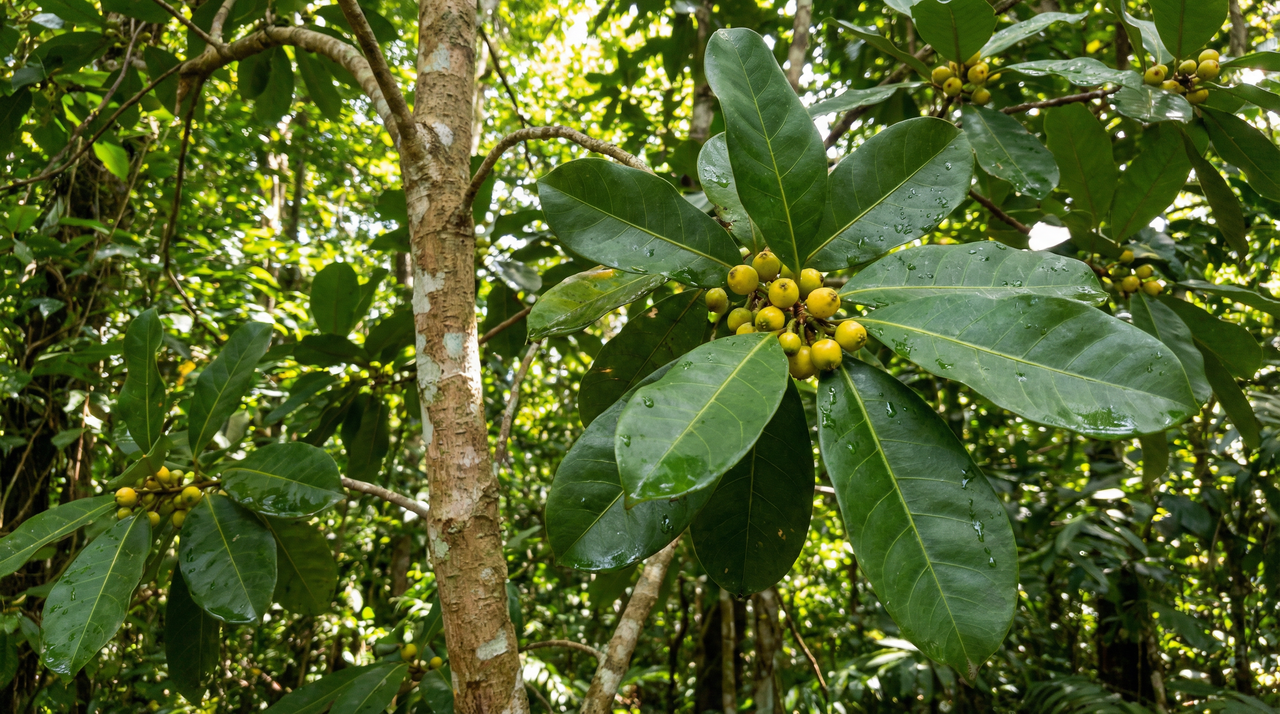
Every permaculture designer I know has a story about the plant that made them feel like they'd been lied to by history. For me, it's Breadnut. Here's the thing that stopped me cold the first time I read about it: archaeologists once assumed the dense stands of Brosimum alicastrum growing around Maya ruins were just opportunistic regrowth, volunteer trees colonizing abandoned land. It took decades of closer work before researchers started recognizing those groves as intentional, managed orchards.[1] The Maya hadn't abandoned their food forests. We just didn't know how to read the landscape they left behind.
What that means, practically, is that a tree capable of feeding civilizations through drought and famine has been sitting in the ethnobotanical record this whole time, hiding in plain sight as a "famine food," a backup, a footnote. That framing has always bothered me. The seeds are nutritionally dense, the tree lives for centuries, it regenerates degraded soils, and it produces reliably even when the rains don't cooperate. That's not a backup plan. That's a cornerstone species someone decided wasn't worth the trouble of understanding.
Breadnut Origin and History
Botanical Background and Native Range of Breadnut
The scientific name of breadnut is Brosimum alicastrum, an evergreen to semi-evergreen member of the Moraceae family native to tropical Mexico, Central America, and northern South America as far south as Peru and Bolivia.[2][3][4] You'll also see it sold or listed as Maya nut, ramon, or bitterwood depending on the region and the seller. It inhabits an impressive ecological range, from sea level up to around 1,000 meters, thriving across tropical dry forests, moist lowland rainforests, semi-deciduous forests, and even secondary growth on abandoned agricultural land.[2][5] That ecological flexibility is one of the first things I noticed when I started researching it seriously: this is a tree that doesn't need ideal conditions to persist.
The lifespan is equally striking. Breadnut is a polycarpic species that lives 100 to 300 years or more, begins flowering somewhere between 5 and 10 years of age, and doesn't hit peak productivity until around 30 years in.[6][7] It has no distinct dormancy period; it just keeps growing, fruiting, and cycling through seasons with a quiet persistence. I think about my fig trees and how temperamental they can be with cold snaps or dry spells, and then I look at breadnut's track record across centuries of Mesoamerican forests and feel a little humbled. If you're designing a food forest meant to outlast you, this is the kind of tree that belongs in the canopy layer.
Visual Characteristics of the Breadnut Tree
A mature breadnut tree is genuinely imposing. It reaches 20 to 40 meters tall, with the largest specimens pushing 45 meters, a straight trunk up to a meter across, and a broad rounded canopy spreading 10 to 25 meters wide.[8][9][10] Young trees put on half a meter to a meter per year before gradually slowing, so there's real establishment momentum early on. The leaves are simple and alternate, ovate to elliptic, glossy dark green on top, paler underneath, typically 7 to 15 centimeters long with a leathery texture and clean entire margins. They persist year-round with no dormant drop.[8][11]
The bark is grayish-brown, smooth to slightly fissured, and cuts to reveal a milky latex that the tree has used both defensively and, historically, as a raw material for human craft.[8][9] Underground, a deep taproot reaching 15 meters or more anchors the tree against seasonal drought, a trait that immediately reminded me of mature figs I've worked with in variable rainfall landscapes; knowing a tree can reach that far down changes how I think about site placement entirely.[12] The flowers are easy to miss: tiny greenish-yellow structures, only 1 to 2 millimeters, clustered in dense axillary heads, with the tree generally monoecious though sources note some variability in that arrangement.[8][13] I've heard from colleagues who've visited botanical collections with mature specimens that the nuts simply appear one day underfoot, almost without announcement. The seeds themselves are enclosed in brown husks with creamy white interiors and carry a mildly sweet, chestnut-like flavor when properly prepared.[9]
Traditional and Cultural Uses by Maya and Indigenous Peoples
Archaeological evidence and 16th-century Spanish chronicles trace breadnut use in Maya communities back at least 4,000 years, to around 2000 BCE.[14][15] This wasn't a backup food. Nuts were ground into flour for breads and porridges, roasted into beverages, and stored in granaries against lean seasons, with the Lacandon Maya among the communities documented relying on it as a genuine dietary anchor.[16][17] Beyond eating, the tree carried sacred status, woven into rituals of fertility and abundance, and served as a vital drought-resistant famine food when maize crops failed.[18] Bark decoctions addressed digestive and respiratory illness, leaves were prepared as teas and poultices for inflammation and fever, and the bark fiber found its way into ropes and hammocks.[19][18] Studying this ethnobotany has genuinely shaped how I approach legacy trees in food forest designs; there's a depth of multi-generation observational knowledge embedded in these uses that no research paper fully captures.
The seeds contain up to 30% protein along with significant fiber and minerals, and that nutritional density underpins current food security initiatives in Guatemala where the Maya Nut Institute and other organizations are promoting traditional processing methods alongside sustainable agroforestry.[20][4] The tree holds Least Concern status from the IUCN with stable populations, though deforestation remains a pressure on wild stands.[21] Sustainable selective harvesting can yield up to 1,000 kilograms per hectare annually, but commercialization efforts raise legitimate questions about intellectual property rights and equitable benefit-sharing with indigenous communities who stewarded this tree for millennia.[22][23] When I recommend breadnut for agroforestry projects, I always stress sourcing from programs that honor indigenous knowledge and fair benefit-sharing. That's non-negotiable for genuinely regenerative work.
Fun Facts and Modern Significance of the Maya Nut
Some breadnut trees are believed to exceed 500 years in age, with confirmed ranges of 200 to 300 years being well documented.[6][24] That multi-century baseline offers profound perspective. A tree planted today by a food forest designer might still be feeding families three centuries from now. I've had the privilege of standing near century-old specimens in tropical landscapes and that sense of accumulated time, of a tree that has quietly outlasted empires, is the reason I prioritize long-lived canopy species in every master plan I write. Breadnut functions as a true keystone in Neotropical ecosystems, supporting wildlife, driving carbon sequestration, and facilitating seed dispersal, all while shrugging off the drought conditions that sideline less-adapted species.[2][24]
The latex has historical craft applications, and the seeds require drying or roasting before consumption to neutralize anti-nutritional compounds and unlock their full nutritional potential.[9][25] That processing requirement is worth knowing upfront; it's a small step that Maya cooks perfected long ago, and skipping it isn't an option. In modern agroforestry, organizations like the Maya Nut Institute are actively reviving breadnut cultivation for reforestation, timber, and food security, recognizing what indigenous communities already knew: that this tree, given time and respect, gives back far more than it asks for.[7][23]
Breadnut Varieties and Sourcing
Botanical Varieties of Breadnut
If you're hunting for a named cultivar of breadnut, you won't find one. Brosimum alicastrum has no formal breeding programs, no patented selections, and no "improved" varieties waiting on a nursery shelf.[26][27] What does exist is something arguably more interesting: genuine botanical diversity across three recognized varieties, var. alicastrum, var. rubrum, and var. tomentosum, each with distinct morphological traits and adapted to different slices of its vast native range.[26][28] I've seen var. rubrum in botanical collections, and the nuts have a subtly different flavor profile from typical material, though the difference is modest enough that most growers won't be selecting for it deliberately.
For permaculture design purposes, this genetic breadth is a feature. Different provenances appear to establish better in different microclimates, and when I've trialed tropical trees in zone 9b Central Florida, material sourced from the more northern parts of the species' range consistently handles cooler nights better than stock from deep equatorial populations. The Mayan breadnut tree's adaptability in agroforestry comes precisely from this unmanaged diversity, not despite it. In the US, viable outdoor cultivation is limited to USDA zones 10-11, with southern Florida, southern Texas, and parts of California being the realistic options.[29][30]
How to Source Breadnut Trees and Seeds
Because there are no commercial cultivars to chase, buying breadnut means navigating specialty tropical nurseries rather than mainstream garden centers.[31] Suppliers worth knowing include Rare Exotic Seeds, Logee's, Sheffield's Seed Company, Florida Native Plants Nursery, Let's Grow Edibles, and Sahara Sidhe Native Seeds.[32][33][34] Seeds typically run $10-25 per ounce, seedlings $15-40, and established trees $50-200 or more depending on size.[35][36] Also watch for it listed as Maya nut, ramon tree, or ojoche -- the same species, just different regional names causing confusion in search results.[37]
The single most important thing to know before ordering seeds: breadnut is recalcitrant, meaning seeds lose viability fast and must be sown within days to weeks of harvest.[38][39] Fresh seeds germinate at 70-80%, but that number drops sharply with age or poor storage. I always ask suppliers for a collection date and germination test results before purchasing -- I've been burned by old stock before, and with recalcitrant species there's no recovering from it.[34] Expect 2-4 weeks to germination at 25-30°C, and a 24-hour soak beforehand helps. On the regulatory side, the Brosimum alicastrum tree carries no CITES restrictions,[40] but international imports still require phytosanitary documentation under USDA APHIS rules.[41] Domestic US shipping from Florida or California nurseries is generally straightforward. I also make a point of buying only from suppliers who can trace their material to sustainable wild or agroforestry harvests, both on principle and because that provenance transparency usually signals fresher, better-handled seed.[42] Budget time as well as money: trees typically begin fruiting 5-8 years after planting.[39]
Breadnut Propagation and Planting Guide
Breadnut rewards growers who learn its rhythms early, and the single most important rhythm to understand is this: its seeds do not wait for you. Get that part right, and the rest follows naturally.
Propagation Methods for Breadnut
Seed propagation is how most breadnut trees get started, and it works beautifully when you respect one non-negotiable rule: sow fresh. Germination rates run 70-90% with seeds sown immediately after harvest, but those numbers drop fast as viability slips away within days to a couple of months.[43][44] I've worked with enough recalcitrant tropical species to know that waiting a week to sow feels harmless but often costs you half the batch. With breadnut, collect and sow within 48 hours whenever you can. Use a sterile seed-starting mix, keep temperatures between 25-30°C, maintain high humidity (a humidity tent or mist bench works well), and expect germination in 2-4 weeks.[45] A quick soak before sowing doesn't hurt rates.
Because breadnut is primarily self-incompatible and pollinators drive high outcrossing rates, seedlings show real genetic variability.[46] For most agroforestry plantings, that diversity is an asset. But if you've found a tree with exceptional nut size or reliable yields and want to replicate it exactly, vegetative methods are the answer. Semi-hardwood cuttings (10-15 cm) treated with IBA at 3000-5000 ppm root at around 50% success under mist, bottom heat of 25-30°C, and a perlite/peat medium.[47][48] Air layering on mature trees produces roots in 4-6 weeks and is especially practical when you want to propagate without cutting the mother tree down.[49] Grafting (cleft or whip-and-tongue) done during the rainy season delivers success rates of 70-80% and brings fruiting forward significantly.[44]
The Maya traditionally relied on natural regeneration, letting mammals, birds, and peccaries disperse seeds through their digestive tracts, which actually improves germination.[43] Modern growers on degraded land don't have that luxury, but understanding that biology helps explain why seeds sown fresh in warm, moist conditions behave so cooperatively.
Soil and Site Requirements
Breadnut is forgiving about soil texture once it's established, but it is unforgiving about drainage. It prefers well-drained loamy to sandy loam soils, does fine on limestone-derived and karst profiles, and tolerates low fertility and rocky conditions after the first couple of years.[50][51] Waterlogged roots, though, invite Phytophthora, and that can kill a young tree fast. I always advise clients in subtropical gardens to test drainage before planting, especially in clay-heavy soils: dig a hole, fill it with water, and see how quickly it clears. The optimal pH sits between 6.0-7.0, with the species tolerating a broader range of 5.5-7.5, but extremes cause trouble.[52] Too alkaline and you'll see iron and manganese deficiency as chlorosis; too acidic and aluminum toxicity shows up as leaf necrosis. If you're planting into unamended limestone soil, I'd amend with compost and rock phosphate before the tree goes in rather than trying to chase deficiencies later.
Young seedlings need partial shade to prevent leaf scorch, which is exactly the same pattern you see with young mangoes: they want shelter early, then they grow into full sun.[53][54] Mature breadnut trees perform best with at least 4-6 hours of direct sun daily, and fruit production improves with more.[55] The species is native to environments receiving 1000-3000 mm of annual rainfall, and its deep taproot handles dry spells well once it's past the establishment phase, though consistent moisture matters during the first one to two years.[56]
Spacing, Planting Technique, and Establishment
Breadnut gets big. Mature trees in cultivation typically reach 10-25 m with a canopy spread of 10-15 m, and they put on 5-10 m of height in the first 5-7 years under good conditions.[8][57] That growth rate is one of the things I love about this tree for reforestation and food forest work, but it does mean you need to plan spacing seriously from the start. In orchard settings, 10x10 m is the standard, giving you 50-100 trees per hectare; in agroforestry systems, 8-15 m between trees is the workable range, with a hard minimum of 8 m to avoid root and canopy competition.[58][44] I've found that 10-12 m in mixed tropical systems hits a sweet spot: enough canopy light penetration to support understory companions like banana or cacao without crowding that suppresses nut yields.
Transplant seedlings once they're 15-30 cm tall, after a proper hardening-off period.[59] A container mix of roughly 40-50% loam or sand, 30% perlite, and 20-30% organic matter supports healthy root development before transplant.[60] Once in the ground, provide partial shade, consistent watering, and stake young trees on windy sites. Plan on one to two years before they really hit their stride and reach 2-3 m; after that, establishment momentum builds quickly.[44]
Germination and Fruiting Timeline
Fresh brosimum alicastrum seeds germinate in 2-4 weeks under warm, moist conditions, which is one of the faster turnarounds among large tropical tree seeds.[61] The longer wait comes after: seed-grown trees typically take 7-10 years to first fruit, though trees in ideal conditions can fruit as early as year five.[62][59] Grafted trees close that gap considerably, coming into production in 3-5 years. In agroforestry contexts, expect meaningful fruiting around years 7-8 under good management.[63]
Seven to ten years sounds like a long time, and it is. But I'd encourage anyone hesitating over that timeline to think about it through a permaculture lens: the breadnut canopy that's shading and sheltering your shorter-lived crops is already delivering value years before the first nut drops. Plant it now for a future yield, and let the interplanted maize, beans, or banana carry the near-term harvest. The patience the tree asks for is exactly proportional to the decades of resilient, low-maintenance production it returns.
Breadnut Care and Growing Guide
There's a version of Breadnut care that sounds impossibly easy: plant it, walk away, harvest nuts for a century. The reality is more nuanced, but not by much. What the tree actually asks for is focused attention during its first two years, then it rewards you with decades of remarkable independence. Getting the establishment phase right is everything.
Water Requirements for Breadnut Trees
Native to Mesoamerican rainforests, breadnut is adapted to a staggering range of annual rainfall, anywhere from 800 to 4,000 mm, with the sweet spot around 1,500–2,500 mm.[64][65] Once established, it backs that range up with a deep taproot and leathery leaves that cut transpiration significantly, making it genuinely drought-tolerant between rains.[66][67] My own established trees go weeks without supplemental water during the dry season, and they're fine.
Young trees are a different story. For the first one to two years, you need consistent moisture, roughly 1–2 inches per week or a thorough watering every three to five days, keeping the top 2–3 inches of soil moist but never waterlogged.[31][61] Once that taproot has found its depth, you can scale back to deep, infrequent irrigation every two to four weeks during extended dry spells, with a bit more attention during fruit set when supplemental water can meaningfully improve yield.[67][68]
Learn the stress symptoms early. Underwatering shows up as wilting, leaf curl, brittleness, and premature drop; overwatering, especially on heavy soils, produces yellowing, browning, wilting, and sometimes visible fungal growth at the base.[61][31][69] The tree prefers well-drained loamy or sandy-loam soils, tolerates limestone-derived profiles, and handles a pH range of 5.5–7.5.[44][31] A 2–4 inch layer of organic mulch, kept well clear of the trunk, does meaningful work here: it moderates soil temperature, retains moisture between waterings, and slowly feeds the biology below.
Feeding and Soil Fertility for Breadnut
Breadnut evolved in nutrient-poor tropical soils, and that history shows in its fertilizer needs, which are genuinely low.[70][71] A big part of why is its strong arbuscular mycorrhizal network, which scavenges phosphorus from low-fertility soils with surprising efficiency.[72] I've found that after several years of adding compost and avoiding synthetic nitrogen, my established trees produce more nuts with almost no supplemental feeding at all. The soil biology does the heavy lifting.
Before reaching for any fertilizer, learn the deficiency symptoms. Uniform chlorosis on older leaves points to nitrogen; purplish discoloration and weak roots suggest phosphorus; marginal necrosis on older leaves indicates potassium; interveinal chlorosis on new growth means iron.[73] If a soil or leaf test confirms an actual deficiency, young trees can receive light applications of a balanced low-nitrogen fertilizer, something like a 10-10-10 or 10-20-20 at 50–200 g per tree, two or three times during active warm-season growth only.[74][71] I never fertilize without a soil test first; the research on over-fertilization is clear, and I've watched friends end up with spindly, pest-prone growth after going heavy on nitrogen.[73] Excess phosphorus above 50–100 ppm creates its own problems, including nutrient runoff and disrupted mycorrhizal function. Compost and green manures are always the first choice.[75] And never apply anything to newly planted bareroot stock, drought-stressed trees, or during cool weather outside the growing season.[76][44]
Heat Tolerance and Heat Stress Management
Breadnut's thermal sweet spot is 25–30 °C, and it's rated for AHS Heat Zones 9–12, with the ability to shrug off brief spikes past 40 °C through efficient stomatal control and heat-shock proteins.[77][78] It handles those 40 °C spikes better than most avocados I've grown, but it still appreciates afternoon shade during its first two summers, especially when heat and dry conditions hit together. Above 35–40 °C, watch for leaf scorch, wilting, and accelerated senescence, particularly if drought stress arrives at the same time.[79]
Practical heat management is straightforward: give seedlings 30–50% shade for the first one to three years, favor a morning-sun or northeast-facing exposure, maintain that mulch layer to buffer root-zone temperature, and water deeply beyond the drip line rather than shallowly at the trunk.[80] Seed provenance matters too; trees from drier source populations tend to perform better through prolonged heat and moisture stress, so it's worth asking about origin when sourcing.
Frost Tolerance and Cold Protection
The breadnut tree growing zone limits require serious consideration. Breadnut is reliably hardy in USDA zones 10b–11, with some sources stretching that to zone 10 or 12 depending on microclimate.[81][82] Damage begins around 28–30 °F and becomes serious below 25 °F; sustained freezes are simply not survivable for this tree.[81][83] Young leaves, flower buds, and developing fruits are the most vulnerable; symptoms include browning, scorching, curling, and dieback that can look dramatic but may not be fatal if the roots stayed protected.[84][82]
My approach for the first two winters is to keep young trees in containers and move them into a bright garage whenever the forecast drops below 30 °F. The recovery the following spring is usually encouraging, but it's a gamble I'd rather not take with a tree I've spent two years nurturing. For in-ground specimens in marginal zones, a south-facing wall microclimate, thick mulch over the root zone, and frost blankets on cold nights are your main tools.[85] Avoid low-lying areas where cold air pools overnight.
Pruning, Maintenance, and Seasonal Rhythm
Pruning breadnut is mostly a matter of restraint. The dry season is the right time for any structural work, limiting both disease entry points and excessive sap flow.[86] On young trees, a little formative pruning to establish a central leader or three to five well-spaced scaffold branches pays off for decades; on mature trees, the job is essentially removal of dead, diseased, or crossing limbs to keep light and air moving through the canopy.[86][87] I limit myself to crossing limbs and the occasional sucker; early on I made the mistake of heavier cuts and ended up with excessive sap bleeding and a tree that sulked for the rest of that season. Sharp, sterilized tools and sanitary disposal of clippings are non-negotiable.[59][87]
Phenologically, breadnut keeps a busy calendar. It's evergreen and flowers year-round with peaks during the dry season, roughly December through April in Central America, and fruits take four to eight months to mature, putting the main harvest window between May and October.[88][89] Temperatures below 20 °C can delay flowering, so in marginal climates expect the whole cycle to shift later. First light crops arrive at three to five years; full production comes at seven to ten years.[90] Once you know that rhythm, annual care becomes mostly observation, a little dry-season cleanup, and patience.
Harvesting Breadnut (Brosimum alicastrum)
Patience is the first skill breadnut teaches. The seedlings look deceptively slow for their first few years, and I'll admit there are moments in early food-forest design work when you wonder whether a canopy species that takes 7-10 years to hit full productivity is really worth the real estate. It absolutely is. Once a mature tree finds its rhythm, harvest becomes one of the more pleasant tasks in the food forest: you're mostly just picking up after it.
Timing and Maturity Cues
Once a tree reaches bearing age, fruit development runs a long course. From flowering to a ripe seed takes roughly 6-8 months, averaging around 200 days in typical tropical conditions.[91][92] In Central America, fruiting season generally runs May through September with peak harvest concentrated in June and August, though trees in some locations produce year-round.[9] The cues are reliable: drupes that were green and firm will shift to yellow, yellowish-orange, or reddish-brown, soften noticeably, and begin dropping on their own.[93][23] That natural drop is your signal of peak nutritional value; green and firm means wait. In a food-forest setting, this makes harvest far more passive than climbing after other canopy species.
Harvest Techniques, Post-Harvest Handling, and Storage
The fruit itself is a small drupe, roughly 1-2.5 cm across, with the edible seed tucked inside.[8][9] Traditional harvest is exactly what it sounds like: collect fallen fruit from the ground, or hand-pick what the tree hasn't dropped yet. Simple, accessible, low-tech.
What happens in the next 48 hours, though, is where growers can lose a significant portion of the crop. After cleaning seeds to remove debris and fruit pulp, you need to dry them rapidly to 10-12% moisture using sun-drying or a mechanical dryer set between 40-60°C, over 2-5 days.[94] Never exceed that 60°C ceiling; I've experimented with both sun-drying and low-temperature dehydrator settings, and going hotter introduces off-flavors while degrading nutrition. Skip or rush the drying step and you're looking at 20-30% post-harvest losses to mold.[95] That's a painful tax on years of patient growing.
Once dried, cure the nuts for a few weeks at rest. This mellows any residual bitterness and develops flavor before you commit them to long-term storage.[94] Store in airtight containers at 15-20°C with relative humidity below 60-70% and you can expect a shelf life of 6-12 months or longer.[94]
Expected Yields and Flavor Profile
A mature tree under good management yields 20-100 kg of nuts per year.[96][88] The seeds themselves are subglobose, about 1.5-2.5 cm across, with a hard brown shell and a nutritional profile high in protein and fiber.[8] Those numbers are the reward for the years of waiting and the care you put into post-harvest handling.
Raw seeds carry an astringency and mild toxicity that typical roasting or boiling reliably eliminates, and the processing step takes minutes.[97][94] What you get on the other side is genuinely delicious: a mild nuttiness with subtle sweetness that reminds me of chestnuts, and a roasted aroma somewhere between coffee and graham crackers from the Maillard reactions at moderate heat. Mexican types tend toward the sweeter end; Central American ones read earthier.[95][23] Proper drying, curing, and storage are what make that flavor payoff possible, which is exactly why the post-harvest steps matter as much as knowing when to pick.
Breadnut Preparation, Culinary Uses, and Benefits
The Maya called it "food of the ancestors," and for good reason. Breadnut seeds have sustained Mesoamerican communities for over 4,000 years,[98][99] and what I find remarkable is that the harvest never once required cutting the tree down. The harvest provides uniquely scalable sustenance from standing trees,[100] which makes this one of the most elegant examples of abundance without destruction I've encountered in any food forest system.
Processing and Culinary Applications of Breadnut Seeds
You cannot eat raw breadnut seeds. They contain tannins and saponins that make them bitter and astringent, and skipping the processing step will leave you with a genuinely unpleasant mouthful.[74][101] I learned this the hard way early on, nibbling a seed fresh from the hull out of impatience. The full traditional sequence of soaking, sometimes fermenting, then boiling or roasting fully neutralizes those compounds; once I started respecting that process, I've never had an issue.
Roasting is where the real magic happens. At 150–200°C, Maillard reactions transform the starchy interior into something that genuinely smells like fresh coffee and tastes of dark chocolate and chestnut.[102][103] In my home trials, that aroma really intensifies around the 15–20 minute mark at 175°C; pull them too early and you lose the complexity, push too far and the sweetness turns bitter again. Fermentation takes a different path, adding a lactic tang or fruity note that works beautifully in savory preparations.[103] Boiling or grinding produces a creamy, porridge-like consistency that suits beverages and baked goods well.[44]
Traditional Maya breadnut recipes built entire meal structures around this versatility: ground into flour for tortillas, tamales, and atole; roasted as a coffee substitute; baked into breads.[104][99] Regional character matters too: Mexican varieties tend sweeter, Central American ones more earthy.[104] Modern applications follow the same logic. Breadnut flour works in gluten-free baking, energy bars, smoothies, and even as a cacao alternative in chocolate recipes.[105] As detailed in the nutrition profile, the seeds pack roughly 15.7 g of protein and are rich in calcium, iron, and potassium per 100 g,[106][100] which explains why communities have leaned on them through centuries of disruption. Dried to 10–12% moisture and stored airtight, they keep one to two years without issue.[100] One note on the rest of the fruit: the sweet orange pulp is edible fresh, but the seed is always the culinary centerpiece; the leaves feed livestock rather than people.[98]
Traditional Medicinal Preparations from Breadnut
Maya communities have long used this tree as both pantry and pharmacy. Bark decoctions address diarrhea and dysentery; leaf and bark infusions reduce fever; poultices from various parts treat wounds, skin irritations, and respiratory complaints; and roasted seeds have served as a general tonic for digestive ailments.[107][108] Traditional guidelines describe 5–10 g of dried leaves per 250 ml water as a decoction taken once or twice daily, and 10–20 g of seed powder mixed into food or beverages.[107][109] While I am not a clinician, these ethnobotanical guidelines reflect generations of community knowledge. The phytochemical research discussed in the health benefits section does lend them biological plausibility, but these preparations are best approached as complementary supports and discussed with a qualified practitioner before use.
Non-Food Uses and Agroforestry Value
The tree gives beyond the seed bowl. Its latex was historically processed into adhesives and the rubber balls used in the Maya ritual ballgame pok-a-tok,[110][17] while the bark yields natural dyes. The wood itself is dense, decay-resistant, and historically used for construction, furniture, and tool handles.[111] In agroforestry systems, breadnut intercropped with coffee or maize delivers shade, soil improvement, and food production from a single canopy position.[88][112] Every time I see one of these trees working inside a well-designed food forest, I'm reminded why I keep recommending it to clients: the annual nut harvest, the structural timber value, the deep shade for understory plants, and the soil benefits from leaf litter cycling all emerge from a single planting decision that pays dividends for generations.
Breadnut Health Benefits and Medicinal Uses
There's a pattern I've noticed with underutilized tropical trees: the plants that sustained civilizations for millennia tend to hold up remarkably well when modern researchers finally turn their attention to them. Breadnut is a good example. The same species that Mayan communities relied on for food, medicine, and cultural continuity turns out to have a genuinely impressive biochemical toolkit backing those traditional applications.
Traditional Mayan Medicinal Uses of Breadnut
Across Mesoamerica, virtually every part of Brosimum alicastrum has found its way into traditional medicine. Leaves, seeds, bark, and latex have been used to treat diarrhea, inflammation, pain, gastrointestinal disorders, diabetes, and even snakebites.[113][114] That's a broad therapeutic range, and not every use has modern research behind it yet. The snakebite application and several of the gastrointestinal uses still live primarily in ethnobotanical records rather than controlled studies, and I think that's worth stating plainly. Traditional knowledge is worth taking seriously; it's also not the same as a clinical trial.
Where the lab data does exist, it's encouraging. Anti-inflammatory activity has been confirmed in preclinical models, with leaf extracts reducing carrageenan-induced paw edema in rats by around 60% at a 200 mg/kg dose, operating through NF-κB suppression and inhibition of TNF-α, IL-6, and COX-2 pathways.[115][116] Antimicrobial activity against Staphylococcus aureus and E. coli has been documented with MIC values between 0.5 and 2 mg/mL, consistent with what you'd expect from the alkaloid and flavonoid content in leaf and bark extracts.[117] Seed extracts also show antidiabetic potential through alpha-amylase and alpha-glucosidase inhibition and hypoglycemic effects in diabetic rat models, plus moderate cytotoxicity against HeLa and MCF-7 cancer cell lines.[118][117] Human clinical trials are limited, so I'd frame these as promising signals rather than established therapeutic claims.
Key Phytochemicals in Breadnut: Flavonoids, Phenolics, and More
The bioactive profile of Brosimum alicastrum is genuinely complex. Leaves are particularly rich in flavonoids, including quercetin, rutin, kaempferol, myricetin, and catechin, while bark and stems concentrate tannins and alkaloids, roots contain triterpenes like lupeol, seeds carry phenolic acids and oils, and latex holds alkaloids and irritant proteins.[119][120] It's a nice reminder that "medicinal plant" rarely means one compound doing one thing; it means a whole tissue-specific chemistry that traditional practitioners learned to work with over generations.
Quantitatively, the leaf extracts can reach up to 150 mg GAE/g total phenolics and 50 to 80 mg QE/g flavonoids, with DPPH radical scavenging IC50 values of 20 to 50 μg/mL for ethanolic extracts, comparable to ascorbic acid.[121][122] As a horticulturalist, I've seen similar potency variation in other aromatic and medicinal plants depending on season, soil, and water stress, and breadnut is likely no different. The numbers you get from a drought-stressed tree versus a well-irrigated one may not be identical.
Nutritional Profile of Breadnut Seeds
Roasted breadnut seeds clock in at around 466 kcal per 100g, with roughly 16g protein, 79g complex carbohydrates, 11 to 18g dietary fiber, and just 2.5g fat.[123][124] The mineral density is what really catches my eye: up to 1,200 mg calcium per 100g, 10 to 15 mg iron, and around 1,000 mg potassium.[125] The Maya Nut Institute promotes it as a food for pregnant and nursing women, and given those calcium and iron levels, that recommendation lines up with the nutrient data.[126] I'd still advise consulting a healthcare provider before using concentrated extracts or supplements during pregnancy, even with a strong traditional safety record.
Seeds are also gluten-free, carry antioxidant polyphenols including ellagic acid and quercetin, and offer protein levels that rival legumes at 18 to 30% on a dry-weight basis.[127][128] I've been using roasted Maya nut flour in baking for a couple of years now, and the slow-burning energy from all that fiber and complex starch is real. It behaves more like roasted chickpea flour or acorn meal than wheat flour, dense and satisfying rather than light and spiky.
Safety Considerations and Proper Processing of Breadnut
Raw breadnut seeds have a noticeably bitter, astringent quality that I've come to think of as a reliable signal that they're not ready to eat. That flavor comes from tannins, phytic acid, trypsin inhibitors, lectins, and oxalates that reduce mineral bioavailability and bring protein digestibility down to around 70%.[129] Traditional roasting at 150 to 180°C for 20 to 30 minutes, boiling, or fermenting reduces phytic acid by 30 to 50%, fully inactivates lectins and inhibitors, and brings digestibility over 90%.[130] Once roasted, that bitterness disappears completely. If you're still tasting strong astringency after roasting, roast longer. Unlike some tropical seeds, breadnut contains no cyanogenic glycosides, and the fruit pulp is safe to eat raw with no toxicity concerns.[129]
The latex is a different matter. Like figs and mulberries (breadnut's Moraceae relatives), it contains ficin, a proteolytic enzyme, along with irritant proteins that can cause contact dermatitis or mucous membrane irritation.[131][132] I handle it the same way I handle fig latex in the garden: gloves on, avoid touching your face, wash up after. Anyone with a latex allergy should be especially cautious given the potential for cross-reactivity. For the seeds themselves, centuries of Mayan and Mesoamerican use with no major toxicity reported and low acute toxicity in rodent studies gives me genuine confidence that properly processed breadnut is a safe, nourishing food.[126][133] Just process it properly, and if you're using leaf or bark preparations medicinally rather than as food, a conversation with a knowledgeable practitioner is always worth having.
Breadnut Pests and Diseases
Breadnut won't win any awards for being the most thoroughly studied tree in the pathology literature. Because it's been largely overlooked by commercial agriculture, species-specific research on Brosimum alicastrum remains thin, and most guidance draws from broader tropical agroforestry experience rather than controlled trials.[97][134] That said, years of agroforestry work across Central America have made one thing clear: follow basic sanitation and drainage rules, and problems stay minor. I'd take that track record over a thick stack of peer-reviewed papers any day.
Natural Disease Resistance and Common Fungal Pathogens
Breadnut carries moderate to high natural disease resistance compared to other members of the Moraceae family, backed by phenolic compounds in the bark and leaves with genuine antifungal activity and thick, leathery leaves that physically slow pathogen entry.[135][136] The tree's copious latex adds another layer of defense, showing antifungal activity against Fusarium and Aspergillus in laboratory studies.[137] When I prune a branch and that milky sap starts flowing immediately, I'm reminded that this is a tree doing a lot of its own protective work. (Wear gloves. The latex irritates skin, and I've learned that lesson more than once.)
The fungal threats that do appear are mostly opportunistic. Anthracnose (Colletotrichum spp.), leaf spots from Cercospora, Alternaria, and Septoria, stem cankers from Botryodiplodia theobromae, and wilt diseases caused by Ceratocystis spp. are the main culprits, along with Phytophthora root rot in waterlogged conditions and some vulnerability to bacterial leaf scorch.[138][139] Drought stress tips the tree toward stem cankers; poor drainage tips it toward root rot.[140] Disease incidence runs noticeably higher in intensive cultivation than in wild or diverse polyculture settings, which tells you almost everything you need to know about the right management approach.
Cultural controls are the first line of defense: proper spacing of 4 to 6 meters for airflow, pruning out crowded or damaged wood in the dry season, removing fallen debris, and avoiding overhead irrigation.[141][142] Copper-based fungicides can be used when pressure escalates, but they should be a last resort, not a routine. Breeding programs in Central America have already developed lines showing 20 to 30 percent better resistance to anthracnose and powdery mildew than wild types, with Central American ecotypes generally outperforming Mexican ones, which is useful to know when sourcing material.[143][144]
Insect Pests and Defensive Mechanisms
Quantified data on breadnut's insect susceptibility is sparse, but field observation across agroforestry systems consistently shows moderate pest pressure, lower than most tropical fruit trees I've worked with, papaya and citrus included.[145][60] The reason is that same latex, combined with tannins, phenolics, flavonoids, terpenoids, and leaf trichomes that physically deter feeding insects before they can do serious damage.[146][147][148] An insect biting into a breadnut leaf hits a wall of sticky, bitter chemistry. Many don't come back.
The pests that do establish themselves include wood-boring cerambycid and bark beetles, leaf-chewing caterpillars and chrysomelid beetles, shoot borers (Hypsipyla grandella), scale insects, aphids, and seed weevils (Conotrachelus spp.) that can cause up to 30 percent loss in stored nuts if ignored.[149][150] Pest pressure reliably intensifies under high humidity or in poorly drained soils, and stressed trees attract both insects and pathogens simultaneously. In my polyculture food forest designs, breadnut trees with good spacing and diverse neighbors consistently show less borer activity and lighter leaf damage than isolated specimens. That's not a coincidence; polyculture disrupts pest cycles and invites the beneficial insects that keep populations in check.[149]
When intervention is necessary, neem oil and insecticidal soaps handle most soft-bodied pest problems without torching the beneficial insect community. No pest-resistant cultivars have been documented yet, so management stays cultural: sanitation, biodiversity, and observation.[151][152] A well-sited breadnut in good company takes care of most of its own pest management. Your job is mostly to stay out of the way.
Breadnut in Permaculture Design
Before you fall in love with any tree, you have to be honest about whether your site can actually support it. Breadnut is a deeply tropical species, and no amount of enthusiasm changes that. Getting clear on its climate envelope early saves a lot of heartbreak later.
Climate and Hardiness Zones for Breadnut
In its native range, breadnut occupies tropical savanna and tropical monsoon climates from sea level up to about 1,000 meters, occasionally pushing to 1,500 m in sheltered spots.[153][154] It wants warmth in the 20–30 °C (68–86 °F) sweet spot, tolerates a broader swing of 15–35 °C without much complaint, but begins to struggle when temperatures drop below 10–15 °C for any extended period.[50][155] I've seen young breadnut leaves blacken after a rare 28 °F dip even in a protected zone 10a microclimate, and it was a firm reminder that cold tolerance data describes what a plant can briefly survive, not what it enjoys. I now wait until root systems are genuinely established before pulling back any winter protection on young trees.
Breadnut's rainfall requirements sit between 1,000 and 3,000 mm annually, and high humidity in the 70–90% range is preferred.[154][156] Once established, its deep root system gives it real staying power through seasonal dry spells, which is one of the traits that makes it interesting for agroforestry on sites with a pronounced dry season. In my experience, established breadnut handles dry periods considerably better than young mangoes on the same site, where I'd be running irrigation long after the breadnut was fine on its own. In the United States, USDA zones 10a–11 are the realistic target, meaning southern Florida, Hawaii, and protected pockets of southern Texas and California.[157][31] For anyone in zone 9b like me in Central Florida, treat it as a sheltered courtyard or microclimate experiment rather than a reliable landscape tree. It prefers well-drained, fertile soils and tolerates everything from full sun to partial shade, which gives designers some useful flexibility in site selection.[158]
Ecosystem Functions and Forest Layer Placement
What I love about placing breadnut in a food forest design is how much ecological work it does without you having to ask. Its abundant leaf litter decomposes into rich humus, mycorrhizal associations extend its soil influence well beyond the root zone, and that deep root system stabilizes slopes and prevents erosion while sequestering meaningful amounts of carbon over a tree's multi-century lifespan.[159][160] It doesn't fix nitrogen the way a legume does, so be clear-eyed about that, but the indirect fertility it builds through leaf drop is real and accumulates noticeably over years in a well-managed tropical system.
The wildlife picture is equally compelling. Seeds and sweet fleshy fruit attract bats, toucans, monkeys, agoutis, and tapirs, all of which become seed dispersers that extend the tree's reach through the landscape.[161][162] That kind of zoochory is exactly what you want in a restoration planting; the tree essentially recruits its own dispersal network.
Pollination is primarily wind-driven, with small greenish-yellow flower clusters arranged in globular inflorescences barely 1–5 mm across.[163] I've watched those inconspicuous clusters on my own trees release pollen on dry-season breezes with almost no insect activity to speak of, which tracks with the literature describing it as primarily anemophilous. The tree is generally monoecious with protogynous dichogamy that reduces self-pollination, though sources occasionally describe it as dioecious; the practical upshot for designers is to plant more than one tree when possible.[63] Flowering peaks in the dry season, roughly February through May in Mesoamerica, and the tree handles disturbed or fragmented sites with real resilience.[161] The Maya relied on it as a complement to maize precisely because of that dependability; when the corn harvest was thin, breadnut was there.[164] That cultural and agroforestry resilience story is still playing out in modern reforestation projects across Mexico, Guatemala, and Central America.[165]
Breadnut Guilds and Companion Planting
Breadnut grows to 20–40 meters with a straight trunk and a broad, dense crown, naturally occupying the canopy, subcanopy, or even emergent layer depending on the forest context.[166][167] That stature is the first thing to plan around. Give it genuine space; this isn't a tree you tuck into a small yard and manage into submission. But on a large tropical or subtropical plot, its size becomes a structural asset rather than a liability.
As an upper-canopy anchor, breadnut shades and shelters understory crops beautifully. Cacao and coffee are classic guild companions, both benefiting from the filtered light and the moisture-retaining microclimate that builds up under a dense tropical canopy.[168][169] Since breadnut doesn't fix nitrogen itself, pairing it with leguminous companions like pigeon pea or leucaena underneath fills that gap neatly, combining the breadnut's leaf-litter fertility with active nitrogen inputs from the guild partners. In a small demonstration bed I planted a young breadnut over cacao and pigeon pea, and what struck me was how quickly the combined leaf drop and pigeon pea biomass began building a genuine mulch layer. The cacao was visibly happier than control plants without that overhead structure.
Bananas, maize, and climbing beans can work in the mid and lower layers during a breadnut's early years before full canopy closure, giving the system productivity while the anchor tree matures.[170] I also noticed faster establishment and noticeably darker foliage on breadnut seedlings planted alongside a legume companion, which reinforced for me that soil biology matters even before the leaf-litter cycle has had time to kick in. A single breadnut, given the decades it needs to reach its potential, becomes a keystone that feeds people, feeds wildlife, and quietly restores the soil it stands in. That's a rare combination in any food forest palette.
Rethinking Breadnut as a Staple Crop
I remember standing under a mature Breadnut in the Yucatán, watching seeds fall around me like a slow, quiet rain, and thinking about all the generations who counted on exactly this moment. There's something humbling about a tree that outlives empires and still shows up. I grow it now not because it's easy or fashionable, but because some plants carry a kind of wisdom the rest of my food forest is still learning from.
Sources 170
- Peters & Pardo-Tejeda (1982), Brosimum alicastrum: Uses and Potential in Mexico, Economic Botany ↩
- Brosimum alicastrum - Maya Nut ↩
- Brosimum alicastrum ↩
- Brosimum alicastrum - Maya Nut Tree ↩
- Plants of the World Online - Brosimum alicastrum ↩
- Growth Rates and Longevity of Neotropical Trees: Case Study of Brosimum alicastrum ↩
- Brosimum alicastrum: Ecology and Silviculture ↩
- Brosimum alicastrum - Wikipedia ↩
- Maya Nut Tree (Brosimum alicastrum) ↩
- Brosimum alicastrum - FAO Agroforestry Species Profile ↩
- Maya Nut (Brosimum alicastrum) - ECHOcommunity.org ↩
- The Breadnut Tree: Brosimum alicastrum - ECHOcommunity.org ↩
- Plants of the World Online (Kew Science) ↩
- Maya Nut (Brosimum alicastrum) and Its Role in Maya Culture ↩
- Maya Nut: History and Ethnobotany ↩
- Nutritional and Ethnobotanical Study of Brosimum alicastrum ↩
- Maya Nut: A Traditional Food Resource ↩
- Ethnobotanical Uses of Brosimum alicastrum in Mayan Communities ↩
- Medicinal Plants of the Maya: Brosimum alicastrum ↩
- Traditional Food Plants of the Maya in Guatemala ↩
- Brosimum alicastrum ↩
- Sustainable Harvesting of Brosimum alicastrum ↩
- Maya Nut: Brosimum alicastrum ↩
- Ecology and Distribution of Brosimum alicastrum in Mesoamerican Forests ↩
- Maya Nut: Traditional Processing and Nutritional Value ↩
- Genetic Diversity and Population Structure of Brosimum alicastrum in Mesoamerica ↩
- Brosimum alicastrum ↩
- Brosimum alicastrum Sw. var. alicastrum ↩
- Brosimum alicastrum - Maya Nut ↩
- Fairchild Tropical Botanic Garden - Plant Collection ↩
- Horticultural Availability of Native Trees: Brosimum alicastrum ↩
- Brosimum alicastrum - Maya Nut Tree ↩
- Maya Nut Tree (Brosimum alicastrum) for Sale ↩
- Rare Tropical Seeds Catalog ↩
- Brosimum alicastrum Seeds - Maya Nut ↩
- Ramon Tree Seedlings for Sale ↩
- Brosimum alicastrum (Breadnut) ↩
- Propagation of Brosimum alicastrum ↩
- Brosimum alicastrum - Maya Nut ↩
- CITES Appendices ↩
- Importing Plants and Plant Products into the United States ↩
- Sustainable Harvesting of Maya Nut ↩
- Brosimum alicastrum: Information Sheet ↩
- Maya Nut Tree: Propagation and Cultivation ↩
- Propagation of Brosimum alicastrum by Seeds and Vegetative Means ↩
- Cross-pollination, outcrossing and mixed mating in a primarily self-incompatible tree: evidence from Brosimum alicastrum (Moraceae) ↩
- Propagation of Tropical Trees by Cuttings ↩
- Vegetative Propagation of Moraceae Species ↩
- Brosimum alicastrum: A Promising Nut Tree for Agroforestry ↩
- Brosimum alicastrum - Useful Tropical Plants Database ↩
- Brosimum alicastrum (Breadnut) Plant Profile ↩
- Agroforestry Systems with Brosimum alicastrum ↩
- Breadnut (Brosimum alicastrum) ↩
- Photosynthetic Responses of Tropical Trees to Light Intensity ↩
- Plants of the World Online (Kew Gardens) ↩
- Ecological Adaptations of Brosimum alicastrum in Mexican Rainforests ↩
- Brosimum alicastrum Sw. - Ramon ↩
- Maya Nut Agroforestry Guidelines ↩
- Brosimum alicastrum: Propagation and Cultivation ↩
- Brosimum alicastrum: Propagation and Cultivation ↩
- Brosimum alicastrum - Maya Nut ↩
- Propagation and Cultivation of Brosimum alicastrum ↩
- Reproductive Biology of Brosimum alicastrum in Tropical Dry Forests ↩
- Ecology and Distribution of Brosimum alicastrum in Mesoamerica ↩
- Drought Tolerance in Tropical Trees: Brosimum alicastrum ↩
- Brosimum alicastrum: A Multipurpose Tree for Agroforestry ↩
- Brosimum alicastrum (Maya Nut) ↩
- Water Requirements for Maya Nut Trees ↩
- Tropical Tree Diseases: Root Rot in Brosimum Species ↩
- Brosimum alicastrum - USDA PLANTS Database ↩
- Maya Nut Tree: Propagation and Cultivation ↩
- Mycorrhizal Associations in Brosimum alicastrum: Implications for Nutrient Acquisition ↩
- Nutrient Management for Tropical Trees: Case Study on Ramon (Brosimum alicastrum) ↩
- Cultivation and Utilization of Brosimum alicastrum (Maya Nut) ↩
- Agroforestry Systems with Brosimum alicastrum: Soil Fertility Management ↩
- Bitternut, Brosimum alicastrum ↩
- Brosimum alicastrum ↩
- Physiological Responses of Brosimum alicastrum to Heat and Drought Stress ↩
- Drought and Heat Tolerance in Brosimum alicastrum Sw. (Moraceae) ↩
- Missouri Botanical Garden Plant Finder ↩
- Brosimum alicastrum (Breadnut, Maya Nut) ↩
- Brosimum alicastrum (Breadnut, Maya Nut) ↩
- Brosimum alicastrum Profile ↩
- Frost Damage on Tropical Trees: Symptoms and Management ↩
- Frost Protection for Tropical Plants ↩
- Brosimum alicastrum: Propagation and Management ↩
- Pruning Tropical Fruit Trees - University of Florida IFAS Extension ↩
- Brosimum alicastrum: Propagation and Cultivation ↩
- Phenology of Brosimum alicastrum in Tropical Dry Forests ↩
- Growing Maya Nut in Florida - University of Florida IFAS Extension ↩
- Phenology and reproductive biology of Brosimum alicastrum in Mexico ↩
- Fruit Development and Maturation in Maya Nut (Brosimum alicastrum) ↩
- Fruits of Tropical Trees: Domestication, Production and Processing ↩
- Post-Harvest Management of Maya Nut (Brosimum alicastrum) ↩
- Processing and Storage Techniques for Underutilized Nuts in Mesoamerica ↩
- Ramon Tree (Brosimum alicastrum) in Agroforestry Systems ↩
- Ethnobotany of Brosimum alicastrum in Mesoamerica ↩
- Explore Plants: Brosimum alicastrum ↩
- Maya Nut: A Forgotten Crop ↩
- Maya Nut: A Forgotten Crop for the Future ↩
- Nutritional and Anti-Nutritional Factors in Brosimum alicastrum Seeds ↩
- Brosimum alicastrum: Nutritional and Sensory Properties ↩
- Processing and Flavor Development in Brosimum alicastrum Seeds ↩
- Culinary Uses of Ramon Nuts in Mesoamerica ↩
- Sustainable Uses of Ramón Nut in Modern Cuisine ↩
- Nutritional Composition of Brosimum alicastrum Seeds ↩
- Ethnomedicinal Uses of Brosimum alicastrum in Mayan Communities ↩
- Maya Nut: Nutritional and Medicinal Properties ↩
- Maya Nut (Brosimum alicastrum) - Maya Nut Institute ↩
- Indigenous Uses of Brosimum alicastrum in Belizean Maya Communities ↩
- Wood Properties and Uses of Brosimum alicastrum ↩
- Tropical Fruit Trees: Moraceae Family Guide ↩
- Ethnobotany of Brosimum alicastrum in Traditional Mayan Medicine ↩
- Traditional Uses and Phytochemistry of Maya Nut (Brosimum alicastrum) ↩
- Anti-Inflammatory Activity of Maya Nut Extract ↩
- Pharmacological Potential of Brosimum alicastrum: A Review ↩
- Antimicrobial and Cytotoxic Activities of Brosimum alicastrum Seeds ↩
- Antidiabetic Potential of Mayan Nut (Brosimum alicastrum) in Traditional Medicine ↩
- Phytochemical Composition and Antioxidant Activity of Brosimum alicastrum Leaves ↩
- Phytochemical and Pharmacological Review of Brosimum alicastrum ↩
- Antioxidant Activity and Phenolic Compounds in Maya Nut ↩
- Phytochemical Analysis and Biological Activities of Brosimum alicastrum ↩
- Nutritional Evaluation of Brosimum alicastrum Sw. Seeds ↩
- Maya Nut Nutritional Composition ↩
- Physicochemical and Nutritional Characteristics of Brosimum alicastrum Seed ↩
- What is it? - Maya Nut Institute ↩
- Nutritional Profile and Oil Composition of Ramón Nut (Brosimum alicastrum) ↩
- Nutritional and Anti-nutritional Factors of Brosimum alicastrum Seeds ↩
- Nutritional Value, Antinutritional Factors, and Protein Quality of Brosimum alicastrum Seeds ↩
- Determination of Nutritional and Antioxidant Properties of Maya Nut Flour ↩
- Toxicity of Brosimum alicastrum Latex ↩
- Latex-Fruit Syndrome: Cross-Reactivity in Moraceae Family ↩
- Toxicity Profile and Safety Evaluation of Maya Nut (Brosimum alicastrum) ↩
- Plant Pathology in Tropical Nurseries: Mesoamerican Case Studies ↩
- Ecological Adaptations of Brosimum Species in Mesoamerica ↩
- USDA PLANTS Database: Brosimum alicastrum ↩
- Antifungal Activity of Brosimum alicastrum Latex Extracts ↩
- Diseases of Tropical Fruit Trees: Focus on Moraceae ↩
- Fungal Diseases of Maya Nut (Brosimum alicastrum) ↩
- Experimental Tropical Trees Database ↩
- Management of Brosimum alicastrum in Agroforestry Systems ↩
- Organic Farming Practices for Maya Nut Cultivation ↩
- Disease Resistance in Brosimum alicastrum: Implications for Agroforestry ↩
- Breeding for Disease Resistance in Underutilized Tropical Fruits ↩
- Brosimum alicastrum ↩
- Phytochemical and Pharmacological Profile of Brosimum alicastrum ↩
- Latex as a Plant Defense Mechanism in Brosimum Species ↩
- Tannins and Phenolics in Tropical Trees: Defense Against Herbivores ↩
- Integrated Pest Management for Brosimum alicastrum in Agroforestry Systems ↩
- Pests and Diseases of Important Tree Species in Tropical Forestry ↩
- The Maya forest garden: a building tool for conservation and development ↩
- Cultivars and Propagation of Brosimum alicastrum ↩
- Plants of the World Online - Brosimum alicastrum ↩
- Kew Science - Brosimum alicastrum ↩
- Missouri Botanical Garden Plant Finder ↩
- USDA PLANTS Database - Brosimum alicastrum ↩
- USDA Plant Hardiness Zone Map ↩
- Missouri Botanical Garden - Brosimum alicastrum ↩
- Nutrient Cycling in Tropical Forests: Role of Moraceae Species ↩
- Agroforestry for Soil and Food Security: The Case of Brosimum alicastrum in Central America ↩
- Ecological Importance of Brosimum alicastrum in Maya Forests ↩
- Fruit Provisioning and Seed Dispersal by Brosimum alicastrum ↩
- The Ecology and Diseases of Brosimum alicastrum ↩
- Maya Nut Tree: Brosimum alicastrum ↩
- Agroforestry with Brosimum alicastrum in Guatemala ↩
- Brosimum alicastrum - Plants of the World Online ↩
- The Maya Nut (Brosimum alicastrum): Distribution, Ecology, and Potential for Agroforestry ↩
- Maya Nut Tree in Agroforestry - ECHO Community ↩
- Agroforestry Guide: Ramón Tree (Brosimum alicastrum) ↩
- Brosimum alicastrum in Permaculture - Permaculture Research Institute ↩