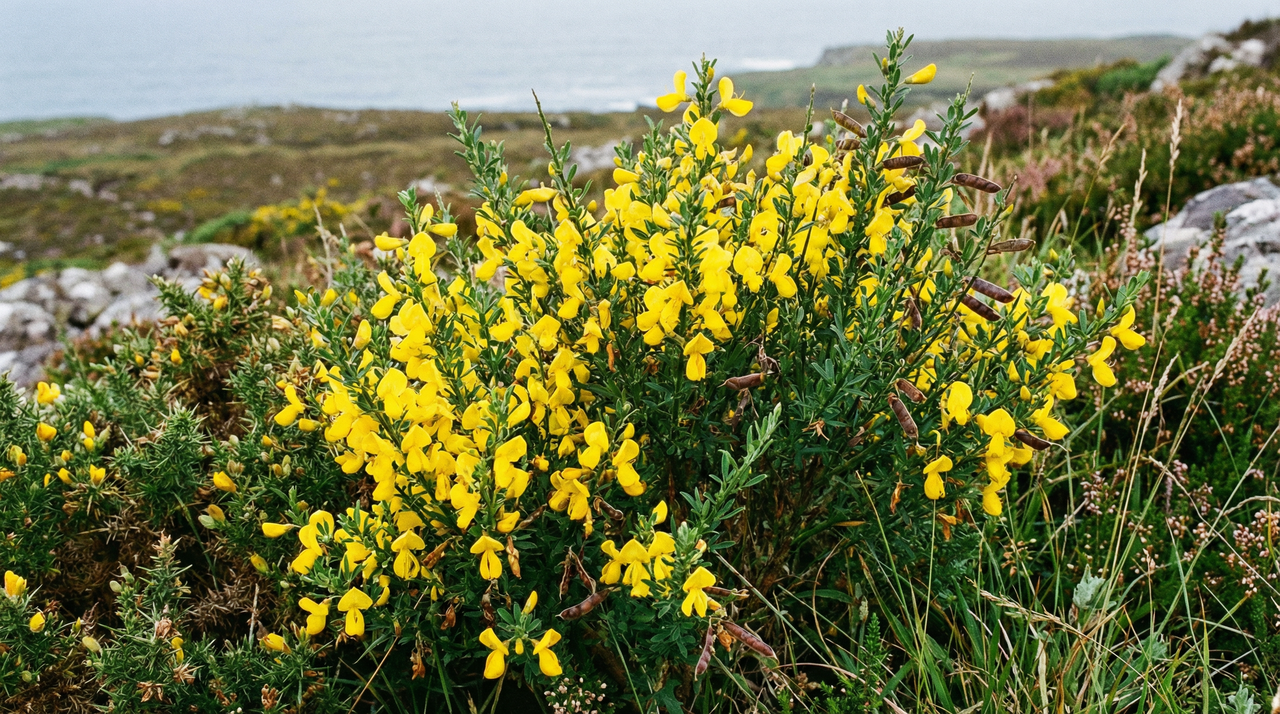
The pods are what got me. I was walking a restoration site in coastal Oregon, late July, and the broom had gone dry and black along the cut banks, and every few seconds I'd hear this sharp little crack, like someone flicking a fingernail against a desk. Seeds. Launching themselves. A single mature plant can carry thousands of seeds, and those seeds can stay viable in the soil for thirty years.[1] I stood there watching a plant I'd once considered a scrappy, useful nitrogen-fixer actively reloading itself for the next three decades, and I had to rethink some things.
Here's the contradiction nobody hands you upfront: Scotch broom is genuinely, ecologically impressive. It fixes nitrogen, stabilizes slopes, blooms so brilliantly yellow in spring that it stops traffic, and it carries a compound in its tissues, cytisine, that researchers are now using to help people quit smoking.[2] It's also one of the most damaging invasive shrubs on the West Coast of North America, capable of forming dense monocultures that crowd out native species and fundamentally alter fire regimes. Both of those things are completely true, and if you only hold one of them, you're going to make bad decisions in the garden.
Broom Origin, History, and Botanical Background
Botanical Background and Native Range of Scotch Broom
Scotch broom, Cytisus scoparius, is native to western and central Europe, from the British Isles and southern Scandinavia south through the Iberian Peninsula to the Mediterranean.[3][4] In its home range, it's an early-successional species that colonizes heathlands, open woodlands, coastal dunes, and disturbed ground -- exactly the kind of raw, scraped, nutrient-poor sites that most plants avoid. That niche tells you everything about what you're dealing with: a member of the Fabaceae that thrives specifically where conditions are harsh and competition is thin.
As a shrub, it's short-lived by woody plant standards, typically surviving 5 to 15 years and occasionally reaching 20 under ideal conditions.[4][5] It doesn't flower once and die like some pioneers; it's polycarpic, flowering and setting seed repeatedly throughout its life.[6] In North America, that persistent reproduction is the crux of the problem. Broom is listed as a noxious weed in Washington, Oregon, California, and Idaho, where it forms dense monocultures through competition, allelopathy, and seed production that is almost breathtaking in scale.[6][7] Seeds remain viable in the soil for decades.[4] I've watched similar long-lived seed banks play out with certain lupines in restoration contexts, but broom's persistence is in another category entirely. I consulted on a coastal restoration project years ago where broom had been cleared, and resprouting from the seed bank continued for years afterward. That experience reshaped how I talk about this plant.
Visual Characteristics and Identification of Cytisus scoparius
Broom grows 1 to 3 meters tall with an upright to arching, multi-stemmed bushy habit and a spread of 1 to 2 meters.[8][9] Its taproot can push over a meter deep, which explains both its drought tolerance and why pulling mature plants by hand is an exercise in frustration.[10] The stems are the first giveaway: distinctly angled and ridged, bright green even through winter, which makes the plant identifiable long after deciduous trees have gone bare.[8][9] The lower stems carry small trifoliate leaves with oblong to obovate leaflets 5 to 20 mm long, but as you move up the plant, leaves reduce to simple or nearly disappear altogether.[11][5] That near-leafless upper silhouette against a blue May sky, covered in blazing yellow flowers, is instantly recognizable once you've seen it in the field.
Those flowers are bright yellow, pea-like, 1.5 to 2.5 cm long, and appear from late spring through early summer.[12] They're genuinely beautiful, which is half of why its range keeps expanding -- people have historically planted it because it looks spectacular. The fruit that follows is a flat black legume pod, 2 to 4 cm long, holding 5 to 15 small seeds.[6] When those pods dry and split on a warm afternoon, they audibly snap and fling seeds several meters in every direction. Combined with nitrogen fixation, fire adaptation, and a preference for the disturbed acidic soils that humans keep creating, broom has everything it needs to outcompete and outlast.[13][10]
Traditional and Cultural Uses Throughout History
Carl Linnaeus formally described the species in Species Plantarum in 1753,[14] but Europeans had been living with and using this plant for centuries before that. By the 14th century, the flexible green stems were being harvested to make sweeping brooms, a use so ubiquitous that the tool eventually took the plant's name rather than the other way around.[15] Weavers used it for basket work, rural communities burned it as fuel, and it wove itself into European folklore as a symbol of protection, witchcraft, and May Day celebration.[16]
European folk medicine leaned on broom as a diuretic, cathartic, and cardiac stimulant.[17] The alkaloid sparteine was used specifically in midwifery to stimulate labor and as a heart tonic.[18] I respect the depth of that herbal tradition, but I'm direct with students about this: sparteine and related cardiac alkaloids make the whole plant unpredictable and dangerous for home use. I've seen enough misidentification incidents at wildcrafting workshops to always recommend professional guidance, and even then, modern practitioners have largely set these uses aside.
Broom arrived in North America in the mid-19th century, with records from the 1840s onward.[4] Some Indigenous communities, including the Cherokee, Nez Perce, and Salish, incorporated it into their own medicinal practices after contact,[19] a testament to human adaptability. But ecologically, the plant's arrival marked the beginning of a slow-motion crisis. Honey from the flowers was valued in folk remedies for respiratory complaints,[20] a charming detail from its European past that feels almost ironic against the backdrop of what it has done to West Coast landscapes. Broom's history is genuinely rich. Its present-day footprint in North America is genuinely alarming.
Broom Varieties and Cultivars
Notable Varieties and Cultivars of Scotch Broom
Cytisus scoparius arrived in North American gardens wearing its best face: a vigorous, 6-10 foot deciduous shrub with bright yellow pea-like flowers in late spring, tough enough for poor soils and pretty enough to earn a place in the ornamental border.[6][21] Breeders selected named cultivars in white, pink, red, and bicolor flower forms, as well as prostrate and weeping habits, giving gardeners options beyond the straight species.[22][23] Subspecies including the coastal subsp. atlanticus and the low-spreading var. diffusus added further taxonomic texture.[24] I get why it was appealing. I used to.
The problem is what happened after planting. Tetraploid variants introduced to North America proved significantly more aggressive than the diploid European populations they descended from, producing heavier seed sets and colonizing disturbed ground with remarkable speed.[25][26] In restoration work I've learned to spot the more aggressive forms by their denser branching and visibly heavier pod load. That genetic upgrade in invasiveness is exactly why scotch broom plants in the Pacific Northwest don't behave like a well-mannered European garden shrub. They behave like a land manager's nightmare. I've removed broom from at least a dozen client properties, and every single time the pattern was the same: one ornamental planting, a decade of neglect, and an entire slope covered in the stuff.
The California Invasive Plant Council rates common broom at "High" ecological impact, and the seed bank is the engine behind that rating: it creates a near-permanent seed bank.[10][27][26] It outcompetes native vegetation, disrupts soil chemistry through aggressive nitrogen fixation, and significantly increases wildfire fuel loads.[10][28] Its hardiness across USDA zones 5-8 and drought tolerance once established only extend the geographic range of that damage.[21] The cultivars are irrelevant; the species itself is the issue.
Sourcing and Regulatory Considerations
California, Oregon, and Washington have each moved to restrict or prohibit the sale, transport, and planting of scotch broom, and the reason reputable nurseries rarely stock it anymore is exactly what you'd expect: responsible growers won't sell a listed noxious weed.[4][29][30][31] There's no federal ban, so technically sourcing is possible through specialty seed companies selling small packets or occasional potted plants from less scrupulous vendors.[4][32] Seeds show up online for a few dollars a packet; plants occasionally appear at $10-25.[33][34] Both the RHS and Missouri Botanical Garden explicitly advise against planting it.[35][24] If you want the yellow flowers in spring and nitrogen fixation in the guild without the ecological cost, I'd point you toward native lupines or Amorpha fruticosa before I'd ever recommend scotch broom plants in a North American landscape. The cultivar conversation just isn't worth having here.
Scotch Broom Propagation and Planting Guide
Scotch broom's propagation story explains, better than almost anything else, why this plant is so difficult to contain once it's loose in a landscape. It seeds prolifically, stores those seeds for decades, and germinates with aggressive enthusiasm when conditions finally line up. Understanding how it reproduces isn't just useful for growers; it's essential context for anyone working with or against this plant.
Propagation Methods: Seeds, Cuttings, and Specialized Techniques
Nurseries and commercial growers rely primarily on seed because of broom's sheer output, but there's a catch that matters enormously for anyone growing named cultivars.[36][21] Scotch broom is self-incompatible and outcrossing, which means seedlings are genetically variable and won't come true to the parent.[37][38] If you want to reproduce a particularly compact form or a specific flower color, cuttings are the only reliable route. I've learned this the hard way: I once grew a flat of seedlings from a gorgeous crimson-blushed specimen, and the offspring were a completely unremarkable yellow. Now I take cuttings from any plant whose habit or flower I actually want to keep.
For seed germination to work at all, you have to crack the physical dormancy of that hard seed coat. Effective scarification methods include mechanical nicking, a hot water soak at 80-90°C held for five to ten minutes, or sulfuric acid treatment for thirty to sixty minutes.[36][39] The hot-water soak is what I use for most batches since it's repeatable and doesn't require chemical handling. Once you've got the timing dialed in, it's straightforward. After scarification, seeds need cold moist stratification at around 4°C for thirty to ninety days before germination is reliable. Sow into a well-drained sand or peat-based mix at 15-21°C, and you can expect seventy to ninety percent germination with proper pretreatment.[21][36][40] That success rate mirrors the plant's ecology as a pioneer: it's built to colonize.
What makes this doubly significant is seed longevity. Broom seeds exhibit orthodox storage behavior, tolerating desiccation well, and stored properly at -18°C with five to ten percent moisture content they can stay viable for ten to twenty or more years.[4][41] In the soil seed bank, viability can exceed thirty to fifty years.[42] That's not just a fascinating botanical fact; it's precisely why eradication efforts fail so often.
For cuttings, semi-hardwood material taken in July or August works best, though softwood cuttings in late spring are also viable. Use IBA rooting hormone at 1000-3000 ppm, a 1:1 sand/peat or perlite/vermiculite mix, intermittent mist to maintain seventy to eighty percent humidity, and bottom heat at 21-24°C. Rooting takes four to eight weeks with success rates of forty to eighty percent.[36][38][43] Grafting onto compatible Cytisus or Genista rootstock and tissue culture propagation are both possible but uncommon outside specialized nursery contexts.[38]
I have to be direct here: in many parts of North America I don't propagate this plant at all. The ecological cost is real, and the seed bank it leaves behind can outlast any garden plan by decades. Before you start any cytisus propagation project, check your local noxious weed regulations; in some jurisdictions planting or distributing seed is illegal.[4][44] Your county extension office is the right first call.
Soil, Site Selection, and Planting Requirements
If there's one thing broom will not forgive, it's wet feet. Heavy clay, compacted ground, poor drainage of any kind will trigger Phytophthora root rot and shut down the nitrogen-fixing Rhizobium symbionts that give the plant its competitive edge.[6][45][46] I think of its drainage requirements the same way I think about lavender or rosemary: if you wouldn't grow those plants in it, don't try broom there either. Sandy, gravelly, or coarse-textured soils are ideal, and the plant handles acidic-to-neutral conditions across a wide pH range of roughly 4.5 to 8.2, with the sweet spot sitting between 5.5 and 7.5.[6]
Counter-intuitively, broom actually prefers nutrient-poor soils. As a nitrogen-fixing legume it generates its own fertility, and low-organic-matter soils (one to five percent) are where it genuinely thrives.[47][48] Open, south-facing slopes in full sun (at least six hours of direct light daily) replicate its native heathland ecology and produce the best-flowering, most vigorous plants. I've watched plants in even slightly shaded or richer soils grow lush and lax, then decline early. The ones in poor, bright, well-drained sites just keep going.
Spacing, Timing, and Establishment Techniques
Standard landscape spacing runs three to six feet apart.[21][4][49] Compress that to one to three feet for erosion-control or hedging situations; open it to five or six feet or more for specimen plants where you want good air circulation and don't want thicket formation.[21] For linear plantings, six to eight feet between rows keeps things manageable. I always lean toward the wider end of any spacing recommendation because broom's vigor routinely exceeds what the tag suggests, and tight spacing accelerates exactly the kind of dense thicket formation you're trying to avoid.
Plant in spring or fall after hardening off containerized stock. Containerized seedlings reach a saleable size in one to two years.[21][4] Young plants need regular watering through the first growing season to get roots established, but once they're in, minimal irrigation is needed.[21] Resist the urge to baby them with amended soil or fertilizer at planting; it runs counter to everything their root system is designed to do.
Germination Timeline, Seed Storage, and Viability
Once scarification and stratification are complete, germination at 15-20°C typically happens within twenty-one to twenty-eight days.[4][50] Smoke or karrikin treatments can push rates even higher by mimicking the fire-disturbance cues broom has evolved to respond to in its native range.[51] Label every flat carefully from the start. Young seedlings look deceptively like parsley or carrot tops in the first few weeks before the characteristic angled branching develops, and I speak from experience having once mixed up a flat of broom with a legume I was trialing nearby. The confusion cost me an entire growing season's tracking. Once you know what to look for, the thin wiry stems are distinctive, but early on they're genuinely easy to mistake.
That thirty-to-fifty-year seed bank persistence[4] is what makes post-removal management so relentless. Seeds sitting in cool, dry storage at -18°C with low moisture content can remain viable for decades;[41] seeds sitting in your topsoil are doing essentially the same thing. Understanding that timeline is the clearest argument for treating broom propagation as a decision with long consequences, not just a seasonal gardening task.
Broom Care Guide: Growing Cytisus scoparius
The single most useful thing I can tell you about caring for broom is this: it was designed by evolution to succeed where you've given up. Sandy, exhausted, acidic soil baking in full sun with barely any rain? That's not neglect, that's the ideal growing environment. Once you internalize that, the entire maintenance routine simplifies considerably. I've installed Cytisus scoparius on several degraded slopes as a nitrogen-fixing pioneer, and the plants I've pampered least have always performed best.
Sunlight Requirements for Broom
Broom is a genuine full-sun plant, meaning it wants six to eight or more hours of direct light daily.[45][52] This isn't a preference so much as the ecological niche it evolved to dominate: open heathlands, disturbed roadsides, coastal cliffs. That's exactly why it colonizes sunny disturbed sites so aggressively. Shade it out and you'll see the consequences quickly: elongated weak stems, sparse foliage, and almost no flowers. Below four to six hours it's barely surviving. At the other extreme, in hot arid zones where afternoon temperatures push hard, the flexible stems and deep taproot help it orient toward light and manage some stress, but prolonged afternoon exposure without air movement can cause leaf scorch and wilting.[6] In those situations, a little afternoon shade buys you considerably better flowering. Place it right the first time and there's almost nothing left to manage.
Watering Needs and Drought Tolerance
Scotch broom evolved in dry coastal habitats across Europe and western Asia, places that receive as little as eight to twelve inches of rain annually.[53][4] That backstory matters practically. During the first year, you'll water about an inch a week to help it establish, but once the deep taproot and nitrogen-fixing nodules are settled in,[54] you pull back dramatically. Mature plants can handle four to eight weeks without irrigation.[55][56] Think of it like rosemary: Mediterranean-adjacent in spirit, hates wet feet, thrives on neglect once established. The biggest mistake I see is overwatering, which produces the same chlorosis and wilting as drought but with a very different cause.[57] Check soil moisture at depth before you water. Drainage must be impeccable; broom will not tolerate waterlogged roots. Soft water or rainwater is preferable since hard tap water can trigger iron chlorosis in soils that are already borderline alkaline.[58]
Soil, Fertilization, and Feeding Broom
Skip the fertilizer. That's not a casual suggestion; it's ecologically important. Broom forms symbiotic relationships with Rhizobium bacteria that fix atmospheric nitrogen directly into the root zone, which is exactly how it thrives in soils too poor for almost anything else.[59][60] Adding nitrogen fertilizer actively disrupts that nodulation, promotes rank vegetative growth at the expense of flowers, reduces drought tolerance, and in North American contexts where this species is invasive, feeds exactly the kind of aggressive spread you want to avoid.[61][62] In my regenerative design work, I never feed pioneer nitrogen-fixers because doing so undermines the low-fertility niche they're meant to occupy. The only exception I'd consider is a one-time application of a half-strength slow-release balanced fertilizer at planting in severely degraded soils,[63] with a soil test done first. On high-pH soils, watch for chlorosis that signals iron, manganese, or molybdenum deficiency; the latter is required for nitrogenase to function properly.[64] I've seen that exact deficiency pattern on other legumes in alkaline Florida soils, and it's worth knowing the symptoms before chalking up yellowing to drought or overwatering.
Frost Tolerance and Winter Protection
Broom is hardy in USDA zones 5 through 8, with established plants surviving down to around -20°F (-29°C) in ideal conditions.[65][66] The critical caveat is that "established plants" and "new transplants" are nearly different species in terms of cold hardiness. Young growth, flower buds, and shoot tips are the most vulnerable, especially to late spring frosts after the plant has broken dormancy.[4] I mark my young broom transplants with bright flags for the first two winters because that early flush of growth looks deceptively promising and is equally tender. I lost several plants before I learned that lesson. Even if a hard freeze kills everything above ground, the root crown will often resprout vigorously if it stayed unfrozen,[67] so two to four inches of mulch around juveniles is cheap insurance. Drainage remains the hidden variable: wet soil in winter dramatically increases root damage risk regardless of air temperature.[68]
Heat Tolerance and Summer Care
Broom handles AHS Heat Zone 8 and short bursts up to about 95°F (35°C) tolerably well as long as moisture is adequate.[4][69] Beyond that, it starts behaving the way rosemary does in relentless summer heat: leaf scorch at the margins, wilting through midday, premature flower drop.[70] Its drought tolerance compensates for a lot, but prolonged high heat combined with dry soil pushes even this tough pioneer into decline. The practical fix is the same as elsewhere: two to three inches of mulch, deep and infrequent irrigation during heat events, and a site with some afternoon respite in the hottest climates.[24] Before reaching for the hose in summer, check your state's noxious-weed list; broom's heat tolerance is part of why it spreads so effectively outside its native range.
Pruning, Maintenance, and Seasonal Rhythm
Before anything else about pruning: check whether it's legal to grow broom where you live. Having watched it overtake roadsides across the Pacific Northwest on earlier projects, I insist on that step.[71][7] In many parts of North America it is a listed noxious weed, and no amount of design value justifies ignoring that.
For those growing it in appropriate zones, the maintenance calendar follows the plant's own rhythm almost naturally. Spring brings a flush of bright yellow flowers, summer produces those audibly explosive seed pods,[5] autumn is leaf drop, winter is dormancy. It's a short-lived shrub, typically lasting five to fifteen years, and persists in the landscape by resprouting from the root crown rather than by old-specimen longevity.[4] Pruning hard into old wood is risky; recovery is slow and sometimes impossible.[4] I limit my pruning to removing dead wood after winter and cutting back flowered stems by about one-third immediately after bloom to keep the shape tidy without going past the point of no return. In any permaculture planting near natural areas, I monitor seedlings obsessively. One escaped plant near a forest edge is a problem that multiplies fast.
Broom Harvesting Guide: Timing, Techniques, and Safety
Harvesting broom is less about filling a basket and more about staying one step ahead of a plant that has its own ideas about seed dispersal. From sowing, expect 1–2 years before you see meaningful pod production, with flowers potentially appearing in year one under warm conditions (65–80 °F) on well-drained soil.[72][73] Once flowering starts, pods take roughly 60–90 days to mature.[72][74]
When to Harvest Broom Seeds and Flowers
Across USDA zones 6–9, Cytisus seed pods mature anywhere from late June through September depending on the year.[4][75] Cool, wet summers push that window later; temperatures between 15–25 °C favor the fastest pod development, and excess rain can stall the drying process noticeably.[4] The cues to watch for are a shift from green to dark brown or black, pods that feel dry and brittle along the seams, and a distinct rattle when you shake a branch. I tell people it sounds exactly like a dried pea pod that's been forgotten on the vine a week too long. That rattle is your warning that dehiscence is imminent.[75][76]
How to Harvest Broom Pods and Manage Explosive Dehiscence
Because mature pods can fling seeds several meters away, the practical move is to collect them a day or two early and finish drying on a tarp indoors.[4] After watching an entire afternoon's work scatter across a gravel path on a hot July afternoon, I started spreading tarps beneath the shrubs during collection; it's now non-negotiable for me. If pods have already popped, sweep nets and ground collection are your options, though you'll inevitably miss some. In a permaculture context, be honest with yourself: harvesting broom pods is almost always about limiting its spread rather than any productive yield.
Flavor, Yield, and Toxicity Warnings for Edible Parts
The whole plant contains quinolizidine alkaloids, primarily cytisine and sparteine. Cytisine is a nicotine-like compound that affects the nervous system, and the bitterness it imparts does not fully cook out.[74][77] The flowers have a mild, pea-like sweetness and appear in some historical European foraging records, and young shoots under 10 cm have occasionally been boiled as famine food in parts of Scandinavia.[78] I personally don't use any part of broom in my kitchen. The residual bitterness alone is a deterrent, but more critically, alkaloid concentrations shift unpredictably depending on soil; plants growing on nutrient-poor, sandy ground carry higher loads than those on richer substrates,[79] which means there's no reliable way to gauge your risk from one plant to the next. The seeds are the most dangerous part and should never be eaten.[79][80] Modern foraging guides and USDA sources consistently advise against regular consumption given documented risks of nausea, vomiting, dizziness, and respiratory effects.[81][82] Treat any edible interest in broom as a historical curiosity, and treat the harvest itself as land management first.
Broom Preparation, Culinary Uses, and Non-Food Applications
Careful Culinary Use of Young Broom Shoots and Flower Buds
Broom (Cytisus scoparius) sits at the very edge of what I'd consider a responsible forage plant, and I treat it accordingly. Only the youngest flower buds and fresh new-season shoots are considered safe for consumption at all, and even those require specific preparation before they're anywhere close to table-ready.[83][84][85][86] Everything else, the seeds, mature pods, woody stems, bark, roots, and established foliage, contains enough quinolizidine alkaloids, cytisine chief among them, to cause serious harm.[83][84][86] That's not a casual caveat; those parts are genuinely not food.
For the narrow category of shoots and buds that are workable, the preparation method is non-negotiable. Boiling or blanching in fresh water for 10 to 15 minutes and then discarding that cooking water reduces cytisine levels by 70 to 90 percent.[85] It's a protocol I've seen with pokeweed and certain elderberry preparations too, that "boil-and-dump" discipline that separates a safe wild food from a trip to the emergency room. I'd never serve broom to anyone without confirming I'd done exactly that step myself, every single time. The bitterness reduction after boiling is noticeable, and what remains is actually mild, somewhat sweet, and faintly reminiscent of peas or green beans with a tender texture. The flavor is the reward for doing the work correctly.
That said, alkaloid concentrations in broom shift with plant age, soil chemistry, and season, which makes it inherently unpredictable. I err on the side of telling pregnant friends or parents of young children to skip broom entirely; the variability across seasons and growing conditions makes it too unreliable to experiment with. Anyone with known alkaloid sensitivities belongs in the same category.
Traditional Non-Food Uses of Broom
Step outside the kitchen and broom's historical utility opens up considerably. Stems were harvested for fiber used in rope and basket weaving, the flowers yield a reliable yellow dye for wool and fabric, and the wood itself burns hot and long as firewood.[4] The common name, of course, comes from bundles of cut stems lashed together for sweeping, a practical tool that long predates synthetic bristles.[87] That broom-yellow dye is still one of the most consistent natural dyes I've worked with in design projects for clients interested in natural textiles; it takes well to mordanted wool without much fuss. None of that changes the plant's invasive profile or makes intentional planting a good idea where it's regulated, but it does explain why people across rural Europe valued it for centuries and why land managers removing it today sometimes put the biomass to use rather than sending it to landfill.
Broom Health Benefits and Medicinal Uses
Scotch broom is a plant I genuinely respect and genuinely fear in equal measure. The same chemistry that makes it a fascinating subject for pharmaceutical researchers is the reason I always wear gloves when I'm pulling it out of a client's landscape. That tension, real therapeutic potential sitting right alongside genuine toxicity risk, is the defining fact of Cytisus scoparius from a human health perspective. Understanding it properly starts with the phytochemistry.
Phytochemical Profile: Cytisine, Flavonoids, and Phenolics
The dominant secondary metabolites in Scotch broom are quinolizidine alkaloids, chiefly cytisine, N-methylcytisine, and sparteine, with cytisine concentrated most heavily in the seeds at 0.5 to 1.7 percent dry weight.[88][89] Alkaloid concentrations shift considerably by tissue: seeds reach two to three percent, leaves and stems run about half that, and roots sit lowest at 0.2 to 0.8 percent.[90] Season, soil nutrition, plant age, and geography all push those numbers around, which is part of what makes whole-plant use so unpredictable. I've noticed in my own landscape work that drought-stressed brooms often seem more pungent and bitter in their growth than well-watered specimens, which I take as a field cue to how growing conditions shape these metabolites, even if I'm not running a gas chromatograph on them.
The plant also produces flavonoids including quercetin glycosides and kaempferol derivatives, phenolic acids like ferulic and p-coumaric acid, and minor compounds such as tannins, triterpenoid saponins, and coumarins including scoparone and fraxetin.[88][91] These secondary compounds contribute to the plant's ecological arsenal: the alkaloids function as chemical defenses against herbivores and pathogens, and the plant produces allelopathic compounds that suppress neighboring vegetation, which partly explains its success as an invader.[92][93] The same chemistry that protects it in the field is the thing that makes it hazardous in the kitchen.
Traditional and Modern Medicinal Applications
European folk medicine used broom flowers and flowering tops as an emetic, diuretic, and treatment for respiratory conditions, urinary tract problems, skin issues, and inflammation.[94][95] I appreciate traditional knowledge, it's foundational to permaculture thinking, but I hold it loosely with this plant. The historical applications were developed without any understanding of the alkaloid load, and modern herbal medicine largely discourages internal use of Scotch broom for exactly that reason, citing toxicity and the absence of established safe dosages for whole-plant preparations.[96]
Where the science gets genuinely compelling is cytisine's isolated, purified form. Cytisine acts as a partial agonist at α4β2 nicotinic acetylcholine receptors, effectively mimicking nicotine's receptor binding at lower efficacy.[97][98] Multiple clinical trials and Cochrane-reviewed meta-analyses have found quit rates two to three times higher than placebo and outcomes comparable to varenicline; purified cytisine is available in formulations like Tabex.[99][100] That's solid, peer-reviewed evidence for a plant-derived compound. Preclinical research also suggests anti-inflammatory effects via NF-κB inhibition, antimicrobial activity, and neuroprotective signals in models of Parkinson's and Alzheimer's disease, along with some cytotoxicity in cancer cell lines.[101][102] These are promising leads, not clinical recommendations, and they belong to pharmaceutical research, not the herb garden. When clients ask me about using broom medicinally, I point them to a qualified practitioner rather than suggesting they brew anything from the shrub out back.
Safety Profile and Toxicity Risks
Broom is toxic. All above-ground parts contain cytisine, sparteine, N-methylcytisine, and anabasine, and as little as 30 grams of leaves or flowers can be toxic to an adult.[95][103] Poisoning symptoms arrive within one to four hours and include nausea, vomiting, abdominal pain, dizziness, tachycardia, and in severe cases respiratory failure or seizures, following a mechanism that closely resembles nicotine poisoning via nicotinic receptor activation.[104][105] There is no specific antidote; treatment is supportive and may include activated charcoal and monitoring.[69]
Livestock and pets face serious risk. Cattle, sheep, dogs, and cats can all experience gastrointestinal distress, ataxia, convulsions, and in severe cases death after ingesting plant material, a point the ASPCA and USDA both flag clearly.[106][107] For those managing broom as an invasive, the plant's pollen can trigger hay fever, direct skin contact may cause contact dermatitis in sensitive individuals, and burning cut material releases toxic smoke.[69] After years of removing broom from client properties, I've seen mild skin reactions on exposed forearms more than once. Gloves and long sleeves are non-negotiable.
Key contraindications include pregnancy, breastfeeding, cardiovascular disease, and hypertension; cytisine may also interact with MAOIs, antihypertensives, and stimulant medications.[108][109] The critical distinction is between purified pharmaceutical cytisine, dosed precisely at 1.5 to 3 mg in controlled formulations, and raw plant material, which carries unpredictable alkaloid concentrations and should never be used for self-medication.[110] Lookalikes including gorse carry comparable alkaloid risks, so confident identification offers no safety guarantee when foraging.[111]
Nutritional Considerations
There is no meaningful nutritional profile for Scotch broom. No official data exists because the plant is not considered a food item; its quinolizidine alkaloid content makes every part unsafe for consumption.[95] Some older herbals mention possible vitamin C in the flowers, but this is entirely unquantified and irrelevant against the toxicity backdrop. Historical culinary experiments, pickling flower buds as caper substitutes, using tops to flavor beer, or roasting seeds as a coffee substitute, are noted in old references but are strongly discouraged today.[60] I understand the appeal of mining traditional knowledge for food uses, but this is one case where the romantic framing of old herbals needs to yield to what we now know about the alkaloid chemistry. The legitimate pharmacological interest in cytisine lives in the pharmaceutical realm, not on the plate.
Broom Pests and Diseases
Broom is genuinely tough against generalist pressure. The alkaloids sparteine and cytisine make the foliage unpalatable to most browsing animals,[112] and I've confirmed this every season: deer walk past broom without a second look while stripping the plants beside it. But "generalist-resistant" is not the same as problem-free, and there are specific pathogens and insects that have learned to get around that armor.
Common Diseases of Broom
The two threats I'd watch first are broom rust (Uromyces cytisi) and Phytophthora root rot. Both are well-documented, and both become far more likely the moment drainage fails.[113][114] I lost three young plants to Phytophthora in a poorly drained clay bed early in my career, and it happened fast enough that I almost didn't realize what killed them. Since then, raised beds or deep sand incorporation are non-negotiable for me with this genus. Septoria and Alternaria leaf spots, powdery mildew, Fusarium wilt, and Verticillium wilt round out the disease roster, with bacterial wilt possible in persistently humid conditions.[115][116]
Here's the ecological wrinkle: broom is actually relatively disease-free in North America compared to its native European range, which is part of what makes it such an aggressive invader.[4] Researchers are actively studying broom rust as a potential biological control agent against invasive populations precisely because that disease pressure is missing here.[113] No cultivar offers full immunity; 'Aureus' shows moderate rust resistance, but "moderate" is not a guarantee, and cultural prevention still matters more than cultivar selection.[117] Dense plantings, waterlogging, and poor air circulation amplify every pathogen risk.[4] I never spray broom preventatively; I focus on spacing, drainage, and removing infected debris promptly, and that approach has kept my plants clean for years.[118]
Insect Pests and Natural Defenses
The insects that do damage are almost all specialists, and the most impactful are the seed weevils: Exapion fuscirostre and related Apion species can destroy up to 90% of viable seed in a given year.[119][120] Galerucella leaf beetles and the twig miner Leucoptera spartifoliella handle defoliation duties, while Aphis cytisuri and the broom psyllid Arytainilla spartiophila work the sap.[121] None of these are deterred by the plant's alkaloid defenses because they evolved alongside the plant and are adapted to its chemistry.
What I find genuinely fascinating about broom's pest ecology is the extrafloral nectaries. I've watched ants patrol the stems of my plants for entire seasons, drawn in by those nectary secretions, and the mutualism is real: the ants do deter some soft-bodied generalists.[122] Combined with the dense trichomes that physically impede feeding,[123] broom has built-in, layered protection that works beautifully against non-specialist pressure. The same specialist insects used in invasive-range biocontrol programs can turn up in garden settings, so if you're in the Pacific Northwest especially, recognize that seed weevil damage on your cultivar isn't a failure of your care but ecology doing its job.[124] Good site selection, adequate spacing, and sanitation remain the foundation of any sensible management approach.[125]
Broom in Permaculture Design
In most of North America, broom should not be intentionally planted in a permaculture system. Full stop. Check your local regulations before you even consider it, because in many states and provinces it's already restricted or outright prohibited. I've seen what happens when a well-intentioned designer includes it as a "nitrogen-fixer for the shrub layer" and then moves on to the next project. What they leave behind is a weed problem that can take years and serious money to undo.
Ecosystem Functions and Guild Roles
On paper, broom's ecological resume looks genuinely impressive, but requires strict context. It fixes nitrogen through Rhizobium symbiosis in root nodules, contributing 50 to 150 kg N/ha/year, which is enough to meaningfully improve depleted soils.[4][126] Its bright yellow flowers, which open March through June and require bee visitation to trigger pollen release via their papilionaceous structure, do support pollinators during a shoulder season when forage can be thin.[6][127] I've watched bumblebees work those flowers the way they work sweet peas, landing and triggering that satisfying pollen burst. But the same bees that benefit from broom are doing the plant a reproductive favor, and where broom invades, it can redirect pollinator visitation away from native plants and disrupt the local network those natives depend on.[128][129] Its root system does stabilize slopes and its biomass can theoretically serve as green manure or mulch, but those pods dehisce explosively and allelopathic compounds leach into surrounding soil, inhibiting germination of neighboring plants.[4][130] In my experience, once broom releases those inhibitory compounds, nearby germination drops dramatically. Every positive function carries a catch like that. The honest assessment is that its invasiveness, allelopathy, and competitive force outweigh the benefits in all but the most controlled, closely monitored, and legally permitted restoration contexts.[131][4]
Hardiness Zones and Climate Preferences
Broom is hardy across USDA zones 5 through 8, performing best in zones 6 and 7.[132][4][69] Zone 5 success depends heavily on microclimate, good drainage, and snow cover to insulate roots against temperatures as low as -20°F to -29°C. It's most at home in temperate oceanic and Mediterranean climates, the kind of mild, wet winters and warm dry summers you get along the Pacific coast and in maritime Europe.[3][133] It struggles in heat combined with high humidity and shows stress above around 100°F. That's actually a useful design note: in hot, humid parts of the Southeast, broom's vigor drops enough that it becomes somewhat easier to manage. The problem is that the Pacific Northwest and Northeast, where it's already classified as invasive and often prohibited, offer exactly the cool, moist conditions where it thrives and spreads most aggressively.[6][134][74] Where it performs best is almost exactly where it causes the most harm.
Forest Layer Placement and Design Cautions
Structurally, broom belongs in the shrub layer, reaching 6 to 10 feet, occasionally 12, with photosynthetically active green stems doing year-round work even after its leaves drop.[23][135] In theory that's a useful mid-layer slot in a food forest guild. In practice, it forms dense thickets that shade out the layers below, its allelopathic compounds interfere with neighboring germination and growth, and its explosive seed pods and rhizomatous spread mean containment is not a realistic expectation in an open garden.[126][4] After consulting on a disturbed slope project where broom was already established, and watching it crowd out every native shrub we'd planted over two seasons, I now reach for alder, clover, or lupine whenever a client needs a nitrogen-fixer for that layer. None of them carry the same risks. If broom is already on your land, mechanical removal before seed set is non-negotiable. I've seen one missed pod restart an infestation. Control requires repeated removal, sometimes targeted herbicides, and in established infestations, biological agents.[4][136] For most permaculturists, especially in North America, the responsible choice is to leave broom out of the design entirely.
The Plant That Taught Me to Read the Fine Print
I spent two seasons admiring a broom hedge on a property I was consulting on, genuinely tempted to propagate it. Then I pulled the ecological data, checked the county weed list, and felt that particular mix of embarrassment and gratitude you get when you almost make a beautiful mistake. It's a striking plant with a real history, and I respect it for both. I just won't plant it.
Sources 136
- Cytisus scoparius Invasive Species Compendium, CABI ↩
- Cytisine for smoking cessation: a review, PMC ↩
- Cytisus scoparius (L.) Link ↩
- Scotch Broom (Cytisus scoparius) ↩
- Cytisus scoparius ↩
- Cytisus scoparius ↩
- Scotch Broom ↩
- Scotch Broom - Cytisus scoparius ↩
- Cytisus scoparius (Scotch broom) ↩
- California Invasive Plant Council - Scotch Broom Biology ↩
- Identification of Scotch Broom ↩
- Missouri Botanical Garden - Cytisus scoparius ↩
- Cytisus scoparius (Scotch broom) ↩
- Species Plantarum ↩
- The Plant Hunters: The Adventures of the World's Greatest Botanical Explorers ↩
- The Broom Plant in Folklore and Tradition ↩
- Ethnobotany of the Plant Cytisus scoparius (L.) Link ↩
- Medicinal Plants of Britain and Europe ↩
- Cytisus scoparius - Cherokee Ethnobotany ↩
- Medicinal Uses of Broom ↩
- Missouri Botanical Garden - Cytisus scoparius ↩
- Royal Horticultural Society - Cytisus scoparius ↩
- Missouri Botanical Garden Plant Finder - Cytisus scoparius ↩
- Missouri Botanical Garden - Cytisus scoparius ↩
- Peer-Reviewed: Wood et al. (2009) - Genetic Analysis of Cytisus scoparius in North America ↩
- Invasive Species Compendium (CABI) - Cytisus scoparius ↩
- Oregon State University Extension: Scotch Broom ↩
- Peer-Reviewed: Simpson & Bocking (2011) - The Ecology of Cytisus scoparius Invasion ↩
- Noxious Weed List ↩
- Noxious Weed Policy and Classification ↩
- Washington State Noxious Weed Control Board - Scotch Broom ↩
- Federal Noxious Weeds ↩
- Scotch Broom Seeds ↩
- Cytisus scoparius (Scotch Broom) Seeds ↩
- Cytisus scoparius - Scotch broom ↩
- Scotch Broom (Cytisus scoparius) Propagation Guide ↩
- Reproductive Biology of Scotch Broom (Cytisus scoparius) ↩
- Propagation of Ornamental Broom Shrubs ↩
- Cytisus scoparius ↩
- Cytisus scoparius ↩
- Seed Storage of Cytisus scoparius (Scotch Broom) ↩
- Longevity and Viability of Scotch Broom Seeds in Soil ↩
- Woody Plant Propagation from Cuttings ↩
- State Noxious Weeds ↩
- Cytisus scoparius ↩
- Cytisus scoparius Plant Profile ↩
- Cytisus scoparius (Scotch broom) Fact Sheet ↩
- Royal Horticultural Society - Cytisus scoparius ↩
- Cytisus scoparius ↩
- Germination of Scotch Broom Seeds ↩
- Germination Protocols for Invasive Legumes: Cytisus scoparius ↩
- Missouri Botanical Garden Plant Finder ↩
- USDA PLANTS: Cytisus scoparius ↩
- Ecology of invasive Scotch broom (Cytisus scoparius) in North America ↩
- Scotch Broom Care Guide ↩
- Drought Tolerance in Invasive Shrubs: Case of Cytisus scoparius ↩
- Cytisus scoparius (Scotch Broom) ↩
- Soil and Water Requirements for Scotch Broom ↩
- Missouri Botanical Garden Plant Finder: Cytisus scoparius ↩
- Plants for a Future - Cytisus scoparius ↩
- Fertilizing Legumes: Nitrogen Fixation and Nutrient Needs ↩
- Scotch Broom - Invasive Species Information ↩
- Missouri Botanical Garden - Plant Finder ↩
- Nutrient Management for Leguminous Shrubs ↩
- Cytisus scoparius ↩
- Cytisus scoparius - RHS Plant Selector ↩
- Cytisus scoparius (Scotch Broom) PLANTS Profile ↩
- Cytisus scoparius ↩
- Scotch Broom (Cytisus scoparius) ↩
- Cytisus scoparius ↩
- Invasive Plant Atlas of the United States ↩
- Cytisus scoparius (L.) Link ↩
- Scotch Broom Biology and Management ↩
- Scotch Broom Biology and Ecology ↩
- Phenology of Scotch Broom ↩
- Plant Guide: Scotch Broom ↩
- Cytisine Content and Variation in Legumes ↩
- Ethnobotany of Scotch Broom ↩
- Alkaloid Profiles in Cytisus scoparius: Influence of Edaphic Factors ↩
- Scotch Broom (Cytisus scoparius) - Edibility and Toxicity ↩
- Edible and Poisonous Plants of the Pacific Northwest ↩
- Cytisine Poisoning ↩
- Royal Horticultural Society – Edible Plants ↩
- USDA PLANTS Database – Cytisus scoparius ↩
- Journal of Ethnopharmacology (2015) – Cytisine reduction by boiling ↩
- Flora of North America – Cytisus scoparius ↩
- Historical Uses of Scotch Broom ↩
- Phytochemical and Pharmacological Review of Cytisus scoparius ↩
- Alkaloids in Scotch Broom (Cytisus scoparius) ↩
- Alkaloid Distribution in Scotch Broom (Cytisus scoparius) ↩
- Flavonoids and Phenolics in Broom Plants ↩
- Chemical Composition and Toxicity of Scotch Broom (Cytisus scoparius) ↩
- Allelopathic Potential of Invasive Scotch Broom: Role of Quinolizidine Alkaloids ↩
- Ethnobotany and pharmacology of Cytisus scoparius ↩
- Scotch Broom - Cytisus scoparius ↩
- Scotch Broom - Drugs and Lactation Database (LactMed) ↩
- Pharmacology of cytisine ↩
- Cytisine: a natural alkaloid with smoking cessation properties ↩
- Cytisine for smoking cessation: a research synthesis ↩
- Cytisine for smoking cessation: A research synthesis and meta-analysis ↩
- Anti-inflammatory and neuroprotective effects of cytisine ↩
- Cytisine: A natural alkaloid with potential in oncology and diabetes ↩
- Toxicity of Scotch Broom (Cytisus scoparius) ↩
- Cytisine Poisoning: A Case Report ↩
- Human Poisoning by Scotch Broom ↩
- Toxicity of Broom Species to Livestock ↩
- Scotch Broom (Cytisus scoparius) ↩
- Cytisine Toxicity Review ↩
- Herb-Drug Interactions: An Overview of Systematic Reviews ↩
- Cytisine: Uses, Toxicity, and Pharmacology ↩
- Scotch Broom Identification and Look-Alikes ↩
- Chemical Defense in Cytisus scoparius: Role of Quinolizidine Alkaloids ↩
- Uromyces cytisi - Broom Rust ↩
- Phytophthora Root Rot on Woody Ornamentals ↩
- Fungal Diseases of Ornamental Plants ↩
- Verticillium Wilt on Woody Ornamentals ↩
- Cytisus scoparius Cultivars ↩
- Integrated Pest Management for Woody Plants ↩
- Biological Control of Scotch Broom in Australia ↩
- USDA Forest Service - Scotch Broom ↩
- CABI Datasheet: Cytisus scoparius ↩
- Extrafloral Nectaries and Ant-Plant Interactions in Cytisus scoparius ↩
- Trichomes and Insect Resistance in Scotch Broom ↩
- Biological Control of Scotch Broom in British Columbia ↩
- Washington State Integrated Management Plan for Scotch Broom ↩
- USDA Plants Database Synthesis: Cytisus scoparius ↩
- Cytisus scoparius Pollination Ecology ↩
- Invasive Scotch broom (Cytisus scoparius) interacts with native plants to alter pollinator visitation ↩
- Bumble bee visitation to Scotch broom in coastal California ↩
- Allelopathy and invasion success of Scotch broom ↩
- Cytisus scoparius (Scotch Broom) - Plant Finder ↩
- Missouri Botanical Garden - PlantsPeoplePlanet ↩
- Missouri Botanical Garden Plant Finder ↩
- California Invasive Plant Council - Cytisus scoparius ↩
- Missouri Botanical Garden Plant Finder ↩
- Missouri Botanical Garden Plant Profile: Cytisus scoparius ↩