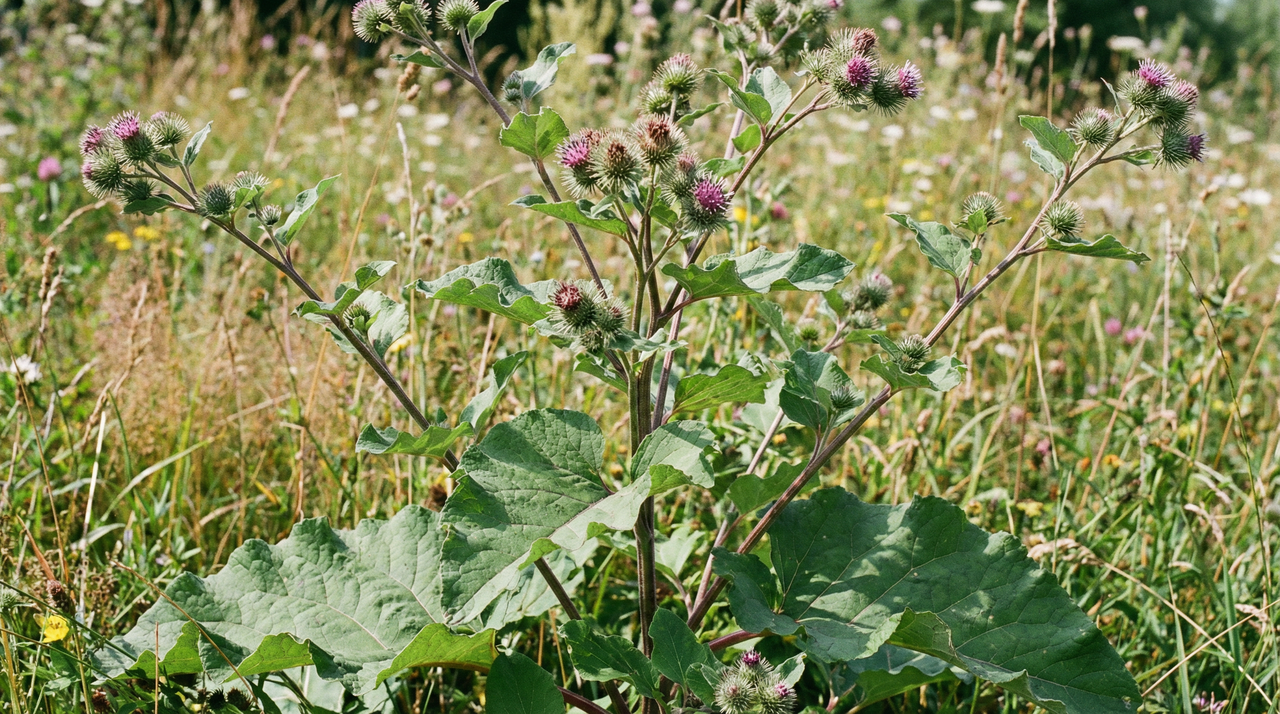
Burdock is the plant that invented Velcro, and almost nobody knows that. In 1941, a Swiss engineer named George de Mestral came home from a walk in the Alps with his dog and spent the next several minutes picking hooked burrs off his trousers and his dog's fur.[1] Under a microscope, he saw exactly what burdock had evolved over millions of years: a nearly perfect mechanical fastener. He patented it. Made a fortune. And the adaptable plant went right on doing what it had always done, which is colonize roadsides, stuff itself into dog coats, and feed half the planet without asking for any credit.
I think about that whenever I'm digging one of these roots, because it captures something true about this plant. Burdock doesn't look like food. It doesn't look like medicine. It looks like a weed with ambitions, the kind of thing you find taking over a vacant lot beside a gas station. And yet across Japan it's been a cultivated vegetable for centuries, its long ivory roots sliced into stir-fries and simmered broths; across East Asia and medieval Europe, its root was the go-to tonic for skin complaints, sluggish livers, and tired blood. The same plant. The same deep taproot. Just a matter of knowing what you're actually looking at.
Burdock Origin, History, and Botanical Background
Few plants have traveled as far on their own terms as burdock. Native to temperate Europe, northern Asia, and parts of North Africa, Arctium lappa has naturalized across 49 U.S. states, much of Australia, and parts of South America, establishing itself in roadsides, woodland edges, riverbanks, and waste areas from sea level up to 1,800 meters elevation.[2][3][4] It arrived partly through deliberate human introduction as a food and medicinal crop, and partly by accident, its hooked burrs hitching rides on animal fur and clothing to colonize disturbed ground wherever people and livestock traveled.[5][6]
Botanical Characteristics and Life Cycle of Arctium lappa
Carl Linnaeus formally named the species in his 1753 Species Plantarum,[7] placing it in the Asteraceae family alongside daisies and dandelions. The burdock root latin name, Arctium lappa, is both the botanical and common reference you'll find across pharmacopoeias and seed catalogs, and the scientific name reflects the plant's defining trait: Arctium from the Greek for bear, a nod to the rough, shaggy burrs.
What I find genuinely elegant about this plant is its two-year strategy. In year one, burdock puts everything into infrastructure: a basal rosette of enormous leaves and a deep, fleshy taproot that typically runs 0.5 to 1 meter, occasionally exceeding 2 meters in loose, well-prepared soil.[8][9] It's storing energy, not showing off. In year two, it bolts to 1 to 3 meters, flowers from July through September with spherical purple heads, produces its famous burr-covered seeds, and then dies having accomplished its sole reproductive purpose.[2][10] That's why, in my experience growing burdock along disturbed garden edges, harvesting the taproot before the second-year bolt isn't just a matter of timing. It's the whole point.
Visual Identification Features of Burdock
First-year burdock announces itself with large, heart-shaped to ovate leaves, dark green on top and distinctly woolly gray underneath.[4] Those woolly undersides are an identification shortcut I always share with new foragers: they feel remarkably similar to mullein, a plant most temperate gardeners already know, and you can confirm them at a glance even before any burrs appear. By the second year, erect branched stems reach 60 to 180 centimeters, with spherical 2 to 5 centimeter flower heads ringed by those iconic hooked bracts.[11][12] The taproot itself has brown skin over a dense white interior, and it's far longer than most people expect when they try to pull one out unprepared.
The look-alike question matters here. Lesser burdock (Arctium minus) is smaller but otherwise similar and safe; the one to avoid is cocklebur (Xanthium strumarium), which is toxic and can be confused with burdock by less experienced foragers.[13] Burdock does best in moist, rich, loamy soils with a neutral to slightly acidic pH, and it's hardy across a wide range of USDA zones, from 2 all the way up through 7 or higher depending on the source.[14][15] That range goes a long way toward explaining where burdock grows so prolifically, essentially anywhere with disturbed ground and decent moisture.
Traditional and Cultural Uses Across Continents
The historical record for burdock starts early and spans continents. In China, the plant appears in the Shennong Bencao Jing from the 1st to 2nd century AD, where the seeds (Niu Bang Zi) were used to clear heat, detoxify the body, and address skin conditions like eczema and acne. Traditional Chinese Medicine continues to use both the root and seeds for respiratory complaints, rashes, and as a blood purifier.[16][17]
In Japan, burdock root took on a second life as gobo, a culinary staple eaten for its flavor and its associations with health, longevity, and purification. It appears in New Year's osechi dishes as a symbol of endurance and prosperity.[18][19] Korean traditional medicine drew on similar applications for respiratory and anti-inflammatory support. Medieval European herbalists including Hildegard von Bingen and Nicholas Culpeper recorded it as a diuretic, blood purifier, and spring tonic for the liver, and folk traditions attached protective meanings to the clinging burrs themselves.[20][21] After European colonization, several Native American tribes adopted burdock for wound healing, rheumatism poultices, and purification practices.[22]
Across all these traditions, the themes of detoxification, balance, and longevity repeat with striking consistency.[16] One practical detail worth mentioning: European herbalists historically favored spring roots while East Asian traditions often harvested in autumn, a difference that reflects both cultural timing and the root's changing chemistry through the season.[23] For my own teas and preparations, I only use home-grown or certified clean burdock. Roadside specimens can accumulate heavy metals, and that's a risk I don't think is worth taking when cultivated roots are this easy to grow.
Fun Fact: How Burdock Inspired Velcro
Those same hooked bracts that spread burdock across continents gave Swiss engineer George de Mestral one of history's most famous design ideas. As mentioned earlier, studying those hooked burrs under a microscope and developed the hook-and-loop fastener we know as Velcro, patented in 1955.[24] I think about this every autumn when I'm pulling burrs off my sleeve in the garden. They cost me a favorite wool sweater once, which I'm still slightly bitter about, but it's hard to be too annoyed at a plant clever enough to inspire a billion-dollar invention.
Burdock Varieties and Sourcing
Notable Burdock Cultivars
The wild type, Arctium lappa var. lappa, is what most North Americans encounter growing in disturbed ground: a deeply taprooted biennial with big, rough leaves and a root that tends toward fibrous and bitter if you don't catch it early.[15] Japanese breeders took that same species and spent generations selecting for something quite different. Cultivars like 'Takinogawa', 'Gifu Early', 'Gifu Late', 'Wakayama', and 'Kanto' (all sold collectively as gobo) were developed for longer, straighter, more tender roots with a noticeably milder flavor profile.[25][26] The difference in the ground is real. I've grown generic wild-type seed and 'Takinogawa' side by side, and the named cultivar won easily: straighter roots, less stringiness, far easier to scrub clean for the kitchen.
There's no comprehensive global catalog of burdock cultivars because breeding has always been regional, driven by local culinary traditions in Japan, China, and Korea rather than any centralized seed industry.[25][27] That's why most Western gardeners encounter only a handful of Japanese gobo names at best. If you can find a named cultivar, seek it out over generic "burdock" seed.[28] The improvement in root quality is worth the extra search.
Where to Buy Burdock Seeds and Plants
Don't expect to find burdock at your local garden center. Availability in the mainstream US horticultural market sits at "occasional" at best,[2] and most of what's available comes through specialty herb nurseries and seed companies like Strictly Medicinal, Fedco, Baker Creek, and Johnny's.[29][30][31][32] Seed packets typically run $3.95 to $5.95,[32] which is a reasonable entry point given how much root you can grow from a single packet. That's competitive with tomato seeds and far cheaper than buying fresh roots, which run $6.50 to $12.00 per pound,[33] or live plants at $8.99 to $14.99.[34]
Before you order anything, check your state regulations. Greater burdock carries no federal noxious-weed designation,[2][35] but Washington, Oregon, and California have listed it as invasive or noxious at the state level.[36][37][38] My own practice, with any biennial that self-seeds freely, is to call the local extension office before I even think about planting. It takes five minutes and can save a lot of headaches.
On quality: I buy certified-organic cultivated roots for any medicinal preparation rather than foraging wild plants. Wild burdock can accumulate heavy metals from contaminated soils,[39] and USDA organic certification provides a meaningful layer of assurance that the cultivated material doesn't carry that risk.[40] If you're growing your own, practices like crop rotation and limiting harvest to 20 to 30 percent of root biomass keep the planting viable season to season.[41]
Burdock Propagation and Planting Guide (Arctium lappa)
Burdock is, at its core, a seed plant. Not because vegetative methods are impossible, but because the biology of this plant pushes you toward seed at every turn. The taproot makes division awkward, stem cuttings form adventitious roots poorly, and grafting remains largely experimental.[42][43] Starting from seed is recommended by every extension resource I've encountered,[44][43] and in practice it's the approach that actually works reliably season after season.
Propagation Methods for Burdock
The seed itself is an achene, 5-7 mm long and enclosed in that iconic spherical burr covered in hooked spines.[45][2] Each one contains a single straight embryo with minimal endosperm, which is useful to know when you're wondering why germination rates vary so much. The first time I threshed burdock burrs bare-handed, I spent the rest of the afternoon picking hooks out of my sleeves. Gloves and a coarse screen are non-negotiable. Rub the dried burrs over the screen and the achenes drop through; anything that doesn't separate easily gets discarded.
One thing worth understanding before you buy named cultivar seed: burdock is self-incompatible and relies on cross-pollination, primarily by bees.[46][47] The resulting genetic variability means seed-grown plants from cultivars won't be true-to-type, with real variation in root quality and vigor.[46] For most kitchen gardeners that's fine. If you're growing for medicinal consistency or want to replicate a specific root form, root division of established two-year-old plants in spring is an option, as are root cuttings taken in late fall treated with IBA rooting hormone at 1000-3000 ppm.[48] These vegetative methods are supplementary routes, not replacements for seed.
Germination Timeline and Seed Handling
Burdock is a biennial, which means the plant you sow this year will spend its entire first season building a taproot before it flowers, sets seed, and dies in year two.[2][43] That life cycle shapes everything about how you handle germination. The seeds carry physiological dormancy that can persist for one to two years in the wild, broken naturally by 30-90 days of cold moist stratification at around 4-5°C.[49][50] Scarification of the hard seed coat helps further.[51] Skip stratification and you'll wonder why your germination rate is depressingly low. I've had noticeably better results keeping my stratifying flats in a sheltered outdoor spot through winter rather than the refrigerator; the natural temperature fluctuations seem to do something a steady 4°C can't quite replicate.
Once stratified, seeds germinate reliably at 15-25°C with consistent moisture and 70-80% humidity, reaching 70-90% germination under ideal alternating temperatures with light exposure.[52][50] Stored properly, burdock seed stays viable for 3-5 years at home (cool, dark, airtight at 0-5°C and 3-7% moisture), and potentially a decade or more under seed-bank conditions.[53][54] Seeds also persist in the soil for 2-7 years,[55] which is part of why burdock earns its weedy reputation and why label your flats carefully: the first true leaves look enough like a handful of common weeds that I've accidentally weeded out a whole tray before.
Soil, Site Selection, and Planting Technique
The taproot tells you everything you need to know about site selection. Burdock wants deep, well-drained, fertile loamy soil with decent organic matter (aim for 3-6%); it'll survive clay and poor disturbed ground, but the roots you pull from those conditions will be stubby, forked, and disappointing.[56][57] For culinary or medicinal roots worth harvesting, prepare your bed to a minimum of 2-3 feet deep with bulk density below 1.3-1.4 g/cm³; in heavy clay, incorporate compost, aged manure, and grit to open the structure.[58][59] I learned this the hard way growing burdock in standard 12-inch pots: the roots forked badly and stayed undersized. I now use a minimum of 18 inches depth for any taproot crop, and I'd honestly push to 24 inches for burdock specifically.
Target a soil pH of 6.5-7.0, though burdock tolerates 6.0-7.5 reasonably well.[52] Stray much higher and you may see iron chlorosis; drift too low and manganese or aluminum toxicity can become an issue.[60] I check my beds each spring because my native soil runs slightly alkaline, and yellowing between the veins shows up faster than most gardeners expect. Full sun (six or more hours daily) drives the best root development and overall vigor,[2][61] which makes sense given that burdock naturally colonizes open roadsides and disturbed edges rather than forest understories. Partial shade is tolerated but growth tends to get leggy and roots suffer for it.
Spacing and Planting Tips
For root production, space plants 12-18 inches apart within rows and 24-36 inches between rows.[43][62] That wider between-row spacing isn't just about root competition; it keeps air moving through the canopy on a plant that reaches 1-2 meters tall with a 60-90 cm spread by midsummer.[63][64] Closer spacing in year one can still yield usable roots, but the long, straight specimens that make gobo worth growing need room. From my observation, wider spacing consistently produces the kind of root you'd actually want to cook with.
One management point I want to flag for anyone integrating burdock into a permaculture guild: the deep taproot does minimize direct competition with shallow-rooted companions, but the self-seeding is genuinely aggressive.[65] Seeds persist in the soil for years, and those hooked burrs disperse enthusiastically into adjacent beds and beyond. In my own guilds I remove flower heads before the burrs fully form whenever I don't want natural spread. It's a five-minute task that saves a lot of hand-pulling later.
Burdock Care Guide: Growing Arctium lappa Successfully
Growing burdock well is really an exercise in growing for the root, not the rosette. The whole plant is built around that deep taproot, and every care decision you make either supports it or undermines it. Since burdock is a biennial, you're working with a two-year clock: year one is all vegetative growth and root storage, year two the plant bolts, flowers, and sets seed before dying. For most culinary and medicinal growers, you harvest at the end of year one, which means your job is keeping that first-year plant focused on root production rather than anything else.
Sunlight Requirements for Burdock
Burdock wants at least six hours of direct sun daily for strong root development.[52][66] Too little and you get the telltale signs of etiolation: pale, floppy stems, undersized leaves, and a plant spending too much energy reaching for light instead of building root mass.[67] Go too far the other way in a hot summer and you risk leaf scorch and heat-induced photoinhibition, which I'll address more under heat tolerance below.[68] The light requirement stays fairly consistent through the season, which reflects burdock's nature as a ruderal colonizer of open, disturbed ground.[69] A sunny garden edge, a hedgerow border, a south-facing slope: pick a spot and it tends to stay right. In hotter climates, partial shade in the afternoon becomes genuinely useful.
Watering Needs and Drought Tolerance
The watering rule I come back to every season is "consistent moisture, never waterlogged." About an inch per week during active growth covers most situations,[52][56] but the method matters more than the frequency. Deep, infrequent watering that saturates the soil to twelve to eighteen inches pulls the taproot down and encourages it to develop length and girth.[52][70] Frequent shallow watering keeps the root near the surface and you end up with shorter, less substantial harvests. Overwatering is the real danger: soggy soil causes root rot, yellowing foliage, and fungal issues quickly.[70] Once established, the taproot gives the plant genuine drought resilience, but seedlings and young transplants need steady attention.[71] Soil pH between 6.0 and 7.5 keeps nutrients available,[43] and a native habitat of moist Eurasian meadows and streamsides (roughly 500 to 1000 mm annual rainfall) tells you the plant evolved for consistent but draining moisture, not standing water.[72] A 2- to 3-inch mulch layer goes a long way toward buffering both dry spells and heavy rain.
Soil Fertility and Feeding for Optimal Root Growth
Here's where I've learned the most from my own mistakes: more nitrogen is not better. Burdock is a moderate feeder that thrives in fertile, loamy soil with good organic matter, but push the nitrogen and you end up with lush, enormous leaves and roots that are fibrous, bitter, and sometimes oddly forked.[73][74] After growing burdock in both compost-rich beds and leaner soil, I consistently get straighter, sweeter roots when phosphorus and potassium are adequate and nitrogen stays modest. A balanced fertilizer like 5-10-10 applied at roughly 1 to 4 pounds per 100 square feet emphasizes exactly the right priorities.[75][76] Phosphorus deficiency shows up as purplish-tinged leaves with stunted roots; potassium deficiency produces scorched leaf margins; nitrogen deficiency yellows the older foliage.[77] Avoid fresh manure entirely; it delivers a nitrogen surge that drives the exact outcome you don't want.[75] And because burdock is an efficient accumulator, I always test soil before planting and avoid any bed near old industrial sites or busy roads -- roots can concentrate lead, cadmium, and arsenic at five to ten times the levels found in the shoots.[78] In a well-balanced bed, proper NPK management can increase root yields by 20 to 30%.[75] Companion planting with legumes lets nitrogen fix itself naturally without overloading the soil.[79]
Frost and Heat Tolerance of Burdock
The frost hardiness of burdock is honestly one of its most impressive traits. The roots survive dormant temperatures down to -40°F in USDA zones 2 through 10, while the foliage starts showing damage below 23°F.[46][80] I've watched the leaves wilt dramatically and blacken at the edges after a hard frost, only to find the crown and taproot entirely unharmed under a few inches of mulch. That's your reassurance signal: once the top freezes back, mulch 4 to 6 inches over the crown after the ground locks up and the plant overwinters reliably.[81][82] Snow cover adds a further buffer and the root almost always comes back strong in spring.
Heat is the bigger practical concern for most American gardeners. Burdock's sweet spot is 59 to 77°F, with the best root development happening between 64 and 72°F.[83] Above 86°F, root enlargement effectively stalls, and sustained heat can cost you up to 40% of root biomass while triggering premature bolting and deformed roots.[84] I think of it like a giant cool-season radish: give it afternoon shade and steady moisture when the thermometer climbs and you protect both texture and flavor. In warm zones, running burdock as an annual (fall-planted, spring-harvested) sidesteps the worst of summer heat entirely.[85] A 30 to 50% shade cloth and generous mulch cover make summer management workable if you're committed to growing through it.[77]
Pruning, Maintenance, and Seasonal Care
The most important maintenance task in burdock's first year is preventing premature bolting. Once the central stalk reaches 12 to 18 inches, pinching or cutting the growing tip redirects the plant's energy back into root development rather than reproductive shoot growth.[86] In my warmer climate, I do this in late spring when growth accelerates, and it reliably extends the root-building window. I also mark my first-year plants carefully, because second-year stalks shoot up fast, turn woody, and become almost impossible to confuse for edible material once they've bolted. Removing flower buds and lower leaves as they appear improves airflow and keeps the plant from committing prematurely to seed production.[5] A well-managed first-year plant typically yields 0.5 to 1 kg of root per plant.[87]
Watch for aphids, root maggots, powdery mildew, and fungal leaf spot, especially in humid summers.[88] Good spacing, drainage, and airflow prevent most issues before they start. Neem oil and insecticidal soap handle most pest pressure organically, and avoiding overhead watering reduces fungal risk considerably. Planting beans, peas, or roses nearby provides some natural pest suppression.[89] Once you've settled into this rhythm -- sun, deep water, modest fertility, tip-pruning in spring, mulch in fall -- burdock in the right spot genuinely looks after itself. Understanding the biennial clock is most of the battle.
Harvesting Burdock Roots and Shoots
Timing and Maturity Cues for First- and Second-Year Harvests
Burdock is a biennial, and that life cycle shapes every decision at harvest time. First-year roots, sown in spring, are ready to pull 100 to 180 days later, putting you squarely in the September-to-November window before the ground freezes.[43][90][91][2] You can wait and harvest second-year roots before the plant flowers at 12 to 18 months, but I've done this and the trade-off is real: bigger roots, yes, and sometimes valued for specific medicinal purposes, but also more fiber and a bitterness that cooking can't entirely tame.[43]
After growing burdock for several seasons, I've learned to watch for the first hints of basal leaf yellowing in early October rather than waiting for full wilting. That's when the plant is redirecting its energy downward into the root, and in my experience, that's the sweet spot before any woodiness sets in.[43][92] Traditional Chinese Medicine has long emphasized late autumn harvest for peak medicinal compound concentration, and my own kitchen trials have landed in the same place.[92] Some European folk traditions historically collected roots in spring, but that conflicts with both TCM guidance and what I observe in flavor quality, so I don't follow it.[92] One practical note from hard experience: burdock's taproot goes deep, sometimes two feet or more, so loosen the soil in a wide circle with a garden fork before you pull. Snapping a root you've tended all season is a particular kind of frustrating.
Flavor, Texture, Yield, and Nutritional Highlights
The first-year root is the culinary prize. Raw, it's crisp and crunchy like jicama or fresh radish, with a mildly earthy, slightly bitter-sweet flavor that carries faint artichoke or leek notes in the aroma.[93][94][94] Cook it, and the whole character shifts: the texture softens toward parsnip or carrot, a gentle mucilaginous quality develops, and the nutty-earthy notes deepen considerably.[95][96] That slippery mouthfeel surprises people the first time, but it's also a signal of the inulin content that makes burdock root genuinely useful as a prebiotic food.[97][93] I've also noticed that roots grown in richer, looser soil come out noticeably sweeter, and a light frost before harvest seems to concentrate the sugars in a way that makes the bitterness recede. Growing conditions genuinely matter here.
Young spring shoots and leaves are edible too, with a bitter, grassy flavor that mellows with cooking, though I treat them as a bonus harvest rather than a reason to plant.[33] The root is the reason you grow burdock. Everything else is secondary.
Burdock Preparation, Culinary Uses, and Medicinal Applications
Culinary Uses and Flavor Profile of Burdock Root
The root is where burdock earns its place in the kitchen. Harvested in its first year for the best texture, it has a mild, earthy sweetness that sits somewhere between carrot, parsnip, and walnut.[98] Young leaves and peeled stems are technically edible too, but they need blanching to cut the bitterness and honestly they're a distant second to what's underground.[5][99] Before you go digging anywhere wild, though, get your identification solid. Poison hemlock and water hemlock can share disturbed sites with burdock, and while their leaves are smooth and finely dissected, burdock's are broad, heart-shaped, and noticeably rough and woolly on the underside.[100] I've handled enough of both to say the texture difference is unmistakable once you know what you're feeling for, but it's not a distinction beginners should skip.
Once you're at the cutting board, peel, slice, and soak the root in cold water immediately to stop oxidation and draw out any residual bitterness.[101] From there the options are wide. Boiling takes 20 to 30 minutes for a tender result; roasting at 400°F for 30 to 40 minutes does something more interesting.[102] The inulin caramelizes and the whole root takes on a nutty, almost sweet depth that I love tossed with sesame oil and tamari.[98] You can also dry and grind it into flour for breads or as a thickener, which is underused and worth experimenting with.[103]
Japanese cuisine has done the most with this root. Known as gobo, it appears in kinpira gobo (stir-fried with carrot and sesame), tempura, and miso soup, where cooking mellows the bitterness and brings up the sweetness.[101] Korean cooks use it as u-eong, blanching and seasoning it for banchan or adding it to bibimbap and jeon.[104] Traditional Chinese preparations lean toward medicinal soups like niu bang tang and stir-fries.[105] European traditions go back even further, with roots and leaves appearing in broths and as a coffee substitute dating to at least the 16th century.[106] For storage, pack unwashed whole roots in moist sand or peat and keep them between 32 and 40°F; they'll hold for months. Cut pieces go into water in the fridge for shorter-term use.[107]
Medicinal Preparations and Dosages
For tea or decoction, the standard guidance is 2 to 6 grams of dried root per day, typically simmered as a teaspoon or two of chopped root in about 250 ml of water for 10 to 15 minutes, taken two or three times daily.[108] I usually land somewhere around 2 to 3 grams per cup for a daily tea, which gives you the earthy flavor without becoming overwhelmingly bitter. Tincture preparations run 2 to 5 ml taken two to three times daily. Leaves and seeds are less standardized in the clinical literature, so I'd stick to root preparations if you're working from research-backed dosing. For the deeper evidence on what those preparations actually do in the body, the health benefits section covers the pharmacology in full.
Non-Food Uses and Sustainable Harvesting
Burdock doesn't stop being useful once the root is out of the ground. The tops chop and drop beautifully as green manure, adding substantial biomass and cycling the nutrients that deep taproot spent two years pulling up from the subsoil.[109] It's one of the more satisfying loops in the permaculture guild: you harvest the root, feed yourself, and return the rest to the bed.
On the foraging side, burdock's status as an introduced species across much of North America means controlled wild collection can actually support population management rather than harm it. That said, I grow my own rather than relying on wild stands whenever I can. Roadside soil is a real concern, and cultivation gives me control over quality that wild harvesting simply doesn't.[92] When I do forage, I hold myself to harvesting no more than 20 to 30 percent of any stand, and I avoid returning to the same patch too soon.[110] I've watched local patches rebound gracefully when treated that way, and collapse when they weren't. Burdock rewards the grower who pays attention.
Burdock Health Benefits and Medicinal Uses
Burdock's medicinal reputation is remarkably consistent globally. The same plant, the same uses, separated by thousands of miles.
Traditional Uses Across Cultures
Across Traditional Chinese Medicine, Japanese Kampo, and European herbal practice, burdock (Arctium lappa) earned its place as a blood purifier, skin remedy, and digestive ally long before anyone was studying NF-κB pathways in a lab.[111][108] TCM practitioners used it to clear heat, move toxins, and address skin conditions like eczema; Kampo employed it similarly for inflammation and as a gentle diuretic; European herbalists reached for it to treat rheumatism, gout, boils, acne, and what they broadly called "impurities of the blood."[112][113] Modern regulatory bodies have started to catch up: Germany's Commission E approves burdock root for appetite stimulation and dyspepsia, and the European Medicines Agency supports traditional use for skin conditions at 6 to 8 grams of root per day.[114][115] Small randomized trials have shown improvements in biochemical markers for type 2 diabetes and promising results for acne with topical extracts, though large-scale human studies are still limited.[116][117]
Key Phytochemicals and Their Actions
The root is where most of the medicinal action concentrates, and that's largely because of two compound families: lignans and inulin. Arctigenin and arctiin, the primary lignans, can make up 4 to 10% of methanol extracts and are the compounds researchers keep circling back to as drivers of burdock's anti-inflammatory and antioxidant effects.[118][119] Alongside those are polyphenols like chlorogenic acid and caffeic acid, flavonoids including quercetin and luteolin glycosides, and a suite of supporting players: sesquiterpene lactones, polyacetylenes, and beta-sitosterol.[120][121] Leaves are richer in flavonoids and phenolics; seeds concentrate lignans and fatty acids. The root's particular profile is what makes it the part most used medicinally and culinarily. I've noticed that roots dug in late fall after a full growing season taste noticeably more earthy-bitter, which lines up with a 2020 study showing autumn harvest can yield 15 to 25% higher flavonoid content and that organically grown plants often carry 10 to 40% more total phenolics.[122][123][124] It's a reminder that growing conditions aren't just about yield; they shape the chemistry you're actually eating.
Pharmacological Research and Evidence
The preclinical evidence for burdock is genuinely impressive in breadth. Arctigenin, which I'd call the star compound here, helps block NF-κB signaling, suppresses COX-2 and iNOS, and reduces pro-inflammatory cytokines like TNF-α and IL-6, with studies showing up to 60% reduction in paw edema in animal models.[125][126] Its polyphenols activate the Nrf2 antioxidant pathway with activity comparable to ascorbic acid in some assays.[127] Wound healing studies found a roughly 20% improvement in closure speed through fibroblast proliferation and angiogenesis. Antimicrobial activity against Staphylococcus aureus and Candida albicans has also been documented, and diuretic effects increased urine output 30 to 50% in rat models, which is consistent with burdock's traditional use alongside plants like dandelion for this purpose.[128][129][130] The liver-protective data is among the more compelling in human-relevant models, with significant reductions in liver enzymes in toxin-induced injury studies.[131] Researchers have also documented antidiabetic mechanisms, modest anticancer activity in breast and colon cancer cell lines, and neuroprotective effects against oxidative stress.[132][133][134] Most of this, though, is in vitro or animal data. The human trials are small. The traditional uses are well-supported mechanistically; the clinical picture is still developing.
Nutritional Profile
A 100g serving of raw burdock root comes in at around 72 calories with 17g of carbohydrates, 3.8g of fiber, modest protein, and almost no fat.[135] The mineral numbers are the most useful part of that profile for everyday eating: 308 to 360mg of potassium, 41mg of calcium, 23mg of magnesium, and meaningful zinc and iron.[136] Vitamins are present but not the main event. What genuinely sets burdock apart as a food-medicine is its inulin content, 25 to 50% of root dry weight, which acts as a prebiotic fiber feeding beneficial gut bacteria while also supporting blood sugar stability.[118][137] I've found that working burdock into stir-fries and soups regularly produces a noticeably gentler digestive effect than some harsher fiber sources; the inulin ferments slowly enough that most people tolerate it well unless they eat a very large amount at once. The FDA classifies it as GRAS for food use, which reflects its long history as a culinary root vegetable in Japan and elsewhere.[138]
Safety and Precautions
For most people eating burdock as food, the safety profile is solid. Roots are widely consumed across East Asia and have GRAS status in the US.[137][139] The main allergy concern is the Asteraceae family: if you react to ragweed, chrysanthemums, or daisy relatives, burdock's sesquiterpene lactones can trigger contact dermatitis or, rarely, respiratory symptoms, so use caution.[140] Overconsumption brings GI upset, nothing dramatic but worth knowing.[141]
I don't use burdock medicinally with my own herbal preparations if someone is pregnant; the evidence for potential uterine stimulation is specific enough to take seriously, and safety data during lactation simply isn't there.[139][142] If you're on diabetes medications, diuretics, or blood thinners, talk with your doctor before using burdock therapeutically; its mild hypoglycemic and diuretic actions can compound those drugs' effects in ways that matter clinically.[143][144] One thing I always emphasize in foraging circles: burdock can be confused with cocklebur (Xanthium strumarium), which is genuinely toxic.[145][13] Know your identification; look for burdock's heart-shaped, woolly leaves and hooked burrs. If you're harvesting from the wild, also consider soil history, since burdock can accumulate heavy metals from contaminated ground.[146] Growing your own, or sourcing from a reputable cultivated supply, removes that uncertainty entirely.
Burdock Pests and Diseases
Natural Defenses Against Pests
The same sesquiterpene lactones and lignans like arctiin that give burdock its medicinal reputation also work as antifeedants against a range of insects, giving the plant moderate baseline pest resistance without any chemical inputs from the grower.[147][148] The glandular trichomes on the leaves add a physical layer on top of that chemistry, trapping small insects and secreting compounds that discourage browsing; this is why burdock tends to shrug off aphid pressure and gall midges fairly well.[149] I've grown borage and comfrey alongside burdock for years, and while all three are hairy plants, neither of those has the same chemical punch behind the trichomes. Burdock's combination of structure and chemistry is meaningfully stronger where aphid pressure is concerned.
That said, "moderate resistance" isn't "immune." Burdock shows high resistance to Melanagria caterpillars and holds its own reasonably well against Lixus weevils and the burdock leaf beetle, largely through root tissue density and those chemical defenses.[150][147] Where it genuinely struggles is with borers and gall-formers: the Redvine Shoot Borer, sedina root weevil, Curculionid weevils, and the gall-forming Eutreta burdannae can all cause serious structural damage, and heavily affected plants have shown up to 30% reductions in seed production.[151][152] Root weevil larvae are the sneaky ones. I've learned to look for wilting or stunted first-year crowns long before any visible adult damage appears above ground.
In my polyculture designs I keep burdock away from susceptible vegetables like tomatoes and beans, because I've watched it harbor pests that then migrate to neighboring crops. The "beneficial weed" reputation is real in many respects, but on the reservoir-host question it needs nuance.[153] For IPM, I lean on crop rotation, ladybugs, and parasitic wasps before reaching for anything else, and I treat sanitation as non-negotiable.[154] If you're growing named cultivars, 'Godo Solo', 'Takaha', and 'Wongan' have shown improved tolerance to both insect pests and some fungal issues through Japanese and Chinese breeding programs, and I've sourced several through specialty seed networks when I wanted to trial them against local pest pressure.[155][156]
Common Diseases and Management
Burdock doesn't have strong innate disease resistance, and fungal pathogens are a bigger practical worry than insects for most growers.[157] The main offenders are rust (primarily Puccinia lapponica), leaf spot caused by Septoria arctii and Alternaria species, powdery mildew from Erysiphe cichoracearum, and several root rot pathogens including Rhizoctonia solani, Fusarium, and Verticillium wilts.[158][159] Burdock yellows virus, a Potyvirus, does appear occasionally and causes mosaic symptoms and stunting, but it's far less common than the fungal suite.[160]
After one particularly wet season where I planted burdock too close together in a guild bed with poor drainage, I watched rust spread through most of the planting by midsummer. That was the last time I skipped raised beds or soil amendment in heavy clay. Proper spacing for airflow, removing infected leaves promptly, consistent crop rotation, and good drainage address the majority of fungal pressure before it becomes a crisis.[161][52] Fungicides like chlorothalonil or myclobutanil exist as a last resort, but prevention through cultural practice is almost always more effective and easier on the surrounding ecosystem.[162] For growers dealing with repeat Fusarium, Verticillium, or powdery mildew problems, cultivars like 'Takara' (developed for leaf spot resistance) and 'Wongan' and 'Takakura' (bred for broader fungal tolerance) are worth tracking down through Japanese horticultural sources or specialty networks.[163][164]
Burdock in Permaculture Design
Burdock earns its place in permaculture systems through a combination of genuine ecological usefulness and humbling invasive potential. Understanding both is what separates a thoughtful design from a future weed management headache.
Climate Adaptability and Hardiness Zones
Few herbaceous plants match burdock's cold tolerance. Hardy across USDA zones 2 through 10 and reported to survive down to -40°F in zone 3a, it's one of the most climate-flexible plants I've worked with in temperate food systems.[2][165][166] That cold hardiness isn't separate from its deep taproot; it's because of it. The same 2-3 foot root that drives down through compacted subsoil also accesses groundwater during drought and insulates the crown through brutal winters.[166][66] The taproot is the whole story with this plant, ecologically and culinarily.
Burdock grows best between 50-77°F and starts to struggle above 86°F, where heat triggers bolting and root quality drops fast.[26][80] In warmer zones, it's often managed as an annual -- sow in spring, harvest roots in fall before the second-year bolt -- while in zones 3 through 7 it typically performs best as a true biennial.[166][66] It tolerates partial shade but prefers full sun, and it's remarkably unfussy about soil type as long as drainage is reasonable and the soil is deep enough to accommodate that taproot.[167][56] For spacing, I plant at 12-24 inches within rows and give rows 24-36 inches apart -- tight enough to suppress weeds, wide enough to access roots at harvest without mangling neighbors.[56]
Burdock has naturalized aggressively across North America, Canada, and Australia, and is considered invasive in many regions outside its native Eurasian range.[168][169] I monitor burdock closely in every design I include it in. Its climate adaptability is real, but so is its capacity to move beyond where you put it.
Ecosystem Functions and Ecological Roles
Burdock's standout permaculture contribution is dynamic accumulation. That deep taproot mines potassium, phosphorus, iron, and calcium from the subsoil and, when the plant decomposes or you chop-and-drop the leaves, those minerals become available in the topsoil.[170][171] I've seen it genuinely improve the structure of compacted clay ground over two seasons, breaking up hardpan while adding organic matter on the way down and back up. I often compare its taproot habit to comfrey, which does something similar with potassium, but burdock is the one I keep on the outer edges of guilds rather than tucking it in close to seedlings.
The reason for that positioning is burdock's mild allelopathy. It forms mycorrhizal associations that help it scavenge phosphorus efficiently, and it shows some capacity to suppress weeds like crabgrass, but that same chemical tendency can subtly set back nearby young transplants.[172][173] Burdock does not fix nitrogen.[172] It's an accumulator, not a fixer, and conflating the two leads to disappointed soil fertility expectations.
As a pioneer species, burdock naturally colonizes disturbed ground in early-to-mid successional stages, stabilizing soil with its taproot while offering real pollinator value from July through September.[174] In my temperate plantings I consistently see honeybees working the purple-pink disc florets most heavily in midsummer, with hoverflies and bumblebees following later.[175][176] Birds and small mammals feed on the seeds, adding wildlife support to its ecological resume.[177] The biomass is substantial and makes excellent green manure when cut before seed set, which you should be doing anyway to control spread.[15]
Forest Layer Placement and Guild Design
Spatially, burdock belongs in the herbaceous layer. The first-year rosette stays low to the ground with those big heart-shaped leaves, then the plant bolts to 3-7 feet in its second year when it flowers and sets seed.[15][178] I've learned to read that first-year rosette as a harvest signal; when the leaves are large and lush but the plant hasn't sent up a flower stalk, the root is at its peak for culinary quality. Once it bolts, you've missed your best window.
In guild design, burdock is often paired with comfrey, nettles, tomatoes, beans, or asparagus, and it genuinely supports pollinators across all of those systems.[179][180] It prefers moist, fertile loamy soil in full sun to light shade, which makes forest edges and managed clearing margins natural homes.[15] That said, its aggressive competitive nature and potential allelopathy mean it can crowd out guild companions if given too much room, and I never let it go to seed unchecked near a woodland edge.[169][181]
I once spent an entire afternoon pulling volunteer burdock seedlings after forgetting to cut the flower stalks the previous fall. Those hooked burrs hitch onto clothing, fur, and anything else passing through the garden, and dispersal happens fast.[172] Because burdock readily naturalizes and its burrs travel so efficiently, I only use it in managed areas well away from native woodland edges or waterways. The research on its invasiveness is unambiguous, and responsible permaculture means knowing when a genuinely useful plant can become someone else's problem. Treat it as a contained accumulator, monitor it seasonally, and it earns its place. Let it run, and it will.
The Root That Made Me Respect the Weeds
I'll be honest: burdock humbled me before it won me over. I spent two seasons ripping it out of a neglected edge before I finally stopped, dug one properly, scrubbed it clean, and sliced it into kinpira. That first bite, nutty and sweet and nothing like I expected from a plant I'd been fighting, is the reason I now give certain weeds a longer look before I reach for the fork.
Sources 181
- The Man Who Invented Velcro – Smithsonian Magazine ↩
- USDA PLANTS Database - Arctium lappa ↩
- Plants of the World Online: Arctium lappa ↩
- Flora of North America: Arctium lappa ↩
- Arctium lappa L. ↩
- RHS Plant Finder: Arctium lappa ↩
- Species Plantarum by Carl Linnaeus ↩
- Arctium lappa ↩
- RHS Plant Finder: Arctium lappa ↩
- Kew Science - Plants of the World Online ↩
- Arctium lappa ↩
- Missouri Botanical Garden Plant Finder: Arctium lappa ↩
- Burdock (Arctium lappa) Identification and Look-Alikes ↩
- Missouri Botanical Garden Plant Finder: Arctium lappa ↩
- Burdock (Arctium lappa) - Plant Profile ↩
- Burdock: A Plant with Historical and Modern Medicinal Uses ↩
- Burdock in Traditional Chinese Medicine ↩
- Burdock: A Medicinal and Cultural Plant ↩
- Traditional Uses of Arctium lappa in East Asia ↩
- The Complete Herbal by Nicholas Culpeper ↩
- Folklore and Symbolism of Burdock in Europe ↩
- Ethnobotany of Burdock Among Native American Tribes ↩
- Ethnobotany of Burdock ↩
- The Story of Velcro: Inspired by Nature ↩
- Cultivation of Burdock in Japan ↩
- Greater burdock ↩
- Medicinal Plants in China ↩
- Arctium lappa - Greater Burdock ↩
- Burdock Seeds ↩
- Burdock - Arctium lappa ↩
- Burdock Seed ↩
- Burdock Seeds ↩
- Organic Burdock Root ↩
- Burdock Live Plants ↩
- Federal Noxious Weeds List ↩
- Washington State Noxious Weed List ↩
- Oregon Noxious Weed Profiles ↩
- California Noxious and Invasive Weed List ↩
- Heavy Metal Accumulation in Arctium lappa: Implications for Herbal Medicine ↩
- Organic Certification Standards for Agricultural Products ↩
- Sustainable Cultivation Practices for Medicinal Plants ↩
- Propagation of Ornamental Plants: Arctium spp. ↩
- Growing Burdock ↩
- Missouri Botanical Garden: Arctium lappa ↩
- Arctium lappa ↩
- Arctium lappa Reproductive Biology ↩
- Pollination and Self-Incompatibility in Asteraceae ↩
- Use of IBA in Plant Propagation ↩
- Phenology of Arctium lappa ↩
- Seed Germination of Arctium lappa L. ↩
- Burdock: Cultivation and Propagation ↩
- Burdock Propagation Guide ↩
- Seed Storage of Horticultural Crops ↩
- Viability of Burdock (Arctium lappa) Seeds Under Different Storage Conditions ↩
- Storage Effects on Germination of Wild Plants ↩
- Burdock Cultivation Guide ↩
- Growing Burdock: Soil and Fertilization ↩
- Plant Finder - Arctium lappa ↩
- Root Crop Soil Aeration and Drainage - University of California Agriculture ↩
- Nutrient Deficiency Symptoms in Vegetable Crops - Purdue University ↩
- University of Idaho Ext. Guide: Foraging Edible Burdock ↩
- Burdock (Arctium lappa) Production and Marketing ↩
- Invasive Plants: Burdock ↩
- Arctium lappa ↩
- Arctium lappa ↩
- Arctium lappa - Burdock ↩
- Symptoms of Light Deficiency in Herbaceous Plants ↩
- Arctium lappa (Burdock): Cultivation and Care ↩
- Arctium lappa ↩
- Arctium lappa: Soil and Water Requirements ↩
- Royal Horticultural Society - Arctium lappa cultivation ↩
- Arctium lappa Profile ↩
- Burdock Production ↩
- Growing Burdock (Arctium lappa) ↩
- Cultivation of Burdock (Arctium lappa) for Root Production ↩
- Fertilizing Root Crops ↩
- Nutrient Deficiency Symptoms in Vegetable Crops ↩
- Heavy Metal Accumulation in Burdock Roots from Contaminated Soils ↩
- Companion Planting and Cover Cropping with Burdock ↩
- Arctium lappa - Greater Burdock ↩
- Frost Damage in Garden Plants ↩
- Protecting Plants from Frost ↩
- Arctium lappa - Burdock ↩
- Response of Arctium lappa to Abiotic Stresses: Focus on Heat Tolerance ↩
- Burdock Production Guide ↩
- Preventing Bolting in Arctium lappa ↩
- Burdock Cultivation Guide ↩
- Burdock Pests and Diseases - University of California Agriculture and Natural Resources ↩
- Companion Planting Guide for Burdock ↩
- Arctium lappa Cultivation ↩
- Burdock: Arctium lappa ↩
- Burdock: From Traditional Uses to Modern Applications ↩
- Burdock (Arctium lappa) Plant Guide ↩
- Arctium lappa ↩
- Plant Finder: Arctium lappa ↩
- Burdock - RHS ↩
- Arctium lappa as a Functional Food: Nutritional and Medicinal Perspectives ↩
- Flavor and Nutritional Profile of Burdock Root - Journal of Food Science ↩
- Missouri Botanical Garden Plant Finder: Arctium lappa ↩
- Toxic Plants: Conium maculatum ↩
- Gobo (Burdock Root) in Japanese Cuisine ↩
- Missouri Botanical Garden - Plant Finder ↩
- Kew Royal Botanic Gardens - Medicinal Plant Names ↩
- Burdock in Korean Traditional Dishes ↩
- Burdock in Traditional Chinese Medicine and Cuisine ↩
- Burdock: A Review of Its Traditional Uses in Europe ↩
- Storing Foraged Roots - University of Minnesota Extension ↩
- Burdock Root - Arctium lappa L. ↩
- Arctium lappa green manure study ↩
- Arctium lappa, Royal Horticultural Society ↩
- Traditional Uses and Pharmacological Activities of Arctium lappa ↩
- Traditional Uses of Burdock in TCM and Kampo ↩
- Burdock (Arctium lappa L.): A Review of the Phytochemistry and Ethnopharmacology ↩
- Arctium lappa ↩
- Assessment Report on Arctium lappa L., Radix ↩
- Randomized clinical trial of a phytotherapic compound containing Pyrus malus, Arctium lappa, and Camellia sinensis for the treatment of type 2 diabetes ↩
- Clinical Trial on Arctium lappa for Dermatological Conditions ↩
- Phytochemical Profile and Antioxidant Activity of Burdock (Arctium lappa L.) Roots: A Review ↩
- Phytochemical and Pharmacological Aspects of Arctium lappa L. ↩
- Phytochemical and pharmacological studies on Arctium lappa ↩
- Phytochemistry and Pharmacology of Arctium lappa ↩
- Phytochemical Variations in Arctium lappa under Different Soil Conditions ↩
- Seasonal and Geographic Effects on Arctium lappa Phytochemistry ↩
- Impact of Cultivation Practices on Phenolic Content in Burdock ↩
- Antioxidant and Anti-inflammatory Properties of Burdock Root ↩
- Anti-inflammatory effects of arctigenin from Arctium lappa ↩
- Nrf2 activation by Arctium lappa lignans ↩
- Wound healing activity of Arctium lappa ↩
- Antimicrobial Activity of Arctium lappa Extracts ↩
- Pharmacological Activities of Arctium lappa: A Review ↩
- Hepatoprotective effects of Arctium lappa in CCl4-induced liver injury ↩
- Antidiabetic mechanisms of Arctium lappa ↩
- Anticancer Potential of Arctigenin ↩
- Neuroprotective effects of Arctium lappa ↩
- Burdock root, raw ↩
- Nutritional Composition and Bioactive Compounds of Arctium lappa ↩
- Arctium lappa L. (Burdock): Insights from Ethnopharmacology Potential ↩
- Phytochemicals and Health-Promoting Effects of the Genus Arctium (Burdock) ↩
- Burdock ↩
- Arctium lappa - Plant Finder ↩
- Poisonous Plants of California ↩
- Burdock (Oral), MedlinePlus ↩
- Arctium lappa L. (Burdock) as a Potential Therapeutic Agent Against Diabetes and its Complications ↩
- Burdock (Arctium lappa) - National Center for Complementary and Integrative Health (NCCIH) ↩
- Distinguishing Cocklebur from Burdock ↩
- Heavy Metal Accumulation in Medicinal Plants: A Review ↩
- Sesquiterpene Lactones from Arctium lappa L. as Potential Insect Antifeedants ↩
- Chemical Defenses in Burdock (Arctium lappa): Role of Lignans in Herbivore Deterrence ↩
- Trichome Morphology and Glandular Secretions in Arctium Species as Anti-Herbivore Adaptations ↩
- Journal of Pest Science study on Arctium lappa defenses ↩
- Integrated Pest Management Guidelines for Arctium lappa Cultivation ↩
- Insect Pests of Arctium Species ↩
- Arctium lappa (Burdock) Pest Management ↩
- Integrated Pest Management for Vegetable Crops ↩
- Breeding for Resistance in Arctium lappa: A Review ↩
- Cultivar Development for Edible Burdock in Japan ↩
- University of California Agriculture and Natural Resources ↩
- American Phytopathological Society ↩
- Fungal Diseases of Burdock ↩
- American Phytopathological Society ↩
- University of Wisconsin Extension ↩
- University of California IPM Online ↩
- Journal of Horticultural Science & Biotechnology ↩
- Plant Pathology Journal ↩
- Missouri Botanical Garden Plant Finder ↩
- Royal Horticultural Society ↩
- Arctium lappa Cultivation - Royal Horticultural Society ↩
- Invasive Plants in Canada: Burdock Adaptation ↩
- Invasive Species Compendium - CABI (Arctium lappa) ↩
- Soil Health Benefits of Deep-Rooted Plants like Burdock ↩
- Nutrient Accumulation by Dynamic Accumulators ↩
- Ecological Roles of Arctium Species in Temperate Ecosystems ↩
- Arctium lappa allelopathy study ↩
- Burdock (Arctium lappa): Habitat and Ecology ↩
- Foraging behaviour and efficiency of insect pollinators in Arctium lappa ↩
- Insect Pollinators of Burdock (Arctium spp.) ↩
- The Ecology of Arctium lappa in Temperate Ecosystems ↩
- Arctium lappa ↩
- Burdock: A Plant for Permaculture ↩
- Burdock in Permaculture and Agroforestry ↩
- Allelopathy in Arctium lappa ↩
About the Author
Farmer Noelle has been farming for over 12 years between Washington and Michigan. Her experience ranges from small-scale biointensive operations to a 40-acre CSA with over 300 members.