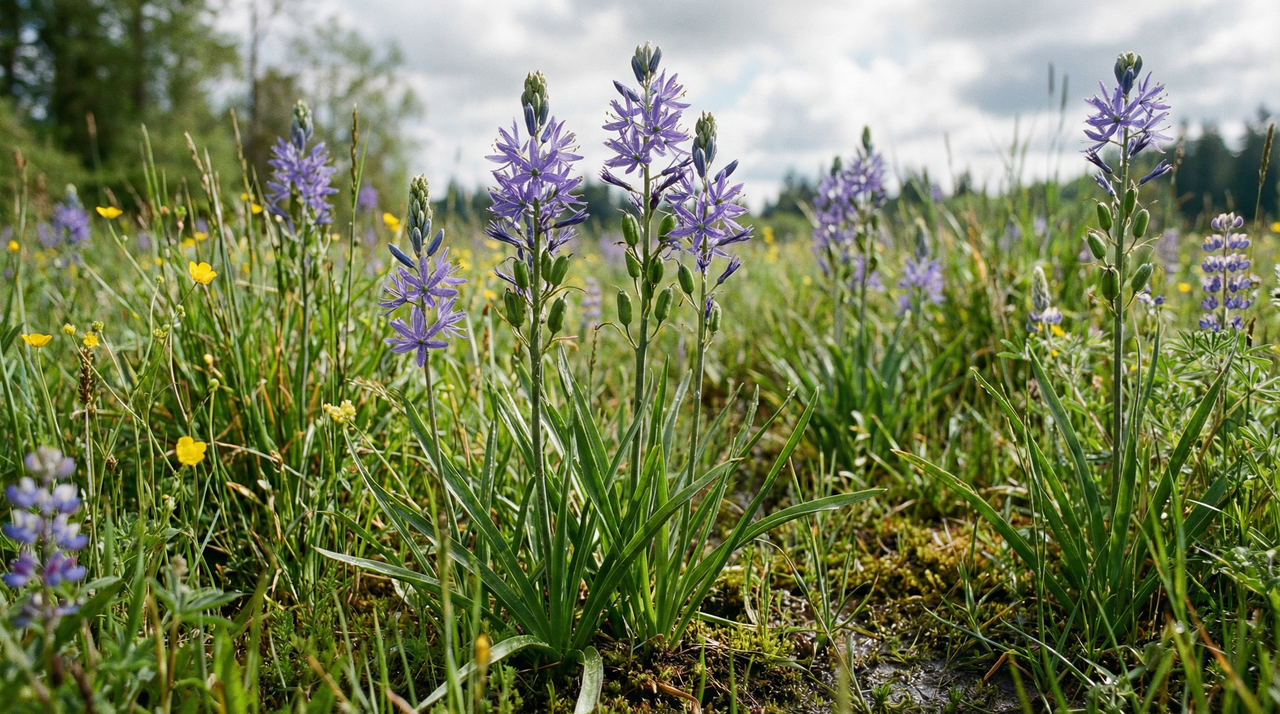
The first time I dug a camas bulb, I almost didn't. Standing in a wet Pacific Northwest meadow with the spent foliage browning back into the soil, I kept second-guessing myself, scanning for the one detail that would confirm I wasn't holding something deadly. That hesitation is exactly right, by the way. Death camas grows in the same meadows, produces similar bulbs, and has ended lives. But here's what struck me most that day: the tribes who stewarded these prairies for thousands of years didn't just survive that risk, they built entire economies around it. Seasonal rounds, trade networks, harvest ceremonies, inter-tribal negotiations over harvesting rights. Camas wasn't just food; it was currency, diplomacy, and identity.
Most people who discover this plant come at it from one of two directions: the pollinator garden crowd who want those gorgeous blue racemes, or the foraging community chasing a piece of Indigenous culinary history. Both groups tend to underestimate it. What I've found after growing camas across multiple sites is that you're dealing with a plant that rewards people who slow down and pay attention, to its seasonal cues, its cultural context, its very specific preferences about when and how it gets harvested. Rush any of that, and you miss the whole point of it.
Origin, History, and Cultural Significance of Camas
If you've ever walked a wet Pacific Northwest meadow in late spring and stopped cold because the ground ahead looked like it was pooling blue sky, you've met Camassia quamash. Common camas is a polycarpic perennial bulb that reproduces by seed and, in established stands, by asexual offsets from the mother bulb.[1][2] Its native range sweeps from southern British Columbia down through Washington, Oregon, and northern California, then arcs east to the Rockies in Montana, Idaho, and Wyoming, threading through moist meadows, open woodlands, and wetland edges from sea level up to about 2,500 meters.[3][4][5] Under good conditions individual bulbs can persist for well beyond the 5 to 15 year typical lifespan in undisturbed prairie soil.[2][6] The genus has cousins worth knowing: great camas (Camassia leichtlinii) occupies a similar Pacific Northwest range but runs taller and carries slightly larger corms, while wild hyacinth (Camassia scilloides) extends the genus all the way east to Ontario, Texas, and Florida.[7][8] Common camas, though, is the anchor species, and it's the one I reach for when designing meadow plantings in temperate, moisture-rich climates.
Botanical Background and Visual Characteristics
Camas announces itself in spring with grass-like basal leaves, 20 to 60 cm long and just 5 to 20 mm wide, rising before the flower scape pushes up.[4][1] That leafless scape climbs 30 to 90 cm and terminates in a raceme of 10 to 30 star-shaped blue-violet flowers, each tepal 15 to 35 mm long, opening in late spring to early summer.[9] Below ground, the tunicated bulb measures 2 to 5 cm across with a distinctive fibrous outer coat; after flowering, the plant sets oblong brown capsules packed with small black seeds around 2 to 3 mm each.[10][4] I always show new clients both the flower color and the fibrous bulb coat together when doing field ID, because death camas (Toxicoscordion venenosum) grows in overlapping habitat and has creamy-white flowers and a membranous rather than fibrous bulb coat.[1][11][12] Once you've seen the blue-violet star and felt that fibrous coat, the distinction is locked in your hands and eyes, not just your memory.
Traditional and Cultural Uses
The plant's cultural story is as deep as its root system. Archaeological evidence places Camassia quamash as a staple food, trade commodity, and ceremonial species for Indigenous peoples of the Pacific Northwest, Great Basin, and Columbia Plateau for more than 10,000 years.[13][14] When Lewis and Clark traveled through Nez Perce territory in 1805 and 1806, they recorded how central the camas bulb was to the diet there; Frederick Pursh formally described the species in 1814 using specimens from those very collections.[15][16] That moment marked the plant's entry into Western botanical science, but the knowledge systems that shaped the camas landscape long predate Pursh's Latin binomial.
Camas featured in first-fruits ceremonies, women's puberty rites, communal feasts, and far-reaching trade networks. Indigenous land managers maintained the expansive meadow ecosystems through controlled burning, a practice that both increased bulb yield and kept open habitat from closing into forest.[17][18][19] Today, tribal nations are actively restoring those camas prairies, reviving harvest ceremonies, and using the camassia lily as a cornerstone of food sovereignty work.[20][21] I've had the privilege of following some of that restoration work closely, and it's changed how I think about what "native plant design" actually means. It means inheriting a responsibility alongside a seed packet.
Fun Facts and Ecological Notes
Before agriculture fragmented the landscape, camas prairies spread for miles across Pacific Northwest valleys in what early observers described as blue lakes of flowers.[22] Much of that habitat is gone now, converted to farmland and development, but targeted restoration projects drawing on traditional ecological knowledge have successfully re-established dense populations in several regions.[22] The plant helps its own case here: bulbs are fire-adapted, resprouting vigorously after low-intensity burns, which is exactly what historically maintained the open prairies where camas thrived.[23] Seeing a restored meadow in full bloom is, honestly, one of the most persuasive arguments I've ever encountered for putting native bulbs back into regenerative landscapes. And the safety note bears repeating here: the common name "camas" is sometimes applied to toxic death camas species, but true Camassia always carries blue to violet star-shaped flowers and that fibrous bulb coat.[12][24] Know your plant before you dig.
Camas Varieties and Sourcing
Botanical Subspecies and Ornamental Cultivars of Camassia quamash
Camassia quamash breaks down into two primary subspecies: subsp. quamash, which ranges across western North America, and subsp. linearis, confined to California and Oregon.[2][4] Within subsp. quamash, var. cusickii grows notably tall (up to 70 cm) with clear blue flowers,[4] while the California endemic var. jepsonii runs in the opposite direction: narrower leaves under a centimeter wide and smaller bulbs overall.[25] Those distinctions matter practically, not just taxonomically, because size differences affect harvest yield and garden presence in equal measure.
On the ornamental side, camassia quamash cultivars have gotten genuinely interesting. 'Blue Melody' offers rich violet-blue racemes, 'Sacajawea' has that eye-catching variegated foliage I've grown myself, 'Prairie Sun' breaks the blue mold entirely with creamy yellow flowers, and 'Little Giant' stays compact enough for tighter plantings.[2][26] I've grown 'Sacajawea' in some challenging humid conditions and found the variegated leaves stay attractive even when bloom is done, which earns it extra points in any design where foliage carries weight after the flower show ends.
The wider genus rounds out the picture. Camassia scilloides carries two botanical varieties (var. scilloides and var. lateriflora) but almost no named cultivars; any 'Blue Bird' selections in circulation may reference hybrids rather than true botanical forms.[8][27][28] Camassia leichtlinii is the showier garden genus member: subsp. leichtlinii produces creamy white flowers while subsp. suksdorfii runs blue-violet, and the cultivar list includes camassia leichtlinii 'Alba', 'Aloha', 'Stellar', plus the same 'Blue Melody' and 'Sacajawea' names that appear on C. quamash selections, which reflects shared breeding history rather than catalog error.[29][30][31] One thing worth keeping straight: any time you're working with camas you haven't identified yourself, confirm the species before you eat anything. The toxic look-alike situation I covered in the origin section makes correct identification genuinely non-negotiable.
Sourcing Camas Bulbs and Seeds Ethically
You won't find camassia quamash bulbs at a big-box garden center, and honestly that's a feature, not a bug. The specialty native-plant nursery network that carries these is solid: Prairie Moon Nursery, Plant Delights Nursery, Strictly Medicinal Seeds, Roundstone Native Seed Company, Cistus Nursery, Xera Plants, and Telos Rare Bulbs all stock one or more species.[32][33][34][35] Seeds run roughly $3 to $8 per packet, individual bulbs $5 to $15 (camassia leichtlinii can come in closer to $2.50), and mature container plants anywhere from $8 to $30 depending on size and source.[36] I generally order from Prairie Moon or Plant Delights when I need nursery-propagated stock I can trust, and I've never been disappointed.
Camassia quamash holds the Royal Horticultural Society Award of Garden Merit,[37] and I've found that AGM designation a reliable shortcut when I'm specifying plants for clients outside the Pacific Northwest. It tells you the plant performs, not just survives. Federally, C. quamash is globally secure (G5), but Washington and Oregon require permits for commercial harvest on public lands, California treats it as sensitive, and camassia scilloides faces stronger pressure in the East where it's endangered in New Jersey and threatened in North Carolina.[1][38][39] None of that should alarm you as a gardener buying from a reputable nursery, but it does underline why nursery-propagated stock is the only ethical choice.
Stock peaks during the fall planting window, so plan orders accordingly.[40] These bulbs carry centuries of cultural weight as a foundational food for Indigenous peoples across the Pacific Northwest, and buying cultivated material rather than wild-collected is the minimum we can do to honor that history while still bringing this remarkable plant into our own gardens.
How to Propagate and Plant Camas (Camassia quamash)
Camas rewards the gardener who takes time to understand its biology before reaching for a trowel. Whether you're starting from camassia bulbs you've divided or tiny seeds stratified in your refrigerator, every step traces back to the same origin: a plant built for cold-winter meadows that needs its natural dormancy cycle respected before it'll cooperate.
Propagation Methods: Seeds vs. Bulb Division
The two dependable routes are bulb division and seed sowing.[41][42] Stem cuttings and grafting aren't standard for this genus, and tissue culture is largely a commercial concern, so for home growers it really does come down to those two. I've done both, and they serve different purposes.
If you want flowers in a season or two, division is your path. Lift established clumps in late summer or early fall once the foliage has died back completely, separate the offsets so each piece has at least one growing point, and replant immediately at 4-6 inches deep in well-drained soil.[41][43] Success rates run 80-95% when you handle them promptly and keep them from drying out. Divisions typically reach flowering size within one to two years, which feels almost fast for a native bulb.
Seed is the conservation-minded choice, and the one I reach for when I want genetic diversity across a meadow planting. Because camas is self-incompatible and obligately outcrossing,[44][45] seed-grown plants vary in height, flower color, and bulb size in ways that make them genuinely more resilient in ecological guild settings. The seeds themselves are small (2-4 mm), flattened, brown to black with a finely warty surface.[4] Common camas capsules dehisce explosively when ripe,[46] so if you're collecting your own you need to watch the plants closely in summer or you'll miss them entirely.
Seeds carry an underdeveloped linear embryo that requires cold moist stratification to break physiological dormancy. The protocol is straightforward: 60-90 days at 35-41°F (2-5°C) in a moist medium, then sow in spring, or skip the artificial chill entirely by sowing fresh seed outdoors in fall and letting winter do the work.[47][48] Germination happens best at 50-70°F with rates of 40-80% for well-stratified fresh seed.[47] One thing I'd tell a first-timer: those seedlings in year one look alarmingly like grass. I've accidentally weeded out an entire row before I knew better. Mark your beds carefully and resist tidying until you're certain what you're looking at.
Germination Timeline and Seed Storage
Once stratification requirements are met, germination typically occurs within 2-4 weeks at 60-70°F.[2][43] The harder truth is what comes after: from seed, camas plants take 3-7 years to first flower and 4-7 years to reach reliable seed production.[2][49] I think of it the same way I think about trout lilies: you're planting for the garden you'll have in a decade, not the one you have now. That shift in mindset is genuinely what separates permaculture plantings from annual bedding schemes.
Bulb offsets reach harvestable size in 3-5 years,[2][41] which is meaningfully quicker. For most food-forest purposes I use division to establish the productive core of a planting and seed to expand and diversify its edges over time.
If you're saving seed, camas is forgiving in storage. Orthodox behavior means the seed tolerates drying and cold: store cleaned, dried seed in an airtight container below 40°F and expect 1-2 years of solid viability at home,[50][51] with some seed banks reporting viability up to 15-20 years under controlled conditions.[52][53]
Soil, Site Selection, and Planting Technique
Every site decision for camas follows from one question: does this spot mimic a moist Pacific Northwest meadow? The plant wants full sun to light partial shade (at least 6 hours direct sun), moist but well-drained loamy or sandy-loam soil, and generous organic matter at roughly 5-10%.[1][41] Drainage and sunlight are the non-negotiables. pH matters, but it's secondary.
Optimal pH runs 6.0-7.5, with the sweetest spot around 6.5-7.0 for bulb development.[43][54] Push above 7.5 and you risk chlorosis from iron and manganese deficiency; drop below 5.5 and aluminum toxicity becomes a concern.[55] I run a simple home soil test each season on all my meadow-style beds before touching lime or sulfur. Takes five minutes and saves a lot of guesswork.
The drainage piece I learned the hard way. I once lost a small batch of bulbs in a spot that looked fine in spring but turned heavy and waterlogged through summer. The rot came quietly. Now I amend clay-heavy spots aggressively with grit and compost before planting anything in this genus, and I haven't had a problem since. If your soil compacts easily, work in organic matter to improve aeration and resist the temptation to skip that step.[1][7]
For container growing, a mix of roughly 50% loamy soil, 30% compost, and 20% coarse sand or perlite in a pot at least 12 inches deep and wide with good drainage holes works well.[43][56] Planting camassia in pots is a reasonable option for those working with small spaces, though division back into garden beds is the long-term goal for any food-focused planting.
Spacing, Depth, and Establishment Tips
Plant camassia bulbs in autumn, September through November, at 4-6 inches (10-15 cm) deep.[57][41] For garden beds, 6-12 inches apart is the standard range; for naturalizing in a meadow or prairie-style planting, you can tighten that to 4-8 inches for a denser, more immediate display.[43] I tend to space on the wider end, especially in humid sites, because better airflow around the emerging foliage makes a genuine difference in preventing the fungal issues that can emerge at the soil line.
In zones 3-5, apply 2-4 inches of organic mulch after foliage dies back to guard against freeze-thaw heaving through winter.[43] Plan to divide established clumps every 3-5 years to maintain vigor and reduce disease pressure from overcrowding.[41] And on sourcing: please buy from reputable native-plant nurseries rather than collecting from wild populations. I've ordered from a handful I trust over the years, and that choice directly supports the restoration of populations that are already under pressure from habitat loss. The plant's slow rhythm asks something of us, and respecting its wild populations is part of that ask.
Camas Care Guide: Growing Camassia quamash
The best advice I can give anyone growing camas is this: learn to follow the plant's cues rather than impose your own schedule. Common camas is a long-lived bulbous perennial, typically thriving 5 to 15 years or more, with a spring ephemeral lifecycle as precise as a calendar.[1][58] Shoots emerge in March and April, blue-violet flowers open in May and June, and by midsummer the foliage yellows and the whole plant retreats underground for months of dormancy. Every care decision you'll make -- watering, feeding, pruning -- slots into this rhythm. Get that framework in your head first, and the rest becomes intuitive.
Seasonal Rhythm and Lifecycle
What I find genuinely clever about this plant is its light strategy. Camas emerges early in spring precisely to capitalize on high light intensity before deciduous canopies fill in, then enters summer dormancy regardless of whether light is still available -- it's escaping heat and drought, not running from shade.[59] Below ground, it maintains mycorrhizal partnerships with arbuscular fungi that help it pull nutrients from the often-poor soils of its native wet prairies.[60] That ancient ecological intelligence shapes every recommendation that follows: you're not managing a high-maintenance ornamental, you're supporting a plant that already knows what it's doing.
Sunlight Requirements
Camassia quamash prefers full sun to partial shade, with at least 4 to 6 hours of direct light daily for reliable flowering and strong bulb development.[41] In warmer zones (7 and 8), afternoon shade becomes genuinely helpful rather than optional. One of my favorite siting tricks is planting under deciduous trees: camas gets full spring sun before the canopy closes, then rests in dappled summer shade during dormancy. It's a near-perfect match. Insufficient light causes etiolated stems, pale foliage, and dramatically reduced blooms; too much sun combined with dry soil leads to leaf scorch and premature dieback.[61][43] The key pairing is always sunlight with adequate moisture; these two variables work together, not independently.
Watering Needs
In its native moist meadows and stream banks, camas grows in soil that stays reliably wet through spring. Replicate that during active growth: about an inch of water per week, applied deeply once the top inch of soil dries, keeps bulbs and developing flowers happy.[1][43] Once dormancy sets in, established bulbs are surprisingly drought tolerant -- you can back off almost entirely. The mistake I see most often is overwatering in summer combined with poor drainage, which creates exactly the warm, wet, anaerobic conditions that cause bulb rot: mushy tissue, yellowing leaves, and that unmistakable foul smell.[41] A 2 to 3 inch layer of organic mulch does a lot of the work for you, retaining spring moisture, moderating soil temperature, and mimicking the natural organic duff layer of prairie soils. Aim for a soil pH between 6.0 and 7.5, and avoid saline conditions entirely.
Soil and Fertility Needs
Camas evolved in nutrient-poor wet meadows, and it shows. This is a genuinely light feeder that stores what it needs in its bulb, so your best investment is a single application of compost worked in at planting time rather than a regular fertilizer regime.[62][43] If you want to supplement, a balanced low-nitrogen fertilizer (5-10-10 works well) applied once in early spring as growth begins is plenty -- and stop entirely by midsummer to let the plant complete its dormancy cycle properly.[63] High-nitrogen feeding is the wrong move here; I've seen the same pattern in other meadow bulbs -- too much nitrogen pushes lush foliage at the expense of flowers and leaves the bulb vulnerable to rot. If you suspect a deficiency, look for pale older leaves (nitrogen), purplish foliage (phosphorus), or scorched leaf margins (potassium) -- the same diagnostic cues you'd use for daffodils or tulips.[64] A soil test every two to three years is a more reliable guide than any fixed schedule.
Frost Tolerance and Winter Protection
Dormant camas bulbs are remarkably cold-hardy, rated for USDA zones 3 through 8 and tolerating temperatures down to around -40°F.[1][41] The vulnerable window is those first weeks of spring emergence: fresh shoots and flower buds suffer real damage below 28°F, showing wilting, browning tips, and blackened edges.[65] I've learned to keep lightweight row cover handy for that first fortnight after shoots appear -- late cold snaps are unpredictable and a little prevention saves a season. Plant bulbs in fall at 4 to 6 inches depth, then apply 2 to 4 inches of organic mulch after the ground freezes (not before, to avoid rot).[43][66] In my experience, drainage matters more than mulch depth for cold-winter survival -- a bulb sitting in cold standing water is in far more danger than one in well-drained soil with no mulch at all.
Heat Tolerance and Summer Dormancy
Common camas is happiest when daytime temperatures sit between 50 and 75°F. It tolerates up to about 85°F reasonably well, but prolonged heat above 90°F -- especially without consistent moisture -- triggers early dormancy, flower drop, and leaf scorch.[41] Here's the thing though: that early dormancy is a feature, not a failure. The plant is doing exactly what it evolved to do in Pacific Northwest summers. For gardeners in zones 7 and 8, the same tools that prevent sun scorch prevent heat stress -- afternoon shade, morning watering, and 2 to 3 inches of mulch kept away from the crown.[41][67] No truly heat-tolerant variety exists, so cultural adjustments are the real story for warmer-climate gardeners.
Pruning, Maintenance, and Division
The camassia flower spike should be deadheaded once blooms fade if you want to prevent self-seeding and keep things tidy -- but that's where tidying ends.[41][43] A question I get constantly is whether you should deadhead camassia or cut back the foliage, and the answer is: deadhead the spent spikes if you like, but leave the leaves completely alone until they've yellowed and died back on their own. I've grown camas from both seed and division, and the difference in bulb size and bloom count the following year between plants whose foliage was left intact versus cut early is striking. That dying foliage is the plant's last act of the season -- it's photosynthesizing and banking energy for next spring.
Clumps benefit from division every three to five years, done during summer dormancy when the foliage has fully died back.[41][68] Separate offsets gently, replant immediately at proper depth, and resist the urge to divide more frequently than that -- these bulbs don't appreciate being disturbed. If you're harvesting any bulbs for eating rather than just dividing for propagation, traditional sustainable-harvest practice holds that 70 to 80% of a population should be left undisturbed and harvest should happen only after seed set.[69] That Indigenous ecological knowledge maps directly onto good permaculture practice -- take what you need, leave the rest to regenerate.
Harvesting Camas Bulbs
Camas rewards patience above almost any other quality a gardener can bring to it. From seed or small offset, a bulb needs anywhere from three to seven years before it reaches edible size, typically two to five centimeters in diameter with a papery outer skin.[2][70] I mark my patches with durable aluminum tags and a hand-drawn map, because once summer arrives the foliage vanishes completely and there is nothing above ground to tell you where your bulbs are sleeping. More than once I have watched a well-meaning helper dig a bed that was "just weeds" in August, and I have learned my lesson about labeling thoroughly.
When to Harvest Camassia quamash Bulbs
The timing cue I trust most is simple: wait until every leaf has gone completely golden-yellow and collapsed to the ground. For common camas that typically means late summer to early fall, somewhere in the July to September window, several weeks after the blue flowers fade in May or June.[58][71] Digging too early not only produces smaller bulbs but weakens the plant's vigor for the following season.[72] I've found that bulbs harvested before that complete die-back are noticeably less sweet when cooked. If you're collecting seed rather than bulbs, watch the pods instead: harvest them when they've dried and just begun to split, usually four to six weeks after flowering.[71]
Before you dig anything, a non-negotiable step: confirm you are looking at camas and not death camas (Toxicoscordion venenosum).[73] The two can share meadow space, and by late summer the foliage of both has died back, leaving only bulbs. If you have any doubt, do not harvest. Track your plants from flower to dormancy so identification is certain before you ever put a digging stick in the ground.
How to Harvest Camas Sustainably
Indigenous peoples of the Pacific Northwest harvested camas using pointed digging sticks, carefully lifting bulbs from moist meadow soil and replanting the smaller offsets in the same hole to ensure the patch regenerated.[74][71] That practice encodes exactly what modern sustainable wildcrafting guidelines recommend: remove no more than ten to twenty percent of any patch, and always work the disturbed soil back around the offsets you leave behind.[71][75] In my own plantings I rarely take more than a handful from any cluster, and I always replant the pea-sized offsets that break loose during digging. It feels like the right way to treat something that took five years to get there.
Flavor, Texture, and Yield After Proper Cooking
Raw camas bulbs contain saponins and alkaloids that will make you very sick, and the inulin that gives them their starchy body causes digestive distress if eaten uncooked.[58][76] Thorough cooking is not optional. Traditional pit-roasting ran twenty-four to seventy-two hours and could render bulbs soft enough to press into cakes for long storage.[77][78] That slow heat converts inulin to fructose, which is what produces the remarkable sweetness. Roasting drives caramel notes; boiling gives a milder, creamier result.[79]
The first time I waited a full five years to harvest from a patch I'd started from seed, the flavor genuinely stopped me. The closest comparison I can offer is a roasted parsnip crossed with a chestnut, sweet and slightly earthy, nothing like a bland starchy root. That reward is real, but it only comes to gardeners willing to think in years rather than seasons, and to harvest as if the patch belongs to the future as much as the present.
Camas Bulb Preparation, Uses, and Safety
Culinary Preparation and Traditional Food Uses
Every conversation about eating camas has to start here: raw bulbs are toxic.[80][81] Severe gastrointestinal distress is the reward for skipping the cooking step, and misidentifying a death camas bulb (white to cream flowers, different bulb tunic) for an edible camas (blue to violet flowers) can kill you.[82][83] I spend a lot of time looking at native bulbs, and even I won't harvest from any patch unless I've watched it flower. Bulbs look too similar out of bloom to risk it.
Once you've confirmed your identification and committed to proper preparation, camas becomes something genuinely worth the effort. Long, slow cooking (traditional pit-roasting ran 24 to 48 hours) converts the indigestible inulin into fructose, neutralizes bitter saponins, and produces a flavor that surprises almost everyone: sweet and nutty, like a roasted chestnut crossed with caramelized sweet potato, with a soft, mealy texture.[84][81] That transformation explains why the Nez Perce, Salish, and Coeur d'Alene built entire seasonal economies around these bulbs, pit-roasting them communally, storing them through winter, and trading dried cakes across vast intertribal networks.[85] At roughly 141 calories per 100 grams and 60 to 75 percent carbohydrates by dry weight, this was serious caloric sustenance, not a garnish.[86][87]
Modern kitchens don't require a pit. Oven baking at 350°F for one to three hours or pressure cooking both work, though longer is better for full sweetness and digestibility.[88] Cooked bulbs can be eaten whole, mashed into cakes, stirred into soups and porridges, or incorporated into contemporary dishes like risotto or paired with salmon and berries.[89] Eastern preparations had their own character; some southeastern peoples boiled Camassia scilloides bulbs alongside pawpaw leaves, a preparation not recorded for western species.[90]
Sustainable harvest means leaving 30 to 80 percent of bulbs in the ground, rotating sites, replanting offsets, and checking land-use permits before digging anywhere public.[91] After traveling through camas meadows in the Pacific Northwest and seeing just how finite those communities are, my personal rule is always take far less than you think you could. Modern foraging of camas is genuinely uncommon, partly because preparation is labor-intensive and partly because the identification stakes are so high.[92] My strong advice is to learn preparation directly from someone with traditional ecological knowledge before attempting it yourself. That's not a legal disclaimer; it's genuine respect for knowledge systems that took generations to develop.
Medicinal and Non-Food Applications
Food has always been the primary relationship here, with medicine running a distant second.[74] Traditional preparations did include decoctions for respiratory complaints, digestive issues, and sore throats, along with poultices applied to wounds and skin sores.[58] Some traditions used bulb preparations as a diuretic, emetic, or laxative, effects likely tied to the same inulin and saponins that require thorough cooking in any culinary context.[93] I find it plausible that the mild laxative quality documented in some uses is essentially what happens when bulbs are cooked less thoroughly, but that's speculation grounded in plant chemistry rather than any clinical data. No standardized modern dosages or phytotherapy protocols exist for any Camassia species, and I personally never use this plant medicinally.[94] If you're curious about traditional uses, consult both a physician and a respected Indigenous knowledge keeper.
Beyond the table and the medicine bundle, camas supported material culture and intertribal economy in ways I find fascinating to see echoed in my own landscape work. Leaves provided fibers for weaving mats, baskets, cordage, and fishing lines, and dried bulbs functioned as a major trade commodity that supported large communal gatherings across western North America.[95][96] I've grown both C. quamash and C. leichtlinii in pollinator guilds, and the fibrous spent foliage really is excellent material for small-scale basketry demonstrations. It's a small thing, but handling those leaves connects me directly to that ethnobotanical record in a way that reading about it simply doesn't.
Common Camas Health Benefits
Before we talk about anything else, let's get the hierarchy straight: camas is food first. For the Nez Perce, Salish, Chumash, WSANH, and many other Pacific Northwest tribes, Camassia quamash was a dietary staple supplying carbohydrates, calcium, and other minerals that sustained communities through winter and fueled large seasonal gatherings where it also served as a trade commodity.[80][74] Medicinal applications existed, but they built on a food tradition thousands of years deep. I keep that hierarchy in mind every time I write or teach about this plant, because collapsing it into a generic "healing herb" profile would be both inaccurate and disrespectful.
Traditional Medicinal Uses
Secondary medicinal uses were genuine and well-documented in ethnobotanical records, even if they are considerably less extensive than the culinary record.[97][58] Tribes used the bulbs topically as poultices for wounds and skin irritations, and the Chumash prepared bulb baths for antiseptic purposes and to treat styes; the WSANH used preparations for skin diseases; and cooked camas served as a mild digestive aid and laxative for constipation.[98][99] That laxative quality is not mysterious once you understand the chemistry: raw camas bulbs contain inulin-type fructans that can make up to 70 percent of dry bulb weight, and the long cooking process that converts them into digestible fructose is the same process that produces the mild laxative effect the tradition describes.[100] These patterns extend genus-wide: C. scilloides was used by Cherokee for coughs and as a respiratory stimulant, while C. leichtlinii appears in records for rheumatism sweat baths and as a diuretic.[90][101]
I respect the depth of that traditional knowledge enormously. What I can't do in good conscience is frame it as modern therapeutic guidance, because no clinical trials exist for any Camassia species.[102] Preliminary lab studies on extracts from C. leichtlinii and C. scilloides show intriguing in-vitro results: anti-inflammatory activity via NF-κB inhibition, antioxidant effects, and some antimicrobial action.[103][104] Those are interesting laboratory observations, not evidence of efficacy in humans. Until the research catches up, I keep camas firmly in the food category and leave the medicine claims to the ethnobotanical record where they belong.
Key Phytochemical Compounds
The chemistry here tells a coherent story if you follow it in order. Inulin-type fructans are the dominant storage carbohydrate in C. quamash bulbs, sometimes reaching 70 percent of dry weight, with concentrations peaking in spring.[105][106] Traditional pit-roasting or boiling over 24 to 48 hours at around 100 to 120°C hydrolyzes those fructans into sweet, digestible fructose and simultaneously reduces saponin bitterness and toxicity.[105] I once pulled a bulb off the fire too early out of impatience, took a small taste, and the saponin bitterness was immediate and unmistakable. That experience made the traditional slow-cooking requirement viscerally real to me in a way no paper ever had.
Those saponins, including camasaponins and related spirostane and furostane glycosides, are the plant's primary chemical defense against herbivores and pathogens. Raw, they're hemolytic and cause serious gastrointestinal distress.[107][108] The genus also contains moderate levels of quercetin glycosides, kaempferol derivatives, and phenolic acids like ferulic and caffeic acid that contribute mild antioxidant capacity after processing.[109] One practically useful note: alkaloid content across the genus is negligible, below 0.1 percent, and Camassia species entirely lack the quinolizidine and veratrum-type alkaloids that make death camas lethal. That distinction matters enormously and I'll return to it shortly.[110] Growers should also know that nitrogen-rich alkaline soils and drought stress can elevate saponin and phenolic concentrations,[110] which is a good reason to site and water your camas consistently.
Nutritional Profile
Only the bulbs of Camassia quamash are eaten, and only after thorough cooking. What you get is a carbohydrate-dominant food: 60 to 80 percent of dry weight from fructans and their conversion products, supplying roughly 150 to 250 kcal per 100 grams cooked, with modest protein (2 to 5 percent), negligible fat, and useful dietary fiber.[111][112] The mineral profile is where camas earns genuine respect as a traditional staple: potassium runs 300 to 500 mg per 100 grams cooked, calcium 25 to 100 mg, magnesium 30 to 50 mg, and iron 1 to 2 mg.[111] Those numbers explain why it was a valued trade food across the Pacific Northwest and why tribes managed entire camas prairies with great care. Vitamin C is present but modest, around 5 to 15 mg, and vitamin A minimal.[113] When my kitchen fills with the caramel-like sweetness of a batch of bulbs that have been slow-roasting for a full day, I'm smelling that inulin-to-fructose conversion happening in real time; it's one of the most distinctive seasonal aromas in my food forest calendar.
Safety Considerations
When properly prepared, common camas is a safe traditional food with a millennia-long track record and no well-documented cases of severe or fatal poisoning from correctly identified and cooked bulbs.[80] The risks are real, but they are also entirely manageable if you take them seriously. Raw or undercooked bulbs will cause nausea, vomiting, diarrhea, and abdominal pain because the inulin and saponins are still intact and fully active.[114][115] The traditional pit-roasting or boiling method of 24 to 48 hours is both the historical practice and the non-negotiable modern requirement; it detoxifies the saponins and converts the inulin to fructose simultaneously.[116]
The single most serious danger is misidentification. Death camas (Toxicoscordion venenosum and related species) contains lethal steroidal alkaloids and shares camas habitat.[117] Every time I harvest or teach a foraging workshop, I check identification against the same cues: camas has blue-violet flowers; death camas produces cream to greenish-white blooms. Camas leaves are flat and basal; death camas leaves are keeled. The flowering period also differs. These are the field ID points I have drilled into students and into myself, because a mistake here is not recoverable.[58] Never forage without expert confirmation, full stop. The same careful processing applies to C. leichtlinii and C. scilloides; all three species require identical treatment.[118] For pregnant or nursing individuals, children, or anyone on medication, treat camas only as an occasional prepared food and consult someone genuinely familiar with the plant before consuming more than that, since no clinical safety data exist for these groups.[119] My own small flock of chickens have always refused raw camas bulbs outright but readily eat roasted ones, which, honestly, seems like good judgment on their part.
Camas Pests and Diseases
For a plant that's spent thousands of years in Pacific Northwest meadows without human protection, camas has developed some impressive self-defense mechanisms. I've grown a lot of native bulbs over the years, and very few of them are as reliably unbothered as camas once they're established. That resilience isn't accidental.
Natural Pest Resistance and Chemical Defenses
Camas is generally considered to have high pest resistance and is virtually disease-free in typical garden and field conditions.[73][120] The reason comes down to chemistry: the bulbs, leaves, and vegetative tissues are loaded with steroidal saponins that create a bitter, soap-like taste and disrupt herbivore digestion, making the plant unappealing to most insects and browsers.[121][122] Deer, elk, and rabbits all show high resistance to it for exactly this reason, though very early spring foliage can still see some exploratory nibbling before the plant fully leafs out.[123] In my experience, once the foliage is a week or two old, deer in the garden simply move on to the tulips instead. That contrast with more palatable spring bulbs is stark and consistent.
Common Pests in Cultivation
Cultivated plants do face more pressure than wild populations, and the pest list grows when you take camas outside its native range or into a greenhouse setting.[124] Slugs and snails are the most consistent threat, showing up wherever the moist conditions camas loves also happen to favor soft-bodied mollusks.[43] I think of it as similar to growing hostas: the same damp, shaded spot that makes the plant happy is exactly what slugs are looking for at night. Occasional visitors include aphids, thrips, vine weevils, bulb mites, and voles that tunnel for the bulbs themselves; gall midges have been noted on great camas specifically.[125] None of these are typically garden-ending problems, and cultivar-specific resistance data across the genus is thin enough that it's best treated as a species-level pattern rather than something you can shop around.[124]
Disease Resistance and Vulnerabilities
Wild camas shows solid natural disease resistance, but cultivated plants face more risk, particularly when drainage is poor.[1][43] The main threats are fungal: Phytophthora, Fusarium, and Pythium rots in waterlogged soils; Botrytis gray mold in cool, humid conditions; and leaf spots or rust from Septoria, Alternaria, or Puccinia in persistently wet foliage.[126][127] Viral and bacterial diseases are rare across the genus, and powdery mildew is only a concern under specific stressful conditions.[128] Fusarium wilt deserves a special mention because once it's in your soil, there's no practical cure; prevention is the only real management option.[129] I learned this the hard way with some bulbs I planted in heavy Florida clay before I understood how unforgiving wet, compacted soil can be for bulbs adapted to seasonally moist but well-drained meadow loam. Sharp sand amendments and slight berms fixed the problem; nothing else would have.
Prevention and Integrated Pest Management
The prevention list isn't long: well-drained soil, 6-12 inch spacing for air circulation, planting at 4-6 inch depth, avoiding overhead watering, dividing clumps every 3-5 years, and pulling out affected material promptly.[43][130] Lay off excess nitrogen too; lush, soft growth invites more trouble than it's worth. For slugs, I start with physical tactics: beer traps, copper tape, diatomaceous earth, and hand-picking after dark with a headlamp.[131] Encouraging ground beetles and birds does real work over a season. Iron phosphate bait is my fallback if populations get out of hand, and neem oil or insecticidal soap handles the occasional aphid flush.[132] I rarely reach for even organic sprays on camas for disease because improving airflow and removing debris has always resolved Botrytis before it escalated. These bulbs reward attentiveness far more than they reward intervention.
Camas in Permaculture Design
If you've spent any time designing food forests or native meadow plantings in the Pacific Northwest, camas keeps showing up as the answer to questions you didn't know you were asking. It feeds pollinators early, stabilizes soil, cycles nutrients, and produces an edible bulb, all while staying compact enough to tuck beneath fruit trees or along a rain garden's edge. The ecological intelligence packed into this one spring ephemeral is genuinely hard to match.
Climate, Hardiness, and Site Requirements
Common camas is hardy in USDA zones 3-8, tolerating winter lows down to -40°F, but it performs best where summers stay below about 80°F.[41][1] That cool-summer preference is worth taking seriously. It wants full sun to partial shade, moist but well-drained fertile soil with a pH of 6.0-7.5, and consistent moisture while it's actively growing in spring; push it into a hot, humid zone 9 garden and you're gambling with bulb rot.[43][4] Once the foliage goes dormant in summer, established plants in cooler climates can handle drying out just fine.
Gardeners in warmer or drier zones aren't entirely out of luck. Great camas (Camassia leichtlinii) actually leans into a Mediterranean rhythm, going summer-dormant when the dry season kicks in, and it's comfortable in neutral to slightly alkaline soils.[133][9] Wild hyacinth (Camassia scilloides) stretches the genus into zones 4-9, tolerates periodic flooding, and thrives in the wetter eastern half of the continent where 40-60 inches of annual rainfall is the norm.[39][134] So while common camas is the anchor species for Pacific Northwest-style designs, the genus has enough range to work somewhere in most North American temperate gardens.
Ecosystem Functions and Guild Roles
The pollinator picture for camas is one of the things that keeps drawing me back to it in guild design. Over 70% of flower visits to common camas come from bumblebees, with solitary bees, syrphid flies, butterflies, and the occasional hummingbird rounding out the picture.[135][136] The flowers are protandrous and self-incompatible, opening sequentially from the base of the spike to the tip over two to three weeks, which stretches that nectar window beautifully. In my own garden I notice the heaviest bumblebee traffic on the taller Great camas spikes, which aligns with what the research suggests about visibility and flower density. Either way, both species are doing real work for the early-season pollinator community before most garden perennials have even broken dormancy.
Habitat fragmentation and invasive species like cheatgrass can cut seed set by up to 50%, so in restoration or garden settings it pays to plant in clusters of at least ten and to consider hand-pollination if your patch is isolated.[137][138] Beyond pollinators, the fibrous roots and clonal bulb offsets stabilize soil and help control erosion in meadow and riparian zones, while the foliage functions as a dynamic accumulator of potassium, phosphorus, and nitrogen, returning organic matter as it senesces each summer.[139][140] That above-ground biomass essentially composts in place, feeding the soil food web year after year with no effort from the gardener.
Camas is also fire-adapted in ways that matter for permaculture practitioners thinking about whole-system management. It resprouts vigorously after burns and historically benefited from the fire regimes that maintained open camas prairie habitat.[141] Indigenous stewards practiced controlled burning, selective digging, and sustainable harvesting to actively expand and maintain populations for generations.[142][143] I incorporate that thinking at a garden scale through occasional chop-and-drop of surrounding vegetation or controlled patch-burning where local ordinances allow; the bulbs come back stronger the following year and flowering density noticeably increases. One non-negotiable caveat worth repeating here: never eat camas bulbs raw. The saponins cause serious gastric upset, and proper long, slow cooking is what transforms them into the safe, sweet staple that Indigenous peoples have relied on for millennia.
Forest Layer and Companion Planting
Camas sits in the herbaceous groundcover to low understory layer, reaching roughly 0.3 to 1.2 meters depending on species, and it completes almost all of its above-ground life before the deciduous canopy above it fills in.[144] Think of it the way you'd think about bluebells or daffodils in a woodland edge planting, except that camas is one of the rare spring bulbs that simultaneously feeds native bees and, eventually, feeds you. That combination of roles is what makes it genuinely worth designing around rather than just tucking in as an afterthought.
For camassia companion plants, I reach for native grasses and sedges to provide structural contrast during and after bloom, then layer in lupines and nitrogen-fixers for soil fertility, with ferns, trilliums, and iris filling the mid-ground visually.[145][9] Once camas goes dormant, those surrounding plants knit together to suppress weeds in the space the camas foliage vacated. It's a satisfying hand-off. A dense camas planting in a rain garden or meadow restoration also benefits from the mycorrhizal relationships these native communities build over time, which is another reason I resist bare-earth planting approaches in favor of sowing into living mulch.
Propagation is straightforward: divide established bulb offsets every three or four years or start from fresh, cold-stratified seed, with germination taking one to two years and first flowering potentially years beyond that.[27][41] Plant bulbs four to six inches deep, six to twelve inches apart, and let the colony spread on its own schedule. One thing I learned the hard way in my first meadow planting: label everything carefully in early spring, because the narrow, grass-like foliage is nearly indistinguishable from death camas (Zigadenus) until the blue flower spikes emerge. The labeling habit is worth keeping every single year.
The Plant That Taught Me to Think in Decades
I planted my first camas bulbs nine years ago in a wet corner of my food forest that nothing else wanted, and I still feel something catch in my chest each April when those blue racemes open. It's not just the beauty; it's knowing I'm watching a plant that fed whole nations, that people defended and managed and mourned over, doing exactly what it has always done. That kind of continuity is rare, and I don't take it lightly.
Sources 145
- USDA PLANTS Database - Camassia quamash ↩
- Camassia quamash - Wikipedia ↩
- USDA PLANTS Database ↩
- Flora of North America - Camassia quamash ↩
- Kew Science - Camassia quamash ↩
- Missouri Botanical Garden - Camassia quamash ↩
- Flora of North America - Camassia leichtlinii ↩
- USDA Plants Database - Camassia scilloides ↩
- Missouri Botanical Garden - Camassia quamash ↩
- Camassia quamash (Pursh) S. Watson ↩
- Toxicoscordion venenosum ↩
- Death Camas (Zigadenus spp.) ↩
- Camas and the Northern Shoshone ↩
- Archaeological Evidence of Camas Use in the Pacific Northwest ↩
- Lewis and Clark's Journal Entries on Camas ↩
- Flora Americae Septentrionalis ↩
- Nez Perce Camas Harvest Traditions ↩
- First Foods Ceremony and Camas Harvest ↩
- Camas and Camassia: The Plants and Culture of the Pacific Northwest ↩
- Reviving Camas: Indigenous Food Sovereignty ↩
- Traditional Ecological Knowledge and Camas Restoration ↩
- Restoration of Camas Prairies in the Pacific Northwest ↩
- Fire Ecology of Camassia scilloides ↩
- Death Camas Poisoning ↩
- Camassia quamash var. jepsonii ↩
- Camassia Cultivars and Varieties ↩
- Flora of North America - Camassia scilloides ↩
- Kew Science - Plants of the World Online ↩
- Royal Horticultural Society - Camassia ↩
- Pacific Bulb Society - Camassia ↩
- Flora of North America: Camassia leichtlinii ↩
- Camas Seeds (Camassia quamash) ↩
- Camassia quamash (Common Camas) ↩
- Camas Bulbs, Camassia quamash ↩
- Camassia Leichtlinii Bulbs ↩
- Camassia quamash - Missouri Botanical Garden ↩
- Camassia quamash - Royal Horticultural Society ↩
- Common Camas (Camassia quamash) ↩
- Camassia scilloides ↩
- Camas Bulbs: Traditional Food of the First Peoples ↩
- Camassia quamash ↩
- Propagation of Camassia ↩
- Camassia Growing Guide ↩
- Camassia Section 2019 Species Profile ↩
- Pollination Biology of Camassia ↩
- Camassia quamash ↩
- Camassia quamash (Common Camas) Plant Guide ↩
- Propagation of Camassia quamash ↩
- Growing Camassia from Seed - Plant Delights Nursery ↩
- Seed Storage of North American Plants ↩
- Royal Horticultural Society - Seed Saving and Bulb Storage for Bulbous Plants ↩
- Seed Storage of North American Prairie Plants ↩
- Royal Botanic Gardens Kew - Seed Information Database ↩
- Soil pH and Nutrient Availability for Bulbous Plants ↩
- Soil pH for Bulbs - Effects of Imbalance ↩
- Growing Camas Lilies in Containers ↩
- Camassia quamash ↩
- Camas (Camassia quamash) - USDA Forest Service ↩
- Fire Ecology of Camassia quamash in Western Prairies ↩
- Mycorrhizal Associations in Liliaceae Family ↩
- Missouri Botanical Garden Plant Finder ↩
- Camas (Camassia quamash) Plant Profile ↩
- Camassia (Camass Lily) Culture Sheet ↩
- Nutrient Deficiencies in Bulbous Plants ↩
- Frost Damage in Perennials ↩
- Perennial Bulbs and Frost Protection ↩
- Growing Camassia: Tips for Heat Tolerance ↩
- Cultivation and Harvest of Camassia Species ↩
- Sustainable Harvesting of Camas (Camassia quamash) in the Pacific Northwest ↩
- Camas (Camassia spp.) Harvest and Processing ↩
- Harvesting Camas: Traditional Methods ↩
- Camas (Camassia quamash) Harvest and Cultivation ↩
- Camassia quamash ↩
- Camas Harvesting and Processing ↩
- Harvesting Camas Bulbs: Sustainable Practices ↩
- Indigenous Cuisine: Camas Preparation Methods ↩
- Camas and Quamash: Traditional Foods of the Pacific Northwest ↩
- Camas Bulbs, the Nutrition of Primitive Man ↩
- Camas and Camassia: The Plants and Their Traditional Use ↩
- Plants Profile for Camassia quamash USDA Plants Database ↩
- NPS: Camas Bulbs: Traditional Food of the Pacific Northwest ↩
- NPS: Camas and Death Camas: Distinguishing Edible from Poisonous Bulbs ↩
- UCANR: Death Camas Toxicity and Identification ↩
- Missouri Botanical Garden: Camassia quamash ↩
- Ethnobotany of Camassia in Native American Cultures ↩
- Camas (Camassia quamash) Nutrition Facts ↩
- Edible and Medicinal Plants of the West ↩
- Native Foods NW: Cooking with Camas: Recipes and History ↩
- Camas Bulbs: Traditional Foods of the Pacific Northwest ↩
- Native American Ethnobotany: Camassia scilloides ↩
- Traditional Harvesting and Management of Camas (Camassia quamash and C. leichtlinii) ↩
- Camassias (Camassia spp.) Plant Guide ↩
- Camas Bulbs as Food and Medicine: Traditional Uses by Indigenous Peoples of the Pacific Northwest ↩
- Ethnobotany of Camassia quamash ↩
- Ethnobotany of the Pacific Northwest Coast ↩
- Camassia Distribution and Indigenous Trade ↩
- Camas (Camassia quamash) ↩
- Camassia quamash (Pursh) Greene (Camassia quamash) - Native American Ethnobotany Database ↩
- Washington State Alaska Native Heritage Center - Traditionally Used Plants ↩
- Camas Bulbs as Food: Traditional Preparation and Nutritional Value ↩
- Traditional Uses of Great Camas (Camassia leichtlinii) in Native American Medicine ↩
- Anti-Inflammatory and Antimicrobial Saponins from Nature: A Review ↩
- Antioxidant and Anti-inflammatory Activities of Camassia leichtlinii Extracts ↩
- Phytochemical and Pharmacological Investigation of Camassia scilloides ↩
- Chemical Composition and Bioactive Compounds of Camassia quamash (Camas) Bulbs ↩
- Ethnobotany and biochemistry of camas (Camassia spp.) ↩
- Saponins from Camassia Species: Isolation and Bioactivity ↩
- Saponins in Camassia Bulbs – Journal of Agricultural and Food Chemistry ↩
- Phytochemical Constituents of Camassia quamash (Pursh) S. Watson ↩
- Environmental Influences on Secondary Metabolites in Camassia Species ↩
- Nutritional and chemical composition of Camassia quamash bulbs ↩
- Nutritional Analysis of Camas Bulbs ↩
- The Nutritional Value of Camas (Camassia quamash) Bulbs: A Review ↩
- Toxic Plants of North America, 2nd Edition ↩
- Camas: So, you are into slow food? ↩
- Cooking Blue Camas Bulbs ↩
- Distinguishing Camas and Death Camas ↩
- Livestock Poisoning by Camassia spp. ↩
- Toxic Plants: Camas ↩
- USDA PLANTS Database - Camassia quamash ↩
- Flora of North America (Camassia entries) ↩
- Chemical Defense in Camassia Species Against Herbivory ↩
- Great Camas (Camassia leichtlinii) ↩
- Camassia leichtlinii and its Cultivars ↩
- Pests of Bulbous Plants - University of California IPM ↩
- Phytophthora on Ornamental Plants - Pacific Northwest Pest Management Handbooks ↩
- Bulb Rot in Ornamentals - University of California IPM ↩
- Missouri Botanical Garden Plant Finder: Camassia ↩
- Fusarium Wilt in Bulb Crops ↩
- Bulb Disease Management - University of Minnesota Extension ↩
- Managing Slugs and Snails in the Garden ↩
- Integrated Pest Management for Bulb Plants ↩
- USDA PLANTS Database - Camassia leichtlinii ↩
- Missouri Botanical Garden Plant Finder - Camassia scilloides ↩
- Pollination Ecology of Camassia quamash in the Pacific Northwest ↩
- Pollination Ecology of Camassia quamash and Camassia leichtlinii ↩
- Impacts of Habitat Fragmentation on Plant-Pollinator Interactions ↩
- Climate Change and Phenological Mismatches in Prairie Ecosystems ↩
- Restoration of Native Prairies: Role of Camassia in Erosion Control ↩
- Nutrient Uptake Dynamics in Camassia quamash Corms ↩
- Fire Ecology of Camassia quamash - Northwest Meadow Restoration ↩
- Traditional Ecological Knowledge of Camas Harvesting Among the Nez Perce ↩
- Ethnobotany of Camassia Species ↩
- Forest Understory Dynamics and Ephemeral Herbs ↩
- Native Plants PNW - Camassia ↩