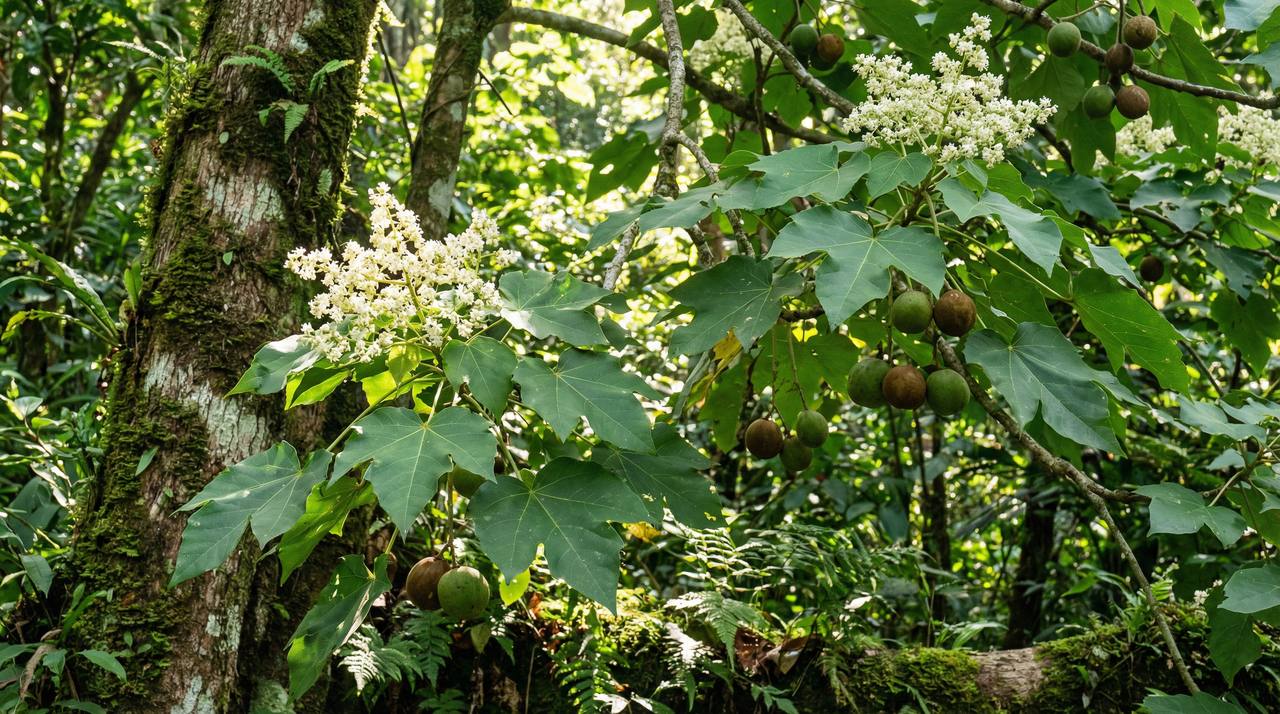
The candlenut is the official state tree of Hawaii, and almost nobody in Hawaii can eat it straight off the tree. Sit with that for a second. The raw seeds are toxic enough to cause severe vomiting and diarrhea, yet Polynesian voyagers considered this tree so essential they carried it across the Pacific as one of their most important canoe plants. That's not a contradiction so much as a window into how differently traditional cultures related to plants that required knowledge to use safely. I think about that a lot when I'm working with species that modern gardeners dismiss as "too complicated," as if every useful plant should be grab-and-go.
What pulled me into the candlenut's story wasn't the toxicity drama, though. It was the oil. Before electricity, kukui nut oil burned in stone lamps across Hawaii, reliable enough and bright enough that the tree became a symbol of enlightenment and protection.[1] Generations of people figured out exactly how to roast, press, and prepare a tree their landscape offered freely, and they built ceremonies around it. That kind of deep, accumulated plant knowledge is precisely what permaculture is trying to recover, and the candlenut, with all its caveats, is a pretty good teacher.
Candlenut Origin, History, and Traditional Uses
Botanical Background and Native Range
The candlenut tree, Aleurites moluccanus, originates from the Malesian region of Southeast Asia, spanning Indonesia, Malaysia, the Philippines, and New Guinea, with its native range extending through northern Australia and out across the Pacific islands.[2][3] In its native habitats, it behaves as a classic tropical pioneer, rushing into light gaps and disturbed edges in lowland rainforests and secondary growth, pushing up into the upper canopy or subcanopy wherever it can grab sun.[4] I recognize that growth habit immediately when I see it in the landscape: it's the same opportunistic energy you get from a fast-growing Cecropia or Macaranga, trees that want disturbed ground and full light and will take every advantage you give them.
It's comfortably at home in USDA zones 10 through 12, requiring annual rainfall of roughly 1,000 to 2,500 mm, temperatures that stay above 15°C, and well-drained soils with a pH between 5.5 and 7.5.[5][6] Once established, it handles salt spray and moderate drought with surprising grace, which makes it genuinely useful near coastal sites. Frost and waterlogged soils are the two things that will kill it. In non-native areas like parts of Hawaii, bird-dispersed seeds can carry well beyond the parent tree, and I've watched seedlings emerge in disturbed lowland sites far from where anyone planted them.[7][8] That invasive potential is worth keeping front of mind, even when a tree carries this much cultural weight.
Visual Characteristics
In the right conditions, candlenut is a genuinely impressive tree. It reaches 15 to 30 meters tall with a broad, rounded canopy spreading 6 to 12 meters, and young trees put on 1 to 2 meters of growth per year before settling into a slower pace.[6][5] The bark starts smooth and greenish before aging to gray and fissured, and if you nick a young stem you'll see milky sap. In my designs, I always space it generously for exactly this reason: underestimate that canopy spread and you'll be shading out every understory companion you planted within a few years.
What I find most interesting about this tree's foliage is how variable it is. Leaves are alternate, 10 to 25 cm long, glossy green on top with a distinctive silvery or pale underside, and the shape shifts considerably depending on site conditions: some leaves are simple ovals, others develop 3 to 5 deep palmate lobes.[9][2] I've seen this on the same tree across different seasons, which can genuinely confuse people trying to identify it. The flowers are small and creamy-white with reddish basal markings, borne in terminal panicles up to 20 cm long, and the fruit is a rounded drupe ripening from green to dark brown-black, containing one to three oily nuts with hard grayish shells.[2] Those nuts hold 60 to 70% oil by weight, which explains pretty much everything about the plant's human history.[10]
Traditional and Cultural Uses
Early Austronesian peoples in Southeast Asia recognized the value of that oil-rich nut long before anyone wrote it down. They domesticated the tree for lighting, cooking, medicine, and materials, then carried it with them as Lapita and Polynesian voyagers spread across the Pacific over the last 3,000 years, introducing it to Hawaii somewhere between 300 and 800 CE as one of their essential canoe plants.[11][12] The Hawaiian word for the tree is kukui, meaning light or enlightenment, and the nuts were literally strung on palm midribs and burned as candles.[13] That's not a metaphor. The name "candlenut" is a direct description of the technology.
Across Pacific cultures, the candlenut tree supplied far more than illumination. Oil from roasted nuts went into hair conditioning and massage; bark infusions treated skin conditions, rheumatism, and inflammation; the shells became lei materials, fishing lures, and sources of dark dye for tattoo inks.[14][15] In Indonesia it's still called kemiri and ground into curry pastes. The same tree that lights a home also feeds the family and treats the sick, which is a very permaculture way to earn your place in a landscape. One critical caveat I never skip over: raw nuts contain toxic phorbol esters that cause violent purgative effects, and they must be roasted before any consumption.[14] I always make this point clearly to anyone who asks about growing candlenut for food use.
Georg Eberhard Rumphius documented the tree botanically in the mid-18th century, followed by Linnaeus describing it in 1753, though Pacific peoples had been using it for at least a millennium by then.[16][17]
Fun Facts About Candlenut
The relationship between the Aleurites moluccana tree and Hawaiian identity stretches back over a thousand years.[6][18] It colonizes lava flows, supports pollinators, and feeds birds that then scatter its seeds across the landscape. This dynamic is ecologically admirable but practically inconvenient in areas where native vegetation is already under pressure.[7] The cultural reverence is real and deserved. So is the need for managed placement. When clients ask me about growing candlenut for its beauty and heritage value, my honest answer is that I'd love to help them plan for it, as long as we're also planning for the seedlings that will show up places they didn't intend.
Candlenut Varieties and How to Source Them
If you go looking for a catalog of candlenut cultivars, you won't find much. Aleurites moluccanus is overwhelmingly propagated by seed, and because seeds don't clone the parent, what you get is a population of genetically variable individuals rather than predictable named selections.[19][20] For permaculture purposes, that variability is more feature than flaw. It means a planting of several seedlings will carry meaningful genetic diversity, which builds resilience over time. Still, it helps to know what intentional selections do exist.
Notable Selections and Characteristics
The handful of recognized forms fall into two loose camps: ornamental and production-focused. On the ornamental side, Aleurites moluccanus f. variegata is the showpiece, with leaves edged in white or cream against the typical silvery-green foliage.[6][21] I've worked with similar variegated tropical trees in landscape designs, and the large palmately lobed leaves of the candlenut make that cream-edged contrast particularly dramatic in dappled light. It's the kind of plant that earns its keep even when it isn't producing anything edible.
For production, ecotypes and horticultural selections like the dwarf 'Ainslie' form tend to emphasize nut and oil output rather than visual drama.[19] Selected forms can push oil content from the typical wild-type range of around 50% up to roughly 60%, which translates to meaningful yield improvements in agroforestry contexts: 2 to 4 tons per hectare under good conditions.[22][23] These aren't registered cultivars in the formal sense; they're more accurately described as horticultural selections or ecotypes, which means sourcing them requires a bit of detective work.
Sourcing Candlenut Trees and Seeds
Getting your hands on a candlenut is genuinely inconsistent. Specialty tropical nurseries in Florida, California, and Hawaii are your best bet; major retailers rarely carry it.[24] Places like Logee's Plants and Fairchild Tropical Botanic Garden have carried it periodically, and when they do, seedlings typically run $20 to $50, with larger specimens reaching $50 to $200 and seed packs in the $5 to $15 range.[25] I've personally driven to botanic garden plant sales only to discover that shipping restrictions make anything I find there useless for customers outside the state. It's frustrating, and it's real.
Before you order anything, check your local invasive species list. Candlenut is classified as a Category II invasive in Florida, and Hawaii monitors it closely despite it being the state tree there.[26][27] Federal importation falls under USDA APHIS oversight and may require permits.[28] In my zone 9B work, I always cross-reference the current FLEPPC list before committing a vigorous tropical species to a design. Candlenut is one where that step isn't optional.
Given those realities, fresh seed is often the most practical path. Viability drops off fast after harvest, so source from a reputable grower and germinate promptly.[29] Cuttings are possible but uncommon, and the propagation details are worth their own section. For now, know that if you find fresh, locally sourced seed through a regional grower or seed exchange, that's usually the most straightforward and legally uncomplicated route you'll find.
Candlenut Propagation and Planting Guide
Everything about growing candlenut successfully starts with understanding what you're actually holding when you pick up one of those seeds. They're roughly spherical, grayish-brown, and surprisingly heavy for their size, because they're essentially a dense package of oil wrapped in a hard woody shell.[30][31] That oil content, somewhere between 60 and 70 percent of the kernel's weight, is what makes candlenut seeds so valuable and also what makes them genuinely tricky to propagate if you're not paying attention to freshness.
Understanding Candlenut Seeds: Morphology and Storage Behavior
Candlenut seeds are monoembryonic, meaning each one carries a single embryo, and they behave like what seed scientists call "intermediate" storage types: they tolerate some drying but crash quickly when moisture drops below about 10 to 12 percent.[32][33] Kept cool at 10 to 15°C with low relative humidity in a sealed container, they can stay viable for one to two years. At room temperature on a shelf, you might have weeks before germination rates fall off a cliff.[32][34] I've learned this the hard way. I once tried to germinate a batch of aleurites moluccana seed that had been sitting in a paper bag for three months and got almost nothing. Now I always start with the current season's harvest whenever I can get it.
Propagation Methods: From Fresh Seed to Grafting
Fresh candlenut seeds are actually wonderful to propagate from. With good germination protocol, you can expect 70 to 90 percent success.[35][29] The protocol matters, though. That hard woody endocarp resists water uptake unless you give it some help. A hot-water soak at around 71°C for 24 hours, or mechanical nicking of the shell, followed by a 24 to 48 hour soak at room temperature, pushes germination rates reliably into the 70 to 80 percent range.[35][36] After losing two seasons to unscarified seed that just sat in the tray looking smug, I now scarify every single batch without exception. Sow into well-drained medium, keep the temperature between 25 and 30°C, and expect sprouts in 10 to 30 days.
The catch with seed-grown trees is genetic variability. Open-pollinated candlenut seeds produce offspring with real diversity in growth habit, oil yield, and nut quality.[37] For home food forests, that's fine. For commercial production or preserving a specific selection, you'll want vegetative methods. Semi-hardwood cuttings of 10 to 15 cm taken in late spring or summer root at 40 to 80 percent when treated with IBA at 3,000 to 5,000 ppm.[38] Cleft or whip-and-tongue grafting during active growth succeeds at 60 to 80 percent, with the added benefit of improved disease resistance through compatible Aleurites rootstocks.[39] Air layering on mature branches is also viable, hitting 50 to 70 percent success over two to three months with wounding and hormone application.[36] Tissue culture exists in the literature but isn't commercially common yet.
Soil, Site Selection, and Planting Technique
In my landscape installs, I've seen more candlenut failures from wet feet than any other cause. The tree is genuinely sensitive to waterlogging; you'll see wilting, yellowing, and stunted growth within weeks of a drainage problem, and root rot follows.[40][41] Raising the planting mound by 20 to 30 cm has been my single most reliable fix on sites where drainage is marginal. On well-drained sandy loam, loam, or volcanic soils with a pH between 5.5 and 6.5, the tree thrives; it tolerates a wider range of 5.0 to 8.0, but I've watched trees on the margins of that range grow more slowly and never quite look as vibrant as those planted at 6.0 to 6.5.[29][42] Work compost or aged manure into poor or heavy soils, aiming for 2 to 5 percent organic matter, and make sure there's at least 60 to 100 cm of workable depth for the taproot to anchor properly.[43]
Spacing, Timeline, and Establishment Expectations
Candlenut becomes a 15 to 25 meter tree with a canopy spread of 10 to 15 meters, and that eventual size should govern every spacing decision you make at planting.[44][45] In home food forest plantings I space trees 6 to 10 meters apart; commercial blocks typically run 8 to 10 meters between trees and 10 to 12 meters between rows. One practical note from the field: label your rows carefully when seedlings are young. In the first month or two, candlenut seedlings share enough family resemblance with other Euphorbiaceae, think young cassava or castor bean, that mixed rows are easier to create than you'd think. The distinctive palmate-lobed leaves that define the mature tree take a few weeks to assert themselves.
On timeline: seed-grown trees typically flower in two to three years and reach meaningful nut production in three to five years under good tropical conditions. Grafted stock can shorten that slightly. I always tell clients that candlenut is a long-term investment. The three to five year wait feels slow on paper, but the tree grows fast enough that within two years you already have a handsome, silver-leafed specimen earning its place in the upper canopy. The fruit takes another six to eight months after flowering to mature fully, which means that first real harvest, when it finally comes, feels well earned.
Candlenut Care Guide
Caring for a candlenut tree is really an exercise in patience during the first two years, followed by a long and relatively low-drama relationship once the tree hits its stride. Get the fundamentals right early and you'll have a specimen that largely takes care of itself. Shortcut them and you'll spend years compensating.
Sunlight Requirements for Candlenut
Candlenut evolved as a coastal and disturbed-habitat pioneer, which means it wants full sun, at least six to eight hours of direct light daily, to develop the canopy density, flowering, and nut yield growers are after.[6][5] I've seen specimens grown under partial shade and they're a giveaway: lanky, sparse-leaved, producing almost nothing. The difference between a shaded tree and a properly sited one in open sun is striking enough that they barely look like the same species. That said, seedlings are a different story. Young plants can scorch badly when moved straight into intense tropical light, so I give mine a few weeks under 30-40% shade cloth before transitioning them out.[46][29] It's a brief extra step that saves a lot of bleached, wilted regret.
Watering Needs and Drought Tolerance
The seedling phase is where most people lose candlenut trees, and almost always because of water. Young plants up to about two years old need consistent moisture, roughly every two to three days or about an inch to two inches per week, with the top inch of soil allowed to dry slightly between waterings.[47][48] The soil must drain freely; sitting in wet ground even briefly invites damping off and Phytophthora root rot, which shows up as yellowing leaves, wilting, and roots that are soft, brown, and smell wrong.[47][49]
Once established, the tree develops a root system three to six feet deep that confers real drought tolerance, carrying it through dry spells of four to six weeks without serious stress.[50] Beyond eight weeks without water, though, expect leaf drop and a noticeable hit to nut production.[5] In Central Florida, summer rains usually handle mature trees on their own. During dry spells, deep watering every seven to fourteen days keeps things stable, and stepping up to an inch or two per week during flowering and fruiting improves nut set meaningfully.[51][48] A two-to-four inch organic mulch ring is one of the most useful things you can do for this tree, conserving moisture and reducing how often you need to irrigate.[51]
Feeding and Fertility Requirements
Candlenut is a moderate to heavy feeder, particularly on the leached tropical and subtropical soils where it typically grows. Young trees do well with a balanced fertilizer like 10-10-10 or 16-16-16, applied every three to four months at about half a kilogram to a kilogram per tree.[29] Mature trees need one to four kilograms annually, split across two or three applications.[52]
Here's where I've learned a lesson the hard way: nitrogen drives gorgeous, lush growth, but pour too much on and you'll get a beautiful, leafy tree with almost no nuts.[53] Once a tree is past establishment, shift toward balanced NPK with potassium emphasized to support fruiting and disease resistance. Phosphorus matters most for root development and nut formation, and potassium enhances drought tolerance too.[44] Soil pH should sit between 5.5 and 7.0; above 7.0 you'll often see iron chlorosis showing up as yellowing in the younger leaves.[53] I've watched that chlorosis disappear within a few weeks of applying chelated iron and soil sulfur in my own garden, so it's a fixable problem once you catch it. Soil testing every year or two is genuinely non-negotiable here; it tells you what the tree actually needs rather than what you assume it needs.[54] Compost and aged manure are excellent supplements that provide slow-release nutrition and improve soil structure at the same time.[29]
Frost and Cold Tolerance
There's no sugarcoating this one: candlenut is a tropical tree, native to frost-free Southeast Asia and the Pacific Islands, and it shows when temperatures drop.[55] It's rated for USDA zones 10-12, and at or below 32°F leaf drop, branch dieback, or whole-plant death become real risks, with young trees and new growth suffering first.[29][56] Optimal growth happens between 68 and 86°F; seedlings start showing stress below 50°F.[57]
For those of us pushing the limits in zone 9B, protection is doable but requires real commitment. I use an eight-inch mulch ring around the base and wrap the trunk with burlap during cold snaps, and I've successfully carried young trees through brief dips to 28°F with only minor leaf drop using that approach.[56] Wet, cold soil amplifies root damage, so good drainage becomes doubly important heading into winter. If you're in a genuine marginal climate, placing young trees in a warm south-facing microclimate buys meaningful additional protection.
Heat Tolerance and Temperature Preferences
On the other end of the spectrum, candlenut handles heat well within its preferred range, classified for AHS Heat Zones 10-12 and tolerating conditions with 210 or more days above 86°F annually.[58] Above 95°F, especially combined with drought, you'll start seeing leaf scorch, wilting, and flower drop.[59] Established trees handle Florida summers considerably better than seedlings, partly because their deep roots access moisture that surface soils have long lost, and partly because their thick, leathery leaves reduce water loss in ways that younger, thinner foliage simply can't.[51] During the most brutal weeks of summer, I provide some afternoon shade for young trees and lean hard on deep, infrequent watering and that mulch layer. No cultivar differences in heat physiology exist, so choosing a "better" variety won't solve extreme heat problems; site selection and management are the only real tools.[60]
Pruning and Seasonal Maintenance
The single most useful thing you can do with a young candlenut tree is shape it early. I spend the first two or three years establishing a strong central leader and an open, vase-shaped canopy, removing basal suckers and any crossing branches that would shade the interior.[61] That open form maximizes light penetration and air movement through the canopy, which matters for both nut production and disease suppression. On a mature tree, I've learned to keep my pruning shears largely holstered. Heavy cuts sacrifice the fruiting wood that carries next season's yield, and the dense, unproductive growth I once allowed before I understood this took years to correct with careful selective thinning. Light pruning of dead, damaged, or crossing branches, done in late winter or early spring, is really all a mature specimen needs.[62]
The broader maintenance rhythm is straightforward once you internalize the tree's seasonal pattern. Flowering occurs year-round with peaks in late winter through spring, and fruits take six to eight months to mature from there.[40][19] Keep two to three inches of organic mulch around the base year-round, always pulled back from direct trunk contact, and stake young trees against wind until they've anchored themselves.[47] That mulch layer ties together nearly everything in this care guide: it buffers soil temperature against both cold and heat, retains moisture between waterings, suppresses weeds, and feeds soil biology as it breaks down. Past the establishment phase, a well-sited candlenut tree is genuinely one of the lower-maintenance canopy trees I grow.
Candlenut Harvesting: Timing, Safety, and Technique
When to Harvest Candlenuts
The candlenut tree does most of the signaling work for you, if you know what to look for. Sometime between 4 and 8 months after flowering, the pericarp shifts from green to brown, starts to soften or split, and the shell underneath hardens noticeably.[63][64] The tree will often drop the nuts before you've even decided to check them, so I'd rather trust the tree's rhythm than a calendar. In Hawaii, that rhythm tends to peak August through December; in subtropical Florida, expect more of a September through January window.[65][29] In true tropical climates, harvest can be nearly year-round with a dry-season peak, but I always tell people to watch the tree, not the month.
Safe Harvesting and Post-Harvest Handling
Here's where I need to be direct: I do not let anyone taste raw kernels, period. Raw candlenuts contain phorbol esters and cyanogenic compounds that cause gastrointestinal distress, vomiting, and skin irritation.[66][67] Children and pets especially should not handle fallen nuts unsupervised. Gather by collecting from the ground or gently shaking branches, then move immediately to post-harvest prep, as prolonged exposure invites rapid degradation. Shade-dry the nuts at 25 to 30°C for one to two weeks until moisture drops to around 10 to 12%, and keep them out of direct sun, which speeds oil rancidity.[63][68] Properly dried nuts store well for a year or more in a cool spot.
Yield, Flavor, and Texture of Candlenuts
A mature tree can produce anywhere from 30 to 100 kg of nuts per year depending on age, irrigation, and soil management.[65][29] In my observation, the 30 to 75 kg range becomes reliable once a tree is past its fourth or fifth year and gets consistent mulch and water. The raw kernel itself is hard, brittle, and greasy, with nothing appetizing about it.[69] Roasting transforms it completely. At 150 to 180°C for 10 to 15 minutes, the bitterness retreats, the oil expresses properly, and you're left with something genuinely buttery and rich, honestly quite close to macadamia.[70][71] I've learned through trial that even slightly undercooked nuts carry a detectable bitterness that lingers, so hold the temperature and don't rush it. That earthy, woody undertone is what makes candlenut fruit so irreplaceable in Indonesian spice pastes and Hawaiian poke.[66][19] The roasting step isn't optional, but the reward absolutely justifies the care.
Candlenut Preparation and Culinary Uses
Why Raw Candlenuts Are Toxic and How to Make Them Safe
Before anything else: do not eat raw candlenuts. The kernels contain phorbol esters and saponins that cause serious gastrointestinal irritation and worse.[72][73] This is not a subtle caveat buried in the footnotes; it's the single most important thing to understand before you ever bring these nuts into a kitchen. The good news is that the fix is straightforward: roast the kernels at 150 to 200°C for 20 to 30 minutes, or boil them thoroughly, and the phorbol ester content drops to safe levels while the bitterness disappears entirely.[74][75] After years of growing these trees I've learned to roast small test batches rather than processing all the kernels at once, because slight differences in seed size and moisture content affect how quickly that raw bitterness resolves. When it's gone, they're ready. I also keep roasted nuts clearly labeled in my pantry so there's no chance of confusing them with unprocessed ones.
Nutritional Profile and Flavor of Properly Prepared Candlenuts
The transformation is worth the extra step. A properly roasted candlenut is 58 to 65% lipids, heavily weighted toward unsaturated fats including oleic acid, linoleic acid, and alpha-linolenic acid, with meaningful amounts of vitamin E, potassium, magnesium, and phosphorus.[76][77][78] Phytosterols like beta-sitosterol are present in modest quantities and may support cholesterol management, though the research on that front is extrapolated from general phytosterol studies rather than candlenut-specific trials.[79] The flavor is the pleasant surprise for anyone unfamiliar with the nut: creamy, mild, subtly sweet, with earthy undertones that remind me of macadamia or hazelnut. The comparison to macadamia is apt; both need careful handling, but candlenut's extra roasting step is simply the price of turning a toxic seed into a genuinely delicious thickener. Keep portions modest, 1 to 2 nuts per serving and no more than 5 to 6 per week, to stay well clear of any residual effects.
Traditional Culinary Applications in Hawaiian and Southeast Asian Cuisines
Ground roasted candlenuts are a workhorse ingredient across the Pacific and Southeast Asia. In Indonesian cooking they go directly into rendang pastes and sambal; in Malaysian curries they thicken the sauce and round out the spice base; in Hawaii, kukui nut relish has long accompanied poke and fish dishes.[80][81][2] The extracted oil has a smooth, buttery quality that works well in dressings or as a substitute for other nut oils in light sautés.[29] If you can't source candlenuts, macadamia is a reasonable stand-in in most recipes, though it lacks the subtle earthiness that makes the original distinctive.
A note on who should avoid candlenuts altogether: if you're pregnant, breastfeeding, managing IBS, or dealing with any gastrointestinal condition, I'd recommend skipping medicinal or large culinary amounts entirely. There's also documented cross-reactivity with other tree nut allergies, and anaphylaxis is a real risk for sensitized individuals. And please, when you're working around your trees, take a moment to confirm what you've got. Candlenut can be superficially confused with Jatropha curcas or Ricinus communis at certain stages, and both of those are genuinely dangerous.[82][83] Look at the leaf shape carefully and check for milky sap, which the look-alikes have and candlenut does not. I kept my young plants well labeled for exactly this reason.
Non-Food and Traditional Medicinal Uses
The kitchen is only one corner of what this tree offers. Pacific Island cultures have burned kukui nut oil in lamps for centuries, used it in skin care, worked it into dyes and body paints, and incorporated it into tattoo preparation.[84][80] In traditional Hawaiian medicine, processed nuts and oil were used to address constipation, rheumatism, skin conditions, and headaches.[80] It carries an official symbolism of enlightenment and peace that reflects just how thoroughly it wove itself into the fabric of island life.[85] What strikes me most is that every part of this plant has been accounted for by the cultures that lived alongside it. The nut that lights the lamp, thickens the curry, heals the skin, and adorns the lei is a reminder that thoughtful, generations-long observation of a single species can yield a whole way of living with it.
Candlenut Health Benefits and Medicinal Uses
Candlenut is a plant that demands respect before it offers its gifts. The health story here is genuinely interesting, but it runs through a gauntlet of caution that you can't skip past. Raw seeds are toxic. Processed oil has real bioactive value. Those two facts need to stay connected in your mind the whole time you're reading this.
Traditional Uses in Hawaiian and Polynesian Medicine
Long before anyone ran a DPPH assay on a plant extract, Hawaiian and Polynesian healers were doing something remarkably sophisticated with kukui nut. Traditional medicine used the oil topically for sores, ulcers, and burns, and as a general moisturizer for dry, sun-stressed skin.[86][87] Bark decoctions addressed respiratory complaints including coughs and asthma, and the seed oil served as a purgative for constipation, with considerable care around dosage.[88][89] Southeast Asian traditions expanded these uses further, applying the plant across skin conditions, inflammation, and various systemic complaints.[90]
I find it telling that kukui nut oil's topical applications map so cleanly onto modern emollient science. The oil is rich in unsaturated fatty acids that support the skin barrier in ways very similar to jojoba or a high-quality coconut oil, both of which I use regularly in client landscape and garden demonstrations in Florida.[86] Preliminary studies have since found anti-inflammatory effects in rodent edema models, wound healing with accelerated epithelialization in animals, and antimicrobial activity against Staphylococcus aureus and certain fungi.[91][92][93] Antioxidant, preliminary anti-diabetic, analgesic, and even early anticancer signals have shown up in cell culture and animal models, attributed to phenolic compounds, flavonoids, and tocopherols.[94][95][96] As with many understudied useful tropicals in regenerative systems, we're working from strong preclinical and traditional evidence while awaiting better human data. The one small controlled study on kukui nut oil for eczema (twenty participants, uncontrolled design) showed mild improvements, which is promising but nowhere near conclusive.[97]
Key Phytochemicals and Their Bioactive Properties
The seed oil's fatty acid profile does a lot of the heavy lifting here. Roughly 41 to 60% is alpha-eleostearic acid, with significant linoleic acid (omega-6) around 40%, oleic acid near 20 to 22%, and palmitic acid at approximately 17%, all alongside tocopherols and phenolic compounds.[98][99] But the seeds also contain toxic phorbol esters, including TPA at up to 2 to 3% of seed oil content, which act as tumor promoters and gastrointestinal irritants. Those don't disappear from the conversation just because the fatty acid profile looks appealing.[100][101]
Different plant parts contribute different bioactive classes. Leaves are particularly rich in quercetin, kaempferol, and their glycosides, driving strong DPPH radical scavenging.[102][103] Bark and stem contain triterpenoids including lupeol, friedelin, and betulinic acid with cytotoxic and anti-inflammatory activity, while the latex carries phorbol esters historically used as fish poisons.[104][105] I've noticed in my own plantings that trees harvested in drier periods seem to yield more potent, aromatic oils, which lines up with a 2019 phytochemical analysis showing lupeol content peaks in dry seasons and that phenolic levels tend to be higher in tropical Southeast Asian and Indonesian chemotypes than in subtropical specimens.[102][103] Organic cultivation practices may increase secondary metabolite yields by 15 to 20%, which is worth knowing if you're growing these trees in a managed permaculture guild.[102]
Nutritional Profile and Health Contributions
Roasted candlenut kernels are genuinely nutrient-dense. Per 100 grams, they deliver approximately 709 kcal, 66.5 grams of fat (predominantly unsaturated), 16.8 to 21.5 grams of protein, and 6.8 to 8.9 grams of dietary fiber.[106][107] The vitamin E content is particularly notable at 35 to 47 mg per 100 grams, which translates to roughly 233 to 313% of the daily value.[108] Minerals include meaningful amounts of magnesium (225 mg), phosphorus (593 mg), potassium (717 mg), calcium (147 mg), and zinc (4.45 mg), though I'd note these figures come from research studies rather than fully standardized USDA databases, so treat them as directional rather than precise.[109] The kernels also contain over 50 identified phytochemicals including total phenolics at 10 to 20 mg GAE per gram of extract, contributing additional antioxidant activity.[110][111]
Candlenut isn't widely consumed in the United States, and there's no FDA regulatory framework treating it as an approved food ingredient.[112] Traditional Hawaiian processed use is the reference point here, not everyday American snacking. For those who do prepare the nuts correctly, the high vitamin E and healthy fat profile make them a worthwhile occasional addition, much in the way macadamia nuts are used. The key phrase is "prepare correctly," and that takes us directly to safety.
Safety Considerations and Limitations of Research
Raw candlenut seeds are not food. The phorbol esters, saponins, and lectins in raw seeds cause nausea, vomiting, abdominal pain, and diarrhea, and there are documented cases of cardiac effects including first- and third-degree AV heart block following raw ingestion.[113][114][115] I've seen firsthand how even well-meaning foragers underestimate that risk, so I'll say it plainly: thorough roasting or boiling is mandatory, not optional, and even processed nuts consumed in excess can produce strong laxative effects.[116]
The plant is toxic to pets across the board. Dogs and cats who ingest seeds experience vomiting, diarrhea, lethargy, and abdominal discomfort requiring veterinary attention.[117][118] When I'm designing client landscapes that include candlenut, I always flag this explicitly for households with dogs, cats, or anyone who is pregnant. The latex and bark can cause contact dermatitis, and the oil has triggered IgE-mediated allergic responses in sensitive individuals, with potential cross-reactivity to other tree nuts that people with candlenut allergy should discuss with a physician.[119][120] Pregnancy and lactation are clear contraindications due to toxic compounds, potential emmenagogue effects, and a flat absence of safety data.[121][88] The candlenut side effects question is one where the honest answer is that traditional use is well-documented but long-term safety evidence from controlled human trials simply doesn't exist yet.
Candlenut Pests and Diseases
One reason I keep recommending candlenut as an upper-canopy anchor in tropical food forests is that its long-term pest and disease profile is genuinely manageable, especially once you get through the first couple of years. The early phase requires real attention; after that, the tree's own chemistry does a lot of the heavy lifting.
Common Pests of Candlenut Trees
In my experience growing candlenut from seed in humid subtropical conditions, first-year seedlings are by far the most pest-prone stage. Aphids, scale insects, and caterpillars are the usual culprits, and they tend to cluster on tender new growth.[122][47] Aphids are the ones I monitor most carefully since they can transmit viruses, so I do a quick weekly check during the growing season on young plants. A few applications of neem oil or insecticidal soap have consistently kept pressure low without reaching for anything synthetic. Once a candlenut is established and putting on serious trunk girth, these insects become more of a nuisance than a genuine threat.[6][47]
Diseases Affecting Candlenut and Management Strategies
Here's where candlenut really earns its reputation as a low-intervention tree. It shows strong resistance to powdery mildew caused by Oidium sp., with no significant symptoms observed even in comparative studies across forest tree species.[123] That's not accidental. The bark and leaves contain flavonoids and terpenoids with demonstrated inhibitory effects against several fungal pathogens, so the tree is essentially running its own antifungal program.[124] I've included candlenut in guild designs where other species would have needed regular fungicide intervention, and it just doesn't ask for that.
The vulnerabilities worth knowing about are leaf spot and root rot. Leaf spot from Cercospora and Colletotrichum species flares during prolonged rainy seasons, and I've seen real spotting after extended summer rains.[125] But in well-drained soil, it has never progressed beyond cosmetic damage on established trees. Phytophthora root rot is a moderate concern, especially for seedlings in soggy ground; tolerance improves significantly with drainage, lower soil moisture, and age.[126] Site selection is really the management strategy here. For growers scaling up to commercial production, grafting onto compatible Euphorbiaceae rootstocks is a proven way to boost soil-borne disease resistance and overall vigor.[127] I've seen noticeably better performance in grafted nursery specimens compared to straight seedlings, which matters if you're planting at any scale.
Candlenut in Permaculture Design
Before you start imagining candlenut shading a lush food forest understory, the first question you need to answer honestly is: where do you garden? This tree is non-negotiable about its climate needs, and no amount of thoughtful design compensates for planting a tropical species in the wrong zone.
Climate and Growing Zones
Candlenut is a core USDA zones 10-12 tree, with reliable cultivation in Hawaii, southern Florida, and Puerto Rico being about the extent of its U.S. range.[8][6] It will tolerate a brief dip to around 25-30°F with microclimate protection, which puts zone 9b technically within reach, but barely.[6][128] I've worked with clients in Central Florida who've tried this on frost-pocket-free southern exposures with overhead canopy cover for young plants, and while it can survive, one hard freeze sets you back a full season or more. Young trees are especially vulnerable, and protecting them through even mild cold snaps requires real effort.
Once your climate clears that bar, the site requirements are fairly specific:
- full sun
- high humidity in the 70-90% range
- well-drained soil with consistent moisture during establishment
- annual rainfall equivalent to 40-60 inches
Ecological Functions and Guild Roles
Candlenut is a classic pioneer species in the best sense: it moves fast into disturbed ground, whether that's a lava flow or a degraded slope, stabilizes it with a deep taproot and mat-forming lateral roots, and begins building soil from day one.[5] It's not a nitrogen fixer, and I want to be clear about that because I've seen it mischaracterized, but it compensates with sheer volume of organic matter. The leaf litter breaks down quickly and releases nitrogen, potassium, and other nutrients back into the system, functioning somewhat like a mulberry or pigeon pea in terms of soil-feeding throughput, just at canopy scale.[132][133] The biomass is also worth harvesting periodically for mulch or green manure applications elsewhere in the garden.
Its fragrant terminal flower panicles support bees (including stingless Trigona species), flies, and beetles, with nectar available through much of the year in tropical conditions.[134][135] Birds and rodents feed on and disperse the seeds, which points toward one of two liabilities you need to weigh honestly in your design. First, the raw nuts and husks contain phorbol esters and are toxic to humans and animals; they require roasting or processing before any use.[136] Second, candlenut has documented invasive potential in Hawaii and coastal Florida, where it can outcompete native vegetation.[137][138] As a designer, I routinely avoid placing known aggressive species near natural areas or wildlife corridors in Florida, and I apply the same caution here: know your local context before committing.
Forest Layer Placement
In a tropical food forest, candlenut belongs in the upper canopy. It reaches 15-30 meters with a broad spreading crown, and its dappled shade creates genuinely useful microclimates for understory crops like coffee and cacao.[6][139] Young plants tolerate partial shade, but mature specimens are full-sun trees and will push toward light regardless of what you want them to do, so placement matters from day one.[133] The tree also forms arbuscular mycorrhizal associations that improve phosphorus uptake in poor tropical soils, which is useful context for anyone designing on degraded or volcanic ground.[140]
Space generously: at least 10-15 meters between individuals to account for mature canopy spread and root competition.[133] I once had to pull out and replant an entire understory guild because I underestimated how far the canopy would extend by year seven; it's an expensive lesson I'd rather save you from. Because candlenut doesn't fix its own nitrogen, pair it with nitrogen-fixing trees or shrubs in the mid-layer to keep the whole system fertility-positive.[64] The falling toxic husks may suppress some sensitive understory plants, so choose mid-layer companions that are reasonably robust and position your more delicate crops outside the drip line. On slopes or exposed coastal sites, the deep taproot and lateral root system make it a strong erosion-control anchor, and that wind tolerance means it can serve a practical windbreak function while also producing. It's a generous tree in the right context, but it asks for space, warmth, and honest management of its risks in return.
The Tree That Made Me Slow Down and Pay Attention
I planted my first candlenut on the edge of a food forest in Central Florida, mostly because I was curious whether I could. Watching it push through that first dry season, dusty and indifferent to my worry, taught me something I keep relearning: the trees that ask the most of you up front tend to give back in ways that outlast any plant you ever coddled. That one tree still shades my cacao.
Sources 140
- Kukui (Aleurites moluccanus), the Candlenut Tree – University of Hawaii CTAHR ↩
- Aleurites moluccanus - Useful Tropical Plants Database ↩
- Aleurites moluccanus - Kew Science ↩
- Aleurites moluccanus (Candlenut) - CABI Compendium ↩
- Kukui (Aleurites moluccanus) Ecology and Distribution ↩
- Aleurites moluccanus - Kukui Nut Tree ↩
- Invasive Plant Species in Hawaii: Aleurites moluccanus ↩
- Aleurites moluccanus (L.) Willd. ↩
- Aleurites moluccanus - Missouri Botanical Garden Plant Finder ↩
- Missouri Botanical Garden - Aleurites moluccanus ↩
- The Candlenut Tree (Aleurites moluccanus): A Review of Its Botany, Uses, and Potential ↩
- Canoe Plants of Ancient Hawaii ↩
- Cultural Uses of Kukui in Hawaii - Bishop Museum ↩
- Aleurites moluccanus in Southeast Asian Ethnobotany ↩
- Tropical Plant Uses: Candlenut (Aleurites moluccanus) ↩
- Herbarum Amboinensium ↩
- Species Plantarum ↩
- Ecology and Management of the Kukui Tree in Hawaii ↩
- Aleurites moluccanus - Wikipedia ↩
- Kukui Nut Tree (Aleurites moluccanus) - University of Hawaii ↩
- Ornamental Plants of Hawaii: Aleurites moluccanus Variegata ↩
- Aleurites moluccanus - Plants of the World Online (Kew Science) ↩
- Aleurites moluccanus (Candlenut) - Plant Profile ↩
- Aleurites moluccana ↩
- Exotic Trees in Florida Nurseries ↩
- Florida's 2023 List of Invasive Plant Species ↩
- Invasive Species in Hawaii ↩
- Federal Noxious Weeds ↩
- Propagation of Candlenut (Aleurites moluccanus) ↩
- Aleurites moluccanus (L.) Willd. - Plants of the World Online ↩
- The Botany of Aleurites Species ↩
- Tropical Tree Seed Manual - USDA Forest Service ↩
- Kew Gardens Millennium Seed Bank Data ↩
- FAO Forestry Paper - Seed Testing of Tropical Species ↩
- Propagation of Aleurites moluccanus ↩
- Propagation of Tropical Trees: Aleurites moluccanus ↩
- Aleurites moluccanus - USDA PLANTS Database ↩
- Vegetative Propagation Techniques for Aleurites Species ↩
- Grafting Techniques for Euphorbiaceae Trees ↩
- USDA Forest Service - Aleurites moluccanus ↩
- Root Rot in Trees - University of Florida IFAS Extension ↩
- Kukui (Aleurites moluccanus) - Agroforestry Guide ↩
- Aleurites moluccanus - Useful Tropical Plants ↩
- Candlenut (Aleurites moluccanus) Production Guide ↩
- University of Hawaii: Kukui Nut Tree Cultivation ↩
- Missouri Botanical Garden Plant Finder ↩
- Kukui Nut Tree Care - University of Hawaii ↩
- Candlenut Tree (Aleurites moluccanus) - University of Florida IFAS Extension ↩
- Phytophthora on Tropical Trees - University of Hawaii ↩
- CABI Compendium: Aleurites moluccanus ↩
- Propagation and Cultivation of Aleurites moluccanus ↩
- Fertilization of Candlenut (Aleurites moluccanus) for Fruit Production ↩
- Nutrient Management for Candlenut (Aleurites moluccanus) ↩
- Nutrient Deficiencies in Tropical Fruit Trees ↩
- Pacific Island Ecosystems at Risk (PIER) - Aleurites moluccanus ↩
- Tropical Trees: Cold Tolerance and Protection ↩
- Tropical Tree Fact Sheet: Candlenut ↩
- Aleurites moluccanus (Kukui Nut Tree) ↩
- Aleurites moluccanus - Plant Finder ↩
- Plant Profile: Aleurites moluccanus (Candlenut, Kukui) ↩
- Candlenut Tree Care and Pruning Guide ↩
- Tropical Tree Pruning Techniques ↩
- Candlenut Production Guide ↩
- Aleurites moluccanus (Kukui, Candlenut) ↩
- Aleurites moluccanus - Candlenut Tree ↩
- Kukui Nut (Aleurites moluccanus) ↩
- Candlenut Toxicity and Culinary Uses - Ethnobotany Journal ↩
- Aleurites moluccanus - Useful Tropical Plants ↩
- USDA PLANTS Database: Aleurites moluccanus ↩
- Processing and Sensory Evaluation of Candlenut ↩
- Candlenut in Southeast Asian Cuisine ↩
- Aleurites moluccanus (Kukui, Candlenut) - Toxic Compounds ↩
- Phorbol Esters in Candlenut Seeds - PubMed ↩
- Phorbol Esters in Candlenuts: Removal by Roasting - Journal of Food Science ↩
- Phorbol Esters in Candlenut: Toxicity and Preparation ↩
- Nutritional Composition of Aleurites moluccanus Seed ↩
- USDA FoodData Central - Candlenuts, raw ↩
- Fatty Acid Profile of Kukui Nut Oil ↩
- Antioxidants and Phytosterols in Candlenut ↩
- Traditional Uses of Kukui in Hawaii - University of Hawaii ↩
- Candlenut in Indonesian Cuisine - Serious Eats ↩
- Missouri Botanical Garden - Jatropha curcas ↩
- USDA PLANTS Database - Aleurites moluccanus ↩
- Kukui Nut Tree in Hawaiian Culture - Native Plants Hawaii ↩
- Aleurites moluccanus - Kew Science Plants of the World Online ↩
- Traditional Uses of Kukui Nut in Hawaiian Medicine ↩
- Kukui Nut Oil in Traditional Hawaiian Medicine - Ethnobotany ↩
- Traditional Uses and Toxicity of Aleurites moluccanus in Hawaiian Medicine ↩
- Medicinal Plants of the Pacific Islands - USDA National Agricultural Library ↩
- Traditional Uses of Candlenut in Southeast Asia - Journal of Ethnopharmacology ↩
- Antioxidant and Antimicrobial Activities of Aleurites moluccanus Seed Oil ↩
- Anti-inflammatory Effects of Aleurites moluccanus Leaf Extract ↩
- Antimicrobial Activity of Kukui Nut Oil Extracts ↩
- Antioxidant Properties of Aleurites moluccanus Leaf Extract ↩
- Anti-diabetic Effects of Aleurites moluccanus Nut Oil ↩
- Anticancer Apoptosis Induction by Aleurites moluccanus ↩
- Traditional Uses of Aleurites moluccanus in Dermatology ↩
- Chemical Composition of Kukui Nut Oil (Aleurites moluccanus) ↩
- Chemical Composition and Pharmacological Activities of the Seed Oil from Aleurites moluccanus ↩
- Phorbol Esters from Aleurites moluccanus ↩
- Phytochemical and Pharmacological Review of Aleurites moluccanus ↩
- Flavonoids and Phenolics in Aleurites moluccanus Extracts ↩
- Secondary Metabolites from Candlenut Tree (Aleurites moluccanus) ↩
- Triterpenoids from the Bark of Aleurites moluccanus ↩
- Phytochemical and Pharmacological Review of Aleurites moluccanus ↩
- Nutritional Composition of Candlenut (Aleurites moluccanus) Seed Kernels ↩
- Tropical Nuts: Nutritional Profile - FAO ↩
- Vitamin Content in Underutilized Nuts - Journal of Food Composition and Analysis ↩
- Nutritional Composition of Candlenut (Aleurites moluccana) Seed ↩
- Phenolic Compounds in Aleurites moluccanus Nuts ↩
- Phytochemical Review of Aleurites moluccanus ↩
- USDA PLANTS Database ↩
- Candlenut Toxicity - Poison Control ↩
- Heart Block Initiated by Candlenut Ingestion - PMC ↩
- Aleurites moluccanus - Toxic Properties ↩
- Herbal Medicine: Biomolecular and Clinical Aspects - NCBI ↩
- Candlenut Toxicity in Humans and Animals ↩
- Veterinary Toxicology: Aleurites spp. ↩
- Contact Dermatitis from Kukui Nut Tree ↩
- Candlenut Oil Safety and Side Effects ↩
- Candlenut (Aleurites moluccanus) - Toxicity and Uses ↩
- Pests and Diseases of Kukui Nut (Aleurites moluccanus) ↩
- Resistance of Various Forest Tree Species to Powdery Mildew Disease in Indonesia ↩
- Phytochemical Analysis and Antifungal Properties of Aleurites moluccanus Extracts ↩
- Fungal Leaf Spot Diseases of Ornamental and Nut Trees in Southeast Asia ↩
- Phytophthora Tolerance in Tropical Nut Trees ↩
- Grafting Techniques for Disease Management in Aleurites Species ↩
- North Carolina Extension Gardener Plant Toolbox ↩
- Aleurites moluccanus Ecology - FAO Tropical Trees ↩
- Candlenut Tree Cultivation - University of Florida IFAS Extension ↩
- Aleurites moluccanus in Agroforestry - World Agroforestry Centre ↩
- Nutrient Cycling in Southeast Asian Forests ↩
- Aleurites moluccanus in Tropical Forestry ↩
- Pollination Ecology of Candlenut (Aleurites moluccanus) ↩
- Insect Pollinators of Candlenut (Aleurites moluccanus) in Indonesia ↩
- PROSEA - Aleurites moluccanus monograph (FAO) ↩
- Aleurites moluccanus - Global Invasive Species Database ↩
- University of Hawaii Department of Agriculture: Aleurites moluccanus Fact Sheet ↩
- Agroforestry Systems with Aleurites moluccanus ↩
- Mycorrhizal Associations of Euphorbiaceae ↩