Catmint is a resilient, pest-repelling perennial that brews into a calming medicinal tea, though most gardeners only know it for making cats lose their minds. The rolling, the drooling, the glazed-over bliss. What's stranger to me is that the same chemistry responsible for that feline euphoria, a volatile compound called nepetalactone, produces almost the opposite effect in humans: calm, ease, a quieting of the nervous system.[1] I find that genuinely fascinating. One molecule. Two completely different nervous systems. Two completely opposite responses. The plant isn't confused; it just has more going on than most people give it credit for.
Here's what I think trips people up: most of what's sold as "catmint" at garden centers isn't actually the true species with that sedative, cat-activating chemistry at all. Those pretty lavender-blue drifts in every perennial catalog? Usually a sterile hybrid bred for tidiness and bloom power, not for tea or for your tabby. The distinction quietly matters, and once I understood it, my whole approach to growing and using this plant shifted. There's a lot more to untangle here than the cat jokes suggest.
Catmint Origin, History, and Traditional Uses
Botanical Background and Native Range
Catmint, known botanically as Nepeta cataria, is a short-lived herbaceous perennial that typically lives three to five years in garden settings.[2][3] It follows a polycarpic strategy, flowering and seeding repeatedly before it finally gives up, which is part of why I always tell people it feels like a permanent garden resident even though technically it isn't. The prolific self-seeding means you rarely lose it entirely; you just lose track of which generation you're growing. Its native range spans temperate Europe, southwestern and central Asia, and parts of northern Africa. Since European colonists carried it to North America in the 1700s, it has naturalized enthusiastically across the continent, especially in disturbed habitats like roadsides and open fields on well-drained soils.[4][5][6] The species is listed as Least Concern on the IUCN Red List,[7] but in some parts of North America it's considered invasive. I always recommend checking with your local extension office before planting; in my experience it self-seeds enthusiastically in disturbed garden beds but a bit of occasional pulling keeps it honest.
The broader genus shows remarkable range. Nepeta odorifera grows wild in grasslands and forest edges across temperate Asia, from China and Japan to Korea, sometimes climbing to 4,200 meters elevation. Nepeta persica clings to rocky slopes and scrublands in the mountains of Iran and the Caucasus, and Nepeta neocalycina makes its home in alpine southwestern China above 2,800 meters.[8][9] That altitudinal range helps explain the genus's legendary toughness in temperate gardens. N. cataria is also deer and rabbit resistant, thanks to the same aromatic oils that make it irresistible to cats,[10] which is a genuinely useful combination in any kitchen garden.
Visual Characteristics
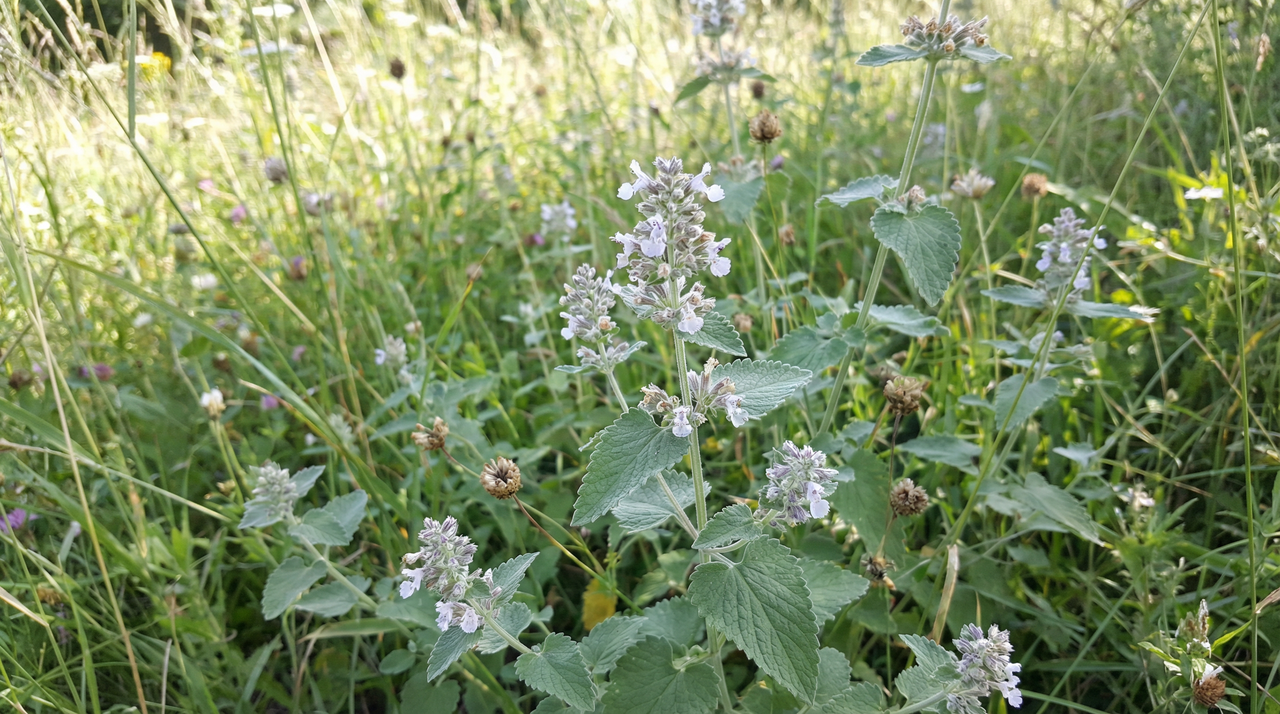
In the garden, catmint grows into an upright, clump-forming plant two to three feet tall with a spread of one to three feet. The stems are square and noticeably downy, the leaves gray-green, softly hairy, and ovate to heart-shaped with toothed margins.[2][3] If you grow basil or peppermint, those square stems and opposite leaves will look immediately familiar. It's one of those family resemblances that, once you see it, you can't unsee it, and it's a quick way to orient new gardeners to the Lamiaceae. Flowers appear June through September in dense whorled spikes, white to pale lavender with purple spots.[11] I've noticed the aroma intensity varies season to season and even plot to plot; plants in leaner, drier soil tend to smell sharper and more concentrated, which tracks with what we know about essential-oil production under mild stress.
Below ground, a rhizomatous root system with fibrous roots enables vegetative spreading, while the fruits split into four tiny nutlets just one to two millimeters long.[5][2] The cultivar Nepeta cataria f. citriodora swaps the classic minty scent for a distinct lemon note, the result of higher citral content in its oils.[12] Related Asian species like N. odorifera and N. persica tend to be more compact with more consistently blue-violet flowers and denser, grayer foliage adapted to higher and drier conditions.[13][14]
Traditional and Cultural Uses Across Cultures
The documented human relationship with catmint goes back at least two thousand years. Dioscorides included it in De Materia Medica around the first century AD, recommending it for digestive ailments, headaches, fevers, and as a diuretic, and Pliny the Elder echoed those applications in his Natural History.[15][16] Medieval European monks carried it into their physic gardens, where it was used for everything from menstrual cramps to insomnia.[17] When colonists brought it to North America in the 1700s, Pawnee, Iroquois, and Cherokee communities adopted it into their own healing traditions, primarily as a tea for fevers, colds, and digestive complaints.[18]
The folklore runs just as deep as the medicine. In European tradition catmint appeared in love charms, protective spells, and magical sachets, associated with the goddess Bastet and woven into Victorian floriography as a symbol of attraction, playfulness, and happiness.[19][20] Meanwhile, across Asia, close relatives were developing their own parallel histories. Nepeta persica appears in traditional Iranian medicine as a digestive, carminative, and sedative tea, with possible references in Avicenna's eleventh-century Canon of Medicine,[21] and N. odorifera has a long record in Traditional Chinese Medicine for colds, fevers, headaches, and insomnia, appearing in texts as old as the Shennong Bencao Jing.[22] I haven't grown N. persica myself, but the catmints I do grow all produce the same gently calming tea, which makes those overlapping traditional applications feel entirely credible. The FDA recognizes catmint as GRAS at food-use levels,[17] and modern herbalism still values it primarily as a mild tea for anxiety and digestive discomfort, though therapeutic doses deserve a conversation with a healthcare provider.
Fun Facts About Catmint
The cat connection is real, well-studied, and delightfully variable. About 70 to 80 percent of domestic cats respond to nepetalactone with rolling, rubbing, vocalizing, and temporary euphoria; the response is genetically inherited, skips kittens under three months, and bypasses 20 to 30 percent of adult cats entirely. Each episode lasts five to fifteen minutes and is entirely safe and non-addictive.[23][24] In my household two of three cats react enthusiastically while the third couldn't care less, which is exactly what the genetics predict. The same chemistry that enchants cats, incidentally, was the basis for those European love-potion associations; it's a nice reminder that humans have been noticing this plant's peculiar effects for a very long time. For cat owners, it's genuinely useful for behavioral enrichment, though not every household will have a cat that bothers to notice it at all.
Catmint Varieties and Where to Buy Them
Notable Varieties of Nepeta cataria and Related Species
Nepeta cataria is the true catnip: hardy from USDA zones 3–9, drought-tolerant once established, a reliable self-seeder, and the species behind the classic minty-nepetalactone aroma that drives cats wild and fills herbal teas.[25][11] Its true cultivars include the lemon-scented 'Citriodora', the tall 'Six Hills Giant' at 3–4 feet with notably high nepetalactone content, and the classic white-flowered 'Catnip' strain.[26]
After years of specifying true N. cataria for clients who want strong cat attraction or medicinal teas, I've learned that garden-center labels can be maddeningly vague. A tag that just says "catmint" is often actually 'Walker's Low', a sterile Nepeta × faassenii hybrid (N. racemosa × N. nepetella) that has earned an RHS Award of Garden Merit for its compact reblooming habit and lavender-blue flowers.[27][28] Similarly, the popular compact 'Cat's Pajamas' (18–24 inches, bred for pollinator density) is Nepeta × faassenii, not N. cataria.[29] These hybrids stay tidier in borders and are sterile, which is exactly why Missouri Botanical Garden recommends them where self-seeding is a concern.[30] But they lack the intense minty punch and reliable medicinal profile of true catnip. Know which one you need before you buy.
If you want something a bit more unusual, Nepeta persica (Persian catnip) is worth tracking down. Hardy in zones 5–9, notably drought-tolerant in poor sandy soils, and less aggressively spreading than N. cataria, it also shows better resistance to powdery mildew and deer.[31][32] Named selections like 'Blue Spire', 'Early Bird', and 'Persian Blue' suit rock gardens and borders well.[33] Then there's Nepeta odorifera, Korean catnip, a 12–18 inch East Asian perennial with lavender-blue flowers, silvery-gray leaves in the 'Silver Lion' cultivar, and shared nepetalactone chemistry that cats still respond to.[34][35] Both species are interesting genus-wide options for a permaculture design, though I'll be honest: they're specialty plants, not garden-center staples.
Sourcing Catmint Seeds, Plants, and Regulatory Considerations
True Nepeta cataria is easy to find. Johnny's Selected Seeds, Burpee, Baker Creek, and High Country Gardens all carry it, with seed packets running roughly $3.95 to $11.50 for 100–500 seeds and starter plants in 4–6 inch pots typically priced between $4.50 and $9.50.[36][37] Seeds are available year-round; live plants peak in spring and summer. If consistency matters to you, buying a started plant often beats growing from seed since germination rates and vigor can vary considerably.[2]
Before you click "add to cart," pull up your state's noxious weed list. I always tell people this, and I've seen gardeners in Washington find out too late that N. cataria is a Class 1-B prohibited weed there, requiring eradication of established plants.[38] California, Pennsylvania, and New Jersey have their own controls worth checking.[39] Sourcing from overseas adds another layer: standard USDA APHIS phytosanitary certificates are required, though small personal seed quantities typically face less scrutiny than commercial shipments.[40]
For Nepeta persica or 'Silver Lion' N. odorifera, the hunt gets more interesting. These aren't at big-box stores; I source them from specialists like Strictly Medicinal Seeds, Plant Delights Nursery, Logee's Greenhouses, and Cistus Nursery, where the true-to-name guarantees actually mean something for a permaculture guild.[41][42][43] Expect to pay $3–6 for seeds and $8–25 for plants depending on size and species, with stock that fluctuates seasonally.[44] The premium is real, but so is the difference from what you'd pull off a standard nursery shelf.
Catmint Propagation and Planting Guide
Catmint is genuinely one of the easier herbs to get started, whether you're working from seed, cuttings, or an established clump that needs dividing. I start it from seed almost every year in my zone 9B garden, and the process is refreshingly forgiving once you understand a few key quirks about how those seeds work.
Seed Characteristics and Germination Requirements
Catmint seeds are tiny, 1-2 mm oval nutlets, pale to dark brown and often slightly glossy, with the minimal-endosperm architecture typical of the mint family.[5][45] When I'm saving seed from the garden, I always take a moment to look at the nutlets under a hand lens; it's a good way to confirm what you've got, since they're easy to confuse with other Lamiaceae family members at first glance. I label my flats meticulously because the first two pairs of seedling leaves look nearly identical to a half-dozen other mint-family starts, and a mislabeled tray is an annoying problem to solve in March.
The most important thing to know about germinating catmint from seed is the light requirement. These seeds need light to germinate, so surface-sow them without covering, and expect sprouts in 7-14 days at temperatures between 60-75°F.[30][46] Fresh, properly stored seed germinates at 50-90% under ideal conditions, but viability declines over time; expect around 90% from fresh seed, dropping to roughly 60% after four years and 50% or less by year five.[47][48] I run a small paper-towel germination test every couple of years on my saved seed, and I've watched that drop happen almost exactly on schedule. Store seeds in an airtight container with desiccant at 4-10°C and 10-20% relative humidity if you want to preserve viability.[47]
True Nepeta cataria doesn't need cold stratification, which puts it a step ahead of species like Persian catnip (Nepeta persica), which requires 30-60 days of cold moist stratification before it'll break dormancy.[49] For most home gardeners, that contrast is a practical reason to start with true catmint if you're new to the genus.
Vegetative Propagation: Cuttings and Division
Seed-grown catmint is easy, but it isn't perfectly consistent. N. cataria propagates relatively true-to-type when grown in isolation from other Nepeta species, but cross-pollination potential in the genus means seedlings can show variation in ornamental habit, aroma, or nepetalactone content.[50][51] I've been propagating the same high-nepetalactone mother plant by cuttings for three seasons now, and even in that relatively controlled situation I still see more variation among the seedlings than among the clones. If uniformity matters to you, go vegetative.
Stem cuttings are straightforward: take 4-6 inch sections from healthy, non-flowering shoots in spring or early summer, and they'll root in 2-4 weeks at 70-75°F with high humidity.[52][46] I dip mine in rooting hormone as a matter of habit; it improves success rates enough to be worth the extra thirty seconds. Division is even simpler. Dig and split established clumps every 3-4 years in early spring or fall, and you'll rejuvenate the original plant while getting several new ones for free, all genetically identical to the parent.[30][53] Grafting isn't done with herbaceous Nepeta species; it's simply not relevant here.[51]
Soil, Site Selection, and Planting Technique
Catmint wants sun. A minimum of 4-6 hours of direct light per day keeps growth compact and flowering abundant, and full sun also drives higher essential oil content.[54][55] I've put plants in shadier spots and watched them stretch toward leggy, pale disappointments. In hotter climates some afternoon shade helps prevent leaf scorch, but more shade than that and you're fighting the plant's basic nature.
Drainage is non-negotiable. Catmint is native to open, disturbed, sunny sites with well-drained soils, and it develops a taproot that needs 12-18 inches of loose, workable soil.[2][30] Sandy loam or loamy texture with modest organic matter (3-6%) and a pH between 6.0 and 7.5 hits the sweet spot; it tolerates a range of 5.5-8.0 but won't tolerate heavy clay, waterlogging, or compaction.[30][56] In my garden I amend heavy areas with coarse grit and sand before planting catmint; I don't add much compost or fertilizer because this plant genuinely prefers lean soil. Enrich the bed too much and you get lush, floppy growth that catches every disease the season throws at it.
Once established, catmint is impressively drought-tolerant, but during germination and through the first growing season it needs consistent moisture, roughly an inch of water per week, to get its roots settled.[2]
Spacing, Timing, and Timeline to First Harvest
Mature plants reach 2-3 feet tall and 12-18 inches wide with a clumping, slowly rhizomatous habit, so space them 12-18 inches apart with 18-24 inches between rows to allow airflow and accommodate that spread over time.[30] In my pollinator guilds I tend toward the wider end of that range; 18 inches creates an aromatic barrier without turning into a crowded tangle by midsummer. Persian catnip needs more room, closer to 18-24 inches between plants, given its larger 3-4 foot stature.[57]
For timing: direct sow outdoors after the last frost date, or start seeds indoors 6-8 weeks before your last frost and transplant once the soil warms.[58] Either approach works; the indoor start just gives you a head start in short-season gardens. Catmint seeds germinate in 7-14 days, and plants typically hit first harvest or flowering in 60-90 days from sowing.[46][58] Plants from cuttings move faster once established, reaching usable harvest size in roughly 2-4 months under good conditions.[46]
One honest note on self-seeding: catmint isn't classified as highly invasive, but it self-seeds readily enough to surprise you if you skip deadheading.[59][58] In my garden the volunteers are genuinely welcome in the pollinator guild, but I pull them from the paths before they establish. A light layer of mulch after planting reduces unwanted seedlings while still letting the plant spread slowly through its rhizomes the way I actually want it to. Stay on top of it early and it stays cooperative.
Catmint Care Guide: Growing Nepeta cataria Successfully
The single best thing I've done for my catmint plants is stop trying to pamper them. Once I started treating them the way their Central Asian and Mediterranean origins actually call for, lean soil, bright sun, and water that dries out between drinks, they became the tightest, most floriferous plants in the border. The care philosophy here is restraint, not neglect, and it runs through everything from watering to fertilizing to how you handle a hot July.
Sunlight Requirements for Catmint
Catmint needs at least six hours of direct sun daily for compact growth, strong flowering, and the essential-oil production that gives it both its fragrance and its cat-attracting potency.[60][61] In my garden, six solid hours is the difference between a tidy mound and a floppy, pale mess that leans on everything around it. It'll survive partial shade, but flowering and overall vigor take a real hit.[62] The one exception I'd make is in zones 8 and 9, where afternoon shade buys the plant some recovery time from brutal summer heat. Think of it like lavender or rosemary in that regard: mostly sun-hungry, but grateful for a break when temperatures push past 95°F.
Watering Needs and Drought Tolerance
Young plants need consistent moisture, roughly every two to three days until they're settled in.[63] Once established, catmint's deep roots and fuzzy, pubescent leaves make it genuinely drought-tolerant, and about an inch of water per week during active growth is all it needs, adjusted for rainfall.[30][53] I learned the hard way not to keep the soil consistently moist after that first season. The roots want to dry out between waterings; letting the top inch dry before you water again is the rhythm mature plants actually prefer.[64]
The symptoms of getting this wrong are pretty readable. Overwatering produces yellowing lower leaves and wilting despite moist soil; underwatering shows up as curling leaves, browning tips, and stunted growth.[63][65] Soil pH should sit between 6.0 and 7.5, and if you're using irrigation, saline water above 2 dS/m can cause problems; rainwater or low-salt sources are ideal.[63] Through winter dormancy, back off dramatically. The plant doesn't need much, and wet roots in cold soil are a real risk.
Feeding and Fertility for Catmint
Catmint is a light feeder that prefers lean to moderately fertile, well-drained soil, and high-nitrogen inputs produce exactly what you don't want: leggy stems that fall over and fewer blooms.[30][66] I stopped fertilizing my established beds in average garden soil years ago, and the plants are tighter, more compact, and more floriferous than they ever were when I was feeding them. If you do need to amend, a balanced slow-release formula like a 5-10-10 or a light top-dressing of compost applied once in early spring is plenty.[67] Always water well after any application to prevent root burn.[30]
I now soil-test every new bed before planting catmint because years of guessing led to unnecessary amendments that made no visible difference. If something does look off, the deficiency patterns are distinct: uniform yellowing on older leaves points to nitrogen; purpling and stunting suggest phosphorus; marginal leaf scorch on older growth is usually potassium; interveinal chlorosis on young leaves in alkaline soils is often iron.[68][69] Balanced micronutrients support oil production across the whole Nepeta genus, but deficiencies are uncommon in reasonably healthy soil.[70]
Frost Tolerance and Winter Care
Catmint is remarkably cold-hardy, rated for USDA zones 3 through 9 and capable of surviving winter lows down to -40°F.[71][72] The RHS rates it H7, meaning it can handle below -20°C with some protection.[73] Established roots are the tough part of the plant; the top will die back to the crown in cold winters and rebound vigorously come spring, which I find deeply satisfying every March. The vulnerability is new transplants and young growth, not mature crowns.
In zones 3 through 5, apply two to three inches of organic mulch after the ground freezes to protect roots from heaving and extreme cold.[74] Drainage matters more than mulch depth, honestly. A plant sitting in wet soil through a freeze is far more at risk than one in lean, fast-draining ground with minimal mulch. Frost damage shows as blackened or wilted foliage, stem dieback, and water-soaked lesions that turn necrotic.[75] If you see that in spring, just cut it back and wait. It almost always comes back.
Heat Tolerance and Summer Management
Catmint handles summer heat up to about 100°F in well-drained soil and is rated for AHS Heat Zones 4 through 9, with optimum growth between 60 and 75°F.[76][77] Above 85 to 90°F, you'll see wilting, leaf scorch, and curling, especially in seedlings.[30] What I didn't expect when I first grew catmint in Central Florida was how quickly prolonged heat tanks the essential-oil content. Extreme heat can reduce nepetalactone by up to 40%, which is why I harvest the first flush for cat toys before summer stress peaks.[78] The plant recovers when nights cool down, but that mid-summer potency dip is real.
The mitigation toolkit is simple: two to three inches of mulch, afternoon shade in the hottest hours, and shade cloth at 30 to 50% above 90°F if needed.[79] Supplemental irrigation helps too. The afternoon-shade trick keeps my Florida plants from going dormant prematurely in August, which is the goal.
Pruning, Maintenance, and Seasonal Rhythm
The midsummer cutback is the single most important maintenance move with catmint, and I mark my calendar for it every year. After the first major flowering flush, shear stems back by one-third to one-half, and you'll get a strong second bloom that, in my experience, is actually more nectar-rich for bees and butterflies than the first wave.[80][81] Before that, pinch growing tips when plants reach six to eight inches in spring to encourage bushiness, and deadhead spent flowers regularly to keep the bloom going.[80]
Each spring, cut established plants back to six to twelve inches to remove winter dieback and stimulate fresh growth.[82] Every three to four years, divide the clumps in spring or fall to keep them vigorous.[53] Two to three inches of organic mulch handles weed suppression, moisture retention, and root insulation all at once.[83] Skip winter pruning; leave the stems standing to protect the crown until spring. Stems are generally self-supporting, but if yours are flopping, that's usually a soil-fertility problem rather than a structural one.[84]
Catmint follows a satisfying annual rhythm: dormancy through winter, emergence in March or April, leafy growth through late spring, flowers from June through September, then seed set before autumn dormancy.[30][2] Once you stop fighting that cycle and start working with it, caring for catmint becomes less a chore and more a seasonal conversation.
Harvesting Catmint (Nepeta cataria)
When to Harvest Catmint for Peak Flavor and Potency
The single most reliable cue I've found after several seasons growing catmint is the smell. Right before the flowering spikes open fully, the plant hits a peak that you can literally walk past and catch in the air. The leaves are at their deepest green, firm and slightly fuzzy, and when you rub one between your fingers the scent is sharp, almost aggressive, with that characteristic minty-citrus bite. That's the moment. Harvesting at or just before this stage captures the highest concentration of nepetalactone and supporting volatile oils; once full bloom passes, potency drops noticeably.[85][86][87] I'd trust that aroma cue over a calendar date any day, especially in humid summers when the season shifts unpredictably.
In the U.S., the main harvest window typically runs July through September depending on your zone,[2][46] but a well-managed plant can give you two or three cuts across the season. New growth is usually ready again 30 to 45 days after a cutback, which means if you time the first harvest right, you're looking at a long productive window rather than a single sprint. Korean catnip (Nepeta odorifera) signals readiness similarly through pliable, pungent leaves; Persian catnip (Nepeta persica) is best harvested for essential oil when 50 to 70 percent of plants are in bloom.[88] Each species has its own cues, but the aromatic trigger is consistent across the genus.
How to Harvest Catmint Leaves, Flowers, and Seeds
Cut in the morning, after the dew has dried but before the day heats up. That window preserves the volatile oils that would otherwise begin dissipating under midday sun.[46][89] Use clean, sharp scissors or pruners and cut stems leaving at least four to six inches of growth above the base. I learned this the hard way on my first real catnip harvest: I cut too low, the plant sulked for weeks, and I lost most of a second flush. Taking the top third, cutting just above a leaf node, encourages the plant to branch out rather than struggle.[90]
What you're harvesting shapes when you cut. For leaves intended for tea, culinary use, or cat toys, pre-flowering stems are your target. For flower heads with their concentrated nectar and fuller aromatic profile, wait for peak mid-to-late summer bloom. Seeds come last: collect them when the capsules have turned brown and papery, typically late summer into fall.[91][92] Once you've cut, get the material out of the sun immediately. Shade, good airflow, and low heat are what stand between a potent dried herb and something that just smells like old hay.[46][93]
Catmint Yield, Flavor Profiles, and Post-Harvest Handling
Fresh catmint leaves have a soft, velvety texture from the fine surface hairs, and the flavor lands somewhere between peppermint and a mild herbal tea, with menthol notes, a subtle earthy sweetness, and a slightly bitter finish that lingers.[28] Dried material becomes brittle and crumbly but softens when steeped. What changes more dramatically is the balance of notes: dry too fast at too high a temperature and you lose the bright minty top notes; dry slowly in good shade and the menthol character holds while the earthiness deepens just enough to feel complex rather than flat.[86][93] I process my own harvests and the difference between a fast outdoor dry versus a slow shaded one is genuinely noticeable in the cup.
With multi-harvest management, a productive plant can yield one to two kilograms of dried material annually.[86] For comparison, Korean catnip delivers a spearmint-forward flavor with citrus undertones and that same soft fresh texture that works well raw; Persian catnip is earthier and more camphor-edged, more subdued once dried.[94][95] For Nepeta cataria, the pre-flowering harvest window is where you get the highest nepetalactone yield and the sharpest flavor, with the research consistently backing what growers observe on the ground.[96]
Catmint Preparation, Culinary Uses, and Medicinal Applications
Edible Parts, Flavor, and Culinary Applications of Catmint
The leaves and flowers are what you're after. Both are edible for humans and have been tucked into teas, herbal infusions, and light seasonings across European kitchens for centuries.[30][2] The flavor is primarily minty and herbal with a subtle citrus lift and a slightly bitter finish if you push the steep too long.[97] I think of it like a cousin to peppermint that went a little wild: softer, more complex, and with that faintly medicinal edge that you either love or find unexpected.
Nutritionally, the numbers are modest. Dried catmint leaves clock in at roughly 20-30 kcal per 100g and offer reasonable levels of vitamin C, vitamin A precursors, calcium, iron, and potassium,[98] though those figures come from underutilized-herb studies so treat them as directional rather than precise. What matters in the kitchen is flavor: it pairs well with lemon balm, fresh mint, chamomile, citrus, and berries, and blends naturally with basil in herbal teas.[99] In Himalayan culinary traditions, related Nepeta species show up in chutneys, spice blends, and dumpling fillings, which gives you a sense of how creatively this genus can be used once you step outside the teacup.[100]
Stick to leaves and flowers; the stems are generally too fibrous to bother with, and the sap and pollen aren't considered edible.[101] And please identify your plant carefully. Deadnettle and some salvias can fool you at a glance, and certain Nepeta species look similar enough to cause confusion.[102] My rule: always crush a leaf first. The smell settles any debate fast.
Preparing Catmint for Medicinal Use
For tea, use 1-2 grams of dried herb per 250 ml of hot water, steep 10-15 minutes, up to three times daily. The American Herbal Pharmacopoeia recommends 1-4 grams of dried herb per day for adults, with tinctures generally running 1-2 ml up to three times daily.[103] These are traditional ranges, not FDA standards, and I always suggest readers start at the lower end and talk to a practitioner before making it a daily habit. I dry my harvest quickly in a shaded, well-ventilated spot at around 70-80°F for one to two weeks; in my zone 9b garden the humidity is high enough that I run a small fan to prevent mold, which changes everything.[104] Properly dried material keeps its aroma for up to a year in an airtight container away from light.
Commercial catmint essential oils can seem dramatically stronger than anything you'd produce at home. That's largely because supercritical CO2 extraction preserves more volatile compounds than traditional steam distillation, yielding oils with nepetalactone concentrations of 80-90 percent.[105] For home medicinal use, a well-dried simple tea or tincture is plenty.
Non-Food Uses: From Cat Toys to Natural Insect Repellent
Most gardeners already know dried catmint goes into sachets, potpourri, and stuffed cat toys.[106] What fewer realize is that the same nepetalactone driving your cat wild is a well-researched insect repellent, effective against aphids and cabbage loopers among others.[107][108] I interplant catmint around my brassicas specifically for this, and I've noticed a real reduction in aphid pressure compared to beds without it. The dried leaves hold their scent for months in a small fabric sachet, so the same quick-drying method that serves the teacup also makes an effective pest-deterring drawer sachet for the shed.
Several related species, including Nepeta odorifera and Nepeta persica, share these repellent properties through similar nepetalactone content.[109][110] In very large quantities some Nepeta species can cause mild gastrointestinal upset, but at the amounts used in sachets or companion planting that's not a realistic concern.
Catmint Health Benefits and Medicinal Uses
There's a certain irony in the fact that the same compound making your cat roll across the lawn in apparent ecstasy is, in humans, a gentle sedative. Catmint and its close relative Nepeta cataria produce nepetalactone as their primary bioactive, and the effects on each species genuinely could not be more different. In cats, it triggers a brief, harmless neurological response through olfactory TAAR receptors. In people, brewed as tea, it quietly does the opposite: calming the nerves, easing digestion, and settling the stomach. I've been growing catmint for years now, and a cup of tea made from freshly dried leaves remains one of my favorite evening rituals after a long day on-site. It's not dramatic the way stronger herbal sedatives can be; it just takes the edge off without leaving me foggy in the morning.
Phytochemical Profile: Nepetalactone and Supporting Compounds
Nepetalactone is the headline compound here. The essential oil of Nepeta cataria is typically 50-80% nepetalactone, climbing toward 90% in some cultivars, with the highest concentrations in the leaves and flowers rather than the stems.[111][112][113] That's why I always harvest the flowering tops rather than stripping bare stems; the potency difference is noticeable, both in how strongly the leaves smell and in how reliably my neighbor's cats respond.
Nepetalactone doesn't work alone. Supporting it is a solid cast of flavonoids (luteolin, apigenin), phenolic acids including rosmarinic acid at up to 50 mg/g dry weight, monoterpenes like β-caryophyllene and 1,8-cineole, and the iridoid glycoside catalpol.[114][115][116] These are the compounds doing the antioxidant and anti-inflammatory work underneath nepetalactone's starring role. This same nepetalactone content also functions as a potent botanical insect repellent.[117]
Growing conditions shape the chemistry noticeably. Plants in nitrogen-rich soils and warmer, drier sites tend to produce 15-30% more nepetalactone than those grown in shade or waterlogged ground.[118][119][120] My own summer harvests from full-sun beds produce leaves that are noticeably more pungent than anything from shaded corners of the same garden, which tracks directly with peak concentrations occurring during summer flowering. It's a good reminder that where and how you grow an herb affects what you're actually drinking.
Traditional and Modern Medicinal Research
Herbalists across Europe and Native American healers were both working with catmint long before anyone identified nepetalactone in a laboratory. European folk medicine leaned on it for calming nerves, easing fevers and headaches, and settling digestive upset; various Native American tribes used it for colic, respiratory complaints, and as a mild sedative.[113][121][122] That's a geographically and culturally diverse set of traditions reaching independently for the same plant, which I find pretty compelling even before looking at the lab data.
Preclinical research has started filling in the mechanisms behind those traditional uses. Animal and in-vitro studies show anxiolytic effects comparable to diazepam in elevated plus-maze models, antispasmodic activity on gastrointestinal smooth muscle via calcium channel blockade, analgesic and anti-inflammatory actions through inhibition of TNF-α, IL-6, and NF-κB pathways, plus antimicrobial activity against common pathogens like S. aureus and E. coli.[123][124][125][126] Related species show the same pattern: Korean catmint (Nepeta odorifera) appears in TCM for fevers and skin conditions, Persian catmint for sedative and digestive uses, Himalayan catmint for anxiety and respiratory issues.[127][128][129] The genus pattern is consistent.
What's missing is large-scale human clinical trials; essentially none exist for any Nepeta species.[130][131] I've had clients ask me whether catmint tea could replace their anxiety medication, and my honest answer is always: it's not there yet in terms of clinical evidence, even if the preclinical research and centuries of safe use are genuinely encouraging. I value that traditional foundation, but I'd rather position catmint as a supportive, gentle daily herb than oversell it as something the research doesn't yet back up for humans.
Nutritional Value of Catmint
Catmint is primarily an herb rather than a nutritional staple, and it's worth approaching the numbers in that spirit. Fresh leaves run about 85% moisture; dried herb concentrates to roughly 290-350 kcal per 100 g with 50-60 g carbohydrates, 15-40 g protein, and 5-10 g fat.[109][132] At the amounts you'd actually consume in a cup of tea, those macros barely register. The more relevant nutritional story is in the micronutrients: fresh leaves offer meaningful vitamin A (as beta-carotene), vitamin C, and vitamin K, with dried herb values scaling up to impressive mineral numbers including calcium, magnesium, and potassium.[133][134] These numbers vary considerably by growing conditions, so treat them as ranges rather than absolutes.
The antioxidant phenolics, especially rosmarinic acid and the flavonoids discussed earlier, are where catmint earns its functional reputation as a daily herb. I enjoy it as an evening tea not because I'm chasing minerals, but because the combination of mild calming chemistry and genuine pleasantness makes it easy to drink regularly, and that consistency is where the real benefit lives.
Safety and Precautions
The good news on safety is straightforward: catmint is classified GRAS by the FDA and considered non-toxic to humans, cats, dogs, and horses at typical culinary or moderate medicinal doses (around 1-2 g dried herb per cup of tea).[135][136] For felines, as established earlier, the temporary euphoric reaction is entirely harmless and non-addictive.[137][138] Dogs may experience mild GI upset with very large quantities, but the plant is not toxic to them either.[138]
The caveats that matter most: I do not recommend catmint tea during pregnancy or while nursing. The research on potential uterine stimulation and emmenagogue effects is clear enough that I err firmly on the side of caution and reach for ginger or chamomile instead.[139] Anyone on CNS depressants, antidiabetic medications, or blood pressure drugs should talk to their healthcare provider before making catmint tea a regular habit, given the potential for additive sedation or interactions.[140] Mint-family allergies can occasionally produce contact dermatitis or respiratory irritation.[141] And the essential oil is a completely different proposition from a cup of tea; it needs to be diluted to 1-2% for any topical application and should never be ingested undiluted, given the neurotoxicity risk from concentrated nepetalactone.[142][143] I keep mine strictly for topical or aromatic use, diluted properly, and the tea for the teacup.
Catmint Pests and Diseases
Nepetalactone: Catmint's Natural Pest-Repellent Defense
One of the reasons I keep catmint in nearly every guild I design is that it earns its keep before anything even tries to eat it. The nepetalactone in its essential oils repels mosquitoes, aphids, flea beetles, and Japanese beetles, and a 2001 American Chemical Society study found it outperformed DEET as an insect deterrent.[144][145] I've never had rabbits touch established catmint, which makes it one of my go-to borders for protecting more vulnerable herbs nearby. Deer largely ignore it too.[146] That aromatic defense runs genus-wide, showing up in Nepeta odorifera, N. persica, and N. nepalensis as well.[147]
Stressed plants are a different story. Aphids, spider mites, whiteflies, and leafminers can all move in when conditions aren't right: aphids cause curled leaves and sticky honeydew, spider mites show up as yellow speckling and fine webbing in hot dry spells, and leafminers leave those telltale serpentine trails.[148][149] In warm spring humidity, I do sometimes see aphid scouts probe young transplants. My fix is a firm blast from the hose and some nearby habitat for ladybugs. That's always been enough. Sprays have never entered the picture.
The broader IPM approach follows a simple hierarchy: cultural controls first (full sun, well-drained soil, proper spacing around 18 to 24 inches, base watering rather than overhead), then biological allies like lacewings and beneficial nematodes, then mechanical removal, with insecticidal soap or neem oil held strictly in reserve to protect the pollinators catmint reliably attracts.[150][151] Healthy, well-sited catmint rarely demands more than the first step.
Common Diseases and Prevention Strategies
Under optimal conditions, catmint shows solid resistance to the fungal diseases that plague other herbaceous perennials. Good drainage, full sun, and decent airflow keep powdery mildew, rust, and leaf spots largely at bay.[46] The main vulnerabilities are root rot from Phytophthora or Pythium when drainage is poor, and powdery mildew when humidity climbs above 70 percent or plants are overcrowded.[152] I've learned the hard way that even this resilient plant sulks in heavy clay; raised beds or well-amended soil make it nearly bulletproof. In humid stretches, I've seen the white dusting appear on lower leaves of crowded plants, but opening up spacing to 18 inches and pruning for airflow stops it without any fungicide. Rarer problems like verticillium wilt, bacterial leaf spots, or viral infections via aphids do occur occasionally, but in practice I almost never see them.[153]
Across the genus, N. persica, N. odorifera, and N. nepalensis share this general profile, with good disease tolerance in well-drained, airy situations and similar susceptibility when those conditions slip.[154] Cultural prevention covers almost everything: site for drainage, water at the base, remove infected debris promptly, and use sterile mix in containers.[155] If you do need to intervene, sulfur-based fungicides or a dilute neem oil application will handle most fungal issues without disrupting the beneficial insects that make catmint so valuable as a catnip plant insect repellent and pollinator magnet in the first place.[49]
Catmint in Permaculture Design
Catmint isn't a flashy food forest plant. It won't fix nitrogen, it won't reach the canopy, and it won't feed your family through the winter. What it will do is quietly hold down the herbaceous layer, draw in bees by the dozens, confuse pest insects, and ask almost nothing in return. That's a trade I'll take every time.
Climate Adaptability and Hardiness Zones
Nepeta cataria earns its reputation as a tough, adaptable perennial. It's reliably hardy across USDA zones 3 through 9, capable of surviving winter temperatures down to -40°F, with its happiest growing window in zones 4 through 7.[156][157] Once established, it handles drought with ease, preferring well-drained soils and somewhere between 20 and 40 inches of annual rainfall; push it past 50 inches without excellent drainage and root rot becomes a real risk.[158] That's not a theoretical limit. During some summer trials I ran at the zone 9b edge in Central Florida, seedlings that looked vigorous in April were gone by July -- not from heat alone, but from the combination of heat and humidity sitting in the soil. Drainage is non-negotiable.
Related species extend the range in different directions. Nepeta odorifera handles zones 4 through 8 but begins to struggle with heat and humidity as you move into warmer, wetter climates.[30][159] Nepeta persica, by contrast, leans into arid heat, preferring well-drained alkaline soils and performing well from zones 5 through 9 in drier conditions.[160] If you're designing in a drought-prone Mediterranean-type climate, persica is worth a closer look. For most temperate food forests, though, cataria is the practical choice. Before planting at scale, it's worth checking your state's noxious weed lists; N. cataria has naturalized widely in North America, and a handful of jurisdictions have restricted it.
Ecosystem Functions and Pollination Services
Structurally, catmint is a gray-green, aromatic perennial growing 2 to 3 feet tall, spreading about 1 to 2 feet wide through rhizomatous clumps, with tubular white-to-lavender flowers that bloom from June through September.[2][161] Those flowers aren't just pretty; they're architecturally calibrated for bees. The bilabiate structure offers a landing platform and a corolla tube that longer-tongued bees navigate easily, and over 70% of pollinator visits come from bees, with honeybees and bumblebees leading the count and butterflies and hoverflies rounding out the remaining 20%.[109][162] The plant is self-incompatible, meaning it depends on cross-pollination to set seed -- which, practically speaking, is another reason to plant it in patches rather than isolated specimens.[163]
I've watched bumblebees work catmint on a mid-July afternoon and it's genuinely impressive -- they move flower to flower with the efficiency of workers who know exactly what they came for. Higher planting density increases that foraging efficiency, and in a landscape where pollinators face pressure from habitat loss, pesticide exposure, and climate disruption, a reliable nectar and pollen source that blooms for months is meaningful.[162][164][165]
Like other Lamiaceae, catmint's aromatic oils do double duty. Nepetalactone and related volatiles attract pollinators while simultaneously deterring a useful list of garden pests -- aphids, flea beetles, and cabbage loopers among them.[166][167] I've used it to border brassica beds where flea beetles would otherwise have a field day, and the reduction in damage is noticeable enough that it's become a standard move in my designs. The rhizomatous spread is real but not alarming; N. cataria naturalizes more readily than its Asian relatives, so deadheading spent flowers before they set seed is good practice to keep it where you want it.[168] Nepeta odorifera offers similar pest deterrence and erosion control on slopes, and its biomass contributes to soil structure, though like cataria it doesn't fix nitrogen.[169][170] That's a real limitation worth designing around -- catmint is not a fertility plant.
Role in Forest Layers and Guilds
In a food forest, catmint sits in the herbaceous layer, reaching 60 to 90 cm and forming dense, weed-suppressing patches through its clumping, rhizomatous habit.[2] It's suited to forest edges and open herbaceous guilds where it gets adequate sun; shade it too much and you lose both vigor and the aromatic oil concentration that makes it useful. Smaller species like Nepeta persica and Nepeta neocalycina typically stay in the 30 to 60 cm range, which makes them easier fits under taller shrub layers.[171]
The functional contributions to a guild are real and layered. Nepeta species attract bees, butterflies, hoverflies, and parasitic wasps; the volatile oils deter aphids and flea beetles; there's evidence of allelopathic weed inhibition from the root zone; and through fibrous root action and chop-and-drop mulching, they accumulate minerals including potassium and phosphorus, cycling them back into the soil.[172][173][174] None of this is dramatic, but as a low-maintenance supporting player it's unusually consistent.
In my designs, I place catmint in the herbaceous layer near tomatoes or brassicas -- both good companions for its pest-deterrent chemistry[175][46] -- rather than letting it run as a dominant ground cover. Its rhizomes spread steadily, not aggressively, but I've had designs where I planted too generously in year one and spent year two doing more division and removal than I'd have liked. The fix is simple: deadhead before seed set, divide clumps every few years, and keep it to defined zones. A periodic chop-and-drop of the cut stems lets you return that mineral-rich biomass to the bed. It's a plant that rewards a light hand on the management side far more than it rewards neglect.
The Plant I Keep Coming Back To, Even When I Say I Won't
I've pulled catmint out of spots it wandered into, cursed it in August when it flops across a path, and still somehow find myself tucking another division in somewhere new each spring. There's a patch near my kitchen steps that I technically didn't plant; it arrived on its own and I left it, because every morning I brush it with my leg on the way out and the whole day smells a little better for it. That's the thing about catmint. It doesn't ask much, and it gives back quietly, in ways you only notice when it's gone.
Sources 175
- Nepetalactone and iridoid bioactivity in Nepeta species ↩
- USDA Plants Database - Nepeta cataria ↩
- Missouri Botanical Garden - Nepeta cataria ↩
- Missouri Botanical Garden Plant Finder – Nepeta cataria ↩
- Flora of North America ↩
- Nepeta cataria - Kew Science Plants of the World Online ↩
- Nepeta cataria L. ↩
- Flora of China - Nepeta neocalycina ↩
- Kew Science - Plants of the World Online: Nepeta persica ↩
- Catnip Ecology and Life History - Ecological Descriptions ↩
- Royal Horticultural Society - Catmint ↩
- Nepeta cataria ↩
- Nepeta odorifera - Plant Profile ↩
- Nepeta persica L. ↩
- De Materia Medica by Dioscorides ↩
- Historical Uses of Catnip in Medicine ↩
- Nepeta cataria - Historical and Medicinal Uses ↩
- University of Michigan Ethnobotany Database - Nepeta cataria ↩
- Nepeta cataria in Traditional Medicine and Folklore ↩
- Ethnobotany of Catmints in the Middle East ↩
- Nepeta persica Boiss.: A Review on Phytochemistry and Pharmacology ↩
- Traditional Uses of Nepeta Species in Chinese Medicine ↩
- Behavioral Response of Domestic Cats to Plant Iridoids ↩
- Catnip and Cats: The Science Behind the Reaction ↩
- Nepeta cataria ↩
- Nepeta cataria 'Catnip' ↩
- Nepeta 'Walker's Low' ↩
- Nepeta x faassenii 'Walker's Low' (Catmint) ↩
- Nepeta 'Cat's Pajamas' Catmint ↩
- Nepeta cataria ↩
- Essential Oils of Nepeta Species ↩
- Nepeta persica ↩
- Nepeta persica ↩
- Nepeta odorifera ↩
- Nepeta odorifera - Species Profile ↩
- Catnip Seeds ↩
- Nepeta cataria ↩
- Washington State Noxious Weed List ↩
- Nepeta cataria - Missouri Botanical Garden ↩
- Importing Plants and Plant Products ↩
- Nepeta persica Seeds ↩
- Logee's Greenhouses - Order Nepeta odorifera ↩
- Cistus Nursery - Nepeta selections ↩
- Buy Nepeta persica Plant ↩
- Seed Morphology of Selected Nepeta Species (Lamiaceae) ↩
- Growing Catnip ↩
- Seed Storage Behaviour of Nepeta cataria ↩
- Kew Seed Information Database ↩
- Seed Germination of Nepeta Species ↩
- Missouri Botanical Garden: Nepeta cataria ↩
- Propagation of Nepeta Species: Seeds and Cuttings ↩
- Nepeta cataria (Catmint) ↩
- Growing Catnip ↩
- Nepeta cataria - Missouri Botanical Garden ↩
- Nepeta cataria - RHS Gardening ↩
- Royal Horticultural Society - Nepeta cataria ↩
- Nepeta persica ↩
- How to Grow Catnip ↩
- Nepeta cataria ↩
- Plants Profile: Nepeta cataria ↩
- Catnip (Catmint): Nepeta cataria ↩
- Growing Catmint in Hot Climates ↩
- Nepeta cataria - Catmint (Catnip) ↩
- Catnip ↩
- Catnip Care: Watering and Common Issues ↩
- Growing Catmint: Nepeta Species Care Guide ↩
- Fertilizing Herbs: Catnip Care Tips ↩
- Micronutrient Deficiencies in Plants ↩
- Nutrient Deficiency Symptoms ↩
- Micronutrients and Aromatic Plant Oil Yield ↩
- Nepeta cataria (Catnip) ↩
- USDA Plant Hardiness Zone Map ↩
- Nepeta cataria - Catmint ↩
- Winter Care for Perennials ↩
- Frost Damage in Garden Plants ↩
- Catnip Plant Profile ↩
- AHS Heat Zone Map ↩
- Effects of Heat Stress on Medicinal Plants ↩
- Royal Horticultural Society Nepeta cataria cultivation ↩
- Missouri Botanical Garden: Nepeta cataria ↩
- Royal Horticultural Society: Nepeta Cultivation Guide ↩
- Nepeta cataria ↩
- Catnip (Nepeta cataria) Growing Guide ↩
- Missouri Botanical Garden: Nepeta cataria ↩
- Nepeta cataria (Catnip, Catmint) ↩
- Influence of Harvest Time on the Essential Oil Yield and Composition of Catnip ↩
- Nepeta cataria: Agronomic Practices and Oil Yield ↩
- Essential Oil Production in Nepeta Species ↩
- Harvesting Herbs: Timing and Techniques ↩
- P-77 Catnip Production Guidelines ↩
- Nepeta cataria - RHS Plant Profile ↩
- Nepeta cataria - Missouri Botanical Garden Plant Finder ↩
- Effect of Drying Methods on the Essential Oil Yield and Composition of Nepeta cataria and Related Species ↩
- Nepeta odorifera - Useful Temperate Plants ↩
- Chemical Composition of the Essential Oil from Nepeta persica Boiss ↩
- Variation in Essential Oil Composition of Nepeta Species from Different Regions ↩
- Nepeta cataria ↩
- Nutritional and Phytochemical Composition of Some Underutilized Herbs ↩
- Plants of the World Online ↩
- Culinary Herbs of the Himalaya and Their Traditional Uses ↩
- Edible and Medicinal Plants of the Nepeta Genus ↩
- Nepeta cataria (Catnip) ↩
- American Herbal Pharmacopoeia: Catnip Monograph ↩
- Drying Herbs for Culinary and Aromatic Use ↩
- Comparison of Steam Distillation and Supercritical CO2 Extraction for Catnip Essential Oil ↩
- Nepeta cataria ↩
- Chemical Composition and Antioxidant Activity of Essential Oil and Different Extracts of Nepeta cataria L. ↩
- Kew Medicinal Plant Database ↩
- Chemical Composition and Biological Activities of Nepeta odorifera Essential Oil ↩
- Nepeta odorifera - Useful Tropical Plants ↩
- Chemical Composition of the Essential Oil of Nepeta cataria ↩
- Chemical Composition of the Essential Oil from Nepeta cataria L. ↩
- Catnip (Nepeta cataria): A Review of Its Traditional and Pharmacological Uses ↩
- Phenolic Compounds and Flavonoids in Catnip (Nepeta cataria) ↩
- Phytochemical Analysis of Nepeta cataria: Focus on Rosmarinic Acid ↩
- Secondary Metabolites from Nepeta Species ↩
- Nepetalactone: A Natural Insect Repellent from Catnip ↩
- Effect of Soil Nitrogen on Secondary Metabolites in Catnip ↩
- Geographic Variation in Nepetalactone Content of Nepeta cataria ↩
- Seasonal Dynamics of Volatile Compounds in Catnip ↩
- Native American Ethnobotany Database ↩
- Nepeta cataria in Traditional European Medicine ↩
- Anxiolytic-like effect of Nepeta cataria in mice ↩
- Analgesic and anti-inflammatory activities of Nepeta cataria in rats ↩
- Anti-inflammatory Effects of Nepeta cataria in Animal Models ↩
- Antioxidant and antimicrobial activities of Nepeta cataria extracts ↩
- Traditional Uses and Phytochemistry of Nepeta odorifera ↩
- Ethnopharmacological survey of Nepeta species in Iran ↩
- Traditional Uses and Pharmacology of Nepeta Species in the Himalayas ↩
- Nepeta cataria (Catnip): A Review of Its Traditional Uses and Potential Therapeutic Applications ↩
- ClinicalTrials.gov Search Results for Catnip ↩
- Nutritional Composition of Catnip (Nepeta cataria) ↩
- Nutritional Profile of Medicinal Herbs: Catnip ↩
- USDA FoodData Central: Catnip, fresh ↩
- Generally Recognized as Safe (GRAS) Substances ↩
- Safety Assessment of Herbal Teas Including Catnip ↩
- The Response of Cats to Catnip and Its Mechanism of Action ↩
- ASPCA Animal Poison Control - Catnip ↩
- Catnip (Nepeta cataria) and Related Species: Safety in Pregnancy ↩
- Catnip: Uses, Side Effects, Interactions ↩
- Allergic Contact Dermatitis from Nepeta cataria (Catnip) ↩
- Safety Assessment of Nepeta cataria Essential Oil ↩
- Toxicity Evaluation of Nepeta Essential Oils ↩
- Catnip as an Insect Repellent ↩
- Catnip and Mosquitoes ↩
- Nepeta cataria ↩
- Insect Repellent Properties of Nepeta Species ↩
- Insect Pests of Catnip ↩
- Common Insect Pests on Catmint and Catnip ↩
- Integrated Pest Management for Catmint and Catnip ↩
- Common Garden Pests of Mint Family Plants ↩
- Missouri Botanical Garden Plant Finder ↩
- Diseases of Mint and Related Herbs ↩
- Nepeta odorifera - Plant Profile ↩
- Herb Gardening: Catnip Cultivation Guide ↩
- USDA PLANTS Database: Nepeta cataria ↩
- Missouri Botanical Garden: Catnip (Nepeta cataria) Plant Profile ↩
- USDA PLANTS Database ↩
- UC ANR Gardening: Annuals & Biennials: Hardy Nepeta catmint... ↩
- Nepeta persica - Kew Gardens ↩
- Nepeta cataria - RHS Gardening ↩
- Pollinator Visitation to Catnip: A Study on Nepeta cataria ↩
- Pollinator Attraction in Catmint Species (Nepeta spp.) ↩
- Global Pollinator Decline and Its Implications ↩
- Flower Density and Pollinator Behavior in Herbs ↩
- Integrated Pest Management Program: Companion Planting ↩
- Catmint (Nepeta spp.) ↩
- USDA PLANTS Database ↩
- Ground Covers for Erosion Control: Including Nepeta Species ↩
- Permaculture Plants: Catmints and Nepetas ↩
- Nepeta neocalycina - Plants of the World Online (Kew Science) ↩
- Integrating Nepeta in Food Forests ↩
- Allelopathic Potential of Nepeta Species ↩
- Catnip in Permaculture: Nepeta Species as Dynamic Accumulators ↩
- Agroforestry with Aromatic Plants: Nepeta Integration ↩