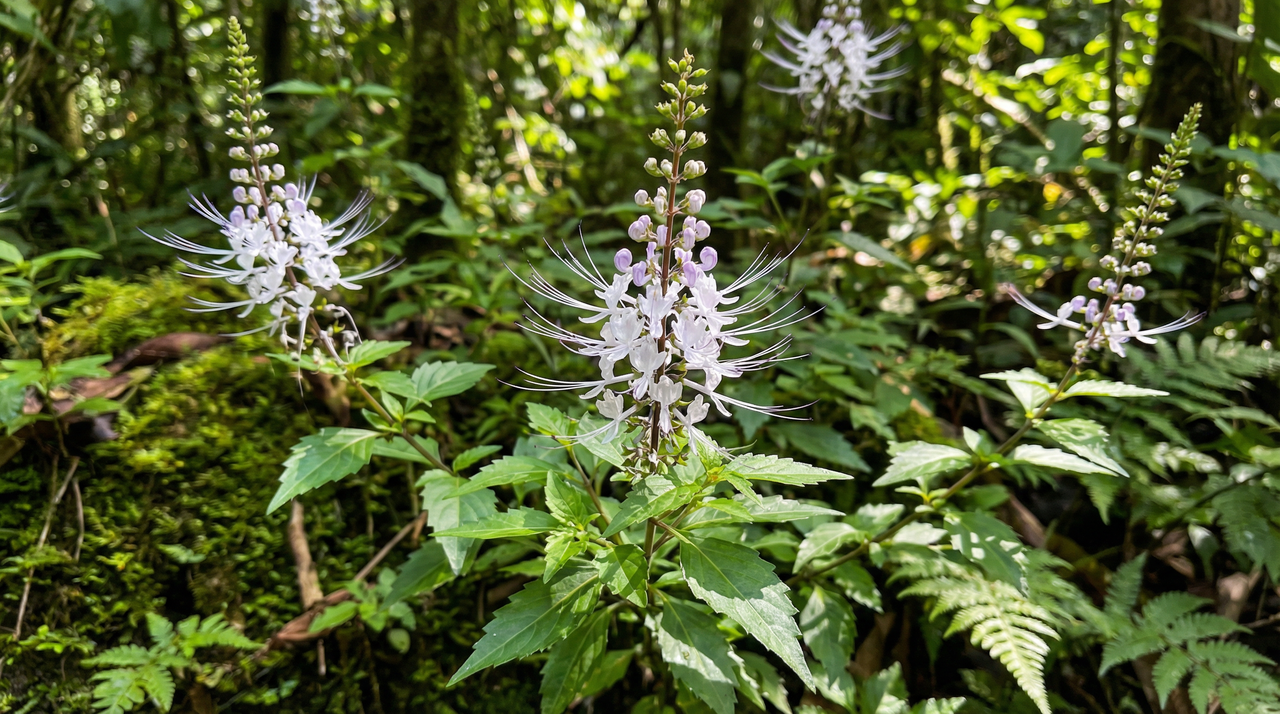
Most plants get their common names from what they do or where they're from. Cat's Whiskers got its name because, honestly, it looks like a cat's face mid-sneeze, those impossibly long, thread-fine stamens arching out four or five centimeters beyond the petals like something a cartoonist drew. I grew it for almost a full season before I stopped just staring at the flowers long enough to actually use the leaves. That's the trap with this plant: its ornamental personality is so arresting that its medicinal identity, centuries old and deeply serious in Southeast Asian traditional medicine, almost gets buried under the aesthetic. In Malaysia and Indonesia, where it's called Misai Kucing and Kumis Kucing (both meaning, yes, "cat's whiskers"), it was never a garden curiosity. It was the thing your grandmother steeped for kidney gravel and a swollen bladder.
What's quietly remarkable is that modern pharmacology has spent the last few decades essentially confirming what Javanese and Malay healers worked out empirically over centuries, finding rosmarinic acid, sinensetin, and a handful of other compounds that explain the diuretic action in measurable, clinical terms. That kind of convergence doesn't happen as often as herbal enthusiasts like to claim, which is exactly why this plant deserves more than a spot at the edge of a cottage border.
Cat's Whiskers Origin, History, and Cultural Significance
Botanical Background of Orthosiphon aristatus
Cat's whiskers belongs to the Lamiaceae family, that sprawling clan of aromatic herbs that also gives us basil, mint, and rosemary. The moment I first grew this plant, its square stems and opposite leaves told me exactly what I was dealing with before I'd looked up a single source. Botanically it goes by two names you'll encounter equally in the literature: Orthosiphon aristatus and Orthosiphon stamineus, which are treated as synonyms.[1][2] It's a perennial herbaceous subshrub that in ideal tropical conditions can persist for three to five years or more,[3][4] native to a broad swath of Southeast Asia covering Indonesia (particularly Java), Malaysia, Thailand, the Philippines, Vietnam, Singapore, New Guinea, and parts of India.[1][5][6]
In the wild it's a forest-edge and stream-bank plant, colonizing moist lowland habitats and disturbed clearings from sea level up to about 1500 meters, always with an eye toward humidity and partial shade.[6][4][7] That stream-bank ecology matters practically. Growing this plant in zone 9b, I've found it thrives most vigorously in the spots that replicate those conditions: dappled light, consistent soil moisture, and enough humidity that it never dries out between waterings. Forcing it into full afternoon sun without compensation is a quick way to lose a beautiful plant.
Visual Characteristics and Etymology
The common name cat's whiskers isn't poetic license. Those stamens really do extend four to five centimeters beyond the corolla, long, curved, and filiform, looking almost animated when a breeze moves through them.[1][4] The flowers themselves are tubular, two-lipped, arranged in terminal spikes ten to fifteen centimeters long, ranging from white to pale lavender with occasional purple spotting. The Malay name Misai Kucing and the Indonesian Kumis Kucing both translate directly to "cat's whiskers," and the Latin epithet aristatus comes from arista, meaning awn or beard, all pointing at the same extraordinary feature.[8][9]
Below those flowers sits a tidy, upright shrub reaching anywhere from half a meter to two meters tall with an overall clumping habit, bright green ovate to lanceolate leaves three to ten centimeters long, and the characteristic square stems of its mint-family relatives.[5][10][11] The fruit is a schizocarp that splits into four small brown nutlets, modest and easy to overlook after the drama of the bloom.[12]
Traditional and Cultural Uses Across Southeast Asia
Carl Ludwig Blume formally described the plant in 1826 in his Bijdragen tot de flora van Nederlandsch Indië,[13] but by then it had already been a trusted household remedy across the region for generations. In Malay, Javanese, Thai, Filipino, and Bornean traditions, including among the Orang Asli and Dayak peoples, the dried leaves were brewed as a diuretic tea for kidney and bladder stones, urinary tract disorders, hypertension, rheumatism, and general inflammation.[14][15][16] Its role was consistently practical rather than ceremonial: this was a kitchen herb, not a ritual one, steeped by ordinary people for ordinary ailments.
The plant was never formally domesticated. For most of its history it was simply collected wherever it grew near settlements, then gradually cultivated in kitchen gardens as demand grew.[14] Global commercial interest in Java tea has since created real pressure on wild populations, and sustainable cultivation is now actively practiced in Indonesia and Malaysia.[14] As someone who sources medicinal plants for client gardens, I always choose nursery-grown stock over anything wild-harvested, and with this species that choice carries genuine ecological weight. Through horticultural trade it has naturalized in India, Sri Lanka, the Caribbean, and parts of Florida and Hawaii, though it doesn't appear on USDA invasive lists and holds no endangered status on the IUCN Red List.[17][18]
Fun Facts About Java Tea
Cat's whiskers has the unusual distinction of being genuinely ornamental and genuinely medicinal in equal measure. Botanical gardens prize it for those extravagant white stamens and its willingness to flower across warm months from spring through fall, or year-round in true tropical climates.[4][19] Bees and butterflies work those long stamens enthusiastically, which makes the plant a welcome addition to any pollinator-friendly design.
Herbarium specimens at Kew Gardens from the 1880s document its early introduction to Europe for medicinal study,[20] which means the Western herbal-tea world has been quietly aware of Java tea for well over a century. What feels like a recent wellness discovery is really a very old relationship, and knowing that history makes it easy to understand why modern phytochemical research keeps confirming what Southeast Asian healers worked out long before Blume ever pressed a specimen.
Cat's Whiskers Varieties and Where to Buy
Notable Varieties of Cat's Whiskers
There are no named cultivars of cat's whiskers. That's the short answer, and I've come to appreciate it. The Missouri Botanical Garden, Kew Gardens, the RHS, and the USDA Plants Database all list Orthosiphon aristatus without a single recognized variety attached.[21][22][23][24] The scientific literature has stayed focused almost entirely on pharmacology and ethnobotany rather than horticultural improvement,[25] because frankly the wild-type already delivers everything anyone has asked of it: reliable phytochemistry for kidney tea, and those spectacular long stamens that make it unmistakable in a border or food forest.[21] Names like "Java tea" and "kidney tea" refer to the species itself, not to any selected line.[21] For a permaculture gardener, that simplifies the decision considerably: you're not hunting for a superior selection. You're growing the same plant that Southeast Asian communities have been harvesting for centuries, with nothing diluted or redirected by a breeding program.
Sourcing Cat's Whiskers Plants and Seeds
The good news is that the straight species is genuinely accessible from US specialty nurseries. For live plants, I've ordered from both Logee's Greenhouses and Almost Eden Nursery, and both ship healthy starts.[26][27] They arrive looking like tidy little mints, which is exactly why I label every flat immediately; the seedlings are easy to mix up with other Lamiaceae until the flowers appear and the whiskers give everything away. If you'd rather start from seed, Strictly Medicinal Seeds carries them and it's a legitimate way to grow a batch.[28] In my experience, seeds started in a warm spot reach flowering size within the same season, which is fast enough to make the extra effort worthwhile. Cuttings also turn up from US-based Etsy sellers if you prefer that route.[29]
Climate reality matters here: outdoor cultivation works in USDA zones 10-11, and everywhere else it's a container or houseplant.[30] Because Orthosiphon aristatus is not native to North America, I only source from nurseries that can confirm their stock is cultivated rather than wild-collected. It keeps my garden honest and keeps the local ecology safer from any unintended introductions. Stock at specialty nurseries does fluctuate seasonally, so check availability directly before you plan your planting window, and confirm shipping restrictions for live plants to your state before ordering.
How to Propagate and Plant Cat's Whiskers (Orthosiphon aristatus)
Cat's whiskers is a plant that will reward you generously once established, but getting there requires understanding what it actually wants from the start. Known as Java tea or Misai Kucing across Southeast Asia, this Lamiaceae subshrub can be started from seed or stem cuttings, and that choice matters more than most guides let on.[31][32]
Propagation Methods: Seeds vs Stem Cuttings
I've tried both routes repeatedly, and I keep coming back to stem cuttings for any plant I want to actually rely on. Seed-grown plants show real variability in leaf aroma and growth habit, which matters when you're growing this specifically for the kidney-supporting tea. Cuttings preserve the traits of a proven mother plant, while seeds maintain genetic diversity.[31][33] For consistent medicinal production, vegetative propagation is simply the more reliable path.
For cuttings, take semi-hardwood or softwood stems 10-15 cm (4-6 inches) long with at least two nodes, ideally in spring or summer from a healthy, vigorous plant.[31][34] Strip the lower leaves, dip the cut end in IBA rooting hormone if you have it (it's optional, but can push success rates to 80-90%), and stick the cutting into a 50/50 perlite-peat or sand-peat mix at pH 5.5-6.5.[31][33][35] Keep humidity between 70-80% (a plastic bag tent or humidity dome works fine), provide indirect light, and maintain temperatures of 21-29°C (70-85°F). Roots usually form in 2-4 weeks.[31][34] Always use clean, sterilized tools to avoid introducing pathogens.
If you want to try orthosiphon aristatus seeds, know what you're getting into. The seeds are tiny, just 0.8-1.0 mm long, and they require light to germinate, so surface-sow them and do not cover them.[31][36] The species has orthodox seed storage behavior, meaning you can store seeds at low moisture (3-5%) and cool temperatures (5-10°C), but viability data for this species is thin.[37] I always run a quick germination test on stored seed before committing a whole tray, because tropical herb seed can lose vigor faster than expected in Florida's heat and humidity. Air layering is also viable and can hit 80% success in 4-6 weeks on a flexible branch; grafting is unnecessary given how readily the plant roots by other means.[38]
Germination Timeline and Requirements
Under good conditions (warm temperatures around 25-30°C, moist soil, light exposure), orthosiphon stamineus seeds germinate in roughly 14-21 days, though I've seen the window stretch to 3-4 weeks depending on seed freshness and ambient conditions.[39][31] What the guides don't always tell you is that germination rates tend to hover around 30-50%, with real variability in the seedlings that do emerge.[5] Sow more seed than you think you need.
From germination (or from a rooted cutting), first harvest maturity arrives at roughly 3-6 months, when the plant is 30-50 cm tall and beginning to flower.[39][5][40] Cuttings skip the slow early seedling stage entirely and typically reach harvestable size faster, which is one more reason I prefer them for anyone growing this plant with a medicinal purpose in mind.
Soil, Site Selection, and Planting Technique
Cat's whiskers evolved along humid tropical forest edges and stream banks in Southeast Asia, and the soil requirements reflect that origin exactly: fertile, well-drained loam with 3-5% organic matter and a pH of 5.5-7.0, with 6.5 being the sweet spot for essential oil content.[4][41] Above pH 7.5, I start seeing interveinal yellowing on new growth; below 5.0, older leaves develop a reddish tinge and growth stalls noticeably. These visual cues are worth learning because they show up before a plant is seriously struggling. Drainage is non-negotiable. I've lost plants to root rot in heavy Florida clay before I started amending aggressively with coarse sand and compost, and that lesson stuck.[42][5]
For humidity and moisture, this plant wants the 60-80% humidity range and consistent soil moisture without waterlogging, reflecting its native habitat's 1,500-3,000 mm annual rainfall.[4][5] Mulch heavily at the base to retain moisture, and in hot climates, a bit of afternoon shade prevents leaf scorch.[43] For container growing, I use roughly 40% loamy soil, 30% compost, 20% perlite, and 10% coco coir, though in my humid subtropical summers I bump the perlite slightly higher to prevent sogginess. Drainage holes are essential; the pot itself should be at least 12-18 inches in diameter.[44]
Spacing and Establishment for Garden or Container Growing
Mature plants reach 1.5-2 m tall with a bushy spread of 60-90 cm, so spacing deserves serious thought upfront.[31][4] The recommended range is 30-60 cm apart, with 45 cm being my personal preference for balancing yield with airflow in humid conditions. Crowded plants trap moisture around the foliage, which creates exactly the kind of environment that invites fungal problems. Adequate spacing also makes pruning and harvesting much easier later on. In cooler climates or for indoor starts, sow seeds 6-8 weeks before the last frost at 21-24°C (70-75°F) and transplant once nighttime temperatures stay reliably warm.[32] Get the spacing and drainage right at planting, and the 3-6 month journey to first harvest goes smoothly.
Cat's Whiskers Care Guide: Growing Orthosiphon aristatus
Cat's whiskers is a plant that rewards consistency over fuss. Get the core conditions right and it settles into a generous, long-lived perennial that practically tends itself. Push it outside its comfort zone and it will tell you immediately, which is actually one of the things I appreciate about it. The symptoms are legible. Learn to read them and you'll spend less time guessing and more time harvesting.
Watering and Humidity Needs
The rule I come back to every time is this: consistently moist, never waterlogged. Water when the top inch or two of soil dries out, and check with your finger rather than a schedule.[4] I do a quick poke before every watering on my potted Java tea on the patio, and honestly it takes two seconds and has saved me from both overwatering and drought stress more times than I can count. During spring and summer when the plant is actively growing, that might mean watering every two to three days; in winter I back off significantly.[32][45]
Humidity matters just as much as soil moisture, especially for indoor plants. In its native Southeast Asian habitat, this plant lives in genuinely humid air, so dry indoor environments in winter can stress it even when the soil looks fine. Misting the foliage helps bridge that gap.[4][46] If you see leaves yellowing or wilting despite consistently moist soil, root rot from waterlogging is the likely culprit.[47] Crispy brown tips and curling leaves, on the other hand, point to underwatering or low humidity.[32] The plant can survive a dry spell of a week or two,[48] but I wouldn't test that tolerance routinely.
Sunlight Requirements
In my Central Florida garden, full sun turns into a problem fast. Cat's whiskers does best with four to six hours of direct light and some afternoon protection,[49] which mirrors the dappled understory conditions it evolved in. I treat it a lot like I treat basil: morning sun is welcome, but by two o'clock it appreciates some shade. Too little light and the stems get leggy; too much direct afternoon exposure and the leaf margins burn within days. A spot on the east side of a taller shrub or under open tree canopy tends to be the sweet spot.
Temperature, Heat, and Frost Tolerance
This plant has a hard floor at around 50°F. Below that threshold, damage starts: wilting, browning, leaf and bud necrosis.[50] The ideal range is 60 to 85°F,[4][51] and it's reliably hardy in USDA zones 10-11 with some sources extending that to zone 9b with protection.[4][51] After I lost my first overwintered plants to an unexpected cold snap, I made a rule: any forecast dipping near 50°F means pots come inside immediately. I haven't lost one since. For in-ground plants, mulching the root zone and covering with frost cloth during cold snaps buys meaningful protection; pruning back frost-damaged stems afterward encourages clean regrowth.[52]
The upper temperature ceiling is softer but real. The plant can handle up to around 95°F, and briefly up to 104°F with acclimatization, but heat stress shows up fast as scorched brown leaf margins and wilting.[53][54] In my garden, tip browning shows up within two days of a dry heat wave over 95°F. The fix: afternoon shade, two to three inches of organic mulch over the root zone, and keeping humidity up around 70 to 90%.[49] In Florida's humid summers, the plant actually thrives once those three things are dialed in.
Feeding and Soil Fertility
Cat's whiskers is a light to moderate feeder. A balanced fertilizer like 10-10-10 applied every four to six weeks through the growing season is plenty; for potted plants, use half strength to avoid salt accumulation.[55][32] The soil itself should be well-drained and fertile, slightly acidic to neutral (pH 5.5 to 7.0), and enriched with compost.[31][56] Early in my growing days I pushed mine with a high-nitrogen fertilizer thinking I'd get bigger, more productive plants. What I got instead was lush, dark green, slightly floppy stems and almost no flowers. The research backs up what I learned the hard way: excess nitrogen drives foliage at the expense of blooms.[31] I've since switched to organic options entirely, which also avoids synthetic residues in leaves destined for tea.[57] Stop fertilizing in winter when the plant is dormant.[32]
Pruning, Maintenance, and Seasonal Rhythm
Light, regular pruning is what keeps cat's whiskers looking dense and flowering well. Hard cuts reduce both flower production and medicinal leaf yield, so the better approach is trimming lightly after each flowering cycle rather than cutting back hard once a year.[58] My standard practice is to pinch the tips of new growth in early June, which nudges the plant into a bushier shape and results in compact, 18-inch plants loaded with blooms by late summer. It's a small intervention with a noticeably bigger harvest come fall. Potted plants benefit from repotting every one to two years to refresh the growing medium and give roots room.[55]
Seasonally, the rhythm is simple: active growth from spring through early fall, then a quieter period through winter.[46] In zones 10 and 11 that dormancy is barely perceptible. For zone 9b growers and anyone in cooler climates, treating it as a tender perennial and moving containers to a bright sheltered spot when temperatures drop is the practical path to keeping the plant for multiple seasons rather than replacing it every year.[59][32]
How to Harvest Cat's Whiskers (Java Tea)
Cat's whiskers is one of those plants that tells you when it's ready. Once it starts flowering, usually around the second or third month after planting and typically 3 to 4 months in, the medicinal compounds are ramping up toward peak concentration. Research points to roughly 90 days post-bloom as the sweet spot for active constituents like rosmarinic acid.[39][40][60] After multiple seasons with this herb, I've learned to wait for that first flush of white or lavender flowers before reaching for my shears. Cutting even a week or two early makes a noticeable difference in aromatic strength when the dried tea steeped.
When to Harvest Cat's Whiskers for Peak Medicinal Quality
In U.S. gardens (USDA zones 9 through 11), the practical harvest window runs from about July through October.[31] In tropical climates, the plant flowers year-round, which means you're never really waiting long between cuts. What makes Orthosiphon aristatus such a satisfying medicinal crop is that a well-established plant remains productive for two to five years or more,[61][4] so once you've got the flowering cue locked in, you're managing a continuous supply rather than a single season's effort.
Harvesting Technique and Post-Harvest Handling
Cut about two-thirds of the plant's height every two to three months, harvesting leaves, flexible young stems, and flowering tops together. Morning is the best time, after the dew dries but before the heat peaks. I look for leaves that are 5 to 10 cm long, deep green, and showing no yellowing. Because the plant responds so well to this aggressive cut, I often harvest a bed in stages over several days rather than all at once, so fresh material is always coming on behind what I've taken.
Post-harvest handling matters as much as the timing. Dry the orthosiphon leaf material at low temperatures, between 40 and 50°C, or shade-dry on elevated racks. In my humid subtropical conditions, I always choose shade-drying to avoid mold, and it turns out that approach also retains more of the volatile compounds than sun exposure would. Store the finished dried herb in airtight, light-proof containers at 15 to 25°C with humidity below 60%; shelf life runs one to two years under those conditions.
Flavor, Yield, and Brewing Tips
Fresh orthosiphon leaves are mild and slightly crisp, with a flavor that's lightly sweet, faintly bitter, and subtly herbal. Brewed, the tea settles into earthy, grassy notes with a clean, slightly sweet finish, nothing aggressive.[7][62][63] Those aromatic qualities come from essential oil compounds like beta-caryophyllene and eugenol,[64] which is exactly why harvest timing and gentle drying make a difference you can taste. Harvesting at peak flower, shade-drying rather than sun-drying, and steeping for 5 to 10 minutes gives you the best balance of flavor without tipping into bitterness.[65][66] I'd compare it to a much gentler, less pungent version of other mint-family herbs I grow for tea. The reward here isn't bold flavor; it's a clean, refreshing infusion that happens to carry serious medicinal weight.
Cat's Whiskers Preparation and Uses
Cat's whiskers is, first and foremost, a tea plant. The leaves and young stems are edible,[39][67] and while young shoots occasionally appear as vegetables in Southeast Asian cooking, the overwhelming story here is a daily cup of java tea rather than anything you'd toss into a stir-fry. Unlike mint or lemon balm, which I find myself weaving into salads, drinks, and desserts all season long, cat's whiskers stays firmly in its lane as a medicinal infusion. That's not a limitation; it's clarity of purpose.
Culinary Uses and Flavor Profile of Java Tea
The standard preparation is simple: 1 to 2 teaspoons of dried leaves steeped in hot water for 5 to 10 minutes.[68][7][62] The flavor is mild, earthy, and slightly bitter with grassy and woody undertones,[69][70] and I've found that leaves harvested just before flowering produce a noticeably gentler cup than those taken later in the season. The bitterness sharpens with longer steeping too, so I generally pull the leaves at 7 minutes and don't push it. Phytochemically, the leaves are well-equipped: they carry meaningful amounts of rosmarinic acid, sinensetin, and eupatorin alongside vitamin C and a striking potassium content,[69][71][72] but you're drinking this for function, not nutrition. Shade-dry the aerial parts after harvest and store them in an airtight container away from moisture and light to preserve those compounds.[73]
One practical note: cat's whiskers shares the Lamiaceae family with Plectranthus and Coleus species that can look deceptively similar in a garden bed.[74][75] My field marker is always those long, exserted stamens; nothing else in this family has that unmistakable whisker effect. If you're not looking at the stamens, you're guessing.
Traditional Medicinal Preparations and Dosages
Across Malaysia, Indonesia, and Thailand, orthosiphon aristatus has been a go-to remedy for urinary tract infections, kidney stones, hypertension, diabetes, and gout, and in Malaysia it's commercially sold as Misai Kucing tea specifically for kidney and blood sugar support.[76][77][78] The daily tea is preventive and tonic rather than acute treatment; leaves are the primary preparation, though decoctions using stems and young shoots appear in traditional practice for kidney stone dissolution and blood sugar regulation.[79][80] Leaves are also applied topically for wound healing in some traditions.[81]
Traditional dosage guidance calls for 4 to 12 grams of dried leaves daily, split across 2 to 3 cups; decoctions use 6 to 15 grams boiled in 500 to 1000 ml of water, taken in 2 to 3 doses.[82][83] I find that two morning cups from freshly dried, pre-flowering leaves fits comfortably within that range without straining the plant, and it aligns naturally with harvesting 2 to 3 times per year rather than constantly stripping the shrub.
Safety, Side Effects, and Contraindications
Java tea is generally considered safe for short-term use in healthy adults at 1 to 2 cups daily,[84] but I want to be direct here: this is a pharmacologically active herb, not a pleasant herbal novelty. Potential side effects include nausea, diarrhea, dehydration, electrolyte imbalance, and low blood pressure.[84] Anyone on diuretics, antihypertensives, lithium, or diabetes medications should talk to their doctor before using orthosiphon stamineus extract or tea regularly; the additive effects are well-documented and not worth risking.[85][86] It's also contraindicated during pregnancy and breastfeeding due to insufficient safety data and potential uterine stimulant effects.[85] Respect those limits and the plant is a genuinely useful part of an herbal toolkit.
Non-Food and Other Uses
Beyond the cup, there's honestly not much to report. No documented fiber, timber, or dye applications exist for this plant,[39] and I'd rather say that plainly than stretch toward uses that aren't real. What it does offer in a permaculture context is biomass: the prunings decompose readily and feed the compost pile, closing the loop between harvest and soil fertility. In my food forest, cat's whiskers earns its place primarily through the tea harvest and the pollinators it draws, and that's enough. Not every plant needs to be a Swiss Army knife.
Cat's Whiskers Health Benefits and Medicinal Uses
Traditional Uses and Scientific Research on Java Tea
Across Indonesia, Malaysia, Thailand, and the Philippines, healers have relied on Orthosiphon aristatus for centuries to treat urinary disorders, kidney stones, hypertension, diabetes, gout, and rheumatism.[87][79] What I find genuinely exciting about this plant is how well the modern science has lined up with that folk record. Preclinical research documents antioxidant, anti-inflammatory, antimicrobial, diuretic, nephroprotective, hypoglycemic, and xanthine oxidase inhibitory activity, though the bulk of that work comes from in vitro and animal studies rather than humans.[88][89]
The diuretic action is where the evidence is most compelling. Cat's whiskers works by inhibiting the Na+/K+-ATPase pump, increasing renal excretion of sodium and water without causing significant potassium loss.[90][91] A small randomized controlled trial of 30 healthy volunteers found diuretic effects comparable to furosemide, with no major adverse events reported.[92] For an herbal tea, that's a meaningful result. Preliminary human data also show reductions in uric acid and improved renal function markers in patients with kidney disorders, and early osteoarthritis work suggests anti-inflammatory benefit in people.[93][94] I find those preliminary studies promising, but I stay measured about them until larger trials appear.
The anti-inflammatory pathway involves suppression of TNF-α and IL-6 through NF-κB and COX-2 inhibition.[95] Antioxidant activity comes from direct free radical scavenging alongside upregulation of the body's own protective enzymes like SOD, CAT, and GPx.[96] The xanthine oxidase inhibition, which reduces uric acid production similarly to allopurinol, aligns beautifully with the traditional gout applications.[97] Nephroprotective effects against drug-induced kidney damage have also been observed in rat models, and systematic reviews affirm genuine potential for kidney health, while being clear that robust large-scale human trials are still needed.[98][99]
Key Phytochemicals in Orthosiphon aristatus
The leaves are richest in polymethoxylated flavonoids, particularly sinensetin, eupatorin, scutellarein tetramethyl ether, and 3'-hydroxy-5,6,7,4'-tetramethoxyflavone, along with phenolic acids led by rosmarinic acid, caffeic acid, and chlorogenic acid.[100][101] Rosmarinic acid is the dominant bioactive and the main driver of antioxidant and anti-inflammatory activity. The plant also contains diterpenes (orthosiphols A through D), ursolic acid, β-sitosterol, saponins, and iridoid glycosides, with leaf tissue consistently showing higher flavonoid and phenolic concentrations than stems or roots.[100][102]
Here's something I always share with clients who grow their own medicinal herbs: phytochemical content isn't fixed. Geography, season, soil pH, harvest timing, and cultivation method all shift the numbers significantly, with Malaysian-sourced plants and material harvested at full flowering tending to show the strongest profiles.[103][104] In my Central Florida beds, I've noticed the dried leaves smell more pungent and aromatic when I've kept the soil on the acidic side and cut at peak bloom. The difference between a vibrant, bioactive tea and a bland one really does come down to when you pick it.
Nutritional Profile of Java Tea Leaves
Java tea is consumed as an herbal infusion, not a food, so keeping nutritional expectations realistic matters.[105] Fresh leaves run about 20-30 kcal per 100 g given their 80-90% water content, and dried leaves contain roughly 10-15% protein, 2-5% fat, and 30-40% carbohydrate, mostly fiber.[105][106] Those numbers will vary depending on variety, soil, and whether you're analyzing fresh or dried material, so treat any single analysis as a rough guide.
The mineral profile is where things get interesting. Dried leaves deliver roughly 1,450 mg of potassium, 820 mg of calcium, and 320 mg of magnesium per 100 g, alongside 18.5 mg of iron and meaningful zinc and phosphorus.[107][108] I think about this in the context of herbs like nettles or dandelion leaf that I also grow for mineral-dense teas; cat's whiskers sits comfortably in that company, especially on potassium, which ties directly to the plant's traditional reputation for blood pressure and diuretic support. The real story, though, is the phytochemical load: the flavonoids, rosmarinic acid, and terpenoids in every cup are ultimately why this plant has a therapeutic reputation at all.[88]
Safety, Side Effects, and Precautions
The good news is that cat's whiskers has a genuinely reassuring safety record for moderate daily tea consumption. Centuries of Southeast Asian use, a high acute toxicity threshold (LD50 above 5,000 mg/kg in rats), and the absence of serious adverse events in human trials up to 500 mg per day all point toward a low-risk herb when used sensibly.[109][110]
Excessive intake, however, brings predictable diuretic-related risks. Mild gastrointestinal upset, nausea, and diarrhea have been reported, and prolonged heavy use can cause electrolyte imbalance, particularly hypokalemia, which is worth monitoring in anyone drinking it therapeutically long-term.[111][112] The same diuretic strength that delivers kidney benefits can cause imbalance if you overdo it. I always tell clients that respecting dosage here isn't overcaution, it's just understanding how the plant works.
Drug interactions are a real concern. Cat's whiskers can compound the effects of diuretics, antihypertensives, anticoagulants, and lithium, and anyone on medications affecting potassium or blood pressure should talk to their physician before using it medicinally.[109][113] Use during pregnancy, lactation, or in children under 12 is not recommended, and those with severe kidney disease should avoid it entirely without medical supervision, simply because the safety data for these groups doesn't yet exist.[110][109] Having read the EMA assessment and the clinical diuretic trial data, I'm comfortable recommending a daily cup of Java tea for healthy adults, but I'm clear with anyone on medication that a quick conversation with their doctor comes first.
Cat's Whiskers Pests and Diseases
Natural Resistance Mechanisms in Orthosiphon aristatus
Cat's whiskers has a decent set of built-in defenses for a plant that's never been seriously bred for pest resistance. The aromatic foliage, physical leaf trichomes, and secondary metabolites including sinensetin, rosmarinic acid, and various terpenoids all work as a first line of deterrence against casual attackers.[114][115] Lab work has confirmed larvicidal activity against Aedes aegypti and antifeedant effects on aphids, though most of that research hasn't been field-validated yet.[69][116] I think of it the way I think about basil or oregano: that fuzzy, fragrant foliage tends to make most garden pests pause before committing. It's not armor, but it's something. Some Malaysian and Indonesian lines, including certain Orthosiphon stamineus selections, do show better pathogen tolerance than others, though breeding has prioritized medicinal chemistry over resistance traits and truly robust commercial varieties remain scarce.[117] When I'm sourcing plants, I look for vigorous, locally adapted stock from reputable Florida or Southeast Asian growers rather than whatever happens to be cheap at a big-box nursery.
Common Diseases and Environmental Triggers
The disease roster is mostly fungal: leaf spot (Cercospora and Alternaria species), root rot from Fusarium, Pythium, and Phytophthora, powdery mildew, rust, and anthracnose are all documented.[118][119] Bacterial wilt (Ralstonia solanacearum) and leaf blight also show up, usually as sudden wilting, vascular browning, or water-soaked lesions.[118][115] What ties most of these problems together is environment. Poor drainage, stagnant air, and persistent humidity are the real culprits.[31][119] I had a planting in a low-lying client garden in zone 9b where a tight microclimate and clay soil triggered root rot within a single wet season; once I improved drainage and opened the canopy above for airflow, the replanted specimens thrived. Copper-based fungicides or azoxystrobin can help when disease pressure is serious, but I'd call those a last resort after cultural fixes are in place.[31][120]
Practical IPM Strategies for Healthy Plants
Aphids, spider mites, whiteflies, leafminers, and mealybugs are the main insect threats, with young plants and stressed specimens bearing the worst of it.[121][122] Spider mites in particular are sneaky; I've learned to flip leaves and check the undersides during dry spells because by the time you see visible damage from above, the population is already well established. In my designs, cultural fixes always come first: good drainage, proper plant spacing for airflow, avoiding overhead irrigation, and prompt removal of diseased material.[31] Ladybugs and predatory mites handle a surprising amount of the insect pressure when the garden isn't being regularly disrupted. Tucking marigolds into the guild is a simple, permaculture-friendly step that deters several pest species while adding pollinator habitat.[123] If something does break through, neem oil or insecticidal soap handles most pest flare-ups without compromising the plant's own chemical defenses. Keeping temperatures in that 20-30°C sweet spot with consistent moisture and good air movement reduces susceptibility across the board, and the aromatic foliage provides some incidental repellency on top of that.[32][124] Get the site conditions right, source healthy plants, and cat's whiskers will spend most of its energy growing rather than fighting.
Cat's Whiskers in Permaculture Design
Every plant has a story about where it comes from, and cat's whiskers tells that story loudly if you know how to read it. Orthosiphon aristatus evolved in the humid understories and disturbed stream banks of Southeast Asia, where it grows naturally alongside trickling water, dappled canopy light, and the kind of rich, constantly recycling organic matter that rainforests produce. When you design a guild around it, that origin is your blueprint.
Climate Preferences and Hardiness Zones
This is a genuinely tropical plant, and I think it's kinder to readers to say that plainly than to soften it with caveats. Cat's whiskers thrives where daytime temperatures sit between 20 and 30 °C and nighttime lows stay reliably above 15 °C.[125][46] It's rated hardy in USDA zones 9b through 11 and carries an RHS H1c designation, meaning any frost is a problem and temperatures below -1 °C will cause real damage.[125][46][4] I learned that lesson the hard way: I lost my first planting to an unexpected night that dipped to around 8 °C, thinking the forecast looked close enough. Now I keep potted backups under cover from October through March and mulch heavily around any in-ground plants. Those two habits are built into the zone recommendation for a reason.
In its native range the plant handles 1500 to 2500 mm of annual rainfall, tolerates humidity between 50 and 80 percent, and naturally colonizes stream banks, swampy edges, and disturbed lowland forest up to about 1500 m elevation.[1][126] In a zone 9b garden, a microclimate near a pond or tucked beneath a dense canopy can push the practical limit a degree or two lower, but I'd still call it a gamble rather than a strategy without that potted backup insurance.
Ecosystem Functions and Guild Roles
The most immediately noticeable thing cat's whiskers contributes to a guild is pollinator activity. Those long, protruding stamens and tubular white-to-lilac flowers aren't just decorative; they're engineered for insects, with nectar guides that draw in honeybees, wild bees, and butterflies, and occasionally hummingbirds where ranges overlap.[1][127] Once my plants are in full bloom I notice a noticeable uptick in bee presence across the whole garden bed, which benefits everything flowering nearby.
Below the surface it's doing quiet, useful work. Orthosiphon aristatus forms partnerships with arbuscular mycorrhizal fungi that improve phosphorus uptake and add some drought resilience, and its nitrogen-rich leaf litter decomposes quickly, feeding microbial communities and cycling nutrients back into the understory.[128][129] I think of it a bit like comfrey in a temperate system: it's not fixing nitrogen itself, so pairing it with legumes like pigeon pea is where you get real synergy. I've interplanted it with pigeon pea for a couple of seasons now, and the cat's whiskers foliage is noticeably greener and more vigorous than plants grown without that nitrogen-fixing neighbor.
As a pioneer species it also stabilizes soil and reduces erosion in wetter areas, and it shows enough competitive ability to fill gaps and suppress weeds without becoming aggressive.[130][131] There are some reports of mild allelopathic effects from root exudates, though the evidence is limited and I haven't noticed any suppression of companion plants in my own guilds.[132] In practice, it fills in around slower-growing perennials very effectively, which is exactly the role you want from an understory pioneer.
Forest Layer Placement and Companion Planting
In a food forest cat's whiskers belongs in the shrub layer, growing as a 1 to 2 m erect subshrub in the understory or along forest edges.[56][1] It actually prefers some shade and consistent moisture, which makes it a good fit for spots under fruit trees where a lot of sun-loving herbs struggle. Think of it as filling the role that sweet potato or caladium might play as a ground-level filler in Florida landscapes, except it's also giving you a steady medicinal harvest.
My favorite guild combination is cat's whiskers paired with pigeon pea for nitrogen, ginger and lemongrass tucked in at ground level, and a citrus or banana overhead to filter the light. The three herbs together create a lush, weed-suppressing mound that I can step into most mornings for a quick leaf harvest without much effort. Planted along a Zone 1 food forest edge or in an herb spiral with good moisture retention, it rewards you by behaving more like a perennial ground cover than a fussy medicinal.[133][134]
The full range of yields is worth keeping in mind when justifying the space it takes up: medicinal tea leaves year-round, biomass for chop-and-drop mulch from its fast-growing stems, and a continuous display of ornamental flowers that keep pollinators working nearby.[1][19] When you design with its stream-bank ecology in mind rather than treating it like an out-of-place tropical curiosity, every placement decision starts to make sense on its own terms.
The Plant That Made Me Take Herbal Tea Seriously Again
I'll be honest: I spent years treating herbal teas as pleasant rituals with soft evidence behind them. Then I started growing Cat's Whiskers and actually reading the clinical literature, and something shifted. There's something quietly clarifying about a plant this beautiful, this specific in what it does, and this thoroughly documented by people outside my hemisphere who've known it for centuries longer than I've been gardening.
Sources 134
- Orthosiphon aristatus (Java tea) - Plant Profile ↩
- Orthosiphon aristatus (Blume) Benth. ↩
- Plants of the World Online - Kew Science ↩
- Missouri Botanical Garden - Orthosiphon aristatus ↩
- Orthosiphon aristatus - Useful Tropical Plants Database ↩
- Royal Botanic Gardens Kew - Plants of the World Online ↩
- Orthosiphon aristatus - Wikipedia ↩
- Orthosiphon aristatus (Blume) Miq. ↩
- Plants of Singapore - Orthosiphon aristatus (Misai kucing) ↩
- Orthosiphon aristatus (Cat's Whiskers) Plant Profile ↩
- Flora of China: Orthosiphon aristatus ↩
- Flora of China - Orthosiphon aristatus ↩
- Bijdragen tot de flora van Nederlandsch Indië ↩
- Orthosiphon aristatus: A Review on Traditional Uses, Phytochemistry, and Pharmacological Properties ↩
- Orthosiphon stamineus (Misai kucing): chemical, pharmacological and therapeutic properties ↩
- Tropical Plant Research: Indigenous uses of Orthosiphon aristatus by the Orang Asli ↩
- USDA PLANTS Database: Orthosiphon aristatus ↩
- IUCN Red List Search for Orthosiphon aristatus ↩
- Growing Orthosiphon aristatus in Florida ↩
- Kew Science Herbarium Catalogue ↩
- Missouri Botanical Garden Plant Finder ↩
- Kew Gardens Plants of the World Online ↩
- Royal Horticultural Society (RHS) Plant Search ↩
- USDA PLANTS Database ↩
- Missouri Botanical Garden Plant Finder ↩
- Orthosiphon aristatus - Cat's Whiskers ↩
- Cat's Whiskers - Orthosiphon aristatus ↩
- Java Tea Seeds (Orthosiphon aristatus) ↩
- Misai Kucing Plant for Sale ↩
- Orthosiphon aristatus (Java Tea) ↩
- Propagation of Orthosiphon aristatus ↩
- Growing Cat's Whiskers (Orthosiphon aristatus) ↩
- Misai Kucing Cultivation Guide ↩
- Propagation of Orthosiphon aristatus (Java Tea Plant) ↩
- Cuttings Propagation Techniques for Medicinal Herbs ↩
- Orthosiphon aristatus - Plants of the World Online ↩
- Seed Storage Behaviour of Orthosiphon stamineus (syn. O. aristatus) ↩
- Propagation of Orthosiphon aristatus by Cuttings and Layering ↩
- Orthosiphon stamineus - Wikipedia ↩
- Cultivation and Harvesting of Orthosiphon aristatus ↩
- Cultivation of Orthosiphon aristatus: Soil and Environmental Requirements ↩
- Orthosiphon aristatus ↩
- Orthosiphon aristatus (Cat's Whiskers) - BBC Gardeners World Magazine ↩
- Cultivation of Misai Kucing (Orthosiphon aristatus) ↩
- Orthosiphon aristatus ↩
- Orthosiphon aristatus (Cat's Whiskers) ↩
- General Plant Care Guide: Avoiding Overwatering ↩
- Orthosiphon aristatus ↩
- Orthosiphon aristatus (Cat's Whiskers) ↩
- Orthosiphon aristatus (Cat's Whiskers) Plant Profile ↩
- Royal Horticultural Society - Orthosiphon aristatus ↩
- Protecting Tropical Plants from Frost ↩
- Response of Orthosiphon aristatus to Heat Stress: Physiological and Biochemical Changes ↩
- Thermal Tolerance in Medicinal Plants: A Case Study on Orthosiphon stamineus ↩
- Growing Cat's Whiskers (Orthosiphon aristatus) ↩
- Orthosiphon aristatus (Cat's Whiskers) Plant Profile ↩
- Cultivation of Orthosiphon aristatus: A Review ↩
- Orthosiphon aristatus Care Guide ↩
- Missouri Botanical Garden - Orthosiphon aristatus ↩
- Orthosiphon aristatus: A Review on Botany, Phytochemistry, and Pharmacology ↩
- Orthosiphon aristatus (Blume) Miq. - Flora of Singapore ↩
- Java Tea (Orthosiphon stamineus) Benefits and Uses - Healthline ↩
- Misai Kucing (Orthosiphon stamineus) - Traditional Medicinal Plant ↩
- Chemical Composition and Antioxidant Activity of Essential Oil from Orthosiphon stamineus ↩
- Effect of Drying Methods on the Volatile Compounds of Orthosiphon aristatus ↩
- Flavor Profile of Java Tea (Orthosiphon stamineus) Infusions ↩
- Flora Malesiana ↩
- Kew Science - Orthosiphon aristatus Fact Sheet ↩
- Nutritional and Phytochemical Composition of Orthosiphon aristatus Leaves ↩
- Misai Kucing (Orthosiphon aristatus) Traditional Uses in Malaysia ↩
- Vitamin and Flavonoid Analysis in Orthosiphon aristatus Tea ↩
- Bioactive Compounds in Misai Kucing (Orthosiphon stamineus) ↩
- Orthosiphon aristatus (Java Tea) - Kew Science ↩
- Misidentification of Medicinal Plants - Journal of Ethnopharmacology ↩
- Lamiaceae Family Look-Alikes - Royal Botanic Gardens Kew ↩
- Medicinal Uses of Orthosiphon aristatus (Java Tea) - Review ↩
- Misai Kucing (Orthosiphon stamineus) in Malaysian traditional medicine ↩
- Ethnobotanical survey of medicinal plants in Malaysia including Orthosiphon aristatus ↩
- Orthosiphon aristatus (Java tea): Overview and traditional uses ↩
- Medicinal Uses of Orthosiphon aristatus (Java Tea) ↩
- Ethnopharmacology of Orthosiphon aristatus ↩
- Orthosiphon aristatus - Examine.com ↩
- Java Tea (Orthosiphon aristatus) - Drugs.com ↩
- Orthosiphon stamineus: Traditional Uses, Phytochemistry, Pharmacology, and Toxicology ↩
- Assessment Report on Orthosiphon stamineus Benth., Folium ↩
- Cat's Whiskers (Orthosiphon stamineus) ↩
- Phytochemical and Pharmacological Review of Orthosiphon aristatus (Blume) Miq. ↩
- Pharmacological Activities of Orthosiphon stamineus: A Review ↩
- Antioxidant and Anti-inflammatory Properties of Orthosiphon aristatus ↩
- Diuretic Activity of Orthosiphon stamineus Extracts ↩
- Diuretic and Renal Effects of Orthosiphon stamineus ↩
- Diuretic Potential of Orthosiphon stamineus in Healthy Volunteers: A Randomized Controlled Trial ↩
- Anti-Inflammatory Effects of Orthosiphon aristatus in a Preliminary Human Study on Osteoarthritis ↩
- Clinical trial on Orthosiphon aristatus for hyperuricemia ↩
- Anti-Inflammatory Effects of Hispidulin from Orthosiphon aristatus ↩
- Antioxidant Mechanisms of Rosmarinic Acid in Orthosiphon stamineus ↩
- Rosmarinic Acid as a Multifunctional Inhibitor in Orthosiphon aristatus ↩
- Nephroprotective effects in rat model ↩
- Systematic Review of Orthosiphon stamineus for Kidney Health ↩
- Phytochemical and Pharmacological Review of Orthosiphon stamineus Benth ↩
- Phenolic Compounds in Orthosiphon aristatus: Rosmarinic Acid Content ↩
- Secondary Metabolites from Roots of Orthosiphon aristatus ↩
- Seasonal Variation in Secondary Metabolites of Orthosiphon aristatus ↩
- Phytochemical and Pharmacological Studies on Orthosiphon aristatus ↩
- Nutritional and Phytochemical Composition of Orthosiphon aristatus Leaves ↩
- Proximate Analysis of Java Tea (Orthosiphon aristatus) from Malaysia ↩
- Nutritional Composition and Antioxidant Properties of Orthosiphon stamineus Leaves ↩
- Proximate and Mineral Composition of Cat's Whiskers (Orthosiphon aristatus) Leaves ↩
- Orthosiphon stamineus: A Review on Its Phytochemistry and Pharmacological Properties ↩
- EMA Final Assessment Report on Orthosiphon aristatus folium ↩
- Cat's Whisker - Uses, Side Effects, and More ↩
- Pharmacological Activities and Safety of Java Tea (Orthosiphon stamineus): A Review ↩
- Herbal Medicines: Orthosiphon aristatus Safety and Dosage ↩
- Secondary Metabolites from Orthosiphon aristatus and Their Biological Activities ↩
- Pests and Diseases of Medicinal Plants: Orthosiphon stamineus ↩
- Antifeedant Effects of Orthosiphon aristatus Leaf Extracts on Aphids ↩
- Breeding for Disease Resistance in Orthosiphon aristatus: Challenges and Opportunities ↩
- Diseases of Orthosiphon aristatus: A Review ↩
- Cultivation Guide for Java Tea (Orthosiphon aristatus) ↩
- Diseases of Herbal Plants: Orthosiphon aristatus ↩
- Pests and Diseases of Orthosiphon aristatus ↩
- Common Pests of Cat's Whiskers Plant in Southeast Asia ↩
- Integrated Pest Management for Herbal Crops ↩
- Cultivation Guide for Cat's Whiskers (Orthosiphon aristatus) ↩
- USDA Plant Hardiness Zone Map and Information ↩
- Cat's Whiskers (Orthosiphon aristatus) Habitat and Cultivation - Useful Tropical Plants ↩
- Floral Biology of Orthosiphon stamineus ↩
- Mycorrhizal Symbiosis in Orthosiphon Species ↩
- Leaf Litter Decomposition Rates in Tropical Ecosystems ↩
- Ecological Studies of Orthosiphon stamineus in Southeast Asian Forests ↩
- Ecological Role of Orthosiphon aristatus in Tropical Forests ↩
- Allelopathy in Medicinal Plants: Orthosiphon aristatus ↩
- Orthosiphon aristatus in Permaculture Guilds ↩
- Permaculture Companion Plants for Tropical Herbs ↩