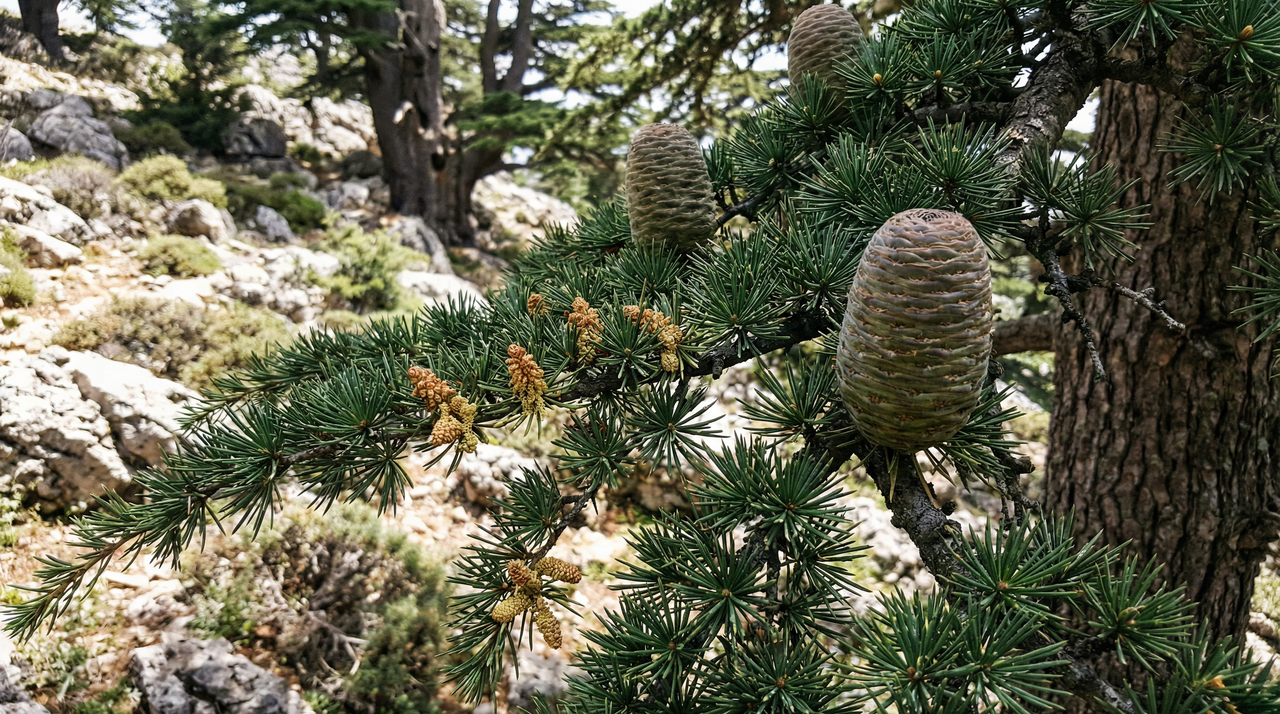
The Cedar of Lebanon, one of the most written-about trees in all of human history, a tree that appears in the Epic of Gilgamesh, the Book of Kings, and the hieroglyphic records of Egyptian pharaohs, now survives in scattered fragments covering less than 17 square kilometers of its native Lebanese highlands.[1] We didn't just use this tree. We built our civilizations out of it, literally, and kept cutting until almost nothing was left.
I've stood under old cedars in landscape settings and felt that particular stillness that only very large, very old conifers seem to hold. The horizontal plates of foliage, the deeply furrowed bark going silver-grey with age, the resinous scent on a warm afternoon; it's a tree that asks you to slow down, which is maybe why it fits so naturally into a permaculture mindset. But before you get charmed into planting one without thinking it through, there's a lot worth understanding: its strange relationship with food and medicine (it's not what most people assume), how its chemistry shapes everything that can and can't grow beneath it, and why getting the site right the first time isn't just good practice here, it's essentially irreversible.
Cedar Origin, History, and Cultural Significance
Few trees carry the weight of human history the way cedar does. I've stood in front of mature Cedrus libani specimens in botanical gardens and felt something shift in my sense of scale. This isn't just a handsome conifer. It's a tree that built empires, anchored sacred texts, and became the face of an entire nation. The cedar appears on the Lebanese flag, a symbol of strength, immortality, and divine favor that has persisted through Phoenician seafarers, Egyptian pharaohs, Roman emperors, and modern conservationists.[2]
Botanical Background and Native Habitat
The Cedar of Lebanon is native to the high-elevation mountains of the eastern Mediterranean: Lebanon, Syria, and Turkey, growing between roughly 900 and 2,900 meters on north-facing slopes with rocky limestone soils and annual rainfall between 800 and 1,500 mm.[3][4] Those conditions, hot dry summers, brutal winters, thin soils, are exactly what forged the legendary resilience that made this tree so prized. When I'm selecting site placement for a long-lived specimen tree, I think about that origin story constantly. A tree shaped by adversity at altitude doesn't want coddling. It wants drainage and exposure.
Half a world away, Deodar cedar (Cedrus deodara) came up in the western Himalayas under strikingly parallel conditions: elevations between 1,200 and 3,200 meters, 1,000 to 2,500 mm of annual rainfall, and similarly well-drained mountain slopes.[5] Both species evolved their toughness in thin air.
Growth is slow, typically 12 to 24 inches per year, though optimal conditions can push that to two or three feet.[6] Reproductive maturity comes around 20 to 30 years.[7] I planted a small Cedrus libani in a client's garden about eighteen years ago, and it's only now beginning to hint at the broad, tiered silhouette it will eventually become. That's the perspective shift this tree asks of you: not what it looks like today, but what it will be in a century. Some specimens in Lebanon have been dated by dendrochronology at over 2,000 years old.[8] That kind of longevity reframes everything about how you design around one.
The IUCN lists Cedrus libani as Vulnerable, with populations declining roughly 20% over 90 years due to historic overexploitation, overgrazing, fire, and climate-driven drought.[9] The conservation picture isn't all grim though: over a million trees have been reforested in Lebanon since the 1990s, and several reserves now hold protected groves.[10] Deodar cedar sits at Least Concern globally, though regional Himalayan populations face similar pressures.[11] I source only from nurseries doing ethical propagation; putting pressure on wild Vulnerable populations through wild collection is something I won't participate in, and I'd encourage any fellow designer to feel the same.
Visual Characteristics and Identification
Cedrus libani starts life with a tidy pyramidal habit and then, over decades, opens into one of the most architecturally distinctive crowns in the conifer world: broad, flat-topped, with tiered branches sweeping horizontally in layers that feel almost deliberate.[5] Mature trees reach 15 to 40 meters, with exceptional specimens pushing 50.[12] The needles are blue-green, 1 to 2 cm long, clustered in dense rosettes of 15 to 45 on short shoots. Bark on young trees is smooth and grayish; as the tree ages it becomes deeply fissured and reddish-brown. The barrel-shaped cones sit erect at 8 to 13 cm, ripening from green to brown.[13]
Deodar cedar reads quite differently once you know what to look for. Its needles are longer and softer, 2.5 to 5 cm, with a graceful pendulous habit on the branch tips that gives the whole tree a weeping quality.[14] The immature cones are a striking bluish-purple before maturing to brown and disintegrating on the tree, which is something I always point out to clients as a distinguishing feature.[15]
One identification note I can't skip: early in my career I mixed up a true cedar with eastern red cedar (Juniperus virginiana), which is not a cedar at all.[16] True Cedrus species have needles in those characteristic dense clusters on short spur shoots. Junipers have scale-like or awl-like foliage and fleshy berry-like cones. Get that distinction right from the start, because use profiles and safety considerations differ meaningfully between them.
Traditional and Cultural Uses Through History
Cedar timber has been coveted for at least three millennia. Phoenicians felled it for their legendary ships and city construction; Egyptian pharaohs used it for royal boats and sarcophagi; the biblical account of Solomon's Temple describes cedars sourced from Lebanon as its primary structural material; and Roman emperors under Nero continued the tradition for temples and palaces.[17][18] The resin served Greek and Roman physicians as incense and as treatment for respiratory ailments and skin conditions.[19] What strikes me is that the same aromatic, rot-resistant qualities that made it worth sailing across the Mediterranean to obtain are the same ones that make cedar heartwood last centuries in structures today.
The cedar's symbolism runs just as deep as its practical uses. Today, the ancient forests where this resilience was forged are recognized by UNESCO as protected biosphere reserves.[20] There's something in that resilience symbolism that resonates directly with permaculture thinking: a tree that survives millennia of exploitation and still holds the soil, still seeds new forests, still represents hope for a nation.
In the Himalayas, Deodar cedar carries equal sacred weight. Known as devadaru, meaning "wood of the gods" in Sanskrit, it appears in Vedic texts including the Rigveda and has been central to Hindu and Buddhist temple construction, ritual, and monastery architecture for thousands of years.[21] Ayurvedic practitioners used it for respiratory complaints, skin disorders, joint pain, and as an antiseptic, with Himalayan communities continuing to rely on it for timber and medicinal preparations.[22] Two great mountain ranges, two ancient civilizations, and the same genus earning sacred status independently. That parallelism always gives me pause.
Commercial logging of both species is now heavily regulated or outright prohibited within their native ranges, which makes sustainable sourcing from reputable propagators the only ethical path forward for modern garden and landscape use.[23]
Longevity, Conservation, and Fun Facts
The ancient grove known as the Cedars of God in Lebanon holds specimens estimated between 1,200 and 2,000 years old, trees that were already mature when the Crusaders passed through the Levant.[8] These trees were used in ritual, medicine, and as living representations of immortality across generations of human civilization. To stand near one is to recalibrate your understanding of time in a way that I think every permaculture designer should experience at least once.
Deodar cedar matches that longevity in its own range, with some Himalayan specimens documented over 700 to 2,000 years old, quietly stabilizing soils, protecting watersheds, and supporting biodiversity across mountain ecosystems with comparatively less conservation pressure than its Mediterranean counterpart.[24][25]
Growing a cedar asks you to think in centuries. A tree you plant today may not reach its full architectural glory for 100 years, may not produce its first cones for two or three decades, and could still be standing when your great-great-grandchildren are old. That's not a limitation. For a permaculture designer, that's the whole point.
Cedar Varieties and Sourcing
Notable Cultivars of Cedar of Lebanon and Related Species
One thing that surprises people when they dig into the botany is that Cedrus libani has no officially recognized subspecies or botanical varieties at the species level.[26][27] For a tree this storied, that's a striking fact. What the botanical record lacks, though, horticulture more than compensates for: centuries of cultivation have produced a solid palette of named cultivars that let modern gardeners participate in the Cedar of Lebanon's story without needing an ancient grove to do it.
Four cultivars show up most reliably in specialty catalogs. 'Aurea' carries golden-yellow foliage that genuinely glows against a winter sky; I've seen it anchoring a formal garden border where it reads as almost luminous on gray November days. 'Columnaris' grows in a tight, narrow habit that suits confined spaces. 'Variegata' offers white-margined green needles for a subtle two-tone effect, and 'Fastigiata' grows in an upright pyramidal form. However, there is genuine taxonomic confusion here as some authorities suspect 'Fastigiata' may actually represent a form of Cedrus atlantica rather than true Cedrus libani.[28][29] Worth knowing before you label the plant tag. The 'Glauca' selection adds silvery-blue needles and grows to a broad pyramidal 50-70 feet, sharing the species' hardiness but sometimes slowing in high humidity.[30] 'Compacta' rounds out the list for anyone working in tighter spaces, growing at a very slow pace into a true dwarf form.[31]
For North American gardeners, particularly those in zones 7-9, deodar cedar (Cedrus deodara) opens the door to an even wider cultivar range with slightly different form and hardiness trade-offs. As a designer, I often specify deodar when a client wants that same genus-level presence but needs more humidity tolerance or a weeping silhouette. 'Pendula' delivers the dramatic drooping branches; 'Feelin Blue' stays compact with blue-green needles that punch well above its size; 'Snow Sprite' is a dwarf with white-tipped needles that reads almost like a garden sculpture in winter; and 'Karl Fuchs' tops out around 20-30 feet, which is genuinely manageable for most suburban lots.[32][33] Golden-foliage options exist in both genera; deodar's 'Aurea' and 'Kashmir' offer that warm yellow tone if that's the effect you're after.[5][34] The key design lesson I come back to is this: choose the cultivar before you choose the site, not the other way around. A 70-foot 'Glauca' is magnificent; it's also a problem if you only had 20 feet of clearance in mind.
Sourcing Cedar Trees: Availability, Pricing, and Considerations
Both Cedrus libani and Cedrus deodara are available through commercial nurseries and garden centers globally, though you'll find deodar cedar stocked more heavily across the US, with the strongest availability in western and southern regions during spring and fall planting windows.[35][36] No nurseries specialize exclusively in Cedar of Lebanon; your best bets are conifer-focused specialty growers and botanical garden plant sales, where staff can actually answer questions about provenance.[37][38] Expect to pay roughly $50-$150 for a 3-foot Cedrus libani sapling, scaling up to $500-$1,000 for an 8-foot specimen. Deodar runs a bit cheaper at comparable sizes, with 3-foot trees typically around $50-$80 and 5-foot trees in the $100-$150 range.
On the regulatory side: neither species appears on CITES appendices, and Cedrus deodara is not considered invasive in the US, including California.[39][40][41] If you're importing nursery stock, USDA APHIS requires an import permit and phytosanitary certificate for both species; California adds its own state-level inspection layer, though neither cedar faces specific federal prohibition beyond standard conifer protocols.[42][43] When I source conifers from overseas suppliers, I always secure the phytosanitary certificate before anything ships. It's a simple step that prevents a lot of headaches at the border.
Buy container-grown over bareroot wherever possible. Cedrus libani develops a deep taproot early, and transplant shock from disturbed roots can set a young tree back by years; in my experience, a healthy container specimen planted with minimal root disturbance establishes far more reliably than a larger bareroot tree.[44] Cutting propagation success rates run below 20%, so most nursery stock is seed-grown or grafted. Cedar of Lebanon is cold-hardy in USDA zones 5-9 with a preference for alkaline, well-drained soil; deodar cedar suits zones 7-9 with slightly more tolerance for acidic ground.[45][5] Match cultivar to zone before you fall in love with a label.
Cedar of Lebanon Propagation and Planting
Growing Cedar of Lebanon from scratch is one of those undertakings where impatience will cost you, but the right technique at the start makes an enormous difference. I've stratified and sown Cedrus libani seed a handful of times for restoration-style plantings, and the biggest lesson I took away is this: know your seed quality before you commit months to pretreatment. These are long-haul plants, and they deserve a long-haul approach from day one.
Seed Morphology, Dormancy, and Germination
The seeds themselves are wonderfully distinctive, oblong and brown, roughly 10-15 mm long with a papery membranous wing stretching another 20-30 mm.[46][3] Handling a tray of them before sowing feels a bit like sorting tiny kites. Each seed is orthodox in its storage behavior, meaning it dries and keeps well, staying viable for 5-10 years or longer when stored at low moisture content (around 5-10%) in a sealed container at cool to freezing temperatures.[47][48] The catch is that fresh seed viability starts at 70-90% and drops quickly if seed is stored warm or moist, so testing before you stratify saves real heartache.[49] A 1% tetrazolium chloride soak for a few hours will turn viable embryos red and rule out empty or dead seed before you invest the season.[50]
Dormancy is the other wrinkle. Cedrus libani seeds have physiological dormancy rooted in underdeveloped embryos, and they also exhibit polyembryony, typically carrying one to three embryos per seed, though only one usually matures fully.[51] To break that dormancy reliably, soak seed for 24-48 hours, then cold-stratify in a moist medium at around 4°C for anywhere from 30-90 days depending on seed freshness and provenance.[52][53] Once stratification is complete, germination at 20-25°C in a well-draining medium under good light can push 50-80% with properly pretreated fresh seed, compared to the 10-20% you'd get just sowing straight into a pot.[52][54] That difference matters when you're raising cedar at any scale.
One thing to keep in mind: because Cedrus libani is highly outcrossing and genetically variable, seedlings won't breed true to a parent's form or provenance.[55][56] For restoration plantings where genetic diversity is a feature, that's fine. For clients wanting a specific named cultivar, it's a problem you solve with vegetative propagation.
Vegetative Propagation: Grafting, Cuttings, Layering, and Tissue Culture
When a client wants the classic Lebanon cedar silhouette, my default is grafting. Side-veneer grafts onto C. atlantica rootstock in late winter or early summer consistently give me the upright, architectural habit that matches what people picture when they hear "cedar of Lebanon," and success rates for experienced grafters run 70-90% on compatible Cedrus rootstocks.[57][58] Grafted trees also reach cone production in 5-10 years compared to the 20-30 year wait for seed-grown trees to hit reproductive maturity, which is a detail worth sharing with any client who wants results within their lifetime.[59][5]
Semi-hardwood cuttings taken in late summer can root at 20-50% success with IBA hormone treatment, bottom heat around 20-25°C, and consistent high humidity, but results vary considerably by cutting timing and conditions.[60] Air layering on semi-mature branches in spring or early summer is another option, achieving 30-50% success over one to two years, though I find it fiddly for large-scale production.[61] Micropropagation on Murashige and Skoog medium with cytokinin and auxin treatments can hit 70-90% success and is genuinely useful for conservation of selected genotypes, though it stays firmly in the realm of specialist labs rather than home nurseries.[62]
Soil and Site Requirements for Cedar Trees
Cedar of Lebanon evolved on limestone mountain slopes, and it shows. The single biggest site requirement is excellent drainage; compacted or waterlogged soil leads quickly to root rot, chlorosis, and stunted growth, and I've watched it happen on a project where I underestimated how poorly a clay subsoil drained after a wet winter.[5][35] After that experience, I now specify a 30-40% perlite or coarse grit amendment and raised planting beds on any humid subtropical site. Deep, granular, or sandy loam soils derived from calcareous parent material are ideal, with a pH range of 6.0-8.0 and sweet spot around 6.5-7.5.[63]
The root system is worth understanding before you plant. Given adequate depth, Cedrus libani develops a taproot that can extend 10-20 meters down, which is the structural secret behind its drought tolerance once established.[64][3] That means soil preparation should go deep, ideally 90 cm or more, before planting. Full sun is non-negotiable, at least six to eight hours daily, and young trees genuinely benefit from a windbreak or sheltering shrub guild during the first few years of establishment.[65]
Planting Technique, Spacing, and Establishment
Container-grown stock in the 3-6 foot range transplants best, and the hole should be as deep as the root ball and two to three times as wide.[66] In zones 5-7, spring planting gives roots time to anchor before winter; in zones 8-9, fall planting avoids summer heat stress during that vulnerable first season.[67] For specimen trees, space generously at 20-30 feet apart to give the mature canopy room; these trees reach 40-70 feet tall with a spread of 30-50 feet, so crowding them now creates real problems in 40 years.[35] Windbreak rows work at 13-20 feet within rows with 10-16 feet between rows, and if you're growing a cedar hedge, 15-20 feet still allows enough air circulation to keep fungal pressure manageable.[68]
Early growth is slow, typically 30-60 cm per year for the first decade or two, reaching roughly 10-15 meters in 30-50 years.[5][69] I always tell clients: you are planting a tree that will outlive you by centuries if sited well. Label your seedlings carefully in the early seasons too, because young cedars can look surprisingly similar to other conifers and it's easy to lose track of provenances in a mixed planting. The patience required at this stage is real, but it's also exactly the mindset this tree seems designed to cultivate.
Cedar of Lebanon Care Guide
Getting Cedar of Lebanon right is less about intensive management and more about reading the tree honestly. These are plants shaped by millennia on rocky, sun-blasted Mediterranean slopes, and most of the care mistakes I've seen come from treating them like thirsty, hungry nursery specimens rather than the stoic mountain trees they actually are.
Sunlight Requirements
Cedrus libani needs full sun, and I mean genuinely full sun: at least six to eight hours of direct light daily.[5][70] Shade tolerance is essentially nonexistent. When a cedar doesn't get enough light, you see it quickly: stretched internodes, sparse foliage, needles that yellow rather than hold their blue-green depth. Those are my first diagnostic flags when I'm assessing a struggling young tree on a site visit. The elongation alone tells the story before I even check the soil.
The nuance worth knowing is that very young trees in hot, dry climates can scorch in intense afternoon sun if they've gone in bone dry.[5][71] Gradual acclimation and consistent establishment watering solve most of this. I've occasionally used a shade cloth on a newly transplanted specimen through its first July, then pulled it by August once the roots had a grip. It's not a long-term workaround, just a bridge.
Water Needs and Drought Tolerance
Here's what I love telling people who are nervous about cedar: once it's settled in after two or three years, it becomes remarkably self-sufficient. Established trees can ride out four to eight weeks of water stress in well-drained conditions and rarely need supplemental irrigation beyond natural rainfall in zones five through nine.[14][72] That's a different category of resilience than most ornamental conifers I work with.
Getting to that point requires patience during the establishment window. For the first year or two, you're watering deeply every seven to ten days, delivering a genuine inch or two down to twelve or eighteen inches of depth.[5][4] Overhead irrigation is a mistake; keep water at the root zone. Drainage, though, is the real non-negotiable. These trees evolved on limestone slopes, and they prefer a well-drained, slightly acidic to neutral soil, somewhere in the pH 6.0 to 7.5 range, though they'll tolerate up to 8.0.[73][74] Saturated soil isn't just a growth problem; it's an invitation to Phytophthora root rot.
I've learned to trust my nose on overwatered cedars. Basal needle yellowing and soft blackened roots with a foul smell are unmistakable once you've encountered them once.[73][75] Underwatering shows up first at the needle tips: browning, then drop, then branch dieback if it goes on long enough. Neither is subtle once you know what to look for.
Feeding and Nutrient Management
Cedar of Lebanon is a light feeder. Its native habitat is rocky, calcareous, and genuinely nutrient-poor, and the tree's physiology reflects that.[73][76] I always test the soil before touching fertilizer, because the visual symptoms of nutrient deficiency overlap so heavily with drought stress, pH issues, and even early pest damage that guessing is a losing game.
Young trees under five years old can benefit from a light early-spring application of balanced slow-release fertilizer, something like a 10-10-10 at half strength, around one to two pounds per hundred square feet.[77][78] Mature trees typically need nothing at all. I've seen the tip-burn and weak, floppy branching that follow an overzealous spring feed, and it's a disappointing outcome on a tree that was otherwise on track. Over-fertilizing also reduces cold hardiness and elevates disease susceptibility, which is a poor trade-off by any measure.[79]
If you're reading deficiency symptoms visually, here's the shorthand: inner-needle yellowing points toward nitrogen; purplish needles with poor root development suggest phosphorus; tip and margin scorch on older needles is potassium; interveinal chlorosis on older needles is magnesium; and yellowing young needles with green veins still intact usually means iron chlorosis from alkaline soil.[80][81] Compost or well-rotted manure are fine organic supplements after testing, but skip any application in late summer or when the tree is under stress.[82][76]
Frost Tolerance and Winter Protection
Cedar of Lebanon is hardy through USDA zones 6 to 9, with protection making zone 5 possible for well-sited specimens. Established trees can handle lows around -12°C to -20°C (-4°F), which reflects their native high-elevation habitat where winter snow cover provides natural insulation.[83][63] Maturity matters enormously here; young trees are far more vulnerable than the hardiness-zone numbers suggest.
I've successfully protected young cedars through unexpected cold snaps using four to six inches of organic mulch around the base (pulled back from the trunk), combined with breathable burlap trunk wrapping on the most exposed specimens.[35][84] A deep watering before the ground freezes and a windbreak on exposed sites rounds out the approach. What I don't do is prune in late winter; that stimulates fresh growth right when a cold snap can kill it. Frost damage shows up as needle browning, wilted new tips, and in bad cases, bark splitting.[3][85] Catching it early at least helps you assess what's viable come spring.
Heat and Drought Tolerance
These trees show moderate heat tolerance, with optimal daytime temperatures in the 15 to 25°C range and stress becoming visible above a sustained 30 to 35°C.[5][86] Seedlings are markedly more vulnerable than mature trees, which have deep enough root systems to buffer summer heat fairly well. In my experience, needle necrosis and the subtle wilting that indicates stomatal shutdown show up within a few hot weeks, giving you a visible window to adjust irrigation before permanent damage sets in.
Supplemental deep watering once or twice weekly during peak heat, combined with two to four inches of mulch, gets most established trees through even difficult summers.[87][88] The mulch does double duty here: it moderates soil temperature and preserves moisture between waterings. Deodar cedar tends to struggle more with high humidity at elevated temperatures than Cedar of Lebanon does, so if you're in a hot-and-humid climate, that distinction matters when choosing between the two.
Pruning, Maintenance, and Seasonal Rhythm
Cedar of Lebanon wants to be left alone. Remove dead, diseased, crossing, or damaged branches in late winter to early spring before bud burst, and that's essentially the full cedar pruning brief.[77][35] Early in my career I made the mistake of shaping a young cedar more aggressively than I should have, and that tree had bare patches for years afterward because it simply doesn't regenerate from old wood. Avoid wet weather pruning to reduce resin canker risk.[89] That lesson stuck.
For ongoing maintenance: two to four inches of mulch around the base, kept clear of the trunk; temporary staking in windy sites for young trees; and burlap wind screens for juveniles in exposed locations.[77] Container growing is possible in large pots with excellent drainage, though repotting should be infrequent given how slowly these trees grow and how much they dislike root disturbance.
The seasonal rhythm of Cedar of Lebanon is one of the things I find quietly satisfying about growing it. Bud burst and new vegetative growth come in April and May, summer is all about putting on length, and then in September and October the male cones release pollen in those faint golden clouds I've come to look for every autumn.[90][91] Female cones take twelve to twenty-four months to mature, so you're tracking multiple years of reproductive effort at once. Winter brings dormancy. It's a tree that operates on its own timeline, and the more you work with that rhythm rather than against it, the better the relationship goes.
Harvesting Cedar of Lebanon
Planting a Cedar of Lebanon is, as I often tell clients, an act of legacy gardening. You're stewarding a tree whose grandchildren may be the ones to harvest the timber. That framing isn't poetic license; it's the biological reality. Cedrus libani requires 20-30 years just to reach reproductive maturity and begin producing cones, and quality timber doesn't come until trees hit 40-60 cm diameter at breast height, typically after 80-120 years of growth.[7][92] For most home growers, the harvest story is really about cones, needles, and the occasional resin, not structural wood.
When to Harvest Cedar: Timelines, Maturity Cues, and Long-Term Patience
I've watched a cedar I grew from seed take nearly two decades before I spotted the first small cones, and even then it felt like a milestone rather than a yield. Female cones take 12-24 months to develop from late-summer pollination to maturity, ripening in autumn when they shift from green or bluish-green to purplish-brown or reddish-brown and begin to open slightly at the base.[93][4] That color change is your clearest signal. The window for seed collection runs August through October; for timber, dormant-season harvest in late winter reduces resin flow and improves wood stability.[94][4] Deodar cedar follows a similar pattern, though its cones can ripen slightly later into November, and some regions see peak seed collection push into spring.[95]
How to Harvest Cedar Cones, Needles, Resin, and Timber
When picking cones, always hand-collect mature brown ones directly from the lower branches of the tree. Ground-fallen cones lose seed viability fast, so don't bother with those. After collection, shade-dry them at 20-30°C for 2-4 weeks to allow natural opening and seed release.[3][96] (Cold stratification for germination is covered in the propagation section.)
Needles can be gathered year-round, ideally before the first frost, and should go straight into drying to prevent mold. Resin is tapped from mature trees during late spring and early summer by collecting exudate from wounds; peak yield comes from trees at 30-50 years, though C. libani tends to produce less than Atlas or Deodar cedar in my experience working with these conifers.[97] For timber, gradual kiln drying at 40-60°C with 40-60% humidity to reach 10-12% moisture content prevents warping and checking.[98] Store all harvested material, whether seeds, needles, or wood, in cool (10-20°C), dry conditions below 60% relative humidity.[99]
Because Cedrus libani is listed as Vulnerable, I only source plants from reputable nurseries and never harvest wild material without permits. The conservation angle matters more than any small yield here. For most permaculture settings, this tree earns its place through beauty, carbon sequestration, erosion control, and habitat, not through regular harvest.
Cedar Flavor Profiles, Yields, and Post-Harvest Handling
Cedar of Lebanon seeds are edible in small quantities with a nutty, resinous flavor reminiscent of pine nuts, and young needles steeped as tea carry mild vitamin C content with a fresh, green-resinous aroma that shifts toward warmer balsamic tones as the material dries, something I noticed the first time I processed a handful at home.[59][100] Resin carries an intense woody, sweet, smoky profile, and the chemistry behind those aromas centers on sesquiterpenes like α-cedrene (20-30%) alongside α-pinene and limonene.[101] These are historical uses, not modern recipes. There are no mainstream culinary applications for Cedrus libani, the safety profile around bark and essential oils carries real toxicity risks, and Deodar cedar runs notably more bitter and pungent in comparison.[102][103] The safety considerations around ingestion are addressed in the health benefits section; the preparation section covers non-food applications in detail.
Cedar of Lebanon Preparation and Uses
Culinary Uses and Edibility of Cedar
Let me be direct here: Cedrus libani is not a food plant. No mainstream culinary tradition uses its seeds, needles, bark, or resin as food, and none of those parts are considered suitable for human consumption.[3][104][59] I've had clients assume that because pine nuts are a staple in Middle Eastern cooking, cedar seeds must be edible too. They're not. Those are Pinus species. Cedar seeds are small, winged samaras, and they are not pine nuts by any stretch.[35] The bark adds another concern: it's woody, fibrous, and high in tannins that make it potentially toxic rather than merely unpleasant.[59][105]
The essential oils compound this caution considerably. Cedar oils are rich in himachalene sesquiterpenes and other monoterpenes, and those from Cedrus species are explicitly contraindicated for ingestion due to potential toxicity.[106][107] When I crush a small needle cluster to get a read on a tree's health, that sharp, resinous scent tells me everything about why this plant has been burned as incense for millennia and why internal use is a different matter entirely. The rare exceptions are worth knowing: resin from Cedrus atlantica has some documentation as a traditional flavoring in North African practice,[108] and Himalayan cultures have occasionally used Deodar cedar needle infusions, though modern toxicology does not endorse this without expert guidance.[109] Cedarwood chips for smoking meats and fish do exist as a modern niche, and I've experimented with them in outdoor cooking setups where the flavor comes through as subtle and distinctive, but this is aromatic transfer, not consumption of the plant itself.
Traditional Medicinal Preparations
The ethnobotanical record for Cedrus libani is genuinely rich, even if it lives almost entirely outside the kitchen. Traditional preparations have included steam distillation for essential oil (typically a 0.5-2% yield), alcohol-based tinctures through multi-week maceration in 70% ethanol, and water-based decoctions boiled at a 1:10 ratio for 20-30 minutes.[110] Resin has been applied as an antiseptic for wound care; tannin-rich bark preparations have served as astringents for diarrhea and skin disorders; needle infusions have addressed coughs and bronchitis.[111][109] The closely related Deodar cedar extends this pattern through Ayurvedic medicine, where resin preparations address skin disorders and rheumatism, essential oil supports respiratory conditions, and wood powder is used for fever and digestive complaints at specific formulated doses.[112][113]
My own practice keeps cedar strictly in the external and aromatic categories. I use steam-distilled cedarwood essential oil in diffusers or diluted for topical applications, and I wouldn't recommend internal preparations without someone working directly with a qualified practitioner who actually knows the sesquiterpene profile. The traditional record is real and worth respecting, but the gap between documented historical use and modern clinical validation is wide, and the safety profile demands that gap be taken seriously.
Non-Food and Practical Uses
Where cedar genuinely shines is in the non-food applications that shaped civilizations. The wood of Cedrus libani is dense (around 550 kg/m³), aromatic, straight-grained, and remarkably resistant to both decay and insects.[114][23] Phoenicians, Egyptians, and Assyrians built temples, palaces, and ships from it for good reason. Quality timber takes 60-100 years to develop, and post-harvest wood requires 6-12 months of air-seasoning before use.[115][96] The resin goes into incense, essential oils, and traditional medicinal preparations.[109] Deodar cedar's timber extends into furniture, railway sleepers, pencil production, and temple construction, with its resin finding use in varnishes and pharmaceuticals.[116][112]
As a landscape designer, I always distinguish true Cedrus timber from Western red cedar (Thuja plicata), which comes up constantly in conversations about shingles and mulch. They're completely different plants with different chemistry and different applications. When I specify cedar in a long-term permaculture planting, it's as a structural anchor, a windbreak, a carbon sink, and eventually a source of aromatic wood and resin harvested responsibly over decades. Given that this species carries a Vulnerable conservation designation, every tree planted thoughtfully is part of the recovery story rather than the exploitation story. The gifts are real; they just take patience and respect to access properly.
Cedar Health Benefits and Medicinal Uses
Cedar of Lebanon has a medicinal reputation that stretches back thousands of years before anyone had the tools to explain why it worked. Across Mediterranean and Middle Eastern civilizations, Cedrus libani was applied to respiratory complaints, skin conditions, digestive troubles, and infections, with the resin and wood smoke carrying particular weight in healing traditions.[117][118] Meanwhile, on the other side of the world, Ayurvedic and Himalayan practitioners were drawing on Deodar cedar's heartwood, known as Devadaru, for strikingly similar purposes: reducing inflammation, easing pain, clearing respiratory passages, fighting microbes.[119][120] The consistency across those geographically separate systems isn't coincidence. It's the same genus, similar chemistry, similar effects. That pattern is what drew me deeper into the research when I started working more cedar into Mediterranean-style designs.
Traditional Medicinal Uses and Ethnobotany
What the traditional healers were working with, even without knowing the mechanism, maps reasonably well onto what laboratory researchers have since documented. Cedar essential oil shows strong antimicrobial activity against both gram-positive bacteria like Staphylococcus aureus and gram-negative strains, along with antifungal action against Candida albicans, with minimum inhibitory concentrations typically falling between 0.125 and 1 mg/mL.[121][122] Anti-inflammatory effects have been observed in animal models, with extracts inhibiting COX-2, NF-κB pathways, and pro-inflammatory cytokines including TNF-α and IL-6, sometimes with activity approaching that of indomethacin or aspirin.[123][124] Antioxidant activity shows up consistently too, with DPPH free-radical scavenging IC50 values commonly between 20 and 50 μg/mL attributed to phenolic and flavonoid content.[123][125] Analgesic effects have also been recorded in rodent models, which makes sense given that COX inhibition tends to do double duty on pain and inflammation.[109][126]
Here's the honest version of that story, though: virtually all of it is preclinical. In vitro assays, animal models, cell cultures. Human clinical trials are essentially absent, and there are no established evidence-based dosing recommendations for phytotherapy with either species.[127][128] The traditional record is genuinely compelling, and the laboratory validation is promising. But promising preclinical data and clinically proven therapeutic use are not the same thing, and I think it's important to say that plainly rather than let centuries of reverence do the scientific heavy lifting.
Key Phytochemical Compounds in Cedar
The chemistry behind those bioactivities is worth understanding, partly because it explains why the tree smells the way it does. If you've ever crushed a fresh Lebanon cedar needle after rain, that sharp, resinous hit is largely α-pinene and other monoterpenes. The essential oil of Cedrus libani is built from a complex mix of monoterpenes including α-pinene, β-pinene, limonene, and myrcene, layered with sesquiterpenes like β-caryophyllene, cedrol, germacrene D, thujopsene, and the himachalenes.[129][130] That composition shifts significantly depending on geography, altitude, season, and which part of the tree you're sampling, which is one reason study results don't always line up neatly. Deodar cedar oil skews even more heavily toward sesquiterpenes, particularly α-, β-, and γ-himachalene, longifolene, and cedrol, giving it the sweeter, more balsamic character I've noticed when working near it in botanical collections.[131][132]
Beyond the volatile fraction, both species contain phenolic acids including ferulic, gallic, and caffeic acids, flavonoids like quercetin and kaempferol, lignans, coumarins, condensed tannins, and diterpenes such as abietic acid.[133][134] These compounds exist primarily to protect the tree itself, serving as UV screens, allelopathic agents, and herbivore deterrents.[135] The same arsenal that makes cedar wood rot-resistant and pest-resistant happens to produce measurable antimicrobial, antioxidant, and anti-inflammatory signals in the lab. The tree didn't evolve these compounds for us, but we've been finding uses for them for millennia anyway.
Nutritional Profile and Edibility
Cedar of Lebanon is not a food plant, and I want to be clear about that upfront because I've had to correct this confusion more than once. A client once called me excited about harvesting "cedar nuts" from their specimen tree, having conflated true cedars with the stone pines (Pinus species) that produce the edible pine nuts sold in grocery stores. They're entirely different trees, and the seeds aren't culinarily interchangeable.[111][59] Analytical studies do show that Cedrus libani and Cedrus atlantica seeds contain significant protein (15-30%), lipids dominated by oleic and linoleic acids, vitamin E, and useful mineral content.[136][137] Some Himalayan communities do consume Deodar cedar seeds in small quantities, and needle teas have been used in folk medicine for respiratory support, but the resins and essential-oil constituents present real risk of gastric irritation.[138] I treat this data as interesting research context, not a foraging invitation.
Safety Considerations and Contraindications
For most gardeners, growing cedar of Lebanon or Deodar cedar as a landscape specimen carries minimal health risk. Both species have low overall toxicity, with animal study LD50 values above 5 g/kg for extracts, and you're not in any danger from walking beneath one or pruning its lower branches.[139][140] Where things get more complicated is with concentrated preparations. I've designed with conifers for years, and I never recommend internal use of cedar essential oils in my consultations. The oils are not for ingestion without professional supervision, and they're contraindicated in pregnancy due to possible emmenagogue activity.[141] Undiluted oil on skin can cause contact dermatitis, sap and resin can trigger dermal reactions in sensitive individuals, and pollen, something I warn clients about every February when the male cones are shedding, is a legitimate trigger for allergic rhinitis and asthma in susceptible people.[142][143]
True cedars are sometimes confused with toxic look-alikes, and getting that identification right matters. Yew (Taxus baccata) has flat single needles and red arils and is highly poisonous. Arborvitae (Thuja) and some junipers contain thujone. True Cedrus species are identifiable by their needles arranged in clusters of 10-20 on short shoots and their upright barrel-shaped cones that disintegrate on the tree rather than dropping whole.[144][145] If you're sourcing cedar for any medicinal or aromatic purpose, get your species identification confirmed before you do anything else.
Cedar Pests and Diseases
There's a reason Cedar of Lebanon has been standing in mountain forests for centuries: healthy trees in their native range are bristling with chemical defenses. The resins, monoterpenes, and essential oils (α-pinene, limonene, himachalene) work as insect repellents, antifeedants, and outright toxins against many common pests.[146][147] But transplant that tree to a humid suburban landscape, plant it in poorly drained clay, or let drought stress take hold, and that chemical armor thins fast. I've seen it happen within a single growing season.
Common Pests of Cedar Trees
Bark beetles are the pest I worry about most on mature specimens. Phloeosinus cedri and Ips sexdentatus bore into stressed or weakened trees, carving galleries that compromise structural integrity and open the door to secondary fungal infections.[148][146] In my experience, pruning wounds made during warm, humid weather are the most common entry points I've observed on established trees. Timing cuts for dry, cool conditions and using sterilized tools isn't pedantic fussiness; it genuinely reduces attack risk. Weevils in the genus Pissodes, including the Deodar weevil and white pine weevil, are another concern on younger trees, causing leader dieback, shoot distortion, and stunted growth that can set back establishment by years.[149][150]
The supporting cast of lesser pests includes leaf miners (Argyresthia spp.), gall midges, cedar aphids (Cinara cedri, Cedrobium laportei), scale insects, sawflies, and processionary moths whose urticating larvae can also be a human health hazard.[151][152] These typically cause needle browning, honeydew, sooty mold, or reduced photosynthesis but rarely kill a healthy tree. Across the genus, Cedrus deodara tends to shrug off insects better than its Lebanon cousin, thanks to thicker bark and more abundant resinous exudates that physically suffocate beetles on contact,[153] while Atlas cedar (Cedrus atlantica) is particularly prone to spider mite pressure in hot, dry, dusty conditions.[154] No cultivar offers reliable pest immunity; vigorous selections like 'Glauca' handle infestations better mainly because overall plant health buys tolerance, not resistance.[155]
Major Diseases Affecting Cedars
Root rots are where cedars die, full stop. Phytophthora cinnamomi and Armillaria (honey fungus) both thrive in poorly drained or waterlogged soil, causing needle yellowing, crown decline, white rot at the root collar, and eventual tree death across the entire genus.[156][157][158] I tell clients plainly: once Phytophthora symptoms appear above ground, the tree is rarely savable. The focus has to be prevention through drainage, not hope for a curative drench.
Foliar and canker diseases are more manageable. Cedar-apple rust (Gymnosporangium juniperi-virginianae) requires a juniper alternate host to complete its cycle, so it's largely a problem in mixed plantings or landscapes where junipers are nearby.[159][160] I routinely recommend removing junipers from cedar guild designs for exactly this reason, having watched rust spread rapidly between hosts in humid conditions. Atlas cedar shows relatively good tolerance to this rust,[161] and the genus as a whole has moderate to high resistance to Dothistroma needle blight. Needle cast fungi, Cytospora and Seiridium cankers, and Diplodia tip blight round out the foliar threats, causing browning, resinous lesions, and dieback mostly on wounded or environmentally stressed trees.[162] Bacterial and viral diseases are uncommon; Verticillium wilt occasionally appears but stays limited to already-stressed individuals.[156] The pattern repeats: stress is the amplifier for almost everything on this list.[162]
Prevention and Integrated Pest Management
Ninety percent of cedar pest and disease management happens before a problem starts. Site selection, drainage, proper spacing for air circulation, avoiding overhead irrigation, timing pruning cuts to dry weather, prompt removal of infected material, appropriate mulching, and regular monitoring for early warning signs are the whole toolkit for most growers.[163][164][165] When a threshold genuinely is exceeded, horticultural oils and insecticidal soaps handle soft-bodied insects, phosphonate drenches offer some Phytophthora suppression in early stages, and copper fungicides or myclobutanil can be used for rust pressure during wet periods.[159][166] Those are last-resort tools, not a maintenance routine. A well-sited cedar with good drainage, full sun, and room to breathe needs remarkably little intervention. Get the conditions right and the tree's own chemistry does most of the work.
Cedar in Permaculture Design
Planting a Cedar of Lebanon is one of the most consequential decisions you can make in a long-term permaculture landscape. I don't say that lightly. This is a tree that will reshape your site's microclimate, anchor its canopy layer, and shelter wildlife long after you're gone. Understanding where it fits ecologically, before you put a single tree in the ground, determines whether you're working with its nature or constantly fighting it.
Climate Suitability and Hardiness Zones
Cedrus libani comes from the mountains. Specifically, it evolved in the eastern Mediterranean at elevations between 1,000 and 2,200 meters, in a Köppen Csa climate with hot, dry summers and cool, wet winters.[59][167] That heritage matters enormously for siting. It's hardy to roughly -20°F, placing it comfortably in USDA zones 5-9, but in practice it performs best in zones 6-8.[168][169] Zone 9 growers in the humid Southeast will almost always run into trouble: this tree wants 20-40 inches of annual precipitation and low to moderate humidity, and it struggles badly in the high-humidity conditions that invite fungal disease.[5][63] Once established, it can push through drought conditions down to 15-20 inches a year, which is why it does so well in coastal California and the Pacific Northwest.
If you're in zones 7-9 with drier summers and less atmospheric humidity, Deodar cedar (Cedrus deodara) is worth considering instead. It comes from the western Himalayas at even higher elevations, handles warmer arid conditions better than C. libani, and has similar sensitivity to heat combined with humidity.[5][170] Both species share one non-negotiable requirement: full sun and excellent drainage.[171][172]
Young trees of both species are considerably more sensitive to temperature extremes than mature specimens, and this is something early plantings taught me the hard way. I lost two unprotected young cedars to needle desiccation during their first winter, not to cold outright, but to drying wind and freeze-thaw cycling that an established tree would shrug off. Heavy mulch over the root zone and a temporary burlap windbreak for the first two or three winters makes a real difference.
Ecosystem Functions and Services
The taproot is where the permaculture story starts. Cedar of Lebanon develops a deep taproot reaching 10-15 meters, and combined with its robust, tiered branching form, it delivers exceptional erosion control and slope stabilization on steep terrain.[173][174] I've watched mature cedars on a hillside site reduce observable wind speed dramatically within just a few years of planting, sheltering more tender understory guild members that would have been battered without that buffer. The research backs this up: a mature cedar windbreak can cut wind speed by up to 50%.[175] Add carbon sequestration over a multi-century lifespan and you have a tree that's doing serious ecological work for generations.
The dense evergreen canopy becomes winter habitat for birds and small mammals, and the understory biodiversity that develops beneath mature trees adds another layer of system resilience.[176][177] Deodar forests function similarly, acting as significant carbon sinks at 150-300 tonnes of carbon per hectare and providing habitat for Himalayan wildlife including monal pheasant and musk deer.[178][179]
Both species are wind-pollinated. Male cones release abundant pollen, while female cones take 18-24 months to mature before releasing seeds in autumn of the second or third year.[93][180] Pollen dispersal can reach over a kilometer under good conditions, but habitat fragmentation genuinely hurts reproductive success in introduced or isolated plantings.[90][181] This is a practical consideration in design: don't plant a single isolated specimen and expect reliable cone set. Optimal pollination happens at moderate temperatures and wind speeds of 5-15 km/h with humidity below 70%.[90]
There's also a conservation dimension here that I think permaculturists should take seriously. Cedrus libani is classified as Vulnerable to Endangered across much of its native range due to centuries of logging and habitat loss.[169][96] When I source cedar for restoration-style guild work, I'm deliberate about choosing nursery stock from responsible propagators rather than anything with murky provenance. Every well-sited planting in a zone-appropriate landscape contributes, in a small way, to the tree's persistence outside its native range.
Forest Layer, Guild Placement, and Pollination
Cedar of Lebanon occupies the canopy layer, full stop. It reaches 25-40 meters at maturity with a spread of 10-15 meters,[3][182] and in its native montane forests it associates with oaks, Abies cilicica, Juniperus excelsa, and Pinus brutia.[183] In a permaculture design, think of it as a permanent architectural anchor rather than a productive component you'll be managing seasonally. Mature specimens become the organizing structure of a larger system.
That size brings real design constraints. The canopy casts heavy shade, roots compete aggressively for water and nutrients across a wide radius, and needle litter gradually acidifies the soil beneath it.[184] There's also mild allelopathy at work, suppressing some weeds and shallow-rooted plants in the immediate understory.[185] I've learned to treat this the same way I treat junipers or pines in a design: respect the zone of influence. I place nitrogen-fixing shrubs and dynamic accumulators at least 5-8 meters from the trunk to compensate for nutrient drawdown and the gradual pH drop, keeping them close enough to benefit from wind shelter without getting shaded out or chemically suppressed.
Spacing between mature specimens needs to be greater than 15 meters to allow both trees to develop properly, which immediately tells you this isn't a plant for a small residential food forest.[186] Deodar cedar reaches 40-60 meters and casts shade so dense it reduces understory light by up to 90%, but it compensates with stronger documented allelopathic effects useful for weed suppression, ectomycorrhizal associations with fungi like Boletus spp. that improve phosphorus uptake, and better compatibility with fruit trees where light gaps allow.[187][188]
Both species are monoecious with dichogamy that encourages outcrossing, and both benefit from deliberate spacing decisions that prioritize air movement. In my designs I aim for at least 12-15 feet between canopy cedars, and I try to orient plantings so prevailing winds can move through rather than around them. On a previous project I saw noticeably reduced cone set in a tighter planting, and opening up the spacing on one side made a clear difference over the next few seasons.[114][189] The investment in thinking through wind corridors at the design stage pays off decades later when you're watching cones develop on a tree that has become the backbone of everything planted around it.
The Tree I Planted for Someone I'll Never Meet
I put a Cedar of Lebanon in the ground eight years ago on a client's property, and it's still barely taller than I am. Some days that's humbling; other days it feels like the whole point. There's something clarifying about working with a tree whose real payoff lands a century out. It quieted something in me I didn't know needed quieting, and I've been a better designer for it ever since.
Sources 189
- IUCN Red List: Cedrus libani ↩
- The Cedar of Lebanon: Biblical and Historical Significance ↩
- Cedrus libani ↩
- Distribution and Habitat of Cedrus libani ↩
- Cedrus deodara - Deodar Cedar ↩
- Cedrus libani Cedar of Lebanon ↩
- Lebanon Cedar (Cedrus libani A. Rich.) ↩
- Cedars of God ↩
- Cedrus libani (Cedar of Lebanon) ↩
- Conservation Status of Cedrus libani in Lebanon ↩
- Cedrus deodara - IUCN Red List ↩
- Cedrus libani: The Lebanon Cedar ↩
- Cedrus libani - Royal Horticultural Society ↩
- Cedrus deodara ↩
- Cedrus deodara ↩
- Juniperus virginiana (Eastern Red Cedar) Toxicology ↩
- The Cedar of Lebanon in History ↩
- Biblical Archaeology: Solomon's Temple Materials ↩
- Cedar of Lebanon ↩
- UNESCO Biosphere Reserves: Lebanon Cedar Forests ↩
- Cedrus deodara in Ancient Indian Texts ↩
- Cedrus deodara (Roxb.) G. Don: Review of its Ethnopharmacology, Phytochemistry and Pharmacology ↩
- The Cedar of Lebanon: History and Uses ↩
- Himalayan Conifers: Growth and Longevity ↩
- Longevity of Trees in the Himalayas ↩
- Cedrus libani ↩
- Plants Database ↩
- Cedrus libani Cultivars ↩
- Cedrus libani Cultivars Overview ↩
- Cedrus libani ↩
- Cedar of Lebanon Cultivars ↩
- Cedrus deodara - Deodar Cedar ↩
- Cedrus deodara Cultivars and Growth ↩
- Royal Horticultural Society - Deodar Cedar Varieties ↩
- Cedar of Lebanon Cedrus libani ↩
- Cedrus deodara (Deodar Cedar) ↩
- Arnold Arboretum Purchasing Plant Materials ↩
- Missouri Botanical Garden Garden Shop ↩
- CITES Appendices ↩
- Cedrus deodara ↩
- Invasive Plant Inventory ↩
- Importing Plants and Plant Products into the United States ↩
- Pest Exclusion - Imported Plants ↩
- Cedrus libani - Cedar of Lebanon ↩
- Cedrus libani ↩
- Seed Morphology of Cedrus Species ↩
- Seed Storage Behaviour of Cedrus libani ↩
- Seeds of Woody Plants of the United States ↩
- Viability and Longevity of Lebanon Cedar Seeds ↩
- Tetrazolium Testing for Seed Viability in Conifers ↩
- Cedrus libani Seed Morphology and Embryogeny ↩
- Seed Dormancy and Germination in Cedrus libani ↩
- Propagation of Cedrus libani by Seed ↩
- Propagation of Cedrus libani ↩
- Genetic Variation and Population Structure in Cedrus libani ↩
- Seed Progeny Variability in Lebanon Cedar ↩
- Grafting Techniques for Conifers ↩
- Interspecific Grafting Compatibility in Cedrus Genus ↩
- Cedrus libani ↩
- Propagation of Conifers by Cuttings ↩
- Propagation of Cedrus libani by Air Layering ↩
- Micropropagation of Cedrus libani A. Rich. ↩
- Soil Preferences of Cedrus libani ↩
- Root System Architecture of Conifers: A Case Study of Cedrus libani ↩
- Cedrus libani ↩
- Cedrus libani - Plant Care, Growing Guide - RHS ↩
- Ornamental Tree Planting Guidelines ↩
- Windbreak Design Manual ↩
- Growth and Silviculture of Cedrus libani ↩
- University of Florida IFAS Extension - Conifer Light Requirements ↩
- Sunscald and Sunburn in Trees - University of Florida IFAS Extension ↩
- Drought Tolerance in Conifers: Cedrus libani ↩
- Cedar of Lebanon Care Guide ↩
- Phytophthora Root and Crown Rot of Trees and Shrubs ↩
- Drought Stress in Conifers ↩
- Nutrient Management for Conifers ↩
- Growing Cedrus libani: Care Tips ↩
- Fertilizing Conifers ↩
- Fertilizing Evergreens - University of Minnesota Extension ↩
- Nutrient Requirements of Conifers in Mediterranean Ecosystems ↩
- Nutrient Disorders of Trees ↩
- Cedar of Lebanon (Cedrus libani) - RHS Gardening ↩
- Cedrus libani (Cedar of Lebanon) ↩
- Winter Care for Cedars ↩
- Conifer Frost Damage Mechanisms and Symptoms ↩
- Physiological responses of Cedrus libani to drought stress ↩
- Drought and Heat Tolerance in Conifers: Case of Cedrus libani ↩
- Drought Tolerance of Lebanese Cedar in Changing Climates ↩
- Diseases of Cedrus Species: Resin Canker Management ↩
- Phenology of Cedrus libani in Lebanon ↩
- Cedar of Lebanon: Growth and Phenology ↩
- The Cedar of Lebanon (Cedrus libani A. Rich.) ↩
- Cedrus libani: The Cedar of Lebanon ↩
- Seed Collection Guidelines for Conifers ↩
- Silviculture of Cedrus deodara ↩
- Silviculture of Cedrus libani in the Eastern Mediterranean ↩
- Technical Monograph: Cedarwood Oils ↩
- Wood Handbook: Wood as an Engineering Material ↩
- Wood Storage Guidelines for Tropical Hardwoods ↩
- Lebanese Cedar: Traditional Uses ↩
- Chemical Composition of Essential Oils from Cedrus libani ↩
- Traditional Uses and Pharmacological Properties of Cedrus deodara ↩
- Culinary and Medicinal Uses of Mediterranean Cedars ↩
- Cedrus libani - Useful Tropical Plants Database ↩
- Ethnobotanical Research and Applications: Traditional uses of plant flora from the Western Himalaya ↩
- Chemical Composition of the Essential Oil from Cedrus libani ↩
- Atlas Cedar Essential Oil Safety - Tisserand Institute ↩
- Royal Botanic Garden Edinburgh - Plant Fact Sheet: Cedrus atlantica ↩
- Ethnobotany of Himalayan Cedars ↩
- Cedrus libani: A Review of Its Phytochemistry and Pharmacology ↩
- Cedrus libani: A Review of Its Traditional Uses, Phytochemistry, and Pharmacology ↩
- Cedrus deodara (Roxb.) G. Don: An Overview of Its Traditional Uses, Phytochemistry and Pharmacology ↩
- Devadaru (Cedrus deodara): A Review on its Medicinal Properties ↩
- Wood Properties of Cedrus libani ↩
- Wood Properties of Cedrus libani ↩
- Wood Properties of Cedrus deodara - Wood Database ↩
- Cedrus libani A. Rich. (Cupressaceae): A Review of Its Ethnopharmacology, Phytochemistry and Pharmacology ↩
- Ethnobotany of Cedrus libani in the Eastern Mediterranean ↩
- Cedrus deodara (Roxb. ex D. Don) G. Don: A Review on its Pharmacognosy, Phytochemistry and Pharmacological Activities ↩
- Traditional Uses, Phytochemistry, and Pharmacology of Cedrus deodara (Roxb. ex D. Don) G. Don: A Review ↩
- Antimicrobial Activity of the Essential Oil of Cedrus libani A. Rich. ↩
- Antimicrobial and antioxidant activities of essential oil and various extracts of Cedrus libani A. Rich ↩
- Antioxidant and Anti-inflammatory Activities of Cedrus libani Essential Oil ↩
- Pharmacological Review on Cedrus deodara: From Traditional Knowledge to Scientific Validation ↩
- Antioxidant and cytotoxic activities of Cedrus deodara essential oil ↩
- Analgesic and Anti-inflammatory Effects of Cedrus deodara in Experimental Models ↩
- Cedrus libani A. Rich.: A Review of Its Traditional Uses, Phytochemistry and Pharmacology ↩
- Pharmacological review of Cedrus species ↩
- Chemical Composition and Antimicrobial Activity of the Essential Oil of Cedrus libani from Lebanon ↩
- Chemical composition and variability of Cedrus libani essential oils from Lebanon ↩
- Chemical Composition and Biological Activities of Cedrus deodara Essential Oil ↩
- Phytochemical Analysis and Anti-inflammatory Activity of Cedrus deodara Extracts ↩
- Secondary Metabolites from Cedar of Lebanon: Flavonoids and Phenolic Acids ↩
- Phenolic Constituents and Biological Activities of Cedrus libani A. Rich ↩
- Secondary Metabolites from Cedrus libani: Distribution and Biological Activities ↩
- Nutritional Composition of Conifer Seeds ↩
- Nutritional Composition of Cedrus libani Seeds ↩
- Medicinal Plants of the Himalayas: Cedrus deodara ↩
- Cedar of Lebanon (Cedrus libani) - Toxicity ↩
- Toxicity Assessment of Cedar Extracts: A Review ↩
- Cedrus deodara (Roxb.) G. Don: An Overview of Its Traditional Uses, Phytochemistry and Pharmacology ↩
- Contact Dermatitis from Cedar Woods ↩
- Allergic sensitization to the pollen of Cedrus libani in Lebanon ↩
- Cedar of Lebanon (Cedrus libani) ↩
- Missouri Botanical Garden Plant Finder - Cedrus deodara ↩
- Insect Pests and Diseases of Cedrus libani in the Mediterranean Region ↩
- Chemical Composition and Insecticidal Activity of Essential Oils from Cedrus libani ↩
- Bark Beetles of Conifers in the Mediterranean ↩
- Pests and Diseases of Cedrus libani ↩
- Cedar and Pine Weevils (Pissodes strobi and Pissodes nemorensis) ↩
- Insect Pests of Cedar Trees ↩
- Processionary Moth (Thaumetopoea pityocampa) on Conifers ↩
- Chemical Ecology of Cedrus deodara: Resin Defenses ↩
- Atlas Cedar Pests and Diseases ↩
- Cedar of Lebanon: Cultivation and Care ↩
- Diseases of Cedrus libani in Natural and Cultivated Stands ↩
- Phytophthora Diseases of Woody Ornamentals ↩
- Armillaria Root Rot in Landscape Trees ↩
- Cedar-Apple Rust and Related Rusts of Apples and Ornamentals ↩
- Cedar Apple Rust ↩
- Atlas Cedar - Atlas Cedar ↩
- Pathology of Mediterranean Conifers ↩
- Diseases of Cedrus Species ↩
- Phytophthora on Conifers ↩
- Conifer Diseases and Pests ↩
- Pests and Diseases of Cedrus deodara ↩
- Cedar of Lebanon (Cedrus libani) ↩
- Cedrus libani - Cedar of Lebanon ↩
- Cedar of Lebanon ↩
- Deodar Cedar Cultivation ↩
- Cedrus libani ↩
- Cedar of Lebanon - Cedrus libani ↩
- Soil Stabilization by Lebanon Cedar Roots ↩
- The Use of Cedrus libani in Erosion Control and Agroforestry ↩
- Ecosystem Services of Cedrus libani Forests ↩
- Cedrus libani - Plant Detail ↩
- Biodiversity in Lebanese Cedar Forests ↩
- Carbon Sequestration in Himalayan Forests ↩
- Biodiversity and Ecology of Cedrus deodara in the Himalayas ↩
- Conifer Reproduction and Cone Morphology ↩
- Genetic Variation in Introduced Populations of Cedrus libani ↩
- Cedrus libani ↩
- Ecology of Cedar Forests in Lebanon ↩
- Ecology and Forest Dynamics of Cedrus libani ↩
- Allelopathy in Conifers: Cedrus Species ↩
- Permaculture Applications of Mediterranean Trees ↩
- Ecology of Cedrus deodara in the Western Himalaya ↩
- Mycorrhizal Associations in Cedrus Species ↩
- Pollination Biology of Cedrus libani ↩