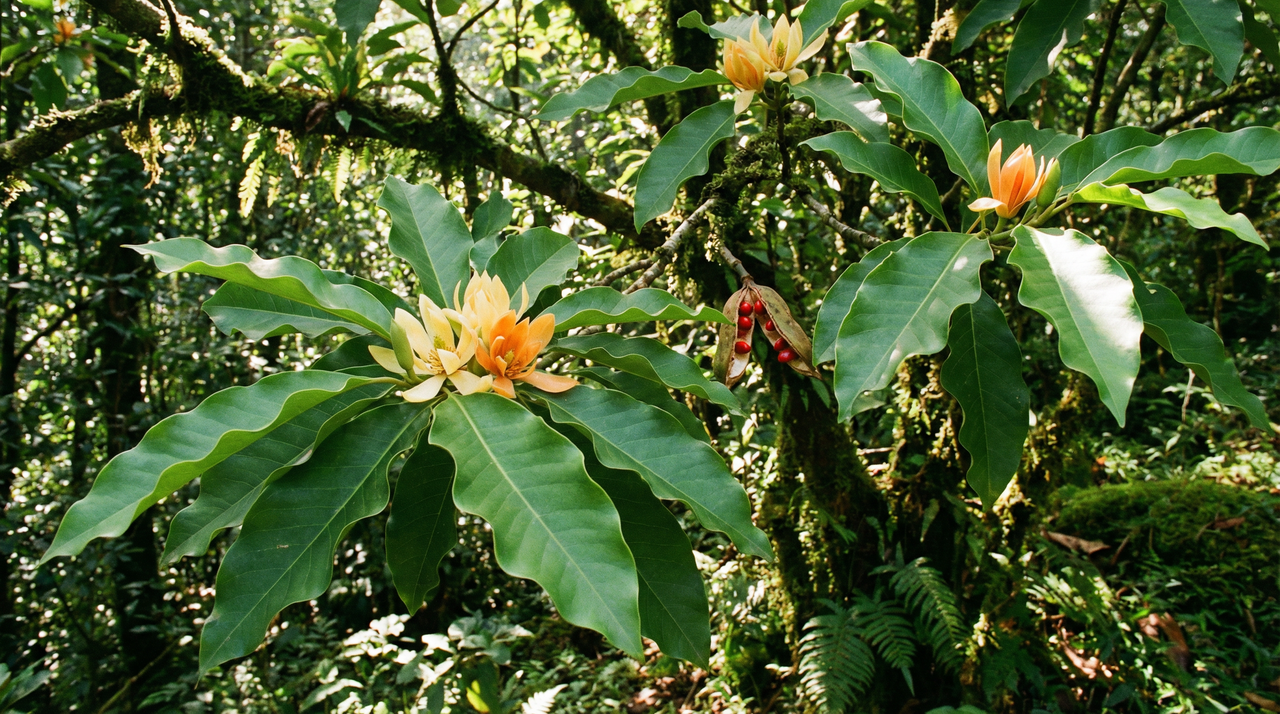
There's a perfume in South and Southeast Asia that stops people mid-stride, something warm and honeyed and almost impossible to place if you didn't grow up around it. That scent comes from Champak, a tree so embedded in the region's sacred traditions that Sanskrit poets were writing about it more than two thousand years ago, and yet in most Western gardens it's essentially unknown. I find that gap genuinely strange. We'll plant a gardenia for fragrance, fuss over a jasmine on a trellis, coax a ylang-ylang cutting through a cold snap, but a tree that inspired an entire category of high-end French perfumery[1] barely registers outside of specialty nurseries and botanical garden collections.
What gets me every time is the contradiction at its core. Champak is a giant, a tree that can push 50 feet in good conditions, with bark and leaves that traditional medicine practitioners have been reaching for across Ayurveda, Siddha, and Unani systems for centuries. But the whole reason people plant it, the reason temples have been garlanding its blooms for millennia, is a flower the size of your thumb. Something that small shouldn't command that much reverence. And yet here we are.
Origin and History of Champak (Michelia champaca)
Few trees carry the weight of human history the way champak does. Long before botanical explorers catalogued it or perfumers distilled it into some of the world's most expensive fragrance extracts, this tree was already ancient in the cultural memory of South and Southeast Asia. Its flowers appear in Sanskrit texts including the Rigveda, the Ramayana, and the Mahabharata, placing them squarely in recorded human life from at least 1500 BCE, with the poet Kalidasa still reaching for champak imagery in the 4th and 5th centuries CE.[2] China documented it in the 16th-century Bencao Gangmu, and by 1786 colonial trade had carried it to England.[2][3] That's a long arc for a single tree.
Botanical Background and Taxonomy
You'll see this plant listed under two names in nursery catalogs and botanical literature, sometimes in the same paragraph. Taxonomists have subsumed the old Michelia genus into Magnolia, so the tree is now formally Magnolia champaca, though its longtime name Michelia champaca still shows up everywhere from Ayurvedic texts to perfume ingredient lists.[4][5] For practical purposes, both names refer to the same tree, and I'd suggest getting comfortable with both before you start making nursery calls.
What makes this tree biologically fascinating is its seed biology. The seeds themselves are ellipsoid, roughly 10-15 mm long, encased in a hard, reddish-brown coat that is essentially impermeable to water.[6] They're recalcitrant, meaning they lose viability rapidly if dried below about 20% moisture, and yet that same hard coat can delay germination for months without scarification or GA3 treatment. Even under ideal warm, moist conditions (25-30°C), germination rates only reach 20-70%.[7] Add in polyembryony (2-4 embryos per seed, both zygotic and nucellar) and you have a plant that's simultaneously overengineered and fussy about germinating.[8]
Seed propagation also produces highly variable offspring because champak is obligately outcrossing, pollinated primarily by beetles and weevils rather than bees.[9] I routinely recommend grafted plants to clients who want predictable flower color and fragrance rather than the lottery of seedlings. The tree itself is polycarpic, flowering repeatedly over a lifespan that typically stretches 50-100 years or more under good conditions.[10] That longevity is worth remembering when you're siting one: you're making a decision for the garden's next century.
Wild populations are declining due to deforestation and overharvesting despite the species holding a Least Concern status from the IUCN as of 2014.[11] When I specify champak for a project, I always ask nurseries for verified propagation material rather than wild-collected stock. It's a small ask that makes a real difference.
Native Habitat and Distribution
Champak is native to an impressively wide swath of tropical and subtropical Asia: the eastern Himalayas, southern China, India, Myanmar, Thailand, Laos, Vietnam, Malaysia, Indonesia, and the Philippines.[6][12] It grows from sea level up to about 1,500 meters, showing up in lowland rainforests, along riverbanks, at forest edges, and as a pioneer species in disturbed areas.[13] That pioneer habit tells you something about its temperament: this isn't a finicky plant that only survives in pristine old-growth. It can colonize a gap. That resilience is part of what made it so useful to so many cultures across such a broad geography.
Traditional and Cultural Uses
The champak flower's religious significance across South and Southeast Asia is hard to overstate. In Hinduism, the blooms symbolize beauty, devotion, and purity and are offered to Vishnu, Shiva, and Lakshmi in garlands for Diwali, Navratri, weddings, and daily temple pujas.[14] In Buddhist traditions across Thailand, Myanmar, Sri Lanka, and Vietnam, the flowers represent enlightenment and impermanence, appearing in Songkran and Loy Krathong ceremonies and in offerings for ancestral rites.[15] Indigenous Himalayan and Northeast Indian communities including the Lepcha and Khasi have used the wood for ritual carvings and temple construction while relying on the plant medicinally for rheumatism, skin conditions, and digestive complaints.[16]
That medicinal tradition runs deep. Ayurvedic, Traditional Chinese, and Southeast Asian medicine have all drawn on the flowers, bark, leaves, and essential oil to treat fever, inflammation, cough, asthma, skin conditions, and headaches, with modern studies beginning to confirm antibacterial, antifungal, and antioxidant properties linked to linalool and related compounds.[17][18] Clinical validation in humans remains limited, so those deeper health questions get their full treatment in the health benefits section.
Visual Characteristics
In cultivation, champak typically reaches 9-15 meters with a 6-9 meter spread, starting out pyramidal and broadening with age into a dense, rounded canopy.[19] In its native forest habitat it can push past 30 meters with a trunk up to a meter in diameter, which helps explain why it's also been prized for timber.[20] The leaves are simple, alternate, lanceolate, 8-20 cm long, with a glossy dark green upper surface and a slightly leathery texture that reminds me of bay laurel but with a more pronounced gloss and a gently pubescent underside.[21] It's instantly recognizable once you've seen it a few times.
The flowers are the reason most people fall for this tree. Solitary or in small clusters, 5-10 cm across, with 10-20 narrow tepals in two or three whorls, they range from creamy white to rich orange-yellow depending on the cultivar and bloom year-round in the tropics with peaks in spring and summer.[22] I've watched visitors stop mid-sentence on a garden tour when they catch the scent drifting across a path. That reaction never gets old. The fruit that follows is an oblong aggregate of 20-40 woody follicles that split open to reveal bright red-ariled, winged seeds, which is as visually striking in its way as the flowers.[6]
Fun Facts and Ecological Role
The flower's essential oil is dominated by linalool (up to 40%), along with geraniol, methyl benzoate, eugenol, and beta-caryophyllene, producing a rich scent with sweet, fruity, citrus, and tea-like notes. Perfumers classify it as a middle-to-base note blending beautifully with ylang-ylang, jasmine, and sandalwood.[23] That fragrance chemistry is ancient; so is the pollination system that produces it. Champak relies primarily on beetles and weevils for pollination, a strategy shared across the Magnoliaceae family that predates bees as a dominant pollination force.[24] The red arils on the seeds then bring birds and mammals into the dispersal picture, with wind providing a secondary assist via the membranous seed wing. When I design food forests that include champak, I always pay attention to what the red arils attract locally; it's a small but satisfying connection between the tree and the wider bird community using the landscape.
Champak has naturalized in Hawaii and parts of Florida, and it's considered invasive in Brazil and Cuba.[25][26] That's a meaningful consideration when planting near natural areas in frost-free climates, and another reason responsible sourcing and thoughtful siting matter as much as they do.
Champak Varieties and Where to Buy Them
Notable Varieties and Cultivars of Michelia Champaca
If you've gone looking for champak at a nursery and found it labeled "Michelia champaca" on one tag and "Magnolia champaca" on the next, you're not imagining things. The genus has undergone taxonomic reclassification, despite the formal reclassification, the old Michelia name stubbornly persists in commerce and among growers who've loved this tree for decades.[13] I've learned to stop worrying about the label and start asking for the specific variety instead, because that's where the real differences lie.
The species itself splits into several natural botanical varieties: var. champaca gives you the classic golden-yellow flowers, var. alba and var. lutea offer white and yellow forms respectively, while var. tomentosa and var. pubinervia are distinguished by their hairy leaves rather than dramatic flower differences.[27][28] In cultivation, the cultivars gardeners actually seek out include 'Alba' for white blooms, 'Rubra' and 'Red Champion' for reddish flower tones, 'Red Imperial' for deep orange-red, 'Magnifica' for larger flowers, and 'Prince' for a more compact growth habit.[13][29]
The white-flowered forms deserve special mention. Michelia alba, sometimes sold as White Champaca or listed under names like magnolia michelia alba in catalogs, reaches 20 to 30 feet with a tidy pyramidal habit and flowers whose banana-sweet fragrance intensifies at night.[29][30] In my experience growing both forms, the michelia champaca alba tends to stay slightly more compact and often reaches blooming size a bit sooner, which matters when you're waiting years for those first flowers. The standard yellow form can push 30 to 50 feet at maturity, so site selection really does depend on which type you're planting.[28][29]
If you want something even more garden-scaled, the related species are worth exploring. Michelia foveolata brings golden-yellow fragrant flowers on a 20 to 30 foot tree with beautiful glossy leaves.[31] Michelia martinii, a hybrid of M. doltsopa and M. yunnanensis, stays in the 15 to 30 foot range and has produced several named cultivars including 'Lemon Beauty' and 'Snowbelle'.[29] Michelia constricta is a dense, conical evergreen with cream-white flowers but very few named cultivars; it's mostly grown from seed.[32][33] These relatives won't replace the incomparable scent of true champak, but for smaller plots they're genuinely appealing alternatives.
Sourcing Champak Plants and Seeds
Champak is not a plant you'll stumble across at a big-box garden center. For Michelia champaca and the michelia alba plant, your best bets are specialty nurseries: Logee's, Plant Delights, FastGrowingTrees.com, Florida Hill Nursery, and One Green World all stock one or both species with reasonable regularity.[34][35][36][37] I've had the best luck ordering from Logee's and Plant Delights personally; the plants arrive well-rooted and accurately labeled, whereas cheaper online seedlings have sometimes taken considerably longer to hit blooming size. Seeds run $5 to $15 per packet and are available through Logee's, Montoso Gardens, and Rare Exotic Seeds, among others.[38][39] Established plants range from roughly $25 to $45 for a one-gallon, $50 to $90 for a three-gallon, and $150 or more for larger specimens.[40][41]
Michelia martinii and Michelia constricta are considerably harder to track down in the U.S. market; expect to source those from specialty magnolia collections or import them, which brings its own paperwork.[42] Michelia odorum falls into the same rare category and mostly appears through importers focused on Asian exotics.[43]
If you're importing plants or seeds from abroad, USDA APHIS requires permits and phytosanitary certificates, and some states like California have additional quarantine rules worth checking before you order.[44][45] Champak is not federally listed as a noxious weed or invasive species in the U.S., so there are no restrictions on growing it once you have it.[46] I always verify current state rules before ordering from out-of-state sources; it takes ten minutes and saves a lot of headache. Whatever you buy, look for vigorous roots, pest-free foliage, and accurate cultivar labeling. The University of Florida IFAS recommends certified nursery sources specifically to ensure disease-free stock, and that's advice I'd echo without reservation.[47]
How to Propagate and Plant Champak (Michelia champaca)
Every time someone asks me how to grow Michelia champaca, my first question back is always the same: how patient are you? Because that answer determines almost everything about how you should start this tree. Seed-grown champak can take 5–7 years to produce its first flower, sometimes longer.[48][49] If you want those intoxicating blooms in 2–3 years, you go the vegetative route. That choice shapes everything downstream.
Propagation Methods for Champak
Semi-hardwood cuttings are the go-to method for commercial nurseries and serious home growers alike. Taken during active growth in summer or early autumn, treated with IBA rooting hormone, and stuck into a well-draining mix of perlite, vermiculite, and coarse sand, cuttings root in 4–8 weeks under the right conditions: 24–27 °C (75–80 °F), 80–90% humidity, and ideally intermittent mist.[50][51] Success rates run 40–80% under optimal conditions, which sounds great until you're on the wrong end of a failed batch. Even with mist and bottom heat, I still lose a meaningful portion of cuttings to fungal issues if the medium isn't perfectly sterile. Lesson learned the hard way: pasteurize your propagation mix.
Grafting onto compatible Michelia or Magnolia rootstocks is another solid option, especially if you're working with cultivars that don't root easily from cuttings. Air layering performs even better, with 70–80% success rates and best results during the rainy season.[52][53] Tissue culture is technically feasible but expensive and not worth pursuing outside a commercial lab setting. For most gardeners, semi-hardwood cuttings or air layers will get you where you need to go.
Seed propagation is possible, but the recalcitrant nature of champak seed makes vegetative methods especially attractive. Germination rates vary wildly, from 5% to 70%, and the window for viable seed is short.[29][54] Champak seeds look deceptively similar to other magnolia family seeds in early stages, so label everything carefully from the start.
Seed Storage and Germination Timeline
Because champak seeds are recalcitrant, they are extremely sensitive to drying out and will not survive low-temperature storage.[55][56] If you harvest fruit and let the seeds sit on a bench to dry out while you attend to other garden tasks, you will likely lose them. Sow immediately after extraction from the fruit, into warm, well-drained seed-starting mix at 25–30 °C, and germination typically follows in 2–4 weeks.[12][57] That temperature range is similar to what you'd maintain for starting basil or tomatoes indoors, which gives you a practical point of reference if you already run heat mats.
If you genuinely can't sow immediately, short-term storage in damp sand, vermiculite, or sphagnum moss held at 15–25 °C and high humidity (80–95% relative humidity, 30–50% seed moisture) buys you a few weeks, maybe a few months at most.[55] Long-term conservation requires experimental approaches like cryopreservation, which is beyond the scope of home growing.
The timeline from seed to flowering is the part that tests patience most. Seed-grown champak typically waits 5–7 years to flower, sometimes stretching to 10.[48][58] Grafted or cutting-grown plants flower in 2–4 years under good subtropical management. That's essentially the same gap you see when comparing seed-grown southern magnolia to one started from a cutting, so it's not unusual for this family, but it's worth factoring into your design timeline. Michelia alba, by comparison, germinates more reliably at 70–90% success and can flower from seed in 3–5 years.[53]
Soil, Site Selection, and Planting Technique
Champak wants fertile, well-drained loamy or clay-loam soil with plenty of organic matter (3–5% or more) and a pH between 5.5 and 7.0, with the sweet spot sitting around 5.6–6.5.[59][48] It will not tolerate waterlogging, and heavy clay without amendment is a slow death sentence. In my experience, a simple soil test kit prevents more yellowing leaves than any fertilizer. When I see interveinal yellowing on new growth, I know to reach for sulfur to bring the pH down rather than reaching for a foliar spray and hoping for the best. High pH above 7.5 locks out iron and manganese, causing that classic chlorosis; pH below 5.5 can swing into manganese toxicity territory.[60][61] Test before you plant, then amend accordingly.
For container propagation or growing in less-than-ideal native soil, a mix of 40% loamy garden soil, 30% peat or coconut coir, 20% perlite or coarse sand, and 10% compost gives you the drainage and organic richness this tree expects from its native forest floor.[62][54] During propagation, keep young plants in indirect light or 50–70% shade while roots establish; once transplanted into the ground, they'll want full sun to part shade with good air circulation.
Spacing Requirements and Transplanting
Mature champak trees reach 30–50 feet tall with a canopy spread of 20–40 feet, though in optimal tropical conditions they can push even larger.[21][63] I've seen a neighbor's specimen become awkwardly cramped at 25-foot spacing, requiring constant corrective pruning that robbed the tree of its natural form. For specimen planting, I give them at least 40 feet between trees. Avenue or landscape use can get away with 26–33 feet, and if you're attempting a loose screen or informal hedge you can drop to 6–12 feet, though champak isn't really built for tight formal hedging.[64] In urban sites, keep the tree at least 26–33 feet from structures to accommodate the fibrous but moderately spreading root system.
Transplant seedlings or rooted cuttings outdoors once they reach 6–12 inches tall and all frost risk has passed. Plant at the root-flare level in a hole 2–3 times wider than the root ball but no deeper than it grew in the container.[65][66] Champak is hardy in USDA zones 10–11 and can tolerate brief dips near 28–30 °F with protection, but marginal zone 9b plantings need a solid frost plan. The tree thrives where annual rainfall runs 1,500–3,000 mm, and the planting hole is where that future success or failure is set in motion.
Champak Care and Growing Guide
Growing champak well comes down to understanding what it's optimized for: a warm, humid monsoon climate with deep seasonal rains, bright light, and rich but free-draining soil. Get those conditions right and this tree essentially takes care of itself. Push against them and you'll spend your time chasing symptoms instead of enjoying the flowers.
Water Needs for Champak
Think deep weekly drinks rather than daily sprinkles. Champak wants you to water thoroughly, let the top two to three inches of soil dry out, then water again, roughly every seven to ten days during the growing season and every two to three weeks when temperatures cool.[67][68] That rhythm mimics its native monsoon habitat, where annual rainfall runs 1,500 to 2,500 mm followed by a distinct dry season.[69] Once established, it handles dry spells reasonably well, but cutting supplemental water during bloom periods will cost you flowers.[70]
In my experience working with Michelia in Central Florida-type conditions, overwatering and poor drainage cause far more losses than drought. Root rot shows up as yellowing leaves, wilting despite wet soil, soft mushy stems, and a foul odor from the rootzone.[71] Underwatering is easier to read: curling leaf edges, dry brittle foliage, and premature leaf drop.[29] Soil pH matters here too. Champak prefers 5.5 to 7.0, slightly acidic to neutral, and it wants soft, low-salinity water; rainwater or filtered water is ideal where tap water runs alkaline or salty.[64] A 2 to 4 inch mulch layer around the base goes a long way toward holding moisture steady between waterings and is especially useful for container-grown plants, where I'd say monitor soil moisture closely rather than following any fixed schedule.
Sunlight Requirements for Champak
Champak needs at least four to six hours of direct sun daily to flower reliably.[72][19] In hotter regions, I think of it the way I think about gardenias or plumeria: morning sun with afternoon shade is the sweet spot. That east-facing or dappled-afternoon exposure prevents leaf scorch while giving the tree enough light energy to push blooms.[73] Established plants can manage up to 50 percent shade without dramatic growth reduction, but young plants pushed into deep shade get leggy, weak, and stingy with flowers.[12] Insufficient light eventually causes etiolation and leaf chlorosis, which can look a lot like a nutrient problem if you're not paying attention to placement.[48]
Feeding and Fertilization for Champak
Champak is a moderate feeder. A balanced slow-release fertilizer (10-10-10 or 14-14-14 NPK) applied in early spring and again in mid-summer is the standard approach, at roughly one to two pounds of actual nitrogen per 1,000 square feet per year split across two to three applications.[74][29] I apply around the drip line, ideally after rain so there's no burn risk. Young trees and seedlings benefit from a higher-nitrogen formula (20-10-10) to push establishment, then you transition to the balanced ratio as they mature.[75] During active bloom, shifting toward a higher-potassium ratio (roughly 4:1:3 NPK) can improve flower quality and production.[48]
Iron chlorosis is the deficiency I see most often, particularly in alkaline soils. It shows up as yellowing of young leaves with the veins staying green. I've corrected it on several Michelia specimens using foliar iron chelate sprays, and within two weeks you can usually see the leaves greening back up. That visible response is a reliable confirmation you've found the problem.[76][77] Over-fertilizing is a real risk too: excess nitrogen produces lush, weak growth that invites pests and disease, while potassium excess causes marginal scorch that looks like drought.[78] I always soil-test before committing to the full nitrogen rate, especially in humid conditions where I've watched over-fertilized trees become leggy and pest-prone by late summer. Every one to two years is a reasonable testing interval, and organic amendments like compost or well-rotted manure are my preferred baseline for sustainable cultivation.[79]
Heat Tolerance of Champak
Champak is solidly at home in USDA zones 10 through 12 and AHS heat zones 9 through 11, with an optimal daytime temperature range of 25 to 30°C (77 to 86°F).[29][80] It can briefly tolerate up to 40°C (104°F) but above 35°C, especially with low humidity, you'll start to see leaf scorch, wilting, and bud drop.[48] Prolonged heat above that threshold impairs germination and flower development as transpiration outpaces root uptake.[81] The practical mitigation toolkit I'd recommend: keep 5 to 10 cm of organic mulch over the rootzone, provide 30 to 50 percent afternoon shade during heat events, and use windbreaks in exposed sites to reduce desiccating airflow.[82] Established trees with deeper root systems handle heat stress considerably better than newly planted ones.
Frost Tolerance of Champak
This is where champak's Southeast Asian origins become a real design constraint. It's rated for USDA zones 10 to 11, with marginal possibility in zone 9b under protection.[64] Short dips to around 25 to 28°F (-4 to -2°C) are survivable for brief periods, but prolonged freezing causes real damage.[29] Flower buds, young shoot tips, and new leaves are the most vulnerable parts; older woody stems and established roots are more resilient.[83] Frost damage looks like drooping, bronzed or blackened leaves, water-soaked lesions, and tip dieback.[84]
For clients pushing champak into zone 9b, wrapping young trunks with burlap and piling on 4 to 6 inches of mulch around the base has allowed plants to recover from brief dips to 28°F with only minor tip burn. That's about as hardy as a mango or citrus; if you're protecting those, you understand the commitment. For growers wanting a cold-hardier Michelia relative, Magnolia martinii (formerly Michelia martinii) can handle down to around 10°F with protection in zones 8 through 10,[85] and Michelia odorum manages zone 8b through 11, tolerating roughly 15 to 20°F with cover.[86]
Pruning and Maintenance for Champak
Champak wants to grow into a naturally pyramidal shape without much help from you. Minimal intervention is the rule: light pruning after flowering in late spring to early summer, removing dead, diseased, or crossing branches is all it really needs.[87][88] Early in my career I learned the hard way that heavy cuts in summer reduce the following year's bloom by half, sometimes more. I don't make that mistake anymore and I advise clients against it firmly. Deadheading spent flowers promptly encourages continuous blooming, and pinching the tips of young shoots in spring produces more branching and therefore more flowering sites down the line. If you're prioritizing flowers over seed production, thinning developing fruits in early summer (leaving four to six per cluster) reduces the energy drain on the tree. Planting timing matters too: spring (March through May) in zones 9 through 11 after last frost, or year-round in frost-free areas.[64]
Seasonal Rhythm for Champak
In a temperate or subtropical garden, champak follows a spring-through-fall growth and flowering cycle with minimal dormancy in winter when temperatures stay above 50°F (10°C).[89] In my zone, the flowers arrive in flushes from spring into fall, heaviest when rains are steady and temperatures hold in that 25 to 30°C sweet spot. In its native tropical habitat the tree flowers year-round with peaks during warm, wet seasons;[28] Michelia alba similarly peaks in spring and summer, while Michelia odorum concentrates most of its bloom from March through June.[90] Read that seasonal rhythm as your cue to time fertilizer applications, deepen watering frequency, and hold off on any pruning until after the main flush has finished. The annual calendar, once you internalize it, makes every other care decision feel obvious.
Harvesting Champak Flowers and Fruits
There are two very different harvests happening on a champak tree, and they run on completely different clocks. The flowers give you a window measured in hours. The fruits ask you to wait the better part of a year.
Timing and Ripeness Cues
A champak flower bud moves from closed to fully open in just 2-4 days, with peak fragrance and volatile oil content occurring 1-2 days after full bloom.[52] I learned this the hard way. The first time I harvested, I went out mid-morning on a beautiful day and was puzzled by how muted the scent was. By 9 or 10 a.m., the volatile compounds have already started to dissipate in the heat. Pre-dawn is not a suggestion; it's the whole game.
Fruits operate on an entirely different schedule. After the April-June bloom period, those woody aggregate follicles spend 6-8 months quietly maturing before they're ready.[91] In India, October through December is the typical harvest peak; in Southeast Asia, expect November through January, when post-monsoon dry conditions reduce mold risk.[92][93] I tag flowering branches so I know which ones to monitor six months later. The visual cues are reliable once you know them: skin color shifts from green to yellowish-brown or reddish-brown, the texture goes dry and leathery, and the follicles begin splitting along their sutures.[94][95] That color shift is your most reliable signal.
Harvest Techniques and Post-Harvest Handling
For flowers, harvest at 50-70% open or at full bloom in the early morning and handle them as gently as you possibly can. Damaged petals lose fragrance fast. Cool them immediately to around 4-8°C if you're extracting oil or using them commercially; even for home kitchen use, getting them into a cool spot slows volatile loss significantly.[96][97][98]
For fruits, hand-pick during the dry season before the follicles split completely open, which prevents seed dispersal before you can collect them. Split the follicles by hand, extract the seeds, and shade-dry them at 25-30°C down to 10-15% moisture before storing cool and dry.[94] If you're working at scale and need uniform ripening, ethylene treatment at 100-500 ppm can synchronize color development across a batch.[99]
Yield, Flavor, and Aroma at Harvest
Champak flowers have been used across South and Southeast Asia to infuse teas, desserts, rice dishes, and beverages for centuries.[13][100][101] The taste itself is mild, a subtle sweetness with occasional slight bitterness, and the petals are delicate like jasmine, becoming tender when dried or briefly infused.[102] What you're really after, though, is the aroma: rich, floral-citrus, with jasmine and ylang-ylang at the core and apricot, tea, and warm spice underneath, all driven by linalool and related volatiles.[6][103] That scent intensifies at dusk to the point where I now schedule evening walks through the garden just to catch it.
Oil yield from fresh flowers is a modest 0.2-0.5% by weight.[96] I still distill small batches because the resulting absolute is complex in a way that's genuinely hard to replicate, but go in with realistic expectations. And use only the petals. Leaves, bark, and seeds contain compounds that make them unsafe for culinary or medicinal use,[104][96] and that's a line I don't cross.
Champak Preparation and Uses
Culinary Uses of Champak Flowers
The flowers are where all the action is in the kitchen. Champak blooms have been used across South and Southeast Asia for centuries to flavor teas, desserts, rice dishes, curries, and beverages, or simply scattered as garnishes over food where their presence is more perfume than ingredient.[27][105] The flavor reads as sweet-floral with threads of jasmine, ylang-ylang, banana, and warm spice, which makes them surprisingly versatile once you start experimenting.[106][107] I've found that steeping a few fresh orange-flowered champak petals into warm rice transforms it into something extraordinary, the spicy-floral punch saturating every grain. White champaca (Michelia alba) is gentler by comparison, its petals velvety and honey-sweet, beautiful torn into a salad but less assertive when infused.[107][108]
Preparation matters here more than with most edible flowers. Shade or air drying preserves 70-80% of the volatile compounds responsible for that scent, while heat drying at higher temperatures degrades the delicate benzyl esters and drops retention to around 50%.[109][110] I pick at dawn, before the heat climbs, and cool the petals immediately. If you're using them fresh rather than dried, storing them at 4-10°C buys you a bit more time before the fragrance fades.[111] The flower's nutritional profile is modest but real, with phenolics, flavonoids, and trace minerals present based on studies of closely related species, though the data isn't deep enough yet to make confident specific claims.[112][113]
Stick strictly to the petals. The fruits are technically edible but bitter and astringent enough that few bother with them, and the leaves, seeds, and bark can cause gastrointestinal upset.[27][105] In my years working with fragrant magnolias, I've learned that sticking to the petals avoids the risk entirely. Also, proper identification matters; toxic look-alikes exist, and the consequences of mistaking oleander for a scented ornamental are severe.[114][115]
Medicinal Preparations from Champak
Traditional systems have formalized what home herbalists might call intuitive use. Ayurvedic practice uses champak in preparations like Chandanadi Vati (250-500mg twice daily), while Siddha medicine uses flower decoctions in the range of 10-20ml per day. More accessible at home are simple infusions: 2-5g of dried petals steeped as tea, or a decoction using 5-10g in 200ml of water.[116][117] Tinctures at a 1:5 ratio in alcohol, taken at 1-2ml per day, appear in some herbalist traditions as well.[118] My own flower teas stay within these conservative ranges, and the ritual of it, the fragrance filling the kitchen the way jasmine does but warmer and richer, is its own kind of medicine. These aren't standardized clinical doses, and for anything beyond gentle flower tea, a conversation with a trained practitioner is the right call.
Non-Food Uses in Perfumery and Culture
Long before Jean Patou pressed champak into Joy, one of the most famous perfumes of the twentieth century, the flowers were being offered to Lord Shiva and woven into Buddhist temple garlands as symbols of enlightenment.[27][119] That sacred status and the michelia champaca essential oil's rich jasmine-ylang scent profile are inseparable in South Asian culture, which makes the commercial pressure on wild populations a genuinely complicated issue.[120][121] Commercial demand has pushed cultivation to scale, but overharvesting remains a real concern.[122] My preference is small-batch flower infusions in a carrier oil at home rather than purchasing industrially extracted michelia champaca perfume ingredients without knowing their provenance. The tree gives generously when grown well; it doesn't need to be strip-harvested to be appreciated. Michelia alba is now cultivated commercially in Indonesia specifically for essential oil production, contributing meaningfully to local economies there, and that kind of intentional cultivation is a better model than wildcrafting under pressure.[123]
Champak Health Benefits and Medicinal Uses
Every part of this tree carries a medicinal story. Across Ayurveda, Siddha, Unani, and Southeast Asian folk traditions, champak has been one of those rare plants where healers reached for different parts depending on the complaint: flowers for headaches, fever, cough, asthma, and skin disorders; leaves as topical poultices for wounds, ulcers, and insect bites; bark for rheumatism, diarrhea, and fever; roots for abdominal pain, urinary issues, and as a diuretic.[124][125][126] Related species like Michelia alba share overlapping applications, particularly for respiratory ailments, skin conditions, and wound care.[127] As a landscape designer who specifies this tree for its fragrance, I always remind clients that the ornamental value and the medicinal history are inseparable. The same compounds driving that extraordinary scent are what traditional healers were working with long before anyone had a gas chromatograph.
Traditional Medicinal Uses of Champak
What makes champak's traditional use record compelling isn't just breadth, it's the cross-cultural consistency. Herbalists in India, Thailand, Indonesia, and the Philippines independently identified overlapping applications across centuries, which is exactly the kind of signal that gets pharmacologists interested. The anti-inflammatory use in Ayurveda for rheumatism and fever maps cleanly onto what preclinical research now shows: Michelia champaca extracts reduce paw edema in animal models through COX-2 and NF-κB pathway inhibition, and related species (alba, martinii, odorum) suppress pro-inflammatory cytokines like TNF-α and IL-6 with up to 65% edema reduction in some assays.[128][117][129] Traditional topical use of leaves for wounds now has in-vitro support showing champak extracts accelerate fibroblast migration and collagen synthesis.[130]
The preclinical picture extends further. Antioxidant activity via DPPH and ABTS assays consistently produces IC50 values comparable to ascorbic acid, driven by high phenolic and flavonoid content.[131][132] Essential oils and extracts show antimicrobial activity against Staphylococcus aureus, Candida albicans, and other pathogens via cell-membrane disruption and biofilm inhibition.[133][134] Analgesic effects comparable to aspirin have been observed in hot-plate and tail-flick tests, possibly involving TRPV1 and CB2 receptor modulation.[135] There's also preliminary cytotoxic activity against cancer cell lines (MCF-7, HepG2, HeLa, A549) through apoptosis induction mechanisms.[136] And additional targets have been identified for Michelia alba with genus-wide overlap: acetylcholinesterase inhibition, 5-HT1A affinity suggesting anxiolytic potential, and α-glucosidase inhibition relevant to blood sugar management.[137]
The preclinical COX-2 inhibition data is genuinely compelling and aligns beautifully with centuries of Ayurvedic use for inflammatory conditions. I treat champak as a supportive rather than primary remedy, though, because clinical evidence remains thin: one small pilot wound-healing trial exists, and no large randomized controlled trials have been conducted for systemic use.[138][127] Most data come from in-vitro assays and animal models, and some medicinal claims for Michelia martinii appear to be extrapolated from related species rather than directly studied.[139] That gap between lab promise and clinical proof matters, and I won't pretend otherwise.
Key Phytochemicals and Bioactive Compounds
The flower's essential oil tells most of the story. Linalool dominates at 30–60% of total composition, with β-caryophyllene, benzyl acetate, eugenol, geraniol, farnesol, and linalyl acetate filling out the profile.[140][141] Michelia alba, martinii, and odorum share similarly linalool-rich profiles, often hitting 30–70%, though geographic and seasonal variation is real. Linalool's known anti-inflammatory and anxiolytic properties in the research literature likely explain much of why aromatherapy traditions valued this fragrance for headache relief and calming.
Move beyond the flowers and the chemistry diversifies considerably. Leaves concentrate flavonoids (rutin, quercetin, kaempferol, chlorogenic acid) and phenolics responsible for the strong antioxidant activity. Bark carries coumarins like scopoletin and umbelliferone alongside lignans (magnolol, honokiol) and alkaloids including magnoflorine. Seeds contain matairesinol, pinoresinol, and fatty acids rich in oleic and linoleic acids.[142][143] The magnolol and honokiol connection to Magnolia pharmacology is interesting, though their concentrations in champak are lower than in Magnolia officinalis.
One thing I find genuinely fascinating from a permaculture design angle is how growing conditions shift the phytochemical profile. Linalool content peaks during summer flowering, sesquiterpene content increases at elevations above 1,000 meters, and phenolic concentrations tend to run higher in Southeast Asian populations than in specimens grown elsewhere.[144][145] I've noticed that trees in full sun seem to produce more intensely scented flowers, which aligns with research suggesting optimized cultivation practices can boost essential oil yield by 20–30%.[146] These secondary metabolites aren't only biomedically relevant; they serve the tree ecologically, attracting pollinators, repelling herbivores, and contributing to allelopathic effects in the soil zone beneath the canopy.
Pharmacological Research and Potential Benefits
The research picture across the genus is consistent enough to feel meaningful: anti-inflammatory, antioxidant, antimicrobial, analgesic, and wound-healing activity have all been documented across multiple independent studies using Michelia champaca and related species.[147][148][149] That kind of convergence across genera, research groups, and methodologies is encouraging. What's less encouraging is that the field remains largely preclinical, with the same fundamental caveat applying to most activity: rat models and petri dishes are not people. The michelia alba essential oil benefits being studied in vitro for antimicrobial and anti-inflammatory effects may not translate dose-for-dose into human therapeutic contexts. I think the Michelia champaca medicinal uses documented in traditional systems deserve serious scientific attention, and researchers are clearly responding, but we're not yet at the point where I'd swap these extracts for evidence-based interventions.
Nutritional Profile of Champak Flowers
The flowers are the only part of this plant you'd actually eat, and the nutritional story is modest but interesting. Fresh flowers run roughly 45–60 kcal per 100 grams with 1.5–2.5 grams of protein, 8–12 grams of carbohydrates, and 2–3 grams of fiber.[150] Dried flowers show meaningful mineral content, particularly potassium (1,200–1,500 mg/100 g), calcium (300–500 mg/100 g), and iron (5–10 mg/100 g), plus modest vitamin C around 10–30 mg per 100 grams.[151][152] These numbers are preliminary and come with real variability depending on cultivation and processing, so I'd treat them as directional rather than precise. Michelia alba and odorum tend to show lower caloric density and mineral levels by comparison.
In practice, I add champak flowers to herbal teas for the fragrance more than for any nutritional goal, and I use them sparingly. A few blooms in a pot of hot water is genuinely lovely; it's not a substitute for vegetables at dinner. The flavonoids (quercetin, kaempferol, rutin) and essential oils do contribute antioxidant capacity that bridges into the pharmacological benefits discussed earlier, which is probably the more meaningful nutritional argument for occasional culinary use. Leaves, fruits, and seeds are not food; they may cause gastrointestinal upset and shouldn't be prepared as edible.
Safety Considerations and Contraindications
Champak has a long and reassuring history of safe use in cuisine, perfumery, and traditional medicine, and the ASPCA lists it as non-toxic to pets.[153] Preclinical toxicology shows low acute toxicity (LD50 above 2,000 mg/kg in rodents) with no major organ damage at therapeutic doses.[154] That said, "non-toxic" is not the same as "use however you like."
The essential oil is where people most often run into trouble. Undiluted, it can cause contact dermatitis or mucous-membrane irritation.[155] My rule of thumb in aromatherapy blends is 4–6 drops per ounce of carrier oil for safe topical application, which works out to roughly 1–2% dilution, consistent with what the research recommends for fragrance compounds. If I'm using it on something sensitive like the temples for headache relief, I stay at the lower end of that range. Pollen and fragrance can also trigger respiratory irritation in sensitive individuals, which is worth knowing before you plant one directly outside a bedroom window.
Pregnancy and breastfeeding represent a clear caution: there's insufficient safety data, and certain compounds may have hypotensive or sedative effects.[156][157] People on blood pressure medications, sedatives, or anticoagulants should also exercise caution, given possible interactions inferred from the magnolol and honokiol chemistry shared (at lower concentrations) with champak bark. Identification matters too: the floral resemblance to oleander in some landscaping contexts is a real look-alike risk, and proper sourcing from pesticide-free cultivation is essential since commercial products vary considerably in quality.[158] When in doubt, consult a healthcare provider before using any part of this plant medicinally.
Champak Pests and Diseases
Champak holds up reasonably well against pests and diseases compared to some of its ornamental relatives, but "reasonably well" is doing a lot of work in that sentence. What I've learned growing Michelia relatives in Central Florida is that this tree's resistance is almost entirely conditional on how well you've set it up from the start. Get the site right and you'll rarely lose sleep over disease. Plant it in a low spot with poor drainage, crowd it, or let water sit on the foliage, and you'll be fighting fungal issues all season long.
Common Diseases of Champak and Related Michelia Species
The disease profile for Michelia champaca includes moderate resistance overall within the Magnoliaceae family, with notably high resistance to Verticillium wilt, but real susceptibility to several fungal pathogens: anthracnose (Colletotrichum spp.), powdery mildew (Oidium, Podosphaera, and Erysiphe spp.), and a range of leaf spot fungi including Cercospora, Curvularia, Alternaria, Phyllosticta, and Septoria.[159][160] Leaf spot incidence tends to run higher in South Asian growing regions, while powdery mildew is the bigger headache across Southeast Asia.[161][162] The pattern makes sense: these are humidity-driven diseases, and they flare predictably when plants are crowded, overhead-irrigated, or sitting in heavy clay.
Phytophthora root rot is the one I worry about most. It causes wilting, yellowing, root decay, and steady decline, and by the time you notice it above ground, there's usually significant damage below.[163][164] I learned this the hard way with an early planting in a spot that looked fine until the summer rains arrived. Raised beds or substantially amended, fast-draining soil aren't optional for champak in humid subtropical climates; they're the entire foundation of a healthy tree. Bacterial leaf blight and stem cankers from Fusarium or Cytospora can also appear in poor-airflow situations, producing water-soaked lesions and dieback on affected branches, though these are less common.[159][164] Viral disease is rare and poorly documented in this species.
Cultural management prevents most of this. Proper spacing of 10 to 30 feet for airflow, well-drained slightly acidic to neutral soil, drip irrigation instead of overhead watering, good sanitation around fallen debris, and any pruning done during dry periods with sterilized tools: these practices, taken together, eliminate the conditions fungal diseases need to establish.[165][166] I've watched the same leaf spot and mildew problems that plagued poorly sited specimens disappear entirely on trees given room to breathe and drip lines instead of sprinklers. When fungicides are warranted, copper-based options (Bordeaux mixture), sulfur, mancozeb, or systemic options like myclobutanil work well at first sign of infection or preventively during wet seasons, but they're backup tools, not a substitute for good site selection.[165][167] For Phytophthora specifically, metalaxyl or fosetyl-Al applied early can slow progression, but they won't save a tree already drowning in compacted wet soil.[168]
Related Michelia species share much of this fungal profile, though resistance varies considerably by cultivar and conditions. Michelia alba's 'Silver Cloud' selection shows improved disease tolerance, while data on less common species like Michelia foveolata and Michelia martinii is thin enough that their pathology is largely extrapolated from champak research.[167][169] If you're planting in a site with a known disease history, that's worth factoring into your species and cultivar choice from the beginning.
Major Insect Pests and Integrated Management
The insect pest list for champak is reasonably long but manageable: aphids, scale insects, mealybugs, leaf beetles, caterpillars including shoot borers, leaf miners, and spider mites are all documented.[170][171] The damage runs the spectrum from cosmetic (aphid-driven sooty mold, stippling from mites) to structurally serious (borer damage in stems). In West Bengal and other parts of India where champak grows in its native range, the champaca leaf miner (Phyllocnistis sp.) is a documented regional pest;[172] in temperate climates where the tree is grown in containers or greenhouses, aphids and spider mites become the primary pressure.[173]
Sap-sucking insects like aphids and scale often set up secondary fungal problems through the honeydew they deposit, which feeds sooty mold. So a minor aphid infestation on a stressed tree can cascade into something uglier if you ignore it. A healthy, well-sited specimen resists much of this on its own, and the essential oil chemistry of related Michelia alba, rich in linalool and geraniol (the same compounds that make the flowers so intoxicating to us), acts as a genuine chemical repellent against certain insects.[174] Species like Michelia martinii and foveolata bring physical defenses too: glandular trichomes, thick cuticles, and rough bark that deter feeding and egg-laying.[175]
For management, I lean hard on integrated pest management rather than reaching for a spray at first sight. Regular monitoring, pruning for airflow, and drip irrigation remove the stress conditions that make plants vulnerable in the first place.[176] In my designs I actively encourage beneficial insects, ladybugs, lacewings, and predatory mites, because I've watched them keep aphid and mite populations completely in check on established trees without any sprays at all. When intervention is needed, horticultural oils, insecticidal soap, and neem oil are my first choices before anything targeted or chemical.[165][177] For clients with known pest pressure, I recommend seeking out 'Silver Cloud' or alba-champaca hybrids that have documented improved tolerance to borers and spider mites over straight champak.[178][179] That one selection decision can meaningfully reduce long-term maintenance. If you're wondering about michelia champaca leaves turning brown, the cause is almost always one of these fungal diseases, a mite infestation, or poor drainage; rarely is it something exotic or difficult to address once you trace it back to site conditions.
Champak in Permaculture Design
Few trees bring together ecology, fragrance, and structural presence the way Magnolia champaca does. In a well-designed food forest, it earns its space not just by smelling extraordinary but by doing real work: building soil, moderating the microclimate, cycling nutrients, and pulling in pollinators that serve the whole guild. If you're designing for subtropical zones and haven't considered it yet, I'd encourage you to look closely.
Climate Zones and Growing Conditions for Champak
Champak is fundamentally a warm-climate tree. It's happiest in USDA zones 10-11, where it can tolerate brief temperature dips to 25-30°F but can't handle sustained freezing or snow.[180][181][182][64] Its sweet spot is daytime temperatures between 75-86°F with 60-80% humidity and 40-100 inches of annual rainfall, though it can manage on less with irrigation where wet and dry seasons alternate clearly.[183][184][13] In the continental US, that means coastal California, Florida, Hawaii, and southern Texas are your realistic outdoor zones, with some protection from salt spray and prevailing winds improving performance near the coast.[185][64]
Zone 9b is marginal, but I've overwintered tender tropical trees in similar profiles by stacking microclimate advantages: south-facing walls, heavy mulch pulled right up to the drip line, and frost cloth for the two or three cold nights that actually matter each winter. That said, if your winters regularly dip below 28°F, true Champak will be a container plant or a gamble. The good news is that related species extend the range. White Champaca (Michelia alba) handles zone 9 with similar cold tolerance, while Michelia martinii and Michelia odorum push into zones 8-10, reportedly tolerating brief lows of 10-15°F in sheltered spots.[186][29] Yellow Champaca (Michelia foveolata) fits zones 8b-11.[187] If you're on the edge, these relatives give you the genus fragrance at lower risk. And for anyone worried about introducing something aggressive: Champak shows no significant invasiveness in zones 9-11, including Hawaii.[188]
Ecosystem Functions and Forest Layer Roles
The most distinctive ecological story with Champak is its pollination system, and it's genuinely worth designing around. The flowers are large, bisexual, and packed with sticky pollen, copious nectar, and a volatile profile of linalool, benzyl acetate, and indole that mimics ripe fruit to attract nocturnal visitors.[189][190][191] The primary pollinators are beetles from four families, Nitidulidae, Scarabaeidae, Rutelidae, and Cetoniidae, with hawk moths and bees playing secondary roles. It's an ancient system, and it shows: flowers open between 4 and 7 AM with fragrance peaking to coincide with nocturnal pollinator activity.[189][192] I've watched the same early-morning timing with Magnolia grandiflora in Central Florida landscapes, and it's one of those things you notice once and never forget. The whole bloom event feels almost secretive.
Because Champak is self-incompatible, it needs cross-pollination to set fruit, and in introduced areas like Florida the specialized beetle fauna is often absent.[189][192] That's where design intent matters. I avoid broad-spectrum sprays entirely around flowering trees; the research on pollinator loss is unambiguous, and the beetles that visit the fragrant blooms disappear quickly when chemicals are present. Providing water, shelter, and a diversity of evening-scented companions draws moths and beetles that improve pollination success.[193] Where beetle populations are genuinely low, a small brush and an early-morning visit to transfer pollen between two trees will improve fruit set considerably.
Below the flowers, the tree is building soil steadily. Champak doesn't fix nitrogen, but its leaf litter decomposes rapidly, releasing nitrogen, phosphorus, potassium, and organic matter back into the system.[194] It also forms arbuscular mycorrhizal associations that improve phosphorus uptake in poor soils, which I find fascinating because it parallels improvements I've seen under other large evergreen trees where the soil profile genuinely changes over a few seasons.[195] Add a dense fibrous root system that stabilizes slopes and controls erosion, an evergreen canopy that sequesters carbon and moderates temperatures below it, and essential oils in the leaves that carry documented repellent activity against mosquitoes and some insects, and you have a tree that functions hard across multiple ecological registers.[196][197][198] Fruits attract birds for seed dispersal, the bark provides habitat structure for epiphytes and small fauna, and the timber is durable enough to serve as a productive material harvest on long rotations.[199][200]
Guilds and Layering Champak in Food Forests
In its native forests, Champak grows as a canopy or emergent species reaching 30-50 meters, occasionally taller.[66][201] In cultivation it's typically 30-50 feet with moderate growth of 12-24 inches a year, which makes it genuinely manageable as a canopy anchor in a designed food forest rather than an uncontrollable giant. Related species fill other layers: White Champaca and Yellow Champaca can serve as canopy or subcanopy, while Michelia martinii and Michelia odorum at 8-20 meters fit a mid-story role more naturally where height is a constraint.[202][203]
The competition realities are worth planning around from the start. Champak's broad canopy reduces understory light, and its shallow roots will compete for topsoil nutrients and moisture in the same zone where you might want to run productive ground layers.[204][205] I use roughly 4-5 meters as a practical buffer for root competition when siting large canopy trees alongside bananas, ginger, or turmeric; that spacing consistently reduces establishment stress on the lower layers without sacrificing the canopy benefits above. For a Champak guild, I'd pair it with pigeon pea or another fast nitrogen-fixer to compensate for what the roots draw, then plant shade-tolerant species like ferns, impatiens, ginger, and turmeric directly beneath, and add pollinator magnets like lantana and salvia at the canopy edge where light penetrates.[206][207] Avoid sites with wet winters; Phytophthora root rot is a real risk and drainage is non-negotiable. Get those fundamentals right, and the canopy above becomes one of the most fragrant, ecologically active spots in the whole system.
Rethinking What a Garden Is For
I once stood under a champak in a courtyard in Chiang Mai at six in the morning, jet-lagged and disoriented, and the smell hit me so hard I just stopped walking. Someone had swept the overnight-fallen blooms into a small pile near the roots, and the air was doing something I hadn't experienced a garden do before: it was asking for something from me. I've grown a lot of plants. Champak is one of the few that feels like it's growing you back.
Sources 207
- Champaca Flower Note - Fragrantica ↩
- Champaka in Ancient Indian Literature ↩
- History of Magnoliaceae Cultivation ↩
- A phylogenetic analysis of the Magnoliaceae ↩
- Plants of the World Online: Magnolia champaca ↩
- Magnolia champaca (Michelia champaca) Seed Morphology ↩
- Germination Studies of Michelia champaca ↩
- Embryology of Michelia champaca ↩
- Reproduction Ecology of Magnoliaceae Species in Kerala, India ↩
- Reproductive Biology of Magnoliaceae ↩
- IUCN Red List: Magnolia champaca ↩
- Michelia champaca - Useful Tropical Plants ↩
- Magnolia champaca - Wikipedia ↩
- Cultural and Religious Significance of Michelia champaca in India ↩
- Champaka in Buddhist Symbolism ↩
- Medicinal Plants Used by Lepcha Community in Sikkim, India ↩
- Champaka (Michelia champaca Linn.): A review on ethnobotany phytochemistry and pharmacology ↩
- Traditional Uses of Champaca in Ayurveda ↩
- Magnolia champaca - Missouri Botanical Garden ↩
- Michelia champaca - Useful Tropical Plants ↩
- Magnolia champaca | North Carolina Extension Gardener Plant Toolbox ↩
- Michelia champaca - Flora of China ↩
- Chemical Composition of Michelia champaca Flower Essential Oil ↩
- Pollination Biology of Michelia spp. ↩
- Magnolia champaca - California Invasive Plant Atlas ↩
- PIER: Michelia champaca ↩
- Michelia champaca - Wikipedia ↩
- Magnolia champaca Varieties - Missouri Botanical Garden ↩
- Michelia champaca 'Alba' - Missouri Botanical Garden ↩
- Royal Horticultural Society Plant Finder ↩
- Michelia foveolata - Missouri Botanical Garden ↩
- Michelia constricta - Plant Profile ↩
- Plants of the World Online | Kew Science ↩
- Michelia Champaca Tree ↩
- Michelia champaca ↩
- Michelia alba - White Champaca Tree ↩
- Michelia alba - White Champaca ↩
- Michelia champaca Seeds ↩
- Champaca Magnolia Seeds ↩
- Michelia Champaca Plant Pricing Guide ↩
- Buying Guide for Magnolia Champaca Varieties ↩
- Rare Magnolias in Cultivation ↩
- White Champaca (Michelia odora) Plant Profile ↩
- Importing Plants and Plant Products ↩
- Federal Noxious Weed List ↩
- Invasive Plant Atlas: Magnolia champaca ↩
- Michelia champaca ↩
- Michelia champaca: Propagation and Cultivation ↩
- Champak Tree Farming Guide ↩
- Propagation of Champak (Michelia champaca) - University of Florida IFAS Extension ↩
- Woody Ornamentals - Magnolia Propagation ↩
- Propagation of Michelia champaca by Grafting ↩
- Michelia alba - White Champaca ↩
- Champaca Tree Care and Propagation Guide ↩
- Seed Storage of Recalcitrant Species ↩
- Seed Storage Behaviour: A Compendium ↩
- Tropical Tree Seed Manual ↩
- Michelia champaca - The Magnificent Champaca Tree ↩
- Michelia champaca Cultivation Guide ↩
- Soil pH Effects on Ornamental Trees ↩
- Chlorosis in Woody Plants ↩
- Growing Michelia champaca - Profile and care ↩
- USDA PLANTS Database ↩
- Michelia alba Care Guide - University of Florida IFAS Extension ↩
- Growing Michelia from Seed - University of Florida IFAS Extension ↩
- Michelia champaca - Missouri Botanical Garden ↩
- Magnolia champaca (Michelia champaca) - RHS Gardening ↩
- How to Grow and Care for Champaca Tree ↩
- Kew Science - Plants of the World Online ↩
- Michelia champaca Care Guide ↩
- Root Rot in Champaca Trees: Symptoms and Treatment ↩
- Michelia champaca - Royal Horticultural Society ↩
- Sun Stress in Magnoliaceae ↩
- University of Florida IFAS Extension: Landscape Tree Fertilization ↩
- Magnolia champaca Fertilizer Best Practices ↩
- Iron Chlorosis in Trees and Shrubs ↩
- University of Florida IFAS: Iron for Florida Soils and Crops ↩
- Nutrient Toxicity in Woody Plants ↩
- Fertilizing Magnolias and Related Species - Royal Horticultural Society ↩
- AHS Heat Zone Map ↩
- Physiological Effects of Heat Stress on Flowering in Michelia Species ↩
- Environmental Stress in Subtropical Ornamentals ↩
- Michelia champaca - North Carolina Extension Gardener Plant Toolbox ↩
- Frost Injury to Plants - University of California Agriculture and Natural Resources ↩
- Magnolia (Michelia) martinii Hardiness ↩
- Cold Hardiness of Michelia Species ↩
- Magnolia champaca Growing Guide ↩
- Pruning Magnolias (including Michelia species) ↩
- Michelia champaca - Kew Gardens Plant Profile ↩
- Michelia alba - North Carolina Extension Gardener Plant Toolbox ↩
- Flowering and Fruiting Habits of Michelia champaca ↩
- Michelia champaca ↩
- Plants of the World Online ↩
- Champaca (Michelia champaca) Production and Marketing ↩
- Magnolia champaca ↩
- Essential Oil Yield from Michelia champaca Flowers ↩
- Harvesting and Post-Harvest Management of Aromatic Plants ↩
- Postharvest Technology of Cut Flowers ↩
- Ethylene in Fruit Ripening: Applications for Tropical Fruits ↩
- Champaca Flower Uses in Cuisine - Ethnobotany Sources ↩
- Edible Flowers in Southeast Asian Diets ↩
- Floral scents in Magnolia champaca. Flavour and Fragrance Journal ↩
- Chemical Composition of Michelia champaca Flower Oil ↩
- Michelia champaca: Uses in Traditional Medicine and Cuisine ↩
- Magnolia champaca: Edible and Medicinal Uses - Useful Tropical Plants Database ↩
- Thai Edible Flower Ethnobotany Research (J Ethnobiol Ethnomed) ↩
- Edible Flowers: A Kitchen Companion ↩
- Missouri Botanical Garden Plant Finder - Michelia alba ↩
- Influence of Drying Methods on the Essential Oil Yield and Composition of Champaka Flowers ↩
- Effect of Drying Methods on Volatile Compounds of Champaca Flowers ↩
- Postharvest Management of Cut Flowers ↩
- Chemical Composition and Antioxidant Activity of Michelia alba Leaves ↩
- Nutritional Composition of Edible Flowers: A Review ↩
- ASPCA - Magnolia Toxicity ↩
- Michelia champaca - Useful Tropical Plants Database ↩
- Michelia champaca in Traditional Medicine: A Review ↩
- Champaca (Michelia champaca) in Traditional Medicine ↩
- Magnolia alba Dosage Guidelines in Ayurveda ↩
- Ethnobotany of Michelia Species in Asia ↩
- Essential Oils of Michelia champaca in Perfumery ↩
- Traditional Uses of Magnoliaceae in Southeast Asia ↩
- Essential Oils from Tropical Flowers: Champaca Profile ↩
- Horticultural Uses of Michelia Species in Indonesia ↩
- Michelia champaca: A Review on its Phytochemistry and Pharmacological Profile ↩
- Ayurvedic Uses of Champaka (Michelia champaca) ↩
- Ethnopharmacology of Michelia champaca ↩
- Review of Michelia alba in Traditional Medicine ↩
- Pharmacological Activities of Michelia champaca: A Review ↩
- Antioxidant Anti-inflammatory and Antimicrobial Activities of Michelia alba Extracts ↩
- Wound healing efficacy of champaka extracts ↩
- Antioxidant and Anti-inflammatory Properties of Michelia champaca Extracts ↩
- Antioxidant Flavonoids from Michelia champaca ↩
- Antimicrobial Activity of Michelia champaca Flower Essential Oil ↩
- Antimicrobial Activity of Michelia odorum Extracts ↩
- Analgesic and Anti-inflammatory Activities of Michelia champaca Leaves ↩
- Anticancer Potential of Michelia champaca: Mechanisms of Apoptosis Induction ↩
- Molecular Targets of Bioactive Compounds from Michelia alba ↩
- Clinical trial on wound healing with Michelia champaca ↩
- Phytochemical and Pharmacological Profile of Michelia martinii ↩
- Chemical Composition and Biological Activities of Michelia champaca ↩
- Chemical Composition and Antioxidant Activity of Essential Oil from Michelia alba ↩
- Phytochemical and Pharmacological Review of Magnolia champaca ↩
- Chemical Composition and Antioxidant Activity of Essential Oil from Michelia martinii ↩
- Chemical Composition and Seasonal Variation of Essential Oil from Michelia champaca ↩
- Geographic Variation in Secondary Metabolites of Michelia champaca ↩
- Influence of Soil pH on Phenolic Content in Michelia champaca Leaves ↩
- Anti-inflammatory and Antioxidant Properties of Michelia champaca Leaf Extract ↩
- Antioxidant and Anti-inflammatory Properties of Michelia alba Extracts ↩
- In Vitro Antimicrobial Activity of Michelia alba Essential Oil ↩
- Nutritional and Phytochemical Evaluation of Michelia champaca Flowers ↩
- Edible Flowers: A Review of Nutritional Value and Bioactive Compounds ↩
- Nutritional Composition of Edible Flowers: A Review ↩
- ASPCA Non-Toxic Plants List ↩
- Toxicity Profile of Magnolia champaca Essential Oil ↩
- Allergic Contact Dermatitis Caused by Fragrances from Michelia alba ↩
- Pharmacological Review of Michelia Species ↩
- Safety of Herbal Medicines in Special Populations ↩
- Toxicological Evaluation of Michelia martinii Leaf Extract ↩
- Diseases of Magnolia and Michelia ↩
- Diseases of Magnolia - Clemson Cooperative Extension ↩
- Journal of Plant Pathology - 'Leaf spot diseases in Magnolia champaca' (2018) ↩
- Asian Journal of Plant Sciences - 'Powdery mildew on Magnolia champaca in Thailand' (2020) ↩
- Phytophthora Root Rot of Woody Ornamentals - University of Florida IFAS Extension ↩
- Diseases of Magnolia Species ↩
- Diseases and Pests of Ornamental Trees - University of Florida IFAS Extension ↩
- Michelia Species Care and Disease Management ↩
- Disease Management in Ornamental Magnoliaceae ↩
- Phytophthora Root Rot in Woody Ornamentals - American Phytopathological Society ↩
- Diseases of Michelia spp. ↩
- Insect Pests of Michelia champaca ↩
- Insect Pests of Ornamental Trees - Michelia champaca ↩
- Insect Pests of Michelia champaca in West Bengal - Journal of Entomology and Zoology Studies ↩
- Greenhouse Pest Management for Container-Grown Trees ↩
- Chemical Composition and Antimicrobial Activity of Essential Oil from Michelia alba D.C. ↩
- Morphological Adaptations in Michelia Leaves for Pest Resistance ↩
- Integrated Pest Management for Ornamental Trees ↩
- University of Florida IFAS Extension: Magnolia Pest Management ↩
- Cultivar Selection for Michelia alba and Hybrids ↩
- Disease and Pest Resistance in Champaca Varieties ↩
- SelecTree: A Tree Selection Guide ↩
- USDA Plants Database ↩
- Missouri Botanical Garden ↩
- Michelia champaca - Plants of the World Online | Kew Science ↩
- Michelia champaca - USDA Forest Service ↩
- Champaca - California Rare Fruit Growers ↩
- Michelia alba - White Champaca ↩
- Michelia foveolata - North Carolina Extension Gardener Plant Toolbox ↩
- Invasive Plant Species in Hawaii - USDA Forest Service ↩
- Pollination Biology of Michelia champaca ↩
- Beetle Pollination in Magnoliaceae ↩
- Floral Biology and Pollination Ecology of Magnolia champaca ↩
- Pollination Biology of Magnoliaceae ↩
- Attracting Pollinators to Your Garden ↩
- Agroforestry Species: Michelia champaca - World Agroforestry Centre ↩
- Mycorrhizal Associations in Magnoliaceae ↩
- Ecological Roles of Michelia Species in Southeast Asian Forests ↩
- Carbon Sequestration Potential of Native Tree Species in India ↩
- Insect Repellent Properties of Champaca Essential Oil ↩
- Biodiversity and Ecosystem Services of Champak Trees ↩
- Traditional uses, phytochemistry and pharmacology of Michelia champaca L ↩
- Ecological Notes on Michelia champaca in Indian Forests ↩
- Michelia alba ↩
- Magnolia martinii ↩
- Flora of China: Michelia champaca ↩
- Horticulture of Michelia alba: Cultivation Guidelines ↩
- Agroforestry Practices with Michelia spp. in Southeast Asia ↩
- Michelia alba - White Champaca ↩