Medieval monks called chaste tree monk's pepper and reportedly ate the berries to suppress desire. Hippocrates prescribed it to encourage milk production. Modern herbalists reach for it to regulate the very hormones that govern fertility. The same plant, the same fruit, across two and a half millennia of use, and the applications point in almost completely opposite directions. That contradiction used to genuinely puzzle me until I understood the mechanism underneath it, and once you do, the whole strange history suddenly makes sense.
Chaste tree (Vitex agnus-castus) is one of those plants that rewards you for looking closer. On the surface it reads as a pretty ornamental shrub, all lavender flower spikes and aromatic grey-green leaves, easy to write off as a Southern garden staple next to the crape myrtles. But tuck a ripe berry between your fingers and crush it, and you get this sharp, peppery, almost medicinal hit that tells you immediately you're dealing with something more than a pretty face. I've grown it in Georgia clay, in a scraggly dryland food forest in New Mexico, and in a zone 6b backyard where it died back to the ground every winter and came roaring back every June. The plant has a lot to say. It just takes a little patience to hear it.
Chaste Tree Origin and History
Botanical Background and Native Habitat
Vitex agnus-castus, the chaste tree, is native to the sun-baked scrublands and rocky hillsides stretching from Portugal and southern Europe eastward through Turkey, the Caucasus, and into western Asia, with populations reaching into North Africa and Israel.[1][2] That origin tells you almost everything you need to know about how to grow it: bright sun, lean soil, and the kind of dry heat that would exhaust a thirstier plant. The deep taproot it developed on those Mediterranean hillsides is the reason it shrugs off drought once established in a way that my water-dependent ornamentals simply cannot.[3][4]
Give it the right conditions and this is not a short-term commitment. Chaste tree is a long-lived deciduous shrub or small tree, typically reaching 10 to 20 feet tall and wide, with a lifespan commonly running 20 to 50 years and occasionally beyond 60 in ideal settings.[5][6] It flowers annually on new growth once it reaches reproductive maturity at around three to five years old, making it a dependable, polycarpic performer in the summer landscape rather than a one-and-done novelty.[7] It has naturalized across parts of the southern United States, including California, Texas, and Florida, and in parts of Australia, a spread worth keeping in mind when you site it near natural areas.[3][8]
Visual Characteristics of the Chaste Tree
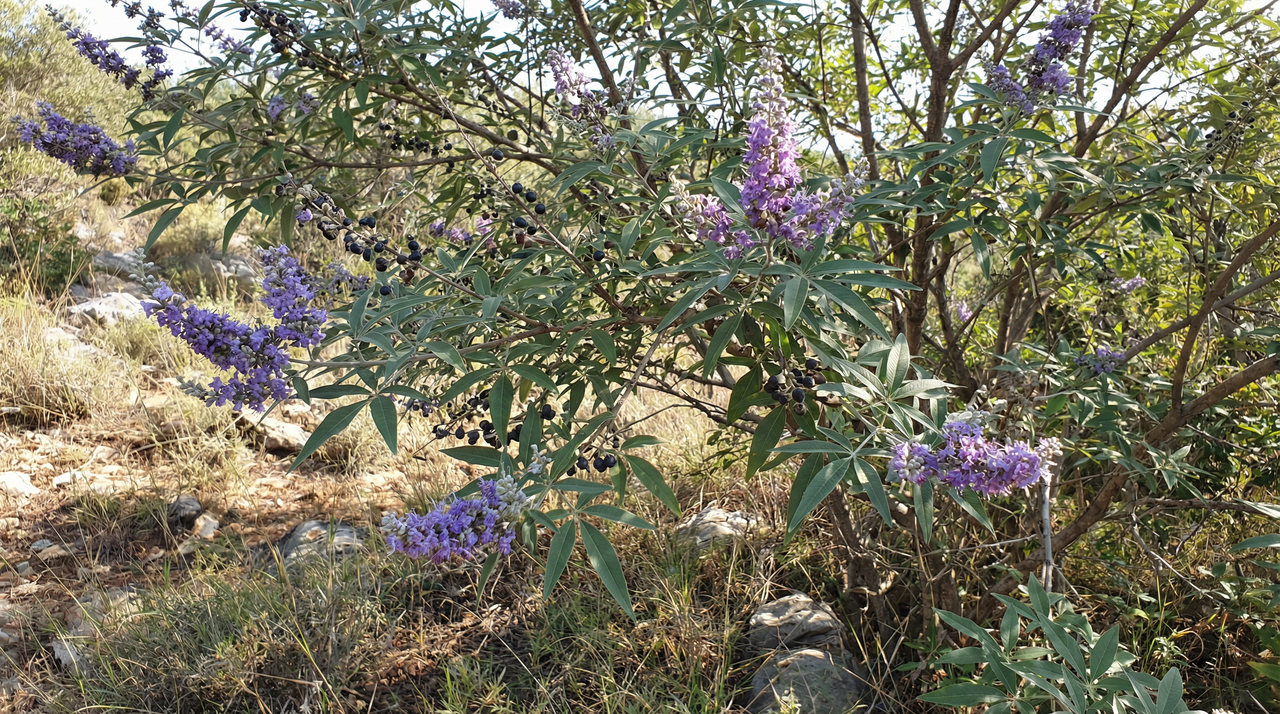
In the landscape, chaste tree takes on an upright, vase-shaped to rounded form with multiple stems that remind me a lot of crape myrtle in their overall architecture and summer bloom timing. Young stems are distinctively four-sided and slightly fuzzy; older bark goes grayish-brown and fissured the way you'd expect from a plant that has weathered decades.[5][3] The palmately compound leaves carry five leaflets in most cases, though anywhere from three to seven is normal, each one lanceolate to ovate with serrated edges, dark green on top and noticeably lighter underneath.[9][10] I'll warn you: those leaves draw a second glance from visitors who don't know the plant. They have a passing resemblance to cannabis foliage that can generate some entertaining conversations during garden tours.
Crush a leaf and you get a spicy, herbal scent I've come to associate with early summer pruning sessions. The flowers themselves appear from June through September as upright conical panicles up to 25 centimeters long, packed with small tubular blooms in lavender-blue to violet, with cultivars occasionally throwing white or pink.[11][12] The protruding stamens make those flower spikes irresistible to bees and butterflies at a time in summer when a lot of other ornamentals have already faded.
Traditional and Cultural Uses Through the Ages
The recorded history of chaste tree in medicine goes back at least two millennia. Hippocrates prescribed it for uterine disorders, and by the first century AD both Dioscorides and Pliny the Elder had written it into their catalogs of useful plants. Dioscorides recommended it for menstrual regulation and as a diuretic; Pliny noted its use as a pungent seasoning and in folk medicine.[13][14] In ancient Greece it appeared in festivals tied to chastity and fertility, sometimes called the sage tree of Athens, its symbolism threading through both purity rites and reproductive medicine in the same breath.[15]
Medieval Christian monks carried that reproductive association in a different direction. They ground the dried berries as a spice, calling them monk's pepper, and reportedly used them to suppress libido and support vows of celibacy.[16] I love keeping a chaste tree in my own permaculture plantings partly for that layered history: the same plant invoked by monks for chastity was being used by women across centuries to regulate their cycles, relieve PMS symptoms, address amenorrhea, and support hormonal balance through berry teas, decoctions, and tinctures.[17][18] That continuity across more than 2,000 years of consistent traditional application is remarkable, and it informed why this plant found its way into European pharmacopoeias and eventually into German Commission E monographs and ESCOP documentation.
Chaste tree arrived in North America in the 18th century and reached Britain in the early 19th, carried along by both its ornamental appeal and its herbal reputation.[19] The IUCN currently lists it as Least Concern globally, though localized overharvesting in parts of Greece and Albania has drawn some attention from conservationists.[20]
Fun Facts and Notable History
Every common name this plant carries, chaste tree, chasteberry, monk's pepper, traces back to that same reputation as a libido-suppressing anaphrodisiac.[15] It's one of those cases where the folk pharmacology is so specific and so consistent across cultures that you can't help but take it seriously. Today the plant is valued as much for its fragrant lavender-blue midsummer flower spikes and pollinator magnetism as for its herbal history, which feels like the right kind of full-circle arc for a Mediterranean native that survived the jump to temperate gardens worldwide.
On the question of invasiveness: context matters enormously here. Vitex agnus-castus can become problematic in coastal California, parts of the Pacific Northwest, and some disturbed sites in the Southeast, and certain cultivars like 'Summer Beauty' may naturalize more readily than the straight species.[21][22] In the Midwest or Northeast, it generally stays well-behaved.[23] In my work with clients in warmer climates, I've learned to treat it like many other enthusiastic self-seeders: beautiful in the right spot, but best kept away from natural areas where it could displace natives. Knowing this history helps us plant with intention rather than regret.
Chaste Tree Varieties and Cultivars
Vitex agnus-castus has no officially recognized botanical varieties or subspecies at all.[24][25][26] What it does have is a remarkably rich palette of over 20 named horticultural cultivars, most developed through selection from wild Mediterranean populations, with North American availability heavily shaped by Texas A&M breeding programs.[27][25] The baseline plant is a deciduous, vase-shaped, multi-stemmed shrub or small tree reaching 10 to 20 feet tall and wide, with aromatic gray-green palmate foliage and those signature lavender-blue flower spikes that show up all summer long.[28][5] Keep that in mind as your reference point before choosing a cultivar.
Popular Cultivars of Vitex agnus-castus
My cultivar choices in permaculture designs come down to three practical questions: How much space does the guild actually have? How humid are the summers? How cold does it get? The cultivar list for chaste tree maps neatly onto those concerns.
For disease resistance in humid climates, 'Shoal Creek' is the one I recommend most often. It carries an RHS Award of Garden Merit, pushes hardiness into zone 5 in protected sites, and in my experience with sticky subtropical summers, it shows noticeably less powdery mildew than the straight species.[27][25] 'Silverado' is worth seeking out for the same reason, with a bonus of silvery-gray foliage that reads beautifully next to darker companion plants. For gardeners on the northern edge of zone 6, 'Shalimar' is another zone-5-tolerant selection worth tracking down.[3][28]
For tighter spaces, I've become genuinely fond of the compact forms. After planting both the standard species and 'Blue Diddley' side by side in a client's food forest path, I kept reaching for the dwarf; its denser flowering drew more bees without crowding the guild. 'Compacta' (sometimes sold as 'Nana') and 'Canberra Spice' are other dwarf options worth considering, topping out around 3 to 6 feet.[27] If flower color matters for your design, the palette goes well beyond lavender-blue: 'Ivory Puffs' and 'Silver Spire' offer white blooms, 'Miss Ruby' leans pinkish-red, and 'Amethyst Puffs' produces double flowers.[25][29] One note on the variegated forms like 'Aurea' and 'Variegata': they're lovely, but they want protection from harsh wind and intense afternoon sun, which limits where they'll work in an exposed landscape planting.
All named cultivars must be propagated from cuttings to preserve their traits reliably[24][25] -- seed-grown plants will revert toward the species. And for context: Vitex doniana, the African black plum that sometimes surfaces in conversations about this genus, is an entirely different animal. It's a frost-tender tropical tree reaching 20 to 65 feet, suited only to zones 10 to 12, and it has no named cultivars to speak of.[30][31] Fascinating plant, but not the one most temperate permaculture gardeners are working with.
Where to Buy Chaste Tree Plants and Seeds
The chaste tree is widely available across the U.S. nursery trade, and finding the straight species is rarely difficult.[3] For named cultivars like 'Shoal Creek' or 'Silverado', specialty nurseries are your best bet: Plant Delights, Bower and Branch, and Logee's Greenhouses regularly carry interesting selections, while the Missouri Botanical Garden shop is a solid source backed by solid botanical credentials.[32][33] For germplasm research or sourcing seed from specific wild accessions, the USDA GRIN database is worth bookmarking.
When you're at the nursery, check the root ball before anything else. A circling root system in a container predicts transplant stress later, especially for a plant that develops a taproot. I've passed on otherwise beautiful specimens for exactly that reason. Look for vigorous growth, clean unblemished foliage, and a sturdy branching structure.[5] Spring after last frost is ideal for planting; fall works in milder climates.[34]
One thing worth knowing before you plant: while chaste tree isn't classified as a federal noxious weed, it can naturalize aggressively in parts of Florida and Texas.[3][35] I've watched self-seeded volunteers pop up throughout Central Florida landscapes, and I now routinely recommend deadheading spent flower spikes in warmer zones to keep things tidy and contained within the guild. Site it thoughtfully, and it rewards you for years.
Chaste Tree Propagation and Planting
Chaste tree propagation really comes down to one question: how soon do you want berries? The answer shapes every decision that follows, from whether you start with seeds or a cutting to how you prepare your site. I'll walk through both paths honestly, because each has real merit depending on your timeline and goals.
Seed Characteristics and Germination
The seeds themselves are worth knowing. Each one is small, kidney-shaped, dark brown, about 4 mm across, with fine surface reticulations and a thin membranous margin that catches the light.[36][37] They're orthodox seeds, meaning they tolerate desiccation and freezing, and they show a curious trait called polyembryony: each seed can contain both zygotic and nucellar embryos.[38][39] Properly stored, they stay viable for one to two years under typical conditions, or up to ten to twenty years at seed-bank temperatures around -18°C with moisture kept below 7%.[3]
The catch is dormancy. These seeds require cold stratification at 3 to 10°C for thirty to ninety days, or scarification, before they'll cooperate.[40] Get the pretreatment right and germination rates run 50 to 80%, with sprouting appearing in fourteen to thirty days at 68 to 77°F.[41] The deeper issue is that chaste tree mixes selfing with outcrossing, so seedlings are genetically variable and not reliably true to the parent plant.[42] I've made the mistake of raising a whole flat of seedlings without careful labeling, and in that first season they look so much like some common herbaceous perennials that you can genuinely lose track of what you've got. Good seed records and clear labels are not optional here.
Vegetative Propagation Methods
If you want a plant that matches the parent exactly and starts fruiting years sooner, cuttings are the answer. Semi-hardwood cuttings taken in late summer are the workhorse method, both commercially and in the home garden. Cut stems 4 to 6 inches long with two to three nodes, treat with rooting hormone, stick them in well-draining propagation media, and keep them under high humidity with bottom heat at 21 to 24°C. Rooting happens in four to six weeks with success rates of 70 to 90%.[6][43][44] I've had excellent results with this method in Florida's humid late summers, though I learned to add a dilute fungicide spray to the cutting batch once I lost a tray to fungal rot before it ever got a chance to root.[45] The humidity that makes propagation easy is the same humidity that invites problems if you're not watching.
Other options exist. Softwood cuttings in late spring and hardwood cuttings in late winter both work, and air layering in spring or summer achieves 60 to 80% success for those who prefer it.[5] Tissue culture is used for mass commercial production. Grafting is technically possible but rarely done because cuttings root so readily that the extra labor makes no sense.[46] For most home gardeners, late-summer semi-hardwood cuttings are simply the best combination of reliability and ease.
Soil, Site Selection, and Planting Technique
Chaste tree comes from Mediterranean rocky slopes and scrublands, and it carries that origin in its bones.[5] It thrives in lean soils with low to moderate organic matter and will grow in loam, sand, or even clay as long as drainage is genuinely good. The word "genuinely" matters here. Waterlogged or heavy clay soils invite root rot, which is the single fastest way to lose an otherwise tough plant.[28] A simple soil test before planting has prevented more failures in my designs than almost anything else I do; it's fifteen minutes of effort that removes the guesswork entirely.[28]
The optimal soil pH sits between 6.5 and 7.5, with the plant tolerating a range of 6.0 to 8.0.[47] Soils running below 6.5 can be corrected with 2 to 4 lb of lime per 100 square feet based on test results;[48] push above pH 8.0 and you risk iron chlorosis and nutrient lockout. Full sun is non-negotiable: at least six hours of direct sun daily keeps growth compact and flowering abundant; less than that and the plant stretches toward the light and blooms sparsely.[5]
When you're ready to plant, dig a hole two to three times wider than the root ball and 12 to 24 inches deep. Set the root ball at grade or just slightly above it; never below. If you're working with heavy clay, amend it with coarse sand or pine bark to open up drainage. Resist the urge to enrich the soil generously: high-nitrogen fertility and excess organic matter push weak, lush growth that's more vulnerable to disease and produces fewer berries than a plant that works a little harder.[49] Once it's in and happy, it asks remarkably little.
Spacing and Initial Establishment
Mature chaste trees reach 10 to 15 feet tall and wide, sometimes pushing to 20 feet, at a growth rate of about 1 to 2 feet per year.[5] Give specimen plants 8 to 12 feet between them. For a hedge or mass planting, 6 to 8 feet works; for a formal hedgerow, you can go as close as 3 to 5 feet; windbreak rows typically use 4 feet within the row and 10 to 12 feet between rows.[3]
Airflow is the reason spacing matters beyond aesthetics. I've watched powdery mildew move through a planting where shrubs were crowded together in our humid summers; plants spaced under 4 feet apart in high-humidity climates are significantly more prone to fungal issues.[50] Generous spacing at planting is cheaper insurance than fungicide treatments later. One ecological note for readers in Australia or other Mediterranean-climate regions: chaste tree has documented invasive potential in some areas, spread by birds that consume the fruit.[51] I monitor volunteer seedlings that pop up from bird-dispersed fruit near a few of my project sites, and while it's not a serious concern across most of the U.S., siting it away from natural areas and wild edges is a reasonable precaution wherever you garden.
Timeline to First Harvest
Seed-grown plants take 3 to 5 years to produce harvestable berries. Cuttings shorten that substantially, typically fruiting in 1 to 2 years; grafted plants land somewhere in between at 2 to 3 years.[52][6] Clients who want medicinal berries in a reasonable timeframe always get a rooted cutting from me. Those who are patient enough for seed get the satisfaction of watching the whole life cycle unfold, which is genuinely rewarding if you're not in a hurry.
Once a plant is established and flowering, fruit quality improves with moderate irrigation, phosphorus and potassium support during berry development, and keeping the pH in that 6.5 to 7.5 range where nutrient availability is best.[53][54] Post-bloom pruning after the season ends also supports more uniform fruit set the following year. These aren't complicated steps; they're the small habits that make the wait worthwhile.
Chaste Tree Care Guide
Most of chaste tree's reputation as a low-maintenance plant is well-earned, but it's conditional. Get two things right from the start and the plant essentially runs itself. Get them wrong and you'll spend years wondering why your vitex looks tired and barely flowers. Those two things are sunlight and drainage, and they're inseparable.
Sunlight Requirements
Chaste tree wants full sun, no negotiating. At least six hours of direct sun daily produces the compact habit and prolific flower spikes that make this plant worth growing; anything less and you get leggier stems and noticeably fewer blooms.[5][55] I've grown vitex in both conditions and the difference is stark. The shaded specimen needed staking by midsummer and attracted maybe a quarter of the pollinators its full-sun sibling did. The one exception I'd grant is a young plant struggling through its first summer in a climate where temperatures regularly push past 100°F; a bit of afternoon shade at 30-50% can prevent leaf scorch while roots are still getting established.[56] For a mature plant in good drainage, though, full sun all day is exactly what it evolved for.
Watering Needs
The first year or two after planting, keep the soil evenly moist, roughly one inch per week or a deep soak every seven to ten days depending on your climate.[5][55][57] Once that deep taproot is established, the calculus changes completely. Mature plants need watering only every two to four weeks during dry stretches, and even then a long, deep soak beats frequent shallow irrigation.[5][28][2] Mulching has made a real difference in my gardens; two to three inches of organic mulch at the root zone evens out soil moisture, moderates temperature, and substantially cuts down on how often I need to water during establishment.[58][5]
Drainage is the one thing you can't compromise on. Waterlogged roots lead directly to root rot, and the symptoms (yellowing leaves starting at the base, wilting, soft mushy roots) can be mistaken for drought stress until it's too late.[5][55] The plant is Mediterranean through and through; it evolved on rocky, alkaline soils that drain fast and dry out quickly, and it prefers a pH anywhere from 6.0 to 8.0.[58] Give it those conditions and it honestly takes care of itself in most droughts.
Feeding and Soil Fertility
I learned this lesson the hard way: chaste tree is a genuine light feeder, and pushing nitrogen at it backfires fast. I once gave a young plant a generous dose of high-nitrogen fertilizer expecting to speed things along, and it responded by producing enormous, lush leaves and almost zero flowers. That was the last time I reached for synthetic fertilizer with this plant. Excess nitrogen promotes vegetative growth at the expense of blooms and also increases susceptibility to pests and disease.[59][60][61]
If you do feed, a soil test first is the smart move. For most established plants in decent soil, an annual compost top-dressing is sufficient. Young plants or those in containers benefit from a balanced slow-release fertilizer at half strength in early spring as new growth starts, and nothing after midsummer so you don't push tender growth into frost season.[62][5][62][63] If you notice chlorosis and stunting on older leaves, that's nitrogen deficiency; purplish leaves with poor flowering point to phosphorus; marginal leaf scorch on otherwise healthy stems suggests a potassium shortfall.[64] Those are the situations that justify intervention. Otherwise, lean toward restraint.
Frost Tolerance and Winter Protection
Mature chaste trees are hardy through USDA zones 6a to 9b, tolerating temperatures down to -10°F with minimal damage.[65][66][3] What often kills it is not cold alone but wet, waterlogged winter conditions; good drainage matters as much in January as it does in July.[65] In colder zones, plants may die back to the ground entirely, but they reliably resprout from the roots in spring.[65][67]
After growing chaste tree through several winters I'm convinced the first two are the make-or-break period. I now mulch young plants with two to three inches at the root zone and wrap exposed stems in burlap when temperatures are dropping below -10°F; established specimens I leave alone and they come back fine.[68] Planting in a sheltered microclimate, near a south-facing wall or out of prevailing winter winds, genuinely extends performance at the cold edge of the range.
Heat and Drought Tolerance
Once established, chaste tree handles heat in a way that impresses even seasoned gardeners. It's rated across AHS heat zones 8-1 and tolerates sustained daytime temperatures of 100-110°F in well-drained soil, helped along by Mediterranean adaptations like pubescent leaves that reflect heat and a deep taproot that keeps reaching for moisture below the scorched surface.[5][28] I've noticed that my plants in full sun with good drainage sail through weeks of 100°F+ heat while ones in heavier clay or partial shade show noticeably more leaf scorch. Cooler nights really do help with flower quality; recovery happens fast when temperatures drop in the evening.
Seedlings are more vulnerable to combined heat and drought above 95°F, so protecting young plants with mulch and consistent deep watering carries them through their first hot summer.[69][70] For mature plants I rely on mulch and infrequent deep soaks rather than shade cloth; shade cloth tends to reduce flowering more than it helps. If you're in an arid climate where summers are brutal, cultivars like 'Shoal Creek' have a track record of stronger heat performance worth seeking out.
Pruning and Maintenance
Chaste tree blooms on new wood, which means pruning timing is everything. Cut back in late winter or early spring before new growth begins, taking off one-third to one-half of the previous year's growth to encourage a bushier plant and more flowering stems.[5][7] I wait until after the last frost date before doing any major cleanup, a habit I developed after losing a flush of early flower buds to a late freeze. A light cut after the first bloom flush can also encourage a second round of flowers later in the season.
Beyond the main structural pruning, remove dead, diseased, damaged, or crossing branches whenever you spot them, and cut root suckers at ground level to prevent the plant from spreading wider than you intended.[28][5] With young plants in their first couple of seasons, pinching stem tips promotes branching without the stress of heavy pruning. In my experience this is a forgiving shrub; if you make a pruning mistake, it bounces back faster than almost anything else in the garden.
Seasonal Growth Rhythm
Understanding chaste tree's annual cycle makes every care task feel logical rather than arbitrary. Vegetative growth pushes out in early spring (March into April), followed by flowering on new wood from June through August, then fruit and seed set in August and September, and finally leaf drop into dormancy from October onward.[3][5][71] For me, watching that first flush of aromatic foliage appear in March is the signal that winter protection can come off and the early spring feeding window is open. Prune before that growth surge, feed lightly as it begins, water consistently through the hot months, then ease off as the plant moves into dormancy. It's a simple rhythm once you've watched it play out a few times.
Harvesting Chaste Tree (Vitex agnus-castus) Berries
Patience is the first skill you develop growing chaste tree. Plants started from seed take three to five years before they flower at all, and even once you have blooms, you're still two to three months away from ripe fruit. Flowering runs from late spring through midsummer, roughly May through July, with berries maturing 60 to 90 days later.[72][8] That puts peak harvest somewhere between August and October depending on your zone; zone 9 growers are often picking in August while zone 6 gardeners wait until September or October.[3][73] I now mark my calendar each July and start checking clusters daily, because once the color shift begins, it moves fast.
When to Harvest Chaste Tree Berries: Timing, Ripeness Cues, and Regional Variations
The signal you're waiting for is unmistakable once you've seen it: those clusters of small 2 to 5 mm drupes shift from green to glossy dark purple-black, and that color change is your go signal.[74][75] It's not just cosmetic. Full ripeness is when agnusides, casticin, phenolic compounds, and essential oils peak in concentration.[76] I only use fully dark, glossy berries for any preparation because research and my own results both show the active compounds peak at that stage; anything greener simply doesn't deliver. The flavor tracks this chemistry directly: unripe berries offer a faint peppery note, while ripe fruit hits with a pronounced bitter, aromatic punch and noticeably higher essential oil content.[77][78] Harvesting a week too early noticeably reduces the aromatic punch when the dried berries are later crushed for tincture or tea.
How to Harvest and Process Chaste Tree Berries for Maximum Potency
The technique itself is simple. Cut entire ripe clusters with pruning shears on a dry morning after the dew has evaporated, keeping clusters intact rather than stripping individual berries.[75][5] From there, drying promptly is what protects your harvest. Spread berries in a single layer in a shaded, well-ventilated space and keep temperatures between 30 and 40°C (86 to 104°F) for one to two weeks until they're completely brittle.[79] I dry mine at the low end of that range in a shaded greenhouse; going hotter risks driving off the volatile oils that account for most of the medicinal character. Store dried berries in airtight containers away from light and heat.
Yield, Flavor Profile, and Quality Factors of Chaste Tree Berries
Fresh ripe berries smell remarkably like black pepper crossed with bay leaf, firm and slightly juicy, with spicy-herbal and faintly sweet undertones.[3][80] Drying concentrates that into something harder and more intense, bitter-peppery with sweet-sour undertones. The chemistry behind it is 1,8-cineole, sabinene, α-pinene, limonene, and β-caryophyllene, all monoterpenes that increase as the fruit matures.[81][82] European cultivars tend to be more pungent than Mediterranean types, so what you grow shapes what you harvest. Historically, that peppery intensity made the berries a medieval substitute for black pepper in meats and stews,[29] but modern culinary use is rare given both the strong bitter-medicinal character and the plant's documented hormonal effects.[83] Mature established plants produce abundant clusters, so yield is rarely the constraint; quality driven by ripeness is what actually matters.
Chaste Tree Preparation and Uses
Culinary Uses and Flavor Profile of Chaste Tree Berries
Crack open a dried Vitex berry and you get something genuinely surprising: a sharp, peppery heat with piney, slightly camphorous undertones from essential oils containing monoterpenes like limonene and 1,8-cineole.[84][85] Medieval European cooks noticed this too, and for centuries the berries served as a cheaper pepper substitute, seasoning meats, stews, and fermented drinks under the name "monk's pepper."[86][87] That culinary chapter is largely closed now. While historical European recipes exist, contemporary use is almost exclusively herbal, and for good reason: the same flavonoids and iridoids responsible for the peppery bite are the compounds driving medicinal value.[85][88] This is not a food crop.
Fresh berries should never be eaten raw; compounds including agnuside and vitexicarpin can cause gastrointestinal irritation, and the bitterness alone discourages it.[89] Processing is essential. I dry my own harvest at low temperatures, either in shade or a dehydrator set below 40°C, and the peppery, cineole-rich scent that fills the workspace confirms the volatile oils are still intact.[78] It took me a couple of seasons to realize that high-heat drying kills that aromatic punch; now I stick to shade or low-temp dehydration and notice better results in both tea flavor and tincture strength. The dried berries remind me of working with allspice, and I crush them fresh rather than buying pre-ground to keep potency high. For a simple vitex tea, one teaspoon of dried berries steeped ten minutes is the traditional approach, sometimes combined with red raspberry leaf.[86]
Medicinal Preparations and Dosages
The dried fruit is the part that matters medicinally. Its hormonal effects, prolactin reduction via pituitary dopamine D2 receptor agonism and downstream progesterone balancing, are what make chaste tree berry extract a recognized herbal intervention for PMS, cyclic breast pain, and menopausal symptoms.[90][91] Standardized extracts are set at 0.5% agnuside per the European Pharmacopoeia, which is the benchmark for quality supplements.[92] Typical adult dosage runs 20-40 mg per day of standardized extract, or 175-225 mg of dried fruit, or 20-40 drops of tincture three times daily, used consistently for three to six months to see results.[93][94][95] For a home tincture, I soak crushed dried berries in 70-80% ethanol for four to six weeks; a decoction uses one to two grams of dried fruit simmered per cup of water for ten to fifteen minutes.[96]
I always tell people clearly: if you're pregnant, breastfeeding, on hormonal birth control, or taking dopamine-related medications, skip chasteberry or talk to your doctor first. The interaction data is too clear to ignore. On sourcing, wild populations in Albania and Turkey face real overharvesting pressure,[97] so I grow my own and encourage others in suitable climates to do the same, or to buy from verified cultivated sources. You know exactly what you're getting, and quality is genuinely better.
Non-Food and Traditional Applications
Beyond medicine, the plant keeps giving. Leaves yield a yellow dye, and the hard, dense wood suits small carvings, tool handles, and basketry frames.[98] In my garden, prunings from annual cutbacks go straight to work as sturdy short-term stakes or get chopped for mulch. Coppiced stems produce useful biomass, and the whole plant responds well to that kind of regular harvesting. It's a good reminder that the same shrub supplying your vitex perimenopause tea in September is also giving you craft material, dye plant, and mulch throughout the year, which is exactly the kind of stacking functions that earns a plant its place in a well-designed system.
Chaste Tree Health Benefits and Medicinal Uses
Chaste tree is not a nutritional powerhouse you add to smoothies. It's a medicinal herb with a specific, well-researched mechanism of action, and understanding that mechanism is the key to understanding why it works, who it works for, and who should stay well away from it.
Key Phytochemicals in Chaste Tree
The berries contain a layered mix of bioactive compounds that work together to produce the plant's distinctive hormonal and anti-inflammatory effects. Iridoids like agnuside and aucubin appear to be the primary drivers of hormonal activity, while flavonoids such as casticin and vitexin contribute antioxidant and anti-inflammatory properties. The diterpenes, including vitexilactone and rotundifuran, and volatile essential oil constituents like 1,8-cineole round out the profile.[99][100][101] That last point matters for home growers: shade drying your harvested berries preserves up to 20-30% more of those volatile compounds compared to heat drying, so your preparation method directly affects what ends up in your tea or tincture.[102]
Medicinal Research and Clinical Evidence
The central mechanism here is dopaminergic. Vitex agnus-castus acts as a dopamine D2 receptor agonist, binding to receptors in the anterior pituitary and suppressing prolactin secretion, which in turn supports progesterone levels during the luteal phase of the menstrual cycle.[16][103][104] That single pathway explains most of what the clinical evidence confirms: when you reduce excess prolactin and support progesterone, you address a common hormonal imbalance underlying PMS, cyclic breast pain, and irregular cycles.
The clinical trials are where vitex chaste tree benefits become genuinely compelling. In studies on PMS and premenstrual dysphoric disorder, 50-60% of participants reported significant symptom improvement after three cycles of treatment.[105][106][107] Cyclic mastalgia, that deep breast tenderness that arrives predictably before menstruation, responded even more strongly, with approximately 70% of participants experiencing meaningful reduction.[108] In my work with clients exploring natural support for menstrual wellness, that three-cycle timeline is something I mention consistently, because I've heard it echoed back again and again by women who report that the first month felt uncertain, the second month felt different, and the third month felt like a turning point.
Beyond women's reproductive health, the research picture is supportive but more preliminary. Animal models show anti-inflammatory effects in arthritis and edema, and in vitro studies demonstrate antioxidant activity comparable to established antioxidants alongside antimicrobial activity against pathogens like Staphylococcus aureus.[109][110][111] Rodent studies also point to mild analgesic and antispasmodic effects, particularly on uterine smooth muscle, and clinical trials have noted sedative-adjacent effects that improve sleep and reduce anxiety in women with PMS.[112][113] These are promising signals, but it's important to name them for what they are: preclinical and in vitro data, not the human trial evidence we have for PMS.
None of this is new territory, exactly. Hippocrates, Dioscorides, and Pliny documented the plant's use for women's reproductive complaints.[114][115][91] Two thousand years of consistent application in women's health, now backed by a plausible mechanism and solid clinical data, is a meaningful convergence. I grow chaste tree in my zone 9B landscapes for its beauty and its value to pollinators, but I find the herbal history adds another dimension to the plant entirely.
Nutritional Profile of Chaste Tree
The dried berry does contain macronutrients and minerals. Approximate values per 100 grams run roughly 300-350 calories, 12-15 grams of protein, 60-70 grams of carbohydrates with 20-30 grams of fiber, and meaningful amounts of potassium, calcium, magnesium, iron, and phosphorus, along with trace vitamin C and vitamin E.[116][117] Treat all of that as interesting context rather than meaningful dietary contribution, because the typical medicinal dose is only 0.5-2 grams of dried berries per day, or 20-40 mg of standardized extract.[118][119] At those amounts, you're not eating for nutrition; you're working with concentrated phytochemistry. The key glycosides show moderate bioavailability at 40-60%, with peak plasma levels reached within one to two hours.[119] The nutritional data is also limited and estimated rather than from standardized databases, so I wouldn't lean on those numbers too heavily.
Safety Considerations for Chaste Tree
The good news on chaste tree side effects is that they're genuinely uncommon. Animal toxicity studies show a high LD50 above 5 g/kg, no fatal human poisonings have been documented at typical doses, and the ASPCA lists it as non-toxic to cats and dogs, with only potential mild digestive upset from large quantities.[120][121][122] Fewer than 10% of users experience any side effects, and those tend to be mild: nausea, headache, gastrointestinal upset, or occasionally a skin rash; allergic responses occur in under 2% of cases.[123][17]
The contraindications, though, are firm. Vitex is not appropriate during pregnancy due to potential hormonal effects that may increase miscarriage risk, and it's not recommended during breastfeeding.[17][124] Hepatotoxicity hasn't been documented in human clinical trials, though animal studies at high doses do show liver effects, so caution is warranted.[125] The drug interaction picture is also significant: because vitex lowers prolactin through dopamine receptor activity, it can interfere with hormonal contraceptives, hormone replacement therapy, dopamine antagonists, and antipsychotics.[126][17] That interaction isn't speculative; it's mechanistically straightforward. When I talk to clients who are using birth control and considering herbal support for hormonal balance, I explain exactly that pathway, because understanding the why makes the caution feel less arbitrary.
One more thing I always flag as a gardener: there are toxic look-alike plants, particularly Ligustrum species (privet), that can cause gastrointestinal distress and potential liver damage.[127][128] Vitex is distinguished by its palmately compound leaves, while privet has simple leaves, but verify your identification before harvesting anything for medicinal use. I label my plants clearly in client gardens precisely because of this. As someone who values both healthy landscapes and healthy clients, I'd recommend discussing vitex with a doctor before using it medicinally, especially if you're pregnant, nursing, or on any hormonal medications.
Chaste Tree Pests and Diseases
Vitex is one of those plants that I recommend partly because of what it doesn't need. In all the years I've grown it alongside Mediterranean companions like lavender and rosemary, the pattern is consistent: aromatic foliage is its own defense system. The same bioactive compounds that give chaste tree its distinctive scent appear to deter most common insect pests, and the result is a shrub that's genuinely resistant to the majority of things that make other ornamentals miserable.[5][129] Rosemary and lavender work the same way, and I almost never spray any of them.
Natural Pest Resistance and Rare Insect Issues
Aphids, spider mites, and leaf beetles rarely bother a healthy, well-sited plant.[5][130] In my own garden, I do a closer look at the new spring growth for aphids, especially in humid southeastern conditions, but I've rarely needed more than a strong blast from the hose. Scale insects and whiteflies can occasionally show up, and their calling cards are sticky honeydew and sooty mold rather than dramatic defoliation, so they're easy enough to catch early if you're paying attention.[128][131] Deer and rabbits tend to leave it alone too, which matters more than people realize when you're establishing a new food forest edge.[132] The guiding approach here is monitoring over intervention: watch the plant, treat only when actually needed, and trust that a healthy specimen in the right spot rarely needs either.[133]
Disease Prevention Through Cultural Practices
Chaste tree shows good resistance to verticillium wilt and other soil-borne diseases that take down less-adapted shrubs.[5][134] Fungal issues like leaf spot, powdery mildew, and rust can appear under humid, crowded, or poorly ventilated conditions, but leaf spot in particular tends to be cosmetic rather than damaging.[5][135] I've noticed that my Vitex in full sun with sharp drainage has never shown that spotting, while a more shaded specimen tucked against a fence struggled noticeably one wet summer. Root rot from Phytophthora is the one disease I'd flag as genuinely serious, and it's entirely avoidable: waterlogged soil is the culprit every time.[5][129] Once I stopped planting into low spots, I stopped seeing it entirely. Bacterial and viral problems are uncommon enough to be almost theoretical in practice.[5]
Good drainage, full sun, thoughtful spacing for airflow, and avoiding overhead irrigation do the heavy lifting here.[5][129] If powdery mildew does appear, potassium bicarbonate or sulfur-based products handle it without heavy intervention.[136] If you're in a humid climate or a site that's even occasionally wet, 'Shoal Creek' is worth seeking out; it's shown noticeably better resistance to both root rot and fungal issues than the straight species in my experience.[137] Most vitex tree problems, honestly, trace back to site selection rather than anything the plant does wrong on its own.
Chaste Tree in Permaculture Design
What draws me to chaste tree as a permaculture plant isn't any single function -- it's how many roles it fills quietly, without much fuss, in climates where a lot of other woody shrubs struggle. It's the kind of plant that rewards you for understanding where it came from.
Climate Adaptation and Hardiness Zones
Vitex agnus-castus sits comfortably in USDA zones 6-9, thriving in the kind of Mediterranean climate profile (think hot dry summers, mild wet winters) that matches much of the American South, Southwest, and Pacific Coast.[5][3] Established plants can handle winter lows down to around -10°F, and the hardiest cultivars push that to -15°F, which the RHS rates as fully hardy to -20°C.[5][138] I've successfully carried plants through a zone 5b cold snap using 4-6 inches of coarse mulch over the root zone and a sheltered south-facing microclimate, and while I wouldn't call it bulletproof at that edge, it's doable with a little extra care in the first couple of winters.[5]
The non-negotiables are full sun (six or more hours) and genuinely well-drained soil.[5][139] In my experience, poor drainage in cold wet winters kills chaste tree faster than any frost does. Get those two conditions right, and you have a plant that needs as little as 20-25 inches of annual rainfall once established, handles coastal salt spray without complaint, and can even extend into zone 10 with some supplemental irrigation during the worst heat.[5][69] The deer resistance and RHS Award of Garden Merit don't hurt its credentials either.[3][140]
Ecosystem Functions and Guild Roles
The bloom period is where chaste tree really earns its keep in a pollinator-conscious design. Those long lavender-purple spikes flower from June through September, sometimes stretching a full twelve weeks, and they pull in honeybees, bumblebees, over fifty species of solitary bees, butterflies, and the occasional hummingbird.[141][2] I've grown this plant in several zone 7-9 designs and what consistently surprises me is the sheer number of bumblebees it draws, especially through August when most other flowering shrubs have given up. That late-summer nectar gap is real, and chaste tree fills it better than almost anything else I've planted at that scale. For context, I've tried butterfly bush in similar spots, but given its invasive potential in many regions, chaste tree is the more responsible choice -- it self-seeds modestly in some areas but presents generally low invasiveness risk in the US.[142][5]
In its native Mediterranean range, chaste tree behaves as a pioneer on disturbed slopes, holding soil together with deep roots while other vegetation reestablishes.[141] Those same deep roots function as a dynamic accumulator, mining potassium and other minerals from subsoil layers and cycling them back through leaf litter.[98] I'll be honest: I initially hoped to use it as a nitrogen fixer in a guild, but soil tests and observation made clear that it just doesn't work that way. It functions far better as a mineral accumulator and windbreak, and once I reframed my expectations around those roles, it became much easier to site correctly.[98] Its dense branching structure also serves as a windbreak or informal hedge, and the aromatic foliage, loaded with compounds like agnuside, actively repels mosquitoes.[98] I've planted it near sitting areas specifically for that reason, and the difference on summer evenings is noticeable. Autumn berries provide some food for birds, though their nutritional value is modest -- this isn't a heavy wildlife producer, but the branching structure does offer nesting cover.[143]
Forest Layer Placement and Companion Planting
At 10-20 feet tall with a similar spread and a rounded, multi-stemmed habit, chaste tree slots naturally into the shrub layer or low tree layer of a food forest, particularly at sunny edges and transitional zones where it can get the full sun it needs.[3][144] Because the taproot goes deep rather than spreading laterally in the surface zone, it competes surprisingly little with the shallow-rooted herbs and groundcovers you'd plant underneath or nearby.[5]
My go-to guild partners for a dry Mediterranean-style planting are lavender and rosemary, both of which share its preference for lean, well-drained, slightly alkaline soil and low summer irrigation.[5][145] The chaste tree provides afternoon shade and windbreak for those lower herbs, they collectively support pollinators across spring, summer, and fall, and the whole planting runs on minimal water once established. In broader agroforestry contexts it earns its place in shelter belts and erosion-control plantings, where coppicing and leaf-litter drop add biomass to the soil over time.[144][146] If you're in a region where it self-seeds readily, deadheading after bloom keeps that in check without sacrificing much -- or you can let a few seedlings establish where they're welcome and move on.
The Plant That Made Me Slow Down and Actually Read the History
I almost passed over chaste tree years ago because I thought I understood it: drought-tolerant, pretty lavender spikes, fine for zone 7. Then I started digging into the monastic records and the Dioscorides references, and I just stopped. There's something humbling about a plant that's been doing exactly this, filling this same ecological and medicinal role, for two thousand years before anyone thought to give it a Latin binomial. It doesn't need my endorsement. It just needs the right spot.
Sources 146
- Vitex agnus-castus L. ↩
- Vitex agnus-castus - Chaste Tree ↩
- Vitex agnus-castus ↩
- Chaste Tree - UC Master Gardener Program ↩
- Vitex agnus-castus (Chaste Tree) ↩
- Chaste Tree (Vitex agnus-castus) ↩
- Vitex agnus-castus ↩
- Chaste Tree (Vitex agnus-castus) ↩
- Plant Finder: Vitex agnus-castus ↩
- Vitex agnus-castus ↩
- Plant Finder - Vitex agnus-castus ↩
- Vitex agnus-castus ↩
- De Materia Medica ↩
- Ethnobotany of Vitex agnus-castus ↩
- Vitex agnus-castus ↩
- Monk's Pepper: A Review of Vitex agnus-castus ↩
- Chaste Tree (Vitex agnus-castus): Use in Women's Health ↩
- Vitex agnus-castus: A Systematic Review ↩
- Vitex agnus-castus ↩
- IUCN Red List: Vitex agnus-castus ↩
- Vitex agnus-castus: California Invasive Plant Council Profile ↩
- Chaste Tree - California Invasive Plant Council ↩
- Chaste Tree (Vitex agnus-castus) ↩
- Vitex agnus-castus - Plants of the World Online ↩
- Vitex agnus-castus - RHS Plant Finder ↩
- Vitex agnus-castus - Missouri Botanical Garden Plant Finder ↩
- Breeding History of Vitex Cultivars ↩
- Chaste Tree (Vitex agnus-castus) ↩
- Ornamental Shrubs: Vitex Selection Guide ↩
- Vitex doniana Sweet ↩
- Black Plum (Vitex doniana) - Uses and Cultivation ↩
- Vitex agnus-castus ↩
- Vitex Agnus-Castus - Chaste Tree ↩
- Vitex agnus-castus ↩
- Florida Exotic Pest Plant Council's List ↩
- Vitex agnus-castus - Missouri Botanical Garden ↩
- Vitex agnus-castus - USDA Plants Profile ↩
- Polyembryony in Vitex agnus-castus L. (Lamiaceae): nucellar embryony and its implications ↩
- Seed storage behavior of Vitex agnus-castus ↩
- Seed Dormancy and Germination in Vitex Species ↩
- Propagation of Vitex agnus-castus: Seeds vs. Cuttings ↩
- Breeding System and Genetic Diversity in Vitex agnus-castus ↩
- Vitex agnus-castus: Propagation and Production ↩
- Propagation of Woody Plants by Cuttings ↩
- Vitex agnus-castus - Chaste Tree ↩
- Micropropagation of Chaste Tree (Vitex agnus-castus) ↩
- Vitex agnus-castus ↩
- Soil pH and Amendments for Trees ↩
- Growing Chaste Tree (Vitex agnus-castus) ↩
- UC Master Gardeners - Vitex agnus-castus Care Guide ↩
- USDA PLANTS Database: Vitex agnus-castus ↩
- Vitex agnus-castus - Growing Guide ↩
- Vitex agnus-castus Cultivation Guide ↩
- Irrigation and Nutrition for Medicinal Plants ↩
- Vitex agnus-castus - RHS Plant Selector ↩
- Vitex agnus-castus: Chaste Tree - Morton Arboretum ↩
- Chaste Tree (Vitex agnus-castus) - UCANR ↩
- Vitex agnus-castus - RHS ↩
- Vitex agnus-castus - Plant Finder - Missouri Botanical Garden ↩
- Vitex agnus-castus - USDA Plants Profile ↩
- Vitex agnus-castus - RHS Plant Selector ↩
- Vitex agnus-castus Growing Guide - RHS ↩
- Vitex agnus-castus - Missouri Botanical Garden ↩
- Nutrient Deficiencies in Woody Ornamentals - UF/IFAS ↩
- Vitex agnus-castus - Missouri Botanical Garden ↩
- Vitex agnus-castus - RHS ↩
- Frost Damage on Woody Plants - UMN Extension ↩
- Vitex agnus-castus - Missouri Botanical Garden ↩
- Chaste Tree (Vitex agnus-castus) - Heat and Drought Tolerance - UF/IFAS ↩
- Horticultural Performance of Vitex agnus-castus Under Stress Conditions ↩
- Vitex agnus-castus - RHS ↩
- Missouri Botanical Garden - Vitex agnus-castus ↩
- RHS Plant Finder - Vitex agnus-castus ↩
- USDA Plant Guide - Vitex agnus-castus ↩
- EMA Assessment Report on Vitex agnus-castus L., fructus ↩
- Phenology and Fruit Development in Vitex agnus-castus ↩
- Chemical Composition and Antioxidant Activity of Vitex agnus-castus Fruits at Different Ripeness Stages ↩
- Vitex agnus-castus: A Review of Its Phytochemistry and Pharmacological Activities ↩
- Commission E Monographs: Agnus castus fruit ↩
- Chemical Composition and Biological Activities of Chaste Tree ↩
- Essential Oils of Vitex agnus-castus ↩
- Essential Oil Variability in Vitex agnus-castus Depending on Geographic Origin and Phenological Stage ↩
- Vitex agnus-castus in Ethnobotany ↩
- Vitex agnus-castus (Chaste Tree): Monograph ↩
- Nutritional Composition of Medicinal Plants: Vitex agnus-castus ↩
- Vitex agnus-castus: A Systematic Review of Biochemical, Pharmacological, and Clinical Evidence ↩
- Royal Horticultural Society (RHS): Vitex agnus-castus 'Dartmunster' - Monks Pepper ↩
- Pharmacognosy of Vitex agnus-castus ↩
- Vitex agnus-castus (Chaste Tree) Fact Sheet ↩
- Commission E Monographs: Agnus Castus Fruit ↩
- Chaste Tree (Vitex agnus-castus) - Phytotherapy Review ↩
- European Pharmacopoeia 10.0 - Vitex agnus-castus fruit ↩
- Vitex Agnus-Castus ↩
- Chasteberry ↩
- Assessment report on Vitex agnus-castus L., fructus ↩
- Herbal Medicines: An Inquiry into their Safety and Efficacy ↩
- Sustainability and Wild Harvest of Vitex agnus-castus ↩
- Vitex agnus-castus in Permaculture Systems ↩
- Phytochemistry and Pharmacology of Vitex agnus-castus ↩
- Phytochemical and Pharmacological Aspects of Vitex agnus-castus ↩
- Chemical Composition of the Fruits of Vitex agnus-castus ↩
- Effect of Drying Methods on Essential Oil Yield in Vitex Species ↩
- Dopamine receptors and effects of Vitex agnus-castus ↩
- Vitex agnus-castus: A Systematic Review of Biochemical, Pharmacological, and Clinical Studies ↩
- Clinical Trials on Vitex for Menstrual Regulation ↩
- Vitex agnus castus for premenstrual syndrome and premenstrual dysphoric disorder ↩
- Vitex agnus-castus extracts for female reproductive disorders: a systematic review of clinical trials ↩
- Mastodynia and Hyperprolactinaemia ↩
- Anti-inflammatory effects of Vitex agnus-castus in animal models ↩
- In vitro antioxidant activity of Vitex agnus-castus extracts ↩
- Antimicrobial properties of chasteberry against common pathogens ↩
- Analgesic and antispasmodic activities of Vitex agnus-castus ↩
- Clinical trial on sedative effects of Vitex for PMS and anxiety ↩
- Vitex agnus-castus: A Systematic Review of Biochemical, Pharmacological, and Ethnobotanical Approaches ↩
- Chaste Tree (Vitex agnus-castus) in Traditional Medicine: A Review ↩
- Chasteberry (Vitex agnus-castus) - Mayo Clinic ↩
- Nutritional and Phytochemical Analysis of Vitex agnus-castus Fruits ↩
- Vitex Agnus-Castus (Chasteberry): Benefits, Side Effects, and Dosage ↩
- Pharmacokinetics of Vitex agnus-castus Extract in Humans ↩
- Safety Assessment of Chaste Tree Berry ↩
- Assessment report on Vitex agnus-castus L., fructus ↩
- Chaste Tree ↩
- Vitex agnus castus: a systematic review of adverse events ↩
- Chaste tree (Vitex agnus-castus) ↩
- Chaste Tree - LiverTox - NCBI Bookshelf ↩
- Herb-Drug Interactions Involving Vitex agnus-castus ↩
- Vitex agnus-castus Plant Profile ↩
- Important Tree and Shrub Directory ↩
- Chaste Tree (Vitex agnus-castus) ↩
- University of Florida IFAS Extension - Vitex agnus-castus ↩
- Insect Pests of Woody Ornamentals in Florida ↩
- Vitex agnus-castus - Chaste Tree ↩
- Integrated Pest Management for Ornamentals ↩
- Chaste Tree: Growth and Care ↩
- Diseases of Woody Ornamentals ↩
- Powdery Mildew on Ornamentals ↩
- Vitex agnus-castus 'Shoal Creek' ↩
- Vitex agnus-castus ↩
- Chaste Tree (Vitex agnus-castus) ↩
- Vitex agnus-castus ↩
- Vitex agnus-castus - Missouri Botanical Garden ↩
- Invasive Plant Atlas ↩
- Missouri Botanical Garden PlantFinder - Vitex agnus-castus ↩
- Vitex agnus-castus in Agroforestry Systems ↩
- Vitex agnus-castus ↩
- Agroforestry Potential of Vitex Species ↩
About the Author
Samiksha is a Certified Permaculture Designer and Teacher. Raised on a regenerative farm, she has over 20 years of experience learning and growing with local and indigenous communities.