Every part of the chayote is edible. The fruit, the shoots, the leaves, the flowers, the starchy tuberous roots. Even the seed, which you can't actually remove before planting because the whole fruit is the seed. I've grown a lot of plants over the years, and I still find that last part slightly mind-bending: you don't crack it open, you don't dry it, you don't stratify it. You take a single wrinkled green fruit off your counter, wait for it to start sprouting from the blossom end on its own, and then you bury the whole thing. The seed and its food source and its future skin are one continuous object. It's one of the more quietly radical things a plant can do.
What gets me is how invisible chayote stays in American gardening culture despite being a dietary staple across Latin America, Southeast Asia, the Caribbean, and parts of Africa. Most people in the U.S. have walked past it in the grocery store a hundred times without a second glance, maybe mistaking it for a pale, lumpy pear. But in Mexico, where it was already cultivated centuries before the Spanish showed up, it's woven into the food system so completely that the vine, the roots, and the shoots all have their own culinary identities.[1] That's the plant I want to tell you about: not an exotic curiosity, but a misunderstood workhorse that's been hiding in plain sight.
Chayote Origin, History, and Botanical Background
If you've ever stood in a grocery store produce aisle puzzling over a pale green, pear-shaped fruit with a single crease down one side, you've met chayote. Pronounced "chai-OH-tay" (though I've heard every variation imaginable at farmers markets), it's technically a fruit in the botanical sense, a fleshy pepo related to cucumbers, squash, and melons. Its full name is Sechium edule, and its story starts deep in Mesoamerica.
Botanical Characteristics of Chayote
Chayote is a perennial climbing vine in the Cucurbitaceae family, native to southern Mexico with a natural range extending through Central America into parts of northern South America.[2][3][4] In the wild it gravitates toward disturbed habitats and forest edges, which tells you something useful about how it behaves in a garden: it's an opportunist with ambition. Under good tropical conditions it's polycarpic, meaning it fruits year after year, sometimes for a decade or more.[5] In practice, though, cultivated plants tend to decline after three to five years as soil pathogens like Fusarium and Phytophthora accumulate.[5] I learned this the hard way in my own subtropical garden; rotating the planting site every few years made a noticeable difference in vine vigor.
Wild chayote populations are dioecious, meaning male and female flowers appear on separate plants, but many cultivated varieties have been selected for parthenocarpy, setting fruit without any pollination at all.[6] Centuries of domestication also pushed cultivars toward larger fruits, earlier maturity, and in some cases better cold tolerance than their wild ancestors.[6] The vine can also root adventitiously at stem nodes when they contact soil,[7][8] which I find fascinating from a permaculture standpoint: it's essentially designed to colonize edges and disturbed ground, spreading its own footprint in a way that mirrors how we think about ground-stabilizing guild plants. A close wild relative, Sechium venosum, native to Mexico and Central America, represents the kind of ancestral morphological diversity that still lurks just beneath our tidy cultivated selections.[9]
Visual Characteristics of Chayote
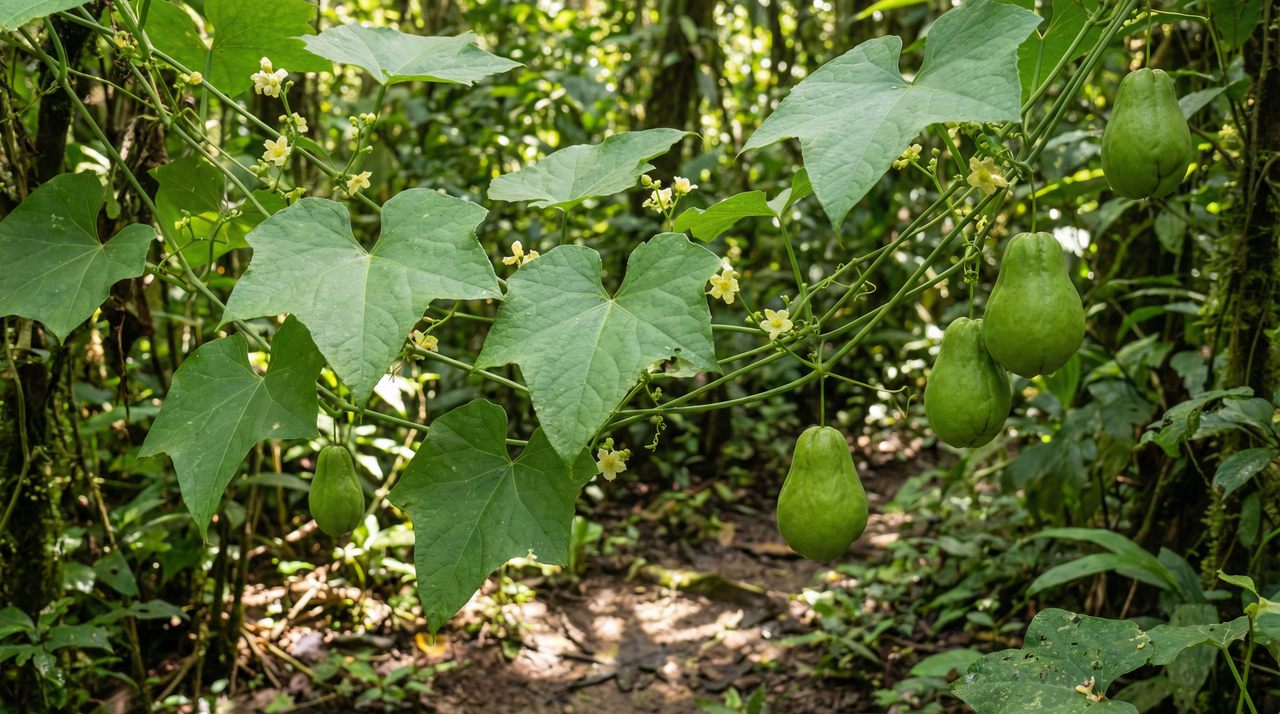
The vine itself is hard to miss once it gets going. Chayote climbs readily to 10-30 feet or more on a trellis, with slender, angular green stems that become brownish and semi-succulent with age.[10][11] The leaves are large and palmately lobed, typically five to seven lobes, broadly heart-shaped at the base, six to eight inches across, and deep green with serrated edges.[12] If you grow cucumbers or squash, the foliage will look immediately familiar. Flowers are small and white, unisexual on the same monoecious plant (male flowers in racemes, females solitary), blooming spring through fall in subtropical regions and potentially year-round where frosts don't interrupt the cycle.[13]
The fruit is that distinctive pear-shaped pepo, typically three to five inches long, though cultivar weight ranges wildly from 100 grams to over a kilogram.[14][15] Skin can be smooth, deeply wrinkled, or covered in soft spines depending on the variety. The root system starts fibrous but can develop tuberous storage roots in mature plants,[16] another detail that makes this plant feel more like a perennial food system anchor than a seasonal vegetable.
Traditional Uses and Cultural Significance
Chayote's relationship with humans goes back a long way. Archaeological evidence from the Tehuacán Valley and genetic studies suggest it was domesticated in Mesoamerica potentially as early as 2000 BCE, and it appears in written records as "chayotl" in the Florentine Codex, compiled between 1545 and 1590.[4][17] The Aztecs and Maya wove it into their food systems at a fundamental level, growing it in chinampas and milpa systems alongside maize, beans, and squash.[18] Every part was used: fruit, shoots, leaves, roots, and seeds all contributed to the diet, and the plant held medicinal roles for treating hypertension, kidney stones, digestive complaints, and wounds through teas and poultices.[18][19] It also carried symbolic weight, tied to fertility and abundance and incorporated into offerings to agricultural deities.[18] When I'm designing a subtropical food guild and I integrate chayote as the climbing layer above a polyculture of nitrogen-fixers and root crops, I'm honestly just updating a template the Maya already perfected.
Spanish colonization carried chayote to Europe in the 16th century, and by the 19th century it had spread to Asia and Africa via explorers and the galleon trade, where it found new medicinal roles in traditional practices for cooling the body and managing blood sugar.[4][20] That global reach is a success story with a complicated edge, though. Modern chayote production faces real sustainability challenges including soil depletion in monoculture systems, overexploitation of wild populations, and serious questions around biopiracy and fair benefit-sharing for indigenous varieties under frameworks like the Nagoya Protocol.[21][22] The plant's global popularity is real, but so is the debt owed to the cultures who developed it.
Fun Facts About Chayote
Here's something that still surprises people: you don't plant a chayote seed. You plant the whole fruit. The seed inside is recalcitrant, meaning it can't survive drying and storage the way most vegetable seeds can, so the fruit itself acts as a protective shell that keeps it viable.[23][24] The first time I tucked a whole chayote squash into a mound of compost-rich soil and watched shoots emerge directly from the stem end a couple of weeks later, I found it genuinely delightful. There's something satisfying about a plant that propagates itself this way, keeping the whole package intact. And that whole-plant philosophy extends to how it was traditionally eaten: fruit, shoots, leaves, roots, and seeds all contributed to Mesoamerican diets, particularly during times of scarcity.[18] For a plant that can run thirty feet up a trellis and produce prolifically for years, that kind of top-to-bottom usefulness feels like exactly the right design.
Chayote Varieties and Where to Source Them
Notable Chayote Cultivars and Fruit Variations
Chayote is genuinely one of the more variable vegetables you can grow, and I don't think most American gardeners realize just how much range exists within a single species. Researchers have documented over 100 accessions of Sechium edule, with fruits varying from round to pear-shaped to heart-shaped, skins running smooth to heavily spined, and colors spanning deep green, cream, white, and pale yellow.[25][26] Some cultivars even set fruit without pollination. The four broad categories you'll encounter are smooth green, wrinkled green, white, and spiny, and they genuinely taste and feel different in the kitchen and garden.
Among named cultivars, 'Burbank' is the one I sought out first. Luther Burbank developed it as the first spineless type, and after one summer of wrestling with spiny chayote squash in Florida humidity, I understood exactly why he bothered.[27] 'Verde Espinoso' is the classic spiny green type common in Mexican markets, firm and flavorful but rough on your hands at harvest. White chayote, sold under names like 'Blanco', has a milder, slightly softer flesh that I find less interesting for raw preparations but lovely braised. 'Kekoa', a dark green Hawaiian variety, is the crispest I've grown; it eats nothing like the rubbery supermarket imports I'd tried before. Southern gardeners are probably most familiar with 'Mirliton', the smooth green heirloom with deep Louisiana roots and a devoted following in Mississippi and beyond.[13][28] Named varieties are far fewer here than in Mexico, so think of these as representative types rather than an exhaustive catalog.
How to Source Chayote Plants, Seeds, and Fruit
Here's the thing that surprises people: chayote doesn't have a seed you extract and dry in a seed packet. The seed stays inside the fruit, and you plant the whole thing.[29] That means the produce aisle is a legitimate seed source. Most chayote in U.S. markets is imported from Mexico and Central America, with smaller domestic supplies from Florida, California, and Hawaii, and it's reliably available year-round wherever there's a sizable Hispanic community.[30][31] I've sprouted grocery-store chayotes on my windowsill more times than I can count. The smooth green types from Mexican bins tend to wake up fastest in Central Florida heat.
If you want a specific cultivar, Baker Creek Heirloom Seeds and Southern Exposure Seed Exchange carry heirloom selections, and Etsy sellers often stock regional types. Expect to pay $3 to $10 for a seed packet and $5 to $20 for a nursery start, with availability peaking in spring.[32][33] Commercial growers skip the genetic lottery entirely and propagate from cuttings, because seed-grown plants are genetically restless and may not hold true to type.[34] I learned the hard way that a single virus-infected vine can quietly ruin an entire trellis; Cucumber mosaic virus can persist in vegetative stock, so buying from reputable nurseries or choosing healthy grocery fruit is worth the extra thought.[35]
How to Propagate and Plant Chayote
Chayote doesn't work the way most squash do, and understanding that from the start saves a lot of frustration. You're not reaching for a seed packet here. The single large seed inside each fruit is recalcitrant, meaning it loses viability almost immediately if it dries out or drops below about 50°F (10°C).[36][37] You can't save chayote "seeds" in an envelope the way you would beans. I learned this the hard way early on, and now I harvest mature fruits in fall and either plant them immediately or pass them along to gardening friends rather than attempting storage.
Propagation Methods for Chayote
The standard approach, and the one I use most, is planting the whole sprouted fruit directly in the ground.[38][39] I'll often pick up a chayote at the farmers' market in late winter, set it stem-end-up on a warm, moist windowsill, and within one to two weeks a vigorous pale sprout pushes out of that rounded end. It's one of those moments that never gets old. Once that sprout appears, the fruit is ready to plant, tilted at about a 45-degree angle with the sprout just above the soil surface.
The reason vegetative propagation is the reliable route isn't just the storage problem. Chayote is highly heterozygous, meaning seed-grown plants don't come true to type.[40][41] Its seeds are sometimes polyembryonic, carrying multiple embryos, but the genetic lottery means seedlings from the same parent fruit can produce fruits of completely different shapes and flavors. I made that mistake once, neglected to label my plantings, and spent most of a growing season wondering why two neighboring vines were producing such different fruit. Lesson learned: if the variety matters, use vegetative clones.
Beyond whole-fruit planting, you have options. Semi-hardwood stem cuttings taken in warm, humid weather root readily, and I've had around 80% success layering vigorous side shoots during summer without any extra fuss. Grafting onto compatible cucurbit rootstocks is worth considering if disease resistance is a priority, and tissue culture exists for large-scale commercial multiplication, though that's well beyond most backyard operations.[42][43][44] Whatever method you choose, use disease-free material and make sure your planting medium drains well. In humid conditions, fungal problems can knock out cuttings fast if air circulation is poor.[45]
Soil, Site Selection, and Planting Requirements
Chayote wants well-drained, fertile loamy or sandy loam soil with good organic matter content, ideally around 3-5%.[15][46] It'll tolerate a range of textures, sandy to moderately clayey, as long as drainage is genuinely good. Waterlogged roots are a death sentence. The vine also needs a root zone at least 60-90 cm deep and consistent moisture sitting in the 60-80% field capacity range, so think of it as deeply moist but never soggy.[15]
Target a soil pH of 6.0-7.0.[47][48] I've seen young vines in alkaline Florida soils develop that faint interveinal yellowing that signals iron deficiency, and it's surprisingly fast to fix with a sulfur amendment and a foliar iron spray once you catch it early. Go below pH 6.0 and you risk phosphorus and micronutrient lockout from the other direction. Do a soil test and adjust two to three months before planting, using lime to raise pH or elemental sulfur to lower it, then work in compost or well-rotted manure to build structure and fertility at the same time.[49][15] For container growing, a mix of 50% potting soil, 30% compost, and 20% perlite in a pot no smaller than five gallons gives the drainage the plant demands.
Site it in full sun, at least six to eight hours daily.[50] The vine tolerates light shade, but productivity drops noticeably in deeper shade. Mulch around the base helps retain moisture in hot, sunny spots, and your trellis needs to be in place before planting, not after the vine is already running.
Germination Timeline and Days to First Harvest
With soil temperatures above 70°F (21°C), a sprouted chayote fruit typically germinates within 7-20 days, and the vine reaches first harvest around 120-150 days after planting.[51][52] In my warm subtropical summers, that window compresses noticeably compared to growers in cooler zones 8 or 9 where temperatures hover near the minimum threshold.
Flowering starts around two to three months after planting, and from there fruit takes 30-50 days to develop after pollination.[42][15] Grafted plants can short-circuit some of that waiting, potentially fruiting within six to twelve months and reaching full production of 50-100 fruits per plant by year two or three. For most home gardeners starting with a whole fruit, though, patience through that first long season is just part of the deal. The vine needs a continuous frost-free period to complete its cycle, so in zones 8-11, plant after your last frost date with robust support already in place.[11][8] The reward for that patience is a perennial producer that, once established, keeps giving for years.
Chayote Care Guide: Growing and Maintaining Sechium edule
Chayote is a plant that will make you feel like a genius gardener right up until the moment it doesn't. The vine grows fast, fruits prolifically, and asks for relatively little once it's settled in. But get the temperature, water, or sun balance wrong, and it will let you know in a hurry. Most of what I've learned about chayote care comes from pushing it slightly outside its comfort zone and watching what happens.
Frost Tolerance and Seasonal Rhythm
Let me be blunt: chayote is a tropical vine and it has no patience for cold. Growth slows noticeably below 55°F (13°C) and stops almost entirely below 50°F (10°C).[53][54] A hard freeze kills the vine outright. Even a brief dip to 28°F (-2°F) can cause serious damage in unprotected plants, with leaves blackening, stems dying back, and any developing fruit aborting.[55][56] Young shoots are especially vulnerable, and unlike some perennials that bounce back from a light frost, chayote rarely recovers well.[57]
In USDA zones 8-11, the plant can behave as a true perennial, dying back to its tuber in winter and resprouting when soil warms.[31][58] In zone 7 and below, treat it as an annual or dig the tuber and overwinter it indoors. If you're trying to stretch it through a borderline winter, a southern exposure with good air drainage, heavy straw mulch over the root zone, and row cover over emerging shoots will buy you meaningful insurance.[59][60] One lesson I learned the hard way: don't mulch too early in spring in a marginal zone. I trapped cold against new shoots one season and lost two weeks of growth. Wait until the soil has genuinely warmed before piling anything on.
Sunlight Requirements
Chayote wants 6-8 hours of direct sun for solid fruit production.[15] But here's the nuance I've observed growing cucurbits side by side: chayote leaves show heat stress faster than cucumber or squash leaves when hit with intense western afternoon sun. They'll go limp and slightly bleached in a way that signals the plant is struggling even if temperatures are only in the mid-80s. In hot climates, afternoon shade or a 30% shade cloth on the west face of the trellis makes a real difference.[60][61]
Too little light creates the opposite problem. Etiolated vines produce fewer female flowers, which means fewer fruits, and you'll also see yellowing foliage that suggests chlorosis rather than any nutrient issue.[15][62] Morning sun with filtered afternoon light is usually the sweet spot in hot climates.
Water Needs and Irrigation
Water management is where chayote care either comes together or falls apart. The vine needs consistent moisture, roughly 1-2 inches per week delivered deeply rather than frequently, in well-drained loamy soil.[38][11] Shallow sprinkles encourage surface roots and set the plant up for stress. I switched to drip irrigation on a timer years ago and it's been my single biggest yield improvement, more than any fertilizer change.
Once flowering starts, consistent soil moisture is non-negotiable. Dry spells during that window cause flower drop and abort developing fruits.[11][63] At the other extreme, soggy soil causes root rot fast, and you'll see it first as generalized wilting that doesn't respond to watering. Check the top inch of soil before irrigating; if it's still moist, wait.[64] If you're overwintering tubers in the ground, pull back on irrigation significantly once the vine dies back. The first time I didn't, I lost the tuber to rot before spring.
Heat Tolerance and Temperature Management
Chayote is happiest between 65-86°F (18-30°C). It can push through short heat spikes up to 95-100°F if it's well-watered, but prolonged temperatures above 86°F stress the plant and cause pollen sterility, which means poor fruit set even when the vine looks lush and healthy.[13][65] Flowering is most productive at 77-82°F, so timing your planting to hit that window for peak bloom matters in warm climates. In humid southeastern summers the heat and moisture together often buffer the plant well enough, but in dry heat you'll need to intervene: shade cloth, 4-6 inches of organic mulch to keep roots cool, and deep early-morning watering before temperatures climb.[46][66]
Feeding, Pruning, and Seasonal Maintenance
Chayote is a vigorous vine and "vigorous" is doing some heavy lifting in that sentence. Given a decent trellis and warm weather, it will reach 30 feet or more and set fruit on new growth throughout the season.[13][60] I grow mine on cattle-panel arches and prune back to 3-4 main stems in early spring, then remove lower leaves through the season to keep air moving through the canopy. That airflow matters more than most people realize, especially in humid summers where stagnant interior foliage becomes a liability.
For feeding, compost side-dressed in spring and again mid-season is usually enough. Avoid pushing too much nitrogen; I've made that mistake and ended up with enormous, beautiful leaves and almost no fruit.[38][58] A balanced organic fertilizer serves the plant better than anything heavy in nitrogen alone. In zones 8-11, protect the tuber through winter with mulch and let the plant re-establish; in cooler areas, lift the tuber after the first frost, store it in a cool dry place, and replant once soil temperatures climb back above 70°F.
Harvesting Chayote
Chayote needs a frost-free growing period of at least 120-150 days before it starts producing reliably,[67][38] which means in most of zones 8-11 the calendar works out to a harvest window that runs from late summer into November.[67][38] That August-through-fall arc is what I've watched year after year in Central Florida, and it holds pretty consistently as long as the summer heat stays in that sweet spot of 70-85°F. Drop below 60°F and the whole process slows noticeably.[68][69]
When to Harvest Chayote: Timing and Maturity Cues
Once flowers appear, fruits are typically ready 25-35 days later under warm conditions,[68] though temperature swings can stretch that window out considerably. I've learned to trust visual and tactile cues over the calendar. A ready fruit sits at roughly 4-6 inches long, the skin loses its shiny brightness and develops a subtle dullness or faint wrinkling, and those spiny prickles (on varieties that have them) soften considerably.[70][71] Press your thumb gently into the skin; you want firm with just the slightest give. Rock hard means wait; squishy means you already missed it. Fruits can technically be picked 4-8 weeks after flowering once that slight wrinkling begins,[72][38] so there's a forgiving window, but those softening prickles and the skin's texture shift are the most reliable signals I've found week over week.
How to Harvest Chayote Properly
Cut the fruit from the vine with a few inches of stem attached rather than pulling, which can stress the tendril growth nearby. The bigger lesson, though, is frequency. Check your vines every 3-4 days once fruits start coming in and pick anything that's ready, even if you don't need it yet. This works exactly like cucumbers: leave a few oversized fruits on the plant and it reads that as "job done" and throttles back new production.[70][71] I've seen the difference firsthand after a week of missed harvests slowed the flush noticeably. Regular picking is genuinely the most effective thing you can do to keep a vigorous vine producing through fall.
Expected Yield, Flavor, and Storage
Patience really does pay off with chayote. A well-established vine can produce hundreds of fruits in a single season and keep bearing for 5-10 years as a perennial,[73][74] but modest first-year harvests often give way to genuinely abundant second- and third-year yields once the root system matures. The flavor stays mild and cucumber-like throughout the usable harvest window regardless of exactly when you pick,[14][75] which gives you flexibility. The skin may shift toward yellowish or show more wrinkling as fruits mature, varying by cultivar, but eating quality holds steady. Freshly picked chayote keeps well for several weeks in the refrigerator, which is a good thing given how quickly a productive vine can outpace the dinner table.
Chayote Preparation and Uses
Culinary Uses of Chayote: Fruit, Leaves, Flowers, Seeds, and Roots
The fruit is where most cooks start, and honestly where most stay. Chayote can be eaten raw or cooked by boiling, steaming, sautéing, roasting, frying, pickling, or fermenting,[76][77] which makes it unusually adaptable in the kitchen. Raw, the flesh is crisp and juicy with a mild, faintly sweet flavor that sits somewhere between cucumber, pear, and apple.[78][15] Once cooked, it transforms into something earthier and softer, absorbing the flavors around it beautifully.[15][77] I've substituted diced chayote for potato in Caribbean-style stews more times than I can count, and it holds seasoning in a way that surprises people every time.
One thing I wish someone had told me before my first big harvest: cut chayote exudes a sticky, milky sap that coats your fingers almost immediately. Wear gloves or rinse your hands often. It's not dangerous, but it's annoying and weirdly persistent.
Beyond the fruit, the flowers can be pickled, fried, or tossed into salads, a common practice throughout Central American cuisines.[76][79] Young leaves and stems are edible too, with a mild spinach-like quality that carries a bit of bitterness; blanching first takes the edge off.[76][80] I treat them the same way I handle mature wild greens that need taming: a quick blanch, squeeze dry, then sauté in olive oil with garlic. Works every time.
The seeds are edible and nutritious when roasted or boiled, but they contain cyanogenic glycosides that can release cyanide in large quantities.[81] In my years growing this vine, I've never had an issue with mature cooked fruit, but I strictly avoid feeding the seeds to children or using them during pregnancy because the research on cyanogenic glycosides is clear. The fruit itself is rich in folate, which matters for fetal development, but the seeds are off the table during pregnancy.[82][80] Skip the roots entirely; they contain cucurbitacins at levels that make them genuinely risky to eat.[76][81] If you find a bitter-tasting fruit, don't push through it; cucurbitacins in unripe or stressed fruit can cause real gastrointestinal distress.[82][83]
Globally, chayote squash recipes span Mexican moles, Caribbean mirliton dishes, Southeast Asian salads, and Mediterranean preparations,[84][85] which tells you something about how well the fruit travels between flavor traditions. If you're already comfortable cooking cucumber or zucchini, chayote dishes will feel immediately intuitive.
Traditional Medicinal Preparations from Chayote
Traditional preparation methods include leaf decoctions, fruit infusions, root tinctures, and topical poultices, practices documented across generations in Latin America and Asia.[86][87] Traditional dosages typically run around 100 to 200 grams of fruit or leaf tea daily,[88] but there are no standardized clinical guidelines backing those numbers up.[89] I grow chayote for the kitchen first, and I respect the long history of medicinal use in the cultures that domesticated this plant. That said, I'll only reach for a leaf tea occasionally and only after checking with my own healthcare provider, because respecting traditional knowledge and deferring to your doctor aren't mutually exclusive.
Non-Food Uses of Chayote Plants
The vine gives more than fruit. Stems yield fiber suitable for cordage and textiles, the woody canes can serve as fuel, and there are documented uses for natural dyes and craft materials.[90] I've experimented with the fibrous pruned stems in small-scale basketry and as a coarse mulch layer under the trellis; neither use is glamorous, but both turn a pruning session into a resource rather than a chore. In a forest garden, that kind of thinking is how a vigorously growing vine stops feeling like a liability and starts earning its square footage.
Chayote Health Benefits and Medicinal Uses
Chayote doesn't have the flashy reputation of medicinal heavyweights like turmeric or elderberry, but spend any time with traditional healers or older cooks in Mexico, Guatemala, or Costa Rica and you'll hear the same refrain: this vine has been quietly working in people's kitchens and medicine gardens for a very long time. I try to hold both things at once, deep respect for that generational knowledge and honest recognition that the clinical science is still catching up.
Traditional and Modern Medicinal Applications
Across Latin America, Asia, and other regions where chayote has naturalized, Sechium edule has been used in traditional medicine to address hypertension, diabetes, and inflammation.[91][92][93] The plant's diuretic properties have made it a traditional go-to for managing high blood pressure,[91][86] while preparations from the fruit and leaves have historically been used to help regulate blood sugar.[92][94]
Modern preclinical research has started to put mechanisms behind these uses. The plant contains flavonoids, phenolic acids, cucurbitacins, and polysaccharides[95][96][97] that collectively underpin antioxidant, anti-inflammatory, antimicrobial, and antidiabetic activity in laboratory and animal studies.[98][99][96] The antidiabetic angle is one of the more developed lines of inquiry, with some preclinical models showing real improvements in glucose tolerance and insulin sensitivity.[100][101] That said, the evidence base is mostly cell and rodent studies with very few well-designed human trials.[102][101][103] I separate my own experience eating chayote as part of a balanced diet from any therapeutic claim: the food is genuinely good for you, but I wouldn't tell anyone to swap their metformin for chayote tea until clinical trials say otherwise.
Key Phytochemicals in Chayote
The antioxidant story in chayote centers on three main flavonoid contributors, rutin, quercetin, and kaempferol, found across the fruit, leaves, and seeds,[104][105][106] alongside phenolic acids like chlorogenic acid and catechins that are linked to cardiovascular benefits.[104][107] Cucurbitacins, the triterpenoids responsible for bitterness in some varieties and more abundant in plants of Central American origin, round out the picture as natural feeding deterrents with their own bioactive properties.[104][108][106]
The different parts of the plant have genuinely distinct chemical profiles. Leaves are phytochemical powerhouses with high flavonoid and phenolic concentrations, seeds contain substantial fixed oils (up to 30 percent by weight) and proteins, roots carry glycosides and saponins, and flowers contribute anthocyanins and essential oils.[105][109][110][94] As a grower, this matters: you're getting a somewhat different nutritional and medicinal package depending on what part of the plant you harvest and eat. What I find genuinely useful to know is that growing conditions influence the fruit's potency too. Phenolic content climbs during dry seasons as the plant responds to abiotic stress, and flavonoid levels can vary as much as 30 percent between cultivars, with pigmented varieties tending to run higher.[111][112][113] In my subtropical garden, I've noticed that fruits harvested during drier stretches taste noticeably more bitter, which makes sense given the stress-driven phenolic accumulation. I take that bitterness as a cue to cook them rather than eat them raw. Soil quality amplifies things further: organic-rich beds can boost antioxidant capacity by 15 to 20 percent compared to conventionally farmed plants.[114][113] These compounds collectively support the antioxidant, anti-inflammatory, antimicrobial, and hepatoprotective effects documented in the research, while simultaneously helping the plant fend off herbivores and manage UV exposure in tropical environments.[104][115][106]
Nutritional Profile of Chayote
At 19 calories per 100 grams with roughly 94 grams of that being water,[116][117] chayote is first and foremost a hydrating, low-calorie vegetable with modest macros (4.5 grams carbohydrate, 1.7 grams fiber, 0.8 grams protein per 100g).[116] What makes the nutritional value of chayote genuinely stand out is the folate content: 93 micrograms per 100 grams, which covers 23 percent of the daily value. That's a meaningful contribution, especially for anyone who relies on fresh garden produce as their primary food source. Raw chayote also delivers 7.7 milligrams of vitamin C (9 percent DV), 125 milligrams of potassium, 12 milligrams of magnesium, and 17 milligrams of calcium per 100 grams.[116][118]
Beyond those basics, the fruit carries 20 to 50 milligrams of phenolic compounds per 100 grams (gallic acid equivalents) and 10 to 30 milligrams of flavonoids with rutin predominating,[119][120][121] which quietly elevates it above the "just fiber and water" category. Cooking doesn't destroy the macros (boiled chayote holds roughly the same calorie and fiber profile as raw),[122] but it does affect vitamin C: boiling causes a 20 to 30 percent loss while steaming keeps losses to 10 to 15 percent.[123][119] I've switched almost entirely to steaming after noticing the texture and mild flavor hold up so much better than with boiling, and the nutrient retention is a welcome bonus. Its low glycemic index and fiber content also suggest a role in gentle blood glucose support,[124][125] though I'd frame that as a dietary benefit of regular consumption rather than a treatment claim.
Safety Considerations for Chayote Consumption
The good news first: chayote has a low overall toxicity profile, is generally safe for culinary consumption, and is non-toxic to cats and dogs when properly prepared.[126][127][97] The cucurbitacins that give some fruits their bitterness are present in cultivated chayote at very low concentrations (typically under 10 mg/kg), and cooking reduces them further.[128] In practice, bitterness is your best field indicator: if a fruit tastes sharp or unpleasant, don't eat it raw. Drought-stressed vines and immature fruits can accumulate higher cucurbitacin levels,[128][129] and raw or large quantities of leaves and stems can cause gastrointestinal irritation.[128][130] If your vine has been parched and the fruit is bitter, peel it and cook it thoroughly.
Fresh sap is worth taking seriously. I always put on gloves before handling freshly harvested fruits because the sap has irritated my skin enough times to make that a non-negotiable habit. Contact dermatitis is a documented risk,[128] and some individuals experience oral allergy syndrome after eating chayote raw, ranging from mild mouth tingling to swelling of the lips and throat, with rare cases of anaphylaxis.[131][132] Young leaves and shoots are edible but should be eaten in moderation given their mild laxative potential.[133] On the reassuring side, chayote is low in oxalates and generally safe for those watching kidney stone risk,[134] and livestock are the population most vulnerable to harm if they ingest significant quantities of leaves or vines.[135] If you're foraging rather than harvesting from a known vine, familiarize yourself with look-alikes like buffalo gourd, wild cucumber, and squirting cucumber before putting anything in your basket.[136]
Chayote Pests and Diseases
Growing chayote means inheriting the same pest pressures you'd face with any cucurbit. If you've grown cucumbers or squash, the cast of characters will be familiar: cucumber beetles, squash bugs, aphids, and squash vine borers all consider chayote fair game.[137][138][50] The upside is that if you already know how to manage squash pests, you're most of the way there.
Common Pests of Chayote
Squash vine borers deserve the most attention. The damage looks exactly like what you'd see on summer squash: sawdust-like frass around entry holes near the stem base, followed by the gut-punch of an entire vine wilting overnight. Those larvae can bore entry holes roughly half an inch across and girdle stems up to an inch thick, which means once you see wilt, the damage is done.[38][137] Scout the stem base weekly during summer. Row covers on younger plants and prompt removal of any egg clusters are your best tools, because there's no good rescue option once a borer is inside.
Aphids are a different conversation. In my experience, a healthy, established chayote vine with good airflow and some predatory insect habitat nearby can shrug off moderate aphid pressure without any intervention. I observe for a week or two before reaching for anything. The vine's vigor usually outpaces the colony.
Diseases Affecting Chayote Vines
Cucumber beetles earn their bad reputation not just from feeding damage but from the bacterial wilt they vector.[137] Once wilt symptoms appear, there's no saving an infected vine. Remove it and destroy it promptly; leaving it in the garden only creates more opportunity for beetles to spread the pathogen. Controlling cucumber beetles with row covers early in the season is genuinely disease prevention.
The fungal and root issues, mainly powdery mildew, root rot, and anthracnose, tend to show up when drainage is poor or foliage stays wet overnight.[50] Water at the base in the morning, keep the canopy thinned for airflow, and make sure your soil drains freely. A rotten chayote root crown almost always traces back to compacted, waterlogged soil rather than a particularly aggressive pathogen. Fix the drainage, and most fungal problems become much more manageable. Well-sited plants in warm, humid climates are genuinely resilient when these basics are in place.
Chayote in Permaculture Design
There's a particular satisfaction in finding a plant that earns its place in a food forest on multiple levels, literally and ecologically. Chayote is one of those plants, though I'll be honest: it demands respect. Get the siting right and it rewards you for years. Get it wrong and you're managing a beautiful green catastrophe.
Climate and Hardiness Zones for Growing Chayote
Chayote (Sechium edule) is native to Central America and Mexico, and it carries that tropical heritage in everything it does.[50] It thrives in warm, frost-free conditions, with an optimal temperature range of 18-29°C (65-85°F) and a functional minimum around 10°C (50°F).[139] In USDA zones 9-11, it performs as the reliable perennial it evolved to be. In zone 8, it's more of a calculated gamble: vines may die back after frost but can resprout from the tuber if you protect the roots with a thick layer of mulch.[50][38] Frost damage kicks in below -2°C (28°F), and the vine won't survive extended dips below -4°C (25°F).[140] In marginal zones I've spoken to growers who dig the tuber at season's end and store it like a sweet potato, replanting in spring. It works, but it's extra labor worth factoring into your design decisions.
Regionally, chayote performs best in southern Florida, Hawaii, coastal California, and the Texas Gulf Coast.[141][48][142] In its native highland habitats it favors elevations of 800-1,500 meters where humidity stays high, somewhere between 60-80%, and annual rainfall ranges from 1,500-2,500 mm.[143][144] In my Central Florida work, those humidity and moisture conditions translate almost perfectly to a long humid summer, which means chayote feels genuinely at home rather than tolerated. As a design-time decision rather than a maintenance one, I always site chayote near a reliable water source and on a raised, well-drained mound with soil pH between 6.0-7.0. You don't want wet feet on this vine, ever.
Pollination and Ecosystem Functions
Chayote is monoecious, meaning it carries separate male and female flowers on the same plant, but it relies on cross-pollination to set fruit reliably.[145] The timing of pollen release (protandry) means you're dependent on bees moving between flowers, primarily honeybees and squash bees, with hawkmoths and possibly bats showing up in its native range at dusk.[146] In Central America, fruit set exceeds 80%. In introduced regions like Florida, it can drop below 50% because the specialist pollinators simply aren't there in the same numbers.[146] Heat above 30°C compounds the problem by triggering flower abortion, so even a well-pollinated vine can struggle during peak summer.[147]
In my experience, squash bees are the most dependable early-morning visitors when they're present, but I've learned not to count on them. Interplanting borage and marigolds along the base of the trellis has made a noticeable difference in bee activity and fruit set.[148] On days when I'm not seeing much insect activity, I hand-pollinate by transferring pollen from a freshly opened male flower to a female flower with a soft brush, which is easy once you know what you're looking for and genuinely reliable.[149] The flowers themselves are large, around 10 cm, white, and fragrant enough to attract a broader range of beneficial insects, making the vine a genuine habitat contributor beyond just the fruits it produces.[150] Birds and small mammals use the dense canopy of foliage too, and I've watched the vine become a functional microhabitat over a single growing season.[50] One caution worth naming plainly: in frost-free subtropical areas, chayote can escape cultivation and form dense thickets that shade out native understory plants.[151] In subtropical gardens like those in Florida, I always site mine where I can easily reach the roots and keep volunteer seedlings pulled before they get established.
Forest Layer Placement and Guild Design
Think of chayote the way you'd think of a hardy kiwi or a vigorous passionflower: a climbing vine that wants to occupy the upper understory to lower canopy layer, scrambling upward with strong tendrils to reach 9-15 meters when given adequate support.[50][48] In zone 9B, I've watched a single vine cover an eight-foot arbor completely by midsummer, which is impressive and also a hint that the structure needs to be genuinely sturdy before you plant. It tolerates partial shade and actually prefers it in its native highland settings, but fruits most abundantly in full sun.[144] For a food forest context, that means positioning it where it gets full morning sun and has room to climb without immediately overwhelming shorter guild members.
Guild compatibility is one of chayote's quieter strengths. It integrates well with nitrogen-fixing legumes and traditional companion crops like maize and beans, and its dense foliage contributes to soil stabilization and microclimate moderation beneath the canopy.[152][153] I prune mine back hard in late winter before new growth pushes, which keeps it from swallowing neighboring guild members and encourages a flush of productive new shoots. Related species like Sechium venosum occupy similar roles in tropical agroforestry, broadening the design options for growers in humid zones where chayote's particular vigor might be too much.[152] The payoff for careful siting and management is substantial: a well-placed, well-supported chayote vine delivers shade, pollinator habitat, soil protection, and a remarkable quantity of edible fruit from a single perennial planting.
The Vine That Taught Me to Think in Abundance
I still remember the first season I grew chayote in Florida, genuinely unprepared for what a single vine would do. By October I was bringing grocery bags of fruit to every neighbor on the street, apologizing and laughing at the same time. It's the plant that finally broke me of scarcity thinking in the garden, and I haven't looked at a trellis the same way since.
Sources 153
- Chayote (Sechium edule): A Review of its Nutritional and Medicinal Properties ↩
- Sechium edule (Chayote) Description ↩
- Chayote: Sechium edule ↩
- Origin and Domestication of Chayote (Sechium edule Jacq.) ↩
- Sechium edule - Chayote ↩
- Plant Finder - Sechium edule ↩
- Distribution and Habitat of Sechium edule ↩
- Sechium edule: Cultivation and Propagation ↩
- Flora of North America: Sechium ↩
- Sechium edule ↩
- Chayote Production Guidelines for Florida ↩
- Royal Horticultural Society (RHS) - Chayote Profile ↩
- Chayote (Sechium edule) - University of Florida IFAS Extension ↩
- Sechium edule - Wikipedia ↩
- Chayote - UF/IFAS Extension ↩
- Sechium edule (Chayote) - Plant Description ↩
- Florentine Codex: General History of the Things of New Spain ↩
- Traditional Uses of Chayote in Mexico ↩
- Ethnobotany of Sechium edule in Mesoamerica ↩
- Medicinal Uses of Sechium edule in Asia ↩
- Sustainability Challenges in Chayote Production ↩
- Biopiracy and Traditional Knowledge: The Case of Chayote ↩
- Sechium edule ↩
- Chayote ↩
- Sechium edule Germplasm Resources ↩
- Horticultural Varieties of Chayote (Sechium edule) ↩
- The Burbank Chayote ↩
- Chayote for Home Gardens in Texas ↩
- Missouri Botanical Garden Plants of the World Online - Sechium edule ↩
- Chayote Squash Production and Marketing ↩
- USDA PLANTS Database: Sechium edule ↩
- Chayote Squash ↩
- Chayote (Sechium edule) ↩
- Royal Horticultural Society - Sechium edule cultivation ↩
- University of Florida IFAS Extension - Sechium edule ↩
- Seed Information Database - Royal Botanic Gardens, Kew ↩
- Seed Storage of Sechium edule ↩
- Chayote Production Guidelines ↩
- Growing Chayote (Sechium edule) ↩
- Propagation of Chayote (Sechium edule) ↩
- Sechium edule: Botany and Horticulture ↩
- Grafting Techniques for Chayote (Sechium edule) Production ↩
- Vegetative Propagation of Chayote (Sechium edule) by Air Layering ↩
- Micropropagation of Chayote through Tissue Culture ↩
- Diseases and Pests of Chayote ↩
- Chayote Growing in the Florida Home Landscape ↩
- Chayote Production Guide ↩
- Growing Chayote: Soil Requirements ↩
- Chayote (Sechium edule) Production Guide ↩
- Sechium edule (Chayote) ↩
- Chayote Growing Guide ↩
- Sechium edule (Chayote) Plant Profile ↩
- Sechium edule Hardiness ↩
- Missouri Botanical Garden - Sechium edule ↩
- Chayote Production Guidelines ↩
- Cold Tolerance of Vegetable Crops ↩
- Chayote Production in California ↩
- Mirliton (Chayote) Growing Guide ↩
- Frost Protection for Tropical Plants ↩
- Sechium edule Cultivation ↩
- Growing Chayote Squash ↩
- Sechium edule ↩
- Water Management for Cucurbit Crops ↩
- Sechium edule (Chayote) ↩
- Effects of Heat Stress on Sechium edule Seedlings and Flowering ↩
- Heat Stress Management in Vegetable Crops ↩
- Chayote ↩
- Chayote Production Guide ↩
- Sechium edule: Botany, Horticulture, and Breeding ↩
- Chayote Growing Guide ↩
- Sechium edule: Chayote ↩
- Chayote Production Guidelines ↩
- Sechium edule: Growing Tips - Royal Horticultural Society ↩
- Chayote (Sechium edule) - Florida Fruit Growers Association ↩
- Chayote Fruit Description - Britannica ↩
- Sechium edule - Plant Finder - Missouri Botanical Garden ↩
- Chayote (Sechium edule) - Nutrition, Benefits, and Uses ↩
- Chayote - Royal Horticultural Society ↩
- Sechium edule (L.) Sw. - USDA PLANTS Profile ↩
- Sechium edule - Fact Sheet - Royal Botanic Gardens, Kew ↩
- Chayote (Sechium edule) - UC IPM Pest Management Guidelines ↩
- Missouri Botanical Garden Plant Finder - Sechium edule ↩
- Toxins in Cucurbitaceae Family and Preparation Methods ↩
- Sechium edule - Plant Finder ↩
- Sechium edule - Kew Science (Plants of the World Online) ↩
- Medicinal Plants of Mexico: Sechium edule ↩
- Traditional Uses of Sechium edule in Latin America ↩
- Medicinal Uses of Chayote - PubMed ↩
- Chayote (Sechium edule): A Nutritional and Pharmacological Review ↩
- Ethnobotany of Chayote: Traditional Uses in Latin America - Journal of Ethnopharmacology ↩
- Medicinal Properties of Sechium edule ↩
- Traditional Uses of Chayote in Latin America ↩
- Ethnobotany of Sechium edule ↩
- Phytochemical and Pharmacological Review of Chayote ↩
- Bioactive Compounds and Pharmacological Activities of Sechium edule ↩
- Bioactive compounds in Sechium edule and their health benefits ↩
- Phytochemical Composition and Safety of Sechium edule ↩
- Anti-inflammatory and antioxidant activities of Sechium edule Swartz extracts ↩
- Pharmacological properties of chayote (Sechium edule): A review ↩
- Hypoglycemic Effects of Sechium edule in Streptozotocin-Induced Diabetic Rats ↩
- Pharmacological Activities of Sechium edule Swartz: A Review ↩
- Traditional uses and pharmacological profile of Sechium edule Sw. ↩
- Health-promoting potential of Sechium edule: A review ↩
- Phytochemical Composition and Antioxidant Activity of Chayote (Sechium edule) Fruits ↩
- Phytochemical screening and antioxidant activity of Sechium edule leaves ↩
- Secondary Metabolites in Sechium edule: Phytochemical Profile and Bioactivity ↩
- Bioactive Compounds in Chayote: A Review ↩
- Geographic Variation in Cucurbitacin Content of Sechium edule ↩
- Chemical composition and biological activities of Sechium edule seeds ↩
- Phytochemical constituents of Sechium edule roots and their pharmacological properties ↩
- Influence of Environmental Factors on Secondary Metabolites in Chayote (Sechium edule) ↩
- Phenolic Content and Antioxidant Activity of Sechium edule Fruits from Different Cultivars ↩
- Seasonal Changes in Antioxidant Activity of Chayote under Different Cultivation Practices ↩
- Effects of Soil Composition on Phytochemicals in Sechium edule ↩
- Secondary Metabolites from Sechium edule Sw. with Anti-Inflammatory Activity ↩
- FoodData Central - Chayote, raw ↩
- Chayote, raw ↩
- Chayote, raw - USDA FoodData Central ↩
- Antioxidant Activity and Phenolic Compounds of Chayote (Sechium edule Sw.) ↩
- Flavonoids and Phenolics in Underutilized Vegetables: Sechium edule ↩
- Bioactive Compounds in Sechium edule: A Review ↩
- Chayote (fruit), cooked, boiled, drained, without salt ↩
- Nutrient Retention in Cooking Methods ↩
- Antioxidant and Hypoglycemic Activity of Sechium edule Extracts ↩
- Nutritional Composition and Health Benefits of Chayote ↩
- ASPCA - Toxic and Non-Toxic Plants ↩
- Toxicity Profile of Chayote Extracts ↩
- Chemical analyses and in vitro and in vivo toxicity of Sechium edule - PMC ↩
- Cucurbitacin Accumulation in Cucurbitaceae under Stress ↩
- Using and Preserving Chayote - National Center for Home Food Preservation ↩
- Allergic Reactions to Chayote (Sechium edule) ↩
- Oral Allergy Syndrome and Cucurbitaceae ↩
- Chayote Leaves Information and Facts ↩
- UCI Kidney Stone Center - Oxalate Content of Foods ↩
- Toxicity of Cucurbitaceae in Livestock ↩
- Buffalo Gourd: Identification and Toxicity ↩
- Pest Management for Cucurbits ↩
- Chayote: Botany, Production and Uses ↩
- Chayote Growing Guide ↩
- Chayote Growing Guide ↩
- Chayote Production in Florida ↩
- Chayote in Hawaii ↩
- Chayote (Sechium edule) Production in Florida ↩
- Cultivation of Chayote in Central America ↩
- Pollination Biology of Sechium edule (Chayote) ↩
- Floral Biology and Pollinators of Chayote in Natural Habitats ↩
- Pollination in Chayote (Sechium edule) in Florida ↩
- Attracting Pollinators to Your Garden ↩
- Hand Pollination Techniques for Vegetable Crops ↩
- Flora of North America ↩
- SEEDU - USDA PLANTS Database ↩
- Agroforestry Uses of Chayote - FAO Document ↩
- Sechium edule ↩