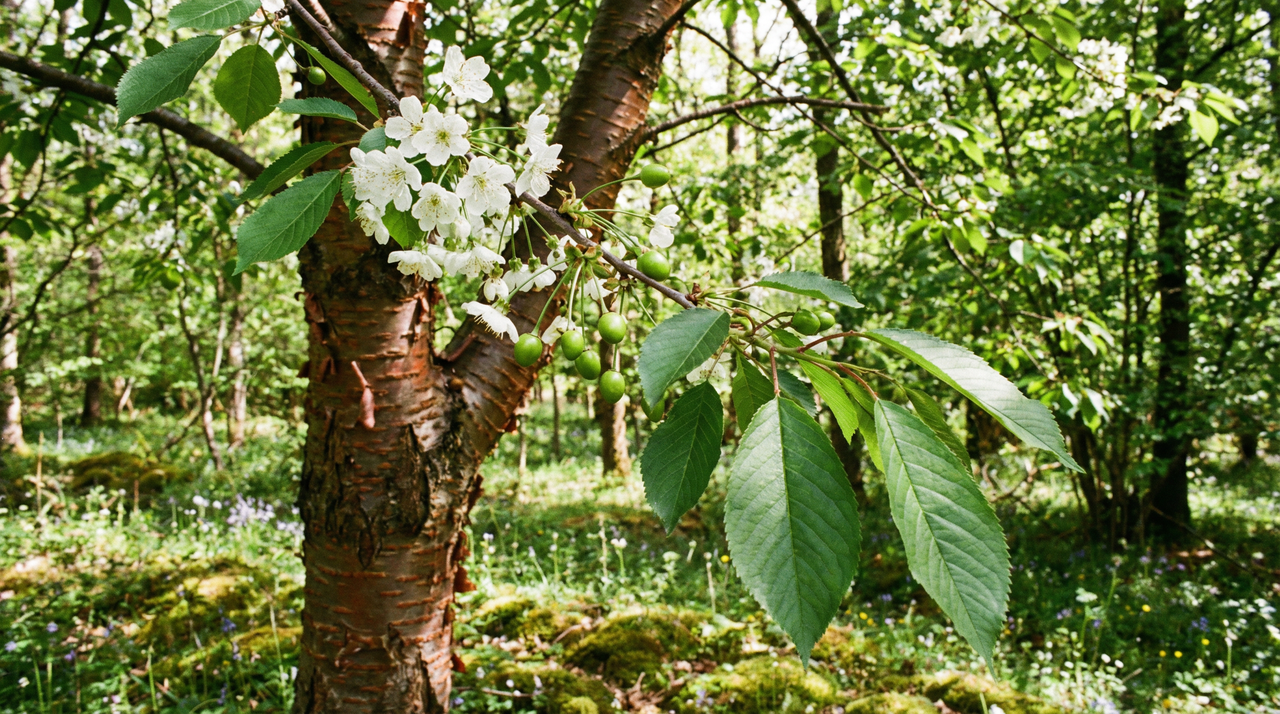
Most people who plant a sweet cherry tree are picturing the fruit. What they don't realize until year three or four, when the birds have stripped every last drupe before it turns fully red, is that they're also growing one of the most ecologically generous trees in the temperate world. I've watched a mature Prunus avium in full bloom stop people mid-sentence. Not because it's particularly showy in the way ornamental cherries are, but because the sound coming out of it is almost disorienting: a low, continuous roar of pollinators working every flower at once. The tree doesn't need your admiration. It's busy.
That wildness is actually the key to understanding cherry, and the thing most backyard growers underestimate. This isn't a domesticated species that's forgotten its origins. Prunus avium can live over 100 years in the right conditions[1], hits canopy height in forest systems, and maintains mycorrhizal partnerships that tie it into the broader soil community in ways a solitary orchard tree never gets the chance to express. Once I stopped managing mine like a fruit crop and started treating it like the forest-layer species it actually is, everything changed: the tree's health, the yield, and honestly, my whole approach to where cherries belong in a food forest design.
Cherry Origin, History, and Botanical Background
Long before anyone bred Bing or Rainier, sweet cherry was simply a tall forest tree making its way across temperate Eurasia. Prunus avium, the scientific name anchoring every sweet cherry cultivar we grow today, belongs to the Rosaceae family and is native to Europe, western Asia, and parts of North Africa, growing naturally in temperate woodlands, forest edges, and hedgerows from sea level up to about 1,800 meters.[2][3] Understanding that native ecology is genuinely useful if you're designing a food forest around one of these trees, because you're essentially working with a pioneer-woodland species that evolved to colonize disturbed edges and thrive with other canopy trees overhead in its youth.
Botanical Characteristics and Native Range
Wild Prunus avium trees are impressive long-haul organisms. In their native range they commonly live 50 to 200 years, sometimes longer.[2][4] Cultivated trees are a different story: intensive management and disease pressure tend to shorten their productive lives to 20 to 30 years, with sour cherry (Prunus cerasus) running a similar 15 to 40 years in orchard conditions.[5] I always share that contrast with clients early in the design conversation. Someone who wants a low-maintenance canopy tree for the long haul has very different needs than someone eager for fruit in three years, and cherry makes you choose your strategy deliberately.
On that note, seed-grown trees take 5 to 7 years to bear fruit, while grafted trees on established rootstock start producing in as little as 2 to 4 years.[6][4] I source grafted trees for almost every client planting for that reason. Ecologically, the species behaves as a light-demanding pioneer with a fascinating masting habit: it produces seed in irregular boom-bust cycles, and seedling mortality in the wild exceeds 90 percent.[7] The trees that do establish are tenacious.
The broader genus brings in close relatives from quite different corners of the world. Sour cherry (Prunus cerasus) is native to southeastern Europe and western Asia and has naturalized across North America since the 17th century.[8] Nanking cherry (Prunus tomentosa) and Chinese sour cherry (Prunus pseudocerasus) come from northern and central China, Korea, and adjacent mountain regions, growing at elevations of 500 to 3,000 meters.[9][10] Each of these parallel domestication stories unfolded separately, shaped by distinct climates and cultures.
Visual Identification and Distinctions
In the wild, Prunus avium is a genuinely impressive tree, reaching 15 to 32 meters with a straight trunk cloaked in smooth purplish-brown bark marked by the distinctive horizontal lines called lenticels.[2][1] The leaves are simple, ovate-oblong, 7 to 14 centimeters long, with serrated margins and two small red glands right at the base of the blade. Those glands are my go-to field mark. Once you know to look for them, confirming sweet cherry in an edible landscape consultation takes about three seconds. The fruit runs from small and yellow to deep red or nearly black, 2 to 4 centimeters across and 7 to 12 grams.[11]
Cherry has several look-alikes worth knowing. Black cherry (Prunus serotina), bird cherry (Prunus padus), and cherry laurel (Prunus laurocerasus) all share superficial similarities, but identification comes down to bark lenticels, those basal leaf glands, and how the fruit attaches.[12][13] Cherry laurel in particular is worth flagging as toxic. St. Lucie cherry (Prunus mahaleb), commonly used as a dwarfing rootstock, is much smaller at 3 to 6 meters, with leaves that release a bitter-almond scent when crushed and small dark-purple drupes whose seeds yield the Middle Eastern spice mahlab.[14] Nanking cherry reads more like a large shrub than a tree, honestly closer in habit to serviceberry or currant, which makes it a natural fit for understory guild positions in food forest design.
Traditional, Cultural, and Historical Uses
Archaeological evidence shows humans foraging wild cherries since the Neolithic around 3000 BCE, with deliberate cultivation likely beginning in the Bronze Age between 2000 and 1000 BCE.[15][16] By the 1st century CE, Roman horticulture had intensified cherry cultivation considerably. Pliny the Elder documented the tree around 70 CE, and the Romans are credited with introducing it to Britain around 46 CE.[17] Medieval monasteries carried the work forward, propagating selected cultivars and maintaining orchards as food and medicine resources.[18] European colonists then brought cherries to North America in the 17th century, where they naturalized across the Pacific Northwest and Appalachians.[19]
Culinary and medicinal traditions grew up alongside that spread. Cherries were eaten fresh, dried, preserved, and fermented into wines and liqueurs like kirsch and maraschino across European cultures.[20] Bark and leaf teas appeared in European folk medicine as treatments for coughs, gout, and rheumatism.[21] I always tell people that while that history is real, the presence of cyanogenic compounds in bark and leaves means we should stick to the fruit and consult a qualified practitioner before making any medicinal preparations from other plant parts.
In East Asia, Prunus pseudocerasus and Prunus tomentosa followed parallel paths. Both appear in classical Chinese texts including the 6th-century Qimin Yaoshu and Li Shizhen's Ben Cao Gang Mu, where bark, roots, and kernels are recorded as treatments for coughs, dysentery, and inflammation in Traditional Chinese and Korean folk medicine.[22][23] Across virtually every culture where cherries grow, the fruit has carried symbolic weight too, representing love, fertility, spring renewal, and the fleeting beauty of life in Roman festivals, Slavic weddings, Nordic May Day traditions, and East Asian poetry alike.[24] Wild populations across Europe now face localized pressure from overharvesting and habitat conversion, making the preservation of genetic diversity in native stands something any serious permaculture grower should care about.[25][26]
Fun Facts About Cherries
That single wild species, Prunus avium, has given rise to more than 1,000 named sweet-cherry cultivars.[27] On the sour side, Montmorency traces its lineage to 15th- and 16th-century France and remains the dominant tart cherry variety in North American production to this day.[28] A mature sweet-cherry tree can yield 20 to 50 kilograms of fruit in a good season,[29] and globally the crop spans roughly 250,000 hectares, with Turkey and the United States leading production.[30]
Phenology varies enough between species to matter for garden planning. Sweet cherries flower in April and May and ripen June through July, roughly 70 to 100 days from bloom. Sour cherries finish 60 to 90 days post-bloom, and Nanking cherry extends the harvest into late summer and early fall.[31][32] One species worth flagging for permaculture designers: Prunus mahaleb, that useful dwarfing rootstock with its mahlab-spice seeds, can become invasive in parts of Ontario and the U.S. Midwest via bird-dispersed seeds.[33] Nanking and Chinese sour cherry carry no such concern in North America,[9] which is one more reason I reach for them when designing edible hedgerows in cold climates.
Cherry Varieties and Sourcing
Walk into a good specialty nursery and the sweet cherry options alone can stop you cold. The genus runs a remarkable gamut of fruit size, flavor, ripening time, and cold tolerance, and the decisions you make before you buy will shape your harvests for decades. I've found it helps to think through five questions in order: When do you want fruit? Does the cultivar need a pollination partner? Does your climate meet its chill-hour requirements? What rootstock size fits your space? And how much disease pressure does your site carry?
Notable Sweet Cherry (Prunus avium) Cultivars
Sweet cherry fruit ranges from 18 to well over 30 mm in diameter and spans yellow to deep burgundy-black, with ripening spread across roughly six weeks of the season.[34][35] Early-season types like 'Burlat' and 'Celeste' get fruit to the table first, mid-season workhorses like 'Van' and 'Bing' dominate backyard plantings, and late-season cultivars like 'Lapins', 'Sweetheart', and 'Regina' close out with larger, firmer fruit that stores a little better.[35][36]
'Bing' is the benchmark: large, dark red, deeply sweet, mid-season.[36] 'Rainier' gives you that gorgeous yellow fruit with a red blush and a mild, honeyed sweetness, but it cracks badly in wet weather and is susceptible to brown rot, which catalogs sometimes understate.[37][36] 'Rainier' rewards dry-summer climates far more than humid ones. 'Lapins' is the cultivar I keep recommending to people planting solo trees: late-ripening, self-fertile, crack-resistant, and showing strong resistance to bacterial canker and powdery mildew.[36][37]
Self-fertility matters more than people realize when planting space is limited. 'Stella', 'Lapins', and 'Sweetheart' are all self-fertile; 'Bing', 'Rainier', and 'Van' require a compatible pollination partner nearby.[34][36] Most sweet cherries also want 800 to 1,500 chill hours and perform best in zones 5 through 8; if you're in zone 8 or warmer, look specifically for low-chill or heat-tolerant selections, because standard cultivars will disappoint.[34][38] Rootstock choice controls final tree size: dwarfing rootstocks keep trees under 4 m for small gardens or high-density planting, semi-vigorous selections reach 5 to 7 m, and standard rootstocks can push above 8 m.[34][4]
Nanking, Sour, and Chinese Cherry Varieties
For gardeners in colder zones, or anyone who wants a shrub-scale cherry that largely takes care of itself, the supporting species open up real possibilities. Nanking cherry (Prunus tomentosa) is a rounded shrub reaching about 1.8 to 3 m and is hardy clear down to zone 2 and -40°C.[39][9] It's self-fertile, blooms generously in early spring, and produces small tart red fruits in June and July that are wonderful for jams and preserves. The cultivar 'Nanking Pearl' is worth seeking out for superior fruit quality if you can find it.[40]
Sour cherry (Prunus cerasus) occupies a different niche: taller than Nanking at 3.7 to 6 m, hardy to zone 4, and producing that distinctly tart, high-acid fruit that makes the best pies and juices.[41] 'Montmorency' dominates because it's reliable and well-documented, but 'North Star' is my recommendation for small spaces. It stays genuinely compact, not much larger than a mature blueberry bush, fully self-fertile, and fits comfortably into a permaculture guild without shading out everything around it.[41] 'Balaton' and 'Danube' round out the selection with improved disease resistance if your site is humid.[41]
Chinese sour cherry (Prunus pseudocerasus) is a compact shrub from central China, hardy in zones 3 to 7, with good disease resistance and regionally adapted cultivars like 'Hongfeng' and 'Meiren' that are slowly becoming more available in Western specialty nurseries.[42][43]
How to Source Quality Cherry Trees
Sweet cherry trees are widely available from commercial nurseries across the US, including Stark Bro's, Gurney's, Nature Hills, Burnt Ridge, and Raintree Nursery, typically priced between $20 and $60 as bare-root or potted saplings.[44][45][46] Buy during dormant season, late winter through early spring, for the best establishment results.[47] Nanking cherry and Chinese bush cherry share many of those same specialty sources, often at $15 to $50, with seed also available through suppliers like Sheffield's; true sour cherry is more occasional but Montmorency shows up reliably at most of those same nurseries.[48][49][41]
Extension services are very clear on how canker spreads from infected nursery stock, and the cost of replacing a three-year-old tree is nothing compared to the frustration of watching it decline. I also always cross-check university extension variety lists before ordering to confirm that a cultivar's chill-hour requirement actually matches my local climate. One more practical note: importing cherry trees into the US is regulated by USDA APHIS, so if you're tempted by a cultivar from a foreign source, check the permit requirements first.[50][51] Finally, watch for name confusion between Chinese sour cherry (Prunus pseudocerasus) and true sour cherry (Prunus cerasus); they're distinct species that nurseries occasionally mislabel, and getting the wrong one affects everything from hardiness to flavor.[41][52]
Cherry Propagation and Planting Guide
Understanding Sweet Cherry Seeds and Why Grafting Is Preferred
Pick up a cherry pit and you're holding a surprisingly elaborate piece of engineering. That hard, woody endocarp encases a pale oval kernel roughly 1.5-2.0 cm long, measuring only 8-12 mm in the outer shell itself.[53][19] Getting that kernel to germinate is a real commitment: sweet cherry seeds require 120-180 days of cold stratification at 3-5°C before they'll even consider waking up, and then they need temperatures of 20-25°C to actually germinate.[54][55] For comparison, Nanking and sour cherries need only 90-120 days of cold treatment, which is part of why they're genuinely easier to work with at the hobby level.[56][57] Seeds stay viable for 1.5-3 years under cool, low-moisture storage, so if you're saving pits for rootstock trials, keep them sealed below 5°C.[58][59]
Here's the frustrating part: even after all that effort, you almost certainly won't get a tree that matches its parent. Sweet cherry is highly heterozygous, outcrossing, and self-incompatible, which means seedlings vary wildly in fruit quality, size, and tree habit.[60][61] That genetic lottery makes seed propagation useful mainly for producing rootstock, not for replicating a named cultivar. If you want 'Bing' or 'Lapins', you need vegetative propagation, full stop.
Grafting is the answer, and it works well when you respect the details. Whip-and-tongue grafts performed in late winter give 80-95% take when cambium layers align cleanly; chip budding in late spring runs 70-90%; T-budding in midsummer comes in at 60-80%.[62][63] In my own grafting workshops, careful cambium alignment on whip-and-tongue has consistently given me 90% or better, so the upper range of that literature figure is genuinely achievable with good technique. Optimal conditions are 20-25°C with 70-80% humidity to encourage callus formation, wraps come off after 4-6 weeks, and no fertilizer for that first month while the union consolidates.[63][64]
Rootstock choice shapes everything downstream. For a backyard tree in a cold climate, Mazzard is my go-to: vigorous, tolerant of cold, and unfussy about soils. Gisela 5 or Gisela 6 are the dwarfing options for smaller spaces or earlier bearing, but Gisela 5 can sucker and has some virus sensitivities worth knowing about before you commit.[65][66] Softwood cuttings are an alternative, though sweet cherry roots reluctantly at 20-50% success even with 1,000-3,000 ppm IBA and mist; Nanking and sour cherries root far more willingly at 50-80% with similar treatment, which is one more reason the bush cherries are genuinely friendlier for the home propagator.[67]
One thing I've learned the hard way: never skip certified disease-free rootstock. I lost a young Mazzard-grafted tree to bacterial canker the first season I sourced questionable material, and the research backs what I experienced. Pseudomonas syringae spreads through wounds and contaminated stock; certified material, copper bactericide applications, and strict sanitation are non-negotiable, not optional upgrades.[68][69]
Soil, Site Selection, and Preparation for Cherry Trees
Sweet cherry is genuinely fussy about where it puts its roots, and understanding that upfront saves a lot of grief. The non-negotiables are well-drained, fertile loamy or sandy-loam soil, a pH of 6.0-7.5 (with a sweet spot of 6.2-6.8), and at least 60-90 cm of soil depth, ideally more than a meter.[53][4] Drainage isn't just a preference; it's a hard physiological limit. Wet feet invite Phytophthora root rot, and once that's established, the tree is rarely recoverable.
The pH sensitivity plays out in predictable ways. Drop below 6.0 and aluminum toxicity becomes a real risk; push above 7.5 and the tree can't access iron, producing the classic interveinal yellowing of chlorosis within a single growing season.[4] I've watched young trees in alkaline Central Florida soils go yellow within weeks of planting, and while a combination of sulfur application and chelated iron foliar spray corrected the immediate crisis without long-term damage, the lesson is clear: test the soil first, amend, and wait. For acidic soils below 6.0, that means 1-2 tons per acre of agricultural limestone applied 6-12 months before planting; for alkaline soils, 200-600 lb per acre of elemental sulfur; and in either case, compost at 5-10 tons per acre to build organic matter toward the 3-5% target.[70][71] Soil testing every 3-4 years keeps you ahead of drift rather than reacting to symptoms.
Compaction is a silent killer that's easy to overlook on established sites. Bulk density above 1.4 g/cm³ starts restricting root growth; above 1.6 g/cm³, the damage is severe, showing up as chlorosis, shallow rooting, and eventual dieback.[72][73] Cover crops, controlled traffic, and subsoiling address compaction before planting; raised beds are a practical solution on clay-heavy sites. Nanking cherry is considerably more forgiving here, tolerating clay, sandy, or rocky soils across pH 5.5-8.0 as long as drainage is adequate; sour cherry handles heavier soils and a wider pH range than sweet cherry will ever accept, though it still benefits from raised beds in clay.[43][41] Sweet cherry is simply the most demanding member of the genus on this front.
Full sun is equally non-negotiable: a minimum of 6-8 hours of direct sunlight daily for reliable flowering and fruit quality.[4] Young trees will tolerate some shade in a woodland-edge setting, but reduced vigor, poor fruit set, and elevated disease pressure follow quickly. A deep mulch layer applied after planting conserves moisture, moderates soil temperature, and suppresses weeds without sacrificing drainage, which ties directly to root-rot prevention.
Planting Spacing, Technique, and Initial Care
Spacing is one of those decisions that feels abstract until you're standing in a 15-year-old orchard wondering why the canopy is a tangled mess. The honest answer is that there's no single right number: spacing is a function of rootstock vigor, training system, and what you're actually trying to accomplish.[74] On standard Mazzard rootstock, a tree can reach 20-30 feet in height and spread, so 15-25 feet in-row with 18-30 feet between rows is the conventional range, supporting around 70-100 trees per acre.[75] Switch to Gisela 5 or Gisela 6 and you can pack 250-400 trees per acre at 8-15 feet in-row and 12-18 feet between rows, but that density demands trellising, intensive annual pruning for light and airflow, and structural support to prevent limb failure under fruit load.[76]
In my own suburban food forest, I moved from 12-15 foot central-leader spacing on standard rootstock toward 8-10 feet on dwarfing rootstock once I added a simple trellis system, and the yield per square foot improved noticeably. I also label every single row now. First-year seedling rootstocks, before they push any distinguishing foliage, genuinely look like carrot tops, and a mix-up at that stage costs you an entire growing season.
For Nanking cherry used as a fruiting shrub, 6-8 feet between plants gives each one room to express itself; tighten to 2-3 feet if you're planting a fruiting hedge, since they sucker readily and fill in fast at their mature 6-10 foot spread.[77][78] Sour cherries on dwarfing rootstock can be planted as close as 10-12 feet, while standard sour cherry spacing runs 10-20 feet in-row with 18-25 feet between rows.[41] Adequate spacing isn't just a size calculation; it's a disease management tool. Good airflow through an open canopy directly reduces bacterial canker and leaf spot pressure, which means spacing decisions made at planting have consequences you'll feel for decades. Plant in early spring after site preparation is complete, and always cross-check your specific numbers with your local extension service, because regional disease pressure and soil type will override anything a generic chart can tell you.
Cherry Tree Care Guide: Growing Sweet Cherries Successfully
Caring for a cherry tree well means understanding a fundamental tension the plant carries all season long: sweet cherry (Prunus avium) is genuinely tough when dormant, surviving temperatures down to around -20 °C or colder, yet during the few critical weeks of bloom and early fruit set it's shockingly fragile. A light frost that would barely faze an apple blossom can wipe out the entire cherry crop. That single biological reality shapes every site, timing, and cultural decision I make. Get the foundational care right and a cherry tree can anchor a food forest for 30 to 50 years or more; cut corners on site selection or seasonal timing and you'll be frustrated year after year by beautiful flowering trees that somehow never produce fruit.
Sunlight Requirements for Healthy Growth and Fruit Production
Sweet cherry is a light-demanding pioneer species, and I don't think most home growers take that seriously enough. You need a genuine 6 to 8 hours of direct sun daily.[4][69] Young trees can tolerate some dappled shade while they establish, but once a cherry hits productive maturity it performs best at a forest edge or in a fully open clearing where photoperiod-driven spring bud break can proceed without interference.[4][79] Insufficient light produces a recognizable suite of problems: elongated spindly shoots, pale or yellowing leaves, poor fruit set, small low-quality fruit, and elevated disease and pest pressure.[80] If a tree in my landscape is doing all of those things at once, the first question I ask is whether something has shaded it out. For growers in hot climates, 30 to 50 percent shade cloth can reduce sunburn on fruit during heat waves without compromising overall light accumulation, and sour cherry specifically benefits from afternoon shade in intense summer heat while still needing that minimum daily sun quota.[41][81]
Watering Needs and Drought Tolerance
Sweet cherry evolved in moist temperate European woodlands with 500 to 1,200 mm of annual rainfall, so it wants consistent moisture but absolutely cannot tolerate waterlogging.[80] During the growing season, mature trees need roughly 1 to 2 inches of water per week (around 20 to 30 gallons per tree), with demand climbing to 4 to 6 inches per month during bloom and fruit development.[82] Young trees are more sensitive, needing 10 to 15 gallons every 7 to 10 days in their first season.[69] Established trees can survive a week or two without supplemental water, but quality and yield drop noticeably with deficits stretching longer than that.[53]
The skill I want every home grower to develop is reading the soil rather than following a calendar. Check moisture at 6 to 8 inches deep; that's where the answer is. Overwatering tends to show up as wilting despite wet soil, yellowing leaves, premature leaf drop, and in serious cases, root rot from Phytophthora.[83] Underwatering gives you leaf scorch, browned edges, smaller fruit, and eventually branch dieback.[80] Midday wilting on a hot afternoon is usually the first signal I notice. Keeping 2 to 4 inches of organic mulch over the root zone (4 to 6 inches for young trees, pulled back from the trunk) steadies moisture and temperature swings considerably.[80] For sour cherry, backing off irrigation 2 to 3 weeks before harvest concentrates sugars and reduces fruit cracking.[41]
Frost Tolerance and Protection Strategies
Dormant sweet cherry wood handles cold remarkably well, tolerating down to -20 °C or lower in USDA zones 5 through 8, and Nanking cherry pushes that envelope all the way to zones 2 through 7.[84][85] But once buds begin to swell in spring, that hardiness evaporates fast. Swelling buds are damaged below -4 °C, open flowers are killed at -2 to -3 °C, and young fruitlets can be lost at just -1 °C.[86] Cherry bloom is more temperature-sensitive than apple or peach at equivalent stages, which is something I had to learn the hard way early in my stone-fruit work. Blackened or mushy flowers, bud necrosis, and fruit pitting are all classic symptoms of a frost event that might otherwise look unremarkable on the thermometer.[87]
Site selection is the most powerful protection you have. Planting on a slope with good air drainage can reduce frost risk by up to 50 percent compared to a low-lying frost pocket.[88] Beyond that, layering passive and active protection works well: mulch the root zone, drape frost blankets over smaller trees (they buy 4 to 8 °F of protection), and where late frosts are frequent, overhead sprinklers that exploit latent heat can protect flowers down to around -5 °C.[89][90] Delaying pruning slightly can also slow bud break by a few days when a late cold snap is forecast. The 800 to 1,600 chill hours sweet cherry needs below 7 °C are what drives spring phenology in the first place, so understanding your local chill accumulation is essential for knowing when that vulnerable bloom window actually arrives.[79]
Heat Tolerance and Managing Summer Stress
Sweet cherry sits in AHS heat zones 5 through 8, and stress starts appearing above 30 °C (86 °F).[80] Above 35 °C, damage is significant; at 38 to 42 °C during critical stages, you'll see fruit cracking and abortion, and flowers are especially vulnerable, dropping before they can set fruit.[91] One summer I watched trees on a west-facing exposure produce fruit about half the normal size, with significant cracking by harvest. The following year I added 40 percent shade cloth over those trees during the worst heat weeks and the difference in fruit quality was obvious.[92]
The mitigation toolkit for heat stress is similar to frost in that layering helps most. Deep, infrequent irrigation of 1 to 2 inches per week, timed for early morning or evening, combined with 2 to 6 inches of organic mulch, goes a long way toward stabilizing root-zone temperatures.[93] Cultivar selection matters here too: 'Lapins', 'Sweetheart', 'Regina', 'Kordia', and 'Montmorency' all have reputations for handling summer stress better than older varieties.[94] One thing most growers underestimate is the role of cool nights: when nighttime temperatures drop below 20 °C, trees recover from daytime heat stress far more effectively than in climates where nights stay warm.
Fertilization and Nutrient Management
Sweet cherry is a moderate feeder, and the biggest fertilization mistake I see in home gardens is too much nitrogen, not too little. Early in my career I over-fertilized a young tree and got genuinely impressive foliage and almost zero fruit. Excess nitrogen drives vegetative growth at the expense of flowering, delays fruiting, reduces fruit quality, and increases susceptibility to disease.[95] Soil testing every 2 to 3 years alongside periodic leaf tissue analysis (targeting 2.5 to 3.0 percent leaf nitrogen) gives you an honest picture of what the tree actually needs rather than what a generic fertilizer label recommends.[96]
When feeding is warranted, apply 0.05 to 0.1 lb of actual nitrogen per year of tree age using a balanced formulation like 10-10-10 or a 4-1-2 ratio, split between early spring before bloom and a post-harvest application in July or August to replenish reserves.[97][98] Avoid any nitrogen application late in the season; it hardens off the tree poorly for winter. Organic growers can substitute well-rotted compost worked in post-harvest, which feeds slowly and improves soil structure simultaneously. Nanking cherry is a notably lighter feeder that thrives with minimal inputs, while sour cherry has a specific sensitivity to boron above 0.5 ppm, so keep that in mind if you're amending for other crops nearby.[99] Nutrient deficiency symptoms overlap enough that visual diagnosis alone is unreliable; yellowing older leaves suggest nitrogen deficiency, purplish coloration points to phosphorus, marginal leaf scorch to potassium, and interveinal chlorosis on young leaves to iron, which is common in alkaline soils.[100] When in doubt, test before you amend.
Pruning, Maintenance, and Seasonal Rhythm
I train my sweet cherries to an open-center vase shape with 6 to 8 scaffold branches, and I've found that form keeps the canopy productive and manageable far longer than a central-leader structure does.[101] Annual pruning happens either in late winter after the last frost risk has passed or in summer after harvest; removing 20 to 30 percent of the canopy, along with water sprouts, suckers, dead wood, and any inward-growing branches improves airflow and light penetration enough to meaningfully reduce disease pressure on its own.[102][103] Early in my practice I used heading cuts habitually; switching to renewal pruning on older trees opened up substantially more fruiting wood and light, which translated directly to better harvests. Fruit thinning after petal fall to 2 to 3 fruits per spur is a step many new growers skip entirely, but it's worth the time: better fruit size, better flavor, and reduced risk of biennial bearing.[4]
Maintaining 3 to 5 percent organic matter in the soil through post-fruiting compost applications and keeping the root zone mulched with 2 to 4 inches of wood chips or straw suppresses weeds, retains moisture, and insulates roots through winter.[104] For small spaces, espalier training on wires spaced 12 to 18 inches apart across a 10 to 15 foot span is a practical and productive option worth considering.
Seasonal Care Calendar for Sweet Cherries
Sweet cherry follows a reliable temperate cycle that, once you internalize it, makes annual care feel intuitive rather than reactive. Winter dormancy runs roughly November through February; this is when chill hours accumulate and when you can complete structural pruning before any vulnerable growth begins.[80] Bud break and flowering arrive March through May depending on your climate and accumulated chill hours, and this is the window to have frost protection ready and irrigation ramping up.[53] Fruit ripens June through August; summer pruning, heat management, and pre-harvest irrigation reduction for sour types all happen here. Post-harvest in late summer is the moment to apply balanced fertilizer, add compost, and assess what the canopy needs structurally before autumn. Leaf senescence through September and October closes the loop, and a fresh mulch layer before the ground freezes sets the tree up for another year.
Grafted trees on dwarfing Gisela rootstocks will fruit earlier and stay compact, but expect a lifespan of 15 to 20 years rather than the 30 to 50-plus years a standard tree delivers under good care.[105] Whichever form you're growing, respecting each phenological window rather than treating the tree as a single undifferentiated season is what separates growers who harvest reliably from those who get beautiful blossoms and empty fruit bowls.
Harvesting Cherries: Timing, Technique, and Yield
When to Harvest Sweet Cherries: From Planting to Peak Ripeness
Patience is built into sweet cherry from the start. Grafted Prunus avium trees typically need 3-7 years before producing a meaningful first harvest, and seed-grown trees push that to 5-7 years.[106] If that timeline feels long, consider working in some of the faster-fruiting relatives: Nanking cherry can deliver its first crop in 1-3 years on grafted stock, and sour cherry on dwarfing rootstocks like Gisela 5 can start bearing in 2-3 years.[41][107] Once a sweet cherry tree hits its stride, expect roughly 60-100 days from full bloom to harvest depending on cultivar and climate, with peak windows landing June through July in the Pacific Northwest and July through August in Michigan.[108][109]
Reading ripeness accurately is what separates genuinely excellent fruit from a mediocre harvest. For sweet cherries, you're looking for full red to deep purple skin color, clean stem separation with light hand pressure, and a Brix reading in the 16-22% range; acidity drops from around 0.8% down to 0.5% as the fruit matures, which is what shifts the flavor from sharp to balanced.[110][111] One thing I've learned the hard way with trees on dwarfing rootstocks is that they hit those Brix targets faster but are also more prone to cracking after a heavy rain, because restricted root systems make water uptake harder to regulate.[112][113] Keep a close eye on the forecast in the final two weeks before harvest; fruit splitting from rapid water absorption can take a promising crop from flawless to unsalvageable overnight.[114] Sour cherry has its own timing pressure: brown rot can force you to pick 5-7 days early, and the flavor difference between a slightly underripe and a fully ripe sour cherry is significant, with ripe fruit developing its characteristic balanced acidity at pH 3.2-3.5 rather than an unpleasant bitter astringency.[115][116]
Harvest Technique and Postharvest Handling for Maximum Quality
Pick sweet cherries in the early morning while the fruit is still cool, and handle them as gently as you'd handle eggs. The stem should release cleanly from the spur; if you're tugging, the fruit isn't quite ready or you're risking spur damage that affects next year's crop. Bruising fruit in the picking basket is the fastest way to lose the crisp texture you waited years to enjoy, which is why I recommend harvesting into shallow crates rather than deep buckets. Fruit at the bottom of a deep container gets crushed under the weight above it long before you notice. Once picked, move the cherries into cold storage as quickly as possible. Pre-cooling to 32-35°F within a couple of hours of harvest is what separates a two-week shelf life from a four-week one; proper cold storage at 32°F with 90-95% relative humidity keeps sweet cherries in excellent condition, and good ventilation or ethylene management extends that further.[117][118][119] If you can't use everything fresh, freezing preserves cherries well for up to 12 months.[119]
Expected Yields and Flavor at Harvest
A mature sweet cherry drupe is 1-2 cm across, smooth-skinned, and ranging from bright red to nearly black depending on cultivar. The flesh is firm and crisp but genuinely juicy, with a flavor that balances sweetness and moderate acidity without any astringency when fully ripe. The aroma is layered: benzaldehyde gives that faint almond-like note in the background, linalool adds a floral quality, and the fresh green and fruity volatile esters round out what makes a just-picked cherry smell like nothing else in the garden.[120] Bing sits at the firm, high-sugar end of the spectrum; Rainier is more delicate and sweet; Lambert is softer with a more balanced acidity.[121] Peak yields arrive at 5-7 years, and what you actually get varies considerably with rootstock, climate, and care.
A note I give every client when they start picking: only the ripe fruit pulp is safe to eat fresh. The pits are severely toxic when crushed or chewed; I tell people to treat them exactly like small peach pits -- never intentional food, and a genuine hazard if kids or pets chew on them.[122][123] Pit them before you process, and discard or compost the pits well away from children and animals.
The flavor diversity across the genus is worth knowing at harvest time. Sour cherries carry higher acidity dominated by malic and citric acids, with bright citrus and floral aromas; the texture softens considerably when cooked, which is where they really shine.[124] Nanking cherry's small drupes remind me of wild plums in both size and that pleasant, lingering tart aftertaste once they've fully deepened to red-purple at 12-15% Brix; the flesh can veer slightly mealy if you wait too long.[125] Chinese sour cherry leads with a more assertive sour-astringent profile, benzaldehyde making up a notable share of its aroma volatiles, with firm-juicy texture at 10-15% Brix.[126] All of them reward the grower who waits for true ripeness rather than harvesting early out of impatience, and in a mature food forest planting, that patience pays off in abundance.
Cherry Preparation and Uses
Culinary Uses and Flavor Profiles
Sweet cherry flesh is the starting point for almost everything.[127] Tree-ripened Prunus avium has a balance of sweetness and mild tartness that store-bought fruit just can't match in my experience; dark-fleshed varieties like 'Bing' taste noticeably richer and more complex, while yellow-fleshed types run milder and almost honeyed.[128][129] There's a subtle marzipan note in freshly made small-batch jam that I've always traced back to the proximity of the kernels during cooking; it's one of those kitchen details you only notice when you've pitted a few hundred pounds of your own cherries over the years. Fresh eating is the obvious first use,[2] but sweet cherries also move beautifully into European desserts like clafoutis, galettes, and crumbles, into savory glazes for pork and duck, into liqueurs, and into Mediterranean salads where their juicy sweetness offsets salty cheeses. Dairy, dark chocolate, and almonds are natural partners.
Nanking cherry sits in a gentler register: milder sweet-tart flavor with slight astringency, less acidic than the sour types, and remarkably versatile.[130] The fruits are eaten fresh, dried, pickled, pressed into wine, or cooked into jams, jellies, and sauces across Chinese cuisine.[131][132] I've scattered Nanking blossoms into spring salads too; the mild sweetness is a genuine surprise, though I harvest sparingly to leave the pollinators and the fruit set intact.[131] Sour cherry and Chinese sour cherry land in a very different place: prominent malic-acid tartness that makes them tough to eat raw but extraordinary once heat and sugar get involved.[43][133] My preference for any cherry pie recipe leans hard toward Montmorency-type tart cherries precisely because their acidity reduces how much sugar the recipe actually needs.[134] Drying intensifies that tartness further and develops caramelized depth through Maillard reactions; fermentation shifts everything toward complex, wine-like esters.[135] Chinese sour cherry handles drying well too, the sweetness concentrating and the astringency mellowing, and Korean cooks prize the Geumgang cultivar specifically for jams and pastry fillings.[136]
One genus outlier worth knowing: St. Lucie cherry (Prunus mahaleb) has bitter flesh that isn't eaten directly, but its dried kernels become mahleb, the aromatic almond-scented spice ground into breads and pastries across Mediterranean and Middle Eastern kitchens.[137] It's a nice reminder that cherry tree recipes span a much wider territory than jam and pie.
Traditional Medicinal Preparations
Long before clinical trials, European herbalists were working with bark decoctions and tinctures for respiratory support, typically at 1 to 2 teaspoons up to three times daily, and using fruit infusions of about a cup per day for digestive and anti-inflammatory support. Phytotherapy formalizes that tradition: with Prunus cerasus in particular, different parts serve different purposes, the fruit for anti-inflammatory and sleep applications, the bark for astringent and gastrointestinal effects, and the leaves as a diuretic.[138][139] For those using modern standardized preparations, current guidance suggests 240 to 480 mL of Montmorency cherry juice daily, 500 to 1,000 mg of anthocyanin-standardized extract, or 1 to 2 grams of dried fruit as tea.[140] Traditional East Asian preparations of Chinese sour cherry run similarly structured: decoctions, infusions, tinctures, and powders, with a typical dried fruit dosage of 9 to 15 grams per day for decoctions.[141] I keep bark and kernel preparations firmly separate from kitchen use; it's just a habit of respecting the chemistry of the whole Prunus genus.
Non-Food Uses of Cherry Wood and Extracts
Sweet cherry wood is genuinely beautiful to work with: fine reddish-brown grain, good density, and a scent when freshly cut that's unmistakably Prunus.[142] It's prized for furniture, cabinetry, and woodturning. Fresh cherry wood needs proper seasoning before you take it to the lathe; I learned that the hard way with a green branch that warped badly on the spindle. Mahaleb cherry adds its own dimension here: aromatic wood suited to tool handles, carving, charcoal, and smoking meats, where that characteristic scent actually contributes to the flavor.[143][144] Beyond wood, bark and fruit from Chinese sour cherry yield natural dyes in red and pink shades historically used in Asian textile work,[145] and tannin-rich bark and pits from sour cherry can push into richer reds and purples. It's a quiet reminder that a cherry tree in a permaculture system gives back long after the harvest season ends.
Cherry Health Benefits and Medicinal Uses
Fresh sweet cherries have a way of selling themselves before you even know anything about their chemistry. The color alone, that deep garnet-red that deepens as ripening progresses, tells you something useful is happening inside. In my experience, the darkest, most intensely flavored fruit from my own trees consistently outperforms anything I buy at the grocery store, and the research on phenolic accumulation during ripening gives that observation some real grounding.
Traditional Uses Across Cultures
Long before anyone isolated a polyphenol, healers across Europe were putting Prunus avium to work in specific, practical ways. Dioscorides and Pliny the Elder both documented the tree's nutritional and medicinal value,[146] and traditional practice elaborated over centuries into a fairly complete plant pharmacy: bark preparations for coughs, bronchitis, and whooping cough; leaf preparations used as diuretics and astringents for urinary tract infections, diarrhea, and skin conditions; and the fruit itself applied to pain conditions including gout and arthritis.[147][148][149] Across Asia, Prunus tomentosa and Prunus pseudocerasus followed parallel tracks in Traditional Chinese Medicine, where they were used to promote digestion, relieve coughs, treat dysentery, address urinary complaints, and serve as a general tonic with antioxidant and antimicrobial roles.[150][151]
Many of those traditional bark and leaf preparations involve plant parts that contain cyanogenic compounds. Using the fruit is a very different thing from brewing a leaf tea. Keep that distinction in mind as you read through the ethnobotanical record.
Key Phytochemicals and Their Mechanisms
The antioxidant reputation of cherry fruit has a solid chemical foundation. Sweet cherry flesh contains anthocyanins, primarily cyanidin-3-glucoside and cyanidin-3-rutinoside, at concentrations ranging roughly 50 to 350 mg per 100 grams of ripe fruit, alongside quercetin, kaempferol, and chlorogenic acid.[152][153] Sour cherry tends to deliver higher total phenolic content, roughly 200 to 500 mg gallic acid equivalents per 100 grams, while Nanking cherry can push even higher, up to 1,200 mg GAE per 100 grams in some analyses.[154][155]
What do these compounds actually do? The anthocyanins and phenolic acids work through several overlapping pathways: free radical scavenging, metal chelation, and activation of the Nrf2 antioxidant pathway on one side; inhibition of NF-κB, COX-2, and inflammatory cytokines like TNF-α and IL-6 on the other.[156][157] That combination of antioxidant and anti-inflammatory activity is what underpins most of the clinical interest in cherry fruit. Concentrations of these compounds increase two to three fold during ripening, which is one reason I always wait until my cherries are deeply colored before picking.
Evidence-Based Benefits from Research
The strongest clinical evidence sits in a few specific areas. Sweet cherry consumption is associated with reduced blood pressure, improved cholesterol profiles, and better endothelial function,[158][159] and there's reasonable evidence it may help with glycemic control by inhibiting α-amylase and α-glucosidase enzymes that drive postprandial glucose spikes.[160] For gout and exercise recovery, the more potent tart cherry research is where I'd point people: Prunus cerasus, particularly the Montmorency cultivar, has solid clinical backing for reducing uric acid, easing exercise-induced muscle soreness, and supporting sleep through its natural melatonin content.[161][162][163] My sweet Prunus avium trees don't have that melatonin profile, but I genuinely find a bowl in the evening takes the edge off the next-day stiffness from heavy garden work. Whether that's placebo or polyphenols, I keep eating them. Preliminary research also points toward neuroprotective and anticancer potential via apoptosis induction,[164][165] though those findings are largely in vitro and need large-scale human trials before drawing conclusions.[166]
Nutritional Profile of Cherries
The edible flesh of sweet cherry provides about 63 calories per 100 grams, with 16 grams of carbohydrates (including roughly 12.8 grams of natural sugars), 2.1 grams of fiber, and 222 milligrams of potassium per serving alongside modest vitamin C at 7 mg per 100 grams.[167] A typical cup of pitted fruit runs about 140 grams, so you're getting a genuinely useful potassium contribution in a single snack-sized serving. The vitamin C is mild compared to, say, Nanking cherry, which can reach up to 70 mg per 100 grams,[168] but the anthocyanin load in a deeply ripe sweet cherry can be substantial. Cooking reduces vitamin C by 20 to 50 percent but preserves most anthocyanins when heat is kept gentle,[169] which is reassuring news for anyone making jam or compote. All of these numbers vary meaningfully with cultivar, growing conditions, soil, and geography. Cherries from my hotter, more humid summer seasons develop noticeably deeper color and more intense flavor, and that tracks with the research on environmental effects on phenolic accumulation. Everything here applies to the flesh only; the pit, leaf, and bark are a separate conversation entirely.
Safety Considerations and Precautions
Ripe cherry flesh is considered generally recognized as safe for human consumption, and whole fruit is non-toxic to pets in small quantities as long as pits are excluded.[170][171] I eat fresh cherries daily in season and feel completely confident doing so. The hazard is specific: the pits, leaves, stems, and bark of all cherry species, including Prunus avium, P. cerasus, P. tomentosa, and others, contain cyanogenic glycosides, primarily amygdalin and prunasin, at concentrations up to 3 to 5 mg per gram in seeds, with leaves of related species reaching over 1,000 mg HCN equivalents per kilogram of fresh weight.[172][173] When these compounds are crushed or digested, they release hydrogen cyanide. Severe poisoning from incidental pit swallowing is rare because toxicity is dose-dependent and requires ingestion of many crushed pits, but wilted leaves and stressed plant parts carry higher cyanogenic potential and should be treated as hazardous.[174] Cooking can reduce but cannot reliably eliminate the risk, so the safest approach is simply to avoid pits, leaves, and bark altogether. I keep pitted cherry waste out of any compost that livestock might access.
A few other sensitivities are worth knowing. People with birch pollen allergy can experience oral allergy syndrome from cherry fruit due to cross-reacting PR-10 proteins (Pru av 1), with symptoms including itching and swelling of the mouth and throat.[175] I've noticed that family members with this sensitivity tend to tolerate sour cherries better in cooked form, though I'd always encourage anyone with a known birch allergy to proceed cautiously. Cherry also contains sorbitol, which can cause digestive upset in sensitive individuals, and there's mild anticoagulant potential that could interact with blood thinners.[176] For most people eating fresh fruit in reasonable amounts, none of this is a barrier. Enjoy the flesh, skip the pits, and you're on solid ground.
Cherry Pests and Diseases
Major Diseases of Cherry Trees and Their Management
Sweet cherry is genuinely vulnerable to disease, and I think growers do themselves a disservice by glossing over that. No cultivar is immune to everything,[177] and brown rot (Monilinia spp.) is the headline threat: in a warm, wet season with humidity consistently above 90%, infection rates can hit 90% without active management.[178][179] Brown rot thrives in exactly the warm, humid conditions (68-77°F, relative humidity above 90%) that also make cherry growing feel rewarding in peak summer.[180] Sour cherry tends to handle it better than sweet, and that difference has shown up consistently in my own plantings.
Cherry leaf spot (Blumeriella jaapii) follows a similar pattern. 'Bing' is quite susceptible, while 'Regina' and 'Kordia' carry moderate resistance and typically need one fewer fungicide application in humid summers.[181][182] Sour cherry is generally highly resistant to leaf spot, and Nanking cherry handles it well too, though wet springs can still prompt preventive action.[183] Wilted cherry tree leaves that yellow and drop prematurely through summer are often the first sign, and by then the disease has already cycled.
Bacterial canker (Pseudomonas syringae) is broadly problematic across Prunus avium cultivars, but rootstock choice matters: Gisela 5 offers meaningful tolerance, and some sour cherry cultivars handle it better than sweet cherry altogether.[184][182] Nanking cherry shows resistance to related bacterial spot that peaches and plums simply don't have.[182] Plum pox virus is less of a daily worry if you source certified virus-free trees; cultivars like 'Sweetheart' carry high resistance, and Nanking cherry is notably tolerant.[185][186] Sweet cherry also carries moderate susceptibility to black knot, powdery mildew, and cherry rust; Phytophthora root rot becomes a real issue in poorly drained or acidic soils, where sour, Nanking, and Chinese sour cherries generally perform better.[187][188]
The environmental piece is where culture becomes your first line of defense. Keeping soil pH between 6.2 and 7.0, ensuring good drainage, and maintaining airflow through open-center pruning addresses several disease pressures simultaneously.[189][190] In my experience, plantings I've designed with 10-15 feet of spacing and a deliberately open canopy have dramatically less brown rot and leaf spot pressure than crowded hedgerow plantings nearby. The research backs this up, and so does the dirt on my pruning saw.[191][192] Targeted fungicides remain part of integrated management for sweet cherry, but sour and Nanking cherries often need significantly less chemical intervention because their baseline resistance is stronger.[193]
Key Insect Pests of Cherry and Integrated Pest Management
Three pests drive most of the crop-loss anxiety in cherry: spotted wing drosophila (SWD), cherry fruit fly, and plum curculio. SWD oviposits directly into ripening fruit, fruit fly larvae cause drop, and curculio scars and punctures developing cherries.[194][195][196] Chinese sour cherry's thin skin makes it especially vulnerable to curculio damage, which narrows spray windows considerably. Cherry aphids curl leaves and transmit viruses, while Japanese beetles skeletonize foliage.[197][198]
The trees in this genus aren't passive. Prunus avium and its relatives deploy cyanogenic glycosides like amygdalin, phenolics, and tannins as chemical deterrents; trichomes on leaf surfaces physically impede insect movement; and volatile organic compounds released from damaged leaves actively attract natural enemies of the insects causing that damage.[199][200][201][202] Nanking cherry's noticeably fuzzy leaves deter early-season aphid settling in a way sweet cherry seedlings simply don't; I've watched aphids bypass established Nanking plants to colonize nearby sweet cherry starts, which is a vivid illustration of that pubescence advantage.[203][204]
Cultivar selection is your most durable pest management tool. 'Regina' and 'Kordia' offer improved brown rot and leaf spot tolerance; 'Lapins' and 'Sweetheart' carry general pest tolerance.[205] On the sour side, 'Montmorency' and 'Northstar' show improved fruit fly and brown rot resistance.[41] For rootstock, Prunus mahaleb (St. Lucie cherry) reduces soil-borne disease incidence, adding another layer of protection before any spray is considered.[206]
Beyond genetics, the IPM framework rests on monitoring, sanitation, biologicals, and targeted chemistry as a genuine last resort. Trap thresholds matter: university trials recommend intervention at 10-14 fruit flies per trap to avoid unnecessary sprays.[207][208] Parasitic wasps, lady beetles, and predatory mites do real work when you give them something to work with.[209] The non-negotiable, though, is fall sanitation. One year I left cleanup incomplete and paid for it with an early-season fruit fly outbreak that set the tone for the whole growing season. Now every fallen fruit and leaf comes out without exception, and my trees stay nearly spray-free as a result. Prunus avium diseases and pests are manageable when genetics, airflow, and hygiene work together; they're overwhelming when any one of those elements is missing.
Permaculture Design with Cherry (Prunus avium)
Sweet cherry earns its place in a food forest not just through fruit, but through the web of relationships it anchors. Before you can design around it well, though, you need to understand one fundamental biological reality: Prunus avium cannot set fruit on its own. It exhibits gametophytic self-incompatibility, meaning pollen from the same variety won't do the job.[210][211] You need at least two compatible varieties in range of each other, which means your guild design begins the moment you choose cultivars, not after.
Ecosystem Functions and Pollination Services
The good news is that cherry flowers are generous. Honey bees, bumblebees, and solitary bees all work them, and hoverflies contribute too, though less efficiently.[212][213] In my own plantings, I've consistently noticed that solitary mining bees (Andrena spp.) are on the flowers early, working efficiently even on cool mornings when honey bees haven't really woken up yet. Pollination performs best between 60-75°F, and cold or wet spells during the April-May bloom window can dramatically cut fruit set.[214][93] That's not unlike what peach growers deal with in zone 7, but with sweet cherry the bloom period is often less forgiving. Designing in plantings of bee balm and borage nearby has, in my experience, noticeably increased pollinator visits even on marginal days.
Nanking cherry and Chinese sour cherry bloom even earlier, in March-April, before leaves emerge.[43][215] Positioning them nearby means you're feeding solitary bees weeks before your sweet cherry opens, which builds the local pollinator population right when you need it most. Beyond pollination, the whole genus contributes to ecosystem health: birds and mammals eat the fruit and disperse seeds, leaf litter enriches organic matter and supports soil microbial activity, and the root systems of shrubby relatives like Nanking cherry actively stabilize slopes.[1][216][217]
Cherries are not nitrogen-fixers. I'll admit that early in my career I made this assumption with St. Lucie cherry (Prunus mahaleb) and listed it as a guild support plant for soil fertility. It isn't.[218][144] No cherry fixes nitrogen. That correction changed how I design every cherry guild I've built since.
Climate Adaptation and Hardiness Zones
Sweet cherry is happiest in USDA zones 5-8, and it needs between 800 and 1,600 chill hours below 45°F to break dormancy properly and set a crop.[79][219] Mature trees can handle temperatures down to -20°F, though young trees are considerably more vulnerable.[53] The Pacific Northwest is genuinely ideal territory: cool summers, reasonable humidity, and reliable chill accumulation.[220] The Southeast is where sweet cherry really struggles, and it's not just the heat. High humidity keeps fungal pressure relentless, and when late spring frosts hit an already-blooming tree, you can lose the whole crop overnight.[221]
This is where the broader genus offers real design flexibility. Nanking cherry tolerates down to -40°F or colder and grows confidently into zone 2.[222] Sour cherry handles zones 4-7 with lower chill requirements, around 350-500 hours, and some cultivars push into zone 3.[41] Chinese sour cherry spans zones 5-9 and tolerates approximately -20°F.[43] For designers in marginal zones, mulching, windbreaks, and careful rootstock selection can extend sweet cherry's practical range somewhat.[69][223] Even with those tools, though, sweet cherry rewards honest site assessment. If your winters are too mild to deliver chill hours or your summers arrive with relentless humidity, a sour cherry or Nanking will give you far less frustration and far more fruit.
Forest Layer Placement and Guild Design
In a food forest, sweet cherry reads as a tall deciduous canopy or sub-canopy tree. Mature specimens can reach 20-50 feet, with wild trees occasionally hitting 80 feet, though cultivated trees on dwarfing rootstocks are often managed at 15-30 feet.[224][225] That's important to internalize before you plant, because a young cherry tolerates some shade, but as it matures it becomes genuinely light-demanding and starts competing hard with whatever you've tucked beneath it for water, light, and nutrients.[226] I've seen gardeners establish lovely understory plantings in the early years and then watch them get progressively shaded out. Give the canopy layer the respect it deserves when placing your shrubs and groundcovers.
Sour cherry, growing 13-33 feet, can fill a mid-story role, while Nanking cherry at 6-10 feet as a multi-stemmed shrub and Chinese sour cherry as a compact small tree or shrub both work beautifully in the understory layer.[227][228] Those shrubby species earn their keep beyond fruit: their root systems reduce erosion, their biomass can be coppiced for mulch, and Nanking's thicket habit shelters small mammals and ground-nesting birds.[216] Chinese sour cherry forms arbuscular mycorrhizal associations that improve phosphorus uptake in poor soils, while sweet cherry teams up with ectomycorrhizal fungi including Boletus and Amanita species for its own nutrient partnerships.[229][230]
For companion plant for cherry tree guild design, I return to a few favorites. Comfrey and clover beneath both sweet and sour cherries have consistently improved soil moisture retention and reduced weed pressure in my plantings, and clover handles the nitrogen-fixing work that cherry cannot do for itself.[231][226] Alfalfa, garlic, chives, and bee balm round out a guild that addresses pollination, pest suppression, and nutrient cycling together.[232] One caveat I always raise with clients, especially in the eastern United States: monitor wild cherry seedlings outside your designed system. Prunus avium has invasive potential in some regions and can exhibit allelopathic effects on surrounding understory plants if it self-seeds aggressively beyond your intended planting.[233] Useful in a thoughtfully designed guild; potentially problematic left to its own devices on the forest edge.
The Tree I Planted Before I Knew What I Was Doing
My first cherry went in crooked, too close to a fence, with no pollinator partner anywhere nearby. It took me three years to admit the mistake and move it. That tree still fruits every June, lopsided and stubborn, and honestly it's the one I check on first. There's something about a cherry that keeps score of your learning curve in a way most plants don't, and somehow still feeds you anyway.
Sources 233
- Wild Cherry | Woodland Trust ↩
- Prunus avium - Wikipedia ↩
- Prunus avium - Kew Science ↩
- Cherry Trees: Lifespan and Lifecycle - Royal Horticultural Society ↩
- Sweet Cherry (Prunus avium) - Missouri Botanical Garden ↩
- Sweet Cherry Production Guide ↩
- Varanka et al. (2020). 'Masting and seedling mortality in Sweet Cherry' ↩
- Prunus cerasus L. ↩
- Prunus tomentosa ↩
- Flora of China - Prunus pseudocerasus ↩
- Sweet Cherry (Prunus avium) ↩
- Identifying Wild Cherries ↩
- Cherry Laurel Toxicity ↩
- Missouri Botanical Garden Plant Finder ↩
- Cherries: Botany, Cultivation and Utilization ↩
- Archaeological Evidence for Cherry Domestication ↩
- The Natural History of Pliny ↩
- Monastic Gardens in Medieval Europe ↩
- Prunus avium ↩
- The Cultural History of Cherries ↩
- Wild Cherry (Prunus avium) - Traditional Uses and Phytochemistry ↩
- Traditional Uses of Nanking Cherry in Chinese Medicine ↩
- Ethnobotany of Cherries in East Asia ↩
- The Cultural History of Cherries ↩
- Overharvesting Impacts on Wild Cherry Populations ↩
- Prunus avium: IUCN Red List ↩
- Varieties of Sweet Cherries ↩
- Montmorency Tart Cherries: Origin and History ↩
- Sweet Cherry Production and Yield ↩
- World Production of Cherries ↩
- Phenology of Prunus avium in Europe ↩
- Plant Finder - Prunus tomentosa ↩
- Invasive Species in Ontario - Prunus mahaleb ↩
- Prunus avium (wild cherry) ↩
- Sweet Cherry Cultivars ↩
- Sweet Cherry Varieties: Bing, Rainier, Lapins, and Van ↩
- Cherry Cultivar Descriptions from WSU ↩
- Sweet Cherry Production in Warm Climates - UC Davis ↩
- Prunus tomentosa ↩
- Nanking Cherry Cultivars: Performance and Selection ↩
- Sour Cherry Varieties - University of Minnesota Extension ↩
- Prunus pseudocerasus ↩
- Prunus pseudocerasus - Chinese Bush Cherry ↩
- Fruit Trees for Sale ↩
- Cherry Trees - Prunus avium ↩
- Sweet Cherry Trees for Sale ↩
- Sweet Cherry Production and Handling Manual ↩
- Chinese Bush Cherry - Prunus tomentosa ↩
- Nanking Cherry - Prunus pseudocerasus ↩
- Fruits and Vegetables Import Requirements (FAVIR) ↩
- Plants for Planting Manual ↩
- USDA PLANTS Database ↩
- USDA PLANTS Database: Prunus avium ↩
- Plant Finder: Prunus avium ↩
- Plants of the World Online: Prunus avium ↩
- Flora of China - Prunus tomentosa ↩
- Seed Germination of Sour Cherry (Prunus cerasus L.) ↩
- Barratt et al. (1997). Storage characteristics of sweet cherry (Prunus avium L.) seed ↩
- Seed Storage Behaviour of Prunus Species ↩
- Cherry Production in the Pacific Northwest ↩
- Sweet Cherry (Prunus avium L.) ↩
- Propagation of Cherry Trees ↩
- Grafting and Budding Fruit Trees ↩
- Post-Graft Care for Cherry Orchards ↩
- Rootstocks for Sweet Cherry ↩
- Sweet Cherry Rootstocks ↩
- Propagation of Cherries and Other Prunus Species ↩
- Bacterial Canker of Stone Fruit ↩
- Cherry Diseases and Their Control ↩
- Sweet Cherry Orchard Establishment and Management ↩
- Soil pH and Nutrient Management for Cherries ↩
- Soil Compaction in Fruit Orchards: Effects on Root Growth ↩
- Bulk Density Thresholds for Tree Fruits ↩
- Sweet Cherry Orchard Establishment and Management ↩
- High-Density Sweet Cherry Orchards ↩
- High-Density Planting Systems for Cherries ↩
- Nanking Cherry ↩
- Growing Nanking Cherries ↩
- Penn State Extension - Sweet Cherry Production ↩
- Missouri Botanical Garden - Prunus avium ↩
- RHS Prunus cerasus ↩
- UCANR Cherry Irrigation Management ↩
- University of Minnesota Extension - Cherry Root Rot ↩
- Oregon State University - Frost Protection for Cherries ↩
- USDA Plant Hardiness Zone Map ↩
- Michigan State University - Sweet Cherry Frost Damage ↩
- Michigan State University - Frost Tolerance of Tree Fruit Buds ↩
- University of California - Frost Protection in Orchards ↩
- RHS - Protecting Cherries from Frost ↩
- Michigan State University - Cherry Frost Protection ↩
- WSU Tree Fruit - Heat Stress in Cherries ↩
- WSU Tree Fruit - Heat Stress Management ↩
- ASHS - Mulching Effects on Soil Temperature ↩
- University of Minnesota - Growing Nanking Cherry ↩
- Utah State University - Sweet Cherry Nutrition and Fertilization ↩
- WSU Tree Fruit - Sweet Cherry Fertilization ↩
- University of Minnesota Extension - Cherry Fertilization Guide ↩
- UC IPM - Cherries Fertilization Guidelines ↩
- Missouri Botanical Garden - Prunus tomentosa ↩
- WSU - Nutrient Deficiencies in Fruit Trees ↩
- Penn State Extension - Cherry Production ↩
- RHS - Cherry Pruning and Training ↩
- Oregon State University - Pruning Cherry Trees ↩
- University of Georgia - Small Fruits Home Production Guide ↩
- MSU - Orchard Management for Cherries ↩
- Growing Sweet Cherry ↩
- Nanking Cherry (Prunus tomentosa) ↩
- Sweet Cherry Phenology and Management ↩
- Michigan Sweet Cherry Harvest Schedule ↩
- Sweet Cherry Harvesting and Postharvest Handling ↩
- Maturity Indices for Tree Fruit ↩
- Prunus avium (Sweet Cherry) ↩
- Gisela Cherry Rootstocks ↩
- Sweet Cherry Production Manual ↩
- Postharvest Handling of Cherries ↩
- Flavor and Compositional Changes in Sour Cherries During Ripening ↩
- Sweet Cherry Harvesting and Handling ↩
- Postharvest Management of Cherries ↩
- Cherry Postharvest Handling Guidelines ↩
- Volatile Compounds in Cherry Fruits ↩
- Cherry Production Guide: Maturity and Harvest ↩
- Toxicity of Cherry Pits ↩
- Cyanogenic Glycosides in Prunus Pits ↩
- Flavor Chemistry of Sour Cherry (Prunus cerasus L.) ↩
- Nanking Cherry (Prunus tomentosa) ↩
- Volatile Compounds and Sensory Characteristics of Chinese Cherry (Prunus pseudocerasus) Fruit ↩
- Prunus avium - Sweet Cherry ↩
- Sweet Cherry (Prunus avium L.): Phenols, Anthocyanins, Flavonoids, and Their Biosynthesis ↩
- Sensory Evaluation of Sweet Cherry Cultivars ↩
- Nanking Cherry - Prunus tomentosa ↩
- Nanking Cherry (Prunus tomentosa) ↩
- Prunus tomentosa - Nanking Cherry ↩
- Flora of China: Prunus pseudocerasus ↩
- Sour Cherries: A Comprehensive Guide ↩
- Effects of Drying on Volatile Compounds in Sour Cherries ↩
- Changes in Phenolics and Sensory Attributes During Drying of Chinese Cherries ↩
- Mahleb: The Aromatic Spice from Cherry Pits - The Spruce Eats ↩
- Phytotherapy of Sour Cherry: Uses and Preparations ↩
- Medicinal Plants of the World: Prunus cerasus ↩
- Tart Cherry for Sleep: A Review ↩
- Herbal Medicine: Biomolecular and Clinical Aspects - Cherry Species ↩
- Wood Properties and Uses of Prunus Species ↩
- Functional Traits of Prunus mahaleb in Mediterranean Ecosystems ↩
- Mahaleb Cherry Tree: Ecological Benefits and Uses ↩
- Natural Dyes from Prunus pseudocerasus ↩
- Historical Uses of Cherries in Greco-Roman Medicine ↩
- Traditional Medicinal Uses of Cherries ↩
- Traditional uses and pharmacology of Prunus avium bark ↩
- Phytochemical composition of Prunus avium leaves and stems ↩
- Medicinal Plants in China ↩
- Pharmacological Properties of Prunus tomentosa ↩
- Bioactive Compounds of Sweet Cherry (Prunus avium L.) and Their Health-Promoting Effects ↩
- Anthocyanins in Cherries: USDA Nutrient Database ↩
- Antioxidant Capacity and Polyphenol Content of Nanking Cherry (Prunus tomentosa Thunb.) Fruits ↩
- Bioactive Compounds in Sour Cherry (Prunus cerasus L.): An Overview ↩
- Antioxidant and Anti-inflammatory Activities of Cherry Fruits ↩
- Anthocyanins from Sweet Cherry (Prunus avium) Inhibit Inflammatory Response ↩
- Anti-Inflammatory Effects of Sweet Cherry in Clinical Trials ↩
- Cardiovascular Benefits of Cherry Consumption: A Randomized Study ↩
- Inhibition of α-amylase by Prunus avium extracts ↩
- Montmorency Sour Cherry Health Benefits ↩
- Cyanogenic Glycosides in Prunus Seeds ↩
- Effects of Tart Cherry Juice on Biomarkers of Inflammation and Oxidative Stress in Older Adults ↩
- Neuroprotective and Anticancer Potential of Sweet Cherry Phenolics ↩
- Apoptosis induction in cancer cells by cherry polyphenols ↩
- Pharmacological Review of Prunus avium ↩
- USDA FoodData Central - Sweet Cherries, Raw ↩
- Nutritional Composition of Nanking Cherry (Prunus tomentosa) ↩
- Effect of Processing on Cherry Antioxidants - Journal of Food Science ↩
- Sweet Cherry - Drugs and Lactation Database (LactMed) ↩
- ASPCA - Cherry Toxicity ↩
- Cyanogenic Glycosides in Prunus Seeds - EFSA Report ↩
- Cyanogenic Glycosides in Prunus Species ↩
- Cyanogenic Glycosides in Edible Plants ↩
- Cherry Allergens and Cross-Reactivity - Allergy Journal ↩
- Cherries and Blood Thinners - WebMD ↩
- Sweet Cherry Cultivars - WSU Tree Fruit Research ↩
- Brown Rot of Stone Fruits - UC IPM ↩
- Disease Resistance in Prunus Species - HortScience Journal ↩
- Brown Rot of Stone Fruits ↩
- Cherry Leaf Spot - UC IPM ↩
- Disease Resistance in Sour Cherry (Prunus cerasus L.) Cultivars ↩
- Nanking Cherry (Prunus tomentosa) in the Home Garden ↩
- Bacterial Canker of Stone Fruits - RHS ↩
- Plum Pox Virus - USDA APHIS ↩
- Plum Pox Virus Resistance in Prunus Species ↩
- Diseases of Cherry Trees ↩
- Phytophthora Root Rot in Cherries ↩
- Phytophthora Root and Crown Rot of Fruit Trees ↩
- Cherry Leaf Spot ↩
- UC IPM: Cherry - Diseases ↩
- Cherry Disease Management Guidelines ↩
- Diseases of Stone Fruits: Cherries ↩
- Spotted Wing Drosophila in Cherries ↩
- Cherry Fruit Fly Management ↩
- Plum Curculio in Stone Fruits ↩
- Aphids on Cherries ↩
- Japanese Beetle on Fruit Trees ↩
- Cyanogenic Glycosides and Plant Defense ↩
- Phenolic Compounds in Cherry Leaves and Insect Resistance ↩
- Trichomes as Physical Defense in Prunus avium ↩
- Volatile Organic Compounds in Sweet Cherry for Indirect Defense ↩
- Comparative Susceptibility of Prunus Species to Aphids ↩
- Nanking Cherry (Prunus tomentosa) Fact Sheet ↩
- Sweet Cherry Cultivar Sensitivity to Fruit and Foliar Diseases ↩
- Prunus mahaleb as Cherry Rootstock ↩
- UC Agriculture and Natural Resources IPM for Fruit Trees ↩
- IPM Guidelines for Sour Cherries ↩
- Stone Fruit Pest Management ↩
- Prunus avium L. - Wild Cherry ↩
- Pollination and Fruit Set in Cherry (Prunus avium L.) ↩
- Insect Pollinators of Prunus avium ↩
- Pollination Biology of Prunus Species ↩
- Environmental Factors in Cherry Pollination ↩
- Nanking Cherry (Prunus tomentosa) - Tree Topics ↩
- Plants Profile for Prunus tomentosa (nanking cherry) ↩
- Soil Health Contributions from Fruit Tree Leaf Litter ↩
- Prunus mahaleb - Flora of North America ↩
- Oregon State University: Cherry Hardiness and Chill Requirements ↩
- North Carolina State University Extension: Cherry Production ↩
- University of Georgia Extension: Fruit Crops in Georgia - Cherries ↩
- Nanking Cherry (Prunus tomentosa) ↩
- Extending Hardiness Zones for Fruit Trees - USDA ARS ↩
- Prunus avium - Wild Cherry ↩
- Sweet Cherry (Prunus avium) ↩
- Prunus avium - Ecology ↩
- Prunus tomentosa ↩
- Prunus cerasus (Sour Cherry) - Missouri Botanical Garden ↩
- Mycorrhizal associations of Prunus avium ↩
- Mycorrhizal Associations in Prunus Species ↩
- Companion Planting for Cherry Trees in Permaculture ↩
- Ecosystem Services Provided by Cherry Species in Permaculture Systems ↩
- USDA PLANTS Database - Prunus avium ↩