Nobody believes me when I tell them that a single tree species once held entire mountain civilizations together. Not metaphorically. Literally. In the Apennines, the Cévennes, the Pyrenees, communities of people ate chestnuts as their primary caloric staple for centuries, grinding the dried nuts into flour and calling it "bread" with complete sincerity.[1] Then, somewhere along the way, chestnuts got demoted. They became a seasonal novelty, a street-cart smell, a holiday garnish. We collectively forgot that we used to depend on them.
What I find even stranger is that this forgetting happened right around the same time we started looking for exactly what chestnuts already are: a low-fat, high-carbohydrate, gluten-free, deep-rooted perennial food source that improves the land it grows on and asks surprisingly little in return. I've planted them in food forests from the Mid-Atlantic to the humid Southeast, and every single time I explain to a client what a mature chestnut tree actually does, the response is some version of "why doesn't everyone grow these?" It's a fair question. The answer involves a fungus, a century of near-total loss, and a genuinely hopeful comeback story that's still being written.
Chestnut Origin and History
Botanical Background and Native Range
Sweet chestnut, Castanea sativa, is the botanical anchor of a genus that has shaped landscapes and fed people across three continents. Native to the temperate forests of southern Europe and Asia Minor, with its core range in the Balkan Peninsula and western Turkey, it belongs to the Fagaceae family alongside oaks and beeches.[2][3][4] As a landscape designer who has placed a fair number of these trees, what grabs my attention first is the sheer scale of ambition in the species: individuals can live over 2,000 years and reach heights of 20 to 38 meters, making every planting decision feel genuinely intergenerational.[2][5] Romans recognized that potential early, cultivating and spreading Castanea sativa across Europe for food, timber, and tannins, and later settlers carried it to North America in the 17th century, where it now grows in USDA zones 5 through 8.[6][4][7] Horticultural trade in the 18th and 19th centuries dispersed the genus even further globally.[8]
The genus doesn't belong to Europe alone. American chestnut (Castanea dentata) once dominated eastern North American forests, comprising up to 25% of the Appalachian tree canopy before a 20th-century blight changed everything.[9][10][11] Chinese chestnut (Castanea mollissima), native to eastern and central China into Korea and Japan, was introduced to the U.S. in the late 19th century partly for its nut quality but, as it turns out, crucially for its blight resistance.[12][13] Japanese chestnut (Castanea crenata) has an equally deep history in East Asia, with archaeological evidence of use stretching back to the Jomon period, roughly 14,000 to 300 BCE.[14][15]
Visual Characteristics of Chestnut Trees
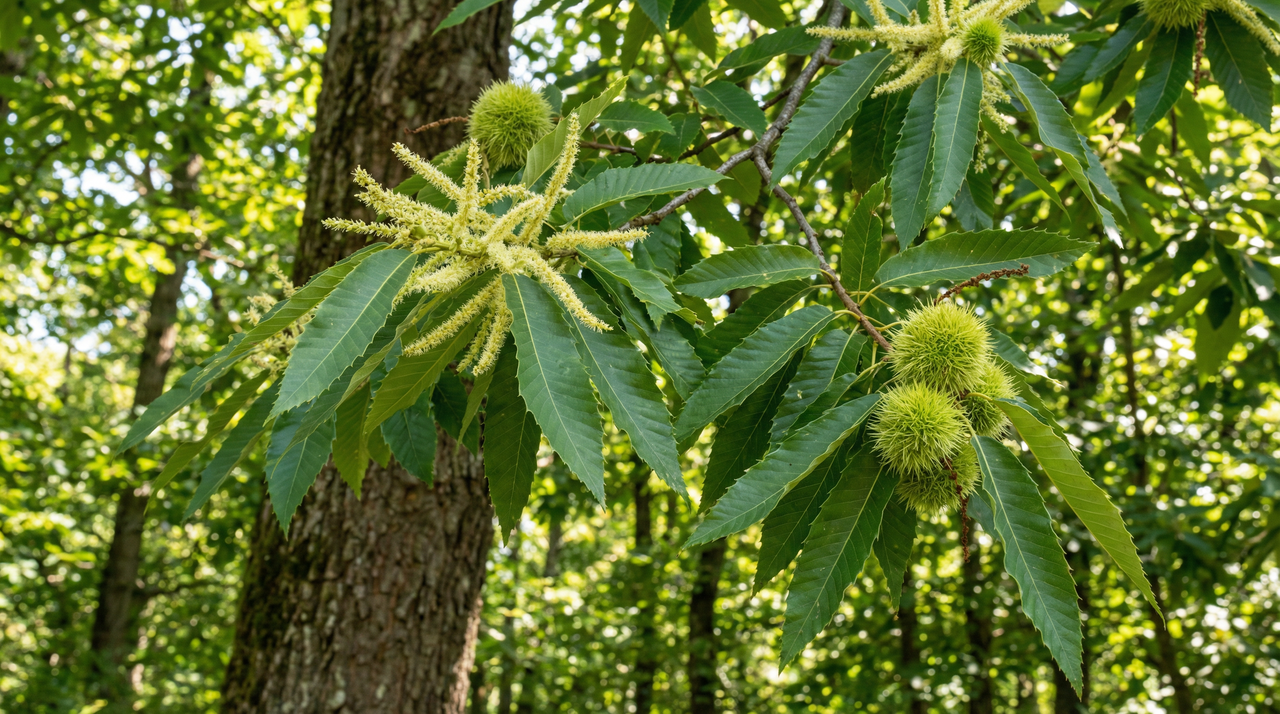
A mature sweet chestnut announces itself. The trunk alone is remarkable: smooth and grayish in youth, it twists into deeply furrowed, dark brown bark with age, developing those characteristic spiral ridges that make ancient specimens look almost architectural.[16][17] The tree typically reaches 50 to 80 feet with a broad, rounded crown and develops a deep taproot that transitions to fibrous roots as the tree matures, which is partly why it handles marginal soils better than many canopy trees I've worked with.[16] The leaves are long, lanceolate, and coarsely toothed, 8 to 20 cm, with a glossy upper surface and softly pubescent underside on young growth.[18] In the field I've had clients mistake young sweet chestnut foliage for oak, but the sharp, regular serration and that slightly furry leaf-back give it away once you know what you're feeling for. Come autumn, the canopy turns golden to bronze, which isn't bad for a tree you're also growing for food.
Flowers arrive as pendulous catkins, and the fruit is the tree's most immediately recognizable feature: glossy brown nuts tucked inside a ferociously spiny burr that splits into two or three segments at maturity.[19][16] Each burr typically holds one to three nuts. American chestnut historically dwarfed its European cousin, reaching 80 to 115 feet, while Chinese and Japanese chestnuts tend toward a more compact 40 to 60 feet and 30 to 40 feet respectively.[20][21][22] The genus even offers a shrub-scale option in Allegheny chinquapin (Castanea pumila), a thicket-forming species reaching just 10 to 30 feet that's worth keeping in mind for forest understory edges.[23]
Traditional and Cultural Uses of Chestnuts
The human relationship with chestnut runs deep and long. Wild nut gathering in Neolithic Italy dates back to roughly 6000 BCE, with deliberate cultivation emerging during the Bronze Age around 2000 to 1000 BCE. Theophrastus documented the tree around 300 BCE, and by 77 CE Pliny the Elder was confirming widespread Roman cultivation.[24][25][26] Romans weren't just eating chestnuts; they were actively spreading the tree as an agricultural asset, valuing it for food, timber, and tannin production.[27] In the mountain communities of Italy, Spain, and France, where thin soils made grain farming unreliable, chestnut flour became the difference between hunger and survival, earning the tree its title as "bread of the poor."[28][29]
That cultural intimacy survives in living tradition. Regional festivals like the magosto in Spain and the sagre delle castagne across Italy still celebrate the harvest, and the durable, rot-resistant timber remains prized for fencing, furniture, and vineyard stakes.[30][31][2] In parallel traditions, Cherokee and Iroquois peoples relied on American chestnut nuts as a dietary staple and used bark and leaves medicinally, while Chinese chestnut has been cultivated in East Asia for over 4,000 years, carrying symbolism around longevity and prosperity and a documented place in traditional Chinese medicine.[32][33][34] Then came the blight. Cryphonectria parasitica, introduced to North America around 1904, effectively ended the American chestnut as an ecological presence, and touched European populations too, forcing a reckoning with centuries of complacent co-existence.[35][36][37] The loss reshaped the meaning of chestnut in North America and pushed breeders toward the Asian species that now anchor restoration programs on both continents.
Fun Facts About Chestnuts
The Hundred Horse Chestnut on Mount Etna in Sicily is thought to be over 2,000 years old and is among the largest-girthed trees ever recorded.[5] Planting a sweet chestnut today is a genuinely long-horizon act; I always tell clients that they're not just planting for themselves but for whoever tends this land generations from now. That longevity is backed by serious ecological engineering: a deep taproot extending 2 to 3 meters, mycorrhizal partnerships, drought-tolerant stomatal regulation, and a vigorous coppicing ability that lets the tree regenerate from cut stumps on 5 to 20 year cycles.[5][38] Those spiny burrs are no accident either; after watching squirrels work through my nut trees over multiple seasons, I can confirm the prickles genuinely slow them down until the burr splits naturally, buying the nuts a critical window before wildlife claims them.[39]
The American chestnut's story is the genus's great tragedy and its most hopeful current chapter. Over 3 billion trees were killed by the blight, reducing Castanea dentata to critically endangered status, with most survivors persisting only as non-reproducing root sprouts.[40][37] The American Chestnut Foundation's backcross breeding program now produces hybrids carrying over 99% American genetics alongside the blight resistance of Chinese chestnut, and transgenic approaches using the oxalate oxidase gene are moving through regulatory review.[41] I follow that work closely, not because I primarily work with American chestnut, but because the science is genuinely exciting and the restoration goal, returning a keystone species to eastern forests, is exactly the kind of regenerative thinking that should animate modern land stewardship. Meanwhile, sweet chestnut's rot-resistant, tannin-rich timber continues earning its keep in vineyards and traditional craft, and the tree's periodic mast years produce nut crops that feed everything from deer and wild boar to jays and dormice.[2][42]
Chestnut Varieties and Cultivars
Choosing the right chestnut species and cultivar is, honestly, the decision that determines everything. Get it wrong and you're babysitting a tree that struggles, resents your climate, or produces mediocre nuts. Get it right and you've got a productive canopy anchor that feeds your family for decades. The genus Castanea includes four main species worth knowing, dozens of named hybrids, and one heartbreaking history lesson that explains why North American growers can't just plant the classic European sweet chestnut and call it a day.
Notable European and Hybrid Cultivars of Castanea sativa
The Spanish chestnut tree, Castanea sativa, is the benchmark. Europe has developed over 300 named cultivars across centuries of selection, bred for larger nuts, regional adaptability, and better disease tolerance.[2][43] The standouts for nut quality include Marigoule, a French hybrid with solid Phytophthora resistance, nuts averaging 20-25 grams, and yields reaching 5 kg per tree[44]; Marrone di Sorrento, an Italian PDO-protected cultivar prized for dessert applications[45]; and Marron de Bart, a traditional French marron-type with elegant nut form.[2] As a tree, the European chestnut is genuinely impressive: it can reach 60-100 feet with a broad, spreading crown, live well over 500 years, and produce timber durable enough that historic buildings across Europe still carry its rafters.[2] The nuts themselves run 1-2 inches across, sweet and starchy, with some cultivars turning almost floury when roasted.[2]
The catch is blight. C. sativa is only moderately resistant to chestnut blight (Cryphonectria parasitica), and it's genuinely susceptible to ink disease in wet soils.[46][47] That same blight functionally eliminated American chestnut (C. dentata) from its native range, which is why I won't recommend planting pure European sweet chestnut in the eastern U.S. without a very honest conversation about disease risk first. I've planted both Marigoule and a Chinese-European hybrid in client designs, and the hybrid showed noticeably better vigor and earlier nut set, especially through the heat and humidity of a long southeastern growing season. Marigoule is beautiful. But where blight pressure exists, the hybrid outperforms it.
North American hybrids like the Dunstan (C. sativa × C. dentata) and ACF backcross lines that push toward 15/16 American genetics combine improved blight resistance with good nut size and flavor, typically beginning reliable production within 3-7 years of planting.[48][49] For most eastern U.S. food forests, these hybrids are the pragmatic choice.
Key Asian and North American Species for Nut Production and Restoration
Chinese chestnut (Castanea mollissima) is the workhorse of American nut orchards and the backbone of most modern breeding programs, and for good reason: it combines high blight resistance with genuine productivity.[50] Qing produces large nuts in the 25-30 gram range and handles heat well; Mopan is widely praised for flavor, ripens early, and can yield 8-10 kg per mature tree with strong resistance to both blight and ink disease[51]; Kuling pushes cold-hardiness into zone 4; and Miller was selected specifically for Florida conditions.[52] Mature trees typically yield 20-50 pounds. That's a serious food forest contribution.
Japanese chestnut (C. crenata) trees run 30-50 feet and are hardy in zones 5-8 with moderate-to-high blight resistance.[22] Tanzawa and Yoshino are valued for disease resistance, Porotan for sweet flavor, and Mammoth for sheer nut size.[53] One thing I tell my apprentices every time we're unpacking a nursery order: label your Chinese and Japanese chestnut seedlings immediately and redundantly, because they look nearly identical for the first two years and the confusion is genuinely easy.
For smaller spaces, Allegheny chinquapin (C. pumila) is the native North American option I keep coming back to. It tops out at 15-30 feet, offers partial blight resistance, and produces small but intensely sweet nuts.[54] Selected forms like Copper (blight-resistant), Fuller (dwarf), and Full Circle (improved yield and hardiness) make it a credible shrub-layer component in a food forest guild or an edible hedge where a full canopy tree simply won't fit.[55]
How to Source Quality Chestnut Trees and Seeds in the United States
Castanea sativa is available from U.S. specialty nurseries including Burnt Ridge Nursery, Prides Corner Farms, Plant Delights, Nature Hills, and Logee's, in forms ranging from seed ($5-15 per packet) to 1-3 year seedlings ($10-30) to grafted trees ($25-100 and up).[56][57][58] Bare-root stock typically ships in early spring or fall; container stock is often available year-round. For Chinese chestnut specifically, Stark Bro's, One Green World, and Gurney's are reliable sources, with young saplings running $15-35.[50] Japanese chestnut has more limited availability; One Green World and Sheffield's Seed Company carry it, though live plant importation is generally prohibited by USDA APHIS due to gall wasp concerns.[59][60]
On the regulatory side: importing Castanea species is strictly controlled under 7 CFR Part 319.[61][62] Buy domestic, buy certified disease-free, and ask specifically about rootstock when purchasing grafted trees. I always request grafted cultivars on disease-resistant rootstock and cross-check with local university extension recommendations before finalizing any variety selection for a client. Pure American chestnut trees are essentially unavailable commercially due to blight, but The American Chestnut Foundation distributes blight-resistant backcross hybrids through their seedling programs and partner nurseries[63]; that's the right path for anyone interested in restoration work.
Propagating and Planting Chestnut Trees
If there's one thing I've learned after propagating dozens of chestnut rootstocks from stratified seed, it's that chestnuts don't behave like most nuts you're used to handling. They're not dormant little packets of dry potential. They're alive, moisture-dependent, and deeply impatient with neglect. Get this distinction wrong early and you'll lose your seeds before they ever see soil.
Seed Morphology, Storage, and Germination
Sweet chestnut seeds are recalcitrant and monoembryonic, meaning each nut contains a single embryo with its nutrients packed into large cotyledons rather than a starchy endosperm.[64][65] They emerge from a spiny burr 5 to 12 cm across, typically enclosing one to three nuts at maturity, and picking them fresh feels a bit like pulling something out of a sea urchin. The spines are unforgiving. Gloves are not optional.
Because these seeds are recalcitrant, drying them even slightly is lethal. They cannot tolerate moisture content below 20 to 30% without irreversible damage, so they must be stored moist, ideally at 85 to 95% relative humidity in peat, sand, or vermiculite, and kept at 2 to 5°C.[66][67][68] Viability can last six to twenty-four months under ideal conditions, but I've seen it drop dramatically after six to twelve months, and any desiccation event can kill the lot. I've watched a bagful of perfectly good conkers turn to paste after someone left them on a radiator for a few days. Fresh, cold, and damp is the mantra.
To break physiological dormancy, chestnuts require cold moist stratification at 2 to 5°C for 90 to 120 days.[69][70] After that, germination at 20 to 25°C takes four to eight weeks with success rates of 50 to 80% under optimal conditions. American and Chinese chestnuts follow the same pattern, needing the same cold stratification window, though Japanese chestnut occasionally shows polyembryony, producing two to four embryos per seed, which is a useful quirk when you're scaling up rootstock production.[71][72]
Vegetative Propagation and Grafting Techniques
Here's the catch with growing a chestnut tree from a nut: the seedlings won't breed true. Sweet chestnut is an obligate outcrosser with high genetic heterozygosity, which means every seed-grown tree is genetically unique.[73][74] If you're raising rootstocks or establishing a diverse nut grove, seed is fine. If you want a named cultivar's specific nut size, flavor, or disease resistance to reliably reproduce, grafting is the only real path.
Grafting is the commercial mainstay for good reason. Whip-and-tongue or chip budding in early spring on compatible rootstocks achieves success rates of 80 to 95%.[27][75] I prefer chip budding onto Castanea mollissima rootstock for the blight tolerance it contributes to the root system, a choice I've settled on after working with American chestnut hybrids where Phytophthora and blight pressure are both real concerns. Asian species like C. mollissima and C. crenata are widely used as rootstocks precisely for their resistance to Phytophthora cinnamomi, the pathogen behind ink disease.[73] Cuttings are possible but frustrating, with success rates of 10 to 60% depending on technique and hormone treatment. Layering performs better at 50 to 80%, though it's slow and labor-intensive.[27] Tissue culture exists but remains largely a specialist or research tool.
Soil and Site Requirements for Chestnuts
I always test soil before planting chestnuts. Always. The species thrives in well-drained loamy or sandy loam soils with a pH of 5.5 to 6.5, and while it can survive a broader range of 4.5 to 7.5, the edges of that range show up as real problems in the ground.[76][77] Below pH 5.0, aluminum toxicity and calcium-magnesium deficiencies become genuine threats. Above pH 7.0, iron chlorosis sets in, and the interveinal yellowing on new growth is almost diagnostic. I had a young sweet chestnut sapling planted on a marginally alkaline slope show that yellowing within its first summer. A few applications of chelated iron foliar spray turned those leaves green within weeks, but it was a clear signal the site needed amendment before the tree went in, not after.
Drainage is non-negotiable. All Castanea species are highly intolerant of waterlogging, which opens the door to Phytophthora root rot.[78][79][80] A deep soil profile matters too; the taproot wants at least a meter, ideally more. Aim for 2 to 5% organic matter to support structure and moisture retention without creating the heavy, compacted conditions that slow drainage. Full sun, a minimum of six to eight hours daily, drives flowering and nut set; seedlings can handle some shade but mature canopy trees really do need to own their slice of sky.[81][82] Chinese chestnut is more forgiving on soil texture and tolerates slightly higher pH than sweet chestnut, while Japanese chestnut on its native alluvial soils contributes useful ink disease resistance when selected as rootstock.[83][84] In my design work I consistently place chestnuts on gently sloping ground where water moves past the root zone rather than sitting in it, and that single decision prevents more problems than any spray program ever could.
Planting Spacing, Technique, and Timelines to First Harvest
Standard orchard spacing for Castanea sativa runs 6 to 8 m between trees and 8 to 10 m between rows, supporting roughly 150 to 300 trees per hectare depending on management intensity.[85][86] Left completely unpruned, sweet chestnut can reach 20 to 35 m with a canopy spread to match; commercial trees are kept to 10 to 15 m through regular shaping. In my nut production groves I've used 8 m centers and found the air flow noticeably better than tighter plantings, which matters both for disease pressure and for harvesting without the canopy closing into a tangle. American chestnut historically needed even more room, 7.5 to 12 m given its massive mature stature, while Allegheny chinquapin at 6 to 9 m height can fit at 3 to 6 m spacing for hedgerows or small-scale plantings.[87][88]
For planting technique, bare-root or container-grown trees go in during late winter to early spring while still dormant, or in fall in mild climates.[89][90] Dig the hole twice the width of the root ball, plant at the same depth as the nursery line, backfill with native soil amended with compost, water thoroughly, and mulch out to the drip line to retain moisture and suppress competition. Avoid the temptation to bury the graft union on grafted stock.
Germination and Maturity Timelines
Patience is the price of admission with chestnuts. Seed-grown Castanea sativa trees typically fruit for the first time in three to seven years, but full production doesn't arrive until ten to fifteen years after planting.[78][91] Grafted trees cut that wait considerably, bearing in four to seven years. Chinese chestnut seedlings fruit in three to seven years with grafted trees bearing in as few as two to three; Japanese chestnut seedlings take five to ten years, though grafted trees often produce in three to five.[92][90] These are ranges, not guarantees; good site preparation, attentive establishment care, and choosing a named cultivar over a random seedling can all shorten the timeline meaningfully. The first small harvest is genuinely exciting. Full production, the kind where you're hauling bushels off a well-placed 20-year-old tree, is the reward for thinking generationally from the start.
Chestnut Tree Care Guide
Caring for a chestnut tree well is mostly a matter of reading signals. The tree will tell you when it's thirsty, when it's hungry, when a late frost has caught it off guard. Your job is to set up the right conditions, then pay attention. Whether you're growing sweet chestnut (Castanea sativa) as a Mediterranean-flavored ornamental or pushing Chinese or American species into colder northern climates, the foundational needs are consistent: slightly acidic, well-drained soil; full sun; and a site that doesn't hold cold air or standing water.
Watering Needs and Drought Tolerance
Young chestnut trees need consistent moisture during their first two to three years, roughly 1 to 2 inches per week, to establish a root system deep enough to sustain them through drier seasons.[78][4] Once established, mature trees are moderately drought-tolerant and can go four to six weeks without supplemental water, though about an inch per week during dry spells keeps production up.[22] The practical seasonal rhythm runs like this: weekly or every-ten-days watering in spring, slightly more frequent in the heat of summer, tapering off in fall, and essentially nothing through winter dormancy.[78][93] I'd trust your soil and your local rainfall over any rigid schedule; what you're aiming for is consistently moist but never waterlogged.
The symptoms of getting it wrong are pretty distinctive. Overwatering, especially on sites with poor drainage, invites Phytophthora root rot: watch for yellowing leaves, wilting despite wet soil, and stunted growth.[94] Underwatering shows up as leaf margin browning, premature drop, reduced nut size, and in severe cases, branch dieback.[95] Deep, infrequent irrigation beats frequent shallow watering every time because it trains roots downward rather than keeping them near the surface where they're vulnerable to drought and heat.[96] A 3 to 4 inch layer of organic mulch does double duty here, retaining moisture while also buffering soil temperature against both late frosts and summer heat.[93] One more site note: sweet chestnut can handle moderate salinity but is sensitive to chlorinated irrigation water, something worth knowing if you're on municipal supply.[97]
Soil Fertility and Feeding
I always do a soil test in late winter before making any fertilizer decisions. I learned this the hard way after over-applying nitrogen to young trees in a poorly draining site and watching them push beautiful, lush foliage that never translated into nuts. The research backs this up: chestnuts are moderate feeders, and excess nitrogen drives vegetative growth at the expense of production while also increasing disease susceptibility.[98] Test first, then fertilize toward the targets.
The sweet spot for soil pH is 5.5 to 6.5, with organic matter above 3% for moisture retention and the microbial activity chestnuts depend on.[99][100] For young trees, a light balanced application (around 50 to 100 grams of a 10-10-10 formulation) in spring is usually enough; mature orchard trees need roughly 0.5 to 1 pound of actual nitrogen annually, split across applications.[101][102] If tests show micronutrient gaps, zinc, boron, and iron deficiencies can all show up in different ways: interveinal chlorosis on young leaves suggests iron, rosetting and small leaves point to zinc, and purplish coloration with poor root development often means phosphorus is short.[103][104] American chestnut in particular benefits from mycorrhizal inoculation at planting, since those fungal partnerships improve uptake of phosphorus, zinc, and copper.[105] If you're planting in urban soils, it's worth checking for heavy metal contamination; chestnuts can accumulate cadmium and lead in acidic urban conditions.[106]
Frost Tolerance and Winter Protection
Sweet chestnut is hardy to USDA zones 5 through 7, tolerating down to around -15°C once fully mature, but young trees need protection below 0°F.[107] If you need a colder-hardy option, American chestnut handles zones 4 through 8 (down to -30°F dormant), and Chinese and Japanese chestnuts both cover a similar range.[108] What all Castanea species share, regardless of cold-hardiness ratings, is vulnerability to late-spring frosts that hit swelling buds and emerging catkins. The pistillate flowers are especially susceptible, and losing them means losing your nut crop for the year.[75]
Even in my mild Central Florida winters, I still mulch young trees every autumn, 3 to 4 inches of leaf mold kept away from the trunk. I've found that consistent mulching prevents late cold snaps from heaving roots on newly planted trees, and it costs almost nothing if you're composting your leaf drop anyway. For growers in frost-prone zones, site selection matters enormously: cold air settles in low spots and hollows, so planting on a gentle slope means a frost that damages trees at the bottom might leave those at mid-elevation untouched.[109] For young trees specifically, frost blankets or burlap wraps during hard freezes add meaningful protection, and a windbreak on the north side reduces desiccation injury.[110] Frost damage shows up as blackened or browned shoots, bark cracking, and necrotic patches; recovery means waiting until you're certain where live tissue ends and then pruning out dead wood with sterilized tools on a dry day.[111]
Heat Tolerance and Summer Stress Management
Sweet chestnut's Mediterranean heritage gives it a foundation of heat adaptability, but that tolerance is conditional on adequate water. Above 30 to 35°C, photosynthesis can decline by 60 to 70% as stomata close to limit water loss.[112] For nut growers, the real concern is that temperatures above 30°C during flowering reduce pollen viability and can cut fruit set by up to 50%.[113] Chinese chestnut handles heat better than the others, with waxy cuticle adaptations that reduce leaf-surface temperatures,[114] while American chestnut has lower thermotolerance and heat stress can compound blight susceptibility.[115]
In my Florida summers with sustained 95°F+ heat, I use 30% shade cloth on young trees and always run drip irrigation before sunrise when temperatures are coolest. The research supports targeting 1 to 2 inches per week in early morning, and mulch at 3 to 6 inches keeps soil temperatures from spiking through the afternoon.[116] If you're selecting cultivars for a hot climate, 'Marsol', 'Qing', and 'Tanzawa' have documented heat tolerance and are worth seeking out.[117] Heat stress symptoms to watch for include leaf scorch at the margins, wilting on hot afternoons that doesn't recover by morning, sunscald on exposed bark, and premature flower bud drop.[118]
Sunlight Requirements
Chestnuts want full sun, at least 6 to 8 hours daily, and nut production drops significantly in anything less.[119] Seedlings and very young trees tolerate moderate shade, which is consistent with their forest ecology, but as they mature they become dominant canopy species that outcompete for light.[120] In a food forest, this means siting your chestnut where it won't be shaded by existing trees at maturity, not just at planting. I've found chestnut less forgiving of deep shade than pawpaw, for example, and shaded trees show it through pale foliage, weak growth, and disappointing yields. The practical fix from the pruning side is maintaining an open canopy so light reaches interior branches, which we'll come to next.
Pruning, Maintenance, and Seasonal Rhythm
Prune in late winter, after the last hard freeze but before bud break. I've learned to time this by watching the trees themselves: once I can see swelling at the buds but no green tissue has emerged, any wounds made will callus quickly without leaving the tree exposed to infection through a long healing period.[119] Summer pruning risks sap bleeding and opens pathways for the fungal pathogens that chestnut is already prone to.[121] Always sterilize tools between cuts, especially if blight or ink disease is present anywhere in your region.
For young trees, the goal is establishing a central leader with scaffold branches spaced 8 to 24 inches apart vertically, removing competing shoots below 60 to 80 cm to build a strong, well-anchored framework.[85] Mature trees need an annual review rather than aggressive cutting: remove no more than 20 to 30% of the canopy in any given year, targeting dead, diseased, crossing, and water-sprout branches to improve light penetration and airflow.[122] Thoughtful thinning can improve kernel quality by up to 25%,[85] which is a meaningful return on an afternoon's work in February.
Cross-pollination is non-negotiable; plant compatible cultivars within 50 meters of each other or you'll get poor nut set regardless of how well you manage everything else.[119] For the American chestnut side of things, blight-resistant hybrids are essentially the only viable path in North America, while Chinese chestnut provides natural resistance but should be monitored for Asian gall wasp.[123] I've seen what unchecked ink disease does in poorly drained spots, and improving drainage consistently outperforms chemical intervention; if you suspect Phytophthora, that's the place to start.[124] The tree's seasonal rhythm anchors all of this: dormancy through winter, vulnerable bud break in spring, wind-pollinated catkins opening in early to mid-summer, and the satisfying thud of ripe nuts dropping in autumn.[2] Learning to read those transitions, and to time your pruning, feeding, and protection around them, is really what separates a productive chestnut from one that merely survives.
Harvesting Chestnuts: Timing, Technique, and Flavor
When to Harvest Chestnuts – From Flowering to Fall Drop
Chestnuts take their time. From late-spring flowers to mature nuts in the basket, Castanea sativa needs roughly 120-150 days, with Chinese chestnut running longer at 150-180 days depending on climate, cultivar, and the particular moods of your season.[125][126] That puts the harvest window in September and October across most of Europe, stretching into early December in the eastern U.S., with the peak sweet spot for the genus landing mid-September through early November.[125][127] If you're planting from seed, expect to wait 15-20 years for a meaningful crop; grafted trees can produce in as few as 2-7 years, which is one reason I always recommend grafted stock for anyone serious about yield in their lifetime.[128][129]
Calendar dates are a rough guide at best. The real cue is the tree itself. In my garden, the first burrs usually start cracking open in mid-October, and I've learned through multiple seasons that waiting until at least 30% of the burrs have split naturally yields noticeably sweeter nuts. Look for the spiny husks yellowing and opening, the glossy brown shells reaching full size around 3-4 cm, and the nuts separating cleanly from their inner lining.[130][131] The water-sink test is your best friend here: drop nuts in a bucket and discard anything that floats. For Chinese-type chestnuts, there's also a waist-height bounce test; a mature nut has a satisfying spring to it when it hits a hard surface that an immature one simply won't.[132]
How to Harvest and Handle Chestnuts
The first time I harvested too early, the kernels were bland and slightly astringent. Waiting for natural drop and running a quick sink test changed everything. Once nuts are falling on their own, go out in the morning after the dew has dried and collect promptly, because squirrels, weevils, and mold don't wait.[133][130] For a backyard tree, raking or hand-gathering from the ground works well, though you'll want thick leather gloves when handling spiny burrs. A pole pruner can knock reluctant burrs down if you're impatient. Commercial orchards use mechanical shakers, which turns the whole operation into a different kind of thing entirely.[127][133] I always float-test every harvest now, because I once lost a large batch to weevils early in my growing journey. Any floater goes straight to the compost.[134]
Yield, Flavor, and Post-Harvest Care
A healthy mature sweet chestnut tree can realistically deliver 10-50 kg of nuts in a good year, though yields swing significantly with age, site quality, and the biennial bearing cycles that produce heavy crops every 2-3 years.[128][132] Raw chestnuts are starchy, mildly earthy, and not especially exciting, but roasting transforms them entirely. Maillard reactions build pyrazines, furans, and lactones that produce the sweet, toasty, faintly umami aroma that makes a paper cone of street chestnuts so irresistible.[135] Not all chestnuts taste the same, either. Southern European and Asian varieties tend toward sweetness with less astringency, while American chestnuts run notably high in sugars at 15-20%.[136][20] If you're ever lucky enough to forage Allegheny chinquapin (Castanea pumila), the tiny 1-1.5 cm nuts taste almost hazelnut-like raw and lean into buttery caramel when roasted. They're a genuine wild treasure.[137]
Storage is where a good harvest can go sideways. I cure mine at around 85-95°F with high humidity for 3-7 days, then move them into mesh bags in the refrigerator at 35°F. Done right, that setup holds quality for up to six months while actually enhancing sweetness.[133][138] Below freezing ruins the texture, so I never risk the hard freeze. The difference between a well-cured nut and one that sprouts in storage after two weeks is entirely in that initial temperature-and-humidity window, and it's worth taking seriously.
How to Prepare and Use Chestnuts: Culinary and Traditional Applications
Culinary Preparation, Flavor, and Traditional Recipes
Raw chestnuts are not the move. Every Castanea species carries enough tannins to make eating them raw an unpleasant, often digestive-disrupting experience, and I say that as someone who has absolutely tried one straight off the ground out of impatience.[78][139] The fix is simple: score an X into the flat side of the shell with a sharp knife, then roast at 200-220°C for 20-30 minutes or boil for 15-20 minutes.[78][140] The scoring does double duty: it vents steam so the shell doesn't explode, and it lets you peel away the bitter inner pellicle while the nut is still warm. That moment when the score line splits open and the kitchen fills with warm caramel scent is genuinely one of fall's best sensory rewards.
Before you forage a single nut, know this distinction cold: true chestnuts have simple serrated leaves and spiny burs containing two or three nuts, while horse chestnut has palmate leaves and a smoother husk with a single large seed containing aesculin, a compound that causes serious poisoning.[141][142] I've taught this identification in foraging workshops for years because confusing the two is one of the few genuinely dangerous mistakes you can make in temperate foraging.
Once cooked, sweet chestnut lands in flavor somewhere between a baked potato and a mild almond, with earthy, starchy sweetness that no other nut quite replicates.[143][144] The fat content is only around 2-3%, which is why the texture turns soft and creamy rather than oily or crunchy.[145] Japanese varieties roast even richer and butterier than European sweet chestnut, while American chestnuts are milder and less sweet.[146] Nutritionally, 100g of raw sweet chestnut gives you roughly 131 kcal, 28g of complex carbohydrates, and a genuinely useful 26mg of vitamin C, which most people don't expect from a nut.[147] They also carry polyphenols including gallic and ellagic acids with measurable antioxidant activity.[148]
That starchy, low-fat profile is precisely what makes chestnut flour so interesting to bake with. You roast, dry, and grind peeled nuts to get a flour that adds natural sweetness to baked goods without much added sugar needed.[78] Italian castagnaccio, a dense gluten-free cake made with chestnut flour, rosemary, and olive oil, barely needs sweetening at all. In traditional European cuisine the nut also purees into soups, enriches poultry stuffings, stars in marrons glacés and mont-blanc, and roasts as simple street food.[149][4] Japanese kuri gohan, chestnut rice, and Chinese stir-fries and congees reflect how differently this genus has been interpreted across cultures, each leaning into the same starchy sweetness with their own technique.[150][151] Allegheny chinquapin, which Native Americans relied on as a staple food, can be roasted, ground into flour for breads and stuffings, or even used as a coffee substitute when roasted and ground fine.[152]
A few practical cautions worth knowing: if you're working with American chestnuts, genuine wild trees are functionally extinct due to blight, and any foraged nuts from blight-affected trees may carry mycotoxin-producing molds.[153] Stick to cultivated blight-resistant hybrids. People with tree nut allergies or latex sensitivity should also know that chestnut cross-reactivity is documented, especially with birch pollen and latex-fruit syndrome.[154][155] And while cooking tames the tannins significantly, eating a large quantity can still cause bloating or digestive upset, so moderation is reasonable.[139]
Non-Food Uses: Timber, Tannins, and Traditional Medicine
The nut is the headliner, but the rest of the tree has historically carried its own weight. Sweet chestnut bark and inner bark are dense with tannins that have been used for centuries to cure leather and produce brownish fabric dyes, and the timber is genuinely exceptional: rot-resistant, durable, and workable enough for construction, furniture, flooring, and barrels.[156] I notice the tannin chemistry on a smaller scale every autumn, when heavy chestnut leaf drop acidifies the soil beneath my trees noticeably more than the surrounding planting areas. It's a useful reminder that the same compounds making the bark valuable for leather tanning also have real effects in the garden and need to be balanced by companion planting and mulch management.
Medicinal traditions across Europe and North America used bark and leaf decoctions for respiratory complaints, diarrhea, and as an astringent, while chestnut flower honey appeared in folk remedies for sore throats and wound healing.[157][158] Similar patterns appear across American, Chinese, and Japanese species in their respective traditional systems.[159] The flowers and young leaves are also edible; flowers feed pollinators and produce that distinctive amber honey, while young leaves can be eaten in small quantities, though they share the genus's tannin load and can cause digestive issues if eaten in excess.[160][161] Stems, bark, and older wood are not food, and their high tannin concentration makes ingesting them potentially harmful.[160] The edible parts are the nuts, young leaves used sparingly, and the flowers. Everything else belongs to the timber yard or the dye pot.
Chestnut Health Benefits and Medicinal Uses
Every culture that grew up alongside chestnuts eventually found medicinal uses for the tree, not just the nut. That kind of cross-cultural convergence is always worth paying attention to.
Traditional Medicinal Uses Across Cultures
Across Mediterranean folk traditions, Castanea sativa leaf decoctions were prepared for coughs and respiratory complaints, while bark preparations addressed diarrhea and skin conditions.[162] The pattern holds almost exactly across continents: Cherokee and Iroquois peoples used American chestnut bark and leaf infusions for dysentery, pulmonary issues, and wound care,[163][164] and traditional Chinese medicine applied Chinese chestnut to tonify the kidneys and spleen, treat coughs, and address inflammation.[165] I still brew small batches of sweet chestnut leaf tea when someone in my household has a rattly chest in winter, and I'm clear with myself that this is traditional practice, not a prescription. There are still no published human clinical trials demonstrating efficacy for specific conditions.[166] What exists are compelling in-vitro and animal studies, and a track record of traditional use that spans enough independent cultures to suggest something real is happening. One modern phytotherapy application that's made it further along the evidence pipeline is C. sativa leaf extract for chronic venous insufficiency, standardized to active compounds and used for circulatory problems including varicose veins.[167]
Key Phytochemicals: Ellagitannins, Phenolics, and Flavonoids
When I'm processing leaves, bark, and nuts in the same season, the difference in astringency between plant parts is impossible to miss. That's the tannin gradient made tangible. Castanea sativa contains a dense array of secondary metabolites: flavonoids including quercetin and kaempferol, phenolic acids including gallic and ellagic acid, hydrolyzable tannins particularly the ellagitannins vescalagin and castalagin, and coumarins, with concentrations running highest in bark and leaves and somewhat lower in the nuts themselves.[168][169] The ellagitannins are especially interesting because they hydrolyze to ellagic acid and contribute to antioxidant, antimicrobial, and astringent activity while simultaneously serving the tree's own defense against pathogens and herbivores.[170] Growing conditions shift the balance significantly: acidic soils and drought tend to push tannin and flavonoid concentrations higher, while roasting or boiling reduces vitamin C and some phenolics but lowers tannins enough to improve digestibility and palatability.[171] Chestnuts from my own trees, properly roasted, consistently taste sweeter and less bitter than anything I've bought at a market, and that tracks with what the chemistry predicts. Proanthocyanidins and additional flavonoids like myricetin round out the profile, and Chinese chestnut also contributes stilbenes, all of which underpin the genus-wide antioxidant and cardioprotective activities researchers have been documenting.[172]
Pharmacological Research: Antioxidant, Anti-inflammatory, and Beyond
The in-vitro research on Castanea is genuinely impressive, even with the clinical trial gap in mind. Extracts demonstrate strong antioxidant activity, often exceeding 80% DPPH radical inhibition, driven by the gallic acid, ellagic acid, and flavonoid content.[173] Anti-inflammatory effects operate through NF-κB signaling inhibition and reduction of pro-inflammatory cytokines like TNF-α and IL-6, with comparable COX-2 inhibition reported across other species in the genus.[174][175] Antimicrobial activity is broad-spectrum, effective against pathogens including Staphylococcus aureus and Candida albicans through cell membrane disruption, with MIC values in the 0.5-2 mg/mL range across species.[176] Moving into more preliminary territory: gallotannin and ellagitannin fractions show alpha-amylase and alpha-glucosidase inhibition comparable to the diabetes drug acarbose in lab settings,[177] cholinesterase inhibition suggests neuroprotective potential,[178] and apoptosis induction via caspase activation has been observed in cancer cell lines.[179] Chinese chestnut adds hepatoprotective and ACE-inhibitory cardioprotective effects in animal models.[180] All of this is preclinical. The traditional uses are plausible and the mechanisms are real, but human trials are still missing.
Nutritional Profile of Chestnut Nuts
I often describe chestnuts to people encountering them for the first time as something like a tree-grown sweet potato with extra antioxidants, and the nutrition label bears that out. European sweet chestnut is strikingly low in fat at 0.6-2.2 g per 100 g and relatively modest in protein at 2-6 g, but delivers 28-45 g of complex carbohydrates and a meaningful 3-8 g of fiber, at around 213 kcal per 100 g raw.[181] That puts it completely outside the flavor and metabolic profile of almonds or walnuts, which are fat-dominant.[182] Vitamin C content is genuinely notable for a nut, at 26-43 mg per 100 g raw, though it declines with cooking, alongside strong potassium levels of 484-715 mg per 100 g plus magnesium, phosphorus, and B vitamins.[181] The phenolic compounds concentrated especially in the pellicle, the thin inner skin, contribute measurably to antioxidant capacity and are best preserved when preparation is minimal.[183] Chinese chestnut runs considerably higher in calories at around 369 kcal per 100 g with notably elevated potassium,[147] a useful reminder that nutritional values shift meaningfully across the genus.
Safety Considerations and Preparation Guidelines
True chestnuts have a long, safe track record as food when correctly identified and cooked, and that's the foundation of everything else here.[184] The identification piece is non-negotiable. Horse chestnut (Aesculus hippocastanum) is toxic and a source of real confusion: the key differences I teach in every workshop are the opposite, palmate leaves of horse chestnut versus the long serrated single leaves of Castanea, and the smooth or slightly bumpy horse chestnut husk versus the densely spiny burr of true chestnut.[185] Once identification is correct, cooking is the other essential step: roasting or boiling reduces tannins substantially, eliminating the bitterness and digestive irritation that raw nuts can cause.[186] I learned this the harder way early on, experimenting with a longer-steeped bark preparation and noticing real digestive discomfort before I understood how much tannin concentration matters with plant parts other than the nuts. Bark and leaf preparations carry classic tannin cautions and are not appropriate for consumption in any quantity.[187] Pollen from Castanea is a common seasonal allergen with cross-reactivity to birch and hazel, and nut allergy is possible in sensitized individuals.[188] For medicinal preparations specifically, anyone taking anticoagulants or who is pregnant should consult a healthcare provider, and extracts at food-level doses show low acute toxicity with an LD50 above 2000 mg/kg, though gastrointestinal upset from high-tannin preparations remains a real possibility.[189] Proper post-harvest drying to below 10% moisture matters for storage safety, since moldy nuts can harbor aflatoxins.[190] Get identification and preparation right, and chestnuts are about as reliable and nourishing a food as a tree can offer.
Chestnut Pests and Diseases
Sweet chestnut's pest and disease story is really a story about where you plant it and what you plant it with. Get those decisions right, and you'll spend very little time worrying about either. Get them wrong, and you'll be fighting problems that no spray program can fully solve.
Major Diseases of Sweet Chestnut
Two diseases dominate the conversation. Chestnut blight, caused by the fungus Cryphonectria parasitica, is the one most people have heard of, and for good reason: after its introduction to North America around 1904, it reduced the American chestnut by over 99% in its native range.[191][192] Sweet chestnut (Castanea sativa) fares considerably better, partly because European populations were already exposed to hypovirulent strains that limit the pathogen's damage, but it's not immune.[193][194] Chinese chestnut (C. mollissima) shows the strongest blight resistance across the genus, outperforming Japanese chestnut (C. crenata), which is itself far tougher than the American species.[195][196] This is exactly why I lean toward Chinese chestnut rootstocks or known hybrids in my designs, especially when clients want to plant in humid regions where blight pressure runs higher. It's not about giving up on C. sativa; it's about giving the tree a fighting chance.
The second major threat is ink disease, caused by Phytophthora cinnamomi, and in my experience this one catches more growers off guard. It thrives in poorly drained, wet soils, and C. sativa shows only moderate resistance at best.[197][198] Trees in heavy clay or low-lying spots invariably struggle, even on supposedly resistant rootstocks. I've learned to be blunt with clients about this: if the site doesn't drain well, either amend it significantly, build a raised bed, or choose a different location entirely. Phytophthora infections intensify outside a soil pH of 4.5 to 6.5 and in soils that stay wet, while well-drained, higher-elevation sites with good air movement reduce risk substantially.[199][200] Asian species still show variability here too; no chestnut is completely off the hook.[201]
Secondary diseases like powdery mildew, Armillaria root rot, Botryosphaeria cankers, and Phytophthora ramorum can show up, but they rarely limit a healthy, well-sited tree.[202][78] Stress is usually the common thread. Cultivar selection matters a lot: Marsol, Marigoule, Maraval, and Ginyose carry improved blight tolerance, while Marsol, Lombarda, and Ragonesi perform better against ink disease, and many newer hybrids blend in Asian resistance genes through active breeding programs.[203][204] Management ultimately leans on cultural practices: plant on well-drained sites, remove infected material promptly, apply hypovirulent blight strains where appropriate, and reserve phosphite or copper-based fungicides as a last resort rather than a routine.[205][206]
Key Insect Pests and Their Management
The oriental chestnut gall wasp (Dryocosmus kuriphilus) is the insect I worry about most in client orchards. It forms galls on buds and shoots and can wipe out up to 90% of a crop in a bad year.[207][208] After seeing the damage firsthand in a client's orchard, I now prioritize cultivars like Marsol, Lombarda, and Prealba with known reduced susceptibility, and I introduce the parasitoid Torymus sinensis early wherever the wasp has been identified.[209][210] C. mollissima shows moderate to high resistance and serves as a key parent in breeding programs aimed at reducing gall wasp susceptibility across the genus.[211]
Chestnut weevils (Curculio elephas and relatives) are the other major concern, boring into developing nuts and causing premature drop and kernel damage.[212][213] C. sativa is susceptible; prompt collection of fallen nuts and thorough orchard sanitation are the most reliable controls available.[214] Chestnut moths, longhorn beetles, leaf miners, and Japanese beetles round out the pest list, targeting nuts, wood, and foliage respectively, though most of these only become serious problems on stressed trees.[215]
The tree isn't defenseless. Mature C. sativa leaves carry 10 to 20% tannin content, which reduces digestibility for many insects, and the volatile organic compounds released by the foliage actively recruit natural enemies of herbivores.[216][217] That astringency you notice biting into a raw nut or handling fresh leaf litter is the same chemistry making the tree less hospitable to insect pressure. Thick furrowed bark and those fiercely spiny husks add physical barriers on top of the chemical ones.[218] In my guild designs, companion planting with insectary species has consistently reduced my reliance on any sprays by keeping populations of predatory wasps and beneficial beetles present through the season. Good drainage, diverse understory plantings, annual sanitation, and a resistant cultivar take care of most problems before they become problems at all.[219][220]
Permaculture Design with Chestnut
Few canopy trees reward long-term thinking the way chestnuts do. You're making a decades-long commitment when you plant one, so getting the design right from the start matters far more than with most plants. I've spent years placing chestnuts in temperate food forests, and the decisions that keep me up at night aren't soil amendments or pruning schedules. They're zone suitability, guild assembly, and whether I've met the cross-pollination requirements. Get those three things right and a chestnut practically runs itself.
Climate and Zone Suitability for Chestnut
Sweet chestnut (Castanea sativa) evolved in the Mediterranean basin, thriving in the wet-winter, dry-summer rhythms of Köppen Csa and Csb climates, with some natural presence at higher elevations in cooler Dfb zones.[2][221] In cultivation it handles minimum temperatures down to around -20°C to -25°C, putting it solidly in USDA zones 5-9, though fruiting performance really shines in zones 6-8 where growing-season temperatures sit between 15-25°C.[222][223][224] It also needs 600-800 chill hours below 7°C for proper dormancy and nut set.[225][226] In my experience, well-drained acidic soil and protection from salt spray matter at least as much as where you fall on the zone map. A tree sitting in a wet clay hollow in zone 7 will struggle more than one in fast-draining loam at the edge of zone 5.
For North American designers, the genus offers more practical options than C. sativa alone. American chestnut (C. dentata) is technically hardy to zone 4 and prefers the humid continental climates of the eastern U.S., but the near-total loss of mature specimens to chestnut blight makes planting pure species a risky proposition for any productive design.[227][228] I never plant pure American chestnut in a client's forest garden; every specimen I use is a Chinese-American hybrid selected for regional blight strains. Chinese chestnut (C. mollissima) tolerates temperatures as low as -34°C and handles summer heat spikes up to 40°C, making it a reliable workhorse for zones 4-8 with 800-1200 chill hours.[72][22] I reach for it when designing for the upper Midwest because it simply doesn't flinch at temperature swings that would set back a European tree. Japanese chestnut (C. crenata) occupies a similar hardiness band in zones 5-8, preferring humid temperate climates with 760-1270 mm of annual rainfall.[14][229] Across the genus, 600-1200 chill hours is a practical working range. For specific cultivar recommendations, the varieties section goes deeper.
Ecosystem Functions and Pollination of Chestnut
What I love about chestnuts in a designed system is the sheer breadth of ecological work they do. The nut drop alone feeds squirrels, deer, wild boar, jays, and woodpeckers, making a mature tree a genuine wildlife hub.[230] I've watched jays cache chestnuts fifty meters from the parent tree, effectively doing my propagation work for me. The roots, reaching 2-3 meters deep, stabilize slopes and pull minerals up from subsoil layers that shallower plants can't access, which is why sweet chestnut earns its dynamic-accumulator status even though it doesn't fix nitrogen.[231] Coppiced on rotation it yields 10-15 tonnes per hectare per year of biomass for mulch or fuel, a remarkable rate for a temperate hardwood.
The mycorrhizal story is equally compelling. All Castanea species form ectomycorrhizal associations, partnering with fungi including Boletus and Tuber species, and those networks benefit neighboring plants by extending water and nutrient reach across the guild.[232][233] American chestnut once anchored these networks across 25-50% of eastern North American forest canopy before blight stripped most mature trees from the landscape; restoration programs now center on blight-resistant hybrids to rebuild that function.[234] Chinese and Japanese chestnuts carry strong genetic resistance to Cryphonectria parasitica and are the backbone of those breeding efforts.[12]
One ecosystem function that catches new growers off guard is the tannin-rich leaf litter. It decomposes and cycles nutrients efficiently, but it can temporarily acidify the soil beneath the canopy and mildly suppress some understory plants. In my own designs I apply wood ash in the first few years and stick with alkaline-tolerant companions until the system stabilizes. On the pollination side, chestnuts are monoecious and primarily wind-pollinated, though insects contribute 10-20% under good conditions.[235][236] The trees are self-incompatible, meaning you need at least two compatible individuals, and the protandrous flowering sequence means timing between trees matters. Optimal conditions sit at 20-25°C with 40-70% humidity and moderate wind; pollen viability drops sharply above 30°C, and a late spring frost can destroy up to 80% of blossoms.[237][238] After watching frost kill the catkin set on a young European chestnut two springs running, I started selecting sites with a slight northern aspect or using temporary shade cloth during bloom to delay flowering just enough to clear the last frost window.
Chestnut in Forest Layers and Guilds
In a permaculture food forest, sweet chestnut owns the tall canopy layer. At 20-35 meters at maturity, with a broad spreading crown, it casts serious shade and sets the light budget for everything beneath it.[239] That shade, combined with the tannin-driven allelopathic effects of the litter, can suppress poorly chosen understory species.[240] So I space trees farther apart than strict orchard recommendations and underplant deliberately. Cross-pollination requires compatible cultivars planted 8-12 meters apart with rows perpendicular to prevailing winds, and that spacing also gives you room to work a productive understory below each tree.[241]
My go-to guild anchors nitrogen-fixers like alder or autumn olive in the mid-layer, with comfrey as a dynamic accumulator groundcover and daffodil bulbs to deter rodent pressure around the root zone. Shade-tolerant herbs fill the gaps. The nitrogen-fixers compensate for the chestnut's inability to fix its own nitrogen, and the comfrey chop-and-drop steadily builds organic matter even as the leaf litter acidifies. For the shrub layer, Allegheny chinquapin (C. pumila) is an underused gem: a 1-9 meter multi-stemmed native that produces small but edible nuts, tolerates partial shade, and slots perfectly beneath taller canopy trees while adding a second nut crop to the harvest calendar.[242][243]
For designers working in North America, the canopy options have shifted considerably since the blight era. American chestnut once dominated eastern forests alongside oaks and hickories at 20-35 meters, but today's restoration guilds rely on Chinese-American hybrids that carry the blight resistance of C. mollissima (10-20 m) or C. crenata (10-15 m) within a somewhat smaller canopy footprint.[244][22][245] That smaller scale can actually be an asset in a home-scale food forest where a full-size European tree would eventually shade out everything else. Modern hybrids let you recapture the keystone canopy function that chestnut historically provided in eastern forests, and doing so with blight-resistant stock means you're building something that will still be standing and producing when your grandchildren are harvesting from it.
The Tree I Planted for My Grandchildren
I put a chestnut in the ground knowing I'd be old before it hit peak production, and I did it anyway. There's something clarifying about that, about committing to a plant on a timescale longer than your own convenience. Every autumn when I'm on my knees in the leaf litter, filling a bucket with glossy nuts, I think about the medieval farmers who did exactly this, and I feel less like a gardener and more like a link in something longer.
Sources 245
- Sweet chestnut (Castanea sativa Mill.) as traditional food in Europe ↩
- Castanea sativa ↩
- Plants of the World Online: Castanea sativa ↩
- Castanea sativa - Sweet Chestnut ↩
- The Hundred Horse Chestnut ↩
- Royal Horticultural Society Plant Profile for Castanea sativa ↩
- University of Missouri Extension: Growing Chestnuts for Profit ↩
- USDA FS: Castanea sativa ↩
- Castanea dentata (L.) Borkh. American Chestnut ↩
- The American Chestnut ↩
- American Chestnut: An Historical and Ecological Biography ↩
- Castanea mollissima - Chinese Chestnut ↩
- The Chinese Chestnut in America ↩
- Castanea crenata - Japanese Chestnut ↩
- Plants of the World Online: Castanea crenata ↩
- Castanea sativa - Missouri Botanical Garden ↩
- Sweet Chestnut - RHS Gardening ↩
- Flora Europaea - Castanea sativa ↩
- Royal Horticultural Society Plant Finder ↩
- The American Chestnut: An Environmental History ↩
- Missouri Botanical Garden - Castanea mollissima ↩
- Castanea crenata - Missouri Botanical Garden ↩
- Castanea pumila - USDA PLANTS Database ↩
- Archaeological Evidence for Chestnut Cultivation in Prehistoric Italy ↩
- The Domestication of the European Chestnut (Castanea sativa Mill.) ↩
- Enquiry into Plants ↩
- History of Chestnut Cultivation in Europe ↩
- Castanea sativa Ethnobotany Across Europe: Historical and Modern Perspectives ↩
- Traditional Uses of Sweet Chestnut in France ↩
- Folk Medicine and Chestnut in Spain ↩
- Cultural Significance of Castanea sativa in Mediterranean Europe ↩
- Ethnobotany of the Eastern Woodlands ↩
- Cultural Significance of Chestnuts in China ↩
- Chinese Chestnut: Botany, Horticulture, and Culture ↩
- Chestnut Blight ↩
- The Impact of Chestnut Blight on European Forests ↩
- American Chestnut Restoration ↩
- Root System Architecture of European Chestnut ↩
- Morphological adaptations of chestnut burrs and seed protection ↩
- Chestnut Blight and the American Chestnut ↩
- The American Chestnut: An Agenda for Managing a Transgenic Forest Tree in a World of Regulatory Uncertainty ↩
- American Chestnut: A Dynamic Forest Resource ↩
- Italian Chestnut Cultivars ↩
- Marigoule Chestnut Variety ↩
- Marrone di Sorrento PDO ↩
- USDA PLANTS Database: Castanea sativa ↩
- Royal Horticultural Society - Castanea sativa ↩
- University of Georgia Extension: Chestnut Production ↩
- American Chestnut Foundation - Breeding for Blight Resistance ↩
- Chinese Chestnut Cultivars in the United States ↩
- Mopan Chestnut: A Promising Cultivar for North America ↩
- Performance of Chinese Chestnuts in Southern States ↩
- Japanese Chestnut Cultivars - Overview ↩
- American Chestnut Foundation - Chinquapin Resources ↩
- Oikos Tree Crops - Chinquapin Selections ↩
- Burnt Ridge Nursery - Chestnut Trees for Sale ↩
- Prides Corner Farms - Castanea sativa ↩
- Sweet Chestnut Trees for Sale ↩
- Japanese Chestnut Trees for Sale ↩
- Chestnut Seeds - Castanea crenata ↩
- Importation of Plants for Planting ↩
- Foreign Quarantine Notices (7 CFR 319) ↩
- American Chestnut Foundation - Seedling Distribution ↩
- USDA PLANTS: Castanea sativa ↩
- Morphology and Anatomy of Chestnut Seeds ↩
- Storage Physiology of Chestnut Seeds ↩
- USDA Forest Service Seed Storage Guidelines ↩
- Recalcitrant Seeds: Biology and Storage ↩
- Dormancy and Storage of Castanea sativa Seeds ↩
- Propagation of Sweet Chestnut (Castanea sativa) ↩
- American Chestnut Seeds: Collection, Stratification, and Storage ↩
- Chinese Chestnut (Castanea mollissima) Seed Handling and Storage ↩
- Grafting as a propagation method of Castanea sativa Mill. and its role in improving the chestnut industry ↩
- Propagation of Chestnuts by Grafting ↩
- Vegetative Propagation of Chestnut (Castanea spp.) ↩
- Royal Horticultural Society: Castanea sativa Care Guide ↩
- Chestnut Soil Management ↩
- Growing Sweet Chestnut Trees ↩
- Soil Requirements for Chestnut Trees ↩
- Chinese Chestnut Production Guide ↩
- Royal Horticultural Society - Castanea sativa ↩
- Growing American Chestnuts ↩
- Chinese Chestnut Production and Culture ↩
- Japanese Chestnut (Castanea crenata) ↩
- Chestnut Production Manual ↩
- Chestnut Production and Management ↩
- Planting American Chestnut Trees ↩
- Growing American Chinquapin ↩
- Chestnut Trees: Planting and Care ↩
- Propagation of American Chestnut ↩
- Chestnut Production and Culture ↩
- Chinese Chestnut Production and Breeding ↩
- Irrigation Management for Chestnut Orchards ↩
- Chestnut Root Rot and Phytophthora Diseases ↩
- Water Stress in Trees ↩
- RHS Gardening: Sweet Chestnut (Castanea sativa) ↩
- Water Relations and Drought Tolerance in Castanea sativa ↩
- Sweet Chestnut Production Guide - Oregon State University Extension ↩
- Growing Chestnuts in the Home Landscape ↩
- Organic Orchard Management: Chestnuts ↩
- Chestnut Production in Maryland ↩
- Fertilization of Chestnut Orchards ↩
- Nutrient Deficiencies in Chestnut Trees ↩
- Nutrient Deficiency Symptoms in Deciduous Trees ↩
- Mycorrhizae in Castanea dentata Restoration ↩
- AAPSOC Journal: Heavy metal accumulation in Castanea sativa forests (2021) ↩
- Castanea sativa - Sweet Chestnut ↩
- USDA Plant Hardiness Zone Map ↩
- Frost Protection in Fruit Orchards ↩
- Restoring the American Chestnut: Planting and Care Instructions ↩
- Castanea sativa Cold Tolerance and Injury Symptoms ↩
- Response of photosynthesis and stomatal conductance to short-term heat stress in sweet chestnut (Castanea sativa Mill.) ↩
- Impact of High Temperatures on Flowering and Fruit Set in Castanea sativa ↩
- Chinese Chestnut Production and Utilization ↩
- Heat Stress Management in European Chestnut Orchards ↩
- Shading Nets and Mulching Effects on Castanea sativa under Drought and Heat ↩
- Effects of Heat Stress on Chestnut Trees ↩
- Heat Stress Management in Nut Trees ↩
- Sweet Chestnut - Growing Guide ↩
- Castanea sativa Profile - USDA PLANTS Database ↩
- Pruning Deciduous Fruit and Nut Trees - Penn State Extension ↩
- Castanea sativa Cultivation Guidelines - FAO ↩
- American Chestnut Restoration Guidelines ↩
- Sweet Chestnut (Castanea sativa) - UC ANR ↩
- Chestnut Orchards: Management Guidelines ↩
- Chestnut Production Manual ↩
- Chestnut Production in the United States ↩
- American Chestnut: Biology, Culture, and Disease Management ↩
- Harvesting Chestnuts: A Guide for Backyard Growers ↩
- Harvesting and Storing Chestnuts ↩
- Chestnut Production Manual ↩
- Maturity Indices for Chestnut Fruits ↩
- Harvesting and Handling Chestnuts ↩
- Post-Harvest Management of Chestnuts ↩
- Characterization of the Key Aroma Compounds in Roasted Sweet Chestnut by Gas Chromatography-Mass Spectrometry and Gas Chromatography-Olfactometry ↩
- Regional Variations in European Chestnut Flavor Characteristics ↩
- American Chinquapin: Castanea pumila ↩
- European Chestnut Production Manual ↩
- Toxicological Profile of Tannins in Raw Chestnuts ↩
- Chestnuts - University of Maryland Extension ↩
- Chestnut Trees: Identification and Care ↩
- Horse Chestnut Toxicity ↩
- Sweet Chestnut Flavor Profile - ScienceDirect ↩
- Nut Characteristics and Composition of Castanea species ↩
- USDA FoodData Central - Chestnuts, European, dried, unpeeled, roasted ↩
- Sensory Characteristics of Japanese Chestnuts ↩
- USDA FoodData Central - Chestnuts, European, raw ↩
- Nutritional Composition and Antioxidant Properties of Fruits and Nuts - Review ↩
- Sweet Chestnut (Castanea sativa) ↩
- Chestnuts in Japanese Cuisine ↩
- The Chestnut in Chinese Culture and Cuisine ↩
- Native American Ethnobotany Database: Chinquapin Uses ↩
- American Chestnut: History, Status and Restoration. ↩
- Pollen-Food Allergy Syndrome and Chestnut ↩
- Latex-Fruit Syndrome and Chestnut Cross-Reactivity - Clinical Reviews in Allergy & Immunology ↩
- Historical Uses of Chestnut Wood ↩
- Ethnobotany of Castanea sativa in the Mediterranean ↩
- Medicinal Properties of Castanea sativa Bark and Leaves ↩
- Castanea dentata ↩
- Sweet Chestnut - Castanea sativa ↩
- Chestnut Flowers and Honey Production ↩
- Ethnopharmacological Review of Castanea sativa ↩
- Native American Ethnobotany Database ↩
- Ethnobotany of the American Chestnut ↩
- Traditional Uses and Phytochemistry of Castanea mollissima ↩
- Phytochemical and Pharmacological Profile of Castanea Species ↩
- Sweet Chestnut (Castanea sativa) Leaf Extract for Venous Insufficiency ↩
- Chestnut (Castanea spp.) Functional Compounds and Their Potential Application for Human Health ↩
- Phytochemical Characterization of Chestnut (Castanea sativa Mill.) By-Products ↩
- Ellagitannins in Sweet Chestnut: Sources and Bioactivities ↩
- Phytochemical Profile of Castanea sativa: A Review ↩
- Proanthocyanidins in Chinese Chestnut Seed Coats ↩
- Antioxidant and Anti-Inflammatory Activities of Castanea sativa Mill. Extracts ↩
- Pharmacological Review of Castanea sativa: Focus on Anti-Inflammatory and Antimicrobial Properties ↩
- Anti-inflammatory Effects of Chestnut Extracts via NF-κB Inhibition ↩
- Antimicrobial Phenolics from Sweet Chestnut ↩
- Antidiabetic Potential: α-Amylase Inhibition by C. sativa ↩
- Neuroprotective Potential of Chestnut Polyphenols ↩
- Anticancer Apoptosis Induction by Chestnut Flavonoids ↩
- Health benefits of polyphenols in Chinese chestnut: A review ↩
- USDA FoodData Central: Chestnuts, European, raw ↩
- University of Minnesota Extension - Nutritional Values of Some Common Human Foods ↩
- Phenolic compounds in chestnut (Castanea sativa Mill.) nutrition ↩
- Sweet chestnut (Castanea sativa) ↩
- Distinguishing Edible Chestnuts from Horse Chestnuts ↩
- Effect of Roasting, Boiling, and Frying on Polyphenolics in Chestnut ↩
- Castanea sativa - Mill. ↩
- Allergens from chestnut (Castanea sativa) nuts and cross-reactivity with birch pollen ↩
- Castanea sativa Mill.: A Review on Its Phytochemistry, Pharmacological Activities, and Safety ↩
- Aflatoxins in Chestnuts ↩
- Chestnut Blight Resistance in Castanea Species ↩
- Chestnut Blight and the American Chestnut ↩
- Castanea sativa Resistance to Cryphonectria parasitica ↩
- Comparative Resistance in Chestnut Species to Cryphonectria parasitica ↩
- A comparison of resistance to major diseases among Japanese, Chinese, and European chestnut ↩
- Comparative Resistance of Chestnut Species ↩
- Phytophthora Root Rot of Chestnut ↩
- Phytophthora Root Rot in Castanea sativa ↩
- Environmental Factors Affecting Chestnut Decline ↩
- Phytophthora Root Rot in Chestnuts: Environmental Factors ↩
- Ink Disease and Resistance Breeding ↩
- Chestnut Diseases - University Extension ↩
- European Chestnut (Castanea sativa Mill.) Breeding for Resistance Against Diseases and Pests ↩
- Resistance of Chestnut (Castanea spp.) to Ink Disease Caused by Phytophthora cinnamomi ↩
- Hypovirulence for Chestnut Blight Control - USDA Forest Service ↩
- Integrated Disease Management for American Chestnut ↩
- Oriental Chestnut Gall Wasp ↩
- Susceptibility of different Castanea sativa genotypes to the oriental chestnut gall wasp ↩
- Resistance to the Asian chestnut gall wasp in European chestnut (Castanea sativa) trees ↩
- Resistance of Chestnut Species to the Oriental Chestnut Gall Wasp ↩
- Susceptibility of Castanea Species to Dryocosmus kuriphilus ↩
- Chestnut Weevil Management ↩
- Chestnut Weevil (Curculio elephas) Management ↩
- Resistance to Chestnut Weevils in Castanea Species ↩
- Insect Pests of Chestnut Trees: Management and Resistance ↩
- Chemical Defense in the American Chestnut ↩
- Tannins and Secondary Metabolites in Chestnut Leaves: Role in Insect Defense ↩
- Phenolic Compounds and Insect Resistance in Chinese Chestnut (Castanea mollissima) ↩
- Integrated Pest Management for Chestnuts - University of Missouri Extension ↩
- Asian Chestnut Gall Wasp - Biology and Biological Control ↩
- European Chestnut Distribution - FAO ↩
- Sweet Chestnut - Castanea sativa ↩
- Chestnut Trees: Climate and Site Requirements ↩
- Missouri Botanical Garden - Castanea sativa ↩
- Chestnut Production in the Pacific Northwest ↩
- Growing Chestnuts in Michigan ↩
- Castanea dentata - USDA PLANTS ↩
- American Chestnut: Biology, Culture, Environment, Management ↩
- Royal Horticultural Society - Castanea crenata ↩
- The Importance of Castanea sativa in Mediterranean Forest Ecosystems ↩
- Erosion Control and Root Systems of Fagaceae Species ↩
- Mycorrhizal associations of Castanea sativa in Mediterranean forests ↩
- Ectomycorrhizal Fungi Associated with American Chestnut ↩
- American Chestnut ↩
- Reproductive Biology of the European Chestnut ↩
- Pollination Biology of Chestnut (Castanea spp.) ↩
- Pollination Biology of Sweet Chestnut (Castanea sativa Mill.) ↩
- Impact of Climate Change on Chestnut Pollination ↩
- Ecology of Castanea sativa in Mediterranean Forests ↩
- Allelopathic effects of chestnut leaf litter on understory vegetation ↩
- Agroforestry systems with sweet chestnut: opportunities and challenges ↩
- USDA PLANTS Database - Castanea pumila ↩
- Castanea pumila (American Chinquapin) ↩
- Castanea dentata ↩
- Castanea crenata - Missouri Botanical Garden ↩