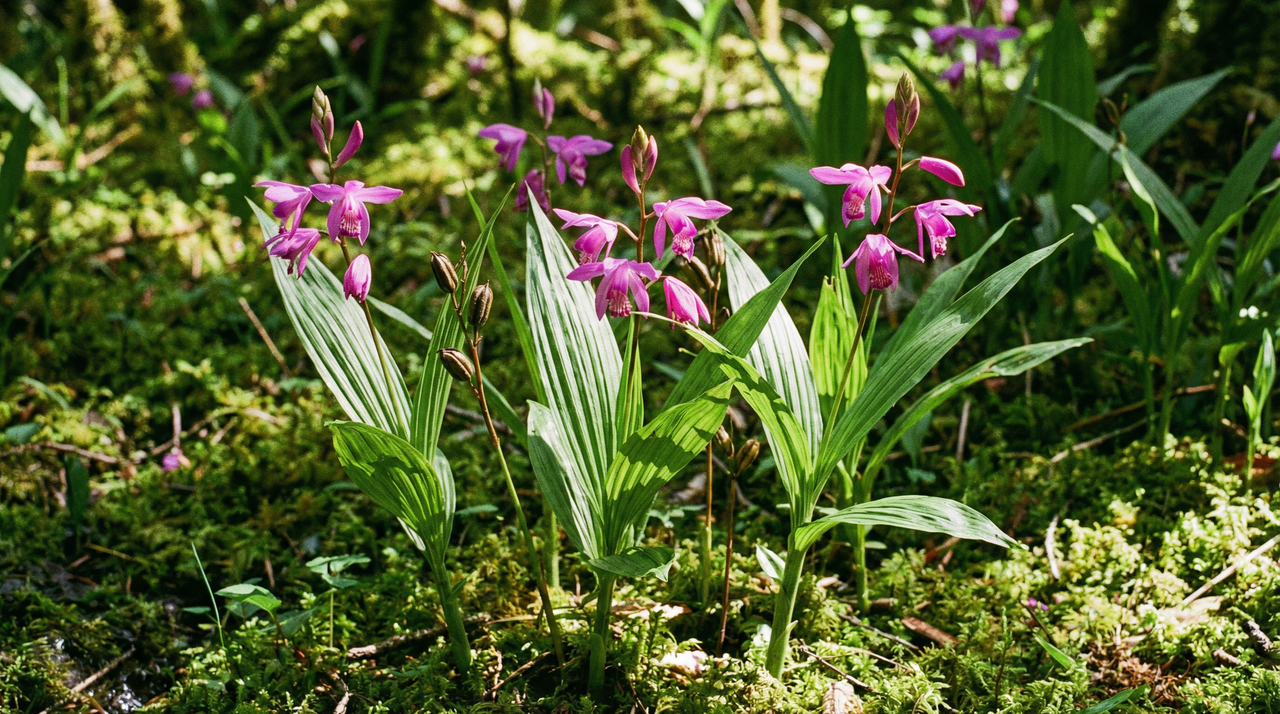
Most people walk past the Chinese Ground Orchid thinking it's just a pretty shade plant, something delicate to tuck under a tree and forget about. And honestly, I get it. Those pleated, almost tropical-looking leaves and the soft magenta blooms it throws up in late spring don't exactly scream "this plant has been stopping bleeding wounds for two thousand years." But that's exactly what it's been doing. The dried pseudobulbs of Bletilla striata appear in the Shennong Bencao Jing, one of the oldest texts in Traditional Chinese Medicine,[1] and the plant is still listed in the modern Chinese Pharmacopoeia today. That's not a folk remedy footnote; that's a continuous thread of use that most Western medicinal herbs can't come close to matching.
What keeps pulling me back to this plant, though, isn't the pharmacology. It's the contradiction of it. Here's a terrestrial orchid, a group famous for being fussy and fragile, that shrugs off temperatures down to roughly -20°F when it's dormant, comes back reliably every spring, spreads itself into tidy clumps without ever becoming a nuisance. It does all of this in the dappled shade that most food forest understories have plenty of. The question worth sitting with isn't whether Chinese Ground Orchid belongs in your garden. It's why it took you this long to consider it.
Origin and History of Chinese Ground Orchid (Bletilla striata)
Botanical Background and Native Habitat
This terrestrial orchid is native to a broad swath of East Asia, ranging across China's Sichuan, Yunnan, and Guangdong provinces, through Japan's main islands, Korea, and even into the Primorsky Krai region of southeastern Russia, with additional populations reported in Myanmar, Taiwan, Vietnam, and Thailand.[2][3] In the wild, it favors forest edges, shaded valleys, and grassy slopes with dappled light at around 10-30% canopy penetration, typically growing anywhere from low elevations up to around 3,000 meters, though most populations cluster between 500 and 2,500 meters.[4][3][5] That range of habitats, from riverbanks to open woodland edges, tells you a lot about why this plant adapts so well in temperate gardens far outside its native territory.
It's a polycarpic perennial that spreads slowly via short creeping rhizomes into satisfying clumps, storing energy in clustered ovoid pseudobulbs that can keep a plant alive and returning for ten to twenty years or more under good conditions.[6][7] I've come to think of those pseudobulbs as the plant's insurance policy. When I mimic its woodland origins with humus-rich, well-drained soil and a canopy of dappled shade, the clumps come back reliably every spring, and grow a little wider each year. Sadly, that same medicinal value in the pseudobulbs has made wild populations vulnerable to overharvesting, and Bletilla striata is listed as Vulnerable on the IUCN Red List as a result.[8][9] I've always sourced mine from reputable nurseries rather than attempting to wild-collect, both for ethical reasons and because cultivated stock establishes far more reliably in garden settings.
Traditional and Cultural Uses in East Asian Medicine
The earliest recorded use of Bletilla striata in Traditional Chinese Medicine dates to the Shennong Bencao Jing, the Divine Farmer's Materia Medica compiled around the 1st to 2nd century AD, where it was classified as a superior herb under the name Bai Ji, valued specifically for hemostasis and tissue regeneration. Li Shizhen's 16th-century Bencao Gangmu expanded the picture considerably, documenting detailed preparation methods and broadened applications including treatment of ulcers and dysentery. That's over two millennia of continuous use backed by successive generations of practitioners refining the knowledge.
The core traditional application centers on the pseudobulbs, which TCM practitioners have used for their astringent, hemostatic, and anti-inflammatory properties: stopping bleeding, promoting wound healing, reducing inflammation, treating sores and ulcers, and supporting tissue regeneration.[10][11][12] That knowledge moved beyond China's borders too: Bai Ji was incorporated into Korean traditional medicine (documented in the Donguibogam of 1613) and into Japanese Kampo medicine, making it a genuinely pan-East Asian herb with a remarkably consistent history of application. The health benefits and preparation methods get a thorough treatment in later sections of this profile, but understanding the depth of that tradition grounds everything else about this plant.
Visual Characteristics and Ornamental Appeal
In the garden, Bletilla striata is immediately recognizable by its pleated, glossy lanceolate leaves, which emerge in spring in clusters of two to five per pseudobulb, each reaching 10 to 40 cm long with a distinctly quilled texture.[13][14] The whole plant matures at 30 to 45 cm tall with roughly a foot of spread, forming tidy clumps from the creeping rhizomes and pseudobulbs below.[15] In my woodland garden designs, I've found that pairing it with ferns or hostas lets that pleated leaf texture do a lot of work long after the flowers have faded; it reads beautifully against the broader, smoother foliage of its neighbors.
The flowers arrive in late spring, typically May into June, in upright racemes of 3 to 8 blooms per stem, each blossom around 2.5 to 4 cm across in shades of pink to purple, with a showy labellum featuring a central yellow to reddish-brown band outlined in maroon.[16][17] They genuinely do look like miniature Cattleya orchids, which still delights me every spring. Foliage yellows and dies back in autumn, and small oblong seed capsules filled with dust-fine seeds persist briefly before releasing.[15][18]
Fun Facts and Conservation Notes
Bletilla striata carries genuine cultural weight in Chinese gardens, where it symbolizes resilience and healing and appears in classical poetry alongside its medicinal reputation.[19] That Bletilla striata symbolism of quiet endurance feels fitting when you've watched a clump survive a hard winter and emerge unfazed. The Royal Horticultural Society has recognized it with its Award of Garden Merit, and named cultivars including the white-flowered 'Albiflora', the variegated 'Variegata', and showier forms like 'Big Bob' and 'Yokohama' extend its ornamental range considerably.[20][21] I've grown both the standard purple and variegated forms and noticed that flower size tends to track with soil richness, a small detail that turns out to matter when you're placing it in a design.
There's also taxonomic complexity worth knowing: recognized subspecies and hybrids with Bletilla ochracea can complicate identification and may affect ecological function in cultivated forms.[22][23] And despite some assessments suggesting lower concern, wild populations are genuinely under pressure from overcollection and habitat loss.[24] Buying from reputable specialist nurseries isn't just good gardening practice; it's a meaningful conservation choice for a plant with two thousand years of history worth preserving.
Chinese Ground Orchid Varieties and Sourcing
Botanical Varieties and Popular Cultivars of Bletilla striata
The species breaks naturally into two botanical varieties. Bletilla striata var. striata is the typical form most gardeners encounter, while var. elliptica (also sold as Bletilla formosana) originates from Taiwan and is distinguished by its broader, more elliptical leaves.[25][26] From there, the named cultivars are primarily a flower color story: 'Alba' (sometimes listed as 'Albiflora') offers clean white blooms, 'Rosea' steps into soft pink, 'Big Bob' pushes the pink deeper with noticeably larger flowers, 'Katherine Andersen' adds a hybrid richness to that darker pink, 'Snow Beach' gives white with subtle spotting, and 'Kuro-ami' goes dramatic with dark purple streaking.[27][28] All of them stay in that tidy 12-18 inch range, which is one of the things I genuinely appreciate about this genus. I've placed 'Rosea' beside bleeding heart in shaded woodland guilds and the pairing is effortless, those soft pink tones reading as a natural continuation rather than a design decision. The white 'Alba' form does something especially striking against dark bark mulch in evening light; it practically glows. What I find refreshing is that Bletilla striata hasn't been hybridized into near-unrecognizable forms the way many orchids have, so any selection you choose stays approachable and cold-hardy.
Where to Buy Bletilla striata Plants and Rhizomes
Don't expect to find this one at a big-box garden center. Bletilla striata lives in the specialist nursery world, stocked by growers who actually understand what they're selling.[29] In the US, Plant Delights Nursery, Logee's Greenhouses, High Country Gardens, and Prairie Moon Nursery are reliable starting points; Etsy and Amazon carry rhizomes too, though with considerably more variability in labeling and care information. UK gardeners can check Crocus.co.uk. Pricing typically runs $10-40 per plant or rhizome depending on size and cultivar, with seed packets in the $5-15 range. I'd skip the seeds entirely. The dust-like seeds need sterile germination conditions and a mycorrhizal fungal partner to establish, and you're looking at 2-3 years before a plant blooms.[30] I once bought a batch of unlabeled rhizomes from an online marketplace and spent a season guessing at hardiness before concluding I should have gone to a nursery that publishes establishment details upfront. The extra few dollars are worth it.
One thing to know before you order internationally: Bletilla striata is listed on CITES Appendix II, meaning international trade requires permits to prevent overexploitation of wild populations.[31][32] For anyone serious about regenerative gardening, this isn't a bureaucratic footnote; it's a meaningful commitment. Buy from reputable domestic growers propagating their own stock, and you sidestep the permitting complexity while supporting the kind of ethical horticulture that keeps wild orchid populations where they belong.
Propagating and Planting Chinese Ground Orchid (Bletilla striata)
If you've ever wondered why you almost never see Bletilla striata grown from seed in anyone's garden, the answer is written into the seeds themselves. I'll admit the first time I looked at them under a hand lens, I was genuinely amazed. They're dust. Literally dust-like particles, 0.1 to 0.5 mm long, pale to dark brown, so light they disperse on a breath of wind.[33] That airy testa is brilliant for wind dispersal but comes at a cost: there's no endosperm, no stored nutrition at all. The embryo is tiny and undifferentiated, sometimes just four to twenty cells, and it cannot germinate without forming a mycorrhizal relationship with specific soil fungi, primarily Tulasnella or Ceratobasidium, through a protocorm stage.[33][34] Without that fungal partner, germination rates in the wild drop to 20-50% at best.[35]
Understanding Bletilla striata Seeds: Tiny Wonders with Unique Needs
Getting these seeds to germinate in a garden setting isn't impossible, but it requires sterile media, fungal inoculation, cold stratification at 4°C for four to six weeks, and carefully controlled warmth and humidity afterward.[36][37] Even under those conditions, plants typically need two to five years to reach flowering size, and because seeds introduce genetic variation, you won't know what flower color you've grown until year three or four.[38] Seeds also store poorly unless kept very dry and cold, with cryopreservation at -196°C recommended for any serious long-term conservation work.[39] I've tried asymbiotic germination trials on MS medium out of sheer curiosity, and while it's genuinely fascinating to watch a protocorm form, it drove home exactly why division is the sensible choice for gardeners. Commercial growers use tissue culture with cytokinins and auxins to produce disease-free plants at scale,[40] but that's lab territory. For the home garden, division wins.
Division: The Reliable Method for Home Gardeners
Dividing established Bletilla clumps is genuinely satisfying work, closer in feel to dividing hostas or daylilies than anything intimidatingly "orchid-like." The timing that works best is early spring before new growth pushes, or after flowering during dormancy, roughly every three to four years once a clump has had time to mature.[15] Use a sharp, clean blade, and make sure each division has at least two to three healthy pseudobulbs with roots attached. When I've divided plants that way, the success rate has been right around 80-90%, which matches the propagation trials published by the American Orchid Society.[41] I've seen gardeners lose patience trying to start this plant from seed when a single good division will bloom the following season. Skip the seed route unless you have a genuine research interest or a very long runway.
The biggest risk with freshly divided chinese ground orchid bulbs is root rot if drainage fails, so getting the soil right before replanting is everything.[4] Keep divisions in cool, humid conditions (around 15-25°C and 50-80% humidity) while you prepare the planting site,[36] and replant promptly.
Soil, Site, and Planting Technique
Bletilla striata comes from temperate woodland understories in China, Japan, and Korea, growing in humus-rich, well-drained soils on gentle slopes where leaf litter accumulates and standing water never does.[42] Mimicking that profile is the whole game. I amend planting beds generously with leaf mold and compost, aiming for 20-40% organic matter, and I work in perlite or coarse bark if the base soil leans heavy.[15][43] That combination keeps the rhizomes aerated and supports the mycorrhizal associations the plant depends on. Soil pH should sit between 5.5 and 7.0, with the sweet spot around 6.0 to 6.5.[44] In every project where I've nailed drainage and pH, root rot hasn't been an issue. In the spots where I compromised, it showed up fast.
For light, partial shade or dappled sunlight is the target. Morning sun with afternoon shade suits most climates well; in cooler gardens with consistent moisture, the plants tolerate more brightness, but midday intensity will scorch those pleated leaves.[4][45] Plant divisions after the last frost, generally mid-April through May in zone 6, setting the pseudobulb tops just below the soil surface at a depth of two to three inches.[15] Space plants 12 to 18 inches apart, giving mature clumps (which reach about 12 to 18 inches tall and wide) room to expand and enough airflow to discourage fungal problems.[46] Finish with a layer of organic mulch to hold moisture and buffer soil temperature. Divisions planted this way will often flower the very next season,[47] which is a pretty satisfying return on a morning's work in the garden.
Chinese Ground Orchid Care Guide
Everything about caring for the Chinese ground orchid makes more sense once you picture where it comes from: the dappled understories of East Asian temperate forests, where moisture is consistent, light is filtered, and the soil is deep with leaf litter. Replicate those conditions reasonably well and this orchid will reward you with far less fuss than its delicate flowers suggest.
Sunlight Requirements for Bletilla striata
Partial shade to dappled light is the sweet spot, ideally morning sun with afternoon protection.[15][48] The practical range sits around 1000-2500 foot-candles; in cooler climates you can push toward full sun as long as moisture stays consistent, but in warm zones that afternoon shade is non-negotiable.[30] I've learned to watch the leaves in early summer for the first hint of bleaching or scorching, because these are thin-tissued leaves that show stress fast.[49][30] Catching it early and shifting a container or adding shade cloth takes five minutes. The flip side is real too: too little light produces that persistent yellowing of older leaves and reliably fewer flowers.[50]
Watering Needs and Soil Moisture
The goal is evenly moist soil, never waterlogged, roughly one inch of water per week during the growing season, with deep watering that reaches 10-15 cm and allows the top inch or two to dry slightly between sessions.[51][52] Spring through flowering is when moisture matters most; established plants can handle a dry spell of two to four weeks, but young divisions and actively growing plants are much less forgiving.[53][4] Rainwater or soft, unchlorinated water mimics what these plants evolved with. Once dormancy arrives, back off dramatically and only water if pseudobulbs begin to shrivel.[54]
I've learned to read my plants rather than follow a rigid schedule. Yellowing leaves and mushy roots mean too much water; shriveled pseudobulbs and brown leaf tips mean too little.[55] A well-drained, humus-rich bed with 2-4 inches of organic mulch keeps moisture retention and drainage in balance, and skip overhead watering entirely to reduce fungal risk.[44] That same mulch layer, as I'll note below, also handles winter protection duty.
Feeding and Fertilization Schedule
Bletilla is a genuine light feeder, and I learned this the hard way. I used to fertilize mine the way I'd feed a hungry vegetable and got the predictable result: leaf tip burn and weak pseudobulbs.[56] Half-strength balanced fertilizer (10-10-10 or 20-20-20) every two to four weeks from spring through early fall is the right rhythm, with a shift toward higher phosphorus in spring to support pseudobulb development.[30][15] Reduce nitrogen as fall approaches to let the plant wind down naturally, and stop entirely when foliage begins to yellow.[44] Less truly is more here; consistent half-strength feeding produces stronger flowering and better-formed bulbs than aggressive fertilization ever will.
Frost Tolerance and Winter Protection
Hardy in USDA zones 5-9 (some sources cite 6-9; I'd hedge toward 6 without protection), Bletilla striata can tolerate lows around -15 to -20°F when its pseudobulbs are safely underground.[43][57] That distinction matters: the leaves, buds, and flowers are frost-susceptible, but the pseudobulbs underground are genuinely resilient.[58] I think of three inches of leaf mold mulch as the plant's winter coat, mimicking the natural forest floor it evolved under.[59] I've watched plants in my garden take a surprise late freeze, lose all their above-ground growth, and emerge perfectly healthy the following spring from those protected bulbs.[60] In zone 5 or colder, add a breathable cover over the mulch for extra insurance.
Heat Tolerance and Summer Care
Native to shaded forest understories up to 3000 meters elevation, Bletilla's active-growth sweet spot sits between 15-25°C (59-77°F).[61] Above 30°C (86°F), expect leaf scorch, wilting, and yellowing.[62] The fix is the same toolkit you're already using: afternoon shade, consistent soil moisture, and 2-3 inches of mulch to buffer soil temperature and maintain humidity around the roots.[15][63] My plants in dappled afternoon shade with mulched beds don't show the summer wilting I see in neighbors' full-sun plantings. Some cultivars handle warmer zones better, but good siting matters more than cultivar selection for most gardens.[64]
Pruning, Maintenance, and Seasonal Rhythm
This plant follows a clear annual calendar once you've grown it a season or two. Pseudobulbs push up in early spring with their distinctive pleated leaves, flowers arrive in late spring on spikes carrying three to seven blooms, and the foliage carries on through summer doing the quiet work of photosynthesis and building next year's bulbs.[15] Cut spent flower stems at the base after blooming, but leave the foliage alone until it yellows naturally in late summer or fall.[65] I actually mark my calendar for when the leaves turn, because the temptation to tidy up early is real and I've seen growers cut back green foliage and then wonder why their clumps underperform the following year.[45] Once foliage dies back, apply fresh mulch and let the plant rest through winter dormancy undisturbed. Every three to four years, divide clumps in spring after frost danger passes to maintain vigor and expand your planting.[66] Follow the plant's own rhythms and the care becomes almost intuitive.
Chinese Ground Orchid Harvesting Guide
If you're growing Chinese ground orchid for its rhizomes, the first thing to accept is that this plant is on its own schedule. Starting from seed, you're looking at 3 to 5 years before the rhizomes are worth harvesting, with flowers typically appearing around year 3 or 4.[44][67] I've grown Bletilla striata from divisions in my Central Florida landscape, and even with that head start, watching those pleated leaves emerge each spring without touching the roots requires real restraint. But that's the deal you make with this plant.
Timing and Maturity for Rhizome and Flower Harvest
Flowers are your first harvestable reward, arriving in late spring to early summer, typically May through June, when the petals are fully open and stems are upright.[68][69] The rhizomes are a completely different conversation. Harvest those only during dormancy, either late autumn after the foliage dies back or early spring before new growth pushes up, when the pseudobulbs have had time to fully develop.[15][70] A mature rhizome ready for medicinal use will be 3 to 6 cm long, firm to the touch, and light yellow to brown in color.[71][72] After years of tending plants through dormancy cycles, there's something deeply satisfying about lifting one of those firm, brown pseudobulbs and knowing it's finally ready.
Harvesting Technique and Post-Harvest Handling
For flowers, cut the stem intact and store in cool conditions if you're using them as cut flowers for display.[68][69] For rhizomes, the work is more deliberate. Dig carefully during dormancy to avoid slicing through the pseudobulbs, then move directly into processing: drying, powdering, boiling, steaming, or stir-frying with honey are all traditional methods used to prepare the tubers for medicinal use.[73][74] I think of it like harvesting any slow-maturing root crop: the digging itself takes minutes, but the years behind that moment are what give it weight.
Yield, Taste Profile, and Traditional Processing
Be clear with yourself about why you're growing this plant. Chinese ground orchid has no meaningful culinary applications; its value is almost entirely medicinal, used in Traditional Chinese Medicine as Bai Ji for its astringent and hemostatic properties to treat wounds, bleeding, and support tissue healing.[75][76] The taste profile reflects that medicinal character: bitter, sweet, and notably astringent when taken in TCM preparations, with a slightly sweet finish that emerges after proper processing.[74][76]
Raw rhizomes should never be eaten. The tannins and mucilage in unprocessed tubers cause real gastrointestinal irritation, and per the research and my own read of these compounds, skipping processing is not worth the risk.[77][76] Once processed, though, the texture transforms entirely: fresh tubers are firm and crisp, dried ones become hard and brittle, and cooked tubers turn soft and mucilaginous from the high polysaccharide content.[74][78] If you've cooked with okra or slippery elm, you'll recognize that quality immediately. It's exactly that kind of soothing, coating texture, which is precisely why TCM has long used it in teas for throat and digestive complaints. For specific medicinal preparation and dosage, always defer to a qualified practitioner.
Chinese Ground Orchid Preparation and Uses
Let me be honest about what Bletilla striata is and isn't: it's a medicinal plant first, a food-medicine bridge second, and never a staple vegetable. [75][79] The pseudobulbs sit at the center of every application, whether you're making a decoction for a persistent cough or slipping slices into a restorative congee. That dual role has a name in TCM: food-medicine homology, the idea that the line between nourishing and healing isn't always fixed. With Chinese ground orchid, that line is particularly blurry.
Culinary and Medicinal Food Applications in Traditional Chinese Medicine
The nutritional profile of those pseudobulbs goes a long way toward explaining why they belong in both the apothecary and the soup pot. They're loaded with polysaccharides, primarily glucomannan, at 30 to 50 percent of dry weight, plus starch at 40 to 50 percent, proteins, fiber, amino acids, and a respectable mineral content.[80][79] Think of them as starchy and mucilaginous once processed, something like slippery elm or marshmallow root in texture and behavior. That mucilage is what makes the plant so useful in soothing porridges and teas for coughs, GI upset, and recovery from illness.[80][74] The flavor is bland and mildly sweet, so it doesn't fight other ingredients.
Raw pseudobulbs are not safe to eat. Potential alkaloids and oxalates can cause gastrointestinal irritation, and traditional practice reflects that reality clearly: proper preparation means boiling, drying, or stir-frying before use.[79][81] I've worked with enough medicinal perennials to know that proper processing isn't optional or overcautious; it's the whole point. Raw use is never worth the risk here.
Safety contraindications deserve direct attention. As established in the health sections, vulnerable groups should seek practitioner guidance before incorporating these preparations.[73][81] I always tell gardeners that those particular precautions are well-documented and not worth second-guessing. Hypersensitivity is also a contraindication, and TCM practitioners note caution for those with yin deficiency patterns.[82]
Source matters enormously. Only cultivated pseudobulbs should be used medicinally or culinarily; wild specimens carry risks of heavy metal accumulation, and wild-harvesting puts real pressure on already vulnerable Asian populations.[83][84] Garden-grown plants are not just the ethical choice; they're also a more consistent source of clean, well-developed mucilage. My own cultivated patches produce pseudobulbs I trust in a way I'd never trust anything foraged.
Medicinal Preparation Methods and Dosages
Once you've waited the three to five years for pseudobulbs to reach medicinal maturity, the preparation process itself is straightforward. Harvest in late autumn when the plant is fully dormant, clean the bulbs carefully, slice them, and dry in shade or at low temperatures (40 to 50°C) until brittle.[73][70] After years of growing season the dried slices are surprisingly plain-looking, and I've learned to label mine meticulously because they blend right in among other dried root medicinals. Low-heat drying preserves the hemostatic and anti-inflammatory compounds that make this plant medicinally relevant. Grinding to powder is traditional for some applications. Standard adult dosage in TCM runs 3 to 9 grams per day as a decoction, or 1 to 3 grams as powder, though some formulas call for higher amounts; these are values best used under qualified practitioner guidance rather than self-directed experimentation.[73][85]
Traditional Non-Food Uses
Beyond the medicine cabinet, early records document the fibrous roots being used for cord-making and dye production across parts of East Asia.[86] These uses are largely historical footnotes today, but they're a useful reminder that plants with strong medicinal identities often had broader, more practical roles in their cultures of origin before synthetic alternatives arrived. It rounds out the story of a plant that has quietly served people in multiple ways across a very long time.
Chinese Ground Orchid Health Benefits and Medicinal Uses
Most people who grow Bletilla striata in their garden know it as that quietly beautiful woodland orchid that blooms in spring and asks very little. What fewer Western gardeners realize is that this same plant has been one of East Asian medicine's most valued hemostatic and wound-healing herbs for well over a thousand years. That gap between ornamental familiarity and medicinal depth is exactly what I find so compelling about it.
Traditional Uses in Chinese Medicine
Bletilla striata is the plant behind Bai Ji, a dried pseudobulb preparation listed in the Chinese Pharmacopoeia (2020 edition) under herbs that stop bleeding.[87][88] The dried pseudobulb is the primary medicinal part; roots, leaves, and flowers rarely appear in classical formulas.[89] Practitioners have used it for centuries to address nosebleeds, hematemesis, traumatic wounds, pulmonary tuberculosis, burns, ulcers, and fractures -- a remarkably broad range of tissue-healing applications all tied to a core action of stopping bleeding and promoting regeneration.[90]
Modern pharmacology has done a reasonable job explaining why those traditional uses held up. Bletilla extracts enhance platelet aggregation and accelerate clotting time, effects validated in animal models like mouse tail bleeding tests.[91] The polysaccharide fraction (BSP) drives wound closure further by stimulating fibroblast proliferation, collagen synthesis, and new blood vessel formation through VEGF upregulation and TGF-β/Smad signaling.[92][93] I think of it a bit like aloe or slippery elm -- that same mucilaginous, demulcent quality you can feel in a well-prepared decoction seems to be doing real biological work. Small clinical studies on postoperative thoracic wounds and oral ulcers have shown accelerated closure and reduced inflammation with minimal side effects.[94]
Anti-inflammatory and antioxidant effects round out the picture. BSP and related compounds suppress TNF-α, IL-6, COX-2, and iNOS through NF-κB and MAPK pathway inhibition in animal models,[95][96] while free radical scavenging (DPPH and ABTS assays) and elevated superoxide dismutase activity confirm meaningful antioxidant capacity.[97] There's also early preclinical data on antimicrobial activity against Staphylococcus aureus and Candida albicans, analgesic effects in mouse models, and apoptosis induction in liver, lung, and gastric cancer cell lines.[98][87] That last category is mostly in vitro work, so I'd temper enthusiasm there. The wound-healing and hemostatic research is where the evidence base is genuinely strong -- and as someone who designs medicinal guilds, I look forward to more rigorous Western RCTs catching up with what centuries of use and solid preclinical data already suggest.[99]
Key Phytochemicals and Their Properties
The pseudobulbs and roots are where the chemistry gets interesting. Polysaccharides (BSP) dominate, making up 20 to 48 percent of dry tuber weight and giving prepared decoctions that characteristic viscous, mucilaginous texture.[100] Beyond polysaccharides, the plant produces around 25 phenanthrene derivatives, a range of bibenzyls including moscatilin, gigantol, and batatasin III, plus flavonoids like quercetin, kaempferol, and luteolin glycosides -- all contributing to antioxidant, antimicrobial, and anti-inflammatory activity.[101][102] Leaves skew toward flavonoids and steroids; flowers carry anthocyanins and volatiles; alkaloids are not a significant part of the profile at all.[103]
What I find genuinely useful as a grower is that these compound levels aren't fixed. Phenolic content peaks in summer and autumn, polysaccharide yield responds to soil pH (well-drained acidic loam around 5.5 to 6.5 is optimal), and mycorrhizal symbiosis appears to influence bioactive accumulation.[104] In my experience propagating terrestrial orchids in conditions that prioritize good drainage, slight acidity, and intact fungal communities, the tubers develop noticeably better than in compacted or chemically treated soil. That's not just anecdote; it lines up directly with what the phytochemical research shows about environmental influences on compound yield.
Nutritional Profile of Bletilla Tubers
Nutritionally, the dried pseudobulb reads like a modest starchy tuber: roughly 320 kcal per 100g, around 8g protein, 70g carbohydrates (dominated by those mucilaginous polysaccharides), 10g fiber, and 1g fat.[105] Vitamins are trace-level; mineral content is modest, with calcium around 45 to 60mg, iron 1.5 to 2.5mg, and magnesium 20 to 30mg per 100g dried.[104] It's not a dietary staple by any Western measure, and I wouldn't frame it that way to anyone in my garden community.
Where the nutritional profile matters is in its role as a medicinal food thickener. At the standard 3 to 10g dried tuber dose, powdered Bai Ji functions beautifully in soups, porridges, and herbal teas, delivering those bioactive polysaccharides, phenanthrenes, and flavonoids that align directly with its traditional hemostatic and tissue-healing uses.[106][107] Think of it less like a vegetable and more like slippery elm powder -- the caloric contribution is incidental; the therapeutic function is the point.
Safety and Precautions
The ASPCA lists Bletilla striata as non-toxic to cats, dogs, and horses.[108] Animal studies show a low acute oral LD50 exceeding 10g/kg for polysaccharides in mice,[109] and the plant's long TCM history reports minimal adverse effects at proper doses.[10] That safety profile makes sense when you remember that non-toxic polysaccharides are the dominant compound class.
Processing matters, though. I've learned handling medicinal plants over the years that skipping the drying or stir-frying step with Bletilla tubers can produce the mild GI upset the research mentions -- nausea or loose stools from raw or excessive consumption.[110] Rare contact dermatitis is possible in those sensitive to the Orchidaceae family, so handle fresh tubers with gloves if you're prone to plant allergies.[111]
If you're pregnant, breastfeeding, or on anticoagulants, skip medicinal use and consult your doctor. The hemostatic research is real, which means it can interact with blood-thinning medications.[111][112] TCM also notes contraindications for yin deficiency with internal heat, and accurate identification in the field is non-negotiable: Fritillaria meleagris, a potentially toxic look-alike containing potent alkaloids, grows in similar conditions and could be confused with Bletilla at the tuber stage.[113] Grow your own from verified stock, source sustainably, and you sidestep most of that risk entirely.
Pests and Diseases of Chinese Ground Orchid
If you've ever kept tropical orchids alive indoors, you know the particular anxiety of checking for scale every few days and watching leaves for the first blush of rot. Bletilla striata is a different experience entirely. Its hardy terrestrial nature gives it a natural resilience that most tropical orchids simply don't have, and in a well-sited woodland planting, you can go entire seasons without a significant pest or disease problem.[114][115] That said, "largely trouble-free" is not the same as "bulletproof," and knowing where the real vulnerabilities lie saves you from catching problems late.
Natural Pest Resistance and Common Insect Pests
The chinese ground orchid's thick, leathery leaves are loaded with silica and covered in a waxy cuticle that makes them genuinely unappealing to most chewing insects.[116][117] Add the secondary metabolites, including steroidal saponins and bibenzyl compounds like bletillin, and you've got a plant with real chemical deterrents built in.[117] Healthy mycorrhizal relationships in the soil amplify this further, delivering the kind of root-level vigor that shows up as foliage that just looks sturdier and shrugs off minor pressure. Plants grown in living, biologically active soil consistently outperform those in sterile mixes on this front, which is one more reason to keep building that woodland soil structure.
The one pest I do keep an eye on every spring is slugs and snails. They're drawn exactly to the moist, shaded, humus-rich spots where Bletilla thrives, and they'll chew irregular holes in emerging shoots and tender pseudobulbs before you've even noticed the season has shifted.[118][119] I refresh a ring of diatomaceous earth around my plantings after any heavy rain in early spring, and it's kept slug damage to essentially nothing for years. Beer traps work too, if you're not squeamish about the cleanup. Aphids can cluster on new growth and occasionally transmit viruses, and spider mites will sometimes appear in hot, dry spells, causing fine stippling on leaves. Mealybugs and thrips show up occasionally but rarely cause serious harm.[118][120] For any of these, the cultural controls covered in the care guide, proper spacing, ground-level watering in the morning, good airflow, come first. Horticultural oils and insecticidal soaps handle anything that persists.[121] The plant is also deer-resistant and not considered invasive in temperate regions, which puts it ahead of many shade perennials on the low-maintenance front.[122]
Major Diseases and Prevention Strategies
Root and crown rot is the most serious threat, caused by familiar fungal culprits: Fusarium, Rhizoctonia, Pythium, Phytophthora, and Sclerotium rolfsii.[123] Every time I've seen yellowing foliage collapse in early summer, it's traced back to a heavy clay patch that holds water. The drainage advice in the care guide isn't optional; it's the single most effective disease prevention strategy this plant has. Adding organic matter to improve soil structure has been my most reliable long-term fix in borderline-wet spots. Leaf spot diseases caused by Phyllosticta, Cercospora, Alternaria, and Colletotrichum (anthracnose) are the other common issue, appearing under humid conditions with poor airflow.[123] Bacterial soft rot from Erwinia can follow injury in high humidity, and while Cymbidium mosaic virus is possible via contaminated tools or insect vectors, it's uncommon.[124]
I rarely reach for fungicides on my Bletilla because consistent airflow and removing spotted leaves at the first sign keeps fungal pressure low enough that sprays feel like overkill. The environmental sweet spot for disease prevention is well-drained, humus-rich soil in that pH 5.5-6.5 range, temperatures between 50-77°F, humidity around 60-80% with ventilation, and filtered light rather than deep shade or full sun.[125] When conditions deviate significantly, stress opens the door. Cultural management handles almost everything: space plants for airflow, avoid overhead watering, remove affected material promptly, divide clumps every three to four years to maintain vigor, and quarantine any new additions before they join an established planting.[126][127] If root rot becomes established, Trichoderma-based biological controls can help alongside those soil improvements. Copper-based fungicides or mancozeb can be used preventively for persistent leaf spot, but they're a last resort, not a routine.[126] No cultivars have been bred specifically for disease resistance; your best protection is site selection and consistent care.[128]
Chinese Ground Orchid in Permaculture Design
Most gardeners discover Bletilla striata through a nursery tag that says "easy orchid" and leave it at that. What the tag doesn't mention is that this plant is quietly doing something remarkable underground. From the moment a pseudobulb establishes itself in your woodland bed, it begins recruiting mycorrhizal fungi, primarily from the Tulasnellaceae family (Tulasnella spp.) alongside Rhizoctonia species. These fungi facilitate phosphorus uptake, support early seedling development, and help decompose organic matter in the surrounding soil.[129][130] I don't plant it in every woodland guild I design, but when the soil biology in a shaded bed feels sluggish, adding Bletilla to the mix has consistently made a difference I can see in the surrounding plants over the following seasons.
Ecosystem Functions and Ecological Roles
The spring flowers are where this plant's ecological generosity gets interesting. Those cattleya-like purple blooms, appearing in racemes of three to seven flowers each measuring 3-4 cm, are running a small deception on their visitors. They produce no nectar but use visual cues, a three-lobed labellum with yellow markings, and a faint sweet scent to attract Halictid bees, hoverflies, butterflies, and moths.[131][132][133] That food-deceptive strategy means natural pollination efficiency tends to be low, especially in fragmented gardens where pollinator populations are already under pressure.[134][135] In my experience, hand-pollinating a few flowers each spring dramatically increases seed set and lets me share divisions with other gardeners, and planting Halictid bee favorites nearby, things like native phacelia or early-blooming alliums at the woodland edge, keeps those pollinators active in the area when Bletilla is at peak bloom.
Below ground, the fibrous root and rhizome system earns its place on a slope. It binds soil, reduces surface erosion, and retains moisture in the upper soil profile, while the plant itself acts as a modest dynamic accumulator, drawing up potassium and phosphorus that return to the soil as the foliage decomposes each autumn.[130][136][137] On a gently shaded embankment where I've struggled with erosion between larger shrubs, Bletilla has proven far more useful than a groundcover that just sits there looking pretty. It's doing real work.
Climate and Hardiness Zones
Before anything else in the design process, hardiness determines whether this plant belongs in your garden at all. The consensus from the Missouri Botanical Garden, the RHS, and USDA data is that Bletilla striata is reliably hardy in zones 5 through 9, tolerating winter lows down to -20°F once established, provided the pseudobulbs are protected with 4-6 inches of organic mulch in colder zones.[15][138][139] Zone 4 survival is technically possible but genuinely unreliable without intensive protection, and I wouldn't count on it without at least a cold frame over the bed.[140][141]
Its native range spans temperate to humid subtropical climates across East Asia, from sea level up to about 3,000 meters, in conditions with annual rainfall of 1,000-1,500 mm and humidity running 50-70%.[142][143][144] Mimicking that in a garden means dappled light, preferably morning sun with afternoon shade to prevent leaf scorch, and soil that stays evenly moist during the growing season but drains freely enough to keep the pseudobulbs from sitting wet through winter.[44][145] I learned the drainage piece the hard way after losing two early plantings to crown rot in a bed that looked perfectly fine in summer but collected water during freeze-thaw cycles in late winter. Now I always incorporate generous organic matter and, on any site with questionable drainage, raise the bed or plant on a subtle slope.
For gardeners in coastal or high-altitude zones that don't fit neatly into the zone map, windbreaks and raised beds can extend the plant's range somewhat, though those solutions come with their own maintenance demands.[140] The optimal temperature window for flowering runs between 15-25°C during the day with cooler nights around 10-15°C, which aligns neatly with the conditions that most temperate woodland gardens already provide in spring.[146]
Forest Layer and Companion Guilds
Physically, this plant belongs in the herbaceous groundcover layer. It reaches 30-60 cm tall, forms dense, slow-spreading clumps, and emerges from pseudobulbs each spring with pleated, lance-shaped leaves that unfurl in a way that always reminds me of a hosta coming out of dormancy, same sculptural quality, same sense that something worth waiting for is finally arriving.[15][147] That emergence pattern actually makes it easy to place: anywhere hostas or ostrich ferns are thriving in your garden, Bletilla will likely feel at home alongside them.
Its preferred position in the understory of deciduous and mixed forests, on shaded slopes with humus-rich, slightly acidic, well-drained soil, translates cleanly into a shaded woodland garden guild.[15][148][149] Pair it with taller ferns for canopy continuity, hostas for moisture retention and textural contrast, and a mid-story deciduous shrub that allows light to filter through in spring before its own leaves fully expand. What you won't have to worry about is the plant taking over. Bletilla is notably non-invasive and deer-resistant, spreading slowly and predictably from its clumping pseudobulbs without ever demanding an intervention to keep it in its lane.[150][15]
One thing worth knowing before you source this plant: its pseudobulbs are the "Bai Ji" of traditional Chinese medicine, valued for centuries for wound healing and hemostasis, and that demand has made the wild populations across China, Japan, Korea, and Myanmar genuinely vulnerable to overcollection.[151][152] Always buy nursery-propagated stock. It's a simple choice that keeps the plant's conservation story from getting worse.
The Orchid That Changed How I Think About "Useful"
I planted my first Bletilla division mostly for the flowers, honestly. Something delicate for a shaded corner where nothing else wanted to cooperate. But after years of watching those pleated leaves push up every spring without complaint, of learning what those little pseudobulbs carry inside them, I stopped thinking of it as ornamental. It earns its place quietly, in a way that took me a while to notice, and that's usually the kind of plant that stays.
Sources 152
- Bletilla striata: Medicinal Uses, Phytochemistry and Pharmacological Activities ↩
- Bletilla striata ↩
- Flora of China - Bletilla striata ↩
- Bletilla striata - Kew Royal Botanic Gardens ↩
- Bletilla striata - North American Orchid Center ↩
- Missouri Botanical Garden Plant Finder ↩
- Royal Horticultural Society Plant Search ↩
- The IUCN Red List of Threatened Species: Bletilla striata ↩
- Sustainable utilization of medicinal orchids in China: A case study of Bletilla striata ↩
- Bletilla striata: A Review of Its Phytochemistry, Pharmacology and Clinical Application ↩
- Pharmacological Activities and Mechanisms of Action of Bletilla striata: A Review ↩
- Bletilla striata: A Comprehensive Review on Traditional Uses, Phytochemistry, and Pharmacology ↩
- Bletilla striata - Chinese Ground Orchid ↩
- Bletilla striata (Chinese ground orchid) ↩
- Bletilla striata ↩
- Bletilla striata ↩
- Bletilla striata - Chinese Ground Orchid ↩
- Flora of China: Bletilla striata ↩
- Bletchley Striata (Bai Ji) in Traditional Chinese Medicine ↩
- Bletilla striata details ↩
- Bletilla striata ↩
- Bletilla striata ↩
- Bletilla striata ↩
- Urgent Action Needed to Ensure the Conservation of the Medicinal Species Bletilla striata (Orchidaceae) ↩
- Flora of China: Bletilla ↩
- Bletilla striata Varieties ↩
- Bletilla striata ↩
- Bletilla ↩
- RHS Plant Finder: Bletilla striata ↩
- Bletilla striata Seed Propagation Guide ↩
- CITES Appendices ↩
- Importation of Plants and Plant Products ↩
- Seed Morphology of Bletilla striata (Thunb.) R. Br. ↩
- Mycorrhizal Symbiosis in Orchids ↩
- Bletilla striata - Chinese Ground Orchid ↩
- Propagation of Bletilla striata: Methods and Best Practices ↩
- Flora of China ↩
- Bletilla striata (Hyacinth Orchid) ↩
- Seed Storage of Bletilla striata: Orthodox Behavior and Cryopreservation ↩
- Propagation of Bletilla striata by Tissue Culture ↩
- Propagation of Bletilla striata by Rhizome Division ↩
- Habitat and Distribution of Bletilla striata ↩
- Bletilla striata - North Carolina Extension Gardener Plant Toolbox ↩
- Bletilla striata Growing Guide ↩
- Growing Hardy Orchids: Bletilla ↩
- How to Grow Bletilla Striata ↩
- Propagation of Chinese Ground Orchid (Bletilla striata) ↩
- Bletilla striata ↩
- Bletilla striata ↩
- Troubleshooting Orchid Leaf Yellowing ↩
- Bletilla striata (Chinese Ground Orchid) ↩
- Bletilla striata ↩
- Bletilla striata ↩
- Bletilla striata - Chinese ground orchid ↩
- Bletilla striata: Hardy Terrestrial Orchid Care ↩
- Orchid Nutrient Toxicity Symptoms ↩
- Bletilla striata ↩
- Bletilla striata - Missouri Botanical Garden Plant Finder ↩
- Bletilla striata ↩
- Bletilla striata - Royal Horticultural Society ↩
- Bletilla striata Plant Profile ↩
- Physiological Responses of Bletilla striata to Heat Stress ↩
- Bletilla striata ↩
- Cultivar Evaluation of Bletilla striata in US Horticulture ↩
- Bletilla striata ↩
- Growing Bletilla striata ↩
- Medicinal Cultivation of Bletilla striata ↩
- Bletilla striata (Chinese Ground Orchid) ↩
- Ornamental Orchid Cultivation Guide: Bletilla striata ↩
- Harvesting and Processing of Bletilla striata Rhizomes ↩
- Chinese Ground Orchid (Bletilla striata) ↩
- Bletilla striata (Chinese Ground Orchid) ↩
- Harvesting and Processing of Bletilla striata Rhizomes for Medicinal Use ↩
- Bletilla striata (Thunb.) R. Br. (Orchidaceae): Ethnobotanical Uses, Phytochemistry, Pharmacology, and Therapeutic Applications ↩
- Bletilla striata - Wikipedia ↩
- Bletilla striata in Traditional Chinese Medicine ↩
- Pharmacological Activities of Bletilla striata ↩
- Journal of Ethnopharmacology (2019) - 'Bletilla striata tuber polysaccharides and their functional properties' ↩
- Bletilla striata: A review of its phytochemistry, pharmacology and clinical application ↩
- Nutritional and Medicinal Value of Bletilla striata Pseudobulb ↩
- Traditional Uses and Contraindications of Baiji (Bletilla striata) ↩
- Safety Evaluation of Bletilla striata Polysaccharides ↩
- IUCN Redlist: Bletilla striata assessment ↩
- Bletilla striata - Missouri Botanical Garden ↩
- Chinese Pharmacopoeia 2020 Edition ↩
- Flora of China: Orchidaceae ↩
- Bletilla striata: A comprehensive review of traditional uses, phytochemistry, pharmacology, and clinical applications ↩
- Chinese Pharmacopoeia (2020 Edition), Volume I ↩
- Traditional Uses and Pharmacology of Bletilla striata in China ↩
- Bletilla striata (Thunb.) Reichb. f.: A Review on pharmacognosy, chemical composition, pharmacology and toxicology of an important Asian medicinal orchid ↩
- Pharmacological activities and mechanisms of Bletilla striata polysaccharides ↩
- Bletilla striata Polysaccharide Promotes Wound Healing by Enhancing Cell Proliferation and Angiogenesis ↩
- Pharmacological Activities and Mechanisms of Action of Polysaccharides from Bletilla striata ↩
- Clinical Study on the Efficacy of Bletilla striata in Wound Healing After Thoracic Surgery ↩
- Bioactive Bibenzyls and Phenanthrenes from Bletilla striata and Their Anti-inflammatory Effects ↩
- Anti-inflammatory and antioxidant properties of Bletilla striata in animal models ↩
- Antioxidant and Antimicrobial Activities of Bletilla striata Extracts ↩
- Phenanthrene Derivatives from Bletilla striata and Their Anticancer Effects ↩
- Safety and Efficacy of Bletilla striata in Traditional Chinese Medicine ↩
- Bletilla striata: A Review on Phytochemistry and Pharmacology ↩
- Phytochemical and Pharmacological Profile of Bletilla striata ↩
- Chemical Constituents and Biological Activities of Bletilla striata ↩
- Chemical composition and pharmacological activities of Bletilla striata ↩
- Nutritional and Medicinal Value of Edible Orchids in China ↩
- Bletilla striata (Thunb.) Reichb. f.: A Review on Phytochemistry and Pharmacology ↩
- Chemical Constituents and Pharmacological Activities of Bletilla striata ↩
- Traditional Uses and Modern Pharmacology of Bletilla striata in TCM ↩
- ASPCA Toxicity Information for Dogs ↩
- Advances and prospects of Bletilla striata polysaccharide as promising multifunctional biomedical materials ↩
- Safety Assessment of Traditional Chinese Medicinal Herbs: Focus on Bletilla striata ↩
- Bletilla striata (Thunb.) Reichb. f.: A review of its phytochemistry, pharmacology and clinical applications ↩
- Chinese Herbal Medicine: Materia Medica ↩
- Bletilla striata - Plant Finder ↩
- Missouri Botanical Garden Plant Finder ↩
- Bletilla striata: The Hardy Chinese Ground Orchid ↩
- Flora of China: Bletilla striata ↩
- Phytochemical Study of Bletilla striata - Journal of Natural Products ↩
- Pest Management for Hardy Orchids - Kew Gardens ↩
- Slugs and Snails on Ornamentals ↩
- Insect Pests of Orchids - University of Florida IFAS Extension ↩
- Integrated Pest Management for Orchids ↩
- American Orchid Society - Growing Bletilla ↩
- Diseases of Bletilla striata ↩
- Pathogens Affecting Bletilla striata Cultivation ↩
- Bletilla striata: Cultivation and Care ↩
- Integrated Pest Management for Ornamental Plants ↩
- Orchid Care: Growing Bletilla Striata ↩
- Bletilla striata Cultivation Guide ↩
- Mycorrhizal Fungi in Bletilla striata: Implications for Conservation ↩
- Ecological roles of terrestrial orchids in forest ecosystems ↩
- Pollination Biology and Breeding System of Bletilla striata (Orchidaceae) ↩
- Insect Pollinators of Bletilla striata in Japanese Temperate Forests ↩
- Reproductive Biology of the Chinese Ground Orchid Bletilla striata ↩
- Pollination Biology of Bletilla striata (Orchidaceae) ↩
- Conservation of Bletilla striata and Pollinator Interactions ↩
- Erosion Control Plants: Bletilla striata ↩
- Using Orchids in Permaculture Gardens ↩
- Bletilla striata ↩
- USDA Plant Hardiness Zone Map: Bletilla striata ↩
- Missouri Botanical Garden Plant Finder - Bletilla striata ↩
- Bletilla striata - Missouri Botanical Garden ↩
- Bletilla striata (Thunb.) R. Br. ↩
- Flora of China: Bletilla ↩
- Bletilla striata ↩
- Bletilla striata Care Guide ↩
- Pollination Biology of Bletilla striata (Orchidaceae) ↩
- Bletilla striata ↩
- Bletilla striata ↩
- Ecological niche of Bletilla striata in forest ecosystems ↩
- Bletilla striata (Thunb.) R. Br. ↩
- Bletilla in Flora of China ↩
- Bletilla striata ↩