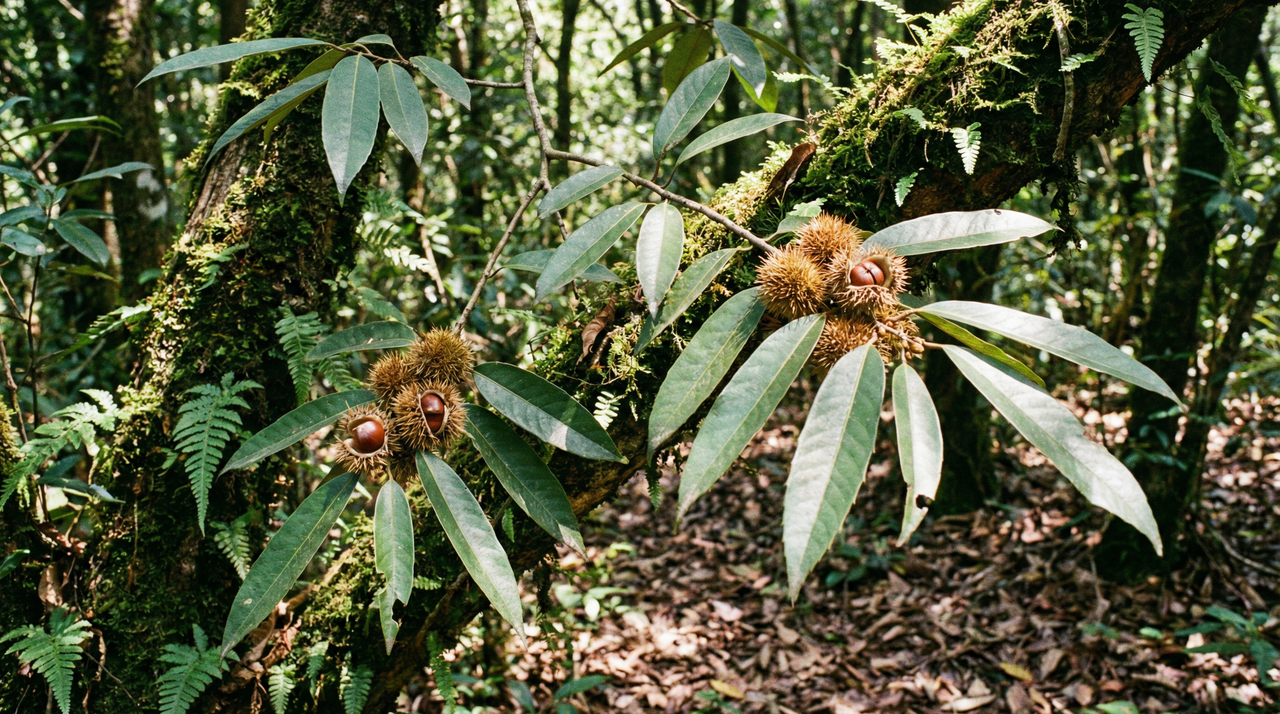
Nobody plants a chinquapin expecting it to outlive their great-grandchildren. But Castanopsis sieboldii does exactly that, quietly, in the warm forests of southern Japan, where specimens over three centuries old still drop their bristled little nuts each autumn like nothing remarkable is happening.[1] I've spent enough time with slow-growing broadleaf evergreens to know that patience is a design strategy, not a personality flaw. This tree gets that.
What stops most Western gardeners from even considering it is the assumption that "nut tree" means something familiar, a chestnut, a hazel, something in the catalog with a cultivar name and a yield chart. Chinquapin hands you none of that. What it hands you instead is a glossy, wind-hardy canopy that feeds birds, nurses mycorrhizal networks, anchors a food forest for decades, and eventually, yes, produces starchy nuts that Japanese foragers have been roasting into sweet, chestnut-like snacks and grinding into mochi flour for longer than most cultivated varieties of anything have existed. The unfamiliarity isn't the obstacle. It's the whole point.
Chinquapin Origin, History, and Botanical Background
Most gardeners in the West hear "chinquapin" and picture the American species, but the plant I want to talk about here is Castanopsis sieboldii, the Itajii chinquapin, a tree that has been quietly holding forests together across Japan, South Korea, and parts of China for centuries. Understanding it means setting aside the chestnut comparisons for a moment and meeting it on its own terms.
Botanical Background and Native Range of Itajii Chinquapin
Castanopsis sieboldii is an evergreen native to Honshu, Shikoku, and Kyushu in Japan, with populations extending into South Korea and coastal China.[2][3] It favors well-drained, fertile soils in warm-temperate to subtropical climates shaped by monsoon rainfall, and in those conditions it doesn't just grow, it dominates. Mature trees reach 10 to 25 meters, occasionally pushing past 30, and they do most of their productive growing at relatively low elevations, from sea level up to about 400 meters, though the species extends to 800 meters in suitable sites.[4][5] Dendrochronological studies document lifespans exceeding 300 years, with exceptional specimens reaching 500.[6]
When I design multi-generational food forests, that kind of longevity changes the whole conversation about site selection. You're not planting for your harvest window; you're planting for your grandchildren's canopy. The reproductive timeline reinforces this: Castanopsis sieboldii first flowers at 8 to 15 years and hits its stride around 20 to 30 years, which means it belongs in the long-term guild architecture, not the quick-yield layer.[7] It's also polycarpic, setting seed year after year once mature, but with a twist: it mast-seeds in synchronized cycles every 2 to 10 years, flooding the forest floor with nuts in boom years as a strategy to overwhelm seed predators before they can consume the whole crop.[8][9] I've learned to watch for synchronized heavy flowering the previous spring across related Fagaceae as a rough predictor of a mast year ahead, which matters enormously for harvest planning.
Visual Characteristics and Identification Features
Once you know what to look for, Itajii chinquapin is unmistakable in a woodland setting. The bark is dark gray to blackish-brown, rough, and deeply fissured on older stems, and the stout reddish-brown twigs carry alternate leaves that are leathery and elliptic to obovate, typically 8 to 15 centimeters long.[10][11] The upper surface is dark and glossy; the underside is paler and holds persistent rusty tomentum along the veins, giving new growth a silvery, almost iridescent quality in certain light. That vein pattern is the detail I always point out first to anyone trying to distinguish this tree in the field. It catches afternoon light in a way that stops you mid-path.
Flowers emerge in late spring, small greenish catkins in erect spikes, and the resulting fruit is a compact ovoid nut, 1 to 1.5 centimeters long, seated in a bowl-shaped spiny cupule that covers roughly half to two-thirds of it.[12][13] The leaves show real plasticity depending on growing conditions: shadier, humid sites produce larger and thinner blades, while exposed or drier positions yield smaller, thicker ones.[14] Its Chinese relative Castanopsis chunii, which grows at higher elevations from 300 to 1,500 meters in southern China, carries smaller leaves of 5 to 12 centimeters and tends toward a broader canopy at comparable heights.[15][16]
Traditional and Cultural Uses in Japan and East Asia
The nuts have fed rural Japanese communities for a very long time, though not straight off the tree. Raw, they carry a significant tannin load that makes them unpleasant and potentially irritating, so traditional preparation always involved leaching: boiling, soaking, or grinding the nuts into flour before working them into noodles, mochi, acorn jelly, or porridge.[17][18][19] Having processed a lot of acorns from other Fagaceae species in my edible landscape work, I can say with confidence that skipping the leaching step is never optional with high-tannin nuts, regardless of species. The bitterness doesn't cook out; it has to be drawn out with water. Ainu and other indigenous groups incorporated these nuts into seasonal food cycles alongside this thorough processing knowledge.
Beyond food, the bark and leaves were used in folk medicine as astringents for diarrhea, wounds, and skin conditions, and the timber itself has a long history in Japanese architecture, furniture, and fuelwood management, reportedly coppiced under the traditional name "moetsuki-ki."[20][21] The tree also appears in Shinto sacred groves and satoyama cultural landscapes, where its longevity made it a natural symbol of endurance, and in Ryukyu communities for tanbark dyeing.[22][17] Across the genus, Castanopsis chunii carries a parallel cultural weight in southern China, where Li, Miao, Zhuang, Yao, and Dai communities invoke it in shamanistic rituals as a typhoon-resistant guardian spirit, though documented food uses comparable to the Japanese tradition haven't emerged from the ethnobotanical record.[23]
Fun Facts and Ecological Significance
A tree that can live 500 years and floods the forest with nuts every few years to overwhelm its predators is doing something sophisticated. During mast years, rodents and birds cache far more nuts than they ever recover, and those forgotten caches become the next generation of trees.[24][8][4] Seeing a mast year play out in a designed landscape, even in a closely related species, genuinely changes how I think about planting these trees in guilds. The ecology is not passive.
The contrast with Castanopsis chunii is worth sitting with for a moment. While the Itajii chinquapin remains relatively secure across its Japanese range, C. chunii is classified as Critically Endangered by the IUCN, with fewer than 250 mature individuals remaining due to habitat fragmentation.[25] That precarious status is a reminder I carry into every sourcing decision: when I'm selecting stock for a resilient food forest, I prioritize ethically propagated material from diverse, well-documented sources. Conservation and design aren't separate conversations in this genus.
Chinquapin Varieties and Where to Buy
Notable Varieties and Forms of Castanopsis sieboldii
If you go looking for a named cultivar of Castanopsis sieboldii, you'll come up mostly empty-handed. This is a species that Western horticulture has barely touched; what you'll find in trade is almost always wild-type material, sometimes sold under a regional Japanese or Korean name with no formal designation behind it.[26][27] That's not a flaw; it's just where this genus sits in terms of domestication, and I've come to appreciate it. What you're getting is essentially forest genetics, shaped by centuries of natural selection rather than a breeder's hand.
Taxonomically, three botanical varieties are recognized: var. sieboldii across Japan and Korea, var. formosana from Taiwan, and var. erosa, also from Japan, each distinguished by leaf shape, cupule spine density, and geography rather than any dramatic difference in garden performance.[28][29] The tree you actually grow will reach 30 to 60 feet tall with a 20 to 40 foot spread, starting pyramidal and filling out into a dense, rounded canopy over time at a moderate pace of roughly 12 to 24 inches per year in good conditions.[30] It's evergreen and genuinely handsome, with dark, glossy, leathery leaves, rust-peeling bark on older wood, and that bronzy-red flush of new growth that makes it worth growing even if it never produced a single nut. The nuts do come, though: small chestnut-brown ovals, 1 to 2 cm, tucked into spiny cupules and dropping in late autumn.[31] Raw, they're bitter from tannins, but roasted or boiled they turn mild and sweet in a way that chestnut lovers will recognize immediately.[32] Hardy in USDA zones 7 through 9, it tolerates partial shade and coastal exposure and wants acidic, well-drained soil in the pH 5.5 to 6.5 range.[33][30] It even works as bonsai, which tells you something about its adaptability.[34]
On the disease side, it carries moderate resistance to chestnut blight, which is genuinely useful given what that pathogen did to American chestnuts, though it's not immune to anthracnose, leaf spot, or root rot in waterlogged soil.[35] The broader pattern here is a genus of ecologically valuable, largely unimproved wild species. Castanopsis chunii, from southern Chinese forests in Guangdong, Guangxi, and Hunan, follows the same template: no recognized varieties, raised from wild-harvested seed, but better suited to warmer USDA zones 8 through 10 and notably more shade-tolerant as a juvenile.[36][37] I find that shade tolerance genuinely useful when slotting a species into a younger food forest with a closing canopy, so it's worth keeping in mind for warmer sites.
Sourcing Castanopsis sieboldii and Related Species
You won't find this tree at a big-box garden center. Specialty nurseries are where the hunt happens: Plant Delights, One Green World, RarePlants.eu, and Sheffield's Seed Company are the names I'd check first.[38][39][40] Container plants in 1 to 3 gallon pots typically run $25 to $70, and seed packets of 10 to 20 seeds land between $15 and $40, with fresh or pre-stratified lots at the higher end.[41] After years of sourcing uncommon Asian trees for clients, I've learned to budget toward the top of that plant range when buying from reputable specialty growers. The root systems are just better, and that translates directly into faster establishment on a species where every growing season counts.
Importing directly from Asia requires a USDA APHIS PPQ permit and phytosanitary certificates from the exporting country, and shipments go smoothest during dormancy in late fall through early spring.[42][43] I've navigated APHIS paperwork for similar rare trees, and it's genuinely manageable with advance planning; the permit process just needs to start weeks before you intend to receive anything.
Before buying, know what you're committing to. Seeds need cold stratification or scarification, germinate at roughly 30 to 40 percent even with proper pretreatment, and the resulting seedlings won't produce nuts for 10 to 15 years.[44] I make a point of telling clients this timeline upfront, especially those who've grown impatient waiting on other Fagaceae to bear, because the slow start is the one thing that genuinely catches people off guard with this genus.
Castanopsis chunii is sometimes available from Chinese or Taiwanese suppliers at lower prices, around $5 to $15 per seed packet or $10 to $50 per plant, but conservation pressures from habitat loss in its native range mean local export controls may apply even though it has no current CITES or APHIS restrictions.[45][46][47] Always verify current availability and your regional import rules before ordering; stock in this corner of the nursery trade shifts quickly.
How to Propagate and Plant Chinquapin (Castanopsis sieboldii)
Chinquapin is not a difficult tree to propagate once you understand its fundamental biology, but it will absolutely punish you if you treat its seeds like acorns you can toss in a paper bag and forget about. I've propagated enough recalcitrant Fagaceae over the years to know that lesson the hard way. Leave these seeds on a potting bench for a few days, let them dry below about 20% moisture content, and you can watch germination rates crater from 80% to near zero. They're not dormant, they're just fragile in ways that conventional dry seed storage completely ignores.
Seed Propagation and Storage of Recalcitrant Chinquapin Seeds
The core challenge with Castanopsis sieboldii seeds is that they're recalcitrant: they can't tolerate desiccation below 20-30% moisture or temperatures below 5-10°C without rapidly losing viability.[48][49][50] If you can't sow fresh, hold them at 10-15°C with moisture content around 30-50% and near-saturated relative humidity; done right, that keeps germination rates at 70-90% for up to six to twelve months.[51] I store mine layered in barely damp sphagnum in a sealed container in the coolest corner of a climate-controlled space. It's more like storing a truffle than a bean.
Fresh sowing is the simplest path. These seeds have essentially no dormancy, so sow them 1-2 cm deep in well-drained, acidic soil at 20-25°C and they'll typically emerge in four to eight weeks at 60-90% success.[52][53] Fall sowing outdoors is equally valid if you're in zones 7-9 and want to let natural conditions do the work. If your seeds have been stored and you're worried about viability before committing them to soil, tetrazolium staining is your friend: viable embryos turn red within four to twenty-four hours, and X-ray radiography can detect internal damage non-destructively.[54][55] Both are standard Fagaceae tools and together give you a confident read before you commit a whole batch. Label your nursery rows carefully, too; chinquapin seedlings closely resemble other young oaks and chestnuts, and a mixed-up row is a genuinely frustrating problem to untangle six months later.
Vegetative Propagation: Grafting, Cuttings, Layering, and Tissue Culture
If you're growing chinquapin for nut production and patience isn't your strong suit, grafting changes the math dramatically. Seed-grown trees typically take 10-15 years to produce nuts; grafted trees start bearing in 3-5 years, with full orchard yields by year seven to ten.[56][57] Whip-and-tongue or cleft grafting onto compatible Fagaceae rootstocks works well, and while literature cites other Castanopsis as ideal rootstock, Quercus species can serve as a practical substitute for most home growers.[58] Time it in late winter during dormancy for the best union. That said, tissue culture this is not; you don't need a lab, just decent timing and clean cuts.
Semi-hardwood cuttings taken in late spring or early summer, four to six inches with two to three nodes, root at 20-60% success with IBA rooting hormone at 1000-3000 ppm under mist and bottom heat around 21-24°C, taking roughly four to eight weeks.[59] That range is wide, and in practice I find the lower end of success more realistic without a reliable mist system. Air layering performed in late spring is more forgiving, hitting 60-80% success when you wound a healthy branch, apply hormone, wrap in moist sphagnum, and seal it well.[60] For growers with lab access, tissue culture via nodal explants on Murashige and Skoog medium can achieve 60-80% shoot regeneration, though phenolic browning is a real management challenge that requires antioxidant additions to the medium.[61] Most of us will never need to go there.
Soil, Site Selection, and Light Requirements for Chinquapin
Think about where this tree comes from: volcanic and alluvial soils in Japan's warm-temperate evergreen forests, loose and well-drained with good organic matter and a rich community of ectomycorrhizal fungi doing much of the nutrient uptake work.[62][6] Replicate that where you can: loamy or sandy loam with bulk density below 1.4 g/cm³ and 3-5% organic matter, never compacted clay. Compaction above 1.5 g/cm³ genuinely inhibits growth, so if you're planting into disturbed soil, break it up and amend it before the tree goes in rather than hoping for the best.
Soil pH is non-negotiable. The optimal window is 5.0-6.5, and while trees will tolerate up to 7.0, they'll do it with reduced vigor.[2][63] Push above 6.5 and you get the classic interveinal chlorosis of iron and manganese deficiency; I've seen it on related acid-loving trees and it responds reasonably well to chelated iron foliar sprays as a stopgap, with elemental sulfur or organic acidifying amendments as the longer fix.[64] Drop below 5.0 and aluminum toxicity becomes the problem, damaging roots before you ever notice the canopy. Get a soil test before planting; it's the cheapest insurance available.
Young chinquapin trees are genuinely shade-tolerant, reflecting their understory origins, and seedlings actually benefit from 30-50% shade during establishment.[65] Think of how you'd treat a young rhododendron: morning sun, afternoon protection. Mature trees adapt to fuller sun in zones 7-9, but the minimum is four to six hours daily.[66][67] A dappled, east-facing site is genuinely ideal for the first few years.
Spacing, Planting Technique, and Establishment Timeline
Before you plant a single chinquapin, understand what you're eventually working with: a tree that reaches 15-25 meters tall with a canopy spread of 6-9 meters, slow to moderate in growth rate, developing a dense rounded crown over decades.[68][69] I've seen plenty of well-intentioned plantings go wrong because the designer used horticultural spacing on what was always going to be a forest tree. For an orchard or agroforestry context, 6-9 meters between trees is the right starting point; this isn't just about mature canopy, it's about the airflow that keeps fungal pressure manageable in humid climates.[70] In woodland settings, 4-6 meters works; hedgerows can go tighter at 1.5-2.5 meters.
Transplant seedlings or grafted stock when they're one to two years old and at least six to twelve inches tall, hardened off properly, in early spring after last frost or in fall in mild climates.[11] At planting, incorporate a mycorrhizal inoculant directly at the root zone; this tree's native success depends on those fungal partnerships, and establishing them early pays dividends for years.[71] Mulch with leaf litter rather than wood chips if you can, both to acidify gently and to mimic the forest floor. One thing I've found with container-grown stock generally is that root pruning before transplant, cutting any circling roots cleanly, makes a real difference in how quickly trees establish rather than spending their first season recovering. Drainage must be excellent; any pooling around the root zone invites problems you don't want to be managing right as the tree is trying to settle in.
Chinquapin Care Guide
Castanopsis sieboldii is the kind of tree that rewards observation over formulas. It comes from Japanese warm-temperate forests with reliable rainfall, mild winters, and the kind of dappled, layered light that filters through a mature canopy. Once you understand that background, most of its care preferences stop feeling arbitrary and start feeling obvious.
Sunlight Requirements
In its native habitat, this chinquapin tree grows in filtered and dappled light, though it adapts readily to full sun in cooler, more temperate climates.[72][73] In hotter regions, afternoon sun is genuinely problematic. Too little light pushes the tree toward pale, leggy growth and greater pest susceptibility; too much direct sun, especially in the afternoon, causes the chinquapin leaves to scorch, brown at the margins, and wilt by midday.[74][75] I've seen the same pattern with Japanese maples and camellias in warm climates: morning sun works, afternoon sun punishes. Morning light and a shaded western exposure is the practical sweet spot for anyone in zones 9 and warmer.
Watering Needs
This species evolved in forests receiving 1000 to 2000 mm of annual rainfall, so it expects consistent moisture without sitting in soggy ground.[76][77] Young trees need about 1 to 2 inches of water per week; container-grown plants may need watering every 3 to 5 days.[70][78] I learned the hard way that light daily watering produces shallow, lazy roots on broadleaf evergreens. Switching to deep, infrequent soaks, every 10 to 14 days during dry spells once a tree is established, produces visibly stronger root systems and better drought resilience. After 2 to 3 years in the ground, Castanopsis sieboldii handles dry spells reasonably well. Watch for yellow lower leaves paired with wilting in moist soil; that combination almost always signals root rot from poor drainage rather than thirst.[79][80] Brown crispy leaf edges without sogginess point the other direction, toward drought stress. Slightly acidic water, pH 5.0 to 6.5, is ideal; rainwater harvesting is genuinely useful here if your tap water runs alkaline.
Feeding and Soil Fertility
Castanopsis sieboldii is a moderate feeder that does best in loamy, organic-rich soil with a pH of 5.5 to 6.5 and optimal leaf nitrogen content sitting between 1.5 and 2.5%.[2][81] Test your soil before reaching for a fertilizer bag. If pH and nutrient levels are reasonable, a balanced slow-release formula formulated for acid-loving plants, applied in early spring around the drip line, is usually enough; shift toward potassium-rich mixes once you're chasing nut production.[82][77][83] I've found that compost mulch and slow-release acidifying fertilizers together do more for related Fagaceae than any aggressive feeding program. When the soil pH creeps above 6.5, interveinal chlorosis on new chinquapin leaves follows quickly; a chelated iron drench alongside an acidifying fertilizer resolved it in my planting within a single growing season. Over-fertilizing is its own problem: root burn, excessive vegetative growth that delays nut set, and even increased frost vulnerability.[70][84][85] Mimic the forest floor with organic matter and let the soil biology do the heavy lifting.
Frost Tolerance and Winter Protection
The chinquapin tree is generally hardy in USDA zones 8 to 10, tolerating brief dips to around 10 to 20°F once established, but prolonged freezes below 15°F cause real damage.[66][86] Young plants and new spring growth are the most vulnerable, showing browning leaf margins, twig dieback, and occasionally bark splitting after hard freezes.[87][88] After losing two young specimens to a late-spring frost on an exposed north-facing slope, I shifted all subsequent plantings to sheltered southern microclimates with heavy mulch, and I haven't had repeat damage since. A 2 to 4 inch organic mulch layer is the single most useful intervention: it insulates roots, prevents frost heaving, and buffers soil temperature swings.[89] Burlap wraps and horticultural fleece add meaningful protection for juveniles in marginal winters.
Heat Tolerance and Summer Care
This is a cool montane species at heart, native to elevations between 300 and 2500 meters, and it shows.[66][90] Above 35°C, photosynthesis drops by 20 to 30%; seedlings can tolerate brief exposure to 40°C but suffer oxidative stress and reduced growth in prolonged heat.[91][92] Visible symptoms, leaf curl, scorched tips, premature drop, bark cracking, look almost identical to what I see on unprotected camellias in full summer sun. For young trees in hot summers, 30 to 50% afternoon shade cloth from July through August, combined with a 2 to 3 inch mulch layer and deep weekly irrigation, has reliably kept foliage clean where I might otherwise see scorching.[93] The tree also needs nighttime temperatures to drop below 75°F to recover from daytime heat load, so humid lowland summers in the Southeast are genuinely challenging for this species.
Pruning and Maintenance
Young chinquapin shrubs and trees benefit from formative pruning in late winter or early spring to establish a clear structure and remove competing leaders.[94] Once mature, only light annual cuts to improve air circulation and maintain the tree's natural conical form are needed. I keep removal under 20% on established broadleaf evergreens; I've watched over-pruned specimens in humid climates respond with dieback and fungal entry points that take years to recover from.[94][95] The formal guideline is 25% maximum; I stay conservative. Avoid heavy summer cuts for the same reason: open wounds in warm, humid conditions invite fungal infection. Sharp, clean tools are non-negotiable. For anyone growing this as bonsai, pinching new shoots in spring and summer keeps the form tight without the stress of harder cuts.[96]
Seasonal Rhythm
The chinquapin's annual cycle is worth mapping out early, because it shapes nearly every care decision. Leaf flush runs March through April, flowers appear May through June, nuts mature September through October, and seed dispersal continues through December. Cone development spans roughly 18 months total.[97][7] That 18-month timeline surprises a lot of growers expecting a quicker payoff; understanding it helps reframe the whole multi-season investment this tree asks for. Physiological dormancy sets in over winter despite the evergreen foliage, which is worth remembering before reaching for fertilizer in January. Overwinter with 2 to 4 inches of mulch pulled back slightly from the trunk, plus burlap or fleece wraps for young or exposed trees, and make sure windbreaks are in place to prevent desiccation of the foliage.[98] That same mulch layer you relied on for frost protection will carry double duty as the soil warms in spring, holding moisture through the flush of new growth when the tree's demands ramp back up.
Harvesting Chinquapin Nuts
Patience is the first skill this tree teaches. Castanopsis sieboldii blooms in May or June, and those flowers won't become harvestable nuts for roughly 150 to 180 days, putting maturity somewhere in October or November depending on your climate and elevation.[99][100] In Japan, the native range sees nuts coming in September to October; growers in USDA zones 7 through 9 often find the window shifts a few weeks later, landing solidly in October to November.[101][102] That half-year of anticipation makes learning the ripeness cues worth every bit of effort.
When to Harvest Castanopsis sieboldii
The spiny burr is your calendar. Watch for it shifting from green to brown, then beginning to split open along its seams, releasing glossy, rich-brown nuts. I've found that collecting when 50 to 70 percent of the burrs have dehisced gives you the best balance of maturity and availability; wait much longer and the squirrels will have already held their own harvest festival.[103][104] A light frost often accelerates that dehiscence, which is a useful signal in temperate zones. For the related Castanopsis chunii, the same color change and burr splitting apply, and the harvest window can stretch into December as nuts fall naturally; the old low-tech water-sink test works well there too, a method I've used with other nuts when I'm unsure about maturity. Early picking in either species means higher tannins and noticeably poorer flavor, so resisting the urge to rush really does matter.[105]
Harvest Technique and Post-Harvest Drying
The simplest approach is also the best: collect fallen nuts and opened burrs from the ground beneath the tree, ideally in the morning after dew has dried.[104] Morning collection reduces the window for fungal spores to settle on damp nuts before you get to them. If you want cleaner handling, you can pull burrs just before they fully split; the spines are uncomfortable but manageable with gloves, and the nuts extract easily once you're inside. After bringing the harvest in, spread the nuts in a warm, well-ventilated space for one to two weeks to cure. I've noticed that within 10 to 14 days they shift from slightly tacky to genuinely hard and glossy, and that change is more than cosmetic. Properly cured nuts store far longer and hold up much better for grinding into flour or roasting than ones that go straight from tree to kitchen.
Yield, Flavor, and Texture of Chinquapin Nuts
What you get after all that waiting is a nut with real culinary character.[106] Raw, they're starchy and dense, not particularly inviting. Cooked, they transform into something mealy and floury, much like a small chestnut, with a mild sweetness and a subtle umami edge that deepens noticeably with roasting.[107][108] I'd describe them as less overtly sweet than commercial chestnuts but more interesting, with a savory, caramelized richness when roasted that makes them genuinely versatile. The flavor only arrives at peak if you've respected the harvest window; nuts picked too early have an astringency that cooking struggles to fully erase. Get the timing right, cure them properly, and you end up with something worth the long growing season.
Chinquapin Preparation, Culinary Uses, and Non-Food Applications
Edible Nuts and Traditional Processing Methods
The first thing to understand about chinquapin nuts is what's actually on the menu: only the nuts.[109][110] Leaves, bark, and other plant parts aren't documented as edible and may contain compounds that cause problems, so I'd steer clear of any folk recipe calling for bark tea until there's far better evidence behind it.
Once you have properly harvested nuts in hand, patience is the whole game. Raw, unprocessed nuts are genuinely unpleasant: high tannin content makes them bitter and indigestible, and eating them that way risks gastrointestinal irritation.[111][112] Traditional Japanese practice removes those tannins by soaking the shelled nuts in fresh water for three to seven days, changing the water daily, then boiling or dry-roasting them to finish.[113][114] In my experience designing edible landscapes with Fagaceae relatives, the soaking step is the one people want to shortcut, and it's exactly the one you can't. Do it properly, dry the nuts thoroughly afterward, and they store remarkably well.
Once processed, they transform into something genuinely worth the effort: a sweet, nutty flavor similar to chestnuts but milder and less starchy, with texture that's dense and mealy when cooked.[36][113] Historically these nuts were a genuine famine food in mountainous Japanese communities,[115] appearing in porridges, mochi fillings, wagashi confections, and tempura, often paired with honey, azuki beans, soy sauce, or mushrooms.[116] The related Castanopsis chunii follows nearly identical preparation in Chinese cuisine: roasted as snacks, boiled into porridge, or ground into flour for dumplings and desserts.[117]
One safety note I always share with newcomers: chinquapin nuts cross-react with birch and oak pollen, so anyone with those allergies should start with a small test portion after full processing rather than diving into a whole bowl.[118][119] Better to be cautious than to associate a genuinely delicious nut with an unpleasant reaction.
Nutritional Profile and Recipe Ideas
Processed chinquapin nuts land at roughly 400 to 450 calories per 100 grams, with carbohydrates making up 70 to 80 grams of that, which explains their traditional role as a starchy staple.[120] Protein runs 8 to 12 grams, fat is modest at 4 to 8 grams and mostly unsaturated, and the mineral profile includes meaningful potassium, phosphorus, and magnesium alongside trace vitamin E and B vitamins.[120][121] Think of them as a sweet chestnut substitute in any recipe: ground into flour for confections, stirred into savory mushroom porridge, or simply roasted with a little salt. While bark preparations appear in older herbal texts for digestion, I focus on the nut uses in my designs because the culinary record is far stronger and better substantiated.
Non-Food Uses of Wood and Other Plant Parts
Beyond the kitchen, chinquapin earns its place through its wood. The timber of Castanopsis sieboldii is dense, durable, and highly resistant to decay, with a long history in Japanese construction, furniture-making, shipbuilding, and tool handles.[122][18] It compares well to the harder oaks in rot resistance, and in agroforestry contexts both this species and Castanopsis chunii have served as windbreak trees, shielding agricultural land and neighboring crops.[123] From a permaculture design standpoint, a mature chinquapin earns its canopy slot several times over: nut yields, wildlife habitat, durable timber on rotation, and serious wind shelter all from a single long-lived tree.
Chinquapin Health Benefits and Medicinal Uses
Most people who encounter Castanopsis sieboldii for the first time think of it as an ornamental curiosity or a slow-growing nut tree. What they don't immediately appreciate is that this chinquapin carries a documented history of therapeutic use that stretches back centuries across Japan, Korea, and China. I find that history worth sitting with before jumping into the lab data, because it tells you something about which parts of the plant matter and why.
Traditional Medicinal Uses in East Asia
In traditional Japanese folk medicine, leaf and bark extracts have long been prepared as teas for gastrointestinal complaints like diarrhea and dysentery, and applied as poultices for wounds and skin inflammation.[18][124][125] The related Chinese species Castanopsis chunii follows a similar pattern, used regionally for wounds, rheumatism, and digestive problems, though these are folk practices rather than formalized entries in standard TCM pharmacopoeia.[126][127] That's an important distinction. The consistent thread across both traditions points strongly to the plant's polyphenol load as the likely active driver, something modern research has started to confirm. That said, while the lab data on these compounds is genuinely promising, I've learned through years of reading horticultural pharmacology that preclinical results don't automatically translate to human outcomes. No human clinical trials on Castanopsis sieboldii have been conducted; everything that follows is in-vitro or animal work.[128][129] That's why I emphasize culinary use over self-medication with this tree.
Key Phytochemicals and Antioxidant Properties
The chemistry underpinning all of the medicinal research is a rich polyphenol profile that varies by plant part. Leaves, bark, and seeds together contribute flavonoids including quercetin, kaempferol, and myricetin; hydrolyzable tannins (ellagitannins and gallotannins); phenolic acids; ellagic acid; procyanidins B1, B2, B4, and C1; (+)-catechin; (-)-epicatechin; and the terpenoid castanol.[130][131][132] These same compounds are also why raw nuts taste aggressively astringent; bite into an unprocessed one and you get an experience that reminds me of a very green persimmon or a raw acorn, a drying, mouth-coating sensation that tells you immediately something needs to happen before this becomes food. Leaf and seed extracts show substantial free-radical scavenging activity in DPPH and ABTS assays, with methanol leaf extracts in particular scoring high antioxidant capacity in vitro.[133][134]
Anti-Inflammatory, Blood Sugar, and Preliminary Anti-Cancer Effects
The anti-inflammatory evidence is the strongest piece of the pharmacological picture. Extracts inhibit TNF-α and IL-6 production, suppress NF-κB signaling, and reduce COX-2 and nitric oxide activity. In rat models, leaf extracts reduced carrageenan-induced paw edema by 40 to 60 percent at 100 to 200 mg/kg doses, with no significant toxicity at effective concentrations.[135][133] Leaf extracts have also shown α-glucosidase inhibitory activity with IC50 values comparable to the diabetes drug acarbose, suggesting potential for slowing post-meal carbohydrate absorption.[134] Polyphenol-rich fractions demonstrated moderate cytotoxic activity against HeLa, A549, and HepG2 cell lines (IC50 50 to 100 μg/mL) via apoptosis pathways, and inhibited sarcoma-180 tumor growth in mice without significant toxicity.[136][137] Antimicrobial activity against Staphylococcus aureus and certain fungi has been reported from seed extracts, which aligns with the traditional wound-healing applications, though efficacy is described as moderate compared to standard agents.[131]
Nutritional Value of the Edible Nuts
The nuts have been a legitimate traditional food in Japan for generations, roasted as snacks, stirred into porridges, or processed into flour for confections.[138] A 100 g kernel (after proper processing) delivers roughly 180 to 250 kcal, with carbohydrates making up 35 to 50 percent of that and dietary fiber contributing 3 to 5 g. Fat content runs 20 to 50 percent, weighted toward unsaturated fatty acids like oleic and linoleic, with protein at 3 to 15 percent.[139][140] Mineral content is respectable: potassium at 250 to 500 mg, magnesium at 50 to 120 mg, phosphorus at 100 to 300 mg, iron at 3.5 mg, and vitamin E tocopherols at 20 to 30 mg per 100 g oil.[141] The nutritional standout, though, is the phenolic load even after processing: flavonoids, procyanidins, catechins, and ellagitannins persist at levels conferring significant antioxidant capacity, with total phenolics reaching 50 to 100 mg GAE/g in related analyses.[142][132] These are the same polyphenols driving the medicinal research, which makes a properly prepared nut feel less like a snack and more like an integrated part of what this tree offers.
Safety Considerations and Processing Requirements
Raw nuts are not safe to eat, full stop. Like acorns and other Fagaceae seeds, they carry high levels of hydrolyzable tannins that cause gastrointestinal distress, nausea, and with chronic exposure, potential kidney damage or impaired nutrient absorption.[143][144] Early in my foraging days I once tasted a minimally processed nut and immediately regretted it; that single experience taught me why the traditional Japanese multi-day leaching process exists. Thorough soaking, leaching, and boiling is non-negotiable. After proper processing, no significant toxicity has been reported, and severe human poisoning from correctly identified and prepared nuts is rare.[111][145] In the field, I rely on leaf venation and cupule shape to distinguish Castanopsis from similar oaks before harvesting, since look-alikes including other Castanopsis species, Lithocarpus, and Quercus carry comparable tannin profiles.[146] Acute toxicity studies on ethanol leaf extracts showed an LD50 above 2000 mg/kg in rats, which suggests a reasonable safety margin for the extractive uses that align with folk medicine traditions.[147] Two other risks deserve mention for growers: pollen can trigger allergic rhinitis, conjunctivitis, or asthma in people sensitized to birch pollen allergens, and sap contact may cause irritant or allergic dermatitis in sensitive individuals.[148][149] If you're designing a planting near living spaces and anyone in the household has existing birch sensitivity, that spring flowering period is worth accounting for.
Chinquapin Pests and Diseases
For a tree with such a long lifespan, getting the site right at the start is genuinely the most important pest and disease management decision you'll make. Most of the serious problems I've seen with Fagaceae relatives, including chinquapin, trace back to conditions that were avoidable from day one.
Common Diseases and Prevention
Root rots caused by Phytophthora spp. are the most consequential threat, showing up as wilting and progressive dieback in trees planted in poorly drained soils.[150][151] Phytophthora is essentially a waterlogging disease wearing a pathogen costume; fix the drainage and you've largely eliminated the risk. Anthracnose (Colletotrichum spp.) and fungal leaf spots including Pestalotiopsis spp. cause brown lesions, shoot dieback, and potential defoliation in humid summers,[152][153] and I recognize those symptoms immediately because they look nearly identical to late-summer anthracnose on dogwoods and red maples: irregular brown blotches that start at leaf margins and work inward. The fix is the same too, good airflow, sanitation, and avoiding overhead irrigation. Chlorosis can appear in trees planted in alkaline or nutrient-poor soils, which reads as a cultural issue first before you treat it as a disease.[151][154] A soil test before planting saves a lot of guesswork.
Key Insect Pests and Damage
The insect pressure on chinquapin is real and worth understanding, though it's easier to manage once you know what you're looking for. Sap feeders, primarily aphids (Cinara and Phyllaphis spp.) and various scale insects, weaken new growth, distort leaves, and leave that telltale sticky residue that invites sooty mold.[155][156][151] Wood-boring beetles, including bark beetles, ambrosia beetles, and longhorn beetles, are the most structurally dangerous; they target stressed trees above all else, boring into trunks and branches in ways that can cause irreversible decline.[157][158][159] Gall wasps (Dryocosmus kuriphilus) and gall midges produce the distinctive abnormal growths on buds, shoots, and leaves that stunt development and reduce vigor.[160][161][61] Foliage feeders, from leaf beetles and miners to geometrid moths like Ectropis obliqua, can cause skeletonization or outright defoliation; across the Castanopsis genus, heavy infestations have stripped 30 to 50 percent of foliage and cut growth rates by 20 to 30 percent in affected stands.[162][163][61][164] Seed weevils (Curculionidae) round out the picture by attacking the nuts directly, which matters a lot if you're growing this tree for harvest.[165][61] Most of this pest literature comes from Japanese and Chinese forestry research; it's unusually thorough compared to what's available in English for similar broadleaf evergreens.
Natural Defenses and Resistant Varieties
Despite that long pest list, healthy chinquapin trees hold their own better than you might expect. The leaves contain tannins and phenolic compounds that deter feeding insects,[166][167][168][169] and when I bruise a leaf the sharp, tannic astringency is immediately obvious, which probably explains why deer and many generalist insects tend to move past well-established specimens. The Japanese cultivars 'Higiri' and 'Shiinoki' show improved tolerance to foliage-feeding insects and borers, and Chinese breeding programs are exploring thicker leaf cuticles as a resistance trait, though no widely commercialized resistant variety exists yet.[170][171][172] In my experience with seedling-grown trees, there's real variation; some individuals show noticeably less insect damage than their neighbors, which suggests selection could matter a great deal in a food-forest planting.
Integrated Pest and Disease Management
For a tree you're expecting to grow for decades, chemical interventions should be a last resort, not a first response. The most effective approach leans hard on cultural practices: proper spacing for airflow, consistent sanitation, careful pruning, and above all, excellent drainage.[173][174][175] I learned the hard way that over-pruning young trees creates fresh wound surfaces that practically invite borers; small, clean cuts with proper wound care are far safer than aggressive shaping. Encouraging predatory wasps and other beneficial insects by planting a diverse guild around the tree does real work against aphids and caterpillars. Neem oil handles early-stage scale and aphid pressure, pheromone traps help you monitor borer activity before populations spike, and trunk injections should stay reserved for serious, confirmed infestations. Because most detailed pest and disease research for this species lives in Japanese-language forestry and horticultural literature, I'd strongly recommend seeking out Japanese forestry extension bulletins or consulting an arborist familiar with East Asian native trees for local diagnosis rather than relying on generic broadleaf evergreen guides.
Chinquapin in Permaculture Design
Before you fall in love with Itajii chinkapin on paper, you need to know whether it will actually survive your winters. A lot of beautiful trees end up as expensive compost because that conversation happens too late. So let's start there.
Climate Adaptation and USDA Zones for Chinquapin
Castanopsis sieboldii is reliably hardy in USDA zones 8-10, tolerating winter lows down to about 10°F (-12°C).[2][66] It wants 1,500 to 2,000 mm of reasonably evenly distributed rainfall and thrives with 70-90% relative humidity, which immediately tells you something about where it fits in North America: coastal California, the Gulf Coast, and the milder pockets of the Pacific Northwest.[176][66] Dry continental climates are a poor match. It isn't built for them.
That said, I've found that microclimate work genuinely extends the range. After growing several Castanopsis species in protected zone 9 settings, I've consistently seen that south-facing slopes tucked under a light pine overstory outperform exposed sites by a couple of degrees on the coldest nights, sometimes more. Strong winds make cold damage significantly worse, and I learned that lesson the hard way with a young tree I sited on a windy knoll that got hammered by leaf scorch its first winter.[177] Now I won't site one without an existing evergreen windbreak to the north and west. With that protection, south-facing exposure, and 4-6 inches of mulch over the root zone, you can push reliably into zone 7b-8 if you're willing to cover young plants during hard freezes.[178] For designers working in warmer subtropical zones, Castanopsis chunii is worth knowing about as a related option suited to zones 9-11, though its tolerance drops faster than sieboldii's in any real cold snap.[179]
Ecosystem Services and Pollination Ecology of Chinquapin
Chinquapin is wind-pollinated, monoecious, and outcrossing, producing pendulous male catkins 5-10 cm long and female florets with feathery stigmas in April and May.[180] Some incidental insect visitation occurs, but the tree doesn't depend on it.[181] From a permaculture standpoint, that's actually a quiet advantage: in landscapes where pollinator pressure is inconsistent or declining, a wind-pollinated nut tree is more reliable than one that needs a full suite of insects to set fruit. What does affect reproductive success more than pollination is weather during the flowering window, something I've observed in other wind-pollinated Fagaceae like oaks: late cold snaps or unseasonably wet springs reduce set noticeably.
Below ground, the ecological contribution is substantial. Castanopsis sieboldii forms ectomycorrhizal associations that improve phosphorus uptake and overall soil function,[182] mirroring what I've seen with oaks in similar food forest guilds. I've compared Fagaceae establishment with and without mycorrhizal inoculants in humid subtropical projects, and the inoculated trees consistently establish faster and show less transplant stress. The nuts, once mature, feed a wide range of wildlife from jays to small mammals, making this tree a genuinely productive mast layer even before humans get involved.[183] Its phenolic compounds also provide some built-in pest deterrence.[169] Castanopsis chunii rounds out the picture at the genus level by contributing to carbon sequestration, slope stabilization through deep roots, and slow-decomposing leaf litter that builds soil organic matter over time.[184]
Forest Layer, Guilds, and Design Strategies for Chinquapin
What I find most useful about understanding chinkapin's natural history is that it tells you exactly where to put it. As a late-successional species, seedlings are shade-tolerant, thriving in dappled light at 30-50% sunlight intensity.[185] That means a young tree can go in under partial cover and bide its time. Given enough years, it eventually rises to dominate the canopy at 10-25 meters.[71] In a food forest, that arc maps beautifully onto zone-2 canopy planning: establish it while successional shrubs and pioneer trees hold the space, and let it grow into the upper layer as the system matures. Castanopsis chunii follows a similar trajectory in southern China's mixed subtropical forests, appearing alongside Schima superba and Quercus spp.,[186] which gives designers in warmer climates a useful template for companion choices.
For the guild itself, pair chinkapin with nitrogen-fixers like alders to compensate for its non-nitrogen-fixing habit,[187] and underplant with shade-tolerant ferns, native gingers, or shrubby understory plants that won't compete hard for light once the canopy closes in. In humid subtropical projects I've worked on, sword ferns and native azaleas have performed well under similar Fagaceae canopies, and they both tolerate the slightly acidic leaf litter these trees produce. Keep mycorrhizal health in mind when choosing companions; avoid heavy-feeding annual vegetables directly under the drip line where they can disrupt the fungal network the tree depends on. Site it where it has room to reach full stature without crowding neighboring trees, and give it the windbreak it needs from the start. Get those fundamentals right, and chinkapin will quietly do enormous ecological work for generations.
The Tree I Planted for the Gardener Who Comes After Me
I put my first Itajii chinquapin in the ground knowing I'd likely never eat a significant harvest from it. That kind of planting changes something in you. There's a quietness to tending a tree on that timescale, a sense that you're less the designer and more the custodian. I think that's exactly why it belongs in a food forest, and exactly why so few people bother with it.
Sources 187
- Journal of the Japanese Forestry Society: Castanopsis sieboldii longevity and forest dynamics ↩
- Castanopsis sieboldii - Trees and Shrubs Online ↩
- Castanopsis sieboldii ↩
- Longevity and Growth Dynamics of Castanopsis sieboldii in Warm-Temperate Forests ↩
- Flora of Japan: Castanopsis sieboldii ↩
- Growth Ring Analysis of Castanopsis sieboldii in Japan ↩
- Reproductive Ecology of Castanopsis sieboldii in Japanese Forests ↩
- Phenology and Mast Seeding in Fagaceae Species ↩
- Reproductive Phenology of Castanopsis sieboldii in Japanese Forests ↩
- Castanopsis sieboldii ↩
- Castanopsis sieboldii ↩
- Flora of China: Castanopsis sieboldii ↩
- Castanopsis sieboldii ↩
- Flora of Japan ↩
- Flora of China - Castanopsis chunii ↩
- Castanopsis chunii - Wikipedia ↩
- Ethnobotany of Japanese Forest Trees ↩
- Traditional Uses of Castanopsis Species in East Asia ↩
- Ethnobotany of Japanese Beech Family Trees ↩
- Traditional Uses of Fagaceae in Japan ↩
- Castanopsis sieboldii: Ecology and Utilization ↩
- Sacred Trees in Japanese Shinto Practices ↩
- Ethnobotanical Survey of Medicinal Plants in Hainan, China ↩
- Seed Dispersal by Mammals in Evergreen Forests of Japan ↩
- Castanopsis chunii ↩
- Castanopsis sieboldii (Makino) Hatus. ↩
- Horticulture of Fagaceae in East Asia ↩
- Castanopsis sieboldii ↩
- Flora of Japan ↩
- Castanopsis sieboldii ↩
- Castanopsis sieboldii ↩
- Japanese Chinkapin ↩
- USDA PLANTS Profile: Castanopsis sieboldii ↩
- Bonsai Profiles: Castanopsis sieboldii ↩
- Castanopsis sieboldii (Japanese Chinquapin) ↩
- Castanopsis sieboldii ↩
- Castanopsis chunii (F.P.Metcalf) Schottky ↩
- Castanopsis sieboldii - Rare Asian Evergreen ↩
- Castanopsis sieboldii - Rare Japanese Chinquapin ↩
- Seeds of Castanopsis sieboldii ↩
- Seed List 2023 ↩
- Importing Plants and Plant Products into the United States ↩
- Bringing Agricultural Products Into the United States ↩
- Castanopsis sieboldii Plant Profile ↩
- IUCN Red List of Threatened Species ↩
- CITES Appendices ↩
- Castanopsis chunii - Sheffield's Seed Company ↩
- Germination and Storage Behavior of Castanopsis Seeds ↩
- Recalcitrant Seeds: Biology and Storage ↩
- Seed Storage Behaviour of Trees and Shrubs ↩
- FAO Manual on Seed Storage ↩
- Seed Propagation of Japanese Castanopsis Species ↩
- Propagation of Japanese Chinquapin (Castanopsis sieboldii) ↩
- Tetrazolium Staining in Chestnut and Chinquapin Seeds ↩
- X-ray Analysis of Acorn Viability in Japanese Oaks and Allies ↩
- Propagation and Cultivation of Castanopsis sieboldii in Japan ↩
- Propagation of Castanopsis Species by Grafting Techniques ↩
- Propagation of Castanopsis species by grafting ↩
- Vegetative Propagation of Selected Tree Species in Japan ↩
- Air Layering Techniques for Trees ↩
- Micropropagation of Castanopsis species: A review ↩
- Ecological Characteristics of Castanopsis sieboldii ↩
- Soil Preferences of Japanese Castanopsis Species ↩
- Nutrient Disorders in Woody Plants: Chlorosis in Fagaceae ↩
- Shade Tolerance in East Asian Fagaceae ↩
- Castanopsis sieboldii ↩
- Castanopsis sieboldii Cultivation Guide ↩
- Castanopsis sieboldii Plant Profile ↩
- Flora of Japan: Castanopsis sieboldii ↩
- Castanopsis Cultivation Guidelines ↩
- Ecology of Castanopsis Forests in Japan ↩
- Light Requirements for Japanese Chinquapin ↩
- Shade Tolerance and Light Requirements of Fagaceae Trees ↩
- Castanopsis sieboldii: Ecology and Cultivation ↩
- Plants Database Entry: Castanopsis sieboldii ↩
- Castanopsis sieboldii ↩
- Castanopsis sieboldii Care Guide ↩
- Evergreen Oak Relatives: Care for Castanopsis ↩
- Managing Root Rot in Chinquapin Trees ↩
- Drought Tolerance in East Asian Fagaceae ↩
- Soil Preferences of Japanese Native Trees ↩
- Nutrient Requirements of Castanopsis Species in Japanese Forests ↩
- Fertilization of Chestnut Trees ↩
- Iron Chlorosis in Evergreen Oaks ↩
- Overfertilization in Trees and Shrubs ↩
- Frost Hardiness of Japanese Chinquapin Trees ↩
- Frost Damage to Trees and Shrubs - University of Minnesota Extension ↩
- Cold Hardiness of Japanese Chinquapin (Castanopsis sieboldii) ↩
- Frost Protection for Evergreen Trees ↩
- Ecological Characteristics of Castanopsis sieboldii ↩
- Physiological Responses of Castanopsis sieboldii Seedlings to Heat Stress ↩
- Physiological Responses of Castanopsis sieboldii to High Temperature and Drought Stress ↩
- Drought Stress Responses in Japanese Broadleaf Evergreens ↩
- Pruning Evergreen Trees: Castanopsis Species ↩
- Pruning Deciduous and Evergreen Trees ↩
- Bonsai Care for Castanopsis sieboldii ↩
- Phenology of Castanopsis sieboldii in Japanese Temperate Forests ↩
- Overwintering Subtropical Evergreens - Royal Horticultural Society ↩
- Phenological Observations of Fagaceae Species in Japan ↩
- Castanopsis sieboldii: Ecology and Reproduction ↩
- Castanopsis sieboldii (Japanese Chinquapin) ↩
- Plants for a Future: Castanopsis sieboldii ↩
- Castanopsis sieboldii (Makino) Hatus. ex Soó ↩
- Castanopsis sieboldii Cultivation Note ↩
- Fruiting Phenology of Castanopsis Species in Subtropical China ↩
- Castanopsis sieboldii - Useful Tropical Plants Database ↩
- Japanese Chinquapin Nuts in Cuisine - Botanical Studies ↩
- Flavor Profile of Japanese Chinquapin Nuts ↩
- Missouri Botanical Garden - Castanopsis sieboldii Plant Profile ↩
- Castanopsis sieboldii in Flora of China ↩
- Castanopsis sieboldii - Useful Tropical Plants Database ↩
- Toxicity of Acorns and Nuts in Fagaceae ↩
- Japanese Chinquapin: Traditional Uses in Cuisine ↩
- Ethnobotany of beech and oak species in Japan ↩
- Ethnobotany of Fagaceae in Japan ↩
- Traditional Japanese Foraged Foods: Itajii Nuts ↩
- Edible Wild Plants of China ↩
- Flora of China - Castanopsis sieboldii ↩
- Kew Gardens - Castanopsis sieboldii ↩
- Nut Characteristics of Castanopsis Species ↩
- Traditional Uses and Nutritional Value of Japanese Chinquapin ↩
- Siebold's Chinquapin: Ecology and Human Utilization ↩
- Ecosystem Services Provided by Castanopsis chunii in Hilly Regions ↩
- Traditional Uses of East Asian Chinquapins ↩
- Traditional Uses and Pharmacology of East Asian Fagaceae Species ↩
- Traditional medicinal uses of Fagaceae family plants in China ↩
- Traditional Uses and Bioactive Compounds of Castanopsis Species in Southern China ↩
- Search Results: Castanopsis sieboldii Clinical Trials ↩
- Bioactive Compounds and Pharmacological Activities of Castanopsis Species ↩
- Bioactive Compounds and Antioxidant Activity of Castanopsis sieboldii ↩
- Phytochemical Analysis and Bioactivity of Castanopsis sieboldii Seeds ↩
- Phytochemical analysis of Castanopsis sieboldii seeds ↩
- Antioxidant and Anti-inflammatory Activities of Castanopsis sieboldii Leaf Extract ↩
- Inhibitory Effects of Castanopsis sieboldii Extracts on α-Glucosidase and Their Antioxidant Activity ↩
- Anti-inflammatory Effects of Castanopsis sieboldii Extract via NF-κB Inhibition ↩
- Cytotoxic Flavonoids from Siebold's Chinquapin (Castanopsis sieboldii) ↩
- Polyphenols from Itajii chinkapin: Anti-cancer potential in animal studies ↩
- Edible Wild Plants of Japan: Itajii Chinkapin ↩
- Nutritional Components of Some Wild Edible Fruits and Nuts in Japan ↩
- Chemical Composition of Castanopsis sieboldii Seeds ↩
- Mineral Content in Fagaceae Nuts: A Review ↩
- Polyphenols and antioxidant activity in Castanopsis sieboldii nuts ↩
- Acorn Poisoning in Animals - Merck Veterinary Manual ↩
- Tannins in Oak Acorns and Toxicity - USDA Forest Service ↩
- Toxicity of Acorns and Other Fagaceae Nuts ↩
- Identification of East Asian Fagaceae - Flora of China ↩
- Toxicity evaluation of Castanopsis sieboldii extracts in rodents ↩
- Allergens from Birch Pollen and Cross-Reactivity with Fagaceae ↩
- Contact Dermatitis from Tree Saps in the Fagaceae Family ↩
- Pests and Diseases of Fagaceae Trees in Japan ↩
- Pests and Diseases of Chinquapin Trees ↩
- Comparative Susceptibility of Castanopsis spp. to Fungal Pathogens ↩
- Fungal Diseases of Castanopsis Species ↩
- Cultivation of Chinese Evergreens at Kew ↩
- Insect Pests of Fagaceae Trees in Japan ↩
- Scale Insects on Ornamental Trees ↩
- Bark Beetles Affecting Castanopsis Species ↩
- Insect Pests of Japanese Beech and Chinquapin Trees ↩
- Journal of Forestry Research - Insect Pest Management in Chinese Castanopsis Stands ↩
- Gall Wasps on Fagaceae: Biology and Control ↩
- Gall-Forming Insects on East Asian Oaks and Allies ↩
- Insect Pests of Fagaceae Trees in Japan ↩
- Biology and Control of Ectropis obliqua on Castanopsis spp. ↩
- Pests and Diseases of Japanese Broad-leaved Trees ↩
- Insect Pests of Castanopsis Species in Japan ↩
- Chemical Defense in Fagaceae: Tannins and Herbivory Resistance ↩
- Leaf Traits and Insect Herbivory in Castanopsis Species ↩
- Chemical Defense Mechanisms in Fagaceae: Tannins and Phenolics ↩
- Leaf Secondary Metabolites and Herbivory Resistance in Castanopsis Species ↩
- Breeding of Resistant Varieties for Castanopsis Species ↩
- Cultivars of Itajii Chinkapin for Pest Resistance ↩
- Breeding for Resistance in Subtropical Trees ↩
- Integrated Pest Management for Evergreen Broadleaves ↩
- Integrated Pest Management for Oak and Chestnut Family Trees in Asia ↩
- Integrated Pest Management for Forest Trees in China ↩
- Ecological Requirements of Fagaceae in East Asia ↩
- Castanopsis sieboldii Cultivation Guidelines ↩
- Itajii Chinkapin (Castanopsis sieboldii) ↩
- Castanopsis chunii - Trees and Shrubs Online ↩
- Pollination Ecology of Fagaceae ↩
- Annals of Botany - Genetic Variation in Fragmented Castanopsis Forests (2018) ↩
- Mycorrhizal Associations of Fagaceae in East Asia ↩
- Fagaceae: Castanopsis sieboldii ↩
- Ecological Roles of Castanopsis Species in Subtropical Forests ↩
- Growth and physiological responses of seedlings of four shade-tolerant tree species to elevated light intensity ↩
- Ecological Characteristics of Castanopsis chunii in Subtropical Forests ↩
- Permaculture Companion Plants for Chestnut Trees ↩