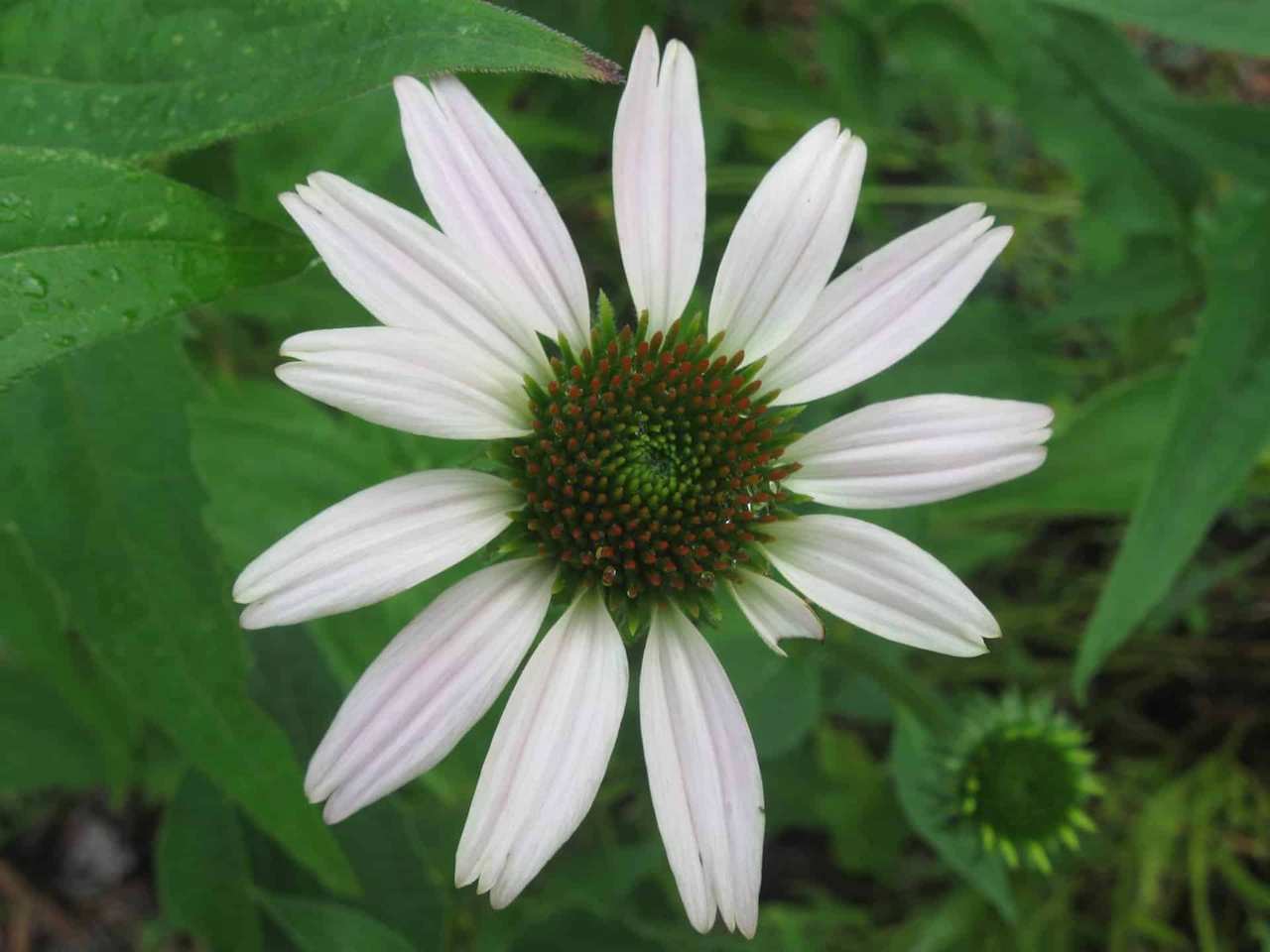
Here's what I didn't expect the first time I chewed a fresh Echinacea root straight from the ground: my tongue went numb. Not dramatically, not painfully, but that unmistakable tingle-and-buzz that starts at the tip and spreads back toward your throat. I'd grown coneflower for years before I ever tasted it, treating it the way most gardeners do, as a pretty purple thing for pollinators and a reliable filler in the herbaceous layer. The tingling changed how I saw every plant in the bed. That sensation is alkamides at work,[1] the same compounds that tell you the plant has medicinal potency, and they're as vivid a reminder as I've ever had that a "garden ornamental" is sometimes just a medicine you haven't learned to read yet.
Most people know coneflower by its roadside silhouette: those reflexed purple petals drooping away from a spiky orange-brown cone, nodding over a sunny border from July through September. What gets less attention is the story underneath that image. Plains tribes like the Lakota and Cheyenne worked with this plant for centuries before it landed in any garden catalog,[2] and the same prairie ecology that shaped those uses, lean soil, hard frosts, blazing summer sun, is exactly what makes Echinacea so stubbornly useful in a designed landscape today. That context matters, both for growing it well and for using it responsibly.
Origin and History of Coneflower (Echinacea purpurea)
Botanical Background and Native Range
Echinacea purpurea, the purple coneflower, is a polycarpic herbaceous perennial that typically lives 3 to 7 years under average garden conditions, though with good drainage and periodic division it can persist a decade or more.[3][4] It flowers in its second or third season, spreads modestly via rhizomes to form clumps, and self-sows freely when seed heads are left standing.[5][6] I've found that dividing clumps every three to four years keeps things vigorous without the rootbound, bloom-sparse look that sets in when you leave them alone too long. That simple practice is worth building into your annual garden rhythm early.[3]
Its native range stretches across eastern and central North America, from southern Michigan and Ohio south to northern Florida and west through Oklahoma, Texas, and Kansas, colonizing tallgrass prairies, open woodlands, savannas, and roadsides wherever the soil drains well and the sun is full.[6][7] For context on what prairie persistence really looks like, consider its relative Echinacea angustifolia, the narrow-leaved coneflower of the Great Plains, which anchors itself with a taproot that can plunge over six feet deep and supports individual clumps that survive 20 to 30 years or more.[8][9] That deep taproot explains why angustifolia is the species under greatest harvesting pressure; purpurea's shallower fibrous root system and faster rhizomatous spread make it far more practical to grow and responsibly harvest in cultivation.[10]
Visual Characteristics and Identification
Purple coneflower grows in upright clumps reaching two to four feet tall, with pubescent stems often flushed purple and coarsely toothed lanceolate leaves that run three to seven inches long, larger near the base and progressively smaller up the stem.[3][11] The flowers are three to four inches across, with drooping purple-pink ray petals surrounding a raised, spiny, orange-brown central cone that blooms from June through early fall for roughly eight to ten weeks.[3][12] That hairy texture on the stems and leaves isn't just a quirk; growing it in my Central Florida landscape, I've watched it shrug off dry spells that left smoother-leaved neighbors wilting, a direct expression of its prairie heritage.
Once you've seen the mature plant, the spiky cone makes it unmistakable. Still, beginners sometimes confuse young seedlings with black-eyed Susan (Rudbeckia hirta), which has yellow petals and a much darker, smaller cone, or with Mexican hat (Ratibida columnifera), whose cone is tall and columnar rather than dome-shaped.[13][14] I've mislabeled a flat of seedlings myself. Now I flag rows at sowing and note that angustifolia roots carry a faintly carrot-like aroma that stops any mix-up cold. For the two most similar Echinacea relatives: angustifolia stays shorter at eight to thirty inches with narrower leaves and that deep taproot, while E. pallida has even paler, more strongly reflexed petals and a longer central cone.[8][15]
Traditional and Cultural Uses
The scientific name Echinacea comes from the Greek echinos, meaning hedgehog, a nod to that spiny cone. Linnaeus first described the plant in 1753 as Rudbeckia purpurea; Conrad Moench reclassified it as its own genus in 1794.[16][17] But long before European botanists put a Latin name to it, Plains peoples had built an extensive pharmacopoeia around the plant. The Dakota, Lakota, Cheyenne, Omaha, Ponca, and many other nations prepared roots, leaves, and flowers as teas, decoctions, poultices, and tinctures for wounds, infections, snakebites, toothaches, colds, and immune support, with some communities incorporating it into spiritual practices for protection and purification.[18][19]
That knowledge was absorbed into 19th-century Eclectic and Thomsonian medicine and eventually commercialized into the cold and flu supplement industry we know today, generating enormous revenue while the Indigenous communities whose observations made it all possible received little acknowledgment and less benefit.[20][21] Having spent time with Daniel Moerman's ethnobotany documentation, I now source only cultivated nursery stock, a small but genuine way to honor that legacy while keeping pressure off wild populations.
Fun Facts and Conservation Notes
Echinacea purpurea itself sits at Least Concern globally, but overharvesting for commercial supplements has pushed E. angustifolia toward Vulnerable assessments in some regions, with state-level protections reflecting real local declines.[22][23] On the cultivar side, the chemical profiles, particularly alkamides, polysaccharides, and phenolics, vary considerably between named selections, which matters if medicinal use is your goal.[24] And if you garden in Europe, outside its native range the species can form dense invasive stands under favorable conditions.[25] Climate modeling suggests the genus will shift northward as temperatures rise, with potential losses at the southern edges of its current range, a reminder that its prairie resilience has limits.[26] Growing it from cultivated stock, choosing species-appropriate varieties for your intended use, and harvesting sustainably are the simplest ways to stay on the right side of all of it.
Coneflower Varieties and Sourcing
Notable Cultivars of Echinacea purpurea and Related Species
Here's something that surprises a lot of gardeners: none of the three main medicinal species, not Echinacea purpurea, not E. angustifolia, not E. pallida, have any formally recognized botanical subspecies or varieties.[27][28][29] Every named selection you'll find in a catalog is a human-made horticultural cultivar, bred for looks, habit, or occasionally medicinal output. That distinction matters, because wild-type plants tend to outperform their cultivated counterparts where it counts for permaculture: deeper drought tolerance, happier in lean soils, and generally higher concentrations of the alkamides, cichoric acid, and polysaccharides that make Echinacea medicinally meaningful.[30][31]
I've grown straight-species E. purpurea side-by-side with 'PowWow Wild Berry,' and on a rainy Central Florida summer the wild-type plants just stood there unbothered while the cultivar flopped and sulked. Pollinators preferred the species too, which tracked with everything I'd read. That said, I'm not a cultivar skeptic. For designed borders, containers, or situations where powdery mildew is a real seasonal problem, some of the newer selections earn their place.
Among purple coneflower cultivars, 'Magnus' remains the benchmark. Dutch breeder Arie Blom selected it in the 1990s for its large rose-pink flowers with notably horizontal petals and strong 90 cm stems that don't need staking.[32] The PowWow series improved on mildew susceptibility that plagued older selections I grew years ago, and 'Kim's Knee High' is genuinely useful in containers or at the front of a bed where full-height plants would overwhelm.[33]
E. angustifolia has a much shorter cultivar list, which reflects its primary identity as a medicinal rather than ornamental plant. Selections like 'Nana,' 'September Beauty,' and 'Prairie Fire' focus on flower quality and phytochemical potency rather than color novelty.[34] E. pallida cultivars are even thinner on the ground; 'Hap Emden' has a tidy, compact habit and 'Heavy Duty' lives up to its name with stiff stems and solid disease resistance.[35][36] Current breeding programs from operations like PanAmerican Seed and the University of Minnesota are pushing toward disease resistance, heat tolerance, extended bloom, and stronger pollinator appeal without sacrificing native genetics entirely.[34][37] For medicinal or ecological plantings, I still reach for straight-species seed. For a pollinator border where I also need something that won't collapse in humidity, those newer disease-resistant selections are worth the trade-off.
How to Source Echinacea Plants and Seeds Sustainably
Echinacea purpurea is one of the top-selling native perennials in the U.S., widely available as nursery plants, seeds, and plugs.[6] E. angustifolia is harder to find in garden centers but sees strong demand in the herbal supplement trade, so specialty seed houses usually carry it.[38] Prairie Moon Nursery, American Meadows, Ion Exchange, and Native American Seed are all solid sources; buy from suppliers that provide provenance information and, where possible, native-plant society endorsements.[33] I learned this the hard way after a batch of non-regional stock failed to overwinter in conditions where my locally sourced plants were fine. Regionally adapted genetics aren't a marketing pitch; they're the difference between a plant that establishes and one that limps along.
Seed packets typically run $2.50 to $5.00 for 100 to 250 seeds, and 1-gallon nursery plants generally land between $8 and $15. Spring and early summer are the best windows for finding plants; echinacea purpurea seeds are most available in late summer and fall once the cones have fully matured and dried. I prefer buying plugs from local native-plant nurseries when I can get them. They establish noticeably faster than bare-root stock from big-box stores, and the provenance is usually clear.
Wild collection is where things get ethically complicated. There are no federal purchasing restrictions, but collecting on public lands requires permits, and many states actively regulate commercial wild harvesting of native medicinal species.[39][40] Both E. angustifolia and E. pallida are globally secure, but localized wild populations remain vulnerable to habitat loss and overharvesting pressure.[41] Buying cultivated nursery stock instead of wild-harvested material is the simplest thing any of us can do to take that pressure off. Look for USDA Organic certification or suppliers that are transparent about their propagation practices.[42][43]
Coneflower Propagation and Planting Guide
Before you decide how to propagate coneflower, there's one botanical fact worth understanding: Echinacea purpurea has a gametophytic self-incompatibility system that forces outcrossing between different plants.[44][45] The practical consequence is that seed-grown plants are rarely true to their parent, showing significant variation in height, color, and form.[46] I label my seedling rows carefully for exactly this reason; young coneflower seedlings look almost identical to juvenile Rudbeckia and even some persistent weeds, and if you're expecting to reproduce a named cultivar exactly, you'll be disappointed. Division is the right tool for keeping a cultivar true. Seed is the right tool for wild-type restoration, naturalized meadow plantings, and anywhere genetic diversity is a feature rather than a problem.
Propagation Methods for Echinacea
If you're going the seed route, both E. purpurea and E. angustifolia need 30 to 60 days of cold-moist stratification at around 4 to 5°C to break physiological dormancy.[47][48] After stratification, germination happens in 10 to 21 days at 20 to 25°C, with typical success rates of 50 to 80 percent.[49] I've tried both refrigerator stratification and direct fall sowing, and for larger plantings I now prefer fall sowing without question. Mimicking the prairie's natural freeze-thaw cycle consistently gives me stronger, more uniform seedlings than anything I've managed in a bag of damp peat in my fridge. If you do store seeds first, the good news is that E. purpurea seeds are orthodox, meaning they tolerate drying down; stored at 3 to 7 percent moisture in airtight containers at refrigerator temperatures, they'll hold 70 to 90 percent viability for five to fifteen years.[50][51]
For vegetative propagation, division is the clear winner: 80 to 90 percent success, straightforward timing in early spring or fall, and the best way to multiply a cultivar you love.[14] I divide plants that are three to five years old, making sure each section has at least one to three healthy eyes and a good portion of roots.[52] Softwood cuttings taken in late spring root at 50 to 70 percent success with IBA rooting hormone at 1000 to 3000 ppm, bottom heat, and high humidity, usually forming roots within three to four weeks.[53] Grafting exists in the literature but sits below 30 percent success and nobody does it commercially; it's firmly in the "because why not" category rather than a practical option. Whatever method you choose, watch for damping-off and root rot, especially in humid conditions or crowded trays. Sterile media, good airflow, and avoiding overhead watering are your best defenses, and a mycorrhizal inoculant at sowing can meaningfully improve germination outcomes.[54][55]
Soil and Site Requirements
More coneflower failures come down to drainage than any other single factor. This is a prairie plant, and the prairie doesn't hold water. Echinacea purpurea wants well-drained loam, sandy loam, or even gravelly soil with modest organic matter around 2 to 5 percent, and at least six hours of direct sun daily.[14][6] Rich, water-retentive soil doesn't reward it; you get leggy stems and fewer flowers. The pH sweet spot is 6.5 to 7.0, though the plant tolerates 6.0 to 7.5 reasonably well.[52] Go above 7.5 and you'll see interveinal chlorosis as iron becomes unavailable. I learned this the hard way one season in slightly alkaline soil, watching new growth yellow between the veins while the established plants looked confused. A round of elemental sulfur at 0.5 to 1 lb per 100 square feet fixed the pH and the plants recovered, but it was an entirely avoidable detour that a soil test before planting would have prevented.[56]
The deep taproot that E. purpurea develops, reaching 60 to 90 cm into the ground, is what gives mature plants their drought resilience, but it also means compaction and poor aeration are genuinely damaging.[57] Once my coneflowers are established I virtually never water them, but that shift from "needs babysitting" to "completely self-sufficient" only happens if those roots can actually go somewhere. For heavy clay, work in 2 to 3 inches of compost or coarse sand to a depth of 6 to 8 inches before planting.[58] E. angustifolia is even less forgiving of clay and heavy soils, tolerating pH up to 8.0 but requiring the same non-negotiable drainage.[59] Always soil-test before amending rather than guessing.
Spacing, Planting Technique, and Timeline
Mature E. purpurea reaches 24 to 48 inches tall and 12 to 24 inches wide, averaging around 36 by 18 inches, while E. angustifolia stays considerably shorter at 10 to 60 cm.[6][14] Those dimensions drive the spacing decision more than anything else. Space plants 18 to 24 inches apart; for mass plantings or meadow mixes, use 24 to 36 inch row spacing. I've shifted to 24 inches as my standard in my more humid growing conditions because the tighter 18-inch spacing contributed to the powdery mildew problems I saw in earlier plantings. Air movement through the canopy matters.
For timing, plant in spring or fall. Direct-sow in fall to let winter do the stratification work for you, or start seeds indoors 8 to 10 weeks before last frost and transplant after frost danger passes.[14] Sow at about a quarter inch deep, keep the soil consistently moist until germination, and mulch in spring, keeping mulch pulled back from the crowns to prevent rot.[52] Skip the high-nitrogen fertilizer; it pushes weak, floppy growth and does nothing for flowering.
Patience is part of the deal with planting purple coneflower seeds. Seedlings typically take two to three years to reach flowering size, and if you're growing for medicinal root harvest, plan on three to four years before the roots are worth digging.[60] Divide plants every three to four years to keep them vigorous and prevent crowding.[61] Pairing coneflower with prairie grasses or other native companions in a polyculture reduces weed competition enough that it meaningfully improves establishment vigor, which is one of those compounding benefits that makes prairie-style planting worth the design effort.
Coneflower Care and Growing Guide
Everything about how to care for coneflower makes more sense once you understand where it comes from. Echinacea purpurea is native to the prairies, open woodlands, and roadsides of central and eastern North America, thriving in full sun and well-drained average to dry soil with a pH tolerance stretching from 6.0 to 8.0.[62][7] That ecological backstory isn't just trivia. It tells you exactly what the plant expects and, more importantly, what it doesn't need from you.
Sunlight Requirements for Healthy Growth and Flowering
Give coneflower at least six hours of direct sun daily and it will reward you. Partial shade is tolerated, especially in warmer zones or with consistent moisture, but the trade-off is real: fewer blooms, etiolated stems, and noticeably reduced vigor.[14][52] I've watched shade-grown plants get progressively leggier and floppier each season, never quite recovering the upright habit they'd have in full sun. Site it right the first time. In hotter zones, afternoon shade can buffer summer stress, but I'd handle that through mulch and microclimate rather than sacrificing a prime sunny spot.
Watering Needs and Drought Tolerance
The first season is the critical window. Water new transplants once or twice a week and seedlings every two to three days, keeping the soil consistently moist without letting it sit waterlogged.[14][63] Once that taproot gets going, reaching 24 to 36 inches deep, the plant becomes genuinely drought-tolerant, needing roughly an inch per week during dry summer spells and tolerating two to three months of dry conditions with minimal stress.[6][14] It recovers from drought faster than a lot of other perennials I grow, bouncing back after a single deep watering in ways that Rudbeckia, for instance, often won't.
Overwatering causes yellowing lower leaves, limp foliage, and mushy stems at the base. Underwatering shows up as wilting, browning leaf tips, and reduced flowering.[64][65] Seasonally, aim for about an inch per week in spring, one to two inches weekly during summer dry periods, occasional deep watering in fall, and near nothing once the plant goes dormant in winter.[66][6] The species prefers a pH near 7.0 and handles low salinity well, though it does best with non-chlorinated water when you have that option.[6]
Feeding and Soil Fertility
I've stopped fertilizing my established coneflowers entirely after soil tests confirmed what I suspected: they were happier and flowered more reliably on lean nutrition. This is a prairie plant adapted to low-fertility soil, and over-fertilizing, especially with nitrogen, produces weak floppy stems, excessive leaf growth, fewer flowers, and increased disease pressure.[6][67][63] The biggest mistake I see new growers make is treating coneflower like a hungry annual.
If a soil test reveals genuine deficiencies, apply a light balanced fertilizer like 5-10-10 at one to two pounds per 100 square feet in early spring only, or top-dress with compost.[68][69] Watch for interveinal chlorosis on new growth as an iron deficiency signal (common in high-pH soils), purplish older leaves pointing to phosphorus issues, and marginal leaf scorch suggesting potassium imbalance.[70][63] Never fertilize late in the season; tender new growth going into winter is an invitation to frost damage.
Frost Tolerance and Winter Protection
Purple coneflower is rated for USDA zones 3 through 9, surviving temperatures as low as -40°F.[71][72] Those dormant roots are genuinely tough. The vulnerability is in the young growth: emerging spring shoots and buds can show wilting, browning at the margins, and water-soaked tissue after a late frost.[6][73] Plants usually rebound vigorously by mid-spring once the crown is intact, in my experience.
Good drainage is the non-negotiable here. After losing several plants to crown rot in heavy clay, I now amend liberally with sand or raise the bed slightly rather than gamble on waterlogged soil through a cold winter. Apply two to four inches of organic mulch after the ground freezes in late fall, pull it back gradually in spring, and add evergreen boughs in zone 3 for extra insurance.[52][74]
Heat Tolerance and Summer Stress Management
Echinacea purpurea carries an AHS Heat Zone rating of 5 through 9, meaning it handles 31 to 150 days above 86°F and tolerates short spikes to 100 to 105°F with adequate moisture.[62][75] Seedlings and flowering plants are the most vulnerable; heat stress above 100°F shows as wilting, leaf scorch, drooping flower heads, and stunted growth.[76][77]
In hotter gardens, the watering and light strategies already described carry most of the load. Add two to three inches of organic mulch, maintain 18 to 24 inch spacing for airflow, and consider 30 to 50 percent shade cloth or afternoon shade positioning in zones 8 and 9.[63][78] Cultivar selection matters too: Magnus, Ruby Star, White Swan, and Hot Papaya have all shown solid heat performance in trials.[63] For the hottest driest gardens, Echinacea angustifolia's Great Plains genetics give it an edge worth considering.
Pruning, Maintenance, and Seasonal Rhythm
Coneflower follows a satisfying seasonal arc: spring emergence and vegetative growth, June through August flowering, late summer seeding, and a clean winter dormancy back to the root crown.[3][52] Caring for it through that rhythm is mostly about knowing when to act and when to leave it alone.
Deadheading spent blooms extends flowering and keeps the plant tidy, but leaving seed heads standing through fall and winter feeds goldfinches and other seed-eating birds.[14][52] I leave most of mine standing because watching goldfinches work through the cones on a November morning is genuinely one of the better things my garden does. If disease pressure was an issue that summer, I'll cut stems back to six to twelve inches after flowering to reduce overwintering spores. Otherwise, I cut to ground level in early spring before new growth emerges. Divide clumps every three to four years in early spring to maintain vigor and prevent crowding[14][31]; a clump that's gotten congested will tell you with fewer blooms and weaker stems. Stake tall varieties in exposed or windy spots, keep mulch over the crown year-round, and this plant will outlast a lot of its neighbors with very little fuss.
Coneflower Harvesting for Medicinal and Edible Use
Coneflower rewards patience. That's probably the single most useful thing I can tell a new grower before they ever pick up a trowel or pair of shears. When I first established Echinacea purpurea from seed, I spent the better part of two growing seasons just watching, labeling rows carefully so I didn't confuse young seedlings with neighboring asters, and waiting for those unmistakable spiny cones to form. The harvesting conversation only really begins in year two or three.
When to Harvest Coneflower: From First Flowers to Mature Roots
Aerial parts -- flowers, leaves, stems -- are best taken from mid-summer through early fall once plants are at least one to two years old, with flowers at their most potent when ray florets are fully expanded but the disc florets still tightly packed, or within the first week after full bloom when petals just start to droop.[56][79][80] In colder zones (4-6) that window tends to run July into August; warmer zones (7-9) push it to August through September.[81] I always cut in the morning after the dew dries but before the heat of midday sets in.
For seed harvest, watch the cones rather than the calendar. When they bronze, dry out, and the bracts begin curling back to release seeds, that's your window -- typically 60 to 90 days post-bloom.[79][82] Move too early and seed potency suffers; wait too long and you're chasing seeds off the ground after they shatter.
Roots are a different patience test entirely. Wait until year three or four, after the first frost triggers foliage dieback, when carbohydrate reserves peak and active compound concentrations are at their highest.[56][47] Roots dug right after a hard frost smell noticeably more pungent than those dug even a few weeks earlier -- a sensory confirmation that the chemistry has shifted in your favor. For Echinacea angustifolia, that same multi-year timeline applies, though establishment runs slightly slower and the roots stay smaller.[62] I never take more than one-third of any established clump regardless of species, leaving the remainder to regrow and keep serving the pollinators that depend on those seed heads through winter.
How to Harvest and Process Coneflower Parts
For flowers and aerial parts, cut stalks 6 to 12 inches above soil level with clean shears.[56] Seeds come free easily once you've cut the dried stalk and shaken the cone over a bowl or bag. Roots require more care: dig in moist (not waterlogged) soil, wash off the clay, then chop and spread immediately for drying.[56][83]
Temperature control during drying is where I've seen people undermine an otherwise perfect harvest. Keep everything below 40°C (104°F), whether you're drying roots or aerial parts.[56][83] I learned this the hard way with an early batch I hurried through a warm oven -- the resulting material was brittle and odorless, a sign the volatile oils and alkamides had cooked off. Shade drying on screens in a well-ventilated space is slower but far more forgiving. Once dried, store in airtight containers away from light and heat, or tincture fresh roots immediately if you prefer that route.[56]
Coneflower Flavor Profiles by Plant Part and Harvest Timing
Echinacea purpurea is edible across all its parts, though calling it a kitchen staple would be a stretch.[84] Leaves run bitter and slightly astringent -- not unlike dandelion greens in their fibrous chew -- flowers offer something milder and almost sweet-floral, and roots are where the full sensory experience hits: intensely bitter, earthy, pungent, with that signature alkamide-induced numbing tingle that tells you, in my experience, the medicine is intact.[84] A mature root measures roughly 10 to 15 cm long with 10 to 20 grams of dry weight per root, so it's not a huge yield per plant, but what's there is concentrated.[56]
Flavor intensity shifts with timing and handling: late-summer harvests bring more bitterness as caffeic acids and flavonoids accumulate, and air-drying preserves more of the volatile terpenes (including germacrene D) than oven methods.[85][86] Cultivar matters too -- alkamide concentrations can swing 20 to 30 percent across selections.[85] E. angustifolia and E. pallida share the tingling bitterness but stay squarely in medicinal territory with almost no culinary application worth pursuing.[87] Even with purpurea, treat it as a specialty bitter herb rather than a vegetable, and pair the bitterness with honey, citrus, or mint when you do use it in the kitchen.
Coneflower (Echinacea purpurea) Preparation and Uses
Most plants earn one identity in the kitchen, but coneflower occupies a strange and satisfying middle ground. It's genuinely edible, legitimately medicinal, and occasionally beautiful on a plate, yet it's none of these things in the way a tomato or a mint is. I think of it as a specialty herb that rewards curiosity and punishes overconfidence.
Culinary Applications and Flavor Profiles of Coneflower
The flowers and young leaves of Echinacea purpurea are edible and find their way into teas, salads, and garnishes, but this is emphatically not a vegetable.[88][89] The petals are the entry point for most people. Fresh from the plant in early morning, before summer heat opens up the cone, they carry a genuinely sweet, slightly fruity note with a faint hint of vanilla.[90] That's the moment I harvest mine for fresh use. Let the day warm up and the spiny cone starts contributing its bitter, peppery earthiness to everything around it.
Young leaves and inner stems can go raw into a salad in small amounts, but I learned the hard way to keep portions modest. The first time I added a generous handful to a spring salad, I spent the afternoon with a grumpy stomach. A few leaves are pleasant; a bowlful is a mistake. Lightly cooking them, or pairing them with mint, takes the edge off.[91] Dried petals behave better than fresh in herbal blends, the bitterness mellows considerably once moisture is out of the equation. I use them in teas alongside honey, a squeeze of lemon, or chamomile, and paired that way they're genuinely lovely. Basil, thyme, citrus, and berries all play well with the purpurea flavor profile too.
If you grow Echinacea angustifolia alongside your purple coneflower, don't expect the same culinary flexibility. Its roots are powerfully astringent, and even its flowers, while mildly tangy, have historically served more as a famine flavoring or medicinal tea ingredient than anything resembling a kitchen staple.[92][93]
Medicinal Preparations and Dosages
This is where most people actually want to use their harvest. For Echinacea purpurea, the evidence-backed preparations are tinctures, infusions, and capsules. Standard adult dosing lands at roughly 2.5 mL tincture (equivalent to about 900 mg dried herb) three times daily, or one to two grams of dried herb steeped per cup of water, up to three cups daily, or 300 to 500 mg of standardized extract in capsule form two to three times daily.[94][95] I personally follow EMA-aligned tincture protocols for my homemade preparations, labeling every batch with the date, plant part, and menstruum ratio. Standardized extracts are worth the extra effort when you're making your own supply from cultivated plants.
For Echinacea angustifolia roots, a decoction (simmering one to two grams of dried root for ten to fifteen minutes) or tincture at 2 mL three times daily reflects common protocols, standardized where possible to around 4% echinacosides.[96][97] Across both species the consistent caution is the same: don't run continuous use beyond eight weeks without a break.[84] The echinacea tea effects people seek, especially for acute immune support, come from appropriate dosing over a short defined window, not from treating it like a daily supplement indefinitely. Pairing your echinacea tea with elderberry is a popular combination, and there's nothing wrong with it, just know they're doing different jobs and each deserves its own dose consideration.
Safety Considerations and Non-Food Uses
The roots of all echinacea species are too fibrous and bitter to eat in any practical sense. Their place is firmly in tinctures, decoctions, and capsules, not on the dinner table.[88][98] The health benefits section covers the contraindications in depth, but the short version is that people with autoimmune conditions, daisy family allergies, or who are on immunosuppressants need to talk to a provider before reaching for any preparation.
On sourcing: please grow your own or buy certified organically cultivated material. Wild-harvested roots carry real risks, contaminants, mislabeling, and pressure on already stressed wild populations, especially for Echinacea angustifolia, which doesn't have the same cultivated abundance as purpurea.[99][98] In my polycultures, coneflower grows alongside yarrow, native grasses, and black-eyed Susan. That means I always know exactly what went into the soil, what didn't get sprayed, and when it was harvested. That traceability is worth more than any certified label on a store shelf.
Coneflower Health Benefits and Medicinal Uses
Most people who grow coneflower start with the flowers and end up fascinated by the medicine. The plant earned its place in gardens partly for those bold purple petals, but its deeper reputation comes from a much older story.
Traditional and Modern Medicinal Research on Echinacea purpurea
Long before modern clinical trials, Indigenous communities effectively documented its broad medicinal utility, relying on both topical and internal preparations across a wide range of ailments.[84][100][101] That breadth of use made sense once the pharmacology started catching up: the plant operates on several fronts simultaneously.
The immunomodulatory effects that make Echinacea purpurea so commercially popular come from alkamides binding to CB2 and TLR2 receptors, polysaccharides activating macrophages and dendritic cells, and modulation of MAPK signaling pathways.[102][103] Beyond immune signaling, it demonstrates antimicrobial activity against Streptococcus and Staphylococcus species[104], antioxidant properties via phenolic and flavonoid compounds[105], and anti-inflammatory action through inhibition of TNF-alpha, IL-6, and NF-kB signaling.[106][107] Topically, the combined anti-inflammatory and antimicrobial effects support wound healing applications that echo those original poultice uses.[108]
For the immune and cold applications that dominate modern use, the clinical picture is genuinely modest and worth being honest about. Cochrane systematic reviews show roughly a-1 to 2-day reduction in cold duration and severity, with inconsistent results across studies and no reliable evidence for preventing infections outright.[109][110] My experience lines up with this pretty well. I reach for an echinacea tincture the moment I feel that first scratchy-throat warning and genuinely think it shortens things; what I don't do is take it daily all winter expecting immunity. The research supports using it at onset, not as a preventive supplement. Preliminary cell-line studies also suggest anti-cancer potential through apoptosis induction, but the human data isn't there yet, and I'd be cautious about anyone treating these early findings as clinical guidance.[111] Adaptogenic, sedative, or strong analgesic claims have even less support; most of the pain-relevant benefit traces back to inflammation reduction rather than any direct analgesic action.[112]
Key Phytochemicals and Their Roles in Coneflower
The phytochemical profile of Echinacea purpurea is what makes it worth understanding as a grower, not just a consumer. Roots are richest in alkamides (0.1-0.6% dry weight) and polysaccharides; flowers concentrate cichoric acid up to 2-4% dry weight; and leaves carry the highest flavonoid content at around 2-3%.[113][114] Those alkamides, specifically the dodeca-2E,4E,8Z,10E/Z-tetraenoic acid isobutylamides, are responsible for the unmistakable tingling sensation on the tongue and are thought to influence cannabinoid receptor pathways.[115][116] Cichoric acid, chlorogenic acid, and quercetin round out the antioxidant and anti-inflammatory contributors.[117]
Here's the part that matters most if you're growing your own: these concentrations are highly responsive to how and when you grow and harvest the plant. Secondary metabolites peak during flowering and in late summer through autumn harvests.[118] Drought stress and nitrogen-poor soils can boost secondary metabolites by 20-30%, while overly rich soil conditions increase biomass but can dilute compound concentrations.[119][120] I've noticed this firsthand: plants that get a little lean and stressed in late summer produce roots with a noticeably stronger alkamide tingle when tasted fresh. That sensory cue is a real signal worth paying attention to. Drying temperature matters too; staying below 40°C protects thermolabile compounds, while heat above 60°C can degrade them by 50-70%.[121]
Nutritional Profile of Echinacea
Echinacea is medicinal-first and dietary-almost-never. No comprehensive nutritional data exists for it in standard food databases, since it's classified as an herb rather than food, and the figures that do exist come from phytochemical studies that vary widely based on plant part, soil, and processing.[122][123] Young leaves and closed flower buds are the most accessible edible parts of E. purpurea, while E. angustifolia is technically more edible across all its parts, though bitterness makes regular consumption more of an acquired taste than a pleasure.[124] Dried herb at 100g contains reasonable mineral density, with potassium up to 4,500 mg, calcium around 1,200-1,500 mg, and meaningful iron[125], but no one is consuming 100g of dried coneflower, and the serving reality of 1-2 teaspoons steeped as tea makes those figures almost irrelevant.[84] Hot water extraction favors water-soluble polysaccharides and phenolics but captures only about 20-30% of phenolics and is far less effective at pulling lipophilic alkamides; tinctures handle that better.[126] The real nutritional story here is the phytochemical one covered above.
Safety Profile and Contraindications
Echinacea purpurea has low overall toxicity, GRAS status, and no plant part has been identified as disproportionately dangerous at standard use levels; the ASPCA, NCCIH, and the European Medicines Agency all support this baseline safety profile.[127][84][128] That said, the primary acute risk is allergic reaction, particularly for people with Asteraceae family sensitivities. Roughly 1-2% of users with hay fever experience reactions ranging from skin rashes to, in rare cases, anaphylaxis.[129] I've seen clients with ragweed allergies react even to topical preparations, so I always recommend a patch test before wider use; the cross-reactivity research on this is clear and shouldn't be dismissed.
For anyone with an autoimmune condition like MS or lupus, I advise against medicinal doses. The immunostimulant effects are real, not theoretical, and they could genuinely worsen symptoms.[84][94] Pregnancy and breastfeeding also warrant avoidance simply due to limited safety data. Healthy adults should cap continuous use at 8 weeks; common side effects at standard doses are mild and typically include gastrointestinal upset or rash, with no serious adverse events reported in clinical trials.[130] On drug interactions, both purpurea and angustifolia have potential CYP3A4 involvement, which creates possible interactions with immunosuppressants, warfarin, statins, and cyclosporine; if you're on any of those, a conversation with your prescriber is non-negotiable before using medicinal preparations.[131] Finally, cultivation conditions affect potency, not safety, but sourcing from reputable growers still matters to avoid heavy metal or pesticide contamination that has nothing to do with the plant's own chemistry.[132]
Coneflower Pests and Diseases
If you're looking for a perennial that mostly takes care of itself on the pest and disease front, coneflower is genuinely one of the better choices in the herbaceous layer. Echinacea purpurea has a well-earned reputation for low-maintenance toughness.[133][134] That resilience isn't accidental. It's built into the plant's chemistry, its surface anatomy, and its ecological relationships.
Natural Pest Resistance and Insect Pests of Echinacea purpurea
The same alkamides, caffeic-acid derivatives, and phenolic compounds that make coneflower extracts medicinally useful also make the foliage bitter and repellent to many insects.[135] On top of that, glandular trichomes on young shoots and flower buds secrete a sticky exudate that physically stops small insects before they can settle in.[136] I always tell new growers to look closely at their emerging spring shoots. That faint fuzziness isn't just texture; it's armor. I've watched tiny aphids get stuck in it before they could even find a foothold to colonize. The plant also attracts parasitoid wasps through volatile organic compounds like (E)-β-ocimene, and its mycorrhizal associations may prime systemic resistance further.[137][138] The compounds doing that ecological work are the same ones extracted for immune-support tinctures, which is part of why I let a few plants go completely to seed each year rather than harvesting everything.
When insects do show up, most cause minor damage at worst. Aphids, flea beetles, and seed-corn maggots are the most commonly reported, but they rarely amount to much. European corn borer is the genuine exception, capable of causing leaf curling, stunting, and flower loss. Leaf beetles, cutworms, spider mites, Japanese beetles, and slugs make occasional appearances but rarely warrant intervention beyond removing them by hand or letting beneficial insects do the work.[139][133] My approach is always to start with cultural and biological controls. Insecticidal soap handles a heavy aphid load without harming the pollinators that are almost certainly foraging right next to them.
Deer resistance is real but comes with a caveat. The aromatic foliage does deter browsing in most situations, and I find coneflower far more reliably deer-proof than hostas or daylilies in my neighborhood.[14][140] That said, young transplants in their first season are more vulnerable, so I do protect new plants until they're established. Cultivar selection can sharpen pest resistance further. 'Magnus' benefits from dense pubescence that physically deters insects and has shown notably reduced powdery mildew pressure.[141] The prairie-adapted genetics of E. angustifolia carry many of the same secondary metabolite defenses, with thick cuticles and trichomes rounding out its resistance profile, though named pest-resistant cultivars are far less common for that species.[142][143]
Disease Resistance and Common Fungal Issues
Coneflower's overall disease resistance is moderate to high, and most gardeners growing it in appropriate conditions will deal with very little.[52][63] The problems that do arise almost always trace back to stress: humidity, poor drainage, overcrowding, or temperatures outside its comfortable range.[14]
Powdery mildew is the most common echinacea plant disease you'll actually encounter, and it's almost entirely a cultural problem. Humid air and poor circulation set the stage; the white coating follows.[63][144] I've grown straight E. purpurea and 'Magnus' side by side in the same humid bed, and the difference in late-summer mildew coverage is noticeable. 'Magnus' consistently comes out cleaner. 'White Swan' and many of the modern hybrids also show improved resistance.[145]
Root rot from Phytophthora or Pythium is the other disease worth taking seriously, because once it's in the crown there's no reliable cure.[63][146] Prevention is the only real control I trust, which is why I always plant coneflowers in raised beds or amended soil when I'm working with heavy clay. Well-drained soil is non-negotiable.
Leaf spot (Septoria, Alternaria) and rust occasionally appear but rarely cause serious trouble in plants grown in full sun with reasonable airflow.[52] Crown gall and true viral diseases are uncommon.[147] Aster yellows is worth knowing about; it's transmitted by leafhoppers and produces distorted growth and unsettling green flowers, but I've rarely seen it in healthy, unstressed plantings.[63] E. pallida tends to outperform E. purpurea on powdery mildew in drier conditions, though it shares susceptibility to leaf spot and root rot when drainage is poor.[148] The through line across all echinacea plant diseases is the same: good siting, proper spacing, and base-level watering will handle the vast majority of problems before they start.[149][150]
Coneflower in Permaculture Design
There's a reason I put coneflower in nearly every pollinator guild I design. It's not nostalgia for prairie landscapes, though I have plenty of that. It's because Echinacea purpurea pulls more functional weight per square foot than almost any other plant in the herbaceous layer, and it does it while looking gorgeous for months on end.
Ecosystem Functions and Ecological Roles
The pollinator story alone is compelling. Purple Coneflower attracts over 30 species of bees, butterflies, and hummingbirds, blooming from summer through fall to deliver an extended nectar window that few perennials match.[6][151] The flowers are primarily insect-pollinated and self-incompatible, which means native bumblebees and solitary bees are doing real work here, transferring pollen between plants rather than just grabbing a quick meal.[152] I've watched the native bee traffic on my second-year plants practically double compared to the first season's modest showing. Once established, a mature stand in full bloom is genuinely buzzing. Peak pollinator activity runs from June through September at 65 to 85°F, and planting in clusters alongside companions like Monarda, Asclepias, and Rudbeckia amplifies that activity considerably.[153][154]
The root system is where this plant really earns its keep below the soil surface. That deep taproot reaches 5 to 8 feet down, stabilizing soil, improving water infiltration, and preventing erosion in ways that shallow-rooted annuals simply can't replicate.[155][156] As a dynamic accumulator, it draws up minerals including potassium and phosphorus, releasing them back into the soil system through decomposition and mycorrhizal associations.[156] Those mycorrhizal relationships also enhance the plant's own resilience and contribute to broader soil health in ways that benefit neighboring species in the guild. On top of all that, established Echinacea stands have needed little additional protection from deer browse compared to many other perennials I've grown, and the plant shows mild deterrent effects on aphids while supporting the predatory insects that keep other pests in check.[156]
Then there's winter. I stop deadheading in late fall specifically because I want to watch the goldfinches work those dried seed heads. Every year, without fail, they arrive to feed on the persistent cones while most of the garden has gone quiet.[14] For restoration plantings and ecological projects, this four-season function -- summer bloom, fall seed, winter wildlife forage, spring regrowth -- makes coneflower a reliable structural choice.[6][156]
Climate Adaptability and Hardiness Zones
Purple Coneflower is hardy across USDA zones 3 through 9, tolerating winter lows down to -40°F and native to the temperate continental prairies of central and eastern North America where annual precipitation runs 25 to 40 inches.[14][6] That zone range is genuinely wide, and once established the plant handles drought well. Full sun and well-drained soil are the real requirements, not particular warmth or consistent rainfall.
The warmer end of that range deserves a candid note. In zones 8 and 9, prolonged heat above 95 to 100°F combined with high humidity can stress plants, and poor air circulation invites fungal problems.[157] In my designs for hotter microsites, I'll sometimes tuck coneflower where it catches afternoon shade from a taller shrub layer, or I'll pile on extra mulch to buffer soil temperature. Young plants are especially vulnerable before their root systems establish depth.[158] For designers working in those marginal warm zones, Narrow-leaved Coneflower (Echinacea angustifolia) is worth knowing about. It shares the zones 3 to 9 range but leans into dry, rocky, well-drained conditions at elevations up to 1500 meters, and its even deeper taproot gives it a slight edge on drought resilience in punishing summers.[158][8] Neither species wants wet feet, heavy shade, or compacted soil, regardless of zone.
Forest Layer Placement and Guild Design
In permaculture design, Purple Coneflower sits squarely in the herbaceous layer. Its upright clumping habit at 2 to 4 feet works beautifully at the edge of a food forest canopy or in open prairie polycultures where it gets the full sun it needs without competing with taller woody layers.[76][6] It thrives at woodland edges and open meadow conditions but doesn't tolerate deep shade, so placement matters.[159]
In the guilds I build, I place coneflower alongside black-eyed Susan and bee balm as a core trio. That combination has consistently produced the most diverse insect activity I've seen in any pollinator planting. Adding little bluestem as a native grass component gives structural variety and fills gaps without crowding. Milkweed and goldenrod round out the guild for monarch and late-season specialists.[154] The coneflower also contributes mild allelopathic root exudates that help suppress weeds around the planting, which reduces maintenance without any chemical intervention.[160] The combined effect is a self-reinforcing guild that provides soil health, medicinal harvest, and biodiversity support from a single planting plan.[161][156]
If you're working with a site that needs stronger soil remediation, Narrow-leaved Coneflower's taproot can reach up to 8 feet with robust mycorrhizal associations specifically enhancing phosphorus uptake.[8] Pale Purple Coneflower (Echinacea pallida) offers similar dynamic accumulator functions at 1 to 4 feet and shows mild pest-repelling traits that complement the whole guild's ecological function.[162][163] The genus gives designers real flexibility on height, root depth, and growing conditions without sacrificing any of those core ecological services.
The Plant That Taught Me to Stop Apologizing for Planting the Same Thing Twice
I have Echinacea in three separate beds, and every few years I add more. People sometimes ask if I'm bored with it, and honestly, the question confuses me. There's a patch near my rain garden that's been self-seeding and slowly drifting east for six years now, finding its own best spots, and I've stopped interfering. Some plants just know what they're doing. I've learned to follow them.
Sources 163
- Phytochemistry and biological activity of Echinacea ↩
- Echinacea purpurea – USDA Forest Service Plant of the Week ↩
- Echinacea purpurea ↩
- Echinacea purpurea ↩
- Echinacea purpurea (Eastern Purple Coneflower) ↩
- Purple Coneflower (Echinacea purpurea) ↩
- Flora of North America - Echinacea purpurea ↩
- Echinacea angustifolia ↩
- Echinacea angustifolia ↩
- Echinacea AHPA Monograph ↩
- Echinacea purpurea (L.) Moench ↩
- Echinacea purpurea ↩
- Rudbeckia vs. Echinacea: Key Differences ↩
- Distinguishing Echinacea from Look-Alikes ↩
- Echinacea pallida - USDA PLANTS Database ↩
- Species Plantarum ↩
- Methodus Plantas Horti et Agri Bononiensis ↩
- Native American Ethnobotany ↩
- Echinacea: Traditional Uses and Current Research ↩
- The History of Echinacea ↩
- Traditional and Current Use of Echinacea: A Narrative Review ↩
- Echinacea purpurea Conservation Status ↩
- Echinacea angustifolia: Sustainability and Conservation Status ↩
- Variability of Phenolic Compounds in Cultivated Echinacea purpurea ↩
- Invasive Potential of Echinacea purpurea in European Ecosystems ↩
- Modeling the Distribution of Echinacea purpurea under Climate Change ↩
- International Plant Names Index (IPNI) - Echinacea purpurea ↩
- Plants Database - Echinacea purpurea (Michx.) Zinn ↩
- Missouri Botanical Garden - Echinacea purpurea ↩
- Bioactive Compounds in Wild vs. Cultivated Echinacea ↩
- Cultivation of Echinacea angustifolia for Medicinal Use ↩
- Echinacea purpurea - Plant Finder ↩
- Purple Coneflower Cultivars: Selection and Care ↩
- Echinacea Breeding: Past, Present, and Future ↩
- Echinacea pallida 'Hap Emden' ↩
- Plant Delights Nursery - Echinacea pallida Cultivars ↩
- New Echinacea Cultivars from PanAmerican Seed ↩
- Echinacea angustifolia Conservation Assessment ↩
- State Regulations on Wild Harvesting Medicinal Plants ↩
- Collecting Plants on Federal Lands ↩
- Narrow-Leaved Purple Coneflower (Echinacea angustifolia) ↩
- Sustainable Harvesting of Medicinal Plants ↩
- National Organic Program (NOP) ↩
- Self-Incompatibility in Echinacea purpurea: Implications for Breeding ↩
- Genetic Diversity and Population Structure in Wild Echinacea purpurea ↩
- Seed Propagation and Variation in Cultivated Echinacea purpurea ↩
- Echinacea Production and Management ↩
- Germination and Dormancy in Echinacea Species ↩
- Propagation of Echinacea ↩
- Royal Botanic Gardens Kew - Seed Information Database ↩
- USDA Native Plant Seed Storage Guidelines ↩
- How to grow Echinacea ↩
- Growing Echinacea ↩
- Propagation of Coneflowers ↩
- Echinacea Diseases | Penn State Extension ↩
- Echinacea Production and Marketing ↩
- Purple Coneflower (Echinacea purpurea) ↩
- Growing Echinacea in the Home Garden ↩
- Narrow-Leaved Purple Coneflower ↩
- Echinacea angustifolia Profile ↩
- Effects of Fertilization and Spacing on Echinacea purpurea Yield and Growth ↩
- Echinacea purpurea ↩
- How to Grow Coneflowers ↩
- Plant Finder: Echinacea purpurea ↩
- How to Grow Coneflowers ↩
- Echinacea purpurea ↩
- Missouri Botanical Garden Plant Finder ↩
- Nutrient Management for Herbaceous Perennials ↩
- Growing Echinacea in the Midwest ↩
- Echinacea Production and Management ↩
- Echinacea purpurea (Purple Coneflower) ↩
- USDA Plant Hardiness Zone Map ↩
- Frost Damage in Perennials ↩
- Winter Care for Perennials in Cold Climates ↩
- AHS Plant Heat Zone Map ↩
- Echinacea purpurea ↩
- Effects of Heat Stress on Echinacea purpurea Seedlings ↩
- Cultivar Performance in Heat and Humidity ↩
- Echinacea purpurea ↩
- Chemical Variation in Echinacea purpurea During Flowering and Fruiting Stages ↩
- St. Louis Missouri Botanical Garden: Echinacea purpurea Cultivation ↩
- Harvesting Echinacea for Medicinal Use ↩
- Harvesting and Processing Medicinal Plants ↩
- Echinacea: Usefulness and Safety ↩
- Phytochemical Variation in Echinacea purpurea: Influence of Harvest Time and Drying ↩
- Chemical Composition and Antioxidant Activity of Echinacea purpurea ↩
- A review of the phytochemistry and pharmacological activities of Echinacea species ↩
- Missouri Botanical Garden Plant Finder - Echinacea purpurea ↩
- UC Master Gardener Program - Echinacea purpurea ↩
- Nova Druid Gardens - Edible and Medicinal Properties of Echinacea purpurea ↩
- Herbal Reality - How to Grow and Use Echinacea (Coneflower) ↩
- Native American Ethnobotany: A Database of Plants Used by North American Indigenous Peoples ↩
- The Flavor of Echinacea: A Sensory Evaluation ↩
- Echinacea ↩
- Public statement on the use of herbal medicinal products containing echinacea purpurea ↩
- Echinacea Preparation Methods ↩
- Assessment report on Echinacea angustifolia DC., radix ↩
- Echinacea ↩
- Echinacea angustifolia ↩
- Traditional Uses of Echinacea by Native Americans ↩
- Ethnobotany of the Omaha Tribe ↩
- Immunomodulatory Effects of Echinacea purpurea: A Review ↩
- Alkylamides from Echinacea Modulate TLR2 Signaling ↩
- Antioxidant and antimicrobial activities of Echinacea ↩
- Antioxidant and anti-inflammatory activities of Echinacea ↩
- Anti-inflammatory effects of Echinacea purpurea ↩
- Echinacea alkylamides modulate TNF-α gene expression via the Monde pathway ↩
- Wound healing activity of Echinacea angustifolia ↩
- Echinacea for preventing and treating the common cold - Cochrane Systematic Review ↩
- Meta-analysis of Echinacea for common cold ↩
- Anti-cancer effects of Echinacea purpurea extracts on cell lines ↩
- PubMed Search: Echinacea angustifolia analgesic OR adaptogenic OR antispasmodic ↩
- Chemical Composition and Variability of Different Echinacea purpurea Parts ↩
- Alkylamides and Polysaccharides in Echinacea purpurea ↩
- Bioactive Compounds from Echinacea Species: A Review ↩
- Biosynthesis of Alkamides in Echinacea purpurea ↩
- Chemical Composition and Health-Promoting Effects of Echinacea spp. ↩
- Seasonal Variation of Secondary Metabolites in Echinacea purpurea ↩
- Phytochemical and Mineral Composition of Echinacea purpurea ↩
- Influence of Soil Nutrients on Phytochemical Content in Echinacea ↩
- Effects of Drying Methods on the Chemical Composition of Echinacea purpurea ↩
- USDA FoodData Central ↩
- USDA Plants Database: Echinacea purpurea ↩
- Echinacea - Wikipedia ↩
- Nutritional Composition of Echinacea Species ↩
- Aqueous Extraction and Phenolic Stability in Echinacea Species ↩
- Echinacea purpurea (Purple Coneflower) - ASPCA ↩
- EMA Herbal Monograph: Echinacea purpurea ↩
- Allergic Reactions to Echinacea ↩
- Echinacea: A Systematic Review ↩
- Drug interactions with herbal medicines: a systematic review ↩
- Safety of Echinacea Species: Absence of Pyrrolizidine Alkaloids ↩
- Missouri Botanical Garden – Echinacea purpurea plant finder ↩
- USDA PLANTS Database – Echinacea purpurea ↩
- Peer-reviewed article: 'Alkaloids as defensive compounds in Echinacea purpurea against herbivorous insects' (Journal of Chemical Ecology, 2004) ↩
- Peer-reviewed article: 'Glandular trichome-mediated defense in Echinacea purpurea' (Phytochemistry, 2005) ↩
- Nelson et al., 2009. Mycorrhizal associations in Echinacea species (Mycorrhiza, 2009) ↩
- Mycorrhizal Fungi Enhance Defense Against Herbivores in Echinacea ↩
- Integrated Pest Management of Echinacea purpurea – Iowa State University Extension, 2019 ↩
- ERNH BUL-163: Purple Coneflower Production and Care ↩
- Missouri Botanical Garden Plant Finder - Echinacea purpurea 'Magnus' ↩
- Trichome Morphology and Insect Resistance in Echinacea angustifolia ↩
- Alkamides from Echinacea angustifolia as Insect Deterrents ↩
- Powdery Mildew Resistance in Echinacea Cultivars - American Society for Horticultural Science ↩
- Echinacea Cultivar Evaluation - University of Georgia ↩
- Perennial Plant Problems: Root Rot in Echinacea - North Carolina State University Extension ↩
- Missouri Botanical Garden - Echinacea purpurea ↩
- Echinacea pallida - North Carolina Extension Gardener Plant Toolbox ↩
- Echinacea purpurea - Missouri Botanical Garden ↩
- Integrated Pest Management for Ornamentals ↩
- Purple Coneflower (Echinacea purpurea) for Pollinators ↩
- Pollination of Native Plants: Echinacea ↩
- Pollination Ecology of Echinacea angustifolia ↩
- Pollinator Enhancement for Echinacea ↩
- Root Systems of Prairie Plants and Soil Stabilization ↩
- Permaculture Plants: Echinacea ↩
- Growing Echinacea in Hot Climates ↩
- Heat and Drought Tolerance in Native Prairie Plants ↩
- Ecological Role of Echinacea in Native Habitats ↩
- Allelopathy in Medicinal Plants: Echinacea Species ↩
- Agroforestry with Native Perennials including Echinacea ↩
- Permaculture Plants: Echinacea pallida ↩
- Arbuscular Mycorrhizal Fungi Associated with Echinacea pallida Roots ↩
About the Author
Farmer Noelle has been farming for over 12 years between Washington and Michigan. Her experience ranges from small-scale biointensive operations to a 40-acre CSA with over 300 members.