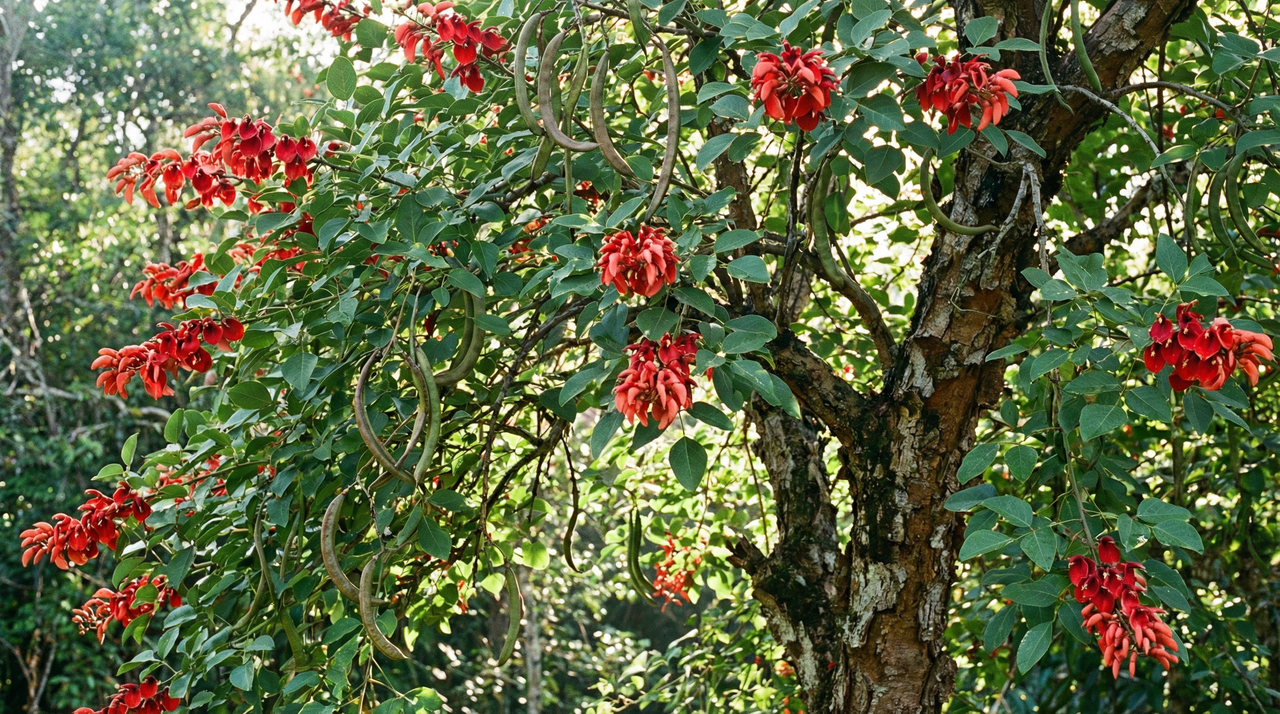
The first time I saw a Coral Tree in full bloom, I almost pulled over. Not because it was beautiful, though it is, almost aggressively so. I pulled over because the tree had no leaves. Just bare grey branches erupting in dense, blood-red flower spikes, like the plant had skipped some fundamental rule about how flowering is supposed to work. That leafless bloom isn't a sign of stress or disease; it's exactly what Erythrina crista-galli does, timed by evolutionary design so pollinators get an unobstructed view and the tree wastes nothing on foliage while it's busy reproducing.[1] I've since grown it in subtropical Florida and watched visitors stop mid-conversation to stare at it every single spring.
What most people don't realize is that this showstopper is a nitrogen-fixing legume doing real ecological work beneath that theatrical exterior, while simultaneously carrying a chemical arsenal potent enough that indigenous healers and modern pharmacologists have both taken serious notice. It feeds the soil, feeds the birds, occasionally feeds people (with significant caveats), and has been woven into national identity, Aztec ritual, and Zulu ceremony across three continents. There's a lot happening inside one thorny, stunning tree.
Origin and History of Coral Tree (Erythrina crista-galli)
Botanical Background and Native Range
The coral tree has a story that starts on the humid riverbanks and open grasslands of eastern South America, where Erythrina crista-galli evolved as a classic pioneer legume: fast-growing, nitrogen-fixing, deciduous, and built to colonize disturbed ground in full sun.[2][3] Its native range spans Argentina, Brazil, Paraguay, and Uruguay, where humid subtropical summers and mild winters suit it perfectly.[4] In the U.S., it's settled into USDA zones 9-11, and has naturalized across parts of Florida.[5] In disturbed Florida sites it has demonstrated the ability to outcompete native vegetation, so always check your county's current invasive status before planting another specimen.[6]
The broader genus tells parallel stories on other continents. Erythrina abyssinica anchors East African woodlands, E. afra hugs the coastal bush of southern Africa, E. americana emerges from Mexican dry forests, and E. edulis climbs into Andean montane habitat between 1,500 and 3,000 meters.[7][8][9][10] Every one of them converged on the same adaptive toolkit: open high-light habitats, deep taproots, deciduous leaf drop to conserve water, fire-adapted resprouting, and symbiotic nitrogen fixation through root nodules.[11][8] I think of this genus the way I think of pigeon pea in a Florida food forest: a legume that builds the soil while it builds itself, buying fertility for everything planted nearby. The main difference is the scale of the drama involved.
Under good conditions, E. crista-galli lives 20 to 50 years or more, though it won't reward impatient gardeners with blooms immediately.[2][12] Reliable flowering from seed-grown trees usually arrives in year three or four, sometimes five, depending on climate and soil warmth. I've watched growers give up on young specimens thinking something was wrong, when really the tree just needed another season. Label your seedlings carefully too; those trifoliate young leaves look surprisingly similar to other legumes in the ground.
Visual Characteristics of the Coral Tree
A mature cockspur coral tree in full spring bloom produces bare branches loaded with scarlet racemes up to 60 cm long. The flowers appear while the tree is completely leafless, which turns what might otherwise be a pleasant floral display into something almost theatrical.[12][13] Each individual flower is tubular, 5 to 8 cm long, with that distinctive crest-like standard petal that gave the species both its common and scientific names.[14] Genus-wide, the bright red tubular flowers and bird-pollinated strategy are essentially universal, though form and timing shift by species.[8]
Outside of bloom, the tree is a 16 to 26 foot specimen with a rounded spreading canopy, growing at a satisfying clip of 3 to 5 feet per year when it's happy.[12][13] The recurved thorns on young growth are serious, sometimes reaching 10 cm, and the deep taproot means you really do need to site this tree correctly from day one; transplanting a mature specimen is not a battle you'll win.[12] After bloom, the fruit pods dehisce explosively, scattering the striking red seeds that make identification unmistakable and toxicity immediately apparent to anyone who knows what those colors mean in the plant world.[15]
Traditional and Cultural Uses Across the Genus
Erythrina crista-galli is both the national flower and the national tree of Argentina and Uruguay, a dual distinction that speaks to how deeply this species is woven into the cultural fabric of the Río de la Plata region.[2][16] Meanwhile in Mesoamerica, E. americana carries pre-Columbian roots dating back to Teotihuacan around 200 BCE; its Nahuatl name, tzompāmitl, translates roughly to "skull tree," and it featured in Aztec rituals tied to blood, sacrifice, and deities like Huitzilopochtli, its crimson flowers symbolizing life and renewal during Día de Muertos.[17][18] In southern Africa, Zulu communities have long used the wood known as incanana ceremonially, including rituals for cooling emotions and protection.[19]
The medicinal uses run across every part of the plant, with bark decoctions, leaf poultices, root preparations, and flower infusions appearing in traditional systems from Argentina to Kenya, addressing pain, fever, wounds, inflammation, respiratory ailments, and more.[20][7][21] The standout exception in the genus is E. edulis, the momo mamo, whose seeds become edible after thorough detoxification and have fed Andean communities for at least 2,000 to 3,000 years.[22][23] Every other species should be approached with serious caution; the alkaloids present across the genus are potent, the line between therapeutic and toxic is narrow, and I would never experiment with bark or seeds medicinally without consulting a qualified practitioner.
Fun Facts and Ecological Roles
The erythrina plant's ecological resume is genuinely impressive. As nitrogen-fixing legumes, these trees can contribute 50 to 200 kg of nitrogen per hectare per year in favorable conditions, improving soil for every plant in their vicinity.[24] They grow fast, establish deep drought-resistant roots, resprout readily after fire, and their brilliant tubular flowers funnel hummingbirds and sunbirds depending on which continent you're on.[25][26][27] Some African species go further still, hosting protective ant colonies inside their hollow thorns, a mutualism that adds a biological bodyguard to an already well-defended tree.[28]
Running underneath all of this ecological generosity is the same alkaloid chemistry that makes the seeds so visually arresting and medicinally interesting: erythravine, erysodine, erysotrine, present throughout the plant and demanding the same respect the thorns demand during pruning.[29] The erythrina plant is not trying to harm you; it's a pioneer species that built its own defenses long before gardeners arrived. Work with that understanding and you've got one of the most ecologically productive, visually dramatic trees a subtropical food forest can hold.
Coral Tree Varieties and Cultivars
The genus Erythrina holds around 130 species, but for most gardeners in North America, the story starts and ends with one: Erythrina crista-galli, the cockspur coral tree. It's the most widely available, the most reliably ornamental, and the one with a cultivar palette broad enough to suit a real range of garden goals. The other species are worth knowing, though, because they expand what's possible once you understand the genus.
Notable Cultivars of Erythrina crista-galli
The anchor species itself grows 15 to 30 feet tall with a broad, rounded canopy,[30][31] and in late spring it erupts into erect racemes up to two feet long packed with scarlet-red tubular flowers.[30] That bare-branch bloom, before the leaves fully emerge in cooler climates, is the visual moment that converts skeptics. Reliably hardy in zones 9 to 11, it can handle brief dips to around 20 to 25°F.[30][32]
The cultivar selection is genuinely good. 'Alba' gives you white flowers, 'Flava' a creamy yellow, and 'Rosea' dense reddish-orange doubles. 'Plena' offers semi-double blooms for a slightly fuller look, and 'Variegata' brings cream-edged foliage that reads beautifully in the landscape. 'Rubra' intensifies the classic red, and 'Ponca' pushes cold hardiness into zone 8a.[33][34][35] I've installed both 'Ponca' and 'Variegata' in Central Florida landscapes, and the difference is notable: 'Ponca' rebounds reliably after a light freeze with nothing more than some dieback on younger wood, while 'Variegata' needs extra care in harsh afternoon sun to avoid leaf scorch and does grow noticeably slower than straight species.
Related Erythrina Species for Gardeners
Across the genus, the ecological profile stays consistent: nitrogen fixation through root nodules, strong pollinator attraction for hummingbirds and butterflies, moderate drought tolerance once established, and shared vulnerabilities to root rot in poorly drained soils.[36] All species contain alkaloids that make seeds and bark toxic; keep that front of mind when selecting a site with young children or pets around.
For gardeners wanting to explore further, Erythrina afra (African coral tree) blooms in late winter before its leaves emerge and reaches a similar 15 to 30 feet.[37] Erythrina americana, the Colorín of Mexico and Central America, stretches taller at 20 to 40 feet and includes variegated, gold-leafed, and pink-flowered selections.[30] At the far end of the size spectrum, the lucky bean (E. abyssinica) can reach 40 to 70 feet in the wild,[38][39] with a more open, thorny canopy that changes guild placement decisions considerably compared to the denser cockspur. If agroforestry is your goal, Erythrina edulis from the Andes brings enormous biomass for chop-and-drop and edible processed seeds, though it lacks named cultivars in the trade.[40]
Sourcing Healthy Coral Tree Stock
E. crista-galli is available from specialty tropical nurseries in Florida, California, and Texas as seeds ($5 to $15), seedlings ($20 to $50), or mature specimens ($100 to $300 or more), with online ordering now making access practical outside those states. Related species like E. americana, E. afra, and E. abyssinica can be found through Plant Delights, Logee's, Top Tropicals, and Rare Exotic Seeds, typically as seed packets ($5 to $25) or container plants ($25 to $200).[41][42][43] I always check root systems and labels before buying, because first-year seedlings of different Erythrina species look nearly identical and mislabeling is a real problem in the trade.
Florida gardeners need to know that E. crista-galli is listed as a Category I invasive by the Florida Exotic Pest Plant Council and can naturalize in warm, moist conditions.[44][45] Check local regulations before planting, and consider container culture if you're in a marginal area. Before ordering any species from outside the country, verify current USDA APHIS import requirements and confirm the material isn't CITES-listed, though most Erythrina species fall outside those restrictions.[46][47] Buy from reputable nurseries that can confirm climate-appropriate, healthy stock; a stressed root system at purchase rarely recovers into the tree you're imagining.
Coral Tree Propagation and Planting (Erythrina crista-galli)
There's something almost theatrical about Coral Tree seeds. Freshly extracted from a mature pod, they're lacquered scarlet with a small white aril at the hilum, each one a glossy ellipsoid about 10-15 mm long and 8-12 mm wide.[48][49] Beautiful, yes. But before you admire them too long, put on gloves. Every part of this genus carries alkaloids, and the seeds are no exception; I keep them well away from anywhere my dogs or visiting kids might find them.[50]
Seed Morphology and the Need for Scarification
That gorgeous hard coat is also the main obstacle to germination. Untreated seeds exhibit physical dormancy, and without scarification you're looking at germination rates below 10%.[51] Nick the seed coat with a file or nail clippers on the end opposite the hilum (you'll see white inner tissue when you've gone deep enough), then soak in water that starts at 80-90°C for up to 24 hours. That combination pushes germination rates to 70-90% across the genus, including E. crista-galli, E. edulis, and E. afra.[51][52] Sulfuric acid treatment also works, but I'll take the hot-water soak over handling concentrated acid any day.
Seed propagation is the most common route precisely because it's so reliable once you've handled that dormancy.[53] The catch: E. crista-galli cross-pollinates freely, so seedlings won't be true-to-type.[54] If you're growing for a specific flower color or cultivar, move to cuttings or grafting. For a permaculture guild tree where genetic diversity is a feature rather than a bug, seeds are perfect. The seeds store well too, with orthodox storage behavior allowing 5-15 years of viability at 5-15°C in airtight containers if dried to 5-10% moisture.[55] I always run a small tetrazolium test or germination trial on saved seed before committing to a full sowing; it takes a week and saves a lot of head-scratching later.
Germination Timeline and Optimal Conditions
After scarification, properly treated seeds germinate in roughly 10-21 days at soil temperatures of 21-29°C, with the sweet spot around 24-27°C.[56][57] Sow 1-2.5 cm deep in a well-draining mix.[58] The first true leaves emerge looking remarkably like oversized bean seedlings, which makes sense given the family. I start seeds indoors 8-12 weeks before I expect to move them out, and I wait until nights are reliably above 15°C before transplanting. Patience in that window pays off significantly in first-season growth.
Alternative Propagation Methods: Cuttings, Grafting, Air Layering, and Tissue Culture
For growers who want a specific cultivar repeated exactly, semi-hardwood cuttings taken in late spring or early summer root in 4-8 weeks at 60-80% success when treated with IBA at 1000-5000 ppm and kept in a sand-perlite mix with bottom heat around 24-30°C and high humidity.[53] The same approach works reliably with E. afra and E. edulis, so it's a solid genus-wide technique.
Grafting is where things get interesting. Cleft, whip-and-tongue, or veneer grafts during active sap flow give 60-90% success, and E. crista-galli makes an excellent rootstock for more tender cultivars because of its vigor.[52] I've used crista-galli rootstock in my zone 9B garden for a less cold-hardy Erythrina cultivar with good results, much the way you'd graft a temperamental apple variety onto a robust rootstock. Air layering is viable at 40-80% success depending on species, and tissue culture exists mainly in research contexts for rapid, disease-free multiplication rather than home gardens.[59]
Soil, Site Selection, and Planting Technique
E. crista-galli does best in fertile, well-drained loamy or sandy soils with a pH between 6.0 and 7.5, though it tolerates a broader range of 5.5 to 8.0 if drainage is solid.[60] I keep a simple soil-test kit within arm's reach because even a half-point drift above 7.5 shows up as iron chlorosis within weeks; below 5.5, aluminum toxicity can stunt the root system before you've noticed anything wrong aboveground.[61] For Central Florida gardeners working with sandy soils, I've found that amending with compost and dialing pH to that 6.0-7.0 window gives noticeably faster establishment.
The root system is relatively shallow, typically only 2-3 feet deep with a wide lateral spread, which reflects the tree's native floodplain and riverbank origins in subtropical South America.[5] That shallow spread means prolonged waterlogging is a real threat, even though the species will shrug off brief flooding.[60] Full sun, meaning 6-8 hours of direct light daily, gives the best flowering; shade reduces blooms noticeably.[62] As a nitrogen-fixing legume, it handles moderately poor soils well once established, so heavy pre-plant fertilization isn't necessary; a soil test and targeted amendments (sulfur to reduce pH, organic matter to open up heavy soils) are all you really need before planting.[63][64]
Spacing, Aftercare, and Establishment Tips
Plant at the same depth as the root ball in a hole two to three times wider, and space trees 10-15 feet apart to accommodate their mature spread.[65] Transplant seedlings when they're 30-50 cm tall, and give them light shade for the first season; on my first two trees I skipped that step and spent the summer nursing sun-scorched transplants back to health. It's a lesson I've shared with every apprentice since. Use sterile media, keep air circulation good, and water carefully to prevent damping-off from Pythium, Fusarium, or Phytophthora, which can take out seedlings quickly if conditions stay too wet.[66] Once the tree is in the ground and established, the care requirements shift considerably, which the care guide covers in detail.
Cockspur Coral Tree Care Guide (Erythrina crista-galli)
Once you understand what the coral tree evolved to do -- colonize sunny riverbanks and savanna edges in subtropical South America, fix its own nitrogen, and flower on bare wood before anyone else has woken up -- the care logic clicks into place. It wants heat, light, good drainage, and very little fussing. Give it those things and it's genuinely easy. Withhold them and it tells you immediately.
Sunlight Requirements and Light Stress Symptoms
Full sun is non-negotiable for good flowering. We're talking a minimum of six hours of direct light daily, and honestly more is better.[30] I've grown seedlings in dappled light thinking I'd harden them off slowly, and what I got was exactly what you'd expect: stretched, pale, weak stems that barely set buds.[67] Now I move young trees into full exposure gradually, using shade cloth only during the hottest afternoon hours in their first summer -- particularly if they're near heat-reflective pavement, which in Central Florida can add a brutal 10-15 degrees to whatever the thermometer says. Once you see leaf tips scorching or bleaching in those conditions, back the tree off slightly, but don't confuse brief heat scorch with a light problem.[30][68] Young plants in climates above 90°F consistently benefit from that brief afternoon buffer while their roots establish.[69]
Watering Needs and Drought Tolerance
The native habitat tells the whole story here: seasonal rainfall, open forest edges, excellent drainage.[70] Young trees need about an inch of water per week through their first season, but once the roots go deep this becomes a genuine set-it-and-forget-it plant.[30] Established specimens in my garden go two to three weeks without supplemental irrigation during dry spells with no visible stress at all. The failure mode I see most often isn't drought; it's waterlogged soil. Yellowing leaves, wilting despite wet soil, leaf drop -- those are overwatering signals, not underwatering ones, and root rot in saturated ground will kill a tree that otherwise shrugs off a Florida dry season.[71] Let the top two to three inches dry between waterings, and make sure the site drains freely.
Feeding and Nutrient Management
Because Erythrina crista-galli fixes atmospheric nitrogen through root bacteria, I skip nitrogen-heavy fertilizers entirely in my own garden.[72] A balanced 10-10-10 or a phosphorus-potassium-focused formula like 5-10-10 applied once in early spring is genuinely sufficient; the phosphorus supports root development and the potassium backs up flowering without pushing the tree toward leafy excess at the expense of blooms.[72] In alkaline soils, watch the newest leaves for interveinal yellowing -- that's iron chlorosis, and a chelated iron drench resolves it quickly before it cascades into broader decline.[73] Compost worked into the planting hole and used as a surface mulch handles most nutrient needs; a soil test every year or two keeps you from guessing.[74]
Frost Tolerance and Winter Protection
Rated for USDA zones 9-11, this tree can handle a brief dip to around 25-28°F without dying, but anything sustained below 23°F starts causing real damage.[5][75] The buds and young growth go first -- blackening at the edges, wilting, shoot dieback -- while the mature trunk holds on longer.[76] My protocol for a forecast freeze: 4 inches of organic mulch over the root zone for established trees, 6 inches for young ones, and a frost blanket over the canopy if temperatures are dropping below 28°F. An old bedsheet works fine.[77] Spring is when you assess the damage -- wait until well after last frost risk, then prune back to live wood. I've watched trees that looked completely destroyed push new growth from the root crown within weeks once the soil warmed up.
Heat Tolerance and Summer Stress Management
Deep-rooted established trees handle extreme heat remarkably well, tolerating daytime temperatures up to 100°F and beyond as long as soil moisture is consistent.[30] Seedlings and flowering-stage trees are a different story. In my experience, wilting and premature flower drop during a heat spike above 95°F almost always traces back to soil moisture running too low, not the temperature itself.[78] A deep soak the evening before a predicted hot stretch buys the plant a lot of resilience. For young trees in their first summer, a shade cloth on the west side during peak afternoon hours prevents the marginal leaf scorching and chlorosis that sets back early establishment.[5]
Pruning, Maintenance, and Toxicity Notes
Timing is everything with this tree. I prune right after the last red flower spike fades in early summer, which lets the tree channel energy into building strong new wood rather than healing cuts during peak growth. Consistently, this approach delivers heavier bloom the following spring than anything else I've tried.[72] Late winter before new growth emerges is the other practical window. On young trees, I select two to three main leaders early and keep the center open so the dramatic bloom display doesn't get buried inside the canopy. Basal suckers come off immediately, every time -- let them go and they steal vigor fast on a tree that can hit 20-30 feet if left entirely unpruned.[79]
One thing I always tell new growers: stake young specimens for the first two seasons. The branches are surprisingly brittle relative to how fast the top grows, and wind rock on an unestablished tree can undo months of progress. Keep 2-3 inches of organic mulch over the root zone, pulled back from the trunk, and you'll retain moisture and suppress weeds with one step.[5] A last point that doesn't get said loudly enough: every part of this plant is toxic if ingested. Use gloves, wash hands after handling, and check your local invasive species list before planting in Florida or Hawaii.
Seasonal Rhythm and Growth Cycle
Watching a coral tree cycle through a full year is genuinely one of the stranger pleasures of subtropical gardening. In cooler winters the leaves drop entirely; in frost-free zones the tree stays semi-evergreen. Either way, the flowers often emerge on bare or nearly bare wood in late winter to early spring before the new foliage flushes -- a vivid red display against nothing but sky.[30] Related species like Erythrina edulis show the same drought-deciduous pattern, dropping leaves before leafless flowering, so this bare-branch bloom is a consistent genus trait rather than a quirk of one species.[80] During dormancy, pull back on watering and stop fertilizing entirely -- the rest period is real, and pushing growth through winter with extra inputs works against the tree's natural hardening cycle.[81] The hummingbirds find the blooms reliably once flowering begins, which is its own reward. By the time leaves have fully returned in spring, you're back into the active growth window and the annual cycle starts again.
Harvesting Coral Tree Flowers and Seeds
Patience is the first skill you need with a coral tree. Grafted stock of Erythrina crista-galli typically blooms reliably within 1-3 years, while seed-grown trees can take 4-7 years before you see a single flower spike.[82][83] I remember hovering over my first grafted specimen in year two, convinced I'd done something wrong. Year three, it bloomed so hard I nearly missed the hummingbirds for all the flowers. Now I time my July harvests around that hummingbird traffic and treat the whole thing as a garden ritual rather than a chore. Seed pods follow the flowers by 4-8 months, maturing from late summer into fall.[56][82]
Timing and Maturity Cues for Coral Tree Harvest
In USDA zones 9-11, flower harvest runs roughly July through November, with pods maturing between July and October.[83][4] Those dates can shift by several weeks depending on your elevation, local rainfall, or how much of a frost your tree weathered the previous winter, so I rely on visual cues more than the calendar. For pods, look for the color shift from green to dark brown or black, a dry brittle texture, and the satisfying rattle of seeds inside when you shake the pod.[84][85] When the pods start to split on their own, you're right on time.
Harvest Techniques and Post-Harvest Handling
Flowers are the easiest harvest this tree offers. Clip fully open blooms in the morning, when they're most vibrant, and drop them straight into a bowl of cool water. Cut spikes can last up to a week in water with a floral preservative, and they air-dry beautifully in shade or with silica gel over 3-5 days if you want to preserve color for ornamental work. Culinary flowers are best used within hours of picking; the texture goes from crisp and tender to limp faster than you'd expect, which is why I rarely bother drying them for the kitchen.
Pod harvest is a different experience entirely. Collect them once they begin splitting naturally, and wear gloves. Dry pods can dehisce with a sharp snap that sends seeds flying. Spread harvested pods in a shaded, well-ventilated spot for a few days before extracting the seeds. For storage, aim to dry the seeds to 10-12% moisture content over 7-14 days in shade at around 25-30°C.[85][86] Stored in airtight containers at 5-10°C with moderate humidity, they'll hold viability for 2-3 years.[86]
Yield, Flavor Profiles, and Safety Considerations
The flowers are the real garden-to-table prize here. Fresh coral tree blossoms are best eaten immediately,[2][87][88] and that crisp-tender texture disappears quickly after picking. Related species like Erythrina americana and E. afra offer similar mild, sweet pea-like blossoms,[89][69] so the genus pattern holds across species. The seeds are another matter. I don't use them for food in my own kitchen; the alkaloid content across the Erythrina genus is well-documented, and they require expert-level detoxification before any culinary use is appropriate. I keep mine strictly for propagation. The preparation and uses section goes into full detail on that side of things, and the health benefits section covers the alkaloid chemistry directly.
Coral Tree Preparation and Uses
The coral tree is a plant that rewards curiosity but punishes overconfidence. Most of what makes it useful sits at the edges of the culinary world, deep in the ethnobotanical record, or in the workshop rather than the kitchen.
Culinary Uses of Coral Tree Flowers and Seeds
The safest culinary use of Erythrina crista-galli is also the most enjoyable one. The freshly opened blossoms have a mild, sweet, pea-like flavor that makes them a pleasant addition to a salad or garnish plate.[90] I've tasted them straight off the raceme and found them genuinely pleasant, nothing aggressive, just a clean floral sweetness. That's where I stop, though. The seeds are a different story entirely.
Seeds of the cockspur coral tree carry significant alkaloid toxicity, and while traditional processing methods like repeated boiling with multiple water changes, roasting, soaking, and fermentation can reduce that load, residual risk remains real.[91][92] After reviewing the ethnobotanical literature and speaking with experienced herbalists, I strongly advise against any home processing of Erythrina seeds. The risk of residual alkaloids is simply not worth the reward for most of us. Even in the ethnobotanical record, the taste profile of processed seeds skews bitter and the effort is considerable.[93]
The contrast with momo mamo (Erythrina edulis) is striking and worth understanding. That Andean species carries up to 30% protein in its arils and has been a genuine dietary staple in highland communities for generations.[94] Mature seeds are processed into soups, stews, tamales, porridges, and even a coffee-like beverage, and can be ground into flour.[95] That's a tradition built over centuries with deep knowledge of exactly how to process it correctly. For crista-galli, no equivalent culinary tradition exists, which tells you something important about practical edibility.
Traditional Medicinal Preparations
Traditional healers across South America, Africa, and Mexico developed specific preparations from coral tree relatives long before any pharmacology lab confirmed their effects. Bark decoctions typically used 5 to 20 grams of bark per liter of water, taken as one to two cups daily; leaf infusions were steeped for respiratory complaints and fever; and crushed leaf poultices were applied topically for wounds and inflammation.[96] I present these here as historical context, not as instructions. These preparations belong in the hands of qualified practitioners who understand the alkaloid profile and contraindications covered earlier in this profile.
Non-Food Uses of Coral Tree Wood, Fiber, and Dyes
The wood is lightweight, easy to work, and surprisingly useful once dried. I've used pruned branches for simple garden tool handles and plant labels, and found them durable enough to last several seasons.[90] Traditionally, the wood serves in furniture, carvings, musical instruments, fence posts, and basic construction across multiple cultures, while the bark fiber is twisted into cordage, rope, and textiles.[97][98] Every pruning session in my zone 9B garden produces armloads of straight, workable material that would be a waste to chip.
The dye potential connects beautifully back to the cultural symbolism this genus carries. Red flowers yield fabric dyes used in ceremonial contexts across Mesoamerica,[99] and the bark of Erythrina abyssinica produces a red dye for textiles and ceremonial items in East Africa.[100] The same fiery color that makes this tree a national symbol also colored the cloth of ceremony. That kind of thread running from ecology through culture and into craft is exactly why I keep planting it.
Coral Tree Health Benefits and Medicinal Uses
The coral tree sits in an interesting tension for anyone who grows it: it's an ecologically valuable, visually arresting tree with a long and serious medicinal history, and yet I'd never recommend treating yourself with it. Understanding why requires following the ethnobotany into the lab and back out again, with clear eyes about where the evidence actually lands.
Traditional Uses Across the Erythrina Genus
Across Argentina, Brazil, and Paraguay, bark decoctions and leaf poultices of Erythrina crista-galli have been used for generations to treat fever, rheumatism, neuralgia, wounds, infections, respiratory complaints, and nervous disorders.[101][102][103] That breadth of application isn't unique to the anchor species. Zulu and Xhosa healers have turned to Erythrina afra for snakebites, toothaches, and wound treatment; Aztec and Maya traditions used Erythrina americana (Colorín) as a sedative and fever remedy; Andean communities relied on Erythrina edulis for rheumatism and as an anxiolytic; and East African practitioners have used Erythrina abyssinica against malaria, fever, and rheumatism.[7][104][96][105] The convergence across continents is striking. Pain, inflammation, infection, fever, and nervous conditions appear on nearly every list, which is exactly the kind of pattern that makes ethnopharmacologists pay attention.
Preclinical research has done quite a bit to explain why. Rodent studies on E. crista-galli show anti-inflammatory effects involving COX-2 inhibition and cytokine reduction, analgesic activity through opioid and nitric oxide pathways, antispasmodic action via calcium channel inhibition, and sedative and neuroprotective effects through GABAergic modulation and acetylcholinesterase inhibition comparable to galantamine.[106][107] Related species show parallel results: anti-inflammatory and analgesic activity in rodent models, hypoglycemic and wound-healing activity in E. edulis and E. abyssinica, antimalarial effects in E. abyssinica, and broadly shared antioxidant and antimicrobial profiles across the genus.[96][108][109] Despite those intriguing rodent results showing effects comparable to indomethacin or acarbose, I would never recommend medicinal use of coral tree without human studies and medical oversight. Every bit of this pharmacological evidence comes from in-vitro assays, animal models, and ethnobotanical surveys. No large-scale human clinical trials exist for E. crista-galli or most related species, so efficacy and safety in humans remain genuinely unconfirmed.[110][111][112]
Key Phytochemicals: Alkaloids, Flavonoids, and Phenolics
The chemistry that connects traditional use to the lab findings centers on two main compound classes. Erythrinan alkaloids, including erythravine, erythridine, erysodine, alpha- and beta-erythroidine, and several others, concentrate primarily in the bark, seeds, and leaves, ranging from roughly 0.5 to 2.5% of dry weight. Flavonoids such as quercetin, kaempferol, and rutin are richest in the leaves and flowers, reaching up to 5% in those parts, alongside phenolic acids including gallic, chlorogenic, and protocatechuic acid.[113][114][115] The alkaloids drive the sedative, analgesic, and neuromuscular effects. The flavonoids are largely responsible for the antioxidant and antimicrobial activity. They're not separate stories; they're the same plant doing two things at once, which is part of what makes it both medically interesting and genuinely risky.
Phytochemical concentration isn't fixed. Alkaloid levels tend to be higher during dry seasons and at flowering, while flavonoids increase at higher elevations. Bark and seeds are alkaloid-dense; leaves and flowers lean flavonoid-rich.[116][117][118] I've noticed in my own propagation work that specimens grown under drier, high-light conditions seem more pungent in the bark, which is consistent with that pattern. The takeaway for growers is that the "same" plant can vary considerably depending on how and where it's raised.
Pharmacological Research and Potential Benefits
The most compelling preclinical findings for E. crista-galli are the anti-inflammatory and analgesic results: paw edema reduction comparable to indomethacin, analgesic effects tracking morphine or aspirin in rodent models, and strong antioxidant capacity from quercetin and phenolic scavenging of free radicals.[106][119] Alpha-glucosidase inhibition comparable to the diabetes drug acarbose has also been documented in vitro, and there's moderate antimicrobial activity against Gram-positive bacteria and fungi at MIC values of 50 to 200 µg/mL.[120] Moderate cytotoxicity against HeLa and MCF-7 cancer cell lines via apoptosis rounds out the picture.[121] The pattern is genuinely consistent with what traditional healers were using this tree for. But consistent patterns in rodent models and petri dishes are not the same thing as clinical evidence, and that gap matters enormously before anyone considers this a treatment for anything.
Nutritional Profile of Edible Parts
The flowers of E. crista-galli are occasionally eaten in their native South American range, carrying a mildly sweet, bean-like flavor that works in salads, soups, and fritters, and young immature pods can be cooked like green beans before they become fibrous.[122][123] Quantitative nutritional data for these parts of the anchor species essentially doesn't exist, though, so any specific numbers have to come from related species. The most useful comparison is Erythrina edulis, the one Erythrina that's been seriously developed as a food crop. After thorough cooking to neutralize alkaloids and antinutritional factors, its seeds deliver approximately 29.5 g protein, 55.3 g carbohydrates, 1,800 mg calcium, and 12.5 mg iron per 100 g dry weight, at around 340 kcal.[124][125] Leaves and flowers of E. americana and E. afra offer moderate protein and vitamin C when properly cooked.[126][100] None of this translates into a green light for casually eating the ornamental coral tree in your garden. E. edulis is the food species; most other Erythrina, including crista-galli, are not cultivated as food crops for very good reasons.
Safety Considerations and Toxicity
In my work with medicinal plants, I've learned that promising chemistry does not override clear toxicity data, and the coral tree is one of the clearest examples I know. All parts of Erythrina crista-galli and its relatives contain erythrinan alkaloids capable of causing nausea, vomiting, hallucinations, respiratory depression, convulsions, and a curare-like neuromuscular blockade that can lead to paralysis or death in severe cases. Seeds and bark carry the highest concentrations. Traditional boiling or roasting reduces but does not eliminate the risk.[127][128][129] Keep children, pets, and livestock away from all plant parts.
The contraindication list is long and serious. Coral tree is contraindicated in pregnancy, where it may act as a uterine stimulant and potential teratogen, in breastfeeding (alkaloids pass into milk), in children, and in anyone with liver, kidney, or neurological conditions. It may potentiate CNS depressants, neuromuscular blockers, antihypertensives, and MAOIs.[127][130] There are no approved therapeutic uses. I label toxic ornamentals clearly in every client design I do, and the coral tree always gets a note: beautiful in the landscape, medically fascinating in the literature, and absolutely not something to self-medicate with. Traditional knowledge built over centuries has real value, but any modern use of Erythrina for health purposes belongs strictly in the hands of qualified medical professionals.
Coral Tree Pests and Diseases
Natural Defenses and Overall Resistance
The coral tree's alkaloid and isoflavonoid chemistry gives it a real head start against most would-be attackers. Those same compounds that make the plant medicinally interesting -- erythravine, erysodine, erythrinine, maackiain, phaseollin -- function as insecticidal, antifeedant, and neurotoxic defenses that keep many chewing insects at bay.[131][132] But "moderate resistance" isn't immunity, and the chemistry only holds up when the tree is genuinely thriving. Stress the plant -- through drought, waterlogging, or temperatures that dip below what it prefers -- and those defenses quietly unravel.
Sap-suckers are the first to notice. Aphids are the highest-pressure pest I see on coral tree, congregating on new growth and leaving behind honeydew that quickly turns to sooty mold. Scale insects follow as a secondary concern, causing slow stunting and occasional dieback if populations go unchecked. Leaf miners, beetles, caterpillars, and borers show up at lower intensity, mostly on already-weakened trees. Gall wasps (Quadrastichus erythrinae) are worth knowing about, as gall formation on shoots and buds can lead to real decline in warm climates where the pest is established.[133][134] Regional patterns matter too: aphid pressure tends to run higher in South American growing zones, while beetle issues show up more in North American gardens.[135]
Other Erythrina species have developed interesting supplementary defenses worth noting. E. afra produces extrafloral nectaries that attract protective ants,[136] and E. abyssinica leans on a dense alkaloid and tannin profile for moderate-to-high resistance.[137] The cockspur coral tree has thorns for physical deterrence but no such mutualist partnerships, which is part of why good siting and an encouraging habitat for beneficial insects matters so much in a permaculture context.
Common Coral Tree Diseases and Their Management
If there's one message I'd want every new coral tree grower to internalize, it's this: poorly drained soil is the fastest path to losing the tree entirely. Phytophthora root rot in waterlogged conditions causes root decay, wilting, and plant death, and Fusarium wilt can trigger branch dieback that progresses to mortality if the tree can't recover.[138][135][139] In every landscape installation I've done with this species in Central Florida, the worst disease outbreaks traced directly back to compacted, poorly drained planting holes. Every time. Dig down six months later and you'd find a gray, rotting root ball that never had a chance.
Foliar diseases are the second tier of concern. Powdery mildew appears as white growth on leaves in humid, low-airflow conditions; Cercospora and Septoria leaf spots cause brown patches, yellowing, and early defoliation; and anthracnose along with canker diseases (Nectria, Botryosphaeria) follow stress or prolonged wet weather.[135][140] Young plants are considerably more vulnerable than established ones, and cold below 28°F accelerates all of these problems by knocking down the tree's natural defenses.[135][141]
Cultural management is genuinely the first line of defense here, and I don't say that as a disclaimer. Full sun, excellent drainage, adequate spacing for air circulation, watering at the base rather than overhead, and removing fallen leaves and diseased wood all significantly reduce disease incidence.[142][140] I mound planting sites and amend heavily with organic matter because breeders haven't given us a Phytophthora-resistant selection yet; cultivar choices in E. crista-galli have been made entirely for flower color and form.[143] When disease does appear, biological controls like Trichoderma and Bacillus subtilis are worth trying before reaching for copper-based fungicides or phosphonates, and targeted sprays should always follow a proper IPM assessment.[140][144]
Key Insect Pests and Integrated Control
The aphids that swarm new coral tree growth behave much like those on hibiscus: fast to establish, messy with honeydew, and surprisingly responsive to a strong blast of water followed by an evening neem application. I've found that approach keeps populations manageable without disrupting the parasitic wasps that show up a week later to do the real work. Scale insects require more persistence; horticultural oil applied when crawlers are active is far more effective than spraying adults, and I tell clients to check the undersides of leaves weekly during the rainy season so we catch infestations before they dig in.[133][134]
The IPM ladder here is clear: cultural practices first (drainage, spacing, debris removal, companion planting to support ladybugs, lacewings, and parasitic wasps), then insecticidal soap, neem oil, or Bt for specific pests, with systemic insecticides kept entirely off the table on a properly sited tree.[133][145] In twenty years of designing regenerative gardens, I've genuinely never needed to reach for systemic insecticides on a coral tree that was correctly sited and consistently monitored. No cultivars have been bred for pest resistance in this species,[146] so the gardener's skill at early detection and environmental management remains the real erythrina stem borer and aphid defense, not genetics. A happy tree in full sun, in well-drained soil, with good airflow around it, handles most pressure on its own.
Coral Tree in Permaculture Design
Few leguminous trees earn their spot in a subtropical food forest on looks alone, but the Cockspur Coral Tree comes close. What I love about siting Erythrina crista-galli in a warm-climate guild is that the ornamental payoff and the functional payoff are the same thing. Those blazing red flower spikes aren't incidental; they're the tree doing its ecological job.
Ecosystem Functions and Soil Benefits
As a nitrogen-fixing legume, Cockspur Coral Tree forms root nodule partnerships with Rhizobium bacteria that can contribute somewhere between 100 and 200 kg of nitrogen per hectare annually in mixed systems, meaningfully reducing synthetic fertilizer inputs across the guild.[147][90][148] Those flowers, built for birds rather than bees, represent some of the most refined ornithophilous architecture I've seen in a garden tree: scarlet-red, tubular, nectar-heavy, scentless, with no landing platform to accommodate anything with wings smaller than a hummingbird.[149][150] I've watched hummingbirds completely ignore a feeder that was hanging ten feet away the moment this tree opened up. Flowering peaks in late winter to spring, often on bare wood before the leaves flush, which aligns beautifully with high hummingbird activity and full-sun exposure of 6 to 8 hours.[150]
Beyond nitrogen, the tree functions as a dynamic accumulator, pulling potassium, calcium, and magnesium into its biomass, and its leaf litter decomposes steadily to improve soil organic matter and nutrient cycling.[151][152] The root system stabilizes slopes and helps check erosion, and the prunings make excellent chop-and-drop material, suppressing weeds and retaining soil moisture while they break down.[147][69] I've compared its leafy prunings to pigeon pea and gliricidia in several subtropical designs, and the coral tree's biomass is comparable in quality; the much higher ornamental return makes the extra management worthwhile in client gardens. Momo mamo (E. edulis) takes this further, producing 20 to 30 tons of biomass per hectare annually,[153] which illustrates the genus's broad potential as a chop-and-drop workhorse. The tree also provides habitat and forage for birds, insects, bats, and small mammals across its bloom and seed cycle.[151]
A word on invasive risk: in Florida and Hawaii I've seen these trees naturalize aggressively in disturbed areas, outcompeting native vegetation and forming dense thickets.[154] I only recommend them inside contained guild systems in those regions, where seedling monitoring is built into the design from the start.
Forest Layer and Guild Applications
In its native habitat, Cockspur Coral Tree occupies the understory and mid-story of open woodlands, savannas, and riparian zones,[155] and that natural positioning translates well to permaculture placement. In a designed food forest it works best as a mid-canopy pioneer layer tree: nitrogen-fixing companion to fruit trees, living fence or windbreak along the guild's edge, a sturdy support for climbing plants, and a generous source of mulch and shade biomass.[13][156] Its fairly open canopy in good light allows enough penetration for understory crops like coffee, ginger, or shade-tolerant herbs to establish beneath it without struggling.
One early-design mistake I've made more than once was placing a coral tree too close to a path. The thorns are unforgiving, and the tree wants space as it matures. I now use it deliberately as a back-layer element or living fence component, where those spines become a feature rather than a hazard. Other Erythrina species fill slightly different vertical niches: E. americana and E. edulis both act as pioneer canopy builders in successional systems, quickly establishing upper layers while supporting understory diversity beneath them,[157] while E. corallodendron can push into canopy or even emergent positioning in open sites.[158] The point isn't to deploy every species at once but to recognize that the genus gives you real flexibility across vertical layers depending on your climate and guild design goals.
Climate Suitability and Growing Zones
Cockspur Coral Tree is rated hardy in USDA zones 9 through 11, with frost damage typically setting in below 28°F and the tree tolerating brief dips to around 20°F before serious injury occurs.[30][159] In zone 9 it may die back to the ground in a hard winter but often regrows vigorously from the roots, behaving more like an herbaceous perennial that year than a tree.[5] After watching several specimens bounce back from 25°F dips in zone 9B landscapes, I now recommend a 4 to 6 inch organic mulch ring extending to the dripline as standard practice; it's the single most reliable way to protect roots when temperatures push the edge.
On the heat end, it handles temperatures up to around 40 to 45°C without lethal damage, with optimal growth between 15 and 30°C.[36] It has reasonable coastal tolerance for salt spray and sandy soils, though it needs shelter from strong drying winds. Rainfall in its native range runs 800 to 2000 mm annually, and it performs best in full sun with well-drained, slightly acidic to neutral soil (pH 6.0 to 7.5); waterlogging is genuinely dangerous for this tree regardless of how warm the climate is.[4][5] Think of its drainage requirements the way you'd think about citrus or bougainvillea: the tree can handle heat, drought, and even brief cold, but wet feet are non-negotiable. South and central Florida and coastal regions, along with zones 9a to 10b in Texas with mulching, represent its most reliable performing regions in North America.[5] If you're working outside that window, E. americana extends slightly into zone 8 with protection,[160] while E. edulis, despite being more frost-sensitive overall, opens up possibilities at higher Andean elevations where most other coral trees wouldn't survive.[161]
The Tree That Stopped Me Cold in February
The first time I saw a Coral Tree blooming on bare wood in the middle of winter, I pulled over. No leaves, no context, just those torchlike scarlet spikes burning against a gray February sky. I didn't know what I was looking at, and that feeling, that particular confusion of "what is that and how do I not have one," is exactly why I keep designing gardens. Some plants teach you things. This one reminded me to look up.
Sources 161
- Fire Effects Information System: Erythrina species ↩
- Erythrina crista-galli - Wikipedia ↩
- Erythrina crista-galli - Kew Science Plants of the World Online ↩
- Erythrina crista-galli - USDA PLANTS Database ↩
- Cockspur Coral Tree - University of Florida IFAS Extension ↩
- Invasive Plant Atlas - Erythrina crista-galli ↩
- Ethnobotanical Study of Erythrina abyssinica in Kenya ↩
- Erythrina afra ↩
- Erythrina americana - Wikipedia ↩
- Erythrina edulis - Plants of the World Online ↩
- Kew Science e-Flora - Erythrina crista-galli ↩
- Cockspur Coral Tree - Missouri Botanical Garden ↩
- Erythrina crista-galli - Kew Royal Botanic Gardens ↩
- Erythrina crista-galli - Missouri Botanical Garden ↩
- Erythrina crista-galli - Kew Science Plants of the World Online ↩
- National Flower of Argentina: The Ceibo ↩
- Archaeological Evidence for Pre-Columbian Cultivation of Erythrina in Mesoamerica ↩
- Tzompāmitl: Plants in Aztec Ritual and Symbolism ↩
- Erythrina afra (PROTA) ↩
- Ethnobotany and Medicinal Uses of Erythrina crista-galli in South America ↩
- Traditional Uses of Erythrina americana in Mexico ↩
- Traditional Uses of Pajuro (Erythrina edulis) by Ecuadorian Communities ↩
- Erythrina edulis - IUCN Red List Assessment ↩
- Erythrina species: Nitrogen fixation and agroforestry ↩
- Pollination Biology of Erythrina Species ↩
- Drought Tolerance in Legume Trees: Erythrina spp. ↩
- Fire Ecology of Savanna Trees in East Africa ↩
- Myrmecophytism in the Legume Genus Erythrina ↩
- Erythrina americana: A Review of Its Phytochemistry, Pharmacology and Toxicology ↩
- Missouri Botanical Garden Plant Finder ↩
- University of Florida IFAS Extension: Erythrina crista-galli ↩
- USDA Plants Database ↩
- Erythrina crista-galli - RHS Gardening ↩
- Missouri Botanical Garden Plant Finder ↩
- Erythrina Species - Huntington Botanical Gardens ↩
- Cockspur Coral Tree in Urban Landscapes - Missouri Botanical Garden ↩
- Erythrina afra - Missouri Botanical Garden ↩
- Erythrina abyssinica - Wikipedia ↩
- Missouri Botanical Garden - Erythrina abyssinica ↩
- Erythrina edulis - Useful Tropical Plants ↩
- Erythrina americana - Plant Delights Nursery ↩
- Erythrina abyssinica - Top Tropicals ↩
- Erythrina abyssinica - Logee's ↩
- Florida Exotic Pest Plant Council 2023 List of Invasive Plant Species ↩
- USDA Plants Database ↩
- Plants for Planting Manual ↩
- CITES Appendices ↩
- Legumes of the World ↩
- Seed Morphology of Erythrina Species ↩
- Erythrina americana Propagation Guide ↩
- Seed Germination of Erythrina Species ↩
- Propagation of Erythrina Species ↩
- Propagation of Erythrina Species ↩
- Germination and Seedling Growth of Erythrina edulis ↩
- Kew Seed Information Database - Erythrina crista-galli ↩
- Erythrina crista-galli ↩
- Seed Germination of Erythrina crista-galli (Research Study) ↩
- Propagation of Erythrina Species ↩
- Vegetative Propagation Techniques for Coral Trees ↩
- Missouri Botanical Garden Plant Finder - Erythrina crista-galli ↩
- Erythrina crista-galli - Royal Botanic Gardens Kew ↩
- Coastal Gardening: Salt-Tolerant Trees ↩
- Soil pH and Trees ↩
- FAO Agroforestry Guide – Soil Requirements for Erythrina Species ↩
- RHS Gardening - Erythrina crista-galli ↩
- Erythrina afra: Cultivation and Propagation Guide ↩
- Plant Etiolation and Light Deficiency ↩
- Leaf Scorch in Trees: Causes and Management ↩
- Erythrina afra - Coast Coral Tree ↩
- Erythrina crista-galli (Cockspur Coral Tree) ↩
- Cockspur Coral Tree Care - University of Florida IFAS Extension ↩
- University of Florida IFAS Extension: Erythrina crista-galli ↩
- Iron Chlorosis in Woody Plants ↩
- Nutrient Deficiencies in Trees - University of Florida IFAS Extension ↩
- Erythrina crista-galli - Royal Horticultural Society ↩
- RHS Gardening: Erythrina crista-galli ↩
- Frost Protection for Tropical Plants - University of Florida IFAS Extension ↩
- Heat Stress in Woody Plants: Symptoms and Management ↩
- Pruning Coral Trees (Erythrina spp.) ↩
- Phenology and reproductive biology of Erythrina edulis ↩
- Plants of the World Online (Kew) ↩
- Erythrina crista-galli ↩
- Cockspur Coral Tree ↩
- Propagation of Erythrina crista-galli ↩
- Seed Maturation in Legumes: Erythrina Species ↩
- Seed Storage of Tropical Tree Species ↩
- Ethnobotany of Erythrina Species ↩
- Ethnobotanical use of Erythrina crista-galli flowers in Argentina ↩
- Traditional Uses of Colorín (Erythrina americana) in Mexican Cuisine ↩
- Erythrina crista-galli - Useful Tropical Plants ↩
- Ethnobotanical study of Erythrina crista-galli in Argentina ↩
- Toxicity and detoxification of Erythrina seeds ↩
- Traditional uses and toxicity of Indian Erythrina species ↩
- Nutritional Value of Chachafruto (Erythrina edulis) ↩
- Erythrina edulis (balu) | CABI Compendium ↩
- Ethnobotanical Survey of Erythrina crista-galli in Traditional Medicine ↩
- FAO Agroforestry Trees Database ↩
- FAO - Non-Wood Forest Products: Erythrina Species ↩
- Ethnobotany of Erythrina Species in Mexico ↩
- Ethnobotanical Uses of Erythrina abyssinica in Kenya ↩
- Traditional Uses and Ethnopharmacology of Erythrina crista-galli in South America ↩
- Ethnopharmacology of Erythrina species: A review ↩
- Medicinal Plants of Argentina: Ceibo (Erythrina crista-galli) ↩
- Erythrina americana Mill., a Review of Its Traditional Uses, Phytochemistry and Pharmacology ↩
- Ethnobotanical survey of medicinal plants in Kenya including Erythrina species ↩
- Analgesic and Anti-inflammatory Activities of Erythrina crista-galli Extracts ↩
- Antioxidant and antispasmodic activities of Erythrina crista-galli extracts ↩
- Hypoglycemic effects of Erythrina abyssinica stem bark extract ↩
- Antimicrobial Activity of Erythrina Species ↩
- Erythrina: Traditional Uses, Chemistry and Pharmacology ↩
- Erythrina Species: A Review on Traditional Uses, Phytochemistry and Pharmacology ↩
- ClinicalTrials.gov Search Results for Erythrina crista-galli ↩
- Phytochemical and Pharmacological Review of Genus Erythrina ↩
- Chemical Constituents of Erythrina crista-galli ↩
- Alkaloids from Erythrina crista-galli: Isolation and Biological Evaluation ↩
- Seasonal variation in alkaloids of Erythrina species ↩
- Environmental influences on secondary metabolites in leguminous trees ↩
- Geographic distribution and chemical variation in Erythrina crista-galli ↩
- Antioxidant and Antimicrobial Properties of Erythrina crista-galli Extracts ↩
- Antidiabetic Potential: Alpha-Glucosidase Inhibition by Erythrina crista-galli ↩
- Cytotoxic Alkaloids from Erythrina Species ↩
- Culinary Uses of Native Argentine Flora ↩
- Ethnobotany of Erythrina Species ↩
- Nutritional Composition of Erythrina edulis Seeds ↩
- Erythrina edulis: A Promising Legume for Food Security ↩
- Nutritional composition of Erythrina americana flowers ↩
- Toxicity of Erythrina species: A review ↩
- Toxicity and Safety Evaluation of Erythrina abyssinica Lam. Ex. DC. (Fabaceae) Seed Extract ↩
- ASPCA - Toxic Plants: Erythrina species ↩
- Pharmacology, toxicity and clinical trials of Erythrina genus plants ↩
- Chemical Constituents and Biological Activities of Erythrina Species ↩
- Alkaloids from Erythrina crista-galli: Isolation and Insecticidal Activity ↩
- UC IPM: Erythrina Pests ↩
- Erythrina Species Pest Management ↩
- University of Florida IFAS Extension ↩
- Extrafloral Nectaries and Ant-Plant Interactions in Erythrina afra ↩
- Agroforestry Species: Erythrina abyssinica ↩
- Peer-Reviewed Study (Sci. Horticult.) ↩
- Diseases and Pests of Erythrina Species in the Andes ↩
- UC IPM Online: Erythrina Pests and Diseases ↩
- North Carolina Extension Gardener Plant Toolbox - Erythrina crista-galli ↩
- Cockspur Coral Tree Care Guide ↩
- Missouri Botanical Garden Plant Finder - Erythrina crista-galli ↩
- Integrated Pest Management for Landscape Trees ↩
- Integrated Pest Management for Erythrina in Agroforestry Systems ↩
- Cockspur Coral Tree - University of Florida IFAS Extension ↩
- Missouri Botanical Garden Plant Finder ↩
- Nitrogen-Fixing Trees in Agroforestry - FAO ↩
- Pollination Biology of Erythrina crista-galli ↩
- Floral Biology of Erythrina crista-galli ↩
- Erythrina crista-galli - Kew Science ↩
- Dynamic Accumulators in Permaculture - Wikipedia ↩
- Erythrina edulis in Agroforestry Systems ↩
- Erythrina crista-galli - Flora of North America ↩
- Missouri Botanical Garden Plant Finder ↩
- Agroforestry Uses of Erythrina Species ↩
- Erythrina americana - Useful Tropical Plants Database ↩
- The Ecology of Erythrina Species in Mesoamerica - FAO ↩
- Royal Horticultural Society - Erythrina crista-galli ↩
- Erythrina americana ↩
- Erythrina edulis ↩