There's a gene that makes roughly 10 to 20 percent of the human population taste fresh coriander leaves as soap.[1] Not "a little soapy." Soap. The same plant that appears in Egyptian tombs, in ancient Sanskrit texts, in the oldest preserved spice collections we've ever found, and in nearly every major global cuisine simultaneously repels a significant slice of humanity at the genetic level. I've always found that contradiction quietly astonishing: a plant this embedded in our collective food history, and yet some people's DNA simply won't let them in. That's not a flaw in the plant. That's just biology being strange and interesting.
What I find even more remarkable, having grown coriander across multiple climates and soil types, is how little patience it has for comfort. Give it the right cool window, and it's abundant, almost effortless. Push the temperature a few degrees too high, and it bolts so fast you can practically watch it happen. That urgency is baked into its character, and once you understand it, you stop fighting the plant and start working with its rhythm. The growers who struggle with coriander are usually trying to grow it like a perennial. The ones who love it have accepted that it lives life in sprints.
Coriander Origin and History
Few herbs have followed humans quite as faithfully as coriander. It shows up in tombs, in sacred texts, in ancient pharmacopeias, and right now, probably in your kitchen. For such an unassuming little annual, it carries a remarkable amount of history.
Botanical Background and Native Range of Coriandrum sativum
The scientific name of coriander is Coriandrum sativum, and its native territory spans the temperate fringes of southern Europe, North Africa, and Western Asia, centered on Mediterranean climates where summers run hot and dry and winters stay mild.[2][3] That climate signature tells you a great deal about how it behaves in the garden. It has naturalized across parts of North America, turning up in disturbed soils and field margins, but it's not considered invasive; cold winters knock it back reliably, preventing the kind of self-sustaining spread that would concern ecologists.[4][5] As an annual, it completes its entire lifecycle in three to six months, germinating, leafing out, flowering, setting seed, and dying, all in a single season.[6][7] That speed is part of what makes it so productive and so demanding of attention in equal measure. I succession-sow every two to three weeks specifically because this plant doesn't pause to wait for you.
Visual Characteristics of Coriander Plants
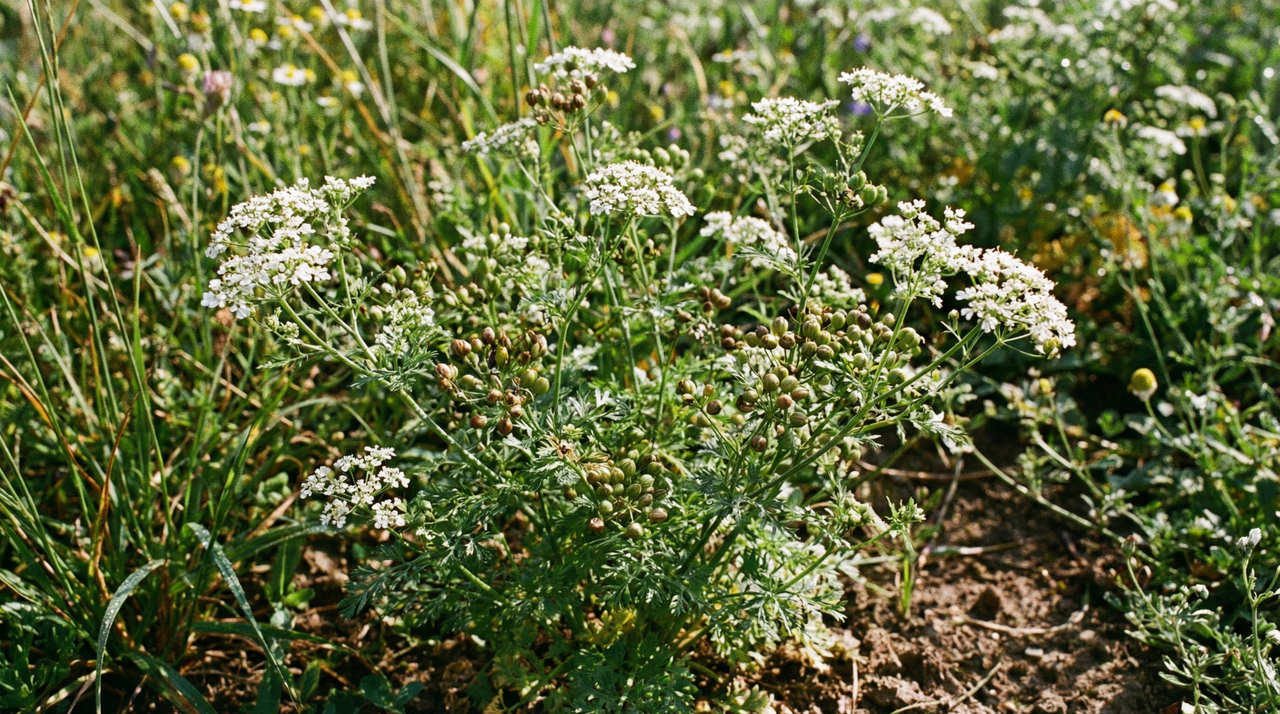
In the garden, coriander starts as a compact rosette of broad, deeply lobed basal leaves that could honestly pass for flat-leaf parsley or young carrot tops in the first couple of weeks. I always tell people to label their seedling rows carefully, because I've pulled what I thought were weeds and lost an entire early planting that way. As the plant matures, the leaves transition dramatically upward: finely divided, almost feathery, on branching stems that typically reach 30 to 60 centimeters tall from a slender taproot.[8][9]
Flowering brings the compound umbels: clusters of tiny white or faintly pink blooms, two to five millimeters across, arranged on five to ten rays like a delicate lacy parasol.[4][10] What follows are the "seeds," which aren't seeds at all botanically. Each fruit is a dry schizocarp, three to five millimeters across, that splits into two ribbed mericarps at maturity, going from pale green to a light golden brown.[4][10] If you grow other Apiaceae, you'll recognize the family resemblance immediately. The cultivar 'Purpureum' adds a purple flush to stems and petioles, and plants under heat stress bolt to taller, narrower-leaved forms almost before you notice the temperature has shifted.[11]
Traditional and Cultural Uses of Coriander Through History
Coriander has been with us for a very long time. Archaeological evidence places it in the Neolithic Levant as far back as 6000 to 5000 BCE, and seeds were found in Tutankhamun's tomb around 1323 BCE, used in mummification, as offerings symbolizing immortality, and in medicine.[12][13] That's 8,000 years of documented human relationship with a single plant.
From there it traveled everywhere. Ancient trade routes carried it to India by 2000 BCE and into China during the Han Dynasty; Spanish colonizers brought it to the Americas in the 16th century.[14] Hippocrates, Dioscorides, and Pliny the Elder all wrote about it for culinary and medicinal purposes,[15][16] and the Book of Numbers compared manna to coriander seed.[17] Ayurvedic texts knew it as Dhanyaka, prescribed for digestion, fever, and balancing doshas; Traditional Chinese Medicine used it as a cooling, detoxifying herb; and Middle Eastern folk traditions reached for it to ease anxiety and gastrointestinal complaints.[18][19] I respect that long ethnobotanical record, even if my own use is more likely fresh leaves over a summer salad than a formal Ayurvedic preparation. The plant's ritual presence extends from Hindu ceremonies and Jewish Passover to Latin American Day of the Dead altars and Ethiopian protective charms.[20] Worth noting too: what North Americans call "cilantro" (the fresh leaves) is simply "coriander" almost everywhere else in the world, a naming split that still confuses recipe readers daily.[21]
Interesting Facts About Coriander
Two main variety types define how people grow this plant: var. sativum, selected for broad leaves and leaf production, and var. microcarpum, with smaller fruits and higher essential oil content, grown primarily for seed.[22] Named cultivars like 'Santo' were bred specifically to slow that inevitable bolt. And the bolting itself is the thing that humbles every coriander grower eventually: once temperatures push above 75°F (24°C), especially combined with lengthening days and dry soil, the plant shifts from leafy to reproductive almost overnight.[23] In Central Florida I've watched it happen within days of a heat spike. The leaves narrow, the stems stretch, and the window for cilantro closes fast. Optimal leaf production lives in that 50 to 75°F range, and viable seed can persist in the soil for two to three years, so a well-placed patch will often return without any help from you.[24]
Then there's the soapy-taste phenomenon, which never stops surprising people at the dinner table. Somewhere between 4 and 14 percent of people, with higher rates among those of European descent, carry a variation in the OR6A2 olfactory receptor gene that makes fresh cilantro leaves smell and taste intensely of soap.[25][26] I have a sister-in-law who insists it ruins every dish it touches; it's entirely real, not a preference. The seeds, by contrast, are dominated by linalool rather than the aldehydes responsible for that reaction, which is why people who loathe fresh cilantro often enjoy ground coriander seed without complaint. And when the plant does flower, it earns its keep in a different way entirely: the umbels draw bees and butterflies reliably through summer, a small but genuine contribution to the pollinator community in any garden.[27]
Coriander Varieties and Where to Buy
Cilantro vs Coriander Cultivars: Choosing for Leaves or Seeds
The most important thing to understand about coriander cultivar selection is that you're really making a management decision, not a botanical one. Coriandrum sativum is a single species, but it's cultivated in two fundamentally different ways: as cilantro, where you're harvesting leaves and tender stems before the plant bolts, and as coriander, where you let the plant complete its full lifecycle and collect the dried seeds.[28][29] Every cultivar choice follows from that decision.
For leaves, slow-bolting varieties are non-negotiable in warm climates.[30] After trialing several over multiple seasons in zone 9B, 'Santo' and 'Calypso' have consistently given me the longest harvest windows before the plants shift to seed mode. 'Santo' delivers high leaf yield with solid bolt resistance; 'Calypso' is vigorous and adds a useful layer of downy mildew resistance that matters in humid summers.[31][29] Other reliable slow-bolting types include 'Leisure,' 'Slobolt,' 'Marino' (fine-leaved and great for cut-and-come-again), and 'Long Standing,' with newer heat-tolerant options like 'Maestro' and 'Spartan' starting to show up in trials for extending harvests in hotter regions.[32][33] In my experience, reaching for a named slow-bolting variety instead of an unlabeled generic packet can easily double your leaf harvest window.
For seed production, cultivars like 'Vulgare' and 'Cruenta' are selected for traits like uniform maturity, essential oil content, and branched plant architecture.[34] I think of cilantro types a bit like cut-and-come-again lettuce, while seed types behave more like a grain crop you commit to seeing all the way through to harvest. Structurally taller and more branched, seed cultivars reward patience rather than frequent cutting.[28] The flavor payoff is entirely different too, since the volatile chemistry of dried seeds is nothing like that of fresh leaves, which is worth remembering when you're deciding which direction to grow.[28]
Because coriander is a self-sowing annual, experimenting with multiple cultivars in a single season costs very little.[32][35] I'll often run a slow-bolt leaf variety alongside a seed type in the same bed and let whichever bolts first drop seed for the next succession.
Where to Source Coriander and Cilantro Seeds or Plants
Seeds are widely available from Johnny's Selected Seeds, Burpee, Seed Savers Exchange, High Mowing Seeds, Baker Creek Heirloom Seeds, and Territorial Seed Company, with live starts showing up at Home Depot and local nurseries seasonally.[36][37][38] Live plants typically run $3 to $5 for a starter seedling and $5 to $10 for a more mature pot.[38][39] I personally lean toward ordering seed from Johnny's or Seed Savers because germination rates from their packets have been noticeably more consistent in my trials than what I've found in generic big-box retail pouches. For a plant this inexpensive and this willing to self-sow, there's no reason not to try two or three varieties at once.
How to Propagate and Plant Coriander
Coriander is one of those plants that practically teaches you how to grow it if you pay attention to its biology. Everything about how it reproduces, germinates, and establishes points toward the same set of practical decisions, and once you understand a few key facts about the seed itself, most of the common beginner mistakes start to make sense.
Understanding Coriander Seeds: Morphology, Polyembryony, and Pollination
What we casually call a coriander "seed" is technically a schizocarp, a dry fruit that splits at maturity into two one-seeded halves called mericarps.[35][40] Each mericarp is globose to ovate, about 2 to 5 mm across, pale yellow to brown, ribbed on the outside, and carries two oil-bearing channels (vittae) that are largely responsible for that distinctive warm, citrusy scent.[4] It's one of the more botanically interesting seeds in the herb garden, though most people just crush them for spice without a second thought. What's less known is that coriander exhibits polyembryony, meaning a single seed can carry multiple embryos, both zygotic and nucellar, surrounded by abundant endosperm.[41][42] This contributes to the seedling vigor you'll notice when germination is good; multiple embryos per fruit means more genetic insurance in each planting.
For seed savers, the pollination profile is reassuring. Coriander is over 90-95% self-pollinating, with cross-pollination rates of only 5-10%.[43][44] If you want strict varietal purity you'd need isolation distances of 250-500 m, but in a typical home garden with only one or two cultivars growing, that's not a practical concern. I routinely save seed from my slowest-bolting plants and get strong germination the following season after storing them in a sealed jar in the refrigerator. The seeds are orthodox, meaning they don't have complex dormancy requirements, and remain viable for 2-3 years under ordinary cool, dry storage, and up to a decade under ideal conditions (5-10°C, 10-20% relative humidity, around 5-8% seed moisture content).[45][46][47] If you're unsure about an older batch, a simple germination test on damp paper towel at room temperature (20-30°C for 7-14 days) should show you at least 70% normal seedlings if the seed is still good.[48][49]
Direct seeding is the only method worth your time for home growing.[50][51] I learned this the hard way: even moving seedlings at the two-true-leaf stage with minimal root disturbance is often enough to trigger early bolting.[50] The taproot is sensitive, and any stress sends the plant a signal to flower and set seed as quickly as possible.[52] Vegetative propagation methods like cuttings, grafting, or layering exist in the literature but succeed at rates below 50% even under favorable conditions and simply aren't practical here.[53][54] One thing I always remind people: the first true leaves look remarkably like flat-leaf parsley or young carrot tops, feathery and delicate. I now label every row, because they're genuinely easy to confuse with emerging weeds or neighboring umbellifers at that stage.
Germination Timeline and Optimal Conditions
Expect germination in 7-15 days, usually closer to 7-10 when conditions are right.[55][56] Soil temperature is the main variable; the sweet spot is 55-70°F (13-21°C), though germination will occur anywhere from 50-77°F (10-25°C).[57] Fresh seed sown into that window achieves 70-90% success without any pretreatment. Older seed benefits from soaking 12-48 hours or light scarification, both of which help water penetrate the hard pericarp and speed things along.[55] Germination is epigeal, so the cotyledons push up out of the soil and are visible almost immediately. Compared to basil, which needs warmer soil (above 65°F at minimum) and can take two weeks or more before you see anything, coriander feels almost impatient.
Leaves are ready to harvest starting 30-45 days after sowing, and with consistent cutting you can keep a plant productive for several weeks before heat or day length pushes it toward flowering.[55][56] The real key to a continuous supply is succession sowing every 2-3 weeks rather than trying to extend a single planting indefinitely.[58] In hotter climates like mine (zone 9B), that succession rhythm runs from late summer through early spring; in cooler zones, it runs from early spring right up until summer heat arrives.
Soil, Site Selection, and Site Preparation
Coriander wants fertile, well-drained loamy or sandy-loam soil with a pH between 6.2 and 6.8.[4][32] It tolerates a broader range (5.5-8.0) but outside that optimal window you'll see problems: high pH above 7.5 causes interveinal chlorosis as iron becomes unavailable, while low pH below 6.0 risks aluminum and manganese toxicity.[56] I always test my beds before a fall planting because I've watched the color difference between plants in a bed at pH 6.5 versus a neglected corner sitting at 7.2 or higher; the pale, yellow-green leaves tell you immediately something is off. Organic matter in the 2-5% range improves both structure and nutrient availability, so working 2-4 inches of compost into the top 6-8 inches before sowing is worth doing.[51] For clay-heavy soils, gypsum at 1-2 lb per 100 sq ft improves drainage without shifting pH; dolomitic lime (1-2 lb per 100 sq ft) raises it, and sulfur brings it down, but always amend based on a soil test rather than guessing.[59] After seedlings emerge, a 2-3 inch layer of organic mulch conserves moisture and suppresses weeds without smothering the young plants.
For sunlight, 4-6 hours of direct sun is the minimum, but in hot climates afternoon shade actively slows bolting and is worth building into your site selection.[8][32] This is a Mediterranean native adapted to moderate rainfall (400-800 mm annually) and cool daytime temperatures in the 15-25°C range, so consistent moisture without waterlogging is essential during establishment.[60] In my raised beds in Central Florida, fall plantings into well-amended, well-drained soil almost always outperform spring ones simply because the temperature curve is working in my favor rather than against it. For containers, a mix of 2 parts potting soil, 1 part perlite, and 1 part compost gives you the drainage this plant needs without drying out too aggressively between waterings.[52]
Spacing, Sowing Technique, and Early Care
Sow seeds ¼ to ½ inch deep (0.5-1 cm), directly into their final position.[51] The spacing you choose depends almost entirely on your goal. For leaf production, start seeds 1-2 inches apart and thin to 6-8 inches between plants in rows 12-18 inches apart; this density (roughly 200-400 plants per square meter) keeps the canopy productive without crowding.[61][62] For seed production, give plants more room: 8-12 inches between plants with wider rows encourages the branched architecture that supports heavy flowering and seed set.[51] Mature plants reach 12-24 inches tall and spread 8-12 inches, so the tighter leaf-crop spacing does mean thinning is non-negotiable, not optional. In my experience, thinning to 6-8 inches strikes the best balance between yield and airflow before summer heat arrives; overcrowded rows are one of the fastest routes to disease pressure and accelerated bolting.
Regional timing matters just as much as spacing. In warm climates (zones 8-10), the productive window runs from late summer through fall into early spring; in cooler zones (3-7), sow as soon as soil can be worked in spring and continue successions until heat shuts things down.[63][58] Intercropping with taller plants that provide partial shade can create cooler microclimates and delay bolting in marginal conditions, though you need enough airflow between plants to avoid fungal problems.[64] Once seeds are in the ground, keep an eye out for damping-off in cool, wet conditions, aphids, and spider mites, all of which can affect young seedlings before they've had a chance to establish.[52][65] Good drainage and adequate spacing prevent most of these problems before they start.
Coriander Care Guide: Water, Sunlight, Feeding, and Maintenance
Every care decision you make with coriander is really a decision about time. How many weeks of leafy cilantro can you squeeze out before the plant shifts into flowering mode? That's the question that drives everything from where you position it in the garden to how you water it on a Tuesday afternoon in July. The plant isn't difficult, but it does have opinions, and learning to read them has shaped how I grow it more than any single book ever could.
Sunlight Requirements and Bolting Prevention
Coriander wants 4-6 hours of direct sun daily, but "full sun" in a Minnesota May is a completely different thing than full sun in a Florida August.[32][66] Once temperatures push past 75-80°F, afternoon shade stops being optional and becomes the main tool for protecting your leaf harvest. In my zone 9B garden, I've watched an identical planting split in two: the rows under 30% shade cloth stayed dark green and leafy for weeks, while the ones in full sun bolted and yellowed within days of a heat spike.[67][68] Morning sun with shade from noon onward is my non-negotiable setup for any summer or late-spring planting here. If that's not possible, I don't bother planting until fall.
Watering Needs and Soil Moisture Management
Consistent moisture is probably the single biggest lever you have against bolting, and coriander needs about an inch of water per week to maintain it.[32][69] I learned to respect the shallow-root system after digging up spent plants and seeing how the fine roots barely reach 8 inches down. That means the top several inches of soil need to stay evenly moist but never soggy, and a quick finger-check in the first inch of soil has become a daily habit for me during warm stretches. Both extremes hurt: overwatering brings yellowing, wilting, and root rot; underwatering can cut photosynthesis by up to 50% and push the plant straight into flower.[70][71] Seedlings do best with light watering every 2-3 days; established vegetative plants want a deeper soak once or twice a week, or daily in hot zones 7-11 during peak heat.[72][32] I use drip irrigation and 2 inches of mulch on every bed; both have done more for my leaf harvest windows than any other single practice.
Fertilizing and Nutrient Management
Coriander is a light feeder, and I'd rather under-fertilize it than over-fertilize it. A balanced slow-release product at 1-2 lbs per 100 square feet worked into the top 6-8 inches at planting, or 2-3 inches of compost incorporated beforehand, covers most of what it needs for the season.[73][74] If you're growing primarily for leaves, a modest nitrogen-forward side-dress after the first true leaves emerge makes sense; for seed production, shift toward a phosphorus-potassium focused ratio like 5-10-10 once flowering begins.[74][75] I once misread pale older leaves as nitrogen deficiency, applied a generous dose of extra N, and watched the whole planting bolt within a week. Now I always check soil pH first, because in alkaline conditions above pH 7.5, iron, zinc, and manganese lock up and cause interveinal chlorosis on young leaves that looks nothing like a simple nitrogen problem.[76][77][78] A quick soil test before reaching for the fertilizer bag has saved me from that mistake several times over.
Frost and Heat Tolerance
The RHS rates coriander H1c, meaning it's frost-tender and happiest between 15-25°C.[79] It can survive a brief dip to around -2°C, and some sources suggest hardened plants may tolerate -5°C for short windows, but young leaves, shoots, and flowers are the first casualties of any hard freeze.[51] Damage shows up as wilting followed by blackening and necrosis. For ground plantings, 2-4 inches of straw mulch or a floating row cover at the first frost forecast buys real protection; I keep a few containers on a rolling cart precisely so I can wheel them under cover when 28°F shows up in the forecast, which has let me keep volunteer seedlings alive through milder winters.[80][51] On the heat side, temperatures above 30°C trigger wilting, leaf scorch, reduced photosynthesis, and rapid bolting, and germination drops sharply once soil temps climb past that threshold.[81] Coriander is rated for AHS Heat Zones 1-9 but really performs best where fewer than 30 days exceed 86°F.[82][83] Shade cloth, consistent irrigation, and cultivars like 'Slow Bolt' or 'Santo' are the tools that make hot-climate growing viable; the varieties section goes deeper on cultivar differences.[84]
Seasonal Rhythm, Pruning, and Maintenance
The coriander clock runs fast. Germination happens in 7-14 days, the plant reaches harvestable leaf size in 30-45 days, and under heat or long days it can push into flower by day 50-65, with seed set completing around day 90-120.[51][85] Heat and day length compress that timeline aggressively, which is why succession planting every 2-3 weeks matters so much in warm climates. The maintenance work that actually extends production comes down to consistent leaf harvesting from the outside of the plant, pinching flower buds the moment you see them forming, and cutting the main stem tip when plants reach 4-6 inches tall to encourage branching rather than a single bolt-prone stalk.[64][51] A 1-2 inch layer of organic mulch applied after seedlings emerge ties all of it together, moderating soil temperature, holding moisture, and suppressing weeds without burying the crowns. Staking is rarely worth the effort unless you're growing a tall seed-crop variety in a windy spot. The harvesting section covers precise cues for both leaf and seed harvest, but the care principle is simple: the more you harvest, the longer the plant works for you.
How to Harvest Coriander (Cilantro Leaves and Seeds)
Every coriander plant forces a decision, and you need to make it early. Are you growing for leaves or for seed? You can chase both from the same planting, but only if you understand that the two harvests follow completely different timelines and respond to completely different cues. Getting that decision wrong is how you end up with bitter leaves you didn't want or a seed crop that shattered onto the ground while you weren't paying attention.
Timing and Signs of Readiness for Leaves vs. Seeds
For leaf harvest, the window opens when plants hit 4 to 6 inches tall with dense, lush foliage, usually 45 to 70 days after sowing.[51][86] Once bolting begins, triggered by temperatures pushing past 75 to 80°F somewhere around day 40 to 60, the leaves turn sharper and more metallic within days.[87][58] I learned this the hard way: the first white flowers appear, you think you have a few more days, and then you go out there and the whole character of the herb has shifted. Now I harvest aggressively the moment I see a flower stalk forming. Succession sowing every 2 to 3 weeks through late spring and early fall is genuinely the only reliable strategy for a steady supply before summer heat shuts the door.[58][88]
For seed, the timeline is longer: 90 to 120 days from sowing, or roughly 30 to 45 days after flowering.[51][89][90] The readiness cue I love is auditory: when 70 to 80% of seeds have turned from green to tan or brown, give an umbel a gentle shake close to your ear. If the seeds rattle like tiny dried beans in a pod, you're there. Don't wait for every single seed to brown, because the first to ripen will start dropping.
Harvest Techniques and Post-Harvest Handling
For leaves, cut-and-come-again is the method. Snip the oldest outer leaves at the base with scissors, leaving the central rosette and growing point completely intact.[51][32] Morning is the right time, after the dew dries but before the day heats up. In Florida's humidity I take this seriously: the aromatic aldehydes that give fresh cilantro its bright flavor dissipate fast once the plant is cut and warm, so I harvest, get it inside, and refrigerate immediately. Every 7 to 10 days works well while plants are actively in their leafy phase.[91]
For seeds, let the plant complete its full cycle. When most seeds have browned and the rattle is there, cut the entire umbels or the whole plant and hang them upside down inside a paper bag in a warm, dark, ventilated spot around 70 to 80°F.[51][89][91] The bag catches anything that drops during drying. Thresh, shake out the chaff, and store in an airtight container away from light. Done right, dried coriander seeds stay viable for the kitchen for 1 to 2 years.
Flavor, Yield, and What Affects Them
Fresh cilantro leaves get their bright, citrusy character from aldehydes, primarily (E)-2-decenal and decanal.[92] A genetic variation in the OR6A2 receptor causes 10 to 20% of people to perceive those same compounds as soapy or metallic.[93][94] In my classes I tell people: if cilantro tastes like dish soap to you, it's not a preference, it's genetics. Focus on the seeds. Virtually everyone finds those appealing.
The seeds are a completely different flavor world, dominated by linalool (60 to 70%), which delivers sweet, floral, spicy warmth, with monoterpenes like α-pinene adding peppery depth.[92][95] Hotter, drier growing conditions increase linalool content, and I notice this in my own garden: a dry summer produces seeds that smell noticeably richer than those from a wet, cool one.[96] Light toasting before using intensifies that sweetness while reducing any residual bitterness.[95]
For yield expectations: a single planting harvested with cut-and-come-again will give you several weeks of leaves before bolting ends the run,[97] which is why succession planting isn't optional if you cook with cilantro regularly. One mature plant delivers enough dried seed to fill a small spice jar with plenty left to save for next year's sowing.[91][97] Plan your bed size around that math.
Coriander Preparation, Culinary Uses, and Beyond
Edible Parts: From Cilantro Leaves to Coriander Seeds, Roots, and More
Every part of Coriandrum sativum is edible and safe in culinary amounts, leaves, stems, roots, seeds, and flowers all included.[21][32] That said, if you're ever foraging rather than harvesting from a plant you grew yourself, get confident with identification first. Poison hemlock (Conium maculatum) and fool's parsley (Aethusa cynapium) are both Apiaceae relatives that look unsettlingly similar, and neither is something you want in your salsa.[98][99]
The leaves are what most Western cooks know as cilantro: fresh, citrusy, occasionally peppery, and notoriously controversial. The soapy perception that about 10-20% of people experience is a real genetic variation in the OR6A2 olfactory receptor, not a matter of taste or tolerance.[100] I've watched family members push cilantro to the edge of their plates for years, and I've stopped arguing with them. Cooking the leaves can reduce that soapy note somewhat, which is worth knowing if you're trying to convert someone.[101]
The seeds are a completely different flavor experience. Dried and toasted, they develop a warm, floral, spicy-sweet aroma driven primarily by linalool, which makes up 40-60% of the essential oil.[102] Toasting before grinding pulls out their nuttiness in a way raw seeds just can't match. They anchor spice blends like garam masala, ras el hanout, and Chinese five-spice, and they're essential in pickling brines and bread doughs across multiple culinary traditions.[21]
The roots deserve more attention than they get in Western kitchens. Intensely citrusy and spicy, they're a foundation ingredient in Thai curry pastes and other Southeast Asian applications.[32] Tender stems are milder versions of the leaves and are fine to chop right in. Even the flowers are edible, with a soft herbaceous flavor that works well scattered over salads or used as a garnish.[21]
Leaf-based uses skew toward bright, acidic pairings: lime, chilies, tomatoes, avocado, and raw onion. Cilantro is foundational to Mexican salsas, guacamole, Indian chutneys, and Middle Eastern salads.[103] A simple cilantro lime rice recipe, whether it's a copycat coriander lime rice or something you improvise from your own garden harvest, captures this pairing perfectly: rice recipes with cilantro almost always reach for fresh lime juice and raw leaves added at the very end. That's exactly the right instinct, as the volatile oils that give the leaves their brightness are the first thing lost to heat.
Preparation Methods, Cooking Tips, and Storage
The rule I follow in my own kitchen is simple: seeds go in early, leaves go in last. For a cilantro recipe of any kind, whether a sauce, soup, or rice dish with cilantro, adding the leaves in the final thirty seconds of cooking keeps those citrus volatiles intact rather than driving them off with steam.[104] In my Central Florida garden, where plants bolt fast, I'm harvesting constantly, which means I always have fresh leaves on hand but rarely more than I can use in a week.
For storage, fresh leaves wrapped in a damp towel stay usable in the refrigerator for one to two weeks at around 0-5°C.[89] Drying them is largely a waste of time since flavor loss is significant. What actually works is freezing: chopped leaves packed into ice cube trays with olive oil hold their flavor remarkably well, and I drop those cubes directly into winter soups when nothing is growing outside.[105] Dried seeds are far more forgiving; store them cool and dry at 10-15°C with low moisture and they stay potent for a year or more.[106]
Humans have been doing all of this for over 5,000 years, which puts our current kitchen habits in reassuring company.[107] Coriander holds GRAS status from the FDA for culinary use, though it can trigger allergic reactions in people sensitive to Apiaceae plants, and it carries mild hypoglycemic and anticoagulant properties worth knowing about if you're managing blood sugar or taking blood thinners.[108]
Medicinal Preparations and Dosages
Traditional medicine has long distinguished between plant parts for specific applications: seeds for carminative and antimicrobial uses, leaves for their digestive and cooling effects, with the whole plant used more broadly for inflammation, anxiety, and general wellness.[109][103] A simple seed infusion, one to two teaspoons of crushed seeds per cup of hot water, drunk up to three times daily, is the preparation I reach for at home when my digestion needs a nudge.[110] For those exploring more concentrated forms, tinctures are typically dosed at 2-5 mL two to three times daily, and powdered seed at 0.5-1g two to three times daily.[111][112] Essential oils are a different story entirely; even 1-2 drops need to be diluted, and I wouldn't exceed 0.5 mL daily without guidance from a qualified practitioner, particularly for anyone on anticoagulants or with Apiaceae allergies.
Traditional and Non-Food Uses
Beyond the kitchen, coriander seeds yield a soft yellowish dye, and stems have occasional minor fiber applications, though neither is a primary reason anyone's growing it.[103] I've experimented with the seed dye on natural fabric and gotten a warm, subtle result, the kind of gentle color that suits the plant's character. On a larger scale, commercial coriander cultivation carries real environmental weight: crops require 300-500 mm of water per season, heavy pesticide use in some regions harms pollinators, monocultures erode genetic diversity, and smallholder farmers in major producing countries like India navigate significant labor equity challenges, with Fairtrade certification providing only partial remedy.[113] Growing it yourself sidesteps nearly all of that. A few successions of direct-sown seed in a kitchen garden or food forest understory costs almost nothing, produces zero pesticide residue, and keeps the full genetic and culinary range of the plant alive in your own hands.
Coriander Health Benefits and Medicinal Uses
Key Phytochemicals in Coriander: Linalool, Flavonoids, and Phenolic Acids
The first thing to understand about coriander's chemistry is that the fresh leaves and dried seeds are genuinely different medicines in the same plant. Both are dominated by linalool, the monoterpenoid responsible for that distinctive floral-citrus aroma, which makes up to 70% of seed essential oil and a similar proportion in leaf oil.[114][115] The infamous "soapy" perception that roughly one in ten people experience? That traces primarily to the aldehyde fraction, specifically decanal and (E)-2-decenal, which make up 5-10% of the oil alongside geraniol and α-pinene.[116] For those of us who don't carry that genetic sensitivity, those same aldehydes contribute to the herb's complexity.
Beyond the oils, the leaves are where the flavonoid and phenolic action is concentrated. Quercetin, kaempferol, and rutin run 5-10 mg/g flavonoid glycosides in fresh leaves, with trace amounts in seeds by comparison.[117][118] Total phenolic content in leaves runs 20-30 mg/g versus 10-15 mg/g in seeds, with chlorogenic, caffeic, ferulic, and p-coumaric acids all present.[119][114] Seeds, meanwhile, concentrate coumarins including coriandrin, umbelliferone, and herniarin, along with trace saponins, tannins, and alkaloids.[120][117]
I've noticed that seeds harvested from plants grown through a hot, dry spell are noticeably more aromatic than those from cooler, wetter seasons, which aligns with research showing that drought stress and high temperatures push linalool and phenolic concentrations higher.[121][122] Regional origin matters too: Indian varieties tend toward high linalool, while Egyptian types skew toward decanal.[123] Drying seeds can reduce volatile oil content by up to 50%, which is one reason fresh-ground seed tastes so much livelier than pre-ground.[122] All of these compounds, collectively, function as the plant's own defense system against herbivores and pathogens, and it's that same defensive chemistry that drives the antioxidant, antimicrobial, and anxiolytic effects researchers keep documenting.[114][124]
Scientific Evidence for Coriander's Medicinal Properties
The strongest mechanistic evidence centers on anti-inflammatory and antioxidant activity. Coriander extracts inhibit pro-inflammatory cytokines, suppress NF-κB signaling, and block COX-2, while on the antioxidant side they activate the Nrf2 pathway and upregulate cytoprotective enzymes HO-1 and NQO1.[125][126] In practical terms, this explains the traditional use for digestive inflammation and bloating that Ayurvedic and Unani practitioners documented long before molecular biology existed to explain it.[127] I've seen this firsthand: a small handful of fresh leaves stirred into a warm meal consistently seems to ease the post-dinner heaviness that otherwise follows a rich, spiced dish.
The essential oil and extracts also show meaningful antimicrobial activity against both gram-positive and gram-negative bacteria, including E. coli and S. aureus, as well as fungi, with linalool and the aldehyde fraction disrupting cell membranes and inhibiting DNA gyrase.[128][129] Beyond that, linalool's GABA-A receptor modulation produces anxiolytic and sedative effects confirmed in animal models, and separate studies point toward analgesic activity and acetylcholinesterase inhibition that may have neuroprotective implications down the line.[130][131]
On the metabolic front, coriander inhibits α-glucosidase (slowing carbohydrate absorption) and activates PPARγ to improve insulin sensitivity, with consistent hypoglycemic results in diabetic rat models.[132][133] A randomized trial in metabolic syndrome patients showed improved antioxidant status, which is promising, though I'd characterize the human evidence base as "encouraging and preliminary" rather than definitive.[134] Preclinical findings also include hypocholesterolemic effects from petroselinic acid in seed oil, ACE inhibition suggesting blood pressure benefits, diuretic and antispasmodic activity, and even preliminary anticancer potential via PI3K/Akt-mediated apoptosis, with one pilot clinical study supporting wound healing.[135][136] The pattern across all of these areas is consistent: compelling mechanistic data, solid animal studies, and a handful of small human trials that need much larger follow-up work.[137]
Nutritional Profile of Coriander Leaves and Seeds
A realistic serving of fresh cilantro leaves is about 4 grams, roughly a tablespoon chopped, and coriander seeds around 1.8 grams per teaspoon.[138] Small servings, yes, but the leaf's nutritional density is real. At 23 kcal per 100 g with 92% water content, fresh leaves deliver 310 μg vitamin K, 674 μg RAE vitamin A, 27 mg vitamin C, 62 μg folate, and 521 mg potassium alongside meaningful iron and calcium.[138] For comparison, parsley, which many gardeners already grow, provides similar vitamin K levels, so if you're already reaching for fresh herbs in your kitchen, you have an intuition for how that density stacks up. The leaves also carry the quercetin and luteolin content established earlier, which adds antioxidant value beyond what the basic mineral panel captures.[138]
Dried seeds are a different creature entirely: 298 kcal per 100 g, 12 g protein, nearly 18 g fat (including the cholesterol-relevant petroselinic acid), 41 g fiber, and striking mineral density with 709 mg calcium and 1,267 mg potassium.[139] For cooking, the practical takeaway from fact #16 is straightforward: I learned to add cilantro at the very end of a dish, off the heat, because steaming retains 80-90% of its vitamin C while boiling destroys 50-70% of it, and drying the leaves loses 40-60%.[140] For seeds, grinding before use improves mineral bioavailability.[141] Typical serving sizes mean the net nutritional contribution to a single meal is modest, but coriander used consistently across a varied diet is genuinely useful rather than merely decorative.
Safety Profile and Precautions for Coriander
For the vast majority of people using coriander in the kitchen, this is a safe herb. The FDA classifies it as GRAS, the European Medicines Agency recognizes the dried fruit as a traditional herbal medicinal product for digestive complaints with no major safety concerns at appropriate doses,[142] and typical medicinal dosages sit at 1-3 g of seed powder daily with uncommon side effects at those levels.[143][144] Those with Apiaceae family sensitivities (celery, carrot, dill) should be aware that cross-reactivity is possible, so mild allergic responses are worth watching for.
Concentrated essential oil is a different matter. Animal studies indicate toxicity at doses around 1 mL/kg, with potential for nausea, vomiting, seizures, and hepatotoxicity at high levels.[143] The oil also shows uterine stimulant activity in animal models, so pregnant women should keep use to culinary amounts and avoid medicinal extracts or concentrated preparations.[111] If you're managing blood sugar with medication, the antidiabetic effects discussed above are real enough that I'd recommend monitoring glucose levels carefully when consuming coriander in larger medicinal quantities alongside antidiabetic drugs.[145] Mild anticoagulant activity has been noted, though significant interactions with warfarin specifically have not been confirmed.[146]
The safety concern I take most seriously, though, is look-alike identification. Coriander is an Apiaceae, a family that includes some of the most toxic plants in temperate gardens: poison hemlock (Conium maculatum), water hemlock (Cicuta spp.), and wild parsnip.[147][148] I've had volunteer seedlings appear in my garden that made me pause long enough to check the stem (hollow vs. solid), check for purple mottling, and, most reliably, crush a leaf and smell it: true coriander has an unmistakable scent that hemlock, with its unpleasant musty odor, simply cannot fake. Never skip that step. For home growers, excess nitrogen fertilization can also elevate leaf nitrate content,[149] and gardeners with sap sensitivity should wear gloves when handling large quantities of fresh plant material. None of this should discourage you from growing coriander; culinary use is genuinely low-risk for most people. It just warrants the same common sense you'd bring to any plant in this family.
Coriander Pests and Diseases
Coriander is not the toughest herb in the garden. It has a real susceptibility to several foliar diseases and a cast of insect pests that can flatten a patch quickly if conditions favor them. That said, I've grown it long enough to know that smart management beats chemical dependence every time, and the plant's own aromatic chemistry gives you more leverage than you might expect.
Common Diseases in Coriander
If you're looking at your coriander and wondering what went wrong, there are three diseases most likely responsible. Downy mildew, caused by Peronospora species, shows up as yellow spots on upper leaf surfaces with a grayish, fuzzy growth underneath; it thrives in cool, wet conditions.[150] Bacterial leaf spot (Xanthomonas campestris pv. coriandri) produces water-soaked lesions that turn necrotic in warm, humid weather, and the pathogen can arrive right in the seed.[151] Powdery mildew, from Erysiphe species, looks like someone dusted white flour across the leaves and favors high humidity with moderate temperatures.[152] After several humid growing seasons, I've learned to check leaf undersides the moment I see yellowing; catching downy mildew early enough to pull affected plants before spores spread has saved more than one succession planting for me.
Disease risk climbs sharply above 27°C when humidity exceeds 80%, while conditions in the 10-24°C range with 50-70% relative humidity keep plants much healthier.[51] Starting with tolerant cultivars helps. 'Slow Bolt', 'Calypso', and 'Santo' all show improved tolerance to powdery mildew and bacterial leaf spot.[153] I switched to 'Slow Bolt' after watching an older variety bolt and mildew simultaneously in the same week; it's not immune, but the difference in a humid fall planting is noticeable. No cultivar is fully immune to all pathogens; resistance is partial across the board.[154][153]
Major Insect Pests and Natural Defenses
Coriander carries moderate to high susceptibility to aphids, thrips, flea beetles, whiteflies, leafhoppers, and caterpillars.[155][156] Aphids are the most troublesome: they sap vigor, transmit viruses, and produce honeydew that leads to sooty mold; they can reach damaging populations fast, especially under cover.[155] Thrips cause silvery scarring on leaves and flowers, with damage worsening in hot, dry stretches.[155][157] Flea beetles punch shot-hole damage mostly into young plants, with partial resistance linked to cultivar-specific leaf compounds and surface traits.[155][158]
The plant's glandular trichomes secrete volatile oils rich in monoterpenes like linalool and geraniol that repel or disorient pests while simultaneously attracting beneficials.[159][160] I use rubbing a leaf and noticing that sharp linalool hit as a quick field check; a robust-smelling plant usually signals those trichomes are working. Within the Apiaceae family, coriander actually fares better than carrots or parsley against root pests like carrot fly, though it remains vulnerable to foliar insects compared with fennel.[161] Experimental lines like 'Vasya' show partial aphid resistance and 'Lemon' shows mite tolerance, but no commercial selection delivers broad-spectrum protection.[153] Pest pressure also shifts by region: in warmer growing zones I watch whitefly and thrips numbers closely, while growers in temperate climates tend to battle flea beetles and leafminers more; hot, dry conditions above 25°C accelerate aphid and spider mite cycles.[162][163]
Integrated Management and Prevention
The approach that actually works combines several levers at once. Cultural practices form the foundation: 2-3 year crop rotation with non-hosts, spacing plants well for airflow, keeping beds clean, and ditching the overhead watering habit that leaves foliage wet for hours.[164] Companion planting with basil, marigolds, or legumes can reduce pest pressure further when layered on top of those cultural steps.[165] I reach for neem or insecticidal soap only after beneficials and cultural interventions haven't been enough; the research backs this up, and my own results confirm that keeping the spray bottle as a last resort preserves the ladybugs and parasitic wasps that do the real heavy lifting against aphids and thrips.[64][166] The system isn't perfect and no single tactic is bulletproof, but a gardener who monitors regularly, spaces generously, and gardens with natural predators in mind will keep coriander productive through most of the season.
Coriander in Permaculture Design
Most people grow coriander for the kitchen and never think much about what it's doing for the rest of the garden. That's a missed opportunity. Even as a short-lived annual, this plant earns its space in a designed system by feeding beneficial insects, discouraging pests, and filling a structural niche that perennials simply can't cover in the same way.
Forest Layer and Guild Placement
Coriander sits squarely in the herbaceous layer of a food forest, reaching anywhere from 20 to 70 cm tall with a shallow taproot that explores just 15 to 30 cm of soil.[8][4] That shallow profile means it threads neatly between deeper-rooted perennials like fruit trees and shrubs without competing for the same resources. I always tell people it behaves a lot like carrot or parsley in the early weeks of growth, which is actually why I label my rows obsessively now after one spring where I pulled what I thought were weeds and lost half a planting.
In terms of guild placement, coriander works beautifully alongside tomatoes, spinach, carrots, beans, cucumbers, and brassicas.[167][82] Keep it well away from fennel. I learned that the hard way early on when an experimental pairing showed visible growth inhibition; the two just don't coexist happily, and the research on allelopathic interactions backs that observation up.
Its soil contributions are real but modest. The taproot functions as a mild dynamic accumulator, drawing up minerals from the subsoil, and chopped foliage makes a fast-decomposing green mulch that improves tilth during cool seasons.[168] I want to be clear though: coriander does not fix nitrogen, and its stature and annual lifecycle limit its value for erosion control. Think of the soil benefits as a nice bonus rather than a design rationale.
Ecosystem Functions and Companion Planting
Here's where coriander genuinely surprises people. Those small white umbel flowers attract over 50 species of pollinators and beneficial insects, including bees, hoverflies, ladybugs, and predatory wasps.[169][170] I've stood next to a bolted plant on a warm morning and counted a dozen different visitors in under a minute. The individual florets are tiny, just 1 to 2 mm across in compound umbels spanning 2.5 to 7.6 cm, but the architecture makes nectar accessible to insects with short mouthparts that can't reach deeper flowers.[171][8]
The plant is primarily self-pollinating, protandrous and self-compatible, with cross-pollination rates that typically stay under 5 to 10%.[171] That said, I've seen noticeably better seed quality in patches where beneficial insect populations are healthy, which tells me that even low-frequency insect visits add up across a planting. Optimal conditions for seed set sit at 15 to 25°C with moderate humidity between 50 and 70% and light winds.[172]
On the pest-suppression side, coriander repels aphids, spider mites, whiteflies, and cabbage moths, and its roots produce mild allelopathic compounds that can suppress certain weeds.[173][167] Since I started interplanting it among tomatoes and brassicas, my aphid pressure has dropped noticeably without any sprays. That's consistent with what the peer-reviewed research on coriander as a companion plant for cilantro-adjacent polycultures documents. One practical note: aphids and spider mites that do find the plant can damage flowers and reduce seed set by 20 to 30% in heavy infestations,[174] so skip the broad-spectrum sprays if you want those beneficial insect communities intact.
Climate Adaptation and USDA Zones
Coriander is listed across USDA zones 2 through 11, which sounds impressive until you understand what that actually means: it's an annual that can be timed into nearly any climate, not a perennial that persists through winters.[4][175] Only in zones 10 and 11 can it behave like a short-lived perennial, reseeding itself through mild winters.
Mature plants handle brief dips to around 25°F (-4°C), though young seedlings start showing damage closer to 28°F (-2°C).[176][177] The bigger threat for most gardeners isn't cold, it's heat. Optimal growth happens between 50 and 85°F, with the sweet spot for leaf production sitting between 60 and 75°F. Sustained temperatures above 75 to 85°F trigger bolting, which shifts the plant's energy from producing leaves to producing seed.[62][51][74]
In hotter seasons, I've watched plantings shift to seed production faster than I expected, sometimes within weeks of germination during a warm spring. That experience pushed me toward fall planting for leaf harvests and succession sowing every two to three weeks when temperatures are marginal. In northern zones, spring sowing after last frost works well; in zones 8 through 11, fall and winter planting is where reliable cilantro harvests actually happen. The plant needs 400 to 600 mm of water across a growing season and performs best with consistent soil moisture and moderate humidity,[178][179] which in practice means designing its placement with access to irrigation or a reliably moist microclimate during its short but productive window.
The Plant That Taught Me to Stop Fighting the Bolt
I spent my first few seasons treating bolting like failure, yanking plants the moment a flower stalk appeared. Now I leave a few to go fully to seed every time, and something about watching those umbels fill with round, ribbed mericarps still gets me. Coriander has a way of being useful on its own terms, not yours, and once I stopped arguing with that, we got along a lot better.
Sources 179
- Genetic variants associated with cilantro preference, Nature Genetics ↩
- Plants of the World Online by Kew Gardens ↩
- Peer-Reviewed Literature: Brill, Y., & Seigler, D. S. (2012). Cladistics and Biogeography of Coriandrum and Related Genera. Springer. ↩
- USDA PLANTS Database - Coriandrum sativum ↩
- Invasive Plant Atlas - Coriandrum sativum ↩
- Missouri Botanical Garden, Plant Finder - Coriandrum sativum ↩
- Royal Horticultural Society, Plant Finder - Coriandrum sativum ↩
- Missouri Botanical Garden - Coriandrum sativum ↩
- Coriandrum sativum - Flora of North America ↩
- Botanical Description of Coriander Fruit - Kew Science ↩
- Cultivar Descriptions: Coriander Varieties Including 'Purpureum' ↩
- Archaeobotanical Evidence for Coriander in the Ancient Near East ↩
- Coriander in Ancient Egypt ↩
- History of Spices in China ↩
- De Materia Medica by Dioscorides ↩
- Natural History by Pliny the Elder ↩
- Spices and Symbolism in the Bible ↩
- Traditional Uses of Coriander in Ayurveda ↩
- Ethnobotany of Coriander (Coriandrum sativum L.) ↩
- Herbs in Hindu Rituals ↩
- Wikipedia: Coriander ↩
- Coriandrum sativum L. ↩
- Cilantro (Coriandrum sativum) Production ↩
- Coriandrum sativum (Cilantro, Coriander) ↩
- An SNP in the Olfactory Receptor Gene OR6A2 is Associated with Cilantro Preference ↩
- Genetic Variation in Taste Perception: The Role of OR6A2 in Cilantro Aversion ↩
- Plant Finder - Coriander ↩
- Missouri Botanical Garden Plant Finder - Coriandrum sativum ↩
- UC Master Gardener Program - Herbs: Cilantro ↩
- Kew Science - Plants of the World Online - Coriandrum sativum ↩
- Downy Mildew Resistant Cilantro Varieties ↩
- RHS Herbs: Coriander ↩
- Cilantro Production Guidelines ↩
- Coriander Cultivars for Seed Production ↩
- Kew Gardens: Coriandrum sativum ↩
- Cilantro Seeds ↩
- Coriander Seeds ↩
- Burpee Cilantro Plant ↩
- Home Depot - Bonnie Plants Cilantro ↩
- Coriandrum sativum L. ↩
- Polyembryony in Coriandrum sativum L. ↩
- Seed Anatomy and Embryology of Apiaceae ↩
- Pollination Biology of Coriander ↩
- Guidelines for Seed Production of Herbs ↩
- Seed Information Database - Kew Science ↩
- Seed Storage of Horticultural Crops ↩
- Coriander Seed Viability and Storage ↩
- ISTA International Rules for Seed Testing 2023 ↩
- Tetrazolium Testing for Seed Viability - AACC International ↩
- Plant Finder - Coriandrum sativum ↩
- Coriander/Cilantro ↩
- Coriander, Cilantro and Fenugreek Home Garden Plants ↩
- Micropropagation of Coriandrum sativum L. through axillary shoot proliferation ↩
- Grafting in the Apiaceae Family: Opportunities and Challenges ↩
- Coriander ↩
- Growing Coriander ↩
- Cilantro Production Guidelines ↩
- Coriander, Cilantro - UC IPM ↩
- Amending Garden Soil with Lime and Gypsum ↩
- Coriander (Coriandrum sativum L.): Processing, Phytochemical Composition and Health Benefits - PMC ↩
- Coriander Production Guidelines - University of California Agriculture and Natural Resources ↩
- How to Grow Cilantro ↩
- Growing Coriander in North Dakota ↩
- Cilantro / UC Statewide IPM Program ↩
- Missouri Botanical Garden Plant Finder ↩
- Coriander Production Guide - UC ANR ↩
- Heat Stress Effects on Coriander Plants ↩
- Physiological Responses of Coriandrum sativum to High Temperatures ↩
- USDA Plant Guide for Coriandrum sativum ↩
- University of Minnesota Extension: Growing Coriander/Cilantro ↩
- Effect of Water Stress on Growth and Yield of Coriander ↩
- Coriander Production Guidelines ↩
- University of Minnesota Extension - Cilantro (Coriandrum sativum) Care ↩
- Cilantro Production Guide - Texas A&M AgriLife Extension ↩
- Fertilizing Herbs - University of Minnesota Extension ↩
- Coriander Production in California ↩
- Micronutrient Disorders in Herbs: Focus on Cilantro ↩
- Visual Guide to Plant Nutrient Deficiencies ↩
- Coriander / RHS ↩
- Frost Injury to Herb Crops ↩
- Physiological Responses of Coriandrum sativum to Heat Stress ↩
- Coriander (Cilantro) ↩
- Cilantro Production - UC Agriculture and Natural Resources ↩
- Heat Tolerance in Cilantro: Varietal Screening and Essential Oil Quality ↩
- UC IPM, Pest Note - Coriander ↩
- Cilantro in the Garden ↩
- Phenology of Coriandrum sativum ↩
- NCSU Extension Gardener Handbook: Coriander - Coriandrum sativum ↩
- Growing Cilantro and Coriander ↩
- Coriander (Coriandrum sativum) Production ↩
- Harvesting and Storing Herbs ↩
- Volatile Composition of Coriander (Coriandrum sativum L.) Essential Oils ↩
- Genetic Background of the Perception of Androstenone and Cilantro Aldehydes ↩
- The Soapy Taste of Coriander: A Genetic Perspective ↩
- Essential Oil Composition of Coriander Seeds: Influence of Drying and Region ↩
- Effect of Climate on Coriander Essential Oil Yield and Composition ↩
- Growing Coriander ↩
- Poison Hemlock vs. Wild Parsley - USDA Forest Service ↩
- Aethusa cynapium - Wikipedia ↩
- Genetic basis for cilantro soapy perception (PNAS, 2012) ↩
- UC Master Gardener Program: Growing Coriander (Cilantro) ↩
- Linalool and linalyl acetate in coriander seeds (Food Chemistry, 2005) ↩
- Ethnobotany of Coriandrum sativum ↩
- Missouri Botanical Garden Plant Finder ↩
- FAO - Post-Harvest Management of Spices ↩
- Cilantro in the Garden ↩
- Ethnobotany of Coriandrum sativum ↩
- Coriandrum sativum - StatPearls - NCBI Bookshelf ↩
- Medicinal Properties of Coriandrum sativum: A Review ↩
- Coriandrum sativum - Herbal Monograph ↩
- Coriander - Drugs and Lactation Database (LactMed®) ↩
- British Herbal Pharmacopoeia - Coriander ↩
- Sustainability Challenges in Coriander Cultivation ↩
- Phytochemical and Pharmacological Properties of Coriandrum sativum: A Review ↩
- Essential Oils of Coriandrum sativum L.: Chemical Composition and Biological Activities ↩
- Chemical Composition and Antioxidant Activity of Coriandrum sativum L. Essential Oil ↩
- Phytochemical Composition and Pharmacological Activities of Coriandrum sativum ↩
- Flavonoid Content in Cilantro Leaves (Coriandrum sativum L.) ↩
- Secondary Metabolites of Coriander (Coriandrum sativum L.): Phytochemical Analysis ↩
- Coumarins from Coriandrum sativum and Their Biological Activities ↩
- Environmental Factors Affecting Essential Oil Yield in Coriandrum sativum ↩
- Variation in Essential Oil Composition of Coriandrum sativum L. from Different Geographical Origins ↩
- Comparative Analysis of Chemical Constituents in Different Parts of Coriander Plant ↩
- Essential Oils of Coriandrum sativum: Composition and Bioactivity Review ↩
- Pharmacological potential of Coriandrum sativum: A review ↩
- Antioxidant Activity of Coriander through Nrf2 Pathway ↩
- Coriandrum sativum: A Comprehensive Review of its Phytochemicals, Pharmacological Activities, and Ethnomedicinal Uses ↩
- Antimicrobial activity of coriander essential oil ↩
- Antimicrobial Mechanisms Involving DNA Gyrase ↩
- Linalool and GABA_A Receptor Modulation ↩
- Analgesic and anti-inflammatory effects of Coriandrum sativum seeds ↩
- Antidiabetic and Hypolipidemic Effects of Coriandrum sativum Seeds in Streptozotocin-Induced Diabetic Rats ↩
- Inhibitory Effects on α-Glucosidase and ACE ↩
- Antioxidant effects of Coriandrum sativum in metabolic syndrome: A randomized trial ↩
- Bioactive Compounds in Coriander and Their Health Benefits ↩
- Clinical evaluation of coriander extract in wound healing ↩
- Medicinal Properties of Coriander (Coriandrum sativum L.): A Review ↩
- USDA FoodData Central - Cilantro (coriander leaves), raw ↩
- USDA FoodData Central - Spices, coriander seed ↩
- Effect of Cooking on Vitamin C Content in Selected Vegetables ↩
- Bioavailability of Minerals from Ground Spices ↩
- European Medicines Agency - Coriandri fructus ↩
- Coriander Uses, Benefits & Dosage ↩
- Herbal Medicine: Biomolecular and Clinical Aspects - Coriander ↩
- Effect of Coriandrum sativum on Blood Glucose Levels in Type 2 Diabetes: A Randomized Controlled Trial ↩
- Coriander (Coriandrum sativum) and its therapeutic benefits ↩
- Poison Hemlock (Conium maculatum) - Missouri Botanical Garden ↩
- Toxic Plants: Apiaceae Family Look-Alikes - University of California Agriculture and Natural Resources ↩
- Nitrogen Fertilization Impact on Coriander Quality and Safety ↩
- Downy Mildew of Coriander ↩
- Bacterial Leaf Spot on Coriander ↩
- Powdery Mildew on Cilantro - UC IPM ↩
- Breeding for Disease Resistance in Coriandrum sativum ↩
- Cilantro Varieties and Disease Management - Extension.org ↩
- Pests of Cilantro ↩
- Insect Pests of Herbs: Cilantro ↩
- Pests and Diseases of Coriander - Royal Horticultural Society ↩
- Cornell University Cooperative Extension - Vegetable Crops Pest Management Guide ↩
- Volatile compounds from Coriandrum sativum as defense against aphids ↩
- Glandular trichomes and phytochemical defense in Apiaceae ↩
- Pest Resistance in Apiaceae Crops - Journal of Economic Entomology ↩
- UC IPM Pest Management Alert for Coriander ↩
- Missouri Botanical Garden Plant Finder - Coriandrum sativum ↩
- Coriander Disease Management - University of California IPM ↩
- Coriander Pest Management - USDA National Institute of Food and Agriculture ↩
- Cornell University: Vegetable Pest Management - Cilantro ↩
- Royal Horticultural Society: Companion Planting Guide ↩
- Missouri Botanical Garden Plant Finder - Coriandrum sativum ↩
- Ecological Role of Coriander in Attracting Beneficial Insects (Peer-Reviewed Study) ↩
- UC Integrated Pest Management - Companion Planting for Edible Gardens ↩
- Pollination Biology of Coriandrum sativum ↩
- Coriander (Coriandrum sativum L.) Production Guidelines ↩
- Study on Allelopathic Potential of Coriandrum sativum ↩
- Pest Management in Coriander: Impacts on Flowering and Pollination ↩
- FAO - Coriander production and trade ↩
- Frost Tolerance of Vegetables - University of Minnesota Extension ↩
- Coriander (Cilantro) - University of Maryland Extension ↩
- Crop Water Requirements - FAO ↩
- Coriandrum sativum L. - FAO ↩