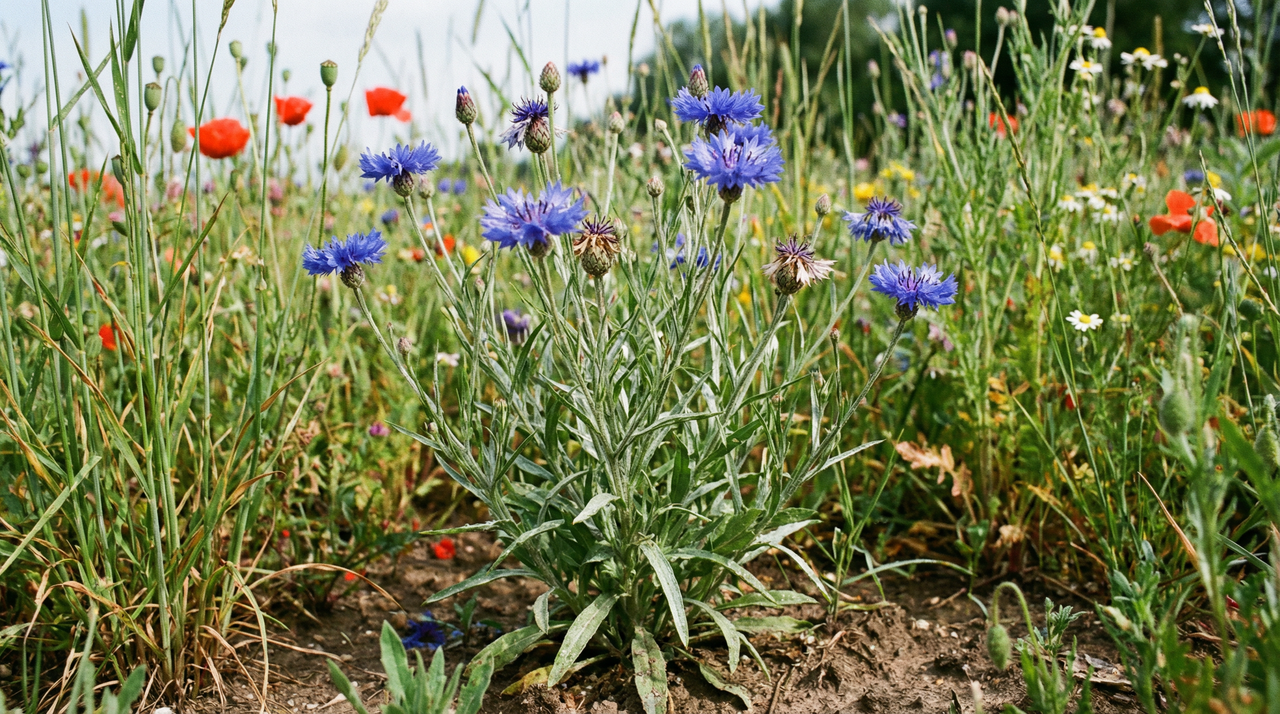
Nobody warned me that cornflower petals taste like a quiet argument. The color promises sweetness, that impossible saturated blue that stops you mid-stride in a summer border, and then you put a petal on your tongue and get something closer to clove, a little peppery, faintly bitter at the edges. I stood in my garden the first time genuinely confused, rechecking the plant tag like it had lied to me. It hadn't. Centaurea cyanus just has that quality of defying the expectation its own beauty sets up.
What gets me, though, is that this plant spent most of human history growing in wheat fields without anyone planting it on purpose. For millennia it was simply there, threading blue through grain crops from Western Asia to the Atlantic coast, so common that medieval farmers barely remarked on it.[1] Then twentieth-century agriculture nearly erased it from the European landscape entirely, and now we're buying seed packets and tucking it into pollinator strips like it's something rare we're trying to save. Which, in its wild form, it kind of is. That reversal, from weed to endangered wildflower to garden staple, tells you something real about what we've done to the landscapes that once made this plant feel ordinary.
Cornflower Origin, History, and Botanical Background
Few plants carry as much quiet history as the cornflower. Centaurea cyanus is a herbaceous annual in the Asteraceae family, typically growing anywhere from 20 to 90 centimeters tall on erect, branching stems.[2][3][4] Native across temperate Europe from Scandinavia down to the Mediterranean and into parts of Western Asia, it has since naturalized across most of North America.[5][3] Before modern agriculture, it was a constant companion in European fields, heavily adapted to the regular turn of the plow.
Botanical Profile and Life Cycle
The reason cornflower was once so ubiquitous in arable fields comes down to its ecology. This is a classic r-selected annual: fast to germinate, fast to flower, and extraordinarily prolific. A single plant can produce 100 to 500 seeds,[6][7] and those seeds can remain viable in the soil for five to ten years.[8] Given cool temperatures between 10 and 18°C, germination typically takes just 7 to 14 days,[9] and the whole life cycle from seed to bloom runs roughly 60 to 90 days.[9][7] It prefers well-drained soils with a pH of 6.0 to 7.5, open sun, and the kind of disturbance that a tilled field or a freshly turned garden bed provides.[7]
I've watched this play out in my own beds. Cornflower colonizes bare soil faster than almost anything else I grow, and that persistent seed bank means volunteers keep appearing for years after the original planting. Its deep taproot helps it anchor quickly into loose ground, something I've come to appreciate when establishing new beds where other plants struggle to get a foothold. Wild populations across Europe are declining because of intensive agriculture,[10] and I've noticed fewer roadside patches over the years than I saw decades ago. That's part of why I include it deliberately in wildflower seed mixes now, because that persistent seed bank is a gift we shouldn't take for granted.
Visual Characteristics and Identification
The flowers are what stop people in their tracks: vivid composite heads 1.5 to 3 centimeters across, most famously in an intense electric blue, though cultivated forms also come in pink, purple, and white.[11][12] But the real identification key is the involucre: an ovoid structure of pale green bracts edged with dark purple to black fringing.[11][13] Once you've seen that dark fringe up close, you'll never mistake this for a look-alike again. The leaves are alternate and lanceolate, slightly rough to the touch, and the whole plant has a quiet thistle-like quality that makes sense once you remember it belongs to the same family. Bloom time runs from June to September, with flowers appearing as solitary terminal heads or loose clusters.[14][3]
Traditional, Cultural, and Medicinal Uses
Cornflower's cultural history is long. Dioscorides recorded it for medicinal use in the 1st century AD,[15] and by the 16th century Gerard was documenting it in English gardens both as an ornamental and as a source of blue dye.[16] Long before anyone understood anthocyanins or polyphenols, European herbalists were using cornflower as an eye wash, a digestive aid, and a remedy for fevers and rheumatism.[17] The German Commission E eventually gave its approval for mild gastrointestinal complaints and topical skin inflammation.[18]
The symbolism is equally rich. In Victorian floriography, cornflower carried meanings of delicate love, hope, and anticipation; legend held that a wilting cornflower worn by a suitor meant unrequited feelings. Estonia adopted it as the national flower in 1969, a symbol of freedom and resistance,[19] and it has carried similar resonance in Germany. Cornflower arrived in North America during the colonial period, carried primarily as an ornamental and occasionally as an accidental contaminant in crop seed,[3] and it has been a garden staple here ever since. I've used the petals to naturally tint vinegars a pale violet-blue for workshops, a simple trick that connects directly to those centuries of dye and culinary tradition and always surprises people with how effective it is.
Fun Facts and Ecological Notes
From a purely practical standpoint, cornflower is one of the most approachable annuals in the garden. It goes from seed to bloom in 60 to 70 days,[20] the flowers are non-toxic to humans, dogs, and cats,[21] and the petals are genuinely edible. Ecologically, it's a meaningful plant: bees, butterflies, and hoverflies are drawn to it reliably, and that deep taproot does double duty improving soil structure while helping the plant handle dry spells better than you might expect.[22]
In parts of the western United States, Canada, Australia, and New Zealand, cornflower is considered invasive in rangeland and disturbed natural areas.[23][24] I treat it as a well-behaved annual in my beds and deadhead religiously before seeds set, but I also understand why land managers in those regions take a different view. Know your local ecology before you let it run. In a thoughtful pollinator garden or a cottage bed, though, it earns its place every single season.
Cornflower Varieties and Sourcing
Notable Cornflower Cultivars
Centaurea cyanus starts as a fairly simple plant: an upright annual in the Asteraceae family, somewhere between 12 and 36 inches tall depending on the cultivar, with that unmistakable electric blue flower that made it famous across European grain fields.[11][25] But 19th-century breeding programs in the United States transformed it into something far more varied, and modern seed catalogs now offer pink, red, white, purple, burgundy, and bicolor forms alongside the classic blue, in both single and double flower types.[11][26] For all that diversity, the wildflower spirit is still in there. Lean in close while deadheading on a warm evening and you'll catch a mild, sweet fragrance from the flowers, driven by volatile compounds including germacrene D and beta-caryophyllene that do double duty attracting pollinators.[27]
After growing tall blue strains alongside compact types for several seasons, I've settled on the dwarf forms for edging and container work. 'Blue Boy' gives you the same deep color and just as much bee traffic as the taller plants, but it stays tidy without staking. For cut-flower rows I reach for 'Kahli', a tall burgundy-red that adds drama to arrangements, or 'Black Ball' with its surprisingly dark maroon blooms. 'Polka Dot Mix' and 'Jubilee Gem' are reliable for mixed-color patches, and 'Milk and Honey' is a lovely bicolor if you want something a little different from the usual palette.[28] The 'Esculenta' strain deserves its own mention: I always keep a dedicated patch of it specifically for edible garnishes, since its petals are selected for culinary use. That said, I'm careful to keep it clearly labeled and separate because not all Centaurea species share that edibility profile.[29]
Before you select your varieties, bear in mind that they all share the species' vigorous self-seeding habit, meaning they can naturalize aggressively in disturbed agricultural soils across the Midwest, Northeast, and other regions.[3][30] I've had cornflower reseed cheerfully in my wildflower beds for years, which is mostly wonderful, but I keep it away from the edges of native grassland areas where it could outcompete local species. Site it thoughtfully, and that tendency to spread becomes an asset rather than a headache.
Where to Buy Cornflower Seeds and Plants
Few flowers are easier to obtain. Centaurea cyanus seeds are carried by virtually every major seed company in the United States, with no federal import restrictions to navigate.[31] Burpee, Johnny's Selected Seeds, Eden Brothers, Seed Savers Exchange, Strictly Medicinal Seeds, Hudson Valley Seed Company, and Everwilde Farms all carry reliable selections; a packet of 100 to 500 seeds typically runs $3 to $10 depending on variety and whether you're buying organic or heirloom.[32][33][34][35][36] I've had consistent germination from Johnny's and Seed Savers in particular, and I appreciate that Seed Savers maintains open-pollinated strains worth saving year to year. If you'd rather start with transplants, live plants in 4-inch pots are available from select nurseries including Plant Delights and Annie's Annuals, generally priced $5 to $15 for specialty varieties.[37][38] The USDA National Plant Germplasm System also maintains research accessions of this species for breeders and scientists, which speaks to how seriously the broader agricultural community takes preserving its genetic diversity.[39] Whatever route you take, check your local extension service for any regional planting cautions before you sow near sensitive natural areas.
Cornflower Propagation and Planting Guide
Seed Morphology and Reproductive Biology
Pick up a handful of cornflower seeds and you'll notice they're small but substantial: slim achenes, 2.5 to 5 mm long, grayish-brown to nearly black, with a tuft of pale bristles at the tip that makes them look like tiny paintbrushes.[22][40] That pappus crown isn't decorative; it's the wind-dispersal mechanism that lets cornflower wander into neighboring beds when you're not paying attention. Worth keeping in mind if you're planting near a wildflower meadow or restoration area.
What I've noticed after saving cornflower seed for several seasons is that the color variation from year to year can be genuinely surprising, even when I start with a named variety. That's not a seed quality issue; it's the plant's biology working exactly as designed. Cornflower has a gametophytic self-incompatibility system that forces it to outcross, with insect pollinators driving outcrossing rates above 90%.[41][42] The result is open-pollinated seed that produces 30 to 50% variation in height, color, and vigor among the offspring.[43] Once I started isolating a few favorite plants under row cover for dedicated seed production, my saved seed got much more consistent. For home gardeners happy with a mixed display, this variability is a feature. For anyone wanting a true uniform stand, isolation or hand-pollination is the practical route.[44]
On saving seed: cornflower is orthodox and desiccation-tolerant, meaning it stores well if you handle it correctly.[45] I harvest heads when they've gone brown and papery, then I let them finish drying on a screen for a week before stripping the seed. My routine is glass jars with a silica gel packet, stored in the refrigerator. At that temperature viability holds five years or longer, and in my experience germination rates the following spring are excellent.[45][46] The key moisture cue at harvest: the seed head should feel dry and crumbly, not at all green or pliable.
Seed is overwhelmingly the best propagation method here, both because cornflower is an annual and because it works so easily.[47] Cuttings, tissue culture, and layering exist in the literature as options for specialist breeding programs, but I've never met a home gardener who needed them, and grafting is simply not practical for an herbaceous annual.[48] Seed is reliable, inexpensive, and satisfying. One practical caution: given its vigorous self-sowing habit, always check local guidance before you do.[49][50] In my garden I let it roam within the beds and pull any volunteers before they set seed if they start heading toward the wild margins.
Germination Timeline and Sowing Techniques
Centaurea cyanus seeds germinate reliably at 60 to 75°F (15 to 24°C), with the sweet spot around 70 to 75°F producing seedlings in 7 to 14 days.[51][52] Direct sow in early spring once soil can be worked, or in fall in warmer zones where the seedlings will overwinter and bloom earlier the following year. Cornflower dislikes root disturbance, so direct sowing outdoors beats starting transplants indoors almost every time.
Here's the thing I wish someone had told me early on: cornflower seedlings in their first two weeks look remarkably like young carrot or parsley foliage. Thin, slightly feathery, easy to mistake for something else you've sown nearby. Label your rows clearly and don't be too quick to thin before you're sure what you're looking at.[51] Scratch the soil lightly to expose the achene attached to each seedling if you're uncertain; it's unmistakable once you know what you're looking for.
Soil, Site, and Spacing Requirements
Full sun is non-negotiable. Six to eight hours of direct light daily is what cornflower needs to produce the dense, upright stems and prolific bloom that make it worth growing.[50] The soil preference is equally clear: well-drained, moderately fertile loamy or sandy loam, pH 6.0 to 7.5.[53] Cornflower tolerates poor, dry, or gravelly conditions with remarkable patience once established, but heavy clay and waterlogged ground lead to root rot and disappointing plants.[49]
Rich soil is actually counterproductive. Excess nitrogen pushes leafy, floppy growth at the expense of flowers, so a light top-dressing of compost for structure is plenty.[54] I test pH every few years in my beds, and even modest amendments to bring it within the 6.0 to 7.5 range make a noticeable difference in bloom density. Outside that window, problems follow: below pH 6.0 you risk aluminum toxicity and iron chlorosis; above 7.5 nutrient lock-up causes similar chlorosis and reduced vigor.[55] For containers, a mix of equal parts multi-purpose compost, loam-based soil, and horticultural grit ensures the drainage cornflower needs when grown in confined spaces.[53]
Space plants 6 to 12 inches apart, with 12 to 18 inches between rows.[56][57] Tighter spacing creates the blue haze effect that makes a cornflower planting so striking; wider spacing gives individual plants room to size up and improves airflow, which matters for keeping fungal issues at bay. The plants reach 24 to 36 inches tall in most gardens (with some varieties pushing 48 inches), spreading 12 to 18 inches at maturity.[58] When direct-sowing, scatter seed generously and thin to final spacing once seedlings are well established; I've found self-sown stands naturally thin themselves into healthier displays when given adequate room to breathe. Deadhead spent flowers consistently to keep bloom going through summer, and keep an eye out for aphids and powdery mildew, both of which are easier to manage early before they get established.[50]
Cornflower Care Guide: Sunlight, Water, Feeding, and Seasonal Maintenance
Cornflower is one of those plants that rewards you for getting out of the way. Give it the right foundation and it practically takes care of itself. Get it wrong, usually by overwatering or overfeeding, and you end up with tall, floppy stems and half the flowers you were expecting. I've made both mistakes, and they've made me a much better grower of this plant.
Sunlight Requirements and Heat Management
Centaurea cyanus relies on maximum sun exposure to produce the tight, floriferous plants you see in seed catalog photos.[11][59] Anything less and the internodes stretch, the foliage turns pale, and flowering drops off noticeably. I've grown cornflower in a bed that caught light shade from a nearby fruit tree in the afternoon, and the contrast with plants in full exposure was stark. The shaded ones were taller but bloomier they were not. In very hot climates, some afternoon shade protects against leaf scorch and bleached flowers,[60] but that's a heat mitigation strategy, not a sign that this plant tolerates shade.
Watering Needs and Drought Tolerance
During the first four to six weeks after planting, keep the soil evenly moist, roughly one inch of water per week.[11][53] Once established, cornflower's deep taproot makes it surprisingly tolerant of dry spells. I check the top inch of soil by feel; if it's dry, I water. In practice that's usually every seven to ten days once plants are settled in.[61] Overwatering is the bigger risk: it causes root rot, yellowing leaves, and mushy roots, while underwatering shows up as limp, browning foliage and stunted growth.[53] A two-inch layer of organic mulch around the base helps regulate moisture either way. Cornflower prefers a soil pH between 6.0 and 7.5 and pairs naturally with other drought-adapted plants like lavender, yarrow, and thyme,[53] which tells you something about the garden conditions where it's genuinely happiest.
Fertility and Feeding: Keep It Lean
The season I tried growing cornflower in a bed I'd amended generously for tomatoes, I got the most impressive foliage display and some of the worst flowering I've ever seen. Tall, leafy, gorgeous green plants. About half the blooms I expected. That's excess nitrogen at work. Centaurea cyanus has low to moderate nutrient demands and genuinely performs best in lean to average fertility.[11][59] If your soil has been amended with compost, you likely don't need to feed at all. If you want to apply something, a light dose of a balanced low-nitrogen formula like 5-10-10 at planting is plenty.[53] Phosphorus supports root establishment and flower initiation, potassium improves disease resistance and overall stem strength.[53] Slow-release compost or well-rotted manure worked in before sowing covers both without risk of overdoing it. I now soil-test new beds before adding anything, a habit I developed after too many early seasons of guessing and getting it wrong.[3]
Frost Tolerance and Temperature Hardiness
Cornflower is hardier than most gardeners expect from a flower this delicate-looking. Established plants tolerate light frosts down to 28°F, and young seedlings can briefly handle temperatures as low as 23°F before tissue damage becomes serious.[62][63] Cornflower seedlings will sail through a light frost that would blacken basil overnight, which makes timing spring plantings much more forgiving. It's hardy across USDA zones 2 through 11 and can be direct-sown two to four weeks before last frost,[64] which is one of my favorite things about it for early-season garden planning. In mild climates, autumn sowing with a two-to-three inch mulch layer over seedlings provides winter protection; germination slows below 41°F, so expect a pause until temperatures moderate.[3]
Heat Tolerance and Summer Stress
Cool to mild conditions, roughly 59 to 77°F, are where cornflower thrives.[59] Above 80 to 86°F, stress becomes visible: wilting, scorched leaf edges, flower drop, and in the worst cases, bud abortion before flowers even open.[65] In my experience, even a single week of temperatures above 85°F during early bud formation noticeably shortens the bloom window. You're watching the flowers essentially quit for the season ahead of schedule. The practical response is to get plants in early so they bloom before summer heat arrives, apply two to three inches of mulch, water deeply in the morning, and ensure good air circulation around plants.[54] In persistently hot gardens, cultivars like 'Blue Boy' handle summer stress somewhat better than more delicate selections.[66]
Pruning, Maintenance, and Seasonal Rhythm
Deadheading is the single most valuable maintenance task with cornflower. I cut stems for bouquets every few days rather than waiting for flowers to fade, which both extends the garden bloom and prevents the heavy self-seeding I once battled in a disturbed bed near the vegetable garden.[67] After the main flush, cutting plants back by about a third can encourage a second round of flowers before summer heat shuts things down. Taller varieties benefit from twiggy branch supports pushed in at planting; staking after the fact rarely works cleanly. Good airflow and avoiding overhead watering go a long way toward keeping powdery mildew and rust in check.[11]
The seasonal rhythm of cornflower is fast and satisfying. Seeds germinate in cool, moist spring soil, and flowering begins 60 to 90 days later, peaking from late spring into early summer.[9][3] That rapid cycle makes succession sowing every two to three weeks a genuinely useful strategy for extending color into summer. In zones 3 through 8, a two-to-three inch mulch layer applied after first frost protects any overwintering rosettes.[11] Sow early, feed lightly, water thoughtfully, and cut often. That's really the whole calendar.
Harvesting Cornflower (Centaurea cyanus)
When to Harvest Cornflowers
Cornflower blooms from late spring through summer, typically June to August in temperate climates.[3][68] As a fast-cycling annual, the window from spring sowing to first bloom moves surprisingly quickly, and once summer heat arrives, plants can bolt and fade just as fast. I've learned to watch the garden rather than the calendar. When the fringed bracts start opening into that intense blue and the centers are just beginning to show, that's your moment.
Harvesting Technique for Cut Flowers and Edible Petals
I've harvested cornflowers for years as both cut flowers and edible garnishes, and the single biggest thing I'd tell a new grower is to get out there in the early morning. The delicate fragrance fades noticeably by afternoon heat, and you lose something real in the kitchen jar or the vase.[69] For cut flowers, take stems when blooms are fully open but not yet fully mature, cutting at a 45-degree angle just above a leaf node with sharp shears.[70][71] For edible petals, choose stems where the center is just cracking open and the color is at its most vivid. Regular cutting also keeps the plant producing, so the harvest and the garden continuity are the same act.
Flavor, Texture, Aroma, Yield, and Safety Considerations
Fresh cornflower petals have a mild, faintly sweet flavor with subtle peppery, clove-like, or anise undertones, a crisp, slightly chewy texture, and a fresh floral fragrance with honey and herbaceous notes underneath.[72][73] That anise note is exactly why I reach for them as a mild saffron colorant in rice dishes; dried cornflower petals won't replicate saffron's depth, but they do contribute a warm blue-violet tint and a slightly bitter edge that works in the right context.[74] Drying shifts the whole profile toward earthier, more pronounced bitterness, which is worth knowing before you add them to a delicate dessert. All of this flavor data applies specifically to Centaurea cyanus; related species in the genus lack this documentation and carry their own genus-level concerns, so precise identification really matters here.
Strip the petals away from the green sepals before using them, since the sepals add an unpleasant bitterness.[3] On the young leaves, I'll be direct: I rarely bother with them. The bitterness outweighs the benefit for me, they contain potential pyrrolizidine alkaloids, and overconsumption can cause digestive upset. If you want to experiment, keep portions very small and consult a forager or your doctor first, especially if you're pregnant. Soil fertility, timing, and cultivar choice all subtly shift flavor quality, and in my trials the double-flowered varieties consistently deliver the sweetest, most useful petals for edible work. They're worth seeking out if the kitchen harvest matters as much to you as the garden display.
Cornflower Preparation and Uses
Edible Parts and Culinary Applications
Let me be clear upfront: only the petals of Centaurea cyanus belong in your kitchen.[73][75][76] Stems, leaves, and seeds are off the table. I grow cornflower every year specifically for those petals, and I've learned through trial and error that pulling just the outer ray florets, leaving the central disc intact, gives you the cleanest, mildest result while letting the plant keep blooming.
The flavor is genuinely lovely: subtly sweet with clove-like and peppery undertones, nothing sharp or bitter about it.[77][78] European cooks, particularly in France, Germany, and Eastern Europe, have long used the petals as garnishes for salads, soups, and desserts, as a natural blue food coloring, and candied for pastries.[79] They pair beautifully with light cheeses, fresh fruit, and simple vinaigrettes; use them sparingly so that delicate floral note actually registers.[80][72] They're also wonderful steeped as a tea or infused into vinegars. Nutritionally, petals are modest: low in calories, with some antioxidant flavonoids and cyanidin derivatives, plus trace amounts of vitamin C, beta-carotene, potassium, and calcium.[81][82] Nice, not miraculous.
A few cautions worth stating plainly. As discussed in the health section, those with Asteraceae sensitivities should exercise caution to avoid cross-reactive flare-ups.[83][84] Large quantities may also cause gastrointestinal upset, though the risk at culinary amounts is low.[85] The leaves are edible but aggressively bitter and tough, better cooked than raw if you use them at all.[77] Always harvest from pesticide-free plants.[74][86] And confirm your ID carefully; cornflower can be confused with invasive knapweeds like Centaurea diffusa and C. solstitialis, which differ in bract structure, leaf shape, and flower color.[87] One more thing: Centaurea cyanoides, a lookalike species, has no documented culinary use in authoritative botanical literature, so don't substitute it.[88][89]
Medicinal Preparations and Dosages
The most authoritative guidance comes from the German Commission E and the European Medicines Agency, and both focus on two uses: internal infusions and topical eye compresses. For adults, the standard is 1 to 2 grams of dried flowers steeped in 150 ml of boiling water, taken two to three times daily.[90][91] For eye compresses, a cooled infusion or decoction is applied externally for mild inflammatory irritation.[90][91] I prepare mine the same way I make a calendula compress: steep, cool completely, strain well, then apply with a clean cloth. Cornflower feels particularly gentle for mild irritation.
Beyond infusions, traditional preparations include tinctures, poultices, and decoctions, though these fall into folk-use territory rather than formally approved applications.[92][93] For children, dosages are not well-established in official monographs, so professional supervision is essential before use.[90][91] The health benefits section covers the underlying phytochemistry and research limitations in detail; here, the practical takeaway is to stick with established dosages and consult a qualified practitioner if you're using it therapeutically rather than culinarily.
Non-Food Uses in the Home and Garden
The petals yield a soft blue dye for textiles, inks, and cosmetics, a use documented in medieval craft traditions for wool and linen. That same vivid blue that makes cornflower irresistible in a bouquet also made it valuable to dyers working centuries before synthetic colorants existed. I cut cornflower regularly for the vase; it holds well and keeps drawing bees and hoverflies to whatever's blooming nearby, which suits the whole garden system.
In the regenerative garden, the spent plant earns its place even after bloom. I cut stems back after peak flower and lay the biomass as mulch around my perennials.[94] The taproot, which I've watched break through compacted clay in my Florida beds, loosens soil structure as the plant decomposes. As ground cover, a dense cornflower planting suppresses weeds while the roots do their quiet structural work below. None of this requires extra effort; it's just what the plant does naturally when you let it finish its cycle rather than pulling it the moment flowering slows.[11]
Cornflower Health Benefits
That electric blue color isn't just beautiful. It's doing something. The pigment responsible for cornflower's signature hue is cyanidin-3-O-glucoside, an anthocyanin that also functions as an antioxidant and ramps up production under environmental stress like UV exposure or drought.[95][96] I noticed this connection years ago when I started drying cornflower petals for eye compresses: flowers harvested from a dry, sun-baked patch dried to a deeper, more vivid blue than those from a coddled irrigated bed. Turns out there's chemistry behind that observation.
Key Phytochemicals in Cornflower
Beyond anthocyanins, the flowers and leaves carry an impressive roster of flavonoids including apigenin, luteolin, quercetin, and kaempferol, with total flavonoid content sitting around 20 to 30 mg per gram concentrated especially in the blooms.[97][98] Phenolic acids, particularly chlorogenic acid and caffeic acid derivatives, show up strongly in both leaves and flowers at similar concentrations.[99] The sesquiterpene lactones, primarily cnicin and cynaropicrin found in the flower heads, are what give the plant its characteristic bitterness and are linked to antimicrobial properties.[100]
Where you find these compounds matters. The flowers are richest in anthocyanins and flavonoids, leaves lean toward phenolic acids, and seeds carry their own minor profile of lignans and indole alkaloids.[101][102] Growing conditions shift the balance too: plants on leaner soils and under summer heat tend to accumulate higher phenolic loads as a stress defense.[96] That's a reminder to the permaculture grower that coddling this plant into the richest bed in the garden may actually produce flowers with less medicinal punch. I always prioritize the blooms over the leaves for teas, and the lab data on antioxidant superiority of flower extracts backs that up.[103]
Medicinal Research and Traditional Uses
Herbalists across Europe have been reaching for cornflower eye washes for centuries, and this is the one application that has earned something close to institutional backing. The German Commission E recognizes cornflower flower infusions for nonpurulent conjunctival inflammation, making it one of the few traditional European remedies with a formal regulatory nod for eye use.[104][105] Traditional practitioners also used the flowers and plant for digestive complaints, as a mild diuretic, and for wound poultices and sore throat gargles.[106]
Modern preclinical research supports the anti-inflammatory tradition in measurable terms: cornflower extracts suppress NF-κB signaling, reduce cytokines like TNF-α and IL-6, and inhibit COX-2 in cell models and rodent edema tests.[107][108] Antimicrobial work shows sesquiterpene lactones like cnicin inhibiting Staphylococcus aureus at MIC values of 32 to 64 μg/mL.[100] Preliminary studies have also flagged antidiabetic, anticancer, anxiolytic, and hepatoprotective effects in cell and animal models.[109][110][111] Promising, yes, but nearly all of this research is in vitro or animal-based, and robust human clinical trials are simply absent for most of these claims.[97][112] In my own practice, I stick to using the flower tea as a gentle external eye soother rather than prescribing internal uses to anyone, because the evidence just isn't there yet to support sweeping claims about the centaurea cyanus benefits beyond what the traditional record actually substantiates.
Nutrition Profile
As something to eat, cornflower is more pleasure than powerhouse, its flowers running about 80 to 90 percent water with modest amounts of carbohydrates, protein, vitamin C, potassium, calcium, and magnesium.[113][114] Quantitative micronutrient data are thin, so I wouldn't reach for this flower as a nutritional supplement. The real value as a culinary ingredient comes from its phytochemicals: the same antioxidants measured in DPPH and FRAP assays that make the flowers medicinally interesting also make the garnish on your salad do a bit more work than a sprig of parsley would.[98] The mild, clove-adjacent flavor and vivid color are the primary draws in European kitchen traditions, and the blooms genuinely outperform the leaves in antioxidant activity, which is reason enough to use the petals rather than tossing in foliage.
Safety and Considerations
The good news for families and pet owners is straightforward: Centaurea cyanus is non-toxic to humans, dogs, cats, and livestock, with an LD50 above 2000 mg/kg in mice and general recognition as safe for short-term culinary and herbal use.[115][21] The seeds do contain indole alkaloids, but these are not the hepatotoxic pyrrolizidine alkaloids that concern herbalists in some other Asteraceae; at typical doses the sesquiterpene lactones and flavonoids don't present a toxicity risk either.[116][117]
A few caveats are worth taking seriously. Anyone with sensitivity to Asteraceae family plants, ragweed and daisies being the most common, should approach cornflower cautiously given the possibility of cross-reactive contact dermatitis or gastrointestinal upset.[118] Use during pregnancy and breastfeeding is contraindicated due to insufficient safety data; for herbal tea, a reasonable guideline is one to two teaspoons of dried flowers per cup, two to three cups daily, though clinical dosage data remain limited.[119]
The look-alike question is where I get most cautious. Earlier in my gardening years I once nearly transplanted what I thought was a cornflower seedling and only caught my mistake when I counted the leaf veins, because it was actually a young Delphinium, which can cause cardiac and neurological toxicity.[120] Lupine seedlings are another potential mix-up, and alkaloid poisoning from lupine is serious.[121] I now teach a simple leaf-check to anyone harvesting from a mixed wildflower patch: cornflower leaves are softly hairy, lance-shaped, and lack the palmate lobing you see on both Delphinium and lupine. It takes thirty seconds and it matters.
Cornflower Pests and Diseases
Cornflower holds its own surprisingly well in a mixed garden. Part of that resilience is structural: run your fingers along the stems and you'll feel a slight stickiness from the glandular trichomes, tiny resin-secreting hairs that physically slow down small insects trying to move across the plant.[122] Pair those with sesquiterpene lactones that disrupt insect digestion and volatile organic compounds that either repel herbivores or signal predatory insects to come investigate, and you've got a plant with genuine, built-in armor.[123][124][125] I've noticed that plants grown in dense polycultures seem to attract far fewer chewing insects than the same variety planted in a monoblock bed, and those chemical defenses are a big part of why.
Common Pests of Cornflower and Natural Defenses
Aphids are where the picture gets complicated. Some sources report reasonable resistance thanks to those trichomes reducing colonization; others flag green apple aphids and cotton aphids as genuine problems, particularly on crowded plants during humid spells.[126][127] In my experience growing mixed beds through humid summers, cultivar choice really does shift the odds. 'Black Ball' tends to stay noticeably cleaner than older open types, and 'Blue Boy' and 'Polka Dot Mix' perform better under pressure than unnamed generic blends.[53][128]
Beyond aphids, cornflower sees moderate pressure from cutworms and cabbage loopers, with occasional spider mites showing up during dry stretches and slugs going after seedlings in wet conditions.[126][53] Spider mites are worth watching for specifically during hot, dry spells; once humidity drops I make a point of checking the undersides of leaves every few days. Leafhoppers appear occasionally but rarely cause serious damage. For the related wild species Centaurea cyanoides, aphids, flea beetles, leaf beetles, and spider mites are all documented threats, and because there are essentially no cultivars bred for pest resistance in that species, you're working without a safety net.[129]
Fungal and Other Diseases Affecting Cornflower
Fungal disease is where cornflower is genuinely vulnerable, and the lineup is worth knowing by sight. Powdery mildew (Erysiphe cichoracearum) shows as white powdery patches on leaves and stems; rust (Puccinia spp.) appears as orange pustules; leaf spots from Alternaria or Septoria cause brown or dark lesions; Botrytis blight creates the characteristic gray fuzz on flowers and stems during cool, wet weather; Fusarium wilt causes yellowing and wilting that starts from infected roots.[130][131][132] Bacterial leaf spot (Xanthomonas) and cucumber mosaic virus, which is aphid-transmitted and causes stunting and mosaic patterns, do occur but considerably less often than the fungal suite.[130]
Environment drives most of this. Humidity above 70% with poor airflow is the fast track to powdery mildew and foliar fungi; overwatering or compacted, soggy soil sets up root rot and wilt; soil pH below 6.0 seems to heighten fungal pressure noticeably; and powdery mildew is most active in the 59-75°F range, which is a lot of spring and fall in temperate gardens.[133][53] 'Blue Boy' has some bred tolerance to powdery mildew and rust, though performance varies by region and pathogen strain, so treat it as a useful advantage rather than a guarantee.[130][134] Centaurea cyanoides presents a different disease profile: it's susceptible to Verticillium wilt (a vascular pathogen worsened by poor drainage) yet shows natural resistance to some Mediterranean rust strains from its native habitat adaptations.[135][136]
Integrated Pest and Disease Management for Cornflower
Cultural prevention is the real first line here. Full sun with good airflow, spacing plants 6-12 inches apart, watering at the base rather than overhead, well-drained soil kept between pH 6.0-7.5, prompt removal of infected material, and crop rotation every 2-3 years with non-hosts like legumes or grasses will prevent the majority of problems before they start.[53][137][138] I've found that even shifting from dense rows to loose clusters makes a visible difference in mildew incidence by the time late summer humidity peaks.
When mildew does appear, neem oil at a 1-2% solution, baking soda spray (one tablespoon per gallon with a drop of dish soap), or diluted milk at a 1:9 ratio are all worth trying.[139][140] I always test any spray on a few leaves first before treating an entire bed; the milk spray in particular can cause spotting if concentration is off or weather stays overcast.[137]
For aphids and other soft-bodied insects, the IPM approach I rely on starts with encouraging natural predators. Interplanting with shallow-flowered nectar sources brings ladybugs in reliably, and they do a lot of heavy lifting before any spray is needed.[141][142] If populations do spike, insecticidal soap or neem oil applied in the evening protects visiting pollinators while still hitting the pest load.[143] Synthetic options stay off the table unless there's genuine crop-level failure, which in a diverse planting is rare; open-field cornflowers grown alongside other species consistently show lower pest pressure than greenhouse-grown stock, and leaf extracts have even shown bioactivity against agricultural insect herbivores in lab conditions.[144][123]
Cornflower in Permaculture Design
Cornflower earns its place in a permaculture system not through nitrogen fixation or canopy support but through something arguably more immediate: it feeds the insects that make everything else work. Before getting into the specifics of where and how to place it, though, it helps to understand just how broadly it can be deployed geographically.
Climate Adaptability and Hardiness Zones
Centaurea cyanus is one of the more climatically flexible annuals I've worked with, rated across USDA zones 2 through 11.[3][145] In zones 3 through 8, it often behaves less like a strict annual and more like a self-seeding biennial, quietly overwintering as a rosette and resuming growth in spring without any help from the gardener.[146] Seeds themselves are remarkably cold-hardy, surviving down to -40°F,[147] which means a stand that sets seed in autumn is essentially banking its next generation against even brutal winters. In colder marginal spots, a light mulch or snow cover over rosettes is enough to carry them through.
The other end of the temperature spectrum is where things get more interesting, and more limiting. Cornflower performs best between 50 and 75°F; push it above 80°F and it bolts fast, much like cilantro or spinach under the same pressure.[148][53] In warmer zones, I've found that siting it where it gets some afternoon shade, and keeping moisture consistent through the early-summer heat, meaningfully extends the bloom window. Full sun with a soil pH between 6.0 and 7.5, good drainage, and decent air circulation round out the site requirements.[53][149][3] Waterlogging and high humidity are the enemies here; both invite the fungal issues that otherwise rarely trouble it in drier, breezier spots.
Ecosystem Functions and Guild Roles
The reason cornflower keeps showing up in my insectary plantings is simple: few plants at this scale attract as wide a range of beneficial insects as reliably as this one. Honeybees, bumblebees, butterflies, and hoverflies all work those composite flower heads heavily,[150][30] and the plant's protandrous flowering strategy, where pollen is released before the stigma becomes receptive, forces cross-pollination and keeps genetic diversity moving through the stand.[30][151] Without those insect visitors, seed set drops sharply. In a well-designed system, that relationship runs both ways: you're feeding your pollinators, and they're regenerating your cornflower population for you.
Below the soil surface, the deep taproot does quiet structural work: stabilizing soil, reducing erosion, and adding organic matter when the plant decomposes in fall.[152][153] When I pull spent plants at the end of the season, the root system is always longer and more substantial than I expect from something so visually delicate. Cornflower does not fix nitrogen, so pair it with legumes if fertility is part of your guild strategy.
Seeds are a food source for birds, and the plant can function as a short-lived pioneer in disturbed ground.[153] That pioneer quality is genuinely useful, but it comes with a caution: in North America especially, cornflower can naturalize aggressively in disturbed soils and outcompete some native species.[154][3] In my experience, a single light pass with the hoe in early spring keeps it from dominating disturbed areas while still allowing a generous enough population to do its pollinator work.
Forest Layer Placement and Companion Planting
Cornflower sits firmly in the herbaceous layer, reaching 12 to 36 inches tall with an upright, branched habit that slots neatly into sunny edges, insectary strips, and open guild spaces.[11][155][156] It doesn't belong under a closed canopy; shade causes it to lean, thin out, and flower poorly. In a maturing food forest, I use it along the sun-facing edges where the canopy hasn't filled in, or in annual beds woven through productive guilds.
As a cornflower companion plant, it punches well above its weight class. Its flowers draw hoverflies and parasitic wasps that keep pest pressure down across the whole guild, and it pulls double duty as an aphid trap crop, concentrating aphids on itself and away from nearby brassicas.[157] I've watched this happen reliably when interplanting cornflower at the edges of kale and broccoli beds; the aphids cluster at the cornflower margins, which makes monitoring and intervention far simpler. Centaurea montana companion plants follow a similar logic, though the mountain cornflower's perennial habit makes it easier to establish a permanent insectary planting without annual reseeding.
There is one interaction to manage thoughtfully: cornflower exhibits mild allelopathic activity through phenolic compounds in its leaf litter and root exudates, which can inhibit germination of some neighboring plants.[158][159] Keep that in mind when direct-seeding small-seeded vegetables nearby. The flowers themselves are edible, with a mild, slightly spicy flavor that works well in salads and teas,[73] so the same border that supports your pollinators also contributes to the kitchen harvest. For a self-seeding annual, that's a lot of function from one modest plant.
The Blue That Keeps Coming Back
I almost pulled cornflower from my insectary strip one season because it was seeding into places I hadn't planned for. Then I watched a bumblebee work a single flower head for a full minute without moving on, and I put the trowel down. Some plants remind you that the garden isn't entirely yours to manage, and there's something good in that reminder.
Sources 159
- Cornflower (Centaurea cyanus L.) in agroecosystems: a review ↩
- Centaurea cyanus ↩
- Centaurea cyanus ↩
- Centaurea cyanus ↩
- Centaurea cyanus L. ↩
- Population ecology of annual weeds in arable fields ↩
- Centaurea cyanus (cornflower) ecology and management ↩
- Seed bank dynamics of Centaurea species ↩
- Cornflower (Centaurea cyanus) - Profile and Growing Guide ↩
- Centaurea cyanus ↩
- Centaurea cyanus ↩
- Centaurea cyanus ↩
- Centaurea cyanus ↩
- Centaurea cyanus ↩
- De Materia Medica ↩
- Gerard's Herball ↩
- Cornflower (Centaurea cyanus L.): A Review of Its Traditional Uses, Phytochemistry, and Pharmacology ↩
- Cornflower ↩
- Centaurea cyanus ↩
- Centaurea cyanus - Royal Horticultural Society ↩
- Cornflower ↩
- Centaurea cyanus ↩
- Centaurea cyanus ↩
- Bachelor's Button | Arthropod & Pest Management ↩
- Centaurea cyanus - Royal Horticultural Society ↩
- History of Cornflower Breeding in the United States ↩
- Volatile Constituents of Centaurea cyanus Flowers ↩
- Centaurea cyanus Cultivars - RHS Gardening ↩
- Seed Savers Exchange - Centaurea cyanus 'Esculenta' ↩
- Centaurea cyanus Fact Sheet ↩
- Cornflower (Centaurea cyanus) Plant Profile ↩
- Cornflower Seeds ↩
- Bachelor's Buttons (Centaurea cyanus) ↩
- Bachelor's Button Seeds ↩
- Centaurea cyanus ↩
- Cornflower Seeds (Centaurea cyanus) ↩
- Centaurea cyanus Live Plants ↩
- Cornflower Centaurea cyanus for Sale ↩
- National Plant Germplasm System - Centaurea cyanus ↩
- Kew Seed Information Database ↩
- Self-incompatibility in Cornflower (Centaurea cyanus L.): Genetic Control and Population Implications ↩
- Pollination Biology of Centaurea cyanus: Insect Visitors and Outcrossing Rates ↩
- Genetic Variability and Heritability in Centaurea cyanus L. ↩
- Breeding for Uniformity in Ornamental Annuals: Case of Centaurea cyanus ↩
- Kew Millennium Seed Bank - Seed Storage Information for Centaurea cyanus ↩
- FAO - Genebank Standards for Plant Genetic Resources ↩
- Plant Finder: Centaurea cyanus ↩
- Propagating Cornflowers (Centaurea cyanus) ↩
- Centaurea cyanus Distribution ↩
- Centaurea cyanus (Bachelor's Button) ↩
- Cornflower (Centaurea cyanus) - RHS Gardening ↩
- Centaurea cyanus - Missouri Botanical Garden ↩
- Centaurea cyanus Growing Guide ↩
- Growing Bachelor's Buttons - University of Minnesota Extension ↩
- Soil pH for Ornamental Plants ↩
- How to Grow Cornflowers (Centaurea cyanus) ↩
- Cornflower Growing Guide ↩
- Centaurea cyanus Care and Spacing ↩
- Royal Horticultural Society - Cornflower ↩
- Growing Bachelor's Buttons (Centaurea cyanus) ↩
- Bachelor's Button (Centaurea cyanus) ↩
- Royal Horticultural Society - Centaurea cyanus ↩
- Almanac - Growing Bachelor's Buttons ↩
- Royal Horticultural Society - Cornflower ↩
- Missouri Botanical Garden - Cornflower Cultivation Guide ↩
- Royal Horticultural Society - Cornflower Growing Guide ↩
- Royal Horticultural Society - How to Grow Cornflowers ↩
- Royal Horticultural Society - Cornflower ↩
- RHS Centaurea cyanus growing guide ↩
- Missouri Botanical Garden Centaurea cyanus ↩
- Kew Gardens Centaurea cyanus fact sheet ↩
- Royal Horticultural Society - Cornflower ↩
- Cornflower (Centaurea cyanus) - Edible and Medicinal Uses ↩
- Missouri Botanical Garden - Plant Finder: Bachelor's Button ↩
- Edible Wild Plants: Cornflower ↩
- Centaurea cyanus - Useful Temperate Plants Database ↩
- Cornflower (Centaurea cyanus) - Edible Flowers ↩
- Edible Flowers: Cornflower ↩
- Centaurea cyanus in Culinary Traditions ↩
- Royal Horticultural Society - Edible Garden ↩
- Nutritional and Phytochemical Properties of Centaurea cyanus ↩
- Antioxidant Activity of Cornflower Extracts ↩
- Royal Horticultural Society Gardening Advice ↩
- Kew Gardens Centaurea Cyanus Profile ↩
- Journal of Ethnopharmacology Study on Centaurea Genus Toxicity ↩
- USDA PLANTS Database - Centaurea cyanus ↩
- Knapweed Identification and Management ↩
- Missouri Botanical Garden Plant Finder: Centaurea cyanoides ↩
- Kew Gardens Plants of the World Online: Centaurea cyanoides ↩
- German Commission E Monographs - Centaurea cyanus ↩
- EMA Herbal Monograph on Centaurea cyanus herba ↩
- Ethnobotany of Centaurea cyanus in Europe ↩
- Cornflower (Centaurea cyanus) - Herbal Monograph ↩
- Ecological Benefits of Centaurea cyanus ↩
- Anthocyanins and Other Phenolics in Cornflower (Centaurea cyanus) ↩
- Secondary Metabolites in Cornflower under Abiotic Stress ↩
- Phytochemical and Pharmacological Review of Cornflower (Centaurea cyanus L.) ↩
- Phytochemical Profile and Antioxidant Activity of Centaurea cyanus L. ↩
- Phenolic compounds in cornflower (Centaurea cyanus) ↩
- Sesquiterpene Lactones from Centaurea Species: Antimicrobial Potential ↩
- Secondary Metabolites from the Aerial Parts of Centaurea cyanus L. ↩
- Phytochemical Profile of Centaurea cyanus L. (Asteraceae) Cultivated in Poland ↩
- Pharmacological Activities of Centaurea cyanus L.: A Review ↩
- German Commission E Monographs - Cornflower ↩
- Centaurea cyanus L. as a Traditional Food and Nutraceutical Plant: A Review ↩
- Traditional Medicinal Uses of Centaurea Genus ↩
- Flavonoids from Centaurea cyanus inhibit NF-κB pathway in LPS-stimulated macrophages ↩
- Anti-inflammatory Activity of Methanolic Extract of Centaurea cyanus in Rat Paw Edema Model ↩
- Antidiabetic Effects of Centaurea cyanus Flavonoids ↩
- Cytotoxic Activity of Centaurea cyanus Against Cancer Cells ↩
- Neuropharmacological Evaluation of Cornflower ↩
- Centaurea cyanus L. – Folk medicine uses in the European and American continent ↩
- Nutritional and Phytochemical Evaluation of Cornflower (Centaurea cyanus L.) ↩
- Chemical Composition of Edible Flowers: Focus on Centaurea cyanus ↩
- Acute toxicity and safety profile of Centaurea cyanus extracts ↩
- Indole alkaloids from the seeds of Centaurea cyanus (Asteraceae) ↩
- Centaurea cyanus: A Review on Phytochemical and Health-Promoting Effects ↩
- Edible Flowers: Safety and Health Implications ↩
- Cornflower - Uses, Side Effects, and More ↩
- Delphinium Poisoning Details ↩
- Lupin Plant Toxicity ↩
- Trichome Morphology and Chemical Defense in Cornflower (Centaurea cyanus) ↩
- Plant Defense Mechanisms Against Herbivory in Centaurea Species ↩
- Sesquiterpene Lactones from Centaurea cyanus L. with Significant Anti-inflammatory Activity ↩
- Volatile Organic Compounds in Centaurea cyanus as Insect Repellents ↩
- Centaurea cyanus ↩
- Centaurea cyanus (Bachelor's Button) ↩
- Bachelor's Buttons: Cultivation and Cultivars ↩
- Insect Pests of Ornamental Plants: Centaurea Species ↩
- Cornflower Diseases and Pests ↩
- Plant Pathology of Centaurea cyanus ↩
- Fungal Diseases of Ornamental Plants ↩
- Cornflower (Centaurea cyanus) - Disease Management ↩
- Breeding for Disease Resistance in Ornamental Plants ↩
- Fusarium Wilt in Ornamental Plants ↩
- Diseases of Asteraceae - Extension Service ↩
- University of Minnesota Extension - Powdery Mildew Management ↩
- Cornell University - Organic Disease Control in Flowers ↩
- Neem Oil for Powdery Mildew - Organic Gardening ↩
- Powdery Mildew on Ornamentals - Cornell Cooperative Extension ↩
- Integrated Pest Management for Ornamentals: Centaurea cyanus ↩
- Biological Control of Pests in Centaurea cyanus ↩
- Pest Management in Garden Flowers: Bachelor's Button ↩
- Insect Pests of Ornamental Asteraceae ↩
- Centaurea cyanus - Missouri Botanical Garden ↩
- Royal Horticultural Society: Centaurea cyanus ↩
- RHS Gardening - Cornflower (Centaurea cyanus) ↩
- Missouri Botanical Garden - Centaurea cyanus ↩
- Missouri Botanical Garden - Centaurea cyanus ↩
- Pollinator Support by Cornflowers in Temperate Ecosystems ↩
- Pollination Ecology of Cornflower (Centaurea cyanus) ↩
- Soil Health Contributions from Wildflowers like Bachelor's Button ↩
- Centaurea cyanus (Cornflower) - Ecological Role and Benefits ↩
- Invasive Potential and Biodiversity Impacts of Centaurea cyanus ↩
- Centaurea cyanus - Royal Horticultural Society ↩
- Centaurea cyanus - Kew Science ↩
- Companion Planting with Cornflowers ↩
- Mycorrhizal Associations in Centaurea Species: Implications for Invasion Ecology ↩
- Allelopathic Potential of Centaurea cyanus Leaf Litter on Grassland Plants ↩