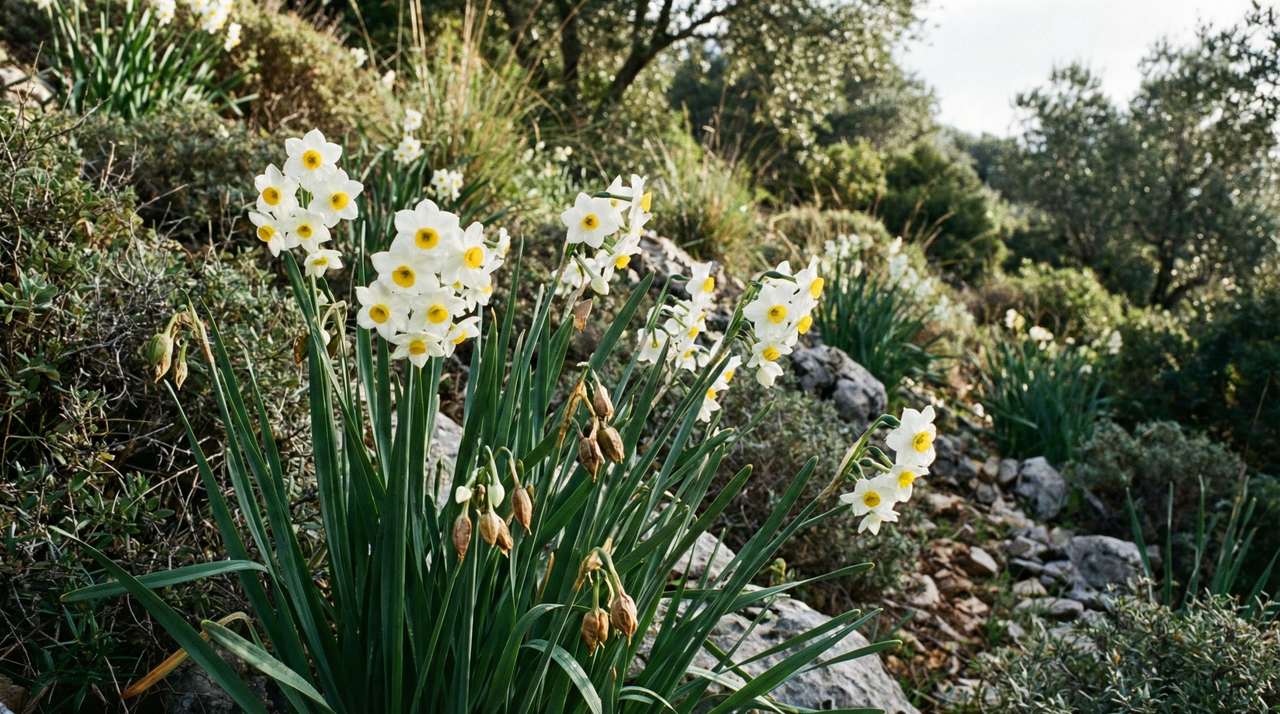
Every spring, someone in Britain mistakes a daffodil bulb for an onion and ends up in the emergency room. It happens so reliably that the National Poisons Information Service tracks it as a recurring seasonal event.[1] I think about that every March when I watch gardeners press their noses into a bowl of narcissus blooms and breathe in like they're standing in a field of honey. The contradiction is almost absurd: one of the most beloved, cheerful, utterly familiar plants in the temperate world is also quietly, comprehensively toxic in every part, root to petal, and has been sending people to hospitals for centuries. That tension doesn't make me love daffodils less. If anything, it makes me pay attention in a way I don't with safer plants.
What I find genuinely strange is how thoroughly that fact gets softened in garden culture. We plant daffodils by the thousands for naturalizing, we hand them to children, we let them go fully feral in churchyards and along roadsides, and then we forget what they actually are. The same alkaloids that make them deer-proof and nearly pest-free are now the chemical basis of a pharmaceutical drug used to treat Alzheimer's disease. A common spring bulb. That's the plant we're talking about, and there's a lot more to it than the cheerful yellow face on the seed packet.
Daffodil Origin and History
There's a reason daffodils feel ancient. They are. The wild daffodil, Narcissus pseudonarcissus, has been quietly doing its thing in the damp grasslands, deciduous woodlands, and meadows of Western Europe long before anyone thought to put it in a garden. Its native range stretches across the UK, France, and the Iberian Peninsula, wherever annual rainfall sits somewhere between 500 and 1500 mm and the soil drains just enough to keep a bulb happy through winter.[2][3][4] It's a fundamentally European story, and understanding that geography explains nearly everything about how this plant behaves in the garden.
Botanical Background and Native Range of Narcissus pseudonarcissus
Narcissus pseudonarcissus is a polycarpic perennial bulb, meaning it flowers repeatedly over many years rather than burning out after a single reproductive event.[5][6] Individual bulbs typically live anywhere from 20 to 50 years or more in natural habitats,[7] and the clonal colonies they form through offset expansion can persist for centuries. Those colonies spread slowly, just 1 to 5 centimeters per year,[7] which is one reason I often recommend planting wild-type daffodils in meadow-style guilds. Their restrained creep lets companion perennials coexist for decades without being crowded out. When I'm designing a guild with bluebells or wood anemone, that predictable, non-competitive spread is genuinely useful.
That slow expansion also explains something ecologically interesting: many wild populations show low genetic diversity because most plants within a colony are essentially clones of one another. Some gene flow via occasional seed production maintains just enough variation to keep populations adaptive,[7][3] which is why we see those reassuringly reliable colonies returning in the same woodland hollow year after year. Seeds, when they do establish, take 5 to 7 years to reach flowering maturity under optimal conditions, sometimes longer in the wild, and require a cold stratification period of 12 to 16 weeks at 2 to 5°C.[8] Most reproduction happens vegetatively via bulb offsets, which maintain genetic fidelity and are divided every 3 to 5 years.[9]
The plant itself rises to 30 to 45 cm tall on a slender hollow scape, with basal strap-like glaucous leaves and a single nodding pale yellow trumpet flower with a deeper yellow-orange corona.[10][6] That solitary bloom is its field ID hallmark. Compare it to the Paperwhite (N. tazetta), which throws 3 to 20 fragrant white flowers per stem in a dense umbel,[11] or the jonquil (N. jonquilla) with its clusters of 3 to 6 fragrant yellow blooms,[12] and you see immediately how distinctive the wild daffodil's quiet, one-flower restraint really is. I've forced Paperwhites indoors many times and their fragrance is intense, almost heady; the wild daffodil's scent is softer, more subtle. Different plants with different personalities, even within the same genus.
Traditional, Cultural, and Medicinal Uses Through History
The botanical record goes back a long way. The earliest documented description of Narcissus pseudonarcissus dates to the 4th century BCE, when Theophrastus wrote about it in Enquiry into Plants. Pliny the Elder later noted it, and by the 16th century Leonhart Fuchs had illustrated it in De Historia Stirpium.[13][14] Centuries of careful observation followed, and with it a complex tangle of traditional medicinal use. European folk medicine employed the plant as an emetic and for respiratory ailments like asthma and whooping cough, and poultices from the bulb were applied externally to wounds, abscesses, and rheumatic joints.[15] I never use daffodil preparations medicinally or culinarily, and I always tell my clients the same. Historical famine-time use of boiled bulbs regularly caused poisoning.[15] That's not folklore, it's a documented pattern. The toxicity is real and serious, and the health benefits section covers it in proper depth.
Monastic gardens were planting wild daffodils for over 400 years, and that cultivation history connects directly to naturalization in woodlands and meadows far beyond the plant's original native range, now including western North America, New Zealand, southeastern Australia, and parts of South America.[16][17] Culturally, the deeper resonance is Welsh. The daffodil is the national flower of Wales, worn on St. David's Day, and its traditional name "lent lily" reflects the timing of its bloom, right at the cusp of the Christian Lenten season.[2][18] Its symbolism as a herald of spring renewal, protection against evil, and emblem of resurrection runs deep in European folklore, though the famous association with the Greek myth of Narcissus is most likely a later cultural conflation rather than the plant's actual origin story.[19]
Overharvesting for the horticultural trade combined with habitat loss has put genuine pressure on wild populations, and N. pseudonarcissus is now protected in the UK under the Wildlife and Countryside Act.[20][21] Early in my career I was less careful about provenance than I should have been. That changed after I learned more about where some "wild collected" stock actually originates. These days I only buy from reputable nurseries that propagate from cultivated sources, and I recommend everyone do the same. Meanwhile, in East Asia, the Paperwhite (N. tazetta) was developing its own rich cultural history entirely independent of the European story, described by Avicenna in the 11th century and later by Li Shizhen, used in TCM and Ayurvedic traditions, and traded from the Ottoman Empire to Europe in the 16th and 17th centuries for ornamental and perfumery use.[22][23] Same genus, entirely different chapter.
Fun Facts and Cultural Significance
Narcissus pseudonarcissus is the type species of the entire genus, the botanical anchor from which all other Narcissus are measured.[2] It's the national flower of Wales and the original "lent lily." Some UK colonies, including those at Glencoyne Bay in Ullswater, are considered 300 to 400 years old,[17][3] which puts the longevity data from the botanical section into immediate, vivid perspective. These aren't theoretical lifespans; they're colonies you can actually visit.
At the other end of the scale, the cultivar 'Cartwheel' holds the record for the largest recorded bloom in the species at approximately 14 cm (about 5.5 inches) across.[24] And if that feels impressive for a solitary flower, the Paperwhite's contribution to the genus's wow factor runs in a completely different direction: up to 8 to 20 flowers per stem,[25] grown hydroponically in China since the Ming Dynasty for Lunar New Year celebrations.[26] One genus, two radically different expressions of what a spring bulb can be.
Daffodil Varieties and Sourcing
Notable Varieties of Narcissus pseudonarcissus and Related Species
The wild daffodil's natural palette is surprisingly restrained. Narcissus pseudonarcissus itself breaks into a handful of recognized subspecies: the classic all-yellow subsp. pseudonarcissus, the bicolor subsp. bicolor with white outer petals and a yellow corona, and the compact subsp. obvallaris, the Tenby daffodil, native to Wales and one of my personal favorites for its tidy, self-possessed look.[27][27] That's the full wild lineup. No explosion of forms, no color breaks. And yet from that narrow foundation, cultivated daffodils have ballooned into hundreds of named selections,[28] the wild species anchoring RHS Division 13 as the taxonomic backbone of the whole genus.[29]
I love heritage cultivars that stay close to the wild form. 'Tresamble' keeps that graceful, understated quality I associate with a woodland clearing in March. Then there's the double-flowered 'Van Sion,' which I've grown alongside modern forcing types and I'll be honest: it's gorgeous but it flops badly after rain, needing support that a wild-type never does. 'Hawera' stays small-cupped and delicate, 'Trevithian' stretches into a long elegant tube, and 'Segovia' has a quiet refinement that suits naturalistic plantings well.[28]
For genus breadth, Narcissus tazetta, the Paperwhite, sits in RHS Division 8 and represents a genuinely different branch of the family tree. Its botanical varieties include subsp. tazetta, subsp. chinensis, and the double-flowered var. pleno-plenus,[30][31] and the cultivar range is wonderfully practical: the fragrant white Paperwhite group for indoor forcing, the yellow 'Grand Soleil d'Or,' the cold-tolerant dwarf 'Arctic Sun,' the reliably easy 'Ziva,' and the multi-flowered golden 'Dunchurch Gold.'[32][33][34] When tazettas stand next to those floppy doubles indoors, there's no contest for structural composure.
Where to Buy Daffodil Bulbs and Seeds
Paperwhite narcissus bulbs are everywhere once autumn arrives: garden centers, big-box stores, and online retailers all carry 'Ziva' and 'Grand Soleil d'Or' reliably.[32] Expect to pay roughly $0.50 to $2.00 per bulb, with 10-bulb packs typically running $5 to $20, and potted plants anywhere from $10 to $50 depending on size. For heritage daffodil types and species selections, I'd steer readers toward Brent and Becky's Bulbs, White Flower Farm, Old House Gardens, Eden Brothers, or K. van Bourgondien. All carry both tazetta cultivars and pseudonarcissus-based garden daffodils.
One thing I learned the hard way on early client jobs: size matters enormously with forcing bulbs. For reliable indoor performance, look for bulbs measuring 14 to 18 cm in circumference, with premium grades at 16 cm and above. Undersized bulbs often produce nothing but foliage the first year, which is a frustrating and entirely avoidable lesson when you're counting on a winter display.
If you're tempted to order specialty cultivars from European growers, go in with eyes open about the regulatory side. Importing bulbs into the US requires a USDA APHIS PPQ 526 permit and a phytosanitary certificate confirming the stock is clean of nematodes and viruses.[35][36] California adds another layer with state-level quarantines that may require inspection or treatment before entry from certain regions.[37] I've helped clients work through this process when sourcing unusual European forms and the phytosanitary certificate is genuinely non-negotiable if you want healthy stock that won't introduce viruses into your garden collection.
Seeds are a more specialized route but worth knowing about. Plant World Seeds and RareSeeds.com both carry N. tazetta seed,[38][39] and the USDA ARS GRIN system holds germplasm accessions that support breeding research and rare subspecies conservation.[40] That behind-the-scenes infrastructure is easy to overlook, but it's part of how rare subspecies stay available to future plant breeders rather than quietly disappearing from cultivation.
Daffodil Propagation and Planting Guide
There are two ways to multiply daffodils, and they tell very different stories about what you're trying to accomplish in the garden. One is slow, biologically fascinating, and opens the door to entirely new forms. The other is reliable, quick, and exactly what permaculture design calls for when you want a spring guild up and running within a season or two. I've done both over the years, and knowing when to reach for each method makes all the difference.
Propagation Methods: Seeds vs. Bulb Division
Narcissus pseudonarcissus seeds are genuinely interesting from a botanical standpoint. They exhibit polyembryony, carrying both zygotic and nucellar embryos within a single seed, a trait shared across the Amaryllidaceae family.[41][42][43] The seeds themselves are small, black, shiny ellipsoids, 3 to 5 mm across, released from a three-locular capsule that splits open longitudinally in late spring or early summer.[44] Each capsule can hold up to 12 seeds per locule, and each seed carries a white, fleshy elaiosome at its base that ants find irresistible. Those ants carry seeds up to 2 to 3 meters before discarding them in their nutrient-rich refuse piles, which turns out to be a reasonably decent germination bed.[44][45] You can mimic that by sowing fresh seed directly where you want plants to establish.
If you do go the seed route, sow fresh. Seeds are orthodox and desiccation-tolerant, holding viable for 2 to 5 years under proper cold, dry storage, but germination rates drop noticeably the longer you wait.[46][47] They also require cold stratification at 4 to 5°C for 8 to 16 weeks before they'll break dormancy, after which germination rates in cool, moist, well-aerated substrate at 10 to 20°C can reach 50 to 70%.[48][49] One thing I wish someone had told me early on: those first-year seedlings look startlingly like wild garlic or young onion shoots. The characteristic strap leaves take a season or two to develop, so mark your rows clearly or you'll weed them out by accident. Even then, because daffodils outcross readily, the offspring show high genetic variability and won't replicate a favorite cultivar reliably.[50] That's exciting for breeders and tedious for anyone who just wants more of what they already have.
Paperwhite Narcissus (Narcissus tazetta) throws a wrinkle into all of this by practicing facultative apomixis, producing occasional clonal seeds alongside sexual ones.[51][52] Commercial growers ignore it entirely and divide bulbs, because seed-to-flower timelines across the genus run 3 to 7 years regardless of species. For guild building and garden expansion, bulb division is simply the right tool. Lift clumps every 4 to 5 years in late summer once the foliage has yellowed completely, separate the offsets, and replant immediately.[53][54] You get reliable replication of the parent, flowers within a season or two, and a clump that keeps expanding on its own schedule.
Soil, Site Selection, and Planting Depth
I've seen more daffodil failures caused by drainage than by any other single factor. Before thinking about spacing or depth or timing, get this right: daffodil bulbs are highly susceptible to basal rot from Phytophthora and Fusarium in poorly drained or compacted soil.[55][56] A bulb that sits in water over winter becomes mush by spring. In heavier soils, I work in coarse horticultural grit and compost before planting, and I'll build a raised section in a woodland-edge guild rather than fight the existing grade. The wild species tells us exactly what it wants: N. pseudonarcissus grows natively on humus-rich, well-drained slopes in western European woodlands and meadows.[57] Replicate that and you're most of the way there.
Soil pH should sit between 6.0 and 7.5 for best performance.[53][58] Push above 7.5 and you'll start seeing interveinal yellowing on new growth from iron chlorosis; drop below 6.0 and aluminum toxicity stunts the roots.[59] I do a simple soil test each fall before planting fresh batches, and I've learned to make pH corrections gradually over a season or two rather than all at once. A heavy lime application one autumn followed by watching the following spring's leaf color tells you far more than any calculator estimate. Add lime to raise pH below 6.0 or sulfur to bring it down above 7.5.[53]
Plant standard daffodil bulbs 6 to 8 inches deep in heavier soils; Paperwhites going into containers or lighter media can sit shallower, around 2 to 3 inches down.[60] Depth matters both for insulation against late frosts and for the structural support those heavy flower stems need when they emerge. Soil must stay consistently moist through the spring growth period, then dry out almost completely during summer dormancy.[55] That seasonal drying cycle is non-negotiable; it's one reason these bulbs struggle in high-rainfall or irrigation-heavy situations without excellent drainage underneath.
Spacing, Timing, and Planting Technique
For garden beds and naturalized plantings, space bulbs 4 to 6 inches apart and plant them in fall, between September and November, before the ground freezes but while soil temperatures are still workable.[61][53] Mature plants reach 20 to 40 cm in height with an individual spread of 5 to 10 cm, but clumps expand to 30 to 60 cm in diameter over several seasons, so the spacing that looks sparse in year one fills in naturally. That's actually a feature rather than a flaw; the expanding clumps are doing exactly what you want in a naturalized guild.
For meadow or lawn naturalizing, you can tighten spacing to 5 to 8 cm center-to-center to create a denser early-season display.[62] In containers, I pack Paperwhites or Jonquil types much more tightly, sometimes 10 to 15 bulbs per square foot in deep pots with excellent drainage.[63] That's a completely different context from ground planting; the goal is a concentrated winter forcing display rather than long-term establishment. For field or bed production, rows spaced 12 to 18 inches apart give enough room for bulb multiplication, airflow, and access between seasons.[64] Airflow around the foliage matters more than most gardeners realize, especially in humid climates where fungal pressure builds quickly once the canopy closes.
Germination and Maturation Timelines
I tell clients upfront: if you're growing N. pseudonarcissus from seed, you're committing to a 5 to 7 year wait before you see a single flower.[65][66] Germination might happen in year one or two with good stratification, but the seedling then needs several more seasons to build a bulb large enough to support flowering. It's not unlike waiting for a fruit tree to bear; you plan for it, you stagger your plantings so something is always coming into its season, and you stop expecting the garden to work on your schedule. I start a new seed batch every year now, so there's always a cohort moving through that multi-year pipeline.
The contrast with forced Paperwhites is almost comical. Narcissus tazetta bulbs placed in water or potting mix indoors can go from planted to flowering in 4 to 8 weeks.[67] Same genus, completely different relationship with time. That 4-to-8-week window is a function of commercial bulb conditioning, not something seed-grown plants can replicate. For most gardeners, that gap in timelines is the clearest possible argument for starting with quality bulbs and dividing your own once the clumps get established.
Daffodil Care and Growing Guide
Of all the bulbs I've planted over the years, the wild daffodil is the one I most often recommend to gardeners who want reliable spring color without hovering. Get the fundamentals right at planting time, respect the plant's seasonal rhythm, and it will largely look after itself. That said, there are a few places where well-meaning gardeners consistently trip up, and those are worth covering carefully.
Sunlight Requirements
Full sun, at least six hours of direct light per day, is where daffodils flower most reliably.[68] In cooler climates that's rarely a problem since they bloom in early spring before trees leaf out. In warmer parts of the range, though, I've found that a spot with dappled afternoon shade does real work: it slows the leaf scorch that comes when spring temperatures jump early, without sacrificing bloom quality. If you're gardening in zones 7 or 8, keep that in mind when you're siting your planting.
Watering Needs
The wild daffodil's native habitat tells you almost everything you need to know: moist, well-drained European meadows and woodlands from autumn through spring, followed by dry summers that the bulb rides out in dormancy.[68][69] During active growth, aim for about an inch of water per week, rain included, keeping the soil evenly moist but never soggy.[70][71] Once dormancy arrives in late spring, back off entirely; the bulb handles short dry stretches of four to six weeks without complaint.[72]
The mistake I see most often isn't underwatering. It's overwatering, especially in heavy soils. Underwatering produces wilting, crispy yellowing leaves, and weak or absent blooms.[53] Overwatering is worse: soft, mushy bulbs, root rot, wilting despite wet soil, and fungal infections that can wipe out a whole planting.[53][48] Drainage is the thing that matters most. If your soil doesn't drain freely, address that before you plant anything else. For gardeners forcing Paperwhite Narcissus indoors, the principles are similar: keep the potting mix moist but not waterlogged, or in hydroponic setups maintain water about one to two inches deep with the bulb base sitting just above the surface and refresh it every seven to ten days.[73][74]
Feeding and Soil Fertility
Here's the truth about feeding daffodils: they really don't want much. The wild species is adapted to lean, nutrient-poor soils with a pH between 6.0 and 7.0,[58][53] and my naturalized plantings go years without any fertilizer at all and still put on a good show. When I do feed, I keep nitrogen low. Excess nitrogen is the most common fertilizing mistake I see in clients' gardens; one season I accidentally applied a high-nitrogen lawn blend to a new daffodil bed and the result was beautiful, lush foliage and almost no flowers the following spring. It's a lesson that sticks.
If you want to feed, use a low-nitrogen product like a 5-10-10 formula, applied lightly at shoot emergence in early spring and again immediately after flowering, with that second application weighted toward potassium to help the bulb recharge.[58][53][53] Deficiency symptoms to watch for include yellowing of young leaves with green veins (iron chlorosis, usually on alkaline soils), stunted or purplish leaves suggesting phosphorus issues, and leaf scorch from low potassium. Over-fertilization, on the other hand, produces leaf burn, excessive top growth, reduced flowering, and elevated bulb rot risk.[53][75] I always advise clients to send a soil sample to their local extension service before adding anything; it removes the guesswork. Paperwhite Narcissus is a bit hungrier and responds well to more frequent fertilizing during active growth,[53][48] but that's a different plant with a different set of expectations.
Frost Tolerance and Winter Protection
The bulbs themselves are remarkably cold-hardy, rated for USDA zones 3 through 8 and capable of surviving down to -40°F once established.[53][48] What's vulnerable is the emerging growth. Shoots and flower buds start to show damage below 28 to 32°F, and an open bloom can blacken in any hard freeze. In cold climates, apply four to six inches of mulch after the ground freezes to prevent frost heave and protect developing roots. Come late winter, I pull that mulch back gradually rather than all at once, keeping an eye on the forecast. There's nothing more frustrating than rushing the cleanup and watching a late frost catch tender new tips.
Heat Tolerance and Summer Care
The wild daffodil is a cool-season plant at heart, happiest with daytime temperatures between 10 and 20°C and cool nights.[76][77] Once temperatures push above 25°C, things get stressful for the plant: photosynthesis slows, leaves scorch, flowers may drop early, and the bulb becomes more vulnerable to rot. In my experience, the worst outcomes happen when heat arrives while the foliage is still actively photosynthesizing after bloom, cutting short the energy-loading window the bulb needs for next year's flowers.
If you're gardening in zone 7 or warmer, site selection matters a lot. A spot with afternoon shade, good airflow, organic mulch over the root zone, and consistent moisture through the post-bloom period makes a measurable difference in how the bulbs perform the following spring.[78] For gardens in zones 8 through 11 where summer heat is relentless, Paperwhite Narcissus is the more practical choice; it tolerates considerably more warmth and doesn't require the same cool-season conditions to thrive.[79]
Pruning, Maintenance, and Seasonal Rhythm
The single most important rule of daffodil care is one that gardeners violate constantly: do not cut the foliage back until it has yellowed and died down naturally, which takes six to eight weeks after flowering ends.[53][80] I know the floppy, tired-looking leaves test patience. I've made the mistake myself early in my career, cutting things tidy before the foliage had done its job, and the following spring's display was noticeably sparse. Those leaves are the only mechanism the bulb has for building next year's flowers. Deadhead the spent blooms to prevent seed set, but leave every leaf alone until it lets go on its own.
Beyond that, established daffodils need very little from you. The species naturalizes readily, spreading slowly into satisfying drifts over the years, and bulbs rarely need lifting unless they've become overcrowded or the soil stays unusually wet in summer. If you do lift them, store the bulbs somewhere cool and dry with good airflow (around 50 to 60°F) and replant them in autumn.[79][81] Companion planting with alliums or lavender can help discourage aphids and bulb flies, which fits neatly into a polyculture approach without any extra effort.
Understanding the full seasonal arc makes every care decision easier. Leaves emerge in late autumn, develop through winter, flowers peak between February and April, and the whole plant goes dormant by late spring, staying underground through summer while the bulb quietly recharges.[82][3] That summer dormancy looks like nothing happening, but it's when the real work is being done. Respect that rhythm and the bulbs will reward you with decades of early spring color on almost no ongoing input. Paperwhite Narcissus can be forced through an accelerated eight-to-twelve week cycle indoors, bypassing dormancy through pre-chilling or hydroponics,[5] which is a useful winter project but a very different commitment than simply planting bulbs and stepping back.
When and How to Harvest Daffodils
Daffodils offer two very different harvests, and most gardeners encounter them in the same order I did: flowers first, then bulbs. The blooms arrive in early spring, typically March to April across much of Europe and late February through early May depending on where you garden in the United States.[83][79] The bulb harvest comes weeks or months later, quietly, after the foliage has done its work and started to fade.
Timing Your Harvest: From Spring Blooms to Summer Bulbs
For cut flowers, I harvest in the morning when buds are about half to three-quarters open. I learned this through trial and error: fully open blooms brought indoors look gorgeous for about two days, while those same flowers cut at the half-open stage easily last a week or more in a vase. If you grow Narcissus tazetta for indoor forcing, harvest even earlier at the "horse head" stage, when the first floret is just beginning to show color.[84][85]
Bulb harvest requires patience. The full period from flowering to bulb maturity runs roughly 100 to 150 days, with commercial growers waiting 4 to 5 months post-bloom until the tunics have properly formed.[53][86] In the home garden, wait until the foliage has fully yellowed and died back, generally 6 to 8 weeks after flowering, which puts most gardeners somewhere between May and July.[53][87][88] I think of it the same way I think about garlic: the dying tops are the signal, not the calendar. Digging early robs the bulb of the energy reserves it needs to perform next spring, and you'll feel that weakness in weaker bloom the following year.
Harvesting Technique for Cut Flowers and Bulbs
For cut flowers, make a 45-degree angled cut leaving a stem around 20 to 30 cm long, then condition the stems immediately in water with a floral preservative.[53][89] That sap-conditioning step matters more with daffodils than with almost any other cut flower I grow, because the stems exude a latex-like sap that clogs vascular tissue if you skip it. Done right, you'll get 7 to 10 days of vase life.
For daffodil bulb storage, use a garden fork rather than a spade to avoid slicing through bulbs you can't see. Ease them up gently, separate any offsets, and strip away loose outer skins. Then comes the curing step that most home gardeners skip: lay the bulbs in a warm, dry, well-ventilated spot for one to two weeks before storing them in mesh bags or shallow trays at around 10 to 15 degrees Celsius.[53][71][90] If you're wondering how to store daffodil bulbs until ready to plant in autumn, that cool, airy, dark location is your answer. Label your rows when you dig them, too. I speak from experience: unearthed daffodil bulbs look remarkably similar to several other spring bulbs once they lose their foliage context.
Sensory Profile, Yield, and Important Safety Notes
What you're actually harvesting from a daffodil, more than anything else, is scent. The flower's fragrance has a honeyed, spring-green quality built from volatile compounds including phenethyl alcohol, benzyl acetate, indole, and limonene, moving from fresh green-citrus top notes through a sweet jasmine-like heart before settling into something softly musky.[91][92] That same absolute appears in classic perfumes including Chanel No. 5.[91][93] One thing I've noticed is that the same quality that smells extraordinary outdoors in the garden can turn heavy and slightly narcotic in a small room with a full vase. I go with three or four stems indoors rather than a dozen.
Paperwhite narcissus (N. tazetta) is more intense still, with a sweet, heady character that some people find off-putting; historically that bitter, acrid edge seemed to serve as a natural deterrent to consumption.[94][95] Take that deterrent seriously. The bulbs and foliage contain toxic alkaloids including narciclasine alongside calcium oxalate crystals that cause real skin irritation, and no part of the daffodil plant is edible.[96][95] The first time I divided a large daffodil clump barehanded, I ended up with red, itchy palms by afternoon. Gloves are not optional. The full toxicity picture, including the seed-pod question (and while planting daffodil seed pods is a valid horticultural question, eating them is a different matter entirely), is covered thoroughly in the health and preparation sections. Harvest these beauties for the vase, the fragrance, and the garden. That's where all their value lives.
Daffodil Preparation and Uses: Safety, History, and Symbolism
Daffodil Culinary Uses and Toxicity Warnings
There are no safe culinary uses for daffodils. None. Every part of Narcissus pseudonarcissus, from the bulbs to the flowers to the water left in a vase, contains toxic alkaloids including lycorine, narcissine, and narciclasine, concentrated most heavily in the bulbs.[97][98][99] The plant holds zero nutritional value and no edible fraction whatsoever.[97][100] As a landscape designer who routinely includes daffodils in early-spring pollinator guilds, the first thing I tell clients with young children or curious pets is this: a single bulb is enough to cause poisoning.[99][101] These severe gastrointestinal and neurological responses require rapid veterinary or medical intervention.[99][101]
The look-alike problem is real and worth taking seriously. In workshops I've watched people hold up daffodil leaves next to onion foliage and genuinely hesitate. The key tells: daffodils produce trumpet-shaped yellow flowers from February through May, their basal leaves are flat and strap-like, and crucially, crushing them releases no onion or garlic smell.[102] The most dangerous confusion involves autumn crocus (Colchicum autumnale), whose bulbs contain fatal colchicine, but mix-ups with Camassia, Leucojum, and Allium species also occur.[103][104] I always label bulbs clearly the moment they go in the ground.
Historical records do document famine-era use of daffodil bulbs in places like 18th- and 19th-century Wales, and occasional traditional preparations appear in Sicilian and Iranian cuisines involving related species, but these were acts of desperation, not culinary wisdom.[100][105] I find that foraging romanticization sometimes makes people want to revisit these historical practices, and I won't soften my position: those preparations carry genuine poisoning risk and have no modern validation.[106] Grow this plant. Admire it. Don't eat it.
Traditional Medicinal Preparations from Daffodils
The ethnobotanical record for daffodil is genuinely fascinating, even if none of it translates into anything I'd recommend today. Culpeper and generations of European herbalists used N. pseudonarcissus bulbs as emetics, expectorants, and topical treatments for wounds, abscesses, and joint pain, applying crushed or dried material externally with what was purely empirical logic.[107][108][109] Related species traveled similar paths elsewhere: paperwhite (N. tazetta) bulbs appear in Traditional Chinese Medicine as decoctions for respiratory complaints and topical wound treatments, while N. poeticus carried medicinal roles across Greek, Turkish, and Balkan traditions.[15][110][111]
These traditions deserve respect as historical record, and I find them genuinely compelling as an ethnobotanist-adjacent horticulturist. But respecting history doesn't mean repeating it. The alkaloids that made daffodils useful to folk practitioners are the same ones that make self-experimentation genuinely dangerous. Any pharmacological discussion of isolated compounds and their clinical applications belongs in another conversation; what matters here is that there's no preparation method that makes this plant safe for home medicinal use.
Non-Food Cultural and Symbolic Uses of Daffodils
Where daffodils truly belong is in the garden and in the cultural imagination. The Narcissus myth, the Lent lily associations, the deep-rooted symbolism of spring rebirth that made this plant Wales' national flower: these aren't trivial decorative footnotes.[112] They reflect thousands of years of humans watching these flowers push through cold ground and finding meaning in it. Paperwhite narcissus carries its own ceremonial weight across Asian cultures, appearing in rituals, as an emetic in formal healing contexts, and as a New Year symbol of good fortune.[113][114] What I love about growing daffodils is that their value doesn't require any extraction. A well-placed daffodil bouquet from the cutting garden, a naturalizing drift beneath a fruit tree, the scent of those flowers on an early March morning before much else is awake: that's the whole point. Some plants earn their place by feeding you. This one earns it by feeding something else entirely.
Daffodil Health Benefits and Medicinal Uses
The daffodil's health story is one of the more fascinating paradoxes I've encountered in years of working with medicinal and ornamental plants. Here's a plant that gave modern medicine one of its most clinically validated treatments for Alzheimer's disease, yet whose bulbs send hundreds of people to poison control centers every spring. Understanding that tension is, I think, the most useful thing a gardener can take away from this topic.
Phytochemical Profile: Amaryllidaceae Alkaloids in Narcissus pseudonarcissus
Narcissus pseudonarcissus produces a genuinely diverse suite of secondary metabolites: Amaryllidaceae alkaloids, flavonoids, phenolic acids, terpenoids, glycosides, condensed tannins, steroids, and coumarins.[115][116][117] The Amaryllidaceae alkaloids dominate the profile, with over 100 identified across Narcissus species, including lycorine, narciclasine, haemanthamine, galanthamine, and narcissidine.[115][118] These compounds exist because the plant evolved them as chemical defenses, and they work extraordinarily well in that role. They're also, not coincidentally, the raw material that pharmaceutical chemists have spent decades trying to harness.
The bulbs are where the chemistry concentrates. Alkaloid content reaches 0.5-1% of dry weight in some reports, with lycorine alone accounting for 0.1-0.2% of that.[119][120] Leaves, stems, roots, and flowers carry significantly lower levels, but "lower" doesn't mean negligible.[121] Galanthamine sits at 0.01-0.2% in the bulbs, functioning as a reversible acetylcholinesterase inhibitor with neuroprotective properties.[122][118] Anyone who has nicked a bulb while dividing a congested clump will know the bitter sap immediately. That acrid quality you feel on your fingers isn't incidental; it's the chemistry announcing itself.
Potency isn't fixed, either. Alkaloid concentrations peak during dormancy and flowering, run higher in alkaline and nutrient-rich soils, and show greater diversity in Mediterranean populations than in northern European ones.[123][124][125] I've noticed over the years that bulbs from different suppliers seem to vary noticeably in sap intensity, even when they're nominally the same cultivar. That variation has a real biochemical basis. The plant also contains rutin and quercetin-based flavonoids with measurable in-vitro antioxidant activity,[126] though I'll address why that's largely academic below.
Medicinal Research and Traditional Uses
The one unambiguous clinical success in this plant's medical story is galanthamine. Isolated from Narcissus pseudonarcissus and related species, it's an FDA-approved acetylcholinesterase inhibitor prescribed for mild to moderate Alzheimer's disease, working by raising acetylcholine levels in the central nervous system.[127][128] That's a meaningful achievement, and it came directly from this genus. I've worked with clients in therapeutic garden settings where spring bulbs are part of sensory and cognitive engagement programs, which is its own kind of valuable, but I want to be careful to separate that experiential observation from any claim that the daffodil itself is treating anyone.
Beyond galanthamine, the research picture is promising but almost entirely preclinical. Lycorine shows in-vitro antimicrobial activity against Staphylococcus aureus and Candida albicans, antiviral properties against poliovirus and SARS-CoV-2, and anticancer potential in leukemia, lung, and breast cancer cell lines.[129][130] Narciclasine induces apoptosis in glioblastoma models through ribosomal RNA stress response and microtubule disruption, with anti-metastatic effects observed in breast cancer research.[131] Haemanthamine, narcissidine, and tazettine contribute anti-inflammatory and analgesic effects in animal studies.[132] All of this is genuinely interesting science. None of it has yet cleared the clinical hurdles that would make it actionable for gardeners or patients.
Historically, European herbalists used the bulbs as emetics and purgatives, and applied them topically for wounds, abscesses, and respiratory complaints. Paperwhite Narcissus appears in Traditional Chinese Medicine, Iranian, and Indian folk medicine in similar roles.[133][134] I think of these uses the way I think about foxglove: traditional healers were observing real pharmacological effects, but the margin between therapeutic and toxic dose is narrow enough to make any crude preparation genuinely dangerous. The difference between traditional medicine and modern pharmaceutical practice is isolation, standardization, and dosage control, and modern research has moved firmly in that direction with this genus.[135]
Nutritional Aspects and Safety Considerations
There's no nutritional story here in any practical sense. Narcissus pseudonarcissus doesn't appear in USDA FoodData Central because it isn't a food source,[136] and that absence is entirely appropriate. The plant does contain phenolic compounds with antioxidant activity, total phenolics around 1-2% dry weight in related species,[126] and minerals including potassium, calcium, and magnesium in concentrations comparable to other bulbous plants.[137] None of that matters because the same tissue is carrying alkaloids that cause serious toxicity. You cannot separate the antioxidants from the lycorine by cooking it differently.
Some Paperwhite Narcissus bulbs have been consumed in limited traditional cuisines after extensive multiple-boiling processing, but detoxification efficacy through that method remains uncertain and consumption is not recommended.[138] I grow a lot of edible and medicinal perennials in my designs, and daffodils stay firmly in the ornamental guild. They earn their place through ecology, beauty, and pollinator support, not nutrition.
Safety, Toxicity, and Responsible Use
Every part of Narcissus pseudonarcissus is toxic. Bulbs carry the highest alkaloid concentrations, primarily lycorine along with galanthamine and related compounds, but the leaves, stems, and flowers are not safe either.[101][139] Ingestion causes nausea, vomiting, diarrhea, and abdominal pain; in severe cases, convulsions, respiratory depression, cardiac arrhythmias, and death are possible outcomes.[140] Symptoms typically begin within 30 minutes to 2 hours and are dose-dependent.[141] Children, cats, dogs, and livestock are especially vulnerable; even small ingestions can cause fatal dehydration or weakness in small animals.[142] So yes, daffodil flowers are poisonous, daffodil bulb poisoning is a real and documented medical emergency, and daffodils are poisonous to cats and dogs without qualification.
Skin exposure deserves its own mention. Sap from cut stems or damaged bulbs can cause allergic contact dermatitis, with redness, itching, and blisters, particularly in florists or anyone handling large quantities regularly.[143] Ocular exposure can cause keratitis or conjunctivitis.[144] I now keep a dedicated pair of nitrile gloves in my daffodil planting kit because even brief contact with freshly cut stems in spring produces that characteristic itching I first noticed years ago dividing an overgrown clump. It's a visceral reminder of what lycorine actually does to tissue, and it's made me a much more consistent hand-washer after any garden work involving these bulbs.
Toxicity varies by season, peaking during flowering, and by growing conditions: alkaline, nutrient-rich soils and Mediterranean-origin populations tend toward higher concentrations, and wild types are generally more variable in potency than cultivated ornamentals.[145][146] If ingestion occurs, rinse the mouth, don't induce vomiting unless instructed by a medical professional, and contact poison control immediately.[147] The plant is also sometimes confused with snowdrops and other spring bulbs, so correct identification of the characteristic yellow trumpet flower matters.[3] The plant is contraindicated in pregnancy due to potential teratogenic effects of the alkaloids, and no safe dosage exists for any medicinal use of crude plant material.[148] Galanthamine works as a drug because it's an isolated, standardized compound administered under medical supervision. That's the only pathway from this plant's chemistry to a health benefit anyone should consider.
Daffodil Pests and Diseases
Pest Resistance and Vulnerabilities
One of the things I genuinely love about growing daffodils is how little I have to worry about deer and rabbits. That's not luck; it's chemistry. Narcissus pseudonarcissus and its relatives pack their bulbs and foliage with alkaloids including lycorine that make them genuinely unpalatable to most wildlife.[149][6][150] The leaves add a second layer of physical defense: they're tough, narrow, semi-erect, and waxy enough that chewing insects don't find them particularly inviting.[6]
After running wild-type and modern hybrid daffodils side by side in the same beds for several seasons, I've consistently seen cleaner, more vigorous performance from older N. pseudonarcissus-derived cultivars. The research backs that observation up: heirloom and wild lines show moderate natural resistance to the narcissus bulb fly (Merodon equestris), bulb mites, aphids, and slugs, while many modern hybrids are noticeably more susceptible.[151][152] I'm not telling you to skip the showy new introductions; just know that resistance isn't uniform across the genus.
That resistance does have weak points. Drought stress is the biggest one I've encountered: stressed bulbs become more attractive to bulb flies, and compacted soils invite stem nematodes (Ditylenchus dipsaci).[153][154] I now prioritize deep, infrequent watering for my daffodil drifts specifically to keep the plants from slipping into that stressed state. The bulb fly is a particularly crafty pest because it actually mimics the flower to aid its own pollination; the larvae feed inside bulbs in early summer and can devastate a planting quietly before you know they're there.[152][153] Covering bulbs with fine mesh right after flowering is a simple, pesticide-free barrier that genuinely helps. For established infestations, beneficial nematodes (Steinernema feltiae) applied to the soil target the larvae biologically, and hot-water treatment at 110°F for two hours can clear bulb mites before replanting.[155][156]
Disease Management and Cultural Prevention
Fungal diseases are the other side of the coin, and they're almost entirely a drainage story. Fusarium basal rot, Botrytis, Sclerotinia, and leaf scorch (Stagonospora curtisii) all become significantly more problematic when bulbs sit in moist or waterlogged soil.[157][158] If you've already set up your beds for good drainage as the care guide recommends, you've already done most of the disease prevention work. When I'm working with new planting sites that I'm not entirely confident about, I'll dip bulbs in a copper hydroxide or copper oxychloride solution before they go in the ground.[159][160] I use the lowest labeled rate and treat it as insurance, not a substitute for getting the site right.
The cultural checklist is short and consistent across both pest and disease management: start with certified disease-free bulbs, space them four to six inches apart for airflow, rotate beds every three to five years, and remove infected foliage promptly rather than letting it sit.[155][48] An integrated approach that leans on these cultural steps first, then biological controls, and reaches for targeted chemical intervention only as a last resort is simply the most effective way to manage this plant long-term.[155][158] In practice, when I give daffodils genuinely sharp drainage, appropriate spacing, and enough sun, I rarely see serious pressure from any of these issues. The plant's own chemistry does most of the work; our job is mostly just to avoid stressing it into vulnerability.
Daffodil in Permaculture Design: Ecosystem Roles and Climate Considerations
The wild daffodil consistently adds value to thoughtful permaculture designs across temperate climates. It does real ecological work in a narrow seasonal window, then disappears entirely, leaving space for everything that comes after. That kind of graceful timing is hard to engineer into a planting scheme, and here it comes built in.
Climate Adaptability and Hardiness Zones for Daffodils
Narcissus pseudonarcissus is comfortably hardy in USDA zones 3 through 8, tolerating established-bulb temperatures down to around -40°F once a decent snow pack builds up, since even 6-12 inches of snow insulation can carry bulbs through lows of -30°F without damage.[79][161][162] What really drives placement decisions, though, is the chill requirement: these bulbs need 10-12 weeks below 45°F to bloom reliably.[163] Skip that cold period and you'll get foliage without flowers, which is a frustrating way to learn the lesson. Narcissus poeticus stretches the range slightly, performing well into zone 9 under the right conditions,[79][164] but the wild daffodil itself is not reliably happy in zones 9 and warmer, where hot, humid summers push bulbs into a slow, stressful decline.
I know this firsthand. Gardening in Central Florida (zone 9B), I've watched standard daffodil bulbs rot out within a season if left in the ground after flowering. The fix is lifting them once the foliage yellows and storing them somewhere cool and dry until fall, essentially simulating the temperate dormancy they evolved for. It's doable, but it's extra work, and worth acknowledging honestly before someone in a warm-humid climate orders two hundred bulbs. If you're in zone 8 or warmer and want a naturalized daffodil that asks less of you, Paperwhite narcissus (N. tazetta) is worth considering: it's adapted to zones 8-11, has no chill requirement at all, and handles brief dips to 20°F.[79][165] That trade-off comes with its own considerations, which I'll get to shortly.
Ecosystem Functions: Pollination Support, Soil Health, and Biodiversity
The ecological case for wild daffodil in a food forest or woodland garden starts with timing. Blooming from February through April, it opens before most other sources of nectar and pollen are available, drawing in bumblebees, solitary bees, hoverflies, and the occasional early butterfly.[4][6] In my garden, daffodils emerge and finish flowering before most other spring bulbs are even thinking about opening, which makes them the true first wave of pollinator support before the canopy fills in. The flower structure reinforces this: the long trumpet briefly traps visiting insects against sticky pollen, promoting cross-pollination in a plant that's self-incompatible and needs pollinators to set seed at all.[6][166]
Below ground, the bulbs support arbuscular mycorrhizal fungi, improve soil aeration, and stimulate the kind of microbial activity that feeds the broader rhizosphere community.[167] Seeds are dispersed by ants attracted to their elaiosomes, which means the plant slowly colonizes suitable spots nearby without ever throwing its weight around.[168] On slopes, the bulbs hold soil without competing aggressively with neighbors, and mild allelopathic compounds in the roots can suppress some weed germination.[169][170]
That allelopathic tendency is something I learned to respect early on. I used to site daffodils too close to annual vegetable beds, and the alkaloids that give the plant its chemical armor can slow germination of nearby seeds. Keeping guilds intentional, with daffodils positioned in the perennial understory rather than adjacent to seed beds, solved the problem. Speaking of those alkaloids: the lycorine and related compounds that protect bulbs and foliage from most mammalian herbivores mean deer largely avoid daffodils, though they may occasionally sample foliage under pressure.[171] Do deer eat daffodil? Sometimes, reluctantly, but it's not their preference, which makes the wild daffodil one of the few plants I can site at the woodland edge in deer-heavy areas without a cage.
One contrast worth flagging for warmer-climate designers: Narcissus pseudonarcissus naturalizes gently without displacing native flora, but N. tazetta has earned invasive-plant status in parts of Florida, California, and Australia.[172][169] Know your species before you plant for naturalization in subtropical guilds.
Forest Layer, Guild Placement, and Companion Planting
The wild daffodil belongs in the herbaceous understory or groundcover layer of a deciduous food forest, topping out at 12-18 inches and dying back completely to the bulb after flowering.[173][174] Its native habitat, well-drained Western European woodland with soils running slightly alkaline (pH 6.5-7.5), tells you exactly what to replicate in a designed system.[6] It emerges while deciduous trees are still bare, captures early-season light and pollinator traffic, builds mycorrhizal relationships that improve phosphorus access,[175] and then gracefully exits before canopy shade makes competition pointless.
In practical guild design, it pairs naturally with bluebells, primroses, wood anemones, ferns, and hostas, all of which either bloom in sequence or emerge as the daffodil foliage fades.[168] I've had real success underplanting daffodils with native ferns and hostas where they form a living mulch through summer, suppressing weeds while their spent foliage disappears neatly beneath the later-emerging canopy of perennial companions. The succession works because each plant is active when the others need space, which is a rare and satisfying design outcome.
When I see wild-type daffodils thriving on a woodland edge, I take it as a signal that the soil and mycorrhizal network beneath are healthy enough to support a diverse perennial guild.[176] These aren't just pretty flowers; they're an indicator species for conditions worth building on. In Mediterranean climates, N. tazetta fills a comparable forest-edge and open-woodland role,[177] though as noted above, its naturalization potential in warmer climates deserves careful attention before planting at scale.
The Plant That Made Me Stop Apologizing for Ornamentals
For years I felt a quiet guilt growing things that weren't edible, as if a permaculture garden had no room for beauty alone. Daffodils talked me out of that. They feed the first bees, they guard the beds around them, they've outlasted entire farm families in the meadows where they still bloom. The fact that I can't eat them stopped feeling like a deficit a long time ago.
Sources 177
- National Poisons Information Service Annual Reports ↩
- Narcissus pseudonarcissus - Wikipedia ↩
- Wild Daffodil - Woodland Trust ↩
- Wild Daffodil (Narcissus pseudonarcissus) - Plantlife ↩
- Narcissus pseudonarcissus - Plant Finder ↩
- Narcissus pseudonarcissus ↩
- Population Genetics of Narcissus pseudonarcissus - Botanical Journal ↩
- Growing Daffodils from Seed - Royal Horticultural Society ↩
- Propagation of Daffodils - Royal Horticultural Society ↩
- Narcissus pseudonarcissus ↩
- Missouri Botanical Garden Plant Finder ↩
- Narcissus jonquilla - Missouri Botanical Garden ↩
- Enquiry into Plants ↩
- De Historia Stirpium ↩
- The Historical Uses of Daffodils in European Folk Medicine ↩
- Narcissus pseudonarcissus ↩
- The Oldest Daffodils in Britain ↩
- Welsh National Symbols: The Daffodil ↩
- Dactlius et Narcissus: The Transformation Myth in Post-Classical Cultures ↩
- Narcissus pseudonarcissus: Ecology and Conservation ↩
- Conservation Status of European Bulbous Plants ↩
- Avicenna's Canon of Medicine ↩
- Narcissus tazetta in Traditional Chinese Medicine ↩
- Daffodil Records and Awards ↩
- The Cultural Significance of Narcissus in Chinese Tradition ↩
- Paperwhites: History and Horticulture in East Asia ↩
- Flora of Europe - Narcissus Subspecies ↩
- Royal Horticultural Society - Daffodils ↩
- Daffodil Divisions - Royal Horticultural Society ↩
- Royal Horticultural Society - Narcissus tazetta ↩
- Flora of China ↩
- Royal Horticultural Society (RHS) ↩
- Missouri Botanical Garden Plant Finder ↩
- American Daffodil Society - Cultivar List ↩
- Importation of Plants and Plant Products ↩
- Bulb Import Regulations ↩
- California Plant Quarantine Manual ↩
- Narcissus tazetta Seeds ↩
- Paperwhite Narcissus (Narcissus tazetta) Seeds ↩
- Narcissus tazetta Germplasm ↩
- Embryology of Flowering Plants: Amaryllidaceae ↩
- Polyembryony in Narcissus ↩
- Seed Development in Narcissus pseudonarcissus ↩
- Seed Morphology and Dispersal in Narcissus pseudonarcissus ↩
- Wild Daffodil: Biology and Ecology ↩
- Seed Storage Behaviour of Narcissus Species ↩
- Germination and Storage of Narcissus Seeds ↩
- Daffodil (Narcissus) - Propagation by Seed ↩
- Dormancy and Germination in Narcissus pseudonarcissus ↩
- Daffodil (Narcissus) growing guide ↩
- Apomixis and Hybridization Drive Reticulate Evolution and Range Expansion in a Polyploid Complex ↩
- Polyembryony in Narcissus tazetta and its implications for horticultural propagation ↩
- Daffodil Cultivation and Harvesting Guide ↩
- Narcissus poeticus (Poet's Daffodil) - Missouri Botanical Garden ↩
- Basal Rot of Narcissus ↩
- Root Rot in Bulbous Plants: Symptoms and Management ↩
- Plants of the World Online - Narcissus pseudonarcissus ↩
- Narcissus pseudonarcissus ↩
- Nutrient Deficiencies in Bulb Flowers ↩
- Paperwhite Narcissus Fact Sheet ↩
- Wild Daffodil (Narcissus pseudonarcissus) - RHS ↩
- Missouri Botanical Garden Plant Finder ↩
- Grow Paperwhite Narcissus Bulbs Indoors ↩
- University of California Agriculture and Natural Resources: Daffodil Production ↩
- Growing Daffodils from Seed ↩
- Narcissus pseudonarcissus Cultivation Guide ↩
- Paperwhite Narcissus Cultivation Guide ↩
- Narcissus pseudonarcissus ↩
- Narcissus pseudonarcissus ↩
- Narcissus pseudonarcissus ↩
- Wild Daffodil (Narcissus pseudonarcissus) ↩
- Drought Tolerance in Native Bulbous Plants of Europe ↩
- Narcissus tazetta Cultivation Guide ↩
- Growing Paperwhites Indoors ↩
- Nutrient Deficiencies in Bulb Crops ↩
- Heat Stress Effects on Narcissus pseudonarcissus: Implications for Conservation ↩
- Temperature Effects on Narcissus Bulb Growth and Flowering ↩
- Heat Stress Management in Bulb Flowers ↩
- Narcissus tazetta ↩
- Post-Bloom Care for Bulbs ↩
- Narcissus poeticus - RHS Gardening ↩
- Narcissus pseudonarcissus - Wild Daffodil ↩
- Narcissus pseudonarcissus ↩
- Postharvest Handling of Cut Flowers ↩
- Narcissus tazetta Cultivation and Harvest ↩
- Commercial Bulb Forcing: Narcissus ↩
- Narcissus Cultivation: From Flower to Bulb ↩
- Daffodil Care: Lifting and Dividing Bulbs ↩
- Cut Flower Production for Narcissus ↩
- Bulb Storage and Division ↩
- Daffodil Fragrance Notes in Perfumery ↩
- Volatile Compounds in Flowers of Narcissus pseudonarcissus ↩
- Narcissus Essential Oil ↩
- Narcissus tazetta - Fragrantica Perfume Notes ↩
- Daffodil and Narcissus Poisoning ↩
- Narcissus (plant) ↩
- Toxicity of Narcissus Species ↩
- Alkaloids in Amaryllidaceae ↩
- Daffodil Poisoning ↩
- Wild Edible Plants of the World ↩
- Narcissus Toxicity ↩
- Wild Daffodil (Narcissus pseudonarcissus) ↩
- Colchicum autumnale Toxicity ↩
- Daffodil Look-Alikes: Avoiding Toxic Confusions ↩
- Wild Daffodils in Welsh Folklore and Famine Use ↩
- Edible Flowers in Sicilian Cuisine ↩
- Culpeper's Complete Herbal ↩
- Medicinal Plants in Folk Tradition: An Ethnobotany of Britain & Ireland ↩
- Narcissus pseudonarcissus - Plants for a Future ↩
- Narcissus poeticus in Traditional Medicine ↩
- Ethnobotany of Amaryllidaceae in the Balkans ↩
- Ethnobotany of Daffodils - Kew Gardens ↩
- Narcissus in Traditional Chinese Medicine ↩
- Medicinal Uses of Narcissus tazetta ↩
- Phytochemistry of Narcissus species ↩
- Alkaloids from Narcissus pseudonarcissus ↩
- Secondary Metabolites in Amaryllidaceae ↩
- Alkaloids of Amaryllidaceae: Total Synthesis and Biological Activity ↩
- Alkaloids of Amaryllidaceae: Distribution and Pharmacological Activity ↩
- Lycorine: A Promising Antiviral But Toxic Plant Alkaloid ↩
- Phytochemistry of Narcissus pseudonarcissus Bulbs and Leaves ↩
- Galanthamine from Narcissus Species ↩
- Seasonal Variation of Alkaloids in Narcissus pseudonarcissus ↩
- Influence of Soil Conditions on Secondary Metabolites in Daffodils ↩
- Geographic and Genetic Variation in Narcissus Alkaloids ↩
- Antioxidant Phenolics in Amaryllidaceae: Narcissus pseudonarcissus ↩
- Galantamine: Mechanism of Action and Clinical Applications in Alzheimer's Disease ↩
- Galanthamine for Alzheimer's Disease - Alzheimer's Association ↩
- Lycorine Alkaloids: Antimicrobial Properties - Journal of Natural Products ↩
- Lycorine: A Promising Antiviral and Anticancer Agent from Narcissus ↩
- Narciclasine Attains Apoptosis in Cancer Cells through Activation of Ribosomal RNA Stress Response ↩
- Anti-Inflammatory and Analgesic Activities of Narcissus Alkaloids ↩
- Ethnobotany of the Narcissus Genus in Europe ↩
- Narcissus tazetta in Traditional Chinese Medicine ↩
- Pharmacological Potential of Amaryllidaceae Alkaloids from Narcissus pseudonarcissus ↩
- USDA FoodData Central Search ↩
- Nutritional Composition of Bulbous Vegetables - ResearchGate ↩
- Edible Bulbs of Narcissus tazetta in Traditional Cuisine - Ethnobotany Journal ↩
- Narcissus Poisoning - StatPearls - NCBI Bookshelf ↩
- Toxicity of Narcissus Alkaloids - NCBI ↩
- Daffodil Poisoning ↩
- Toxicology of Amaryllidaceae Alkaloids Including Lycorine ↩
- Contact Dermatitis from Narcissus Species ↩
- Allergic Contact Dermatitis to Daffodil Sap ↩
- Seasonal Dynamics of Lycorine in Wild Daffodils ↩
- Evolution of alkaloid biosynthesis in the genus Narcissus - PubMed ↩
- Daffodil Poisoning - Poison Control ↩
- Narcissus pseudonarcissus L. (Wild Daffodil): A Review on Its Phytochemistry and Pharmacology ↩
- Plant Finder: Narcissus pseudonarcissus ↩
- Alkaloids from Narcissus tazetta and Their Biological Activities ↩
- Daffodils: Pests and Diseases ↩
- Narcissus Bulb Fly Management ↩
- Merodon equestris Behavioral Ecology ↩
- Integrated Pest Management for Ornamentals ↩
- Daffodils: Pests and Diseases ↩
- Kimbell 2022 Narcissus Bulb Fly Merodon equestris Control Organic ↩
- Narcissus pseudonarcissus Plant Profile ↩
- Integrated Pest Management for Bulb Crops ↩
- Daffodil Diseases and Insect Pests ↩
- Fusarium Basal Rot of Narcissus ↩
- USDA Plant Hardiness Zone Map ↩
- Winter Hardiness of Bulbs ↩
- Narcissus pseudonarcissus (Wild Daffodil) ↩
- Narcissus poeticus - RHS Gardening ↩
- Narcissus tazetta ↩
- Pollination Ecology of Narcissus pseudonarcissus ↩
- Soil Microbial Communities in Wild Daffodil Habitats ↩
- The Wild Daffodil: Ecology and Conservation ↩
- Ecological Role of Bulbous Plants in Meadows ↩
- Allelopathy in Narcissus Species ↩
- Herbivory and Defense Mechanisms in Amaryllidaceae ↩
- Invasive Plant Atlas of the United States ↩
- Narcissus pseudonarcissus ↩
- Narcissus pseudonarcissus ↩
- Mycorrhizal Associations in Geophytes ↩
- Wild Daffodil - Narcissus pseudonarcissus ↩
- Narcissus tazetta ↩