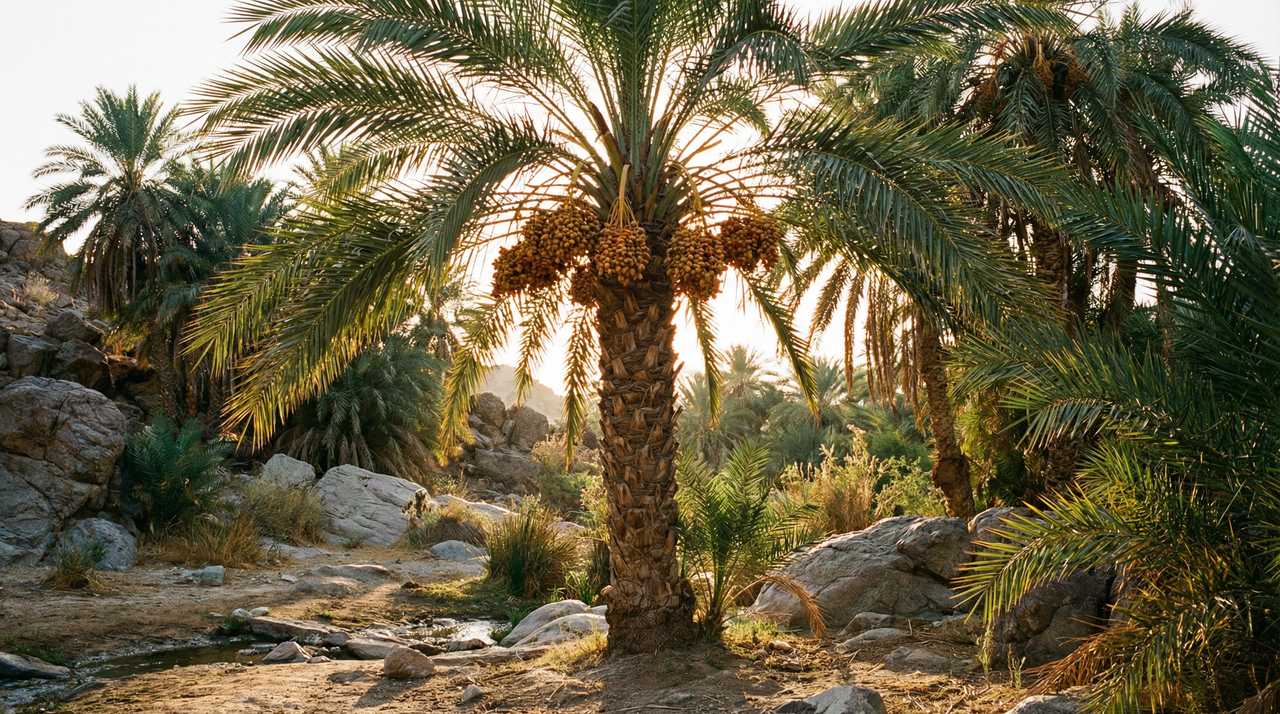
There's a date palm seed in a museum in Tel Aviv that germinated. That alone wouldn't be remarkable, except this particular seed had been sitting in a jar since its excavation from the ancient fortress of Masada, where it had lain dormant for roughly 2,000 years.[1] Researchers planted it in 2005, mostly out of curiosity, and it sprouted. They named the seedling Methuselah. He's still alive. That story gets passed around as a curiosity, a quirky botanical footnote, but I think it quietly tells you everything important about this tree: that it is built for time and scarcity in a way that almost nothing else is.
Most people who grow up in temperate climates think of date palms the way they think of camels, as scenery for somewhere else, somewhere impossibly hot and dry and far away. But I've watched them fruit in the Coachella Valley and seen them anchor a permaculture food forest in ways that no other canopy tree could manage in that heat. The deeper I've gotten into designing for arid and semi-arid climates, the more I've come to think that dismissing this plant as an exotic irrelevance is one of the more expensive mistakes a desert gardener can make.
Origin and History of Date Palm
Few plants are as deeply woven into the fabric of human civilization as the date palm. Phoenix dactylifera originated in the desert oases of the Fertile Crescent and Arabian Peninsula, where annual rainfall can drop below 100 mm and most plants simply refuse to grow.[2][3] That punishing birthplace explains everything about what this tree became: not just a food source, but an entire survival system for the cultures that grew up alongside it.
Botanical Background and Visual Characteristics
The date palm is built for longevity. Trees typically live 100 to 150 years, and under optimal conditions some push well past 200.[4][5] That long arc of productivity is part of what made the tree so valuable: it begins fruiting at five to eight years old, reaches full production around fifteen years, and then holds that output for another forty to sixty years.[6] In permaculture terms, that's an extraordinary return on a single planting investment. It's polycarpic, meaning it flowers and fruits repeatedly across its life rather than spending itself in one grand reproductive event, which makes it a remarkably stable food source in harsh environments.[7]
Architecturally, the tree is hard to miss. A mature specimen reaches 15 to 24 meters with a solitary trunk 30 to 60 cm across, its surface marked by a striking diamond pattern of persistent leaf bases.[8][2] The crown carries pinnate fronds three to five meters long, and the rachis is armed with stout yellowish spines up to 10 cm. The tree is dioecious, with male and female flowers on separate plants, each producing large pendulous inflorescences up to 1.5 meters long.[2][9] That dioecious nature has real practical implications for anyone hoping to grow fruit, something I'll note from experience is the first thing people overlook when they impulse-buy a small date palm at a nursery.
The broader Phoenix genus offers interesting context. The Canary Island date palm (Phoenix canariensis) is native to a subtropical Mediterranean climate and typically matures to 15 to 25 meters over 20 to 30 years, with a lifespan that can exceed 150 years.[8][10] I've used it as a focal point in Central Florida gardens and watched that stunning transition from upright silvery juvenile fronds to the drooping, glaucous adult form.[8][11] The silver date palm (Phoenix sylvestris) is smaller still at 9 to 15 meters, native to arid and semi-arid regions of South Asia, and brings a distinctive metallic sheen from its pubescent silvery-green leaflets.[12][13] These relatives share the genus's long-lived perennial habit but vary enough in climate tolerance and growth rate to suit different garden contexts entirely.
Traditional, Cultural, and Religious Significance
Domestication of Phoenix dactylifera began around 6000 to 5000 BCE in Mesopotamia, with archaeological evidence from sites like Tell el-Ubaid confirming its deep roots in the Fertile Crescent.[14][15] From there it moved outward through Phoenician trade routes around 1200 BCE and then swept across North Africa, Spain, and Sicily during the Islamic expansion of the seventh century CE.[14] Ancient Egypt cultivated date palms by around 3000 BCE for fruit, for brewing beer and wine, and for fiber to make ropes and mats, while associating the tree with the fertility goddess Hathor in rituals of renewal.[16] In Mesopotamia, cuneiform texts document its role in agriculture, trade, and mythology as a symbol of fertility and prosperity.[17]
Its religious significance runs even deeper. The date palm is mentioned over twenty times in the Quran as a symbol of sustenance and paradise, and dates are the traditional food used to break the Ramadan fast.[18] Living in Florida with a diverse community, I've seen that tradition up close at neighborhood iftars, and it genuinely shifted how I think about this plant from an agricultural specimen to a living article of faith. In Jewish tradition, palm branches (lulav) are among the Four Species used during Sukkot, and the date is counted among the seven species of the Land of Israel.[19] Scholars of the Islamic Golden Age catalogued extensive medicinal uses for dates, including treatments for digestive complaints, anemia, and fatigue, while Bedouin and North African cultures have long called it a "tree of life" for good reason: it provides food, medicine, construction material, and ritual significance simultaneously.[20][21] UNESCO has formally recognized that living heritage, designating date palm oases such as Al-Ahsa in Saudi Arabia as cultural landscapes and listing date palm knowledge and practices as intangible cultural heritage.[22][23]
While the true date palm became the global commodity crop, its relatives built their own cultural stories. Phoenix sylvestris appears in the Rigveda and Ayurvedic texts dating to around 1500 BCE, with applications in treating urinary disorders and diabetes, and its leaves remain important in Hindu rituals associated with Shiva.[24][25] The Canary Island date palm, by contrast, was consumed mainly during scarcity and is now primarily ornamental.[26]
Ecological Role, Adaptations, and Fun Facts
The scale of a mature date palm puts it in a different category than most food trees. It can reach 30 meters tall, live for two centuries, and some ancient specimens have been estimated at over 2,000 years old.[27][28] A healthy tree in its prime yields 80 to 100 kg of fruit annually, and under optimal conditions that number can double.[6] Those numbers help explain why entire civilizations organized themselves around groves of these trees.
The physiological adaptations that make this possible are genuinely remarkable. Root systems extend 10 to 30 meters deep, stomata open at night to minimize water loss, leaf surfaces carry thick waxy cuticles with sunken stomata, and the tree tolerates salinity levels up to 8 to 12 dS/m and temperatures reaching 50°C.[29][30] I think about those deep roots every time I work with date palms in design: they're doing soil-stabilization work that rivals anything else I've planted in a hot, dry system. Other deep-rooted permaculture trees like mesquite perform similar functions, but date palms layer on top food production at a scale that makes them uniquely valuable as overstory anchors in desert food forests.
All of those adaptations feed directly into the palm's ecological role as a keystone species in arid landscapes. The shade it generates creates cooler, moister microhabitats; its roots stabilize soil and facilitate groundwater recharge; its fruit, pollen, and nectar support birds, mammals, insects, and reptiles.[31][32] In the United States today, commercial cultivation concentrates in California's Coachella Valley and parts of Arizona, southern Texas, and Florida, primarily within USDA zones 9 to 11.[33][34] Medjool has become a standout in warmer microclimates I've designed for clients: its sweetness is exceptional and it handles the occasional cold snap better than most people expect. After 8,000 years of cultivation, the date palm's combination of ecological function and extraordinary productivity still hasn't been surpassed by anything else in its climate zone.
Date Palm Varieties and Cultivars
With somewhere between 400 and 600 recognized cultivars of Phoenix dactylifera in commercial use worldwide, and over 3,000 distinct varieties documented when you include regional landraces, the date palm carries a level of genetic diversity that stops most people cold when they first encounter the numbers.[35][36][37] For most American growers, though, that number collapses pretty quickly to three cultivars you'll actually encounter.
Notable Date Palm Cultivars and Related Phoenix Species
Medjool, Deglet Noor, and Barhi each fill a different niche, and the differences between them go well beyond fruit size. Medjool produces the large, soft, caramel-rich fruit most people picture, with sugar content around 70-80%, yields up to 90 kg per tree, and cold tolerance down to 18°F.[38][39] After specifying it in landscape and food forest plans across the region, I've seen firsthand how its premium soft texture commands real value at local farm stands in ways Deglet Noor simply doesn't. Deglet Noor, on the other hand, is the practical homesteader's cultivar: medium elongated fruit, 65-75% sugar, excellent shelf life as a semi-dry date, and cold hardiness down to 15°F with yields of 80-100 kg per tree.[38][40] Barhi is the outlier, a smaller fruit with the highest fresh sugar content of the three at around 80%, a honeyed caramel flavor unlike anything you'll find in the grocery store, but less cold tolerance at 20°F and lower yields of 40-60 kg per tree.[38][41]
The trees themselves grow at a fairly uniform 1-2 feet per year once established, reaching a mature height of 50-80 feet with a 20-30 foot spread.[27][42] Medjool starts producing in 4-8 years, but peak yields don't arrive until year 8-10, so this is genuinely a long-game plant.[42][43]
The Canary Island date palm (Phoenix canariensis) and silver date palm (Phoenix sylvestris) round out the genus in American gardens, though neither is a serious fruit crop. Phoenix canariensis tops out at 33-66 feet with those signature stout trunks, silvery-blue pinnate fronds up to 15 feet long, and cold hardiness to about 20°F.[8][44] Its fruits are orange-red and astringent, not worth harvesting commercially, and if you're in Florida, plant this one with your eyes open: I've watched Canary Island date palms drop volunteer seedlings in neighborhood sidewalk strips and disturbed edges with real enthusiasm, and its invasive potential in Florida, California, and Hawaii is genuinely documented rather than theoretical.[45] Phoenix sylvestris, the silver date palm, runs a bit shorter at 30-50 feet, has that beautiful arching silvery-blue foliage, and actually yields edible fruit with a sweet-sour tang, though again it's grown primarily for shade, windbreaks, and xeriscaping rather than the kitchen.[46][47] The silvery sheen on P. sylvestris fronds genuinely changes the mood of a garden in a way the other species don't quite replicate.
Cultivar selection within these two species is thin by comparison. Phoenix canariensis offers a handful of ornamental selections including 'Glauca' with its intense silvery-blue leaves, a 'Compacta' form reaching 20-30 feet, and 'Roehlii' running 25-40 feet; Phoenix sylvestris has even fewer named forms, mostly variegated ornamentals with limited nursery presence.[48][49][50] All three species share susceptibility to red palm weevil and Fusarium wilt, which the pests and diseases section covers in full, but it's worth knowing that P. sylvestris adds Ganoderma butt rot and Phytophthora bud rot to its list of concerns.[51][52][53]
Sourcing Date Palms in the United States
Finding Phoenix dactylifera in the U.S. means working primarily with licensed nurseries in California, Arizona, and Florida, where certified disease-free stock is available as seeds, seedlings, offshoots, or mature trees.[54] Price ranges are fairly predictable: seeds run $5-$15 for a packet, young 1-3 foot plants cost $20-$80, and mature 10-foot-plus specimens can reach $200-$1,500 or more depending on cultivar and tree health.[54] Spring is peak availability for the fruit-bearing cultivars, with Medjool offshoots being the most sought-after and often the hardest to source affordably because demand consistently outpaces supply.[55]
If you're thinking about importing, brace yourself for the paperwork. Every time I've helped a client navigate phytosanitary certificates or a USDA APHIS permit (PPQ Form 526), the upfront investment in getting it right has saved months of disappointment from diseased or rejected stock.[56] California and Florida both have additional state-level movement restrictions on palm material, and port inspections specifically targeting red palm weevil are standard.[57][58] The USDA National Plant Germplasm System is a legitimate starting point for verified accessions, and university extension offices in Arizona and California regularly publish nursery recommendations worth following.[59]
Phoenix canariensis is far easier to find, showing up at big-box garden centers and specialty nurseries across suitable states year-round, with small plants at $20-$100 and 15-20 foot specimens anywhere from $500-$2,000 or more.[60] Phoenix sylvestris sits in between: available through specialty palm nurseries rather than general retailers, with young plants at $20-$100 and established specimens reaching $300-$800 depending on size.[61] Whichever species you're after, certified disease-free sourcing isn't optional. It's the single most important decision you'll make before a single frond goes in the ground.
Propagating and Planting Date Palms
If you want predictable fruit from a named cultivar, the propagation decision is essentially made for you before you even dig a hole. Date palms are dioecious and primarily outcrossing, which means seeds shuffle the genetic deck every time.[62][63] Seedlings show wild variation in fruit size, flavor, color, yield, and ripening time, and roughly half of them will be male.[64] I've started both seed-grown and offshoot date palms on projects over the years, and the lesson I keep relearning is that you can't tell much about a seedling's quality until it's old enough to fruit, which can be a very long wait.
Choosing a Propagation Method: Offshoots, Seeds, Tissue Culture, or Grafting
Offshoots are the gold standard, full stop. A healthy offshoot removed at three to five years old, carrying ten to fifteen leaves, transplants with a 90 to 100 percent success rate when the timing is right.[65][66] The resulting plant is a true clone of its mother, preserving all those elite fruit traits. The catch is that a single tree only produces ten to twenty offshoots across its entire lifetime, so supply is always limited.[67] I prefer removing offshoots in early summer in my region so the mother palm has the full rainy season to callus and recover, which is a practical adaptation of the FAO timing recommendations to humid subtropical conditions.
When offshoots aren't available, tissue culture fills the commercial gap. Micropropagation via leafy shoot tips achieves 80 to 95 percent multiplication rates under controlled lab conditions with MS medium, auxins, and cytokinins.[68][69] It's expensive and requires sterile conditions, but it's how large-scale nurseries produce genetically identical stock of premium cultivars.[70] For most home growers, buying a tissue-cultured plant from a reputable nursery is more practical than attempting it yourself. Grafting is a niche option with success rates ranging from 20 to 70 percent depending on technique and rootstock compatibility, and cuttings or air layering simply don't work reliably for palms due to their monocot structure.[71][72] If you're sourcing plants in the United States, also know that federal quarantine regulations for red palm weevil apply to nursery stock.[73]
Date Palm Seed Characteristics and Long-Term Storage
Growing a date tree from seed is genuinely worth trying if you're curious about the plant's biology or want to experiment with seedling selection over a long time horizon. The seeds themselves are beautiful: oblong to ovate, dark brown to near-black, hard and glossy, roughly 1.8 to 2.5 cm long with a woody endosperm and a small embryo tucked at the base.[74][75] Some varieties exhibit polyembryony, where a single seed can produce multiple seedlings from both zygotic and nucellar origins, which occasionally surprises growers expecting one plant per pit.[76][77] Fresh seeds germinate at 50 to 80 percent over one to three months at soil temperatures of 25 to 35°C in well-draining, sandy or loamy mix with a pH of 6.0 to 8.0.[67][72]
What I find remarkable about date palm seeds is their orthodox storage behavior. Properly dried to 5 to 10 percent moisture content and kept at 5 to 10°C in airtight containers, viability can hold for decades.[78][79] The most dramatic proof of this: ancient seeds excavated at Masada, approximately 2,000 years old, were successfully germinated.[80] That stopped me cold the first time I read it. It's a useful reminder that a date pit saved and stored correctly isn't a throwaway; it's potentially viable far longer than any of us will be around to tend the tree.
Soil, Site, and Sun Requirements for Successful Establishment
Drainage is non-negotiable. Date palms demand sandy, loamy, or gravelly soils with excellent aeration, and they flatly refuse to tolerate prolonged waterlogging.[8][81] In their native habitat, the root zone runs through soil that's 70 to 90 percent sand with minimal clay.[82] When I'm working with heavier Florida soils, I plant on mounded berms and incorporate 20 to 30 percent coarse sand into the backfill.[83] A little compost at 5 to 10 kg per square meter improves structure, but resist the urge to go heavier on organics since excessive moisture retention is what kills these palms.[84] The root system spreads horizontally up to 10 to 20 meters while reaching depths of 1 to 2 meters, so you also want at least 1.5 to 2 meters of workable soil below the planting site.[82]
Target a soil pH of 6.5 to 8.5.[85] Drop below 5.5 and you risk aluminum toxicity along with cascading nutrient deficiencies.[8] Push too far alkaline and iron deficiency chlorosis appears, showing up as interveinal yellowing on younger leaves that progresses to necrosis if left untreated.[86] I test soil pH before planting any Phoenix species in Central Florida and keep chelated iron foliar spray on hand for young transplants until their roots are fully established. On the salinity side, date palms are genuinely impressive, surviving electrical conductivity levels up to 8 to 12 dS/m, though fruit yields start declining above 4 dS/m.[87]
Full sun is the other requirement that can't be compromised. Six to eight hours of direct sun per day is the baseline, and more is usually better.[88] Light-deficient palms grow slowly, lose color, produce fewer fronds, and fruit poorly.[89] Young transplants can show leaf tip scorch during heat extremes, which is temporary, but choose your site knowing there's no correcting a shaded location once the tree is in the ground.
Spacing, Planting Technique, and Timeline to First Fruit
Plant in spring, March through May after the last frost threat has passed.[90] For offshoots, set the root ball at
Propagating and Planting Date Palms
There's a fundamental fork in the road when you decide to grow a date palm, and which path you take will shape your experience for the next decade. Seed propagation is accessible, fascinating, and almost always the wrong choice if you care about fruit quality. Offshoots are slower to source but give you something seeds simply can't: a genetic copy of the mother tree.
Choosing a Propagation Method: Offshoots, Seeds, Tissue Culture, or Grafting
Phoenix dactylifera is dioecious and heavily outcrossing, which means any seed you plant is the product of a genetic shuffle.[62][63] The seedling you grow might be male, might produce small astringent fruits, might ripen two months later than the variety you were hoping to replicate. There's no way to know until the tree is four to eight years old.[91] I've started both seed-grown and offshoot date palms on landscape projects, and learned early that rigorous labeling matters in year one, because by the time fruiting-age variation reveals itself, the original context is long forgotten.
Offshoots (often called pups or suckers) are the traditional solution to this problem and still the gold standard for anyone growing named cultivars like Medjool or Deglet Noor. A healthy offshoot removed at three to five years old, carrying ten to fifteen leaves, transplants with a success rate of 90 to 100 percent when timing is right.[65][66] The catch is that each tree produces only around ten to twenty offshoots across its entire lifetime, so supply is always tight.[68] I prefer removing offshoots in early summer in humid subtropical climates so the mother palm has the full rainy season to recover, which is a practical adaptation of FAO timing recommendations to Florida conditions.
Tissue culture solves the supply problem at scale, achieving 80 to 95 percent multiplication rates from shoot tips in controlled lab conditions.[68][69] The tradeoff is cost and somaclonal variation risk, which is why tissue-cultured plants are more common in commercial orchards than in home gardens. Grafting is a niche option with variable success rates of 20 to 70 percent and is rarely worth the trouble for most growers.[71] Standard stem cuttings and air layering are essentially off the table; as monocots, date palms don't root reliably from vegetative cuttings, and air layering success sits below 50 percent.[67] For permaculture food-forest design where predictable fruit quality is the point, I recommend sourcing tissue-cultured plants of known cultivars or waiting for offshoot availability rather than gambling on seedlings.
Date Palm Seed Characteristics and Long-Term Storage
Where seeds do shine is in their remarkable botany. Date palm seeds are oblong to ovate, roughly 1.8 to 2.5 cm long, hard, glossy, and dark brown to nearly black, with a pale horny endosperm surrounding a small embryo at the base.[74] Many seeds exhibit polyembryony, occasionally producing multiple seedlings from a single pit through both zygotic and adventitious origins.[76] Fresh seeds germinate at rates of 50 to 80 percent, typically within one to three months at soil temperatures of 25 to 35°C in well-draining sandy or loamy mix with a pH of 6.0 to 8.0.[67]
What really stops me in my tracks is the orthodox storage behavior of date palm seeds. They tolerate desiccation and cold storage remarkably well, remaining viable for 20 to 50 years or more when kept at 5 to 10°C with moisture content below 10 percent in airtight containers.[78][79] The famous example is the Masada seeds, approximately 2,000 years old, which were successfully germinated after surviving centuries under hyper-arid desert conditions.[80] I've worked with a lot of palms, and I haven't encountered another genus that comes close to that kind of seed longevity. It's a reminder that the biology of this tree is genuinely extraordinary, even if those seeds won't give you the Medjool you were hoping for.
Soil, Site, and Sun Requirements for Successful Establishment
Drainage is non-negotiable. Date palms native to oasis environments are adapted to sandy, gravelly, or loamy soils with excellent aeration, and they will not tolerate prolonged waterlogging; heavy clay is essentially a death sentence over time because root rot sets in before you notice anything wrong above ground.[8][81] The natural soil texture in native habitat runs 70 to 90 percent sand, and that figure is worth keeping in mind when you're amending a planting site.[82]
The optimal pH window is 6.5 to 8.5.[8] Go below 5.5 and aluminum toxicity becomes a real problem.[85] Go above 7.5 and you often see iron-deficiency chlorosis manifesting as interveinal yellowing on newer leaves.[86] I routinely test pH before planting any Phoenix species in Central Florida, and I've had good results using chelated iron foliar sprays on young transplants during establishment until the root system is fully settled. On the other end of the tolerance spectrum, date palms handle salinity impressively well, surviving electrical conductivity levels up to 8 to 12 dS/m, though fruit yields start declining above 4 dS/m.[87]
The root system needs room to work. Roots spread horizontally 10 to 20 meters from the trunk and reach depths of 1 to 2 meters, so a minimum soil depth of 1.5 to 2 meters is recommended for healthy establishment.[82] Soil compaction is a quiet threat; root penetration drops sharply once bulk density exceeds roughly 1.8 g/cm³.[92] For heavy or poorly draining sites, raised mounds or beds amended with 20 to 30 percent coarse sand and moderate organic matter (5 to 10 kg per square meter) mimic the native soil profile well.[81] Container growing works with a mix of 40 to 50 percent coarse sand, 30 percent potting mix, and 20 to 30 percent perlite or pumice targeting pH 6.0 to 7.5.[83]
Full sun is the one requirement that admits no compromise. Young transplants need a minimum of 6 to 8 hours of direct light per day, and insufficient sun shows up as pale, chlorotic fronds, stunted growth, and poor fruit set.[88] Even in brutal summer heat, mature palms handle full exposure well, though very young transplants can show leaf tip scorch if moved from shade to intense sun too abruptly.[93]
Spacing, Planting Technique, and Timeline to First Fruit
Planting a date palm is a long game. Seed-grown trees typically take four to eight years to produce their first fruit, while offshoot-propagated palms can bear in three to five years.[91] Full commercial production usually doesn't arrive until eight to ten years post-propagation.[94] That timeline is why getting spacing right from the start matters so much. A mature date palm reaches 50 to 80 feet tall with a canopy spread of 20 to 25 feet, and you absolutely cannot move it once established.[95]
For food-forest or orchard planting, the University of California recommends 25 feet by 25 feet as a solid target, with commercial rows running 20 to 30 feet within-row and 30 to 40 feet between rows.[96][97] In my food-forest guilds I give the canopy anchor a full 25-foot radius, partly because the root spread justifies it and partly because that breathing room keeps airflow high, reduces disease pressure, and leaves enough light for nitrogen-fixing shrubs and ground covers in the understory. Ornamental plantings can compress to 13 to 20 feet if fruit production isn't the priority.[98]
When planting offshoots, set the bud crown 4 to 6 inches above the soil surface at a planting depth of roughly 60 to 90 cm, water deeply after planting, and resist the urge to overwater during establishment.[81][91] Spring planting in the United States, from March through May after the last frost, gives new transplants the best window to settle in before summer heat arrives.[90] Young plants need consistent moisture and more protection than the weather-hardened specimens you see thriving in Phoenix or the Coachella Valley; the oasis toughness that makes mature date palms legendary takes years to develop.
Date Palm Care Guide
Of all the cultural decisions you'll make with a date palm, water management is where most growers succeed or fail. The learning curve is real, and I'll be honest: I've watched beginners lavish young palms with daily watering out of genuine care, only to end up with yellowing lower fronds and the telltale soft-trunk symptoms of root rot. The transition from frequent seedling irrigation to deep, infrequent mature watering is the single most important mindset shift this tree demands.
Watering Needs and Irrigation Schedules
Established date palms need roughly 40-60 inches of water annually in arid climates, typically delivered as 1-2 inches per week during the growing season via deep, infrequent irrigation.[99][100] Young trees, though, need watering every 3-7 days for their first two to three years while roots establish.[101] Soil type, rainfall, and mulch will shift those numbers considerably, so treat them as starting points. The "why" behind deep and infrequent comes directly from the native oasis environment, where palms tap groundwater rather than surface moisture.[102] Compare that to Phoenix roebelenii, the pygmy date palm, which originates in humid habitats receiving 1,500-3,000 mm of annual rainfall[103] and makes the point that this genus spans an enormous range of water adaptation. Caring for a pygmy date palm and caring for Phoenix dactylifera are genuinely different tasks.
Drainage is non-negotiable. Overwatering produces yellowing and browning of lower fronds, stunted growth, and eventually Phytophthora root rot, while underwatering shows up as wilting, leaf curl, and scorched tips.[86] Date palms handle irrigation water with an electrical conductivity up to 4-6 dS/m with minimal yield loss and tolerate soil ECe up to 8-12 dS/m, though they perform best below EC 2 dS/m, with an optimal soil pH of 7.0-8.5.[104][105] Their salinity tolerance is genuinely impressive compared to most palms, but it doesn't excuse poor drainage.
Fertilizing and Nutrient Management
I test my own palms every two years rather than the standard 1-3 year cycle recommended for most regions[106][107] because Florida's heavy summer rains leach micronutrients far faster than arid-zone guidelines assume. Soil and leaf analysis are the foundation; everything else is guesswork.
Use a balanced palm fertilizer with low nitrogen and high potassium, something in the range of 8-2-12 or a 3-1-3 ratio, applied three to four times a year in spring, summer, and fall at roughly 1-2 kg nitrogen per mature tree annually.[108][100] The potassium emphasis isn't cosmetic; it directly supports fruit quality and drought resistance. In alkaline soils, iron, manganese, and zinc become locked up fast, so chelated micronutrient sprays are often necessary. Optimal leaf ranges run Fe 50-150 ppm, Mn 25-100 ppm, and Zn 15-70 ppm.[109]
Learning to read deficiency symptoms is the real date palm fertilizer skill. Uniform yellowing across older fronds points to nitrogen. Marginal scorch creeping inward from leaf tips, especially after a dry spell, is almost always potassium.[110] I've seen that exact slow browning on mature specimens and it's distinctly different from the interveinal chlorosis on new growth that signals iron deficiency. Frizzle top, where emerging leaflets look stunted and twisted, is a manganese signal I see frequently in Florida landscapes after heavy rain periods; chelated foliar sprays green them up within weeks.[109] And if you ever see hockey-stick curvature in new growth, think boron first. Over-fertilizing is its own problem: salt buildup causes leaf tip burn that can look deceptively like underwatering.[110]
Heat and Cold Tolerance
Phoenix dactylifera is a desert plant at heart. Mature specimens tolerate sustained temperatures up to 50°C (122°F), rated for AHS Heat Zones 9-12, and cultivars like Medjool, Barhi, and Deglet Noor handle those extremes particularly well.[111][112] Their waxy fronds and antioxidant enzyme systems (SOD, CAT, POD) provide real physiological armor against heat stress.[111] That said, seedlings become vulnerable above 40°C, and pollen sterility can occur at 45-50°C during flowering, so timing matters.[113] If you're planting in an especially exposed site, 30-50% shade cloth during the first summer, 4-6 inches of mulch, and early-morning irrigation reduce stress meaningfully.[114] Phoenix sylvestris manages comparable heat but uses roughly 30% less water[115] -- something worth knowing if you're designing a water-wise guild in a hot, dry landscape.
Frost Protection and Cold Hardiness
Date palms are best suited to USDA zones 9-11. Mature trees can survive brief drops to 20°F (-6.7°C), but young plants sustain damage below 25-28°F (-4 to -2°C).[116] Duration and acclimation matter enormously here; a single night at 26°F on an acclimated mature tree is different from two consecutive nights on a two-year-old seedling. Phoenix sylvestris pushes slightly harder into zone 8b with protection[117] and is worth considering for marginal climates.
Frost damage starts as tip browning and blackening of fronds, then moves toward total frond necrosis; in severe cases the apical bud dies or the trunk splits.[118] The apical bud and flowers are the most vulnerable tissue, damaged below 28°F. Protect with burlap trunk wraps, 6-12 inches of mulch kept well away from the trunk, frost blankets, and sheltered siting against a south-facing wall or structure.[119] After a Central Florida freeze a few years back, I learned to leave the damaged fronds in place until late spring. New growth shows you exactly where living tissue starts, and cutting too early removes protection the palm still needs.[120]
Pruning, Maintenance, and Seasonal Care
The rule I come back to every time: only remove what is truly dead, damaged, or diseased, and do it in late winter or early spring with sterilized tools.[121] Over-pruning is rampant in ornamental palm care and it weakens trees over time. Wear long sleeves and eye protection; the spines on mature fronds are serious, and I say that from experience rather than caution. Remove basal suckers to maintain a single trunk, and stake young trees in windy sites for the first three to five years.[122]
On mulching: 2-4 inches of organic material out to the drip line is excellent for moisture retention and soil biology, but keep it 6-12 inches clear of the trunk.[121] I once lost a young palm to trunk rot after piling mulch right up against the base, and it's an easy mistake to make when you're trying to do everything right. That gap between mulch and trunk makes a real difference.
The seasonal rhythm follows a clear pattern: active growth and fertilization in spring and summer, flowering in spring, fruit development through summer and into fall harvest, then a slow-down in winter when you cut back water and stop feeding entirely.[122][89] Tailor your attention to the palm's life stage: frequent moisture for the first year, an establishment focus through year five, then consistent fruiting support beyond that.[123] A palm that gets consistent, well-timed care from the beginning can stay productive for well over a century. That's a long return on a little seasonal discipline.
Harvesting Date Palms: Timing, Technique, and Flavor
Ripening Stages and When to Harvest
Date palm fruit doesn't just ripen; it transforms through four distinct stages, each with its own name and its own personality. Kimri is the green, hard, aggressively astringent phase that tells you nothing is ready yet. Khalal is when the fruit reaches full size and shifts color, often to yellow or red depending on cultivar, but biting into one will pucker your face. Rutab is where things get interesting: the flesh softens, the astringency drops away, moisture runs around 15-25%, and you're looking at peak fresh eating.[124][94] Tamar is the fully dried, wrinkled, chewy stage that most of us recognize from grocery store bins. The whole journey from hand pollination to physiological maturity takes 150 to 210 days, with California growers typically harvesting between August and December, peaking in October and November, while growers in hotter regions like Egypt or Saudi Arabia can see early varieties ready as soon as July or August.[125][126]
Visual and tactile cues are your best guides. You're watching for color shift from green toward yellow, red, or amber, and feeling for the yielding softness that signals rutab. Sugar content at full ripeness runs 60 to 85° Brix, which is extraordinarily high even among sweet fruits.[124] If you're growing Canary Island date palm or Silver date palm, the visual cues are similar but the flavor payoff is different. Canary Island fruits turn orange-red and plump up, while Silver date palm fruits shift to yellow-orange or reddish-brown and yield under gentle pressure, but their sugar content tops out around 15 to 25° Brix.[127][128] I learned this distinction firsthand with the Canary Island palm I grew in my Central Florida-adjacent landscape; I kept waiting for those fruits to taste like dates and they never quite did. Once I started processing them into syrup instead of eating them out of hand, they became genuinely useful.
Harvest Technique and Yield
Hand pollination in late February or March, using pollen from male inflorescences dusted onto female flowers, is what sets the entire harvest timeline in motion.[129] Get that step right and you've got fruit six or seven months later. Get it wrong and you've got a beautiful palm that produces nothing worth eating. Thinning shortly after fruit set is the other non-negotiable: commercial best practice calls for removing 80 to 90% of fruitlets from each bunch to concentrate the tree's energy into the remaining dates.[129][130] The first year I skipped aggressive thinning, I ended up with hundreds of tiny, low-sugar dates that weren't worth processing. That experience permanently changed how seriously I take thinning.
The actual harvest day involves working at 20 to 30 feet, cutting entire bunches at the base with long poles fitted with blades, ladders, or scaffolding.[129] My approach is always to check bunch color and softness carefully from the ground first, confirming the fruit is genuinely in the rutab window before committing to the climb or extended reach. Those bunches are heavy; an average bunch runs 20 to 50 pounds, so you want to be sure before you're up there.[126]
What to Expect: Yield, Flavor, Aroma, and Texture
About 90% of each fruit is edible fleshy pulp wrapped around a single hard, inedible seed.[131] The flavor is overwhelmingly sweet, with 65 to 80% sugars by dry weight, mostly glucose and fructose, and very low acidity ranging from 0.1 to 0.4% citric acid equivalent.[132] Fresh rutab-stage fruit carries a honey-caramel aroma with notes of almond, citrus, and tropical fruit; as dates dry into tamar, Maillard reactions deepen those aromas toward toffee, butter, and faint chocolate.[133][134] Texture moves from fibrous and hard at kimri through soft and moist at rutab to dense and chewy at tamar.
Cultivar shapes all of this considerably. Medjool delivers rich, caramel depth. Deglet Noor is milder, honeyed, with a nutty edge. Barhi at the khalal stage is something I find genuinely surprising every time: creamy and almost banana-like, nothing like the dried date experience at all.[135] Silver date palm fruits offer a pleasant sweet-sour balance with mild astringency when underripe and around 50 to 60% sugars fully ripe, while Canary Island date palm fruits are smaller, lower in sugar, more acidic, and fibrous enough that cooking or jamming suits them far better than fresh eating.[136][137] One thing home growers reliably discover is that fruit picked at true rutab and eaten the same day tastes noticeably richer than anything from a store, simply because commercial dates are often harvested slightly early to survive shipping. That caramel-and-nut finish on a home-harvested Medjool is a different experience entirely.
Date Palm Preparation and Uses
Culinary Preparation of Dates
Fresh dates are safely eaten raw straight from the tree once properly ripened, and Kew Gardens confirms Phoenix dactylifera fruits are edible raw or processed when handled correctly.[138] Their natural sweetness, chewy texture, and caramel-like depth make them genuinely one of the most culinarily flexible fruits I've grown, pairing well with nuts, dairy, spices, and even savory components in ways that still surprise me.[139] Roasting at 120-150°C for 10-20 minutes concentrates those caramel notes considerably,[82] and I've used roasted dates in grain bowls and braised dishes where they add a dark sweetness that most people can't quite identify.
For home processing, drying at 50-70°C reduces moisture below 20% and extends shelf life significantly.[82] In humid climates like mine, good airflow is essential at that temperature range or you'll get surface mold before the interior dries down. Fresh dates need cold storage at 0-5°C with 85-95% humidity for a shelf life of 4-6 weeks; dried dates store best at 0-10°C with humidity below 60% for 6-12 months.[100][140] Keeping moisture below 10% matters for food safety, since insufficient drying creates conditions for mycotoxins like aflatoxins.[141] Date syrup comes from boiling extracted juice down to 60-70% solids, and date flour from drying and grinding the pulp or seeds into powder, both worth making if you have a genuine surplus.[82] Seeds can also be cold-pressed at 40-50°C for oil.[82]
The Canary Island date palm (Phoenix canariensis) produces small 1-2 cm fruits that ripen yellow to orange and are technically edible but noticeably less sweet and more astringent.[142] Cooking improves them considerably, and they can be processed into jams, jellies, or wine. The silver date palm (Phoenix sylvestris) offers more promise: ripe fruits carry a honey-like sweetness from high fructose and glucose content, and its tapped sap is traditionally processed into jaggery, palm sugar, or fermented toddy.[143][144] Both species have edible hearts of palm when cooked, but I've never harvested one from a mature tree because doing so kills it. I'd rather let mine stand and use the fruits and fallen fronds instead.
Medicinal Preparations from Date Palm
Traditional medicinal preparations from Phoenix dactylifera include decoctions using 5-10g of dried fruit, infusions with 10-20g, a daily powder dose of 3-5g, and leaf extracts equivalent to 2-5g of dry leaves.[145][146] None of these are FDA-standardized, and individual responses vary considerably. When I make decoctions from fruit off my own trees, I start at the lower end of that range and adjust from there. Consulting a qualified practitioner is sensible, especially if you're managing a specific condition or taking other medications.
Non-Food Uses of Date Palm
The utility of this tree extends well past the fruit bowl. Date palm fronds have been woven into mats, baskets, and temporary shelters across the Middle East and North Africa for thousands of years, and the trunk provides timber for construction and fuel.[147][138] I've worked with palm leaf fiber in basketry projects alongside other subtropical plants, and Phoenix fronds hold up remarkably well through wet seasons compared to most alternatives. The silver date palm adds breadth to this picture: its leaves are used for thatching, weaving, brooms, and handicrafts, while fibers go into ropes and wood serves for construction and fuel.[20][25] The Canary Island and Silver date palms both yield saps that can be processed into sugar, jaggery, or palm wine.[148] A tree that feeds you, shelters you, clothes you, and builds your home: it's no coincidence that cultures living alongside these palms for millennia came to regard them as sacred.
Date Palm Health Benefits (Phoenix dactylifera)
Most people encounter the date palm as food long before they encounter it as medicine, which is actually the right order. The fruit is where the nutrition is, and understanding what you're eating makes everything else about this plant click into place.
Nutritional Profile of Dates: Fresh vs. Dried
When you bite into a date, you're eating the sweet, fleshy mesocarp surrounding the seed.[149] That distinction matters more than it sounds, because fresh and dried dates behave quite differently as food. Fresh dates clock in around 142 kcal per 100g; dried dates jump to about 277 kcal once most of that 50-70% water content evaporates below 20%.[150] I've harvested dates at the soft rutab stage straight off the tree and found them noticeably less sweet-dense and easier on digestion than the fully dried, chewy tamar-stage fruit I keep in my kitchen through winter. Both are useful. They're just doing different things.
The macronutrient profile of Medjool dates is dominated by carbohydrates (about 75g per 100g), with modest protein (1.8g), almost no fat, and a solid 6.7g of dietary fiber.[151] Deglet Noor runs leaner on sugar and higher on fiber (8g), which is worth knowing if you're using dates as a whole-food sweetener. Vitamins are present but not the headline: a little B6, trace vitamin C, small amounts of vitamin K and beta-carotene.[151] The minerals are where dates genuinely shine. Potassium leads at 696mg per 100g, followed by magnesium (54mg), calcium (64mg), phosphorus (62mg), iron, zinc, copper, and manganese.[151] For a whole food that also functions as a sweetener, that mineral payload is genuinely unusual. Layer on top of that 250-550mg of polyphenols per 100g fresh weight, flavonoids in the 100-300mg range, and carotenoids including beta-carotene and lutein,[152] and you start to see why dates have sustained entire civilizations. I love using chopped dates to sweeten homemade energy bars, but I keep portions small and pair them with nuts and seeds because the glycemic impact is real.
Key Phytochemicals and Their Roles
The phytochemical complexity of Phoenix dactylifera goes well beyond simple antioxidants. The fruit contains phenolic acids like ferulic, syringic, and caffeic acid; flavonoids including rutin, quercetin, luteolin, and kaempferol; terpenoids like beta-sitosterol and alpha-tocopherol; alkaloids including caffeine and theobromine derivatives; plus saponins, tannins, coumarins, and carotenoids including lutein.[153][154][155] That's not a short list for a desert fruit.
Concentration varies significantly by plant part. Date palm leaves carry 10-50mg of phenolic compounds per gram dry weight, while the seeds pack even more firepower with 20-100mg/g of proanthocyanidins.[154][156] The fruits themselves demonstrate DPPH radical scavenging up to 80-95%, driven primarily by those polyphenols.[157] These compounds also scavenge free radicals through NF-κB pathway inhibition and Nrf2 activation, and show antimicrobial activity against pathogens including Staphylococcus aureus.[158][159]
One thing I wish more growers knew: the phytochemical profile shifts considerably based on cultivar, fruit maturity, geography, and even irrigation stress.[160][161] Ripe fruit has higher phenolics and carotenoids; immature fruit leans tannin-heavy.[162] Organic cultivation and managed water deficit tend to push bioactive concentrations higher. In other words, how you grow and when you harvest directly shape the nutritional quality of what ends up on the table.
Medicinal Research and Traditional Uses
Traditional medicine across the Arabian Peninsula, North Africa, and South Asia has long used Phoenix dactylifera for digestive ailments (both diarrhea and constipation), wound healing, respiratory complaints, fever, urinary tract infections, anemia, and as a general restorative tonic.[163] It's a broad portfolio, and increasingly the lab work is catching up. Preclinical studies show date palm extracts inhibit NF-κB, suppressing pro-inflammatory cytokines (TNF-alpha, IL-6) and COX-2 expression in macrophages, while simultaneously activating the Nrf2 pathway to upregulate the body's own antioxidant enzymes including glutathione, superoxide dismutase, and catalase.[164][165] Seed and fruit extracts also inhibit alpha-glucosidase and alpha-amylase, which explains the traditional use in blood-sugar management,[166] and demonstrate antimicrobial activity against both Staphylococcus aureus and E. coli.[167]
The honest caveat is that most of this evidence comes from in-vitro and animal studies. Robust human clinical trials on standardized date palm extracts remain limited; the positive human data comes primarily from eating the whole fruit.[168] I find that framing actually reassuring. It means that eating dates as food, rather than chasing isolated extracts, is still the most evidence-supported approach. Silver date palm (Phoenix sylvestris) adds a hepatoprotective dimension through its own Nrf2-mediated effects,[169] and Phoenix canariensis shows preliminary neuroprotective potential,[170] but neither changes the core message: date palm benefits are real, preclinical evidence is exciting, and whole-fruit consumption at sensible amounts is where the practical value lives.
Safety Considerations and Contraindications
Phoenix dactylifera is non-toxic to humans and most animals, with date products carrying GRAS status and clinical studies commonly running 50-100g of fresh fruit daily without adverse events.[171][172] In all my years growing and harvesting dates, the only injuries I've seen are from the spines, not the plant itself. Those basal frond spines are genuinely hazardous: I learned early in my pruning career to wear heavy gloves and long sleeves without exception. A single spine through a thin garden glove is enough to convince you permanently.
The confusion with sago palm (Cycas revoluta) deserves a direct mention because it's potentially lethal. Sago palms contain cycasin, which causes liver failure and neurological damage.[173] Date palms look nothing like sago palms once you've grown both, but new gardeners should learn the distinction before planting anything with "palm" in the common name.
The real safety considerations for Phoenix dactylifera are more nuanced. Date palm pollen carries the allergen Pho d 2, a profilin protein that triggers allergic rhinitis, asthma, and conjunctivitis in sensitized individuals.[174] I keep my male trees positioned upwind of garden seating because the spring pollen release is unmistakable and can genuinely affect sensitive visitors. For people with diabetes or on medications metabolized by cytochrome P450 enzymes, the high natural sugar content and possible hypoglycemic effects of date fruit warrant a conversation with a healthcare provider before consuming regularly.[175][176] Pregnancy is a more nuanced picture: some controlled trials support date consumption in the final trimester for labor support,[177] but that's a decision for a midwife or obstetrician, not a plant profile. Moderation and good sourcing cover most people well.
Date Palm Pests and Diseases
I learned the hard way what red palm weevil damage looks like from the outside: nothing. A mature date palm in a landscape project I was consulting on showed barely a yellowed frond before it collapsed. By then, the larvae had been tunneling through the crown for months. That experience changed how I approach every warm-climate palm planting I do now, and it's the single reason I insist on quarterly trunk inspections and pheromone trap deployment before anyone sees so much as a suspicious frond.
Major Insect Pests: Red Palm Weevil and Scale Insects
The red palm weevil (Rhynchophorus ferrugineus) is the most destructive insect pest the date palm faces. Adults bore into trunks and crowns, larvae excavate galleries through living tissue, and by the time symptoms are visible the tree is often unsaveable. In warm, humid conditions between 25 and 35°C, young palms can see up to 90% mortality from a single infestation.[178][179][180] Cultivar choice modulates risk: 'Medjool', 'Barhi', and 'Deglet Noor' show moderate to higher resistance through denser wood, elevated phenolic content, and tougher leaf sheaths, while 'Khalas' is considerably more susceptible, though no cultivar is fully immune.[181][162] I routinely steer clients toward 'Medjool' or 'Barhi' wherever weevil pressure is a documented local risk. When I've grown Phoenix sylvestris alongside Phoenix canariensis, the contrast in frond texture is immediately obvious: the silver date palm's tougher, tannin-rich fronds feel almost leathery compared to the softer growth of the Canary Island palm, and that physical difference maps directly onto the sylvestris's moderate weevil resistance versus the canariensis's high susceptibility.[182][183]
Scale insects are the chronic background pressure that weevils are not. Aulacaspis tubercularis, Aspidiotus destructor, and Parlatoria blanchardi all feed on sap, reduce photosynthesis, and excrete honeydew that cultivates sooty mold across fronds and fruit.[184][185] Rounding out the pest roster: citrus mealybug deforms fruit and invites secondary fungal infection, western flower thrips scar flowers and vector viruses, spider mites stipple foliage under dry stress, and rhinoceros beetle and coconut leaf beetle can skeletonize leaves when populations get ahead of you.[186][187][188] Every one of these pressures escalates under environmental stress; a drought-hammered or waterlogged palm is a much easier target than a healthy one.[189][190]
Key Diseases: Bayoud, Ganoderma, Phytophthora, and Lethal Yellowing
Bayoud disease, caused by the soil-borne fungus Fusarium oxysporum f. sp. albedinis, has devastated North African date palm plantations and remains one of the most serious threats the species faces.[191][192] The good news is that resistance is cultivar-dependent, with 'Medjool', 'Barhi', 'Khadrawy', 'Bousthami', 'Iklane', and 'Saharbey' all showing useful tolerance; 'Deglet Beida' offers partial resistance.[193] Ganoderma root and butt rot (Ganoderma zonatum) is widespread in Florida and reported in Arizona and California, causing slow decline and eventual death with no cure once established.[194] In my experience, any palm showing early frond wilt in poorly drained soil is immediately suspect for root rot, and I always recommend raised planting or soil solarization before putting a new palm into Florida-type humidity.
Phytophthora root and crown rot susceptibility climbs sharply with overwatering or heavy soils; well-drained conditions and disciplined irrigation are your best mitigation.[195] Leaf spots from Alternaria or Bipolaris spp. tend to appear on stressed trees and respond well to sanitation pruning and restored vigor.[196] Lethal yellowing phytoplasma is a particular concern for Phoenix canariensis, which is highly susceptible, while bacterial diseases like Xanthomonas campestris and bunchy top virus have limited natural resistance across the genus and require early removal of infected material and vector control.[197][198] Underlying all of this: potassium deficiency causes frizzled leaves and magnesium deficiency causes chlorosis, and either one weakens a palm's immune response enough to open the door to infection.[196][85]
Natural Defenses and Integrated Management Strategies
The date palm isn't defenseless. Those recurved spines at the leaf bases are genuinely formidable physical deterrents to crawling insects, and the waxy cuticle on the fronds visibly repels adhesion and oviposition (I have a scar from handling a young specimen without gloves that reminds me of this every time). Internally, phenolic compounds, terpenoids, saponins, and tannins deter feeding and disrupt digestion, while extrafloral nectaries on the petioles secrete sugars that recruit ants and predatory insects as indirect bodyguards.[113][199][200] Good management amplifies all of it.
An effective integrated approach starts with prevention: proper irrigation to avoid both drought stress and waterlogging, sanitation pruning of infested or diseased fronds, adequate spacing for airflow, and pheromone trap deployment to catch weevil activity before it becomes an infestation.[201][202][203] Biological controls, including predatory beetles, parasitic wasps, ladybugs, and predatory mites, form the next line. Targeted insecticides or systemic treatments are the last resort, not the first response.[204][205] The single highest-leverage decision in all of this, though, happens at planting: choosing a resistant cultivar. A 'Medjool' in a weevil-prone region starts with a meaningful biological advantage that no spray program can fully replicate after the fact.
Date Palm in Permaculture Design
If you're gardening in a hot, dry climate and looking for an upper-canopy anchor that delivers on multiple fronts, the date palm deserves serious consideration. But I want to be honest with you upfront: this is not a tree that bends to marginal conditions, at least not without a fight. Getting placement and climate assessment right from the start saves years of frustration.
Climate and Hardiness Zones for Date Palm
Phoenix dactylifera is solidly a USDA zones 9-11 species. Mature specimens can survive brief dips to around 20°F (-7°C) and occasionally push through 15°F (-9°C) with protection, but young trees are a different story entirely.[206][81][207] I've grown several Phoenix palms in Central Florida microclimates and learned the hard way that what the literature quotes for cold tolerance applies to established specimens with thick trunks and deep roots, not the three-gallon nursery transplant you just put in the ground. Give young plants at least three full winters of active protection before you start trusting those hardiness numbers.
The heat and drought requirements are just as defining as the cold limits. The date palm thrives where annual rainfall sits between 4 and 10 inches, with low to moderate humidity in the 20-50% range.[5][91] It tolerates temperatures above 100°F and can survive short spikes to 125°F, with an optimal daytime range of 77-95°F for active growth and fruit development.[208][209] Once annual rainfall climbs above 20-24 inches, fungal disease pressure rises sharply, and above 70% ambient humidity the risks compound further.[5] This is why commercial date production in the United States is almost entirely confined to the low desert of California and Arizona.
Consistent fruiting requires those long, fiercely hot summers that only zones 9-11 reliably provide.[210][211] In marginal zone 9a or sheltered 8b microclimates, heavy mulching, trunk wrapping, and frost cloth become non-negotiable practices, not optional extras. The related Canary Island date palm (P. canariensis) tolerates brief snow in sheltered sites, and silver date palm (P. sylvestris) handles monsoon rainfall of 500-1500 mm in its native range, giving those species a somewhat broader climate envelope.[212][213] But neither rivals Phoenix dactylifera for fruit productivity in true desert conditions.
Ecosystem Functions and Services of Date Palm
In the right climate, a date palm is genuinely oasis-building infrastructure. The tall, dense crown reduces wind speed, drops temperatures beneath the canopy by several degrees, and nudges local humidity upward, creating conditions where understory plants that couldn't otherwise survive can take hold.[214][215] That's a meaningful ecological service in a place where raw summer sun and desiccating wind are your two biggest enemies.
Below ground, the deep, extensive root system, reaching up to 6 meters, anchors sandy soils and reduces erosion while slowly cycling nutrients back to the surface through fallen fronds and dropped fruit.[215][216] Beyond its structural roles, the palm supports biodiversity by providing nesting sites, food, and habitat for birds, insects, and small mammals; the inflorescences generate nectar and pollen that attract bees and other beneficial insects.[215][217] For desert permaculture, that combination of physical habitat and food web support is hard to match.
The biomass yield is worth planning around. Pruned fronds, thinned fruit, and other organic material from a mature date garden can generate 10-15 tonnes per hectare annually for use as mulch, fodder, fiber, or fuel.[216][138] Those numbers come primarily from oasis agroforestry studies, so treat them as a useful order of magnitude rather than a guaranteed yield for a small home planting. The silver date palm offers an interesting quantified comparison, with individual trees yielding 50-100 kg of fruit annually and interplanted agroforestry trials showing 15-25% productivity gains and 20-30% improvements in soil moisture retention.[218] One caution worth flagging: P. canariensis can become invasive in frost-free parts of California and Florida, and its non-fruit parts contain saponins and oxalates.[219] I've watched seedlings appear under mature Canary Island palms in my region. If you garden in a warm, moist climate, harvest fruit before it drops or consider planting only a sterile male to avoid volunteer palms spreading into the landscape.
Pollination Requirements and Techniques
Here's where a lot of first-time date palm growers get caught off guard. Because male and female flowers are on entirely separate trees, you need at least one male for every 50-100 females to achieve fruit set.[220][213] Plan that ratio into your design from the beginning, and think carefully about male placement relative to prevailing wind direction.
In natural arid habitats, wind does the pollination work. In designed systems with wider spacing, that wind transfer becomes unreliable, which is why hand pollination is standard practice and delivers 80-90% fruit set compared to lower rates from wind alone.[221][222] The techniques, dusting, brushing, or inserting pollen strands directly into the female inflorescence, are straightforward once you understand the timing. The female spathe must be pollinated within 1-2 days of opening, and pollen viability is similarly short.[223][224] I've found that catching the spathe at first crack rather than waiting even two extra days makes a dramatic difference in fruit set. Conditions matter too: optimal pollination happens at 77-95°F with 40-60% relative humidity and light wind around 5-15 mph, which aligns neatly with the same desert climate where the tree fruits best.[223]
Forest Layer and Guild Roles
The date palm occupies the upper canopy or emergent layer in permaculture food forests and arid agroforestry systems, reaching 20-30 meters with a 6-10 meter crown that casts dappled shade beneath it.[225][226] That shade can be a genuine asset for understory species that would otherwise be destroyed by direct desert sun. But the design picture has real constraints worth understanding before you start planning guilds around it.
The deep root system that makes this tree so drought-tough also means serious competition for water in the soil profile. I've watched comfrey and other deep-rooted dynamic accumulators struggle once established palm roots reach 4-5 meters; I now position water-hungry understory plants outside the drip line rather than directly beneath the canopy. The slowly decomposing, tannin-rich leaf litter can mildly suppress germination for some understory species as well.[227][228] Much of the guild data for Phoenix dactylifera is drawn from oasis and South Asian agroforestry research, so apply it with your own local observations rather than as firm prescription. Let the palm build its microclimate first, then select companions based on what's actually thriving in the modified conditions it creates.
The Tree That Made Me Rethink What "Productive" Means
I planted my first date palm knowing I'd never harvest a single fruit from it myself; the timeline simply doesn't work that way. And somewhere in accepting that, something shifted in how I think about this work entirely. There
The Tree That Made Me Believe in Permanence
I planted my first date palm knowing I'd never harvest a meaningful crop from it myself, and something about that felt right. There's a particular humility in tending something designed to outlast you, whose full productivity belongs to whoever comes after. Most of what I grow, I eat within a season. This one I planted for the food forest, not for me, and it's the tree I think about most when I wonder whether any of this work actually matters.
Sources 228
- Methuselah: A Viable Seed from 2,000-Year-Old Date Palm (Science, 2008) ↩
- Date Palm - Britannica ↩
- Ecological Requirements of Date Palm - FAO ↩
- Date Palm (Phoenix dactylifera L.): Biology and Utilization ↩
- FAO Date Palm Cultivation ↩
- Food and Agriculture Organization of the United Nations - Date Palm Cultivation ↩
- Missouri Botanical Garden - Phoenix dactylifera ↩
- Phoenix dactylifera - Missouri Botanical Garden ↩
- Inflorescence and Flowering in Date Palm ↩
- Phoenix canariensis - Kew Science Factsheet ↩
- Phoenix sylvestris - University of Florida IFAS Extension ↩
- Phoenix sylvestris - Wikipedia ↩
- Phoenix sylvestris L. ↩
- The Date Palm: Its Domestication and History ↩
- History of Date Palm Cultivation ↩
- The Date Palm in Ancient Egypt ↩
- Date Palms in Ancient Mesopotamia ↩
- Date Palm in the Holy Quran and Islamic Medicine ↩
- The Date Palm in the Bible and Jewish Tradition ↩
- Traditional Uses and Medicinal Properties of Date Palm (Phoenix dactylifera) ↩
- Ethnobotany of Date Palm in North Africa ↩
- Date Palm Oases as Cultural Heritage ↩
- The Date Palm: From the Sacred Tree to a Source of Income ↩
- Plants in Ancient Indian Medicine ↩
- Traditional Uses of Indian Date Palm by Bhil Tribe in Rajasthan ↩
- Traditional Uses and Toxicology of Phoenix canariensis in the Canary Islands ↩
- Date Palm ↩
- Date Palm Cultivation ↩
- Physiological responses of date palm to drought and salinity stress ↩
- Root System Architecture of Phoenix dactylifera ↩
- Ecological Role of Date Palm in Arid Environments ↩
- Date Palms and Oasis Ecosystems ↩
- Cultivation Practices for Date Palms in California ↩
- Phoenix dactylifera Fact Sheet ↩
- Date Palm Cultivation by FAO ↩
- Date Palm Varieties and Cultivars - UC Riverside ↩
- Global Date Palm Production and Cultivars - Research Article ↩
- Date Palm Production in California ↩
- Date Palm Cultivars and Characteristics ↩
- Growing Date Palms in Texas ↩
- Growing Date Palms in Arizona ↩
- Date Palm Production in California ↩
- Date Palm Cultivation in Texas ↩
- Phoenix canariensis ↩
- Invasive Plant Atlas of the United States ↩
- Phoenix sylvestris - Silver Date Palm ↩
- Phoenix sylvestris (Silver Date Palm) ↩
- Phoenix canariensis ↩
- Dwarf and Compact Forms of Canary Island Palm ↩
- Phoenix sylvestris ↩
- Red Palm Weevil ↩
- Fusarium Wilt of Palms ↩
- Ganoderma Butt Rot of Palms ↩
- Date Palm Production in California ↩
- Date Palm Production in California ↩
- Importing Plants and Plant Products ↩
- Nursery Stock Regulations ↩
- Plant Import Regulations ↩
- Phoenix dactylifera in GRIN-Global ↩
- Florida Landscape Plants: Prices and Sizes ↩
- Phoenix Sylvestris Pricing and Availability ↩
- Date Palm Cultivation ↩
- Propagation of Date Palms ↩
- Genetic Diversity in Date Palm (Phoenix dactylifera L.) ↩
- Date Palm Cultivation ↩
- Vegetative Propagation of Date Palm ↩
- Propagation of Date Palm (Phoenix dactylifera L.) ↩
- Challenges in Date Palm Propagation: A Review ↩
- Micropropagation of Phoenix dactylifera via Leafy shoot tips ↩
- Date Palm Cultivation ↩
- Grafting Techniques for Date Palm (Phoenix dactylifera) Propagation ↩
- Date Palm Propagation ↩
- Red Palm Weevil Quarantine ↩
- Flora of China: Phoenix dactylifera ↩
- Date Palm Seed Morphology ↩
- Polyembryony in Date Palm (Phoenix dactylifera L.): A Review ↩
- Seed Germination and Polyembryony in Date Palm ↩
- Seed Storage Behaviour of Phoenix dactylifera ↩
- Long-term Storage of Date Palm Seeds ↩
- Germination of Ancient Date Seeds from Masada ↩
- Date Palm Cultivation and Problems - University of Florida IFAS Extension ↩
- Date Palm Cultivation: Soil Requirements ↩
- Soil Management for Date Palms - University of California Agriculture and Natural Resources ↩
- Date Palm Cultivation Guide - FAO ↩
- Soil pH Preferences for Palm Trees - University of Florida IFAS Extension ↩
- Iron Chlorosis in Palms - University of Florida IFAS Extension ↩
- Date Palm (Phoenix dactylifera L.): Cultivation, Production and Uses ↩
- Missouri Botanical Garden Plant Finder - Phoenix dactylifera ↩
- Date Palm Cultivation - FAO Agricultural Services Bulletin ↩
- Date Palm Propagation - Texas A&M AgriLife Extension ↩
- Date Palm Cultivation ↩
- Date Palm Root System - University of Arizona Extension ↩
- Phoenix dactylifera Growth Requirements - University of California Agriculture and Natural Resources ↩
- Propagation of Date Palms ↩
- Date Palm - USDA Forest Service ↩
- Date Palm Cultivation - University of California Agriculture and Natural Resources ↩
- USDA Date Palm Cultivation Guide ↩
- Date Palm Production Guide ↩
- Date Palm Production in California ↩
- Irrigation Management of Date Palms ↩
- USDA Plant Guide: Date Palm ↩
- Date Palm Irrigation Management in California ↩
- Phoenix roebelenii - Plants of the World Online ↩
- Irrigating Date Palms in Arizona ↩
- FAO: Date Palm Cultivation - Water Quality ↩
- Date Palm Production Manual ↩
- Nutrition and Fertilization of Palms ↩
- Palm Fertilization Guide ↩
- Nutrient Management for Date Palms ↩
- Nutrient Deficiencies of Palms ↩
- Physiological Responses of Date Palm to Heat Stress ↩
- AHS Plant Heat Zone Map ↩
- Varietal Differences in Heat Tolerance of Date Palm Cultivars ↩
- Heat Stress Management in Date Palms ↩
- Phoenix sylvestris: Cultivation and Management in Arid Regions ↩
- Cold Hardiness of Phoenix Palms ↩
- Phoenix sylvestris - Silver Date Palm ↩
- Frost Injury to Palms ↩
- RHS Advice: Protecting Palms from Frost ↩
- Date Palm Cold Hardiness and Frost Protection ↩
- Pruning Date Palms in Home Landscapes ↩
- Date Palm Cultivation ↩
- Phenology and Growth of Date Palm ↩
- Date Palm Production and Processing ↩
- Date Palm Production in California ↩
- Date Palm Cultivation ↩
- Phoenix canariensis: Canary Island Date Palm ↩
- Phenology and Fruit Development in Indian Date Palm (Phoenix sylvestris) ↩
- Date Palm Pollination and Management ↩
- Harvesting and Postharvest Handling of Dates ↩
- Date Palm (Phoenix dactylifera L.) Fruit and Fruit Products ↩
- USDA FoodData Central - Dates, Medjool ↩
- Analysis of Volatile Compounds in Dates (Phoenix dactylifera L.) Using Automated Headspace Solid-Phase Microextraction ↩
- Volatile Compounds in Dates: Identification and Sensory Impact ↩
- Flavor and Chemical Composition of Date Fruits (Phoenix dactylifera L.) at Three Ripening Stages ↩
- Biochemical Composition of Phoenix sylvestris Fruits ↩
- Nutritional composition of Phoenix canariensis fruit ↩
- Phoenix dactylifera Edibility - Kew Gardens ↩
- Date Palm (Phoenix dactylifera L.): Natural Products and Therapeutic Potential ↩
- Date Fruit Storage and Handling ↩
- Date Fruit Safety and Storage Guidelines ↩
- Phoenix canariensis - Edible Uses ↩
- The Indian Date Palm: Phoenix sylvestris ↩
- Ethnobotanical Uses of Phoenix sylvestris: A Review ↩
- Medicinal Properties of Phoenix dactylifera: A Review ↩
- Clinical Trial on Date Palm Powder for Diabetes ↩
- Phoenix dactylifera - Kew Science ↩
- Phoenix canariensis: Uses and Benefits ↩
- Edible Parts of Date Palm - FAO ↩
- FAO Palm, Date Fact Sheet ↩
- USDA FoodData Central - Dates, medjool, raw ↩
- Nutritional, phytochemical and commercial quality of dates ↩
- Secondary Metabolites of Date Palm (Phoenix dactylifera L.): A Review on Bioactivities and Future Perspectives ↩
- Phenolic Compounds in Date Palm (Phoenix dactylifera L.): A Review ↩
- Phytochemical Composition and Bioactive Compounds of Date Palm (Phoenix dactylifera L.) ↩
- Antioxidant Activity of Date Seed Proanthocyanidins ↩
- Antioxidant activity of date fruit (Phoenix dactylifera L.) ↩
- Phenolic Compounds and Antioxidant Activity of Date Palm (Phoenix dactylifera L.) Fruits from Algeria ↩
- Antimicrobial Activity of Date Seed Extracts ↩
- Phenolic Compounds and Antioxidant Activity of Date Palm (Phoenix dactylifera L.) Fruits from Various Cultivars and Regions ↩
- Effects of Cultivation Practices on Phytochemical Composition of Date Fruits ↩
- Seasonal and Maturity Stage Variations in Bioactive Compounds of Phoenix dactylifera ↩
- Ethnobotanical Survey of Medicinal Plants in Oman ↩
- Pharmacological Activities of Date Palm (Phoenix dactylifera): A Review ↩
- Systematic Review of Date Palm Pharmacology ↩
- Oxidative Medicine and Cellular Longevity: Date Palm (Phoenix dactylifera) Phenolic Compounds, Anti-Inflammatory, and Anticancer Properties ↩
- Antimicrobial Activity of Phoenix dactylifera Seed Extract ↩
- Systematic Review - Medicinal and nutritional potential of Phoenix dactylifera: a critical review ↩
- Hepatoprotective effects of Phoenix sylvestris against carbon tetrachloride toxicity ↩
- Neuroprotective Effects of Palm Extracts: Focus on Phoenix Species ↩
- ASPCA - Toxic and Non-Toxic Plants ↩
- Safety and Toxicity Profile of Date Palm Fruit (Phoenix dactylifera L.) ↩
- University of Florida IFAS Extension - Sago Palm Toxicity ↩
- IUIS Allergen Nomenclature - Phoenix dactylifera ↩
- Nutritional and functional properties of dates: a review ↩
- Safety assessment of date seed extract and its bioactive compounds ↩
- Effect of Date Consumption on Labor Parameters in Full-Term Pregnancy: A Randomized Controlled Trial ↩
- Red Palm Weevil - USDA Animal and Plant Health Inspection Service ↩
- Management of Red Palm Weevil on Date Palms ↩
- Management of Red Palm Weevil in Date Palms ↩
- Susceptibility of Date Palm Cultivars to Red Palm Weevil in the UAE ↩
- Resistance of Wild Date Palm to Rhynchophorus ferrugineus ↩
- Resistance Mechanisms in Wild Date Palms Against Insect Pests ↩
- Scale Insects on Ornamental Palms ↩
- Date Palm Scale Insects ↩
- Citrus Mealybug on Date Palm ↩
- Western Flower Thrips ↩
- Phoenix canariensis Insect Pests ↩
- Pests and Diseases of Ornamental Palms ↩
- Environmental Factors Affecting Date Palm Pests ↩
- Bayoud Disease of Date Palm ↩
- FAO Date Palm Production and Protection Against Bayoud Disease ↩
- INRA Morocco - Resistant Date Palm Varieties to Bayoud ↩
- Ganoderma Root and Butt Rot of Palms - University of Florida IFAS Extension ↩
- Phytophthora Palm Root and Crown Rot - University of California IPM ↩
- Date Palm Diseases and Pests ↩
- Viral Diseases of Date Palm ↩
- Lethal Yellowing of Palms ↩
- Phenolic compounds in date palm and their role in pest resistance ↩
- Extrafloral Nectaries and Ant-Plant Interactions in Palms ↩
- Pest Management for Palm Trees ↩
- Management of Date Palm Pests ↩
- Red Palm Weevil Management in California Palms ↩
- Date Palm Diseases and Pests ↩
- Florida Plant Disease Management Guide: Palms ↩
- Phoenix dactylifera - Missouri Botanical Garden ↩
- Growing Date Palms in Arizona ↩
- Date Palm Cultivation - University of Arizona Extension ↩
- Phoenix dactylifera - Missouri Botanical Garden ↩
- Date Palm - University of Florida IFAS Extension ↩
- Growing Date Palms in California ↩
- Phoenix canariensis ↩
- Phoenix sylvestris - Silver Date Palm ↩
- Windbreak Functions of Date Palms ↩
- Date Palm (Phoenix dactylifera) in Desert Ecosystems ↩
- Date Palm Ecosystem Services in Arid Regions ↩
- Biodiversity in Date Palm Plantations ↩
- Phoenix sylvestris: A multipurpose tree for agroforestry ↩
- Phoenix canariensis: The Canary Island Date Palm ↩
- Sexual Dimorphism in Date Palm (Phoenix dactylifera) ↩
- Date Palm Cultivation: Pollination Practices ↩
- Pollination Techniques in Date Palm (Phoenix dactylifera L.) ↩
- Environmental Requirements for Date Palm Pollination ↩
- Hand Pollination of Date Palms ↩
- Canary Island Date Palm - FAO Agroforestry ↩
- Ecological Interactions of Phoenix canariensis in Agroforestry Systems ↩
- Shading and Competition Effects of Canary Island Date Palm ↩
- Leaf Litter Impacts on Understory Vegetation ↩