Every poisonous plant I've ever grown has had at least one redeeming quality I could point to from a safe distance: edible seeds, pollinator value, nitrogen fixation, something. Deadly nightshade is the one that genuinely tests that instinct. The berries are glossy, almost jewel-like, and reportedly sweet enough that children eat them willingly, which is exactly what makes them so catastrophic. A handful can kill a child. Two or three leaves can kill an adult.[1] And yet the same alkaloids responsible for that lethality have been dilating pupils in ophthalmology clinics, steadying hearts in emergency rooms, and treating motion sickness for decades, often under names patients recognize without ever connecting back to this plant.
What keeps pulling me back to Atropa belladonna isn't morbid curiosity, it's the way it refuses to be flattened into a single story. The genus name honors Atropos, the Greek Fate who cuts the thread of life; the species name translates to "beautiful lady," a nod to Renaissance women who dripped berry extract into their eyes to dilate their pupils for cosmetic effect, risking blindness in the process.[2] That tension, between beauty and death, between medicine and poison, is baked into the plant's very name. Understanding it doesn't make it safer. But it does make ignoring it harder.
Origin and History of Deadly Nightshade (Atropa belladonna)
Botanical Background and Native Range
Deadly nightshade is a Eurasian plant through and through, native across Europe, North Africa, and Western Asia, growing from sea level up to around 2,000 meters in woodlands, scrublands, and rocky slopes.[3][4] It belongs to the Solanaceae family and grows as a short-lived herbaceous perennial, typically lasting three to five years, occasionally reaching ten in ideal conditions, and hitting one to two meters tall from a deep, fleshy taproot.[5][6] Every part of the plant contains highly toxic tropane alkaloids, atropine and scopolamine chief among them, and it takes a full two to three years from seed before the plant flowers or fruits for the first time.[7] It's not native to North America, but has naturalized in scattered parts of the eastern and central United States, where regulations on cultivation vary by state.[4][8] I appreciate its botanical history the way I appreciate a well-documented toxicology case study: with deep respect and zero desire to bring it into a home garden.
Visual Characteristics and Identification
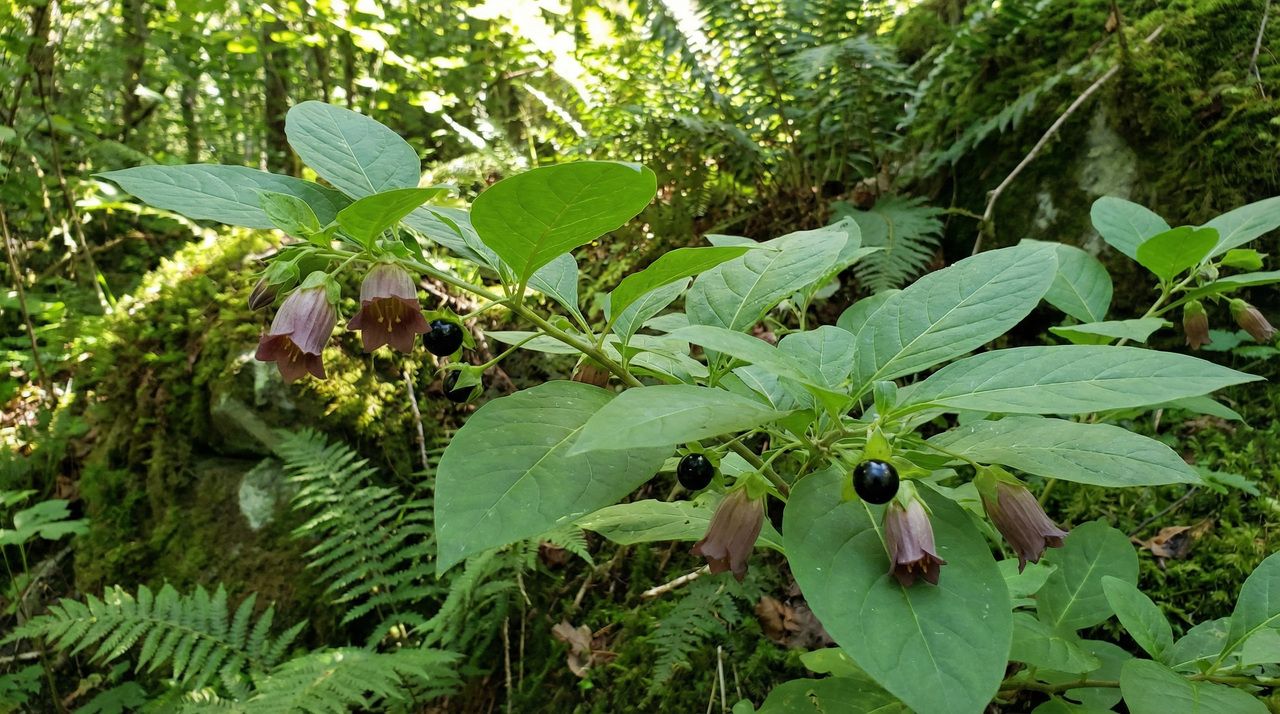
The plant grows as an upright, branching shrub with notably purple-tinged stems, alternate ovate leaves up to 20 cm long, and solitary nodding bell flowers in a muted purplish-violet that blooms from June through September.[9][10] Fruits ripen in late summer to early autumn as shiny black berries, one to two centimeters across, sweet-smelling and deceptively cherry-like.[11] I teach people in identification workshops to crush a leaf before drawing any conclusions: the smell is genuinely unpleasant, nothing like the mild green scent of a tomato leaf, and that alone is enough to stop most people in their tracks. The solitary nodding bells and those purple stems are the other giveaways. Bittersweet nightshade produces small, clustered, star-shaped flowers and bears red berries, so side by side the two plants look quite different once you know what to look for. The deep taproot is worth mentioning too: I've seen mature plants that were essentially immovable, which tells you something about how committed this species is to staying exactly where it wants to be.
Traditional and Cultural Uses
The documented record reaches back to the first century AD, when both Dioscorides in "De Materia Medica" and Pliny the Elder in "Naturalis Historia" described it as a sedative and analgesic, used for conditions including asthma and gout.[12][13] Archaeological seeds from Bronze Age European sites suggest that knowledge of this plant predates those texts by at least a millennium.[14] Medieval European herbalists used it for respiratory ailments and rheumatism, while Persian and western Asian traditions employed it for pain and as a narcotic.[15]
The name "belladonna," meaning beautiful lady, comes from Renaissance Italy, where women used diluted extracts to dilate their pupils for a wide-eyed appearance.[16][17] Its darker reputation runs parallel: medieval witchcraft ointments reportedly used it to induce hallucinations, and historical poisonings, including political assassinations, have been attributed to it.[17] Traditional preparations, tinctures of dried leaves, water infusions, topical poultices, were the foundation from which atropine, hyoscyamine, and scopolamine were eventually isolated, alkaloids that still appear in regulated pharmaceutical forms today for ophthalmology, bradycardia, motion sickness, and as antidotes.[18][19] I find it genuinely remarkable that the same plant gave us flying ointments and life-saving cardiac drugs. What I'd never do is bridge that history into any kind of home experimentation; the raw plant is a completely different proposition from a purified pharmaceutical compound.
Fun Facts and Cautionary Tales
Let's be clear about the numbers: ingestion of just one to two berries can be fatal to a child, and ten to twenty leaves or their equivalent can kill an adult.[20][21] Those glossy black berries are the most dangerous part, partly because they're sweet enough to invite a second bite. This is a plant that should never be sited anywhere accessible to children, pets, or livestock, full stop.
Ecologically, the plant does have a role: its summer flowers provide nectar for bumblebees and other pollinators, and birds and small mammals disperse the seeds, which is largely how it has naturalized beyond its native range.[10][22] It functions as a woodland pioneer on disturbed ground, preferring well-drained, calcareous soils in partial shade.[23] Knowing how to read those ecological preferences is useful for identification purposes. Growing it, however, belongs firmly in the realm of botanical collections, licensed pharmaceutical cultivation, and research institutions. Having studied plenty of toxic plants for educational purposes over the years, Atropa belladonna is the one I would most confidently advise the average reader to admire only from behind a garden center display case.
Deadly Nightshade Varieties and Sourcing
Notable Cultivars of Atropa belladonna
The name tells you everything. "Atropa" comes from Atropos, the Greek fate who cuts the thread of life, while "belladonna" is Italian for "beautiful lady," a nod to the Renaissance practice of using diluted berry juice to dilate pupils for a wide-eyed look.[24] Kew's Plants of the World Online rates the species as Least Concern across its native European range, which tells you something about how well it manages on its own without our help.[24] It doesn't need us to coddle it, and frankly, we don't need to be growing it casually.
Every part of this plant is highly poisonous due to tropane alkaloids including atropine, scopolamine, and hyoscyamine, with concentrations that shift by plant part, season, growing conditions, and genetics.[3][25][5] The fruits and roots tend to be the most concentrated. I want to say that clearly before talking about cultivars, because no named ornamental form changes this chemistry one bit. A prettier leaf is still a deadly leaf.
The species is most reliable in USDA zones 6 to 9, settling into partial shade with moist, well-drained soil.[26][27][4] Given its extreme toxicity, true cultivated varieties are few, and home cultivation outside controlled herbal, pharmaceutical, or research settings is genuinely inadvisable.[26][28][10][4] The named ornamental forms that do exist, 'Variegata', 'Alba', 'Black Beauty', and 'Purple Prince', differ mainly in foliage patterning, flower color, or berry intensity.[29][30][24][31] 'Variegata' has cream-and-green variegated foliage and grows more slowly than the straight species. I've used variegated plants in shaded landscape designs before, and like a hosta or caladium, the patterning genuinely does pop in low light. But those plants won't hospitalize a child. 'Alba' carries white flowers rather than the typical violet-purple, which is striking. The real-world performance differences between cultivars are minor and microclimate-dependent; in my experience, the kind of person who tracks down specialty foxglove or castor bean cultivars is the same type who might find these forms interesting, but the risk calculus here is in a different category entirely.
Related species extend the genus's geographic footprint. Atropa acuminata, sometimes called Indian belladonna, is native to the western Himalayas and is typically hardy in zones 7 to 9, while Atropa indobelladonna reaches into zones 6 to 9.[32][33][34] The Himalayan origin of atropa acuminata is useful context when I'm thinking about which US microclimates could theoretically support it, but none of that changes the fundamental advisory: these are plants for researchers and experienced botanical collectors, not kitchen gardens.
Sourcing Deadly Nightshade Plants and Seeds
Atropa belladonna is not federally prohibited in the United States, but that's not the same as saying it's straightforward to acquire or grow.[4][35] State regulations vary considerably; some restrict sale or interstate shipping due to invasive potential, so checking your local ordinances before ordering is not optional.[4][36] International importation requires a USDA APHIS permit.[35] When I've ordered seeds from specialty botanical suppliers, I always verify current permits and local law first. It's a two-step check that takes twenty minutes and has saved me headaches more than once.
Seeds are the realistic entry point if you're a licensed researcher or very experienced botanical collector. Specialty nurseries and online suppliers carry them, typically in the $5 to $15 range per packet. Live seedlings run $20 to $50, and mature plants, when they appear at all, are $30 to $100.[4] Vetting your supplier's reputation matters here as much as the price. Whatever you source, treat every part of the plant as the neurotoxin delivery system it is: gloves, eye protection, and no bare-skin contact are the baseline.[37][25][38] I've seen clients inadvertently plant toxic ornamentals near high-traffic zones, and even species far less dangerous than this one cause serious problems. Deadly nightshade warrants complete isolation from paths, play areas, and anywhere pets roam. This is a plant for controlled, intentional settings only, and experienced hands at that.
Deadly Nightshade Propagation and Planting
Growing deadly nightshade is not a project you take on out of curiosity or because the plant looked interesting in a hedgerow. I only propagate this species when I have a specific, well-justified medicinal or educational reason, and I do it with full protective gear, a clear workspace, and no children or pets anywhere nearby. Every propagation activity, from handling seeds to dividing roots, demands gloves, eye protection, and strict avoidance of touching your face.[39] That's not cautionary boilerplate; it's the baseline.
Safety, Toxicity, and Legal Considerations
Before you acquire a single seed or root division, check your local and state regulations. Cultivation of Atropa belladonna is restricted or outright prohibited in some jurisdictions because of its toxicity and the potential for misuse, and the legal landscape varies considerably even within a single country. The varieties section of this article covers sourcing in more detail, but the short version is: do your legal homework first, then proceed only if you have a genuine, defensible reason to grow it. This is a plant for experienced, intentional hands only.
Seed Characteristics and Dormancy
If you're familiar with starting tomatoes or peppers from seed, you have a rough frame of reference for what belladonna seeds look like: small, kidney-shaped, dark brown to nearly black.[40][41][10] But unlike a tomato seed, these have both a hard, relatively impermeable coat and physiological dormancy driven by germination inhibitors including abscisic acid.[42][43] Breaking both barriers requires either scarification or four to twelve weeks of cold moist stratification at around 4-5°C, followed by incubation at 20-25°C.
Even with proper pretreatment, germination rates range from around 20% to 80% depending on seed freshness and lot quality,[44][45][46] and seedlings that do emerge are genetically variable due to the species' tendency toward outcrossing and self-incompatibility.[47][48] That variability matters enormously if you're growing for medicinal purposes, because alkaloid profiles shift between seedlings. If you need to store seed long-term, the good news is that these are orthodox seeds: dried to 3-7% moisture and held at -18 to -20°C in airtight containers, viability can exceed twenty years.[49][50][51] Viability can be confirmed non-destructively via X-ray radiography or by tetrazolium staining, which colors living embryo tissue red.Deadly Nightshade Care Guide
Every part of Atropa belladonna is acutely toxic. The tropane alkaloids hyoscyamine, atropine, and scopolamine are present throughout the plant, root to berry, and ingestion can be fatal in humans and animals.[52][4] I treat every interaction with this plant as a hazardous-materials task: nitrile gloves on before I touch anything, clippings bagged immediately, and hands washed thoroughly afterward regardless. The plant belongs behind barriers and away from children, pets, and anyone who hasn't been explicitly briefed. Check your local regulations before growing it; cultivation is restricted or prohibited in some jurisdictions and ignorance of those rules isn't a defense. Deadly nightshade is a woodland-edge native, which tells you most of what you need to know about its light preferences. Dappled or partial shade is where it's happiest, though it can manage full sun if moisture is consistent.[30][53] Aim for at least four to six hours of light daily. In my woodland-edge pollinator beds, I design for that same filtered light, and I label those areas carefully because belladonna seedlings can be surprisingly easy to overlook among other shade-tolerant species. Too little light produces the leggy, etiolated growth you'd expect; abrupt shifts from shade into bright sun are equally problematic, causing photoinhibition before the plant can adjust.[10] The plant prefers consistently moist, well-drained soil. During active growth, roughly an inch of water per week is a reasonable baseline, letting the top inch or two dry slightly between waterings.[30][54] Once established, it has moderate drought tolerance, but don't push it; consistent moisture keeps growth sturdy rather than stressed. Winter is when you need to pull back significantly. The plant is dormant, the taproot is just sitting there, and waterlogged soil during that period is one of the most reliable ways to lose the plant to root rot.[44] Overwatering at any time shows as yellowing leaves and soft stems; chronic underwatering produces wilting and marginal browning that crisps at the leaf edges. Belladonna wants fertile, humus-rich loamy or sandy-loam soil with a pH of 6.0 to 7.5.[30] Its nutrient needs are genuinely low to moderate, and excess nitrogen is the most common mistake I see. High nitrogen pushes lush, weak growth that's vulnerable to frost and, for anyone growing this for pharmaceutical interest, it appears to suppress alkaloid concentration.[54] After noticing marginal necrosis on older leaves in a test planting a few seasons back, I switched to early-spring soil tests and a compost or well-rotted manure top-dressing as my default approach rather than reaching for synthetic fertilizers. If you do supplement, a balanced low-nitrogen formula like 5-10-10 at half strength, applied once in early spring, is plenty.[55] Deficiency symptoms follow Solanaceae family patterns: general chlorosis on older leaves points to nitrogen, purplish foliage and stunted growth suggests phosphorus, and marginal necrosis with leaf curling on older growth indicates potassium.[56][55] Interveinal chlorosis on young leaves usually signals iron; on older leaves, suspect magnesium first. Established plants are hardy in USDA zones 5 through 9, rated RHS H5-H6, and can tolerate temperatures down to around -10 °C to -15 °C (5 to 14 °F).[57][58] Above-ground stems will die back in harsh winters, but the taproot will push new growth in spring if it's been kept from freezing in waterlogged soil. A heavy organic mulch over the root zone, combined with a sheltered, well-drained site, is the most reliable winter protection.[31] Fleece during extreme cold events adds extra insurance for young plants, which are considerably less tolerant than established specimens. Frost damage shows as blackened, water-soaked tissue that shrivels as it dries. The related Himalayan species Atropa acuminata tolerates similar cold with protection, suggesting the genus has reasonable cold adaptability across temperate conditions, though the European species remains the better-documented one.[59] This is a temperate woodland plant, and it performs best at 15 to 25 °C (59 to 77 °F) with cooler nights.[60] Short spikes to 35 °C (95 °F) are survivable, but prolonged heat above 30 °C triggers wilting, leaf scorch, and reduced flowering that can look deceptively similar to drought stress.[61] In zone 9b, where I work, I've watched plants that were doing fine through June struggle significantly when we hit those 95 °F-plus days combined with humid nights. Thirty to fifty percent shade cloth during peak afternoon sun, two to four inches of mulch over the root zone, and deep irrigation every three to five days rather than shallow daily watering gets most plants through it.[62] Flowering-stage plants are most vulnerable, so if a heat event is forecast, that's when the shade cloth goes up first. The seasonal pattern of deadly nightshade is straightforward once you understand it as a perennial driven by its taproot. Shoots emerge in March or April, vegetative growth builds through spring, flowering runs June through September, berries ripen July through October, and then the whole above-ground structure dies back into dormancy through winter.[30][4] Pruning needs are minimal: cut back dead or damaged stems in late winter or early spring to about 20 to 30 cm, and you're done.[63] Wear gloves for this. Every pruning cut is the same hazardous-materials protocol as everything else with this plant. Staking is something I learned the hard way. Stems reach one to two meters and they're brittle, which means an unsupported plant in a summer thunderstorm is a plant on the ground by morning. I now install bamboo canes early each spring before the stems have much height, which is far easier than staking after the fact. A two to three inch layer of organic mulch applied in spring retains moisture, suppresses weeds, and insulates the roots headed into summer and eventual winter.[30] Deadhead if you need to prevent self-seeding, but handle those berries with the same care you'd give anything else on this plant. This section is not a guide for home gardeners, foragers, or permaculture practitioners. Every part of Atropa belladonna contains tropane alkaloids potent enough to kill, and even casual handling without full protective gear creates real risk.[44][64][65] What follows describes what licensed medicinal growers and researchers observe in the field. For most people, the safest harvest is simply never touching this plant at all. There are no culinary uses, no edible preparations, and no safe home-scale applications for any part of this plant. Children are at particular risk because the berries look strikingly similar to wild cherries or elderberries; in my landscape design work, any time a client mentions wanting a "gothic" specimen planting, deadly nightshade is the first plant I rule out for precisely that reason. Gloves and protective clothing aren't optional here; they're the minimum. The health and preparation sections of this profile cover the toxicological specifics, but the short version is: this is a pharmaceutical supply chain plant, not a garden plant. I've grown plenty of slow-maturing perennials, and two to three years is a long wait under any circumstances. With deadly nightshade, that wait is non-negotiable; plants typically require that full 2-3 year period from seed before producing substantial berry yields.[44][46] Flowering runs May through September in temperate zones, with fruiting from August into October.[66][52] From pollination to full berry maturity takes roughly 30-50 days, with ripening sensitive to warmth and light availability.[66] The practical harvest window for mature berries falls September to October.[52][67] This long, weather-sensitive timeline is part of why commercial cultivation remains limited and tightly regulated. Ripe berries are glossy black, cherry-sized, and smooth; they progress from green through yellow-green, red, and purple before detaching easily from the calyx at full maturity.[68][44] The initial taste is sweet, reminiscent of mild cherry or tomato, followed quickly by pronounced bitterness from the alkaloids themselves.[44][69] That sweetness is the trap. Consumption produces an immediate numbing and drying sensation in the mouth and throat as the anticholinergic effects begin, and the progression from there can be rapid and severe.[70] This is not a flavor profile anyone should ever explore firsthand. The flowers carry a faint musty scent; crushed leaves release a sharp, acrid odor. Experienced plant workers learn to recognize that smell as a warning, not a curiosity. In licensed medicinal contexts only: leaves are harvested in dry morning weather before full flowering, ideally June through July in temperate zones, once the plant is at least one to two years old.[71][72] Gloves are non-negotiable. Immediate drying after harvest is essential to preserve alkaloid stability for pharmaceutical processing; this is a principle I've seen applied consistently across potent medicinal plants, and the WHO guidelines confirm it as standard practice.[73] Berries are collected only when fully black, shiny, and detaching cleanly from the calyx, always with gloves and controlled handling.[71][67] Roots come last, harvested in autumn of the second or third year once the aerial parts die back; root alkaloid concentrations are high and require strictly licensed handling.[73][74] I would never harvest this plant in a home setting. The margin for error is zero, and that's not hyperbole. No part of this plant is food. Not the berries, not the leaves, not the root. Every structure of Atropa belladonna contains tropane alkaloids — atropine, scopolamine, hyoscyamine — and drying, boiling, or cooking does not reliably neutralize them.[75][76] The berries are the cruelest trap. They taste genuinely sweet when ripe, which is exactly why I spend so much time on identification during forest-garden walks with students. As few as one to three berries can kill a child; adults face lethal risk somewhere between two and ten.[77][75] What follows that sweetness is anticholinergic crisis: dry mouth, dilated pupils, blurred vision, intense thirst, then hallucinations, delirium, seizures, and potentially fatal respiratory failure.[75][78] The vegetative parts tell a different sensory story. I've crushed a leaf between gloved fingers and the bitterness hits immediately, a sharp chemical edge that makes the danger feel real in a way that reading about it doesn't quite capture. That bitterness intensifies with drying, because drying concentrates the alkaloids rather than destroying them.[79][80] Infusions and water extractions pull the alkaloids out readily into solution.[69] The plant is also easily confused with bittersweet nightshade, black nightshade, jimsonweed, and henbane, none of which are safe either, but that identification ambiguity adds another layer of risk for foragers who think they know what they're looking at.[81][4] The distinction between edible nightshade versus deadly nightshade matters enormously, and glossy black berries on their own are not enough to tell the story. History shows us what humans have attempted with this plant, not what's safe to attempt now. Historically, extracts of the plant were used cosmetically to dilate pupils.[82][83] European witchcraft traditions used it in so-called flying ointments, blended with animal fat and absorbed transdermally to induce hallucinations.[17] In Himalayan and Ayurvedic traditions, the closely related Atropa acuminata appeared in highly diluted preparations used as antispasmodics and sedatives, always under expert supervision.[84][33] None of these were kitchen experiments. They were calculated risks taken by practitioners who still frequently got it wrong. Crude plant material has no safe home dosage, full stop.[64] Traditional tinctures, decoctions, and honey-based folk remedies all carry serious poisoning risk without expert formulation, and that risk applies regardless of how carefully someone thinks they're measuring.[83][85] As a designer who occasionally includes Atropa in educational demonstration guilds, I never allow students to harvest it themselves. The therapeutic window here is narrower than foxglove, a plant most gardeners already treat with serious caution, and the consequences of miscalculation are equivalent. The only accepted benchmarks come from regulatory bodies working with standardized pharmaceutical extracts, not raw plant. Germany's Commission E approves belladonna leaf dry extract standardized to 0.03-0.04% total alkaloids, dosed at 50-100 mg three times daily for adults treating gastrointestinal spasms; the European Medicines Agency sets the ceiling at 1 mg total alkaloids per day.[86][87] Pharmaceutical-grade drying protocols require precise temperature control between 35 and 45°C for 24 to 72 hours, because temperatures above 50°C degrade the alkaloids that make the extract medicinally useful.[88] Modern atropine and scopolamine are purified derivatives of this chemistry, used in hospitals and surgical settings under strict medical supervision.[70] The plant's alkaloids remain genuinely valuable in medicine. They just don't belong in a backyard apothecary, or anyone's kitchen. Deadly nightshade is not a medicinal plant you use at home. Full stop. Whatever drew you to this article, whether curiosity, research, or a misguided sense of botanical adventure, I want the toxicology established before we discuss anything else. The "benefits" in this section belong to isolated, pharmaceutical-grade compounds extracted under controlled conditions, not to the plant sitting in your garden or the berries your child is eyeing right now. Atropa belladonna carries a genuinely complex chemistry. The plant produces tropane alkaloids (atropine, hyoscyamine, scopolamine), flavonoids including quercetin and rutin, phenolic acids, tannins, saponins, terpenoids, steroids, and coumarins.[16][89][90] The dominant players are hyoscyamine (the primary alkaloid), atropine (its racemic form), and scopolamine, all synthesized via the tropane biosynthetic pathway.[91][92] Concentrations shift dramatically depending on plant part: leaves run 0.2-1.3% dry weight, roots 0.1-1.5%, seeds 0.5-1.5%, and the notorious berries 0.03-0.4%.[93][94] Those numbers also swing with growing conditions. Alkaloid levels peak in mid-summer during flowering and drop off in autumn, and soil pH, nitrogen availability, geographic origin, and water stress all push concentrations up or down.[95][96] I've worked with enough Solanaceae in my career to know that secondary metabolite production in this family is exquisitely sensitive to growing conditions, and what's true of, say, nicotine in tobacco is doubly true here. You cannot look at a belladonna plant and know how much atropine is in it. That unpredictability alone rules out any safe home dosing scenario. Mechanistically, these tropane alkaloids work by competitively blocking muscarinic acetylcholine receptors throughout the body and nervous system, which is both the source of any medicinal interest and the engine of its toxicity.[92][97] The flavonoids (quercetin, rutin) contribute real antioxidant activity, and that's chemically interesting, but it's entirely irrelevant to any practical application here.[90] The alkaloids overwhelm everything else in the risk calculus. The same alkaloids that fend off grazing animals in the wild make this plant entirely unsuitable for any guild where children, pets, or livestock might browse. Historically, Atropa belladonna was used as an analgesic, antispasmodic, and sedative, and animal studies do support those traditional applications: the alkaloids depress the central nervous system and relax smooth muscle in the gastrointestinal and urinary tracts.[98] That history matters for context, but it does not translate into modern practice using raw plant material. What does persist is the pharmacology of isolated compounds. Purified atropine is used clinically to dilate pupils for eye exams, to treat dangerously slow heart rhythms, and as an antidote to organophosphate poisoning. Scopolamine, often delivered via transdermal patch, manages motion sickness. Both alkaloids are prescribed as antispasmodics for conditions like irritable bowel syndrome and overactive bladder.[98][99] The key phrase throughout is "isolated and standardized." These applications are only possible because pharmaceutical production removes the guesswork from dosing. Some preliminary in-vitro studies suggest belladonna extracts may have cytotoxic effects against certain cancer cell lines and antiviral activity against herpes simplex, but these are laboratory observations with no clinical translation.[100] There are no clinical trials, no systematic reviews, and no meta-analyses evaluating the whole plant for any therapeutic purpose. The WHO and EMA have directed their reviews entirely toward isolated alkaloids, not the raw plant, precisely because the narrow therapeutic index makes whole-plant investigation too dangerous to pursue.[74][101] Every part of this plant is highly toxic, and none of it is consumed as food under any circumstances.[31][102] There are no caloric values, no mineral or vitamin profiles, no USDA FoodData Central entry for Atropa belladonna because the data simply doesn't exist to populate one.[103] The alkaloids present at 0.2-1.2% dry weight in leaves and roots aren't reduced to safe levels by cooking or processing; they're relatively heat-stable, and drying changes concentrations but never eliminates toxicity.[16][104] Closely related species like Atropa indobelladonna carry the same alkaloid profile and the same absolute prohibition.[105] This plant belongs nowhere near food production, foraging, or a kitchen garden. The berries are the part that kills most often, and they do it efficiently. As few as 2-3 berries can poison a child; 4-10 may be fatal to an adult.[31][81] Having planted and managed teaching gardens with Solanaceae collections, I can tell you those berries look exactly like something a child would pop into their mouth without hesitation: glossy black, roughly the size of a cherry tomato, sweet at first taste. That sweetness is the trap. The anticholinergic syndrome that follows is anything but. The alkaloids block muscarinic receptors throughout the body, producing a classic constellation of symptoms: dry mouth, blurred vision, dilated pupils, racing heart, fever, confusion, hallucinations, delirium, seizures, and in severe cases coma, respiratory failure, and death.[106][70] Symptoms begin within 15-60 minutes of ingestion and can peak anywhere between 4 and 24 hours later.[70][107] The therapeutic window for atropine is extraordinarily narrow: effects begin at 0.2 mg, and the lethal dose is estimated at 10-20 mg for adults.[70] That gap is far too small to navigate without a laboratory. Handling precautions are non-negotiable. Gloves, thorough handwashing, and strict plant labeling are baseline requirements.[108] Skin contact can cause irritation, and inhaled smoke from burning plant material can produce systemic anticholinergic effects.[109] Any teaching or medicinal garden containing Solanaceae species should have every plant clearly labeled, because deadly nightshade can be confused with henbane or jimsonweed, and all three are dangerous.[110] Contraindications for belladonna-derived medications include glaucoma, pregnancy, nursing, myasthenia gravis, prostatic hypertrophy, and gastrointestinal obstruction; interactions with other anticholinergics or CNS depressants are additive and dangerous.[106][111] The FDA does not recognize belladonna as safe for self-medication and has issued specific warnings about homeopathic and unregulated products containing belladonna alkaloids, including teething products marketed to infants.[112] I don't recommend any home use of this plant in any amount or form. The therapeutic applications that exist belong entirely to pharmaceutical preparations under medical supervision, and the regulatory consensus on that is clear.[106][113] There's a certain dark elegance to how deadly nightshade defends itself. The same tropane alkaloids that make it so dangerous to people and livestock -- atropine, scopolamine, hyoscyamine -- are produced in glandular trichomes coating the leaves and stems, and they work on insects by targeting the acetylcholine system, causing neurological disruption, paralysis, and disorientation in would-be feeders.[114][115][116][117] The result is a plant with moderate to high overall pest resistance that deer and rabbits reliably leave alone, and one that generally holds its own against aphids and flea beetles that would devastate a tomato in the same bed.[118][119] Compared to other nightshade family members I've grown -- tomatoes, potatoes, even tomatillos -- Atropa sits at the extreme defensive end of the spectrum. Those cousins lack the same alkaloid intensity and rarely escape summer without pest intervention; this one usually does. That said, "resistant" is not "immune." Aphids (Myzus persicae), spider mites, flea beetles, leaf miners, and slugs will still make an appearance under the right conditions, showing up as leaf distortion, yellowing, stippling, shot-holes, and the characteristic serpentine mines from Liriomyza spp.[120][121][122] Aphids and mites are worth catching early because they can vector mosaic virus into already-stressed plants.[123][124] My approach here is strictly IPM: monitoring, beneficial insect habitat nearby, and only organic options like neem or insecticidal soap if absolutely necessary. Because every part of this plant is poisonous, I never reach for even organic sprays without full protective gear, and I prefer prevention through culture wherever possible -- a stance the research on alkaloid contamination fully supports.[123] No resistant cultivars exist to make that calculus easier; breeding for pest resistance simply hasn't happened with a plant of such limited agricultural use.[125][126] What does help is site selection. Plants I've sited in dappled woodland-edge conditions consistently show far less aphid pressure than specimens in full sun, which mirrors the natural habitat where hairy young growth and cooler, moist understory conditions reduce insect incidence in the first place.[127][102] The disease list is a familiar Solanaceae roll call: powdery mildew, Verticillium wilt, bacterial wilt (Ralstonia solanacearum), Alternaria leaf spot, Botrytis gray mold, Phytophthora root and crown rot, rust, Septoria leaf spot, and bacterial soft rot (Erwinia spp.).[128][129] None of that will surprise anyone who's grown tomatoes. What's worth noting is that disease incidence climbs noticeably in cultivated settings compared to wild populations, where genetic variability within stands likely provides some buffer.[129][128][130] No disease-resistant cultivars or ornamental forms with improved pathogen tolerance have been documented, so there's no shortcut there. Almost all disease management here is cultural. Well-drained soil prevents Phytophthora and root rots; base watering and adequate spacing keep leaf surfaces dry and air moving freely enough to suppress Botrytis and powdery mildew; sanitation (removing infected debris promptly) breaks pathogen cycles before they establish.[131][130] When I place Atropa belladonna near other Solanaceae in any kind of managed planting, I space more generously than most reference charts suggest. I learned that lesson after early fungal problems in tighter plantings, and I haven't had a recurrence since opening up the airflow. Maintaining moderate humidity (40-60%) and avoiding overwatering matters too; stressed, waterlogged plants are significantly more vulnerable to leaf spot, mosaic virus, and fungal infection across the board.[121][122] Fungicides aren't generally recommended, and given the plant's toxicity, minimizing any chemical contact or contamination is the responsible default.[131] Get the siting right, give it room, keep it from sitting in wet soil, and this plant will largely manage its own pest and disease pressures the way it does in the wild. Deadly nightshade has no place in a food forest, an edible landscape, or any garden where children, pets, or livestock can wander. Every part of the plant contains tropane alkaloids potent enough to cause anticholinergic poisoning, delirium, and death from a handful of berries.[4][44] I grow a lot of Solanaceae. Tomatoes, peppers, tomatillos, even some of the wilder ground cherries. That family's defensive chemistry is something I think about often. But the solanine in a potato or the capsaicin in a pepper represents one end of a spectrum; Atropa belladonna is the extreme other end, and the difference is not a matter of degree I'm willing to manage casually. I would never plant this anywhere a child or dog could reach the berries. The risk is not theoretical. The toxicology literature is unambiguous. With that foundation laid, the plant does have a real ecological story worth understanding. Hardy across USDA zones 5 through 9 in principle, it performs most reliably in zones 6 through 9, where established plants can tolerate temperatures down to around -10°F (-23°C) with some crown protection.[30][132][4] Young plants are considerably more frost-sensitive and benefit from heavy mulching over their first winter. That pattern is familiar to me from other herbaceous perennials that die back to a taproot each season and re-emerge once soil temperatures climb in spring. The plant grows best between 18 and 25°C (64 to 77°F), and above roughly 30 to 35°C with low humidity it shows heat stress, placing it comfortably in AHS Heat Zones 4 through 9.[27][133] Its native climate is temperate to Mediterranean, corresponding to Köppen-Geiger zones Csa, Cfb, and Cfa, spanning Europe, North Africa, and western Asia.[134][135] The related Himalayan species, Atropa acuminata (sometimes classified as Atropa indobelladonna), broadens the genus picture considerably: native to elevations between 1,000 and 3,000 meters, it prefers cooler summers with high humidity and is rated only half-hardy by the RHS, performing best in zones 7 through 9 with protection.[59][136] That Himalayan lineage is cultivated almost exclusively for pharmaceutical alkaloid extraction under controlled conditions, not for garden use, and I mention it here only to show how the genus adapts across elevations and moisture regimes rather than as any kind of cultivation recommendation. The same alkaloids (atropine, scopolamine, hyoscyamine) that make deadly nightshade so dangerous to us are its primary ecological tools. They deter most generalist herbivores effectively, and the plant's root exudates show mild allelopathic effects on nearby competitors like Poa annua.[137][138] That chemistry both defines and limits its guild role: it protects itself through toxicity, but those same compounds push it toward isolation rather than integration. Where it genuinely earns ecological interest is in pollination. The plant is self-incompatible and depends entirely on cross-pollination by insects, primarily bumblebees working through buzz pollination, or sonication, along with honeybees, hoverflies, and notably carrion flies and dung flies drawn in by the flowers' faint musky odor and dull greenish-purple coloration that mimics decaying matter.[139][140][141] I've watched bumblebees sonicate flowers on my tomatillos and eggplants many times, gripping the anthers and buzzing at a specific frequency to release pollen. The pendulous, 3 to 4 cm bell-shaped flowers of Atropa belladonna are built for exactly that behavior, with a deep nectar tube that favors large-bodied insects and effectively screens out weaker visitors.[142] Flowering runs June through September in native European habitats, overlapping neatly with peak bumblebee activity at optimal temperatures between 15 and 25°C.[142] Even so, the plant can be a frustratingly inefficient fruiter. Pollinator limitation and habitat fragmentation can reduce seed set by up to 50% in isolated populations, something I find familiar from managing other self-incompatible perennials where getting fruit requires both healthy pollinator traffic and nearby genetic variation.[139][143] Beyond pollination, the ripe black berries are consumed by thrushes and other birds whose gut chemistry is resistant to the alkaloids, driving seed dispersal across woodland edges.[144][145] Leaf litter adds organic matter as it decomposes, and the deep taproot anchors soil on disturbed slopes and woodland margins. It's not a hyperaccumulator of heavy metals, and its soil microbial influence appears limited, likely because it's non-mycorrhizal in the typical Solanaceae pattern.[146][147] The ecological portrait is genuinely interesting; the guild value for most permaculture systems is not. In its native woodland-edge habitats, deadly nightshade occupies the shrub and herb layer as a shade-tolerant herbaceous perennial reaching 1 to 2 meters tall, with a branching, upright habit and that characteristic deep taproot.[148][135] It's a gap colonizer, moving into disturbed sites and forest margins where it can catch dappled light for four to six hours a day, preferring well-drained, fertile, calcareous soils at roughly pH 7.0, tolerating a range of 6.0 to 8.0.[138][149] Structurally it fits that classic understory niche well. The problem is everything around that structural fit. Because all parts cause anticholinergic poisoning capable of causing delirium, hallucinations, or death, this plant is categorically unsuitable for food forests, edible landscapes, or any mixed guild where accidental contact is possible.[4][44] The related Himalayan species share the same toxicity profile and are grown almost exclusively for pharmaceutical extraction under controlled, regulated conditions.[150] I grow many Solanaceae precisely because the family offers such rich ecological roles, but this species sits at a threshold where the alkaloid load changes the entire calculus. The narrow therapeutic applications (antispasmodic, mydriatic, motion-sickness treatments) are real and historically significant, yet they require professional supervision and a therapeutic index so tight that even clinical use demands careful monitoring.[151][148] If a very experienced medicinal grower has a genuine, research-driven reason to include this plant, the only responsible approach involves strict physical containment, clear signage, awareness of legal restrictions that vary by jurisdiction, and no adjacent pathways used by anyone unfamiliar with its risks. Permaculture ethics ask us to care for people first. For most of us, that means admiring the Atropa ecosystem from a botanical garden distance and making a conscious decision to keep it out of any landscape we're responsible for. I've spent decades putting plants in the ground, and I can count on one hand the ones I've chosen to keep out entirely. Deadly nightshade is at the top of that list, not because I don't find it extraordinary, but because I do. There's something clarifying about a plant that asks nothing of you except your honest assessment of the risk, and answers back with those glossy black berries, patient and perfect, every single time.Toxicity and Safety Precautions
Sunlight Requirements
Watering Needs
Soil, Fertility, and Feeding
Frost Tolerance and Winter Care
Heat Tolerance and Summer Stress Management
Pruning, Maintenance, and Seasonal Rhythm
Deadly Nightshade Harvesting Safety, Timing, and Technique
Critical Safety Warnings Before Any Contact
Timeline from Planting to First Substantial Harvest
Ripeness Indicators, Sensory Cues, and Yield Characteristics
Harvesting Leaves, Roots, and Berries with Extreme Care
Deadly Nightshade Preparation, Uses, and Safety
Why Deadly Nightshade Is Not Edible
Traditional and Historical Uses
Medicinal Preparations and Modern Pharmaceutical Use
Deadly Nightshade Health Benefits and Medicinal Uses
Phytochemical Profile of Deadly Nightshade: Tropane Alkaloids and More
Medicinal Research and Clinical Applications of Belladonna Alkaloids
Why Deadly Nightshade Has No Nutritional Value
Safety Profile, Toxicity, and Contraindications
Deadly Nightshade Pests and Diseases
Natural Pest Resistance from Tropane Alkaloids
Common Insect Pests and Symptoms
Fungal and Bacterial Diseases
Prevention and Cultural Management
Permaculture Design with Deadly Nightshade
Climate Adaptation and Hardiness Zones
Ecosystem Functions and Guild Placement
Forest Layer, Guild Suitability, and Safety Considerations
A Plant That Demands Absolute Caution
Sources 151