Every cook thinks they know dill, and almost every cook is wrong about at least one thing. The assumption I run into constantly is that dill weed and dill seed are basically the same flavor in different forms, one fresh and one dry. They're not. They come from the same plant, sure, but the leaves are dominated by a compound called carvone that reads as bright, grassy, almost citrusy on your tongue, while the seeds carry that deeper, caraway-warmth that turns a jar of cucumbers into something completely different.[1] I've watched people grab dried dill seed for a cucumber salad and wonder why it tasted off. This is why.
What I find genuinely fascinating about dill, after growing it across very different climates, is how much the same plant changes depending on when you catch it. A cool morning harvest in spring gives you leaves so fragrant they almost sting the sinuses. Let that same plant bolt in July heat and it's practically a different herb, bitter and sharp where it was once bright. That volatility isn't a flaw to manage around. Once you understand it, it becomes the whole point.
Dill Origin, History, and Botanical Background
Botanical Background and Native Range of Dill
The dill plant's scientific name, Anethum graveolens, comes from a genus all its own within the Apiaceae (carrot) family, and its native range stretches across the Mediterranean, southwestern Asia, southern Russia, and parts of North Africa, with most botanists pointing to the eastern Mediterranean as the likely cradle of domestication.[2][3][4] As an annual, it completes its full cycle from germination to seed set in roughly 60 to 90 days.[5][6] I grow mine in Florida, and I can tell you that "60 days" can feel generous in summer heat; once warm nights settle in, a dill plant bolts almost overnight, racing from soft vegetative growth straight into flowering before you've had a chance to harvest half your leaves.
Traditional and Cultural Uses Through the Ages
Dill's medicinal reputation is ancient and remarkably consistent. The earliest written evidence comes from the Ebers Papyrus, dated around 1550 BCE, where Egyptian physicians prescribed it for digestive complaints and childbirth complications.[7] Archaeological dill seeds from Bronze Age settlements in Greece and Turkey, dating to roughly the same period, confirm it was already cultivated, not just foraged.[8] Hippocrates recommended it for stomach ailments, Dioscorides praised it for culinary and preservative uses, and Pliny the Elder named it as a remedy for flatulence and indigestion.[9][10] Avicenna's Canon of Medicine later documented it as a carminative, antispasmodic, and treatment for headaches, cramps, and insomnia.[11] Those are the same reasons I still dry dill seed for after-dinner tea today.
The plant spread across Europe through Roman trade routes and arrived in the Americas with European settlers in the 16th and 17th centuries.[12][13] Vikings carried dill seeds on voyages and included them in burials around 900 CE, while monastery gardens across medieval Europe grew it for pickling fish, flavoring breads, and treating digestive ailments.[14] In Ayurveda it's known as Shatapushpa, used for gastrointestinal complaints, lactation support, and fever, and Traditional Chinese Medicine employs the seeds to warm the middle and ease abdominal pain.[15] The thread running through all of these systems is strikingly similar: calm the gut, ease cramping, support digestion. Modern research backs this up with the identification of carvone and limonene as the primary active compounds behind those effects.[16] If you're sourcing seed for any of these purposes, choose cultivated varieties; wild populations in Eastern Europe and Central Asia face real pressure from overharvesting.[17]
Visual Characteristics of Dill
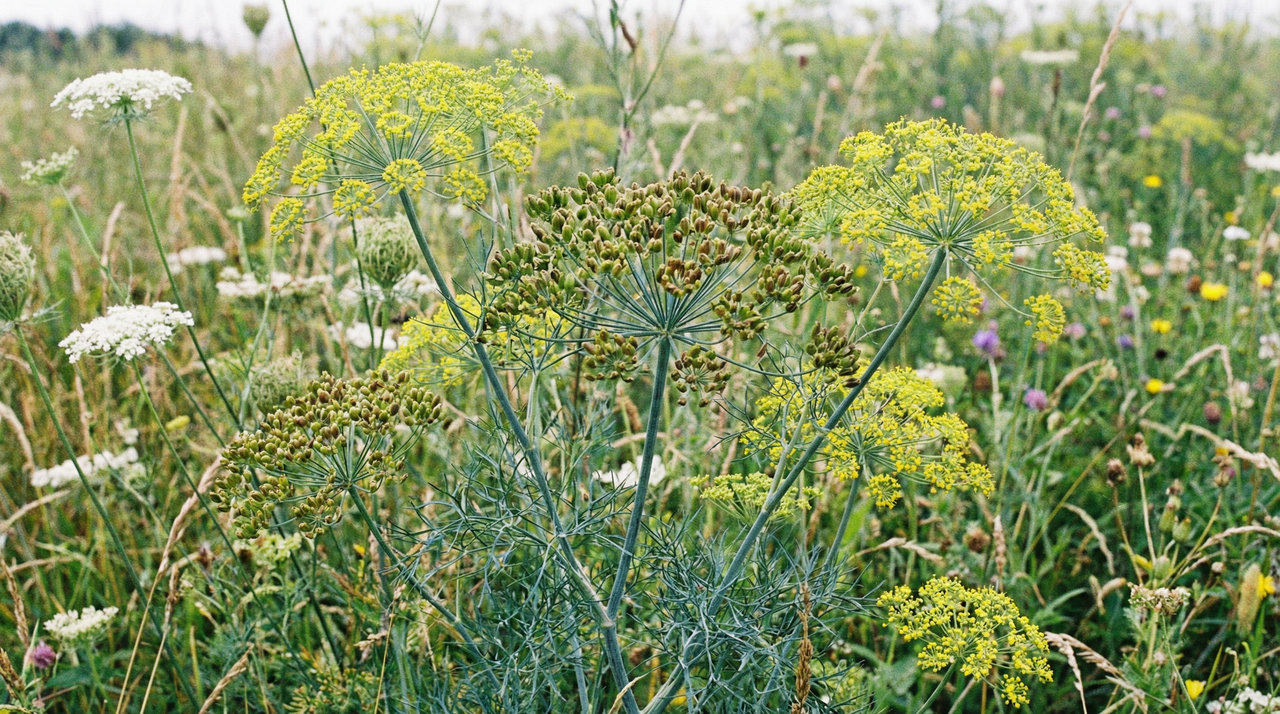
In the garden, dill is unmistakable once you know it: an upright, hollow-stemmed plant ranging from about 8 inches to 4 feet tall depending on the cultivar and conditions, with alternate leaves so finely divided they look like blue-green lace against the sky.[18][19] Those feathery, filiform segments are a signature of the Apiaceae family, and the small starry yellow flowers are arranged in the classic compound umbels the family is known for, typically 3 to 4 centimeters across.[20] Brush against the foliage and a warm, slightly anise-like fragrance rises immediately, one of those unmistakable garden signals that always makes me smile. That aroma is the essential oil talking, and it's present throughout every part of the plant.
Where does dill weed come from in terms of where to find it as a seedling? This is worth mentioning because I've learned the hard way to label rows carefully. The first true leaves look remarkably similar to carrot or fennel tops, and more than once I've nearly pulled young dill thinking it was a weed, or the reverse. The glaucous blue-green color is your best visual cue early on.[3] Size, leaf density, and the timing of flowering all shift with cultivar, soil fertility, moisture, and temperature.[3]
Fun Facts About Dill
Dill's essential oil is produced in glandular trichomes scattered across its tissues, and it's dominated by carvone (up to 60%), limonene (20 to 40%), and α-phellandrene, the trio responsible for that warm, spicy-anise character.[16] Those same compounds are what make dill a genuine workhorse for pollinators and beneficial insects: the nectar-rich umbels pull in bees, hoverflies, butterflies, and parasitic wasps, and I've watched those wasps working my dill patch every summer, methodically hunting aphids and caterpillars on nearby brassicas.[21][22] That ecological generosity will get proper attention later in the permaculture design section, but it's inseparable from what dill is at its core.
Cultivar choice shapes the whole experience. 'Long Island Mammoth' can reach six feet and produces seed prolifically; 'Fernleaf' stays compact with exceptionally fine foliage and holds an RHS Award of Garden Merit; 'Bouquet' is the go-to for pickling; and 'Dukat' or 'Superdukat' deliver the highest essential-oil content if potency is what you're after.[23][24] Knowing these options from the start means you're selecting a plant with intention rather than just grabbing whatever's at the nursery.
Dill Varieties for the Home Garden
The cultivar you choose shapes your whole season with dill. Pick the wrong one for your space or climate and you'll end up with a plant that bolts before you've cut a single sprig for the kitchen, or a six-foot giant crowding out everything in a container planting. I've learned this the hard way, and more importantly, I've watched clients learn it too.
Popular Dill Cultivars and Their Best Uses
Most gardeners start with four workhorses: 'Bouquet,' 'Fernleaf,' 'Long Island Mammoth,' and 'Superdukat.' Each has a distinct personality. 'Bouquet' is the reliable all-rounder, useful for fresh herb and seed alike. The towering 'Long Island Mammoth' strain lives up to its name, reaching impressive heights and producing heavy seed heads perfect for pickling jars. 'Superdukat' carries high essential oil content that makes it a favorite for preserving and extraction.[3][25][26][5] Then there's the fernleaf dill plant, which is genuinely its own category. Where 'Long Island Mammoth' towers as an airy backdrop, 'Fernleaf' stays compact and tidy. I default to it now whenever I'm designing an herb spiral or a container planting; the fine-textured foliage mixes gracefully with flowering perennials in a way that upright varieties simply don't.[27][28]
If your summers run hot, the dukat dill plant type is worth serious consideration. 'Dukat' and its improved sibling 'Superdukat' are heat-tolerant selections with elevated dillapiol and essential oil content, favored across California and the broader zones 8-10 where standard types often race to flower before you've got a good harvest.[26][27] For gardeners who want to keep cutting leaves longer without managing the race against bolting, 'Sherlock' is a bolt-resistant hybrid that genuinely extends the fresh-leaf window.[5] I've seen it give Central Florida gardeners nearly two extra weeks of productive harvest before the spring-to-summer heat surge triggers flowering. If foliage yield is your primary goal and seeds are secondary, 'Lopez' was bred specifically for large, abundant leaves rather than spice production.[3] Rounding out the lineup, 'Tetra' bolts slowly with dense foliage, 'Express' pushes to maturity fast and uniform, and 'Nobel' combines high yield with solid disease resistance, all representing targeted commercial breeding that translates into real reliability for home growers too.[26]
Where to Buy Dill Seeds and Plants
For seeds I consistently point clients toward Johnny's Selected Seeds, Seed Savers Exchange, and Burpee. Johnny's carries certified-organic packets of around 500 seeds for approximately $4.95, and they label germination rates clearly, which matters to me when I'm specifying plant material for a paying project.[29] Standard retail packets run $2-$5, and bulk seed drops to roughly $1.50 per ounce if you're planting a large patch or succession-sowing all season. Live plugs show up at herb nurseries seasonally, which is handy if you've missed the direct-sow window. Fresh dill bunches are easiest to find at farmers markets from late spring through fall, with peak quality in summer if you need it for the kitchen before your garden plants mature.
Dill Propagation and Planting Guide
The single most important thing I can tell you about growing dill is this: direct seed it, every time. Dill develops a taproot early and doesn't forgive disturbance. I learned that the hard way after losing an entire flat of carefully tended indoor starts to transplant shock, watching them wilt and stall while a row I'd scattered directly in the garden shot past them in two weeks. The Missouri Botanical Garden and RHS both recommend direct seeding for exactly this reason, and I've never looked back.[30][31] If you absolutely must move a seedling, do it before the taproot exceeds two to three inches, and use a deep pot to avoid bending it.[5]
Seed Storage, Viability, and Longevity
Dill seed is what botanists call orthodox: it tolerates drying down to 5-8% moisture content, which means you can store it properly and count on it for years.[32][33] Fresh seed typically shows 70-95% germination, but that number slides to 40-60% after three years under average kitchen conditions.[32][33] Keep seeds cool (4-10°C), dark, and dry (relative humidity below 20-30%) and home-saved seed holds well for three to five years; seed banks pushing controlled conditions can maintain viability for a decade or more.[34][32][35] I grow dill every year from seed I save myself, and when I dry the umbels promptly before moisture creeps back in, germination rates consistently hit that upper range. If you're working with older seed, a quick germination test on moist paper towels at room temperature for 7-14 days will tell you whether to sow densely or start fresh.
Cuttings, division, layering, and grafting are not realistic options for home gardeners. I've tried the softwood-plus-humidity method twice and got one weak, sad rooting.[31][36] Success rates run below 30% even under good conditions. Seed is simpler, faster, and far more reliable.
Primary Propagation: Direct Seeding
Sow seeds directly after your last frost date, pressing them about a quarter to half an inch deep into prepared soil.[5][37] Germination is fastest at soil temperatures between 15-21°C (60-70°F), with most seeds sprouting in 10-14 days and stragglers showing by three weeks.[5][37][21] Dill is an annual across USDA zones 2-11, though in mild winters it can behave like a short-lived perennial by self-sowing so freely it seems to never leave.[30][38] For continuous leaf harvest, succession sow every two to three weeks rather than planting everything at once.[30] Go light on nitrogen at establishment; too much pushes leggy growth and accelerates bolting at the expense of the aromatic compounds that make dill worth growing.[5]
Soil, Site Selection, and pH Requirements
Dill's Mediterranean and Southwest Asian origins tell you most of what you need to know about site selection: full sun (at least six to eight hours daily), excellent drainage, and lean-to-moderate fertility.[39][6][3] It does best in loose, loamy or sandy-loam soil with around 3-5% organic matter, and it will tolerate genuinely poor soils as long as water moves through freely.[5][21] Compaction and waterlogging are a different story: both invite Pythium root rot, which will kill plants fast.[5][3] I've always prioritized drainage over fertility, because even average soil grows excellent dill when the roots aren't sitting in moisture.
Target a soil pH between 5.5 and 6.5.[21][5] Dill tolerates 5.0-7.5, but push above 7.0 and you'll start seeing iron and manganese deficiency show up as chlorosis on the youngest leaves; drop below 5.5 and nutrient uptake suffers, stunting growth.[21][40] I do a quick soil test every spring because even a half-point drift toward alkalinity shows up as subtle yellowing that most gardeners attribute to overwatering. A little lime or elemental sulfur corrects it easily before planting. For containers, go with a minimum 12-18 inch depth and a mix weighted toward drainage: roughly 70% potting soil, 20% perlite, and 10% coarse sand or vermiculite.[31][41] The taproot needs room to go straight down, and it won't negotiate.
Spacing, Thinning, and Planting Technique
Dill is feathery and upright, more like a tall carrot or fennel than a bushy herb, and it needs air moving around it. Thin seedlings to 12-18 inches apart in rows spaced 18-24 inches, and mature plants will reach 24-48 inches tall with a spread of 12-24 inches.[30][5][3] Since I started giving dill the same breathing room I give carrots, the fungal issues I used to see in humid summers have largely disappeared. Adjust spacing by goal: tighter planting (12-18 inches) works well for a steady leaf harvest, while seed production benefits from wider spacing at 24-36 inches.[5][42]
Start harvesting leaves once plants reach 6-8 inches tall (usually 40-60 days after sowing), and frequent snipping encourages bushier regrowth rather than a single bolt to flower.[5][43][21][44] I always leave a few plants to go to seed: partly for seed saving, partly because the self-sowing that follows means I rarely have to think too hard about replanting in fall.
Dill Care Guide: Growing and Maintaining Anethum graveolens
Caring for dill is really about understanding its urgency. This is a plant with a biological agenda: germinate, leaf out, flower, seed, done. Your job as a gardener is to slow that process down wherever possible, giving yourself more of the feathery foliage and less of the race to seed heads. Once you understand what pushes dill toward each transition, the whole care routine starts to make intuitive sense.
Sunlight Requirements for Healthy Dill Growth
Dill needs full sun, and I mean genuine full sun: 6 to 8 hours of direct light per day.[30][45] Shade it and you'll know quickly: plants stretch toward the light, stems grow weak and pale, and the flavor drops noticeably because the plant simply can't produce the essential oils that make dill worth growing.[31] A leggy, yellow-green dill plant in a shaded bed is also more prone to pest pressure and, ironically, more likely to bolt prematurely despite lacking the conditions to thrive.[31][30] The opposite problem shows up in high summer: too much intense afternoon sun in hot climates causes leaf scorch and wilting.[46][47] I've found that afternoon shade cloth has been the single biggest difference in keeping my dill leafy and productive through July rather than seeding out by the Fourth of July.
Water Needs and Irrigation Best Practices
Aim for about 1 inch of water per week, adjusted for your soil and weather.[37][5] Seedlings need more consistent attention; sandy soils may need water every 2 to 3 days during dry spells. I check soil moisture by pushing a finger an inch or two down. Moist is what you're after. Soggy is a problem you'll feel right away, and wet is a skill you genuinely develop after a season or two. Once established, dill handles dry stretches reasonably well, tolerating up to 1 to 2 weeks without water before wilting,[48] but don't rely on that tolerance as a strategy: inconsistent moisture is one of the most reliable triggers for premature bolting in this Mediterranean native.[49] Overwatering shows up first as yellowing on the lower leaves, then wilting, and eventually root rot.[31] Underwatering gives you crisp brown leaf edges and stunted growth before the plant rushes to flower.[31] If you're using tap water with high chlorine levels, letting it sit overnight or using rainwater is worth the extra step.[5]
Feeding and Soil Fertility for Dill
Dill is a genuinely light feeder, and treating it like a tomato is one of the fastest ways to ruin it.[50] I learned this the hard way early on: one overly generous application of a high-nitrogen fertilizer and my dill went from lush and fragrant to leggy and flowering in under a week. If you're amending at planting, a modest amount of balanced fertilizer (something like 5-10-10 or 10-10-10 at 1 to 2 pounds per 100 square feet) is plenty.[51][52] Stop feeding entirely before the plant begins to flower. My preferred approach is to work compost into the bed at planting and let that carry the plant through its whole cycle, with a light fish emulsion application if I notice the older leaves going pale.[53] Pale older leaves suggest nitrogen deficiency; marginal leaf scorch points to potassium; interveinal yellowing in older leaves is usually magnesium.[54] Keeping soil pH between 6.0 and 7.5 prevents most of these deficiencies from developing in the first place.[5] Regular leaf harvesting also reduces the need for supplemental feeding; you're removing growth that would otherwise demand more nutrients.[52]
Frost Tolerance and Cold Protection
Dill handles light frosts reasonably well once established, surviving down to about 25 to 30°F (-4 to -1°C), but hard freezes below 28°F will cause real damage.[42][5] It's technically hardy in USDA zones 3 through 11,[55] but in practice it's grown as an annual nearly everywhere because it doesn't reliably overwinter outdoors. In my mixed herb beds, I'd compare its frost sensitivity to cilantro: both handle a touch of cold, but neither is basil. Young seedlings and flower buds are the most vulnerable life stages, which is why I always wait for soil temperatures to hit 60°F before direct seeding.[56] A floating row cover adds 4 to 8°F of protection if a late frost threatens,[56][57] and 2 to 4 inches of organic mulch at the base helps moderate soil temperature as nights cool in autumn. In zones 8 to 10, overwintering potted plants indoors above 50°F can extend your growing season considerably.[58]
Heat Tolerance and Bolting Prevention
Dill's sweet spot is 60 to 75°F (15 to 24°C), and it starts to struggle noticeably once temperatures push past 80 to 85°F.[5][21] At that point the plant reads heat as a signal to reproduce: foliage quality drops, essential oil production suffers, and the race to flower accelerates. Germination and flowering are the stages most vulnerable to heat stress, with high temperatures capable of reducing seed yields by up to 70% through flower abortion.[59][60] For managing summer heat, I rely on 30 to 50% shade cloth over afternoon beds, early-morning watering, and spacing plants 6 to 12 inches apart for airflow.[61][47] Certain varieties like 'Bouquet' or 'Dukat' offer marginally better heat tolerance, but I wouldn't count on variety selection alone to solve a hot-climate problem. The real solution is timing: plant in early spring or fall in warmer regions and let the mild shoulder seasons do the work your garden design can't.[47]
Seasonal Rhythm and Life Cycle
Dill completes its lifecycle in 6 to 12 months: roughly 4 to 6 weeks of vegetative growth, first flowering at 40 to 70 days, and reproductive maturity by 50 to 65 days.[5][39] It's triggered toward flowering by long days (over 12 hours) and warmth, which is why plants sown in late spring often bolt faster than those sown in early spring or fall. In my experience, the moment days lengthen and nights stay warm, the plant shifts gears almost overnight. In zones 9 to 11 with protection, dill can occasionally persist as a short-lived perennial,[5] but that's more a pleasant bonus than a reliable strategy. Pest pressure, water stress, or poor soil can shorten the cycle by 2 to 4 weeks.[62] Successive plantings every 2 to 3 weeks have become my standard practice, staying ahead of the plant's natural urgency and ensuring a continuous supply of fresh foliage through the season.
Pruning, Maintenance, and Growing Tips
The single most effective thing I do to extend my dill harvest is pinch out flower buds the moment I see them forming at the center of the plant. That visual cue, those tiny yellow buds just beginning to cluster, is your signal to act immediately. Once I see them, I pinch the top growth and harvest the surrounding leaves. Repeat consistently and you can easily double your leaf harvest window.[37][5] Deadheading spent flowers prevents the garden from disappearing under a wave of self-seeded volunteers and redirects the plant's energy back into foliage.[31] A 2 to 3 inch layer of organic mulch around the base helps hold moisture, suppresses weeds, and keeps soil temperatures from swinging too dramatically during hot or cold spells.[37] As plants approach maturity, especially in windy spots, staking the taller seed heads prevents lodging.[31] Regular harvesting also means you'll need less supplemental fertilizer; a frequently cut plant simply doesn't accumulate enough growth to demand it.[53] One last note: dill resents transplanting because of its taproot, so direct seed it where it will grow, keep it away from carrots and tomatoes, and let it do what it does best.[5]
How to Harvest Dill
When to Harvest Dill Leaves and Seeds
Dill offers two very different harvests, and they run on separate clocks. Leaves are ready to cut 40-60 days after sowing, once plants reach 6-8 inches tall.[5][63][31] Seeds take 90-120 days from sowing and aren't ready until the flower heads turn brown and you can hear them rattle when you gently shake the umbel.[21][64] That rattle is your green light. Before that, you're just guessing.
The critical thing to understand about leaf harvest is that the window closes fast. Once flowering begins around 60-70 days after sowing, leaves toughen and lose their bright, grassy flavor pretty quickly, and then you have about 20-30 days before seeds are mature.[31][5][65] I've watched dill bolt in under a week during a humid July in the Southeast, which is exactly why succession planting every 2-3 weeks is the smarter play for a continuous fresh-leaf supply than trying to stretch one planting out.[5][66] Regional calendars vary considerably: gardeners in Florida may harvest nearly year-round in mild conditions, while those in California work April through October, Texas March through November, and northern growers typically focus on June through September for leaves and August through September for seeds.[67][68][69] Don't treat day counts as a rigid schedule; watch the plants and listen for that rattle.
Harvesting Techniques for Maximum Flavor
For leaves, harvest in the morning on a dry day, cutting outer stems or pinching leaves once they reach 4-6 inches long.[70][31][27][71] Morning is when the volatile oils are most concentrated, before the heat of the day drives them off. I've found the flavor peaks in that first hour after cutting on a cool morning, which is why I now harvest small amounts frequently rather than a big batch that wilts before I can use it. Those repeated snips also keep the plant bushy and delay the push toward flowering, so you can return every 2-3 weeks until the first flower buds appear.
For seeds, wait until the umbels have gone fully brown, then cut the heads and hang them upside down inside a paper bag in a dry spot.[70][31] The bag catches seeds as they drop during drying, which means you lose almost nothing to the ground and end up with clean, dry seeds ready for the jar.
Yield, Flavor, and Storage of Dill
The two harvestable parts from a single dill plant taste nothing like each other, and that's the point. The feathery leaves, what most recipes call dill weed, deliver a bright, grassy, citrus-tinged flavor with a tender texture that wilts the moment heat touches it. The seeds are warmer, pungent, and closer to anise or caraway with a lingering licorice aftertaste.[72][73][74] Whether something ends up in a cucumber salad or a pickle brine comes down to which part you harvest and when you harvest it; timing is what determines the final flavor profile.[75]
Storage is where most people lose what they worked to grow. Fresh dill weed stays vibrant for 1-2 weeks wrapped in a damp paper towel inside a perforated bag in the fridge at near-freezing temperatures and high humidity.[76][77] For preserving summer's harvest into winter, I chop fresh leaves and freeze them in ice-cube trays with a little water or olive oil; the flavor holds far better than dried dill weed from a jar. Seeds, once fully dry, go into an airtight container in a cool, dark spot and will stay potent for 1-4 years.[78][77] The difference between vibrant herbs and faded ones is almost always in those post-harvest minutes.
Dill Preparation and Uses in the Kitchen and Apothecary
Edible Parts, Flavor Profiles, and Culinary Applications
The fronds and seeds are the culinary workhorses of the dill plant; the flowers are edible but rarely worth the effort in the kitchen, and the roots aren't on the menu at all.[79][22] What makes working with both parts so satisfying is how differently they behave. The tender leaves bring an immediate, volatile brightness to finished dishes, while the robust oil-rich seeds stand up to lengthy cooking or pickling, with real pungency and a bitter undertone that adds umami depth to whatever they touch.[19][80] That contrast comes down to chemistry: carvone drives the caraway-like quality, limonene contributes the citrusy brightness, and α-phellandrene gives the leaves their distinctive herbaceous lift.[80]
After growing dill for years, I've learned the leaves lose their bright grassy notes within minutes of chopping, so I harvest only what I need right before serving. Fresh fronds go into tzatziki, scatter over roasted potatoes, fold into egg dishes, and pair beautifully with salmon; I often finish a piece of fresh-caught fish with dill, garlic, and lemon because the combination mirrors the plant's own carvone and limonene profile in a way that feels almost intentional.[31] The seeds earn their place in pickling, breads, and spice blends, where their staying power is an asset rather than a liability. A classic dill pickles recipe leans on whole seeds tucked into the jar alongside fresh heads; the seeds carry heat and time in ways the tender leaves never could.[3] Refrigerator dill pickle recipes and dill spears recipes often call for both, layering fresh heads for aroma and dried seeds for depth. Dill is safe for the full range of culinary preparations, from raw and fermented to roasted and pickled, in the moderate amounts any cook would use.[81] The one firm caveat: dill essential oil is a different matter entirely and shouldn't be used internally without professional guidance due to real toxicity risk at higher doses.[82]
Medicinal Preparations, Dosages, and Traditional Uses
The same fronds and seeds that flavor your dinner have a long parallel history in the medicine cabinet. Both parts are used in teas, decoctions, and tinctures, with digestive support as the strongest and best-documented application: dill has been used as a carminative for gas and bloating, a mild diuretic, and a gentle aid for colic in infants across Ayurvedic and European folk traditions.[83][84] Lactation support appears repeatedly in traditional records too, though the evidence there is lighter than it is for digestive use.
I love a simple dill seed tea for mild indigestion after a heavy meal, but I always measure carefully. The EMA and WHO monographs put the adult dose for seeds at 1-3 grams per day as a tea or powder for flatulence and dyspepsia, with an upper range of around 4 grams daily.[85][86] Treating that guidance as a practical ceiling rather than a suggestion feels right to me. As for dill essential oil, I keep mine strictly for topical use or diffuser blends; the research on potential toxicity is clear enough, particularly around children, that I don't risk internal use without professional advice.[85][82] The dried herb and whole seeds, though, remain as safe and approachable from your own garden harvest as anything in the kitchen.
Dill Health Benefits and Medicinal Uses
Dill has been a kitchen staple for so long that it's easy to overlook how pharmacologically interesting this plant actually is. Every benefit attributed to it, from settling a gassy stomach to reducing menstrual cramps, traces back to a surprisingly rich cocktail of secondary metabolites: essential oils, flavonoids, phenolic acids, coumarins, and tannins all present in the same feathery leaves you're shaking over your potato salad.[87][88]
Phytochemical Profile: Carvone, Limonene, and Supporting Flavonoids
The essential oil is where dill's chemistry gets genuinely fascinating. Seed oil dominates in concentration at 2-4% by weight, compared to just 0.2-0.5% in the leaves.[89] Within that oil, carvone runs at 40-60% in seeds and limonene at 15-50%, with α-phellandrene, dillapiole, and β-caryophyllene rounding out the profile.[87][90] Leaf oils tend to flip the balance toward α-phellandrene, which is why fresh leaves and dried seeds smell and behave so differently in the kitchen and in herbal preparations.
I've grown dill in Central Florida for years, and the difference between seeds harvested in a hot, dry July versus a milder autumn is unmistakable. The summer seeds are noticeably more pungent, almost sharp. That tracks with the research: oil yield and carvone concentration peak around full flowering and early seed set, and they climb higher in warmer temperatures and nitrogen-rich soil.[91][92] So how you grow it genuinely shapes what you get out of it.
Supporting the oil chemistry are flavonoids including kaempferol, quercetin, isorhamnetin glycosides, and vicenin-2, concentrated primarily in the leaves,[87] plus phenolic acids like chlorogenic, caffeic, and rosmarinic acid that add antioxidant depth.[88] These compounds also serve the plant ecologically: the same carvone and limonene that make dill aromatic to us act as insect deterrents and allelopathic agents in the garden.[93]
Antioxidant, Anti-Inflammatory, and Antimicrobial Research
Across European folk medicine, Ayurveda, and Middle Eastern traditions, dill earned its keep primarily as a carminative: something you reached for when you were bloated, gassy, or just generally digestively unhappy.[94][95] Modern preclinical research explains why: dill exhibits antispasmodic effects through calcium channel blockade and smooth muscle relaxation, broad-spectrum antimicrobial action against organisms including E. coli and Staphylococcus aureus, and anti-inflammatory activity via COX-2 inhibition and cytokine suppression.[96][97] The antioxidant story runs through flavonoid activity and Nrf2 pathway activation, which connects neatly back to all those phenolics and kaempferol compounds in the leaves.
The clinical evidence, while still limited in scale, is genuinely interesting. Dill seed extract has outperformed placebo in reducing menstrual pain in women with primary dysmenorrhea.[98] Seed powder has shown improvements in total cholesterol and triglycerides in hyperlipidemic patients.[99] And dill seed extract has performed comparably to simethicone in reducing infant colic symptoms.[100] I haven't run clinical trials from my garden, obviously, but I've recommended dill tea to friends with colicky babies and gassy toddlers for years. The traditional use and the emerging human data point in the same direction.
The European Medicines Agency formally supports traditional use of dill fruit at 3g per day for dyspepsia, and both the EMA and WHO monographs recognize it for digestive teas and preparations.[101][102] The honest framing is that preclinical evidence is robust, and human trials are promising but still limited in scale. Worth following as the research matures.
Nutritional Value of Fresh and Dried Dill
A typical tablespoon of fresh chopped leaves weighs about 1 gram,[103] so the numbers per 100g represent a much larger quantity than you'd normally use. Still, the profile is legitimately impressive. Fresh dill delivers 94% of the daily value for vitamin C, 162% for vitamin K, and 43% for vitamin A per 100g.[103] The mineral picture is similarly strong: 37% DV for iron, 21% DV for calcium, and 55% DV for manganese, alongside meaningful potassium at 738mg.[103] Compared to parsley or cilantro, which I grow alongside it in the herb guild, dill holds its own as a nutritionally serious herb rather than just a garnish.
The antioxidant compounds from the phytochemical profile, kaempferol, vicenin-2, quercetin glycosides, carvone, and limonene, sit on top of all of that.[103][104] Drying concentrates the calories and minerals but burns off volatile oils, and cooking can reduce vitamin C by 20-50%.[105] My rule of thumb in the kitchen: add fresh dill at the end, dried dill earlier in the process when you want the seed-forward earthiness and can sacrifice some of the brightness.
Safety Profile and Considerations
The FDA classifies dill as Generally Recognized As Safe for culinary use, the ASPCA lists it as non-toxic to dogs, cats, and horses, and there are no significant human poisoning cases on record from normal food use.[106][107] In my years of growing and using dill, I've never seen an issue with the fresh herb itself, and I grow it around kids, pets, and a rotating cast of garden visitors without any concern.
The caveats are real but narrow. Allergic reactions can occur in people sensitive to the Apiaceae family, with cross-reactivity presenting as oral allergy syndrome, contact dermatitis, or in rare cases anaphylaxis.[108] If someone in your household has carrot or celery allergies, worth flagging. The look-alike risk in the wild, proximity to poison hemlock and related Apiaceae species, is real enough that I always advise foragers to be certain of their identification before harvesting anything from that family.[109]
Concentrated dill essential oil is a different story entirely from the culinary herb. Ingested in large quantities it can cause gastrointestinal distress, dizziness, or worse, and topical application requires dilution to 1-2%.[110][111] I grow dill for kitchen and tea use; I leave therapeutic oil applications to people with professional training. For anyone on blood thinners, diuretics, or diabetes medications, dill's mild antiplatelet and blood-sugar-modulating effects are worth a conversation with a prescriber before moving into medicinal doses.[112][113] Culinary amounts during pregnancy are considered safe; concentrated preparations or essential oils are not, due to potential uterotonic effects.[114] As with most herbs: enjoy it freely as food, and consult someone qualified before you treat it as medicine.
Dill Pests and Diseases
Dill as a Natural Pest Repellent and Beneficial Insect Magnet
Dill is one of those rare plants that earns its space in the garden by actively defending its neighbors. The essential oils that give it that bright, unmistakable scent, primarily carvone, limonene, and alpha-phellandrene alongside dill apiole and myristicin, function as potent deterrents against aphids, spider mites, cabbage loopers, and squash bugs.[115][116] A 2018 entomological study found up to 60-90% reduction in pest infestation and 70-80% aphid repellency from dill's essential oils.[115] The plant's glandular trichomes add a physical layer to that defense, secreting sticky substances that trap small insects while phenolic compounds toughen tissue against herbivore feeding.[117]
The flowering umbels take this further by drawing in ladybugs, hoverflies, and parasitic wasps that actively hunt soft-bodied pests throughout the garden.[118][119] I interplant dill with brassicas and cucumbers every season, and once those yellow umbels open, I notice hoverflies within days and significantly fewer aphid colonies on the surrounding plants. The chemistry and the observation line up neatly.
Common Pests of Dill and How to Manage Them
Despite its considerable chemical armor, dill has real vulnerabilities. Aphids (particularly Aphis fabae), flea beetles, leaf miners (Liriomyza spp.), thrips, spider mites (Tetranychus urticae), whiteflies, and cabbage loopers will all take a run at it under the right conditions.[120][121] Spider mites flare in hot, dry conditions, causing stippling and webbing that can defoliate plants quickly. Aphids are the more pressing concern, though, because they transmit cucumber mosaic virus. I treat aphid colonies the moment I spot them rather than waiting to see if the population self-limits; the research on viral vectoring is too clear to risk it.
For pest management, I work through cultural options first: crop rotation, adequate spacing for airflow, and yellow sticky traps for monitoring. When intervention is necessary, insecticidal soap and neem oil handle aphids and mites without disrupting the beneficials you've worked to attract. Bacillus thuringiensis (Bt) is the go-to for loopers specifically, and spinosad covers thrips when they're persistent.[122][123]
Fungal, Bacterial, and Viral Diseases
The disease roster for dill includes downy mildew, powdery mildew, bacterial leaf spot, cucumber mosaic virus, and Pythium root rot.[23][124] Downy mildew shows as yellowing with grayish-purple fuzz on leaf undersides; powdery mildew produces the familiar white coating on upper surfaces; bacterial leaf spot leaves water-soaked lesions ringed by yellow halos. Root rot is a wet-soil problem almost entirely preventable with good drainage. Dill has moderate baseline disease resistance, but humidity, poor airflow, or overhead watering erodes that quickly.[125][126] I often compare it to basil in this way: both collapse fast in stagnant, humid air, and both reward you with far fewer problems when you just give them room to breathe. Cultivars like 'Fernleaf' and 'Superdukat' show moderate tolerance to powdery mildew and bacterial leaf spot,[125] but in my own trials I've found that airflow and rotation matter more than any variety name.
Integrated Prevention and Organic Controls
Prevention is straightforward and genuinely effective here. Rotate dill on a three-to-four year cycle, keep plants properly spaced, water at the base rather than overhead, and pull infected debris promptly.[5][50] When cultural practices aren't enough, copper-based products address downy mildew and bacterial leaf spot; baking soda or sulfur sprays work against powdery mildew; neem oil and insecticidal soap reduce aphid pressure and, by extension, the risk of viral spread.[5][127] These treatments are secondary tools, not substitutes for the cultural foundation. A well-sited, well-spaced dill plant rarely needs them.
Dill in Permaculture Design
Dill pulls its weight in a permaculture system in ways that would surprise anyone who thinks of it as just a pickling herb. At 2-4 feet tall with those characteristic hollow stems and feathery blue-green foliage, it's visually distinct enough to read clearly in a mixed guild, and those compound yellow umbels, each 2-6 inches across, are doing serious ecological work when they open.[3][128] The plant matures quickly, self-seeds reliably, and contributes to biodiversity at multiple levels without demanding much in return.
Ecosystem Functions and Services
The umbels are the star of the show. When dill blooms through its 4-6 week mid-summer window, it draws an impressive parade of honeybees, bumblebees, solitary bees, syrphid flies, butterflies, and parasitic wasps.[129][3][130] I've watched this firsthand in my brassica guilds: once the dill flowers open, the hoverflies and tiny parasitic wasps show up within days, and the aphid pressure on nearby kale visibly drops. It's the kind of feedback loop you don't fully believe until you see it happen in real time. These beneficials don't just visit; they stay to hunt, with parasitic wasps, ladybugs, lacewings, and hoverflies all preying on aphids, spider mites, and cabbage worms throughout the season.[3][131][132]
There are a couple of nuances worth designing around. Dill can act as a trap crop for carrot root fly, which is useful if you manage it intentionally, and it has mild allelopathic effects that can inhibit nearby tomatoes and other Solanaceae.[133][134] I learned the tomato incompatibility the hard way early on, and I now keep dill well away from the nightshade bed. These aren't reasons to avoid dill; they're reasons to place it thoughtfully.
Below ground, dill contributes through its deep taproot, which improves soil aeration and supports nutrient cycling as it breaks down.[133][3] Its spent biomass makes good chop-and-drop mulch or compost material. Dill does not fix nitrogen. Some permaculture plant lists imply that aromatic herbs generally build soil nitrogen, but that's not what the research shows here, and it's not what I observe. Dill's soil contribution comes from physical root action and organic matter, not from bacterial nitrogen fixation. That's still valuable; it's just a different mechanism than legumes.
As a Mediterranean native naturalized across temperate gardens worldwide, dill slots into regenerative systems without becoming a management problem.[135][3][21] It enhances local biodiversity without the kind of aggressive spread that would require active containment.
Forest Layer, Guilds, and Companion Planting
Dill belongs in the herbaceous layer. At 20-90 cm tall, thriving in full sun and well-drained loamy or sandy soils, it fits naturally along sunny garden edges, in open kitchen herb guilds, or woven through vegetable polycultures.[3][30][48] It's not a plant for shaded understory positions; put it where it can reach full height and bloom freely, because that's where it earns its place in the guild.
For companion planting, brassicas are the natural first choice. Dill repels cabbage worms and aphids while attracting the beneficials that keep those populations in check, and similar logic applies near cucumbers, lettuce, onions, and corn. Intercropping dill with vegetables can improve yields by 10-20%, though those numbers come from specific study contexts and results will vary with your system.[5][48][136][132] Keep it away from carrots (cross-pollination can compromise seed quality), tomatoes and potatoes (allelopathy and competition), and fennel, which can hybridize with or inhibit it.[5][48]
Dill's self-seeding habit is one of its most useful permaculture traits. Given a suitable spot, it volunteers reliably each season without any intervention from you, providing continuous ecosystem services year after year.[19][6][137] One practical tip from managing my own guild: label your self-seeded dill early. The first true leaves look deceptively like young carrot or fennel seedlings, and I've accidentally weeded out good volunteers more than once before I learned to mark where I expected them to emerge.
Climate Adaptation and Hardiness Zones
Dill is listed as hardy across USDA zones 2-11, which sounds almost too good to be true, and in a way it needs some unpacking.[3][24][128] That broad range reflects its adaptability as an annual and the fact that established plants can handle a light frost, down to about 25°F for short periods. It doesn't mean dill is a true perennial across cold climates. The zones 4-9 window is where it performs most reliably; in zone 9 and warmer, it can behave more like a short-lived perennial with winter mulching and consistent self-seeding.
The temperature sweet spot for growth is 60-75°F, with germination best in the 60-70°F range.[24][5][128] Once temps push above 85°F, dill bolts, shifting energy from leaf production to flowering and seed set on a 60-70 day cycle. I've learned to time successive plantings around this threshold in warmer months, and on particularly hot years I'll tuck dill where it gets light afternoon shade just to stretch the leaf-harvest window a few extra weeks. It's a small adaptation that makes a real difference.
On the water side, dill performs best with about 1-2 inches per week and moderate annual precipitation of 20-30 inches.[128][31][5] It's moderately drought-tolerant once established, but consistent dry spells will accelerate bolting, so irrigation matters in low-rainfall gardens. High humidity paired with poor airflow opens the door to powdery mildew, which is another reason to avoid crowding it in dense plantings. Regionally, northern growers in zones 3-7 plant after last frost for summer growth; gardeners in zones 8-11 do better with spring or fall sowings that sidestep peak summer heat.[138][3][42] Timing is the real lever here, and getting it right makes every other aspect of growing dill considerably easier.
The Herb That Taught Me Timing
I lost a whole stand of dill once because I kept telling myself I'd harvest it tomorrow, and then the heat came and it bolted overnight. Now I cut it almost too early, and it's better for it. There's something dill insists on teaching you: the window is real, the window is short, and the plant will not wait around for your schedule to clear. That lesson has made me a better gardener with everything else too.
Sources 138
- Carvone: Why It Matters in Dill and Caraway ↩
- Anethum graveolens ↩
- Anethum graveolens L. dill ↩
- Dill (Anethum graveolens) ↩
- Growing Dill: From Seed to Harvest - University of Minnesota Extension ↩
- Anethum graveolens (Dill) | North Carolina Extension Gardener Plant Toolbox ↩
- Ebers Papyrus - Wellcome Collection ↩
- Missouri Botanical Garden: Plants of the World Online ↩
- Pliny the Elder: Natural History ↩
- Historical and Traditional Uses of Dill (Anethum graveolens) ↩
- Avicenna's Canon of Medicine ↩
- Anethum graveolens ↩
- Dill - Anethum graveolens ↩
- Royal Horticultural Society: Historical Uses of Dill ↩
- Dill in Traditional Medicine ↩
- Dill (Anethum graveolens L.): A review of its traditional uses, phytochemistry, and pharmacology ↩
- Ethnobotany of Dill (Anethum graveolens L.) ↩
- Anethum graveolens - Missouri Botanical Garden ↩
- Dill - Wikipedia ↩
- Missouri Botanical Garden Plant Finder ↩
- Dill (Anethum graveolens) ↩
- Kew Royal Botanic Gardens: Anethum graveolens ↩
- Dill Varieties and Growing Guide ↩
- Herb Gardening: Dill Cultivars ↩
- Missouri Botanical Garden Plant Finder - Dill ↩
- Dill - Anethum graveolens L. ↩
- Dill in California Gardens ↩
- USDA Plant Hardiness Zone Map ↩
- Johnny's Selected Seeds Product List ↩
- Anethum graveolens (Dill) ↩
- Dill: How to Grow ↩
- Seed Viability and Storage for Herbs ↩
- Seed Storage of Horticultural Crops ↩
- Optimal Conditions for Storing Vegetable Seeds ↩
- Longevity of Dill (Anethum graveolens L.) Seeds Under Different Storage Conditions ↩
- Rooting Herbaceous Cuttings ↩
- Dill Production Guide ↩
- Dill Growing Guide ↩
- Anethum graveolens - Kew Science ↩
- Growing Dill - UC Master Gardener ↩
- Growing Herbs in Containers ↩
- Dill in the Home Garden ↩
- How to Plant, Grow, and Harvest Dill ↩
- Growing Dill in the Home Garden ↩
- Royal Horticultural Society - Dill ↩
- University of Minnesota Extension - Sunscald and Photoinhibition in Herbs ↩
- IPM - Dill Cultural Practices ↩
- Dill Growing Guide - The Old Farmer's Almanac ↩
- Drought Tolerance in Culinary Herbs ↩
- Dill in Home Gardens ↩
- Growing Dill ↩
- Dill Production Guide ↩
- Growing Herbs in Minnesota ↩
- Micronutrient Deficiencies in Plants ↩
- USDA Hardiness Zones for Herbs - Missouri Botanical Garden ↩
- Frost Protection for Vegetables and Herbs ↩
- University of Minnesota Extension - Frost and Freeze Protection ↩
- Overwintering Herbs Indoors ↩
- Effects of Heat Stress on Germination and Seedling Growth of Dill ↩
- Heat Tolerance in Medicinal Plants: A Case Study on Dill ↩
- Herb Gardening in Heat Zones ↩
- Dill Production | Penn State Extension ↩
- Anethum graveolens (Dill) ↩
- Dill Seed Production ↩
- Herb Gardening: Dill ↩
- Dill Production and Harvesting Guidelines ↩
- Dill in the Florida Garden ↩
- Dill Production ↩
- Dill: Planting, Growing, and Harvesting ↩
- Anethum graveolens ↩
- Growing Dill ↩
- Missouri Botanical Garden Plant Finder: Anethum graveolens ↩
- Volatile Compounds of Anethum graveolens L. (Dill) Essential Oil ↩
- Chemical Composition and Aroma Profile of Dill Essential Oils ↩
- Chemical Composition of Dill (1976) ↩
- Storing Fresh Herbs ↩
- Dill Production and Handling ↩
- Spice Storage Guidelines ↩
- Missouri Botanical Garden Plant Finder: Anethum graveolens ↩
- Chemical Composition of the Essential Oils of Anethum graveolens L. from Two Different Regions ↩
- Dill - The Nutrition Source ↩
- Essential Oils Safety Guidelines - Dill Oil ↩
- Anethum graveolens (Dill) - PFAF Plant Database ↩
- Dill - Uses, Benefits & Dosage - Drugs.com ↩
- EMA Assessment Report: Anethum graveolens L., aetheroleum ↩
- WHO Monographs on Selected Medicinal Plants, Volume 3 ↩
- Chemical Composition and Antioxidant Properties of Essential Oil of Anethum graveolens L. ↩
- Secondary Metabolites from Anethum graveolens: A Review ↩
- Essential Oils of Anethum graveolens: Chemical Composition and Bioactivity ↩
- Phytochemical Characterization of Dill (Anethum graveolens L.) Essential Oil and Evaluation of Its Antioxidant and Antimicrobial Activities ↩
- Influence of Environmental Factors on the Essential Oil Composition of Dill (Anethum graveolens L.) ↩
- Effect of Growth Stage and Harvest Time on the Yield and Composition of Dill Essential Oil ↩
- Essential Oils of Anethum graveolens: A Review of Their Biological Activities ↩
- Traditional Uses and Phytochemistry of Dill ↩
- Ethnopharmacological Review of Anethum graveolens ↩
- Pharmacological Activities of Anethum graveolens: A Review ↩
- Anti-inflammatory and Antioxidant Properties of Dill ↩
- Effect of Dill (Anethum graveolens L.) Seed on Primary Dysmenorrhea: A Double-Blind Randomized Placebo-Controlled Trial ↩
- Clinical Trial of Dill in Hyperlipidemia ↩
- Clinical Trial: Dill Seed for Infant Colic ↩
- Anethum graveolens - EMA Assessment Report ↩
- WHO Monographs on Selected Medicinal Plants - Volume 4: Anethum graveolens ↩
- USDA FoodData Central - Dill weed, fresh ↩
- Chemical Composition and Antioxidant Properties of Essential Oils from Anethum graveolens ↩
- USDA FoodData Central - Dill weed, dried ↩
- FDA GRAS Status for Anethum graveolens ↩
- ASPCA Animal Poison Control Center Plant Toxicity List ↩
- Cross-reactivity between Apiaceae plants ↩
- Apiaceae Family and Toxic Look-Alikes ↩
- Anethum graveolens - Drugs and Lactation Database (LactMed) ↩
- Essential Oil Toxicity: A Review ↩
- Herb-Drug Interactions: Dill and Anticoagulants ↩
- Dill - Mount Sinai Health Library ↩
- Dill - Drugs and Lactation Database (LactMed) ↩
- Insect Repellent Properties of Dill Essential Oil ↩
- Volatile Compounds in Dill and Herbivore Deterrence ↩
- Trichomes in Dill: Structure and Function in Defense ↩
- Anethum graveolens in Organic Pest Management ↩
- Companion Planting with Dill ↩
- Insect Pests of Dill ↩
- Dill (Anethum graveolens) - Pests and Diseases ↩
- Insect Pests of Dill - University of Minnesota Extension ↩
- Managing Aphids and Leafminers on Dill - UC IPM Online ↩
- USDA Plant Disease Handbook - Dill Diseases ↩
- Dill Production and Disease Management ↩
- Powdery Mildew on Herbs ↩
- Powdery Mildew Control in Vegetables ↩
- Dill (Anethum graveolens) - Missouri Botanical Garden ↩
- Pollinators of Herbs: Dill and Others ↩
- Dill - Royal Horticultural Society (RHS) ↩
- Attracting Beneficial Insects with Dill ↩
- Companion Planting with Dill - UC IPM ↩
- Permaculture Plants: Dill ↩
- Allelopathic Effects of Anethum graveolens - Journal of Chemical Ecology ↩
- Anethum graveolens - Wikipedia ↩
- Economic Benefits of Intercropping Herbs in Vegetable Systems - Agronomy Journal ↩
- Permaculture Research Institute - Companion Planting with Dill ↩
- Kew Science - Plants of the World Online: Anethum graveolens ↩