Every fruit has a reputation, but durian has a mythology. I've watched grown adults gag at the smell from thirty feet away, and I've watched those same people, forty minutes later, quietly reach for a second piece. That contradiction is real, and it's documented: sensory researchers have identified over 50 volatile compounds in durian's aroma profile, including the sulfurous molecules responsible for its infamous smell, yet blinded taste-panel studies consistently rank the flavor as one of the most complex and pleasurable of any fruit.[1] The nose and the tongue are apparently having two completely separate arguments about this fruit.
What gets lost in all the shock-value coverage is that durian is also one of the most ecologically extraordinary food trees on earth, a rainforest emergent shaped by bats, elephants, and centuries of human devotion into something genuinely unlike anything else you can grow. If you've ever wondered whether a plant this polarizing could earn a serious place in a food forest or tropical garden, I'd like to make the case that it absolutely can, and that the process of growing one teaches you things about tropical agroforestry that nothing else quite will.
Durian Origin, History, and Cultural Significance
Botanical Background and Ecology of Durio zibethinus
The scientific name of the durian tree is Durio zibethinus, and everything about it reads like a plant that was designed to be extreme. Native to the tropical rainforests of Borneo and Sumatra, with its center of domestication in Borneo, this is a tree that refuses to exist quietly.[2][3] In the wild it's a true emergent, pushing 25 to 45 meters into the rainforest canopy; even cultivated specimens managed by pruning typically reach 8 to 15 meters.[4][5] The first time I stood under a mature specimen in a Southeast Asian botanic collection, the buttressed base and latex-weeping bark told the whole story immediately. These are rainforest giants, and they carry that identity in every structural detail.
Its reproductive ecology is just as fascinating. Durian belongs to the Malvaceae family and reproduces on its own schedule, exhibiting mast fruiting cycles that sync up every two to four years, often triggered by El Niño climatic events.[6][7] Flowering happens from April through August, peaking around June and July in Malaysia and Indonesia, with pollination handled mostly after dark by bats, civets, and insects. Natural pollination success rates are strikingly low, often landing somewhere between one and five percent.[2] Once pollinated, fruit development takes 105 to 140 days, and seeds are dispersed by gravity and by large mammals, elephants especially.[6][8] From seed, expect to wait four to seven years before fruiting begins; grafted trees can cut that to three to five years, which is exactly why I always recommend grafted stock to anyone seriously considering one for their food forest.[5]
History and Traditional Uses Across Southeast Asia
The written record for durian goes back to 12th-century Chinese texts, with Zhou Qufei's Lingwai Daida from 1178 AD documenting the fruit from the Champa region; Dutch naturalist Georg Eberhard Rumphius captured cultivation evidence in his Herbarium Amboinense in the 17th century, with additional references appearing in ancient Thai Ayutthaya-period texts.[9] From there, durian followed trade routes across the region, reaching the Philippines during Spanish colonial times through the Manila galleon trade, expanding commercially under British colonial rule in Malaya during the 19th century, and eventually arriving in Brazil in the early 20th century through Southeast Asian immigrant communities.[10]
What the historical timeline can't fully convey is the depth of reverence. Durian has long symbolized prosperity and good fortune across Malaysia, Indonesia, Thailand, and beyond, appearing in harvest celebrations, weddings, religious ceremonies, and festivals complete with eating contests and sprawling market gatherings.[2][11] I find myself comparing it to something like the pawpaw in North America, a fruit with genuine cultural weight, except durian's status is orders of magnitude deeper and more ceremonially embedded. Traditional medicine reflects that same whole-plant thinking: the fruit pulp addresses fever, cough, and digestive complaints and is considered a warming, aphrodisiac food in Malay practice; leaves are brewed for fever, jaundice, and skin conditions; bark decoctions treat diarrhea and wounds; roots help manage fever; and boiled seeds are prepared as a paste for boils and skin ailments.[12][13] Every part of this tree has a use, which is exactly the kind of deep ecological knowledge that permaculture practitioners spend years trying to reconstruct.
Visual Characteristics and Fun Facts About the King of Fruits
The tree itself is an unmistakable presence: a large evergreen with a straight buttressed trunk, rough grayish-brown bark that weeps milky latex when damaged, and long leathery leaves up to 18 cm with drip tips that are a classic rainforest adaptation for shedding tropical downpours.[14][15] The flowers are nocturnal, cauliflorous, and creamy-white to pale yellow, and the fruit they produce is one of the most recognizable objects in the plant kingdom: a spiny greenish-brown capsule typically 15 to 30 cm long and weighing one to three kilograms on average, with record specimens reaching five to eight kilograms, splitting open at maturity to reveal custard-like arils that taste of caramel, almonds, and rich cream.[2][16] That flavor is why people cross continents to eat it fresh.
And then there's the smell. My first encounter with a ripe durian at a market in Southeast Asia made the transport bans make complete sense. Singapore and Malaysia prohibit durians on public transit and in many hotels because the odor, which some describe as sewage or pungent onions and others find creamy and appealing, is simply that polarizing.[17] I respect that reality entirely while still thinking the flavor is worth every bit of the controversy. The commercial world has clearly agreed: global production hit roughly 2.1 million metric tonnes in 2022, with Thailand alone accounting for around 1.3 million tonnes, or about 62 percent of world output.[18][19] Growers get there through hand-pollination to compensate for those low natural pollination rates, a cultivation reality that connects directly back to the tree's bat-dependent rainforest ecology and tells you everything about what it takes to coax a wild emergent canopy species into a productive orchard setting.
Durian Varieties and Where to Buy Them
Notable Durian Cultivars: Flavor, Size, and Market Favorites
Which durian you grow determines almost everything about the eating experience. Growers who've spent time around this fruit quickly learn that a name on a tag translates directly into dollars and dinner quality. Thai Monthong and Malaysian Musang King sit at opposite ends of the flavor spectrum, and everything in between is its own story.[20][21]
Monthong is the export champion. Its fruits are enormous, commonly 3 to 5 kg and occasionally pushing 8 kg, with golden pillow-shaped flesh, mild sweetness, and an odor noticeably gentler than most other cultivars.[22][23] I've opened a Monthong at a Thai market stall and then walked ten minutes to try a Chanee, and the difference in aroma alone was arresting. Monthong is the one Westerners can sit near without evacuating the building. That accessibility is exactly why it dominates global exports and why it performs best of the available cultivars in University of Florida trials for southernmost Florida.[5]
Musang King, the Malaysian cultivar registered as D197, is where durian obsessives point when they want to make a case for the fruit's genius. Fruits run smaller at 1.5 to 3 kg, with short blunt spines and a deep orange-yellow aril that fills 33 to 38% of the fruit.[24][25] The flavor is rich, nutty, and custard-complex in a way Monthong simply doesn't reach. Its post-harvest shelf life of 4 to 5 days also edges past Monthong, which matters enormously when you're trying to get fruit to a local market or share it with friends.[26] The higher price tag on a grafted musang king durian tree pays for itself in exactly that margin of quality and deliverability.
Chanee rounds out the commercial trio. Its trees are vigorous, reaching 20 to 30 meters, and productive; yields can exceed 100 fruits per tree annually.[22][27] The aroma is bold, the flavor assertive. In Hawaii, both Monthong and Chanee are the most commonly planted cultivars, selected partly for that reliable output in island conditions.[28] Beyond the big three, Kan Yao from Thailand produces elongated fruits with long spines and firm, sweet, low-fiber flesh, while Malaysia's D24 delivers compact 2 to 3 kg fruits with few seeds and consistently creamy sweetness.[22][29] Both remain regionally important and occasionally show up through specialty nurseries.
Kew Royal Botanic Gardens recognizes roughly 30 named cultivars globally, but commercial cultivation depends on grafted clones because genetic diversity among cultivated material is relatively narrow compared to wild populations.[30][31] FAO export standards require a minimum 2 kg fruit weight and over 28% aril content with Brix readings between 25 and 30, which is why commercial growers lean toward Monthong and Musang King rather than smaller regional selections.[32][33] For a backyard grower, aril ratio and flavor complexity matter more than minimum weights, which is exactly why Musang King keeps winning converts despite its smaller fruit.
Sourcing Durian Trees and Seeds in the United States
Here's the reality: durian is about as commercially available in the United States as a tree can possibly not be.[34][5] You're not going to find a monthong durian tree at a garden center. What you will find, with some searching, are seeds from online retailers like Etsy or Baker Creek at $1 to $10 per seed, and the occasional grafted tree from a niche tropical nursery at $100 to $300 or more.[35] Grafted stock is worth every cent because it locks in the cultivar's flavor, yield, and productivity traits. I grew my first durian from seed, waited six years for it to fruit, and got something thoroughly mediocre. That experience permanently cured me of seed romanticism where premium tropical fruit trees are concerned.
If you go the seed route anyway, move fast. I've learned the hard way that durian seeds left on the counter more than ten days lose most of their viability. They're recalcitrant, meaning they can't be dried or stored like most seeds. Plant them within one to two weeks of harvest, soak them for 24 hours first, and keep soil temperature between 25 and 30°C. Under those conditions you can expect 50 to 70% germination from fresh seed.[35]
Before ordering anything, check current USDA APHIS regulations and your state's agricultural import rules. Fresh durian fruit importation is heavily restricted, and even seeds may face phytosanitary requirements depending on where you live.[36] The paperwork hurdle is real, and it's better to know before your package gets confiscated at the border than after.
Durian Propagation and Planting
Before you can grow a durian, you have to reckon with its seeds. They're big, anywhere from 2 to 6 cm long, and they're recalcitrant, requiring immediate planting before they lose viability.[37][38] I've lost batches of mango and avocado seed the same way, letting them sit on a bench for even a day or two. With durian I now plant the same day the seed comes out of the fruit, no exceptions. Given the right conditions (25-30°C, high humidity, partial shade) they germinate in two to four weeks.[39] The bigger problem is what you get when they do: because the seeds are monoembryonic with high genetic variability, seedlings won't reliably produce the parent's fruit.[37] That's why seeds are used almost exclusively for rootstock production, not for growing trees you intend to eat from.
Durian Propagation Methods
If you want Musang King, you need to graft Musang King. Seed-grown trees take 7 to 10 years (sometimes up to 15) to fruit, while grafted trees come in at 3 to 5 years.[40][41] Side veneer grafting is the standard, with reported success rates of 80 to 90% when performed during the warm, humid rainy season at 25-32°C.[35][42] I've used this technique on other tropical fruit trees and learned quickly that sealing the union inside a simple plastic humidity tent makes an enormous difference in take rate. Durian is not forgiving of a dry graft. Compatible rootstocks include Durio kutejensis, which brings drought tolerance and Phytophthora resistance, and Durio graveolens as another option depending on local availability.[35]
Air layering can work, with success rates up to 80% within two to three months, but the labor involved makes it impractical at any real scale.[43] Stem cuttings, even with IBA rooting hormone, bottom heat, and misting, succeed less than 30% of the time.[44] Tissue culture is emerging for commercial mass propagation but carries real risks of somaclonal variation and remains expensive enough to be out of reach for most growers.[45] For anyone serious about getting fruit, grafting is simply the path.
Soil, Site Selection, and Planting Technique for Durian
Durian's roots are extensive but surprisingly sensitive. The tree demands deep, well-drained, fertile sandy loam or loam with at least 1 to 1.5 meters of usable profile, organic matter in the 3 to 5% range, and a pH between 5.5 and 6.5.[46][47] Compaction above a bulk density of 1.4 g/cm³ is a serious problem, and waterlogging even briefly creates ideal conditions for Phytophthora root rot, which is the number one killer I've seen in marginal plantings of wet-sensitive trees.[48] My rule of thumb: dig a hole, fill it with water, and check back in two hours. If there's still standing water, you need raised mounds before you plant anything, full stop.
Gentle slopes that shed water naturally are ideal. Where the ground is flat, raised beds and deep organic mulch around (but not touching) the trunk make a real difference. Young plants appreciate partial shade while they establish, but mature trees want 6 to 8 hours of direct sun daily.[49] Test your soil and amend accordingly with lime or sulfur to hit that pH target before planting.[50]
Spacing, Timeline, and Establishment
Durian trees grow to 20 to 40 meters tall with canopy spreads of 12 to 15 meters.[51] I've had to remove tropicals planted too close together more times than I'd like to admit, and the lesson always costs more than it should. Plan for 8 to 10 meters between trees from day one.[52] That spacing also pays off in air circulation and bat pollinator access, both of which directly affect your eventual yield.[53]
Dig your planting pits generously, at least 1m x 1m x 1m, and backfill with organic-matter-enriched soil before placing the grafted seedling.[35] Stake the young tree for stability and commit to structural pruning in the first three to five years to build a sound scaffold. Durian is viable only in frost-free climates, essentially USDA zones 10 to 11 in the U.S., covering parts of Hawaii and southernmost Florida.[47] If your site doesn't stay above 15°C year-round and drain freely, it's better to grow something else. I've seen too many ambitious plantings fail before a single fruit is ever produced.
Durian Care Guide
Durian is not a plant you ease into. Every requirement sits at the demanding end of the tropical spectrum, and the tree doesn't negotiate. Get the fundamentals right and you're rewarded with one of the most extraordinary fruits on the planet. Miss them and the tree will tell you, loudly, through its leaves.
Water Requirements and Irrigation for Durian Trees
Durian wants moisture that is consistent, never excessive, and never absent for long. It thrives where rainfall runs 2000–3000 mm annually, but even in genuinely wet climates, supplemental irrigation of 800–1200 mm per year is typically necessary to bridge dry spells.[49][54] Stress during flowering or fruiting causes leaf drop, reduced yield, and real decline, so there is no coasting through a dry season.
Young trees up to three years old need frequent attention: 25–50 mm weekly, or roughly 20–30 liters per session two to three times a week during dry periods.[55][49] Once the tree matures and the taproot has found depth, you shift to deep, infrequent watering, around 40–60 mm or 25–50 liters per tree weekly, increasing that volume as fruit develops to prevent premature drop. The target is 60–80% of field capacity throughout the profile.[56][57] Drip irrigation paired with 10–15 cm of organic mulch is the most reliable way to hold that sweet spot while keeping surface evaporation in check. Soil pH should sit at 5.5–6.5, and salinity must stay below EC 1 dS/m; durian has almost no tolerance for salt stress.
After I switched a young planting from overhead sprinklers to drip plus a thick mulch layer, my supplemental water use dropped by nearly 30% and the Phytophthora scares I'd been managing at the crown base essentially disappeared. Overwatering produces chlorosis, root rot, wilting, and leaf drop; underwatering shows up as crisp leaf margins, stunted growth, and small fruit falling before its time.[16][58] Learn to read those symptoms early and act before the tree has to shout.
Fertilizer and Nutrient Management
Durian is a genuinely heavy feeder. At the orchard scale, annual macronutrient demand runs approximately 200–300 kg N, 100–150 kg P, and 250–400 kg K per hectare, with potassium being the most critical input during fruit sizing.[59][60] For home growers those numbers translate into a stage-specific fertilizer schedule: a balanced 15-15-15 or nitrogen-forward 20-10-10 during vegetative growth, a phosphorus-heavy 15-30-15 blend as flowering approaches, then a potassium-rich 15-15-30 once fruit set begins.[61][62]
Young trees receive 100–200 g of balanced fertilizer monthly, split into three or four applications per year; mature specimens need 2–5 kg per tree annually in the same split pattern.[61] I've found that in my own trials, increasing the K application at the first visible sign of fruit set consistently produces larger, better-flavored arils. The research backs it, but so does what I actually harvest.
Micronutrients matter here too. Boron is critical for pollen tube growth and fruit set; calcium prevents blossom-end rot and tip burn; magnesium (50–100 kg/ha/yr) supports photosynthesis; and zinc, copper, iron, and manganese round out the picture.[63][64] Keep soil pH between 5.5 and 6.5 with around 2–3% organic matter, and test every one to two years. Lime if pH drops below 5.0. After years of watching durian in both garden and client landscapes, I can tell you that interveinal chlorosis on older leaves is almost always magnesium once pH is ruled out. Uniform yellowing of older leaves points to nitrogen; purplish leaf color suggests phosphorus deficiency; marginal necrosis signals potassium stress; tip burn means calcium.[65][66] Over-fertilizing is its own trap: excessive nitrogen produces lush soft growth that disease loves, and nutrient runoff becomes a real ecological problem. Always water thoroughly after any application.
Sunlight, Heat, and Frost Tolerance
As an emergent rainforest canopy species, a mature durian tree demands six to eight hours of direct sun daily to fruit well.[67] Young trees are a different story: 30–50% shade protects them from scorch while the root system establishes. Optimal conditions are 24–30°C daytime temperatures, nights above 20°C, and 70–90% relative humidity. Sustained temperatures above 35°C cause photosynthesis to drop, trigger leaf wilt and flower drop, and can abort developing fruit.[68][69] I've noticed that 'Monthong' seedlings under 40% shade cloth show noticeably less leaf scorch than unselected seedlings in identical conditions, which is one reason I recommend cultivar selection before you commit to a planting site. Early-morning and late-afternoon irrigation, 5–10 cm of mulch, and windbreaks all help buffer heat spikes; the tree can recover from a brief spike to 38–40°C given water and shade, but sustained nighttime heat above 30°C causes spikelet abortion with no recovery.
On the cold end, durian has essentially no buffer. Mature trees suffer damage below 15°C and face lethal injury with prolonged exposure below 10°C; juveniles are even more vulnerable.[49][70] Cold damage moves fast: chlorosis and wilting give way to browning, necrosis, and tissue death as ice crystals rupture cell membranes. I learned this the hard way when a single unexpected night at 8°C turned healthy foliage to mush on a young specimen I thought was protected enough. I never skip the forecast check now. Outside USDA zones 10–11, realistic cultivation means controlled tropical glasshouses, as institutions like Kew Gardens demonstrate.[30] Where frost is a genuine risk, prioritize warm microclimate site selection above all other tactics, then layer in frost blankets and overhead sprinklers for juveniles and active heating for established trees.[49]
Pruning, Training, and Seasonal Maintenance
Start shaping durian early. Pinch the apical tip at 30–50 cm height to encourage lateral branching, then select three to five well-spaced scaffolds for either an open-center or central-leader structure, and stake against wind while the trunk is establishing.[35][51] I favor the open-center form for airflow in humid climates because fungal pressure is relentless where durian thrives.
Mature tree pruning happens post-harvest in the dry season. Remove dead, diseased, crossing, or water-sprout branches; thin the canopy for light and air penetration; and raise the skirt to 1.5–2 m to discourage ground-level fungal splash. Keep removal under 20–25% of canopy mass in any single season to avoid stressing the tree, and sterilize tools between cuts, applying fungicide to any wound larger than a centimeter.[35] Where natural bat pollinators are absent, hand pollination becomes part of the maintenance calendar. A 10–15 cm mulch ring around the root zone ties everything together, conserving moisture and suppressing weed competition year-round.[55]
Seasonal Rhythm and Phenology
Durian has no true dormancy, but its growth does slow noticeably after the demands of fruiting.[6] Flowering is triggered by dry-season moisture stress, not by temperature cues as in temperate trees, which means managing irrigation timing is part of how you coax the tree to bloom. Bat pollination follows, then 14–16 weeks of fruit development, with mast fruiting events typically occurring every two to four years.[61] Your fertilizer, irrigation, and pruning calendar maps directly onto these stages: nitrogen-forward feeding during the vegetative flush, phosphorus emphasis at flowering, heavy potassium through fruiting, then post-harvest pruning and recovery feeding before the cycle restarts. Once you internalize the dry-season flowering trigger, the rest of the year's rhythm tends to fall into place around it.
Harvesting Durian: Timing, Technique, and Yield
When to Harvest Durian: Maturity Indicators and Seasonal Timing
Durian develops over 105 to 120 days from flowering to physiological maturity,[71][72] but I've learned the hard way that calendar dates are almost useless. Since I started checking my trees daily in that final 3-4 week window, I've caught things I would have missed: the first faint sulfurous whiff drifting through before the husk even shows a visible crack, or spines that have gone from rigid to gently flexible overnight. That combination of aroma emergence, spine softening, and a shift in husk color from dark green toward yellowish-green or yellowish-brown is the real signal.[72][5] A hollow sound when you tap the fruit and slight yellowing or loosening of the stem are confirming signs rather than primary ones.
Cultivar genetics shift the timeline meaningfully. Monthong typically matures in 100-110 days with peak harvest running May through July in Thailand, while Musang King runs closer to 105-120 days, peaking June through August in Malaysia.[73][74] That 10-20 day spread between varieties is real and matters if you're growing multiple cultivars side by side. Soil quality and irrigation also move the window; consistent moisture and fertile, well-drained soil support uniform maturation, while deficits can delay ripening by weeks and drag down quality.[75]
How to Harvest and Handle Durian After Picking
Good harvesting actually starts months earlier. Thinning young fruits down to one or two per cluster when they're marble-sized reduces competition and produces noticeably larger, better-quality fruit at the end.[76][77] Think of it as editing the tree's ambitions early so it can deliver on flavor later.
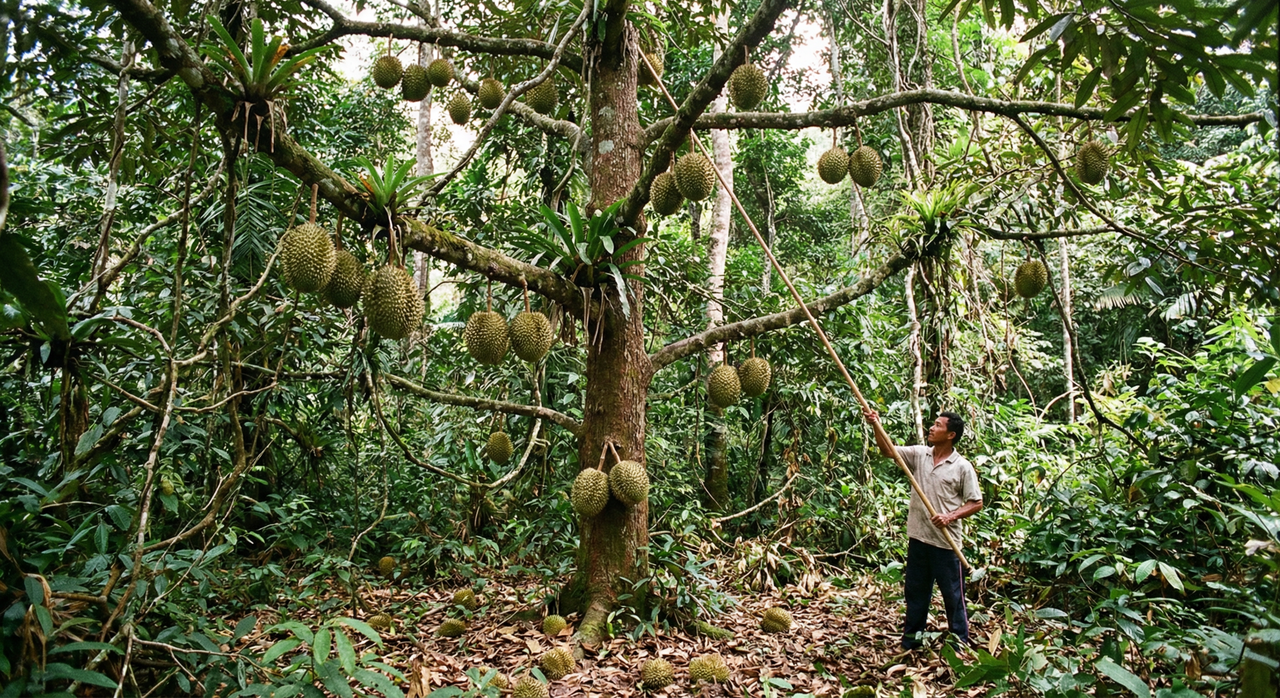
At harvest, the standard approach is a long pole fitted with a blade or hook to cut the stem cleanly from the ground.[78][49] Letting a durian drop is not a viable shortcut; the impact accelerates ethylene production and causes splitting, and a split fruit deteriorates within hours. Think of it like avocados, another climacteric fruit where the harvest moment matters deeply, except durian's window is even narrower and the consequences of a bruised fruit are far more immediate.
Post-harvest handling is where most home growers lose the plot. Durian is highly perishable and should be cooled to 13-15°C at 85-95% relative humidity as quickly as possible to push shelf life out to 5-7 days.[79][80] Without commercial refrigeration I've experimented with shaded, humid storage and found that even a few degrees above that threshold noticeably shortens the edible window. At room temperature you're looking at 2-3 days before over-ripening takes hold.[81] Freezing the pulp preserves quality for months and is the most practical option if you're working with more fruit than you can eat fresh.
Durian Yield, Flavor Profile, and Sensory Characteristics
A mature durian tree produces 100-150 fruits per year under average conditions, translating to roughly 200-500 kg of total fruit, with elite varieties under optimal management reaching 200-300 fruits.[82] The edible portion is the creamy aril surrounding the seeds, which means yield in practice is a fraction of total fruit weight, but even a modest harvest from one well-managed tree is genuinely significant.
Getting the harvest timing right is what separates sublime from mediocre. Properly ripened durian pulp is intensely sweet with a custard-like texture from roughly 5% fat content, layered with subtle umami, a hint of bitterness, and occasional sour notes.[83][84] The notorious aroma comes from sulfur volatiles including ethanethiol and diethyl disulfide,[85] which I'll admit reads more pleasantly than it smells to newcomers. Home-harvested fruit at peak ripeness is noticeably sweeter and less bitter than anything I've bought from a store, with the aftertaste lingering anywhere from 30 minutes to over an hour, transitioning from initial sweetness toward deeper sulfurous and bitter notes.[86] That persistence is part of the experience, and once you've tasted it at the right moment off a tree you've tended yourself, the reputation makes complete sense.
Durian Preparation, Culinary Uses, and Non-Food Applications
Edible Parts and Safe Preparation of Durian Pulp and Seeds
The custard-like pulp is what everyone comes for. Botanically the mesocarp, it's that creamy, yielding flesh that surrounds the seeds, and it's eaten raw at peak ripeness or folded into smoothies, durian ice cream, traditional sweets, and durian cake.[30] Opening one for the first time is messier than it looks. I made the rookie mistake of yanking at the pulp without working around the fibrous core first, and ended up with a hand coated in aroma and half the fruit mashed. The cleaner move is to run a knife along the seam, lever the husk open in sections, and lift each lobe of pulp free intact. The texture rewards that patience: dense and silky, almost like a spoonable crème brûlée with the occasional fibrous thread near the seed.
The seeds are genuinely edible, but they need thorough cooking first. Boiling for 20 to 30 minutes, steaming, or roasting neutralizes saponins and bitter compounds that make raw seeds unpleasant at best.[87][88] I've found the full boil produces something nutty and starchy, closer to a cooked chestnut than anything fruity, and it works well alongside savory Malaysian-style preparations. Don't shortcut the cooking time; the bitterness signals something real.
Flavor Profile, Texture, and Regional Variety Differences
Describing durian's flavor to someone who hasn't tasted it is genuinely difficult. The creamy base hits first, sweet and rich with notes of caramel and almond, and then the sulfurous undertone arrives: a whisper of onion or roasted garlic woven into the custard. Over 200 volatile compounds are responsible, with esters carrying the fruity sweetness and sulfides generating that notorious aroma.[89] I've worked with jackfruit and other pungent tropical ingredients long enough to appreciate how individual perception shapes the whole experience. Some people smell rotting compost; others smell caramel. Both reactions are biochemically legitimate.
Cultivar choice changes the conversation considerably. Monthong from Thailand leans mild and sweet with restrained pungency, which is why it dominates export markets and durian recipe applications for newcomers. Musang King from Malaysia goes the opposite direction: intensely creamy, deeply nutty, and rich enough that a small portion satisfies. Indonesian varieties tend to be more sulfurous and aromatic, firmly in traditional-connoisseur territory.[90] If you're considering frozen durian for smoothies or durian candy recipes, Monthong's milder profile is far more forgiving to work with.[16][91]
Traditional Non-Food Uses of Durian Rind, Seeds, and Flowers
The husk gets discarded in most kitchens, but there's genuine utility in it. Traditionally the thick, spiny rind has been used for wound dressings, as an insect repellent, and as raw material for dyes and rope-making.[92] I've experimented with using fibrous tropical byproducts as a mulch layer and pest barrier in regenerative garden beds, and while I haven't run a formal trial with durian husk specifically, the logic of its chemical profile as a deterrent is sound. The seeds carry additional traditional weight beyond the kitchen, used ethnobotanically to ease coughs and asthma in parts of Southeast Asia, and ground into flour for cooking when available.[92] Even the flowers have ceremonial relevance in some communities, though they're rarely eaten.[30] What I find compelling about this fruit is that almost nothing goes to waste once you start looking at it the way traditional growers always have.
Durian Health Benefits and Medicinal Uses
If you spend any time in Southeast Asia, you quickly realize that durian's reputation extends well beyond its smell. Traditional healers across the region have worked with nearly every part of Durio zibethinus for generations, treating conditions ranging from fever and digestive upset to skin infections and joint pain.[93][94] That depth of ethnobotanical use, accumulated across centuries of careful observation, deserves more credit than it usually gets in Western nutritional writing.
Traditional Medicinal Uses Across Plant Parts
In Malay folk medicine, leaves are applied as poultices for boils, swellings, and wounds, and boiled into decoctions, typically 10 to 20 leaves prepared as a tea taken once or twice daily, for fever relief.[88][95] That anti-inflammatory use isn't just anecdotal: leaf extracts have been shown in rat models to reduce paw edema at rates comparable to aspirin, with measurable free radical scavenging activity in vitro.[96] The fruit pulp itself, consumed in portions of around 100 to 200g daily in traditional practice, has been used for fever, sore throat, digestive complaints, and general energy.[88][95] Philippine and Thai herbalists have traditionally used small amounts of roasted or powdered seed for diarrhea and as a vermifuge.[97][88] The bark, meanwhile, appears in Malay medicine for wound healing and gastrointestinal disorders.[95] As a horticulturist, I find this breadth of use across plant parts genuinely compelling, even where modern clinical trials haven't yet caught up to the traditional knowledge.
Key Phytochemical Compounds in Durian
The chemistry behind those traditional applications is rich. Durian contains alkaloids, flavonoids, terpenoids, phenolic acids, glycosides, saponins, tannins, steroids, and coumarins, concentrated most densely in the fruit, seeds, and leaves.[98][99] The flavonoids quercetin, kaempferol, catechin, epicatechin, and rutin appear across leaves, bark, and fruit pulp, alongside phenolic acids like gallic and ellagic acid in the seeds and bark, giving the whole tree a robust antioxidant toolkit.[98][100] The same sulfur volatiles responsible for the notorious aroma, compounds like 3-methylbutyl ethanethioate and diethyl disulfide, serve dual ecological roles: attracting bats and insects for nocturnal pollination and providing chemical defense against herbivores.[101][102] Tannins and saponins in the seeds and bark add further antimicrobial and defense capacity, while leaf essential oils containing α-pinene, sabinene, and caryophyllene show antimicrobial potential in preliminary studies.[103][104] One thing I've noticed working in tropical landscapes is that stress-affected trees, particularly those dealing with drought, often show reduced leaf vibrancy that corresponds to documented findings that drought stress can cut phenolic levels by up to 30%.[105] Cultivar matters too, with Malaysian D24 running notably higher in carotenoids than Thai Monthong, so the phytochemical picture shifts depending on what you're growing and how.[106]
Nutritional Profile of Durian Pulp
The edible portion is the creamy aril surrounding the large seeds, and per 100g it delivers approximately 147 calories, 27g carbohydrates, 5.3g fat, 1.5g protein, and 3.8g fiber.[107] The headline nutrient is thiamin: at 2.4mg per 100g, that's 200% of the daily value from a single modest serving.[108] To put that in perspective, it's roughly double what you'd get from the same weight of sunflower seeds or a comparable portion of pork loin. Durian also contributes meaningful pantothenic acid (26% DV), niacin (14% DV), riboflavin (15% DV), 436mg potassium, and variable vitamin C ranging from around 20 to 44mg depending on cultivar and ripeness.[109] On the antioxidant side, total phenolics reach up to 540mg GAE per 100g in some cultivars, DPPH scavenging can hit 80 to 90%, and ORAC values around 1120 μmol TE/100g put it in respectable company with many berries.[110][111] Antioxidant capacity increases as the fruit ripens and starch converts to sugars, which is a good reason to let it come to full maturity before eating.[112] If you're processing it with heat, know that boiling or steaming can reduce water-soluble vitamins like C by 30 to 50%.[113]
Pharmacological Research and Potential Benefits
Preclinical research paints an interesting picture. Durian extracts demonstrate antioxidant and anti-inflammatory activity through inhibition of pro-inflammatory cytokines and the NF-κB pathway.[114][115] Separate studies show antimicrobial activity against various pathogens, inhibition of α-glucosidase and α-amylase suggesting anti-diabetic potential, and HMG-CoA reductase inhibition consistent with lipid-lowering effects.[116][117][118] Quercetin and related phenolics are likely driving many of these effects across multiple biochemical pathways.[119] The vast majority of this research is in vitro or animal-based, and human clinical trials are sparse.[120] The ethnobotanical record is genuinely impressive, and the preclinical data is promising, but anyone positioning durian as a therapeutic food should do so with proportionate humility about where the human evidence actually stands.
Safety Considerations and Potential Side Effects
The pulp has a long, well-supported history of safe culinary use at typical servings of 100 to 200g, with few documented poisoning incidents in its home region.[121] Overconsumption can cause bloating, gas, diarrhea, or nausea from the high fiber, fat, and sulfur content, so portion control is sensible.[122] The seeds are a different matter entirely. They contain cyanogenic glycosides capable of releasing hydrogen cyanide, thiaminase that degrades thiamin, and saponins that irritate the gut.[123][20] I've always told people to discard or compost the seeds; they're not suitable for casual consumption or animal feed.
People with latex allergies should approach durian cautiously. I've seen cross-reactivity patterns with avocado and banana in my own networks, and the mechanism here involves similar chitinase proteins that can trigger latex-fruit syndrome reactions ranging from rash and swelling to anaphylaxis.[124][125] Anyone on warfarin should note the vitamin K content (0.3 to 1.5mg per 100g), and those on ACE inhibitors or potassium-sparing diuretics need to account for the 436mg potassium per serving, particularly with any kidney impairment.[126][127] The glycemic index sits around 49, moderate but not trivial given the roughly 27g of sugars per 100g, so portion awareness matters for diabetics.[128] On alcohol: having read the 2009 Food Chemistry research and heard consistent anecdotal reports, I advise people clearly to never combine durian with alcohol. The fruit inhibits aldehyde dehydrogenase and produces a disulfiram-like reaction with flushing, palpitations, nausea, and headache.[129] The research on that one is clear. Finally, keep durian away from dogs entirely; the high fat and sugar content can cause vomiting, diarrhea, and potential pancreatitis.[130]
Durian Pests and Diseases
Durian isn't a fragile tree, but growing it in the humid conditions it demands means you're also cultivating ideal territory for a handful of pathogens and insects that can genuinely devastate a harvest. The reality is a combination of moderate overall resistance, meaningful cultivar differences, and cultural management doing most of the heavy lifting. Chemicals exist, but they're the last line, not the first.
Common Diseases of Durian and Resistance Profiles
The three pathogens worth losing sleep over are Phytophthora palmivora, anthracnose (Colletotrichum spp.), and Fusarium wilt. Cultivar choice matters enormously here. D24, Chanee, D101, and D175 all show moderate to high resistance against Phytophthora root and fruit rot, while Monthong holds up reasonably well during prolonged wet spells where anthracnose pressure climbs.[131][132][133] Fusarium wilt and bacterial issues from Erwinia spp. affect most cultivars to some degree, and the research on viral diseases like cucumber mosaic virus is thinner; resistance there is cultivar-dependent and I'd hedge on any firm claims.[134][135]
Environment tips the scales as much as genetics. Humidity above 80% accelerates both Phytophthora fruit rot and anthracnose; soil pH held between 5.5 and 6.5 supports resistance, while anything outside that range increases root rot risk.[136][137] Botryodiplodia theobromae causes black lesion fruit rot and Cercospora leaf spot can trigger defoliation under high humidity.[138] Poor drainage is the fastest route to losing a tree; as I covered in site selection, raising or mounding planting areas is non-negotiable in heavy soils. Good air circulation through 8 to 10 meter spacing and regular pruning remains the primary defense, with phosphonate fungicides like fosetyl-Al for Phytophthora, copper-based sprays for leaf spot and anthracnose, and systemic options like azoxystrobin reserved for established problems rather than routine application.[139][137] Breeding programs are actively developing more resistant rootstocks, which is genuinely encouraging for the next decade.[140]
Major Insect Pests and Natural Defenses
The three pests that do real damage are fruit flies (Bactrocera dorsalis and Ceratitis capitata), fruit borers (Conogethes punctiferalis), and the pink borer (Coniesta ignefusalis), which tunnels into trunks and branches as well as fruit.[141][142][143] Secondary pressure comes from mealybugs, scale insects, aphids, leaf miners, weevils, longhorn beetles, and mites; in mixed plantings, rhinoceros beetle can also show up.[144][145]
Durian does come with its own defenses. The fused spiny husk physically deters many insects, and the fruit's phenolic compounds, alkaloids, and sulfur-rich essential oils add a chemical barrier.[146] I think of it like a pineapple or artichoke in this respect: the armor reduces incursion but doesn't eliminate it, especially from insects that evolved alongside the tree. Monthong shows moderate resistance to fruit borers and mealybugs, Kradum Thong offers good borer tolerance, and Chanee holds up better against sucking insects, so matching cultivar to your primary pest pressure is worth the effort.[147][148]
Integrated pest management is the right frame here. Sanitation and pruning reduce habitat for overwintering insects and improve airflow, which simultaneously cuts fungal disease pressure since pest damage frequently opens the door to secondary infections.[149] Pheromone traps and Trichogramma parasitoid releases have meaningfully cut fruit-fly damage in my own tropical fruit setups; I started using them early in orchard establishment and the difference was noticeable before I'd reached for any spray. Intercropping with marigolds in the understory guild suppresses soil-dwelling pests and I've used this approach in mixed plantings to good effect. Entomopathogenic nematodes, Oryctes virus for rhinoceros beetle, and neem oil round out the biological toolkit before reaching for targeted insecticides.[150][151] Adapting these Southeast Asian protocols to other humid climates takes observation and iteration, but the principles transfer.
Permaculture Design with Durian
Every permaculture system I've ever designed starts with the same question: what does this plant think it is? Durian thinks it's a rainforest giant. And if you want to work with it rather than against it, your job is to give it something that feels like home.
Climate Requirements and Suitable Zones for Durian
Durian needs consistent warmth between 24–30°C, at least 2000–3000 mm of well-distributed annual rainfall, and relative humidity sitting in the 80–90% range.[152][49] Those numbers aren't aspirational guidelines; they're the baseline below which this tree simply refuses to perform. It stays below 600 meters in its native range for good reason, and salt spray or waterlogged soils will knock it back just as effectively as cold.[30]
In the United States, that realistically means USDA zones 10b and 11, which mostly comes down to the southern tip of Florida and parts of Hawaii.[41][28] Even there, the tree remains essentially a hobbyist crop with no commercial production to speak of, and the threats of hurricane-force winds, Phytophthora pressure, and surprise cold snaps keep growers on their toes.[153] I've grown durian from seed in a protected Central Florida microclimate and watched a single night dipping below 12°C trigger significant leaf drop on seedlings that had otherwise been thriving. That experience makes the 10°C lethal threshold feel less like a number in a database and more like a hard line you do not want to cross.[154][155] If you're in zone 10a or cooler, plan on greenhouse protection or accept that you're growing a large ornamental that may never fruit reliably. That's not a discouragement; it's just honest site assessment, which is the first job of any permaculture designer.
Ecological Functions and Pollination in Permaculture Systems
Here's where durian gets genuinely fascinating to design around. Those large, bell-shaped, greenish-white flowers that open at night aren't an inconvenient quirk; they're a highly specific invitation to fruit bats.[156][157] The flowers are protogynous, which structurally favors cross-pollination, and they produce abundant nectar that bats like Cynopterus sphinx have co-evolved to exploit.[158] The flowers need temperatures between 24–32°C and that same high humidity to stay viable, which means optimal pollination conditions and optimal growing conditions are essentially the same window.[68]
The problem is that natural pollination rates in commercial orchards typically land at only 5–10% because habitat fragmentation has decimated bat populations across much of Southeast Asia.[159] A permaculture approach treats that as a design opportunity rather than a defeat. Installing bat boxes, maintaining or restoring forest-edge corridors, and supplementing with manual hand-pollination at night can push fruit set to 20–50%.[160] Hand-pollinating durian by headlamp while the flowers breathe out that sour-sweet, almost fermented scent into the dark is one of the stranger tasks this work has asked of me. But it's also a direct reminder of what we're trying to replicate: a functional nocturnal ecosystem. Durian is also part of a deeper web of megafauna relationships, with Asian elephants and orangutans historically dispersing its seeds across forest landscapes.[161] Your durian farming setup won't include elephants, but preserving any patch of natural habitat near the planting goes a long way toward supporting the bat populations that the tree genuinely needs.
Forest Layer Placement and Companion Guilds
Durian is an upper-canopy species. In native lowland forest it reaches 20–40 meters with a broad spreading crown and buttressed roots.[162][163] Place it accordingly when you're laying out a food forest: it's the anchor that determines sun angles, wind patterns, and long-term canopy structure for everything around it. Young trees will tolerate 30–50% shade during establishment, but once they mature they need 6–8 hours of full sun to flower and fruit reliably, so give them room from the start.[164]
The most practical guild strategy I've used draws directly from Thai agroforestry: plant bananas around young durians during establishment.[165] The bananas buffer drying winds, retain moisture in the root zone, and gave me harvests to eat while I was waiting years for the durian canopy to fill in. That's layered production in the most literal sense. As the durians grow and take over the canopy, the bananas gradually phase out, which is exactly how succession is supposed to work.
Below that canopy layer, durian rewards thoughtful soil-building companions. The tree prefers deep, fertile soils and has a genuine appetite for heavy macronutrient feeding.[163] Intercropping with pigeon pea or mung bean can reduce synthetic fertilizer needs by roughly 20–30% under research conditions,[166] and in my own plots, after incorporating pigeon pea into the guild, I noticed improved leaf color and growth rate that my soil tests confirmed as higher available nitrogen. I pair pigeon pea with turmeric in the ground layer; ginger or turmeric fill that understory niche well, their pungent foliage seems to reduce mite pressure on young leaves, and they don't compete aggressively with the durian's deep root system.[167][168] On a durian farm designed around these principles, you're not fighting the rainforest; you're building a version of it that happens to feed you.
The First Time Durian Made Me Question Everything I Thought I Knew About Fruit
I still remember standing in a Bangkok market at six in the morning, watching a vendor crack open a Musang King with the calm confidence of someone handling something sacred. The smell hit me before the taste did, and my instinct was to step back. I didn't. That first bite rewired something. It's not the flavor I keep coming back to when I think about why this tree belongs in every serious tropical food forest; it's that moment of choosing to stay.
Sources 168
- Identification of Volatile Compounds in Durian (Durio zibethinus) by Gas Chromatography–Olfactometry and Gas Chromatography–Mass Spectrometry ↩
- Durian - Wikipedia ↩
- Durio zibethinus - Missouri Botanical Garden ↩
- Durio zibethinus - Plants of the World Online (Kew) ↩
- Durian Cultivation Guide - University of Florida IFAS Extension ↩
- Phenology and reproductive ecology of Durio zibethinus in Borneo ↩
- The Durian: Botany, Horticulture, and Utilization - HortScience ↩
- Seed Dispersal by Elephants in Durian Forests ↩
- Durian - Wikipedia ↩
- History of Durian Cultivation in the Philippines ↩
- The King of Fruits: A History of the Durian ↩
- Medicinal Properties of Durio zibethinus in Traditional Southeast Asian Medicine ↩
- Ethnobotanical Uses of Durian in Indonesia ↩
- Durio zibethinus - Missouri Botanical Garden ↩
- Durio zibethinus - Plants of the World Online (Kew) ↩
- Durian Fruit Facts - Purdue University ↩
- Why Durian is Banned on Singapore's Public Transport ↩
- FAOSTAT: Production Data for Durian ↩
- Global Durian Market Report 2023 ↩
- Volatile Compounds and Sensory Characteristics of Different Durian Cultivars ↩
- Durian Cultivars: Flavor Profiles from University of Malaya Study ↩
- Durian Cultivars in Thailand - Department of Agriculture ↩
- Durian Cultivars of Thailand ↩
- Musang King Durian - Malaysian Agricultural Research Institute ↩
- Musang King Durian Characteristics ↩
- Peer-Reviewed Study on Durian Shelf Life ↩
- Thai Durian Varieties List ↩
- Durian Production in Hawaii ↩
- Malaysian Durian Varieties including D24 ↩
- Durian - Kew Royal Botanic Gardens ↩
- Genetic Diversity of Durio zibethinus ↩
- Durio zibethinus - Wikipedia ↩
- FAO Guidelines on Tropical Fruits: Durian ↩
- Durio zibethinus - Missouri Botanical Garden ↩
- Durian Cultivation Guide ↩
- USDA APHIS - Plant Import Requirements ↩
- Durian: Post-harvest Operations ↩
- Recalcitrant Seeds of Tropical Species: Durio zibethinus ↩
- Propagation of Tropical Fruit Trees ↩
- Durian: Botany, Horticulture, and Utilization ↩
- Growing Durian from Seed ↩
- Grafting Durian Trees ↩
- Propagation of Durian (Durio zibethinus Murr.): A Review ↩
- Vegetative Propagation Techniques for Durian ↩
- Micropropagation of Durian (Durio zibethinus Murr.) ↩
- FAO - Durian Production Guidelines ↩
- University of Florida IFAS Extension - Growing Durian in Florida ↩
- Durian: Botany, Horticulture, and Utilization ↩
- Durian Cultivation Guide - University of Florida IFAS Extension ↩
- Durian Production Guide ↩
- Durian Cultivation and Orchard Management ↩
- Spacing and Yield in Durian Plantations - Journal of Tropical Agriculture ↩
- Durian Orchard Management - Malaysian Agricultural Research and Development Institute ↩
- Water Requirements for Tropical Fruit Trees - FAO ↩
- Durian Production in Thailand ↩
- Irrigation Management for Tropical Fruit Trees - FAO Guidelines ↩
- FAO - Tropical Fruits: Durian Production Guidelines ↩
- Durian Cultivation Guide ↩
- Nutrient Management for Durian Cultivation ↩
- Macronutrient Requirements of Durio zibethinus ↩
- Durian Cultivation Guide - Department of Agriculture, Thailand ↩
- Tropical Fruit Fertilization Recommendations ↩
- Nutrient Management in Durian Cultivation ↩
- Soil Fertility and Durian Production in Acid Soils ↩
- Nutrient Deficiencies in Durian Trees ↩
- Durian Cultivation Practices ↩
- Physiological Responses of Durio zibethinus to Environmental Stress ↩
- Durian Cultivation: Temperature Requirements and Stress Tolerance ↩
- Durian Production Guide: Managing Abiotic Stresses ↩
- Durian Production - FAO ↩
- Durian Production and Harvesting Guidelines ↩
- Maturity Indices for Durian (Durio zibethinus) Fruit ↩
- Durian Production Manual ↩
- Musang King Durian: Cultivation and Harvesting ↩
- Durian Cultivation Guide ↩
- Durian Production in Thailand ↩
- Tropical Fruits: Durio zibethinus ↩
- Durian Production and Post-Harvest Handling ↩
- Postharvest Handling of Durian ↩
- Durian Postharvest Technology Guidelines ↩
- Harvesting and Postharvest Handling of Durian (Durio zibethinus) ↩
- Durian Production in Southeast Asia ↩
- Volatile Compounds in Durian (Durio zibethinus L.) Fruit ↩
- Durian: The King of Fruits - Taste and Aroma ↩
- Sensory and Instrumental Evaluation of Durian Aroma ↩
- Journal of Agricultural and Food Chemistry - Studies on Durian Volatiles ↩
- Durian Seed Preparation and Safety ↩
- Toxins in Tropical Fruits: Durian ↩
- Flavor Compounds in Durio zibethinus - Journal of Agricultural and Food Chemistry ↩
- Regional Durian Varieties: Taste Profiles - Malaysian Agricultural Research Institute ↩
- The Culinary Uses of Durian in Southeast Asia ↩
- Ethnobotanical Uses of Durio zibethinus in Southeast Asia ↩
- Ethnopharmacological Uses and Pharmacological Activities of Durio zibethinus ↩
- Traditional Medicinal Uses of Durian in Southeast Asia ↩
- Traditional Medicinal Uses of Durian Plant Parts in Southeast Asia ↩
- Antioxidant and Anti-inflammatory Activities of Durian Leaf Extract ↩
- Medicinal Uses of Durian Seeds in Traditional Healing ↩
- Phytochemical Composition and Antioxidant Activity of Durian (Durio zibethinus Murr.) ↩
- Secondary Metabolites from Durio zibethinus: A Review ↩
- Phenolic Compounds in Durian Fruit and By-Products ↩
- Identification of the Key Odorants in Durian (Durio zibethinus L. 'Monthong') by Stable Isotope Dilution Assay and Aroma Extract Dilution Analysis ↩
- Pollination Ecology of Durian (Durio zibethinus) in Southeast Asia ↩
- Saponins and Tannins in Durian Seeds ↩
- Essential Oils from Durio zibethinus Leaves: Composition and Bioactivity ↩
- Secondary Metabolites in Durio zibethinus: Responses to Soil and Climate Factors ↩
- Phytochemical Composition of Durian Fruit: Influence of Cultivar and Environment ↩
- USDA FoodData Central - Durian, raw ↩
- USDA FoodData Central ↩
- USDA FoodData Central - Durian, raw ↩
- Phytochemicals and Antioxidant Capacities of Durio zibethinus Murr. Cultivars ↩
- Bioactive Compounds and Antioxidant Activity in Different Pulp Colors of Durian (Durio zibethinus Murr.) ↩
- Peer-reviewed study: Antioxidant Activity of Durian During Ripening (Journal of Food Science) ↩
- Effects of Cooking on Durian Nutrients (Food Chemistry) ↩
- Pharmacological Activities of Durio zibethinus: A Review ↩
- Anti-Inflammatory Flavonoids from Durio zibethinus Targeting NF-κB ↩
- Antimicrobial Activity of Durio zibethinus Against Pathogenic Microorganisms ↩
- α-Amylase Inhibition by Durian Bioactives ↩
- Inhibitory Effects of Durian Extracts on HMG-CoA Reductase ↩
- Quercetin and Its Mechanisms in Durio zibethinus ↩
- Phytochemical and Pharmacological Review of Durio zibethinus ↩
- Missouri Botanical Garden Plant Finder ↩
- Adverse effects of durian fruit ↩
- Cyanogenic Glycosides in Edible Fruits of Durio zibethinus ↩
- Latex-Fruit Syndrome: Cross-Reactivity with Durian (Allergy Journal) ↩
- Fruit Allergies: Durian and Cross-Reactivity ↩
- Vitamin K Content in Fruits and Vegetables ↩
- Food-Drug Interactions: Potassium-Rich Foods and Medications ↩
- Glycemic Index of Fruits Including Durian ↩
- Inhibition of aldehyde dehydrogenase enzyme by Durian (Durio zibethinus Murray) fruit extract - Food Chemistry 2009 ↩
- Veterinary Toxicology: Fruits Toxic to Dogs ↩
- Phytophthora Diseases of Durian ↩
- Cultivar Resistance to Pathogens in Durio zibethinus ↩
- Breeding for Anthracnose Resistance in Thai Durian Varieties ↩
- Fusarium Wilt of Durian: Symptoms and Management ↩
- Viral Diseases in Tropical Fruits Including Durian ↩
- University of Putra Malaysia Durian Disease Management ↩
- FAO Durian Production Guidelines ↩
- Postharvest Fruit Rot of Durian ↩
- Durian Production Guide - USDA ↩
- Resistant Rootstocks for Durian ↩
- University of Florida - IFAS Extension ↩
- FAO - Durian (Durio zibethinus) production in Thailand ↩
- Durian Fruit Borer Control ↩
- Durian Diseases and Pests in Malaysia ↩
- Pests of Durian in Hawaii ↩
- Phytochemical and Insecticidal Properties of Durio zibethinus Extracts ↩
- Thai Durian Varieties and Their Pest Tolerance ↩
- Breeding for Pest Resistance in Durio zibethinus ↩
- Integrated Pest Management for Durian ↩
- Integrated Pest Management for Durian in Malaysia ↩
- FAO Guidelines on Durian Pest Management ↩
- Durio zibethinus - Useful Tropical Plants Database ↩
- Growing Tropical Fruits in Florida ↩
- Durian Production in Malaysia ↩
- Durio zibethinus - Useful Tropical Plants ↩
- Durian Pollination Biology - Royal Botanic Gardens, Kew ↩
- Evidence that fruit bats are effective pollinators of durian (Durio zibethinus) ↩
- Pollination ecology of durian (Durio zibethinus) in Peninsular Malaysia ↩
- Effects of Habitat Fragmentation on Durian Pollinators ↩
- Enhancing Pollination in Tropical Fruit Crops Including Durian ↩
- Role of Megafauna in Durian Seed Dispersal ↩
- Durio zibethinus - Missouri Botanical Garden ↩
- Durio zibethinus - Plants of the World Online | Kew Science ↩
- Shade Tolerance and Intercropping Potential of Durian (Durio zibethinus) ↩
- Durian Agroforestry Practices in Thailand: Intercropping with Bananas ↩
- Nutrient Management for Durio zibethinus Including Nitrogen Fixers ↩
- Agroforestry Research on Durian (Durio zibethinus) in Southeast Asia ↩
- Durian Cultivation Guide - ECHO Community ↩