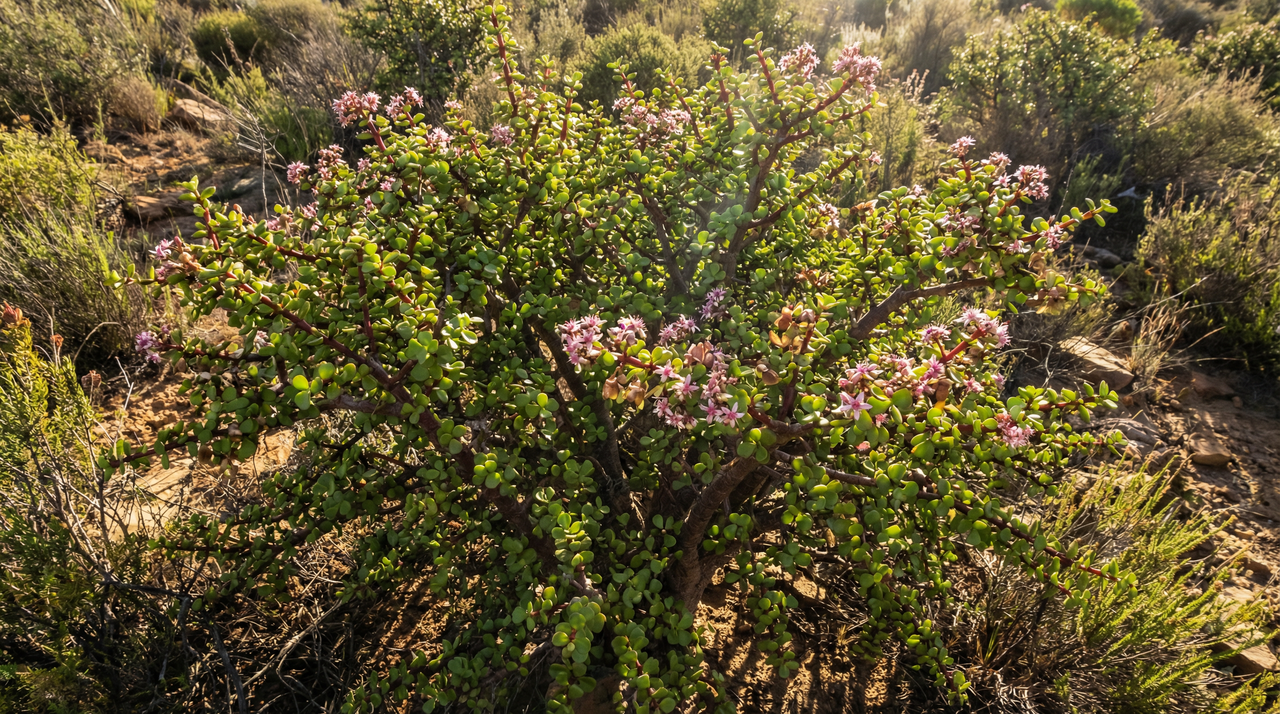
Most people who grow Elephant Bush have no idea they've been casually maintaining one of the most effective carbon-sequestering plants on the planet. Portulacaria afra stores carbon at roughly four times the rate of most succulents,[1] which is remarkable for a plant most of us keep in a terracotta pot on a sunny windowsill, occasionally forgetting to water. I've grown it in coastal California, in a polytunnel in the UK, and in a semi-arid food forest in southern Spain, and every single time someone picks up a leaf, gives it a sniff, and says "wait, you can eat this?" Yes. You can. And the people who knew that long before any of us were born ate it regularly, sourced it from the wild, and shared landscapes with the elephants that gave this plant its name.
That collision of the ordinary and the extraordinary is exactly what makes Elephant Bush worth understanding properly. It's not just a forgiving houseplant for beginners, though it absolutely is that. It's a food source, a living hedge, a pollinator resource, and a piece of southern African ecological history that happens to tolerate neglect with extraordinary grace. Once you see it that way, a three-dollar nursery cutting starts to feel like a very different kind of investment.
Elephant Bush Origin and History
There's something grounding about growing a plant that has been feeding megafauna for millions of years. Portulacaria afra, commonly known as elephant bush, is one of those plants. I've had specimens in my garden and in bonsai pots for years, and the more you watch it grow, the more you start to read its evolutionary history in its structure: compact internodes, small waxy leaves, thick water-storing stems, and a stubborn refusal to die when conditions get brutal. This is a plant that was shaped by a hard landscape, and it shows.
Native Range and Botanical Background
Elephant bush is native to South Africa, where it thrives across the semi-arid scrublands of the Eastern Cape, the Karoo, and KwaZulu-Natal. As a member of the family Didiereaceae (historically placed in Portulacaceae), it has evolved the classic succulent toolkit for surviving in environments with irregular rainfall, high temperatures, and soils that drain almost aggressively fast. Those adaptations, CAM photosynthesis, fleshy tissues that bank water during dry spells, and a growth habit that recovers quickly after losing biomass, are not accidental. They're the result of a plant that has been browsed, burned, and drought-stressed across deep time and kept coming back anyway. That resilience is exactly what makes it so interesting from a permaculture perspective.
Traditional and Cultural Significance
Indigenous communities across southern Africa have long recognized what ecologists have since confirmed: this plant is edible, and its sour, slightly acidic leaves provided a genuine nutritional resource in landscapes where leafy greens weren't always easy to come by. Zulu and Xhosa communities in particular incorporated the leaves into their diets both raw and cooked, and the plant's reliability in harsh conditions made it a low-effort, high-return food source. Specific ethnobotanical records for Portulacaria afra are thinner than for more famous medicinal plants, but the pattern of human use across the region is consistent and credible. When a plant grows in difficult terrain and tastes reasonably good, people figure that out quickly.
Why It's Called Elephant Bush
The common name "elephant bush spekboom" captures something real. Elephants, along with kudus, tortoises, and other large herbivores, browse heavily on this plant across its native range. What's remarkable is that Portulacaria afra seems almost designed to handle that kind of pressure: it resprouts vigorously after being eaten down to stubs, which means intense herbivory functions more like hard pruning than destruction. I think about that every time I take cuttings. The way elephants work through a stand of this shrub in the wild isn't so different from what a gardener does with a pair of secateurs to keep a container specimen compact. The plant doesn't just survive that treatment; it responds to it. That quality, the ability to be consumed and return stronger, is exactly what drew traditional communities and modern permaculture designers to it alike.
Elephant Bush Varieties and Cultivars
The straight species is where most people start, and honestly, for a lot of permaculture applications, it's where you stay. The standard green Portulacaria afra is a vigorous, upright grower that can reach 6 to 15 feet given time and decent conditions. Its small, glossy, jade-green leaves are plump and satisfying to look at, and the plant just gets on with the job without much fuss. It's the workhorse of the group, and I keep reaching for it when I need a reliable living hedge or a fast-filling gap in a dry guild. The formal horticultural literature on named cultivars is pretty thin, so most of what follows is drawn from years of installing and observing these plants in real landscapes.
Popular Portulacaria afra Cultivars for Garden and Permaculture Use
Portulacaria afra 'Variegata' is the selection you'll see most often at nurseries, and for good reason. Its cream-edged leaves bring real contrast into dark foliage guilds, and it photographs beautifully. Rainbow elephant bush is another name that floats around for some of these cream-and-green forms. What I've noticed in my own installations is that 'Variegata' is noticeably less vigorous than the green species. It rebounds more slowly after dry spells, it's a touch more sensitive to harsh afternoon sun, and it doesn't bulk up into a serious hedge the same way. I still use it, but I'm honest with clients that they're trading some toughness for the ornamental appeal.
The dwarf and compact selections, sometimes sold as Portulacaria afra 'Minima' or listed under names like Portulacaria afra prostrata for trailing forms, are where I get excited for small-space design work. These typically stay under 2 to 3 feet and spread more than they climb, which makes them genuinely useful in tight spots. I've used compact elephant bush in container guilds where the full-sized species would have swallowed its companions within two seasons. Portulacaria afra macrophylla is the opposite direction entirely, a larger-leaved form that makes a bold statement but is harder to track down. Names like 'Kaleidoscope' and 'Manny' occasionally appear at specialty succulent nurseries, though labeling consistency is, let's say, optimistic at best.
Sourcing Healthy Elephant Bush Plants and Cuttings
Buy once from a reputable source and then propagate from there. A good local succulent nursery or an established online specialist will give you a correctly labeled plant with a fighting chance; big-box garden centers often sell mislabeled stock and keep plants in conditions that stress them before you even get them home. What I look for every single time is leaf turgidity: the leaves should look plump and feel firm, not shriveled or soft. I also check the leaf axils carefully for mealybugs because Portulacaria is prone to them and the cottony clusters hide in the tightest joints. Finding an infestation in the car on the way home is not a good afternoon. One clean mother plant, propagated by cuttings, can quickly supply a whole food forest edge planting, which fits the permaculture logic of investing once and multiplying from your own stock.
Elephant Bush Propagation and Planting Guide
Every elephant bush I've ever lost came down to one thing: the wrong soil. Not the wrong light, not the wrong pot size, not neglect. The soil. Once I accepted that, everything changed.
Propagating elephant bush is genuinely straightforward, whether you're starting from stem cuttings, rooting in water, or transplanting a nursery plant. The real work happens before the cutting even touches the ground, because Portulacaria afra propagation success hinges almost entirely on what you put it into. Get the substrate right and this plant practically roots itself. Get it wrong and you'll be diagnosing problems for months.
Soil Requirements and Site Selection for Portulacaria afra
In its native Eastern Cape, this plant grows on rocky outcrops and sandstone slopes where water drains away in minutes, with over 60% of wild populations occurring on gravelly substrates.[2][3] That habitat context is your soil recipe. Compacted, moisture-retentive substrates cause stunted growth and leaf-tip necrosis, and I've watched both develop within a few weeks of planting in standard potting mix.[4]
The mix I reach for now targets at least 30% air-filled porosity: roughly 40-60% coarse quartz sand or pumice, 10-20% granular orchid bark, and 20-30% well-decomposed compost, with a soil pH between 6.0 and 7.5.[4][5][6] A straight commercial cactus mix rarely hits that porosity threshold. High-moisture-retention or clay-loam substrates nearly double root-rot incidence from Phytophthora and Pythium pathogens, and in Central Florida's humid summers, that risk is very real.[4] For what it's worth, I've grown jade plant (Crassula ovata) in the same conditions for years, but Portulacaria afra is measurably less forgiving of excess moisture than its lookalike cousin.
Depth matters less than you might expect. This is a shallow-rooted succulent that can establish in as little as 15 cm (6 in) of soil, though 30 cm (12 in) gives it room to develop fully.[7][5] That's why it performs well in containers and shallow raised beds, but don't let the shallow tolerance fool you into planting in heavy clay and hoping for the best. If compaction develops over time, a top-dressing of coarse grit worked lightly into the surface goes a long way. This soil profile holds whether you're rooting a cutting or settling in a transplant. The roots don't care how the plant started; they need the same aeration either way.
Elephant Bush Care Guide
Understanding where elephant bush comes from makes caring for it almost intuitive. In its native Eastern and Western Cape of South Africa, Portulacaria afra grows in rocky, sandy, well-drained soils that receive just 200–600 mm of rainfall annually, most of it in winter.[8][9] That context explains everything. This isn't a plant that evolved in a lush, moist environment and learned to cope with drought; it evolved in drought and only tolerates moisture in short bursts. Keep that image in your mind whenever you reach for the watering can.
Watering and Soil Requirements for Portulacaria afra
Elephant bush uses CAM photosynthesis and stores water in both its leaves and stems, which means a healthy, established plant can go four to eight weeks without irrigation at moderate temperatures before it starts to struggle.[10] I grow jade plant (Crassula ovata) alongside it in my succulent garden, and even by jade standards this one is impressively frugal. During spring and summer, I water thoroughly every two to three weeks once the top inch or two of soil is dry, letting the pot drain completely before it goes back on the shelf.[11][12] In fall and winter, that stretches to once a month or less, and I stop entirely if temperatures drop below 10°C.[13] Young seedlings are the exception; they need lighter, more frequent watering every seven to ten days to keep that top couple of centimeters barely moist while their root systems establish.[13]
The diagnostic cues are straightforward once you've seen them once. Wrinkled or slightly drooping leaves mean it's thirsty. Soft, translucent leaves or mushy stems mean you've gone too far the other direction. In Central Florida's humidity I learned this lesson faster than I'd have liked. The shift from firm, plump leaves to that concerning softness can happen in just a few days of waterlogged soil, and by then root rot with blackened, foul-smelling roots may already be underway. Overwatering is by far the most common way this plant dies in cultivation. When in doubt, wait another week.
Soil and pot selection are non-negotiable partners in keeping roots healthy. A well-draining cactus or succulent mix in a pot with drainage holes is the baseline.[14][12] I repot every two to three years to refresh the medium, prevent compaction, and clear any salt buildup from irrigation.[14] Bright indirect light indoors or full sun outdoors keeps growth compact and efficient; low light produces the leggy, etiolated stems that also tend to be more vulnerable to rot.[11][12] If you're using tap water, it tolerates low to moderate chlorine levels just fine, though it does prefer rainwater when you have it available.[15]
Brief frost is tolerable given its native habitat, but prolonged exposure is a different matter.[11][16] I bring my container specimens under cover when nighttime temperatures start flirting with freezing. A plant that looks worryingly dry and dormant in December is almost always exactly where it should be. Get the drainage and light right, and caring for elephant bush becomes one of the more forgiving routines in the garden.
Harvesting Elephant Bush (Portulacaria afra)
What I love about harvesting elephant bush is that there's no dedicated harvest day. You're not waiting for a fruit to ripen or a root to bulk up. Every time this plant needs a light shaping, you get food. The pruning session and the kitchen yield are the same act.
When and How to Harvest Elephant Bush Leaves and Stems
Tender leaves and stem tips can be taken year-round, but the best eating comes from new growth during the active growing season, roughly spring through fall in most climates.[17] The leaves are plumper, more succulent, and noticeably less fibrous than older growth. My personal rule is simple: if the plant looks happy and is putting on new tips, it's fair to pick. If it's been through a drought stretch or a frost, I wait until it looks recovered and the leaves feel full again before I take anything.[18] A stressed plant needs that leaf area working for it, not ending up in my salad bowl.
Sustainable Harvesting Techniques and Expected Yields
Sharp, clean secateurs are your best tool here. I snip 4 to 8 inch stem tips, cutting just above a leaf node, which encourages the plant to branch and fill in rather than leave bare stubs.[19] For a small kitchen pinch, individual leaves pull off easily by hand. The bigger principle, though, is the one-third rule: never remove more than a third of the plant's foliage at once.[18][17] I treat my elephant bush like a living hedge, and I've seen what happens when I pushed past that limit once, thinking it could handle it. The plant visibly sulked, and I lost weeks of productive growth. Respecting that ceiling keeps the carbon-capturing leaf canopy intact and means a mature specimen can supply a modest, continuous flow of greens across the whole growing season.[19]
The flavor those tips deliver is mild and slightly sour, a lot like purslane in both texture and that faint lemony tang. If you've ever pinched young purslane stems for a salad, you already know the vibe. Use them fresh if you can; stored in a loosely sealed bag with a paper towel, they'll hold in the refrigerator for up to a week.[20] The culinary possibilities from there are wider than most people expect.
Elephant Bush Culinary Uses and Preparation
Culinary Uses and Nutrition of Elephant Bush Leaves
Long before elephant bush became a popular drought-tolerant landscaping plant in Western gardens, Zulu and Xhosa communities in South Africa were eating it regularly. Raw leaves go into salads and make a quick trail-side snack; cooked leaves thicken stews and add a pleasantly tart note to braised dishes.[19][21] That lemony, purslane-like tang is genuinely appealing once you try it, and I always encourage people to pinch a single leaf and taste it fresh before committing to a full recipe.
The nutritional case for including elephant bush edible leaves in your diet is surprisingly strong. Fresh leaves clock in at roughly 120 to 150 mg of vitamin C per 100 grams, which comfortably rivals spinach and edges out many popular salad greens.[22] There's also meaningful calcium (around 200 to 300 mg per 100 g), omega-3 fatty acids, and a solid antioxidant profile from flavonoids and phenolic compounds, all at roughly 20 to 30 calories per 100 grams.[22][23] In a permaculture food forest, I'll toss a small handful of fresh leaves into a salad alongside purslane and a few heat-tolerant herbs; the sourness actually brightens the whole bowl the way a squeeze of lemon would.
The one honest caveat: elephant bush leaves contain calcium oxalates, which can cause mild digestive upset if you eat large quantities raw.[24] I've snacked on leaves straight from the plant dozens of times without any issue, but when I'm cooking a bigger batch into a stew or stir-fry, I always apply heat, because cooking reduces oxalate levels considerably. For the majority of gardeners, the practical rule is simple: small raw amounts are fine, and cooking takes any guesswork off the table. If you have clients or family members with dogs, cats, or horses, you can rest easy too; the ASPCA classifies Portulacaria afra as non-toxic to all of them.[25] That clearance is one reason I recommend it without hesitation when clients ask for edible succulents that won't require a separate fenced-off zone away from the family pets.
Elephant Bush Health Benefits and Edibility
If you came to this section expecting a list of clinically proven medicinal superpowers, Elephant Bush is going to disappoint. And I say that as someone who genuinely loves this plant. The honest truth is that Portulacaria afra benefits don't include a pharmaceutical resume. What it does offer is something more modest and, I'd argue, more honest: a safe, edible, drought-tolerant green that earns its place in the garden through sheer dependability rather than hype.
Nutritional Profile and Edible Uses
The leaves are the prize. They're small, fleshy, and when you pop one straight off the stem while pruning (which I do constantly), there's a pleasant, bright tang to them, almost like a squeeze of lemon with a crisp, juicy finish. [26] That acidity makes them a genuinely useful addition to a garden salad or a quick stir-fry of mixed greens. Because Elephant Bush sits in the purslane family, it's reasonable to expect the leaves contain modest levels of vitamin C, antioxidants, and omega-3 fatty acids similar to common purslane (Portulaca oleracea), which is one of the most nutritionally documented wild edibles around. [27][28] I'd love to tell you there are detailed phytochemical analyses confirming all of this for P. afra specifically, but that research simply hasn't been done yet. The family resemblance is suggestive, not conclusive.
Medicinal Research and Traditional Uses
Here's where the elephant bush plant benefits narrative runs thin: there are no peer-reviewed clinical studies and no documented phytochemical profiles demonstrating specific medicinal effects for this species. Some corners of the internet will hint at anti-inflammatory potential by drawing on its purslane relatives, and while that's a reasonable hypothesis, it's not evidence. In southern Africa, where Spekboom has deep roots in the landscape, its traditional role has been primarily as forage for livestock and wildlife rather than as a human medicinal plant; any folk remedies that do appear in the literature are anecdotal and unverified. [29] After years of growing it, I've never once felt the need to reach for it as medicine. Its real gift is ecological: a tough, generous plant that asks almost nothing and keeps on giving.
Safety Profile
The good news is that Elephant Bush is regarded as non-toxic to humans and is safe to eat in moderate amounts as a fresh leafy green. [30][31] People with sensitivities to oxalates or plant acids should go slowly with new additions to their diet, as with any succulent in this family, but there are no known drug interactions to worry about because medicinal doses have never been studied or used. I always harvest only from plants I know haven't been treated with pesticides, and I give any new succulent acquisition a proper identification check before tasting it, because a few houseplants that superficially resemble Elephant Bush are decidedly less friendly. Get the ID right, grow it clean, and it becomes one of the most reliably safe edibles in the succulent garden. A plant this easy to grow means fresh homegrown leaves are almost always on hand, and that abundance is, quietly, the most practical health benefit it offers.
Elephant Bush Pests and Diseases
Natural Resistance of Portulacaria afra
Elephant bush is about as close to a pest-proof plant as I've encountered in this climate range, and the reasons go deeper than just "it's tough." Under the right conditions, full sun, fast-draining soil, and decent air circulation, significant pest pressure is genuinely rare.[32] The same thick, waxy leaves that store water through a South African dry season also make the plant unappealing to chewing insects, and research published in the Journal of Ethnopharmacology confirms there's real chemistry behind that resistance: flavonoids, phenolic compounds, and likely tannins that function as anti-feedants.[33] The plant evolved these defenses in arid habitats where it couldn't afford to be eaten twice. When I have seen pest trouble on my plants, it's almost always traced back to a stretch of accidental overwatering, which stresses the tissue and creates exactly the damp, stagnant conditions that insects exploit.
Common Pests and Organic Management
The four pests worth knowing are mealybugs (look for white cottony masses tucked into stem joints), spider mites (fine webbing with a stippled or dusty leaf surface, more common in dry indoor air than outdoors), aphids (clusters on new growth, sticky honeydew, curling tips), and scale (hard or waxy bumps that slowly weaken branches).[34][35][36] For small infestations, I go straight for a cotton swab dipped in isopropyl alcohol. It's precise, it doesn't harm the succulent tissue, and catching mealybugs or scale early means you never have to break out a sprayer. For anything more widespread, insecticidal soap or diluted neem oil handles it without the chemistry you'd want to avoid near an edible plant. True fungal or bacterial disease is essentially a non-issue here; I haven't found it meaningfully documented in the literature, and in practice, a well-sited plant with good drainage just doesn't get sick. Prevention really is ninety percent of the battle with elephant bush, and once you've dialed in the watering and the light, you may go years without seeing a single pest worth worrying about.
Elephant Bush in Permaculture Design
Elephant Bush isn't the heavy lifter in a permaculture guild. It won't fix nitrogen, it won't mine deep minerals and shuttle them to the surface, and in many climates it will go years without a significant bloom. What it will do is hold its ground beautifully in a dry polyculture, fill a living-hedge role with almost zero inputs, and when conditions align, quietly become one of the more interesting nectar sources in the garden. I think of it as biodiversity insurance: not the anchor species in a design, but the plant you'll be glad you included when the right conditions finally arrive.
Ecosystem Functions and Pollinator Support
Portulacaria afra is an entomophilous species, meaning it depends on insects for pollination. The visitors that show up when it does flower are a genuinely pleasant mix: honeybees (Apis mellifera), native South African solitary bees, butterflies, and various flies, all working those tiny star-shaped pale-pink flowers clustered at stem tips.[19][37] The flowers are only about 5 mm across, so they're not showy from a distance, but up close they're loaded with nectar and generalist pollinators find them reliably.
The catch is that flowering in cultivation is inconsistent. In its native Eastern Cape and Karoo habitats, blooms appear late spring through early summer, peaking October through December in the Southern Hemisphere, and the trigger seems to be nighttime temperatures in the 50 to 70°F range (10 to 21°C).[38][17] The plant is also primarily outcrossing, which means a single isolated specimen is unlikely to set seed even when it does flower. I always plant at least three individuals within 10 to 15 feet of one another when I'm intending to use elephant bush as a seasonal nectar source; it signals to the plant, in a way, that it's in company.
I learned this the slow way. My first planting went into a warm, south-facing microclimate with excellent reflected heat and almost no temperature swing after dark. Two seasons, almost no blooms. When I moved a cluster to a spot that caught cooler night air off an open slope, pollinator activity the following year was noticeably different. That experience matches what the Karoo climate data suggests: this plant evolved to sense the cool of a dry-winter night, and without that cue, it just doesn't feel the urgency to flower.
Compared to something like Sedum spectabile or Sempervivum, which bloom reliably across a wide temperature range, elephant bush is a more conditional contributor to a pollinator guild. But in Mediterranean-climate gardens, arid food forests, or succulent-focused designs in USDA zones 9 through 11, it fills a real gap in the late-spring nectar calendar when many other plants have already finished or haven't yet started. The Portulacaria afra carbon sequestration story is well documented elsewhere (it's one of the more carbon-dense succulents known), but from a pure design standpoint, its value here is simpler: a low-demand, drought-adapted shrub that provides seasonal pollinator support and living-hedge structure with almost nothing asked in return.
The Plant I Keep Coming Back to When Nothing Else Will Survive
I've killed more plants than I care to admit trying to force the wrong species into dry, neglected corners of a design. Elephant Bush never asked me to try that hard. There's something quietly humbling about a plant that spent millennia feeding elephants in the Karoo and then just... tolerates my occasional forgetfulness without complaint. I keep a pot of it by my back door mostly so I remember what low-maintenance actually looks like.
Sources 38
- Carbon sequestration potential of Portulacaria afra ↩
- Missouri Botanical Garden Plant Finder - Portulacaria afra ↩
- Kew Gardens - Portulacaria afra Fact Sheet ↩
- Elliott et al. 2020 - Soil aeration and root health in succulents, Journal of Arid Environments ↩
- Royal Horticultural Society - Portulacaria afra ↩
- University of California Agriculture and Natural Resources - Succulent Plant Care ↩
- Missouri Botanical Garden Plant Finder ↩
- Portulacaria afra - Missouri Botanical Garden ↩
- Kew Science - Portulacaria afra Factsheet ↩
- Spekboom (Portulacaria afra) Water Use Efficiency Study ↩
- Portulacaria afra - Missouri Botanical Garden ↩
- Portulacaria afra ↩
- Spekboom (Portulacaria afra) Cultivation Guide ↩
- Portulacaria afra - Missouri Botanical Garden ↩
- Water Quality and Plants ↩
- Portulacaria afra ↩
- Portulacaria afra ↩
- Spekboom – The Carbon Sponge ↩
- Portulacaria afra – PlantZAfrica ↩
- Edible Succulents: Portulacaria afra ↩
- Portulacaria afra: Edible and Medicinal Uses - Eat The Weeds ↩
- Nutritional Evaluation of Portulacaria afra Leaves - South African Journal of Botany ↩
- Antioxidant Activity and Phytochemical Composition of Spekboom - Journal of Food Science and Technology ↩
- Edible and Medicinal Plants of South Africa - Briza Publications ↩
- ASPCA Toxic and Non-Toxic Plants ↩
- Portulacaria afra - Useful Tropical Plants ↩
- Purslane: A Prospective Plant Source of Nutrition and Antioxidant with Versatile Potential ↩
- Nutritional and Phytochemical Analysis of Portulaca Species ↩
- Portulacaria afra (Spekboom) – an understudied plant with potential health benefits ↩
- Portulacaria afra - Poisonous Plants of California ↩
- Spekboom: Uses, Benefits & Cultivation ↩
- Elephant Bush, Porkbush, Dwarf Jade (Portulacaria afra) - University of Florida IFAS Extension ↩
- Portulacaria afra: A Review of Its Phytochemistry and Pharmacology - Journal of Ethnopharmacology ↩
- Common Pests of Succulents - University of California Agriculture and Natural Resources ↩
- Elephant Bush Care and Pests - The Spruce ↩
- Portulacaria afra Care Guide - Royal Horticultural Society ↩
- Portulacaria afra - Kew Science Plants of the World Online ↩
- Pollination Ecology of Succulents in South Africa - SANBI ↩