The first time I sliced into a raw elephant ear corm, my hands started itching within about thirty seconds. Not a mild tingle. A deep, maddening itch that crept up my wrists before I'd even finished peeling. I'd grown Xanthosoma sagittifolium for two seasons by then, harvested corms the size of softballs, and nobody had thought to warn me. That's the contradiction sitting at the center of this plant: something this lush, this productive, this ancient in human hands, and yet it will remind you immediately that it was never designed to be eaten raw. Calcium oxalate raphides, microscopic crystal needles packed into every cell, are the plant's first and loudest word on the subject.
What I find genuinely strange is how thoroughly that reputation gets erased once you know what you're doing. Boil the corm correctly and it becomes soft, slightly nutty, starchy in the best way, a staple that's fed people across the Caribbean, West Africa, and Latin America for centuries.[1] The same leaves that'll punish a careless forager turn silky and mild with heat, closer to spinach than to anything dangerous. This isn't a plant that rewards fearlessness. It rewards patience and paying attention, which, in my experience, describes most of the plants worth growing.
Elephant Ear Origin, History, and Botany
Botanical Background and Native Range
The elephant ear plant (scientific name Xanthosoma sagittifolium) is native to the humid lowland rainforests, riverbanks, and disturbed edges of Central and South America, ranging from southern Mexico through Colombia, Venezuela, and Brazil and into parts of the Caribbean.[2][3][4] It's a plant of the understory and the disturbed edge, thriving below 800 meters where warmth and moisture are constants. Linnaeus formally described the genus in 1753,[5] though by that point the plant had already been moving around the world in human hands for centuries. Its precise native boundaries are genuinely blurry because indigenous peoples had been cultivating and transporting it long before any European botanist arrived with a notebook, so what looks like a "wild" population in parts of the Caribbean may well be a very old garden escape. That human imprint on the plant's range is part of what makes its history so interesting.
Visual Characteristics of Elephant Ear
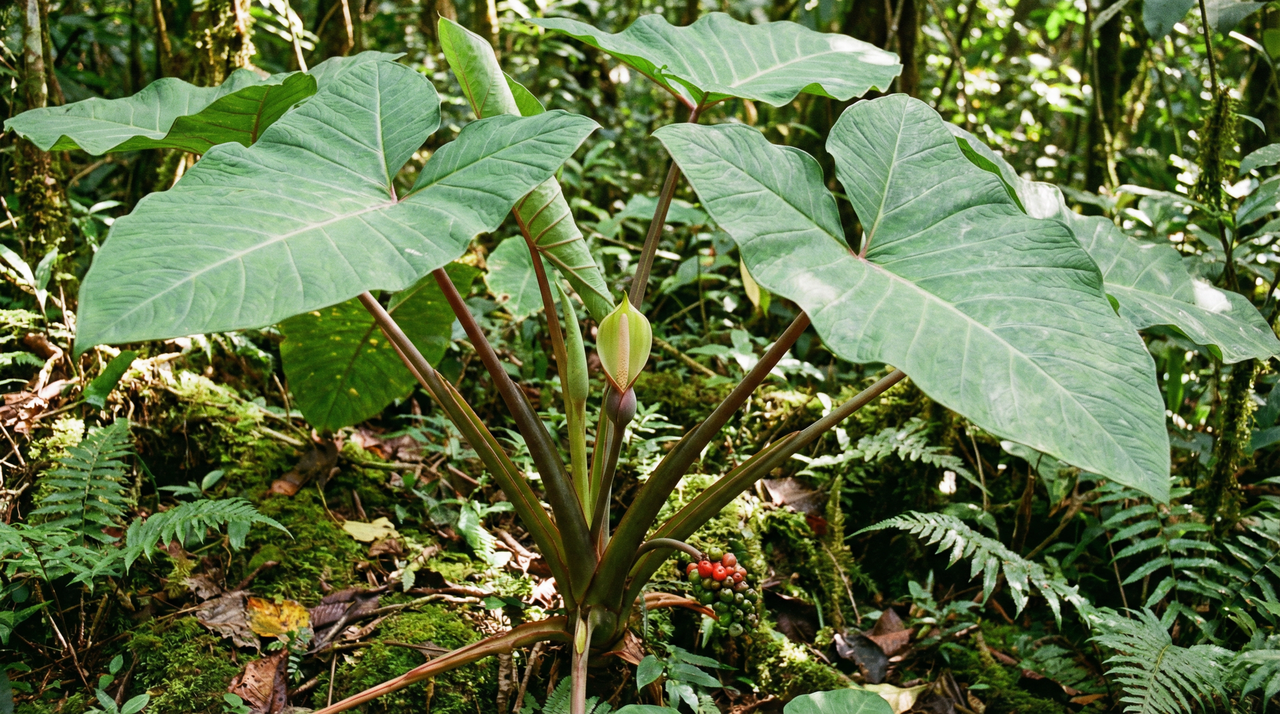
If you've ever stood next to a mature clump and felt genuinely small, you understand why the name stuck. Xanthosoma sagittifolium grows from a thickened central corm, pushing up arching petioles that can reach one to two meters tall and carrying sagittate (arrow-shaped) leaves anywhere from 30 to 100 cm long.[6][7] The whole plant typically reaches 1.5 to 2.5 meters in height with a spread of 0.6 to 1.5 meters. After years of designing tropical food forests, I've learned to use those petioles as a living label: the purple or reddish-brown mottling on the stems lets me quickly tell volunteer Xanthosoma apart from taro (Colocasia esculenta) in a crowded guild, where the leaf shapes can look deceptively similar at a glance.
That distinction matters more than it sounds. Xanthosoma attaches its petioles at the notch of the arrowhead (hastate attachment), while Colocasia has a peltate leaf where the stem connects closer to the center of the blade.[7] Once you see it, you can't unsee it. The inflorescence is a creamy-white, boat-shaped spathe 8 to 15 cm long wrapped around a spadix bearing unisexual flowers; the resulting fruit, a cluster of bright red-orange berries, is rarely encountered in cultivation.[8][9] For contrast, Giant Taro (Alocasia macrorrhizos) occupies the upper end of the aroid size spectrum entirely, sometimes reaching 4.6 meters with leaves over a meter long.[10][11] Both are dramatic, but they're solving different design problems.
Traditional and Cultural Uses Through History
Phytolith and starch grain evidence places the domestication of Xanthosoma sagittifolium in Mesoamerica and northern South America around 3000 to 2000 BCE.[12][13] Indigenous peoples boiled, roasted, and incorporated both the corms and young leaves into stews and tamales, always after cooking to break down the calcium oxalate crystals that make raw consumption a punishing experience. The plant was also woven into medicine and ritual long before any European arrived to document it.[14]
The first European accounts come from the 16th century: Gonzalo Fernández de Oviedo y Valdés described it in 1535 under the names "yautia" and "malanga," terms still in use today.[15] Portuguese traders carried it to West Africa via the Atlantic slave trade in the 16th and 17th centuries, where it became known as "new cocoyam" and embedded itself in cuisines across the continent.[16][17] Spanish colonizers simultaneously spread it through the Caribbean, where it found its way into callaloo and fufu. On the other side of the world, Giant Taro was independently domesticated in New Guinea or Island Southeast Asia around the same period, filling a nearly identical nutritional role and accumulating its own deep cultural significance around fertility, abundance, and ancestral ritual.[18][19] Two aroid lineages, two hemispheres, remarkably parallel human stories.
Fun Facts About Elephant Ear
Xanthosoma sagittifolium belongs to the Araceae family and differs from its close relative taro not just in leaf shape but in corm texture: tannia corms are less watery, which changes how they behave in the kitchen.[20] Under good tropical conditions, a plant can go from corm piece to two-meter specimen in six to nine months.[21] The rapid growth during the wet season still surprises me each year, even knowing it's coming. A few centimeters of new leaf a day is not unusual at the height of summer, and watching the whole clump swell is one of the more satisfying spectacles in a food forest.
The ornamental Giant Taro shares one trait every grower should know: all plant parts in both species contain calcium oxalate raphides.[22] I've processed both for clients' edible landscapes, and the extra boiling step is non-negotiable. The difference in mouthfeel between properly cooked tannia and an undercooked leaf is a lesson you only need to learn once. Preparation is covered in depth later in this profile, but consider this your first and friendliest warning.
Elephant Ear Varieties and How to Source Them
If you've ever wondered why "elephant ear" seems to describe a dozen completely different plants at the nursery, the answer is in the genetics. Xanthosoma sagittifolium alone carries remarkable morphological variation across its cultivars and landraces, with differences in leaf shape, petiole color, corm size, and yield significant enough that two plants sharing the same common name can look and perform very differently in the garden.[23][24] That diversity is a feature, not a bug, and understanding it is what separates purposeful planting from guesswork.
Notable Varieties and Cultivars of Xanthosoma sagittifolium
The most practical way to navigate Xanthosoma cultivar selection is by corm color and intended use. Cultivars fall into groups distinguished by white, yellow, or purple corm flesh, and breeders have long separated them by primary purpose: corm-producers like 'Criollo' and 'Mamey' versus leaf-producers like 'Blanco' and 'Morado.'[23] If you're growing primarily for the kitchen, that distinction matters more than foliage drama. Colombia alone has over 20 named varieties documented in germplasm collections, with breeding efforts now focused on improved yield, disease resistance, and reduced acridity in hybrids.[23][24] For permaculture designers working in humid subtropical climates, that genetic breadth is exactly the kind of resilience pool worth paying attention to.
Mickey Mouse Taro (Xanthosoma atrovirens) sits at the opposite end of the selection spectrum. There's minimal documented cultivar diversity here; most visible differences between plants come down to growing conditions rather than genetics.[25][26] Compact forms occasionally get marketed informally as "pocket plants" for indoor use, but that's branding, not botany.
The alocasia side of the family is where ornamental selection really gets going. Alocasia macrorrhizos has a respectable roster of named cultivars, including 'Variegata' with its cream and white patterned leaves, 'Green Dragon' with deeply lobed foliage, and 'Upright Elephant Ear,' all developed primarily for indoor and landscape use.[27][28] I've grown 'Variegata' in containers and the foliage stops people cold, the kind of dramatic statement that compact hostas or caladiums simply can't match. That said, availability varies widely by region, and in Florida I won't plant giant taro in the ground at all given its documented invasive potential. Beauty in the garden should never come at the expense of local ecosystems, and that's a line I won't cross for any cultivar.
Sourcing Elephant Ear Plants and Corms
For quality Xanthosoma sagittifolium corms in the US, specialty tropical nurseries and Caribbean or Latin American food markets are your most reliable options. Big-box stores carry generic elephant ear stock, but named cultivars and edible-grade corms with documented provenance are almost exclusively a specialty-nursery find. When I'm sourcing corms for clients, I handle every one before purchase. Any softness, any discoloration at the basal plate, and I put it back. I learned that lesson the hard way after introducing a corm with early rot into a newly planted bed, and one bad actor can compromise neighboring plantings before you see any symptoms above ground.
Prices for common Xanthosoma corms have been fairly accessible, though specialty alocasia cultivars like Alocasia frydek, Alocasia regal shield, and Alocasia polly command noticeably higher prices, often reflecting tissue-culture production and collector demand. The Alocasia plant market in particular has swung dramatically in recent years. If you want to source less common landraces or explore germplasm for breeding purposes, USDA's GRIN database is a legitimate starting point, though importing plant material internationally requires USDA APHIS permits and phytosanitary compliance that can catch first-time buyers off guard. For most home growers, a reputable domestic tropical specialist will cover everything you actually need.
Propagating and Planting Elephant Ear (Xanthosoma sagittifolium)
If you've grown this plant for any length of time, you already know that most people never bother with seeds. That's not laziness; it's practicality. The vegetative path, working from corms, cormels, suckers, or cut tuber pieces, is faster, more reliable, and gives you plants that are genetically identical to the parent.[29][30] I've divided healthy corms in early spring for several seasons running in Central Florida, and the results are consistent. Once that practice clicks, seed propagation feels like a detour most home growers don't need to take.
Propagation Methods: Seeds vs. Vegetative Division
The seeds themselves are genuinely fascinating from a botanical standpoint. Each small ellipsoid to ovoid seed (1.5 to 3 mm long) sits embedded in clusters of two to six inside a red-orange berry, and the species exhibits polyembryony, meaning a single seed can carry multiple embryos.[31][32] The seeds also carry a hard brownish coat that imposes physical dormancy, so scarification is needed before you'll see any germination.[33] Botanically interesting? Absolutely. Practical for gardeners? Not really.
The problem is viability. These are recalcitrant seeds, meaning they're exquisitely sensitive to desiccation.[34] Moisture content below 30 to 40% and they decline fast.[35] I tried storing a small batch in moist vermiculite one year, keeping conditions as close to ideal as I could manage, and watched germination drop from around 90% when fresh to under 30% after four months. The research backs that up: even under optimal humidity (80 to 90%) and temperature (15 to 20°C), viability rarely exceeds three to six months.[36][37] If you do want to experiment with seeds, sow them fresh immediately after harvest; germination happens in two to four weeks at 25 to 32°C with high humidity.[7] Giant Taro (Alocasia macrorrhizos) presents its own seed challenges, typically requiring scarification or gibberellic acid treatment just to get germination above 20%.[38] In practice, most of us just divide healthy corms in spring and move on.
Soil, Site Selection, and Planting Technique
Elephant ear evolved in the humid, shaded understories of Central and South American rainforests, and that origin shapes every site-selection decision you'll make.[39] It wants fertile, moisture-retentive but well-drained loam or clay-loam soil with organic matter at 3 to 5% or higher, and it really struggles in compacted ground or anywhere water sits for extended periods.[17] Aim for a soil pH between 5.5 and 7.0, with 6.0 to 6.5 being the sweet spot for nutrient uptake.[40] In Florida's sandy soils, I've seen new leaf yellowing that screams chlorosis caused by low pH. A basic soil test followed by a targeted sulfur amendment corrected it within weeks; it's one of those moments where a $15 test saves you months of frustration.
For light, partial shade or bright indirect light (50 to 70% shade) suits this plant best.[41] Before planting, work in generous amendments: 10 to 20 tons per hectare equivalent of compost or well-rotted manure if you're scaling up, or simply a rich layer of finished compost worked into the top 30 to 45 cm for home gardens.[17] Then mulch immediately with 5 to 10 cm of straw or leaves to hold moisture and suppress weeds. Container growers should use a mix of roughly 50% peat or coco coir, 30% perlite or vermiculite, and 20% compost, with drainage holes that actually drain.[42]
Germination Timeline and Spacing Requirements
Vegetative propagation from corm pieces reaches harvest maturity in 8 to 12 months under good tropical conditions.[29][30] Seed-grown plants, on the rare occasions someone attempts it, take 12 to 18 months to reach that same point. For comparison, Giant Taro grown from seed commonly needs two to four years before a significant corm harvest; corm division gets you there in one to two years.[43] I grow both genera in my food forest, and this difference genuinely shapes how I plan new guild installations. Xanthosoma fills that mid-term productive slot; Alocasia is a longer commitment.
Practical Tips for Successful Establishment
Mature plants reach 3 to 6 feet tall with a 3 to 5 foot spread, and leaves can hit 18 to 24 inches long.[6] Standard spacing is 60 to 90 cm between plants and 1 to 1.5 meters between rows.[44] I give my clumps the full 90 cm in richer soil to let the canopy breathe, though I ran a test bed at 60 cm spacing and found it improved airflow in some respects while also raising leaf-spot incidence. That trade-off is worth knowing before you crowd them for space efficiency.
Plant corm setts 10 to 15 cm deep with the bud oriented upward into soil that's been tilled to at least 30 to 45 cm depth.[45][46] That depth and orientation combination consistently delivers faster, more uniform emergence than shallower sets in my experience. The upright clumping habit needs no staking, but in exposed or windy sites the large leaves can take a beating, so shelter matters. Remove older yellowing leaves periodically for airflow and canopy management. If you notice soft, mushy roots with any wilting or chlorosis above ground, that's a drainage or compaction problem, not a nutrient deficiency.[46] Raised beds have saved me from this headache in heavy clay patches more than once. Giant Taro, being considerably larger at 6 to 15 feet tall, needs wider spacing of 3 to 5 feet between plants and 4 to 6 feet between rows to reach its potential.[47]
Elephant Ear Care Guide: Growing Xanthosoma sagittifolium
Every care decision you make for elephant ear comes back to one mental image: a humid tropical understory where light filters through a canopy, the soil stays consistently moist, and the air is thick with warmth. Get that image right and the rest follows naturally. Get it wrong and the plant tells you immediately, in very legible leaf symptoms.
Sunlight and Light Requirements
Xanthosoma sagittifolium performs best with 50-70% shade, tolerating about 2-4 hours of direct sun per day, ideally in the morning.[11][30] In my Central Florida garden, the leaf margins start going brown exactly when afternoon sun hits them past about 10 a.m. in midsummer. I've learned to position these plants where a banana or a young citrus takes the heat off by noon. Too little light brings its own problems: chlorosis, stretched leggy stems, and leaves that never reach their potential size.[48] For indoor growing, a north- or east-facing window with bright, filtered light is the right match.[6] Think of how calatheas and staghorn ferns look in that same spot; elephant ear wants the same quality of light, just at a bigger scale.
Water Needs and Humidity
This plant evolved in tropical forests receiving 1,500-2,500 mm of rainfall annually at 70-90% humidity, so consistently moist soil is non-negotiable.[49] In practice, that means 1-2 inches of water per week during the growing season, checking the top inch or two of soil every few days and watering when it starts to dry.[50] I lift my containers to gauge moisture rather than poking around and disturbing roots. A thick mulch layer cuts watering chores considerably in Florida's rainy season, moderating both moisture loss and soil temperature.
Water quality matters more than most growers expect. Optimal irrigation pH sits between 5.5 and 7.0, and the species has low salt tolerance, preferring soft water under 150 ppm CaCO₃; rainwater is genuinely the best option if you can collect it.[51][52] Overwatering shows as yellowing leaves, mushy stems, and wilting even when the soil is wet; underwatering shows as drooping, brown crispy margins, and soil pulling away from pot sides.[53][54] Young plants need watering every 1-2 days during establishment; established specimens can survive 7-14 days of dry soil before serious wilting sets in, and they recover quickly with prompt rewatering.[55]
Fertility and Feeding
Elephant ear is a genuinely heavy feeder, and I learned that the hard way. My first season I dumped on a high-nitrogen lawn fertilizer and watched the plants produce enormous, floppy leaves with almost no corm development underneath. Lesson absorbed. What these plants actually need is a balanced NPK program timed to their growth stage: a balanced 10-10-10 or 15-15-15 at planting, nitrogen-forward side-dressing in the first three to four months to push leaf growth, then a shift toward phosphorus and potassium as the corms bulk up.[56][57] Soil pH between 5.5 and 7.0 in fertile, well-drained soil is the baseline.[58] A soil test before you start saves a lot of guesswork and lets you target the right nutrient levels rather than over-applying.[59] In my own beds I side-dress with composted manure every six weeks; heavy organic amendments like compost or manure can increase yields 20-50% while improving soil structure over time.[60]
Each season I scan leaves before I fertilize. Purple petioles or dark leaf undersides signal phosphorus deficiency. Yellowing starting at the tips of older leaves points to nitrogen. Marginal necrosis on older leaves with weak stems suggests potassium is running low. Interveinal chlorosis on older leaves means magnesium, while distorted young leaves with yellowing usually indicate iron or zinc issues.[60][61] Over-fertilizing is its own problem: tip burn, brown margins, and stunted growth are the visible signs, and excess nitrogen in particular drives foliage at the expense of corm production.[62]
Heat and Frost Tolerance
The sweet spot for growth is 70-90°F with humidity in the 70-90% range; things slow noticeably below 68°F and the plant can suffer serious damage below 50°F.[63][7] I've noticed that when humidity drops below 60%, my plants wilt even at 88°F, which is a good reminder that heat tolerance is really a heat-humidity package rather than a temperature number on its own. Prolonged heat above 32°C (about 90°F) reduces tuber size and delays corm bulking.[64] When midsummer heat spikes, a 30-50% shade cloth, 5-10 cm of organic mulch, and early-morning irrigation make a meaningful difference.[65][66]
On the cold end, Xanthosoma sagittifolium is genuinely frost-sensitive, hardy only in USDA zones 9b-11 with protection possible in zone 8.[7][6] Extended exposure below 50°F causes leaf browning, necrosis, and eventual collapse.[67] Young plants are especially vulnerable. Options include heavy mulching, frost blankets, or digging tubers and storing them indoors in peat, vermiculite, or sand at 50-60°F.[68][69]
Pruning, Maintenance, and Seasonal Rhythm
Routine pruning is simple: remove dead, yellowing, or damaged leaves at the base with clean shears, never taking more than a third of the foliage at once to avoid stressing the plant.[70] Good air circulation from regular cleanup genuinely reduces disease pressure. Sucker management matters more than most gardeners realize; remove excess suckers 4-8 weeks after emergence, keeping just the dominant central bud for maximum corm yield or 3-4 vigorous suckers if leaves are your primary goal.[71] Stake tall plants in exposed sites where wind can lever them over. Indoors, keep relative humidity around 60-70% with pebble trays or misting rather than relying on routine sprays or pesticides; IPM, solid drainage, and good sanitation are the real disease prevention.[6]
Overwintering and Storage
As days shorten and temperatures drop, elephant ear eases into dormancy with yellowing leaves and gradual dieback. That's the signal to scale back, not panic. Reduce watering to just enough to keep soil barely moist, stop fertilizing entirely, and prepare for storage.[72][11] Store lifted tubers in peat, vermiculite, or sand at 50-60°F in a dark, dry spot, checking monthly for rot.[67] I store mine at 55°F after losing an early batch to a 45°F garage; that 10-degree difference was enough to turn perfectly good tubers to mush by February. The monthly check is not optional. I use the same peat-and-vermiculite mix I use for cannas and dahlias, and I check each tuber the same day every month so nothing slips past me.
Harvesting Elephant Ear (Xanthosoma sagittifolium)
Patience is the main skill required here. From corm pieces planted in late winter, you're looking at 8 to 12 months before a worthwhile harvest,[29][73] and in Central Florida that window typically runs 10 to 12 months, landing right in late fall to early winter.[74] I've come to genuinely appreciate that timing. By November the lush abundance of summer has done its work, and the plant starts to tell you it's ready.
When to Harvest Elephant Ear: Timelines and Maturity Cues
The clearest signal is leaf senescence: yellowing, wilting, gradual die-back from the outer leaves inward. The corms themselves should feel heavy and firm, with skin that has turned thick, rough, and papery, ranging from brown to reddish-brown. Size-wise you're looking for corms in the 5 to 15 cm diameter range, often weighing somewhere between half a kilogram and two kilograms under good conditions.[75][76] Don't wait too long once you see those signs; oversized corms go fibrous and the texture suffers.[77] Flowering around the three to six month mark signals that the plant has shifted into serious corm-bulking mode,[78] which is why the leaves suddenly look enormous at that stage. That's the plant investing energy underground. Let it.
If you're growing alongside taro, you'll notice that Xanthosoma's corms hold their firmness a bit longer after leaf die-back, which gives you slightly more flexibility on timing. Still, I've learned not to push that grace period through a wet Florida fall.
Leaf harvest is a separate, ongoing opportunity. Once blades reach about 60 cm long, typically around months six through eight, they're ready to cut for the kitchen, and you can come back every two to three weeks after that.[79] I cut the outer, largest leaves first for stir-fries and soups, always leaving the center leaves intact to keep fueling corm development below.
How to Harvest Elephant Ear Corms and Leaves
For corms, dig when the soil is moist but not waterlogged, using a garden fork inserted well away from the crown to avoid piercing the corm. Work carefully; any skin damage or bruising is an invitation for soft rot, especially in humid conditions.[76][73] After lifting, the curing step is non-negotiable. I lost an early batch to rot because I skipped it, and I've never made that mistake again. Set the corms in a warm, dry, well-ventilated spot for several days to let the skin harden and any small wounds seal over. Properly cured corms store reliably for weeks to months; I've kept mine in the garage for six to eight weeks with no trouble.[79]
For leaves, cut the blade at the petiole junction and leave the base attached to the plant. The rule I follow without exception is never removing more than one-third of the total foliage in a single harvest.[80][79] Strip too much and you're robbing the plant of the photosynthetic capacity it needs to keep sizing up those corms below ground.
Elephant Ear Preparation and Uses
Every part of this plant has a use. That's genuinely exciting in a food forest context, but there's one thing you need to understand before you do anything with elephant ear in the kitchen: nothing goes in your mouth raw. Not the corm, not the leaves, not a stray bite while you're peeling. The calcium oxalate raphides in Xanthosoma sagittifolium cause burning, swelling, excessive salivation, and in serious cases digestive distress or airway irritation.[81][21][82] That burning sensation is memorable, and not in a good way. I've seen it happen to first-time foragers who assumed that "edible" meant "edible as-is." It doesn't, with this plant.
Culinary Uses of Elephant Ear: Safe Preparation of Corm and Leaves
The good news is that the fix is straightforward: heat and water. Boil the peeled corm for 30 to 60 minutes and change the water at least once midway through. That single step, changing the water, is the one I emphasize most when I'm teaching clients how to prep tannia for the first time. Boiling and discarding the water can reduce oxalate content by up to 90%, while roasting or baking alone won't cut it.[83][84] Leaves need 20 to 30 minutes of boiling with a water change as well; adding a pinch of salt, a squeeze of lime, or even wood ash to the pot helps accelerate oxalate breakdown.[85]
Once properly cooked, the corm earns its place at the table. The texture lands somewhere between a fluffy potato and taro: creamy, starchy, mildly earthy with a faint nuttiness.[86] You can mash it, fry it into chips, or boil and serve it alongside anything you'd pair with a potato. Per 100g cooked, you're getting roughly 118 kcal, 27.4g of carbohydrates, 591mg of potassium, and a solid contribution of vitamin C, B6, magnesium, and folate.[87] The leaves do something different nutritionally. They taste mild and slightly bitter, like spinach,[86] but they pack considerably more vitamins and minerals than the corm: around 4.4g protein per 100g, up to 50mg vitamin C, good iron, calcium, and high vitamin A.[88] When I'm designing edible landscapes for clients who want maximum nutritional density from a single plant, the leaf protein alone makes a strong case for keeping a clump in the understory.
Culturally, these two edible parts show up in some of the most beloved dishes in the Caribbean and West Africa. Young leaves are central to callaloo stew, simmered with coconut milk, okra, and crab or salted meat. In West Africa, pounded corm becomes fufu, or is incorporated into egusi soup alongside the leaves.[89] The corm can also be wet-milled into a fine white starch flour that works beautifully as a gluten-free thickener.[90]
One thing I always tell new growers: know your plant before you harvest. Xanthosoma sagittifolium shares a lot of visual real estate with Colocasia esculenta (taro) and Alocasia macrorrhizos (giant taro). I've seen clients mistake young taro for elephant ear at the nursery. Both are safe once thoroughly cooked, but Alocasia leaves tend to carry higher toxin loads and sometimes require fermentation rather than simple boiling.[91] Checking the leaf vein pattern has saved me from harvesting the wrong plant more than once.
Traditional Medicinal Preparations from Elephant Ear Leaves
The same leaves that go into callaloo have a long history in traditional medicine. Leaf poultices applied externally and decoctions of 10 to 20 grams of dried leaves simmered in a liter of water are both well-documented practices across Latin America and the Caribbean.[92][93] The same careful cooking that makes the plant edible is what makes internal medicinal use safe; the ethnobotanical tradition and the food-safety science point in the same direction. One caution worth naming directly: if you take medication to lower blood sugar, talk to your doctor before using elephant ear medicinally. The evidence for additive hypoglycemic effects is clear enough that I always advise caution with any client managing diabetes.[94]
Non-Food Uses: Fiber and Crafts from Elephant Ear
After you've eaten the corm and used the leaves, the stems and petioles still have something to offer. Across Latin America, the Caribbean, and Pacific island cultures, the fibrous stems of Xanthosoma and related aroids like Alocasia macrorrhizos have been used for rope, basketry, mats, and thatching.[95][96] In a permaculture context, that's a plant genuinely pulling triple duty: food, medicine, and material, all within the same humid, shaded understory niche where it naturally thrives.
Elephant Ear Health Benefits and Medicinal Uses
The health story of Xanthosoma sagittifolium is one of the more compelling in the tropical aroid world, but it comes with a firm asterisk: almost none of it applies to the raw plant. I grow tannia in my Central Florida garden specifically as a food crop, and one of the first things I tell anyone who shows interest is that this plant is simultaneously a nourishing staple and a potential irritant, depending entirely on how you treat it before it reaches your mouth.
Traditional and Modern Medicinal Research
Across Latin America, the Caribbean, parts of Africa, and Southeast Asia, communities have long used elephant ear leaves, corms, and sap to treat wounds, digestive complaints, inflammation, hypertension, respiratory problems, rheumatism, and even as an anti-venom in some Amazonian traditions.[97][98][99] That breadth of traditional use across unconnected cultures is always worth paying attention to, and modern phytochemical work has begun to explain why. The plant contains flavonoids (quercetin, kaempferol), phenolic acids, saponins, alkaloids, tannins, terpenoids, and carotenoids including beta-carotene and lutein, along with phenolic compounds like chlorogenic acid and catechins.[100][101]
Laboratory studies using these extracts show real antioxidant activity via DPPH and FRAP free-radical scavenging assays, measurable anti-inflammatory effects including COX-2 inhibition and reduced paw edema in animal models, and antimicrobial action against both Staphylococcus aureus and Escherichia coli, likely through saponin disruption of bacterial cell membranes.[102][103][104] The hypoglycemic findings are particularly interesting: root and leaf extracts have shown blood-glucose lowering and alpha-glucosidase inhibition in streptozotocin-induced diabetic rat models and in vitro assays.[105][94] Related species like Alocasia macrorrhizos show additional preliminary cytotoxic, analgesic, and hepatoprotective activity in cell lines and animal models.[106] All of this is genuinely promising, but no human clinical trials on Xanthosoma sagittifolium have been conducted.[99][107] I always tell friends: view elephant ear as a nourishing food first, and talk to your doctor before leaning on it therapeutically.
Nutritional Profile of Cooked Corms and Leaves
Once properly cooked, the corm becomes a legitimate starchy staple. Raw values give you the baseline: roughly 112 kcal, 25g carbohydrates (mostly starch), 3.1g fiber, 1.5g protein, and 0.2g fat per 100g.[87] The standout mineral is potassium at 591 mg per 100g raw, which compares favorably to a medium potato (around 620 mg per 150g serving), putting them in the same tier as high-potassium staples despite the corm's smaller typical serving size.[87][108] Phosphorus, calcium, magnesium, and iron round out the mineral profile, with values varying noticeably by soil and cultivar. Water-soluble vitamins (C, B6, folate) are modest and drop 20-50% with boiling, so roasting, which I prefer for flavor anyway, preserves more of what's there.[87][109] Cooking also gelatinizes the starch, genuinely improving digestibility and bioavailability.[110]
The leaves deserve their own mention. Cooked, they offer 2-3g protein per 100g, meaningful fiber, and significantly higher phenolic content (10-25 mg GAE/g dry weight) than the corms, along with flavonoids and carotenoids including beta-carotene and lutein.[111] If you're treating this plant as part of a food forest, the leaves represent a secondary yield worth harvesting carefully rather than composting.
Safety, Toxicity, and Preparation Guidelines
Here's where I get direct, because this matters. Every part of the raw plant contains needle-like calcium oxalate raphides that cause immediate burning and swelling in the mouth and throat, excessive salivation, difficulty swallowing, and gastrointestinal distress.[112][113] I learned the hard way that the seedlings look utterly harmless, so I now label every young plant in my garden. For dogs and cats, the elephant ear plant poses the same risks: oral irritation, drooling, vomiting, pawing at the mouth, and in severe cases potential airway swelling, though fatalities are genuinely rare.[114][115] If you have cats or dogs with garden access, keep that in mind regardless of whether you're growing this as an ornamental or a food plant.
The good news is that thorough cooking resolves most of the risk. Boiling for 30-45 minutes, roasting, or pressure cooking breaks down 70-90% of the oxalate crystals, rendering both corms and leaves safe for regular consumption.[116][117] Leaves and petioles run higher in oxalates (0.5-2% dry weight) than corms (0.1-0.5%), so they need the full treatment. This is where Xanthosoma actually has an advantage over Giant Taro (Alocasia macrorrhizos): cooking reduces oxalate load more completely in tannia, while Giant Taro's phytoliths can increase tissue penetration and are harder to fully neutralize.[118][119]
People with kidney disease or a history of calcium oxalate stones should be cautious even with cooked material, since residual oxalates remain.[120] When handling raw plant parts, wear gloves; I skipped them once during a harvest and ended up with contact dermatitis on my forearms that took days to clear.[121] True IgE-mediated allergies are uncommon but possible in individuals with latex-fruit syndrome, and while the plant does contain trace cyanogenic glycosides, the levels are far below cassava and well below any threshold of practical concern.[122] Cooked properly, this is a valued and safe staple eaten across the tropics by millions of people. The raw plant demands respect; the cooked one rewards it.
Elephant Ear Pests and Diseases
The same warm, humid conditions that make elephant ear such a dramatic presence in a subtropical garden also roll out a welcome mat for a surprising array of fungal, bacterial, viral, and insect pressures. In my experience growing Xanthosoma sagittifolium in zone 9B, the question isn't really whether you'll encounter problems but how well your cultural choices set the plant up to handle them. Good drainage and air circulation do more preventive work than any spray I've ever reached for.
Major Diseases of Xanthosoma sagittifolium
Xanthosoma sagittifolium faces a formidable disease complex: Phytophthora blight and root rot, Fusarium wilt, bacterial wilt caused by Ralstonia solanacearum, fungal and bacterial leaf spots, and Dasheen mosaic virus.[123][124][125] Phytophthora is the one I respect most. Under high humidity above 80% with warm temperatures and any standing water near the crown, it can devastate a planting fast, with yield losses potentially reaching 50 to 70%.[126] Florida's afternoon summer storms make this feel less like a warning and more like a seasonal certainty if you've planted in a low spot.
Fusarium wilt attacks the vascular system and kills plants outright; in monoculture stands it runs at 15 to 25% incidence on average, which is a sobering number if you're relying on a bed for food production.[127] Bacterial wilt from Ralstonia solanacearum spreads aggressively in wet, poorly drained soils and can affect up to 30% of plants, sometimes causing total crop failure.[128] Leaf spot diseases from Cercospora, Phyllosticta, and Xanthomonas are less catastrophic on their own but flare when leaves stay wet too long.[129] Dasheen mosaic virus, spread by aphids, degrades both foliage quality and corm development; the only reliable control is starting with virus-free planting material and keeping aphid populations down.[123] I refuse to share divisions from any plant showing mosaic or mottled patterns, and new acquisitions get quarantined before they go anywhere near established clumps.
Environment drives nearly all of this. High humidity, temperatures between 25 and 35°C, and poor drainage create the conditions where fungal and bacterial pathogens thrive.[130] Breeding programs have developed cultivars with improved resistance, including 'Otou' for moderate Fusarium tolerance, 'CRB-A-36' for Phytophthora, and 'Xanthi-1' and 'Santo Domingo' for bacterial wilt, though broad-spectrum resistance remains limited.[131][132] I always start with locally tested varieties or virus-indexed stock because replacing a mature clump is not a small job. Beyond cultivar selection, integrated management combining crop rotation, removal of infected plants, improved drainage, and targeted copper-based fungicides or metalaxyl when needed gives the best results.[133] Giant Taro (Alocasia macrorrhizos) faces its own version of this, with anthracnose, powdery mildew, and root rot common; cultivars like 'Variegata' and 'Black Velvet' show better leaf spot tolerance than 'Polly', which struggles in humid conditions.[134][135]
Common Pests and Their Impact
On the insect side, Xanthosoma sagittifolium contends with leaf beetles, corm-boring weevils, mealybugs, caterpillars (especially Spodoptera litura), and aphids.[136][137] In unmanaged plantings, these pests collectively cause yield reductions of 20 to 60%, with mealybugs, root weevils, and caterpillars posing the highest consistent risk.[138] Some varieties get a little natural breathing room from waxy leaf surfaces and phenolic compounds that make feeding less appealing to insects, which is one more reason cultivar selection matters beyond just disease. Giant Taro shares vulnerability to spider mites, mealybugs, aphids, scale, fungus gnats, and root-knot nematodes, with problems intensifying under overwatering stress or low humidity.[139]
Mealybugs deserve special attention because they tuck into the sheltered undersides of those enormous leaves in a way that makes them genuinely easy to miss until the population is established. I make a habit of checking new growth first, since that's where aphids and mealybugs show up before they spread. For management, I lean hard on cultural practices and biological controls: sanitation, rotation, and interplanting with marigolds as a companion repellent.[138][140] A consistent neem oil spray schedule has kept my ornamental elephant ear stands clean without synthetic chemicals, which fits the permaculture approach nicely. Predatory insects do real work here too, and a diverse polyculture around your elephant ear planting gives them places to live and overwinter.
Elephant Ear in Permaculture Design
Elephant Ear didn't arrive in permaculture design by accident. Xanthosoma sagittifolium evolved in exactly the kind of place permaculture tries to recreate: disturbed tropical lowlands and secondary forests in Central and South America, from sea level up to about 1500 meters, where it thrived in the dappled margins between canopy and clearing.[21][141] That ecological origin shapes everything about how I use it in a food forest: it's a plant built for the understory, built for disturbance, and built for working alongside other species rather than dominating them.
Climate Preferences and Growing Zones
If I had to describe Elephant Ear's climate preference in one phrase, it would be "reliably warm and never dry." Optimal growth and tuber development happen between 75 and 85°F, with days comfortable up to 90°F and nights staying above 60°F.[142] Push below 50°F consistently and the foliage takes real damage; frost is simply not in this plant's vocabulary.[142][143] The heat ceiling matters too. Above 95°F, tuber yields start to suffer,[142][144] which is something I think about during Central Florida summers when temperatures routinely flirt with that threshold.
Humidity matters as much as heat. This plant wants 60 to 90 percent relative humidity and somewhere between 1500 and 2500 mm of annual rainfall spread evenly across the year.[2][17] It fits squarely into Köppen Af and Am climates, with irrigation making a zone Aw planting workable.[145] For USDA zones, 9b through 11 is where it lives as a true landscape perennial.[7][146] Anywhere cooler, it becomes a container plant or a lifted-and-stored tuber, which is a perfectly valid way to use it, though you lose most of its ecosystem contributions in that mode. For growers who want to push the genus into coastal zones, Giant Taro (Alocasia macrorrhizos) has notable salt tolerance and can handle mangrove ecotones and river deltas where most aroids wouldn't last a season.[147]
Ecosystem Functions and Pollination Ecology
Here's the part about Elephant Ear that I find genuinely fascinating and that almost nobody talks about in garden circles: it traps beetles. The inflorescence is a protogynous spadix enclosed in a spathe, and it lures scarab beetles in during the female flowering phase, traps them overnight, then releases them the following morning dusted in pollen to carry to the next plant.[148][149] The mechanism behind the attraction is thermogenesis: the spadix actually heats itself 5 to 10°C above ambient air temperature while releasing odors that mimic rotting organic matter.[150][151] I've put my hand near a blooming spadix on a warm evening and felt the heat radiating off it. It's a small thing, but it's the kind of thing that reminds you these plants are doing far more than just sitting there looking dramatic.
Pollination success peaks at 25 to 30°C with humidity above 70 percent and 12 to 14 hours of daylight, which are essentially the same conditions the plant needs to thrive.[151] Drought stress can cut pollinator visits by up to 70 percent, and in fragmented or monoculture plantings where beetle populations are thin, hand-pollination can boost yield by 40 to 50 percent.[152][153] That's a compelling argument for keeping diverse polycultures around it, since a well-designed food forest guild maintains beetle habitat far better than a row monoculture. Nearby relatives show interesting variation: Tannia (X. mafaffa) produces a faint yeasty scent instead of fetid odors, while Xanthosoma aureum recruits additional beetle families including Staphylinidae and Nitidulidae.[154][155]
Beyond pollination, the plant pulls its weight in several other ways. Those enormous leaves suppress weeds effectively, reduce erosion on slopes, and create the kind of layered microhabitat that draws beneficial insects once the canopy fills in.[156][141] I've started thinking of the leaves as living umbrellas: they intercept rainfall, slow it down, and funnel it toward the root zone rather than letting it sheet off and carry topsoil with it. After harvest, the leaves and stems decompose rapidly, returning nitrogen, potassium, and phosphorus directly back into the soil cycle.[156][157] It also forms mycorrhizal associations that improve phosphorus uptake in low-fertility soils,[158] which is something I've observed directly: patches in my garden with strong fungal networks consistently produce noticeably larger tubers than isolated plants in comparable soil. It doesn't fix nitrogen, but its biomass turnover makes it a genuine dynamic accumulator of potassium and other minerals.[159]
Forest Layer Placement and Guild Design
Elephant Ear belongs in the herbaceous understory layer, and it earns that placement honestly. It thrives under 30 to 50 percent canopy cover,[160][161] which puts it in the same functional niche as ferns or caladiums in a Florida understory, except that it also produces a substantial edible corm. In cultivation it typically reaches 3 to 6 feet, occasionally pushing toward 8 feet in ideal conditions, with its corm and large sagittate leaves creating a dense, ground-covering clump.[162] That compact footprint makes placement straightforward: it fits cleanly beneath the canopy of bananas or plantains without competing for the same light band.
If you want to work higher in the food forest vertical stack, Giant Taro (Alocasia macrorrhizos) can reach 8 to 15 feet, putting it at the shrub or low sub-canopy transition,[163] while Alocasia indica occupies the 6 to 10 foot range between them.[6] That genus range gives a designer real flexibility across layers without abandoning the aroid toolkit.
For guild design, the classic combination is Elephant Ear beneath bananas or plantains, with a legume like pigeon pea at the margins to cover the nitrogen gap that the aroid can't fill itself.[156][73] Cacao works beautifully in the canopy position where the climate allows, since both plants share the same humidity and shade requirements. The Elephant Ear suppresses weeds at ground level, cycles nutrients through its litter, supports beetle pollinators, and produces food. The deer nibble occasionally, but I've never had a planting devastated; the calcium oxalate crystals keep heavy browsing in check without any intervention on my part. It's a plant that does a lot of the work for you, as long as you put it in the right layer to begin with.
The Plant That Made Me Slow Down and Actually Cook
I still remember the first time I peeled a tannia corm in my kitchen, hands wrapped in gloves, genuinely unsure whether I was doing it right. That small moment of doubt taught me more about respecting a plant's chemistry than almost anything I'd read. Elephant ear doesn't let you be lazy or incurious. It asks something of you, and once you give it, it gives back generously, season after season, in ways that a raised bed of tomatoes simply never will.
Sources 163
- Xanthosoma sagittifolium: Nutritional composition and bioactive compounds ↩
- Xanthosoma sagittifolium - Wikipedia ↩
- Tannia (Xanthosoma sagittifolium) - CABI Compendium ↩
- Kew Science - Plants of the World Online ↩
- Species Plantarum (Linnaeus Description of Xanthosoma) ↩
- Xanthosoma sagittifolium - Missouri Botanical Garden ↩
- Xanthosoma sagittifolium - USDA PLANTS Database ↩
- Xanthosoma sagittifolium - Missouri Botanical Garden ↩
- Xanthosoma sagittifolium - Kew Science Plants of the World Online ↩
- Alocasia macrorrhizos ↩
- Alocasia macrorrhizos (Giant Taro) ↩
- Archaeological Evidence of Pre-Columbian Agriculture in the Americas ↩
- Tannia (Xanthosoma sagittifolium) ↩
- Ethnobotany of Xanthosoma in the Neotropics ↩
- Historia General y Natural de las Indias, Islas y Tierra Firme del Mar Océano ↩
- The Introduction of New World Crops to Africa ↩
- Tannia in Caribbean Agriculture ↩
- Starch Analysis of Plant Residues from Lapita Sites ↩
- Taro and Its Symbolism in Oceanic Cultures ↩
- Comparison of Taro (Colocasia) and Tannia (Xanthosoma) Species ↩
- Xanthosoma sagittifolium (Tannia) ↩
- Missouri Botanical Garden Plant Finder: Alocasia macrorrhizos ↩
- Morphological and Agronomic Characterization of Tannia (Xanthosoma sagittifolium) Germplasm ↩
- Varieties and Landraces of Xanthosoma in the Neotropics ↩
- Xanthosoma atrovirens - RHS Gardening ↩
- Xanthosoma atrovirens - Missouri Botanical Garden Plant Finder ↩
- Alocasia macrorrhizos ↩
- Alocasia macrorrhizos 'Variegata' ↩
- Tannia (Xanthosoma sagittifolium) Production Guidelines ↩
- Propagation and Cultivation of Xanthosoma ↩
- Embryology and Polyembryony in Araceae ↩
- Seed Development in Xanthosoma Species ↩
- Seed Germination in Araceae ↩
- Recalcitrant Seeds: Xanthosoma - Kew Royal Botanic Gardens ↩
- Seed Storage Behavior in Araceae Family ↩
- Seed Storage of Recalcitrant Species ↩
- FAO Guidelines on Seed Storage for Tropical Crops ↩
- Germination and Dormancy in Araceae ↩
- Plants of the World Online: Xanthosoma sagittifolium ↩
- Tannia (Xanthosoma sagittifolium) Production Guidelines ↩
- Xanthosoma Cultivation in Tropical Environments ↩
- Growing Elephant Ears in Containers - Gardening Know How ↩
- Royal Horticultural Society: Grow Giant Elephant's-Ear ↩
- Cultivation of Tannia (Xanthosoma sagittifolium) ↩
- Tannia Production Guide ↩
- Growing Xanthosoma - University of Florida IFAS Extension ↩
- Growing Elephant Ears (Alocasia, Colocasia, etc.) ↩
- Troubleshooting Yellow Leaves in Elephant Ears - The Spruce ↩
- Tannia (Xanthosoma sagittifolium) - CABI Compendium ↩
- Missouri Botanical Garden Plant Finder ↩
- Xanthosoma sagittifolium Cultivation Guide - University of Florida IFAS ↩
- Soil and Water Management for Taro and Tannia - FAO ↩
- Overwatering Symptoms in Elephant Ear Plants - EDIS ↩
- Xanthosoma sagittifolium Care Guide - Royal Horticultural Society ↩
- Drought Stress Effects on Taro and Tannia - FAO ↩
- Production of Taro and Tannia - FAO ↩
- Fertilizer Recommendations for Root Crops - CTAHR ↩
- Taro and Tannia Production Guidelines - FAO ↩
- Nutrient Management for Root and Tuber Crops - IITA ↩
- Fertilizer Recommendations for Taro and Eddo - CTAHR ↩
- Diagnosing Plant Nutrient Deficiencies - FAO ↩
- Over-Fertilization Effects on Elephant Ear Plants - RHS ↩
- Tannia (Xanthosoma sagittifolium) - University of Florida IFAS ↩
- Heat Stress Management in Aroid Crops - CIAT ↩
- Tropical Root and Tuber Crops: Production and Utilization - FAO ↩
- Mulching for a Healthy Landscape - University of Florida IFAS ↩
- Overwintering Tropical Plants - University of Florida IFAS ↩
- Elephant's Ear (Xanthosoma) - RHS Gardening ↩
- Tannia (Xanthosoma sagittifolium) Production in Florida - University of Florida IFAS ↩
- Tannia (Xanthosoma sagittifolium) Production Guidelines - FAO ↩
- University of Florida IFAS Extension - Growing Taro and Xanthosoma (Yautia) ↩
- Overwintering Elephant Ears Indoors - University of Minnesota Extension ↩
- Taro Production in Florida ↩
- Taro and Tannia Production in Florida ↩
- Tannia (Xanthosoma sagittifolium) Cultivation Guide ↩
- Taro and Tannia Production Guidelines ↩
- Cocoyam Production Guide ↩
- Agronomic Practices for Xanthosoma sagittifolium ↩
- Missouri Botanical Garden Plant Finder ↩
- Kew Gardens - Cocoyam Production Guide ↩
- Xanthosoma ↩
- Toxic Plants: Arrowhead Elephant's Ear (Xanthosoma spp.) ↩
- Tannia (Xanthosoma spp.) - Food Safety and Preparation ↩
- Cooking Methods to Reduce Antinutrients in Taro and Yautia ↩
- Processing of Tannia Tubers - FAO ↩
- Xanthosoma sagittifolium (Tannia) ↩
- USDA FoodData Central: Tannia, cooked, without salt ↩
- Nutritional Composition of Xanthosoma sagittifolium Leaves ↩
- Ethnobotanical Uses of Xanthosoma sagittifolium in the Caribbean and Africa ↩
- FAO - Tropical Root Crops: A Vital Source of Starch ↩
- Alocasia macrorrhizos Toxicity ↩
- Xanthosoma sagittifolium - Useful Tropical Plants ↩
- Xanthosoma - Ethnobotanical Uses ↩
- Xanthosoma sagittifolium (L.) Schott: Phytochemistry, Pharmacology, Toxicology and Traditional Uses ↩
- Traditional Uses of Xanthosoma in Latin America ↩
- Ethnobotany of the Genus Alocasia in Southeast Asia and the Pacific ↩
- Ethnobotany and Medicinal Uses of Xanthosoma sagittifolium ↩
- Pharmacological potential of Xanthosoma sagittifolium in traditional medicine ↩
- Ethnobotanical Survey of Medicinal Plants in the Caribbean ↩
- Bioactive Compounds and Pharmacological Activities of Xanthosoma sagittifolium ↩
- Mineral, vitamin, and phenolic compound content of Xanthosoma sagittifolium leaves from different traditional agro-systems in southern Mexico ↩
- Antioxidant and antimicrobial activities of Xanthosoma sagittifolium ↩
- Anti-Inflammatory Effects of Xanthosoma sagittifolium Leaf Extract via COX-2 Inhibition ↩
- Antimicrobial and Antidiabetic Screening of Alocasia macrorrhizos ↩
- Hypoglycemic Activity of Xanthosoma sagittifolium Leaf Extract ↩
- Cytotoxic and Hepatoprotective Effects of Alocasia macrorrhizos ↩
- Alocasia macrorrhizos (L.) G. Don.: An Updated Review on Traditional Uses, Phytochemistry, and Pharmacological Activities ↩
- Tannia, raw ↩
- Effect of Cooking Methods on Nutrient Retention in Xanthosoma ↩
- Nutritional Composition and Processing Effects on New Cocoyam (Xanthosoma sagittifolium) ↩
- Phytochemical Screening and Antioxidant Activity of Xanthosoma sagittifolium Leaves ↩
- Calcium Oxalate Poisoning in Plants ↩
- Toxic Plants: Araceae Family - Poison Control ↩
- Elephant Ears - ASPCA ↩
- Elephant Ear Plant Toxicity - Merck Veterinary Manual ↩
- Calcium Oxalate Crystals in Edible Aroids ↩
- New Cocoyam (Xanthosoma sagittifolium) Processing and Toxicity ↩
- Toxicity of Alocasia macrorrhizos: Calcium Oxalate Raphides ↩
- Processing and Edibility of Taro (Alocasia spp.) ↩
- Oxalate Content of Foods and Its Effect on Humans ↩
- Irritant Contact Dermatitis from Xanthosoma sagittifolium ↩
- Allergic Reactions to Aroid Plants: Calcium Oxalate and Latex ↩
- Diseases of Taro and Tannia ↩
- Diseases of Cocoyam (Xanthosoma sagittifolium) ↩
- Xanthosoma sagittifolium Production Guide ↩
- Phytophthora Blight of Taro and Cocoyam ↩
- Fusarium Wilt Management in Aroids ↩
- Bacterial Diseases of Root Crops ↩
- Management of Leaf Spot Diseases in Xanthosoma ↩
- Xanthosoma Cultivation Guide ↩
- Breeding for Resistance to Phytophthora in Xanthosoma ↩
- Evaluation of Tannia Cultivars for Disease Resistance ↩
- Management of Cocoyam Diseases ↩
- Diseases of Alocasia and Colocasia in the Pacific ↩
- Diseases of Alocasia: Identification and Management ↩
- Insect Pests and Diseases of Taro and Tannia ↩
- Pest Management in Taro and Other Aroids ↩
- Pest Management in Cocoyam (Xanthosoma sagittifolium) ↩
- Houseplant Pests: Alocasia macrorrhizos ↩
- Integrated Pest Management for Elephant Ears ↩
- Tropical Root Crops: Xanthosoma ↩
- Missouri Botanical Garden Plant Finder ↩
- USDA PLANTS Database ↩
- Growing Giant Taro (Alocasia macrorrhizos) ↩
- Climate Preferences of Araceae Family - FAO Plant Production and Protection ↩
- North Carolina Extension Gardener Plant Toolbox - Xanthosoma sagittifolium ↩
- Alocasia macrorrhizos: Distribution and Habitat ↩
- Entomophily in Tropical Aroids: The Case of Xanthosoma ↩
- Pollination Biology of Araceae ↩
- Thermogenesis in the Araceae ↩
- Pollination Biology of Xanthosoma sagittifolium ↩
- Ecological Factors Affecting Pollination in Tropical Aroids ↩
- Xanthosoma Cultivation and Reproductive Biology ↩
- Floral Biology of Xanthosoma sagittifolium ↩
- Insect Pollinators in Araceae: Flies and Beetles ↩
- Xanthosoma and Colocasia: Ethnobotany, Botany, Crop Management, and Agroecology of Two Important Tuber Crops in the Tropics ↩
- Nutrient Cycling with Leaf Litter in Tropical Systems ↩
- Mycorrhizae in Tropical Araceae ↩
- Permaculture Plants: Xanthosoma sagittifolium ↩
- Permaculture Plants: Tannia - Permaculture Research Institute ↩
- Xanthosoma sagittifolium - CABI Compendium ↩
- Xanthosoma sagittifolium - Missouri Botanical Garden ↩
- Alocasia macrorrhizos ↩